Govt. Engineering College Ajmer
A SEMINAR PRESENTATION
ON
MESSAGE QUEUE TELEMETRY PROTOCOL
Guided by:-
Mr. Vinesh Jain
(Assistant Professor)
Submitted to:-
Mr. Prakash Meena
Presented By:-
Piyush Rathi
13EEACS060
The Internet of Things (IoT) is the network of physical objects or "things" embedded
with electronics, software, sensors, and network connectivity, which enables these
objects to collect and exchange data. IoT allows objects to be sensed and controlled
remotely across existing network infrastructure, creating opportunities for more
direct integration between the physical world and computer-based systems, and
resulting in improved efficiency, accuracy and economic benefit.
Things," in the IoT sense, can refer to a wide variety of devices such as heart
monitoring implants, biochip transponders on farm animals, electric clams in coastal
waters, automobiles with built-in sensors, DNA analysis devices for
environmental/food/pathogen monitoring or field operation devices that assist fire-
fighters in search and rescue operations. These devices collect useful data with the
help of various existing technologies and then autonomously flow the data between
other devices.
INTERNET OF THINGS (IoT)
Data collected by the device is called telemetry. This is the eyes-and-ears data that IoT
devices provide to applications. Telemetry is read-only data about the environment, usually
collected through sensors.
Each source of telemetry results in a channel. Telemetry data might be preserved as a
stateful variable on the device or in the cloud.
Although each device might send only a single data point every minute, when you multiply
that data by a large number of devices, you quickly need to apply big data strategies and
patterns.
WHAT IS TELEMETRY ?
MQTT-MESSAGE QUEUE TELEMETRY PROTOCOL
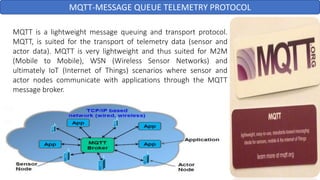
MQTT is a lightweight message queuing and transport protocol.
MQTT, is suited for the transport of telemetry data (sensor and
actor data). MQTT is very lightweight and thus suited for M2M
(Mobile to Mobile), WSN (Wireless Sensor Networks) and
ultimately IoT (Internet of Things) scenarios where sensor and
actor nodes communicate with applications through the MQTT
message broker.
• The publish/subscribe message pattern to provide one-to-many message distribution and
decoupling of applications
• A messaging transport that is agnostic to the content of the payload
• The use of TCP/IP to provide basic network connectivity
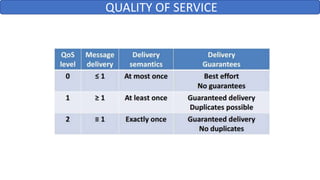
• Three Qualities of Service for message delivery:
a. At most once
b. At least once
c. Exactly once
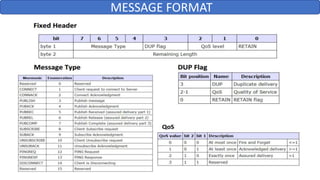
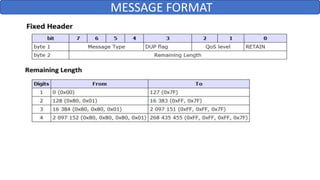
• A small transport overhead (the fixed-length header is just 2 bytes), and protocol
exchanges minimised to reduce network traffic
• A mechanism to notify interested parties to an abnormal disconnection of a client using
the Last Will and Testament feature
FEATURES OF MQTT ?
WHY NOT HTTP ?
Established
Great for request and response.
No good solution for push and subscribe.
Do not provide any quality of service.
Text-based requires more bandwidth.
Acting on requires a web server.
Require more battery.
• connectivity is intermittent
• bandwidth is at a premium
• an enterprise application needs to interact with one or more
phone apps
• phone or tablet apps need to send data reliably without
requiring code retry logic
• low latency
• assured messaging and efficient distribution
WHEN SHOULD WE USE MQTT?
QUALITY OF SERVICE
MESSAGE FORMAT
MESSAGE FORMAT
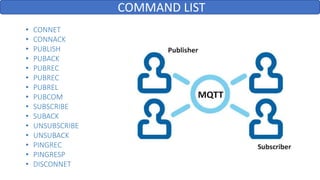
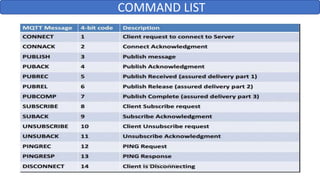
COMMAND LIST
• CONNET
• CONNACK
• PUBLISH
• PUBACK
• PUBREC
• PUBREC
• PUBREL
• PUBCOM
• SUBSCRIBE
• SUBACK
• UNSUBSCRIBE
• UNSUBACK
• PINGREC
• PINGRESP
• DISCONNET
COMMAND LIST
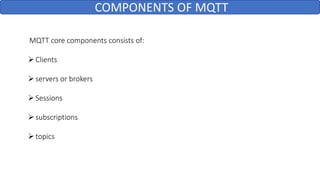
MQTT core components consists of:
Clients
servers or brokers
Sessions
subscriptions
topics
COMPONENTS OF MQTT
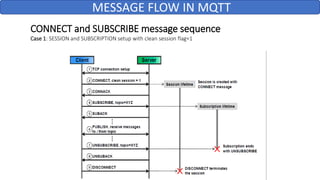
MESSAGE FLOW IN MQTT
CONNECT and SUBSCRIBE message sequence
Case 1: SESSION and SUBSCRIPTION setup with clean session flag=1
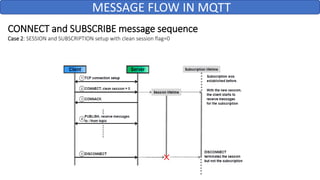
MESSAGE FLOW IN MQTT
CONNECT and SUBSCRIBE message sequence
Case 2: SESSION and SUBSCRIPTION setup with clean session flag=0
MESSAGE FLOW IN MQTT
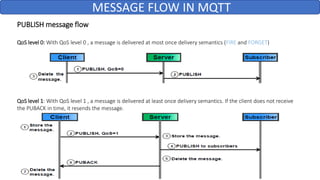
PUBLISH message flow
QoS level 0: With QoS level 0 , a message is delivered at most once delivery semantics (FIRE and FORGET)
QoS level 1: With QoS level 1 , a message is delivered at least once delivery semantics. If the client does not receive
the PUBACK in time, it resends the message.
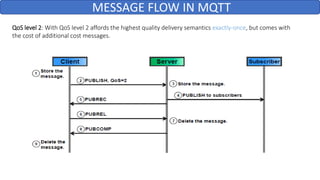
QoS level 2: With QoS level 2 affords the highest quality delivery semantics exactly-once, but comes with
the cost of additional cost messages.
MESSAGE FLOW IN MQTT
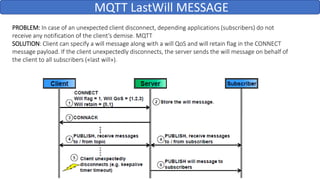
MQTT LastWill MESSAGE
PROBLEM: In case of an unexpected client disconnect, depending applications (subscribers) do not
receive any notification of the client’s demise. MQTT
SOLUTION: Client can specify a will message along with a will QoS and will retain flag in the CONNECT
message payload. If the client unexpectedly disconnects, the server sends the will message on behalf of
the client to all subscribers («last will»).
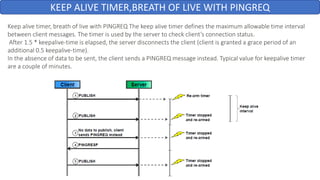
Keep alive timer, breath of live with PINGREQ The keep alive timer defines the maximum allowable time interval
between client messages. The timer is used by the server to check client’s connection status.
After 1.5 * keepalive-time is elapsed, the server disconnects the client (client is granted a grace period of an
additional 0.5 keepalive-time).
In the absence of data to be sent, the client sends a PINGREQ message instead. Typical value for keepalive timer
are a couple of minutes.
KEEP ALIVE TIMER,BREATH OF LIVE WITH PINGREQ
TOPIC WILDCADS
PROBLEM: Subscribers are often interested in a great number of topics. Individually subscribing to each named
topic is time- and resource-consuming. MQTT
SOLUTION: Topics can be hierarchically organized through wildcards with path-type topic strings and the wildcard
characters ‘+’ and ‘#’. Subscribers can subscribe for an entire sub-tree of topics thus receiving messages published
to any of the sub-tree’s nodes.
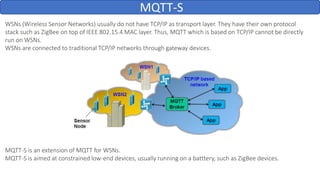
MQTT-S
WSNs (Wireless Sensor Networks) usually do not have TCP/IP as transport layer. They have their own protocol
stack such as ZigBee on top of IEEE 802.15.4 MAC layer. Thus, MQTT which is based on TCP/IP cannot be directly
run on WSNs.
WSNs are connected to traditional TCP/IP networks through gateway devices.
MQTT-S is an extension of MQTT for WSNs.
MQTT-S is aimed at constrained low-end devices, usually running on a batttery, such as ZigBee devices.
REAL WORLD USERS
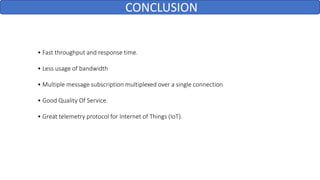
CONCLUSION
• Fast throughput and response time.
• Less usage of bandwidth
• Multiple message subscription multiplexed over a single connection
• Good Quality Of Service.
• Great telemetry protocol for Internet of Things (IoT).
REFERENCES
 http://www.hivemq.com/blog/mqtt-essentials-part2-publish-subscribe
 http://a4academics.com/be-seminar-topics/17-be-it-cse-computer-science-seminar-topics/543-message
-queue-telemetry-transport-mqtt
 https://www.slideshare.net/PeterREgli/mq-telemetry-transport
 https://en.wikipedia.org/wiki/Internet_of_things
 https://www.mqtt.com/solutions
 https://www.ijareeie.com/upload/2014/march/67_Machine.pdf
YOUTUBE VIDEO
 https://www.youtube.com/watch?v=EIxdz-2rhLs
 https://www.youtube.com/watch?v=exMm-fmU5ck&spfreload=10
 https://www.youtube.com/watch?v=EH3GOzKvdZw
Mqtt(Message queue telemetry protocol) presentation

Mqtt(Message queue telemetry protocol) presentation

  • 1.
    Govt. Engineering CollegeAjmer A SEMINAR PRESENTATION ON MESSAGE QUEUE TELEMETRY PROTOCOL Guided by:- Mr. Vinesh Jain (Assistant Professor) Submitted to:- Mr. Prakash Meena Presented By:- Piyush Rathi 13EEACS060
  • 2.
    The Internet ofThings (IoT) is the network of physical objects or "things" embedded with electronics, software, sensors, and network connectivity, which enables these objects to collect and exchange data. IoT allows objects to be sensed and controlled remotely across existing network infrastructure, creating opportunities for more direct integration between the physical world and computer-based systems, and resulting in improved efficiency, accuracy and economic benefit. Things," in the IoT sense, can refer to a wide variety of devices such as heart monitoring implants, biochip transponders on farm animals, electric clams in coastal waters, automobiles with built-in sensors, DNA analysis devices for environmental/food/pathogen monitoring or field operation devices that assist fire- fighters in search and rescue operations. These devices collect useful data with the help of various existing technologies and then autonomously flow the data between other devices. INTERNET OF THINGS (IoT)
  • 3.
    Data collected bythe device is called telemetry. This is the eyes-and-ears data that IoT devices provide to applications. Telemetry is read-only data about the environment, usually collected through sensors. Each source of telemetry results in a channel. Telemetry data might be preserved as a stateful variable on the device or in the cloud. Although each device might send only a single data point every minute, when you multiply that data by a large number of devices, you quickly need to apply big data strategies and patterns. WHAT IS TELEMETRY ?
  • 4.
    MQTT-MESSAGE QUEUE TELEMETRYPROTOCOL MQTT is a lightweight message queuing and transport protocol. MQTT, is suited for the transport of telemetry data (sensor and actor data). MQTT is very lightweight and thus suited for M2M (Mobile to Mobile), WSN (Wireless Sensor Networks) and ultimately IoT (Internet of Things) scenarios where sensor and actor nodes communicate with applications through the MQTT message broker.
  • 5.
    • The publish/subscribemessage pattern to provide one-to-many message distribution and decoupling of applications • A messaging transport that is agnostic to the content of the payload • The use of TCP/IP to provide basic network connectivity • Three Qualities of Service for message delivery: a. At most once b. At least once c. Exactly once • A small transport overhead (the fixed-length header is just 2 bytes), and protocol exchanges minimised to reduce network traffic • A mechanism to notify interested parties to an abnormal disconnection of a client using the Last Will and Testament feature FEATURES OF MQTT ?
  • 6.
    WHY NOT HTTP? Established Great for request and response. No good solution for push and subscribe. Do not provide any quality of service. Text-based requires more bandwidth. Acting on requires a web server. Require more battery.
  • 7.
    • connectivity isintermittent • bandwidth is at a premium • an enterprise application needs to interact with one or more phone apps • phone or tablet apps need to send data reliably without requiring code retry logic • low latency • assured messaging and efficient distribution WHEN SHOULD WE USE MQTT?
  • 8.
  • 9.
  • 10.
  • 11.
    COMMAND LIST • CONNET •CONNACK • PUBLISH • PUBACK • PUBREC • PUBREC • PUBREL • PUBCOM • SUBSCRIBE • SUBACK • UNSUBSCRIBE • UNSUBACK • PINGREC • PINGRESP • DISCONNET
  • 12.
  • 13.
    MQTT core componentsconsists of: Clients servers or brokers Sessions subscriptions topics COMPONENTS OF MQTT
  • 14.
    MESSAGE FLOW INMQTT CONNECT and SUBSCRIBE message sequence Case 1: SESSION and SUBSCRIPTION setup with clean session flag=1
  • 15.
    MESSAGE FLOW INMQTT CONNECT and SUBSCRIBE message sequence Case 2: SESSION and SUBSCRIPTION setup with clean session flag=0
  • 16.
    MESSAGE FLOW INMQTT PUBLISH message flow QoS level 0: With QoS level 0 , a message is delivered at most once delivery semantics (FIRE and FORGET) QoS level 1: With QoS level 1 , a message is delivered at least once delivery semantics. If the client does not receive the PUBACK in time, it resends the message.
  • 17.
    QoS level 2:With QoS level 2 affords the highest quality delivery semantics exactly-once, but comes with the cost of additional cost messages. MESSAGE FLOW IN MQTT
  • 18.
    MQTT LastWill MESSAGE PROBLEM:In case of an unexpected client disconnect, depending applications (subscribers) do not receive any notification of the client’s demise. MQTT SOLUTION: Client can specify a will message along with a will QoS and will retain flag in the CONNECT message payload. If the client unexpectedly disconnects, the server sends the will message on behalf of the client to all subscribers («last will»).
  • 19.
    Keep alive timer,breath of live with PINGREQ The keep alive timer defines the maximum allowable time interval between client messages. The timer is used by the server to check client’s connection status. After 1.5 * keepalive-time is elapsed, the server disconnects the client (client is granted a grace period of an additional 0.5 keepalive-time). In the absence of data to be sent, the client sends a PINGREQ message instead. Typical value for keepalive timer are a couple of minutes. KEEP ALIVE TIMER,BREATH OF LIVE WITH PINGREQ
  • 20.
    TOPIC WILDCADS PROBLEM: Subscribersare often interested in a great number of topics. Individually subscribing to each named topic is time- and resource-consuming. MQTT SOLUTION: Topics can be hierarchically organized through wildcards with path-type topic strings and the wildcard characters ‘+’ and ‘#’. Subscribers can subscribe for an entire sub-tree of topics thus receiving messages published to any of the sub-tree’s nodes.
  • 21.
    MQTT-S WSNs (Wireless SensorNetworks) usually do not have TCP/IP as transport layer. They have their own protocol stack such as ZigBee on top of IEEE 802.15.4 MAC layer. Thus, MQTT which is based on TCP/IP cannot be directly run on WSNs. WSNs are connected to traditional TCP/IP networks through gateway devices. MQTT-S is an extension of MQTT for WSNs. MQTT-S is aimed at constrained low-end devices, usually running on a batttery, such as ZigBee devices.
  • 22.
  • 23.
    CONCLUSION • Fast throughputand response time. • Less usage of bandwidth • Multiple message subscription multiplexed over a single connection • Good Quality Of Service. • Great telemetry protocol for Internet of Things (IoT).
  • 24.
    REFERENCES  http://www.hivemq.com/blog/mqtt-essentials-part2-publish-subscribe  http://a4academics.com/be-seminar-topics/17-be-it-cse-computer-science-seminar-topics/543-message -queue-telemetry-transport-mqtt https://www.slideshare.net/PeterREgli/mq-telemetry-transport  https://en.wikipedia.org/wiki/Internet_of_things  https://www.mqtt.com/solutions  https://www.ijareeie.com/upload/2014/march/67_Machine.pdf YOUTUBE VIDEO  https://www.youtube.com/watch?v=EIxdz-2rhLs  https://www.youtube.com/watch?v=exMm-fmU5ck&spfreload=10  https://www.youtube.com/watch?v=EH3GOzKvdZw