






Laura Legg
RHIT, CCS, CDIP,
AHIMA approved ICD-
10 CM/PCS Trainer
HRG Executive
Director of Revenue
Integrity and
Compliance
Presented by:
Disclaimer
This PowerPoint presentation is an education tool to provide basic
information for coding. The information is the sole view of the
author and was put together based on experience, research and
expertise in the coding profession. It is not intended to be an
exhaustive review and should not be considered a substitution for
Coding Guidelines. The presenter does not accept any
responsibility or liability with regard to errors, omissions
misinterpretations or misuse by the audience.
Objectives
answer the question why is sepsis so challenging for hospitals
examine sepsis coding challenges
identify areas to focus for clinical documentation opportunities
review a multidisciplinary approach to protect revenue for DRGs 870-872
learn how to take advantage of pre-audits for reputation and reimbursement
hrgpros.com
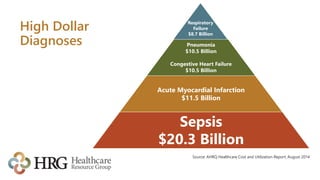
High Dollar
Diagnoses
Source: AHRQ Healthcare Cost and Utilization Report, August 2014
Pneumonia
$10.5 Billion
Congestive Heart Failure
$10.5 Billion
Acute Myocardial Infarction
$11.5 Billion
Sepsis
$20.3 Billion
Respiratory
Failure
$8.7 Billion
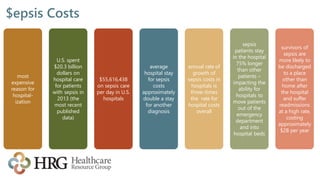
$epsis Costs
most
expensive
reason for
hospital-
ization
U.S. spent
$20.3 billion
dollars on
hospital care
for patients
with sepsis in
2013 (the
most recent
published
data)
$55,616,438
on sepsis care
per day in U.S.
hospitals
average
hospital stay
for sepsis
costs
approximately
double a stay
for another
diagnosis
annual rate of
growth of
sepsis costs in
hospitals is
three-times
the rate for
hospital costs
overall
sepsis
patients stay
in the hospital
75% longer
than other
patients –
impacting the
ability for
hospitals to
move patients
out of the
emergency
department
and into
hospital beds
survivors of
sepsis are
more likely to
be discharged
to a place
other than
home after
the hospital
and suffer
readmissions
at a high rate,
costing
approximately
$2B per year
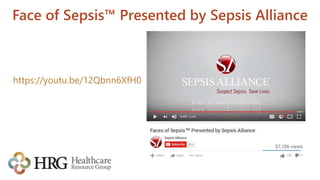
Face of Sepsis™ Presented by Sepsis Alliance
https://youtu.be/12Qbnn6XfH0
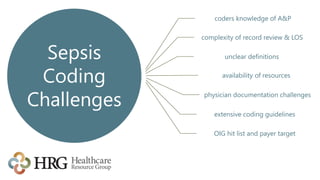
Sepsis
Coding
Challenges
coders knowledge of A&P
complexity of record review & LOS
unclear definitions
availability of resources
physician documentation challenges
extensive coding guidelines
OIG hit list and payer target
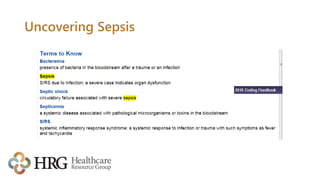
Uncovering Sepsis
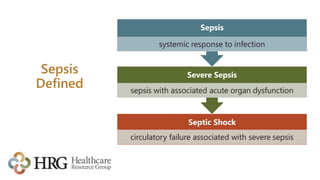
Sepsis
Defined
Septic Shock
circulatory failure associated with severe sepsis
Severe Sepsis
sepsis with associated acute organ dysfunction
Sepsis
systemic response to infection
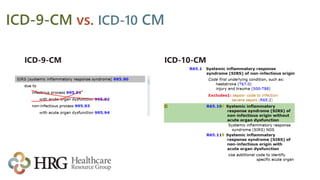
ICD-9-CM vs. ICD-10 CM
ICD-9-CM ICD-10-CM
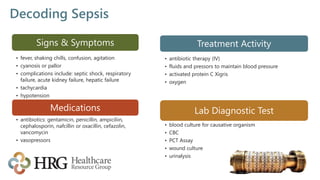
Decoding Sepsis
Signs & Symptoms
• fever, shaking chills, confusion, agitation
• cyanosis or pallor
• complications include: septic shock, respiratory
failure, acute kidney failure, hepatic failure
• tachycardia
• hypotension
Treatment Activity
• antibiotic therapy (IV)
• fluids and pressors to maintain blood pressure
• activated protein C Xigris
• oxygen
Medications
• antibiotics: gentamicin, penicillin, ampiciliin,
cephalosporin, nafcillin or oxacillin, cefazolin,
vancomycin
• vasopressors
Lab Diagnostic Test
• blood culture for causative organism
• CBC
• PCT Assay
• wound culture
• urinalysis
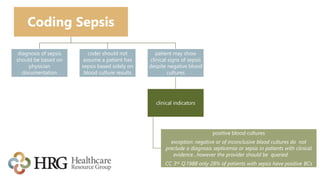
Coding Sepsis
diagnosis of sepsis
should be based on
physician
documentation
coder should not
assume a patient has
sepsis based solely on
blood culture results
patient may show
clinical signs of sepsis
despite negative blood
cultures
clinical indicators
positive blood cultures
exception: negative or of inconclusive blood cultures do not
preclude a diagnosis septicemia or sepsis in patients with clinical
evidence…however the provider should be queried
CC 3rd Q1988 only 28% of patients with sepsis have positive BCs
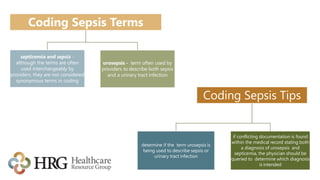
Coding Sepsis Terms
septicemia and sepsis -
although the terms are often
used interchangeably by
providers, they are not considered
synonymous terms in coding
urosepsis - term often used by
providers to describe both sepsis
and a urinary tract infection
Coding Sepsis Tips
determine if the term urosepsis is
being used to describe sepsis or
urinary tract infection
if conflicting documentation is found
within the medical record stating both
a diagnosis of urosepsis and
septicemia, the physician should be
queried to determine which diagnosis
is intended
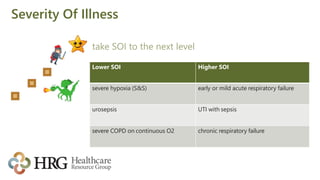
Severity Of Illness
Lower SOI Higher SOI
severe hypoxia (S&S) early or mild acute respiratory failure
urosepsis UTI with sepsis
severe COPD on continuous O2 chronic respiratory failure
take SOI to the next level
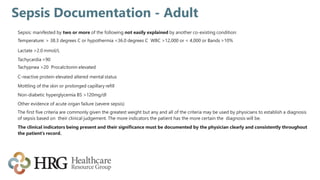
Sepsis Documentation - Adult
Sepsis: manifested by two or more of the following not easily explained by another co-existing condition:
Temperature: > 38.3 degrees C or hypothermia <36.0 degrees C WBC >12,000 or < 4,000 or Bands >10%
Lactate >2.0 mmol/L
Tachycardia >90
Tachypnea >20 Procalcitonin elevated
C-reactive protein elevated altered mental status
Mottling of the skin or prolonged capillary refill
Non-diabetic hyperglycemia BS >120mg/dl
Other evidence of acute organ failure (severe sepsis)
The first five criteria are commonly given the greatest weight but any and all of the criteria may be used by physicians to establish a diagnosis
of sepsis based on their clinical judgement. The more indicators the patient has the more certain the diagnosis will be.
The clinical indicators being present and their significance must be documented by the physician clearly and consistently throughout
the patient’s record.
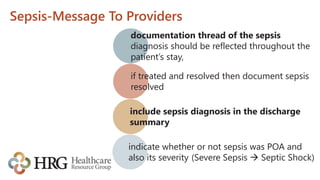
Sepsis-Message To Providers
documentation thread of the sepsis
diagnosis should be reflected throughout the
patient’s stay,
if treated and resolved then document sepsis
resolved
include sepsis diagnosis in the discharge
summary
indicate whether or not sepsis was POA and
also its severity (Severe Sepsis  Septic Shock)
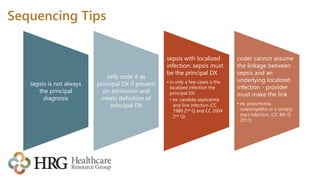
Sequencing Tips
sepsis is not always
the principal
diagnosis
only code it as
principal DX if present
on admission and
meets definition of
principal DX
sepsis with localized
infection: sepsis must
be the principal DX
• in only a few cases is the
localized infection the
principal DX
• ex: candida septicemia
and line infection (CC
1989 2nd Q and CC 2004
2nd Q)
coder cannot assume
the linkage between
sepsis and an
underlying localized
infection - provider
must make the link
• ex: pneumonia,
osteomyelitis or a urinary
tract infection. (CC 4th Q
2011)
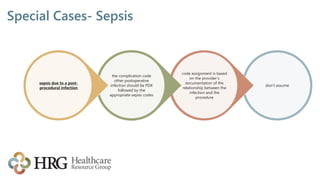
don’t assume
code assignment is based
on the provider’s
documentation of the
relationship between the
infection and the
procedure
the complication code
other postoperative
infection should be PDX
followed by the
appropriate sepsis codes
sepsis due to a post-
procedural infection
Special Cases- Sepsis
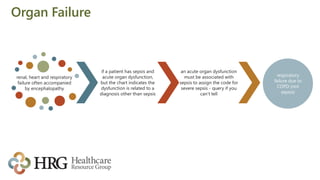
Organ Failure
renal, heart and respiratory
failure often accompanied
by encephalopathy
if a patient has sepsis and
acute organ dysfunction,
but the chart indicates the
dysfunction is related to a
diagnosis other than sepsis
an acute organ dysfunction
must be associated with
sepsis to assign the code for
severe sepsis - query if you
can’t tell
respiratory
failure due to
COPD (not
sepsis)
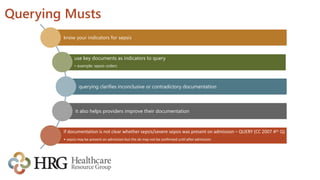
Querying Musts
know your indicators for sepsis
use key documents as indicators to query
• example: sepsis orders
querying clarifies inconclusive or contradictory documentation
it also helps providers improve their documentation
if documentation is not clear whether sepsis/severe sepsis was present on admission – QUERY (CC 2007 4th Q)
• sepsis may be present on admission but the dx may not be confirmed until after admission
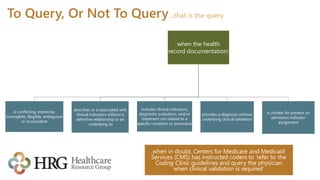
when the health
record documentation:
is conflicting, imprecise,
incomplete, illegible, ambiguous
or inconsistent
describes or is associated with
clinical indicators without a
definitive relationship to an
underlying dx
includes clinical indicators,
diagnostic evaluation, and/or
treatment not related to a
specific condition or procedure
provides a diagnosis without
underlying clinical validation
is unclear for present on
admission indicator
assignment
To Query, Or Not To Query…that is the query
when in doubt, Centers for Medicare and Medicaid
Services (CMS) has instructed coders to ‘refer to the
Coding Clinic guidelines and query the physician
when clinical validation is required’
Facility Best Practice For Querying
accredited
coders/CDI staff
linkage to physician advisors
& quality staff
3d’s
define,
document,
defend
(using approved definitions)
support quality measures
and generate ACCURATE
coding to support risk-
adjusted outcomes data
29
Define – Document - Defend
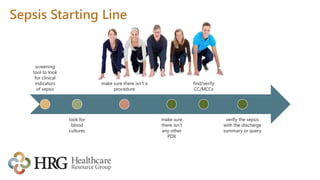
Sepsis Starting Line
screening
tool to look
for clinical
indicators
of sepsis
look for
blood
cultures
make sure there isn’t a
procedure
make sure
there isn’t
any other
PDX
find/verify
CC/MCCs
verify the sepsis
with the discharge
summary or query
Case Study #1
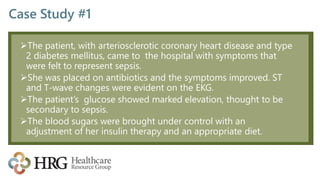
The patient, with arteriosclerotic coronary heart disease and type
2 diabetes mellitus, came to the hospital with symptoms that
were felt to represent sepsis.
She was placed on antibiotics and the symptoms improved. ST
and T-wave changes were evident on the EKG.
The patient’s glucose showed marked elevation, thought to be
secondary to sepsis.
The blood sugars were brought under control with an
adjustment of her insulin therapy and an appropriate diet.
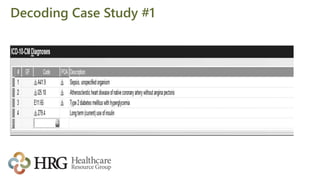
Decoding Case Study #1
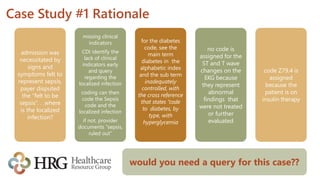
Case Study #1 Rationale
admission was
necessitated by
signs and
symptoms felt to
represent sepsis,
payer disputed
the “felt to be
sepsis”. . .where
is the localized
infection?
missing clinical
indicators
CDI identify the
lack of clinical
indicators early
and query
regarding the
localized infection
coding can then
code the Sepsis
code and the
localized infection
if not, provider
documents “sepsis,
ruled out”
for the diabetes
code, see the
main term
diabetes in the
alphabetic index
and the sub term
inadequately
controlled, with
the cross reference
that states “code
to diabetes, by
type, with
hyperglycemia
no code is
assigned for the
ST and T wave
changes on the
EKG because
they represent
abnormal
findings that
were not treated
or further
evaluated
code Z79.4 is
assigned
because the
patient is on
insulin therapy
would you need a query for this case??
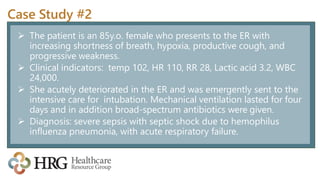
Case Study #2
 The patient is an 85y.o. female who presents to the ER with
increasing shortness of breath, hypoxia, productive cough, and
progressive weakness.
 Clinical indicators: temp 102, HR 110, RR 28, Lactic acid 3.2, WBC
24,000.
 She acutely deteriorated in the ER and was emergently sent to the
intensive care for intubation. Mechanical ventilation lasted for four
days and in addition broad-spectrum antibiotics were given.
 Diagnosis: severe sepsis with septic shock due to hemophilus
influenza pneumonia, with acute respiratory failure.
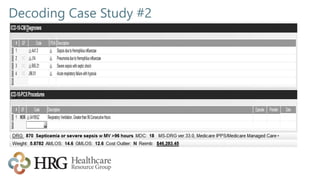
Decoding Case Study #2
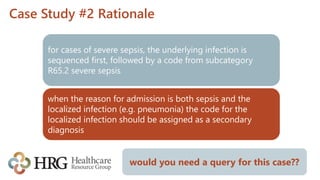
Case Study #2 Rationale
for cases of severe sepsis, the underlying infection is
sequenced first, followed by a code from subcategory
R65.2 severe sepsis
when the reason for admission is both sepsis and the
localized infection (e.g. pneumonia) the code for the
localized infection should be assigned as a secondary
diagnosis
would you need a query for this case??
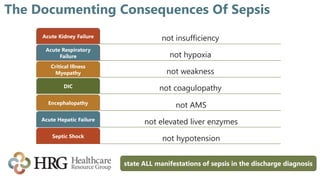
The Documenting Consequences Of Sepsis
not insufficiencyAcute Kidney Failure
not hypoxia
Acute Respiratory
Failure
not weakness
Critical Illness
Myopathy
not coagulopathyDIC
not AMSEncephalopathy
not elevated liver enzymesAcute Hepatic Failure
not hypotensionSeptic Shock
state ALL manifestations of sepsis in the discharge diagnosis
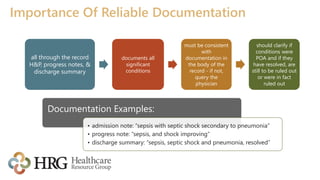
Importance Of Reliable Documentation
all through the record
H&P, progress notes, &
discharge summary
documents all
significant
conditions
must be consistent
with
documentation in
the body of the
record - if not,
query the
physician
should clarify if
conditions were
POA and if they
have resolved, are
still to be ruled out
or were in fact
ruled out
Documentation Examples:
• admission note: “sepsis with septic shock secondary to pneumonia”
• progress note: “sepsis, and shock improving”
• discharge summary: “sepsis, septic shock and pneumonia, resolved”
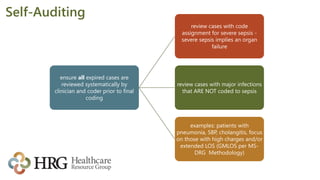
Self-Auditing
ensure all expired cases are
reviewed systematically by
clinician and coder prior to final
coding
review cases with code
assignment for severe sepsis -
severe sepsis implies an organ
failure
review cases with major infections
that ARE NOT coded to sepsis
examples: patients with
pneumonia, SBP, cholangitis, focus
on those with high charges and/or
extended LOS (GMLOS per MS-
DRG Methodology)
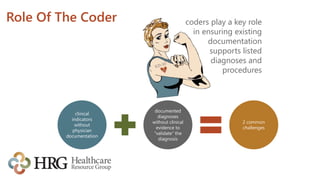
Role Of The Coder
clinical
indicators
without
physician
documentation
documented
diagnoses
without clinical
evidence to
“validate” the
diagnosis
2 common
challenges
coders play a key role
in ensuring existing
documentation
supports listed
diagnoses and
procedures
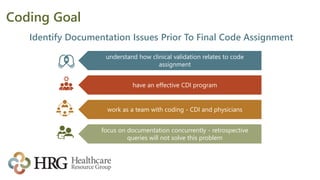
Identify Documentation Issues Prior To Final Code Assignment
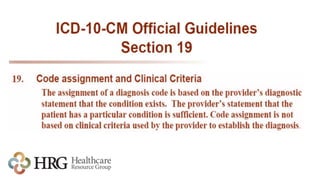
understand how clinical validation relates to code
assignment
have an effective CDI program
work as a team with coding - CDI and physicians
focus on documentation concurrently - retrospective
queries will not solve this problem
Coding Goal
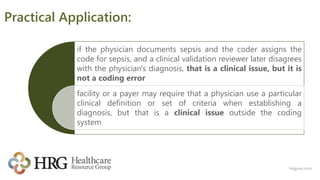
Practical Application:
if the physician documents sepsis and the coder assigns the
code for sepsis, and a clinical validation reviewer later disagrees
with the physician's diagnosis, that is a clinical issue, but it is
not a coding error
facility or a payer may require that a physician use a particular
clinical definition or set of criteria when establishing a
diagnosis, but that is a clinical issue outside the coding
system
hrgpros.com
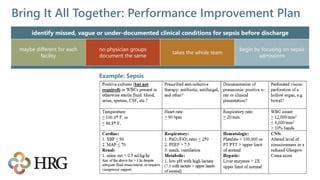
Bring It All Together: Performance Improvement Plan
identify missed, vague or under-documented clinical conditions for sepsis before discharge
maybe different for each
facility
no physician groups
document the same
takes the whole team
begin by focusing on sepsis
admissions
Example: Sepsis
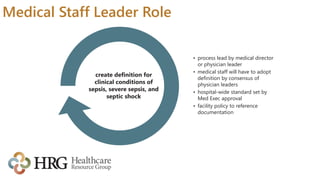
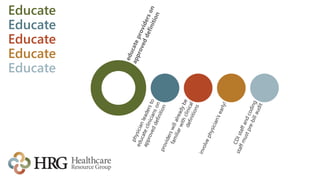
Medical Staff Leader Role
• process lead by medical director
or physician leader
• medical staff will have to adopt
definition by consensus of
physician leaders
• hospital-wide standard set by
Med Exec approval
• facility policy to reference
documentation
create definition for
clinical conditions of
sepsis, severe sepsis, and
septic shock
Educate
Educate
Educate
Educate
Educate
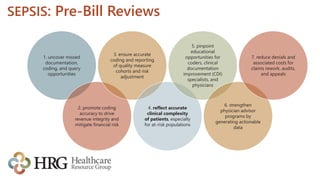
SEPSIS: Pre-Bill Reviews
1. uncover missed
documentation,
coding, and query
opportunities
2. promote coding
accuracy to drive
revenue integrity and
mitigate financial risk
3. ensure accurate
coding and reporting
of quality measure
cohorts and risk
adjustment
4. reflect accurate
clinical complexity
of patients, especially
for at-risk populations
5. pinpoint
educational
opportunities for
coders, clinical
documentation
improvement (CDI)
specialists, and
physicians
6. strengthen
physician advisor
programs by
generating actionable
data
7. reduce denials and
associated costs for
claims rework, audits,
and appeals
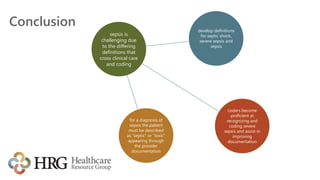
Conclusion
sepsis is
challenging due
to the differing
definitions that
cross clinical care
and coding
develop definitions
for septic shock,
severe sepsis and
sepsis
coders become
proficient at
recognizing and
coding severe
sepsis and assist in
improving
documentation
for a diagnosis of
sepsis the patient
must be described
as “septic” or “toxic”
appearing through
the provider
documentation
YourPartner@hrgpros.com
•questions
•comments
•CEU request (delivery within 7 days)
hrgpros.com
References
hrgpros.com
http://www.ahacent
raloffice.org/about
us/what-is-icd-
10.shtml
https://www.cms.gov/
https://youtu.be/12Qb
nn6XfH0
Sepsis Alliance
Faces of Sepsis™
hrgpros.com
Laura Legg,
RHIT, CCS, CDIP, AHIMA Approved ICD-10
CM/PCS Trainer
HRG Executive Director of
Revenue Integrity & Compliance
Visit us online for more
information on HRG’s
CDI program and
Laura’s upcoming
speaking engagements!
hrgpros.com/CDI
800.695.8171 YourPartner@hrgpros.com @hrgpros

The Sepsis Code: discover the secret to coding it right the first time

  • 1.
    Laura Legg RHIT, CCS,CDIP, AHIMA approved ICD- 10 CM/PCS Trainer HRG Executive Director of Revenue Integrity and Compliance Presented by:
  • 2.
    Disclaimer This PowerPoint presentationis an education tool to provide basic information for coding. The information is the sole view of the author and was put together based on experience, research and expertise in the coding profession. It is not intended to be an exhaustive review and should not be considered a substitution for Coding Guidelines. The presenter does not accept any responsibility or liability with regard to errors, omissions misinterpretations or misuse by the audience.
  • 3.
    Objectives answer the questionwhy is sepsis so challenging for hospitals examine sepsis coding challenges identify areas to focus for clinical documentation opportunities review a multidisciplinary approach to protect revenue for DRGs 870-872 learn how to take advantage of pre-audits for reputation and reimbursement hrgpros.com
  • 4.
    High Dollar Diagnoses Source: AHRQHealthcare Cost and Utilization Report, August 2014 Pneumonia $10.5 Billion Congestive Heart Failure $10.5 Billion Acute Myocardial Infarction $11.5 Billion Sepsis $20.3 Billion Respiratory Failure $8.7 Billion
  • 5.
    $epsis Costs most expensive reason for hospital- ization U.S.spent $20.3 billion dollars on hospital care for patients with sepsis in 2013 (the most recent published data) $55,616,438 on sepsis care per day in U.S. hospitals average hospital stay for sepsis costs approximately double a stay for another diagnosis annual rate of growth of sepsis costs in hospitals is three-times the rate for hospital costs overall sepsis patients stay in the hospital 75% longer than other patients – impacting the ability for hospitals to move patients out of the emergency department and into hospital beds survivors of sepsis are more likely to be discharged to a place other than home after the hospital and suffer readmissions at a high rate, costing approximately $2B per year
  • 6.
    Face of Sepsis™Presented by Sepsis Alliance https://youtu.be/12Qbnn6XfH0
  • 7.
    Sepsis Coding Challenges coders knowledge ofA&P complexity of record review & LOS unclear definitions availability of resources physician documentation challenges extensive coding guidelines OIG hit list and payer target
  • 8.
  • 9.
    Sepsis Defined Septic Shock circulatory failureassociated with severe sepsis Severe Sepsis sepsis with associated acute organ dysfunction Sepsis systemic response to infection
  • 10.
    ICD-9-CM vs. ICD-10CM ICD-9-CM ICD-10-CM
  • 12.
    Decoding Sepsis Signs &Symptoms • fever, shaking chills, confusion, agitation • cyanosis or pallor • complications include: septic shock, respiratory failure, acute kidney failure, hepatic failure • tachycardia • hypotension Treatment Activity • antibiotic therapy (IV) • fluids and pressors to maintain blood pressure • activated protein C Xigris • oxygen Medications • antibiotics: gentamicin, penicillin, ampiciliin, cephalosporin, nafcillin or oxacillin, cefazolin, vancomycin • vasopressors Lab Diagnostic Test • blood culture for causative organism • CBC • PCT Assay • wound culture • urinalysis
  • 13.
    Coding Sepsis diagnosis ofsepsis should be based on physician documentation coder should not assume a patient has sepsis based solely on blood culture results patient may show clinical signs of sepsis despite negative blood cultures clinical indicators positive blood cultures exception: negative or of inconclusive blood cultures do not preclude a diagnosis septicemia or sepsis in patients with clinical evidence…however the provider should be queried CC 3rd Q1988 only 28% of patients with sepsis have positive BCs
  • 14.
    Coding Sepsis Terms septicemiaand sepsis - although the terms are often used interchangeably by providers, they are not considered synonymous terms in coding urosepsis - term often used by providers to describe both sepsis and a urinary tract infection Coding Sepsis Tips determine if the term urosepsis is being used to describe sepsis or urinary tract infection if conflicting documentation is found within the medical record stating both a diagnosis of urosepsis and septicemia, the physician should be queried to determine which diagnosis is intended
  • 15.
    Severity Of Illness LowerSOI Higher SOI severe hypoxia (S&S) early or mild acute respiratory failure urosepsis UTI with sepsis severe COPD on continuous O2 chronic respiratory failure take SOI to the next level
  • 16.
    Sepsis Documentation -Adult Sepsis: manifested by two or more of the following not easily explained by another co-existing condition: Temperature: > 38.3 degrees C or hypothermia <36.0 degrees C WBC >12,000 or < 4,000 or Bands >10% Lactate >2.0 mmol/L Tachycardia >90 Tachypnea >20 Procalcitonin elevated C-reactive protein elevated altered mental status Mottling of the skin or prolonged capillary refill Non-diabetic hyperglycemia BS >120mg/dl Other evidence of acute organ failure (severe sepsis) The first five criteria are commonly given the greatest weight but any and all of the criteria may be used by physicians to establish a diagnosis of sepsis based on their clinical judgement. The more indicators the patient has the more certain the diagnosis will be. The clinical indicators being present and their significance must be documented by the physician clearly and consistently throughout the patient’s record.
  • 17.
    Sepsis-Message To Providers documentationthread of the sepsis diagnosis should be reflected throughout the patient’s stay, if treated and resolved then document sepsis resolved include sepsis diagnosis in the discharge summary indicate whether or not sepsis was POA and also its severity (Severe Sepsis  Septic Shock)
  • 18.
    Sequencing Tips sepsis isnot always the principal diagnosis only code it as principal DX if present on admission and meets definition of principal DX sepsis with localized infection: sepsis must be the principal DX • in only a few cases is the localized infection the principal DX • ex: candida septicemia and line infection (CC 1989 2nd Q and CC 2004 2nd Q) coder cannot assume the linkage between sepsis and an underlying localized infection - provider must make the link • ex: pneumonia, osteomyelitis or a urinary tract infection. (CC 4th Q 2011)
  • 19.
    don’t assume code assignmentis based on the provider’s documentation of the relationship between the infection and the procedure the complication code other postoperative infection should be PDX followed by the appropriate sepsis codes sepsis due to a post- procedural infection Special Cases- Sepsis
  • 20.
    Organ Failure renal, heartand respiratory failure often accompanied by encephalopathy if a patient has sepsis and acute organ dysfunction, but the chart indicates the dysfunction is related to a diagnosis other than sepsis an acute organ dysfunction must be associated with sepsis to assign the code for severe sepsis - query if you can’t tell respiratory failure due to COPD (not sepsis)
  • 21.
    Querying Musts know yourindicators for sepsis use key documents as indicators to query • example: sepsis orders querying clarifies inconclusive or contradictory documentation it also helps providers improve their documentation if documentation is not clear whether sepsis/severe sepsis was present on admission – QUERY (CC 2007 4th Q) • sepsis may be present on admission but the dx may not be confirmed until after admission
  • 22.
    when the health recorddocumentation: is conflicting, imprecise, incomplete, illegible, ambiguous or inconsistent describes or is associated with clinical indicators without a definitive relationship to an underlying dx includes clinical indicators, diagnostic evaluation, and/or treatment not related to a specific condition or procedure provides a diagnosis without underlying clinical validation is unclear for present on admission indicator assignment To Query, Or Not To Query…that is the query when in doubt, Centers for Medicare and Medicaid Services (CMS) has instructed coders to ‘refer to the Coding Clinic guidelines and query the physician when clinical validation is required’
  • 23.
    Facility Best PracticeFor Querying accredited coders/CDI staff linkage to physician advisors & quality staff 3d’s define, document, defend (using approved definitions) support quality measures and generate ACCURATE coding to support risk- adjusted outcomes data
  • 24.
  • 25.
    Sepsis Starting Line screening toolto look for clinical indicators of sepsis look for blood cultures make sure there isn’t a procedure make sure there isn’t any other PDX find/verify CC/MCCs verify the sepsis with the discharge summary or query
  • 26.
    Case Study #1 Thepatient, with arteriosclerotic coronary heart disease and type 2 diabetes mellitus, came to the hospital with symptoms that were felt to represent sepsis. She was placed on antibiotics and the symptoms improved. ST and T-wave changes were evident on the EKG. The patient’s glucose showed marked elevation, thought to be secondary to sepsis. The blood sugars were brought under control with an adjustment of her insulin therapy and an appropriate diet.
  • 27.
  • 28.
    Case Study #1Rationale admission was necessitated by signs and symptoms felt to represent sepsis, payer disputed the “felt to be sepsis”. . .where is the localized infection? missing clinical indicators CDI identify the lack of clinical indicators early and query regarding the localized infection coding can then code the Sepsis code and the localized infection if not, provider documents “sepsis, ruled out” for the diabetes code, see the main term diabetes in the alphabetic index and the sub term inadequately controlled, with the cross reference that states “code to diabetes, by type, with hyperglycemia no code is assigned for the ST and T wave changes on the EKG because they represent abnormal findings that were not treated or further evaluated code Z79.4 is assigned because the patient is on insulin therapy would you need a query for this case??
  • 29.
    Case Study #2 The patient is an 85y.o. female who presents to the ER with increasing shortness of breath, hypoxia, productive cough, and progressive weakness.  Clinical indicators: temp 102, HR 110, RR 28, Lactic acid 3.2, WBC 24,000.  She acutely deteriorated in the ER and was emergently sent to the intensive care for intubation. Mechanical ventilation lasted for four days and in addition broad-spectrum antibiotics were given.  Diagnosis: severe sepsis with septic shock due to hemophilus influenza pneumonia, with acute respiratory failure.
  • 30.
  • 31.
    Case Study #2Rationale for cases of severe sepsis, the underlying infection is sequenced first, followed by a code from subcategory R65.2 severe sepsis when the reason for admission is both sepsis and the localized infection (e.g. pneumonia) the code for the localized infection should be assigned as a secondary diagnosis would you need a query for this case??
  • 32.
    The Documenting ConsequencesOf Sepsis not insufficiencyAcute Kidney Failure not hypoxia Acute Respiratory Failure not weakness Critical Illness Myopathy not coagulopathyDIC not AMSEncephalopathy not elevated liver enzymesAcute Hepatic Failure not hypotensionSeptic Shock state ALL manifestations of sepsis in the discharge diagnosis
  • 33.
    Importance Of ReliableDocumentation all through the record H&P, progress notes, & discharge summary documents all significant conditions must be consistent with documentation in the body of the record - if not, query the physician should clarify if conditions were POA and if they have resolved, are still to be ruled out or were in fact ruled out Documentation Examples: • admission note: “sepsis with septic shock secondary to pneumonia” • progress note: “sepsis, and shock improving” • discharge summary: “sepsis, septic shock and pneumonia, resolved”
  • 34.
    Self-Auditing ensure all expiredcases are reviewed systematically by clinician and coder prior to final coding review cases with code assignment for severe sepsis - severe sepsis implies an organ failure review cases with major infections that ARE NOT coded to sepsis examples: patients with pneumonia, SBP, cholangitis, focus on those with high charges and/or extended LOS (GMLOS per MS- DRG Methodology)
  • 35.
    Role Of TheCoder clinical indicators without physician documentation documented diagnoses without clinical evidence to “validate” the diagnosis 2 common challenges coders play a key role in ensuring existing documentation supports listed diagnoses and procedures
  • 36.
    Identify Documentation IssuesPrior To Final Code Assignment understand how clinical validation relates to code assignment have an effective CDI program work as a team with coding - CDI and physicians focus on documentation concurrently - retrospective queries will not solve this problem Coding Goal
  • 37.
    Practical Application: if thephysician documents sepsis and the coder assigns the code for sepsis, and a clinical validation reviewer later disagrees with the physician's diagnosis, that is a clinical issue, but it is not a coding error facility or a payer may require that a physician use a particular clinical definition or set of criteria when establishing a diagnosis, but that is a clinical issue outside the coding system hrgpros.com
  • 39.
    Bring It AllTogether: Performance Improvement Plan identify missed, vague or under-documented clinical conditions for sepsis before discharge maybe different for each facility no physician groups document the same takes the whole team begin by focusing on sepsis admissions Example: Sepsis
  • 40.
    Medical Staff LeaderRole • process lead by medical director or physician leader • medical staff will have to adopt definition by consensus of physician leaders • hospital-wide standard set by Med Exec approval • facility policy to reference documentation create definition for clinical conditions of sepsis, severe sepsis, and septic shock
  • 41.
  • 42.
    SEPSIS: Pre-Bill Reviews 1.uncover missed documentation, coding, and query opportunities 2. promote coding accuracy to drive revenue integrity and mitigate financial risk 3. ensure accurate coding and reporting of quality measure cohorts and risk adjustment 4. reflect accurate clinical complexity of patients, especially for at-risk populations 5. pinpoint educational opportunities for coders, clinical documentation improvement (CDI) specialists, and physicians 6. strengthen physician advisor programs by generating actionable data 7. reduce denials and associated costs for claims rework, audits, and appeals
  • 43.
    Conclusion sepsis is challenging due tothe differing definitions that cross clinical care and coding develop definitions for septic shock, severe sepsis and sepsis coders become proficient at recognizing and coding severe sepsis and assist in improving documentation for a diagnosis of sepsis the patient must be described as “septic” or “toxic” appearing through the provider documentation
  • 44.
  • 45.
  • 46.
    hrgpros.com Laura Legg, RHIT, CCS,CDIP, AHIMA Approved ICD-10 CM/PCS Trainer HRG Executive Director of Revenue Integrity & Compliance Visit us online for more information on HRG’s CDI program and Laura’s upcoming speaking engagements! hrgpros.com/CDI 800.695.8171 YourPartner@hrgpros.com @hrgpros