Agenda Input Interaction (Q&A, Suggestions) The way forward www.slideshare.net/GregPeachey/foe-fredome   www.FREdome.org   http://fredome.wordpress.com
Greg Peachey Former management consultant Get all stakeholders in… … to pull together for collective benefit organisation  community world 7 yrs 30 yrs
A shared way forward A shared way forward V  i   s   i   o   n   a   r   y   T   r   u   s   t A shared way forward
What do these have in common?
Probability & Impact I P I P OR Act?
Probability & Impact I P I P OR Act 
Probability & Impact I P I Act! Definitely
Threats    Benefits? P
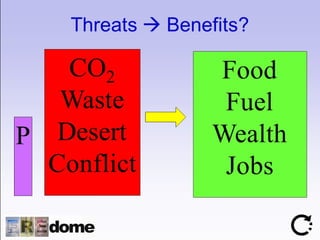
Threats    Benefits? CO 2 Waste Desert Conflict P Food Fuel Wealth Jobs
 
Carbon Sustainability! Limiting Capture Re-use The missing link!
Carbon Cycling The cyclic, as opposed to consume-and-dump, use of Carbon, Water and Macro/Trace Nutrients (at local and global levels)
C O 2
What’s the answer? Surplus air-carbon Carbon resources low Crops turn a) into b) Most of the world is wasteland
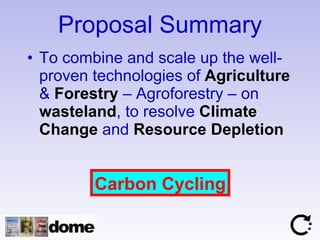
Proposal Summary To combine and scale up the well-proven technologies of  Agriculture  &  Forestry  – Agroforestry – on  wasteland , to resolve  Climate Change  and  Resource Depletion Carbon Cycling
Arid world areas to convert for crops to turn our CO 2  into resources
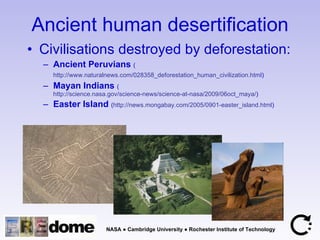
Ancient human desertification Civilisations destroyed by deforestation: Ancient Peruvians   ( http://www.naturalnews.com/028358_deforestation_human_civilization.html )   Mayan Indians   ( http://science.nasa.gov/science-news/science-at-nasa/2009/06oct_maya/ ) Easter Island   ( http://news.mongabay.com/2005/0901-easter_island.html ) NASA ● Cambridge University ●  Rochester Institute of Technology
Recent human desertification  Aral Sea  (once the world’s 4 th  largest lake) 1973 2003
Madagascar http:// www.jurassiccoast.com/downloads/Education/madagascar_resource_materials.pdf


Agroforestry 8% of world’s land productive, could be 75% Trees+crops    10 times the yield of monocultures    Earth could be 100 times as fruitful
Gorshkov & Makarieva (Under discussion) Global carbon cycle Forests convert deep water into water vapour in the air. It condenses, contracts and pulls water vapour from the sea to the interior of continents Logged coastal trees for shipbuilding Continents turned into deserts Need to restore coastal forests
How?
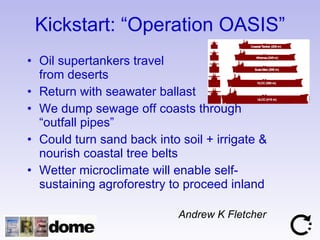
Kickstart: “Operation OASIS” Oil supertankers travel  from deserts Return with seawater ballast We dump sewage off coasts through “outfall pipes” Could turn sand back into soil + irrigate & nourish coastal tree belts Wetter microclimate will enable self-sustaining agroforestry to proceed inland Andrew K Fletcher
Plausible?
Key Steps 1. Tankering  waste 2. Acceptance  by desert nations 3. Wastewater to  irrigate  desert vegetation 4. Cloud  formation above coastal vegetation 5. Trees “milking”  rain  from clouds 6. Spread of self-sustaining  vegetation
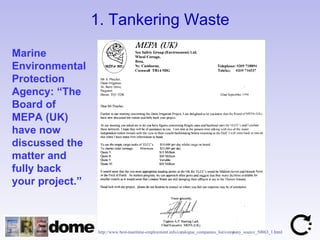
1. Tankering Waste Marine Environmental Protection Agency: “The Board of MEPA (UK) have now discussed the matter and fully back your project.” http://www.best-maritime-employment.info/catalogue_companies_list/company_source_50063_1.html
2. Acceptance by desert nations eg Kuwait: “ This is to confirm that the Public Authority of Agriculture and the Kuwait Institute for Scientific Research are considering your Oasis Project…” “ With an open invitation to Kuwait to discuss your project further.”
eg Israel: “ I greatly appreciate your extensive efforts to open the road to successfully harnessing adequately treated sewage effluents for irrigation in arid and semi arid region and as I mentioned before  we will be very happy to support Oasis Irrigation  in spreading the good values of irrigation with effluents, based on our large experience in the field.”
Arab Water Forum November 2011
3. Wastewater to irrigate desert vegetation http://www.unep.or.jp/ietc/publications/techpublications/techpub-15/3-2AsiaWest/2-4.asp “ In  Egypt , the practice of reuse of wastewater started in Cairo city in 1911 to irrigate Jabal al-Asfar farms covering an area of 1260 hectares… treated wastewater production will reach a potential of 4.9BCM* per year.  This amount is planned to irrigate an area of about 400,000 hectares of desert land . ” Newsletter and Technical Publications <International Source Book On Environmentally Sound Technologies for Wastewater and Stormwater Management>  *MCM/BCM = Million/Billion Cubic Metres “ Wastewater is a rich source of nutrient”
“ In  Jordan , the volume of treated wastewater produced in 1998 reached 74MCM per year, of which about 95% is reused for irrigation.”  “ In  Kuwait , about 25% of its agriculture and green areas is irrigated using 52MCM of treated wastewater.” and so on…
BUT irrigation with ground water creates salt deserts “ Salinization – buildup of salt in surface soil layers. It is more common in arid areas where precipitation is minimal and evaporation rates are high. This happens because of irrigation.” Must use waste water that originates as rain Leticia Neves - University of Sao Paulo http://aboutenvironment.com/category/soil/
4. Cloud formation over coastal vegetation Abrupt temperature differential, get cumulonimbus (storm) clouds & sea breezes to 75 miles inland http://www.aviationweather.ws/097_Sea_Breeze_Soaring.php Aviation Weather For Pilots and Flight Operations Personnel FAA Advisory Circular AC 00-6A “ Over vegetation where air is usually moist, sea breeze cumulus are the rule. Over arid regions, little or no cumulus development may be anticipated with a sea breeze front.”
5. Trees “milking” rain from clouds  (or coastal fog) 1850 – a barren volcanic island, buffeted by dry trade winds Darwin got Hooker of Kew Gardens & Navy to deposit trees regularly to capture rain & reduce evaporation By late 1870s vegetation had run riot on “Green Mountain” Charles Darwin's ecological experiment on Ascension isle Howard Falcon-Lang Science reporter, BBC News  http://www.bbc.co.uk/news/science-environment-11137903   ALSO:  Green Deserts Charity Abu Dhabi:   Tree planting project    “first rainfall in living memory.” Rodrigues:   Removed trees, rains stopped. Re-planted, rains returned.
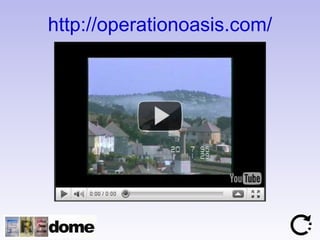
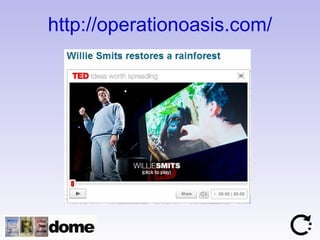
http://operationoasis.com/
Growing interest in the effect of re-vegetation on rainfall
6. Spread of self-sustaining vegetation Ascension Island Government http://www.ascension-island.gov.ac/about   http://www.greenfudge.org/2010/09/03/how-charles-darwin-transformed-a-desert-island-into-a-lush-green-oasis/ “ The highest point, Green Mountain, at 2818 ft is covered with lush vegetation most of which was introduced in the 1800s. Much of the island has become green in recent years…” ASCENSION ISLAND TODAY Photo by Simon and Tracey Watts (TheWatts on Flickr CC)
Local endorsement of  potency & plausibility
Plausible  
Economics Tankering over  20-times cheaper  than local processing ( South West Water ,  Baltic Exchange ,  Port World ) Value of local biogas pays for tankering  1½ times over   ( Thames Water ) Agricultural profit/15km 2   £3.5M  in first two years, times 12 in 12 years  ( SAIIA ) Land value increase/15km 2   £80M   ( Civilization's Future )
4 Phases Nett economic & social benefits * Repeat for 15 km 2  plots Cost Value Nett Gain Phase 1 - Preparation   -£439,537 £583,000 £143,463 Phase 2 - Infrastructure Assembly -£766,498 £773,000 £6,502 Phase 3 - Establishment of Coastal Vegetation  * -£7,597,093 £111,881,000 £104,283,907 Phase 4 - Extension of Agroforestry Inland  * -£4,287,874 £90,886,750 £86,598,876
Presented at… Social Enterprise Day Global Entrepreneurship Week 15-21 Nov 2010 18 th  November 2010
It emerged that…
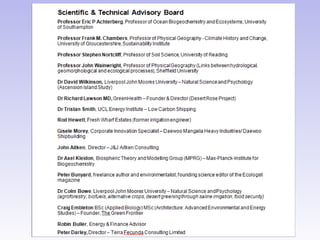
Scientific & Technical Advisory Board
1 st  February 2011
 
Currently… International Funding Application
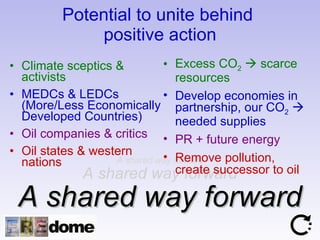
Potential to unite behind  positive action Climate sceptics & activists MEDCs & LEDCs (More/Less Economically Developed Countries) Oil companies & critics Oil states & western nations Excess CO 2     scarce resources Develop economies in partnership, our CO 2     needed supplies PR + future energy Remove pollution, create successor to oil A shared way forward A shared way forward A shared way forward
Threats    Benefits? CO 2 Waste Desert Conflict P Food Fuel Wealth Jobs
What do these have in common?
George Osborne’s budget speech “… we should resolve that the rest of the country becomes a  world leader  in advanced manufacturing,  life sciences , creative industries, business services,  green energy  and so much more…” “ So this is our plan for growth. We want the words: ‘Made in Britain’ ‘Created in Britain’ ‘Designed in Britain’ ‘ Invented in Britain ’ To  drive our nation forward .” 
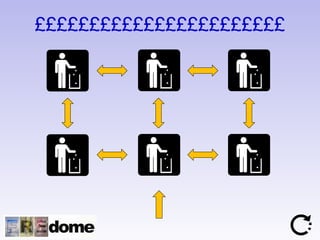
Government response, so far  (simplified) http://tinyurl.com/govt-resp APPCCG Employment
£££££££££££££££££££££££
After 6 months…
Please sign our letter…
Agenda Input Interaction (Q&A, Suggestions) The way forward: Joint letter to PM? Broader FoE involvement? www.slideshare.net/GregPeachey/foe-fredome   www.FREdome.org   http://fredome.wordpress.com

FoE FREdome - can trees make it rain?

  • 1.
  • 2.
  • 3.
    Agenda Input Interaction(Q&A, Suggestions) The way forward www.slideshare.net/GregPeachey/foe-fredome www.FREdome.org http://fredome.wordpress.com
  • 4.
    Greg Peachey Formermanagement consultant Get all stakeholders in… … to pull together for collective benefit organisation  community world 7 yrs 30 yrs
  • 5.
    A shared wayforward A shared way forward V i s i o n a r y T r u s t A shared way forward
  • 6.
    What do thesehave in common?
  • 7.
    Probability & ImpactI P I P OR Act?
  • 8.
    Probability & ImpactI P I P OR Act 
  • 9.
    Probability & ImpactI P I Act! Definitely
  • 10.
    Threats  Benefits? P
  • 11.
    Threats  Benefits? CO 2 Waste Desert Conflict P Food Fuel Wealth Jobs
  • 12.
  • 13.
    Carbon Sustainability! LimitingCapture Re-use The missing link!
  • 14.
    Carbon Cycling Thecyclic, as opposed to consume-and-dump, use of Carbon, Water and Macro/Trace Nutrients (at local and global levels)
  • 15.
  • 16.
    What’s the answer?Surplus air-carbon Carbon resources low Crops turn a) into b) Most of the world is wasteland
  • 17.
    Proposal Summary Tocombine and scale up the well-proven technologies of Agriculture & Forestry – Agroforestry – on wasteland , to resolve Climate Change and Resource Depletion Carbon Cycling
  • 18.
    Arid world areasto convert for crops to turn our CO 2 into resources
  • 19.
    Ancient human desertificationCivilisations destroyed by deforestation: Ancient Peruvians ( http://www.naturalnews.com/028358_deforestation_human_civilization.html ) Mayan Indians ( http://science.nasa.gov/science-news/science-at-nasa/2009/06oct_maya/ ) Easter Island ( http://news.mongabay.com/2005/0901-easter_island.html ) NASA ● Cambridge University ● Rochester Institute of Technology
  • 20.
    Recent human desertification Aral Sea (once the world’s 4 th largest lake) 1973 2003
  • 21.
  • 22.
  • 23.
  • 24.
  • 25.
    Agroforestry 8% ofworld’s land productive, could be 75% Trees+crops  10 times the yield of monocultures  Earth could be 100 times as fruitful
  • 26.
    Gorshkov & Makarieva(Under discussion) Global carbon cycle Forests convert deep water into water vapour in the air. It condenses, contracts and pulls water vapour from the sea to the interior of continents Logged coastal trees for shipbuilding Continents turned into deserts Need to restore coastal forests
  • 27.
  • 28.
    Kickstart: “Operation OASIS”Oil supertankers travel from deserts Return with seawater ballast We dump sewage off coasts through “outfall pipes” Could turn sand back into soil + irrigate & nourish coastal tree belts Wetter microclimate will enable self-sustaining agroforestry to proceed inland Andrew K Fletcher
  • 29.
  • 30.
    Key Steps 1.Tankering waste 2. Acceptance by desert nations 3. Wastewater to irrigate desert vegetation 4. Cloud formation above coastal vegetation 5. Trees “milking” rain from clouds 6. Spread of self-sustaining vegetation
  • 31.
    1. Tankering WasteMarine Environmental Protection Agency: “The Board of MEPA (UK) have now discussed the matter and fully back your project.” http://www.best-maritime-employment.info/catalogue_companies_list/company_source_50063_1.html
  • 32.
    2. Acceptance bydesert nations eg Kuwait: “ This is to confirm that the Public Authority of Agriculture and the Kuwait Institute for Scientific Research are considering your Oasis Project…” “ With an open invitation to Kuwait to discuss your project further.”
  • 33.
    eg Israel: “I greatly appreciate your extensive efforts to open the road to successfully harnessing adequately treated sewage effluents for irrigation in arid and semi arid region and as I mentioned before we will be very happy to support Oasis Irrigation in spreading the good values of irrigation with effluents, based on our large experience in the field.”
  • 34.
    Arab Water ForumNovember 2011
  • 35.
    3. Wastewater toirrigate desert vegetation http://www.unep.or.jp/ietc/publications/techpublications/techpub-15/3-2AsiaWest/2-4.asp “ In Egypt , the practice of reuse of wastewater started in Cairo city in 1911 to irrigate Jabal al-Asfar farms covering an area of 1260 hectares… treated wastewater production will reach a potential of 4.9BCM* per year. This amount is planned to irrigate an area of about 400,000 hectares of desert land . ” Newsletter and Technical Publications <International Source Book On Environmentally Sound Technologies for Wastewater and Stormwater Management> *MCM/BCM = Million/Billion Cubic Metres “ Wastewater is a rich source of nutrient”
  • 36.
    “ In Jordan , the volume of treated wastewater produced in 1998 reached 74MCM per year, of which about 95% is reused for irrigation.” “ In Kuwait , about 25% of its agriculture and green areas is irrigated using 52MCM of treated wastewater.” and so on…
  • 37.
    BUT irrigation withground water creates salt deserts “ Salinization – buildup of salt in surface soil layers. It is more common in arid areas where precipitation is minimal and evaporation rates are high. This happens because of irrigation.” Must use waste water that originates as rain Leticia Neves - University of Sao Paulo http://aboutenvironment.com/category/soil/
  • 38.
    4. Cloud formationover coastal vegetation Abrupt temperature differential, get cumulonimbus (storm) clouds & sea breezes to 75 miles inland http://www.aviationweather.ws/097_Sea_Breeze_Soaring.php Aviation Weather For Pilots and Flight Operations Personnel FAA Advisory Circular AC 00-6A “ Over vegetation where air is usually moist, sea breeze cumulus are the rule. Over arid regions, little or no cumulus development may be anticipated with a sea breeze front.”
  • 39.
    5. Trees “milking”rain from clouds (or coastal fog) 1850 – a barren volcanic island, buffeted by dry trade winds Darwin got Hooker of Kew Gardens & Navy to deposit trees regularly to capture rain & reduce evaporation By late 1870s vegetation had run riot on “Green Mountain” Charles Darwin's ecological experiment on Ascension isle Howard Falcon-Lang Science reporter, BBC News http://www.bbc.co.uk/news/science-environment-11137903 ALSO: Green Deserts Charity Abu Dhabi: Tree planting project  “first rainfall in living memory.” Rodrigues: Removed trees, rains stopped. Re-planted, rains returned.
  • 40.
  • 41.
  • 42.
    Growing interest inthe effect of re-vegetation on rainfall
  • 43.
    6. Spread ofself-sustaining vegetation Ascension Island Government http://www.ascension-island.gov.ac/about http://www.greenfudge.org/2010/09/03/how-charles-darwin-transformed-a-desert-island-into-a-lush-green-oasis/ “ The highest point, Green Mountain, at 2818 ft is covered with lush vegetation most of which was introduced in the 1800s. Much of the island has become green in recent years…” ASCENSION ISLAND TODAY Photo by Simon and Tracey Watts (TheWatts on Flickr CC)
  • 44.
    Local endorsement of potency & plausibility
  • 45.
  • 46.
    Economics Tankering over 20-times cheaper than local processing ( South West Water , Baltic Exchange , Port World ) Value of local biogas pays for tankering 1½ times over ( Thames Water ) Agricultural profit/15km 2 £3.5M in first two years, times 12 in 12 years ( SAIIA ) Land value increase/15km 2 £80M ( Civilization's Future )
  • 47.
    4 Phases Netteconomic & social benefits * Repeat for 15 km 2 plots Cost Value Nett Gain Phase 1 - Preparation   -£439,537 £583,000 £143,463 Phase 2 - Infrastructure Assembly -£766,498 £773,000 £6,502 Phase 3 - Establishment of Coastal Vegetation * -£7,597,093 £111,881,000 £104,283,907 Phase 4 - Extension of Agroforestry Inland * -£4,287,874 £90,886,750 £86,598,876
  • 48.
    Presented at… SocialEnterprise Day Global Entrepreneurship Week 15-21 Nov 2010 18 th November 2010
  • 49.
  • 50.
    Scientific & TechnicalAdvisory Board
  • 51.
    1 st February 2011
  • 52.
  • 53.
  • 54.
    Potential to unitebehind positive action Climate sceptics & activists MEDCs & LEDCs (More/Less Economically Developed Countries) Oil companies & critics Oil states & western nations Excess CO 2  scarce resources Develop economies in partnership, our CO 2  needed supplies PR + future energy Remove pollution, create successor to oil A shared way forward A shared way forward A shared way forward
  • 55.
    Threats  Benefits? CO 2 Waste Desert Conflict P Food Fuel Wealth Jobs
  • 56.
    What do thesehave in common?
  • 57.
    George Osborne’s budgetspeech “… we should resolve that the rest of the country becomes a world leader in advanced manufacturing, life sciences , creative industries, business services, green energy and so much more…” “ So this is our plan for growth. We want the words: ‘Made in Britain’ ‘Created in Britain’ ‘Designed in Britain’ ‘ Invented in Britain ’ To drive our nation forward .” 
  • 58.
    Government response, sofar (simplified) http://tinyurl.com/govt-resp APPCCG Employment
  • 59.
  • 60.
  • 61.
    Please sign ourletter…
  • 62.
    Agenda Input Interaction(Q&A, Suggestions) The way forward: Joint letter to PM? Broader FoE involvement? www.slideshare.net/GregPeachey/foe-fredome www.FREdome.org http://fredome.wordpress.com

Editor's Notes

  • #2 Good evening. I’d like to start by thanking you for welcoming me to your Friends of the Earth event. I must say that everyone who is a friend of the earth is a friend of mine.
  • #3 The title of our session today is: Can trees make it rain? Everything I say today will revolve around that premise, and I hope that the vast significance of that will become clear as the evening progresses.
  • #4 I suggest that we divide today’s session into three parts: Some input from me, some dialogue in the room, and finally a time to make sure that this event is productive. If you want to look things up after today, here are the addresses of our website, blog and these slides. (I’ll leave these up on the screen at the end.)
  • #5 May I introduce myself briefly. I used to help all stakeholders in an organisation to pull together for their collective benefit. I’ve now progressed to doing this in a wider, community and global context. The first one pays. This one doesn’t. So I hope that’s an indication of how much I believe in and care about this project.
  • #6 So now I chair the FREdome Visionary Trust, which aims to help people in the world to pull together against shared threats.
  • #7 Now, to get those mental processes working – what do these two things have in common? (golden flax seed and the Lottery). A clue is that Golden Flax Seed is claimed to reduce risk of cancer.
  • #8 Well – in both cases, people are using unlikely (or at least unproven) approaches to dealing with high-impact events. The events are either a threat, as in the case of cancer, or an opportunity, as in the case of the Lottery. Indeed, if an event is high impact, then people will understandably try all sorts of even unlikely means of dealing with it.
  • #9 But if a means of dealing with a high-impact event is fairly plausible, then it is certainly worth considering.
  • #10 And if there is action that has a good chance of converting high-impact threats into high-impact benefits, then we definitely should follow it up.
  • #11 And today I am going to talk to you about one very plausible means of converting major threats into major benefits.
  • #12 And these are the threats and benefits… The means of making that conversion is Carbon Cycling.
  • #13 Now, although I’m an environmentalist, as soon as I hear someone begin to talk about carbon emissions, I tend to switch off, because it’s always the same old depressing mantra. We’ve got to cut back on carbon – use our cars less, turn our heating down in winter, our air-con in summer, switch our TVs off standby, give up those foreign holidays, pay fuel taxes, carbon taxes…
  • #14 You see, all we seem to talk about is cutting carbon emissions and sometimes burying them. If only we could convert them back into the carbon resources that we’re told to cut back on, then we’ve done it! We’ve achieved Sustainability of civilisation. That’s the goal of Carbon Cycling and that is the MISSING LINK in today’s debate.
  • #15 Here’s my definition of Carbon Cycling – it’s a bit broader than just carbon – it’s about restoring the Carbon, Water and Nutrient Cycles – locally and globally because they’re all part of the same process.
  • #16 So what is it that turns CO2 into carbon resources like food and fuel? Plants. (Through photosynthesis.) Plant life takes Carbon Dioxide from us and gives us back carbohydrates, such as food and fuel
  • #17 So we’ve got too much CO 2 ; we’re running out of carbon-based resources; crops turn a) into b), but we haven’t got enough land to do it on. So the ideal solution becomes obvious: We need to convert wasteland to grow more crops.
  • #18 So, the Carbon Cycling proposal in a single sentence is: “ To combine and scale up the well-proven technologies of Agriculture &amp; Forestry – Agroforestry – on wasteland, to resolve Climate Change (by taking CO 2 out of the air) and Resource Depletion (by converting it back into carbon resources) ”
  • #19 Remember, we want to use wasteland to grow more crops to turn our CO2 back into the resources that are running out. On this map the brown and white areas are arid wasteland. It’s quite alarming to see how little of our planet we are actually making use of. And deserts are a serious, growing threat.
  • #20 Studies by reputable bodies such as these are concluding that ancient civilisations perished when they unwittingly turned their forests into desert.
  • #21 More recently through human actions the great Aral Sea, formerly the world’s 4 th largest lake, was virtually turned into desert in a matter of 30 years – so fast that you can see here some of the ships left stranded .
  • #22 Here’s what is happening right now to Madagascar – home to many unique species..
  • #23 90% of the forests have already been destroyed
  • #24 And these shocking pictures show the soil being washed out to sea as a result
  • #25 Yet another desert in the making.
  • #26 With all that wasteland, James Sholto-Douglas pointed out that only about 8% of the world’s land is productive, whereas it could be more like 75% Where trees and crops are grown together in conjunction, the TOTAL yield of an area of land is multiplied. So the earth has the potential to become many times as fruitful, locking masses of CO 2 away in productive vegetation, securing our environment, our resources, our civilisation and our world economy.
  • #27 What has gone wrong it that we have decimated the natural carbon cycle. Trees put down deep roots and reach low water tables. They transpire that water vapour into the air where it cools and contracts and pulls in moist air from over the sea. Trees further inland do the same thing, and in this way the world’s forests pump moisture from coasts to the interior of continents. However, when we arrived at the big continents we logged the coastal forests, for things like shipbuilding, cutting the forests off from their source of moisture, and the rest is history. Now we are doing the same thing to the Amazon rainforest and witnessed two severe droughts. If you think about it, unfortunately, if you’re going to clear forests, you have to work from the coast, because you can’t easily transport felled trees away through the remaining forest. It does seem like common sense, doesn’t it, that if you are going to halt or reverse destruction of rainforests, then the best place to start is at the coast, where there is a source of airborne moisture. So we need to re-establish coastal trees.
  • #28 How do we do that?
  • #29 Andrew K Fletcher points out that oil supertankers happen to travel from the desert regions. We send them back loaded with seawater as ballast to stabilise them. Meanwhile, we still outfall-pipe some of our sewage off our coasts and it sometimes comes back to haunt us. Now if, instead of filling them with seawater, we sent them back with our sewage and wastewater, it would be automatically biodigested, and there would be masses of nutrient to restore the organic content of desert sand converting it back into soil and millions of tons of water with which to irrigate tree belts, which would create a wetter microclimate, allowing agroforestry to extend inland.
  • #30 So, is this all plausible?
  • #31 I’ve divided the kickstart process into six major steps so that we can look briefly at the plausibility of each: Can we get organic material to the desert shores? Would the recipient nations accept it? Could they use it to reclaim desert? Would the vegetation form clouds? Could trees make the clouds rain? And would vegetation could spread inland as a result?
  • #32 Step 1: Can we tanker organic material to desert shores? We have proposed the project to parties in the tankering industry, and, for example, the Marine Environmental Protection Agency wrote back with financial data and said: “The Board of MEPA (UK) have now discussed the matter and fully back your project.” Signed Captain A P Starling Lark, who is a knowledgeable and well-experienced mariner. You can look up his credentials. Obviously we can only outline these steps today, but I think you can see that Step 1 seems at least plausible . And that’s all I want to establish at this stage.
  • #33 Now would recipient nations accept the organic material? We have approached foreign embassies. The Kuwait Embassy wrote back, saying “ This is to confirm that the Public Authority of Agriculture and the Kuwait Institute for Scientific Research are considering your Oasis Project… ” They asked for a bit more information, and finished: “ With an open invitation to Kuwait to discuss your project further. ”
  • #34 The Water Commissioner wrote back from Israel , saying: “ we will be very happy to support Oasis Irrigation in spreading the good values of irrigation with effluents, based on our large experience in the field.”
  • #35 More recently we have been invited to address the 2 nd Arab Water Forum this November in Cairo. So, I think we can conclude that it is at least plausible that the recipient nations would accept the organic material.
  • #36 Now, could they use the wastewater to irrigate coastal desert? Here you can see the UN publication, which states that Egypt has already been using it for irrigation since 1911, and as a result of that experience they have quantified how much waste water you need to irrigate a given area of desert.
  • #37 They’re also using it in other countries, such as Kuwait and Jordan So, use of waste water to reclaim desert is more than plausible.
  • #38 IN FACT, desert nations have to rely on ground water which contains a high level of salt. The water evaporates very quickly, leaving the salt on potentially arable land, ultimately turning it into a permanent salt desert. What they really need is wastewater that originates as rain – as ours does, and they need it to rain in their own countries. (Rain is pure, distilled water, free of mineral content.) So, we begin to see that this project is not just plausible, it’s NECESSARY
  • #39 Now, can coastal vegetation form clouds? Here is an excerpt from official, practical information given to pilots who conduct safety-critical work. It states that: Over arid regions there is virtually no cloud. Vegetation, however, does cause cloud formation. Where there is an abrupt difference between land and sea temperatures, as there is at a hot desert coast, then the moist air currents rise to great heights, forming towering cumulonimbus – storm clouds, and The on-shore breezes typically extend up to 75 miles inland. So it is plausible that coastal tree belts will create rain clouds that move inland.
  • #40 Now, can trees get those clouds to rain? (or coastal fog, which is the same thing at ground level) A monument testifying to that exists in the form of Ascension Island. When Darwin originally visited the island it had been turned into a barren volcanic rock. He got Kew Gardens to work with the Navy to have a variety trees planted on a peak to capture rain. Within 20 years a tropical rain forest had completely taken over that peak, which became known as Green Mountain.
  • #41 If you look on our project forum website, you will see actual footage of sea mist on our own south coast hugging a belt of trees and crossing over onto land on an otherwise hot and dry day.
  • #42 Also on the website you can view a presentation from Willie Smits who has used agroforestry to transform the environment and productivity of effective wasteland in terms of biodiversity, rainfall, yield, employment and economics.
  • #43 You can also see here that interest in the effects of re-vegetation on rainfall is growing in the academic world. So, once again it is highly plausible that trees can make clouds rain.
  • #44 Finally, can self-sustaining vegetation spread, once trees have created a wet microclimate? Here we see information published by the Government of Ascension Island: They confirm that: ”The highest point, Green Mountain, is covered with lush vegetation most of which was introduced in the 1800s” And go on to say: ”Much of the island has become green in recent years” So, it is more than plausible that self-sustaining vegetation will spread in a wet microclimate induced by trees.
  • #45 I have here a letter here from our local Green Party, saying that they “see nothing implausible” in our proposal and “cannot understand why something like this is not already being done or at least forming a signicant part of the debate.” Similarly, the Agriculture &amp; Research Unit of the University of Herts has formally declared in writing that this is a plausible solution that merits further investigation.
  • #46 So, from a technical viewpoint, this all sounds plausible.
  • #47 From an economic viewpoint, if you do the sums you find that it’s actually over 20 times cheaper to tanker the waste away than to process it locally. The biogas recovered at this end is more than enough to pay for the tankering anyway. Additionally there will be a substantial and growing profit from the agricultural produce, and the land will increase vastly in value.
  • #48 We have proposed the project as a series of phases, where each phase outputs a mix of net economic and social benefits designed to ensure an effective, timely and fair implementation . Every stage is therefore compelling in its own right.
  • #49 At the end of last year we presented the proposal before an All Party Parliamentary group.
  • #50 At that meeting it emerged that before the invasion by Iraq, Thames Water had proposed the project to the Kuwaitis, who were actually going to pay for the implementation – further adding weight to plausibility.
  • #51 At the meeting and subsequently a group of senior academics and industry figures have agreed to act as our Scientific and Technical Advisory Board.
  • #52 Our project has also been endorsed by Professor Braungart, co-founder of the European C2C Network.
  • #53 The European Commission, which co-funds Prof Braungart’s work, has allocated 105 bn euros to be spent on green job creation up to 2013/
  • #54 We have assembled a team of volunteer executives to construct that application. If successful, this will bring in foreign investment to create new employment and position the UK as a leader and shareholder in a new global industry to restore the world’s environment and resources.
  • #55 Carbon cycling can unite people of very differing opinions. Both climate “activists” and “sceptics”, can agree that it makes sense to convert plentiful CO2 into threatened, carbon resources, such as food &amp; fuel. If we work with developing nations to cultivate their arid land, then they will absorb our excess emissions, develop their economies and put back onto the world market renewable supplies upon which our communities and industries depend. Oil companies can gain positive PR whilst setting up a supply of renewable energy. Oil states can remove our pollution, reverse desertification and create a replacement for their oil when it runs out.
  • #56 So, I hope I have demonstrated a highly plausible option to convert these major threats into these major benefits.
  • #57 Time for a small topical interlude. What do all these things have in common? They all originated in England and are considered very English, but we have been overtaken. For example, we are not top in the world of cricket, tennis or football. The internet was invented here, but because of it most of our IT jobs have been exported. Neither Harrods nor Rolls Royce belongs to England now. Even words of our language, such as Disk, are no longer spelled the English way.
  • #58 In his budget speech, George Osborne indicated that Britain should grow through our inventiveness. We would therefore hope that our own government would pick up on an idea as powerful as this before other nations take it up. So let’s see how our government has responded so far…
  • #59 First we took the project to the All Party Parliamentary Climate Change Group. Because the way to kickstart this is to redeploy unemployed executives to apply for funding to create green jobs, we wrote to the Minister for Employment asking for a very short meeting. His Correspondence Department sent back a template rejection letter simply saying he cannot reply personally to all the letters he received. In parallel we wrote to our local MP in St Albans who in turn wrote to the Minister encouraging a favourable response. The Minister suggested that perhaps we should contact the Department of Energy &amp; Climate Change or the Department for Business Innovation &amp; Skills. He wrote a letter back to our MP saying that his diary did not permit him to meet us. She forwarded his letter back to us, simply saying “The Minister cannot meet you. Is there anything else I can do for you?” We then wrote to the Minister for Civil Society offering this as a potentially powerful practical example of the Big Society in Action. He passed the letter onto the Department of Climate Change &amp; Energy, who informed me that they had passed it on to a government official. I haven’t heard from them since. We therefore escalated the matter to the Secretary of State for the DWP, copied to the Minister for Employment, whose Correspondence Team sent us a template letter, virtually identical to their very first. We sent another letter back, asking them not to just skim read it &amp; send another standard copied &amp; pasted letter back. Once again, they simply sent virtually the same letter back!
  • #60 So, within government we have a very expensive forwarding and filing service.
  • #61 And at the end of six months, the politicians involved are still all pointing to each other, having achieved nothing.
  • #62 We have now constructed a letter to the Prime Minister himself, asking him to ensure that this powerful &amp; beneficial proposal should be at least be looked into by the UK and not simply allowed to be taken over by other nations.
  • #63 So thank you for listening. Here’s the remainder of the agenda. I’d like to finish my input by inviting you to give us your questions and suggestions, and, if you’re satisfied, to perhaps add your signatures to that letter before we despatch it and consider whether Friends of the Earth might consider this project worthy of broader support.