Day 3: INFRASTRUCTURE, WATER
          and ENERGY
3.1 INTRO
• Permaculture Bingo
• Appropriate technology
• Energy
Appropriate technology
•   Low cost
•   Long lasting
•   Locally produced
•   Low embodied energy
•   Low maintenence
Low embodied energy
• Solutions found and implemented at lowest
  possible energy-use levels
• This means “don’t use a sledgehammer to
  crack a nut!”
Low maintenence
• Maintenance = work that WE have to do (or
  pay someone else to do).
• As much as possible, we should design
  maintenance OUT of the system.
Energy: Summary
• What is energy? What is energy power?
• What is the status of the technology?
  Comparison
• Can we store energy?
• Reduce, conserve, design!
• Village-scale energy potentials and solutions
• Energy and mobility
• Measuring ecological footprint and design for
  carbon neutrality
What is energy? What is energy
                  power?
Forms of energy that we use:
•Mechanical
•Chemical
•Electricity
•Heat
•Light


                        They are all interchangeable


LOSSES: Energy is lost when we convert from one form to another (usually as
heat). All energy comes indirectly from the sun.
POWER is the ability to do work: a measure of energy. The more power, the
more work can be done.
Mechanical
• Direct drive water wheel (e.g. corn mill or
  sawmill)
• Brick press (human provides the energy, but
  the lever provides a mechanical advantage)
• Direct drive wind powered water pump

Less losses than if we generate electricity and
  use electric pumps or grinders.
Chemical
Usually an energy store that is released when
we use it.
•A battery (used to generate electricity)
•Wood in a tree (burned in a fire – heat+light)
•Food! (Perhaps this is the most important and
fundamental form of energy of all, from our
point of view)
Electricity
• Can be generated from many of the other
  forms.
• Is a very useful and versatile form of energy to
  have, but often is gained through an
  inefficient process (lots of losses)
  – Coal power station is only 35% efficient at transferring the
    chemical energy in coal to electricity.
  – Solar panel is <20% efficient at transforming solar
    radiation (but that’s OK because sunlight is abundant).
Heat
• Cooking
• Space heating
• Hot water
• Increasing crop growth (greenhouse or
  nursery)
• Generating other forms of energy (e.g. steam
  to drive a turbine)
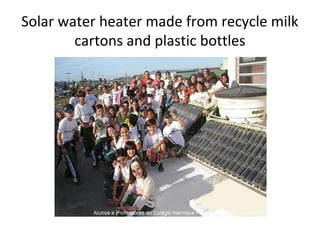
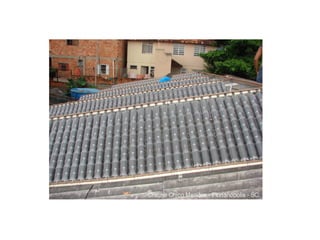
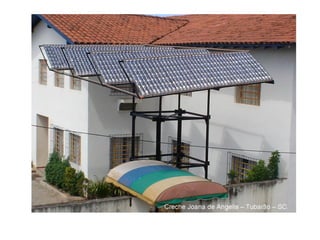
Solar water heater made from recycle milk
        cartons and plastic bottles
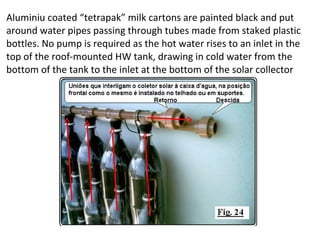
Aluminiu coated “tetrapak” milk cartons are painted black and put
around water pipes passing through tubes made from staked plastic
bottles. No pump is required as the hot water rises to an inlet in the
top of the roof-mounted HW tank, drawing in cold water from the
bottom of the tank to the inlet at the bottom of the solar collector
Light
• Use natural daylight in buildings as much as possible instead
  of electric light
• Separate solar-powered low energy LED lighting systems
  (using daytime sunlight at night)
• A key element for plant growth (chemical energy production
  in biomass).
Solar Bottle Lights
•   Youtube video links:
•   https://www.youtube.com/watch?v=bLg-K97sWxA
•   https://www.youtube.com/watch?v=kHTD_RX3J2I
•   https://www.youtube.com/watch?v=SBWi3NtND6
•   https://www.youtube.com/watch?v=p3ccUgbTPIc
What is the status of the technology?
                 Comparison
•   Fossil fuels
•   Solar
•   Wind
•   Biofuel
•   Gas
•   Hydro
Fossil fuels
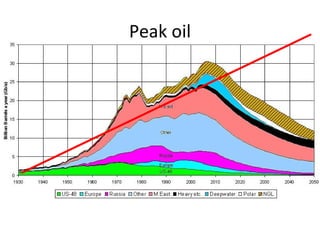
• Peak oil
• Climate change

• Fossil Fuel Dependency
10 calories oil used to produce 1 calorie of food (from
  industrial system). This is a MASSIVE energy DEFECIT.
  In economic terms, this is the road to bankruptcy.
  We must design systems that create an energy
  SURPLUS.
Peak oil
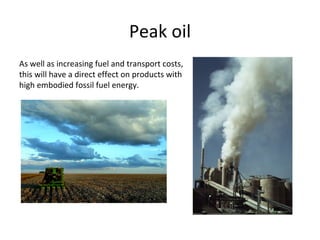
Peak oil
As well as increasing fuel and transport costs,
this will have a direct effect on products with
high embodied fossil fuel energy.
Climate change
• Increasing instability
• Unpredictability
• Every year local extreme records are broken
  (hottest, wettest, driest, coldest…)
• We MUST design more flexible, resilient
  systems that can survive weather extremes
  and adapt to rapid change.
Solar
• Photovoltaic (PV) for electric
  – Expensive, but price is coming down as global production volume
    increases and technology and efficiency improves (average global cost
    per W of PV power installed is decreasing). Good investment if you
    have the capital.

• Solar hot water
  – One of the most cost-effective and useful
    renewable technologies.
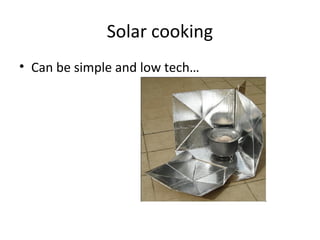
Solar cooking
• Can be simple and low tech…
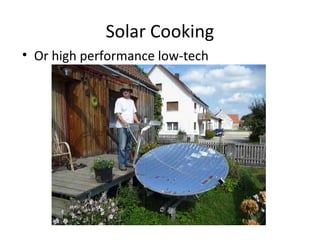
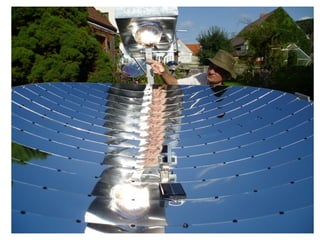
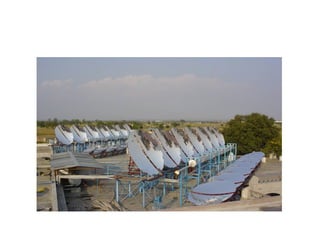
Solar Cooking
• Or high performance low-tech
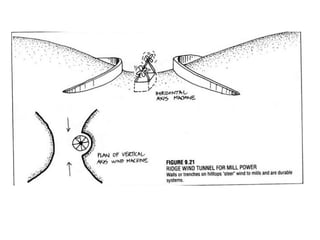
Wind
• Small turbines can be good, but YOU MUST
  HAVE THE RIGHT LOCATION!
• The power in wind increases with the square
  of the speed. >7 meters per second is
  minimum to be worthwhile.
• Larger turbines more efficient.
• Balance out well with solar in a hybrid system
  – Use same batteries and charge controller etc
  – Often windy when no sun
Biofuel
• Very bad from industrial monoculture (e.g.
  palm oil plantations)
• Can be good from permaculture systems
  – Co-product that does not compete with fuel
  – Grown on waste
  – Not using a food crop to make fuel
  – Using a multifunctional element, such as…
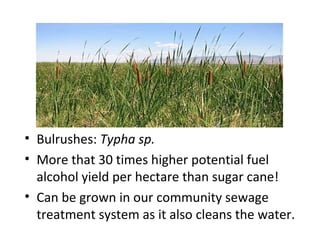
• Bulrushes: Typha sp.
• More that 30 times higher potential fuel
  alcohol yield per hectare than sugar cane!
• Can be grown in our community sewage
  treatment system as it also cleans the water.
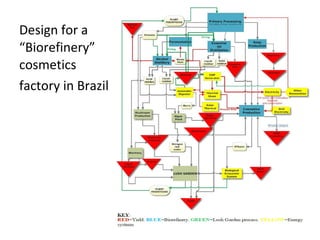
Design for a
“Biorefinery”
cosmetics
factory in Brazil
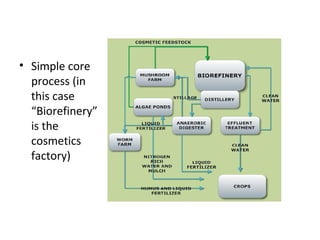
• Simple core
  process (in
  this case
  “Biorefinery”
  is the
  cosmetics
  factory)
Gas
• Highly convenient, but fossil gas becoming
  more expensive (see peak oil)
• We can MAKE our own – biogas digester.
• This can be beneficially connected to many
  other elements.
Hydro
• Can be done at the small scale.
• Can be used to generate constant electricity
  with no batteries needed (if flow is steady).
  This saves money and energy.
• Water PV pumped to high dams can be used
  to generate electricity when no sun.
• You can generate as you irrigate your crops
  below the dam.
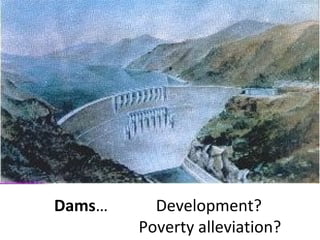
Dams…     Development?
        Poverty alleviation?
Reduce, conserve, design!
• First we must design to reduce energy
  consumption. This is more efficient than ANY
  form of generation. (Passive Design!)
• Second we must use the simplest and most
  appropriate form of generation.
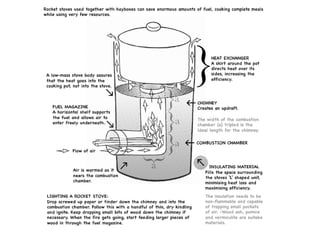
ROCKET STOVE
• Haiti Rocket Stove Design Website
• Principles the same but design
  can be very different and
  versatile, according to available
  materials.
Rocket Stoves in Malawi
• https://www.youtube.com/watch?
  v=sh5EYVuKFEg
Rocket Stove Kitchen
• https://www.youtube.com/watch?
  v=VypiS5X31aA
Village-scale energy potentials and
                  solutions
•   Biogas
•   Managed fuelwood forest
•   Ethanol/ biodiesel
•   ENERGY CAPTURE AND CYCLING
Biogas
• Many different types of systems, to suit
  different climates, feedstocks and other
  requirements.
• Excellent for centralised community-scale
  energy production.
• Vehicles can be run on biogas. You can power
  your car on poo!
Managed fuelwood forest
• Wood is a very sustainable fuel if it is
  managed correctly and not overharvested
• Cook on smallwood/fallen branches, coppice,
  not timber from cut trees. Don’t burn your
  building materials!
• Nitrogen-fixing pioneers (improve soil for
  main crop)
• Grown in waste stream (sewage treatment)
  e.g. wattles (Salix sp.) or bullrushes (Typha
  sp.).
ENERGY CAPTURE AND CYCLING
• Source to sink diagram
• Constructed wetland sewage system
  producing biomass fuel and building materials
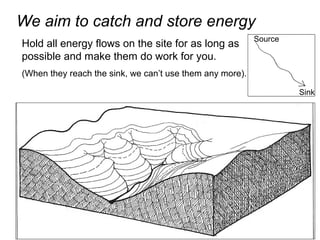
We aim to catch and store energy
                                                          Source
Hold all energy flows on the site for as long as
possible and make them do work for you.
(When they reach the sink, we can’t use them any more).

                                                                   Sink
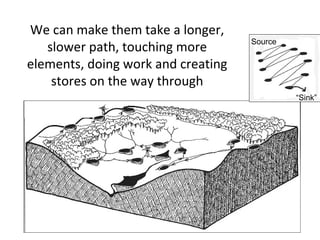
We can make them take a longer,
                                    Source
   slower path, touching more
elements, doing work and creating
    stores on the way through
                                             “Sink”
Constructed wetland sewage system
      producing biomass fuel
Energy and mobility
• Reduce dependency on fossil fuels where
  possible
• Bike and animal transport (more feasible
  within community on car-free roads).
• Alternative vehicle fuels – biogas, biodiesel,
  bioethanol.
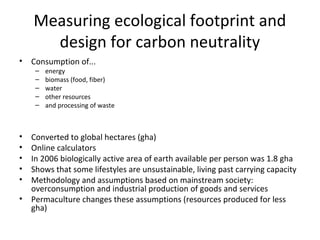
Measuring ecological footprint and
  design for carbon neutrality
Measuring ecological footprint and
      design for carbon neutrality
•   Consumption of...
     –   energy
     –   biomass (food, fiber)
     –   water
     –   other resources
     –   and processing of waste


•   Converted to global hectares (gha)
•   Online calculators
•   In 2006 biologically active area of earth available per person was 1.8 gha
•   Shows that some lifestyles are unsustainable, living past carrying capacity
•   Methodology and assumptions based on mainstream society:
    overconsumption and industrial production of goods and services
•   Permaculture changes these assumptions (resources produced for less
    gha)
Online calculator for S.A.
• http://www.footprintnetwork.org/en/index.php/g

• You can go online and calculate your
  ecological footprint by answering a
  questionnaire
In 2006 biologically active area of
earth available per person was 1.8 gha

• American EF was 9.0 gha per peson
• Switzerland was 5.6 gha
• China was 1.8 gha

Shows that some lifestyles are unsustainable,
  living past carrying capacity
But…methodology has
               assumptions
It is a good place to start, but assumes…

•Business as usual Monoculture etc
•Permaculture = Doing more with less, so we can reduce our
footprint further by increasing efficient design of our supply
systems, not just reducing consumption.
•This is how everyone on the planet can have a dignified and
developed standard of living. But we need to get back within
limits (more of a concern for the over-developed, energy-obese
west, but also for fast developing countries).
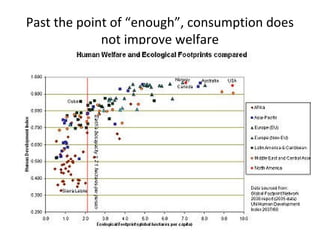
Past the point of “enough”, consumption does
             not improve welfare

Energy presentation

  • 1.
    Day 3: INFRASTRUCTURE,WATER and ENERGY
  • 2.
    3.1 INTRO • PermacultureBingo • Appropriate technology • Energy
  • 3.
    Appropriate technology • Low cost • Long lasting • Locally produced • Low embodied energy • Low maintenence
  • 4.
    Low embodied energy •Solutions found and implemented at lowest possible energy-use levels • This means “don’t use a sledgehammer to crack a nut!”
  • 5.
    Low maintenence • Maintenance= work that WE have to do (or pay someone else to do). • As much as possible, we should design maintenance OUT of the system.
  • 6.
    Energy: Summary • Whatis energy? What is energy power? • What is the status of the technology? Comparison • Can we store energy? • Reduce, conserve, design! • Village-scale energy potentials and solutions • Energy and mobility • Measuring ecological footprint and design for carbon neutrality
  • 7.
    What is energy?What is energy power? Forms of energy that we use: •Mechanical •Chemical •Electricity •Heat •Light They are all interchangeable LOSSES: Energy is lost when we convert from one form to another (usually as heat). All energy comes indirectly from the sun. POWER is the ability to do work: a measure of energy. The more power, the more work can be done.
  • 8.
    Mechanical • Direct drivewater wheel (e.g. corn mill or sawmill) • Brick press (human provides the energy, but the lever provides a mechanical advantage) • Direct drive wind powered water pump Less losses than if we generate electricity and use electric pumps or grinders.
  • 9.
    Chemical Usually an energystore that is released when we use it. •A battery (used to generate electricity) •Wood in a tree (burned in a fire – heat+light) •Food! (Perhaps this is the most important and fundamental form of energy of all, from our point of view)
  • 10.
    Electricity • Can begenerated from many of the other forms. • Is a very useful and versatile form of energy to have, but often is gained through an inefficient process (lots of losses) – Coal power station is only 35% efficient at transferring the chemical energy in coal to electricity. – Solar panel is <20% efficient at transforming solar radiation (but that’s OK because sunlight is abundant).
  • 11.
    Heat • Cooking • Spaceheating • Hot water • Increasing crop growth (greenhouse or nursery) • Generating other forms of energy (e.g. steam to drive a turbine)
  • 12.
    Solar water heatermade from recycle milk cartons and plastic bottles
  • 15.
    Aluminiu coated “tetrapak”milk cartons are painted black and put around water pipes passing through tubes made from staked plastic bottles. No pump is required as the hot water rises to an inlet in the top of the roof-mounted HW tank, drawing in cold water from the bottom of the tank to the inlet at the bottom of the solar collector
  • 16.
    Light • Use naturaldaylight in buildings as much as possible instead of electric light • Separate solar-powered low energy LED lighting systems (using daytime sunlight at night) • A key element for plant growth (chemical energy production in biomass).
  • 17.
    Solar Bottle Lights • Youtube video links: • https://www.youtube.com/watch?v=bLg-K97sWxA • https://www.youtube.com/watch?v=kHTD_RX3J2I • https://www.youtube.com/watch?v=SBWi3NtND6 • https://www.youtube.com/watch?v=p3ccUgbTPIc
  • 18.
    What is thestatus of the technology? Comparison • Fossil fuels • Solar • Wind • Biofuel • Gas • Hydro
  • 19.
    Fossil fuels • Peakoil • Climate change • Fossil Fuel Dependency 10 calories oil used to produce 1 calorie of food (from industrial system). This is a MASSIVE energy DEFECIT. In economic terms, this is the road to bankruptcy. We must design systems that create an energy SURPLUS.
  • 20.
  • 21.
    Peak oil As wellas increasing fuel and transport costs, this will have a direct effect on products with high embodied fossil fuel energy.
  • 22.
    Climate change • Increasinginstability • Unpredictability • Every year local extreme records are broken (hottest, wettest, driest, coldest…) • We MUST design more flexible, resilient systems that can survive weather extremes and adapt to rapid change.
  • 23.
    Solar • Photovoltaic (PV)for electric – Expensive, but price is coming down as global production volume increases and technology and efficiency improves (average global cost per W of PV power installed is decreasing). Good investment if you have the capital. • Solar hot water – One of the most cost-effective and useful renewable technologies.
  • 24.
    Solar cooking • Canbe simple and low tech…
  • 25.
    Solar Cooking • Orhigh performance low-tech
  • 29.
    Wind • Small turbinescan be good, but YOU MUST HAVE THE RIGHT LOCATION! • The power in wind increases with the square of the speed. >7 meters per second is minimum to be worthwhile. • Larger turbines more efficient. • Balance out well with solar in a hybrid system – Use same batteries and charge controller etc – Often windy when no sun
  • 31.
    Biofuel • Very badfrom industrial monoculture (e.g. palm oil plantations) • Can be good from permaculture systems – Co-product that does not compete with fuel – Grown on waste – Not using a food crop to make fuel – Using a multifunctional element, such as…
  • 32.
    • Bulrushes: Typhasp. • More that 30 times higher potential fuel alcohol yield per hectare than sugar cane! • Can be grown in our community sewage treatment system as it also cleans the water.
  • 33.
  • 34.
    • Simple core process (in this case “Biorefinery” is the cosmetics factory)
  • 35.
    Gas • Highly convenient,but fossil gas becoming more expensive (see peak oil) • We can MAKE our own – biogas digester. • This can be beneficially connected to many other elements.
  • 36.
    Hydro • Can bedone at the small scale. • Can be used to generate constant electricity with no batteries needed (if flow is steady). This saves money and energy. • Water PV pumped to high dams can be used to generate electricity when no sun. • You can generate as you irrigate your crops below the dam.
  • 37.
    Dams… Development? Poverty alleviation?
  • 39.
    Reduce, conserve, design! •First we must design to reduce energy consumption. This is more efficient than ANY form of generation. (Passive Design!) • Second we must use the simplest and most appropriate form of generation.
  • 40.
    ROCKET STOVE • HaitiRocket Stove Design Website
  • 42.
    • Principles thesame but design can be very different and versatile, according to available materials.
  • 43.
    Rocket Stoves inMalawi • https://www.youtube.com/watch? v=sh5EYVuKFEg
  • 44.
    Rocket Stove Kitchen •https://www.youtube.com/watch? v=VypiS5X31aA
  • 45.
    Village-scale energy potentialsand solutions • Biogas • Managed fuelwood forest • Ethanol/ biodiesel • ENERGY CAPTURE AND CYCLING
  • 46.
    Biogas • Many differenttypes of systems, to suit different climates, feedstocks and other requirements. • Excellent for centralised community-scale energy production. • Vehicles can be run on biogas. You can power your car on poo!
  • 47.
    Managed fuelwood forest •Wood is a very sustainable fuel if it is managed correctly and not overharvested • Cook on smallwood/fallen branches, coppice, not timber from cut trees. Don’t burn your building materials! • Nitrogen-fixing pioneers (improve soil for main crop) • Grown in waste stream (sewage treatment) e.g. wattles (Salix sp.) or bullrushes (Typha sp.).
  • 48.
    ENERGY CAPTURE ANDCYCLING • Source to sink diagram • Constructed wetland sewage system producing biomass fuel and building materials
  • 49.
    We aim tocatch and store energy Source Hold all energy flows on the site for as long as possible and make them do work for you. (When they reach the sink, we can’t use them any more). Sink
  • 50.
    We can makethem take a longer, Source slower path, touching more elements, doing work and creating stores on the way through “Sink”
  • 51.
    Constructed wetland sewagesystem producing biomass fuel
  • 52.
    Energy and mobility •Reduce dependency on fossil fuels where possible • Bike and animal transport (more feasible within community on car-free roads). • Alternative vehicle fuels – biogas, biodiesel, bioethanol.
  • 53.
    Measuring ecological footprintand design for carbon neutrality
  • 54.
    Measuring ecological footprintand design for carbon neutrality • Consumption of... – energy – biomass (food, fiber) – water – other resources – and processing of waste • Converted to global hectares (gha) • Online calculators • In 2006 biologically active area of earth available per person was 1.8 gha • Shows that some lifestyles are unsustainable, living past carrying capacity • Methodology and assumptions based on mainstream society: overconsumption and industrial production of goods and services • Permaculture changes these assumptions (resources produced for less gha)
  • 55.
    Online calculator forS.A. • http://www.footprintnetwork.org/en/index.php/g • You can go online and calculate your ecological footprint by answering a questionnaire
  • 56.
    In 2006 biologicallyactive area of earth available per person was 1.8 gha • American EF was 9.0 gha per peson • Switzerland was 5.6 gha • China was 1.8 gha Shows that some lifestyles are unsustainable, living past carrying capacity
  • 57.
    But…methodology has assumptions It is a good place to start, but assumes… •Business as usual Monoculture etc •Permaculture = Doing more with less, so we can reduce our footprint further by increasing efficient design of our supply systems, not just reducing consumption. •This is how everyone on the planet can have a dignified and developed standard of living. But we need to get back within limits (more of a concern for the over-developed, energy-obese west, but also for fast developing countries).
  • 58.
    Past the pointof “enough”, consumption does not improve welfare