Renewable Energy in Hawaii
Kaylee Castillo, Hiroko Chiba, Metotagivale Meredith, &
Cheyne Yonemori
Why Should We Stop Using Petroleum?
❏ Hawaii is the most petroleum dependent state
❏ 4/5 of state’s energy comes from petroleum
❏ 1/10 of state’s GDP spent on energy, mostly for importing foreign
petroleum
❏ Hawaii produces no petroleum and has no proven petroleum reserves
❏ Only two petroleum refineries on Oahu supply 9/10 of Hawaii’s
demand, creating a duopoly
❏ Use of petroleum releases toxic emissions that cause to global warming
❏ Save money
❏ By switching from fossil fuels to indigenous renewable energy
resources can save Hawaii’s citizens $200 billion (Phillips et al., 2003)
What’s Being Done?
❏The Hawaii Clean Energy Initiative aims to
reduce Hawaii’s dependence on petroleum
❏ HCEI’s major goal is to displace 70% of
petroleum based ground transportation fuels with
locally sourced biofuels by 2030.
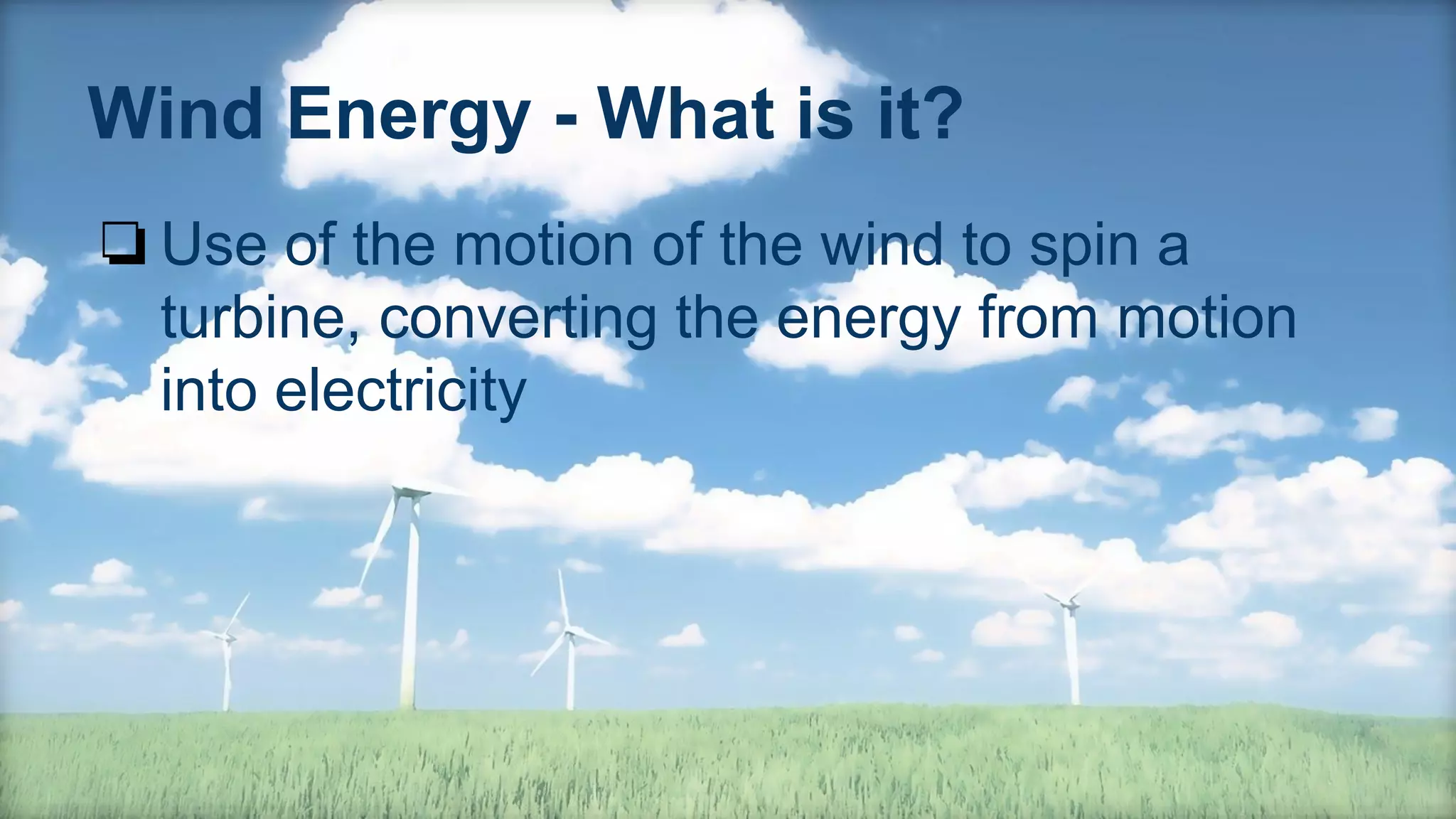
Wind Energy - What is it?
❏Use of the motion of the wind to spin a
turbine, converting the energy from motion
into electricity
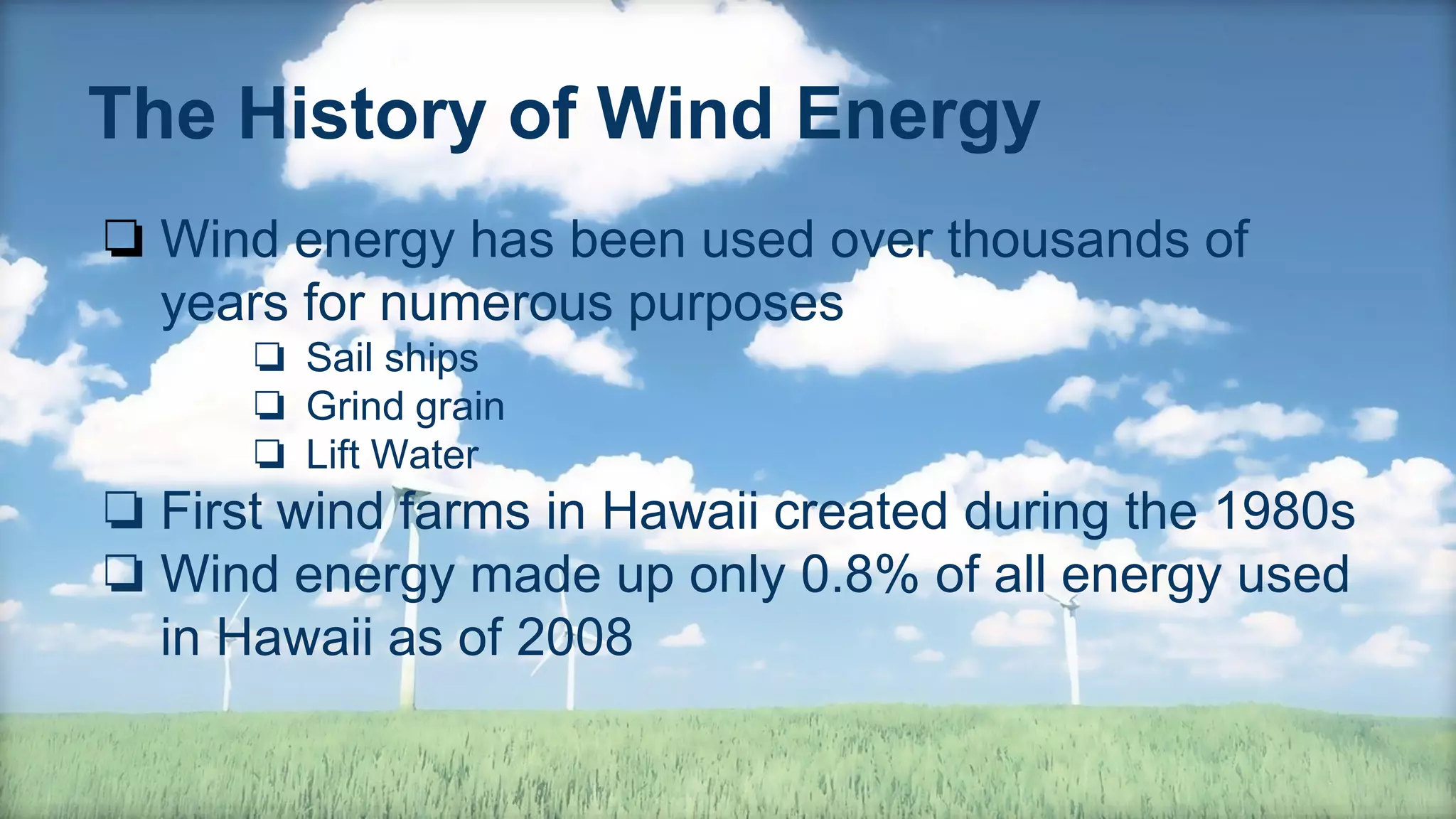
The History of Wind Energy
❏ Wind energy has been used over thousands of
years for numerous purposes
❏ Sail ships
❏ Grind grain
❏ Lift Water
❏ First wind farms in Hawaii created during the 1980s
❏ Wind energy made up only 0.8% of all energy used
in Hawaii as of 2008
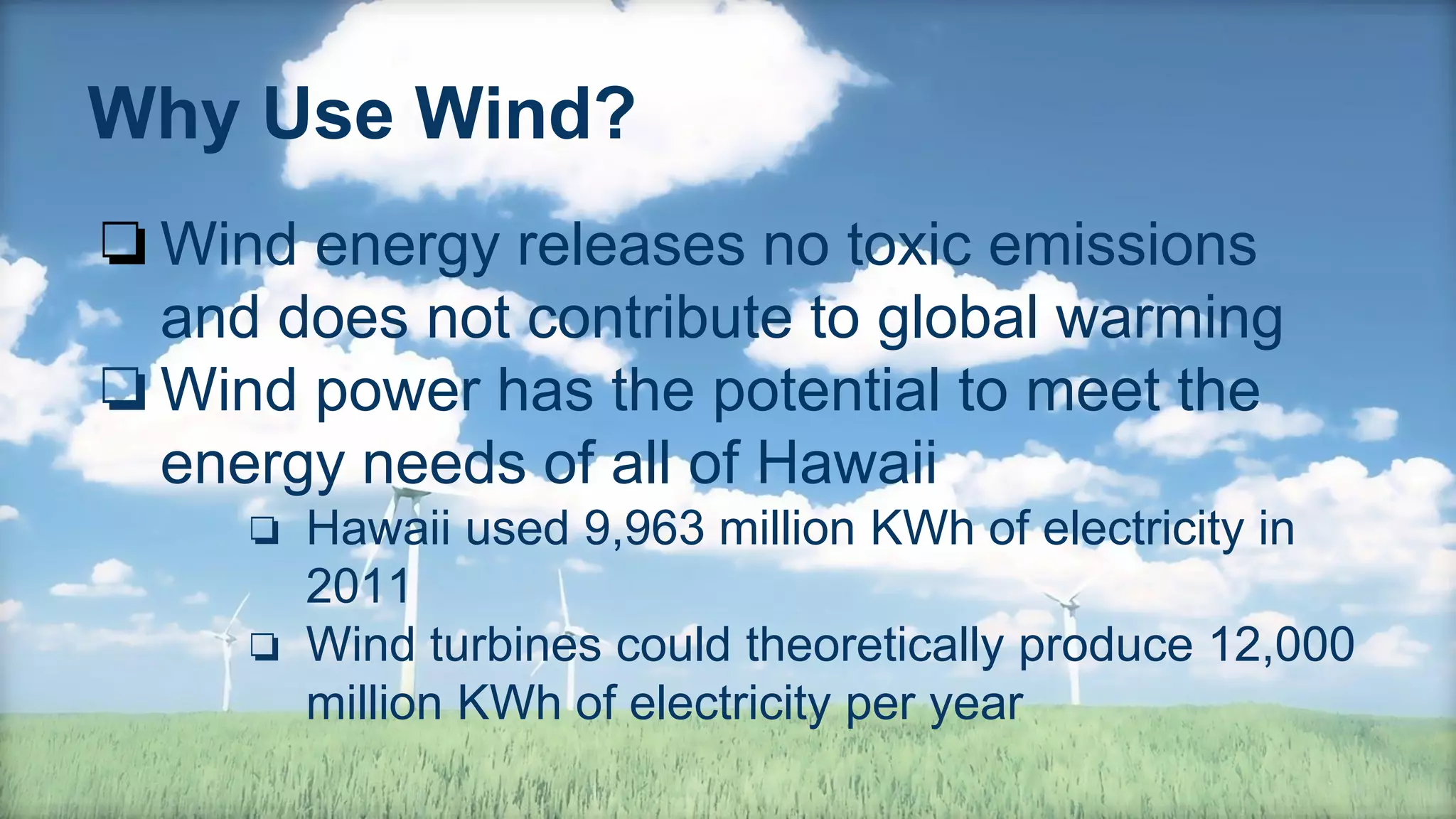
Why Use Wind?
❏Wind energy releases no toxic emissions
and does not contribute to global warming
❏Wind power has the potential to meet the
energy needs of all of Hawaii
❏ Hawaii used 9,963 million KWh of electricity in
2011
❏ Wind turbines could theoretically produce 12,000
million KWh of electricity per year
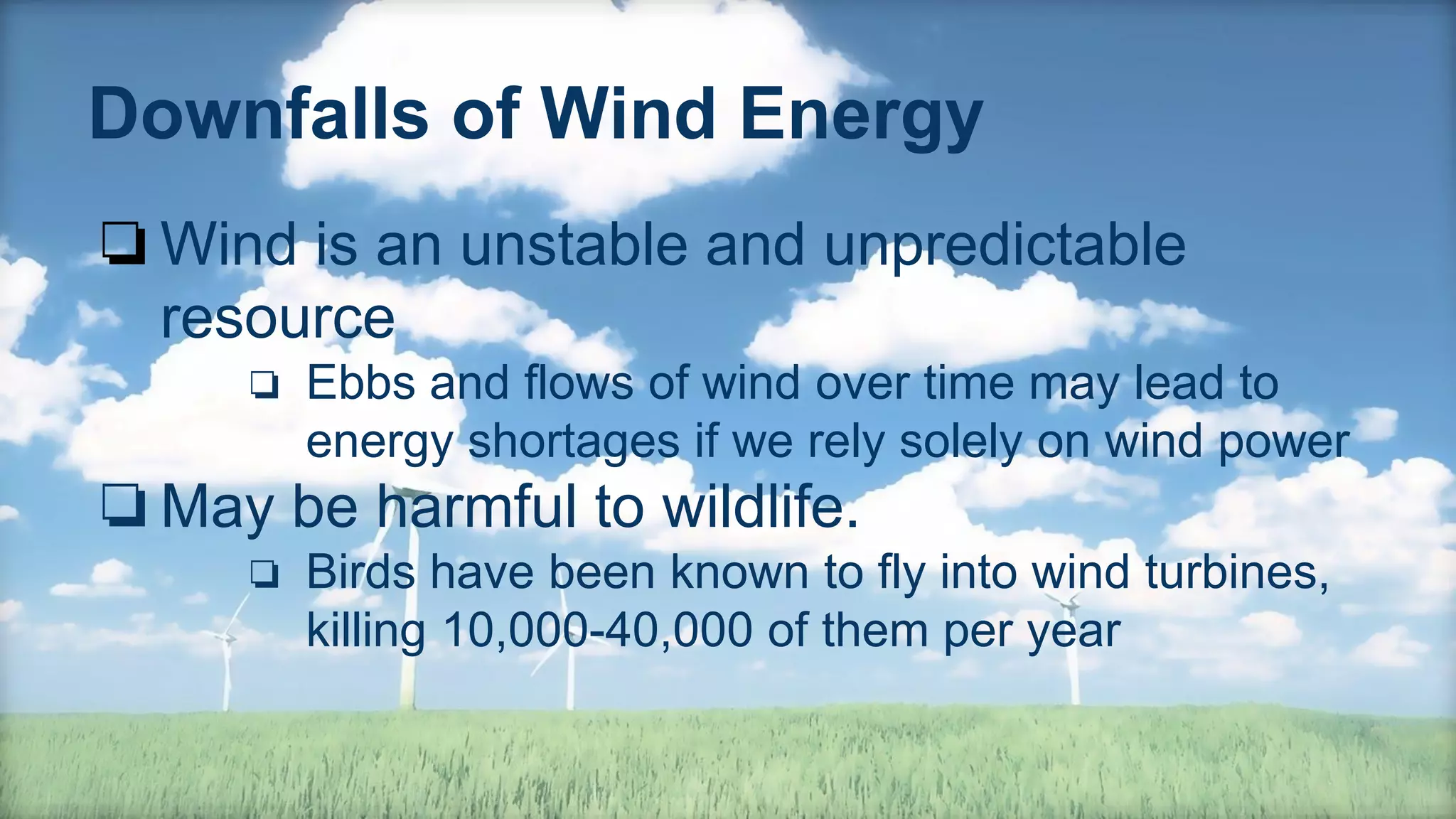
Downfalls of Wind Energy
❏Wind is an unstable and unpredictable
resource
❏ Ebbs and flows of wind over time may lead to
energy shortages if we rely solely on wind power
❏May be harmful to wildlife.
❏ Birds have been known to fly into wind turbines,
killing 10,000-40,000 of them per year
Wave Energy - What is it?
❏The transport of energy by ocean waves
and the capturing of that energy in order to
create electricity
Why Use Waves?
❏ Wave energy releases no harmful greenhouse gasses
and does not contribute to global warming
❏ Wave energy is easily Predictable
❏ Wave energy produces no land damage
❏ Hawaii is surrounded by the Pacific Ocean and is
therefore rich in renewable wave energy
❏ Hawaii’s ocean wave resources are among the highest in
the U.S
Downfalls of Wave Energy
❏Variation in wave energy
❏ Wave energy is not practical in every location
❏ Weak Performance in rough weather
❏Negative Effect on Marine Ecosystem
❏ Creates hazards to some of the creatures near it
❏Creates noise and visual pollution
❏Wave energy is a new technology, it needs
more research, making it expensive
Ideal Areas for the Harnessing of Wave Energy
❏Hawaii Island
❏Kauai
❏Maui
❏Oahu
❏ Kaneohe, Oahu is ideal for wave energy development due to its
proximity to population centers and the availability of a shallow
shelf off the vantage point from accessible areas (Stopa et al.,
2013)
Solar Energy - What is it?
❏The use of solar modules in order to collect
sunlight, exciting electrons in the solar panel
and creating electricity
Why Use Solar?
❏Solar energy is non-polluting and renewable
❏ It creates no noise or emissions
❏Solar Energy is reliable
❏ Most solar panels have warranties up to 25 years and
last even longer
❏Money saved from using solar energy would
outweigh costs of installing solar panels
❏Solar energy could theoretically meet all of
Hawaii’s energy needs
Downfalls of Solar Energy
❏Solar panels require large tracts of land to
be effective
❏The initial costs of installing solar panels are
very expensive
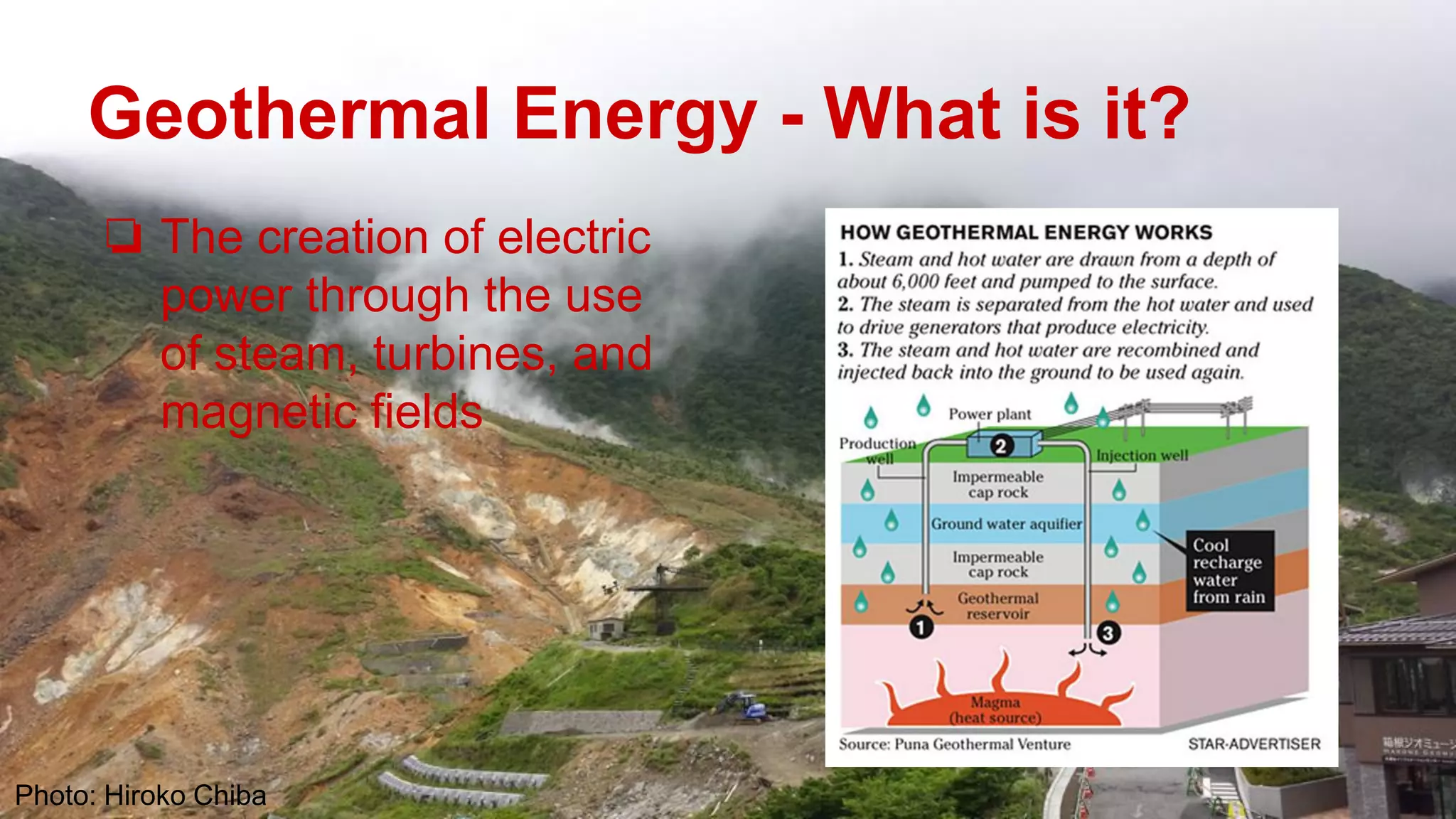
Geothermal Energy - What is it?
❏ The creation of electric
power through the use
of steam, turbines, and
magnetic fields
Photo: Hiroko Chiba
Geothermal Use in Hawaii
❏Puna Geothermal Venture (PGV)
❏ Location: Puna, Hawaii Island
❏ Energy source: Geothermal steam and hot liquids
❏ Technology: Steam turbine generators
❏ Contract capacity: 30 megawatts with an 8 megawatt
expansion
❏ System: Two air-cooled power plants combined
❏ Cycle system
❏ Binary system
Why Use Geothermal?
❏ Geothermal energy is renewable
❏ Geothermal energy releases less greenhouse gasses
❏ Less greenhouse gasses ⇒ less greenhouse effect
❏ Independence from fossil fuel
❏ Geothermal energy is more economic
❏ Geothermal energy is stable
❏ It offers stable energy output regardless of weather,
season, or time of day
❏ Reliability is due to stable steam flows produced by
geothermal energy
Downfalls of Geothermal Energy
❏ Geothermal energy is still a developing technology
❏ The initial costs of implementing geothermal technology are
very high
❏ Minor environmental issues
❏ In extreme cases may cause earthquakes
❏ Costs of heating/cooling systems
❏ Only sustainable if properly managed
❏ Drilling site pollution
❏ No guarantee that possible sites will provide desired
quantities, due to cooling of earth’s surface
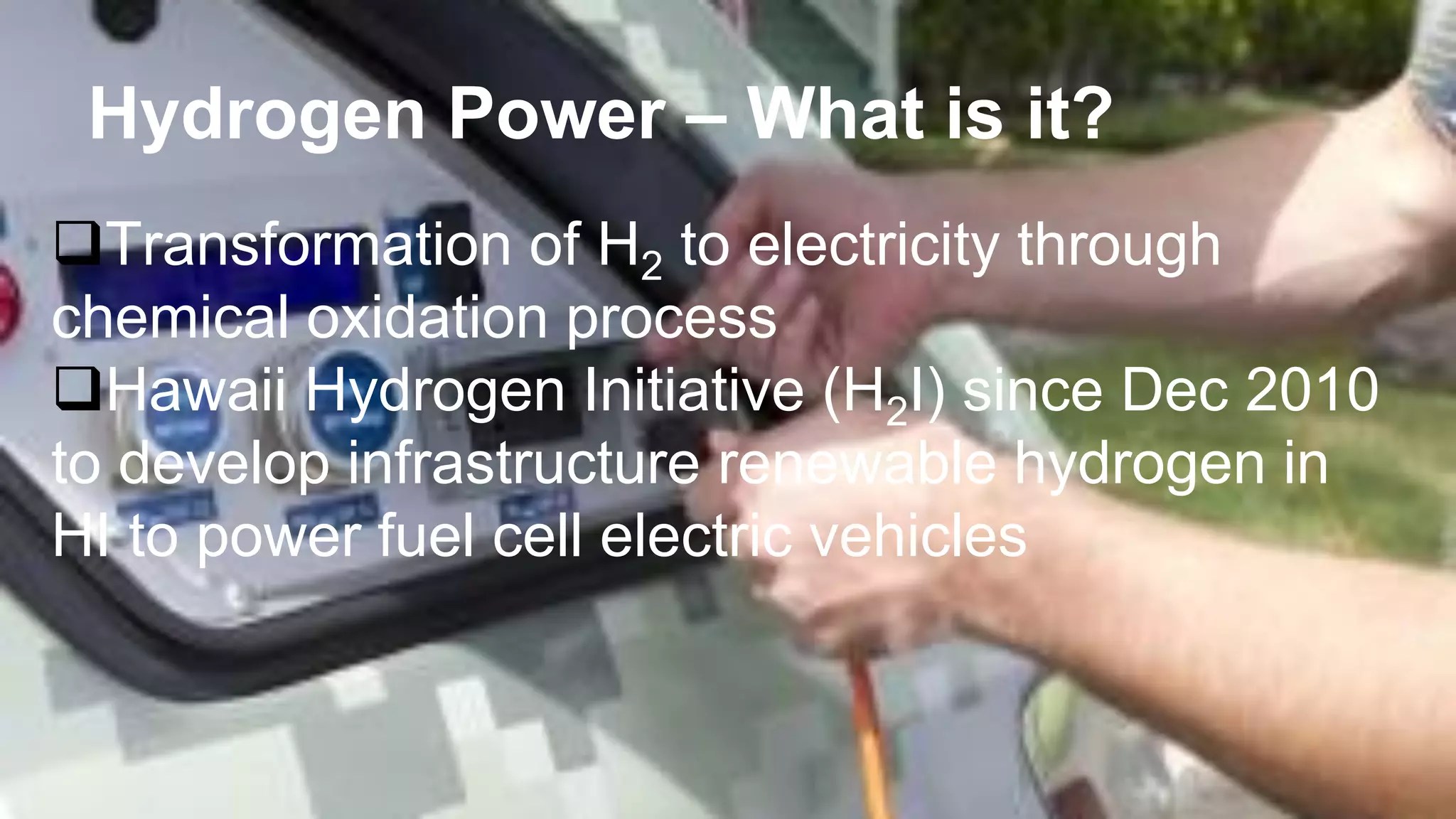
Hydrogen Power – What is it?
Transformation of H2 to electricity through
chemical oxidation process
Hawaii Hydrogen Initiative (H2I) since Dec 2010
to develop infrastructure renewable hydrogen in
HI to power fuel cell electric vehicles
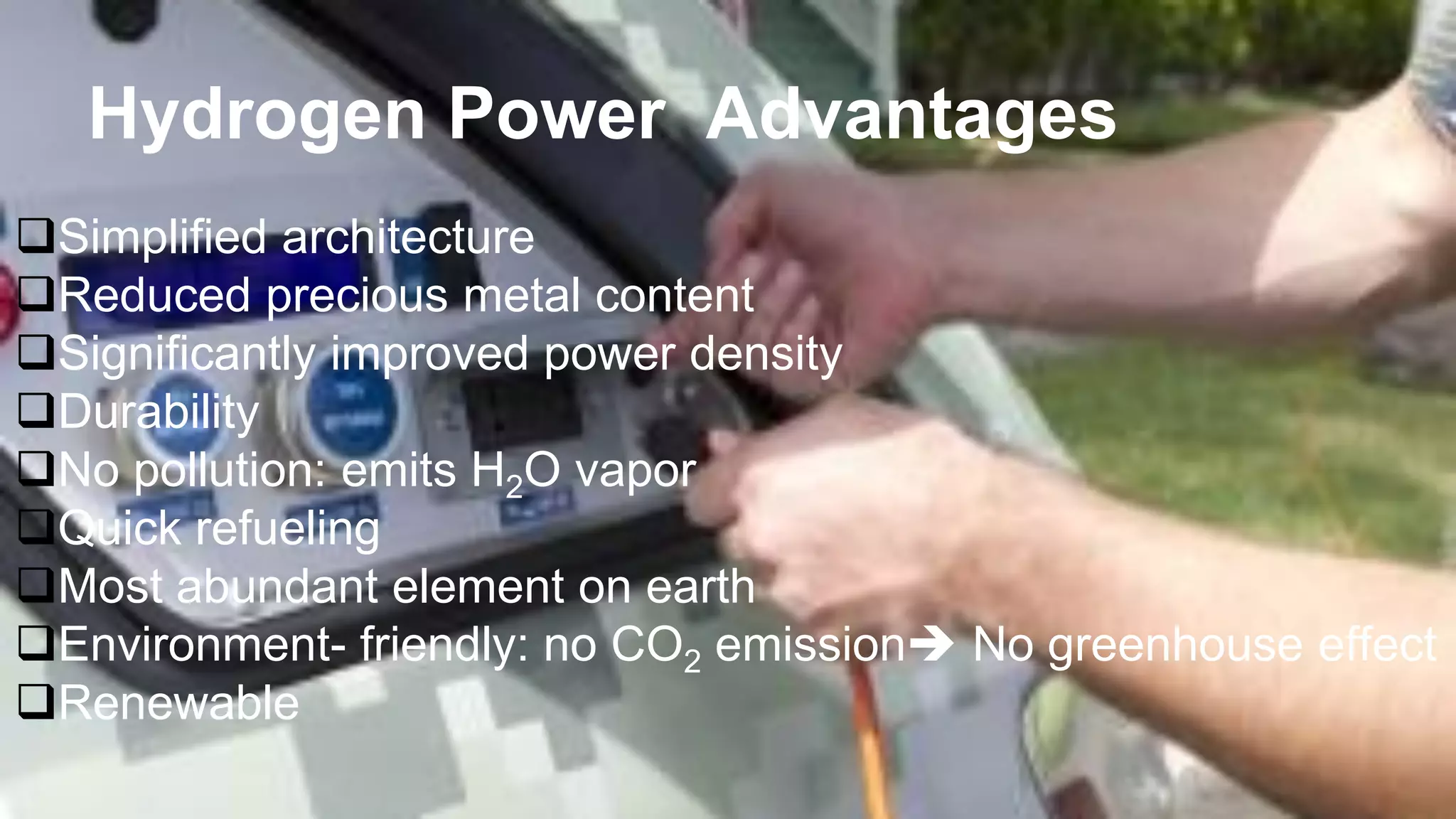
Hydrogen Power Advantages
Simplified architecture
Reduced precious metal content
Significantly improved power density
Durability
No pollution: emits H2O vapor
Quick refueling
Most abundant element on earth
Environment- friendly: no CO2 emission No greenhouse effect
Renewable
Hydrogen Power Downfall
No infrastructure
Expensive research and development
Electrolysis is the least efficient way of obtaining
hydrogen
Storage issues
Expensive transportation
Next Steps
❏Get involved
❏ Let people know that we need and can create infrastructure to
take advantage of natural energies
❏ Create or join groups working toward a more sustainable Hawaii
❏ Try to live a more natural and sustainable lifestyle
❏Take it to the government
❏ Hold Seminars through Sience program at UHH to publicly
promote and also support the idea to authorities
❏ Petition for lawmakers to cut reliance on fossil fuels and to take
action in creating infrastructure that takes advantage of abundant
natural resources
❏ Write to politicians stating what you want done to create a more
sustainable Hawaii
Works Cited
Hawaii State Energy Office. (n.d.). Hawaii State Energy Office. Retrieved June 18, 2014, from
http://energy.hawaii.gov/renewable-energy/wind
Markiesha Gervacio / UH at Manoa (2009). Rscatter. Retrieved June 22, 2014, from http://www2.hawaii.edu/~markiesh/100/Rscatter.pdf
Phillips, V., Chuveliov, A., & Takahashi, P. (2003). Renewable-Energy paradox in paradise: A case study of Hawaii. Elsevier, 47(4),
299-339. Retrieved June 17, 2014, from http://cletus.uhh.hawaii.edu:2069/science/article/pii/030626199490040X
Puna Geothermal Venture (PGV). (n.d.). Hawaiian Electric:. Retrieved June 16, 2014, from
http://www.heco.com/heco/_hidden_Hidden/Renewable-Energy/Puna-Geothermal-Venture-(PGV)?cpsextcurrchannel=1
Renewable Energy, Hydrogen and Fuel Cells, Hydrogen Power. (n.d.). Retrieved June 22, 2014, from
http://www.altenergy.org/renewables/hydrogen_power.html
Stopa, J., Filipot, J., Li, N., Cheung, K. F., Chen, Y., & Vega, L. (2013). Wave energy resources along the Hawaiian Island chain.
Elsevier, 55, 305-321. Retrieved June 17, 2014, from http://cletus.uhh.hawaii.edu:2069/science/article/pii/S0960148112007963
U.S. Energy Information Administration - EIA - Independent Statistics and Analysis. (2013, December 18). Hawaii. Retrieved June 18,
2014, from http://www.eia.gov/state/analysis.cfm?sid=HI
Wind Energy. (n.d.). Hawaiian Electric:. Retrieved June 17, 2014, from http://energy.hawaii.gov/renewable-energy/wind
H2I | Hawai‘i Hydrogen Initiative. (2010). Retrieved June 22, 2014, from http://www.hydrogen2hawaii.com

Com 344 final project presentation renewable energy in hi

  • 1.
    Renewable Energy inHawaii Kaylee Castillo, Hiroko Chiba, Metotagivale Meredith, & Cheyne Yonemori
  • 2.
    Why Should WeStop Using Petroleum? ❏ Hawaii is the most petroleum dependent state ❏ 4/5 of state’s energy comes from petroleum ❏ 1/10 of state’s GDP spent on energy, mostly for importing foreign petroleum ❏ Hawaii produces no petroleum and has no proven petroleum reserves ❏ Only two petroleum refineries on Oahu supply 9/10 of Hawaii’s demand, creating a duopoly ❏ Use of petroleum releases toxic emissions that cause to global warming ❏ Save money ❏ By switching from fossil fuels to indigenous renewable energy resources can save Hawaii’s citizens $200 billion (Phillips et al., 2003)
  • 3.
    What’s Being Done? ❏TheHawaii Clean Energy Initiative aims to reduce Hawaii’s dependence on petroleum ❏ HCEI’s major goal is to displace 70% of petroleum based ground transportation fuels with locally sourced biofuels by 2030.
  • 4.
    Wind Energy -What is it? ❏Use of the motion of the wind to spin a turbine, converting the energy from motion into electricity
  • 5.
    The History ofWind Energy ❏ Wind energy has been used over thousands of years for numerous purposes ❏ Sail ships ❏ Grind grain ❏ Lift Water ❏ First wind farms in Hawaii created during the 1980s ❏ Wind energy made up only 0.8% of all energy used in Hawaii as of 2008
  • 6.
    Why Use Wind? ❏Windenergy releases no toxic emissions and does not contribute to global warming ❏Wind power has the potential to meet the energy needs of all of Hawaii ❏ Hawaii used 9,963 million KWh of electricity in 2011 ❏ Wind turbines could theoretically produce 12,000 million KWh of electricity per year
  • 7.
    Downfalls of WindEnergy ❏Wind is an unstable and unpredictable resource ❏ Ebbs and flows of wind over time may lead to energy shortages if we rely solely on wind power ❏May be harmful to wildlife. ❏ Birds have been known to fly into wind turbines, killing 10,000-40,000 of them per year
  • 8.
    Wave Energy -What is it? ❏The transport of energy by ocean waves and the capturing of that energy in order to create electricity
  • 9.
    Why Use Waves? ❏Wave energy releases no harmful greenhouse gasses and does not contribute to global warming ❏ Wave energy is easily Predictable ❏ Wave energy produces no land damage ❏ Hawaii is surrounded by the Pacific Ocean and is therefore rich in renewable wave energy ❏ Hawaii’s ocean wave resources are among the highest in the U.S
  • 10.
    Downfalls of WaveEnergy ❏Variation in wave energy ❏ Wave energy is not practical in every location ❏ Weak Performance in rough weather ❏Negative Effect on Marine Ecosystem ❏ Creates hazards to some of the creatures near it ❏Creates noise and visual pollution ❏Wave energy is a new technology, it needs more research, making it expensive
  • 11.
    Ideal Areas forthe Harnessing of Wave Energy ❏Hawaii Island ❏Kauai ❏Maui ❏Oahu ❏ Kaneohe, Oahu is ideal for wave energy development due to its proximity to population centers and the availability of a shallow shelf off the vantage point from accessible areas (Stopa et al., 2013)
  • 12.
    Solar Energy -What is it? ❏The use of solar modules in order to collect sunlight, exciting electrons in the solar panel and creating electricity
  • 13.
    Why Use Solar? ❏Solarenergy is non-polluting and renewable ❏ It creates no noise or emissions ❏Solar Energy is reliable ❏ Most solar panels have warranties up to 25 years and last even longer ❏Money saved from using solar energy would outweigh costs of installing solar panels ❏Solar energy could theoretically meet all of Hawaii’s energy needs
  • 14.
    Downfalls of SolarEnergy ❏Solar panels require large tracts of land to be effective ❏The initial costs of installing solar panels are very expensive
  • 15.
    Geothermal Energy -What is it? ❏ The creation of electric power through the use of steam, turbines, and magnetic fields Photo: Hiroko Chiba
  • 16.
    Geothermal Use inHawaii ❏Puna Geothermal Venture (PGV) ❏ Location: Puna, Hawaii Island ❏ Energy source: Geothermal steam and hot liquids ❏ Technology: Steam turbine generators ❏ Contract capacity: 30 megawatts with an 8 megawatt expansion ❏ System: Two air-cooled power plants combined ❏ Cycle system ❏ Binary system
  • 17.
    Why Use Geothermal? ❏Geothermal energy is renewable ❏ Geothermal energy releases less greenhouse gasses ❏ Less greenhouse gasses ⇒ less greenhouse effect ❏ Independence from fossil fuel ❏ Geothermal energy is more economic ❏ Geothermal energy is stable ❏ It offers stable energy output regardless of weather, season, or time of day ❏ Reliability is due to stable steam flows produced by geothermal energy
  • 18.
    Downfalls of GeothermalEnergy ❏ Geothermal energy is still a developing technology ❏ The initial costs of implementing geothermal technology are very high ❏ Minor environmental issues ❏ In extreme cases may cause earthquakes ❏ Costs of heating/cooling systems ❏ Only sustainable if properly managed ❏ Drilling site pollution ❏ No guarantee that possible sites will provide desired quantities, due to cooling of earth’s surface
  • 19.
    Hydrogen Power –What is it? Transformation of H2 to electricity through chemical oxidation process Hawaii Hydrogen Initiative (H2I) since Dec 2010 to develop infrastructure renewable hydrogen in HI to power fuel cell electric vehicles
  • 20.
    Hydrogen Power Advantages Simplifiedarchitecture Reduced precious metal content Significantly improved power density Durability No pollution: emits H2O vapor Quick refueling Most abundant element on earth Environment- friendly: no CO2 emission No greenhouse effect Renewable
  • 21.
    Hydrogen Power Downfall Noinfrastructure Expensive research and development Electrolysis is the least efficient way of obtaining hydrogen Storage issues Expensive transportation
  • 22.
    Next Steps ❏Get involved ❏Let people know that we need and can create infrastructure to take advantage of natural energies ❏ Create or join groups working toward a more sustainable Hawaii ❏ Try to live a more natural and sustainable lifestyle ❏Take it to the government ❏ Hold Seminars through Sience program at UHH to publicly promote and also support the idea to authorities ❏ Petition for lawmakers to cut reliance on fossil fuels and to take action in creating infrastructure that takes advantage of abundant natural resources ❏ Write to politicians stating what you want done to create a more sustainable Hawaii
  • 23.
    Works Cited Hawaii StateEnergy Office. (n.d.). Hawaii State Energy Office. Retrieved June 18, 2014, from http://energy.hawaii.gov/renewable-energy/wind Markiesha Gervacio / UH at Manoa (2009). Rscatter. Retrieved June 22, 2014, from http://www2.hawaii.edu/~markiesh/100/Rscatter.pdf Phillips, V., Chuveliov, A., & Takahashi, P. (2003). Renewable-Energy paradox in paradise: A case study of Hawaii. Elsevier, 47(4), 299-339. Retrieved June 17, 2014, from http://cletus.uhh.hawaii.edu:2069/science/article/pii/030626199490040X Puna Geothermal Venture (PGV). (n.d.). Hawaiian Electric:. Retrieved June 16, 2014, from http://www.heco.com/heco/_hidden_Hidden/Renewable-Energy/Puna-Geothermal-Venture-(PGV)?cpsextcurrchannel=1 Renewable Energy, Hydrogen and Fuel Cells, Hydrogen Power. (n.d.). Retrieved June 22, 2014, from http://www.altenergy.org/renewables/hydrogen_power.html Stopa, J., Filipot, J., Li, N., Cheung, K. F., Chen, Y., & Vega, L. (2013). Wave energy resources along the Hawaiian Island chain. Elsevier, 55, 305-321. Retrieved June 17, 2014, from http://cletus.uhh.hawaii.edu:2069/science/article/pii/S0960148112007963 U.S. Energy Information Administration - EIA - Independent Statistics and Analysis. (2013, December 18). Hawaii. Retrieved June 18, 2014, from http://www.eia.gov/state/analysis.cfm?sid=HI Wind Energy. (n.d.). Hawaiian Electric:. Retrieved June 17, 2014, from http://energy.hawaii.gov/renewable-energy/wind H2I | Hawai‘i Hydrogen Initiative. (2010). Retrieved June 22, 2014, from http://www.hydrogen2hawaii.com