CANONICAL DATA MODEL
Govind Mulinti
2015 © WHISHWORKS. All rights reserved. WHISHWORKS Confidential
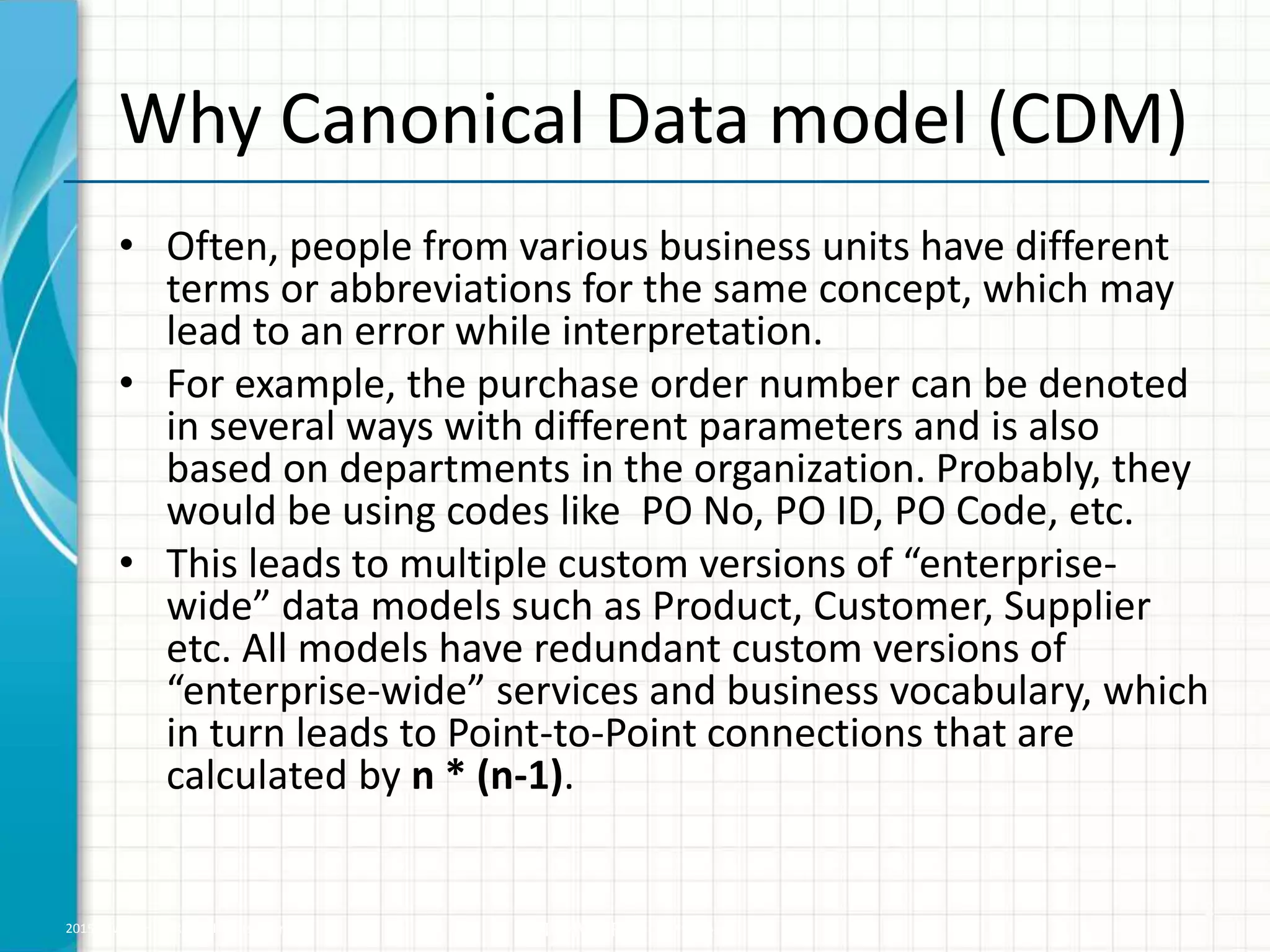
• Often, people from various business units have different
terms or abbreviations for the same concept, which may
lead to an error while interpretation.
• For example, the purchase order number can be denoted
in several ways with different parameters and is also
based on departments in the organization. Probably, they
would be using codes like PO No, PO ID, PO Code, etc.
• This leads to multiple custom versions of “enterprise-
wide” data models such as Product, Customer, Supplier
etc. All models have redundant custom versions of
“enterprise-wide” services and business vocabulary, which
in turn leads to Point-to-Point connections that are
calculated by n * (n-1).
2
Why Canonical Data model (CDM)
2015 © WHISHWORKS. All rights reserved. WHISHWORKS Confidential
Enterprise integrated across systems
3
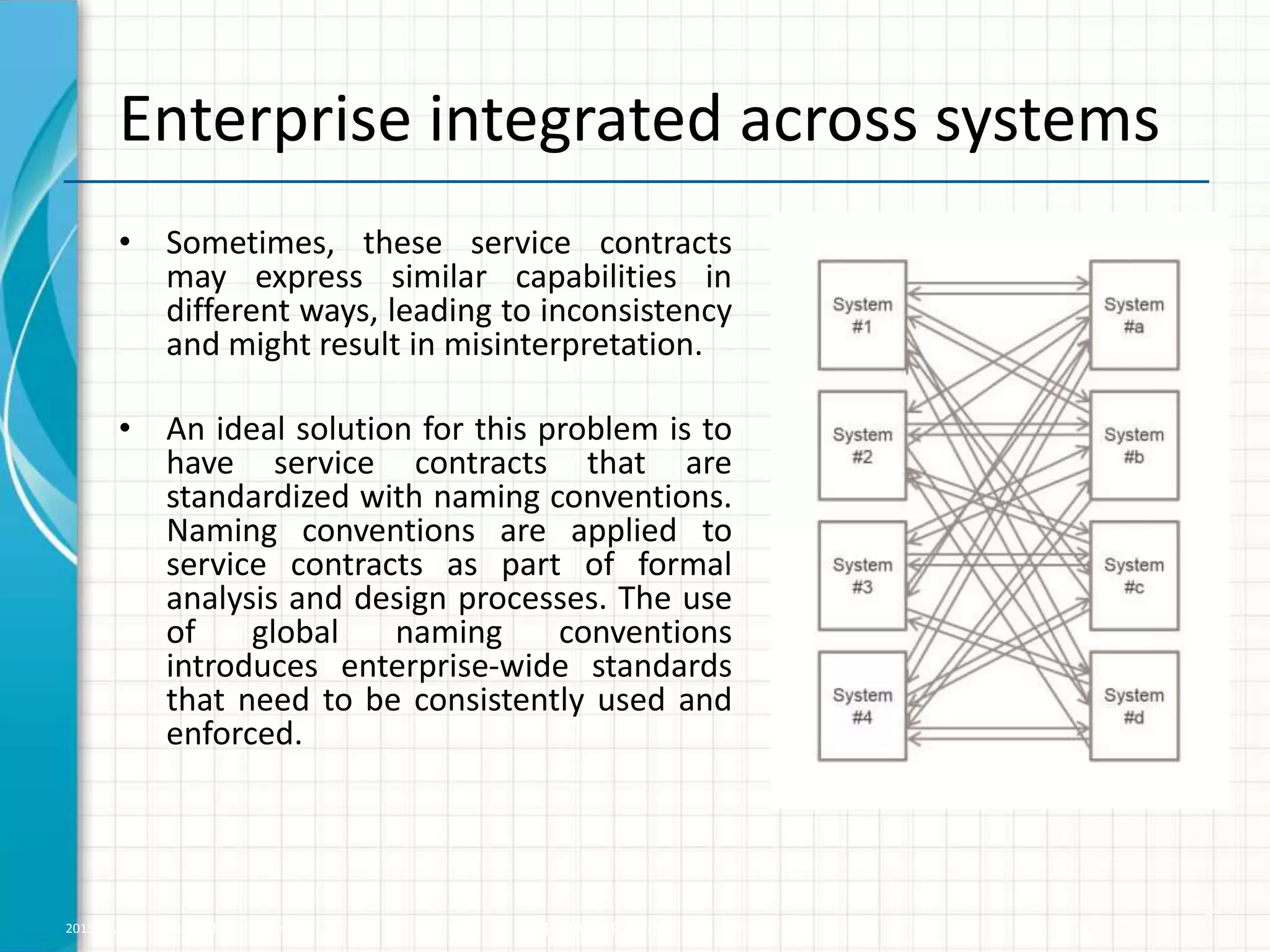
• Sometimes, these service contracts
may express similar capabilities in
different ways, leading to inconsistency
and might result in misinterpretation.
• An ideal solution for this problem is to
have service contracts that are
standardized with naming conventions.
Naming conventions are applied to
service contracts as part of formal
analysis and design processes. The use
of global naming conventions
introduces enterprise-wide standards
that need to be consistently used and
enforced.
2015 © WHISHWORKS. All rights reserved. WHISHWORKS Confidential
CDM - Shift
4
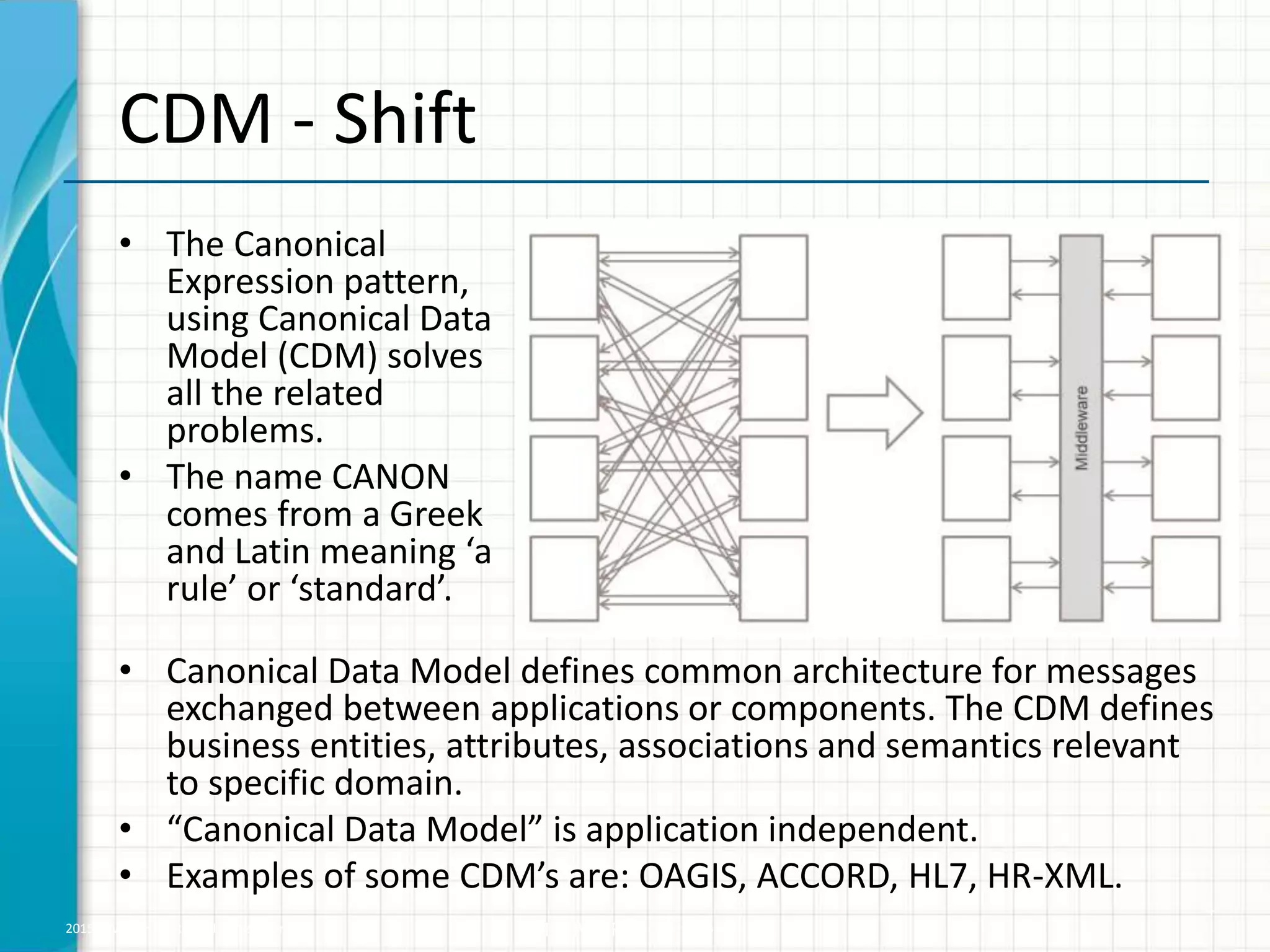
• The Canonical
Expression pattern,
using Canonical Data
Model (CDM) solves
all the related
problems.
• The name CANON
comes from a Greek
and Latin meaning ‘a
rule’ or ‘standard’.
• Canonical Data Model defines common architecture for messages
exchanged between applications or components. The CDM defines
business entities, attributes, associations and semantics relevant
to specific domain.
• “Canonical Data Model” is application independent.
• Examples of some CDM’s are: OAGIS, ACCORD, HL7, HR-XML.
2015 © WHISHWORKS. All rights reserved. WHISHWORKS Confidential
Benefits and downsides
5
• Benefits of the CDM shift are:
– Improve Business Communication through standardization
– Increase re-use of Software Components
– No. of possible connections is (n * 2) against n (n-1).
– Reduce transformations
– Reduce Integration Time and Cost
• Few downsides while using CDM are
– CDM’s are too generic (BIG in size) (Light versions might
release in order to solve this problem)
– CDM usage might impact run-time performance
– In general, CDM’s do not contain business validations

Canonical data model

  • 1.
  • 2.
    2015 © WHISHWORKS.All rights reserved. WHISHWORKS Confidential • Often, people from various business units have different terms or abbreviations for the same concept, which may lead to an error while interpretation. • For example, the purchase order number can be denoted in several ways with different parameters and is also based on departments in the organization. Probably, they would be using codes like PO No, PO ID, PO Code, etc. • This leads to multiple custom versions of “enterprise- wide” data models such as Product, Customer, Supplier etc. All models have redundant custom versions of “enterprise-wide” services and business vocabulary, which in turn leads to Point-to-Point connections that are calculated by n * (n-1). 2 Why Canonical Data model (CDM)
  • 3.
    2015 © WHISHWORKS.All rights reserved. WHISHWORKS Confidential Enterprise integrated across systems 3 • Sometimes, these service contracts may express similar capabilities in different ways, leading to inconsistency and might result in misinterpretation. • An ideal solution for this problem is to have service contracts that are standardized with naming conventions. Naming conventions are applied to service contracts as part of formal analysis and design processes. The use of global naming conventions introduces enterprise-wide standards that need to be consistently used and enforced.
  • 4.
    2015 © WHISHWORKS.All rights reserved. WHISHWORKS Confidential CDM - Shift 4 • The Canonical Expression pattern, using Canonical Data Model (CDM) solves all the related problems. • The name CANON comes from a Greek and Latin meaning ‘a rule’ or ‘standard’. • Canonical Data Model defines common architecture for messages exchanged between applications or components. The CDM defines business entities, attributes, associations and semantics relevant to specific domain. • “Canonical Data Model” is application independent. • Examples of some CDM’s are: OAGIS, ACCORD, HL7, HR-XML.
  • 5.
    2015 © WHISHWORKS.All rights reserved. WHISHWORKS Confidential Benefits and downsides 5 • Benefits of the CDM shift are: – Improve Business Communication through standardization – Increase re-use of Software Components – No. of possible connections is (n * 2) against n (n-1). – Reduce transformations – Reduce Integration Time and Cost • Few downsides while using CDM are – CDM’s are too generic (BIG in size) (Light versions might release in order to solve this problem) – CDM usage might impact run-time performance – In general, CDM’s do not contain business validations