BIOREACTOR
GLAXY EZEKEL.V
ROLL NO: 2
M.PHIL BOTANY
ST.TERESAS COLLEGE. ERNAKULAM
• Bioreactor: scaling up and cost reduction
• Production of useful compounds via
biotransformation
• Secondary metabolite production
• Suspension cultures
• Immobilization
• Examples of chemicals being produced for use in
pharmacy, medicine and industry
• Management and marketing
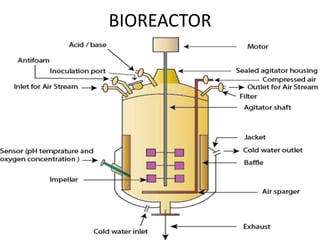
BIOREACTOR
SIDE VIEW FRONT VIEW
• It is a cylindrical vessel
• It is a vessel in which chemical
process which involves
organisms or biochemically
active substances derived
from such 9rganisms are
carried out.
• under sterile condition &
control of environmental
conditions
• This process can either be
aerobic or anaerobic.
• The bioreactors are commonly
cylindrical, ranging in size
from litres to cubic metres,
• are often made of stainless
steel.
AIM OF BIORERACTOR
• To provide a controlled environment to achieve
optimal growth and/or product formation in the
particular cell system employed.
• Bioreactors are used in the biotechnological
production of substances such as pharmaceuticals,
antibodies, or vaccines, or for the bioconversion of
organic waste.
• The function of the bioreactor is to provide a suitable
environment in which an organism can efficiently
produce a target product
• the target product might be
Cell biomass
Metabolite
Transformed Product
• The performance of any bioreactor depends on the key
factors such as:
Agitation rate
Oxygen transfer
Temperature
Foam production
pH
BIOREACTOR SHOULD HAVE FOLLOWING
QUALITIES
• The vessel – capable of being operated aseptically
for a number of days.
• Adequate aeration and agitation
• Power consumption - should be as low as possible.
• Temperature control and pH should be provided.
• Sampling facilities should be provided.
• Evaporation losses from fermenter should not be
excessive.
• Minimal use of labor in operation, harvesting,
cleaning and maintenance.
• Should have internal smooth surfaces .
• Containment involves prevention of escape of
viable cells from a fermenter or downstream
equipment.
• Aseptic operation involves protection against
contamination.
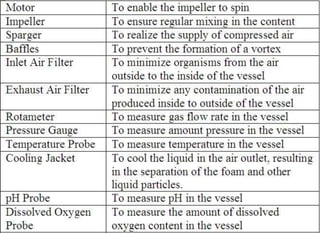
PARTS OF A BIOREACTOR
BIOREACTOR
VESSEL
• Glass vessel with a round or flat bottom and a top
flanged carrying plate.
• The large glass containers originally used were
borosilicate battery jars.
• They are sterilized by autoclaving.
• Glass is useful because it gives smooth surfaces, is
nontoxic, corrosion proof and it is easy to examine
the interior of the vessel
• More expensive.
• Pilot-scale and industrial scale – stainless steel
AERATION AND AGITATION
• Aeration provide microorganisms in submerged
culture with sufficient oxygen for metabolic
requirements.
• Agitation is the mixing or uniform suspension of
microbial cells in homogeneous nutrient medium.
• Structural components involved in aeration and
agitation are…
1. Agitator (impeller)
2. Baffles
3. Aeration system (sparger)
AGITATOR
• Also known as impeller
 bulk fluid and gas-phase mixing
air dispersion
oxygen transfer
 heat transfer
 suspension of solid particles
maintaining uniform environment throughout
vessel contents.
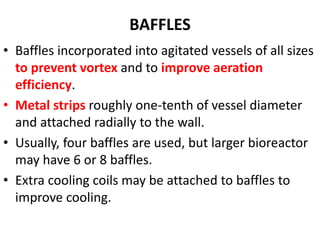
BAFFLES
• Baffles incorporated into agitated vessels of all sizes
to prevent vortex and to improve aeration
efficiency.
• Metal strips roughly one-tenth of vessel diameter
and attached radially to the wall.
• Usually, four baffles are used, but larger bioreactor
may have 6 or 8 baffles.
• Extra cooling coils may be attached to baffles to
improve cooling.
CLASSIFICATION OF BIOREACTOR
Based on the need
of oxygen
Based on the mode
of use
Based on the mode
of operations
Based on the mode
of growing
microbes
Based on the mode
of type of
bioreactors used in
the industries
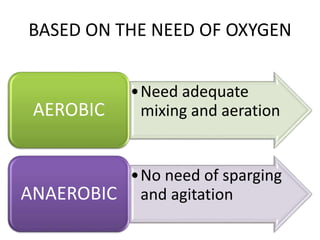
BASED ON THE NEED OF OXYGEN
•Need adequate
mixing and aerationAEROBIC
•No need of sparging
and agitationANAEROBIC
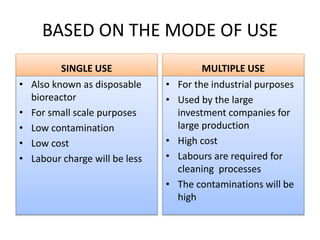
BASED ON THE MODE OF USE
SINGLE USE
• Also known as disposable
bioreactor
• For small scale purposes
• Low contamination
• Low cost
• Labour charge will be less
MULTIPLE USE
• For the industrial purposes
• Used by the large
investment companies for
large production
• High cost
• Labours are required for
cleaning processes
• The contaminations will be
high
BASED ON THE MODE OF OPERATION
BATCH
FED-BATCH
CONTINOUS
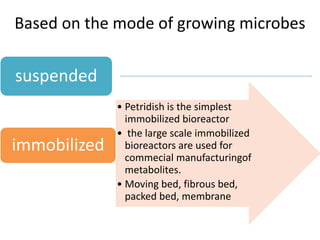
Based on the mode of growing microbes
suspended
• Petridish is the simplest
immobilized bioreactor
• the large scale immobilized
bioreactors are used for
commecial manufacturingof
metabolites.
• Moving bed, fibrous bed,
packed bed, membrane
immobilized
BASED ON THE TYPES OF BIOREACTORS
USED IN INDUSTRIES
• Stirred tank bioreactor
• Continuous stirred tank bioreactor
• Bubble column bioreactor
• Air lift bioreactor
• Tower bioreactor
• Jet-loop bioreactor
• Fixed bed bioreactor
• Fluidised bed bioreactor
• Propeller bioreactor
• Flocullated bioreactor
• Gaseous phase bioreactor
• photobioreactor
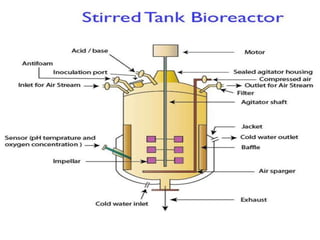
Stirred tank bioreactor
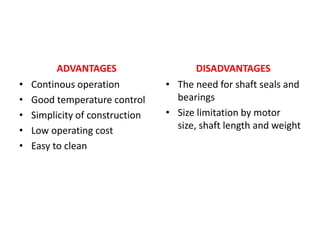
ADVANTAGES
• Continous operation
• Good temperature control
• Simplicity of construction
• Low operating cost
• Easy to clean
DISADVANTAGES
• The need for shaft seals and
bearings
• Size limitation by motor
size, shaft length and weight
CONTINUOUS STIRRED TANK BIOREACTOR
Advantages
• Continuous operation
• Good temperature control
• Easily adapts to two phase
runs
• Good control
• Simplicity of construction
• Low operating (labor) cost
• Easy to clean
Disadvantages
• The need for shaft seals and
bearings.
• Size limitation by motor
size, shaft length and
weight.
BUBBLE COLUMN BIOREACTOR
ADVANTAGES
• They have excellent heat
and mass transfer
charectristics
• Little maintenance
• Low operating cost
• Lack of moving parts and
compactness
DISADVANTAGES
• The durabilitry of the
catalyst or other packing
material is high
• Oriejnted only on one
phase, i.e either liquid or
gas
AIR LIFT BIOREACTOR
ADVANTAGES
• Simple design
• Easier steriliusation
• Low energy requirement vs
stirred tank
• Greater heat removal vs
stirred tank
• Very low cost
DISADVANTAGES
• Greater air throughput and
higher pressures needed
• Inefficient break the foam
when foaming occurs
• No bubbles breaker
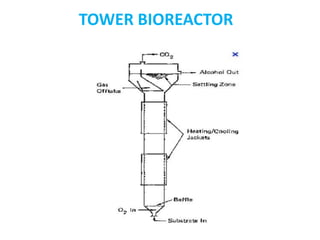
TOWER BIOREACTOR
• Non agitated type of bioreactor
• Used in both continuous and batch process
• It has long tube with closed ends
• The presence of baffles increase the turbulent
and residual time of waves inside the
bioreactor and also helps in aeration
• This type of reactor is used in the production
of beer, citric acid, bakers yeast
FLUIDISED BED BIOREACTOR
ADVANTAGES
• Uniform particle mixing
• Uniform temperature
gradients
• Ability to operate reactor in
continous state
DISADVANTAGES
• Increased reactor vessel size
• Pumping requirements and
pressure drop
• Particle entrainment
• Lack of current
understanding
• Erosion of internal
components
• Pressure loss scenarios
Propeller bioreactor
• Propeller is present
• Loop circulation is
promoted by a
propeller which acts as
a pump to force fluid
either up or down
through a central draft
tube
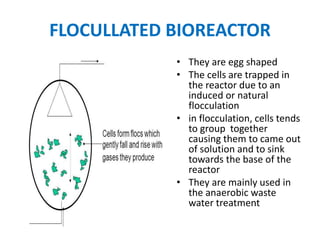
FLOCULLATED BIOREACTOR
• They are egg shaped
• The cells are trapped in
the reactor due to an
induced or natural
flocculation
• in flocculation, cells tends
to group together
causing them to came out
of solution and to sink
towards the base of the
reactor
• They are mainly used in
the anaerobic waste
water treatment
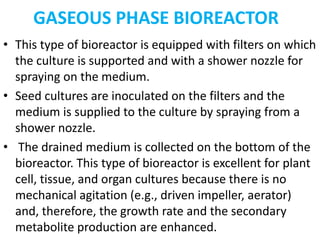
GASEOUS PHASE BIOREACTOR
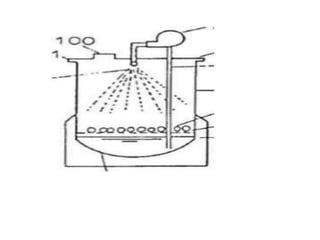
• This type of bioreactor is equipped with filters on which
the culture is supported and with a shower nozzle for
spraying on the medium.
• Seed cultures are inoculated on the filters and the
medium is supplied to the culture by spraying from a
shower nozzle.
• The drained medium is collected on the bottom of the
bioreactor. This type of bioreactor is excellent for plant
cell, tissue, and organ cultures because there is no
mechanical agitation (e.g., driven impeller, aerator)
and, therefore, the growth rate and the secondary
metabolite production are enhanced.
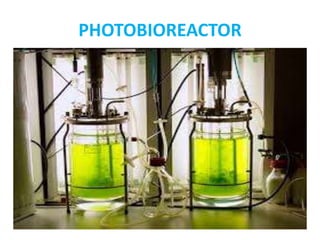
PHOTOBIOREACTOR
ADVANTAGES
• Higher productivity
• Large surface to volume
ratio
• Better control of gas
transfer
• Reduction in evaporation of
growth medium
• More uniform temperature
DISADVANTAGES
• Capital cost is very high
• The productivity and
production cost in some
enclosed photobioreactor
systems are not much
better than those
acheivable in open pond
cultures
• The technical difficulty in
sterilizing
PACKED BED BIOREACTOR
ADVANTAGES
• Higher conversion per unit
mass of catalyst than other
catalytic reactor
• Low operating cost
• Continous operation
• No moving parts to wear out
• Catalyst stays in the reactor
• Reaction mixture/catalyst
seperation is easy
• Effective at high temperatures
and pressures
DISADVANTAGES
• Undesired heat gradients
• Poor temperature control
• Difficult to clean
• Difficult to replace catalyst
• Undesirable side reactions
ROTARY DRUM REACTOR.
ADVANTAGES
• In this, the drum is filled
with 40% of its volume and
rotated by means of rollers.
It is particularly suitable for
the cultivation of the plant
cell cultures.
• High oxygen transfer.
• Good mixing Facilitated
better growth and impart
less hydrodynamic stress
DISADVANTAGES
• Difficult to scale up.
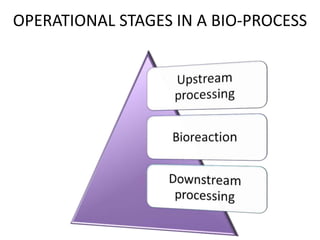
OPERATIONAL STAGES IN A BIO-PROCESS
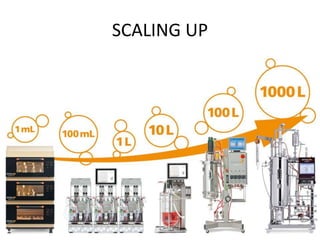
• Products need to be produced at large volume
• This requires scaling up
• We do scaling up studies to ensure that the
fermentation process is technically and
economically viable to be produced in the end
at a large scale.
• Preliminary work is carried out at the level of
petridishes
SCALING UP
• After laboratory scale fermenters have been
used to work out the optimum growth
conditions, the process is next scaled upto a
pilot plant fermenter.
• The pilot plant fermenter is used to trial the
industrial process and production
• It is also using to confirm that the growth
conditions that were optimal in the laboratory
scale fermenter are the same when the process
is scaled up.
• Also ensuring that the products are not at all
harmful to the workers and those who
eventually buy it.
• After upstream processing step, the resulting feed
is transferred to one or more Bioreaction stages.
• The Biochemical reactors or bioreactors form the
base of the Bioreaction step.
• This step is mainly consists of three operations
namely,
i. production of biomass
ii. metabolize biosynthesis
iii. biotransformation.
• Finally, the material produced in the bioreactor
must be further processed in the downstream
section to convert it into more useful form.
• The downstream process is mainly consists of
physical separation operations which includes,
solid liquid separation, adsorption, liquid-liquid
extraction, distillation, drying etc.
• The raw material can be of biological or non-
biological origin.
• It is first converted to more suitable form for
processing.
• This is done in upstream processing step which
involves chemical hydrolysis, preparation of liquid
medium, separation of particulate, air purification
and many other preparatory operations
DOWNSTREAM PROCESSING
• Separation of particles
• Disintegration of cells
• Extraction
• Concentration
• Purification
• Drying
BIOTRANSFORMATION
• It is the chemical modification (or modifications)
made by an organism on a chemical compound.
• If this modification ends in mineral compounds like
CO2, NH4
+, or H2O, the biotransformation is called
mineralisation.
• Biotransformation means chemical alteration of
chemicals such as nutrients, amino acids, toxins,
and drugs in the body.
• It is also needed to render non-polar compounds
polar so that they are not reabsorbed in renal
tubules and are excreted.
DRUG METABOLISM
• The metabolism of a drug or toxin in a body is an
example of a biotransformation.
• The body typically deals with a foreign compound by
making it more water-soluble, to increase the rate of its
excretion through the urine.
• There are many different processes that can occur; the
pathways of drug metabolism can be divided into:
1. phase І
2. phase II
• Drugs can undergo one of four potential
biotransformations: Active Drug to Inactive Metabolite,
Active Drug to Active Metabolite, Inactive Drug to
Active Metabolite, Active Drug to Toxic Metabolite
(biotoxification).
PHASE І REACTION
• Includes oxidative, reductive, and hydrolytic
reactions.
• In these types of reactions, a polar group is either
introduced or unmasked, so the drug molecule
becomes more water-soluble and can be excreted.
• Reactions are non-synthetic in nature and in
general produce a more water-soluble and less
active metabolites.
• The majority of metabolites are generated by a
common hydroxylating enzyme system known as
Cytochrome P450.
PHASE II REACTION
• These reactions involve covalent attachment of
small hydrophilic endogenous molecule such as
glucuronic acid, sulfate, or glycine to form water-
soluble compounds, that are more hydrophilic.
• This is also known as a conjugation reaction.
• The final compounds have a larger molecular
weight.
SECONDARY METABOLITE PRODUCTION
• Plant secondary metabolism produces products that
aid in the growth and development of plants but
are not required for the plant to survive
• A common role of secondary metabolites in plants
is defence mechanism
• It is believed that production of secondary
metabolites is linked to the induction of
morphological differentiation-
WHY SECONDARY METABOLITES
• Chemically warfare to protect plants from the
attacks by predators, pathogens or competitors
• Attract pollinators are seed dispersal agent
• Important for abiotic stress
• Medicine
• Industrial additives
Seven production types of secondry
metabolite production in bioreactors
 shikonin production
 Berberine production
 rosmarinic acid production
 Indole alkaloid production
 Organ culture
 Hairy root culture
 commercialization
SUSPENSION CULTURES
• Suspension culture is a type of culture in
which single cells or small aggregates of cells
multiply while suspended in agitated liquid
medium.
• It is also referred to as cell culture or cell
suspension culture.
PRINCIPLE
• Callus proliferates as an unorganised mass of cells.
• So it is very difficult to follow many cellular events
during its growth and developmental phases.
• To overcome such limitations of callus culture, the
cultivation of free cells as well as small cell
aggregates in a chemically defined liquid medium as
a suspension was initiated to study the
morphological and biochemical changes during
their growth and developmental phases.
• To achieve an ideal cell suspension, most
commonly a friable callus is transferred to agitated
liquid medium where it breaks up and readily
disperses.
• After eliminating the large callus pieces, only
single cells and small cell aggregates are again
transferred to fresh medium and after two or
three weeks a suspension of actively growing cells
is produced.
• This suspension can then be propagated by regular sub-
culture of an aliquot to fresh medium.
• Ideally suspension culture should consist of only single cells
which are physiologically and biochemically uniform.
• Although this ideal culture has yet to be achieved, but it can
be achieved if it is possible to synchronize the process of cell
division, enlargement and differentiation within the cell
population.
• The culture of single cells and cell aggregates in moving liquid
medium can be handled as the culture of microbes.
• The suspension culture eliminates many of the disadvantages
ascribed to the callus culture on agar medium. Movement of
the cells in relation to nutrient medium facilitates gaseous
exchange, removes any polarity of the cells due to gravity and
eliminates the nutrient gradients within the medium and at
the surface of the cells.
PROTOCOL
• Take 150/250 ml conical flask containing autoclaved
40/60 ml liquid medium (Fig 4.1).
• 2. Transfer 3-4 pieces of pre-established callus tissue
(approx. wt. 1 gm. each) from the culture tube using
the spoon headed spatula to conical flasks.
• 3. Flame the neck of conical flask, close the mouth of
the flask with a piece of alluminium foil or a cotton
plug. Cover the closure with a piece of brown paper.
• 4. Place the flasks within the clamps of a rotary shaker
moving at the 80-120 rpm (revolution per minute)
• 5. After 7 days, pour the contents of each flask through
the sterilized sieve pore diameter -60µ- 100µ and
collect the filtrate in a big sterilized container. The
filtrate contains only free cells and cell aggregates.
• 6. Allow the filtrate to settle for 10-15 min. or centrifuge the
filtrate at 500 to 1,000 rpm and finally pour off the supernatant.
• 7. Re-suspend the residue cells in a requisite volume of fresh liquid
medium and dispense the cell suspension equally in several ster-
ilized flasks (150/250 ml). Place the flasks on shaker and allow the
free cells and cell aggregates to grow.
• 8. At the next subculture, repeat the previous steps but take only
one-fifth of the residual cells as the inoculum and dispense equally
in flasks and again place them on shaker.
• 9. After 3-4 subcultures, transfer 10 ml of cell suspension from
each flask into new flask containing 30 ml fresh liquid medium.
• 10. To prepare a growth curve of cells in suspension, transfer a
definite number of cells measured accurately by a
haemocytometer to a definite volume of liquid medium and
incubates on shaker. Pipette out very little aliquot of cell
suspension at short intervals of time (1 or 2 days interval) and
count the cell number. Plot the cell count data of a passage on a
graph paper and the curve will indicate the growth pattern of
suspension culture.
USE OF CELL SUSPENSION CULTURE
• Understanding of biosynthetic pathway
• Mutant selection
• Secondary metabolite production
• In plant propagation
IMMOBILIZATION
• Enzyme immobilization may be defined as
a process of confining the enzyme
molecules to a solid support over which a
substrate is passed and converted to
products.
TECHNIQUE OF ENZYME IMMOBILIZATION:-
1.Carrier binding
· Physical adsorption
· Covalent bonding
· Ionic bonding
2. Cross linking
3. Entrapment
· Occlusion within a cross linked gel
· Microencapsulation
High Stability.
Reusable.
Products are enzyme free.
Controls of enzyme function is easy.
Suitable for industrial & medical use.
Minimize effluent disposal problems.
ADVANTAGES OPF IMMOBILISED
ENZYMES
Possible loss of biological activity of an enzyme
during immobilization or while it is in use
Immobilization is expensive technique requires
sophisticated equipment
DISADVANTAGES
Immobilized glucosidase & glucose isomerase
are used in production of fructose from
starch.
Immobilized L-Aminoacylase which resolves a
mixture of D- and L- amino acids.
Immobilization of Microbial cells.
APPLICATIONS
• These devices are being developed for use in tissue
engineering
• The bioreactor is modular in nature and carry out all
the processes of fermentation in a single contained
environment.
• Bioreactor plays a core role in bioprocess.
• Stirred tank bioreactors are commonly used in
fermentation
• Due to simple technology and higher yield solid
state bioreactors are widely used in industries.
• Ethanol fermentation is done by saccharomyces
cerevisiae in bioreactor.
• Organic acids e.g. acetic acid and butyric acid are
formed in bioreactor by the Eubacterium
limosum.
• Thienamycine an antibiotic also produced in
bioreactor.
• Glucomylase is produced by Auerobasidium
pullulans
• The use of immobilized enzymes, antibodies
or reactive proteins was recently considered
as a promising approach for detoxification
purposes.

Bioreactor copy

  • 1.
    BIOREACTOR GLAXY EZEKEL.V ROLL NO:2 M.PHIL BOTANY ST.TERESAS COLLEGE. ERNAKULAM
  • 2.
    • Bioreactor: scalingup and cost reduction • Production of useful compounds via biotransformation • Secondary metabolite production • Suspension cultures • Immobilization • Examples of chemicals being produced for use in pharmacy, medicine and industry • Management and marketing
  • 3.
  • 4.
    • It isa cylindrical vessel • It is a vessel in which chemical process which involves organisms or biochemically active substances derived from such 9rganisms are carried out. • under sterile condition & control of environmental conditions • This process can either be aerobic or anaerobic. • The bioreactors are commonly cylindrical, ranging in size from litres to cubic metres, • are often made of stainless steel.
  • 5.
    AIM OF BIORERACTOR •To provide a controlled environment to achieve optimal growth and/or product formation in the particular cell system employed. • Bioreactors are used in the biotechnological production of substances such as pharmaceuticals, antibodies, or vaccines, or for the bioconversion of organic waste.
  • 6.
    • The functionof the bioreactor is to provide a suitable environment in which an organism can efficiently produce a target product • the target product might be Cell biomass Metabolite Transformed Product • The performance of any bioreactor depends on the key factors such as: Agitation rate Oxygen transfer Temperature Foam production pH
  • 7.
    BIOREACTOR SHOULD HAVEFOLLOWING QUALITIES • The vessel – capable of being operated aseptically for a number of days. • Adequate aeration and agitation • Power consumption - should be as low as possible. • Temperature control and pH should be provided. • Sampling facilities should be provided. • Evaporation losses from fermenter should not be excessive.
  • 8.
    • Minimal useof labor in operation, harvesting, cleaning and maintenance. • Should have internal smooth surfaces . • Containment involves prevention of escape of viable cells from a fermenter or downstream equipment. • Aseptic operation involves protection against contamination.
  • 9.
    PARTS OF ABIOREACTOR
  • 10.
  • 12.
    VESSEL • Glass vesselwith a round or flat bottom and a top flanged carrying plate. • The large glass containers originally used were borosilicate battery jars. • They are sterilized by autoclaving. • Glass is useful because it gives smooth surfaces, is nontoxic, corrosion proof and it is easy to examine the interior of the vessel • More expensive. • Pilot-scale and industrial scale – stainless steel
  • 13.
    AERATION AND AGITATION •Aeration provide microorganisms in submerged culture with sufficient oxygen for metabolic requirements. • Agitation is the mixing or uniform suspension of microbial cells in homogeneous nutrient medium. • Structural components involved in aeration and agitation are… 1. Agitator (impeller) 2. Baffles 3. Aeration system (sparger)
  • 14.
    AGITATOR • Also knownas impeller  bulk fluid and gas-phase mixing air dispersion oxygen transfer  heat transfer  suspension of solid particles maintaining uniform environment throughout vessel contents.
  • 15.
    BAFFLES • Baffles incorporatedinto agitated vessels of all sizes to prevent vortex and to improve aeration efficiency. • Metal strips roughly one-tenth of vessel diameter and attached radially to the wall. • Usually, four baffles are used, but larger bioreactor may have 6 or 8 baffles. • Extra cooling coils may be attached to baffles to improve cooling.
  • 16.
    CLASSIFICATION OF BIOREACTOR Basedon the need of oxygen Based on the mode of use Based on the mode of operations Based on the mode of growing microbes Based on the mode of type of bioreactors used in the industries
  • 17.
    BASED ON THENEED OF OXYGEN •Need adequate mixing and aerationAEROBIC •No need of sparging and agitationANAEROBIC
  • 18.
    BASED ON THEMODE OF USE SINGLE USE • Also known as disposable bioreactor • For small scale purposes • Low contamination • Low cost • Labour charge will be less MULTIPLE USE • For the industrial purposes • Used by the large investment companies for large production • High cost • Labours are required for cleaning processes • The contaminations will be high
  • 19.
    BASED ON THEMODE OF OPERATION BATCH FED-BATCH CONTINOUS
  • 20.
    Based on themode of growing microbes suspended • Petridish is the simplest immobilized bioreactor • the large scale immobilized bioreactors are used for commecial manufacturingof metabolites. • Moving bed, fibrous bed, packed bed, membrane immobilized
  • 21.
    BASED ON THETYPES OF BIOREACTORS USED IN INDUSTRIES • Stirred tank bioreactor • Continuous stirred tank bioreactor • Bubble column bioreactor • Air lift bioreactor • Tower bioreactor • Jet-loop bioreactor • Fixed bed bioreactor • Fluidised bed bioreactor • Propeller bioreactor • Flocullated bioreactor • Gaseous phase bioreactor • photobioreactor
  • 22.
  • 23.
    ADVANTAGES • Continous operation •Good temperature control • Simplicity of construction • Low operating cost • Easy to clean DISADVANTAGES • The need for shaft seals and bearings • Size limitation by motor size, shaft length and weight
  • 24.
  • 25.
    Advantages • Continuous operation •Good temperature control • Easily adapts to two phase runs • Good control • Simplicity of construction • Low operating (labor) cost • Easy to clean Disadvantages • The need for shaft seals and bearings. • Size limitation by motor size, shaft length and weight.
  • 26.
  • 27.
    ADVANTAGES • They haveexcellent heat and mass transfer charectristics • Little maintenance • Low operating cost • Lack of moving parts and compactness DISADVANTAGES • The durabilitry of the catalyst or other packing material is high • Oriejnted only on one phase, i.e either liquid or gas
  • 28.
  • 29.
    ADVANTAGES • Simple design •Easier steriliusation • Low energy requirement vs stirred tank • Greater heat removal vs stirred tank • Very low cost DISADVANTAGES • Greater air throughput and higher pressures needed • Inefficient break the foam when foaming occurs • No bubbles breaker
  • 30.
  • 31.
    • Non agitatedtype of bioreactor • Used in both continuous and batch process • It has long tube with closed ends • The presence of baffles increase the turbulent and residual time of waves inside the bioreactor and also helps in aeration • This type of reactor is used in the production of beer, citric acid, bakers yeast
  • 32.
  • 33.
    ADVANTAGES • Uniform particlemixing • Uniform temperature gradients • Ability to operate reactor in continous state DISADVANTAGES • Increased reactor vessel size • Pumping requirements and pressure drop • Particle entrainment • Lack of current understanding • Erosion of internal components • Pressure loss scenarios
  • 34.
    Propeller bioreactor • Propelleris present • Loop circulation is promoted by a propeller which acts as a pump to force fluid either up or down through a central draft tube
  • 35.
    FLOCULLATED BIOREACTOR • Theyare egg shaped • The cells are trapped in the reactor due to an induced or natural flocculation • in flocculation, cells tends to group together causing them to came out of solution and to sink towards the base of the reactor • They are mainly used in the anaerobic waste water treatment
  • 36.
    GASEOUS PHASE BIOREACTOR •This type of bioreactor is equipped with filters on which the culture is supported and with a shower nozzle for spraying on the medium. • Seed cultures are inoculated on the filters and the medium is supplied to the culture by spraying from a shower nozzle. • The drained medium is collected on the bottom of the bioreactor. This type of bioreactor is excellent for plant cell, tissue, and organ cultures because there is no mechanical agitation (e.g., driven impeller, aerator) and, therefore, the growth rate and the secondary metabolite production are enhanced.
  • 38.
  • 39.
    ADVANTAGES • Higher productivity •Large surface to volume ratio • Better control of gas transfer • Reduction in evaporation of growth medium • More uniform temperature DISADVANTAGES • Capital cost is very high • The productivity and production cost in some enclosed photobioreactor systems are not much better than those acheivable in open pond cultures • The technical difficulty in sterilizing
  • 40.
  • 41.
    ADVANTAGES • Higher conversionper unit mass of catalyst than other catalytic reactor • Low operating cost • Continous operation • No moving parts to wear out • Catalyst stays in the reactor • Reaction mixture/catalyst seperation is easy • Effective at high temperatures and pressures DISADVANTAGES • Undesired heat gradients • Poor temperature control • Difficult to clean • Difficult to replace catalyst • Undesirable side reactions
  • 42.
  • 43.
    ADVANTAGES • In this,the drum is filled with 40% of its volume and rotated by means of rollers. It is particularly suitable for the cultivation of the plant cell cultures. • High oxygen transfer. • Good mixing Facilitated better growth and impart less hydrodynamic stress DISADVANTAGES • Difficult to scale up.
  • 44.
    OPERATIONAL STAGES INA BIO-PROCESS
  • 45.
    • Products needto be produced at large volume • This requires scaling up • We do scaling up studies to ensure that the fermentation process is technically and economically viable to be produced in the end at a large scale. • Preliminary work is carried out at the level of petridishes
  • 46.
  • 47.
    • After laboratoryscale fermenters have been used to work out the optimum growth conditions, the process is next scaled upto a pilot plant fermenter. • The pilot plant fermenter is used to trial the industrial process and production • It is also using to confirm that the growth conditions that were optimal in the laboratory scale fermenter are the same when the process is scaled up. • Also ensuring that the products are not at all harmful to the workers and those who eventually buy it.
  • 48.
    • After upstreamprocessing step, the resulting feed is transferred to one or more Bioreaction stages. • The Biochemical reactors or bioreactors form the base of the Bioreaction step. • This step is mainly consists of three operations namely, i. production of biomass ii. metabolize biosynthesis iii. biotransformation. • Finally, the material produced in the bioreactor must be further processed in the downstream section to convert it into more useful form.
  • 49.
    • The downstreamprocess is mainly consists of physical separation operations which includes, solid liquid separation, adsorption, liquid-liquid extraction, distillation, drying etc. • The raw material can be of biological or non- biological origin. • It is first converted to more suitable form for processing. • This is done in upstream processing step which involves chemical hydrolysis, preparation of liquid medium, separation of particulate, air purification and many other preparatory operations
  • 50.
    DOWNSTREAM PROCESSING • Separationof particles • Disintegration of cells • Extraction • Concentration • Purification • Drying
  • 51.
    BIOTRANSFORMATION • It isthe chemical modification (or modifications) made by an organism on a chemical compound. • If this modification ends in mineral compounds like CO2, NH4 +, or H2O, the biotransformation is called mineralisation. • Biotransformation means chemical alteration of chemicals such as nutrients, amino acids, toxins, and drugs in the body. • It is also needed to render non-polar compounds polar so that they are not reabsorbed in renal tubules and are excreted.
  • 52.
    DRUG METABOLISM • Themetabolism of a drug or toxin in a body is an example of a biotransformation. • The body typically deals with a foreign compound by making it more water-soluble, to increase the rate of its excretion through the urine. • There are many different processes that can occur; the pathways of drug metabolism can be divided into: 1. phase І 2. phase II • Drugs can undergo one of four potential biotransformations: Active Drug to Inactive Metabolite, Active Drug to Active Metabolite, Inactive Drug to Active Metabolite, Active Drug to Toxic Metabolite (biotoxification).
  • 53.
    PHASE І REACTION •Includes oxidative, reductive, and hydrolytic reactions. • In these types of reactions, a polar group is either introduced or unmasked, so the drug molecule becomes more water-soluble and can be excreted. • Reactions are non-synthetic in nature and in general produce a more water-soluble and less active metabolites. • The majority of metabolites are generated by a common hydroxylating enzyme system known as Cytochrome P450.
  • 54.
    PHASE II REACTION •These reactions involve covalent attachment of small hydrophilic endogenous molecule such as glucuronic acid, sulfate, or glycine to form water- soluble compounds, that are more hydrophilic. • This is also known as a conjugation reaction. • The final compounds have a larger molecular weight.
  • 55.
    SECONDARY METABOLITE PRODUCTION •Plant secondary metabolism produces products that aid in the growth and development of plants but are not required for the plant to survive • A common role of secondary metabolites in plants is defence mechanism • It is believed that production of secondary metabolites is linked to the induction of morphological differentiation-
  • 56.
    WHY SECONDARY METABOLITES •Chemically warfare to protect plants from the attacks by predators, pathogens or competitors • Attract pollinators are seed dispersal agent • Important for abiotic stress • Medicine • Industrial additives
  • 57.
    Seven production typesof secondry metabolite production in bioreactors  shikonin production  Berberine production  rosmarinic acid production  Indole alkaloid production  Organ culture  Hairy root culture  commercialization
  • 58.
    SUSPENSION CULTURES • Suspensionculture is a type of culture in which single cells or small aggregates of cells multiply while suspended in agitated liquid medium. • It is also referred to as cell culture or cell suspension culture.
  • 59.
    PRINCIPLE • Callus proliferatesas an unorganised mass of cells. • So it is very difficult to follow many cellular events during its growth and developmental phases. • To overcome such limitations of callus culture, the cultivation of free cells as well as small cell aggregates in a chemically defined liquid medium as a suspension was initiated to study the morphological and biochemical changes during their growth and developmental phases.
  • 60.
    • To achievean ideal cell suspension, most commonly a friable callus is transferred to agitated liquid medium where it breaks up and readily disperses. • After eliminating the large callus pieces, only single cells and small cell aggregates are again transferred to fresh medium and after two or three weeks a suspension of actively growing cells is produced.
  • 61.
    • This suspensioncan then be propagated by regular sub- culture of an aliquot to fresh medium. • Ideally suspension culture should consist of only single cells which are physiologically and biochemically uniform. • Although this ideal culture has yet to be achieved, but it can be achieved if it is possible to synchronize the process of cell division, enlargement and differentiation within the cell population. • The culture of single cells and cell aggregates in moving liquid medium can be handled as the culture of microbes. • The suspension culture eliminates many of the disadvantages ascribed to the callus culture on agar medium. Movement of the cells in relation to nutrient medium facilitates gaseous exchange, removes any polarity of the cells due to gravity and eliminates the nutrient gradients within the medium and at the surface of the cells.
  • 63.
    PROTOCOL • Take 150/250ml conical flask containing autoclaved 40/60 ml liquid medium (Fig 4.1). • 2. Transfer 3-4 pieces of pre-established callus tissue (approx. wt. 1 gm. each) from the culture tube using the spoon headed spatula to conical flasks. • 3. Flame the neck of conical flask, close the mouth of the flask with a piece of alluminium foil or a cotton plug. Cover the closure with a piece of brown paper. • 4. Place the flasks within the clamps of a rotary shaker moving at the 80-120 rpm (revolution per minute) • 5. After 7 days, pour the contents of each flask through the sterilized sieve pore diameter -60µ- 100µ and collect the filtrate in a big sterilized container. The filtrate contains only free cells and cell aggregates.
  • 64.
    • 6. Allowthe filtrate to settle for 10-15 min. or centrifuge the filtrate at 500 to 1,000 rpm and finally pour off the supernatant. • 7. Re-suspend the residue cells in a requisite volume of fresh liquid medium and dispense the cell suspension equally in several ster- ilized flasks (150/250 ml). Place the flasks on shaker and allow the free cells and cell aggregates to grow. • 8. At the next subculture, repeat the previous steps but take only one-fifth of the residual cells as the inoculum and dispense equally in flasks and again place them on shaker. • 9. After 3-4 subcultures, transfer 10 ml of cell suspension from each flask into new flask containing 30 ml fresh liquid medium. • 10. To prepare a growth curve of cells in suspension, transfer a definite number of cells measured accurately by a haemocytometer to a definite volume of liquid medium and incubates on shaker. Pipette out very little aliquot of cell suspension at short intervals of time (1 or 2 days interval) and count the cell number. Plot the cell count data of a passage on a graph paper and the curve will indicate the growth pattern of suspension culture.
  • 65.
    USE OF CELLSUSPENSION CULTURE • Understanding of biosynthetic pathway • Mutant selection • Secondary metabolite production • In plant propagation
  • 66.
    IMMOBILIZATION • Enzyme immobilizationmay be defined as a process of confining the enzyme molecules to a solid support over which a substrate is passed and converted to products.
  • 67.
    TECHNIQUE OF ENZYMEIMMOBILIZATION:- 1.Carrier binding · Physical adsorption · Covalent bonding · Ionic bonding 2. Cross linking 3. Entrapment · Occlusion within a cross linked gel · Microencapsulation
  • 68.
    High Stability. Reusable. Products areenzyme free. Controls of enzyme function is easy. Suitable for industrial & medical use. Minimize effluent disposal problems. ADVANTAGES OPF IMMOBILISED ENZYMES
  • 69.
    Possible loss ofbiological activity of an enzyme during immobilization or while it is in use Immobilization is expensive technique requires sophisticated equipment DISADVANTAGES
  • 70.
    Immobilized glucosidase &glucose isomerase are used in production of fructose from starch. Immobilized L-Aminoacylase which resolves a mixture of D- and L- amino acids. Immobilization of Microbial cells.
  • 71.
    APPLICATIONS • These devicesare being developed for use in tissue engineering • The bioreactor is modular in nature and carry out all the processes of fermentation in a single contained environment. • Bioreactor plays a core role in bioprocess. • Stirred tank bioreactors are commonly used in fermentation
  • 72.
    • Due tosimple technology and higher yield solid state bioreactors are widely used in industries. • Ethanol fermentation is done by saccharomyces cerevisiae in bioreactor. • Organic acids e.g. acetic acid and butyric acid are formed in bioreactor by the Eubacterium limosum. • Thienamycine an antibiotic also produced in bioreactor. • Glucomylase is produced by Auerobasidium pullulans
  • 73.
    • The useof immobilized enzymes, antibodies or reactive proteins was recently considered as a promising approach for detoxification purposes.