What is BMS ?
• Provides a single sea for Monitoring and
Control of various parameters in a
building for all utilities, integration with
Fire & life safety systems, to offer
precision control, automation, safety
lockouts, energy savings and advanced
information management systems to
enable take corrective actions – pre and
post the events
How do we achieve this ?
• Place intelligent Systems at various locations
in a building
• Capture important and critical parameters
• Measure and gather field data through
intelligent field devices and sensors etc.,
• Process the applications through DDC
technology
• Analyze current performance and take
corrective actions
Why do we need BMS ?
• Every piece of equipment in a building today
is highly intelligent
• Complex algorithms to be processed
• Multiple buildings and a single seat of access
• Energy Costs are increasing
• Occupants want faster, quality and timely
response
• Building functions keep changing
• Buildings are an asset to the owner
• Safer and healthier place for occupants
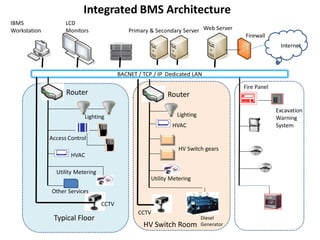
BACNET / TCP / IP Dedicated LAN
Router
Lighting
Access Control
HVAC
Utility Metering
Other Services
CCTV
Typical Floor
Router
Lighting
HVAC
Utility Metering
CCTV
HV Switch Room
HV Switch gears
Diesel
Generator
Fire Panel
Excavation
Warning
System
IBMS
Workstation
LCD
Monitors Primary & Secondary Server Web Server
Firewall
Internet
Integrated BMS Architecture
Benefits
• Precision control
• Automatic operations
• Safety Interlock
• Energy savings
• Better Maintenance management
• Good Information Systems
Sub-systems of BAS
• Energy management systems
– HVAC
– Electrical
– Lighting
– Misc utilities like hydrant, water systems
• Fire, life safety systems
– Fire detection systems
– Access control systems
– CCTV systems
– Perimeter protection systems
What is a typical application in BMS?
• HVAC
• Monitor and control high side equipment including chiller through
integration on Modbus /Bacnet for trending of parameters
• Monitoring and control of Pumps and other associated equipment
for High side
• Monitoring and control of AHUs, VFDs, IAQ parameters
• Monitoring of CO levels in basement
• Integration of precision air conditioner for server
room/switch/hub/IDF rooms
Control Loop
• The process of controlling an HVAC
system involves three steps. These
steps include first measuring data,
then processing the data with other
information and finally causing a
control action. These three functions
make up what is known as a control
loop
• achieved through Direct Digital
Controllers
PROTOCOLS used in BMS
BACnet
ModBus
LonWorks
Gateway
A device that translates one set of
communication rules to another. It
connects networks that use different
protocols, allowing them to pass data to
each other. A gateway is sometimes called
an “integrator” or “bridge.”
Integration
Combines several functional systems into
one (for example: security, metering,
lighting, HVAC, and fire-alarm systems).
Signals from these systems travel over the
same digital network, and they can be
controlled from the same workstation
using uniform commands and graphics.
CONTROL FUNDAMENTALS

Building Management System BMS Introduction

  • 1.
    What is BMS? • Provides a single sea for Monitoring and Control of various parameters in a building for all utilities, integration with Fire & life safety systems, to offer precision control, automation, safety lockouts, energy savings and advanced information management systems to enable take corrective actions – pre and post the events
  • 2.
    How do weachieve this ? • Place intelligent Systems at various locations in a building • Capture important and critical parameters • Measure and gather field data through intelligent field devices and sensors etc., • Process the applications through DDC technology • Analyze current performance and take corrective actions
  • 3.
    Why do weneed BMS ? • Every piece of equipment in a building today is highly intelligent • Complex algorithms to be processed • Multiple buildings and a single seat of access • Energy Costs are increasing • Occupants want faster, quality and timely response • Building functions keep changing • Buildings are an asset to the owner • Safer and healthier place for occupants
  • 4.
    BACNET / TCP/ IP Dedicated LAN Router Lighting Access Control HVAC Utility Metering Other Services CCTV Typical Floor Router Lighting HVAC Utility Metering CCTV HV Switch Room HV Switch gears Diesel Generator Fire Panel Excavation Warning System IBMS Workstation LCD Monitors Primary & Secondary Server Web Server Firewall Internet Integrated BMS Architecture
  • 5.
    Benefits • Precision control •Automatic operations • Safety Interlock • Energy savings • Better Maintenance management • Good Information Systems
  • 6.
    Sub-systems of BAS •Energy management systems – HVAC – Electrical – Lighting – Misc utilities like hydrant, water systems • Fire, life safety systems – Fire detection systems – Access control systems – CCTV systems – Perimeter protection systems
  • 7.
    What is atypical application in BMS? • HVAC • Monitor and control high side equipment including chiller through integration on Modbus /Bacnet for trending of parameters • Monitoring and control of Pumps and other associated equipment for High side • Monitoring and control of AHUs, VFDs, IAQ parameters • Monitoring of CO levels in basement • Integration of precision air conditioner for server room/switch/hub/IDF rooms
  • 8.
    Control Loop • Theprocess of controlling an HVAC system involves three steps. These steps include first measuring data, then processing the data with other information and finally causing a control action. These three functions make up what is known as a control loop • achieved through Direct Digital Controllers
  • 9.
    PROTOCOLS used inBMS BACnet ModBus LonWorks
  • 10.
    Gateway A device thattranslates one set of communication rules to another. It connects networks that use different protocols, allowing them to pass data to each other. A gateway is sometimes called an “integrator” or “bridge.”
  • 11.
    Integration Combines several functionalsystems into one (for example: security, metering, lighting, HVAC, and fire-alarm systems). Signals from these systems travel over the same digital network, and they can be controlled from the same workstation using uniform commands and graphics.
  • 12.