Early Intervention on Intellectual Disability
Presented by
Dr. Fateha Sultana
Child Health Physician
Shishu Bikash Kendra
Rajshahi Medical College Hospital
Rajshahi
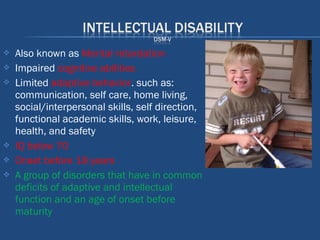
 Also known as Mental retardation
 Impaired cognitive abilities
 Limited adaptive behavior. such as:
communication, self care, home living,
social/interpersonal skills, self direction,
functional academic skills, work, leisure,
health, and safety
 IQ below 70
 Onset before 18 years
 A group of disorders that have in common
deficits of adaptive and intellectual
function and an age of onset before
maturity
 Intellectual functioning. Also known as IQ, this
refers to a person’s ability to learn reason,
make decision, and solve problems.
 Adaptive behavior. These are skills necessary
for day to day life, such as being able to
communicate effectively, interact with others,
and take care of oneself.
 Conceptual skills- language and literacy; money,
time, and number concepts; and self-direction.
 Social skills- interpersonal skills, social
responsibility, self-esteem, gullibility, naivete(i.e.
wariness), social problem solving, and ability to
follow rules/obey laws and to avoid being
victimized.
 Practical skills- activities of daily living (personal
care), occupational skills, healthcare,
travel/transportation, schedule/routines, safety,
use of money, use of the telephone.
 Intellectual disability has an overall general
population prevalence of approximately 1%,
and prevalence rates vary by age
 Prevalence for severe intellectual disability is
approximately 6 per 1000.
 According to WHO Intellectual Disability rate
approximately 3.06% in Bangladesh
 Genetic condition. These include things like Down syndrome and
fragile X syndrome.
 Problem during pregnancy. Things that can interfere with fetal brain
development include Zika virus, alcohol or drug use, malnutrition, certain
infections or preeclampsia.
 Problems during childbirth. ID may result if a baby is deprived of
oxygen during childbirth or born extremely premature.
 Illness or injury. Infections like meningitis, whooping cough, or the
measles can lead to ID. Severe head injury, near-drowning, extreme
malnutrition, exposure to toxic substance such as lead, and severe
neglect or abuse can also cause it.
 None of above. In two-third of all children who have ID, the cause is
unknown.
 Rolling over, sitting up, crawling or walking late.
 Talking late or having trouble with talking
 Slow to master things like potty training, dressing,
and feeding himself or herself
 Difficulty remembering things
 Inability to connect actions with consequences
 Behavior problems such as explosive tantrums
 Difficulty with problem-solving or logical thinking
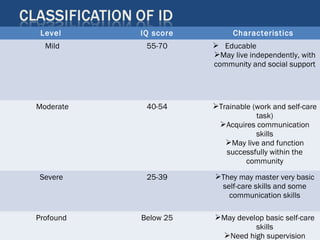
Level IQ score Characteristics
Mild 55-70  Educable
May live independently, with
community and social support
Moderate 40-54 Trainable (work and self-care
task)
Acquires communication
skills
May live and function
successfully within the
community
Severe 25-39 They may master very basic
self-care skills and some
communication skills
Profound Below 25 May develop basic self-care
skills
Need high supervision
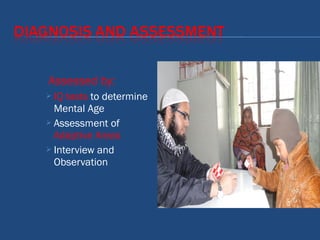
Assessed by:
 IQ tests to determine
Mental Age
 Assessment of
Adaptive Areas
 Interview and
Observation
 EEG
 Thyroid function test : T3,T4, TSH
 Chromosomal study for down syndrome, turner’s syndrome,
fragile X syndrome etc
 Biopsy (bone marrow, liver, rectum, brain, skin) to confirm
storage disorders.
 X-ray skull , CSF examination
 CT and MRI scan may define hydrocephalus, absence of
corpus callosum, tuberous sclerosis, cortical atrophy.
 X-ray skull , CSF examination
 CT and MRI scan may define hydrocephalus, absence of
corpus callosum, tuberous sclerosis, cortical atrophy.
 Genetic counseling: consanguineous marriages.
 Mothers older than 35yrs should be screened for
down syndrome.
 During labor: Good obstetrics and post-natal
supervision is essential to prevent birth asphyxia,
injuries, jaundice and sepis.
 Neonatal and neurological infections should be
diagnosed and treated promptly.
 Cretinism and galactosemia
should be treated early in
infancy
 Screening of all the newborn
infants for metabolic disorders
such as PKU and
homocystinuria.
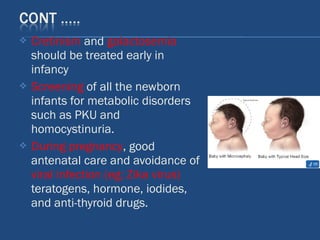
 During pregnancy, good
antenatal care and avoidance of
viral infection (eg; Zika virus)
teratogens, hormone, iodides,
and anti-thyroid drugs.
 No specific drugs available….
 Neuroleptic drugs to reduce aggressive and
anti-social behavior. e.g. Phenothiazines
 Anti-psychotic drugs
 Anti-depressant drugs may be given according
to patient’s needs
 Treatment requires patience, good will,
unlimited time
 Minimal criticism and high appreciation
 Associated vision, hearing, musculoskeletal,
and locomotion dysfunction should be
appropriately managed
 Mainstreaming : It means to bring the ID
children with the normal children
 Early Intervention is a system of services designed to help
infants and toddlers with disabilities ( until their 3rd
birth
day) and their families.
 Learn everything you can about ID. The more you know, the
better advocate you can be for the child
 Encourage the child’s independence. let the child try new
things and encourage the child to do things by himself or
herself.
 Get the child involved in group activities. Taking an art class
or participating in scouts will help the child build social
skills.
 Stay involve. By keeping in touch with the child.
 Get to know others parents of intellectually disabled
children.
 work with the child’s family to develop what is known as an
Individualized Family Services Plan or IFSP
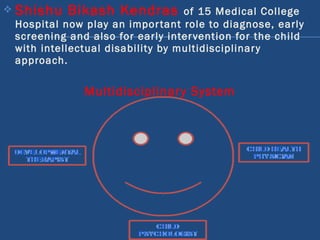
 Shishu Bikash Kendras of 15 Medical College
Hospital now play an important role to diagnose, early
screening and also for early intervention for the child
with intellectual disability by multidisciplinary
approach.
Multidisciplinary System
Intellectual disability

Intellectual disability

  • 1.
    Early Intervention onIntellectual Disability Presented by Dr. Fateha Sultana Child Health Physician Shishu Bikash Kendra Rajshahi Medical College Hospital Rajshahi
  • 2.
     Also knownas Mental retardation  Impaired cognitive abilities  Limited adaptive behavior. such as: communication, self care, home living, social/interpersonal skills, self direction, functional academic skills, work, leisure, health, and safety  IQ below 70  Onset before 18 years  A group of disorders that have in common deficits of adaptive and intellectual function and an age of onset before maturity
  • 3.
     Intellectual functioning.Also known as IQ, this refers to a person’s ability to learn reason, make decision, and solve problems.  Adaptive behavior. These are skills necessary for day to day life, such as being able to communicate effectively, interact with others, and take care of oneself.
  • 4.
     Conceptual skills-language and literacy; money, time, and number concepts; and self-direction.  Social skills- interpersonal skills, social responsibility, self-esteem, gullibility, naivete(i.e. wariness), social problem solving, and ability to follow rules/obey laws and to avoid being victimized.  Practical skills- activities of daily living (personal care), occupational skills, healthcare, travel/transportation, schedule/routines, safety, use of money, use of the telephone.
  • 5.
     Intellectual disabilityhas an overall general population prevalence of approximately 1%, and prevalence rates vary by age  Prevalence for severe intellectual disability is approximately 6 per 1000.  According to WHO Intellectual Disability rate approximately 3.06% in Bangladesh
  • 6.
     Genetic condition.These include things like Down syndrome and fragile X syndrome.  Problem during pregnancy. Things that can interfere with fetal brain development include Zika virus, alcohol or drug use, malnutrition, certain infections or preeclampsia.  Problems during childbirth. ID may result if a baby is deprived of oxygen during childbirth or born extremely premature.  Illness or injury. Infections like meningitis, whooping cough, or the measles can lead to ID. Severe head injury, near-drowning, extreme malnutrition, exposure to toxic substance such as lead, and severe neglect or abuse can also cause it.  None of above. In two-third of all children who have ID, the cause is unknown.
  • 7.
     Rolling over,sitting up, crawling or walking late.  Talking late or having trouble with talking  Slow to master things like potty training, dressing, and feeding himself or herself  Difficulty remembering things  Inability to connect actions with consequences  Behavior problems such as explosive tantrums  Difficulty with problem-solving or logical thinking
  • 8.
    Level IQ scoreCharacteristics Mild 55-70  Educable May live independently, with community and social support Moderate 40-54 Trainable (work and self-care task) Acquires communication skills May live and function successfully within the community Severe 25-39 They may master very basic self-care skills and some communication skills Profound Below 25 May develop basic self-care skills Need high supervision
  • 9.
    Assessed by:  IQtests to determine Mental Age  Assessment of Adaptive Areas  Interview and Observation
  • 10.
     EEG  Thyroidfunction test : T3,T4, TSH  Chromosomal study for down syndrome, turner’s syndrome, fragile X syndrome etc  Biopsy (bone marrow, liver, rectum, brain, skin) to confirm storage disorders.  X-ray skull , CSF examination  CT and MRI scan may define hydrocephalus, absence of corpus callosum, tuberous sclerosis, cortical atrophy.  X-ray skull , CSF examination  CT and MRI scan may define hydrocephalus, absence of corpus callosum, tuberous sclerosis, cortical atrophy.
  • 11.
     Genetic counseling:consanguineous marriages.  Mothers older than 35yrs should be screened for down syndrome.  During labor: Good obstetrics and post-natal supervision is essential to prevent birth asphyxia, injuries, jaundice and sepis.  Neonatal and neurological infections should be diagnosed and treated promptly.
  • 12.
     Cretinism andgalactosemia should be treated early in infancy  Screening of all the newborn infants for metabolic disorders such as PKU and homocystinuria.  During pregnancy, good antenatal care and avoidance of viral infection (eg; Zika virus) teratogens, hormone, iodides, and anti-thyroid drugs.
  • 13.
     No specificdrugs available….  Neuroleptic drugs to reduce aggressive and anti-social behavior. e.g. Phenothiazines  Anti-psychotic drugs  Anti-depressant drugs may be given according to patient’s needs
  • 14.
     Treatment requirespatience, good will, unlimited time  Minimal criticism and high appreciation  Associated vision, hearing, musculoskeletal, and locomotion dysfunction should be appropriately managed  Mainstreaming : It means to bring the ID children with the normal children
  • 15.
     Early Interventionis a system of services designed to help infants and toddlers with disabilities ( until their 3rd birth day) and their families.  Learn everything you can about ID. The more you know, the better advocate you can be for the child  Encourage the child’s independence. let the child try new things and encourage the child to do things by himself or herself.  Get the child involved in group activities. Taking an art class or participating in scouts will help the child build social skills.  Stay involve. By keeping in touch with the child.  Get to know others parents of intellectually disabled children.  work with the child’s family to develop what is known as an Individualized Family Services Plan or IFSP
  • 16.
     Shishu BikashKendras of 15 Medical College Hospital now play an important role to diagnose, early screening and also for early intervention for the child with intellectual disability by multidisciplinary approach. Multidisciplinary System