Basic Steam Engineering 62b-201 Nucleate Boiling
1. Describe the theory of  nucleate boiling and how it  applies to boiler operations 2. Describe how variations  in  circulation lead to shrink and swell Enabling Objectives
Boiling Process  In A Generating Tube Tubes have a  waterside  (internal volume) and a  fireside  (external surface) LIKE BOILING WATER IN A POT, BOILING IN THE GENERATING TUBES IS A PROGRESSIVE PHENOMENON (i.E. Little bubbles, bigger bubbles, bulk boiling)
SUBCOOLED Nucleate Boiling Definition of  SUBCOOLED : Below  temperature ( T SAT ) at which water will change state to steam at a given pressure Bulk of boiler water is SUBCOOLED as it rises up  generating tubes
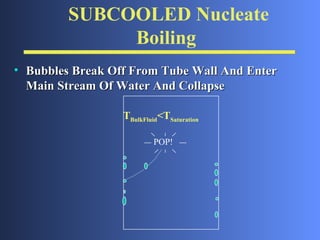
SUBCOOLED Nucleate Boiling Bubbles Break Off From Tube Wall And Enter Main Stream Of Water And Collapse T BulkFluid <T Saturation POP!
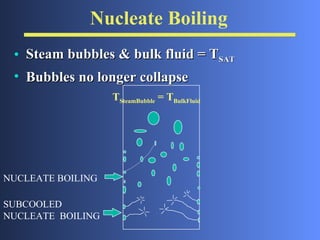
Nucleate Boiling Steam bubbles & bulk fluid = T SAT   Bubbles no longer collapse NUCLEATE BOILING SUBCOOLED NUCLEATE  BOILING T SteamBubble  = T BulkFluid
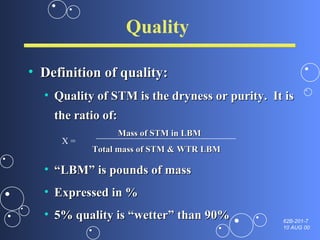
Quality  Definition of quality: Quality of STM is the dryness or purity.  It is the ratio of:  Mass of STM in LBM  Total mass of STM & WTR LBM “ LBM” is pounds of mass Expressed in % 5% quality is “wetter” than 90% X =
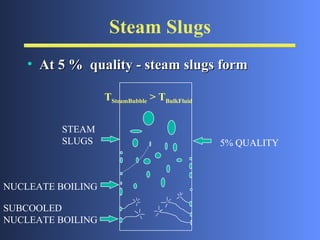
Steam Slugs At 5 %  quality - steam slugs form NUCLEATE BOILING SUBCOOLED  NUCLEATE BOILING STEAM SLUGS 5% QUALITY T SteamBubble  > T BulkFluid
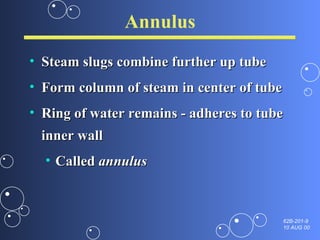
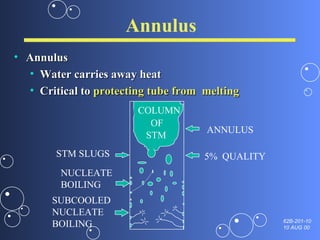
Annulus Steam slugs combine further up tube Form column of steam in center of tube Ring of water remains - adheres to tube inner wall Called  annulus
Annulus Annulus  Water carries away heat  Critical to  protecting tube from  melting NUCLEATE BOILING SUBCOOLED NUCLEATE BOILING  STM SLUGS  5%  QUALITY ANNULUS  STM COLUMN OF
Nucleate Boiling Ideally steam & water exiting generating tubes will be: Annular flow  20 % - 30% quality
Moisture Separators Chevron & cyclone type Remove water from steam to prevent moisture carryover Steam  exits boiler  at 99.75% (recall that steam  exits tube  at 20-30%)
Natural Circulation There is no pump to circulate boiler water We rely on natural circulation Termed  accelerated  due to slant in generating tubes Promoted by   thermal driving head (TDH) Retarded by  head losses (hl)
Thermal Driving Head Explanation: AVERAGE SPECIFIC VOLUME (VOL) OF WATER IN GENERATING TUBES > WATER IN DOWNCOMERS (i.E. On a LBM basis, the water in tubes takes up more space) Therefore => density of steam/ water mixture in tubes < water in DOWNCOMERS
Thermal Driving Head Therefore => weight of steam/ water in generating tubes < water in DOWNCOMERS Therefore => pressure on water in DOWNCOMERS > pressure on steam/ water mixture in generating tubes
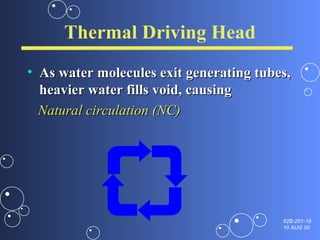
Thermal Driving Head As water molecules exit generating tubes, heavier water fills void, causing Natural circulation (NC)
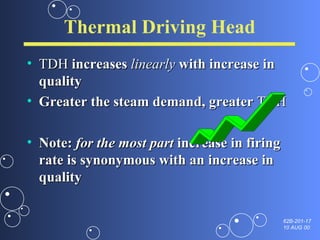
Thermal Driving Head TDH  increases  linearly  with increase in quality Greater the steam demand, greater  TDH Note:  for the most part  increase in firing rate is synonymous with an increase in quality
Head Loss TDH  creates flow  down DOWNCOMERS and back up generating tubes Actual mass flow rate of NC is difference between  TDH  and  hl : M flow  = TDH - HL
Head Loss As quality increases, larger  steam slugs form Slugs  impede flow of remaining water in tube, causing  head loss
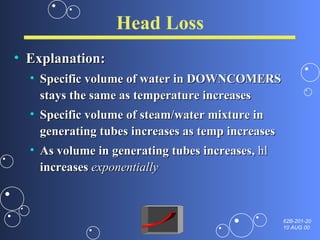
Head Loss Explanation: Specific volume of water in DOWNCOMERS stays the same as temperature increases Specific volume of steam/water mixture in generating tubes increases as temp increases As volume in generating tubes increases,  hl  increases  exponentially
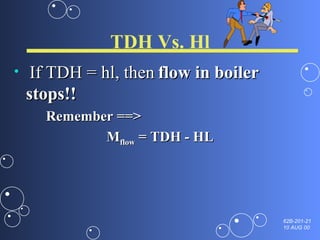
TDH Vs. Hl If TDH = hl, then   flow in boiler stops!! Remember ==>  M flow  = TDH - HL
Flow Rate Stops... Is this bad?????
End Point Of Circulation Major concern! No cooling taking place Boiler is a heat exchanger Possible causes: High firing rate  Reduction in steam drum pressure below minimum limit
Boiler End Points Capacity of a boiler is limited by: Design of boiler Its operation These limits are known as  boiler end points
Boiler End Points There are 3 boiler end points : End point of combustion Moisture carryover End point of circulation
End Point Of Combustion Fuel rate at designed max with all burners lit Air at amount required for complete/proper combustion Steam drum pressure at set point
End Point Of Combustion End point of combustion is the only end point that is likely to be reached in a properly designed and operated boiler
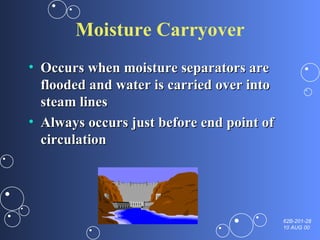
Moisture Carryover Occurs when moisture separators are flooded and water is carried over into  steam lines  Always occurs just before end point of circulation
Film Boiling Definition:  When excessive heat transfer rates and insufficient circulation causes a layer of steam  to form on the surface of tubes
Film Boiling Film boiling is infrequent occurrence Causes:  Poor boiler design Misalignment of burners (most frequent cause) Causes excessively high heat by flames impinging on furnace tubes
Departure From Nucleate Boiling Definition: Point where heating surfaces of tubes are abnormally hot  If temp is high enough, heating surface may burn out or melt --this is known as the burnout point or critical heat flux Departure from nucleate boiling (DNB) is very close to this point
Departure From Nucleate Boiling Occurs prior to end point of natural circulation Causes: Reduction in steam drum pressure below lower operating limit High firing rate
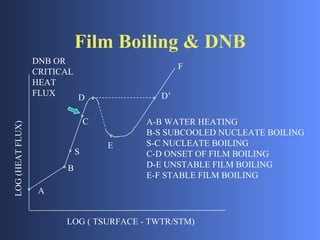
Film Boiling & DNB A-B WATER HEATING B-S SUBCOOLED NUCLEATE BOILING S-C NUCLEATE BOILING C-D ONSET OF FILM BOILING D-E UNSTABLE FILM BOILING E-F STABLE FILM BOILING A B C D E D’ F DNB OR  CRITICAL HEAT FLUX S LOG ( TSURFACE - TWTR/STM) LOG (HEAT FLUX)
Shrink & Swell During  up power  maneuvers, a temporary rise in boiler water level occurs -- called  swell During  down power  maneuvers, a temporary drop in boiler water level occurs -- called  shrink
Swell Increase in steam demand: More steam leaves boiler. Drum press starts decreasing. Steam bubbles in GEN tubes expand. Water level “swells.”
Swell Automatic combustion control system (acc sys) senses decrease in drum press and increases firing rate Drum press increases and regains SETPOINT Water level decreases as bubble size decreases
Swell Water reaches normal and gets slightly below normal Automatic boiler control system (ABC sys) will increase feed flow to match steam  flow Water level achieves  normal
Shrink  During a down power maneuver shrink has the opposite effect: Throttle closes Steam drum press rises Water level lowers or “shrinks”
Shrink  Acc system decreases firing rate  Drum press regains SETPOINT Water level increases Water level reaches normal,  and slightly above normal ABC sys decreases feed flow
Can the Effects of Shrink and Swell Be Avoided? YES, and the navy knows how but still doesn’t ! How and why not ?? Increasing boiler size reduces the fluctuations in level caused by shrink and swell (space limitation).
Summary Waterside & fireside SUBCOOLED nucleate boiling Nucleate boiling Annulus Quality of steam (equation) Steam slugs  Film boiling DNB
Summary Boiler end points  Causes and limits of natural circulation Thermal driving head Head loss Boiler power level & natural circulation (graph of TDH VS head loss) Shrink & swell
Any Questions...?
Basic Steam Engineering 62b-201 Nucleate Boiling

Basic steam engineering nucleate boiling ppt

  • 1.
    Basic Steam Engineering62b-201 Nucleate Boiling
  • 2.
    1. Describe thetheory of nucleate boiling and how it applies to boiler operations 2. Describe how variations in circulation lead to shrink and swell Enabling Objectives
  • 3.
    Boiling Process In A Generating Tube Tubes have a waterside (internal volume) and a fireside (external surface) LIKE BOILING WATER IN A POT, BOILING IN THE GENERATING TUBES IS A PROGRESSIVE PHENOMENON (i.E. Little bubbles, bigger bubbles, bulk boiling)
  • 4.
    SUBCOOLED Nucleate BoilingDefinition of SUBCOOLED : Below temperature ( T SAT ) at which water will change state to steam at a given pressure Bulk of boiler water is SUBCOOLED as it rises up generating tubes
  • 5.
    SUBCOOLED Nucleate BoilingBubbles Break Off From Tube Wall And Enter Main Stream Of Water And Collapse T BulkFluid <T Saturation POP!
  • 6.
    Nucleate Boiling Steambubbles & bulk fluid = T SAT Bubbles no longer collapse NUCLEATE BOILING SUBCOOLED NUCLEATE BOILING T SteamBubble = T BulkFluid
  • 7.
    Quality Definitionof quality: Quality of STM is the dryness or purity. It is the ratio of: Mass of STM in LBM Total mass of STM & WTR LBM “ LBM” is pounds of mass Expressed in % 5% quality is “wetter” than 90% X =
  • 8.
    Steam Slugs At5 % quality - steam slugs form NUCLEATE BOILING SUBCOOLED NUCLEATE BOILING STEAM SLUGS 5% QUALITY T SteamBubble > T BulkFluid
  • 9.
    Annulus Steam slugscombine further up tube Form column of steam in center of tube Ring of water remains - adheres to tube inner wall Called annulus
  • 10.
    Annulus Annulus Water carries away heat Critical to protecting tube from melting NUCLEATE BOILING SUBCOOLED NUCLEATE BOILING STM SLUGS 5% QUALITY ANNULUS STM COLUMN OF
  • 11.
    Nucleate Boiling Ideallysteam & water exiting generating tubes will be: Annular flow 20 % - 30% quality
  • 12.
    Moisture Separators Chevron& cyclone type Remove water from steam to prevent moisture carryover Steam exits boiler at 99.75% (recall that steam exits tube at 20-30%)
  • 13.
    Natural Circulation Thereis no pump to circulate boiler water We rely on natural circulation Termed accelerated due to slant in generating tubes Promoted by thermal driving head (TDH) Retarded by head losses (hl)
  • 14.
    Thermal Driving HeadExplanation: AVERAGE SPECIFIC VOLUME (VOL) OF WATER IN GENERATING TUBES > WATER IN DOWNCOMERS (i.E. On a LBM basis, the water in tubes takes up more space) Therefore => density of steam/ water mixture in tubes < water in DOWNCOMERS
  • 15.
    Thermal Driving HeadTherefore => weight of steam/ water in generating tubes < water in DOWNCOMERS Therefore => pressure on water in DOWNCOMERS > pressure on steam/ water mixture in generating tubes
  • 16.
    Thermal Driving HeadAs water molecules exit generating tubes, heavier water fills void, causing Natural circulation (NC)
  • 17.
    Thermal Driving HeadTDH increases linearly with increase in quality Greater the steam demand, greater TDH Note: for the most part increase in firing rate is synonymous with an increase in quality
  • 18.
    Head Loss TDH creates flow down DOWNCOMERS and back up generating tubes Actual mass flow rate of NC is difference between TDH and hl : M flow = TDH - HL
  • 19.
    Head Loss Asquality increases, larger steam slugs form Slugs impede flow of remaining water in tube, causing head loss
  • 20.
    Head Loss Explanation:Specific volume of water in DOWNCOMERS stays the same as temperature increases Specific volume of steam/water mixture in generating tubes increases as temp increases As volume in generating tubes increases, hl increases exponentially
  • 21.
    TDH Vs. HlIf TDH = hl, then flow in boiler stops!! Remember ==> M flow = TDH - HL
  • 22.
    Flow Rate Stops...Is this bad?????
  • 23.
    End Point OfCirculation Major concern! No cooling taking place Boiler is a heat exchanger Possible causes: High firing rate Reduction in steam drum pressure below minimum limit
  • 24.
    Boiler End PointsCapacity of a boiler is limited by: Design of boiler Its operation These limits are known as boiler end points
  • 25.
    Boiler End PointsThere are 3 boiler end points : End point of combustion Moisture carryover End point of circulation
  • 26.
    End Point OfCombustion Fuel rate at designed max with all burners lit Air at amount required for complete/proper combustion Steam drum pressure at set point
  • 27.
    End Point OfCombustion End point of combustion is the only end point that is likely to be reached in a properly designed and operated boiler
  • 28.
    Moisture Carryover Occurswhen moisture separators are flooded and water is carried over into steam lines Always occurs just before end point of circulation
  • 29.
    Film Boiling Definition: When excessive heat transfer rates and insufficient circulation causes a layer of steam to form on the surface of tubes
  • 30.
    Film Boiling Filmboiling is infrequent occurrence Causes: Poor boiler design Misalignment of burners (most frequent cause) Causes excessively high heat by flames impinging on furnace tubes
  • 31.
    Departure From NucleateBoiling Definition: Point where heating surfaces of tubes are abnormally hot If temp is high enough, heating surface may burn out or melt --this is known as the burnout point or critical heat flux Departure from nucleate boiling (DNB) is very close to this point
  • 32.
    Departure From NucleateBoiling Occurs prior to end point of natural circulation Causes: Reduction in steam drum pressure below lower operating limit High firing rate
  • 33.
    Film Boiling &DNB A-B WATER HEATING B-S SUBCOOLED NUCLEATE BOILING S-C NUCLEATE BOILING C-D ONSET OF FILM BOILING D-E UNSTABLE FILM BOILING E-F STABLE FILM BOILING A B C D E D’ F DNB OR CRITICAL HEAT FLUX S LOG ( TSURFACE - TWTR/STM) LOG (HEAT FLUX)
  • 34.
    Shrink & SwellDuring up power maneuvers, a temporary rise in boiler water level occurs -- called swell During down power maneuvers, a temporary drop in boiler water level occurs -- called shrink
  • 35.
    Swell Increase insteam demand: More steam leaves boiler. Drum press starts decreasing. Steam bubbles in GEN tubes expand. Water level “swells.”
  • 36.
    Swell Automatic combustioncontrol system (acc sys) senses decrease in drum press and increases firing rate Drum press increases and regains SETPOINT Water level decreases as bubble size decreases
  • 37.
    Swell Water reachesnormal and gets slightly below normal Automatic boiler control system (ABC sys) will increase feed flow to match steam flow Water level achieves normal
  • 38.
    Shrink Duringa down power maneuver shrink has the opposite effect: Throttle closes Steam drum press rises Water level lowers or “shrinks”
  • 39.
    Shrink Accsystem decreases firing rate Drum press regains SETPOINT Water level increases Water level reaches normal, and slightly above normal ABC sys decreases feed flow
  • 40.
    Can the Effectsof Shrink and Swell Be Avoided? YES, and the navy knows how but still doesn’t ! How and why not ?? Increasing boiler size reduces the fluctuations in level caused by shrink and swell (space limitation).
  • 41.
    Summary Waterside &fireside SUBCOOLED nucleate boiling Nucleate boiling Annulus Quality of steam (equation) Steam slugs Film boiling DNB
  • 42.
    Summary Boiler endpoints Causes and limits of natural circulation Thermal driving head Head loss Boiler power level & natural circulation (graph of TDH VS head loss) Shrink & swell
  • 43.
  • 44.
    Basic Steam Engineering62b-201 Nucleate Boiling

Editor's Notes