Giant Covalent & Ionic
Structures
DR FARHAD M. ALI
MARCH 2023
17/03/2023 1
Giant structures
Either covalent or ionic
 Covalent: carbon (diamond, graphite);
silicon dioxide; polymer (made from non-
metals which form giant structures)
 Ionic:
giant metallic lattice: sodium and
aluminium as examples
giant ionic lattice: ionic compounds such
sodium chloride.
17/03/2023 2
What are giant covalent structures?
• When a large number of atoms are joined by
covalent bonds, it creates a giant covalent
structure.
• A giant covalent structure has lots of covalent
bonds linking several atoms in a regular
pattern, which forms a lattice.
17/03/2023 3
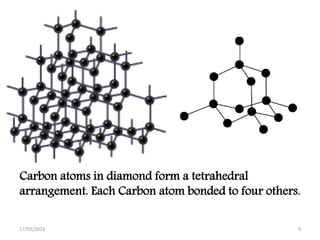
Carbon atoms in diamond form a tetrahedral
arrangement. Each Carbon atom bonded to four others.
17/03/2023 4
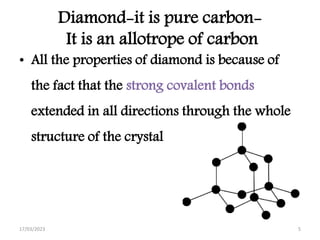
Diamond-it is pure carbon-
It is an allotrope of carbon
• All the properties of diamond is because of
the fact that the strong covalent bonds
extended in all directions through the whole
structure of the crystal
17/03/2023 5
17/03/2023 6
Graphite-it is pure carbon
It is an allotrope of carbon
17/03/2023 7
Graphite-it is pure carbon
It is an allotrope of carbon
17/03/2023 8
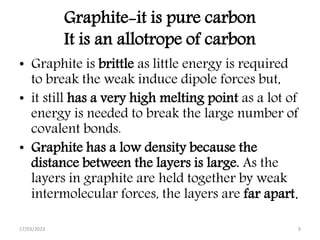
Graphite-it is pure carbon
It is an allotrope of carbon
• Graphite is brittle as little energy is required
to break the weak induce dipole forces but,
• it still has a very high melting point as a lot of
energy is needed to break the large number of
covalent bonds.
• Graphite has a low density because the
distance between the layers is large. As the
layers in graphite are held together by weak
intermolecular forces, the layers are far apart.
17/03/2023 9
Graphene-it is pure carbon
Also an allotrope of carbon
17/03/2023 10
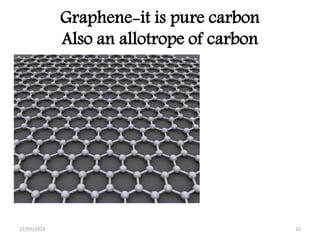
Graphene-it is pure carbon
Also an allotrope of carbon
 Graphene is technically composed of carbon
atom and a covalent bond that formed a
honeycomb pattern.
 is made of a single sheet of carbon
atoms arranged in a crystal lattice (like a
honeycomb pattern).
 It is the basic building block of graphite.
 show high melting points than many other
materials
17/03/2023 11
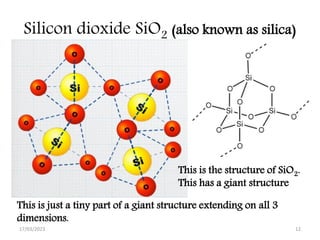
Silicon dioxide SiO2 (also known as silica)
This is the structure of SiO2.
This has a giant structure
This is just a tiny part of a giant structure extending on all 3
dimensions.
17/03/2023 12
Silicon dioxide SiO2
• When we look at the structure we see that the
silicon bonds to 4 oxygen atoms but why do
we say SiO2?
• The Silicon atom is bonded to 4 Oxygen atoms
and each Oxygen is bonded to 2 other silicon
atoms. This leads to a ratio of 1:2
17/03/2023 13
The physical properties of silicon
dioxide
• has a high melting point (around 1700°C).
• Very strong silicon-oxygen covalent bonds have
to be broken throughout the structure before
melting occurs.
• is hard. This is due to the need to break the very
strong covalent bonds.
• doesn't conduct electricity. There aren't any
delocalised electrons. All the electrons are held
tightly between the atoms, and aren't free to
move.
• is insoluble in water and organic solvents.
17/03/2023 14
Why do giant covalent structures have
high melting points?
• These structures have high melting points due
to the covalent bonds holding the atoms
together.
• It is very difficult to break down these bonds
when they are melted and they require a large
amount of energy (i.e. a high temperature) to
break the structure.
17/03/2023 15
Are giant covalent structures soluble
in water?
• These structures are insoluble due to their
strong covalent bonds.
• Therefore, these are generally inert and so do
not react with water, making it impossible to
dissolve
17/03/2023 16
Why do giant covalent structures not
conduct electricity?
• The structures are poor electrical
conductors of electricity because they do not
have free electrons to conduct electricity
through the molecule.
• However, graphite is an exception.
17/03/2023 17
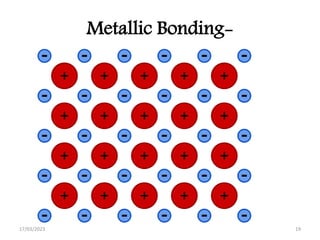
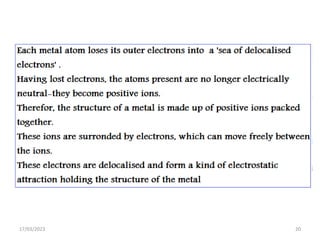
Metallic Bonding-
• Metallic bonding is a type of chemical
bonding that arises from the electrostatic
attractive force between conduction electrons
(in the form of an electron cloud of
delocalized electrons) and positively charged
metal ions
17/03/2023 18
Metallic Bonding-
17/03/2023 19
17/03/2023 20
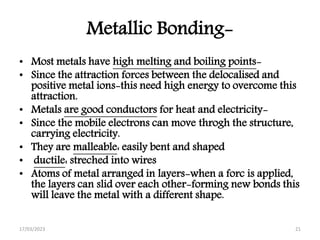
Metallic Bonding-
• Most metals have high melting and boiling points-
• Since the attraction forces between the delocalised and
positive metal ions-this need high energy to overcome this
attraction.
• Metals are good conductors for heat and electricity-
• Since the mobile electrons can move throgh the structure,
carrying electricity.
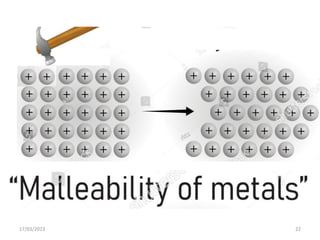
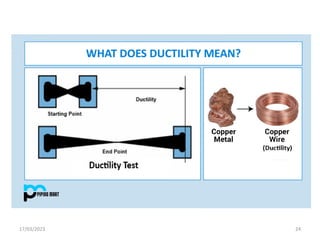
• They are malleable: easily bent and shaped
• ductile: streched into wires
• Atoms of metal arranged in layers-when a forc is applied,
the layers can slid over each other-forming new bonds this
will leave the metal with a different shape.
17/03/2023 21
17/03/2023 22
17/03/2023 23
17/03/2023 24
17/03/2023 25

GIANT IONIC AND COVALENT STRUCTURES-GCSE.pdf

  • 1.
    Giant Covalent &Ionic Structures DR FARHAD M. ALI MARCH 2023 17/03/2023 1
  • 2.
    Giant structures Either covalentor ionic  Covalent: carbon (diamond, graphite); silicon dioxide; polymer (made from non- metals which form giant structures)  Ionic: giant metallic lattice: sodium and aluminium as examples giant ionic lattice: ionic compounds such sodium chloride. 17/03/2023 2
  • 3.
    What are giantcovalent structures? • When a large number of atoms are joined by covalent bonds, it creates a giant covalent structure. • A giant covalent structure has lots of covalent bonds linking several atoms in a regular pattern, which forms a lattice. 17/03/2023 3
  • 4.
    Carbon atoms indiamond form a tetrahedral arrangement. Each Carbon atom bonded to four others. 17/03/2023 4
  • 5.
    Diamond-it is purecarbon- It is an allotrope of carbon • All the properties of diamond is because of the fact that the strong covalent bonds extended in all directions through the whole structure of the crystal 17/03/2023 5
  • 6.
  • 7.
    Graphite-it is purecarbon It is an allotrope of carbon 17/03/2023 7
  • 8.
    Graphite-it is purecarbon It is an allotrope of carbon 17/03/2023 8
  • 9.
    Graphite-it is purecarbon It is an allotrope of carbon • Graphite is brittle as little energy is required to break the weak induce dipole forces but, • it still has a very high melting point as a lot of energy is needed to break the large number of covalent bonds. • Graphite has a low density because the distance between the layers is large. As the layers in graphite are held together by weak intermolecular forces, the layers are far apart. 17/03/2023 9
  • 10.
    Graphene-it is purecarbon Also an allotrope of carbon 17/03/2023 10
  • 11.
    Graphene-it is purecarbon Also an allotrope of carbon  Graphene is technically composed of carbon atom and a covalent bond that formed a honeycomb pattern.  is made of a single sheet of carbon atoms arranged in a crystal lattice (like a honeycomb pattern).  It is the basic building block of graphite.  show high melting points than many other materials 17/03/2023 11
  • 12.
    Silicon dioxide SiO2(also known as silica) This is the structure of SiO2. This has a giant structure This is just a tiny part of a giant structure extending on all 3 dimensions. 17/03/2023 12
  • 13.
    Silicon dioxide SiO2 •When we look at the structure we see that the silicon bonds to 4 oxygen atoms but why do we say SiO2? • The Silicon atom is bonded to 4 Oxygen atoms and each Oxygen is bonded to 2 other silicon atoms. This leads to a ratio of 1:2 17/03/2023 13
  • 14.
    The physical propertiesof silicon dioxide • has a high melting point (around 1700°C). • Very strong silicon-oxygen covalent bonds have to be broken throughout the structure before melting occurs. • is hard. This is due to the need to break the very strong covalent bonds. • doesn't conduct electricity. There aren't any delocalised electrons. All the electrons are held tightly between the atoms, and aren't free to move. • is insoluble in water and organic solvents. 17/03/2023 14
  • 15.
    Why do giantcovalent structures have high melting points? • These structures have high melting points due to the covalent bonds holding the atoms together. • It is very difficult to break down these bonds when they are melted and they require a large amount of energy (i.e. a high temperature) to break the structure. 17/03/2023 15
  • 16.
    Are giant covalentstructures soluble in water? • These structures are insoluble due to their strong covalent bonds. • Therefore, these are generally inert and so do not react with water, making it impossible to dissolve 17/03/2023 16
  • 17.
    Why do giantcovalent structures not conduct electricity? • The structures are poor electrical conductors of electricity because they do not have free electrons to conduct electricity through the molecule. • However, graphite is an exception. 17/03/2023 17
  • 18.
    Metallic Bonding- • Metallicbonding is a type of chemical bonding that arises from the electrostatic attractive force between conduction electrons (in the form of an electron cloud of delocalized electrons) and positively charged metal ions 17/03/2023 18
  • 19.
  • 20.
  • 21.
    Metallic Bonding- • Mostmetals have high melting and boiling points- • Since the attraction forces between the delocalised and positive metal ions-this need high energy to overcome this attraction. • Metals are good conductors for heat and electricity- • Since the mobile electrons can move throgh the structure, carrying electricity. • They are malleable: easily bent and shaped • ductile: streched into wires • Atoms of metal arranged in layers-when a forc is applied, the layers can slid over each other-forming new bonds this will leave the metal with a different shape. 17/03/2023 21
  • 22.
  • 23.
  • 24.
  • 25.