1/25/2023
Trauma!
InitialAssessment
andManagement
• Faiez Alhmoud
• Consultant Surgeon
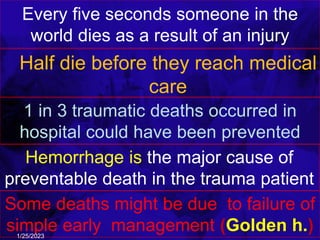
Every five seconds someone in the
world dies as a result of an injury
Half die before they reach medical
care
1 in 3 traumatic deaths occurred in
hospital could have been prevented
Some deaths might be due to failure of
simple early management (Golden h.)
1/25/2023
Hemorrhage is the major cause of
preventable death in the trauma patient
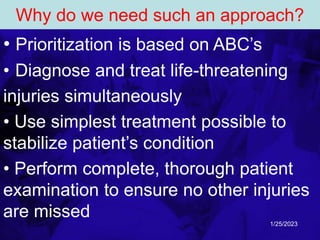
• Prioritization is based on ABC’s
• Diagnose and treat life-threatening
injuries simultaneously
• Use simplest treatment possible to
stabilize patient’s condition
• Perform complete, thorough patient
examination to ensure no other injuries
are missed
1/25/2023
advanced life support & care
Why do we need such an approach?
“To minimize preventable death and
to restore the patient back to his
pre-injury status”
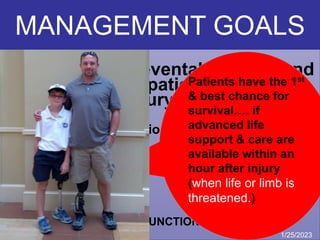
Having the following priorities :
• LIFE SALVAGE
• LIMB SALVAGE
• SALVAGE OF TOTAL FUNCTION IF POSSIBLE
What are the aims in
Primary Trauma Care?
Patients have the 1st
& best chance for
survival…. if
advanced life
support & care are
available within an
hour after injury
(when life or limb is
threatened.)
1/25/2023
MANAGEMENT GOALS
Principles
1/25/2023
Be familiar with your
equipment & team
members’ skills.
Establish patient’s
priorities
safe and reliable initial
trauma management steps
• Rapid and accurate assessment (Triage)
• Identify life threatening conditions (Pr. Survey)
• Resuscitate, stabilize and re-evaluate patients
according to priority. (Pr. Survey)
• Perform a head-to-toe evaluation with history
and physical examination, including all vital
signs. (Secondary survey)
• Plan for next stage of care and definitive
treatment
• Ensure continued postresuscitation monitoring
1/25/2023
Time is critical
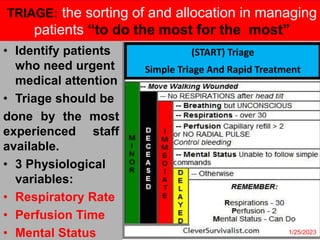
TRIAGE: the sorting of and allocation in managing
patients “to do the most for the most”
• Identify patients
who need urgent
medical attention
• Triage should be
done by the most
experienced staff
available.
• 3 Physiological
variables:
• Respiratory Rate
• Perfusion Time
• Mental Status 1/25/2023
(START) Triage
Simple Triage And Rapid Treatment
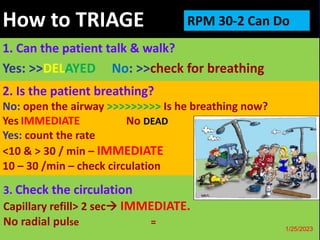
How to TRIAGE
1. Can the patient talk & walk?
Yes: >>DELAYED No: >>check for breathing
2. Is the patient breathing?
No: open the airway >>>>>>>>> Is he breathing now?
Yes IMMEDIATE No DEAD
Yes: count the rate
<10 & > 30 / min – IMMEDIATE
10 – 30 /min – check circulation
3. Check the circulation
Capillary refill> 2 sec IMMEDIATE.
No radial pulse =
1/25/2023
RPM 30-2 Can Do
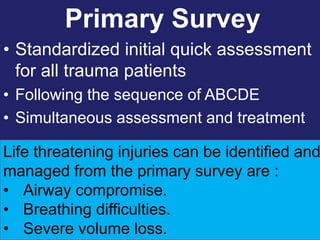
Primary Survey
• Standardized initial quick assessment
for all trauma patients
• Following the sequence of ABCDE
• Simultaneous assessment and treatment
1/25/2023
Life threatening injuries can be identified and
managed from the primary survey are :
• Airway compromise.
• Breathing difficulties.
• Severe volume loss.
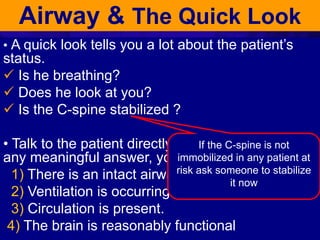
Airway & The Quick Look
• A quick look tells you a lot about the patient’s
status.
 Is he breathing?
 Does he look at you?
 Is the C-spine stabilized ?
• Talk to the patient directly. If the patient gives
any meaningful answer, you will know that:
1) There is an intact airway
2) Ventilation is occurring
3) Circulation is present.
4) The brain is reasonably functional
If the C-spine is not
immobilized in any patient at
risk ask someone to stabilize
it now
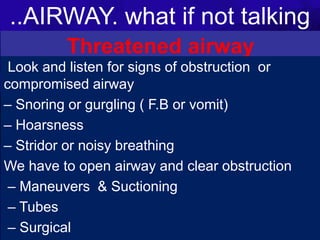
..AIRWAY. what if not talking
1/25/2023
Threatened airway
Any of the following is a possible cause or risk for
airway obstruction
• Coma (GCS<9)
• F.B or aspiration
• Maxillofacial trauma
• Neck trauma
• Burn
-Thermal injury causes airway edema
-Inhalation injury can cause hypoxia
C-Spine injuries (C3,4,5 impair respiratory drive)
Look and listen for signs of obstruction or
compromised airway
– Snoring or gurgling ( F.B or vomit)
– Hoarsness
– Stridor or noisy breathing
We have to open airway and clear obstruction
– Maneuvers & Suctioning
– Tubes
– Surgical
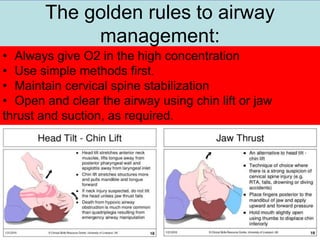
The golden rules to airway
management:
1/25/2023
• Always give O2 in the high concentration
• Use simple methods first.
• Maintain cervical spine stabilization
• Open and clear the airway using chin lift or jaw
thrust and suction, as required.
1/25/2023
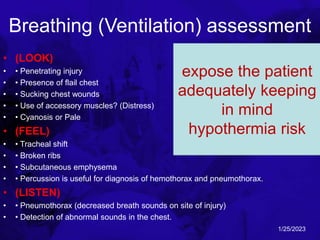
Breathing (Ventilation) assessment
• (LOOK)
• • Penetrating injury
• • Presence of flail chest
• • Sucking chest wounds
• • Use of accessory muscles? (Distress)
• • Cyanosis or Pale
• (FEEL)
• • Tracheal shift
• • Broken ribs
• • Subcutaneous emphysema
• • Percussion is useful for diagnosis of hemothorax and pneumothorax.
• (LISTEN)
• • Pneumothorax (decreased breath sounds on site of injury)
• • Detection of abnormal sounds in the chest.
The respiratory rate
and effort are sensitive
indicators in chest
trauma. They should be
monitored and
recorded at frequent
intervals.
expose the patient
adequately keeping
in mind
hypothermia risk
1/25/2023
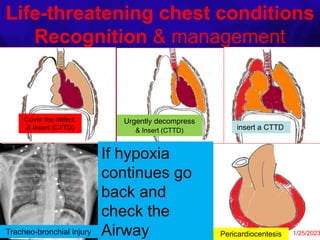
Life-threatening chest conditions
Recognition & management
Cover the defect.
& Insert (CTTD)
Urgently decompress
& Insert (CTTD) insert a CTTD
oxygen and
analgesics Pericardiocentesis
Maintain the
patient on oxygen
until complete
stabilization is
achieved and
SpO2 >95%. 1/25/2023
Tracheo-bronchial injury
If hypoxia
continues go
back and
check the
Airway
1/25/2023
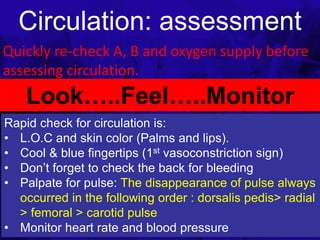
Circulation: assessment
Quickly re-check A, B and oxygen supply before
assessing circulation.
1/25/2023
Look…..Feel…..Monitor
Rapid check for circulation is:
• L.O.C and skin color (Palms and lips).
• Cool & blue fingertips (1st vasoconstriction sign)
• Don’t forget to check the back for bleeding
• Palpate for pulse: The disappearance of pulse always
occurred in the following order : dorsalis pedis> radial
> femoral > carotid pulse
• Monitor heart rate and blood pressure
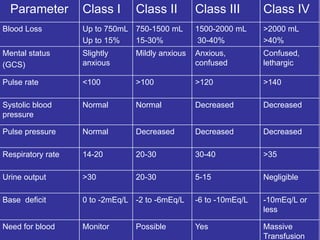
Parameter Class I Class II Class III Class IV
Blood Loss Up to 750mL
Up to 15%
750-1500 mL
15-30%
1500-2000 mL
30-40%
>2000 mL
>40%
Mental status
(GCS)
Slightly
anxious
Mildly anxious Anxious,
confused
Confused,
lethargic
Pulse rate <100 >100 >120 >140
Systolic blood
pressure
Normal Normal Decreased Decreased
Pulse pressure Normal Decreased Decreased Decreased
Respiratory rate 14-20 20-30 30-40 >35
Urine output >30 20-30 5-15 Negligible
Base deficit 0 to -2mEq/L -2 to -6mEq/L -6 to -10mEq/L -10mEq/L or
less
Need for blood Monitor Possible Yes Massive
Transfusion
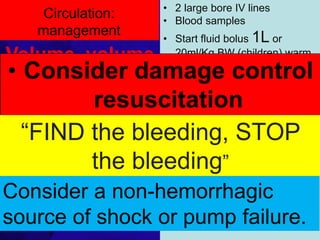
Circulation:
management
• 2 large bore IV lines
• Blood samples
• Start fluid bolus 1L or
20ml/Kg BW (children) warm
crystalloids and think about
giving blood
• Avoid hypoxemia and
hypercarbia giving O2 to all
• Aggressive and continued
volume resuscitation is not a
substitute for definitive control
of hemorrhage
• Aggressive crystalloids
resuscitation before control of
bleeding has been
demonstrated to increase
mortality and morbidity.
Volume, volume
& stop bleeding
• Direct pressure is the
preferred method
• Fractured long
bones or pelvis must
be splinted
• If possible, avoid
tourniquets
1/25/2023
• Consider damage control
resuscitation
“FIND the bleeding, STOP
the bleeding”
Consider a non-hemorrhagic
source of shock or pump failure.
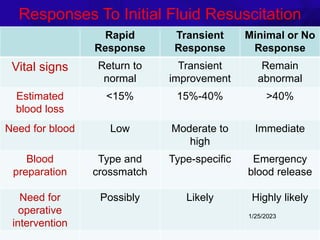
Responses To Initial Fluid Resuscitation
Rapid
Response
Transient
Response
Minimal or No
Response
Vital signs Return to
normal
Transient
improvement
Remain
abnormal
Estimated
blood loss
<15% 15%-40% >40%
Need for blood Low Moderate to
high
Immediate
Blood
preparation
Type and
crossmatch
Type-specific Emergency
blood release
Need for
operative
intervention
Possibly Likely Highly likely
1/25/2023
1/25/2023
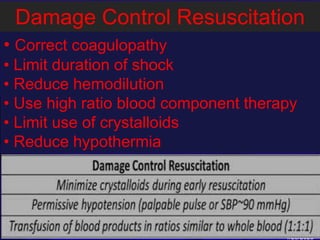
Damage Control Resuscitation
• Correct coagulopathy
• Limit duration of shock
• Reduce hemodilution
• Use high ratio blood component therapy
• Limit use of crystalloids
• Reduce hypothermia
Pattern of recognition
• Non responsive severe trauma
• Abnormal mental status
• Weak or absent radial pulse
1/25/2023
• Children
• Elderly
• Athletes
• Obese
• Pregnancy
• Medications
Remember
In primary survey:
-There are (C)
physiological
variations in
special
individuals…
-But the priorities
are same for all
patients 1/25/2023
• Stable oxygen saturation.
• Stable hemodynamics.
• Temperature >35.5C
• Urinary output > 1ml /kg/hr.
• No requirement of inotropic support.
• Lactate level below 3 mmol / L.
• No coagulopathy. (INR<1.5)
End point of resuscitation
1/25/2023
1/25/2023
Disability (AVPU)
• A rapid & easy
neurological
assessment as
a baseline for
more detailed
neuro
examination in
the secondary
survey
• A
• V
• P
• U
ALERT
GCS = 14-15
VERBAL RESPONSE
GCS = 9 - 13
UNRESPONSIVE
GCS = 3
RESPONDS TO PAIN ONLY
GCS = 4 - 8
1/25/2023
-L.O.C : AVPU vs
GCS
-Pupillary function
-4 extremity
movements
-External signs of
head injury
-Check glucose
Neurological life
threats
 Penetrating
cranial injury
 Intracranial
hemorrhage
 Diffuse axonal
injury
 High spinal cord
injury
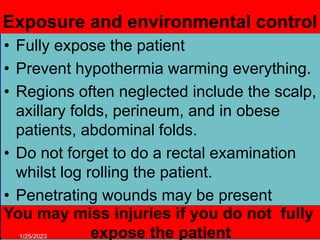
Exposure and environmental control
• Fully expose the patient
• Prevent hypothermia warming everything.
• Regions often neglected include the scalp,
axillary folds, perineum, and in obese
patients, abdominal folds.
• Do not forget to do a rectal examination
whilst log rolling the patient.
• Penetrating wounds may be present
anywhere
You may miss injuries if you do not fully
expose the patient
1/25/2023
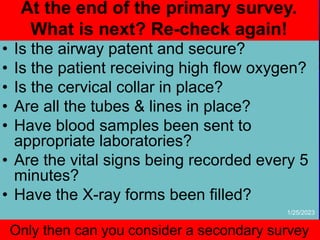
At the end of the primary survey.
What is next? Re-check again!
• Is the airway patent and secure?
• Is the patient receiving high flow oxygen?
• Is the cervical collar in place?
• Are all the tubes & lines in place?
• Have blood samples been sent to
appropriate laboratories?
• Are the vital signs being recorded every 5
minutes?
• Have the X-ray forms been filled?
Only then can you consider a secondary survey
1/25/2023
Pause &
check!
1/25/2023
After completing the primary survey and
handling any life-threatening problems, You
may proceed to the secondary survey
Secondary
survey: History
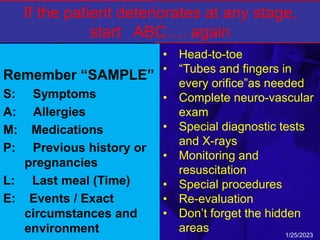
Remember “SAMPLE”
S: Symptoms
A: Allergies
M: Medications
P: Previous history or
pregnancies
L: Last meal (Time)
E: Events / Exact
circumstances and
environment
Secondary survey:
Components
• Head-to-toe
• “Tubes and fingers in
every orifice”as needed
• Complete neuro-vascular
exam
• Special diagnostic tests
and X-rays
• Monitoring and
resuscitation
• Special procedures
• Re-evaluation
• Don’t forget the hidden
areas 1/25/2023
If the patient deteriorates at any stage,
start ABC…. again
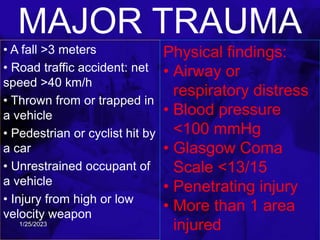
MAJOR TRAUMA
• A fall >3 meters
• Road traffic accident: net
speed >40 km/h
• Thrown from or trapped in
a vehicle
• Pedestrian or cyclist hit by
a car
• Unrestrained occupant of
a vehicle
• Injury from high or low
velocity weapon
Physical findings:
• Airway or
respiratory distress
• Blood pressure
<100 mmHg
• Glasgow Coma
Scale <13/15
• Penetrating injury
• More than 1 area
injured
1/25/2023
Radiological Investigations
• A multiply injured patient requires the
following X-rays
–Cervical X-ray (recent modifications now tend
to move this to the secondary survey because
of the associated time delay)
–Chest X-ray
–Pelvic X-ray
–FAST or E-FAST
Further X-ray investigation should be
taken at the end of the secondary survey.
1/25/2023
Monitoring of Resuscitation
 During and after the secondary survey, we will
monitor the effects of prior resuscitation efforts.
This is primarily through patient color, skin
temperature, mental status, blood pressure,
respiratory rate, and pulse rate.
 If the patient does not respond to fluid infusion, a CVP
monitoring catheter must be placed.
A low CVP (less than 6
indicates
the need for further
fluid
A high CVP
raises suspicion of
obstructive shock
The combination of
inappropriate
bradycardia with systolic
pressures of around 80,
warm extremities,
and a normal CVP
reading is typical of spinal shock.
1/25/2023
Don’t forget
• Start resuscitation at the same time as performing
primary survey
• Do not start secondary survey until completing primary
survey
• Constantly reassess patient for response to treatment
and…….. if condition deteriorates, reassess ABC
• Do not start definitive treatment until secondary survey
is completed unless required as life-saving measure
• When definitive treatment is not available, have a plan
for safe transfer of patient to another center
• Assume hypotension is related to bleeding
• All injured patients should be given high flow Oxygen
The patient does not leave the
emergency department for
definitive care (whether to the
operating room or to a higher
care facility or to ICU) until the
secondary survey and critical
testing are complete
1/25/2023
Take home message
• Co-ordinated team for trauma care
• Correct and in sequence ATLS approach
• Primary survey includes synchronized assessment and
treatment of trauma patient
• Priorities of resuscitation are same for all
• Proper transfer protocol should be
followed
• Many of trauma related deaths are preventable
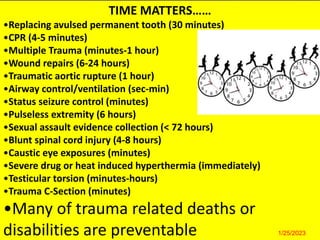
TIME MATTERS……
•Replacing avulsed permanent tooth (30 minutes)
•CPR (4-5 minutes)
•Multiple Trauma (minutes-1 hour)
•Wound repairs (6-24 hours)
•Traumatic aortic rupture (1 hour)
•Airway control/ventilation (sec-min)
•Status seizure control (minutes)
•Pulseless extremity (6 hours)
•Sexual assault evidence collection (< 72 hours)
•Blunt spinal cord injury (4-8 hours)
•Caustic eye exposures (minutes)
•Severe drug or heat induced hyperthermia (immediately)
•Testicular torsion (minutes-hours)
•Trauma C-Section (minutes)
•Many of trauma related deaths or
disabilities are preventable 1/25/2023
Thank You

Approach to Trauma Patient.ppt

  • 1.
  • 2.
    Every five secondssomeone in the world dies as a result of an injury Half die before they reach medical care 1 in 3 traumatic deaths occurred in hospital could have been prevented Some deaths might be due to failure of simple early management (Golden h.) 1/25/2023 Hemorrhage is the major cause of preventable death in the trauma patient
  • 3.
    • Prioritization isbased on ABC’s • Diagnose and treat life-threatening injuries simultaneously • Use simplest treatment possible to stabilize patient’s condition • Perform complete, thorough patient examination to ensure no other injuries are missed 1/25/2023 advanced life support & care Why do we need such an approach?
  • 4.
    “To minimize preventabledeath and to restore the patient back to his pre-injury status” Having the following priorities : • LIFE SALVAGE • LIMB SALVAGE • SALVAGE OF TOTAL FUNCTION IF POSSIBLE What are the aims in Primary Trauma Care? Patients have the 1st & best chance for survival…. if advanced life support & care are available within an hour after injury (when life or limb is threatened.) 1/25/2023 MANAGEMENT GOALS
  • 5.
    Principles 1/25/2023 Be familiar withyour equipment & team members’ skills. Establish patient’s priorities
  • 6.
    safe and reliableinitial trauma management steps • Rapid and accurate assessment (Triage) • Identify life threatening conditions (Pr. Survey) • Resuscitate, stabilize and re-evaluate patients according to priority. (Pr. Survey) • Perform a head-to-toe evaluation with history and physical examination, including all vital signs. (Secondary survey) • Plan for next stage of care and definitive treatment • Ensure continued postresuscitation monitoring 1/25/2023 Time is critical
  • 7.
    TRIAGE: the sortingof and allocation in managing patients “to do the most for the most” • Identify patients who need urgent medical attention • Triage should be done by the most experienced staff available. • 3 Physiological variables: • Respiratory Rate • Perfusion Time • Mental Status 1/25/2023 (START) Triage Simple Triage And Rapid Treatment
  • 8.
    How to TRIAGE 1.Can the patient talk & walk? Yes: >>DELAYED No: >>check for breathing 2. Is the patient breathing? No: open the airway >>>>>>>>> Is he breathing now? Yes IMMEDIATE No DEAD Yes: count the rate <10 & > 30 / min – IMMEDIATE 10 – 30 /min – check circulation 3. Check the circulation Capillary refill> 2 sec IMMEDIATE. No radial pulse = 1/25/2023 RPM 30-2 Can Do
  • 9.
    Primary Survey • Standardizedinitial quick assessment for all trauma patients • Following the sequence of ABCDE • Simultaneous assessment and treatment 1/25/2023 Life threatening injuries can be identified and managed from the primary survey are : • Airway compromise. • Breathing difficulties. • Severe volume loss.
  • 10.
    Airway & TheQuick Look • A quick look tells you a lot about the patient’s status.  Is he breathing?  Does he look at you?  Is the C-spine stabilized ? • Talk to the patient directly. If the patient gives any meaningful answer, you will know that: 1) There is an intact airway 2) Ventilation is occurring 3) Circulation is present. 4) The brain is reasonably functional If the C-spine is not immobilized in any patient at risk ask someone to stabilize it now
  • 11.
    ..AIRWAY. what ifnot talking 1/25/2023 Threatened airway Any of the following is a possible cause or risk for airway obstruction • Coma (GCS<9) • F.B or aspiration • Maxillofacial trauma • Neck trauma • Burn -Thermal injury causes airway edema -Inhalation injury can cause hypoxia C-Spine injuries (C3,4,5 impair respiratory drive) Look and listen for signs of obstruction or compromised airway – Snoring or gurgling ( F.B or vomit) – Hoarsness – Stridor or noisy breathing We have to open airway and clear obstruction – Maneuvers & Suctioning – Tubes – Surgical
  • 12.
    The golden rulesto airway management: 1/25/2023 • Always give O2 in the high concentration • Use simple methods first. • Maintain cervical spine stabilization • Open and clear the airway using chin lift or jaw thrust and suction, as required.
  • 13.
  • 14.
    Breathing (Ventilation) assessment •(LOOK) • • Penetrating injury • • Presence of flail chest • • Sucking chest wounds • • Use of accessory muscles? (Distress) • • Cyanosis or Pale • (FEEL) • • Tracheal shift • • Broken ribs • • Subcutaneous emphysema • • Percussion is useful for diagnosis of hemothorax and pneumothorax. • (LISTEN) • • Pneumothorax (decreased breath sounds on site of injury) • • Detection of abnormal sounds in the chest. The respiratory rate and effort are sensitive indicators in chest trauma. They should be monitored and recorded at frequent intervals. expose the patient adequately keeping in mind hypothermia risk 1/25/2023
  • 15.
    Life-threatening chest conditions Recognition& management Cover the defect. & Insert (CTTD) Urgently decompress & Insert (CTTD) insert a CTTD oxygen and analgesics Pericardiocentesis Maintain the patient on oxygen until complete stabilization is achieved and SpO2 >95%. 1/25/2023 Tracheo-bronchial injury If hypoxia continues go back and check the Airway
  • 16.
  • 17.
    Circulation: assessment Quickly re-checkA, B and oxygen supply before assessing circulation. 1/25/2023 Look…..Feel…..Monitor Rapid check for circulation is: • L.O.C and skin color (Palms and lips). • Cool & blue fingertips (1st vasoconstriction sign) • Don’t forget to check the back for bleeding • Palpate for pulse: The disappearance of pulse always occurred in the following order : dorsalis pedis> radial > femoral > carotid pulse • Monitor heart rate and blood pressure
  • 18.
    Parameter Class IClass II Class III Class IV Blood Loss Up to 750mL Up to 15% 750-1500 mL 15-30% 1500-2000 mL 30-40% >2000 mL >40% Mental status (GCS) Slightly anxious Mildly anxious Anxious, confused Confused, lethargic Pulse rate <100 >100 >120 >140 Systolic blood pressure Normal Normal Decreased Decreased Pulse pressure Normal Decreased Decreased Decreased Respiratory rate 14-20 20-30 30-40 >35 Urine output >30 20-30 5-15 Negligible Base deficit 0 to -2mEq/L -2 to -6mEq/L -6 to -10mEq/L -10mEq/L or less Need for blood Monitor Possible Yes Massive Transfusion
  • 19.
    Circulation: management • 2 largebore IV lines • Blood samples • Start fluid bolus 1L or 20ml/Kg BW (children) warm crystalloids and think about giving blood • Avoid hypoxemia and hypercarbia giving O2 to all • Aggressive and continued volume resuscitation is not a substitute for definitive control of hemorrhage • Aggressive crystalloids resuscitation before control of bleeding has been demonstrated to increase mortality and morbidity. Volume, volume & stop bleeding • Direct pressure is the preferred method • Fractured long bones or pelvis must be splinted • If possible, avoid tourniquets 1/25/2023 • Consider damage control resuscitation “FIND the bleeding, STOP the bleeding” Consider a non-hemorrhagic source of shock or pump failure.
  • 20.
    Responses To InitialFluid Resuscitation Rapid Response Transient Response Minimal or No Response Vital signs Return to normal Transient improvement Remain abnormal Estimated blood loss <15% 15%-40% >40% Need for blood Low Moderate to high Immediate Blood preparation Type and crossmatch Type-specific Emergency blood release Need for operative intervention Possibly Likely Highly likely 1/25/2023
  • 21.
    1/25/2023 Damage Control Resuscitation •Correct coagulopathy • Limit duration of shock • Reduce hemodilution • Use high ratio blood component therapy • Limit use of crystalloids • Reduce hypothermia Pattern of recognition • Non responsive severe trauma • Abnormal mental status • Weak or absent radial pulse
  • 22.
  • 23.
    • Children • Elderly •Athletes • Obese • Pregnancy • Medications Remember In primary survey: -There are (C) physiological variations in special individuals… -But the priorities are same for all patients 1/25/2023
  • 24.
    • Stable oxygensaturation. • Stable hemodynamics. • Temperature >35.5C • Urinary output > 1ml /kg/hr. • No requirement of inotropic support. • Lactate level below 3 mmol / L. • No coagulopathy. (INR<1.5) End point of resuscitation 1/25/2023
  • 25.
  • 26.
    Disability (AVPU) • Arapid & easy neurological assessment as a baseline for more detailed neuro examination in the secondary survey • A • V • P • U ALERT GCS = 14-15 VERBAL RESPONSE GCS = 9 - 13 UNRESPONSIVE GCS = 3 RESPONDS TO PAIN ONLY GCS = 4 - 8 1/25/2023 -L.O.C : AVPU vs GCS -Pupillary function -4 extremity movements -External signs of head injury -Check glucose Neurological life threats  Penetrating cranial injury  Intracranial hemorrhage  Diffuse axonal injury  High spinal cord injury
  • 27.
    Exposure and environmentalcontrol • Fully expose the patient • Prevent hypothermia warming everything. • Regions often neglected include the scalp, axillary folds, perineum, and in obese patients, abdominal folds. • Do not forget to do a rectal examination whilst log rolling the patient. • Penetrating wounds may be present anywhere You may miss injuries if you do not fully expose the patient 1/25/2023
  • 28.
    At the endof the primary survey. What is next? Re-check again! • Is the airway patent and secure? • Is the patient receiving high flow oxygen? • Is the cervical collar in place? • Are all the tubes & lines in place? • Have blood samples been sent to appropriate laboratories? • Are the vital signs being recorded every 5 minutes? • Have the X-ray forms been filled? Only then can you consider a secondary survey 1/25/2023
  • 29.
    Pause & check! 1/25/2023 After completingthe primary survey and handling any life-threatening problems, You may proceed to the secondary survey
  • 30.
    Secondary survey: History Remember “SAMPLE” S:Symptoms A: Allergies M: Medications P: Previous history or pregnancies L: Last meal (Time) E: Events / Exact circumstances and environment Secondary survey: Components • Head-to-toe • “Tubes and fingers in every orifice”as needed • Complete neuro-vascular exam • Special diagnostic tests and X-rays • Monitoring and resuscitation • Special procedures • Re-evaluation • Don’t forget the hidden areas 1/25/2023 If the patient deteriorates at any stage, start ABC…. again
  • 31.
    MAJOR TRAUMA • Afall >3 meters • Road traffic accident: net speed >40 km/h • Thrown from or trapped in a vehicle • Pedestrian or cyclist hit by a car • Unrestrained occupant of a vehicle • Injury from high or low velocity weapon Physical findings: • Airway or respiratory distress • Blood pressure <100 mmHg • Glasgow Coma Scale <13/15 • Penetrating injury • More than 1 area injured 1/25/2023
  • 32.
    Radiological Investigations • Amultiply injured patient requires the following X-rays –Cervical X-ray (recent modifications now tend to move this to the secondary survey because of the associated time delay) –Chest X-ray –Pelvic X-ray –FAST or E-FAST Further X-ray investigation should be taken at the end of the secondary survey. 1/25/2023
  • 33.
    Monitoring of Resuscitation During and after the secondary survey, we will monitor the effects of prior resuscitation efforts. This is primarily through patient color, skin temperature, mental status, blood pressure, respiratory rate, and pulse rate.  If the patient does not respond to fluid infusion, a CVP monitoring catheter must be placed. A low CVP (less than 6 indicates the need for further fluid A high CVP raises suspicion of obstructive shock The combination of inappropriate bradycardia with systolic pressures of around 80, warm extremities, and a normal CVP reading is typical of spinal shock. 1/25/2023
  • 34.
    Don’t forget • Startresuscitation at the same time as performing primary survey • Do not start secondary survey until completing primary survey • Constantly reassess patient for response to treatment and…….. if condition deteriorates, reassess ABC • Do not start definitive treatment until secondary survey is completed unless required as life-saving measure • When definitive treatment is not available, have a plan for safe transfer of patient to another center • Assume hypotension is related to bleeding • All injured patients should be given high flow Oxygen
  • 35.
    The patient doesnot leave the emergency department for definitive care (whether to the operating room or to a higher care facility or to ICU) until the secondary survey and critical testing are complete 1/25/2023
  • 36.
    Take home message •Co-ordinated team for trauma care • Correct and in sequence ATLS approach • Primary survey includes synchronized assessment and treatment of trauma patient • Priorities of resuscitation are same for all • Proper transfer protocol should be followed • Many of trauma related deaths are preventable TIME MATTERS…… •Replacing avulsed permanent tooth (30 minutes) •CPR (4-5 minutes) •Multiple Trauma (minutes-1 hour) •Wound repairs (6-24 hours) •Traumatic aortic rupture (1 hour) •Airway control/ventilation (sec-min) •Status seizure control (minutes) •Pulseless extremity (6 hours) •Sexual assault evidence collection (< 72 hours) •Blunt spinal cord injury (4-8 hours) •Caustic eye exposures (minutes) •Severe drug or heat induced hyperthermia (immediately) •Testicular torsion (minutes-hours) •Trauma C-Section (minutes) •Many of trauma related deaths or disabilities are preventable 1/25/2023
  • 37.