Reference values for potentially harmful
elements in soils from
Atlantic Rainforest, Brazil
Eloana Janice Bonfleur
Vander Freitas Melo
Brenda Buschle
Luiz Claudio Paula Souza
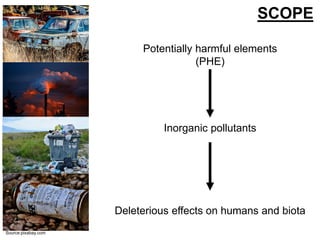
Potentially harmful elements
(PHE)
Inorganic pollutants
Deleterious effects on humans and biota
Source:pixabay.com
SCOPE
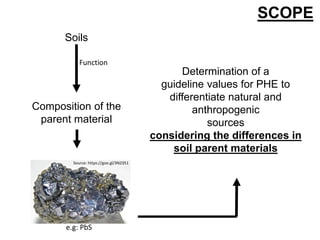
Soils
Composition of the
parent material
SCOPE
e.g: PbS
Source: https://goo.gl/3N2351
Determination of a
guideline values for PHE to
differentiate natural and
anthropogenic
sources
considering the differences in
soil parent materials
Function
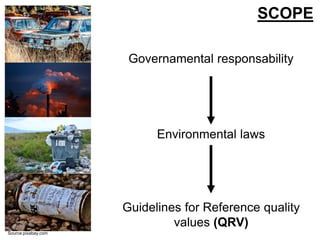
Governamental responsability
Environmental laws
Guidelines for Reference quality
values (QRV)
Source:pixabay.com
SCOPE
AIM
Determine the background values and quality reference
values for
Ag, As, Ba, Cd, Co, Cr, Cu, Mo, Ni, Pb, Sb, V e Zn.
The first study to determine quality reference values (QRV) for
PHE in Coastal Plain (Atlantic Rainforest) from Brazil;
• Atlantic Rainforest
 greater diversity of wildlife and flora of the planet
 its preservation begins with the determination of natural
background levels of organic and inorganic pollutants in
soils.
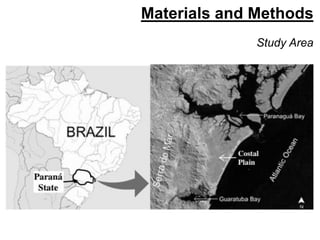
Materials and Methods
Study Area
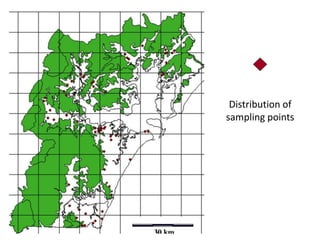
Distribution of
sampling points
Materials and Methods
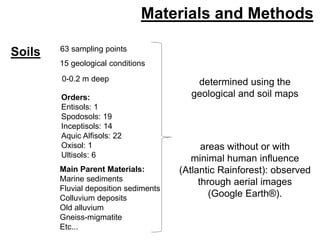
Orders:
Entisols: 1
Spodosols: 19
Inceptisols: 14
Aquic Alfisols: 22
Oxisol: 1
Ultisols: 6
Main Parent Materials:
Marine sediments
Fluvial deposition sediments
Colluvium deposits
Old alluvium
Gneiss-migmatite
Etc...
determined using the
geological and soil maps
63 sampling points
areas without or with
minimal human influence
(Atlantic Rainforest): observed
through aerial images
(Google Earth®).
15 geological conditions
0-0.2 m deep
Soils
Materials and Methods
Potentially harmful elements (PHE) in soils
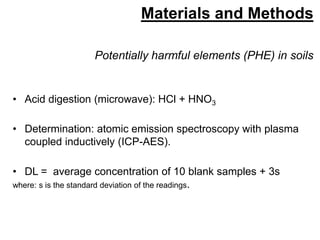
• Acid digestion (microwave): HCl + HNO3
• Determination: atomic emission spectroscopy with plasma
coupled inductively (ICP-AES).
• DL = average concentration of 10 blank samples + 3s
where: s is the standard deviation of the readings.
Materials and Methods
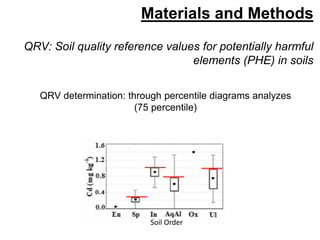
QRV: Soil quality reference values for potentially harmful
elements (PHE) in soils
QRV determination: through percentile diagrams analyzes
(75 percentile)
Soil Order
Results and Discussion
Physical and chemical soil attributes
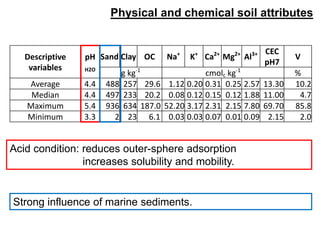
Descriptive
variables
pH
H2O
Sand Clay OC Na+
K+
Ca2+
Mg2+
Al3+ CEC
pH7
V
g kg-1
cmolc kg-1
%
Average 4.4 488 257 29.6 1.12 0.20 0.31 0.25 2.57 13.30 10.2
Median 4.4 497 233 20.2 0.08 0.12 0.15 0.12 1.88 11.00 4.7
Maximum 5.4 936 634 187.0 52.20 3.17 2.31 2.15 7.80 69.70 85.8
Minimum 3.3 2 23 6.1 0.03 0.03 0.07 0.01 0.09 2.15 2.0
Acid condition: reduces outer-sphere adsorption
increases solubility and mobility.
Strong influence of marine sediments.
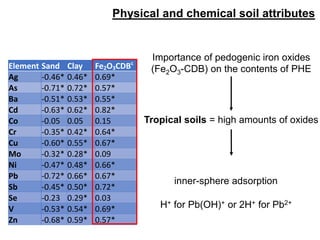
Element Sand Clay Fe2O3CDBc
Ag -0.46* 0.46* 0.69*
As -0.71* 0.72* 0.57*
Ba -0.51* 0.53* 0.55*
Cd -0.63* 0.62* 0.82*
Co -0.05 0.05 0.15
Cr -0.35* 0.42* 0.64*
Cu -0.60* 0.55* 0.67*
Mo -0.32* 0.28* 0.09
Ni -0.47* 0.48* 0.66*
Pb -0.72* 0.66* 0.67*
Sb -0.45* 0.50* 0.72*
Se -0.23 0.29* 0.03
V -0.53* 0.54* 0.69*
Zn -0.68* 0.59* 0.57*
Importance of pedogenic iron oxides
(Fe2O3-CDB) on the contents of PHE
inner-sphere adsorption
H+ for Pb(OH)+ or 2H+ for Pb2+
Physical and chemical soil attributes
Tropical soils = high amounts of oxides
Potentially harmful elements (PHE) in soils
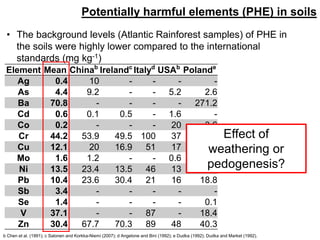
• The background levels (Atlantic Rainforest samples) of PHE in
the soils were highly lower compared to the international
standards (mg kg-1)
b Chen et al. (1991); c Salonen and Korkka-Niemi (2007); d Angelone and Bini (1992); e Dudka (1992); Dudka and Market (1992).
Element Mean Chinab
Irelandc
Italyd
USAb
Polande
Ag 0.4 10 - - - -
As 4.4 9.2 - - 5.2 2.6
Ba 70.8 - - - - 271.2
Cd 0.6 0.1 0.5 - 1.6 -
Co 0.2 - - - 20 3.6
Cr 44.2 53.9 49.5 100 37 16.8
Cu 12.1 20 16.9 51 17 6.3
Mo 1.6 1.2 - - 0.6 -
Ni 13.5 23.4 13.5 46 13 7.4
Pb 10.4 23.6 30.4 21 16 18.8
Sb 3.4 - - - - -
Se 1.4 - - - - 0.1
V 37.1 - - 87 - 18.4
Zn 30.4 67.7 70.3 89 48 40.3
Effect of
weathering or
pedogenesis?
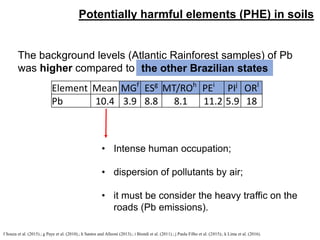
• Intense human occupation;
• dispersion of pollutants by air;
• it must be consider the heavy traffic on the
roads (Pb emissions).
The background levels (Atlantic Rainforest samples) of Pb
was higher compared to
Element Mean MGf
ESg
MT/ROh
PEi
PIj
ORl
Pb 10.4 3.9 8.8 8.1 11.2 5.9 18
f Souza et al. (2015).; g Paye et al. (2010).; h Santos and Alleoni (2013).; i Biondi et al. (2011).; j Paula Filho et al. (2015);. k Lima et al. (2016).
the other Brazilian states
Potentially harmful elements (PHE) in soils
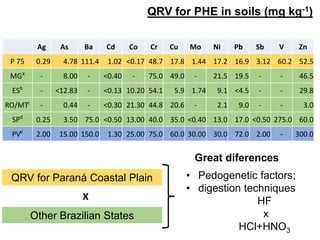
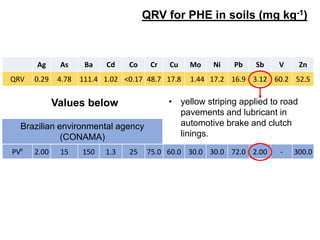
QRV for PHE in soils (mg kg-1)
Ag As Ba Cd Co Cr Cu Mo Ni Pb Sb V Zn
P 75 0.29 4.78 111.4 1.02 <0.17 48.7 17.8 1.44 17.2 16.9 3.12 60.2 52.5
MGa
- 8.00 - <0.40 - 75.0 49.0 - 21.5 19.5 - - 46.5
ESb
- <12.83 - <0.13 10.20 54.1 5.9 1.74 9.1 <4.5 - - 29.8
RO/MTc
- 0.44 - <0.30 21.30 44.8 20.6 - 2.1 9.0 - - 3.0
SPd
0.25 3.50 75.0 <0.50 13.00 40.0 35.0 <0.40 13.0 17.0 <0.50 275.0 60.0
PVe
2.00 15.00 150.0 1.30 25.00 75.0 60.0 30.00 30.0 72.0 2.00 - 300.0
Other Brazilian States
QRV for Paraná Coastal Plain
X
• Pedogenetic factors;
• digestion techniques
HF
x
HCl+HNO3
Great diferences
Ag As Ba Cd Co Cr Cu Mo Ni Pb Sb V Zn
QRV 0.29 4.78 111.4 1.02 <0.17 48.7 17.8 1.44 17.2 16.9 3.12 60.2 52.5
MGa
- 8 - <0.4 - 75.0 49.0 - 21.5 19.5 - - 46.5
ESb
- <12.83 - <0.13 10.21 54.1 5.9 1.74 9.1 <4.5 - - 29.8
RO/MTc
- 0.44 - <0.3 21.3 44.8 20.6 - 2.1 9.0 - - 3.0
SPd
0.25 3.5 75 <0.5 13 40.0 35.0 <0.4 13.0 17.0 <0.5 275.0 60.0
PVe
2.00 15 150 1.3 25 75.0 60.0 30.0 30.0 72.0 2.00 - 300.0
Brazilian environmental agency
(CONAMA)
• yellow striping applied to road
pavements and lubricant in
automotive brake and clutch
linings.
Values below
QRV for PHE in soils (mg kg-1)
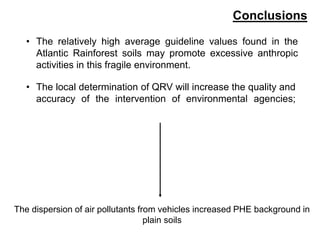
Conclusions
• The local determination of QRV will increase the quality and
accuracy of the intervention of environmental agencies;
• The relatively high average guideline values found in the
Atlantic Rainforest soils may promote excessive anthropic
activities in this fragile environment.
The dispersion of air pollutants from vehicles increased PHE background in
plain soils
Contact
eloanabonfleur@ufpr.br
Soil Science and Agricultural Engineering Department.
Federal University of Paraná. Brazil.
Thank You!!!

Reference values for potentially harmful elements in soils from Atlantic Rainforest, Brazil

  • 1.
    Reference values forpotentially harmful elements in soils from Atlantic Rainforest, Brazil Eloana Janice Bonfleur Vander Freitas Melo Brenda Buschle Luiz Claudio Paula Souza
  • 2.
    Potentially harmful elements (PHE) Inorganicpollutants Deleterious effects on humans and biota Source:pixabay.com SCOPE
  • 3.
    Soils Composition of the parentmaterial SCOPE e.g: PbS Source: https://goo.gl/3N2351 Determination of a guideline values for PHE to differentiate natural and anthropogenic sources considering the differences in soil parent materials Function
  • 4.
    Governamental responsability Environmental laws Guidelinesfor Reference quality values (QRV) Source:pixabay.com SCOPE
  • 5.
    AIM Determine the backgroundvalues and quality reference values for Ag, As, Ba, Cd, Co, Cr, Cu, Mo, Ni, Pb, Sb, V e Zn. The first study to determine quality reference values (QRV) for PHE in Coastal Plain (Atlantic Rainforest) from Brazil; • Atlantic Rainforest  greater diversity of wildlife and flora of the planet  its preservation begins with the determination of natural background levels of organic and inorganic pollutants in soils.
  • 6.
  • 7.
  • 8.
    Materials and Methods Orders: Entisols:1 Spodosols: 19 Inceptisols: 14 Aquic Alfisols: 22 Oxisol: 1 Ultisols: 6 Main Parent Materials: Marine sediments Fluvial deposition sediments Colluvium deposits Old alluvium Gneiss-migmatite Etc... determined using the geological and soil maps 63 sampling points areas without or with minimal human influence (Atlantic Rainforest): observed through aerial images (Google Earth®). 15 geological conditions 0-0.2 m deep Soils
  • 9.
    Materials and Methods Potentiallyharmful elements (PHE) in soils • Acid digestion (microwave): HCl + HNO3 • Determination: atomic emission spectroscopy with plasma coupled inductively (ICP-AES). • DL = average concentration of 10 blank samples + 3s where: s is the standard deviation of the readings.
  • 10.
    Materials and Methods QRV:Soil quality reference values for potentially harmful elements (PHE) in soils QRV determination: through percentile diagrams analyzes (75 percentile) Soil Order
  • 11.
  • 12.
    Physical and chemicalsoil attributes Descriptive variables pH H2O Sand Clay OC Na+ K+ Ca2+ Mg2+ Al3+ CEC pH7 V g kg-1 cmolc kg-1 % Average 4.4 488 257 29.6 1.12 0.20 0.31 0.25 2.57 13.30 10.2 Median 4.4 497 233 20.2 0.08 0.12 0.15 0.12 1.88 11.00 4.7 Maximum 5.4 936 634 187.0 52.20 3.17 2.31 2.15 7.80 69.70 85.8 Minimum 3.3 2 23 6.1 0.03 0.03 0.07 0.01 0.09 2.15 2.0 Acid condition: reduces outer-sphere adsorption increases solubility and mobility. Strong influence of marine sediments.
  • 13.
    Element Sand ClayFe2O3CDBc Ag -0.46* 0.46* 0.69* As -0.71* 0.72* 0.57* Ba -0.51* 0.53* 0.55* Cd -0.63* 0.62* 0.82* Co -0.05 0.05 0.15 Cr -0.35* 0.42* 0.64* Cu -0.60* 0.55* 0.67* Mo -0.32* 0.28* 0.09 Ni -0.47* 0.48* 0.66* Pb -0.72* 0.66* 0.67* Sb -0.45* 0.50* 0.72* Se -0.23 0.29* 0.03 V -0.53* 0.54* 0.69* Zn -0.68* 0.59* 0.57* Importance of pedogenic iron oxides (Fe2O3-CDB) on the contents of PHE inner-sphere adsorption H+ for Pb(OH)+ or 2H+ for Pb2+ Physical and chemical soil attributes Tropical soils = high amounts of oxides
  • 14.
    Potentially harmful elements(PHE) in soils • The background levels (Atlantic Rainforest samples) of PHE in the soils were highly lower compared to the international standards (mg kg-1) b Chen et al. (1991); c Salonen and Korkka-Niemi (2007); d Angelone and Bini (1992); e Dudka (1992); Dudka and Market (1992). Element Mean Chinab Irelandc Italyd USAb Polande Ag 0.4 10 - - - - As 4.4 9.2 - - 5.2 2.6 Ba 70.8 - - - - 271.2 Cd 0.6 0.1 0.5 - 1.6 - Co 0.2 - - - 20 3.6 Cr 44.2 53.9 49.5 100 37 16.8 Cu 12.1 20 16.9 51 17 6.3 Mo 1.6 1.2 - - 0.6 - Ni 13.5 23.4 13.5 46 13 7.4 Pb 10.4 23.6 30.4 21 16 18.8 Sb 3.4 - - - - - Se 1.4 - - - - 0.1 V 37.1 - - 87 - 18.4 Zn 30.4 67.7 70.3 89 48 40.3 Effect of weathering or pedogenesis?
  • 15.
    • Intense humanoccupation; • dispersion of pollutants by air; • it must be consider the heavy traffic on the roads (Pb emissions). The background levels (Atlantic Rainforest samples) of Pb was higher compared to Element Mean MGf ESg MT/ROh PEi PIj ORl Pb 10.4 3.9 8.8 8.1 11.2 5.9 18 f Souza et al. (2015).; g Paye et al. (2010).; h Santos and Alleoni (2013).; i Biondi et al. (2011).; j Paula Filho et al. (2015);. k Lima et al. (2016). the other Brazilian states Potentially harmful elements (PHE) in soils
  • 16.
    QRV for PHEin soils (mg kg-1) Ag As Ba Cd Co Cr Cu Mo Ni Pb Sb V Zn P 75 0.29 4.78 111.4 1.02 <0.17 48.7 17.8 1.44 17.2 16.9 3.12 60.2 52.5 MGa - 8.00 - <0.40 - 75.0 49.0 - 21.5 19.5 - - 46.5 ESb - <12.83 - <0.13 10.20 54.1 5.9 1.74 9.1 <4.5 - - 29.8 RO/MTc - 0.44 - <0.30 21.30 44.8 20.6 - 2.1 9.0 - - 3.0 SPd 0.25 3.50 75.0 <0.50 13.00 40.0 35.0 <0.40 13.0 17.0 <0.50 275.0 60.0 PVe 2.00 15.00 150.0 1.30 25.00 75.0 60.0 30.00 30.0 72.0 2.00 - 300.0 Other Brazilian States QRV for Paraná Coastal Plain X • Pedogenetic factors; • digestion techniques HF x HCl+HNO3 Great diferences
  • 17.
    Ag As BaCd Co Cr Cu Mo Ni Pb Sb V Zn QRV 0.29 4.78 111.4 1.02 <0.17 48.7 17.8 1.44 17.2 16.9 3.12 60.2 52.5 MGa - 8 - <0.4 - 75.0 49.0 - 21.5 19.5 - - 46.5 ESb - <12.83 - <0.13 10.21 54.1 5.9 1.74 9.1 <4.5 - - 29.8 RO/MTc - 0.44 - <0.3 21.3 44.8 20.6 - 2.1 9.0 - - 3.0 SPd 0.25 3.5 75 <0.5 13 40.0 35.0 <0.4 13.0 17.0 <0.5 275.0 60.0 PVe 2.00 15 150 1.3 25 75.0 60.0 30.0 30.0 72.0 2.00 - 300.0 Brazilian environmental agency (CONAMA) • yellow striping applied to road pavements and lubricant in automotive brake and clutch linings. Values below QRV for PHE in soils (mg kg-1)
  • 18.
    Conclusions • The localdetermination of QRV will increase the quality and accuracy of the intervention of environmental agencies; • The relatively high average guideline values found in the Atlantic Rainforest soils may promote excessive anthropic activities in this fragile environment. The dispersion of air pollutants from vehicles increased PHE background in plain soils
  • 19.
    Contact eloanabonfleur@ufpr.br Soil Science andAgricultural Engineering Department. Federal University of Paraná. Brazil. Thank You!!!