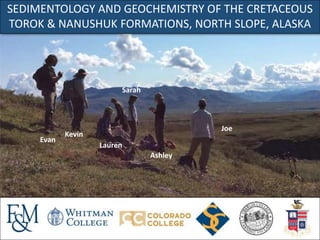
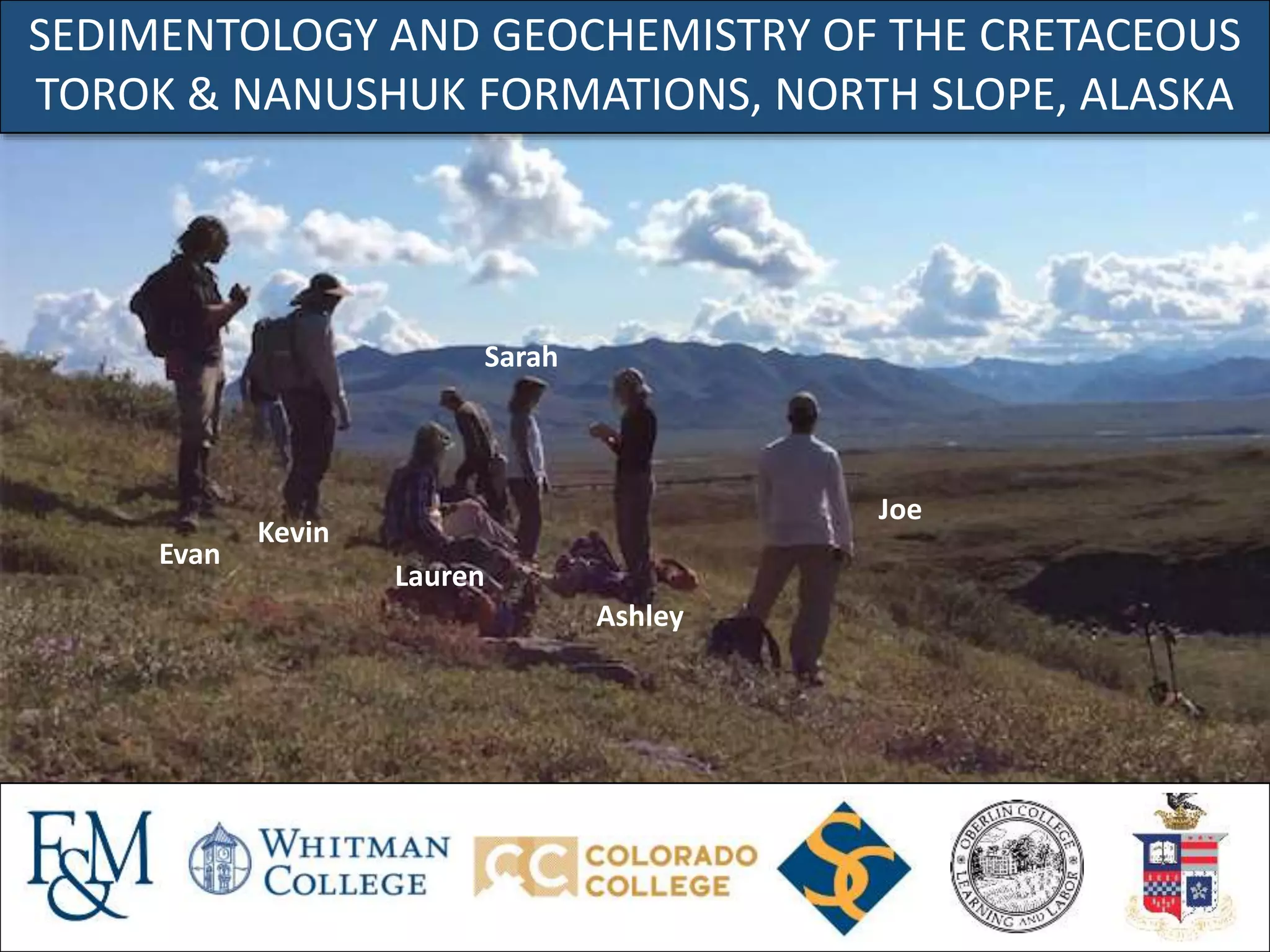
SEDIMENTOLOGY AND GEOCHEMISTRY OF THE CRETACEOUS
TOROK & NANUSHUK FORMATIONS, NORTH SLOPE, ALASKA
Kevin
Joe
Ashley
Sarah
Lauren
Evan
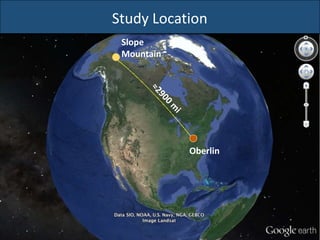
Study Location
Slope
Mountain
Oberlin
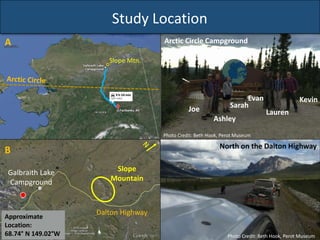
North on the Dalton Highway
Photo Credit: Beth Hook, Perot Museum
Evan Kevin
Joe
Ashley
Sarah
Lauren
Arctic Circle Campground
Study Location
Dalton Highway
Galbraith Lake
Campground
Slope
Mountain
Approximate
Location:
68.74° N 149.02°W
Slope Mtn.
A
B
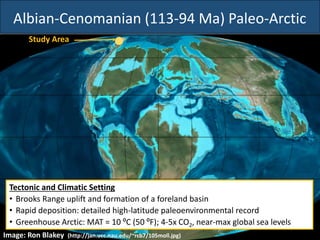
Tectonic and Climatic Setting
• Brooks Range uplift and formation of a foreland basin
• Rapid deposition: detailed high-latitude paleoenvironmental record
• Greenhouse Arctic: MAT = 10 ºC (50 ºF); 4-5x CO2, near-max global sea levels
Study Area
Image: Ron Blakey (http://jan.ucc.nau.edu/~rcb7/105moll.jpg)
Albian-Cenomanian (113-94 Ma) Paleo-Arctic
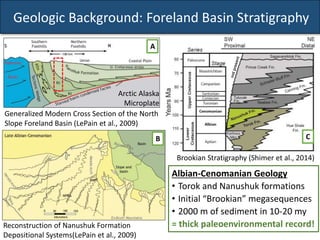
Geologic Background: Foreland Basin Stratigraphy
Arctic Alaska
Microplate
Generalized Modern Cross Section of the North
Slope Foreland Basin (LePain et al., 2009)
Brookian Stratigraphy (Shimer et al., 2014)
Reconstruction of Nanushuk Formation
Depositional Systems(LePain et al., 2009)
Albian-Cenomanian Geology
• Torok and Nanushuk formations
• Initial “Brookian” megasequences
• 2000 m of sediment in 10-20 my
= thick paleoenvironmental record!
A
B C
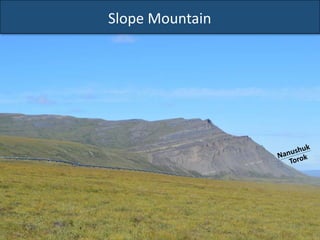
Slope Mountain
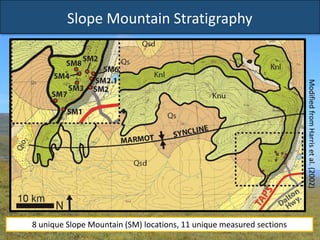
Slope Mountain Stratigraphy
ModifiedfromHarrisetal.(2002)
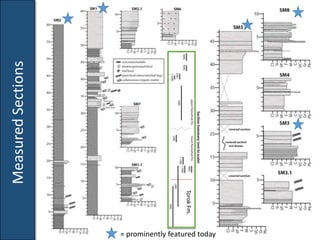
8 unique Slope Mountain (SM) locations, 11 unique measured sections
Measured SectionsMeasuredSections
= prominently featured today
TorokFm.
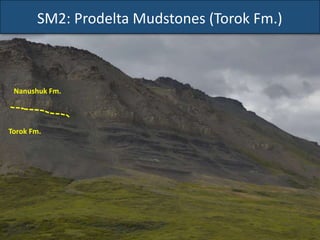
SM2: Prodelta Mudstones (Torok Fm.)
Nanushuk Fm.
Torok Fm.
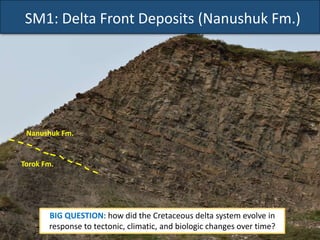
SM1: Delta Front Deposits (Nanushuk Fm.)
Nanushuk Fm.
Torok Fm.
BIG QUESTION: how did the Cretaceous delta system evolve in
response to tectonic, climatic, and biologic changes over time?
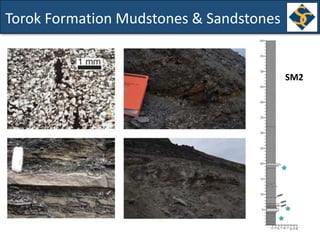
Torok Formation Mudstones & Sandstones
SM2
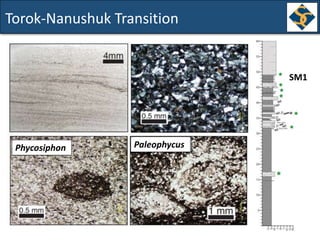
Torok-Nanushuk Transition
SM1
Phycosiphon Paleophycus
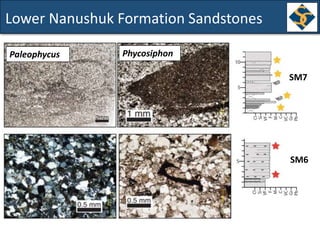
Lower Nanushuk Formation Sandstones
SM7
SM6
Paleophycus Phycosiphon
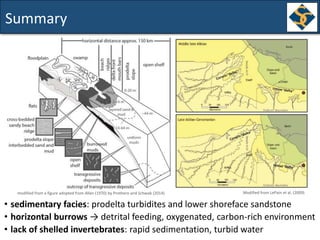
Summary
• sedimentary facies: prodelta turbidites and lower shoreface sandstone
• horizontal burrows → detrital feeding, oxygenated, carbon-rich environment
• lack of shelled invertebrates: rapid sedimentation, turbid water
modified from a figure adopted from Allen (1970) by Prothero and Schwab (2014) Modified from LePain et al. (2009)
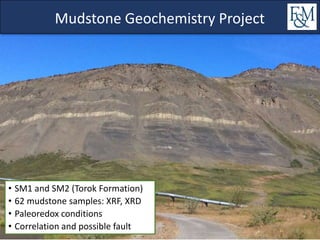
Mudstone Geochemistry Project
• SM1 and SM2 (Torok Formation)
• 62 mudstone samples: XRF, XRD
• Paleoredox conditions
• Correlation and possible fault
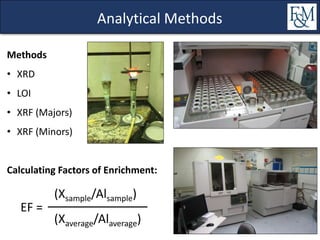
Analytical Methods
Methods
• XRD
• LOI
• XRF (Majors)
• XRF (Minors)
Calculating Factors of Enrichment:
EF =
(Xsample/Alsample)
(Xaverage/Alaverage)
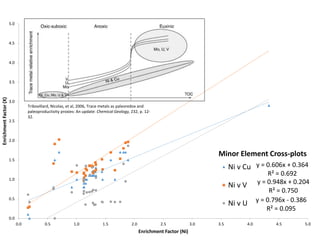
y = 0.606x + 0.364
R² = 0.692
y = 0.948x + 0.204
R² = 0.750
y = 0.796x - 0.386
R² = 0.095
0.0
0.5
1.0
1.5
2.0
2.5
3.0
3.5
4.0
4.5
5.0
0.0 0.5 1.0 1.5 2.0 2.5 3.0 3.5 4.0 4.5 5.0
EnrichmentFactor(X)
Enrichment Factor (Ni)
Minor Element Cross-plots
Ni v Cu
Ni v V
Ni v U
Tribovillard, Nicolas, et al, 2006, Trace metals as paleoredox and
paleoproductivity proxies: An update: Chemical Geology, 232, p. 12-
32.
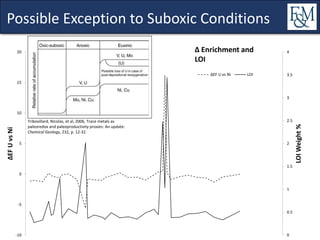
Possible Exception to Suboxic Conditions
0
0.5
1
1.5
2
2.5
3
3.5
4
-10
-5
0
5
10
15
20
LOIWeight%
∆EFUvsNi
∆EF U vs Ni LOI
∆ Enrichment and
LOI
Tribovillard, Nicolas, et al, 2006, Trace metals as
paleoredox and paleoproductivity proxies: An update:
Chemical Geology, 232, p. 12-32.
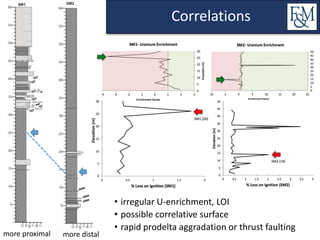
Correlations
more proximal more distal
Elevation(m)
• irregular U-enrichment, LOI
• possible correlative surface
• rapid prodelta aggradation or thrust faulting
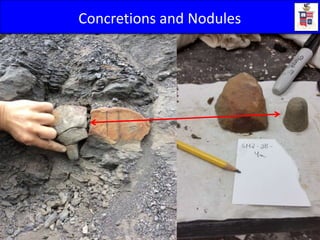
Concretions and Nodules
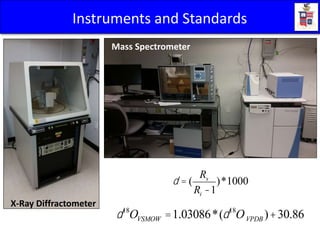
X-Ray Diffractometer
Mass Spectrometer
Instruments and Standards
d = (
Rs
Ri -1
)*1000
d18
OVSMOW =1.03086*(d18
OVPDB )+30.86
d = (
Rs
Ri -1
)*1000
d = (
Rs
Ri -1
)*1000
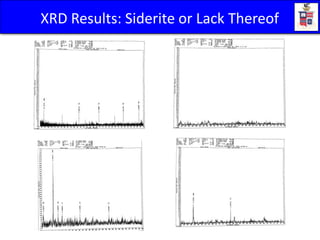
XRD Results: Siderite or Lack Thereof
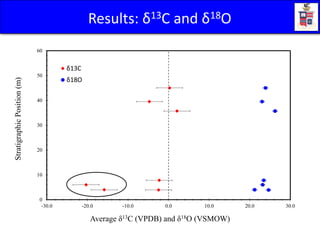
0
10
20
30
40
50
60
-30.0 -20.0 -10.0 0.0 10.0 20.0 30.0
StratigraphicPosition(m)
Average δ13C (VPDB) and δ18O (VSMOW)
δ13C
δ18O
Results: δ13C and δ18O
0
5
10
15
20
25
30
35
40
-30.0 -25.0 -20.0 -15.0 -10.0 -5.0 0.0 5.0 10.0
δ18O(VSMOW)
δ13C (VPDB)
This Study
Concretions from McKay et al. (1995)
Middle-Cretaceous Paleosols from Ufnar et al. (2008)
Middle-Cretaceous Bivalves from Suarez et al. (2015)
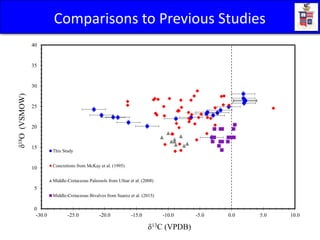
Comparisons to Previous Studies
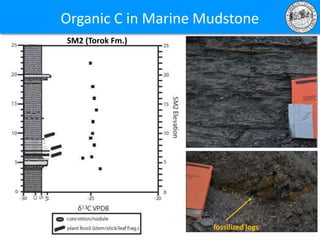
Organic C in Marine Mudstone
SM2 (Torok Fm.)
fossilized logs
C3 plants
Marine
Algae
Lacustrine
Algae
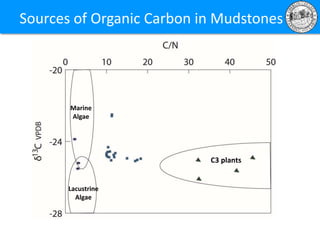
Sources of Organic Carbon in Mudstones
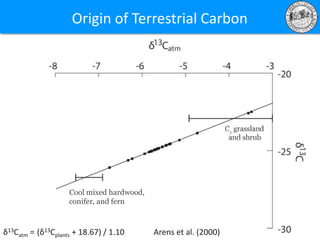
Origin of Terrestrial Carbon
δ13Catm = (δ13Cplants + 18.67) / 1.10 Arens et al. (2000)
Cool mixed hardwood,
conifer, and fern
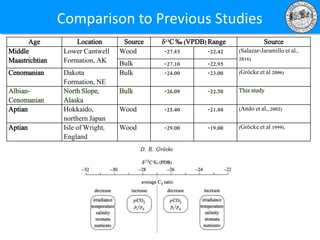
Age Location Source 13C ‰ (VPDB) Range Source
Middle
Maastrichtian
Lower Cantwell
Formation, AK
Wood -27.85 -22.42 (Salazar-Jaramillo et al.,
2016)
Bulk -27.10 -22.95
Cenomanian Dakota
Formation, NE
Bulk -24.00 -23.00 (Gröcke et al 2006)
Albian-
Cenomanian
North Slope,
Alaska
Bulk -26.09 -22.50 This study
Aptian Hokkaido,
northern Japan
Wood -25.40 -21.80 (Ando et al., 2002)
Aptian Isle of Wright,
England
Wood -29.00 -19.00 (Gröcke et al 1999).
Comparison to Previous Studies
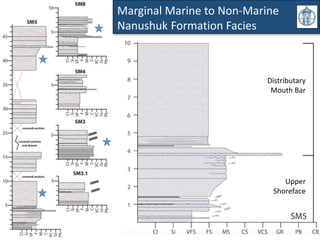
Marginal Marine to Non-Marine
Nanushuk Formation Facies
Distributary
Mouth Bar
Upper
Shoreface
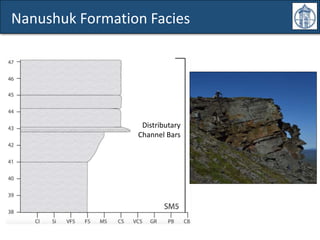
Distributary
Channel Bars
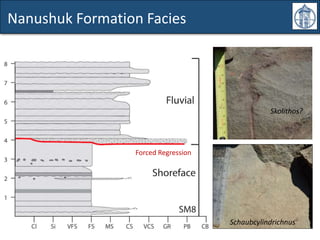
Nanushuk Formation Facies
Schaubcylindrichnus
Skolithos?
Forced Regression
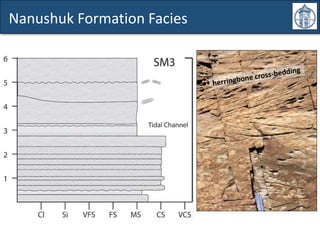
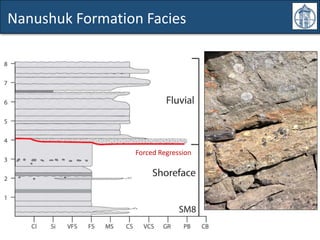
Nanushuk Formation Facies
Forced Regression
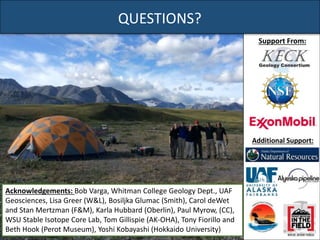
Acknowledgements: Bob Varga, Whitman College Geology Dept., UAF
Geosciences, Lisa Greer (W&L), Bosiljka Glumac (Smith), Carol deWet
and Stan Mertzman (F&M), Karla Hubbard (Oberlin), Paul Myrow, (CC),
WSU Stable Isotope Core Lab, Tom Gillispie (AK-OHA), Tony Fiorillo and
Beth Hook (Perot Museum), Yoshi Kobayashi (Hokkaido University)
Support From:
Additional Support:
QUESTIONS?

Keck North Slope Projects

  • 1.
    SEDIMENTOLOGY AND GEOCHEMISTRYOF THE CRETACEOUS TOROK & NANUSHUK FORMATIONS, NORTH SLOPE, ALASKA Kevin Joe Ashley Sarah Lauren Evan
  • 2.
  • 3.
    North on theDalton Highway Photo Credit: Beth Hook, Perot Museum Photo Credit: Beth Hook, Perot Museum Evan Kevin Joe Ashley Sarah Lauren Arctic Circle Campground Study Location Dalton Highway Galbraith Lake Campground Slope Mountain Approximate Location: 68.74° N 149.02°W Slope Mtn. A B
  • 4.
    Tectonic and ClimaticSetting • Brooks Range uplift and formation of a foreland basin • Rapid deposition: detailed high-latitude paleoenvironmental record • Greenhouse Arctic: MAT = 10 ºC (50 ºF); 4-5x CO2, near-max global sea levels Study Area Image: Ron Blakey (http://jan.ucc.nau.edu/~rcb7/105moll.jpg) Albian-Cenomanian (113-94 Ma) Paleo-Arctic
  • 5.
    Geologic Background: ForelandBasin Stratigraphy Arctic Alaska Microplate Generalized Modern Cross Section of the North Slope Foreland Basin (LePain et al., 2009) Brookian Stratigraphy (Shimer et al., 2014) Reconstruction of Nanushuk Formation Depositional Systems(LePain et al., 2009) Albian-Cenomanian Geology • Torok and Nanushuk formations • Initial “Brookian” megasequences • 2000 m of sediment in 10-20 my = thick paleoenvironmental record! A B C
  • 6.
  • 7.
    Slope Mountain Stratigraphy ModifiedfromHarrisetal.(2002) 8unique Slope Mountain (SM) locations, 11 unique measured sections
  • 8.
  • 9.
    SM2: Prodelta Mudstones(Torok Fm.) Nanushuk Fm. Torok Fm.
  • 10.
    SM1: Delta FrontDeposits (Nanushuk Fm.) Nanushuk Fm. Torok Fm. BIG QUESTION: how did the Cretaceous delta system evolve in response to tectonic, climatic, and biologic changes over time?
  • 11.
    Torok Formation Mudstones& Sandstones SM2
  • 12.
  • 13.
    Lower Nanushuk FormationSandstones SM7 SM6 Paleophycus Phycosiphon
  • 14.
    Summary • sedimentary facies:prodelta turbidites and lower shoreface sandstone • horizontal burrows → detrital feeding, oxygenated, carbon-rich environment • lack of shelled invertebrates: rapid sedimentation, turbid water modified from a figure adopted from Allen (1970) by Prothero and Schwab (2014) Modified from LePain et al. (2009)
  • 15.
    Mudstone Geochemistry Project •SM1 and SM2 (Torok Formation) • 62 mudstone samples: XRF, XRD • Paleoredox conditions • Correlation and possible fault
  • 16.
    Analytical Methods Methods • XRD •LOI • XRF (Majors) • XRF (Minors) Calculating Factors of Enrichment: EF = (Xsample/Alsample) (Xaverage/Alaverage)
  • 17.
    y = 0.606x+ 0.364 R² = 0.692 y = 0.948x + 0.204 R² = 0.750 y = 0.796x - 0.386 R² = 0.095 0.0 0.5 1.0 1.5 2.0 2.5 3.0 3.5 4.0 4.5 5.0 0.0 0.5 1.0 1.5 2.0 2.5 3.0 3.5 4.0 4.5 5.0 EnrichmentFactor(X) Enrichment Factor (Ni) Minor Element Cross-plots Ni v Cu Ni v V Ni v U Tribovillard, Nicolas, et al, 2006, Trace metals as paleoredox and paleoproductivity proxies: An update: Chemical Geology, 232, p. 12- 32.
  • 18.
    Possible Exception toSuboxic Conditions 0 0.5 1 1.5 2 2.5 3 3.5 4 -10 -5 0 5 10 15 20 LOIWeight% ∆EFUvsNi ∆EF U vs Ni LOI ∆ Enrichment and LOI Tribovillard, Nicolas, et al, 2006, Trace metals as paleoredox and paleoproductivity proxies: An update: Chemical Geology, 232, p. 12-32.
  • 19.
    Correlations more proximal moredistal Elevation(m) • irregular U-enrichment, LOI • possible correlative surface • rapid prodelta aggradation or thrust faulting
  • 20.
  • 21.
    X-Ray Diffractometer Mass Spectrometer Instrumentsand Standards d = ( Rs Ri -1 )*1000 d18 OVSMOW =1.03086*(d18 OVPDB )+30.86 d = ( Rs Ri -1 )*1000 d = ( Rs Ri -1 )*1000
  • 22.
    XRD Results: Sideriteor Lack Thereof
  • 23.
    0 10 20 30 40 50 60 -30.0 -20.0 -10.00.0 10.0 20.0 30.0 StratigraphicPosition(m) Average δ13C (VPDB) and δ18O (VSMOW) δ13C δ18O Results: δ13C and δ18O
  • 24.
    0 5 10 15 20 25 30 35 40 -30.0 -25.0 -20.0-15.0 -10.0 -5.0 0.0 5.0 10.0 δ18O(VSMOW) δ13C (VPDB) This Study Concretions from McKay et al. (1995) Middle-Cretaceous Paleosols from Ufnar et al. (2008) Middle-Cretaceous Bivalves from Suarez et al. (2015) Comparisons to Previous Studies
  • 25.
    Organic C inMarine Mudstone SM2 (Torok Fm.) fossilized logs
  • 26.
  • 27.
    Origin of TerrestrialCarbon δ13Catm = (δ13Cplants + 18.67) / 1.10 Arens et al. (2000) Cool mixed hardwood, conifer, and fern
  • 28.
    Age Location Source13C ‰ (VPDB) Range Source Middle Maastrichtian Lower Cantwell Formation, AK Wood -27.85 -22.42 (Salazar-Jaramillo et al., 2016) Bulk -27.10 -22.95 Cenomanian Dakota Formation, NE Bulk -24.00 -23.00 (Gröcke et al 2006) Albian- Cenomanian North Slope, Alaska Bulk -26.09 -22.50 This study Aptian Hokkaido, northern Japan Wood -25.40 -21.80 (Ando et al., 2002) Aptian Isle of Wright, England Wood -29.00 -19.00 (Gröcke et al 1999). Comparison to Previous Studies
  • 29.
    Marginal Marine toNon-Marine Nanushuk Formation Facies Distributary Mouth Bar Upper Shoreface
  • 30.
  • 31.
  • 32.
  • 33.
  • 34.
    Acknowledgements: Bob Varga,Whitman College Geology Dept., UAF Geosciences, Lisa Greer (W&L), Bosiljka Glumac (Smith), Carol deWet and Stan Mertzman (F&M), Karla Hubbard (Oberlin), Paul Myrow, (CC), WSU Stable Isotope Core Lab, Tom Gillispie (AK-OHA), Tony Fiorillo and Beth Hook (Perot Museum), Yoshi Kobayashi (Hokkaido University) Support From: Additional Support: QUESTIONS?