International Network of
Black Soils
Yuxin Tong
• Considering the great importance of black soils and their risk of
severe degradation, it has become crucial to promote their
conservation and sustainable use.
• And to unlock their potential in the longer term to support food
security while protecting the environment and mitigating
climate change.
The International Network of Black Soil (INBS) has been launched
in Rome on 21th of March 2017 during the Global Symposium of
Soil Organic Carbon.
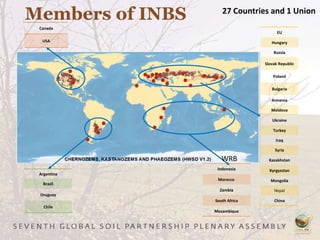
Members of INBS
Canada
USA
EU
Hungary
Russia
Slovak Republic
Poland
Bulgaria
Armenia
Moldova
Ukraine
Turkey
Iraq
Syria
Kazakhstan
Kyrgyzstan
Mongolia
Nepal
China
Argentina
Brazil
Uruguay
Chile
Indonesia
Morocco
Zambia
South Africa
Mozambique
WRB
27 Countries and 1 Union
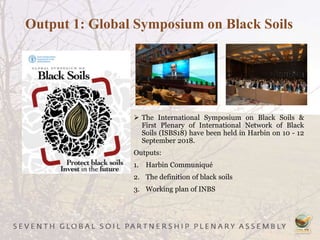
Output 1: Global Symposium on Black Soils
 The International Symposium on Black Soils &
First Plenary of International Network of Black
Soils (ISBS18) have been held in Harbin on 10 - 12
September 2018.
Outputs:
1. Harbin Communiqué
2. The definition of black soils
3. Working plan of INBS
Output 2: Harbin Communiqué
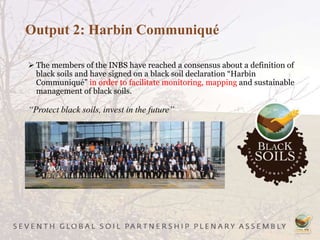
 The members of the INBS have reached a consensus about a definition of
black soils and have signed on a black soil declaration “Harbin
Communiqué” in order to facilitate monitoring, mapping and sustainable
management of black soils.
“Protect black soils, invest in the future”
 The definition of black soils
 Black soils, considered the food basket for many countries and for the world, and are often
recognized as inherently productive and fertile soils, are broadly defined under the
International Network of Black soils as soils having the following core characteristics:
• High organic carbon content as per the following:
>1.2% for cold and temperate regions
>0.6% for tropical and sub tropical regions
• Dark to black coloured surface horizons
• Thickness of dark to black soil surface horizons not less than 25 cm.
With the following complementary characteristics:
• A high base saturation >50%
• Strong aggregate stability
• High level of nutrient content
 Working plan
1. Complete a delineation of the areas identified as Black Soils according to the
criteria adopted at National level. (priority in 2019)
2. Perform a global assessment of black soils and publish it as a formal report of the
Global Soil Partnership. (priority in 2019)
3. Black Soils Data streamline as part of a monitoring sub-component of the Global
Soil Information System (GLOSIS);
4. Support implementation the Voluntary Guidelines for Sustainable Soil
Management in the areas designated at National level as black soils;
5. Establish a capacity development programme on the management of black soils;
6. Prepare a policy brief on the importance of black soils and advocate for the
implementation of binding legislation for the full protection of these soils for
future generations;
7. Develop the “Best Available Practice” Knowledge Bank as part of INBS
Information System.
Progress:
Output 1: Global Symposium on Black Soils
Output 2: Harbin Communiqué
Challenges:
Method for global black soil distribution map
Mobilizing resources for activities
Support by member countries
Evaluate and identify the best method for Global Black Soil Distribution Map
(GBSmap)
Support the documents on report, technical manual on sustainable management
practices, policy brief
Support the establishment of a black soil monitoring network and an academic
committee
Support to publish scientific papers on global black soils
International Network of Black Soils (INBS)
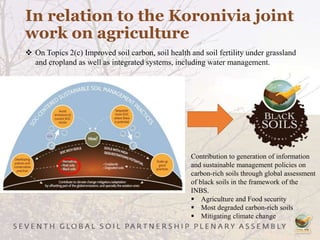
In relation to the Koronivia joint
work on agriculture
Contribution to generation of information
and sustainable management policies on
carbon-rich soils through global assessment
of black soils in the framework of the
INBS.
 Agriculture and Food security
 Most degraded carbon-rich soils
 Mitigating climate change
 On Topics 2(c) Improved soil carbon, soil health and soil fertility under grassland
and cropland as well as integrated systems, including water management.
International Network of Black Soils

International Network of Black Soils

  • 1.
  • 2.
    • Considering thegreat importance of black soils and their risk of severe degradation, it has become crucial to promote their conservation and sustainable use. • And to unlock their potential in the longer term to support food security while protecting the environment and mitigating climate change. The International Network of Black Soil (INBS) has been launched in Rome on 21th of March 2017 during the Global Symposium of Soil Organic Carbon.
  • 3.
    Members of INBS Canada USA EU Hungary Russia SlovakRepublic Poland Bulgaria Armenia Moldova Ukraine Turkey Iraq Syria Kazakhstan Kyrgyzstan Mongolia Nepal China Argentina Brazil Uruguay Chile Indonesia Morocco Zambia South Africa Mozambique WRB 27 Countries and 1 Union
  • 4.
    Output 1: GlobalSymposium on Black Soils  The International Symposium on Black Soils & First Plenary of International Network of Black Soils (ISBS18) have been held in Harbin on 10 - 12 September 2018. Outputs: 1. Harbin Communiqué 2. The definition of black soils 3. Working plan of INBS
  • 5.
    Output 2: HarbinCommuniqué  The members of the INBS have reached a consensus about a definition of black soils and have signed on a black soil declaration “Harbin Communiqué” in order to facilitate monitoring, mapping and sustainable management of black soils. “Protect black soils, invest in the future”
  • 6.
     The definitionof black soils  Black soils, considered the food basket for many countries and for the world, and are often recognized as inherently productive and fertile soils, are broadly defined under the International Network of Black soils as soils having the following core characteristics: • High organic carbon content as per the following: >1.2% for cold and temperate regions >0.6% for tropical and sub tropical regions • Dark to black coloured surface horizons • Thickness of dark to black soil surface horizons not less than 25 cm. With the following complementary characteristics: • A high base saturation >50% • Strong aggregate stability • High level of nutrient content
  • 7.
     Working plan 1.Complete a delineation of the areas identified as Black Soils according to the criteria adopted at National level. (priority in 2019) 2. Perform a global assessment of black soils and publish it as a formal report of the Global Soil Partnership. (priority in 2019) 3. Black Soils Data streamline as part of a monitoring sub-component of the Global Soil Information System (GLOSIS); 4. Support implementation the Voluntary Guidelines for Sustainable Soil Management in the areas designated at National level as black soils; 5. Establish a capacity development programme on the management of black soils; 6. Prepare a policy brief on the importance of black soils and advocate for the implementation of binding legislation for the full protection of these soils for future generations; 7. Develop the “Best Available Practice” Knowledge Bank as part of INBS Information System.
  • 8.
    Progress: Output 1: GlobalSymposium on Black Soils Output 2: Harbin Communiqué Challenges: Method for global black soil distribution map Mobilizing resources for activities Support by member countries Evaluate and identify the best method for Global Black Soil Distribution Map (GBSmap) Support the documents on report, technical manual on sustainable management practices, policy brief Support the establishment of a black soil monitoring network and an academic committee Support to publish scientific papers on global black soils International Network of Black Soils (INBS)
  • 9.
    In relation tothe Koronivia joint work on agriculture Contribution to generation of information and sustainable management policies on carbon-rich soils through global assessment of black soils in the framework of the INBS.  Agriculture and Food security  Most degraded carbon-rich soils  Mitigating climate change  On Topics 2(c) Improved soil carbon, soil health and soil fertility under grassland and cropland as well as integrated systems, including water management.

Editor's Notes

  • #3 Out of the total area covered by black soils 62 % is used as croplands. Black soils hold 55 Pg of SOC, which makes up 8 % of the total global SOC stock (680 Pg) (Figure 5). Out of the total land dedicated to growing crops, 19 % is currently comprised of black soils (Figure 2). Black soils are extensively and intensively farmed (cereal, pasture, range and forage system). According to various estimates, black soils lost over 20-50% of SOC, and this trend is still ongoing in most black soil countries. The significant decrease of SOC in black soils contributes to climate change through greenhouse gas emissions from soils especially CO2.
  • #10 Out of the total area covered by black soils 62 % is used as croplands. Black soils hold 55 Pg of SOC, which makes up 8 % of the total global SOC stock (680 Pg) (Figure 5). Out of the total land dedicated to growing crops, 19 % is currently comprised of black soils (Figure 2). Black soils are extensively and intensively farmed (cereal, pasture, range and forage system). According to various estimates, black soils lost over 20-50% of SOC, and this trend is still ongoing in most black soil countries. The significant decrease of SOC in black soils contributes to climate change through greenhouse gas emissions from soils especially CO2.