INBS
Global Black Soil
Distribution
Assessment
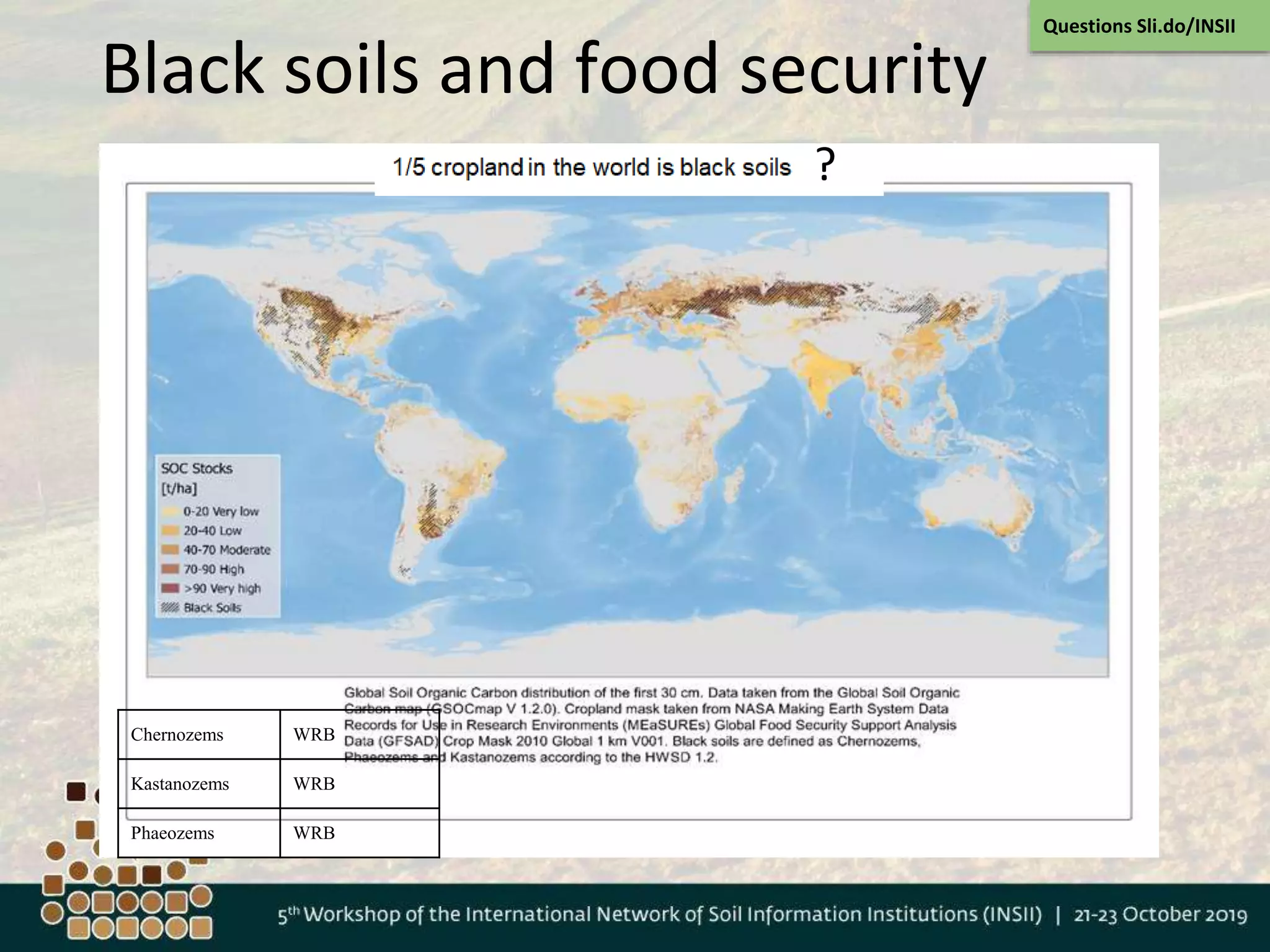
Black soils and food security
Chernozems WRB
Kastanozems WRB
Phaeozems WRB
Questions Sli.do/INSII
?
Out of the total area covered by
black soils 62 % is used as croplands.
Questions Sli.do/INSII
Black soils and SOC
Out of the total land dedicated to growing crops, 19 % is currently
comprised of black soils (Figure 1). Black soils used for growing crops hold
26 % of the total soil organic carbon stocks in croplands (Figure 2).
Questions Sli.do/INSII
Members of INBS
Questions Sli.do/INSII
Priorities of INBS in Harbin Communiqué
1. Complete a delineation of the areas identified as Black Soils according to
the criteria adopted at National level;
2. Support implementation the Voluntary Guidelines for Sustainable Soil Management in
the areas designated at National level as black soils;
3. Perform a global assessment of black soils and publish it as a formal report of the
Global Soil Partnership;
4. Establish a capacity development programme on the management of black soils;
5. Prepare a policy brief on the importance of black soils and advocate for the
implementation of binding legislation for the full protection of these soils for future
generations;
6. Black Soils Data streamline as part of a monitoring sub-component of the
Global Soil Information System (GLOSIS).
7. Develop the “Best Available Practice” Knowledge Bank as part of INBS Information
System.
Questions Sli.do/INSII
Review of the definition of Black
Soils
Black Soils concept (to be written)
Black soils are mineral soils having at least 25 cm deep black surface
horizon enriched with organic carbon. There are two categories of black
soils having different value from the global perspective and different status
of protection should be applied whether they belong to the 1st or 2nd
category of Black Soils.
Questions Sli.do/INSII
Review of the definition of Black
Soils
Eutric Black Soils (1st category, the most vulnerable and endangered, the highest rate of
protection at a global level) are those having all five properties given below:
● The presence of black or very dark surface horizons with a chroma of ≤3 moist, a value of
≤3 moist and ≤5 dry (by Munsell colours); and
● The total thickness of these black surface horizons not less than 25 cm; and
● Organic carbon content in the upper 25-cm black horizons not less than 1.2% (or 0.6% for
tropical regions) and not higher than 20%; and
● CEC in these black surface horizons not less than 25 cmol/kg; and
● A base saturation in these black surface horizons not less than 50%.
Most but not all Eutric Black soils:
● Have well-developed granular or fine subangular structure and aggregate stability in black
surface horizons in case of their non- or slightly degraded state or in the humus-rich
underlying horizon which was not subjected to degradation;
● Taxonomically they usually belong to Chernozem, Kastanozem and Phaeozem soil types
(WRB) or analogous soil types in other classification systems (+Mollic epipedon…).
Questions Sli.do/INSII
Review of the definition of Black
Soils
Other Black soils (2nd category, mostly endangered at the national
level) are those having all three properties given below:
● The presence of black or very dark surface horizons with a chroma of
≤3 moist, a value of ≤3 moist and ≤5 dry (by Munsell colours); and
● The total thickness of these black surface horizons not less than 25 cm;
and
● Organic carbon content in the upper 25-cm black horizons not less than
1.2% (or 0.6% for tropical regions) and not higher than 20%.
Most but not all of Other Black soils:
● Usually belong to Umbrisols and Andosols soil types (WRB) or
analogous soil types in other classification systems.
Questions Sli.do/INSII
Suggestion from mapping group
of GSP
1. Technical product specifications and guidelines for data providers
needed. P4 working group, expert from INSII and black soil member
countries.
2. Member country provide the soil types which match the modified
definition of INBS.
3. The first version is a global scale of black soil map as 1km resolution,
later will forward different version for management.
4. Member countries will produce their national black soil distribution
maps and GSP Secretariat will compile the GBSM.
5. The INBS will try to organize training for member country especially
members who can not produce map themselves.
6. GSP Secretariat will develop a gap filling methodology to produce
black soil maps for the countries with no technical capacity/funds.
Questions Sli.do/INSII
Call for a working group for the guidelines of Global Black
Soil Distribution Map
• From 23 October to 22 November (ITPS meeting with final definition).
Tesk: Review the background and the first version of approach.
• From 22 November to 28 February 2020.
Tesk: The guidelines of Black Soil Distribution Map will be discussed in
INSII meeting and pillar 4 working group
• From 1 March 2020 to 15 September 2020
Tesk: Black Soil Distribution Map be developed by member countries
Thank You!
Questions
Sli.do/INSII

VIIf - INBS - Global Black Soil Distribution Assessment

  • 1.
  • 2.
    Black soils andfood security Chernozems WRB Kastanozems WRB Phaeozems WRB Questions Sli.do/INSII ?
  • 3.
    Out of thetotal area covered by black soils 62 % is used as croplands. Questions Sli.do/INSII
  • 4.
  • 5.
    Black soils andSOC Out of the total land dedicated to growing crops, 19 % is currently comprised of black soils (Figure 1). Black soils used for growing crops hold 26 % of the total soil organic carbon stocks in croplands (Figure 2). Questions Sli.do/INSII
  • 7.
  • 8.
  • 9.
    Priorities of INBSin Harbin Communiqué 1. Complete a delineation of the areas identified as Black Soils according to the criteria adopted at National level; 2. Support implementation the Voluntary Guidelines for Sustainable Soil Management in the areas designated at National level as black soils; 3. Perform a global assessment of black soils and publish it as a formal report of the Global Soil Partnership; 4. Establish a capacity development programme on the management of black soils; 5. Prepare a policy brief on the importance of black soils and advocate for the implementation of binding legislation for the full protection of these soils for future generations; 6. Black Soils Data streamline as part of a monitoring sub-component of the Global Soil Information System (GLOSIS). 7. Develop the “Best Available Practice” Knowledge Bank as part of INBS Information System. Questions Sli.do/INSII
  • 11.
    Review of thedefinition of Black Soils Black Soils concept (to be written) Black soils are mineral soils having at least 25 cm deep black surface horizon enriched with organic carbon. There are two categories of black soils having different value from the global perspective and different status of protection should be applied whether they belong to the 1st or 2nd category of Black Soils. Questions Sli.do/INSII
  • 12.
    Review of thedefinition of Black Soils Eutric Black Soils (1st category, the most vulnerable and endangered, the highest rate of protection at a global level) are those having all five properties given below: ● The presence of black or very dark surface horizons with a chroma of ≤3 moist, a value of ≤3 moist and ≤5 dry (by Munsell colours); and ● The total thickness of these black surface horizons not less than 25 cm; and ● Organic carbon content in the upper 25-cm black horizons not less than 1.2% (or 0.6% for tropical regions) and not higher than 20%; and ● CEC in these black surface horizons not less than 25 cmol/kg; and ● A base saturation in these black surface horizons not less than 50%. Most but not all Eutric Black soils: ● Have well-developed granular or fine subangular structure and aggregate stability in black surface horizons in case of their non- or slightly degraded state or in the humus-rich underlying horizon which was not subjected to degradation; ● Taxonomically they usually belong to Chernozem, Kastanozem and Phaeozem soil types (WRB) or analogous soil types in other classification systems (+Mollic epipedon…). Questions Sli.do/INSII
  • 13.
    Review of thedefinition of Black Soils Other Black soils (2nd category, mostly endangered at the national level) are those having all three properties given below: ● The presence of black or very dark surface horizons with a chroma of ≤3 moist, a value of ≤3 moist and ≤5 dry (by Munsell colours); and ● The total thickness of these black surface horizons not less than 25 cm; and ● Organic carbon content in the upper 25-cm black horizons not less than 1.2% (or 0.6% for tropical regions) and not higher than 20%. Most but not all of Other Black soils: ● Usually belong to Umbrisols and Andosols soil types (WRB) or analogous soil types in other classification systems. Questions Sli.do/INSII
  • 14.
    Suggestion from mappinggroup of GSP 1. Technical product specifications and guidelines for data providers needed. P4 working group, expert from INSII and black soil member countries. 2. Member country provide the soil types which match the modified definition of INBS. 3. The first version is a global scale of black soil map as 1km resolution, later will forward different version for management. 4. Member countries will produce their national black soil distribution maps and GSP Secretariat will compile the GBSM. 5. The INBS will try to organize training for member country especially members who can not produce map themselves. 6. GSP Secretariat will develop a gap filling methodology to produce black soil maps for the countries with no technical capacity/funds. Questions Sli.do/INSII
  • 15.
    Call for aworking group for the guidelines of Global Black Soil Distribution Map • From 23 October to 22 November (ITPS meeting with final definition). Tesk: Review the background and the first version of approach. • From 22 November to 28 February 2020. Tesk: The guidelines of Black Soil Distribution Map will be discussed in INSII meeting and pillar 4 working group • From 1 March 2020 to 15 September 2020 Tesk: Black Soil Distribution Map be developed by member countries
  • 16.