FRAMEWORKS FOR UNDERSTANDING RISKS AND
VIABLE SOLUTIONS
DIETMAR MÜLLER-GRABHERR
© Environment Agency Austria
FRAMEWORKS FOR UNDERSTANDING RISKS AND VIABLE SOLUTIONS – AN OVERVIEW
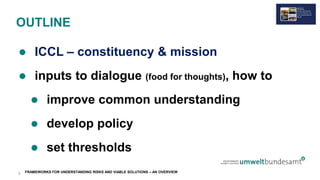
OUTLINE
 ICCL – constituency & mission
 inputs to dialogue (food for thoughts), how to
 improve common understanding
 develop policy
 set thresholds
3
FRAMEWORKS FOR UNDERSTANDING RISKS AND VIABLE SOLUTIONS – AN OVERVIEW
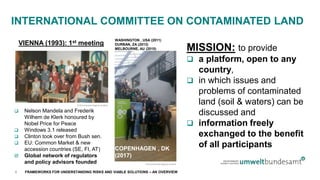
INTERNATIONAL COMMITTEE ON CONTAMINATED LAND
© Environment Agency Austria
 Nelson Mandela and Frederik
Wilhem de Klerk honoured by
Nobel Price for Peace
 Windows 3.1 released
 Clinton took over from Bush sen.
 EU: Common Market & new
accession countries (SE, FI, AT)
 Global network of regulators
and policy advisors founded
© Environment Agency Austria
MISSION: to provide
 a platform, open to any
country,
 in which issues and
problems of contaminated
land (soil & waters) can be
discussed and
 information freely
exchanged to the benefit
of all participants
VIENNA (1993): 1st meeting
WASHINGTON , USA (2011)
DURBAN, ZA (2013)
MELBOURNE, AU (2015)
COPENHAGEN , DK
(2017)
4
FRAMEWORKS FOR UNDERSTANDING RISKS AND VIABLE SOLUTIONS – AN OVERVIEW5
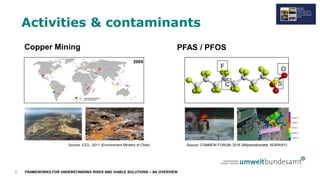
Activities & contaminants
Copper Mining
Source: ICCL; 2011 (Environment Ministry of Chile)
F
C S
O
PFAS / PFOS
Source: COMMON FORUM; 2016 (Miljodirektoratet; NORWAY)
2005
FRAMEWORKS FOR UNDERSTANDING RISKS AND VIABLE SOLUTIONS – AN OVERVIEW
©ICCL;193
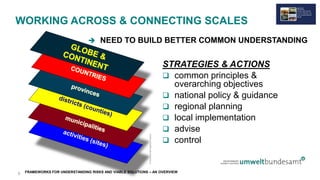
WORKING ACROSS & CONNECTING SCALES
STRATEGIES & ACTIONS
 common principles &
overarching objectives
 national policy & guidance
 regional planning
 local implementation
 advise
 control
©EnvironmentAgencyAustria
 NEED TO BUILD BETTER COMMON UNDERSTANDING
6
FRAMEWORKS FOR UNDERSTANDING RISKS AND VIABLE SOLUTIONS – AN OVERVIEW
COMMON UNDERSTANDING (?)
Contamination / Pollution (synonym or different?)
BASELINE (referenced to) ?
 natural soil quality (properties and/or functions)
 Environmental quality standards (EQS)
ORIGIN ?
 human activities and / or natural processes
CONSEQUENCES ?
 may cause or causing harm (damage, liability, expenditures)
7
FRAMEWORKS FOR UNDERSTANDING RISKS AND VIABLE SOLUTIONS – AN OVERVIEW
BARRIERS TO CONTAMINATED LAND MANAGEMENT
Examples (a personal selection on ‘systemic inertia’)
policy: old & wrong framing (e.g. ‘limit values’ or waste legislation)
knowledge: missing understanding regarding natural systems and
processes
behaviours: staying to routines and missing interactions of different
actors
practices & technology: hardly any good quality demonstration, nor
independent review
8
FRAMEWORKS FOR UNDERSTANDING RISKS AND VIABLE SOLUTIONS – AN OVERVIEW
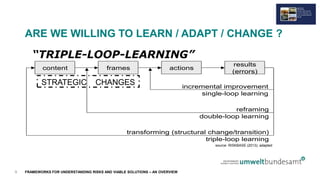
ARE WE WILLING TO LEARN / ADAPT / CHANGE ?
content frames actions
results
(errors)
incremental improvement
single-loop learning
reframing
double-loop learning
transforming (structural change/transition)
triple-loop learning
“TRIPLE-LOOP-LEARNING”
source: RISKBASE (2013); adapted
STRATEGIC CHANGES
9
FRAMEWORKS FOR UNDERSTANDING RISKS AND VIABLE SOLUTIONS – AN OVERVIEW
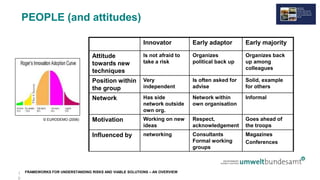
Innovator Early adaptor Early majority
Attitude
towards new
techniques
Is not afraid to
take a risk
Organizes
political back up
Organizes back
up among
colleagues
Position within
the group
Very
independent
Is often asked for
advise
Solid, example
for others
Network Has side
network outside
own org.
Network within
own organisation
Informal
Motivation Working on new
ideas
Respect,
acknowledgement
Goes ahead of
the troops
Influenced by networking Consultants
Formal working
groups
Magazines
Conferences
PEOPLE (and attitudes)
© EURODEMO (2006)
1
0
FRAMEWORKS FOR UNDERSTANDING RISKS AND VIABLE SOLUTIONS – AN OVERVIEW
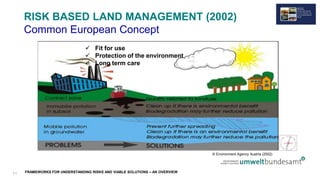
RISK BASED LAND MANAGEMENT (2002)
Common European Concept
 Fit for use
 Protection of the environment
 Long term care
© Environment Agency Austria (2002)
11
FRAMEWORKS FOR UNDERSTANDING RISKS AND VIABLE SOLUTIONS – AN OVERVIEW
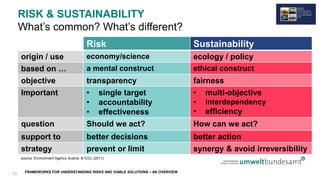
RISK & SUSTAINABILITY
What’s common? What’s different?
Risk Sustainability
origin / use economy/science ecology / policy
based on … a mental construct ethical construct
objective transparency fairness
Important • single target
• accountability
• effectiveness
• multi-objective
• interdependency
• efficiency
question Should we act? How can we act?
support to better decisions better action
strategy prevent or limit synergy & avoid irreversibility
source: Environment Agency Austria & ICCL (2011)
12
FRAMEWORKS FOR UNDERSTANDING RISKS AND VIABLE SOLUTIONS – AN OVERVIEW
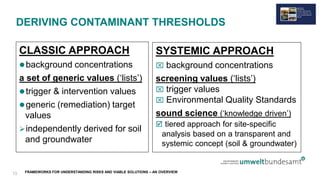
DERIVING CONTAMINANT THRESHOLDS
CLASSIC APPROACH
background concentrations
a set of generic values (‘lists’)
trigger & intervention values
generic (remediation) target
values
independently derived for soil
and groundwater
SYSTEMIC APPROACH
 background concentrations
screening values (‘lists’)
 trigger values
 Environmental Quality Standards
sound science (‘knowledge driven’)
 tiered approach for site-specific
analysis based on a transparent and
systemic concept (soil & groundwater)
13
FRAMEWORKS FOR UNDERSTANDING RISKS AND VIABLE SOLUTIONS – AN OVERVIEW
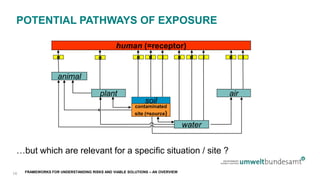
POTENTIAL PATHWAYS OF EXPOSURE
human (=receptor)
contaminated
site (=source)
water
airplant
animal
o d i d ioo d io
soil
…but which are relevant for a specific situation / site ?
14
FRAMEWORKS FOR UNDERSTANDING RISKS AND VIABLE SOLUTIONS – AN OVERVIEW
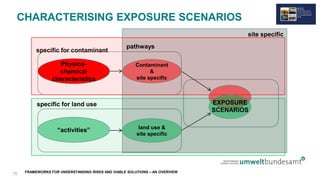
CHARACTERISING EXPOSURE SCENARIOS
site specific
specific for land use
specific for contaminant
land use &
site specific
Contaminant
&
site specific
Physico-
chemical
characteristics
“activities”
EXPOSURE
SCENARIOS
pathways
15
FRAMEWORKS FOR UNDERSTANDING RISKS AND VIABLE SOLUTIONS – AN OVERVIEW
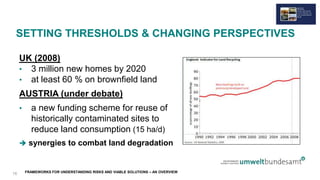
SETTING THRESHOLDS & CHANGING PERSPECTIVES
UK (2008)
• 3 million new homes by 2020
• at least 60 % on brownfield land
AUSTRIA (under debate)
• a new funding scheme for reuse of
historically contaminated sites to
reduce land consumption (15 ha/d)
 synergies to combat land degradation
16
FRAMEWORKS FOR UNDERSTANDING RISKS AND VIABLE SOLUTIONS – AN OVERVIEW
REMEDIATION POLICY: CHANGING PARADIGMS
It’s not concentrations, but about creating benefits while
minimizing negative consequences (risks)
Dig and dump is not a sustainable technology but trading off
pollution
Understanding time frames – extensive and intensive remediation
approaches
o Make use of natural processes and stimulate if feasible (“working
with nature”)
o Apply intensive bioremediation
o Apply other techniques for non-degradable components and source
reduction
17
FRAMEWORKS FOR UNDERSTANDING RISKS AND VIABLE SOLUTIONS – AN OVERVIEW
TOWARDS BETTER GOVERNANCE
RISK-INFORMED (transparent & accountable)
 natural capacities & ecosystem services (from local to global)
 societal system and processes (human well-being)
SUSTAINABLE (fair, environmental friendly and participatory)
 corporate responsibility (“bottom-up”)
 social learning (3-loop: improve, reframe, transform)
 resilient strategies (to cope with complexity, uncertainty, ambiguities)
 options & scenario-thinking (anticipate different futures)
 from BAT to NEXT (‘new’ environmental technologies-“factor 4”)
18
| FRAMEWORKS FOR UNDERSTANDING RISKS AND VIABLE SOLUTIONS – AN OVERVIEW
CONTACT & INFORMATION
Dietmar MÜLLER-GRABHERR
International Committee on Contaminated Land
Webpage: www.iccl.ch
E-Mail: CF-secretariat@umweltbundesamt.at
19
ENVIRONMENT AGENCY AUSTRIA
www.umweltbundesamt.at
Global Symposium on Soil Pollution
Rome (Italy)  2 May 2018
“And just as we have the power to shape culture,
we also have the power to undo the culture,
that does not serves us well.“ (Janelle Monáe, 2018)
Frameworks for understanding risks and viable solutions – an overview on experiences in managing soil pollution

Frameworks for understanding risks and viable solutions – an overview on experiences in managing soil pollution

  • 2.
    FRAMEWORKS FOR UNDERSTANDINGRISKS AND VIABLE SOLUTIONS DIETMAR MÜLLER-GRABHERR © Environment Agency Austria
  • 3.
    FRAMEWORKS FOR UNDERSTANDINGRISKS AND VIABLE SOLUTIONS – AN OVERVIEW OUTLINE  ICCL – constituency & mission  inputs to dialogue (food for thoughts), how to  improve common understanding  develop policy  set thresholds 3
  • 4.
    FRAMEWORKS FOR UNDERSTANDINGRISKS AND VIABLE SOLUTIONS – AN OVERVIEW INTERNATIONAL COMMITTEE ON CONTAMINATED LAND © Environment Agency Austria  Nelson Mandela and Frederik Wilhem de Klerk honoured by Nobel Price for Peace  Windows 3.1 released  Clinton took over from Bush sen.  EU: Common Market & new accession countries (SE, FI, AT)  Global network of regulators and policy advisors founded © Environment Agency Austria MISSION: to provide  a platform, open to any country,  in which issues and problems of contaminated land (soil & waters) can be discussed and  information freely exchanged to the benefit of all participants VIENNA (1993): 1st meeting WASHINGTON , USA (2011) DURBAN, ZA (2013) MELBOURNE, AU (2015) COPENHAGEN , DK (2017) 4
  • 5.
    FRAMEWORKS FOR UNDERSTANDINGRISKS AND VIABLE SOLUTIONS – AN OVERVIEW5 Activities & contaminants Copper Mining Source: ICCL; 2011 (Environment Ministry of Chile) F C S O PFAS / PFOS Source: COMMON FORUM; 2016 (Miljodirektoratet; NORWAY) 2005
  • 6.
    FRAMEWORKS FOR UNDERSTANDINGRISKS AND VIABLE SOLUTIONS – AN OVERVIEW ©ICCL;193 WORKING ACROSS & CONNECTING SCALES STRATEGIES & ACTIONS  common principles & overarching objectives  national policy & guidance  regional planning  local implementation  advise  control ©EnvironmentAgencyAustria  NEED TO BUILD BETTER COMMON UNDERSTANDING 6
  • 7.
    FRAMEWORKS FOR UNDERSTANDINGRISKS AND VIABLE SOLUTIONS – AN OVERVIEW COMMON UNDERSTANDING (?) Contamination / Pollution (synonym or different?) BASELINE (referenced to) ?  natural soil quality (properties and/or functions)  Environmental quality standards (EQS) ORIGIN ?  human activities and / or natural processes CONSEQUENCES ?  may cause or causing harm (damage, liability, expenditures) 7
  • 8.
    FRAMEWORKS FOR UNDERSTANDINGRISKS AND VIABLE SOLUTIONS – AN OVERVIEW BARRIERS TO CONTAMINATED LAND MANAGEMENT Examples (a personal selection on ‘systemic inertia’) policy: old & wrong framing (e.g. ‘limit values’ or waste legislation) knowledge: missing understanding regarding natural systems and processes behaviours: staying to routines and missing interactions of different actors practices & technology: hardly any good quality demonstration, nor independent review 8
  • 9.
    FRAMEWORKS FOR UNDERSTANDINGRISKS AND VIABLE SOLUTIONS – AN OVERVIEW ARE WE WILLING TO LEARN / ADAPT / CHANGE ? content frames actions results (errors) incremental improvement single-loop learning reframing double-loop learning transforming (structural change/transition) triple-loop learning “TRIPLE-LOOP-LEARNING” source: RISKBASE (2013); adapted STRATEGIC CHANGES 9
  • 10.
    FRAMEWORKS FOR UNDERSTANDINGRISKS AND VIABLE SOLUTIONS – AN OVERVIEW Innovator Early adaptor Early majority Attitude towards new techniques Is not afraid to take a risk Organizes political back up Organizes back up among colleagues Position within the group Very independent Is often asked for advise Solid, example for others Network Has side network outside own org. Network within own organisation Informal Motivation Working on new ideas Respect, acknowledgement Goes ahead of the troops Influenced by networking Consultants Formal working groups Magazines Conferences PEOPLE (and attitudes) © EURODEMO (2006) 1 0
  • 11.
    FRAMEWORKS FOR UNDERSTANDINGRISKS AND VIABLE SOLUTIONS – AN OVERVIEW RISK BASED LAND MANAGEMENT (2002) Common European Concept  Fit for use  Protection of the environment  Long term care © Environment Agency Austria (2002) 11
  • 12.
    FRAMEWORKS FOR UNDERSTANDINGRISKS AND VIABLE SOLUTIONS – AN OVERVIEW RISK & SUSTAINABILITY What’s common? What’s different? Risk Sustainability origin / use economy/science ecology / policy based on … a mental construct ethical construct objective transparency fairness Important • single target • accountability • effectiveness • multi-objective • interdependency • efficiency question Should we act? How can we act? support to better decisions better action strategy prevent or limit synergy & avoid irreversibility source: Environment Agency Austria & ICCL (2011) 12
  • 13.
    FRAMEWORKS FOR UNDERSTANDINGRISKS AND VIABLE SOLUTIONS – AN OVERVIEW DERIVING CONTAMINANT THRESHOLDS CLASSIC APPROACH background concentrations a set of generic values (‘lists’) trigger & intervention values generic (remediation) target values independently derived for soil and groundwater SYSTEMIC APPROACH  background concentrations screening values (‘lists’)  trigger values  Environmental Quality Standards sound science (‘knowledge driven’)  tiered approach for site-specific analysis based on a transparent and systemic concept (soil & groundwater) 13
  • 14.
    FRAMEWORKS FOR UNDERSTANDINGRISKS AND VIABLE SOLUTIONS – AN OVERVIEW POTENTIAL PATHWAYS OF EXPOSURE human (=receptor) contaminated site (=source) water airplant animal o d i d ioo d io soil …but which are relevant for a specific situation / site ? 14
  • 15.
    FRAMEWORKS FOR UNDERSTANDINGRISKS AND VIABLE SOLUTIONS – AN OVERVIEW CHARACTERISING EXPOSURE SCENARIOS site specific specific for land use specific for contaminant land use & site specific Contaminant & site specific Physico- chemical characteristics “activities” EXPOSURE SCENARIOS pathways 15
  • 16.
    FRAMEWORKS FOR UNDERSTANDINGRISKS AND VIABLE SOLUTIONS – AN OVERVIEW SETTING THRESHOLDS & CHANGING PERSPECTIVES UK (2008) • 3 million new homes by 2020 • at least 60 % on brownfield land AUSTRIA (under debate) • a new funding scheme for reuse of historically contaminated sites to reduce land consumption (15 ha/d)  synergies to combat land degradation 16
  • 17.
    FRAMEWORKS FOR UNDERSTANDINGRISKS AND VIABLE SOLUTIONS – AN OVERVIEW REMEDIATION POLICY: CHANGING PARADIGMS It’s not concentrations, but about creating benefits while minimizing negative consequences (risks) Dig and dump is not a sustainable technology but trading off pollution Understanding time frames – extensive and intensive remediation approaches o Make use of natural processes and stimulate if feasible (“working with nature”) o Apply intensive bioremediation o Apply other techniques for non-degradable components and source reduction 17
  • 18.
    FRAMEWORKS FOR UNDERSTANDINGRISKS AND VIABLE SOLUTIONS – AN OVERVIEW TOWARDS BETTER GOVERNANCE RISK-INFORMED (transparent & accountable)  natural capacities & ecosystem services (from local to global)  societal system and processes (human well-being) SUSTAINABLE (fair, environmental friendly and participatory)  corporate responsibility (“bottom-up”)  social learning (3-loop: improve, reframe, transform)  resilient strategies (to cope with complexity, uncertainty, ambiguities)  options & scenario-thinking (anticipate different futures)  from BAT to NEXT (‘new’ environmental technologies-“factor 4”) 18
  • 19.
    | FRAMEWORKS FORUNDERSTANDING RISKS AND VIABLE SOLUTIONS – AN OVERVIEW CONTACT & INFORMATION Dietmar MÜLLER-GRABHERR International Committee on Contaminated Land Webpage: www.iccl.ch E-Mail: CF-secretariat@umweltbundesamt.at 19 ENVIRONMENT AGENCY AUSTRIA www.umweltbundesamt.at Global Symposium on Soil Pollution Rome (Italy)  2 May 2018 “And just as we have the power to shape culture, we also have the power to undo the culture, that does not serves us well.“ (Janelle Monáe, 2018)