1
Addressing soil erosion
through policy and
economic assessments
Professor Lindsay C. Stringer-
University of Leeds, UK
2
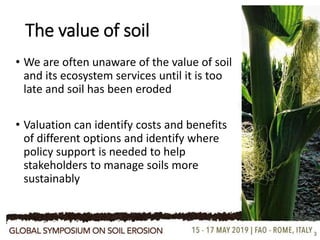
The value of soil
• We are often unaware of the value of soil
and its ecosystem services until it is too
late and soil has been eroded
• Valuation can identify costs and benefits
of different options and identify where
policy support is needed to help
stakeholders to manage soils more
sustainably
3
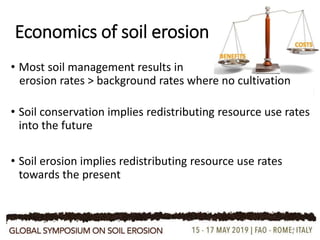
Economics of soil erosion
• Most soil management results in
erosion rates > background rates where no cultivation
• Soil conservation implies redistributing resource use rates
into the future
• Soil erosion implies redistributing resource use rates
towards the present
4
Farmer perspectives
• Direct costs, e.g. labour, materials,
equipment, structures for both
initiation and maintenance
• Opportunity costs e.g. foregone
output that land taken for erosion
control could have been used for
• Benefits come from soil as an asset
that provides income, so can be
assessed using e.g. yields,
representing gains in production
and income into the future
5
• Cost benefit analysis (CBA) compares costs and benefits of the
consequences of soil erosion and any steps taken to reduce it
• Cost and benefits accrue to all members of society, not just
farmers
• Farmers are concerned with on-site costs and benefits; society
with off-site, external costs
• Externalities occur during production or consumption, e.g. soil
erosion on farmland leads to downstream sedimentation,
while upstream soil conservation creates a positive externality
• Externalities are not reflected in market prices or farmer
decision making, yet have an economic value
Scale matters…
6
Assessing the costs and benefits of
soil conservation in Kenya
• For a given soil conservation practice, implemented over a
defined area of land for a specified period of time:
• Calculate costs
• Calculate benefits
• Discount future costs & benefits
• Calculate a net present value and return on investment
period
• Does it makes financial sense for farmers to invest
in soil conservation?
7
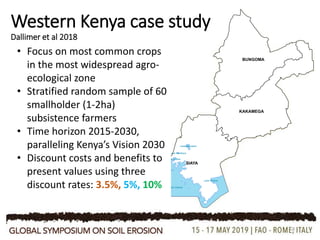
Lake Victoria
Lake Kanyaboli
Lake Sare
Lake Namboyo
Lake Victoria
SIAYA
BUNGOMA
KAKAMEGA
Western Kenya case study
Dallimer et al 2018
8
• Focus on most common crops
in the most widespread agro-
ecological zone
• Stratified random sample of 60
smallholder (1-2ha)
subsistence farmers
• Time horizon 2015-2030,
paralleling Kenya’s Vision 2030
• Discount costs and benefits to
present values using three
discount rates: 3.5%, 5%, 10%
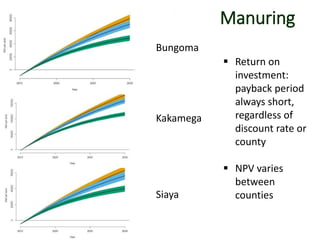
Manuring
 Return on
investment:
payback period
always short,
regardless of
discount rate or
county
 NPV varies
between
counties
Bungoma
Kakamega
Siaya
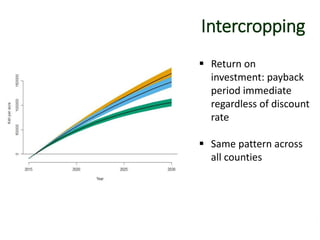
Intercropping
 Return on
investment: payback
period immediate
regardless of discount
rate
 Same pattern across
all counties
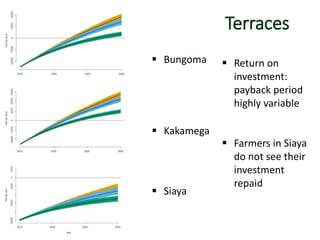
Terraces
 Bungoma
 Kakamega
 Siaya
 Return on
investment:
payback period
highly variable
 Farmers in Siaya
do not see their
investment
repaid
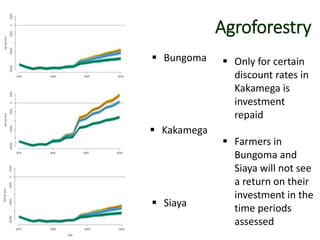
Agroforestry
 Bungoma
 Kakamega
 Siaya
 Only for certain
discount rates in
Kakamega is
investment
repaid
 Farmers in
Bungoma and
Siaya will not see
a return on their
investment in the
time periods
assessed
Policy suggestions
 Policy should target promoting the right soil
conservation practices to the right areas
 Promote simple, low cost, practices for
maximum impact on individual farmers
 Policy needs to recognise wider societal gains
and ensure farmers do not carry all the costs
 Subsidy schemes
 Payments for ecosystem services
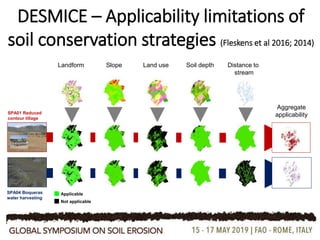
Landform Soil depthLand use Distance to
stream
Slope
Applicable
Not applicable
SPA01 Reduced
contour tillage
SPA04 Boqueras
water harvesting
Aggregate
applicability
DESMICE – Applicability limitations of
soil conservation strategies (Fleskens et al 2016; 2014)
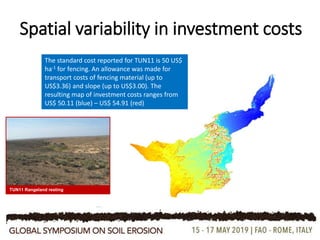
The standard cost reported for TUN11 is 50 US$
ha-1 for fencing. An allowance was made for
transport costs of fencing material (up to
US$3.36) and slope (up to US$3.00). The
resulting map of investment costs ranges from
US$ 50.11 (blue) – US$ 54.91 (red)
TUN11 Rangeland resting
Spatial variability in investment costs
[A – B – C + D] =
Annual cash flow series for
each technology and grid cell
Production
foregone
without case
X Value (€)
X Value (€)
Foregone
costs of:
- Production
Costs of:
- Production
- Maintenance
- Other (e.g.
area loss)
DC
BAProduction
with applied
technology
Cash flow series are constructed for
each grid cell
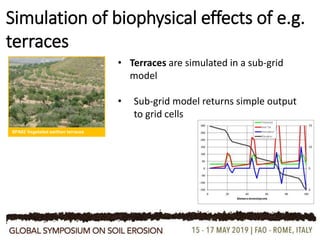
• Terraces are simulated in a sub-grid
model
• Sub-grid model returns simple output
to grid cells
SPA02 Vegetated earthen terraces
Simulation of biophysical effects of e.g.
terraces
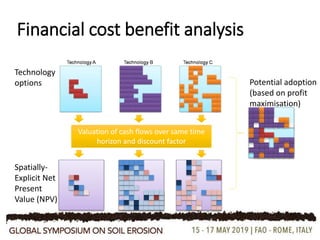
Spatially-
Explicit Net
Present
Value (NPV)
Technology
options Potential adoption
(based on profit
maximisation)
Valuation of cash flows over same time
horizon and discount factor
Financial cost benefit analysis
Do we just need more research?
• Having economic information on costs of soil erosion,
inaction and value of benefits helps, but isn’t a
solution on its own
• Challenges link to a combination of overlapping
barriers, specifics of which differ according to each
country:
Political and institutional
Capacity and resourcing
Social and cultural
Legal and regulatory
19
Whose responsibility?
Barriers: Political and institutional; Capacity and resourcing;
Legal and regulatory
• Soils cross-cut the remit of multiple ministries and
departments
• Difficult to avoid conflicts and contradictions
• Requires leadership but also strong interplay and
coordination
• Other stakeholders (e.g. media, private sector) can be useful
allies but may also have counter-interests and act as
barriers, especially if mainstreaming soil erosion into policy
challenges established political-economic interests
Knowledge, tools, data and
information deficits
Barriers: Capacity and resourcing; Social and cultural
• Mismatches between supply and demand
• Lack of collaboration and knowledge /information sharing
• Scale of knowledge and data not always appropriate
• Local and indigenous knowledge often undervalued
• Substantial training opportunities provided but staff move
leaving institutional voids. Knowledge and information not
always passed on
What do policymakers need to know?
• Need to match supply and demand for knowledge, tools,
data and information
• Information needs to be available, visible, accessible and
compatible with policy processes (Stringer and Dougill,
2013)
• Compatibility links to policy cycles as well as the format of
information – build from the strengths, don’t start with
criticism
23
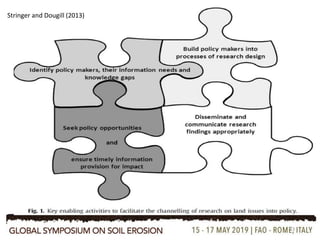
Stringer and Dougill (2013)
Lessons for policy
• Options exist that reduce soil erosion and tools are
available to assess their economic feasibility
• Low cost measures that deliver ‘quick wins’ are
preferred by farmers and can help reach policy goals
• Design and opportunity costs need full consideration
before rolling out policy measures
• CBA can be applied spatially to examine the
profitability of different measures and what this might
mean for farmer adoption
• Research alone is not enough: supply and demand for
information need to be balanced and barriers to
addressing soil erosion in policy need to be overcome
24
Acknowledgements
Thank you to Martin Dallimer and Luuk Fleskens for their inputs to this
presentation; GIZ who funded the Kenya case study and the Economics of
Land Degradation Initiative; and to the EU who funded the work on
PESERA-DESMICE
References
Dallimer M, Stringer LC, Orchard SE, Osano P, Njoroge G, Wen C, Gicheru P. 2018.Who uses sustainable
land management practices and what are the costs and benefits? Insights from Kenya. Land
Degradation and Development 29(9), 2822-2835
Fleskens L, Nainggolan D, Stringer LC. 2014. An exploration of scenarios to support sustainable land
management using integrated environmental socio-economic models. Environmental
Management 54, 1005-1021
Fleskens L, Kirkby MJ, Irvine BJ. 2016. The PESERA-DESMICE modelling framework for spatial
assessment of the physical impact and economic viability of land degradation mitigation technologies.
Frontiers in Environmental Science 4:31
Stringer LC, Dougill AJ. 2013. Channelling science into policy: enabling best practices from research on
land degradation and sustainable land management in dryland Africa. J Environ Management 114,
328-335
25
Addressing soil erosion through policy and economic assessments

Addressing soil erosion through policy and economic assessments

  • 1.
  • 2.
    Addressing soil erosion throughpolicy and economic assessments Professor Lindsay C. Stringer- University of Leeds, UK 2
  • 3.
    The value ofsoil • We are often unaware of the value of soil and its ecosystem services until it is too late and soil has been eroded • Valuation can identify costs and benefits of different options and identify where policy support is needed to help stakeholders to manage soils more sustainably 3
  • 4.
    Economics of soilerosion • Most soil management results in erosion rates > background rates where no cultivation • Soil conservation implies redistributing resource use rates into the future • Soil erosion implies redistributing resource use rates towards the present 4
  • 5.
    Farmer perspectives • Directcosts, e.g. labour, materials, equipment, structures for both initiation and maintenance • Opportunity costs e.g. foregone output that land taken for erosion control could have been used for • Benefits come from soil as an asset that provides income, so can be assessed using e.g. yields, representing gains in production and income into the future 5
  • 6.
    • Cost benefitanalysis (CBA) compares costs and benefits of the consequences of soil erosion and any steps taken to reduce it • Cost and benefits accrue to all members of society, not just farmers • Farmers are concerned with on-site costs and benefits; society with off-site, external costs • Externalities occur during production or consumption, e.g. soil erosion on farmland leads to downstream sedimentation, while upstream soil conservation creates a positive externality • Externalities are not reflected in market prices or farmer decision making, yet have an economic value Scale matters… 6
  • 7.
    Assessing the costsand benefits of soil conservation in Kenya • For a given soil conservation practice, implemented over a defined area of land for a specified period of time: • Calculate costs • Calculate benefits • Discount future costs & benefits • Calculate a net present value and return on investment period • Does it makes financial sense for farmers to invest in soil conservation? 7
  • 8.
    Lake Victoria Lake Kanyaboli LakeSare Lake Namboyo Lake Victoria SIAYA BUNGOMA KAKAMEGA Western Kenya case study Dallimer et al 2018 8 • Focus on most common crops in the most widespread agro- ecological zone • Stratified random sample of 60 smallholder (1-2ha) subsistence farmers • Time horizon 2015-2030, paralleling Kenya’s Vision 2030 • Discount costs and benefits to present values using three discount rates: 3.5%, 5%, 10%
  • 9.
    Manuring  Return on investment: paybackperiod always short, regardless of discount rate or county  NPV varies between counties Bungoma Kakamega Siaya
  • 10.
    Intercropping  Return on investment:payback period immediate regardless of discount rate  Same pattern across all counties
  • 11.
    Terraces  Bungoma  Kakamega Siaya  Return on investment: payback period highly variable  Farmers in Siaya do not see their investment repaid
  • 12.
    Agroforestry  Bungoma  Kakamega Siaya  Only for certain discount rates in Kakamega is investment repaid  Farmers in Bungoma and Siaya will not see a return on their investment in the time periods assessed
  • 13.
    Policy suggestions  Policyshould target promoting the right soil conservation practices to the right areas  Promote simple, low cost, practices for maximum impact on individual farmers  Policy needs to recognise wider societal gains and ensure farmers do not carry all the costs  Subsidy schemes  Payments for ecosystem services
  • 14.
    Landform Soil depthLanduse Distance to stream Slope Applicable Not applicable SPA01 Reduced contour tillage SPA04 Boqueras water harvesting Aggregate applicability DESMICE – Applicability limitations of soil conservation strategies (Fleskens et al 2016; 2014)
  • 15.
    The standard costreported for TUN11 is 50 US$ ha-1 for fencing. An allowance was made for transport costs of fencing material (up to US$3.36) and slope (up to US$3.00). The resulting map of investment costs ranges from US$ 50.11 (blue) – US$ 54.91 (red) TUN11 Rangeland resting Spatial variability in investment costs
  • 16.
    [A – B– C + D] = Annual cash flow series for each technology and grid cell Production foregone without case X Value (€) X Value (€) Foregone costs of: - Production Costs of: - Production - Maintenance - Other (e.g. area loss) DC BAProduction with applied technology Cash flow series are constructed for each grid cell
  • 17.
    • Terraces aresimulated in a sub-grid model • Sub-grid model returns simple output to grid cells SPA02 Vegetated earthen terraces Simulation of biophysical effects of e.g. terraces
  • 18.
    Spatially- Explicit Net Present Value (NPV) Technology optionsPotential adoption (based on profit maximisation) Valuation of cash flows over same time horizon and discount factor Financial cost benefit analysis
  • 19.
    Do we justneed more research? • Having economic information on costs of soil erosion, inaction and value of benefits helps, but isn’t a solution on its own • Challenges link to a combination of overlapping barriers, specifics of which differ according to each country: Political and institutional Capacity and resourcing Social and cultural Legal and regulatory 19
  • 20.
    Whose responsibility? Barriers: Politicaland institutional; Capacity and resourcing; Legal and regulatory • Soils cross-cut the remit of multiple ministries and departments • Difficult to avoid conflicts and contradictions • Requires leadership but also strong interplay and coordination • Other stakeholders (e.g. media, private sector) can be useful allies but may also have counter-interests and act as barriers, especially if mainstreaming soil erosion into policy challenges established political-economic interests
  • 21.
    Knowledge, tools, dataand information deficits Barriers: Capacity and resourcing; Social and cultural • Mismatches between supply and demand • Lack of collaboration and knowledge /information sharing • Scale of knowledge and data not always appropriate • Local and indigenous knowledge often undervalued • Substantial training opportunities provided but staff move leaving institutional voids. Knowledge and information not always passed on
  • 22.
    What do policymakersneed to know? • Need to match supply and demand for knowledge, tools, data and information • Information needs to be available, visible, accessible and compatible with policy processes (Stringer and Dougill, 2013) • Compatibility links to policy cycles as well as the format of information – build from the strengths, don’t start with criticism
  • 23.
  • 24.
    Lessons for policy •Options exist that reduce soil erosion and tools are available to assess their economic feasibility • Low cost measures that deliver ‘quick wins’ are preferred by farmers and can help reach policy goals • Design and opportunity costs need full consideration before rolling out policy measures • CBA can be applied spatially to examine the profitability of different measures and what this might mean for farmer adoption • Research alone is not enough: supply and demand for information need to be balanced and barriers to addressing soil erosion in policy need to be overcome 24
  • 25.
    Acknowledgements Thank you toMartin Dallimer and Luuk Fleskens for their inputs to this presentation; GIZ who funded the Kenya case study and the Economics of Land Degradation Initiative; and to the EU who funded the work on PESERA-DESMICE References Dallimer M, Stringer LC, Orchard SE, Osano P, Njoroge G, Wen C, Gicheru P. 2018.Who uses sustainable land management practices and what are the costs and benefits? Insights from Kenya. Land Degradation and Development 29(9), 2822-2835 Fleskens L, Nainggolan D, Stringer LC. 2014. An exploration of scenarios to support sustainable land management using integrated environmental socio-economic models. Environmental Management 54, 1005-1021 Fleskens L, Kirkby MJ, Irvine BJ. 2016. The PESERA-DESMICE modelling framework for spatial assessment of the physical impact and economic viability of land degradation mitigation technologies. Frontiers in Environmental Science 4:31 Stringer LC, Dougill AJ. 2013. Channelling science into policy: enabling best practices from research on land degradation and sustainable land management in dryland Africa. J Environ Management 114, 328-335 25