8.4 Training Planning
Microcycle
IAAF CECS Level I
8.4 / 2
Planning
Macrocycle
Period / Phase
Mesocycle
Microcycle
Session
Unit
“A Macrocycle is a developmental period […] directed toward achievement of a peak of maximum fitness.
For many athletes […] this may require nearly a year.” Martin/ Coe: Training distance runners p.123
“Period of the year during which there is a particular
training emphasis depending on the specific requirements
of the sport. Commonly used phases include preparatory
phase; competition phase; and the transition phase.”
Kent: Oxford dictionary of sports science and medicine p. 332
“A Mesocycle lasts anywhere from a few weeks to a few
months and typically has a specific developmental
objective […] may emphasize development of an
endurance base […]” Martin / Coe: Training distance runners p. 123
“Microcycles contain training units and recovery units
combined in such a way that their training effects are
optimized.” Kent: Oxford dictionary of sports science and medicine p. 278
“The smallest cyclic block of training, usually of 7, 10,14
or 21 days duration.” Johnson: Javelin throwing, p. 73
Session is ”a continuous period of time devoted to
training. A single session might include several training
units.” Kent: Oxford dictionary of sports science and medicine p. 458
”A […] unit meets the
objective of training a single
component, such as speed or
strength.”Gambetta: Planned performance training,p.42
MICRO – CYCLE (MC)
• “The reason for the MC is shown primarily by the well established
relationships between load and recovery.”
• “The structure of the load demand (relationships of the load factors:
volume and intensity) changes in the course of the MC.”
• “The load degree of the athlete differs in single training sessions
and changes according to the load tolerance and ability to recover
between lower and very high loads.”
• “The MC contains training sessions with different main tasks”
Harre, D. (Ed.): Principles of Training. Berlin 1982 p.86
IAAF CECS Level I Coaching Theory 8.4 / 3
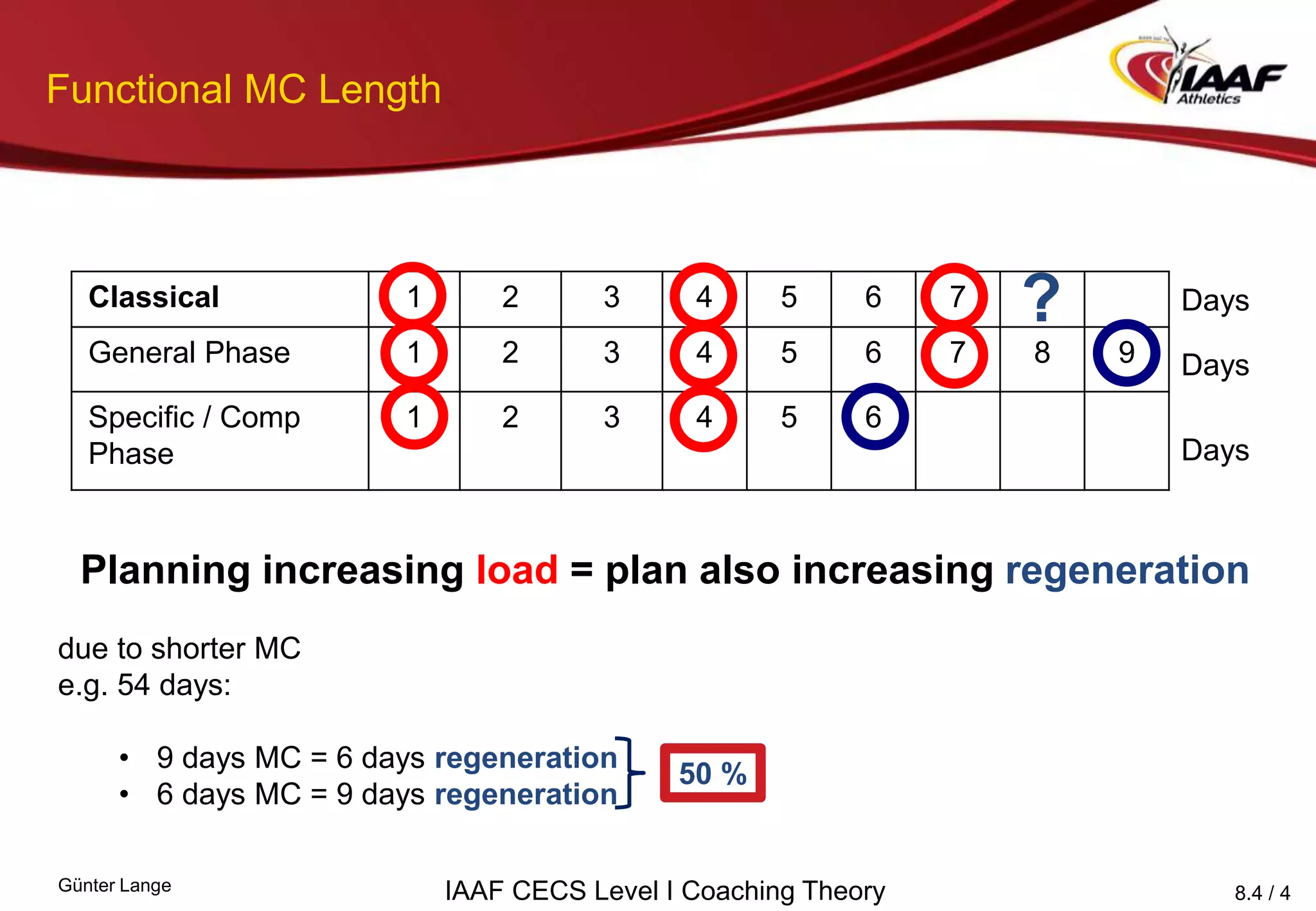
Functional MC Length
Classical 1 2 3 4 5 6 7
General Phase 1 2 3 4 5 6 7 8 9
Specific / Comp
Phase
1 2 3 4 5 6
Planning increasing load = plan also increasing regeneration
due to shorter MC
e.g. 54 days:
• 9 days MC = 6 days regeneration
• 6 days MC = 9 days regeneration
Days
Days
Days
50 %
IAAF CECS Level I Coaching Theory 8.4 / 4
Günter Lange
?
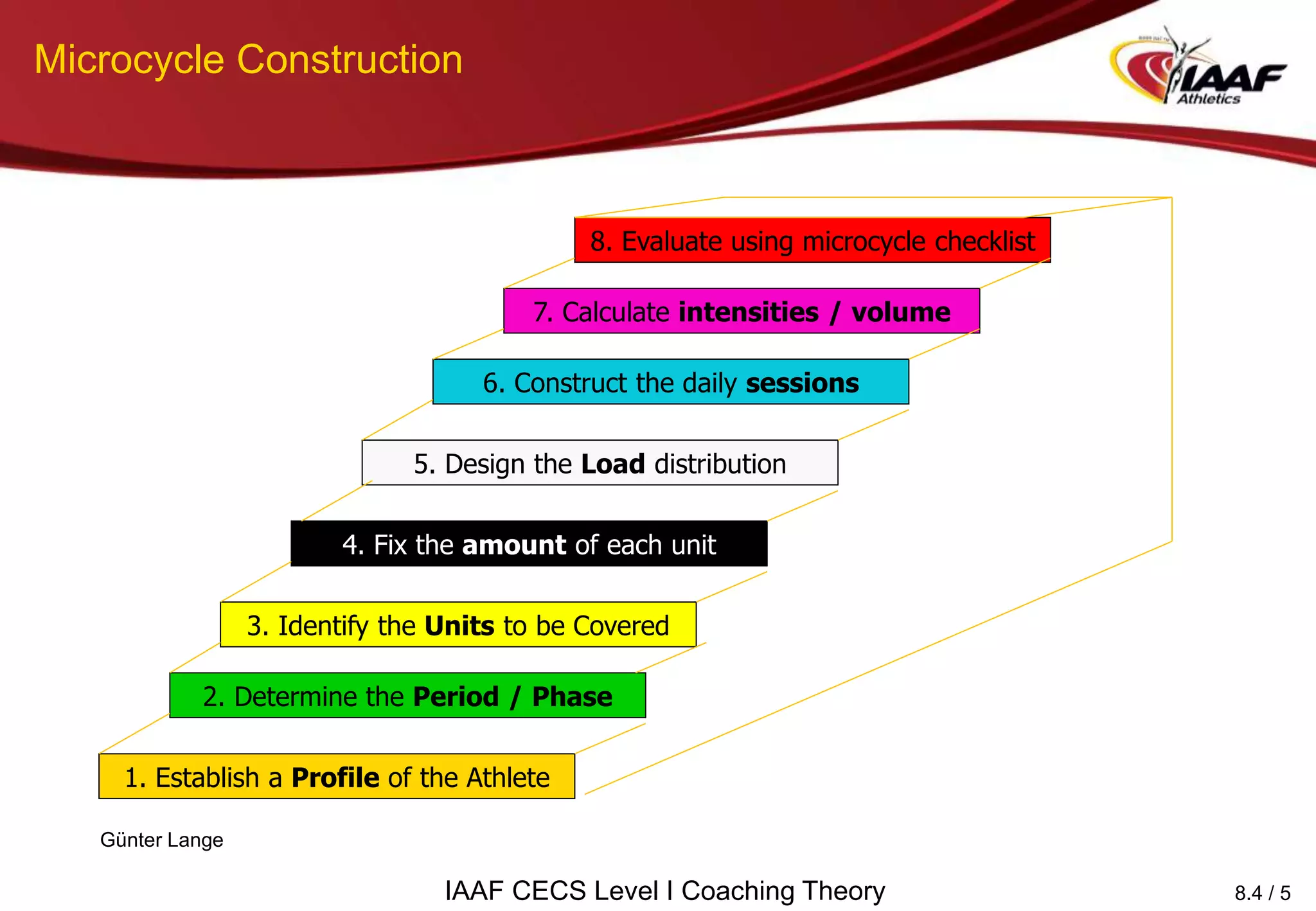
Microcycle Construction
Günter Lange
1. Establish a Profile of the Athlete
2. Determine the Period / Phase
3. Identify the Units to be Covered
4. Fix the amount of each unit
5. Design the Load distribution
6. Construct the daily sessions
7. Calculate intensities / volume
8. Evaluate using microcycle checklist
IAAF CECS Level I Coaching Theory 8.4 / 5
Microcycle Construction
Rules
 The intensity and type of loading
• Central Nervous System (CNS)/ Neuro Muscular System (NMS)
• Metabolic
• Structural
• Mental
must be given careful consideration
 The athlete must not be exposed to very high demands
upon same system in successive units
 Each unit is in pursuit of a specific objective and should
• vary within a day
• vary from day to day
8.4 / 6
Microcycle Construction
Rules (continued) (2)
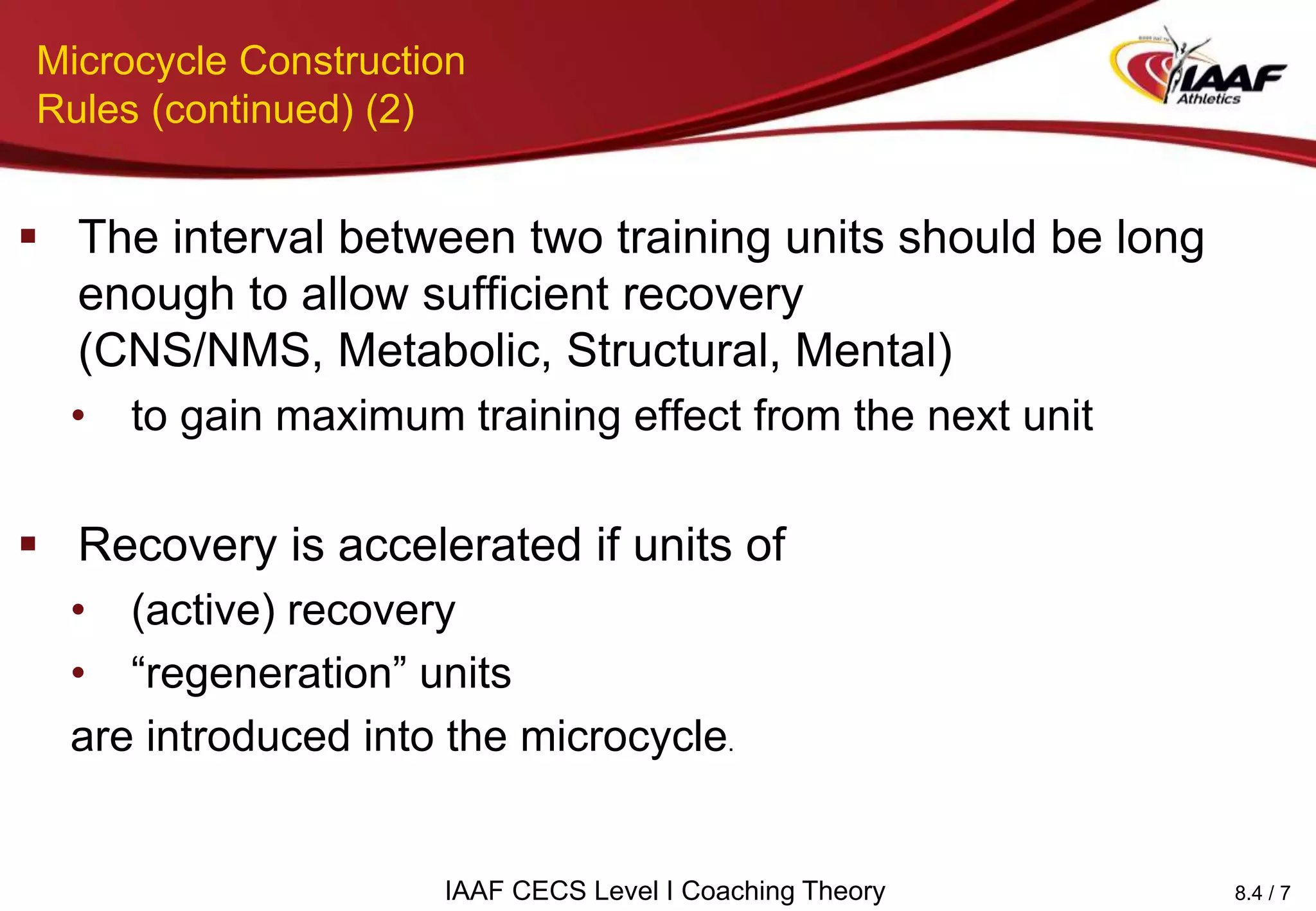
 The interval between two training units should be long
enough to allow sufficient recovery
(CNS/NMS, Metabolic, Structural, Mental)
• to gain maximum training effect from the next unit
 Recovery is accelerated if units of
• (active) recovery
• “regeneration” units
are introduced into the microcycle.
IAAF CECS Level I Coaching Theory 8.4 / 7
Microcycle Construction
Rules (continued) (3)
 When training units with different objectives and
varying demands follow each other, it may not be
necessary to await complete recovery
 Concentration on one particular objective in a unit
allows some optimal period of time when the
athlete can be exposed to the desired stimulus.
IAAF CECS Level I Coaching Theory 8.4 / 8
Microcycle Construction
Rules (continued) (4)
 Well-constructed MC reduce monotony in training
 Highly demanding NMS loading
• be carried out on days of optimal capacity
• never following days of high demand
o e.g. anaerobic-lactic energy system (speed endurance)
 24 - 48 hours are required to recover from high loadings
• Functional MC length
o General Phase 9 days
o Specific Phase 6 days
IAAF CECS Level I Coaching Theory 8.4 / 9
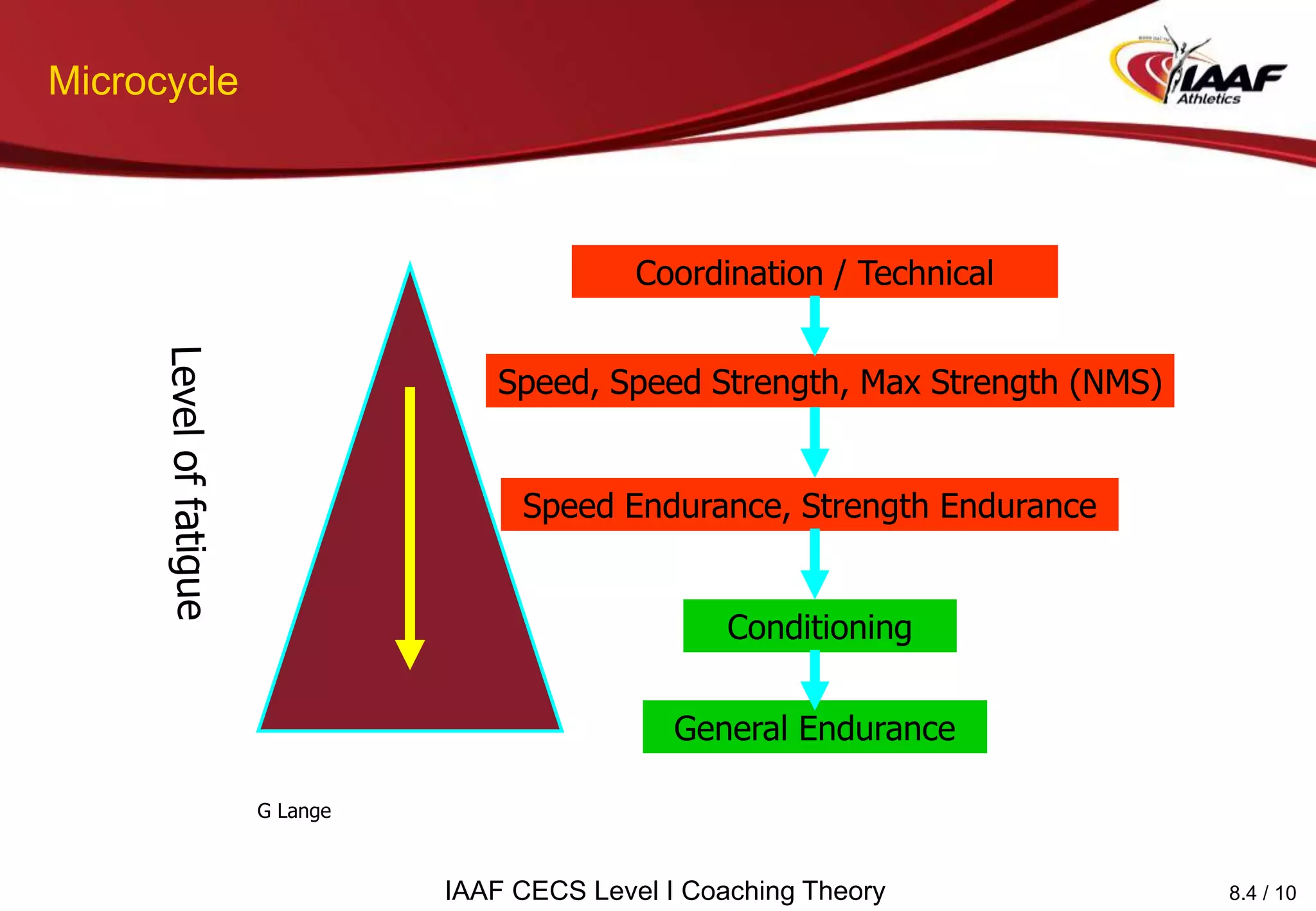
Microcycle
Coordination / Technical
Speed, Speed Strength, Max Strength (NMS)
Speed Endurance, Strength Endurance
Conditioning
General Endurance
G Lange
IAAF CECS Level I Coaching Theory 8.4 / 10
Microcycle Check List
• Is the content appropriate to period of training?
• Are the chosen methods appropriate (intensity) to the goals?
• Are the methods age-related?
• Is there a balance between training load and recovery?
• Principle of variation
• Are the training units and also the training components
arranged to meet different requirements (precondition:
recovery) of each of the biomotoric abilities? G Lange 8.4 / 11
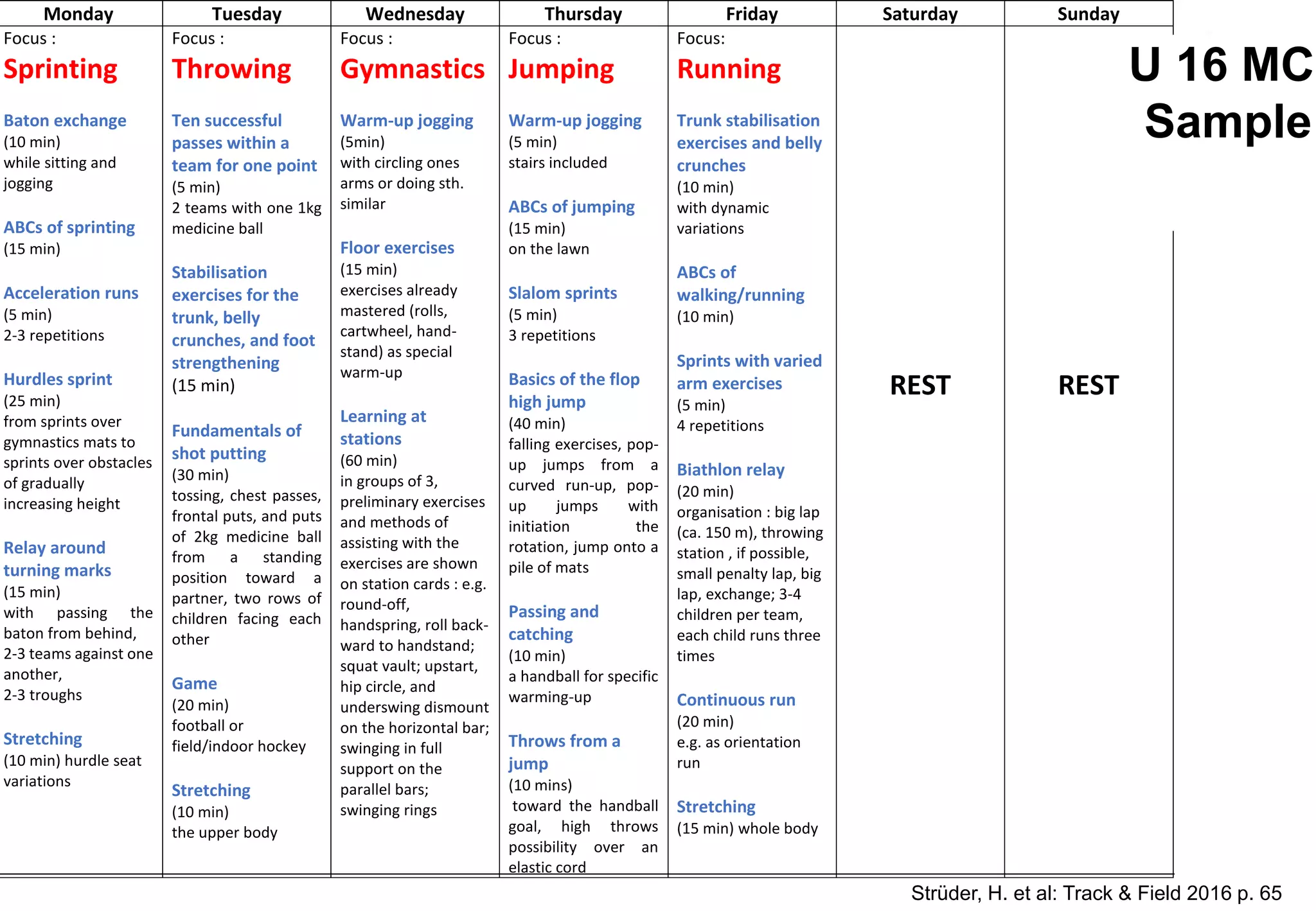
Monday Tuesday Wednesday Thursday Friday Saturday Sunday
Focus :
Sprinting
Baton exchange
(10 min)
while sitting and
jogging
ABCs of sprinting
(15 min)
Acceleration runs
(5 min)
2-3 repetitions
Hurdles sprint
(25 min)
from sprints over
gymnastics mats to
sprints over obstacles
of gradually
increasing height
Relay around
turning marks
(15 min)
with passing the
baton from behind,
2-3 teams against one
another,
2-3 troughs
Stretching
(10 min) hurdle seat
variations
Focus :
Throwing
Ten successful
passes within a
team for one point
(5 min)
2 teams with one 1kg
medicine ball
Stabilisation
exercises for the
trunk, belly
crunches, and foot
strengthening
(15 min)
Fundamentals of
shot putting
(30 min)
tossing, chest passes,
frontal puts, and puts
of 2kg medicine ball
from a standing
position toward a
partner, two rows of
children facing each
other
Game
(20 min)
football or
field/indoor hockey
Stretching
(10 min)
the upper body
Focus :
Gymnastics
Warm-up jogging
(5min)
with circling ones
arms or doing sth.
similar
Floor exercises
(15 min)
exercises already
mastered (rolls,
cartwheel, hand-
stand) as special
warm-up
Learning at
stations
(60 min)
in groups of 3,
preliminary exercises
and methods of
assisting with the
exercises are shown
on station cards : e.g.
round-off,
handspring, roll back-
ward to handstand;
squat vault; upstart,
hip circle, and
underswing dismount
on the horizontal bar;
swinging in full
support on the
parallel bars;
swinging rings
Focus :
Jumping
Warm-up jogging
(5 min)
stairs included
ABCs of jumping
(15 min)
on the lawn
Slalom sprints
(5 min)
3 repetitions
Basics of the flop
high jump
(40 min)
falling exercises, pop-
up jumps from a
curved run-up, pop-
up jumps with
initiation the
rotation, jump onto a
pile of mats
Passing and
catching
(10 min)
a handball for specific
warming-up
Throws from a
jump
(10 mins)
toward the handball
goal, high throws
possibility over an
elastic cord
Focus:
Running
Trunk stabilisation
exercises and belly
crunches
(10 min)
with dynamic
variations
ABCs of
walking/running
(10 min)
Sprints with varied
arm exercises
(5 min)
4 repetitions
Biathlon relay
(20 min)
organisation : big lap
(ca. 150 m), throwing
station , if possible,
small penalty lap, big
lap, exchange; 3-4
children per team,
each child runs three
times
Continuous run
(20 min)
e.g. as orientation
run
Stretching
(15 min) whole body
REST REST
Strüder, H. et al: Track & Field 2016 p. 65
U 16 MC
Sample
8.4 / 13
G Lange

8.4 COR Training Planing - Microcycle.pptx

  • 1.
  • 2.
    8.4 / 2 Planning Macrocycle Period/ Phase Mesocycle Microcycle Session Unit “A Macrocycle is a developmental period […] directed toward achievement of a peak of maximum fitness. For many athletes […] this may require nearly a year.” Martin/ Coe: Training distance runners p.123 “Period of the year during which there is a particular training emphasis depending on the specific requirements of the sport. Commonly used phases include preparatory phase; competition phase; and the transition phase.” Kent: Oxford dictionary of sports science and medicine p. 332 “A Mesocycle lasts anywhere from a few weeks to a few months and typically has a specific developmental objective […] may emphasize development of an endurance base […]” Martin / Coe: Training distance runners p. 123 “Microcycles contain training units and recovery units combined in such a way that their training effects are optimized.” Kent: Oxford dictionary of sports science and medicine p. 278 “The smallest cyclic block of training, usually of 7, 10,14 or 21 days duration.” Johnson: Javelin throwing, p. 73 Session is ”a continuous period of time devoted to training. A single session might include several training units.” Kent: Oxford dictionary of sports science and medicine p. 458 ”A […] unit meets the objective of training a single component, such as speed or strength.”Gambetta: Planned performance training,p.42
  • 3.
    MICRO – CYCLE(MC) • “The reason for the MC is shown primarily by the well established relationships between load and recovery.” • “The structure of the load demand (relationships of the load factors: volume and intensity) changes in the course of the MC.” • “The load degree of the athlete differs in single training sessions and changes according to the load tolerance and ability to recover between lower and very high loads.” • “The MC contains training sessions with different main tasks” Harre, D. (Ed.): Principles of Training. Berlin 1982 p.86 IAAF CECS Level I Coaching Theory 8.4 / 3
  • 4.
    Functional MC Length Classical1 2 3 4 5 6 7 General Phase 1 2 3 4 5 6 7 8 9 Specific / Comp Phase 1 2 3 4 5 6 Planning increasing load = plan also increasing regeneration due to shorter MC e.g. 54 days: • 9 days MC = 6 days regeneration • 6 days MC = 9 days regeneration Days Days Days 50 % IAAF CECS Level I Coaching Theory 8.4 / 4 Günter Lange ?
  • 5.
    Microcycle Construction Günter Lange 1.Establish a Profile of the Athlete 2. Determine the Period / Phase 3. Identify the Units to be Covered 4. Fix the amount of each unit 5. Design the Load distribution 6. Construct the daily sessions 7. Calculate intensities / volume 8. Evaluate using microcycle checklist IAAF CECS Level I Coaching Theory 8.4 / 5
  • 6.
    Microcycle Construction Rules  Theintensity and type of loading • Central Nervous System (CNS)/ Neuro Muscular System (NMS) • Metabolic • Structural • Mental must be given careful consideration  The athlete must not be exposed to very high demands upon same system in successive units  Each unit is in pursuit of a specific objective and should • vary within a day • vary from day to day 8.4 / 6
  • 7.
    Microcycle Construction Rules (continued)(2)  The interval between two training units should be long enough to allow sufficient recovery (CNS/NMS, Metabolic, Structural, Mental) • to gain maximum training effect from the next unit  Recovery is accelerated if units of • (active) recovery • “regeneration” units are introduced into the microcycle. IAAF CECS Level I Coaching Theory 8.4 / 7
  • 8.
    Microcycle Construction Rules (continued)(3)  When training units with different objectives and varying demands follow each other, it may not be necessary to await complete recovery  Concentration on one particular objective in a unit allows some optimal period of time when the athlete can be exposed to the desired stimulus. IAAF CECS Level I Coaching Theory 8.4 / 8
  • 9.
    Microcycle Construction Rules (continued)(4)  Well-constructed MC reduce monotony in training  Highly demanding NMS loading • be carried out on days of optimal capacity • never following days of high demand o e.g. anaerobic-lactic energy system (speed endurance)  24 - 48 hours are required to recover from high loadings • Functional MC length o General Phase 9 days o Specific Phase 6 days IAAF CECS Level I Coaching Theory 8.4 / 9
  • 10.
    Microcycle Coordination / Technical Speed,Speed Strength, Max Strength (NMS) Speed Endurance, Strength Endurance Conditioning General Endurance G Lange IAAF CECS Level I Coaching Theory 8.4 / 10
  • 11.
    Microcycle Check List •Is the content appropriate to period of training? • Are the chosen methods appropriate (intensity) to the goals? • Are the methods age-related? • Is there a balance between training load and recovery? • Principle of variation • Are the training units and also the training components arranged to meet different requirements (precondition: recovery) of each of the biomotoric abilities? G Lange 8.4 / 11
  • 12.
    Monday Tuesday WednesdayThursday Friday Saturday Sunday Focus : Sprinting Baton exchange (10 min) while sitting and jogging ABCs of sprinting (15 min) Acceleration runs (5 min) 2-3 repetitions Hurdles sprint (25 min) from sprints over gymnastics mats to sprints over obstacles of gradually increasing height Relay around turning marks (15 min) with passing the baton from behind, 2-3 teams against one another, 2-3 troughs Stretching (10 min) hurdle seat variations Focus : Throwing Ten successful passes within a team for one point (5 min) 2 teams with one 1kg medicine ball Stabilisation exercises for the trunk, belly crunches, and foot strengthening (15 min) Fundamentals of shot putting (30 min) tossing, chest passes, frontal puts, and puts of 2kg medicine ball from a standing position toward a partner, two rows of children facing each other Game (20 min) football or field/indoor hockey Stretching (10 min) the upper body Focus : Gymnastics Warm-up jogging (5min) with circling ones arms or doing sth. similar Floor exercises (15 min) exercises already mastered (rolls, cartwheel, hand- stand) as special warm-up Learning at stations (60 min) in groups of 3, preliminary exercises and methods of assisting with the exercises are shown on station cards : e.g. round-off, handspring, roll back- ward to handstand; squat vault; upstart, hip circle, and underswing dismount on the horizontal bar; swinging in full support on the parallel bars; swinging rings Focus : Jumping Warm-up jogging (5 min) stairs included ABCs of jumping (15 min) on the lawn Slalom sprints (5 min) 3 repetitions Basics of the flop high jump (40 min) falling exercises, pop- up jumps from a curved run-up, pop- up jumps with initiation the rotation, jump onto a pile of mats Passing and catching (10 min) a handball for specific warming-up Throws from a jump (10 mins) toward the handball goal, high throws possibility over an elastic cord Focus: Running Trunk stabilisation exercises and belly crunches (10 min) with dynamic variations ABCs of walking/running (10 min) Sprints with varied arm exercises (5 min) 4 repetitions Biathlon relay (20 min) organisation : big lap (ca. 150 m), throwing station , if possible, small penalty lap, big lap, exchange; 3-4 children per team, each child runs three times Continuous run (20 min) e.g. as orientation run Stretching (15 min) whole body REST REST Strüder, H. et al: Track & Field 2016 p. 65 U 16 MC Sample
  • 13.