9.4 Periodization
IAAF CECS Level I
Planning the Training Programme
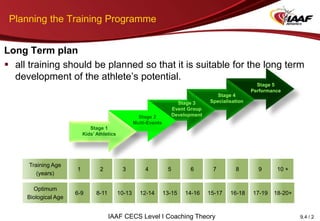
Long Term plan
 all training should be planned so that it is suitable for the long term
development of the athlete’s potential.
Stage 1
Kids’ Athletics
Stage 2
Multi-Events
Stage 3
Event Group
Development
Stage 4
Specialisation
Stage 5
Performance
Training Age
(years)
1 2 3 4 5 6 7 8 9 10 +
Optimum
Biological Age
6-9 8-11 10-13 12-14 13-15 14-16 15-17 16-18 17-19 18-20+
IAAF CECS Level I Coaching Theory 9.4 / 2
Periodisation
- what to do and when to do it
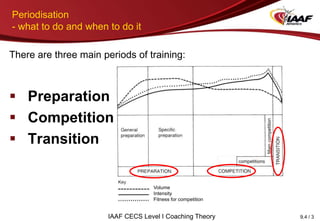
There are three main periods of training:
 Preparation
 Competition
 Transition
Volume
Intensity
Fitness for competition
IAAF CECS Level I Coaching Theory 9.4 / 3
Preparation Period
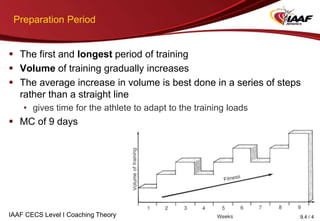
 The first and longest period of training
 Volume of training gradually increases
 The average increase in volume is best done in a series of steps
rather than a straight line
• gives time for the athlete to adapt to the training loads
 MC of 9 days
IAAF CECS Level I Coaching Theory 9.4 / 4
Competition Period
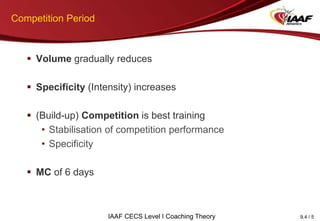
 Volume gradually reduces
 Specificity (Intensity) increases
 (Build-up) Competition is best training
• Stabilisation of competition performance
• Specificity
 MC of 6 days
IAAF CECS Level I Coaching Theory 9.4 / 5
Transition Period
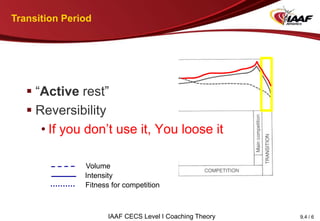
Volume
Intensity
Fitness for competition
IAAF CECS Level I Coaching Theory 9.4 / 6
 “Active rest”
 Reversibility
• If you don’t use it, You loose it
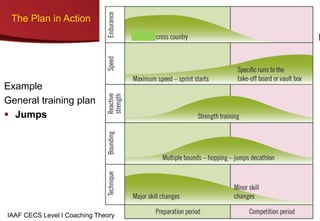
The Plan in Action
Example
General training plan
 Jumps
IAAF CECS Level I Coaching Theory
Summary
 Macrocycle can be divided into ‘periods’ of training
This provides
• Structure
• Progression
• Variety
to the training
 There are three main “periods” of training:
• Preparation
• Competition
• Transition
• Periodization helps in the long term development of the athlete.
9.4 / 8

9.4 COR Periodization.pptx

  • 1.
  • 2.
    Planning the TrainingProgramme Long Term plan  all training should be planned so that it is suitable for the long term development of the athlete’s potential. Stage 1 Kids’ Athletics Stage 2 Multi-Events Stage 3 Event Group Development Stage 4 Specialisation Stage 5 Performance Training Age (years) 1 2 3 4 5 6 7 8 9 10 + Optimum Biological Age 6-9 8-11 10-13 12-14 13-15 14-16 15-17 16-18 17-19 18-20+ IAAF CECS Level I Coaching Theory 9.4 / 2
  • 3.
    Periodisation - what todo and when to do it There are three main periods of training:  Preparation  Competition  Transition Volume Intensity Fitness for competition IAAF CECS Level I Coaching Theory 9.4 / 3
  • 4.
    Preparation Period  Thefirst and longest period of training  Volume of training gradually increases  The average increase in volume is best done in a series of steps rather than a straight line • gives time for the athlete to adapt to the training loads  MC of 9 days IAAF CECS Level I Coaching Theory 9.4 / 4
  • 5.
    Competition Period  Volumegradually reduces  Specificity (Intensity) increases  (Build-up) Competition is best training • Stabilisation of competition performance • Specificity  MC of 6 days IAAF CECS Level I Coaching Theory 9.4 / 5
  • 6.
    Transition Period Volume Intensity Fitness forcompetition IAAF CECS Level I Coaching Theory 9.4 / 6  “Active rest”  Reversibility • If you don’t use it, You loose it
  • 7.
    The Plan inAction Example General training plan  Jumps IAAF CECS Level I Coaching Theory
  • 8.
    Summary  Macrocycle canbe divided into ‘periods’ of training This provides • Structure • Progression • Variety to the training  There are three main “periods” of training: • Preparation • Competition • Transition • Periodization helps in the long term development of the athlete. 9.4 / 8