
INTRODUCTION
Because of advances in endoscope
design and miniaturization, along
with the development of highly
effective surgical lasers,
ureteroscopy (URS) and laser
lithotripsy has become the
predominant method for urinary
stone treatment in North America
Advanced Ho:YAG technologies have
been introduced, such as the Moses
technology, a pulse modulation
mode that improves holmium laser
energy transmission through water.
The holmium:yttriumaluminum- garnet
(Ho:YAG) laser is the most widely used
laser for URS, with modern systems
providing users with a range of settings
and parameters that have numerous
effects on stone fragmentation.
The thulium fiber laser (TFL) is a new,
solid-state, diode-pumped laser
thatmay provide urologists with
increased options for stone
treatment.
HOLMIUM LASER
Pulse Energy (PE)
PE, measured in joules
(J), is the total optical
energy emitted from the
laser fiber tip in 1 pulse.
Frequency
Frequency, measured in
hertz (Hz), is the number of
pulses emitted from the
laser fiber per second.
Pulse Width (PW)
PW, also described as pulse
duration or length, is defined
as the duration of the single
optical pulse emitted from
the fiber tip
• The Ho:YAG laser is a solid-state, flash lamp pumped pulsed laser, and is the current standard
for lithotripsy during URS.
• Because its wavelength is 2120 nm, it is highly absorbed in water, with a low penetration
depth that limits the amount of energy reaching surrounding tissue.
• The process of ablation and fragmentation are highly dependent on the total power (Watts)
delivered to the stone, which is a product of the pulse energy (PE) and frequency.
Other Technical Parameters Affecting Laser Lithotripsy
The fiber tip to stone working
distance has implications on
lithotripsy efficiency because
energy from the holmium
laser is highly absorbed in
water.
Fiber Tip
Smaller core diameter fibers
are associated with more
retropulsion compared with
larger core fibers.
Fiber Size
Two other factors that affect fragmentation are the
laser fiber size, and the fiber tip to stone working distance.
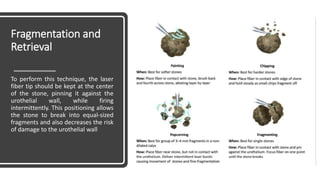
Fragmentation and
Retrieval
To perform this technique, the laser
fiber tip should be kept at the center
of the stone, pinning it against the
urothelial wall, while firing
intermittently. This positioning allows
the stone to break into equal-sized
fragments and also decreases the risk
of damage to the urothelial wall
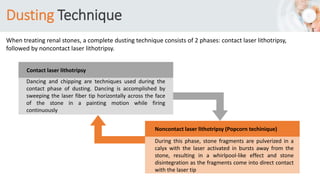
Dusting Technique
Dancing and chipping are techniques used during the
contact phase of dusting. Dancing is accomplished by
sweeping the laser fiber tip horizontally across the face
of the stone in a painting motion while firing
continuously
During this phase, stone fragments are pulverized in a
calyx with the laser activated in bursts away from the
stone, resulting in a whirlpool-like effect and stone
disintegration as the fragments come into direct contact
with the laser tip
Contact laser lithotripsy
Noncontact laser lithotripsy (Popcorn techinique)
When treating renal stones, a complete dusting technique consists of 2 phases: contact laser lithotripsy,
followed by noncontact laser lithotripsy.
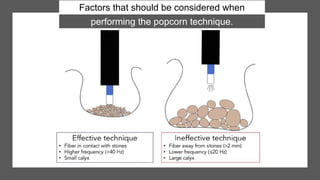
Factors that should be considered when
performing the popcorn technique.
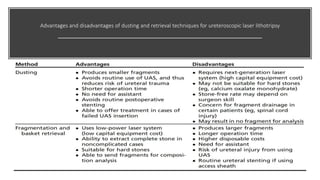
Advantages and disadvantages of dusting and retrieval techniques for ureteroscopic laser lithotripsy
LASER TECHNIQUES FOR PERCUTANEOUS
RENAL STONE SURGERY
Percutaneous nephrolithotomy
(PCNL) is the gold standard
treatment for stone burdens greater
than 2 cm or staghorn calculi.
The workhorse for lithotripsy during
PCNL has been the ultrasonic
and/or pneumatic device, an early
handpiece proved the utility of
combined suction with a holmium
laser fiber to permit simultaneous
lithotripsy and suction of fragments.
Laser suction devices has made the
holmium laser a viable energy
source for fragmentation during
PCNL.
NEW
TECHNOLOGY
• Moses technology changes how the energy is delivered to the stone, a
process called pulse modulation. The energy is delivered over 2 pulses
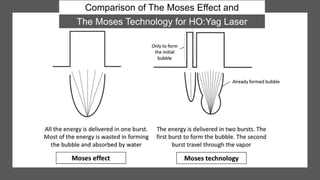
• The first pulse delivers part of the energy to form the vapor bubble. Once
the bubble is formed, the second pulse delivers the rest of the energy
through the already-formed vapor channel
• Moses technology can be cost-effective if the laser fiber cost can be
reduced or if the procedure time is reduced by at least 4 minutes
Moses Platform for Holmium
Laser Lithotripsy
EMERGING
TECHNOLOGY
• The first pulse delivers part of the energy to form the vapor bubble. Once
the bubble is formed, the second pulse delivers the rest of the energy
through the already-formed vapor channel
• Second, the energy or TFL is generated in a small fiber so it can be coupled
to laser fibers with core diameters as small as 100 mm
• Third, the range of settings available on the two laser systems are
different. TFL has pulse energies as small as 33 mJ and frequency as high
as 2000 Hz, compared with the holmium laser in which 200 mJ is the
lowest PE and 80 Hz is the highest currently achievable frequency
Thulium Fiber Laser (TFL)
Comparison of The Moses Effect and
The Moses Technology for HO:Yag Laser
Summary
Laser techniques during endoscopic stone surgery can result
in fragments that are small enough for retrieval or small
enough for spontaneous passage
High PE is used for active retrieval, whereas low PE is used
for dusting technique. LP mode results in less stone
retropulsion and fiber tip degradation.
The popcorn technique is used to pulverize stones into fine
fragments and is an important endgame strategy for dusting.
The Moses technology for the holmium laser is a pulse
modulation method that delivers energy over 2 pulses in
order to reduce retropulsion and increase fragmentation.
The TFL is an emerging laser technology, and future research
will help clinicians understand how to incorporate these
technologies and techniques with the aim of improving
patient outcomes.
Thank you

Laser Techniques for Urinary stones

  • 2.
    INTRODUCTION Because of advancesin endoscope design and miniaturization, along with the development of highly effective surgical lasers, ureteroscopy (URS) and laser lithotripsy has become the predominant method for urinary stone treatment in North America Advanced Ho:YAG technologies have been introduced, such as the Moses technology, a pulse modulation mode that improves holmium laser energy transmission through water. The holmium:yttriumaluminum- garnet (Ho:YAG) laser is the most widely used laser for URS, with modern systems providing users with a range of settings and parameters that have numerous effects on stone fragmentation. The thulium fiber laser (TFL) is a new, solid-state, diode-pumped laser thatmay provide urologists with increased options for stone treatment.
  • 3.
    HOLMIUM LASER Pulse Energy(PE) PE, measured in joules (J), is the total optical energy emitted from the laser fiber tip in 1 pulse. Frequency Frequency, measured in hertz (Hz), is the number of pulses emitted from the laser fiber per second. Pulse Width (PW) PW, also described as pulse duration or length, is defined as the duration of the single optical pulse emitted from the fiber tip • The Ho:YAG laser is a solid-state, flash lamp pumped pulsed laser, and is the current standard for lithotripsy during URS. • Because its wavelength is 2120 nm, it is highly absorbed in water, with a low penetration depth that limits the amount of energy reaching surrounding tissue. • The process of ablation and fragmentation are highly dependent on the total power (Watts) delivered to the stone, which is a product of the pulse energy (PE) and frequency.
  • 4.
    Other Technical ParametersAffecting Laser Lithotripsy The fiber tip to stone working distance has implications on lithotripsy efficiency because energy from the holmium laser is highly absorbed in water. Fiber Tip Smaller core diameter fibers are associated with more retropulsion compared with larger core fibers. Fiber Size Two other factors that affect fragmentation are the laser fiber size, and the fiber tip to stone working distance.
  • 5.
    Fragmentation and Retrieval To performthis technique, the laser fiber tip should be kept at the center of the stone, pinning it against the urothelial wall, while firing intermittently. This positioning allows the stone to break into equal-sized fragments and also decreases the risk of damage to the urothelial wall
  • 6.
    Dusting Technique Dancing andchipping are techniques used during the contact phase of dusting. Dancing is accomplished by sweeping the laser fiber tip horizontally across the face of the stone in a painting motion while firing continuously During this phase, stone fragments are pulverized in a calyx with the laser activated in bursts away from the stone, resulting in a whirlpool-like effect and stone disintegration as the fragments come into direct contact with the laser tip Contact laser lithotripsy Noncontact laser lithotripsy (Popcorn techinique) When treating renal stones, a complete dusting technique consists of 2 phases: contact laser lithotripsy, followed by noncontact laser lithotripsy.
  • 7.
    Factors that shouldbe considered when performing the popcorn technique.
  • 8.
    Advantages and disadvantagesof dusting and retrieval techniques for ureteroscopic laser lithotripsy
  • 9.
    LASER TECHNIQUES FORPERCUTANEOUS RENAL STONE SURGERY Percutaneous nephrolithotomy (PCNL) is the gold standard treatment for stone burdens greater than 2 cm or staghorn calculi. The workhorse for lithotripsy during PCNL has been the ultrasonic and/or pneumatic device, an early handpiece proved the utility of combined suction with a holmium laser fiber to permit simultaneous lithotripsy and suction of fragments. Laser suction devices has made the holmium laser a viable energy source for fragmentation during PCNL.
  • 10.
    NEW TECHNOLOGY • Moses technologychanges how the energy is delivered to the stone, a process called pulse modulation. The energy is delivered over 2 pulses • The first pulse delivers part of the energy to form the vapor bubble. Once the bubble is formed, the second pulse delivers the rest of the energy through the already-formed vapor channel • Moses technology can be cost-effective if the laser fiber cost can be reduced or if the procedure time is reduced by at least 4 minutes Moses Platform for Holmium Laser Lithotripsy
  • 11.
    EMERGING TECHNOLOGY • The firstpulse delivers part of the energy to form the vapor bubble. Once the bubble is formed, the second pulse delivers the rest of the energy through the already-formed vapor channel • Second, the energy or TFL is generated in a small fiber so it can be coupled to laser fibers with core diameters as small as 100 mm • Third, the range of settings available on the two laser systems are different. TFL has pulse energies as small as 33 mJ and frequency as high as 2000 Hz, compared with the holmium laser in which 200 mJ is the lowest PE and 80 Hz is the highest currently achievable frequency Thulium Fiber Laser (TFL)
  • 12.
    Comparison of TheMoses Effect and The Moses Technology for HO:Yag Laser
  • 13.
    Summary Laser techniques duringendoscopic stone surgery can result in fragments that are small enough for retrieval or small enough for spontaneous passage High PE is used for active retrieval, whereas low PE is used for dusting technique. LP mode results in less stone retropulsion and fiber tip degradation. The popcorn technique is used to pulverize stones into fine fragments and is an important endgame strategy for dusting. The Moses technology for the holmium laser is a pulse modulation method that delivers energy over 2 pulses in order to reduce retropulsion and increase fragmentation. The TFL is an emerging laser technology, and future research will help clinicians understand how to incorporate these technologies and techniques with the aim of improving patient outcomes.
  • 14.

Editor's Notes

  • #4 HOLMIUM LASER Next-generation systems also allow pulse width manipulation to either short-pulse or long-pulse modes. Altering the Pulse Energy, frequency, and Pulse Width, in addition to new parameters related to pulse modulation, can affect stone ablation, retropulsion, and laser fiber tip degradation. Adjusting these parameters can optimize lithotripsy and improve the efficiency of fragmentation. PULSE ENERGY (PE) Higher PE may have more impact on ablation volume than increasing the total power There are several drawbacks to using higher PE, including greater laser fiber tip degradation and stone retropulsion, which can hinder ablation efficiency and procedure time. Retropulsion decreases efficiency by increasing the distance between the fiber tip and stone, resulting in less energy reaching the stone Frequency If the PE is kept constant and the frequency increases, fragmentation rates can increase Pulse Width (PW) A major advantage of using LP is decreased retropulsion of the stone, which can offset the negative effects higher PE may have on retropulsion. LP reduces laser fiber tip degradation, also known as burnback, which is a result of thermal shock, and chemical and mechanical breakdown of the silica fiber.
  • #5 The greatest fragmentation occurs when the laser is activated while in contact with the stone, and, if the fiber tip distance increases, it reduces fragmentation efficacy because the energy reaching the stone diminishes as the distance between the laser fiber and stone increases.
  • #6 Stone location, density, and volume are factors to consider when selecting a fragmentation and retrieval method. For nonimpacted mobile stones in the lower ureter, fragmentation may be a better option, because this location easily permits retrieval of fragments with a basket. The density of the stone may be calculated on a computed tomography (CT) scan (Hounsfield units), which can act as a guide in the selection of lithotripsy technique and whether a ureteral access sheath (UAS) to facilitate retrieval will be required. Hard stones may be difficult to ablate using a dusting technique. Stone volume dictates the number of repeated passages of the ureteroscope to remove a stone, whereas the size of the UAS influences the maximum size of the fragment that can be extracted in a basket. For large stones, the number of scope passages needed for complete active retrieval can be daunting.
  • #7 The aim when executing a dusting technique is to incorporate a setting parameter so that most of the fragments breaking off the stone are as small as possible
  • #11 The bubble that forms when laser energy is transmitted through fluid. The energy causes a “vapor tunnel [that] serves as a pathway permitting transmission of radiation between the parted seas of blood or water” hence the term the Moses effect This method ensures that more energy is delivered to the stone compared with the regular pulse mode. The Moses platform has 2 settings: the Moses contact (MC) mode, intended for operation at a close distance, and Moses distance (MD) mode, which is designed for lithotripsy at a distance of 1 to 2 mm.
  • #12 TFL operates at a wavelength that has a higher absorption peak in water compared with Ho:YAG, which operates at 2120 nm. For this reason, it has been hypothesized that increased water absorption leads to better fragmentation. For the Ho:YAG laser, the energy is generated from a larger crystal and can only be coupled to fibers larger than 200 mm. For TFL, the smaller fibers allow higher irrigation rates and better ureteroscope maneuverability. According to Traxer and colleagues TFL is safe and effective for treating renal and ureteral stones for all stone compositions during URS