Information
skills for research
http://unihub.mdx.ac.uk/your-study/library-and-it-support
BIS3400 Feb 2017
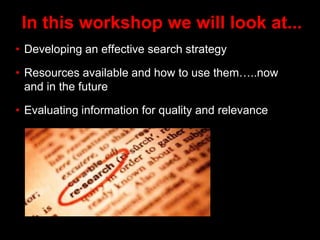
In this workshop we will look at...
• Developing an effective search strategy
• Resources available and how to use them…..now
and in the future
• Evaluating information for quality and relevance
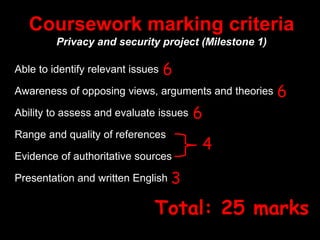
Coursework marking criteria
Privacy and security project (Milestone 1)
Able to identify relevant issues
Awareness of opposing views, arguments and theories
Ability to assess and evaluate issues
Range and quality of references
Evidence of authoritative sources
Presentation and written English
6
6
6
4
3
Total: 25 marks
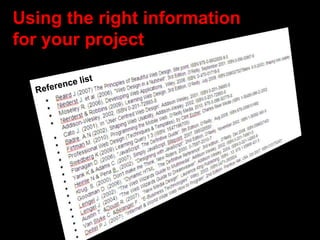
Using the right information
for your project
Quality or resources
• Range of resources
• Academic quality
• Currency
Relevance
• Right subject
Correctly referenced
• Harvard
The right information
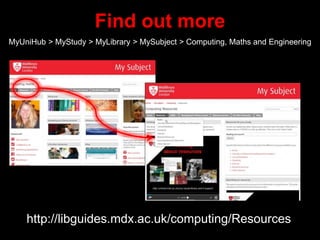
Find out more
MyUniHub > MyStudy > MyLibrary > MySubject > Computing, Maths and Engineering
http://libguides.mdx.ac.uk/computing/Resources
http://www.flickr.com/photos/rossjamesparker/89414788/
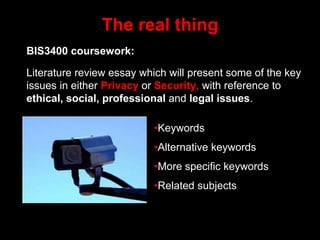
The real thing
BIS3400 coursework:
Literature review essay which will present some of the key
issues in either Privacy or Security, with reference to
ethical, social, professional and legal issues.
•Keywords
•Alternative keywords
•More specific keywords
•Related subjects
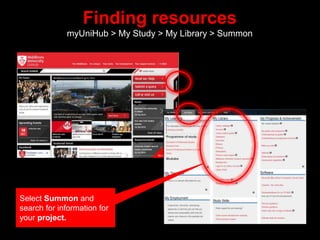
Finding resources
myUniHub > My Study > My Library > Summon
Select Summon and
search for information for
your project.
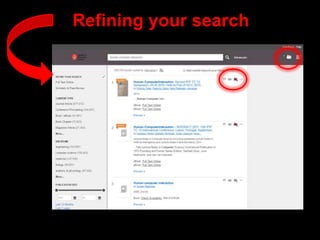
Refining your search
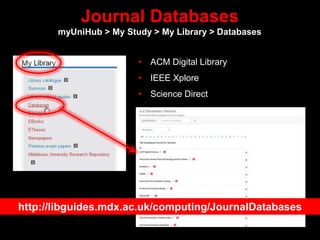
Journal Databases
myUniHub > My Study > My Library > Databases
• ACM Digital Library
• IEEE Xplore
• Science Direct
http://libguides.mdx.ac.uk/computing/JournalDatabases
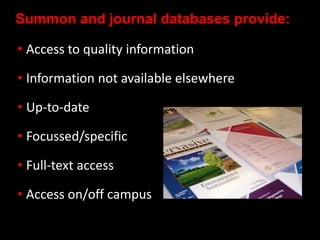
Summon and journal databases provide:
• Access to quality information
• Information not available elsewhere
• Up-to-date
• Focussed/specific
• Full-text access
• Access on/off campus
It’s not in the Library!
• Inter Library Loans http://bit.ly/InterLibraryLoans
• Sconul Access http://www.sconul.ac.uk/sconul-access
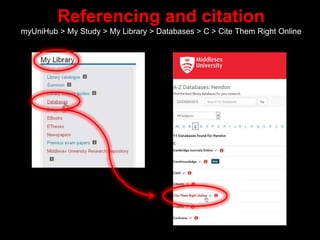
Referencing and citation
myUniHub > My Study > My Library > Databases > C > Cite Them Right Online
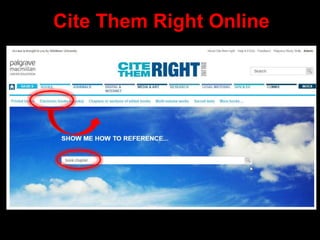
Cite Them Right Online
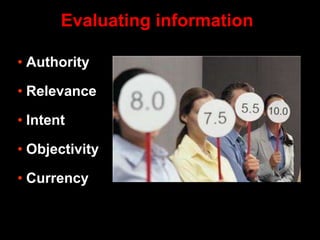
Is it reliable?
• Authority
• Relevance
• Intent
• Objectivity
• Currency
Evaluating information
Life after Uni
•Accessing academic information
•Using other libraries
•Careers advice
•Preparing for job interviews
•Professional associations
•Keeping up-to-date
•Online communities
•Conferences
More information: http://libguides.mdx.ac.uk/computing/LifeAfterUni
Need further help?
Your Librarian is:
Vanessa Hill v.hill@mdx.ac.uk
http://libguides.mdx.ac.uk/computing/Help

BIS3400 Feb 2017

Editor's Notes

  • #2  Welcome and intros.
  • #3 How to develop an effective search strategy when you need to find information for an essay or project The range of resources available and how to use them to find good quality and relevant information for your essay/project……now and in the future once you leave MDX Evaluating information for quality and relevance Research from Uni of Huddersfield shows that correlation between library usage and good grades.
  • #4  Essay demonstrates ability to identify relevant ethical, social and legal issues, pertaining to a particular topic area, case study or domain of application = 6 ie. need to find relevant books and journals etc Essay shows that the student is aware of opposing perspectives, and/or different arguments/theories in the topic area = 6 ie. need to find a balanced range of resources to get all viewpoints Essay assesses and evaluates relevant ethical and legal issues. Are professional principles applied in order to explain arguments, or recommend courses of action =6 ie. might want to speak to LDU re critical thinking etc Range and quality of references, including evidence of authoritative sources used. Use of correct referencing style, including in-text referencing = 4 ie. need to use good quality resources and reference correctly Presentation and written English, including grammar and spelling = 3 ie. might want to speak to LDU
  • #5 Hand out Reference game: Imagine that you are a lecturer teaching on a computer security module.   You have asked your students to write a report on Computer Security and Malware.   You will award 15% of the total marks for a list of quality references, which are both relevant and correctly given using the Harvard Referencing System. (The other marks will be awarded for content and style).   Look at the 3 reference lists that you have been given, and award a mark out of 5 for each list under the 3 headings (marking criteria): 1 = low mark 5= high mark.
  • #6 List 1 All items relevant Good range of resources: British Standards, encyclopaedia, conference proceedings, academic journals, books Academic quality: reputable sources eg. BSI, Britannica, IEEE....peer reviewed etc Up-to-date Correctly referenced: a couple of mistakes List 2 Some items relevant, some not eg. newspaper article Limited range of resources: mainly websites Academic quality: poor academic quality- local newspapers, wikipedia, webopedia etc Not Up-to-date eg. book 1985 Correctly referenced: Badly referenced eg. don’t know when accessed electronic resources, no publisher details for the book List 3 All items relevant Good range of resources: reasonable range of academic resources eg. academic journal, books, conference proceeding Academic quality: reputable sources eg. IEEE Up-to-date: older edition of Gollman book, article 2004, other books quite old Correctly referenced: a couple of mistakes ie. don’t know when eresources accessed
  • #7 More information about the range of resources available on the Library Subject Guide plus useful online guides eg. how to find information for your project.
  • #8  What can you see in the picture…fruit If type ‘fruit’ into database will get millions of hits, how can you break it down ie. search for something more specific to get more manageable results Can you be more specific ie. Type of fruit: apples, oranges, bananas etc Location: Stall, market, outdoor market, fruit market, Britain Detail: boxes, signs, astroturf, prices, colour of fruit, lights, pound £ signs, special offer etc People in background: old, young, male, female > stall holder, customers, browsers etc Think of related subjects eg. retail, commercial, financial, point-of-sale Shopping, shops, fish/meat/clothes market, shopping centres, high street Town, city, centre, British town Nutrition: vits and mins Also: Orange or Blackberry: fruit NOT telephone Apple: fruit NOT computer Thinking beyond the obvious, looking for the detail that might make a difference.
  • #9 Hand out worksheet. Coursework: 1500-1700 words presenting some of the key issues in either privacy or security. Need to read academic literature in your chosen topic area (minimum of 2 book chapters from different books, 1 academic journal article and one internet article of your choice excluding wikipedia) Sources need to be authoritative sources recognised by experts and need to be referenced correctly in your essay Need to present some of the key issues as discussed in the literature with reference to ethical and social issues, professional issues and legal issues. Issues should be illustrated by focussing on a particular aspect of your topic eg. a particular technology of information system in a specific context of application, or a recent case study Need to think about keywords: Privacy: private, secret, personal, restricted, confidential, confidentiality , individual (antonyms: general, public) Security: secure, secures, safe, safeguard, crime/sabotage/attack prevention, secureness, information security, computer security, risk management, security policy, integrity, authentication, access control Ethical: moral, integrity, accepted principles, ethically, principles of conduct, ethical codes, unethical, honourable, moral behaviour, fair, responsible, principled, correct, decent, honest Social: society, public, Government policy Professional: profession, vocational, occupational, expert, specialist, behavioural ethics/codes, professionalism Legal: legislation, law, lawful, legitimate licit legally, policy, freedom of information, data protection (antonyms: illegal, illigitimate, illicit, lawless, unlawful, wrongful)
  • #10 Need to carry out a literature review: Finding the information available on a subject Finding information to inform, underpin and shape your research Finding what has already been written on a subject Analyzing, evaluating and making judgements about the info found Identifying the main trends Finding appropriate information: the information needs to be suitable for your need ie. right level, current if important, sufficient breadth or detail etc Explain to students what Summon is. Go to UniHub > Login in to MyUniHub > My Study > My Library > Summon Ask students to search for information for their project. Remember to use some of the keywords that we have discussed.
  • #11 Show the students how to refine their search using: FT Content type Subject terms Publication date Language etc Have another go.
  • #12 Students can also search individual databases. ACM Digital library, IEEE Xplore and Science Direct are the main ones for Computing, but more information available from the library subject guide or from the drop-down menu on the Databases page.
  • #13 CS £1397 IEEE Xplore £61,000 Summon £16k Access to quality academic information eg. Peer reviewed journal articles, conference proceedings , research etc Information not available elsewhere Up-to-date Focussed/specific....not designed to sell you things, search results not sponsored Full-text access Access on/off campus Personalize eg. In MyEBSCO, once signerd up you can: Save preferences Organise research within folders Share folders Save search history Create email alerts/Rss feeds for searches and subjects Can provide citation and journal impact info > more info on next slide
  • #14 Inter Library Loan service: request copies of books and journals not held by MDX. £3 charge. Register as DL first. More info on our website. SCONUL Access http://www.access.sconul.ac.uk/ The SCONUL Access Scheme provides reciprocal access and borrowing rights for staff and students to approximately 170 member institutions in the UK. Apply online. Other libraries (specialist, catalogues etc): British Library http://www.bl.uk/ COPAC http://copac.ac.uk/ COPAC is a union catalogue that gives access to the merged online catalogues of members of the Consortium of University Research Libraries (CURL). Twenty  major university libraries currently contribute to COPAC. Search25 http://www.search25.ac.uk/: helps you discover library resources across London and the South East. You can also see where the libraries are and find out how to visit them. SUNCAT http://www.suncat.ac.uk/ SUNCAT, a union catalogue of serials (periodicals) for the UK, is a tool for locating serials held in UK libraries.
  • #15 Students can also search individual databases. Select ‘Computing science’ for a list of subject specific resources.
  • #17 Lee Harvey Oswald shot be Jack Ruby Nov 1963 Information can be manipulated....need to make sure it is reliable. How do you decide if the information is reliable....what criteria? Hand out Criteria Game.
  • #18 Hand out ‘Evaluation criteria’ game. Imagine you have searched for information for your current project. Decide what criteria you think are important, not important or very important.
  • #19 Take feedback and discuss. Authority : Who is the author? What is their knowledge base/qualifications? How have they carried out their research? Relevance : Is this what I need? Will it answer my question? Is it at the right level? Intent : What is the purpose of information e.g. financial gain, propaganda, academic etc? Objectivity : Balanced view? Opposing views represented? Links to supporting information? Currency: How old is this information? When was it last updated and by whom?
  • #20 Accessing academic information: once you leave you won’t be able to access our full-text e-books and e-journals, but you can still search Summon and our library catalogue and get information from other sources Using other libraries: British Library and specialist libraries in London Careers advice: careers advice available from the Uni Preparing for job interviews: we have a number of databases which you can use (before you leave) which can help you find company information to impress potential new employers Professional associations: The Library subscribes to several online resources provided by professional organisations, which provide academic quality information. By taking out a personal subscription to a professional organisation, it is possible to maintain partial access to key information sources, as well as professional support and development. Keeping up-to-date: Journal databases:Create email alerts/RSS feeds for searches and subjects Table of Contents Alerts: Zetoc , CituLike, TicToc Google Alerts: Google Alerts are email updates of the latest relevant Google results (web, news, etc.), based on your queries. Simply enter a subject that you wish to monitor and you will be sent regular updates. Blogs: Use Blogsearch to find blogs and blog posts for your subject Online communities: Online communities are a useful tool for professionals to keep up-to-date with the latest news, trends, tools, techniques, as well as sharing best practice and advice. Conferences: Attending conferences is a good way to find the latest information, make contacts with the leading authorities and vendors in the industry, as well as being an opportunity to network with your peers. More information: http://bit.ly/LifeafterUni
  • #21 More help available at the link.