http://unihub.mdx.ac.uk/your-study/library-and-it-support
CSD4040 Oct 2015
Finding research evidence
In this workshop we will look at...
• How to find information
• Developing an effective search strategy
• Resources available and how to use them
• Evaluating information for quality and relevance
• Managing references
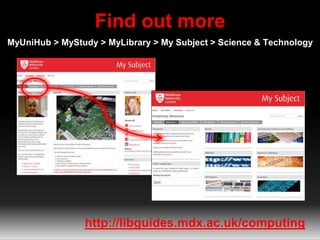
Find out more
MyUniHub > MyStudy > MyLibrary > My Subject > Science & Technology
http://libguides.mdx.ac.uk/computing
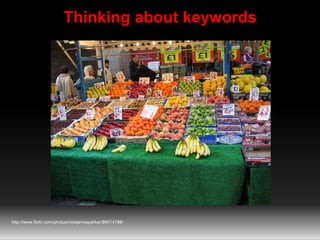
Thinking about keywords
http://www.flickr.com/photos/rossjamesparker/89414788/
The real thing
Algorithmic Biology, Formal Methods and Quantum
Information Processing or Artificial Intelligence.
•Keywords
•Alternative keywords
•More specific keywords
•Related subjects
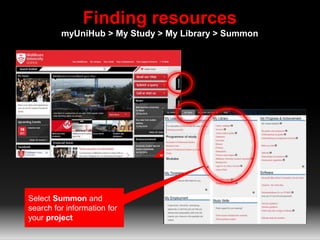
Finding resources
myUniHub > My Study > My Library > Summon
Select Summon and
search for information for
your project
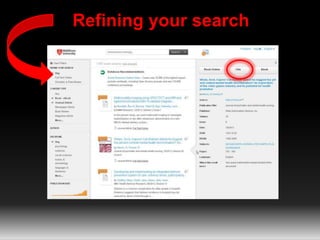
Refining your search
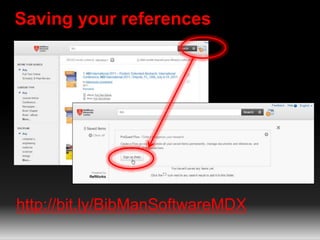
Saving your references
http://bit.ly/BibManSoftwareMDX
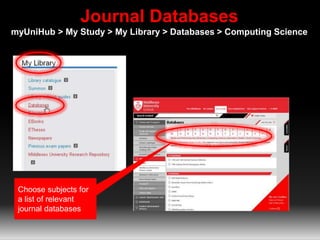
Journal Databases
myUniHub > My Study > My Library > Databases > Computing Science
Choose subjects for
a list of relevant
journal databases
Summon and journal databases provide:
• Access to quality information
• Information not available elsewhere
• Up-to-date
• Focussed/specific
• Full-text access
• Access on/off campus
• Personalize
• Citation and journal impact info
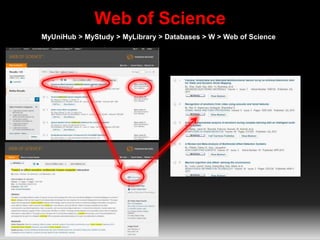
Citation searching
• Which articles have cited an earlier article
• Find articles on similar/related subject
• How many times an article has been cited
• Best journals in your field
Web of Science
MyUniHub > MyStudy > MyLibrary > Databases > W > Web of Science
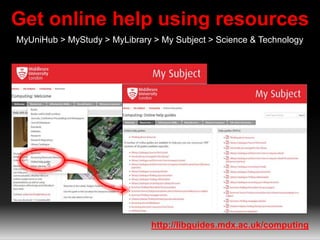
Get online help using resources
MyUniHub > MyStudy > MyLibrary > My Subject > Science & Technology
http://libguides.mdx.ac.uk/computing
Keeping up-to-date with your subject
• Zetoc Alert
• TicTOC
• Google Alerts
More information on Library Subject Guide:
http://bit.ly/CSkeepingcurrent
It’s not in the Library!
• Inter Library Loans http://bit.ly/InterLibraryLoans
• Sconul Access http://www.access.sconul.ac.uk/sconul-access
• Other libraries http://bit.ly/visitingotherlibraries
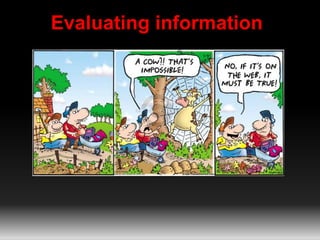
Evaluating information
Imagine you are researching ‘The right to be forgotten’
Go to http://libguides.mdx.ac.uk/EvaluatingInformationPG
Have a look at these items and then answer the following questions:
• What do we know about the author(s)?
• How do we know if the information is reliable?
• Authority
• Relevance
• Intent
• Objectivity
• Currency
Evaluating information
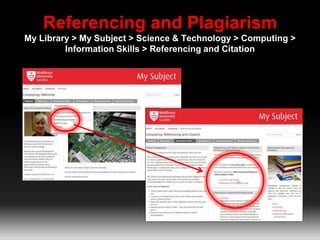
Referencing and Plagiarism
My Library > My Subject > Science & Technology > Computing >
Information Skills > Referencing and Citation
Need further help?
Your Librarian is:
Vanessa Hill v.hill@mdx.ac.uk

Csd4040 Oct 2015

Editor's Notes

  • #2  Welcome and intros. username: eisstudent password: Concorde
  • #3 How to find information for your projects How to develop an effective search strategy when you need to find information for an essay or project The range of resources available and how to use them to find good quality and relevant information Evaluating information for quality and relevance Managing references Research from Uni of Huddersfield shows that correlation between library usage and good grades.
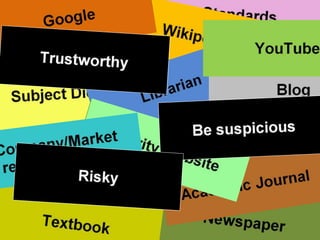
  • #4  Sources game Magazine (A regular publication aimed at a profession, business or interest....trade/popular) Good: Latest news: events, jobs, products etc, concise info, easy to obtain Bad: lacks detail, can be bias, old issues hard to come by Standards (An agreed, often legally binding level of quality or way of doing something....regional, Nat, Internat, profession/sector) Good: Created by experts, confidence Company/market research report (Well researched overview of a company or product market. Could contain future trends, financial data, competitors and SWOT analysis) Good: Up-to-date: latest research/data, Insider information: information not freely available elsewhere, objective, accurate Bad: Hard to locate Webpage Good: All subjects covered, easy to use, mobile Bad: accuracy, no editorial control, anyone can add information, provenance Newspapers Good: Daily information ie. up-to-date, edited, current issues accessible Bad: Sensationalist, biased (unbalanced), harder to get back issues Conference proceedings (Collof aca papers distributed after a conference, cont the contributions made by researchers, academics etc) Good: Up-to-date: latest research, ideas, thinking on a subject, focussed/specialist, stringent quality control Bad: Too specific Journals Good: Up-to-date, Focussed: specialist subject areas, quality Bad: Too specific Books Good: overview, background knowledge, edited/quality Bad: Currency, detailed/specific information
  • #5 More information about the range of resources available on the Library Subject Guide plus useful online guides eg. how to find information for your project.
  • #6 Group discussion: What can you see in the picture…fruit If type ‘fruit’ into database will get millions of hits, how can you break it down ie. search for something more specific to get more manageable results Can you be more specific ie. Type of fruit: apples, oranges, bananas etc Location: Stall, market, outdoor market, fruit market, Britain Detail: boxes, signs, astroturf, prices, colour of fruit, lights, pound £ signs, special offer etc People in background: old, young, male, female > stall holder, customers, browsers etc Think of related subjects eg. retail, commercial, financial, point-of-sale Shopping, shops, fish/meat/clothes market, shopping centres, high street Town, city, centre, British town Nutrition: vits and mins Also: Orange or Blackberry: fruit NOT telephone Apple: fruit NOT computer Thinking beyond the obvious, looking for the detail that might make a difference.
  • #7 Hand out worksheet. 5 mins. Feedback.
  • #8 Need to carry out a literature review: Finding the information available on a subject Finding information to inform, underpin and shape your research Finding what has already been written on a subject Analyzing, evaluating and making judgements about the info found Identifying the main trends Finding appropriate information: the information needs to be suitable for your need ie. right level, current if important, sufficient breadth or detail etc Explain to students what Summon is. Go to UniHub > Login in to MyUniHub > My Study > My Library > Summon Ask students to search for information for their project. Remember to use some of the keywords that we have discussed.
  • #9 Show the students how to refine their search using: FT Content type Subject terms Publication date Language etc Have another go.
  • #11 Students can also search individual databases. Select ‘Computing science’ for a list of subject specific resources.
  • #12 CS £1397 IEEE Xplore £61,000 Summon £16k Access to quality academic information eg. Peer reviewed journal articles, conference proceedings , research etc Information not available elsewhere Up-to-date Focussed/specific....not designed to sell you things, search results not sponsored Full-text access Access on/off campus Personalize eg. In MyEBSCO, once signerd up you can: Save preferences Organise research within folders Share folders Save search history Create email alerts/Rss feeds for searches and subjects Can provide citation and journal impact info > more info on next slide
  • #13  Which articles have cited an earlier article ie. Way of looking forward in the literature-if have found excellent article, can use a citation index to see which articles have subsequently cited it Find articles on similar/related subjects: Citation implies subject relationship, so can find papers on a similar topic without using any keywords or subject terms Find out how many times a paper has been cited ie. gauge the usefulness/quality. esteem of a paper Determine which are the best journals in your field: citation data used to rank journals within particular subject areas…..useful way of seeing how journals perform in relation to others in the same subject area
  • #14 Citation data and journal citation reports available from Web of Knowledge
  • #15 Lots of useful online guides eg. How to find books How to find information for your project Accessing journal databases etc
  • #16 Zetoc BL current awareness service - provides access to the British Library's Electronic Table of Contents of around 20.000 current journals and around 16,000 conference proceedings published every year The database covers from 1993 to the present, and is updated on a daily basis. It includes current awareness services, so that subscribers can receive notification of relevant new material either from particular journals, authors or on particular subjects (keywords) CituLike Headline articles from recent publications Some journals publish an electronic table of contents for the most recent issue Browse all the recent articles in these journals just as if they were on your bookshelf Currently 13507 journals online TicToc Search for 1000s of journal table of contents (TOCs) RSSfeeds by title, subject or publisher, export citations or link to full text, and then save TOCs in your ticTOCs account Also things like Google Alerts and Google Blog Search
  • #17 Inter Library Loan service: request copies of books and journals not held by MDX. £3 charge. Register as DL first. More info on our website. SCONUL Access http://www.access.sconul.ac.uk/ The SCONUL Access Scheme provides reciprocal access and borrowing rights for staff and students to approximately 170 member institutions in the UK. Apply online. Other libraries (specialist, catalogues etc): British Library http://www.bl.uk/ COPAC http://copac.ac.uk/ COPAC is a union catalogue that gives access to the merged online catalogues of members of the Consortium of University Research Libraries (CURL). Twenty  major university libraries currently contribute to COPAC. Search25 http://www.search25.ac.uk/: helps you discover library resources across London and the South East. You can also see where the libraries are and find out how to visit them. SUNCAT http://www.suncat.ac.uk/ SUNCAT, a union catalogue of serials (periodicals) for the UK, is a tool for locating serials held in UK libraries.
  • #18 How do you decide if the information is any good? Especially important with the Internet. What do you think about this quote?
  • #19 Paul Bernal’s blog ‘The right to be forgotten roadshow- and the power of Google’ Blog about Privacy, Human Rights, Law, The Internet, Politics and more. PB is Lecturer in Information Technology, Intellectual Property and Media Law at the University of East Anglia Law School. Wikipedia ‘Right to be forgotten’ Lots of refs. BBC News Technology ‘What is the 'right to be forgotten'?’ Dave Lee author is BBC Technology reporter. Contact details. The Guardian ‘EU to Google: expand 'right to be forgotten' to Google.com’ Contact details for author. Substantial. Facts etc Computer Law & Security Review ‘The ‘Right to be Forgotten-Worth remembering?’ Substantial article, lots of refs, peer reviewed, good source.
  • #20 Take feedback and discuss. Authority : Who is the author? What is their knowledge base/qualifications? How have they carried out their research? Relevance : Is this what I need? Will it answer my question? Is it at the right level? Intent : What is the purpose of information e.g. financial gain, propaganda, academic etc? Objectivity : Balanced view? Opposing views represented? Links to supporting information? Currency: How old is this information? When was it last updated and by whom?
  • #21 Referencing and Plagiarism libguide includes information on how to reference material correctly. Also information about Plato, LDU support and links to helpsheets. Don’t forget: Computing LibGuide bring together all the resources for your subject area.