Hand Trauma Prepared by: Dr. Ahmed Mirza Shammasi  2031040009 Surgical Intern - KFU – Saudi Arabia
Outlines Introduction Mechanisms of Injury Approach to hand trauma patient Structural Injuries: Cutaneous Injuries Tendon Injuries Nerve Injuries Bone Injuries Amputation and Replantation Anatomy Presentation and Management
Introduction The hand is a very vital part of the human body 4 requirements for a functioning hand: Supple (moving with ease) Sensate Account for 5-10 % of hospital ER visits. Great potential for serious handicap Good understanding of hand anatomy and function, good physical examination skills, and knowledge of indications for treatment. Proper Initial diagnosis and timely appropriate treatment would reduce morbidity. Pain free Coordinated
Mechanisms of Injury Blunt trauma Most common type Crush injuries, contusions, abrasions Laceration or puncture Avulsion  with or without soft tissue deficit  Form of amputation where digit is pulled off rather than cut off. Ring avulsion
Approach to Hand Trauma History: General Age Hand dominance Occupation/hobbies History of previous hand problems When and where did this injury take place?  Determine the likelihood of severe injury and probability of contamination with foreign matter. How was the trauma sustained?  This gives clues to the most likely injury.  What was the posture of the hand at the time of the injury?  Structures in the hand slide with movement. The tissue under a bruise or laceration may not be the same tissue that was present when the injury was sustained Past history of treatment or surgery in the hand
Approach to Hand Trauma Physical examination Entire upper limb should be exposed and carefully inspected (Muscle wasting, colour change, Asymmetry, fixed abnormal posture etc.) Extrinsic flexor and extensor muscles and their tendons’ injuries. Intrinsic muscles (Thenar, lumbricals, interossei, and hypothenar muscles). Joints’ pain and stability. Sensory examination. Circulation for colour change, Allen test.
Approach to Hand Trauma Imaging Studies Radiography Plain-films of the hand or wrist should be obtained when a patient presents with a soft tissue injury suggestive of fracture or an occult foreign body. US Has a growing role in locating foreign bodies and in evaluating soft tissues Can detect ruptured tendons and assess dynamic function of tendons non-invasively. MRI Highly sensitive in detecting ruptured tendons.  However, it does not have a role in emergent management of hand wounds.
CUTANEOUS INJURIES Anatomy Presentation Management
Anatomy Dorsum surface Thin and pliable.  Attached to the hand's skeleton only by loose areolar tissue, where lymphatics and veins course. Edema of the hand is manifested predominantly at the dorsum Loose attachment makes it more vulnerable to skin avulsion injuries. Palmar surface Thick and glabrous and not as pliable as the dorsal skin Strongly attached to the underlying fascia by numerous vertical fibers Most firmly anchored to the deep structures at the palmar creases Contains a high concentration of sensory nerve endings essential to the hand's normal function
Presentation Cutaneous injuries are very common injury. Two Types Open:  Incised, laceration, punctured (bites), penetration, abrasion. Closed:  Contusions, Hematomas Vary in depth from superficial to very deep involving underlying structures. Explore for underlying structural Injuries.
Management Skin Laceration: Small:  Rinse and cover. Large: Infiltrate with Lidocaine Irrigate wound profusely with betadine or sterile water Drape and explore (underlying injuries and foreign bodies) Close the skin wound with simple sutures. Wounds older than 6-8 hours should not be closed primarily because of an increased likelihood of infections.  Irrigate, explore then apply sterile dressing. Re-check after 4 days for skin infection. Delayed primary closure at 4 days. Update Tetanus vaccination.
Management Bites: Should not be closed primarily but should be given serial wound checks with delayed closure at 4 days if needed Antibiotic prophylaxis is indicated in human (including fight-bites) and cat bites and may be of benefit in dog bites as well. Contusions: Cold packs with pressure for 30 to 60 min. several times daily for 2 days. Two days after the injury, use warm compresses for 20 minutes at a time. Rest the bruised area and raise it above the level of the heart Do not bandage a bruise.
Management Abrasions: Superficial:  Rinse and cover.  Prophylactic antibiotic ointment Deep: Rinse with antiseptic or warm normal saline. Scrub gently with gauze if necessary. Dress with semi-permeable dressing (Tegaderm, Bioclusive). Changed every few days. Keep wound moist. Enhance healing process.
TENDON INJURIES Anatomy Presentation Management
Anatomy Muscles of the hand are divided into two main groups: Extrinsic group Extrinsic extensors Extrinsic flexors Intrinsic group: Thenar complex lumbricals  Interosseous Hypothenar complex Extensor Function Interphalangeal joints
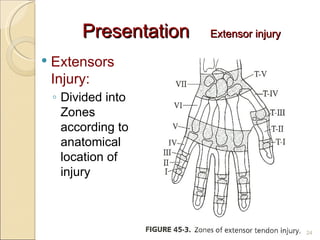
Presentation Extensor injury Extensors Injury: Divided into Zones according to anatomical location of injury
Presentation Extensor injury
Management Zone Presentation Management I Mallet’s Deformity Closed: splinting 6-8 weeks Open: suture repair for fixation. Soft tissue reconstruction III Boutonniere’s Deformity Closed: splinting MCP and PIP in hyperextension for 6 weeks Open: suture repair (figure of 8 suture) V Fixed flexion of MCP Closed: splinting ,45 extension at wrist and 20 flexion  at MCP Open: suture repair. VII Fixed flexion of MCP Suture repair followed by post-op splinting
Presentation Flexor injury Flexors Injury: Divided into Zones according to anatomical location of injury
Presentation Flexor injury Zone Presentation Management I Loss of active flexion at DIP joint Hyperextension of DIP joint Primary or Secondary tendon repair Careful suturing prevent post-op adhesions. II Loss of active flexion at MCP joint Skin closure then secondary repair by tendon grafting Primary repair performed by skilled hand surgeon to minimize post-op adhesions. III, IV Thumb Same Primary or secondary tendon repair Examine carefully for thenar muscle injury and recurrent branches of median nerve.
Presentation Flexor injury Zone Presentation Management V Palm Uncommon Lie deep and protected by palmar fascia Same presentation Superior to Tendon division: repair is unnecessary. Both muscles’ tendon division: primary repair VI, VII Wrist Multiple flexor tendon injury Impaired active flexion of multiple digits Primary tendon suturing further proximal in the forearm to prevent post-op cross-adherence. Injuries to muscles in forearm require primary repair Post-op splinting of wrist in flexion position and elevation  for 4 weeks.
NERVE INJURIES Anatomy Presentation Management
Anatomy
Anatomy
Presentation Mechanisms of injury: Traction:  force is longitudinal to nerve axon Compression:  force is cross-sectional to nerve axon. Laceration:  sharp object injury. Blunt trauma delivers forces that stretch and compress nerves. Nerve my undergo total disruption or avulsion. Less favorable outcome. Sharp laceration can cause complete transection of nerve but it is associated with best prognosis
Presentation Effect of injury:  “Seddon’s Classification” Neuropraxia:  Disruption of Schwann cell sheath but no loss of continuity. Axonotmesis:  Injury to both Schwann sheath and axon. Distal part undergoes Wallerian degeneration. Stimulation of nerve 72 hours after injury does not elicit response. Regeneration occurs with the average rate of 1-2 mm/day.  Regeneration is supported and guided by the surrounding endoneurium.
Presentation Neorutmesis: Injury to all anatomical components, myelin sheath, axons and the surrounding connective tissue. This total nerve disruption makes regeneration impossible. Surgical intervention is necessary. Examine carefully to document any sensory or motor injury and for follow up.
Presentation
Presentation
Management Neurolysis: Removal of any scar or tethering attachments to surroundings that obstruct nerve ability to glide. Neurorrhaphy: End-to-end repair. Resection of the proximal and distal nerve stumps and then approximation. Autologus Nerve grafting: Gold standard for clinical treatment of large lesion gaps. Nerve segments taken from another parts of the body. Provide endoneural tubes to guide regeneration. Two types: Allograft, Xenograft.
BONE INJURIES Anatomy Presentation Management
Presentation Key to diagnosis is careful History and Physical Examination, supported by radiographic studies. History: Handedness Occupation Mechanism of injury Time since injury “golden period” Place of injury Physical Examination: Inspection for open fractures, swelling Deformities (angulation, rotation, shortening) Alignment. Range of motion (active and passive) Neurovascular status Radiographic studies: 3 planes: AP, Lateral and Oblique
Carpal Fractures Scaphoid fractures: Most common carpal fracture Results from force applied on distal end with wrist hyper extended. Common in young adults. Unless treated effectively it would result in mal-union and permanent weakness and pain in the wrist. With subsequent osteoarthritis. If blood supply is confined to distal end, proximal end will undergo avascular necrosis. Deep tenderness in anatomical snuffbox is felt. Treatment: Stable:  Cast for 12 weeks Unstable or non-union:  open reduction and internal fixation.
Carpal Fractures Triquetral fracture: 2 nd  most common carpal fracture Results from direct blow to the dorsum of the hand or extreme dorsiflexion. On clinical examination, palpation of the triquetrum is facilitated by radial deviation of the hand. Point tenderness is usually elicited directly over the triquetrum. Treatment: Chip fracture:  symptomatic with 2-3 weeks immobilization. ROM exercise once symptoms decrease. Body fracture:  Minimally displaced: cast immobilization for 4-6 weeks + ROM exercise Displaced: Closed reduction and pinning or Open reduction and fixation
Metacarpal Fractures Relatively common. 30-40% of hand fractures Result from direct or indirect trauma. Direct trauma commonly results in transverse fracture, usually midshaft. Most fractures are easily reducible, stable and managed non-operatively. Immobilization or controlled mobilization. Indications of surgical intervention: Intra-articular fractures,  Displaced and angulated fractures,  Unstable fracture patterns,  Combined or open injuries,  Irreducible and unstable dislocations
Thumb Fractures Bennett’s fracture: Fracture at the base of the 1 st  Metacarpal. Intra-articular fracture subluxation: unstable arthritic joint with secondary loss of motion and pain. Swelling and pain at the thumb base Closed reduction and immobilization with thumb spica splint Open reduction and internal fixation. Rolando’s fracture: Comminuted (displaced) thumb base fracture. Improper healing would lead to restriction of motion around Carpometacarpal joint. Swollen, tender thumb base. If significant varus has developed, a clinically visible deformity may be present. Swelling can mask a surprising amount of angulation. Open reduction and internal fixation.
Bennett’s Rolando’s
Phalangeal Fractures Distal Phalanx: Extra-articular fractures are common, associated with significant soft tissue injury. Crush injuries from a perpendicular force (injuries from a car door or hammer) Intra-articular fractures are associated with extensor tendon avulsion (Mallet’s finger), flexor profundus tendon avulsion (Jersey finger). Examination:  Inspection: attitude of the injured finger, and localization of any swelling. Neurovascular status should be examined as well as color, capillary refill, and digital temperature. Palpation is done for tenderness. Closed treatment is recommended with splinting and if necessary closed reduction
Phalangeal Fractures Middle Phalanx: Blunt or crush force perpendicular to the long axis of the bone. Angulation and rotation are two features of instability that must be examined. Rotational deformities are serious injuries and are detected clinically. Examination: Inspection: for dislocations and sublaxations. Ask patient to fully flex the phalanx to examine alignment of digits. Palpation: swelling and tenderness Treatment: Nondisplaced without impaction: require only dynamic splinting for 2-3 weeks. Angulation and rotation require closed reduction and splinting to restore finger alignment.
Phalangeal Fractures Proximal Phalanx: More common than middle phalanx fractures. May result in a great deal of disability. Direct perpendicular force, a rotary force, or hyperextension of the finger. Dorsal or palmar angulation may occur with these fractures. Examination: Inspection: attitude of the injured finger, and localization of any swelling. Neurovascular status (color, capillary refill, and digital temperature). Palpation is done for tenderness. Treatment: Nondisplaced fractures: usually stable and treated by closed reduction and dynamic splinting. Angulation or unstable fractures may require internal or external fixation.
AMPUTATION AND REPLANTATION
Introduction Replantation:  reattachment of a severed digit of extremity. Not all patients with amputation are candidates for replantation Decision is based on: Importance of the part, level of injury, mechanism of injury and expected return of function. Because hand function is severely compromised if the thumb or multiple fingers are not present to oppose each other, thumb and multiple-finger replants should be attempted. Mechanism of injury may be the most predictive variable for successful replantation.
Introduction Recommended ischemia times for reliable success: Digit: 12 hours for warm ischemia and 24 hours for cold ischemia. Major replant: 6 hours of warm and 12 hours of cold ischemia. Preoperative preparation: radiography of both amputated and stump parts to determine the level of injury and suitability for replantation
Outcome Overall success rates for replantation approach 80%. Better outcome with Guillotine (sharp) amputation (77%) compared to severely crushed and mangled body parts(49%). Studies have demonstrated that patients can expect to achieve 50% function and 50% sensation of the replanted part.
References Plastic Surgery, Goldwyn and Cohen, 3 rd  edition. Plastic Surgery, Grabb and Smith, 3 rd  edition. Clinical Anatomy, Richard Snell, 6 th  edition. Macleod’s Clinical Examination, 11 th  edition. www.emedicine.com

Hand Trauma

  • 1.
    Hand Trauma Preparedby: Dr. Ahmed Mirza Shammasi 2031040009 Surgical Intern - KFU – Saudi Arabia
  • 2.
    Outlines Introduction Mechanismsof Injury Approach to hand trauma patient Structural Injuries: Cutaneous Injuries Tendon Injuries Nerve Injuries Bone Injuries Amputation and Replantation Anatomy Presentation and Management
  • 3.
    Introduction The handis a very vital part of the human body 4 requirements for a functioning hand: Supple (moving with ease) Sensate Account for 5-10 % of hospital ER visits. Great potential for serious handicap Good understanding of hand anatomy and function, good physical examination skills, and knowledge of indications for treatment. Proper Initial diagnosis and timely appropriate treatment would reduce morbidity. Pain free Coordinated
  • 4.
    Mechanisms of InjuryBlunt trauma Most common type Crush injuries, contusions, abrasions Laceration or puncture Avulsion with or without soft tissue deficit Form of amputation where digit is pulled off rather than cut off. Ring avulsion
  • 5.
    Approach to HandTrauma History: General Age Hand dominance Occupation/hobbies History of previous hand problems When and where did this injury take place? Determine the likelihood of severe injury and probability of contamination with foreign matter. How was the trauma sustained? This gives clues to the most likely injury. What was the posture of the hand at the time of the injury? Structures in the hand slide with movement. The tissue under a bruise or laceration may not be the same tissue that was present when the injury was sustained Past history of treatment or surgery in the hand
  • 6.
    Approach to HandTrauma Physical examination Entire upper limb should be exposed and carefully inspected (Muscle wasting, colour change, Asymmetry, fixed abnormal posture etc.) Extrinsic flexor and extensor muscles and their tendons’ injuries. Intrinsic muscles (Thenar, lumbricals, interossei, and hypothenar muscles). Joints’ pain and stability. Sensory examination. Circulation for colour change, Allen test.
  • 7.
    Approach to HandTrauma Imaging Studies Radiography Plain-films of the hand or wrist should be obtained when a patient presents with a soft tissue injury suggestive of fracture or an occult foreign body. US Has a growing role in locating foreign bodies and in evaluating soft tissues Can detect ruptured tendons and assess dynamic function of tendons non-invasively. MRI Highly sensitive in detecting ruptured tendons. However, it does not have a role in emergent management of hand wounds.
  • 10.
    CUTANEOUS INJURIES AnatomyPresentation Management
  • 11.
    Anatomy Dorsum surfaceThin and pliable. Attached to the hand's skeleton only by loose areolar tissue, where lymphatics and veins course. Edema of the hand is manifested predominantly at the dorsum Loose attachment makes it more vulnerable to skin avulsion injuries. Palmar surface Thick and glabrous and not as pliable as the dorsal skin Strongly attached to the underlying fascia by numerous vertical fibers Most firmly anchored to the deep structures at the palmar creases Contains a high concentration of sensory nerve endings essential to the hand's normal function
  • 12.
    Presentation Cutaneous injuriesare very common injury. Two Types Open: Incised, laceration, punctured (bites), penetration, abrasion. Closed: Contusions, Hematomas Vary in depth from superficial to very deep involving underlying structures. Explore for underlying structural Injuries.
  • 14.
    Management Skin Laceration:Small: Rinse and cover. Large: Infiltrate with Lidocaine Irrigate wound profusely with betadine or sterile water Drape and explore (underlying injuries and foreign bodies) Close the skin wound with simple sutures. Wounds older than 6-8 hours should not be closed primarily because of an increased likelihood of infections. Irrigate, explore then apply sterile dressing. Re-check after 4 days for skin infection. Delayed primary closure at 4 days. Update Tetanus vaccination.
  • 15.
    Management Bites: Shouldnot be closed primarily but should be given serial wound checks with delayed closure at 4 days if needed Antibiotic prophylaxis is indicated in human (including fight-bites) and cat bites and may be of benefit in dog bites as well. Contusions: Cold packs with pressure for 30 to 60 min. several times daily for 2 days. Two days after the injury, use warm compresses for 20 minutes at a time. Rest the bruised area and raise it above the level of the heart Do not bandage a bruise.
  • 16.
    Management Abrasions: Superficial: Rinse and cover. Prophylactic antibiotic ointment Deep: Rinse with antiseptic or warm normal saline. Scrub gently with gauze if necessary. Dress with semi-permeable dressing (Tegaderm, Bioclusive). Changed every few days. Keep wound moist. Enhance healing process.
  • 17.
    TENDON INJURIES AnatomyPresentation Management
  • 18.
    Anatomy Muscles ofthe hand are divided into two main groups: Extrinsic group Extrinsic extensors Extrinsic flexors Intrinsic group: Thenar complex lumbricals Interosseous Hypothenar complex Extensor Function Interphalangeal joints
  • 24.
    Presentation Extensor injuryExtensors Injury: Divided into Zones according to anatomical location of injury
  • 25.
  • 27.
    Management Zone PresentationManagement I Mallet’s Deformity Closed: splinting 6-8 weeks Open: suture repair for fixation. Soft tissue reconstruction III Boutonniere’s Deformity Closed: splinting MCP and PIP in hyperextension for 6 weeks Open: suture repair (figure of 8 suture) V Fixed flexion of MCP Closed: splinting ,45 extension at wrist and 20 flexion at MCP Open: suture repair. VII Fixed flexion of MCP Suture repair followed by post-op splinting
  • 29.
    Presentation Flexor injuryFlexors Injury: Divided into Zones according to anatomical location of injury
  • 32.
    Presentation Flexor injuryZone Presentation Management I Loss of active flexion at DIP joint Hyperextension of DIP joint Primary or Secondary tendon repair Careful suturing prevent post-op adhesions. II Loss of active flexion at MCP joint Skin closure then secondary repair by tendon grafting Primary repair performed by skilled hand surgeon to minimize post-op adhesions. III, IV Thumb Same Primary or secondary tendon repair Examine carefully for thenar muscle injury and recurrent branches of median nerve.
  • 33.
    Presentation Flexor injuryZone Presentation Management V Palm Uncommon Lie deep and protected by palmar fascia Same presentation Superior to Tendon division: repair is unnecessary. Both muscles’ tendon division: primary repair VI, VII Wrist Multiple flexor tendon injury Impaired active flexion of multiple digits Primary tendon suturing further proximal in the forearm to prevent post-op cross-adherence. Injuries to muscles in forearm require primary repair Post-op splinting of wrist in flexion position and elevation for 4 weeks.
  • 35.
    NERVE INJURIES AnatomyPresentation Management
  • 36.
  • 37.
  • 38.
    Presentation Mechanisms ofinjury: Traction: force is longitudinal to nerve axon Compression: force is cross-sectional to nerve axon. Laceration: sharp object injury. Blunt trauma delivers forces that stretch and compress nerves. Nerve my undergo total disruption or avulsion. Less favorable outcome. Sharp laceration can cause complete transection of nerve but it is associated with best prognosis
  • 39.
    Presentation Effect ofinjury: “Seddon’s Classification” Neuropraxia: Disruption of Schwann cell sheath but no loss of continuity. Axonotmesis: Injury to both Schwann sheath and axon. Distal part undergoes Wallerian degeneration. Stimulation of nerve 72 hours after injury does not elicit response. Regeneration occurs with the average rate of 1-2 mm/day. Regeneration is supported and guided by the surrounding endoneurium.
  • 40.
    Presentation Neorutmesis: Injuryto all anatomical components, myelin sheath, axons and the surrounding connective tissue. This total nerve disruption makes regeneration impossible. Surgical intervention is necessary. Examine carefully to document any sensory or motor injury and for follow up.
  • 41.
  • 42.
  • 43.
    Management Neurolysis: Removalof any scar or tethering attachments to surroundings that obstruct nerve ability to glide. Neurorrhaphy: End-to-end repair. Resection of the proximal and distal nerve stumps and then approximation. Autologus Nerve grafting: Gold standard for clinical treatment of large lesion gaps. Nerve segments taken from another parts of the body. Provide endoneural tubes to guide regeneration. Two types: Allograft, Xenograft.
  • 45.
    BONE INJURIES AnatomyPresentation Management
  • 47.
    Presentation Key todiagnosis is careful History and Physical Examination, supported by radiographic studies. History: Handedness Occupation Mechanism of injury Time since injury “golden period” Place of injury Physical Examination: Inspection for open fractures, swelling Deformities (angulation, rotation, shortening) Alignment. Range of motion (active and passive) Neurovascular status Radiographic studies: 3 planes: AP, Lateral and Oblique
  • 48.
    Carpal Fractures Scaphoidfractures: Most common carpal fracture Results from force applied on distal end with wrist hyper extended. Common in young adults. Unless treated effectively it would result in mal-union and permanent weakness and pain in the wrist. With subsequent osteoarthritis. If blood supply is confined to distal end, proximal end will undergo avascular necrosis. Deep tenderness in anatomical snuffbox is felt. Treatment: Stable: Cast for 12 weeks Unstable or non-union: open reduction and internal fixation.
  • 50.
    Carpal Fractures Triquetralfracture: 2 nd most common carpal fracture Results from direct blow to the dorsum of the hand or extreme dorsiflexion. On clinical examination, palpation of the triquetrum is facilitated by radial deviation of the hand. Point tenderness is usually elicited directly over the triquetrum. Treatment: Chip fracture: symptomatic with 2-3 weeks immobilization. ROM exercise once symptoms decrease. Body fracture: Minimally displaced: cast immobilization for 4-6 weeks + ROM exercise Displaced: Closed reduction and pinning or Open reduction and fixation
  • 52.
    Metacarpal Fractures Relativelycommon. 30-40% of hand fractures Result from direct or indirect trauma. Direct trauma commonly results in transverse fracture, usually midshaft. Most fractures are easily reducible, stable and managed non-operatively. Immobilization or controlled mobilization. Indications of surgical intervention: Intra-articular fractures, Displaced and angulated fractures, Unstable fracture patterns, Combined or open injuries, Irreducible and unstable dislocations
  • 54.
    Thumb Fractures Bennett’sfracture: Fracture at the base of the 1 st Metacarpal. Intra-articular fracture subluxation: unstable arthritic joint with secondary loss of motion and pain. Swelling and pain at the thumb base Closed reduction and immobilization with thumb spica splint Open reduction and internal fixation. Rolando’s fracture: Comminuted (displaced) thumb base fracture. Improper healing would lead to restriction of motion around Carpometacarpal joint. Swollen, tender thumb base. If significant varus has developed, a clinically visible deformity may be present. Swelling can mask a surprising amount of angulation. Open reduction and internal fixation.
  • 55.
  • 57.
    Phalangeal Fractures DistalPhalanx: Extra-articular fractures are common, associated with significant soft tissue injury. Crush injuries from a perpendicular force (injuries from a car door or hammer) Intra-articular fractures are associated with extensor tendon avulsion (Mallet’s finger), flexor profundus tendon avulsion (Jersey finger). Examination: Inspection: attitude of the injured finger, and localization of any swelling. Neurovascular status should be examined as well as color, capillary refill, and digital temperature. Palpation is done for tenderness. Closed treatment is recommended with splinting and if necessary closed reduction
  • 58.
    Phalangeal Fractures MiddlePhalanx: Blunt or crush force perpendicular to the long axis of the bone. Angulation and rotation are two features of instability that must be examined. Rotational deformities are serious injuries and are detected clinically. Examination: Inspection: for dislocations and sublaxations. Ask patient to fully flex the phalanx to examine alignment of digits. Palpation: swelling and tenderness Treatment: Nondisplaced without impaction: require only dynamic splinting for 2-3 weeks. Angulation and rotation require closed reduction and splinting to restore finger alignment.
  • 59.
    Phalangeal Fractures ProximalPhalanx: More common than middle phalanx fractures. May result in a great deal of disability. Direct perpendicular force, a rotary force, or hyperextension of the finger. Dorsal or palmar angulation may occur with these fractures. Examination: Inspection: attitude of the injured finger, and localization of any swelling. Neurovascular status (color, capillary refill, and digital temperature). Palpation is done for tenderness. Treatment: Nondisplaced fractures: usually stable and treated by closed reduction and dynamic splinting. Angulation or unstable fractures may require internal or external fixation.
  • 61.
  • 62.
    Introduction Replantation: reattachment of a severed digit of extremity. Not all patients with amputation are candidates for replantation Decision is based on: Importance of the part, level of injury, mechanism of injury and expected return of function. Because hand function is severely compromised if the thumb or multiple fingers are not present to oppose each other, thumb and multiple-finger replants should be attempted. Mechanism of injury may be the most predictive variable for successful replantation.
  • 63.
    Introduction Recommended ischemiatimes for reliable success: Digit: 12 hours for warm ischemia and 24 hours for cold ischemia. Major replant: 6 hours of warm and 12 hours of cold ischemia. Preoperative preparation: radiography of both amputated and stump parts to determine the level of injury and suitability for replantation
  • 65.
    Outcome Overall successrates for replantation approach 80%. Better outcome with Guillotine (sharp) amputation (77%) compared to severely crushed and mangled body parts(49%). Studies have demonstrated that patients can expect to achieve 50% function and 50% sensation of the replanted part.
  • 67.
    References Plastic Surgery,Goldwyn and Cohen, 3 rd edition. Plastic Surgery, Grabb and Smith, 3 rd edition. Clinical Anatomy, Richard Snell, 6 th edition. Macleod’s Clinical Examination, 11 th edition. www.emedicine.com