Prepared By:
Dr. Nirmaljit Kaur
Associate Professor
Khalsa College of Education
Amritsar
Assisted By:
Manpreet kaur Randhawa
Assistant Professor
Khalsa College of Education
Amritsar
 Preparation
 Presentation
 Contemplation
 Practice/Creating a situation/application
Dr Nirmaljit kaur, Associate Prof. Khalsa College of Education,
Amritsar
 Preparation: This step is concerned with the task of preparing
the students for receiving new value/idea. It is just like
preparing the ground before sowing the seed in it. The
students, by suitable means must be made to receive the new
value/idea.
It involves two parts:
P K Testing/
Creating a situation
Announcement of
the Aim/Topic
Dr Nirmaljit kaur, Associate Prof. Khalsa College of Education,
Amritsar
 Presentation: At this stage the subject matter highlighting the value
is put forth by using the appropriate method/technique of teaching.
To sustain the interest of the students in the lesson, the subject
matter needs to be divided into sub parts and arranged logically/
psychologically.
 Contemplation: After completion of the lesson sensitizing the
students about the value intended to be imbibed by them , the
students should be given some time to discuss/ deliberate/ponder
over the newly received value, individually or in groups .It will help
them to understand the worth of the value.
 Practice/Creating a situation/application: It is in fact a step for
the fixing up or consolidation of the value/idea acquired in the
lesson. Here what is learnt or generalized is applied to particular
situations or facts for its further verification and provision of
review, practice or application in the likewise situations.
Dr Nirmaljit kaur, Associate Prof. Khalsa College of Education, Amritsar
Subject: Social Studies Class: X
Topic: Life in Equatorial Regions Duration :40 mins
Value to be Inculcated: Empathy
 General objectives:
• To develop sense of space among the students.
• To develop the feeling of universal brotherhood among the students.
• To develop logical thinking among the students.
 Specific objectives:
 Cognitive:
To enable the students to have knowledge about the climatic conditions, vegetation and
life of people in Equatorial Regions.
 Conative:
• To enable the students to prepare map showing Equatorial Regions.
• To prepare scrap book showing the life of inhabitants of Equatorial Regions.
 Affective:
To develop feeling of Empathy among the students for the people living in hostile
conditions.
 Illustrative aids- Map, Chart, Power Point presentation.
Dr Nirmaljit kaur, Associate Prof. Khalsa College of Education, Amritsar
 PREPARATION
 Creation of the Situation : The Teacher will show the slides of Pygmies(
a tribe living in Central Africa) and ask the students the following
questions:
Ques.1How do the people shown in the slides look different from us?
Exp. Ans. They are short statured with dark complexion.
Ques.2 What type of life do they seem to lead?
Exp. Ans. They seem to lead a Primitive style of life.
Ques.3 What hardships do you think they have to face leading a primitive
style of life?(Problem Question)
 Announcement of the Aim : Well, students they have to face a lot of
hardships because they are the inhabitants of Equatorial Regions .Today
we are going to discuss about the “Life of the people living in the
Equatorial Regions.”
Dr Nirmaljit kaur, Associate Prof. Khalsa College of Education,
Amritsar
Teaching
points
Developing
questions/Activity
Teacher’s statement BB Work
 Location What is the Latitudinal
extent of Equator?
The Map of
Equatorial Regions
will be shown.
Equator is located at 0° and on both
sides of Equator up to 5° N and 5° S,
the areas located are called as
Equatorial Regions. These regions
include The Amazon Basin (South
America), The Congo Basin(Central
Africa), Malaysia, Indonesia(South
East Asia) etc.
0°-5° N
0°-5° S
The Amazon
Basin (South
America), The
Congo Basin
(Central Africa),
Malaysia,
Indonesia(South
- East Asia) etc.
 PRESENTATION
The lesson will be developed on the basis of the previous knowledge of the students by
adopting multi-disciplinary approach and the concepts will be explained with the help of a
PowerPoint Presentation.
Dr Nirmaljit kaur, Associate Prof. Khalsa College of Education, Amritsar
Teaching
points
Developing
questions/Activity
Teacher’s statement BB Work
 Climate 1) How many
seasons do we
have in a year?
 The Teacher will
explain why the
seasons do not
change in the
Equatorial
Regions from
the slide.
We have different seasons i.e.
winter, spring, summer, rainy
and autumn but in Equatorial
regions there is no change in
season through out the year.
The climate is hot and humid.
They are the only areas of the
world where the seasons do not
change.
Hot and Humid
Climate
Dr Nirmaljit kaur, Associate Prof. Khalsa College of Education, Amritsar
Teaching
points
Developing
questions/Activity
Teacher’s statement BB Work
Temperature 2) What is the
position of the
Sun at the
equator
throughout the
year?
 The Teacher will
explain the
reason of high
temperature at
Equator.
The sun shines overhead all the
year around. At the equator, sun
rays fall vertically throughout the
year and as a result temperature
remains very high. Usually
above 28º C. The air is also calm
and there are no prevailing
winds.
High
Temperature
Usually above
28º C
Dr Nirmaljit kaur, Associate Prof. Khalsa College of Education, Amritsar
Teaching
points
Developing
questions/Activity
Teacher’s statement BB Work
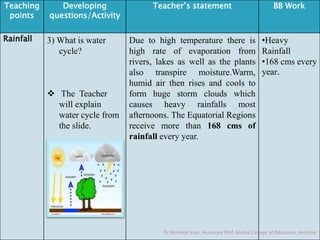
Rainfall 3) What is water
cycle?
 The Teacher
will explain
water cycle from
the slide.
Due to high temperature there is
high rate of evaporation from
rivers, lakes as well as the plants
also transpire moisture.Warm,
humid air then rises and cools to
form huge storm clouds which
causes heavy rainfalls most
afternoons. The Equatorial Regions
receive more than 168 cms of
rainfall every year.
•Heavy
Rainfall
•168 cms every
year.
Dr Nirmaljit kaur, Associate Prof. Khalsa College of Education, Amritsar
Teaching
points
Developing
questions/Activity
Teacher’s statement BB Work
4) How do you feel
on a day which
is hot and
humid?
We feel miserable. And
imagine , the inhabitants of
these regions have to live in
such hostile climatic
conditions throughout their
life.
Hostile
climatic
conditions.
5) In which season
disease causing
agents are more
active?
The disease causing agents
like viruses, bacteria and
insects are active in the hot
and humid climate. That is
why the inhabitants of this
region have to face large no.
of Health Hazards. It is
reported that every year a
large no. of people die of
diseases like malaria, cholera,
snake bites, Tsetse fly bites
etc.
Health
Hazards.
Dr Nirmaljit kaur, Associate Prof. Khalsa College of Education, Amritsar
Teaching
points
Developing
questions/Activity
Teacher’s statement BB Work
Natural
vegetation
Which type of climate is
more suitable for the
growth of vegetation?
The Teacher will
show the related slides
and explain the features
of Tropical rain forests.
Since the climate is hot and humid
so thick cover of natural
vegetation is found. Hundreds of
types of hard wood trees grow in
equatorial region like Mahagani ,
Rosewood and Ebony. The trees
grow very tall and spread out their
branches to catch more light. The
tops of the trees form a layer up to
7 mts thick canopy which blocks
out sunlight to the forest floor.The
Forest floor becomes very
dark,gloomy and marshy as the
sunlight does not penetrate
through this thick cover of
vegetation . At ground level, there
is mass of rotting vegetation and
fungus. On account of these harsh
conditions the natural resources of
Equatorial Regions are not
properly utilized and that’s why
the inhabitants of these regions are
very poor.
•Thick natural
vegetation
•Hard wood trees
like Mahagani ,
Rosewood and
Ebony.
•Forest floor
becomes very
dark, gloomy and
marshy
Dr Nirmaljit kaur, Associate Prof. Khalsa College of Education,
Amritsar
Teaching points Developing
questions/Activity
Teacher’s statement BB Work
 Inhabitants 1)Who are Tribal people?
 The Teacher will show
the slide of tribal people.
2)What effect does the
excessive exposure to sun
has on our skin?
The tribal people are those who
live in a jungle and lead a
primitive life style. Various
Tribes of people live in the
Equatorial Regions such as The
Pygmies of Central Africa, The
Lumad people of the Southern
Phillipines and The Amazonia
Indians of South America. It is
believed that there are 67
uncontacted tribes in Brazil and
44 on the Island of New Guinea.
Excessive exposure to sun makes
the skin look tanned because the
production of melanin in the skin
increases which makes the skin
look darker. So that is why people
living in equatorial regions are
dark complexioned which
protects them from the harmful
rays of the sun.
The Pygmies of
Central Africa, The
Lumad people of the
Southern Phillipines
and The Amazonia
Indians of South
America
•Increased
production of
Melanin
•Protects them from
harmful rays of the
sun.
Dr Nirmaljit kaur, Associate Prof. Khalsa College of Education, Amritsar
Teaching points Developing
questions/Activity
Teacher’s statement BB Work
 Hardships What hardships we have
to face during the month
of July-August (Rainy
season)?
 Slides showing
hardships faced by the
inhabitants will be
shown by the Teacher.
In Equatorial Regions the
inhabitants are subjected to
most serious handicaps. They
have little energy because the
damp, steady heat never
changes. They suffer terribly
from no. of diseases like
Malaria, Yellow Fever and
other tropical diseases. Along
with the trying conditions of
climate and diseases, they
have to suffer from the host of
rodents, insect pests and other
little irritations. Apart from
this the odors, mists, irritating
sounds of the insects get on
the nerves, the heavy
,drooping ,silent, impenetrable
green forests everywhere
shuts one in like a smothering
grave; the mind grows sick,
and the body follows.
•Serious
handicaps
•Damp, steady
heat never
changes
•Suffer terribly
from no. of
diseases like
Malaria, Yellow
Fever and other
tropical diseases.
Teaching points Developing
questions/Activity
Teacher’s statement BB Work
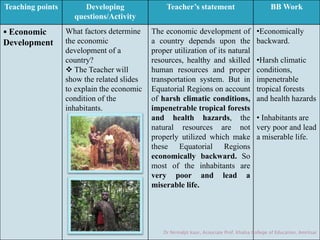
 Economic
Development
What factors determine
the economic
development of a
country?
 The Teacher will
show the related slides
to explain the economic
condition of the
inhabitants.
The economic development of
a country depends upon the
proper utilization of its natural
resources, healthy and skilled
human resources and proper
transportation system. But in
Equatorial Regions on account
of harsh climatic conditions,
impenetrable tropical forests
and health hazards, the
natural resources are not
properly utilized which make
these Equatorial Regions
economically backward. So
most of the inhabitants are
very poor and lead a
miserable life.
•Economically
backward.
•Harsh climatic
conditions,
impenetrable
tropical forests
and health hazards
• Inhabitants are
very poor and lead
a miserable life.
Dr Nirmaljit kaur, Associate Prof. Khalsa College of Education, Amritsar
 CONTEMPLATION
After the completion of the topic the students will be divided
into different groups and will be instructed to discuss the life of
people of Equatorial Regions in their respective groups.
 APPLICATION
 The students will be asked to write, if they were inhabitants of
Equatorial Regions, what kind of hardships they would have
experienced?
 How can we make a difference to the life of people living in the
Equatorial Regions?
 HOMEWORK
The students will be asked to prepare a scrap book showing the
life of people living in Equatorial Regions.
Dr Nirmaljit kaur, Associate Prof. Khalsa College of Education, Amritsar
Dr Nirmaljit kaur, Associate Prof. Khalsa College of Education,
Amritsar

Value based lesson plan

  • 1.
    Prepared By: Dr. NirmaljitKaur Associate Professor Khalsa College of Education Amritsar Assisted By: Manpreet kaur Randhawa Assistant Professor Khalsa College of Education Amritsar
  • 2.
     Preparation  Presentation Contemplation  Practice/Creating a situation/application Dr Nirmaljit kaur, Associate Prof. Khalsa College of Education, Amritsar
  • 3.
     Preparation: Thisstep is concerned with the task of preparing the students for receiving new value/idea. It is just like preparing the ground before sowing the seed in it. The students, by suitable means must be made to receive the new value/idea. It involves two parts: P K Testing/ Creating a situation Announcement of the Aim/Topic Dr Nirmaljit kaur, Associate Prof. Khalsa College of Education, Amritsar
  • 4.
     Presentation: Atthis stage the subject matter highlighting the value is put forth by using the appropriate method/technique of teaching. To sustain the interest of the students in the lesson, the subject matter needs to be divided into sub parts and arranged logically/ psychologically.  Contemplation: After completion of the lesson sensitizing the students about the value intended to be imbibed by them , the students should be given some time to discuss/ deliberate/ponder over the newly received value, individually or in groups .It will help them to understand the worth of the value.  Practice/Creating a situation/application: It is in fact a step for the fixing up or consolidation of the value/idea acquired in the lesson. Here what is learnt or generalized is applied to particular situations or facts for its further verification and provision of review, practice or application in the likewise situations. Dr Nirmaljit kaur, Associate Prof. Khalsa College of Education, Amritsar
  • 5.
    Subject: Social StudiesClass: X Topic: Life in Equatorial Regions Duration :40 mins Value to be Inculcated: Empathy  General objectives: • To develop sense of space among the students. • To develop the feeling of universal brotherhood among the students. • To develop logical thinking among the students.  Specific objectives:  Cognitive: To enable the students to have knowledge about the climatic conditions, vegetation and life of people in Equatorial Regions.  Conative: • To enable the students to prepare map showing Equatorial Regions. • To prepare scrap book showing the life of inhabitants of Equatorial Regions.  Affective: To develop feeling of Empathy among the students for the people living in hostile conditions.  Illustrative aids- Map, Chart, Power Point presentation. Dr Nirmaljit kaur, Associate Prof. Khalsa College of Education, Amritsar
  • 6.
     PREPARATION  Creationof the Situation : The Teacher will show the slides of Pygmies( a tribe living in Central Africa) and ask the students the following questions: Ques.1How do the people shown in the slides look different from us? Exp. Ans. They are short statured with dark complexion. Ques.2 What type of life do they seem to lead? Exp. Ans. They seem to lead a Primitive style of life. Ques.3 What hardships do you think they have to face leading a primitive style of life?(Problem Question)  Announcement of the Aim : Well, students they have to face a lot of hardships because they are the inhabitants of Equatorial Regions .Today we are going to discuss about the “Life of the people living in the Equatorial Regions.” Dr Nirmaljit kaur, Associate Prof. Khalsa College of Education, Amritsar
  • 7.
    Teaching points Developing questions/Activity Teacher’s statement BBWork  Location What is the Latitudinal extent of Equator? The Map of Equatorial Regions will be shown. Equator is located at 0° and on both sides of Equator up to 5° N and 5° S, the areas located are called as Equatorial Regions. These regions include The Amazon Basin (South America), The Congo Basin(Central Africa), Malaysia, Indonesia(South East Asia) etc. 0°-5° N 0°-5° S The Amazon Basin (South America), The Congo Basin (Central Africa), Malaysia, Indonesia(South - East Asia) etc.  PRESENTATION The lesson will be developed on the basis of the previous knowledge of the students by adopting multi-disciplinary approach and the concepts will be explained with the help of a PowerPoint Presentation. Dr Nirmaljit kaur, Associate Prof. Khalsa College of Education, Amritsar
  • 8.
    Teaching points Developing questions/Activity Teacher’s statement BBWork  Climate 1) How many seasons do we have in a year?  The Teacher will explain why the seasons do not change in the Equatorial Regions from the slide. We have different seasons i.e. winter, spring, summer, rainy and autumn but in Equatorial regions there is no change in season through out the year. The climate is hot and humid. They are the only areas of the world where the seasons do not change. Hot and Humid Climate Dr Nirmaljit kaur, Associate Prof. Khalsa College of Education, Amritsar
  • 9.
    Teaching points Developing questions/Activity Teacher’s statement BBWork Temperature 2) What is the position of the Sun at the equator throughout the year?  The Teacher will explain the reason of high temperature at Equator. The sun shines overhead all the year around. At the equator, sun rays fall vertically throughout the year and as a result temperature remains very high. Usually above 28º C. The air is also calm and there are no prevailing winds. High Temperature Usually above 28º C Dr Nirmaljit kaur, Associate Prof. Khalsa College of Education, Amritsar
  • 10.
    Teaching points Developing questions/Activity Teacher’s statement BBWork Rainfall 3) What is water cycle?  The Teacher will explain water cycle from the slide. Due to high temperature there is high rate of evaporation from rivers, lakes as well as the plants also transpire moisture.Warm, humid air then rises and cools to form huge storm clouds which causes heavy rainfalls most afternoons. The Equatorial Regions receive more than 168 cms of rainfall every year. •Heavy Rainfall •168 cms every year. Dr Nirmaljit kaur, Associate Prof. Khalsa College of Education, Amritsar
  • 11.
    Teaching points Developing questions/Activity Teacher’s statement BBWork 4) How do you feel on a day which is hot and humid? We feel miserable. And imagine , the inhabitants of these regions have to live in such hostile climatic conditions throughout their life. Hostile climatic conditions. 5) In which season disease causing agents are more active? The disease causing agents like viruses, bacteria and insects are active in the hot and humid climate. That is why the inhabitants of this region have to face large no. of Health Hazards. It is reported that every year a large no. of people die of diseases like malaria, cholera, snake bites, Tsetse fly bites etc. Health Hazards. Dr Nirmaljit kaur, Associate Prof. Khalsa College of Education, Amritsar
  • 12.
    Teaching points Developing questions/Activity Teacher’s statement BBWork Natural vegetation Which type of climate is more suitable for the growth of vegetation? The Teacher will show the related slides and explain the features of Tropical rain forests. Since the climate is hot and humid so thick cover of natural vegetation is found. Hundreds of types of hard wood trees grow in equatorial region like Mahagani , Rosewood and Ebony. The trees grow very tall and spread out their branches to catch more light. The tops of the trees form a layer up to 7 mts thick canopy which blocks out sunlight to the forest floor.The Forest floor becomes very dark,gloomy and marshy as the sunlight does not penetrate through this thick cover of vegetation . At ground level, there is mass of rotting vegetation and fungus. On account of these harsh conditions the natural resources of Equatorial Regions are not properly utilized and that’s why the inhabitants of these regions are very poor. •Thick natural vegetation •Hard wood trees like Mahagani , Rosewood and Ebony. •Forest floor becomes very dark, gloomy and marshy Dr Nirmaljit kaur, Associate Prof. Khalsa College of Education, Amritsar
  • 13.
    Teaching points Developing questions/Activity Teacher’sstatement BB Work  Inhabitants 1)Who are Tribal people?  The Teacher will show the slide of tribal people. 2)What effect does the excessive exposure to sun has on our skin? The tribal people are those who live in a jungle and lead a primitive life style. Various Tribes of people live in the Equatorial Regions such as The Pygmies of Central Africa, The Lumad people of the Southern Phillipines and The Amazonia Indians of South America. It is believed that there are 67 uncontacted tribes in Brazil and 44 on the Island of New Guinea. Excessive exposure to sun makes the skin look tanned because the production of melanin in the skin increases which makes the skin look darker. So that is why people living in equatorial regions are dark complexioned which protects them from the harmful rays of the sun. The Pygmies of Central Africa, The Lumad people of the Southern Phillipines and The Amazonia Indians of South America •Increased production of Melanin •Protects them from harmful rays of the sun. Dr Nirmaljit kaur, Associate Prof. Khalsa College of Education, Amritsar
  • 14.
    Teaching points Developing questions/Activity Teacher’sstatement BB Work  Hardships What hardships we have to face during the month of July-August (Rainy season)?  Slides showing hardships faced by the inhabitants will be shown by the Teacher. In Equatorial Regions the inhabitants are subjected to most serious handicaps. They have little energy because the damp, steady heat never changes. They suffer terribly from no. of diseases like Malaria, Yellow Fever and other tropical diseases. Along with the trying conditions of climate and diseases, they have to suffer from the host of rodents, insect pests and other little irritations. Apart from this the odors, mists, irritating sounds of the insects get on the nerves, the heavy ,drooping ,silent, impenetrable green forests everywhere shuts one in like a smothering grave; the mind grows sick, and the body follows. •Serious handicaps •Damp, steady heat never changes •Suffer terribly from no. of diseases like Malaria, Yellow Fever and other tropical diseases.
  • 15.
    Teaching points Developing questions/Activity Teacher’sstatement BB Work  Economic Development What factors determine the economic development of a country?  The Teacher will show the related slides to explain the economic condition of the inhabitants. The economic development of a country depends upon the proper utilization of its natural resources, healthy and skilled human resources and proper transportation system. But in Equatorial Regions on account of harsh climatic conditions, impenetrable tropical forests and health hazards, the natural resources are not properly utilized which make these Equatorial Regions economically backward. So most of the inhabitants are very poor and lead a miserable life. •Economically backward. •Harsh climatic conditions, impenetrable tropical forests and health hazards • Inhabitants are very poor and lead a miserable life. Dr Nirmaljit kaur, Associate Prof. Khalsa College of Education, Amritsar
  • 16.
     CONTEMPLATION After thecompletion of the topic the students will be divided into different groups and will be instructed to discuss the life of people of Equatorial Regions in their respective groups.  APPLICATION  The students will be asked to write, if they were inhabitants of Equatorial Regions, what kind of hardships they would have experienced?  How can we make a difference to the life of people living in the Equatorial Regions?  HOMEWORK The students will be asked to prepare a scrap book showing the life of people living in Equatorial Regions. Dr Nirmaljit kaur, Associate Prof. Khalsa College of Education, Amritsar
  • 17.
    Dr Nirmaljit kaur,Associate Prof. Khalsa College of Education, Amritsar