DENTAL 
AMALGM 
& 
COMPOSIT. 
ABCD’S&G.
DENTAL AMALGM & COMPOSITE 
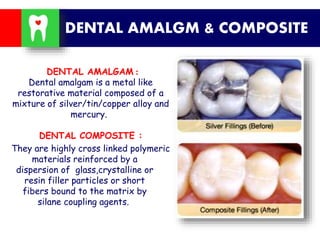
DENTAL AMALGAM : 
Dental amalgam is a metal like 
restorative material composed of a 
mixture of silver/tin/copper alloy and 
mercury. 
DENTAL COMPOSITE : 
They are highly cross linked polymeric 
materials reinforced by a 
dispersion of glass,crystalline or 
resin filler particles or short 
fibers bound to the matrix by 
silane coupling agents.
COMPOSITION OF AMALGM & COMPOSITE 
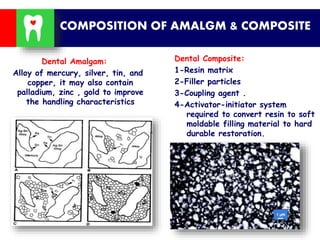
Dental Amalgam: 
Alloy of mercury, silver, tin, and 
copper, it may also contain 
palladium, zinc , gold to improve 
the handling characteristics 
Dental Composite: 
1-Resin matrix 
2-Filler particles 
3-Coupling agent . 
4-Activator-initiator system 
required to convert resin to soft 
moldable filling material to hard 
durable restoration.
CALSSIFACTION OF AMALGM & COMPOSITE 
Based on copper content : 
1-Low copper alloy -- < 6% copper (conventional alloy) . 
2- High copper -- 6-30% copper 
(1) admixed alloy (2) single composition alloy 
Based on zinc content : 
(1) zinc containing alloy -- > 0.01% zinc 
(2) zinc free alloy -- < 0.01 zinc. 
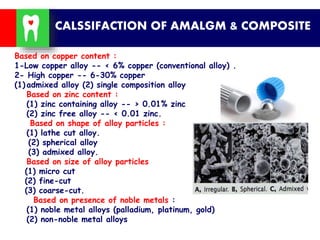
Based on shape of alloy particles : 
(1) lathe cut alloy. 
(2) spherical alloy 
(3) admixed alloy. 
Based on size of alloy particles 
(1) micro cut 
(2) fine-cut 
(3) coarse-cut. 
Based on presence of noble metals : 
(1) noble metal alloys (palladium, platinum, gold) 
(2) non-noble metal alloys
COMPOSITION OF AMALGM & COMPOSITE 
Dental Composite: 
• Based on curing mechanism: 
• 1-Chemically activated 
• 2-Light activated 
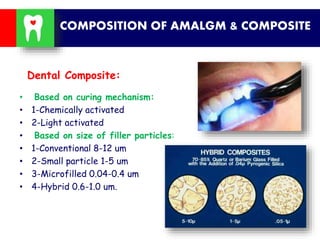
• Based on size of filler particles: 
• 1-Conventional 8-12 um 
• 2-Small particle 1-5 um 
• 3-Microfilled 0.04-0.4 um 
• 4-Hybrid 0.6-1.0 um.
INDICATIONS OF AMALGM & COMPOSITE 
Dental Amalgam: 
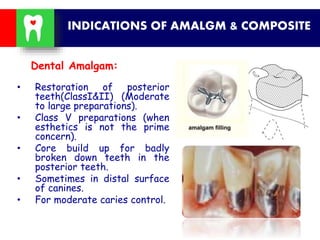
• Restoration of posterior 
teeth(ClassI&II) (Moderate 
to large preparations). 
• Class V preparations (when 
esthetics is not the prime 
concern). 
• Core build up for badly 
broken down teeth in the 
posterior teeth. 
• Sometimes in distal surface 
of canines. 
• For moderate caries control.
INDICATIONS OF AMALGM & COMPOSITE 
Dental Composite: 
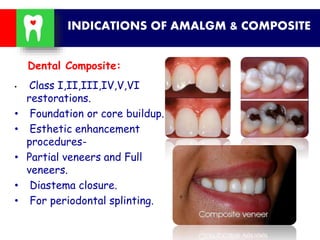
• Class I,II,III,IV,V,VI 
restorations. 
• Foundation or core buildup. 
• Esthetic enhancement 
procedures- 
• Partial veneers and Full 
veneers. 
• Diastema closure. 
• For periodontal splinting.
CONTAINDICATIONS OF AMALGM & COMPOSITE 
Dental Amalgam: Dental Composite: 
1.High caries incidence and 
poor oral hygiene. 
2.Teeth with heavy or 
abnormal Occlusal stress. 
3.If access & isolation 
difficulties. 
4.Patient allergic or 
sensitive to resin 
composite. 
1-Esthetics. 
2- Extensive loss of tooth 
structure 
3- Small class I and class 
II cavities.
ADVANTAGES OF AMALGM & COMPOSITE 
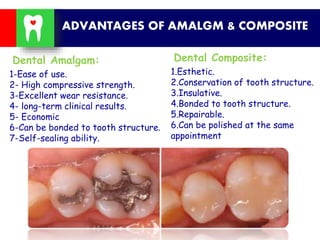
Dental Amalgam: Dental Composite: 
1-Ease of use. 
2- High compressive strength. 
3-Excellent wear resistance. 
4- long-term clinical results. 
5- Economic 
6-Can be bonded to tooth structure. 
7-Self-sealing ability. 
1.Esthetic. 
2.Conservation of tooth structure. 
3.Insulative. 
4.Bonded to tooth structure. 
5.Repairable. 
6.Can be polished at the same 
appointment
DISADVANTAGES OF AMALGM & COMPOSITE 
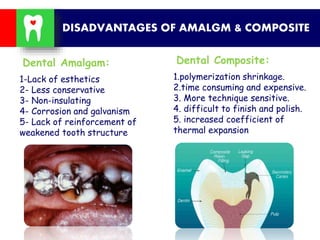
Dental Amalgam: Dental Composite: 
1-Lack of esthetics 
2- Less conservative 
3- Non-insulating 
4- Corrosion and galvanism 
5- Lack of reinforcement of 
weakened tooth structure 
1.polymerization shrinkage. 
2.time consuming and expensive. 
3. More technique sensitive. 
4. difficult to finish and polish. 
5. increased coefficient of 
thermal expansion
MANIPULAION OF AMALGM & COMPOSITE 
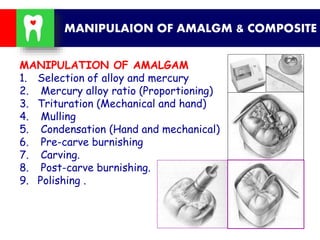
MANIPULATION OF AMALGAM 
1. Selection of alloy and mercury 
2. Mercury alloy ratio (Proportioning) 
3. Trituration (Mechanical and hand) 
4. Mulling 
5. Condensation (Hand and mechanical) 
6. Pre-carve burnishing 
7. Carving. 
8. Post-carve burnishing. 
9. Polishing .
MANIPULAION OF AMALGM & COMPOSITE 
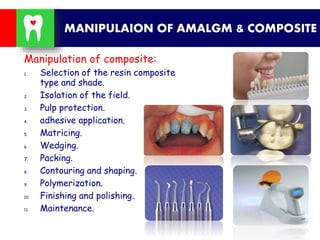
Manipulation of composite: 
1. Selection of the resin composite 
type and shade. 
2. Isolation of the field. 
3. Pulp protection. 
4. adhesive application. 
5. Matricing. 
6. Wedging. 
7. Packing. 
8. Contouring and shaping. 
9. Polymerization. 
10. Finishing and polishing. 
11. Maintenance.
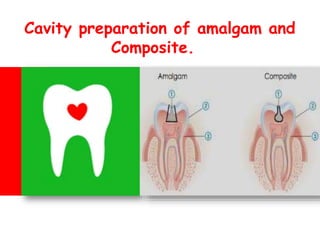
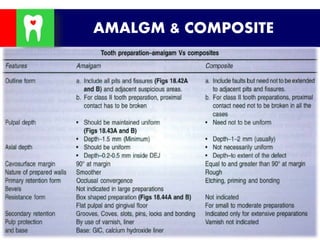
Cavity preparation of amalgam and 
Composite.
CAVITY PREPARTION OF AMALGM & COMPOSITE 
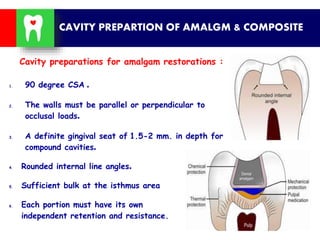
Cavity preparations for amalgam restorations : 
1. 90 degree CSA . 
2. The walls must be parallel or perpendicular to 
occlusal loads. 
3. A definite gingival seat of 1.5-2 mm. in depth for 
compound cavities. 
4. Rounded internal line angles. 
5. Sufficient bulk at the isthmus area 
6. Each portion must have its own 
independent retention and resistance.
CAVITY PREPARTION OF AMALGM & COMPOSITE 
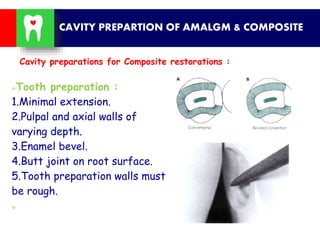
Cavity preparations for Composite restorations : 
Tooth preparation : 
1.Minimal extension. 
2.Pulpal and axial walls of 
varying depth. 
3.Enamel bevel. 
4.Butt joint on root surface. 
5.Tooth preparation walls must 
be rough. 

CAVITY PREPARTION OF AMALGM & COMPOSITE 
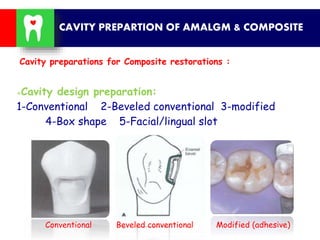
Cavity preparations for Composite restorations : 
Cavity design preparation: 
1-Conventional 2-Beveled conventional 3-modified 
4-Box shape 5-Facial/lingual slot 
Conventional Beveled conventional Modified (adhesive)
AMALGM & COMPOSITE
AMALGM & COMPOSITE 
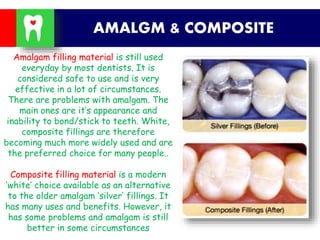
Amalgam filling material is still used 
everyday by most dentists. It is 
considered safe to use and is very 
effective in a lot of circumstances. 
There are problems with amalgam. The 
main ones are it’s appearance and 
inability to bond/stick to teeth. White, 
composite fillings are therefore 
becoming much more widely used and are 
the preferred choice for many people.. 
Composite filling material is a modern 
‘white’ choice available as an alternative 
to the older amalgam ‘silver’ fillings. It 
has many uses and benefits. However, it 
has some problems and amalgam is still 
better in some circumstances
ABCD’S&G.

Amalgam &composite

  • 1.
    DENTAL AMALGM & COMPOSIT. ABCD’S&G.
  • 2.
    DENTAL AMALGM &COMPOSITE DENTAL AMALGAM : Dental amalgam is a metal like restorative material composed of a mixture of silver/tin/copper alloy and mercury. DENTAL COMPOSITE : They are highly cross linked polymeric materials reinforced by a dispersion of glass,crystalline or resin filler particles or short fibers bound to the matrix by silane coupling agents.
  • 3.
    COMPOSITION OF AMALGM& COMPOSITE Dental Amalgam: Alloy of mercury, silver, tin, and copper, it may also contain palladium, zinc , gold to improve the handling characteristics Dental Composite: 1-Resin matrix 2-Filler particles 3-Coupling agent . 4-Activator-initiator system required to convert resin to soft moldable filling material to hard durable restoration.
  • 4.
    CALSSIFACTION OF AMALGM& COMPOSITE Based on copper content : 1-Low copper alloy -- < 6% copper (conventional alloy) . 2- High copper -- 6-30% copper (1) admixed alloy (2) single composition alloy Based on zinc content : (1) zinc containing alloy -- > 0.01% zinc (2) zinc free alloy -- < 0.01 zinc. Based on shape of alloy particles : (1) lathe cut alloy. (2) spherical alloy (3) admixed alloy. Based on size of alloy particles (1) micro cut (2) fine-cut (3) coarse-cut. Based on presence of noble metals : (1) noble metal alloys (palladium, platinum, gold) (2) non-noble metal alloys
  • 5.
    COMPOSITION OF AMALGM& COMPOSITE Dental Composite: • Based on curing mechanism: • 1-Chemically activated • 2-Light activated • Based on size of filler particles: • 1-Conventional 8-12 um • 2-Small particle 1-5 um • 3-Microfilled 0.04-0.4 um • 4-Hybrid 0.6-1.0 um.
  • 6.
    INDICATIONS OF AMALGM& COMPOSITE Dental Amalgam: • Restoration of posterior teeth(ClassI&II) (Moderate to large preparations). • Class V preparations (when esthetics is not the prime concern). • Core build up for badly broken down teeth in the posterior teeth. • Sometimes in distal surface of canines. • For moderate caries control.
  • 7.
    INDICATIONS OF AMALGM& COMPOSITE Dental Composite: • Class I,II,III,IV,V,VI restorations. • Foundation or core buildup. • Esthetic enhancement procedures- • Partial veneers and Full veneers. • Diastema closure. • For periodontal splinting.
  • 8.
    CONTAINDICATIONS OF AMALGM& COMPOSITE Dental Amalgam: Dental Composite: 1.High caries incidence and poor oral hygiene. 2.Teeth with heavy or abnormal Occlusal stress. 3.If access & isolation difficulties. 4.Patient allergic or sensitive to resin composite. 1-Esthetics. 2- Extensive loss of tooth structure 3- Small class I and class II cavities.
  • 9.
    ADVANTAGES OF AMALGM& COMPOSITE Dental Amalgam: Dental Composite: 1-Ease of use. 2- High compressive strength. 3-Excellent wear resistance. 4- long-term clinical results. 5- Economic 6-Can be bonded to tooth structure. 7-Self-sealing ability. 1.Esthetic. 2.Conservation of tooth structure. 3.Insulative. 4.Bonded to tooth structure. 5.Repairable. 6.Can be polished at the same appointment
  • 10.
    DISADVANTAGES OF AMALGM& COMPOSITE Dental Amalgam: Dental Composite: 1-Lack of esthetics 2- Less conservative 3- Non-insulating 4- Corrosion and galvanism 5- Lack of reinforcement of weakened tooth structure 1.polymerization shrinkage. 2.time consuming and expensive. 3. More technique sensitive. 4. difficult to finish and polish. 5. increased coefficient of thermal expansion
  • 11.
    MANIPULAION OF AMALGM& COMPOSITE MANIPULATION OF AMALGAM 1. Selection of alloy and mercury 2. Mercury alloy ratio (Proportioning) 3. Trituration (Mechanical and hand) 4. Mulling 5. Condensation (Hand and mechanical) 6. Pre-carve burnishing 7. Carving. 8. Post-carve burnishing. 9. Polishing .
  • 12.
    MANIPULAION OF AMALGM& COMPOSITE Manipulation of composite: 1. Selection of the resin composite type and shade. 2. Isolation of the field. 3. Pulp protection. 4. adhesive application. 5. Matricing. 6. Wedging. 7. Packing. 8. Contouring and shaping. 9. Polymerization. 10. Finishing and polishing. 11. Maintenance.
  • 13.
    Cavity preparation ofamalgam and Composite.
  • 14.
    CAVITY PREPARTION OFAMALGM & COMPOSITE Cavity preparations for amalgam restorations : 1. 90 degree CSA . 2. The walls must be parallel or perpendicular to occlusal loads. 3. A definite gingival seat of 1.5-2 mm. in depth for compound cavities. 4. Rounded internal line angles. 5. Sufficient bulk at the isthmus area 6. Each portion must have its own independent retention and resistance.
  • 15.
    CAVITY PREPARTION OFAMALGM & COMPOSITE Cavity preparations for Composite restorations : Tooth preparation : 1.Minimal extension. 2.Pulpal and axial walls of varying depth. 3.Enamel bevel. 4.Butt joint on root surface. 5.Tooth preparation walls must be rough. 
  • 16.
    CAVITY PREPARTION OFAMALGM & COMPOSITE Cavity preparations for Composite restorations : Cavity design preparation: 1-Conventional 2-Beveled conventional 3-modified 4-Box shape 5-Facial/lingual slot Conventional Beveled conventional Modified (adhesive)
  • 17.
  • 18.
    AMALGM & COMPOSITE Amalgam filling material is still used everyday by most dentists. It is considered safe to use and is very effective in a lot of circumstances. There are problems with amalgam. The main ones are it’s appearance and inability to bond/stick to teeth. White, composite fillings are therefore becoming much more widely used and are the preferred choice for many people.. Composite filling material is a modern ‘white’ choice available as an alternative to the older amalgam ‘silver’ fillings. It has many uses and benefits. However, it has some problems and amalgam is still better in some circumstances
  • 19.