THERMOREGULATION
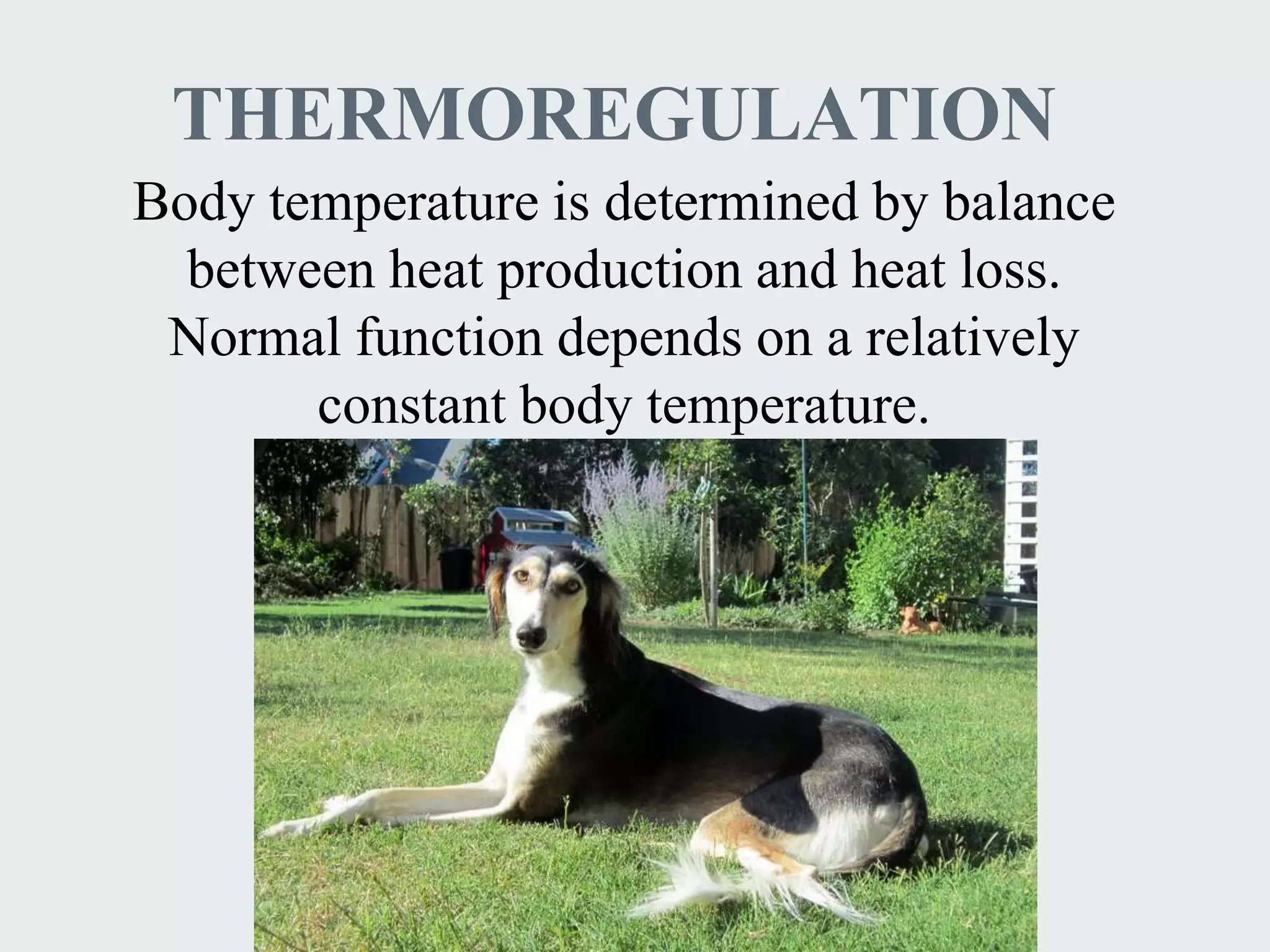
Body temperature is determined by balance
  between heat production and heat loss.
 Normal function depends on a relatively
       constant body temperature.
Why should I care about understanding
        thermoregulation?
  • Improve patient safety
    – Particularly during/after anesthesia
  • Improve patient comfort
  • Improve patient willingness to participate in
    procedures
  • Facilitate understanding of hypothermia &
    hyperthermia causes & treatments (clinical)
Metabolic rate and Thermoregualtion
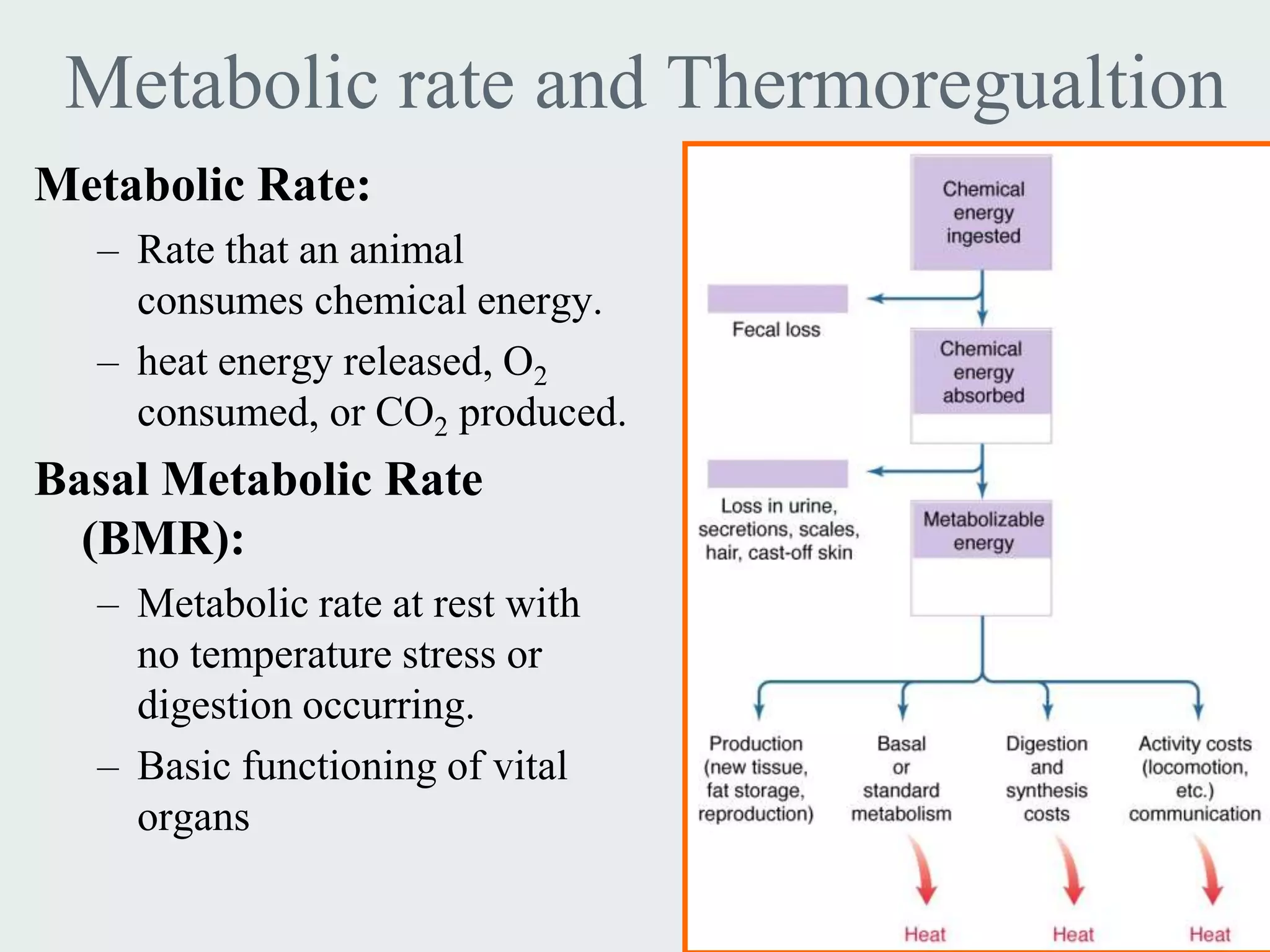
Metabolic Rate:
  – Rate that an animal
    consumes chemical energy.
  – heat energy released, O2
    consumed, or CO2 produced.
Basal Metabolic Rate
  (BMR):
  – Metabolic rate at rest with
    no temperature stress or
    digestion occurring.
  – Basic functioning of vital
    organs
Energy
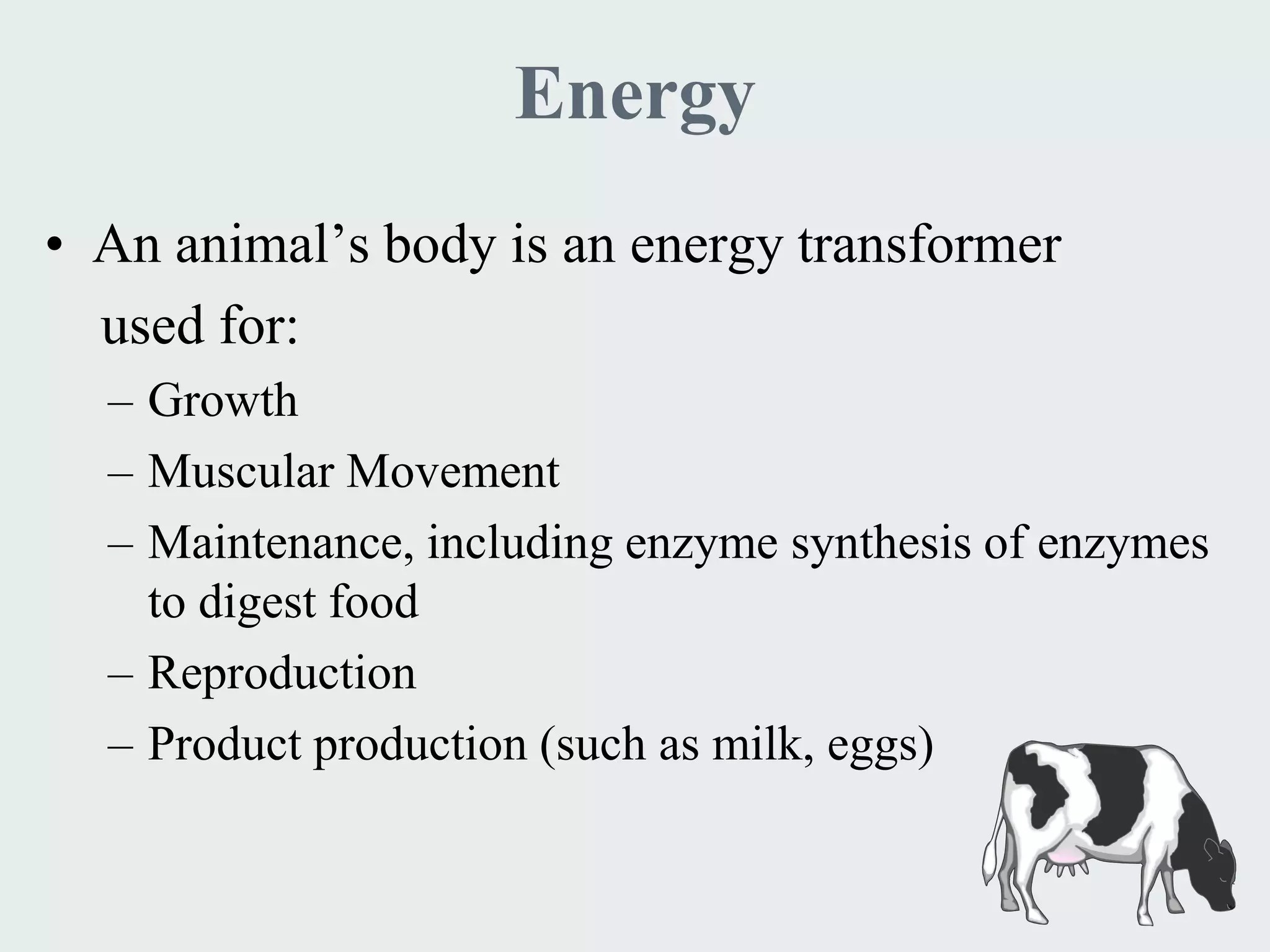
• An animal’s body is an energy transformer
  used for:
  – Growth
  – Muscular Movement
  – Maintenance, including enzyme synthesis of enzymes
    to digest food
  – Reproduction
  – Product production (such as milk, eggs)
Energy (& thus heat) comes from:
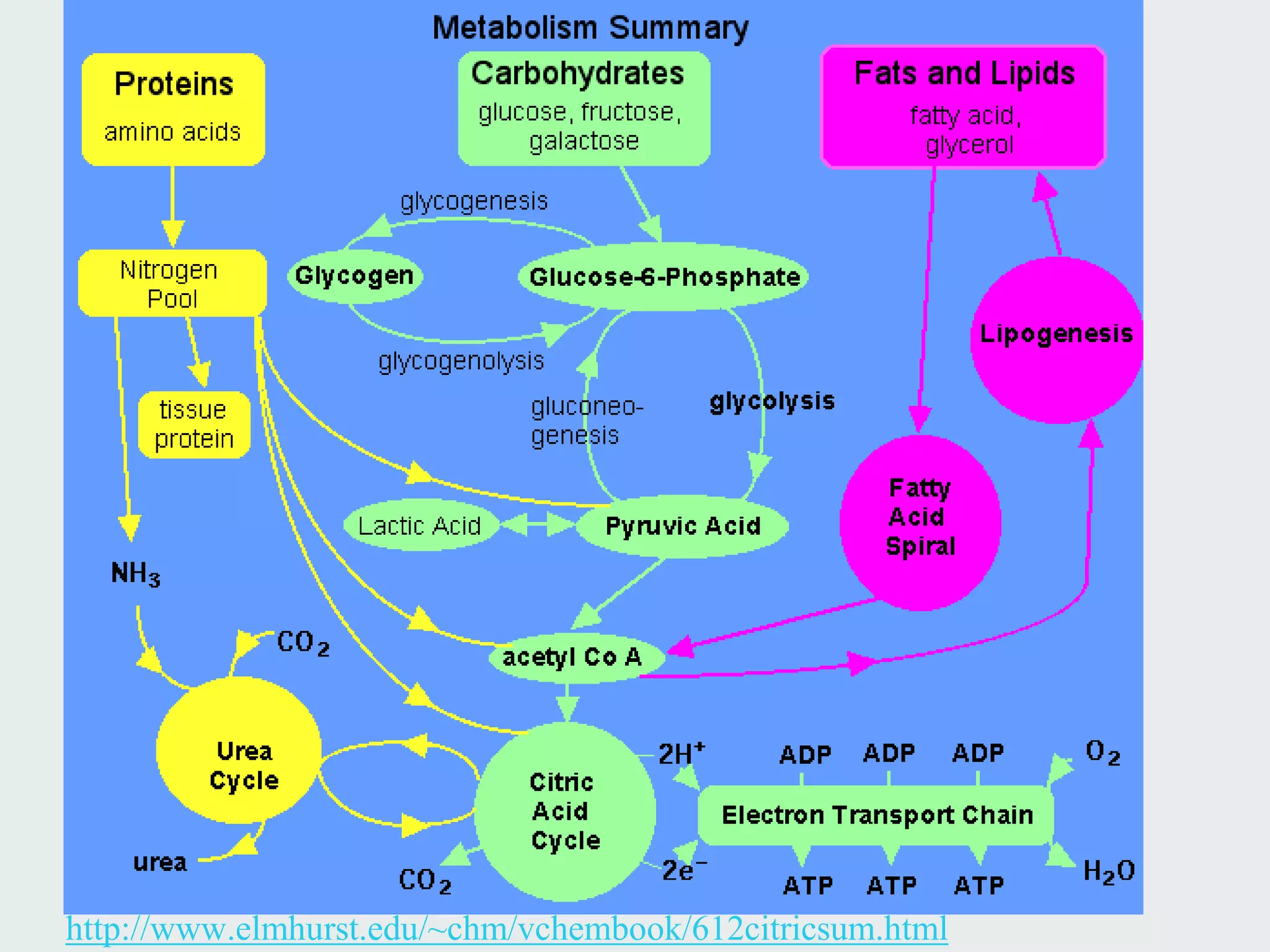
• Organic compounds (food)
  glucose  ATP production via glycolysis, Krebs (TCA,
   citric acid) Cycle, Electron Transport Phosphorylation,
   and anaerobic (lactic acid) metabolism
• Brown adipose tissue
  • Most prominent in neonates
  • Important for small mammals in cold environment,
    hibernating animals
  • Inverse correlation between amount of brown fat & BMI
http://www.elmhurst.edu/~chm/vchembook/612citricsum.html
Body Temperature
• The Body Temperature is the temperature recorded
  on a thermometer inserted into the rectum deep
  enough to record the core (or internal) temperature
• Temperature of skin surface may be higher or
  lower than core
• Body temperature may be ↑ or ↓ depending on
  surface the animal is placed on
• Effects of both internal (adipose – brown & white)
  and external insulating layers (hair, feathers) is
  important during restraint
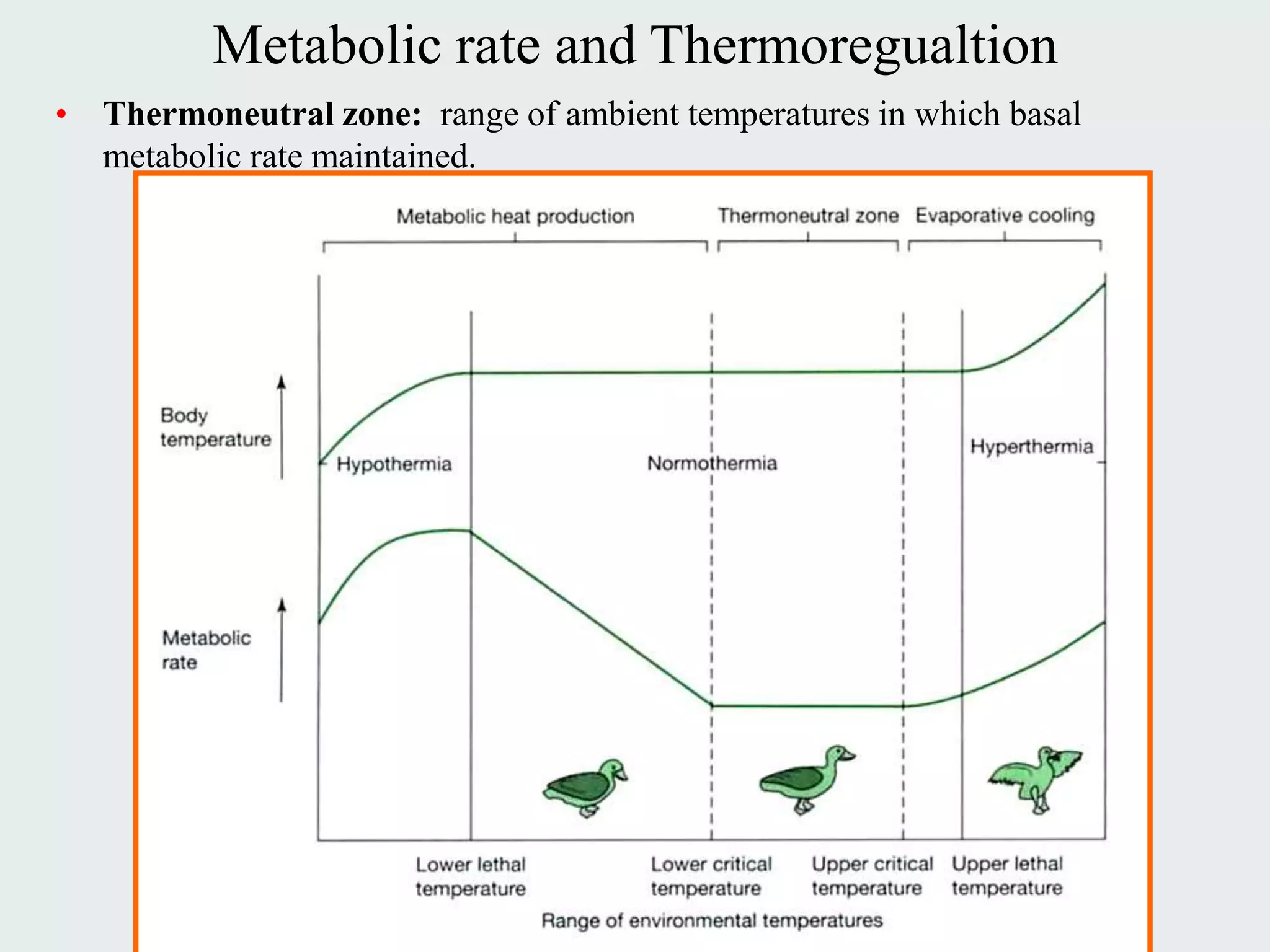
Metabolic rate and Thermoregualtion
• Thermoneutral zone: range of ambient temperatures in which basal
  metabolic rate maintained.
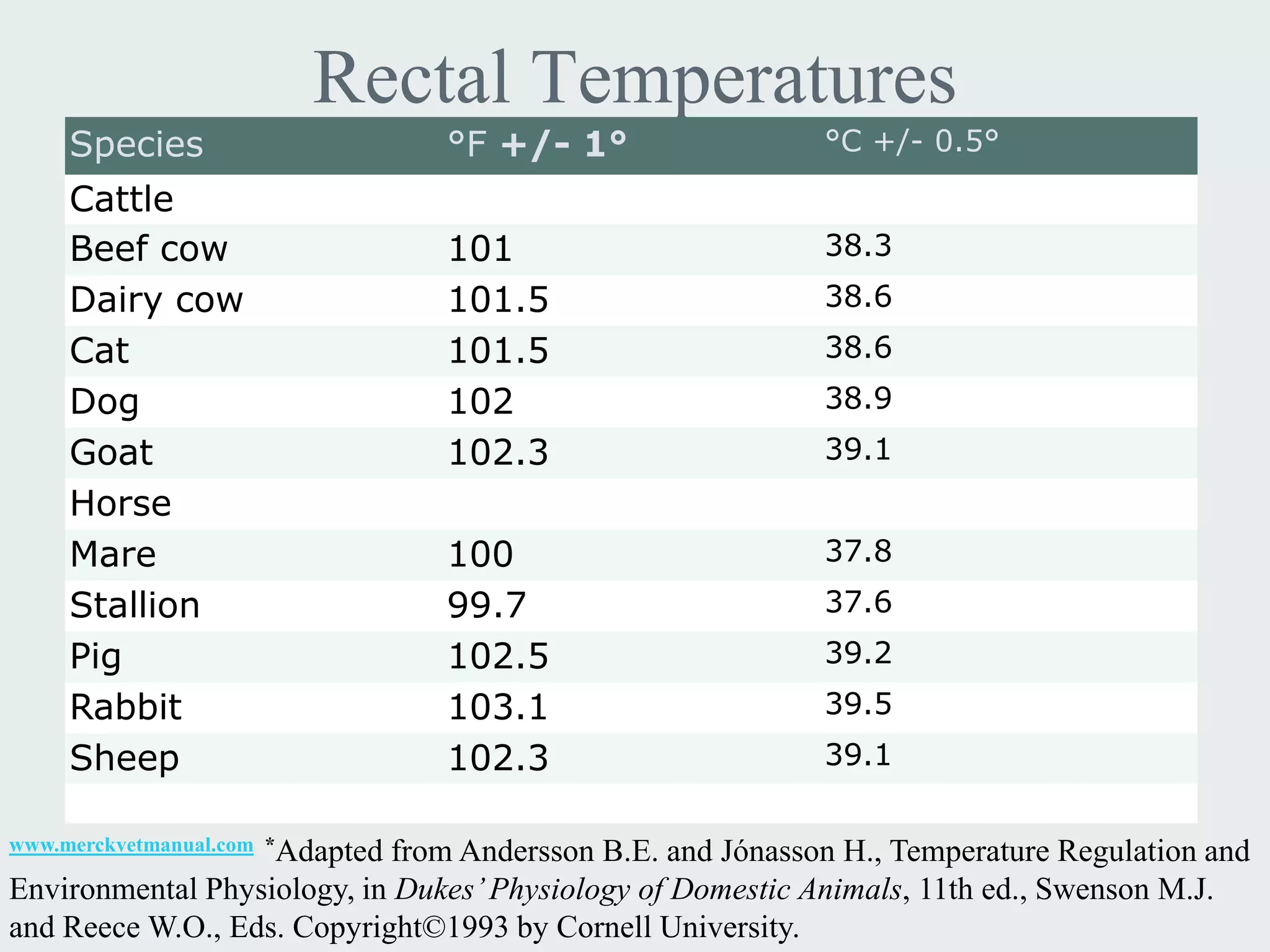
Rectal Temperatures
     Species                      °F +/- 1°                 °C +/- 0.5°
     Cattle
     Beef cow                     101                       38.3
     Dairy cow                    101.5                     38.6
     Cat                          101.5                     38.6
     Dog                          102                       38.9
     Goat                         102.3                     39.1
     Horse
     Mare                         100                       37.8
     Stallion                     99.7                      37.6
     Pig                          102.5                     39.2
     Rabbit                       103.1                     39.5
     Sheep                        102.3                     39.1

www.merckvetmanual.com *Adapted
                             from Andersson B.E. and Jónasson H., Temperature Regulation and
Environmental Physiology, in Dukes’ Physiology of Domestic Animals, 11th ed., Swenson M.J.
and Reece W.O., Eds. Copyright©1993 by Cornell University.
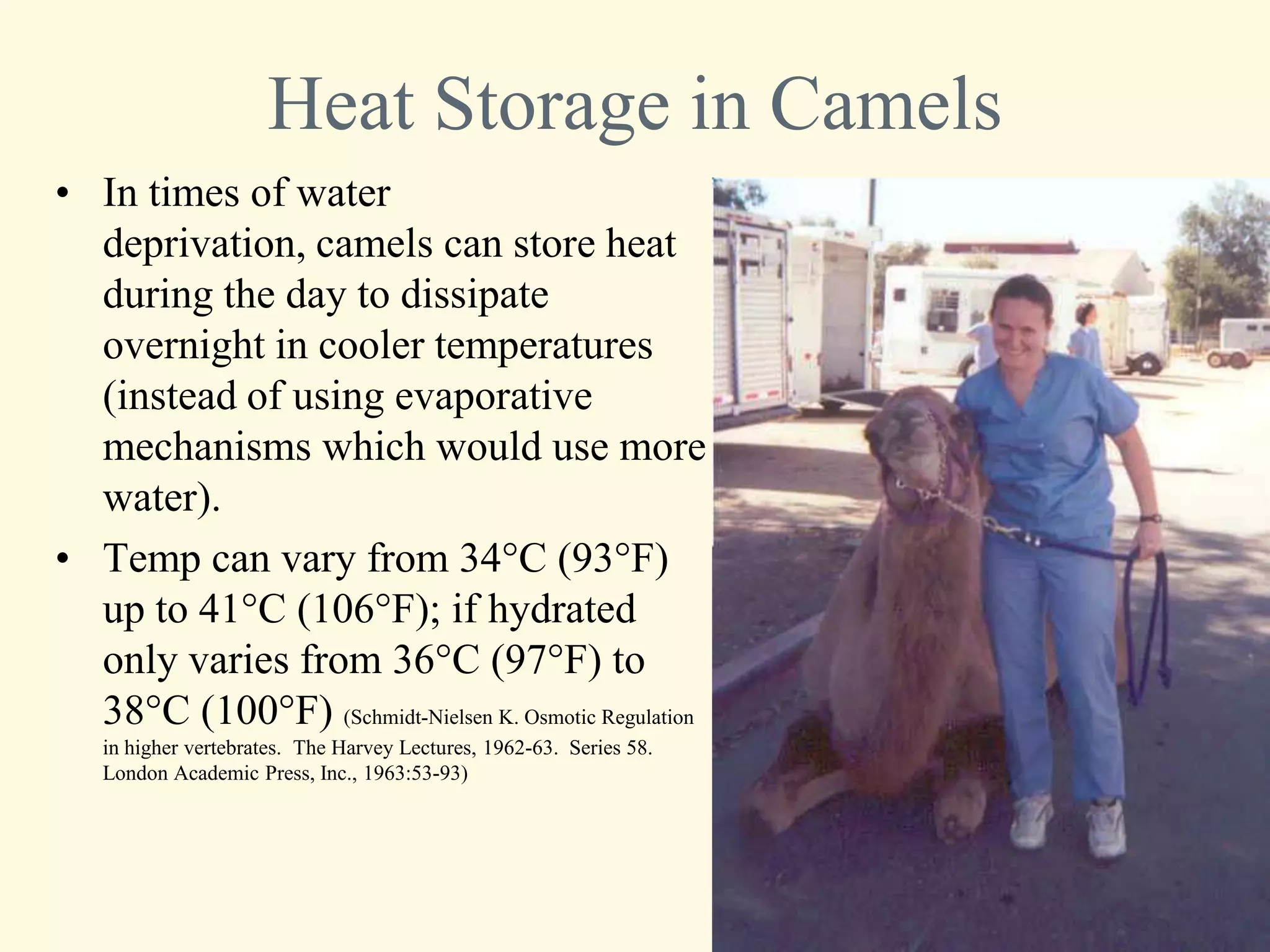
Heat Storage in Camels
• In times of water
  deprivation, camels can store heat
  during the day to dissipate
  overnight in cooler temperatures
  (instead of using evaporative
  mechanisms which would use more
  water).
• Temp can vary from 34°C (93°F)
  up to 41°C (106°F); if hydrated
  only varies from 36°C (97°F) to
  38°C (100°F) (Schmidt-Nielsen K. Osmotic Regulation
   in higher vertebrates. The Harvey Lectures, 1962-63. Series 58.
   London Academic Press, Inc., 1963:53-93)
Body temperature is affected by:
–   Ambient temperature
–   Level of activity
–   Digestion, food & water intake
–   Time of day (higher when typically active)
     • Diurnal animals – lower temp in am, then warms up
     • Nocturnal animals – higher temp in am, cools down during day
– Time of year (hibernation)
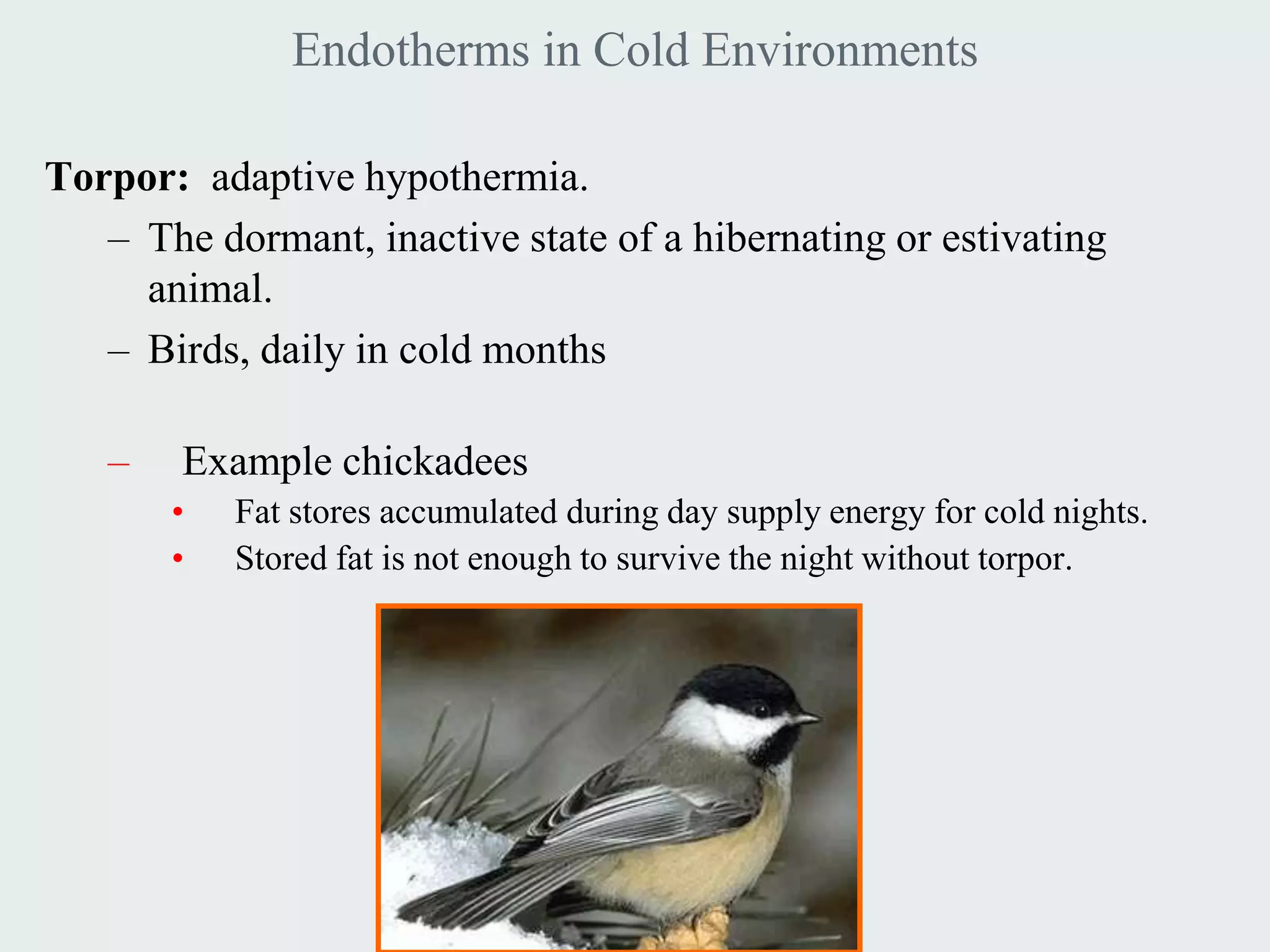
Endotherms in Cold Environments

Torpor: adaptive hypothermia.
   – The dormant, inactive state of a hibernating or estivating
     animal.
   – Birds, daily in cold months

   –    Example chickadees
       •   Fat stores accumulated during day supply energy for cold nights.
       •   Stored fat is not enough to survive the night without torpor.
Endotherms in Hot Environments
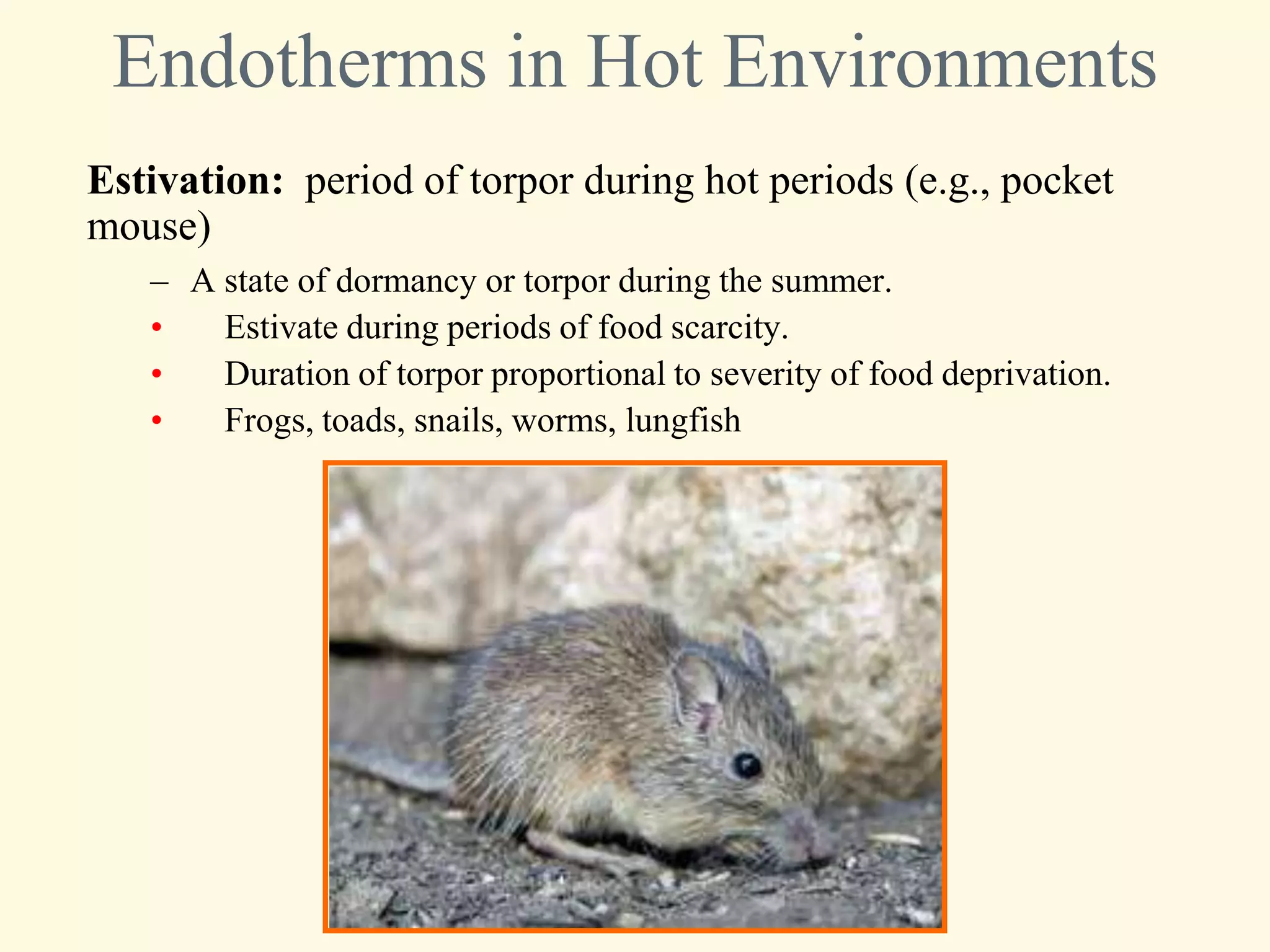
Estivation: period of torpor during hot periods (e.g., pocket
mouse)
   – A state of dormancy or torpor during the summer.
   •   Estivate during periods of food scarcity.
   •   Duration of torpor proportional to severity of food deprivation.
   •   Frogs, toads, snails, worms, lungfish
• Hibernation
  – An inactive state resembling deep sleep in
    which certain animals living in cold climates
    pass the winter.
  – Bats, ground squirrels, some other rodents
• Brumation
  – A state of cold-period dormancy or reduced
    activity in cold-blooded animals. Unlike
    hibernation, the animal may remain partially
    active during brumation.
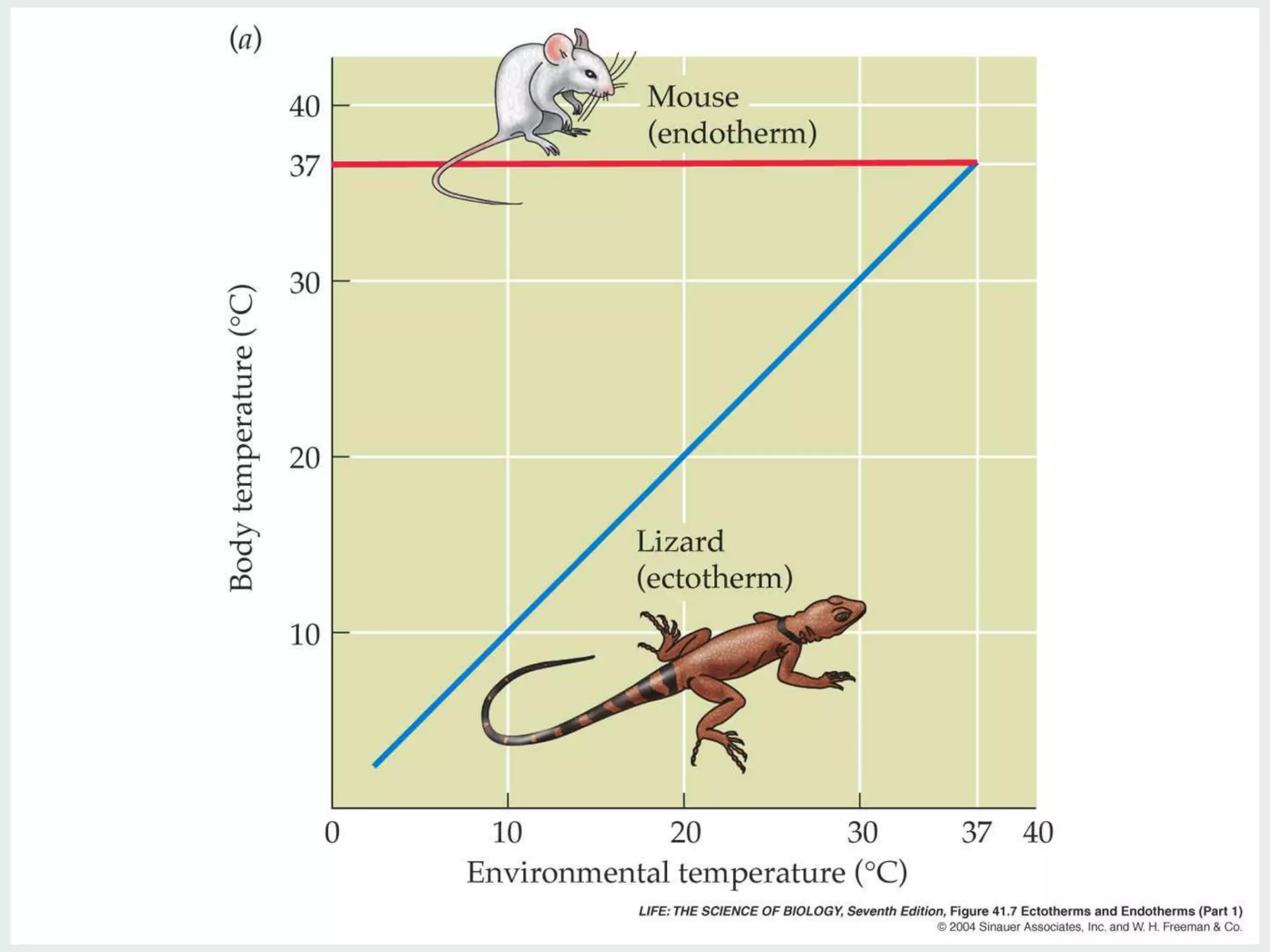
Homeotherm (endotherm)
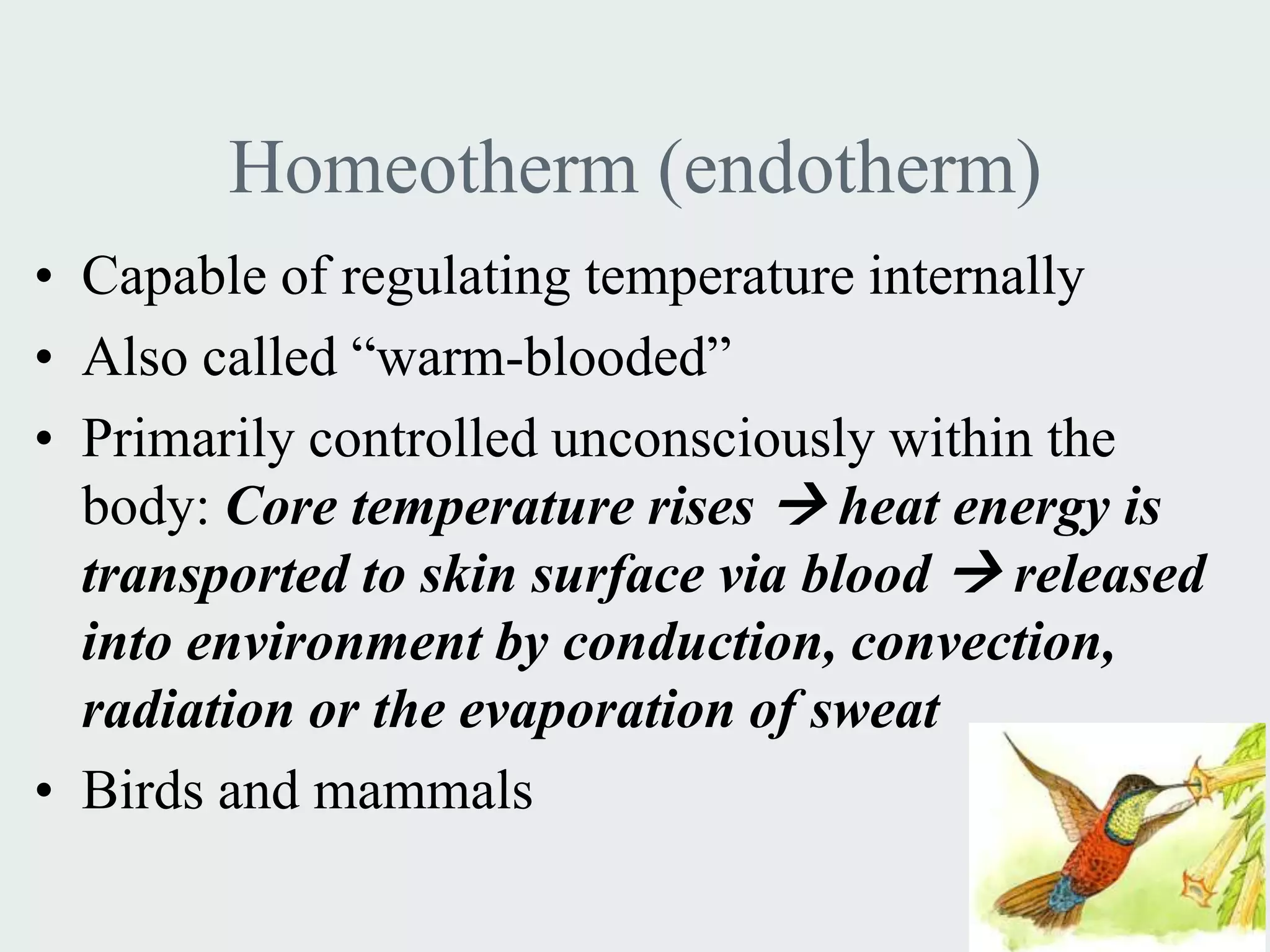
• Capable of regulating temperature internally
• Also called “warm-blooded”
• Primarily controlled unconsciously within the
  body: Core temperature rises  heat energy is
  transported to skin surface via blood  released
  into environment by conduction, convection,
  radiation or the evaporation of sweat
• Birds and mammals
Homeotherm (endotherm)
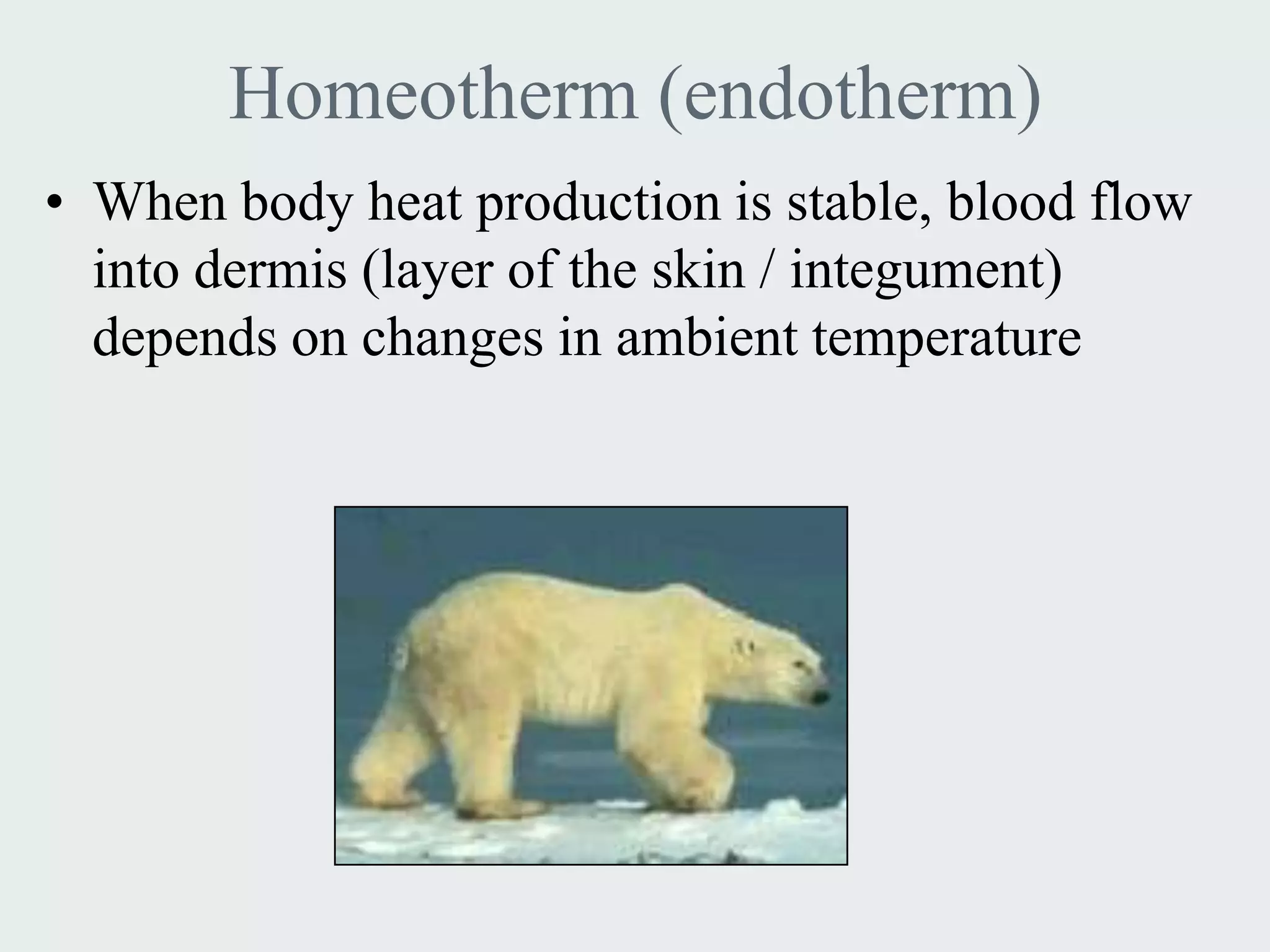
• When body heat production is stable, blood flow
  into dermis (layer of the skin / integument)
  depends on changes in ambient temperature
Homeotherm (endotherm)
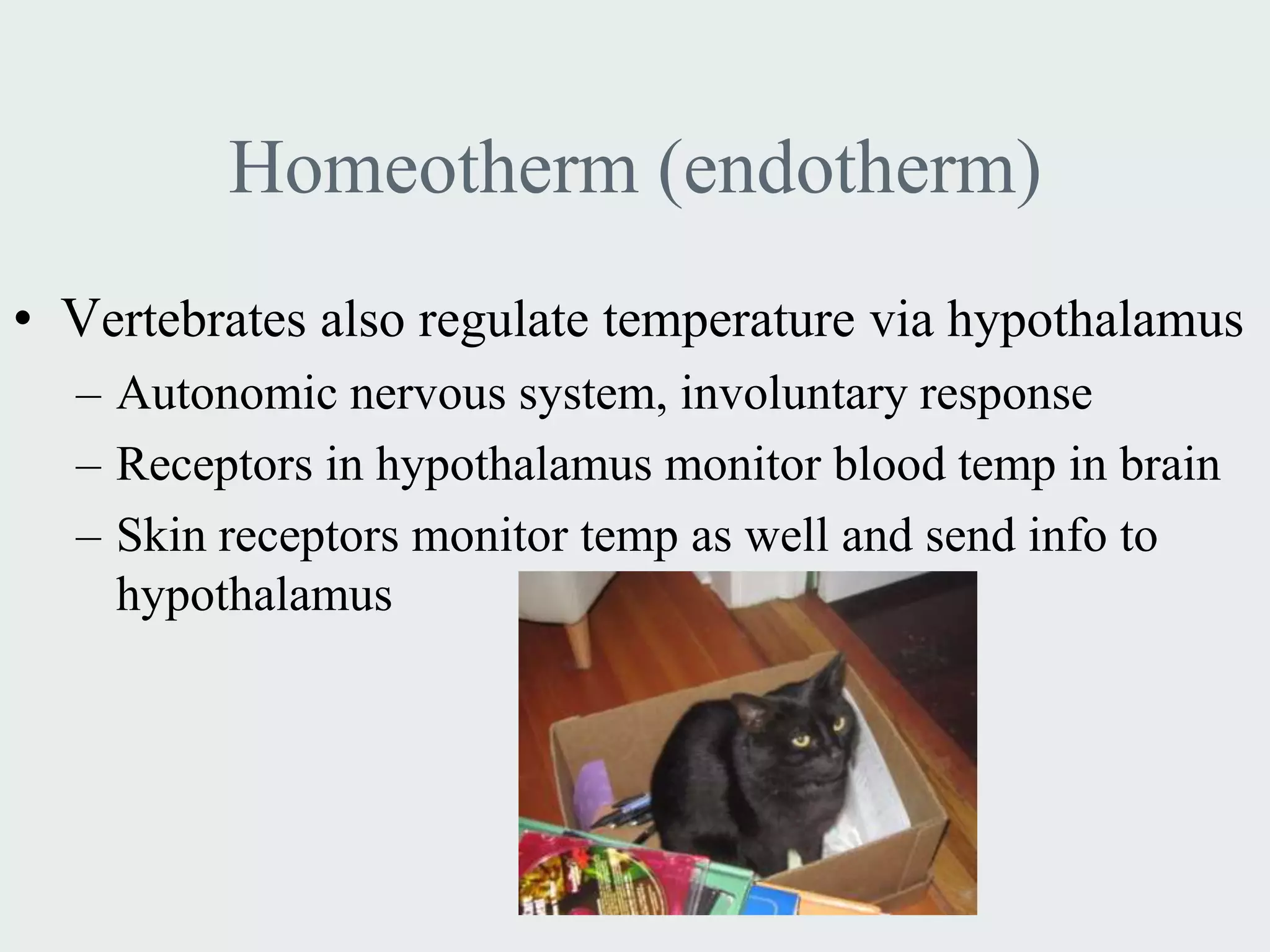
• Vertebrates also regulate temperature via hypothalamus
  – Autonomic nervous system, involuntary response
  – Receptors in hypothalamus monitor blood temp in brain
  – Skin receptors monitor temp as well and send info to
    hypothalamus
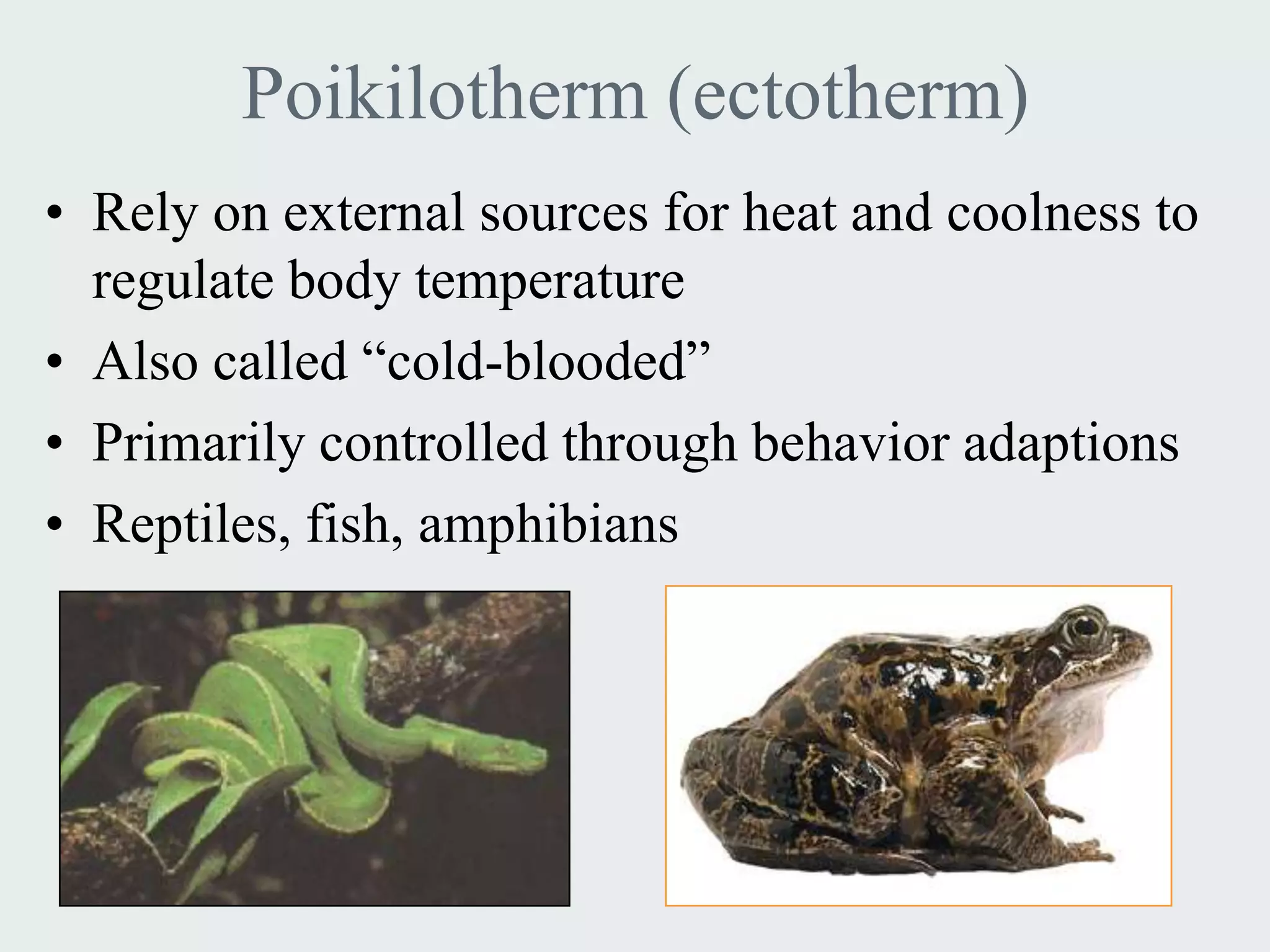
Poikilotherm (ectotherm)
• Rely on external sources for heat and coolness to
  regulate body temperature
• Also called “cold-blooded”
• Primarily controlled through behavior adaptions
• Reptiles, fish, amphibians
Heat Production
• Heat gained/temperature increased by:
  – increased production or
  – by absorption from the environment
• Production is through:
  1. ↑ muscle tone - shivering
  2. Exercise
  3. Eating
  4. Fever (pyrexia)
  5. Brown adipose
Endotherms in
           Cold Environments
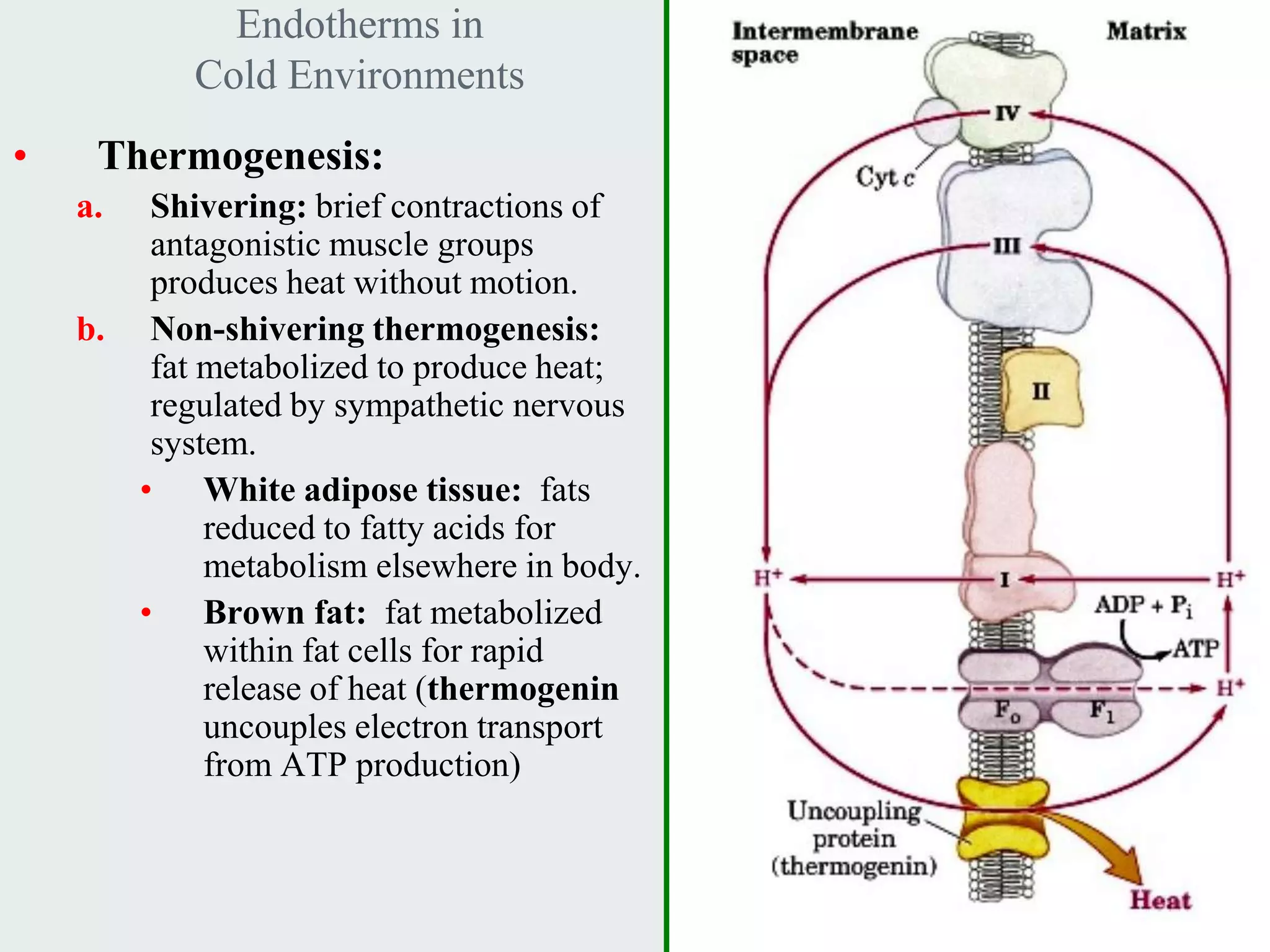
•    Thermogenesis:
    a.  Shivering: brief contractions of
        antagonistic muscle groups
        produces heat without motion.
    b. Non-shivering thermogenesis:
        fat metabolized to produce heat;
        regulated by sympathetic nervous
        system.
       • White adipose tissue: fats
            reduced to fatty acids for
            metabolism elsewhere in body.
       • Brown fat: fat metabolized
            within fat cells for rapid
            release of heat (thermogenin
            uncouples electron transport
            from ATP production)


                                            Fig. 17-2
Physics of Heat Transfer
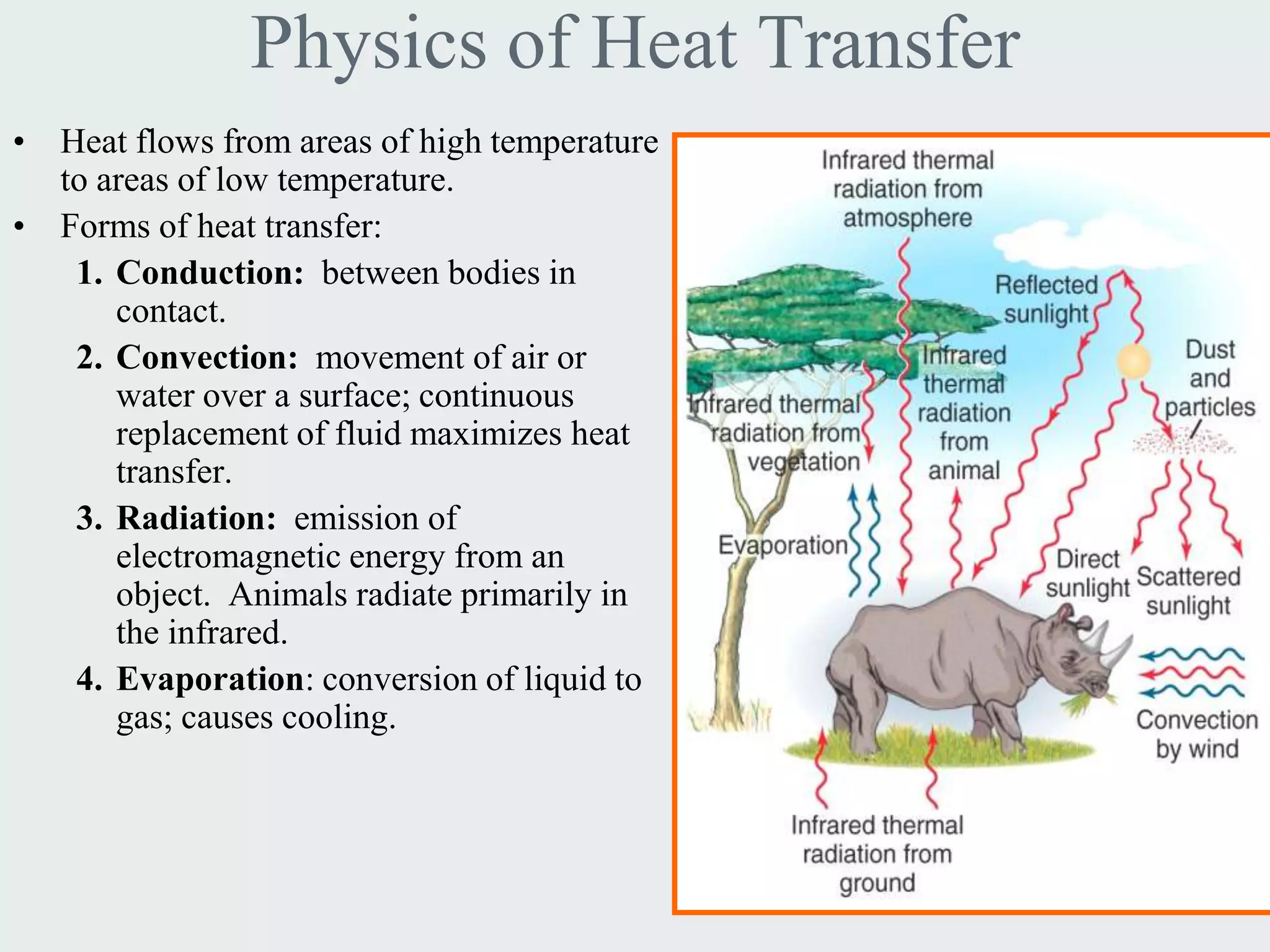
• Heat flows from areas of high temperature
  to areas of low temperature.
• Forms of heat transfer:
   1. Conduction: between bodies in
      contact.
   2. Convection: movement of air or
      water over a surface; continuous
      replacement of fluid maximizes heat
      transfer.
   3. Radiation: emission of
      electromagnetic energy from an
      object. Animals radiate primarily in
      the infrared.
   4. Evaporation: conversion of liquid to
      gas; causes cooling.
Heat from environment is via:

     1. Radiation
     2. Conduction
     3. Convection
Radiation
• Electromagnetic waves transfer energy
  without heating the intervening air.
  Sun most important source
  All warm objects (including animals) give
  off radiant energy
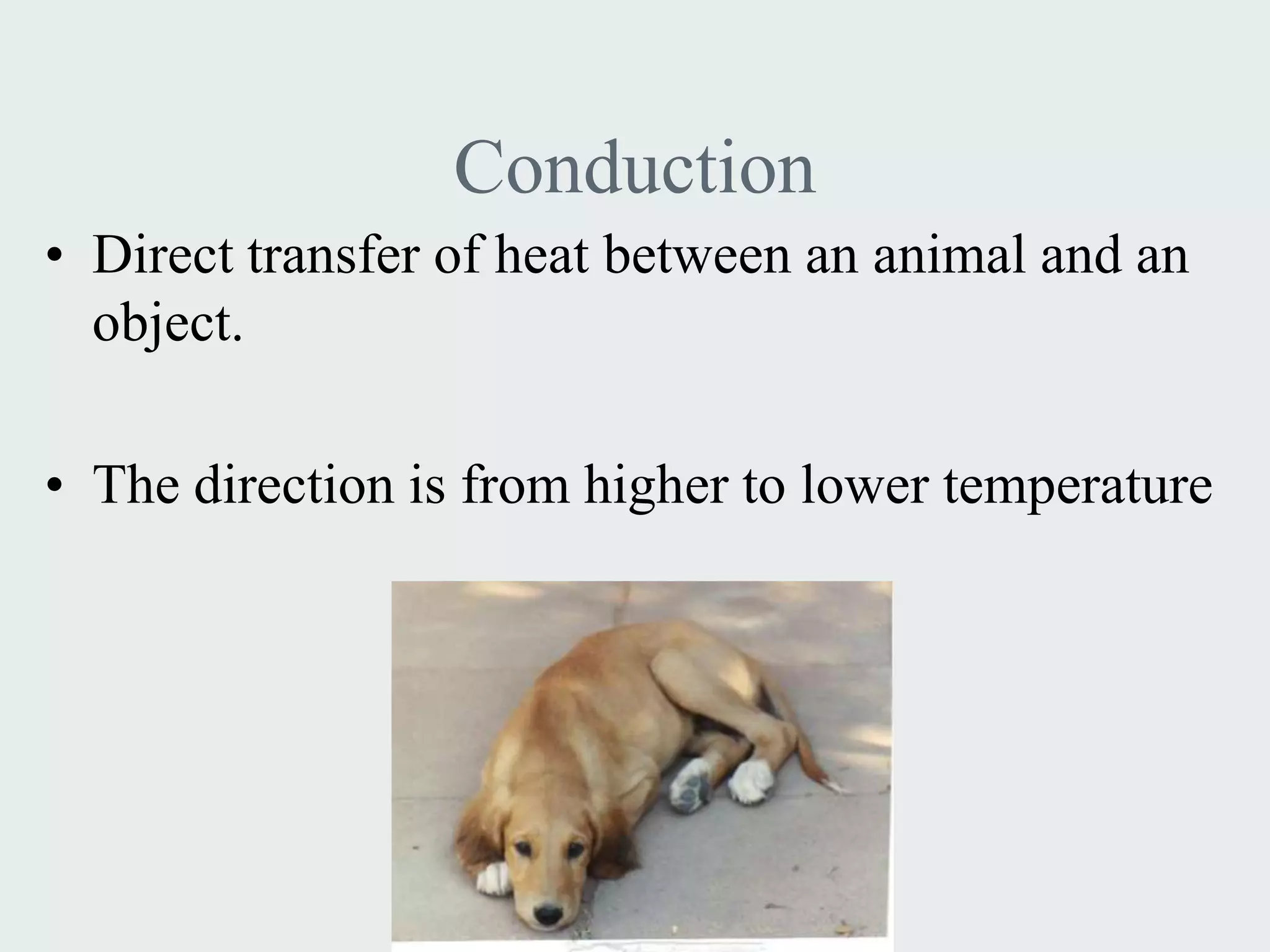
Conduction
• Direct transfer of heat between an animal and an
  object.

• The direction is from higher to lower temperature
Convection
• Transmission of heat by movement of a
  medium surrounding or within an object:
  – Air
  – Water
  – Blood
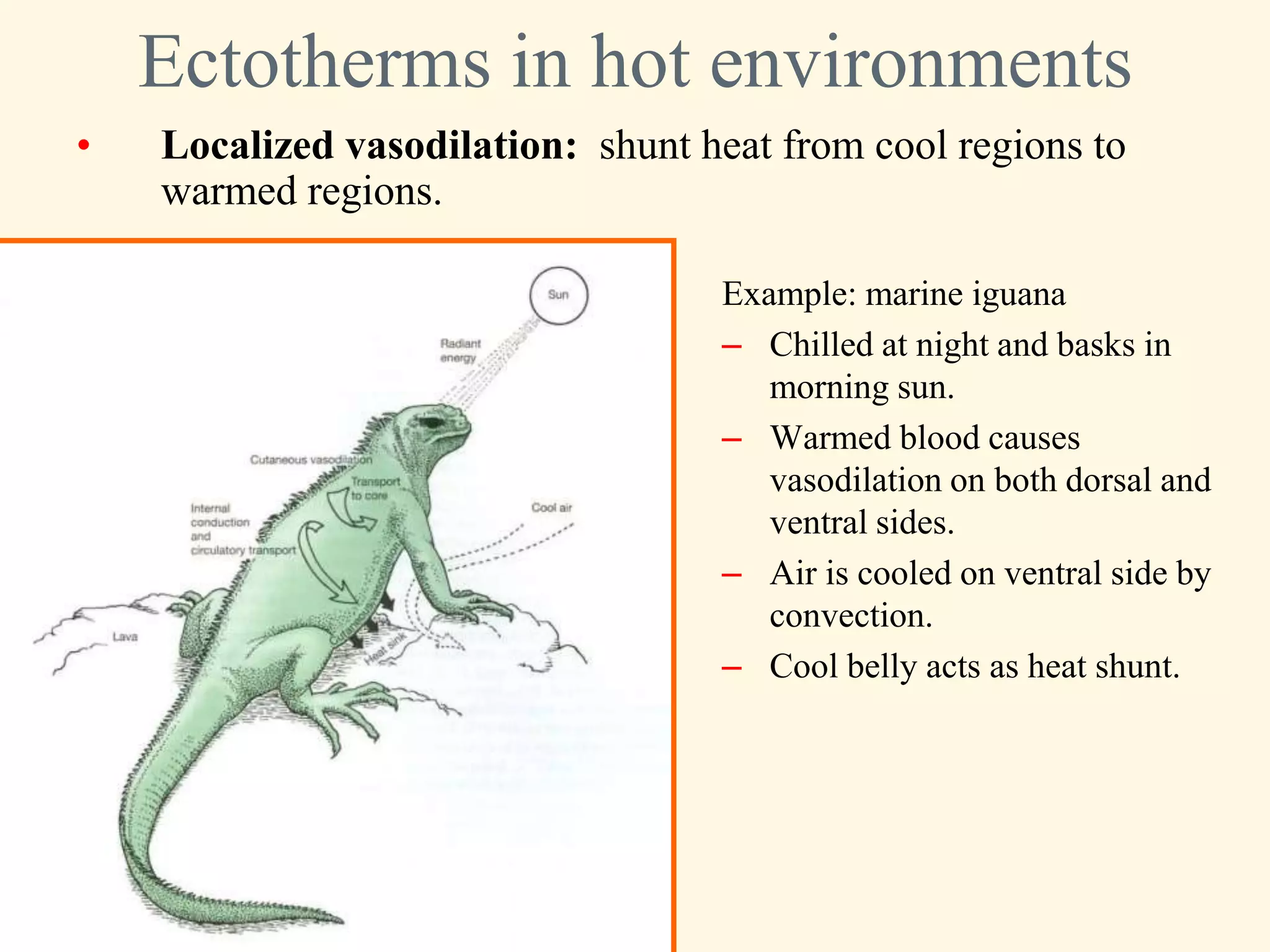
Ectotherms in hot environments
•   Localized vasodilation: shunt heat from cool regions to
    warmed regions.

                                   Example: marine iguana
                                   – Chilled at night and basks in
                                      morning sun.
                                   – Warmed blood causes
                                      vasodilation on both dorsal and
                                      ventral sides.
                                   – Air is cooled on ventral side by
                                      convection.
                                   – Cool belly acts as heat shunt.
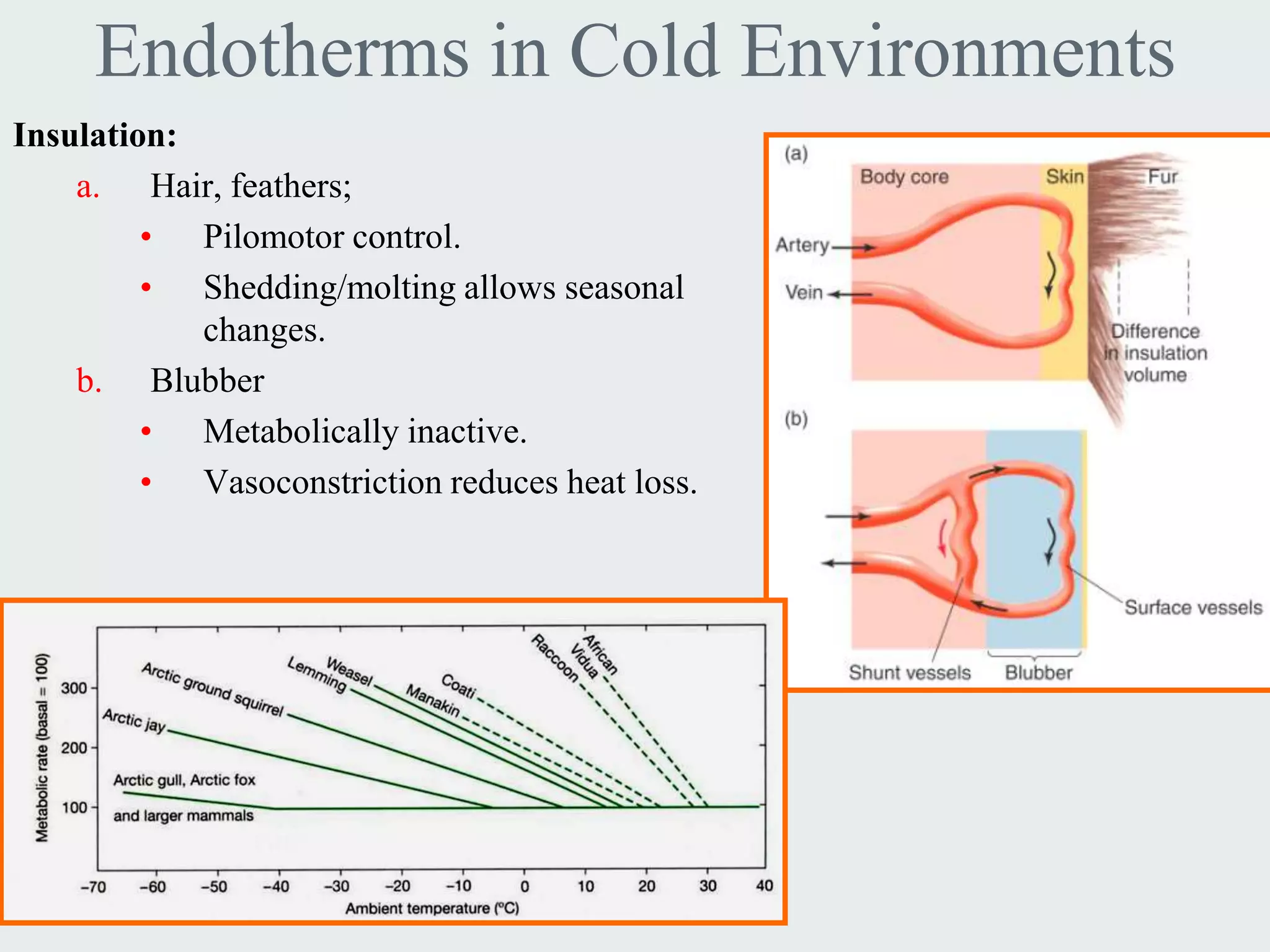
Heat Conservation
• Heat is conserved through vascular
  responses:
  1. Blood vessels near surface constrict to
  allow skin temperature to drop without
  jeopardizing core temperature
  2. Velocity of blood flow increases which
  decreases exposure time to cold
Endotherms in Cold Environments
Insulation:
    a. Hair, feathers;
         • Pilomotor control.
         • Shedding/molting allows seasonal
            changes.
    b. Blubber
         • Metabolically inactive.
         • Vasoconstriction reduces heat loss.
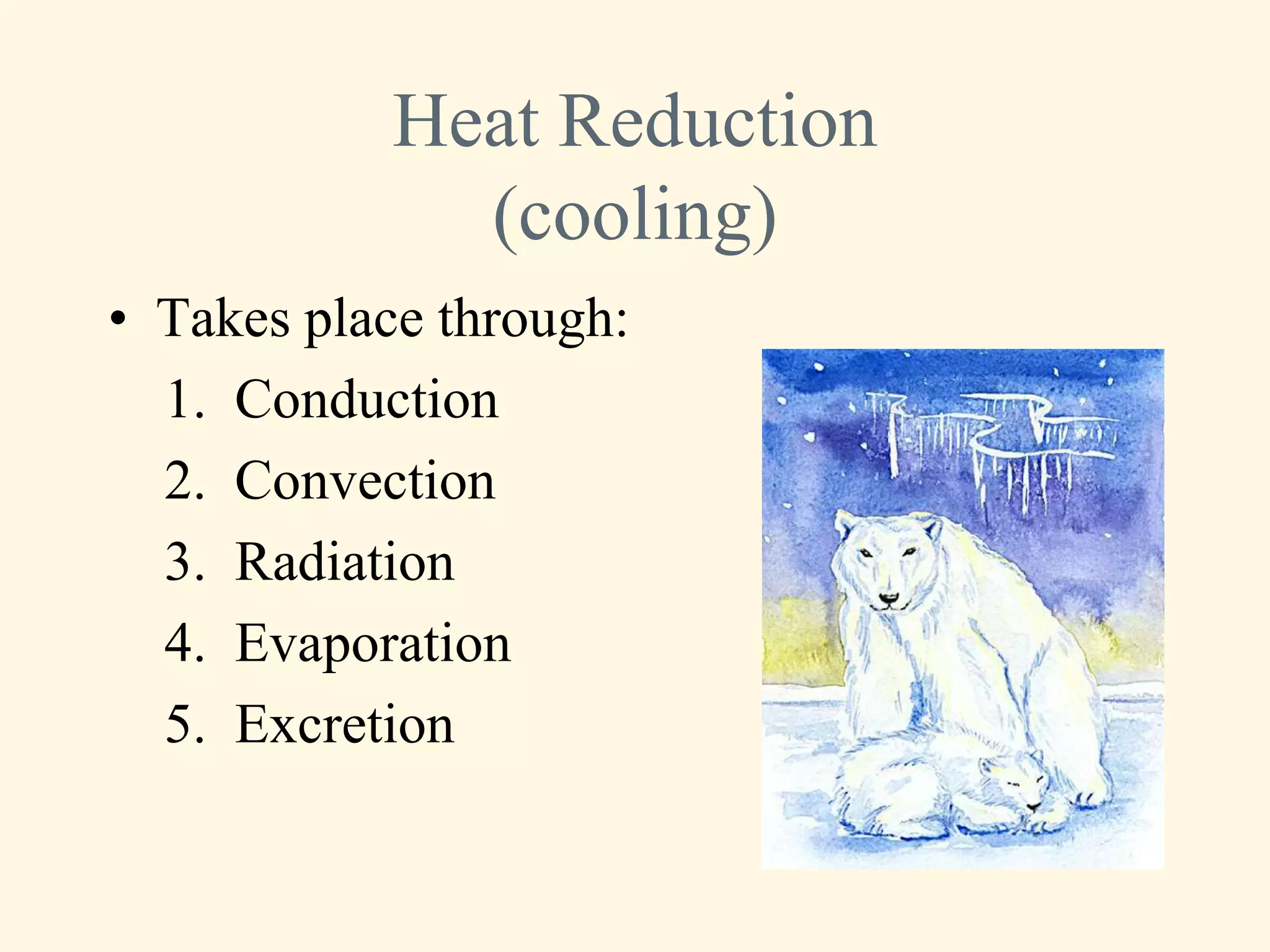
Heat Reduction
             (cooling)
• Takes place through:
  1. Conduction
  2. Convection
  3. Radiation
  4. Evaporation
  5. Excretion
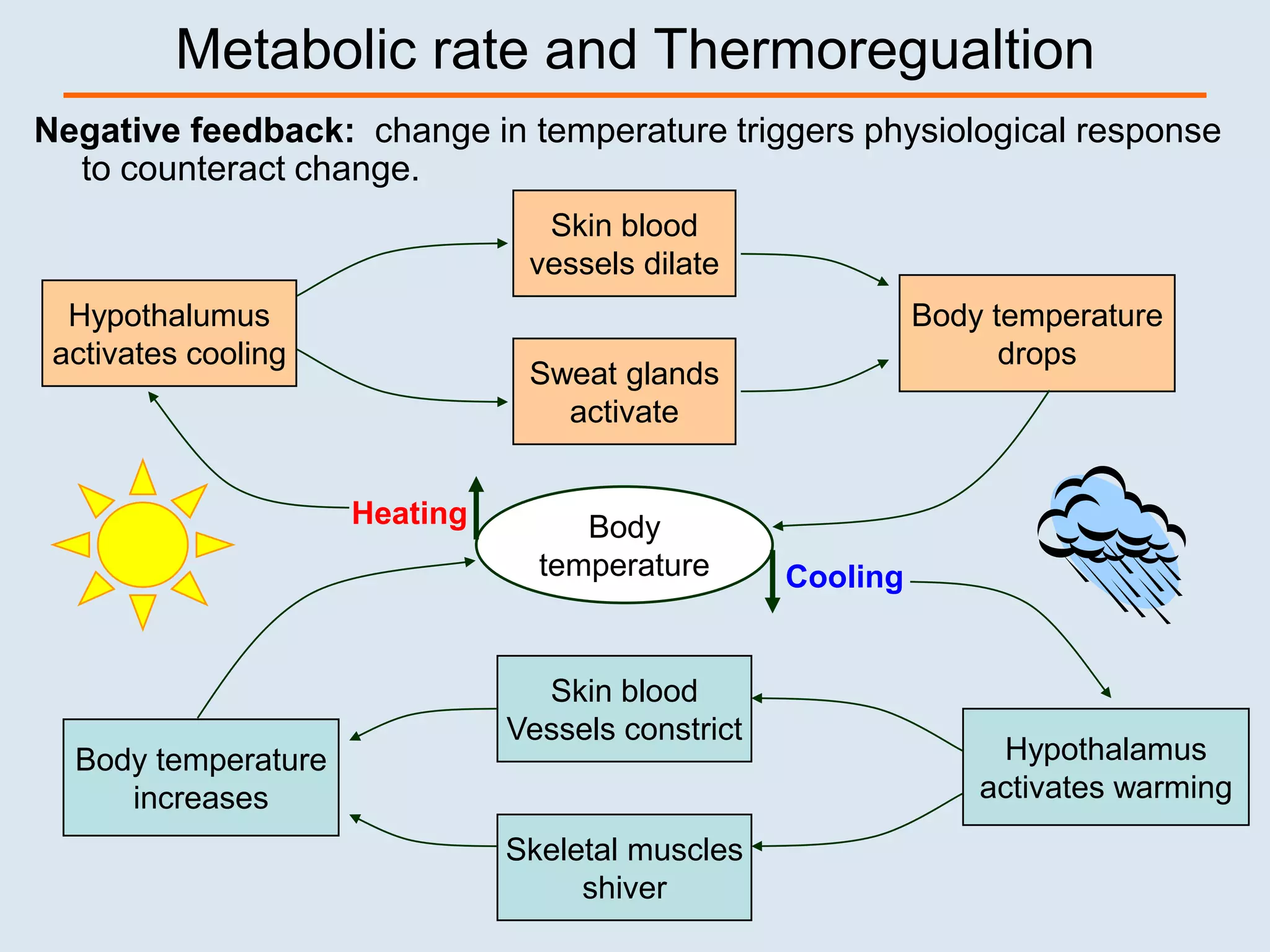
Metabolic rate and Thermoregualtion
Negative feedback: change in temperature triggers physiological response
  to counteract change.
                                 Skin blood
                                vessels dilate
  Hypothalumus                                               Body temperature
 activates cooling                                                 drops
                                Sweat glands
                                  activate


                     Heating        Body
                                 temperature       Cooling


                                 Skin blood
                               Vessels constrict
  Body temperature                                                Hypothalamus
     increases                                                   activates warming
                               Skeletal muscles
                                    shiver
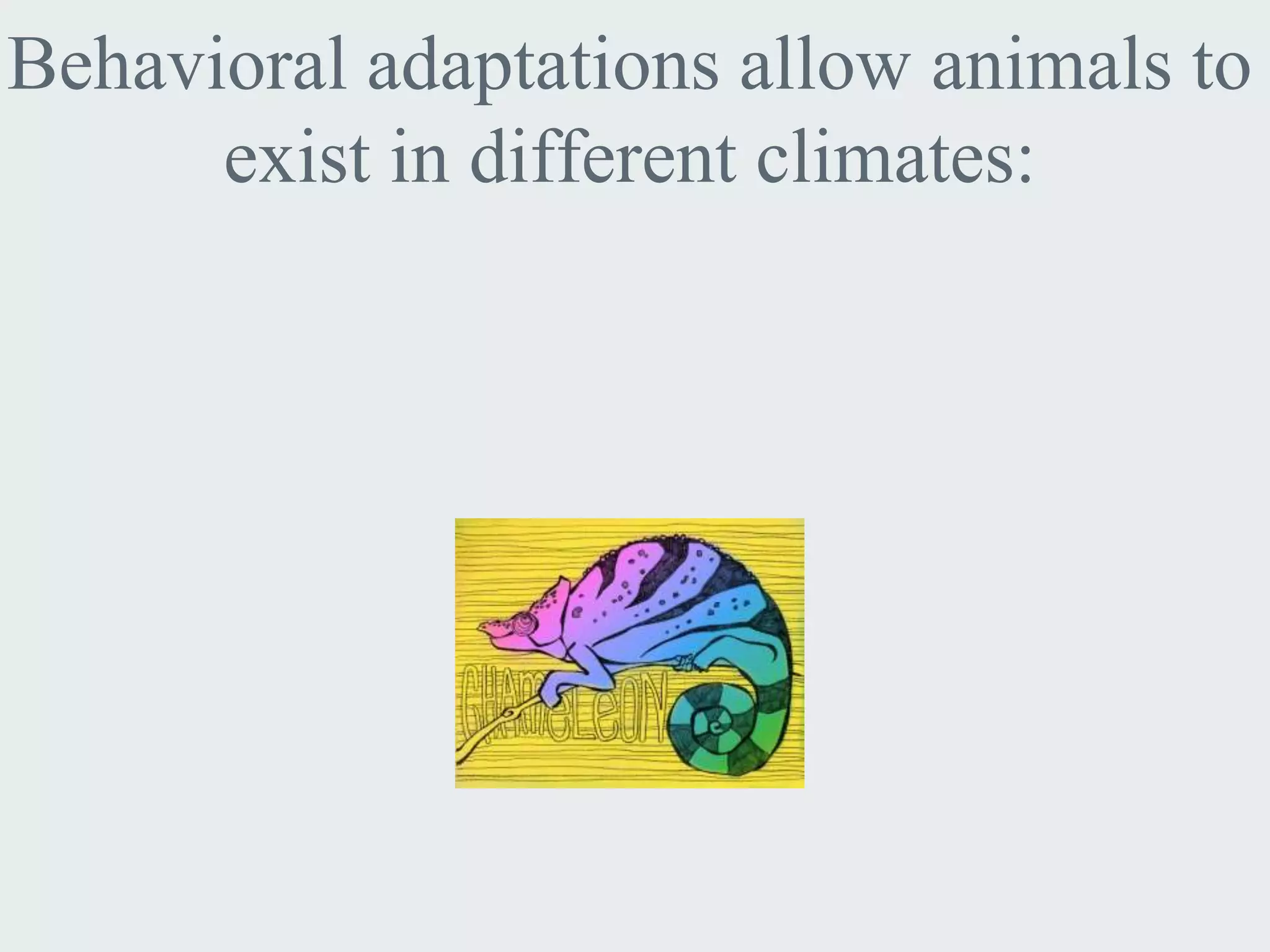
Behavioral adaptations allow animals to
      exist in different climates:
Ectotherms in hot environments
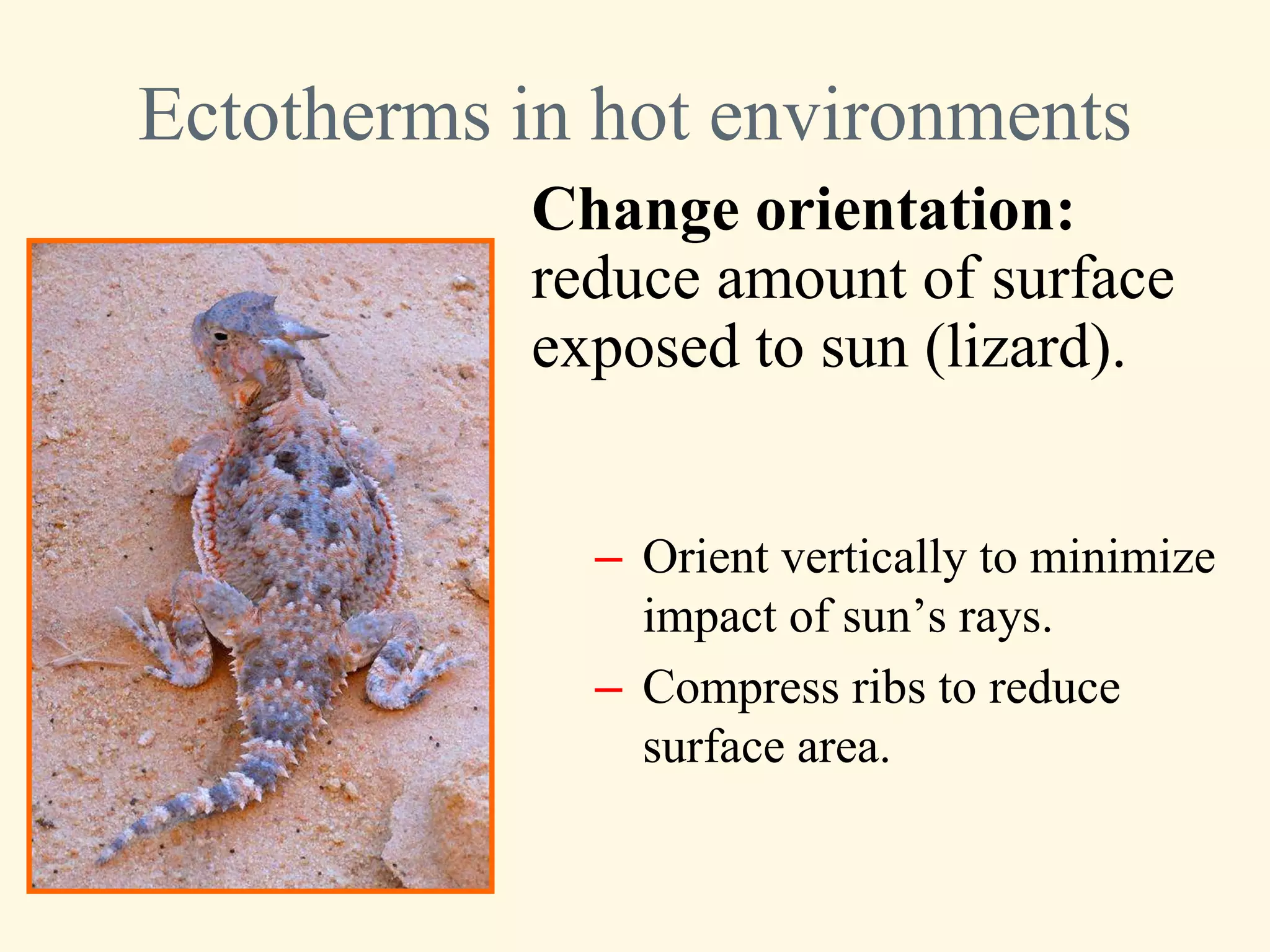
           Change orientation:
           reduce amount of surface
           exposed to sun (lizard).


             – Orient vertically to minimize
               impact of sun’s rays.
             – Compress ribs to reduce
               surface area.
Ectotherms in hot environments
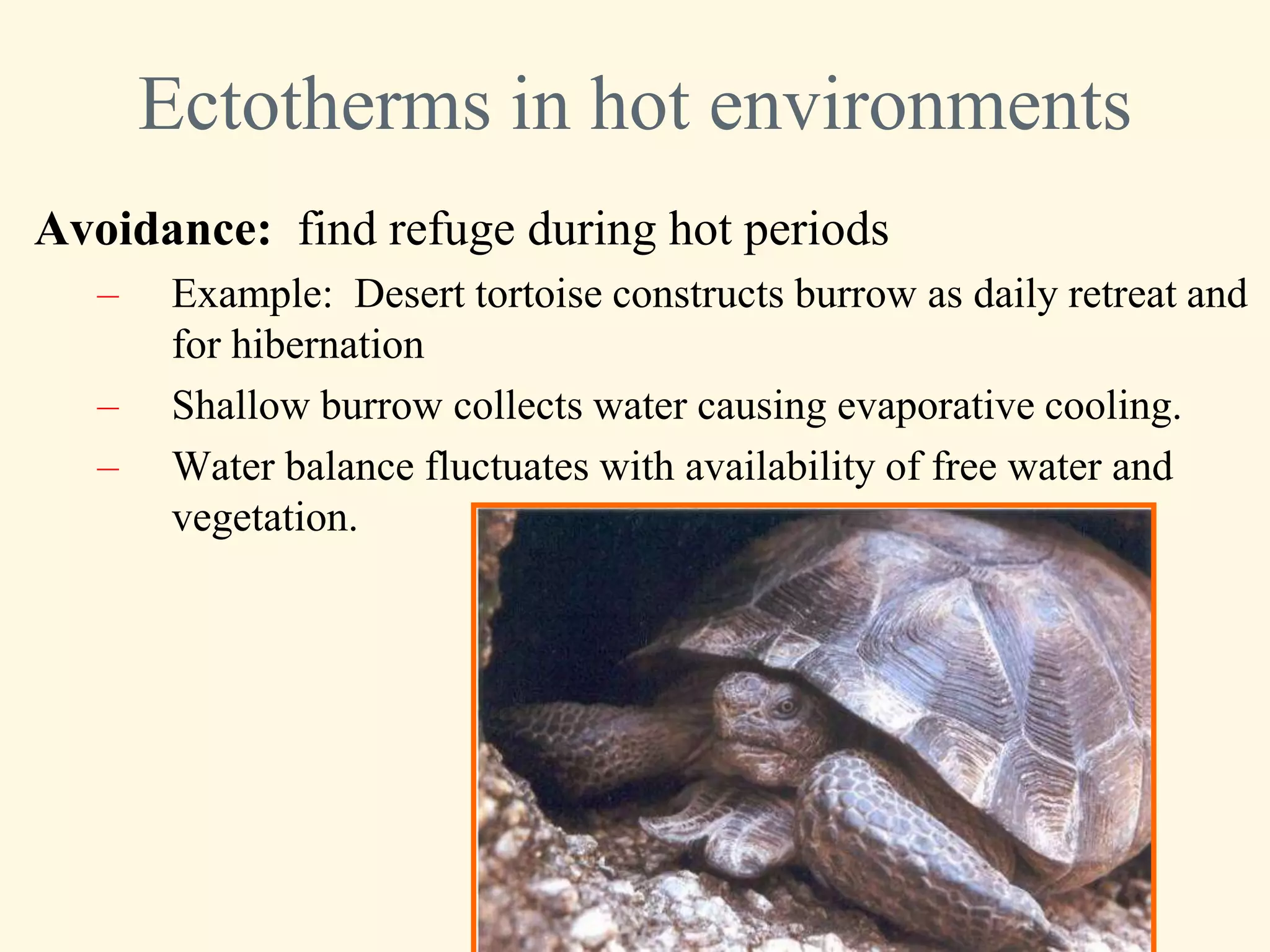
Avoidance: find refuge during hot periods
   –    Example: Desert tortoise constructs burrow as daily retreat and
        for hibernation
   –    Shallow burrow collects water causing evaporative cooling.
   –    Water balance fluctuates with availability of free water and
        vegetation.
Ectotherms in hot environments
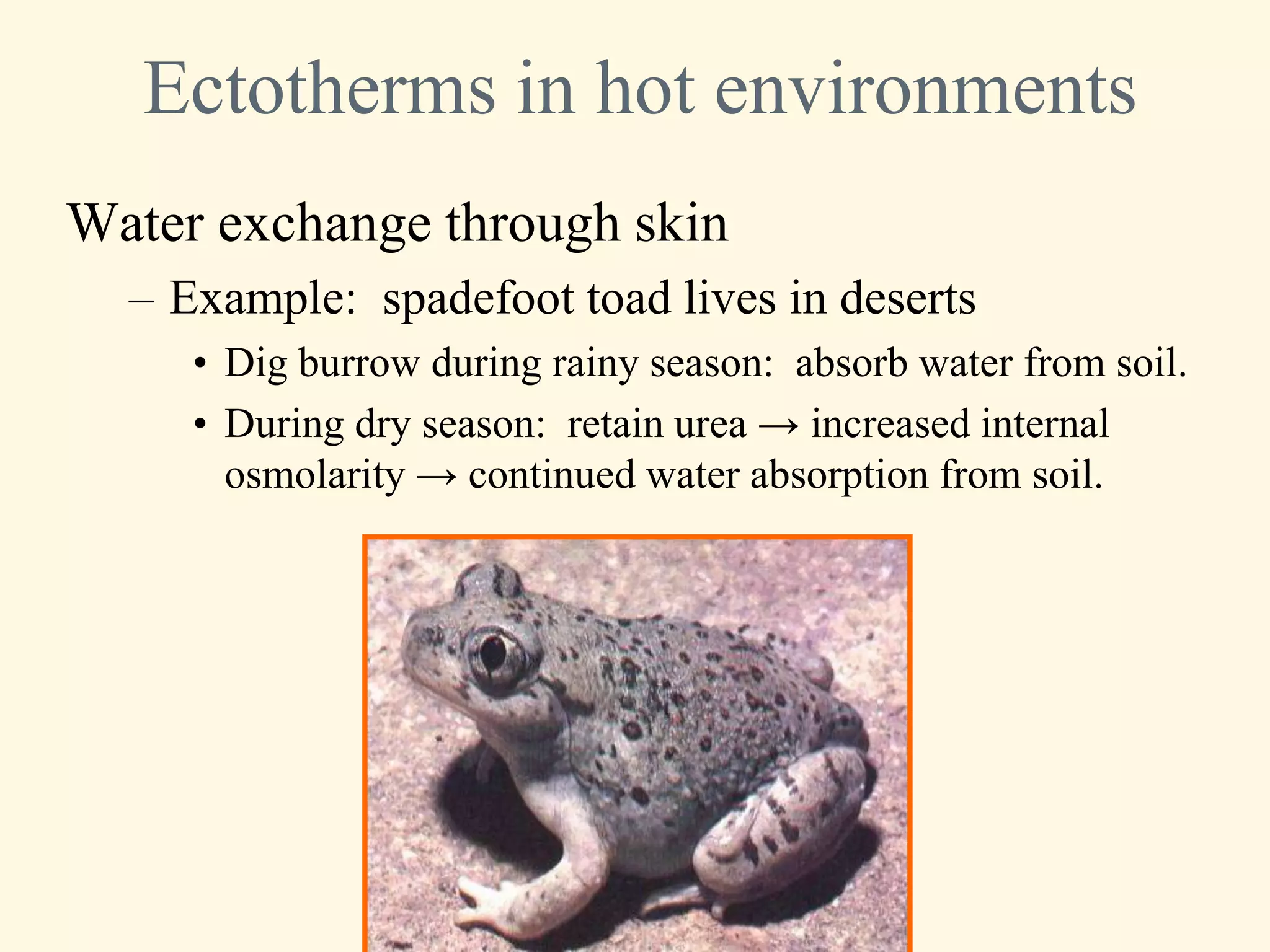
Water exchange through skin
  – Example: spadefoot toad lives in deserts
     • Dig burrow during rainy season: absorb water from soil.
     • During dry season: retain urea → increased internal
       osmolarity → continued water absorption from soil.
Hypothermia
Body temperature decreases when heat loss
  exceeds heat production or gain
• Below 93.2 degrees in homeotherms –
  impaired – below 86 completely eliminated
• Newborns have undeveloped
  thermoregulatory ability
Causes of Hypothermia
• Exposure to wind       • Surgery
• Soiled or moistened      –   Placement
  hair coat                –   shaving & wetting
• Restraint on a cold      –   cleaning solutions
  surface                  –   open incision
                           –   vasodilatory drugs
• Prolonged immobility
• Chemical restraint
  drugs & anesthesia
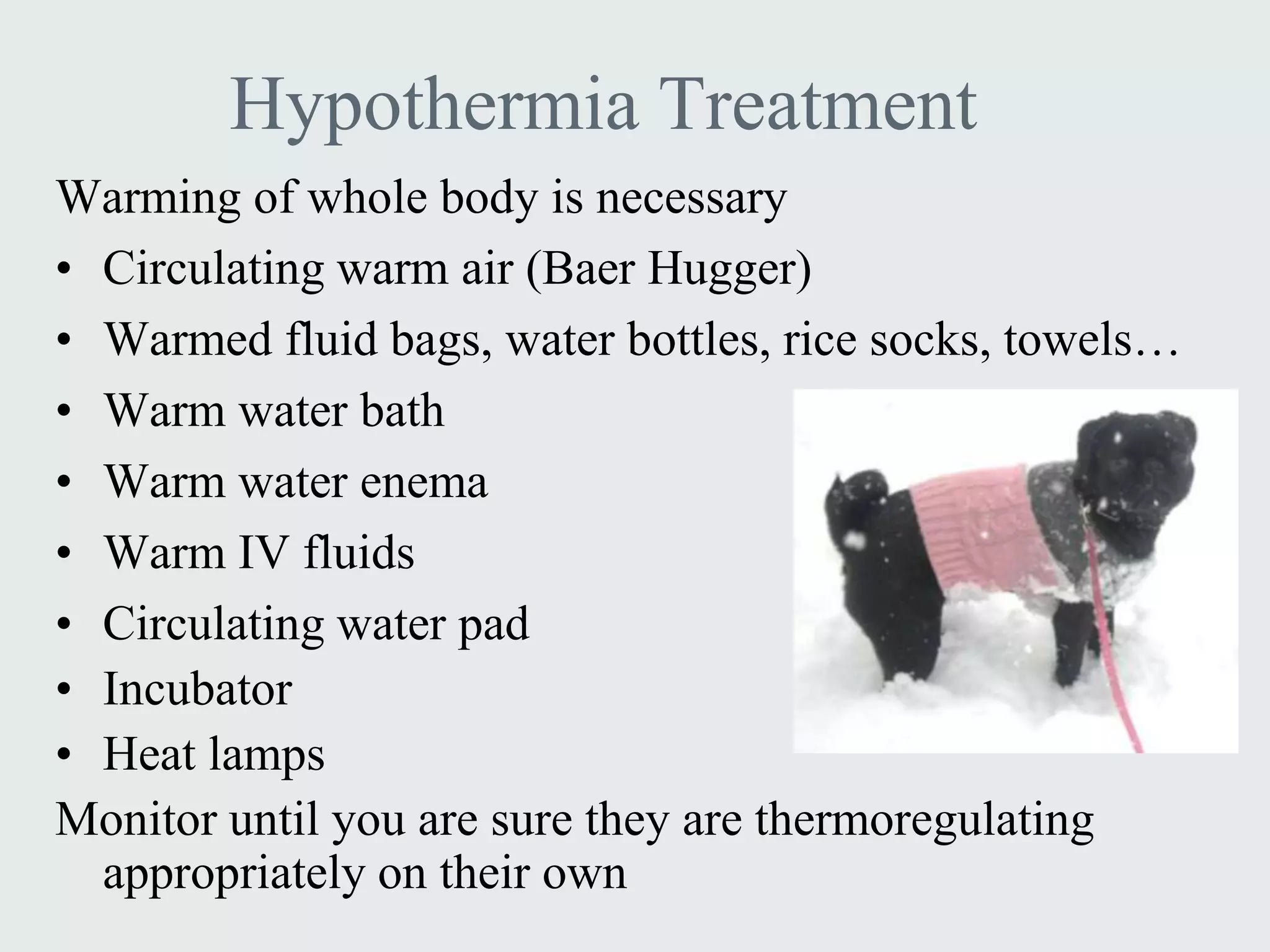
Hypothermia Treatment
Warming of whole body is necessary
• Circulating warm air (Baer Hugger)
• Warmed fluid bags, water bottles, rice socks, towels…
• Warm water bath
• Warm water enema
• Warm IV fluids
• Circulating water pad
• Incubator
• Heat lamps
Monitor until you are sure they are thermoregulating
  appropriately on their own
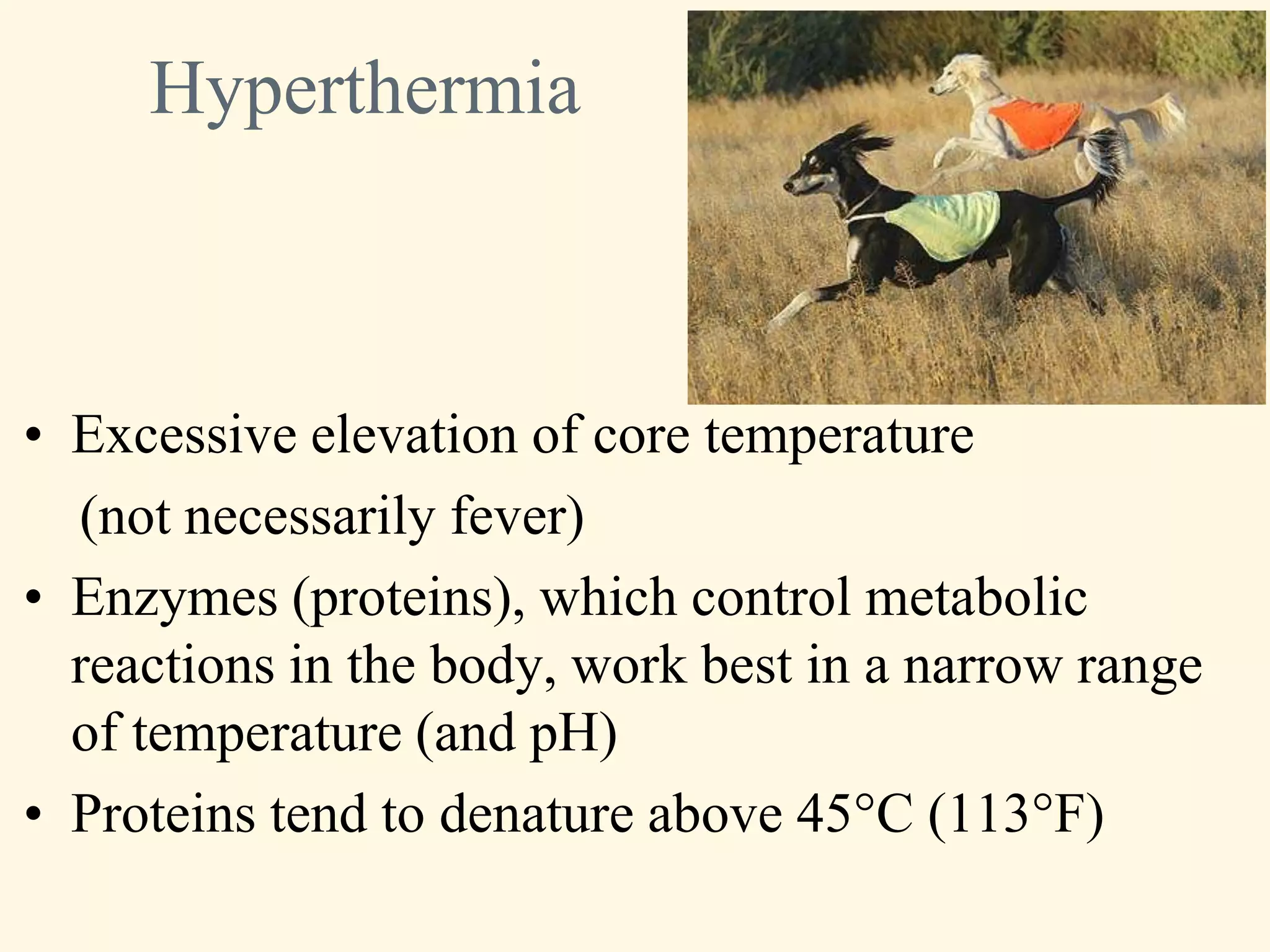
Hyperthermia


• Excessive elevation of core temperature
  (not necessarily fever)
• Enzymes (proteins), which control metabolic
  reactions in the body, work best in a narrow range
  of temperature (and pH)
• Proteins tend to denature above 45°C (113°F)
Hyperthermia
Predisposing factors:
• Increased ambient temperature
• Humidity
• Excessive muscle exertion or metabolic activity
• Physical structure – think brachycephalic breeds
• Dehydration
• Trauma
• Restraint
Hyperthermia
• The maximum body temperature
  compatible with life is ten degrees above
  normal.
• Hyperthermia increases metabolic rate and
  cellular oxygen consumption
Hyperthermia Clinical Signs
• Increased heart rate     •   Restlessness
• Increased respiration    •   Slow responses
• Open mouth breathing     •   Uncoordinated
• Sweat & salivate         •   Convulsions
  profusely at beginning   •   Collapse
• Pulse weakens            •   Death
Hyperthermia Treatment

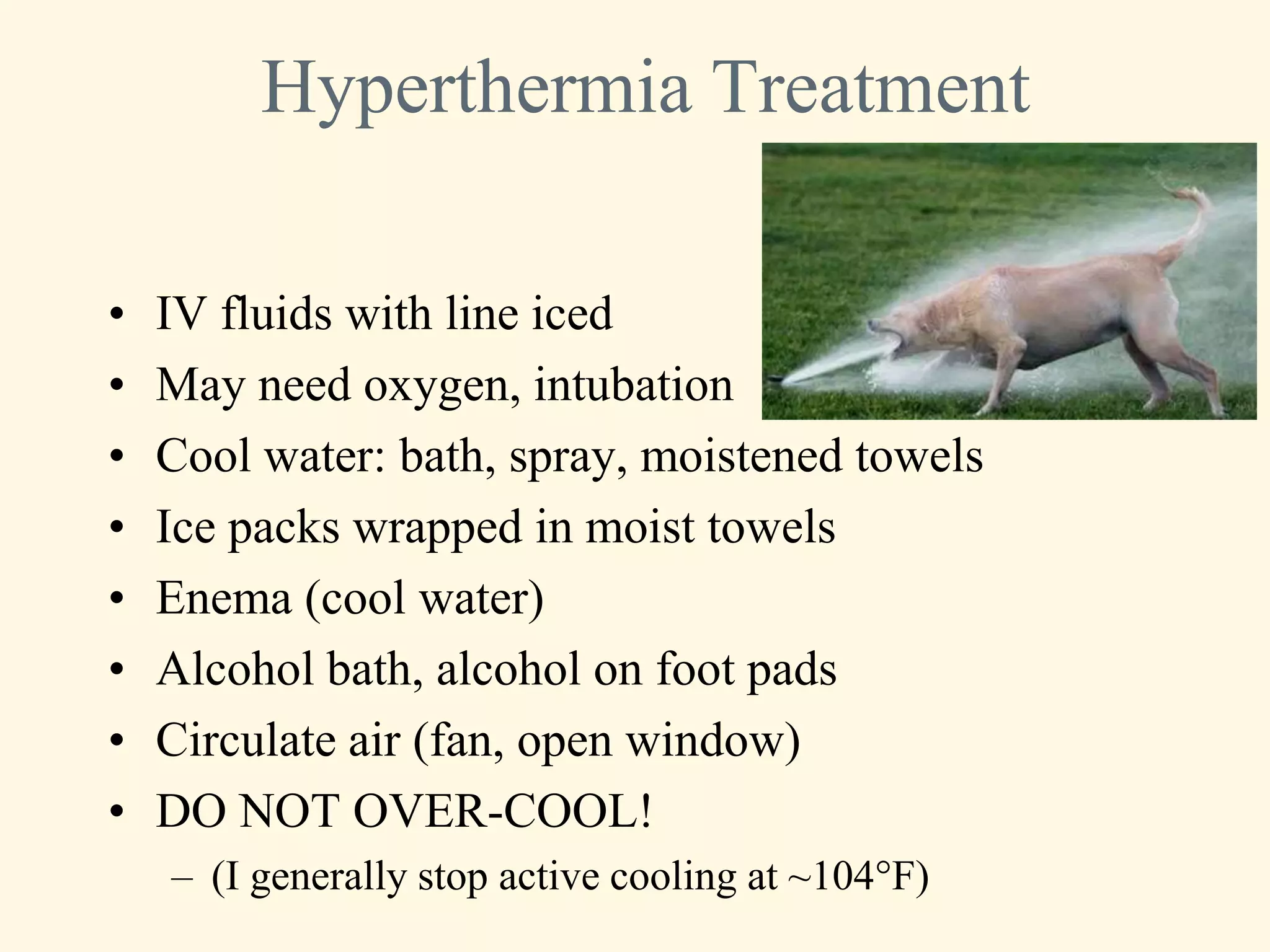
•   IV fluids with line iced
•   May need oxygen, intubation
•   Cool water: bath, spray, moistened towels
•   Ice packs wrapped in moist towels
•   Enema (cool water)
•   Alcohol bath, alcohol on foot pads
•   Circulate air (fan, open window)
•   DO NOT OVER-COOL!
    – (I generally stop active cooling at ~104°F)
Hyperthermia Treatment
• Provide diuresis, supportive care

• Hyperthermia may cause delayed organ dysfunction
• Watch P for several days, repeat CBC/Chemistry
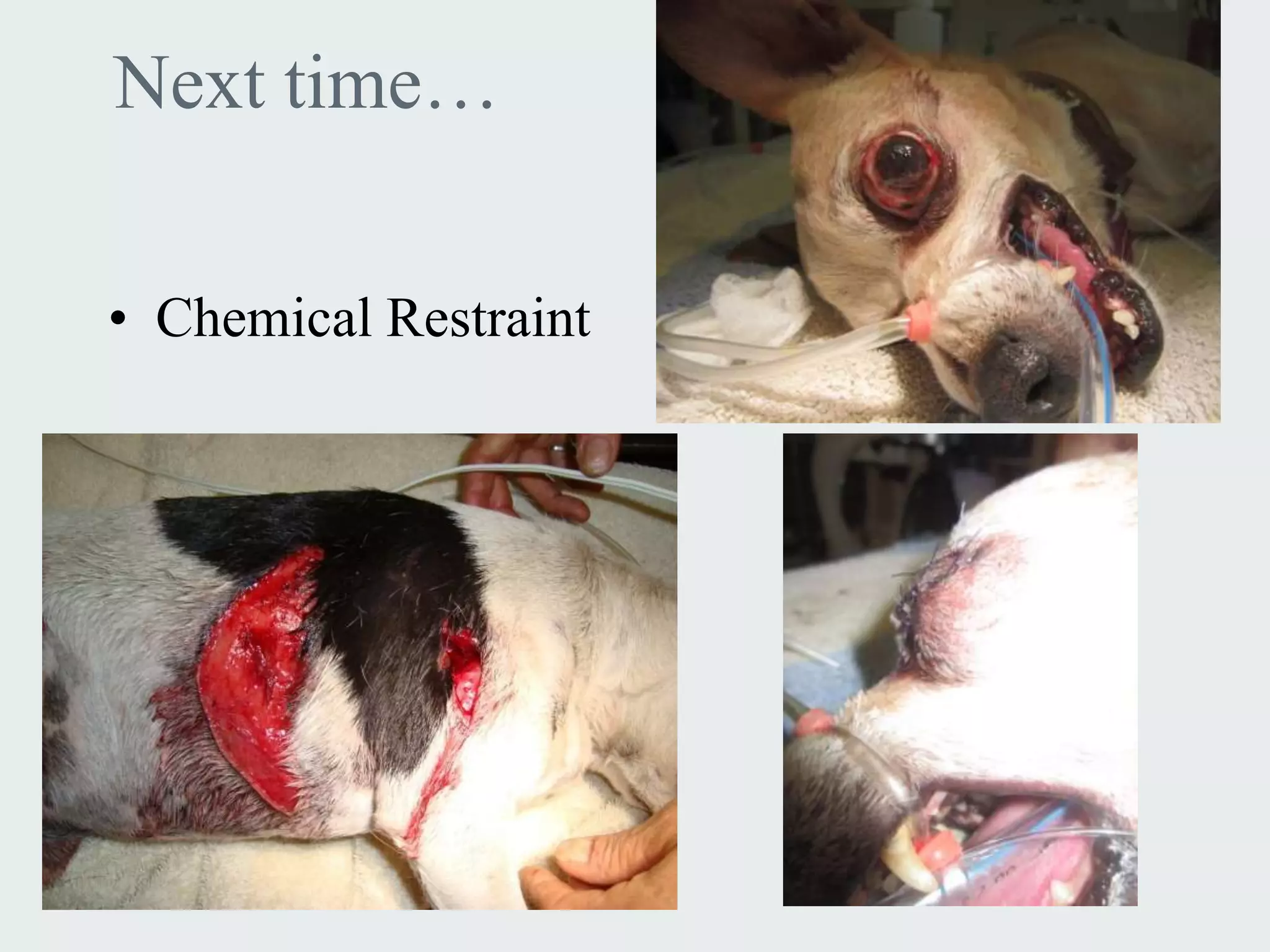
Next time…

• Chemical Restraint

Lec 09 Thermoregulation

  • 1.
    THERMOREGULATION Body temperature isdetermined by balance between heat production and heat loss. Normal function depends on a relatively constant body temperature.
  • 2.
    Why should Icare about understanding thermoregulation? • Improve patient safety – Particularly during/after anesthesia • Improve patient comfort • Improve patient willingness to participate in procedures • Facilitate understanding of hypothermia & hyperthermia causes & treatments (clinical)
  • 3.
    Metabolic rate andThermoregualtion Metabolic Rate: – Rate that an animal consumes chemical energy. – heat energy released, O2 consumed, or CO2 produced. Basal Metabolic Rate (BMR): – Metabolic rate at rest with no temperature stress or digestion occurring. – Basic functioning of vital organs
  • 4.
    Energy • An animal’sbody is an energy transformer used for: – Growth – Muscular Movement – Maintenance, including enzyme synthesis of enzymes to digest food – Reproduction – Product production (such as milk, eggs)
  • 5.
    Energy (& thusheat) comes from: • Organic compounds (food) glucose  ATP production via glycolysis, Krebs (TCA, citric acid) Cycle, Electron Transport Phosphorylation, and anaerobic (lactic acid) metabolism • Brown adipose tissue • Most prominent in neonates • Important for small mammals in cold environment, hibernating animals • Inverse correlation between amount of brown fat & BMI
  • 6.
  • 7.
    Body Temperature • TheBody Temperature is the temperature recorded on a thermometer inserted into the rectum deep enough to record the core (or internal) temperature • Temperature of skin surface may be higher or lower than core • Body temperature may be ↑ or ↓ depending on surface the animal is placed on • Effects of both internal (adipose – brown & white) and external insulating layers (hair, feathers) is important during restraint
  • 8.
    Metabolic rate andThermoregualtion • Thermoneutral zone: range of ambient temperatures in which basal metabolic rate maintained.
  • 9.
    Rectal Temperatures Species °F +/- 1° °C +/- 0.5° Cattle Beef cow 101 38.3 Dairy cow 101.5 38.6 Cat 101.5 38.6 Dog 102 38.9 Goat 102.3 39.1 Horse Mare 100 37.8 Stallion 99.7 37.6 Pig 102.5 39.2 Rabbit 103.1 39.5 Sheep 102.3 39.1 www.merckvetmanual.com *Adapted from Andersson B.E. and Jónasson H., Temperature Regulation and Environmental Physiology, in Dukes’ Physiology of Domestic Animals, 11th ed., Swenson M.J. and Reece W.O., Eds. Copyright©1993 by Cornell University.
  • 10.
    Heat Storage inCamels • In times of water deprivation, camels can store heat during the day to dissipate overnight in cooler temperatures (instead of using evaporative mechanisms which would use more water). • Temp can vary from 34°C (93°F) up to 41°C (106°F); if hydrated only varies from 36°C (97°F) to 38°C (100°F) (Schmidt-Nielsen K. Osmotic Regulation in higher vertebrates. The Harvey Lectures, 1962-63. Series 58. London Academic Press, Inc., 1963:53-93)
  • 11.
    Body temperature isaffected by: – Ambient temperature – Level of activity – Digestion, food & water intake – Time of day (higher when typically active) • Diurnal animals – lower temp in am, then warms up • Nocturnal animals – higher temp in am, cools down during day – Time of year (hibernation)
  • 12.
    Endotherms in ColdEnvironments Torpor: adaptive hypothermia. – The dormant, inactive state of a hibernating or estivating animal. – Birds, daily in cold months – Example chickadees • Fat stores accumulated during day supply energy for cold nights. • Stored fat is not enough to survive the night without torpor.
  • 13.
    Endotherms in HotEnvironments Estivation: period of torpor during hot periods (e.g., pocket mouse) – A state of dormancy or torpor during the summer. • Estivate during periods of food scarcity. • Duration of torpor proportional to severity of food deprivation. • Frogs, toads, snails, worms, lungfish
  • 14.
    • Hibernation – An inactive state resembling deep sleep in which certain animals living in cold climates pass the winter. – Bats, ground squirrels, some other rodents • Brumation – A state of cold-period dormancy or reduced activity in cold-blooded animals. Unlike hibernation, the animal may remain partially active during brumation.
  • 15.
    Homeotherm (endotherm) • Capableof regulating temperature internally • Also called “warm-blooded” • Primarily controlled unconsciously within the body: Core temperature rises  heat energy is transported to skin surface via blood  released into environment by conduction, convection, radiation or the evaporation of sweat • Birds and mammals
  • 16.
    Homeotherm (endotherm) • Whenbody heat production is stable, blood flow into dermis (layer of the skin / integument) depends on changes in ambient temperature
  • 17.
    Homeotherm (endotherm) • Vertebratesalso regulate temperature via hypothalamus – Autonomic nervous system, involuntary response – Receptors in hypothalamus monitor blood temp in brain – Skin receptors monitor temp as well and send info to hypothalamus
  • 18.
    Poikilotherm (ectotherm) • Relyon external sources for heat and coolness to regulate body temperature • Also called “cold-blooded” • Primarily controlled through behavior adaptions • Reptiles, fish, amphibians
  • 20.
    Heat Production • Heatgained/temperature increased by: – increased production or – by absorption from the environment • Production is through: 1. ↑ muscle tone - shivering 2. Exercise 3. Eating 4. Fever (pyrexia) 5. Brown adipose
  • 21.
    Endotherms in Cold Environments • Thermogenesis: a. Shivering: brief contractions of antagonistic muscle groups produces heat without motion. b. Non-shivering thermogenesis: fat metabolized to produce heat; regulated by sympathetic nervous system. • White adipose tissue: fats reduced to fatty acids for metabolism elsewhere in body. • Brown fat: fat metabolized within fat cells for rapid release of heat (thermogenin uncouples electron transport from ATP production) Fig. 17-2
  • 22.
    Physics of HeatTransfer • Heat flows from areas of high temperature to areas of low temperature. • Forms of heat transfer: 1. Conduction: between bodies in contact. 2. Convection: movement of air or water over a surface; continuous replacement of fluid maximizes heat transfer. 3. Radiation: emission of electromagnetic energy from an object. Animals radiate primarily in the infrared. 4. Evaporation: conversion of liquid to gas; causes cooling.
  • 23.
    Heat from environmentis via: 1. Radiation 2. Conduction 3. Convection
  • 24.
    Radiation • Electromagnetic wavestransfer energy without heating the intervening air. Sun most important source All warm objects (including animals) give off radiant energy
  • 25.
    Conduction • Direct transferof heat between an animal and an object. • The direction is from higher to lower temperature
  • 26.
    Convection • Transmission ofheat by movement of a medium surrounding or within an object: – Air – Water – Blood
  • 27.
    Ectotherms in hotenvironments • Localized vasodilation: shunt heat from cool regions to warmed regions. Example: marine iguana – Chilled at night and basks in morning sun. – Warmed blood causes vasodilation on both dorsal and ventral sides. – Air is cooled on ventral side by convection. – Cool belly acts as heat shunt.
  • 28.
    Heat Conservation • Heatis conserved through vascular responses: 1. Blood vessels near surface constrict to allow skin temperature to drop without jeopardizing core temperature 2. Velocity of blood flow increases which decreases exposure time to cold
  • 29.
    Endotherms in ColdEnvironments Insulation: a. Hair, feathers; • Pilomotor control. • Shedding/molting allows seasonal changes. b. Blubber • Metabolically inactive. • Vasoconstriction reduces heat loss.
  • 30.
    Heat Reduction (cooling) • Takes place through: 1. Conduction 2. Convection 3. Radiation 4. Evaporation 5. Excretion
  • 31.
    Metabolic rate andThermoregualtion Negative feedback: change in temperature triggers physiological response to counteract change. Skin blood vessels dilate Hypothalumus Body temperature activates cooling drops Sweat glands activate Heating Body temperature Cooling Skin blood Vessels constrict Body temperature Hypothalamus increases activates warming Skeletal muscles shiver
  • 32.
    Behavioral adaptations allowanimals to exist in different climates:
  • 33.
    Ectotherms in hotenvironments Change orientation: reduce amount of surface exposed to sun (lizard). – Orient vertically to minimize impact of sun’s rays. – Compress ribs to reduce surface area.
  • 34.
    Ectotherms in hotenvironments Avoidance: find refuge during hot periods – Example: Desert tortoise constructs burrow as daily retreat and for hibernation – Shallow burrow collects water causing evaporative cooling. – Water balance fluctuates with availability of free water and vegetation.
  • 35.
    Ectotherms in hotenvironments Water exchange through skin – Example: spadefoot toad lives in deserts • Dig burrow during rainy season: absorb water from soil. • During dry season: retain urea → increased internal osmolarity → continued water absorption from soil.
  • 36.
    Hypothermia Body temperature decreaseswhen heat loss exceeds heat production or gain • Below 93.2 degrees in homeotherms – impaired – below 86 completely eliminated • Newborns have undeveloped thermoregulatory ability
  • 37.
    Causes of Hypothermia •Exposure to wind • Surgery • Soiled or moistened – Placement hair coat – shaving & wetting • Restraint on a cold – cleaning solutions surface – open incision – vasodilatory drugs • Prolonged immobility • Chemical restraint drugs & anesthesia
  • 38.
    Hypothermia Treatment Warming ofwhole body is necessary • Circulating warm air (Baer Hugger) • Warmed fluid bags, water bottles, rice socks, towels… • Warm water bath • Warm water enema • Warm IV fluids • Circulating water pad • Incubator • Heat lamps Monitor until you are sure they are thermoregulating appropriately on their own
  • 39.
    Hyperthermia • Excessive elevationof core temperature (not necessarily fever) • Enzymes (proteins), which control metabolic reactions in the body, work best in a narrow range of temperature (and pH) • Proteins tend to denature above 45°C (113°F)
  • 40.
    Hyperthermia Predisposing factors: • Increasedambient temperature • Humidity • Excessive muscle exertion or metabolic activity • Physical structure – think brachycephalic breeds • Dehydration • Trauma • Restraint
  • 41.
    Hyperthermia • The maximumbody temperature compatible with life is ten degrees above normal. • Hyperthermia increases metabolic rate and cellular oxygen consumption
  • 42.
    Hyperthermia Clinical Signs •Increased heart rate • Restlessness • Increased respiration • Slow responses • Open mouth breathing • Uncoordinated • Sweat & salivate • Convulsions profusely at beginning • Collapse • Pulse weakens • Death
  • 43.
    Hyperthermia Treatment • IV fluids with line iced • May need oxygen, intubation • Cool water: bath, spray, moistened towels • Ice packs wrapped in moist towels • Enema (cool water) • Alcohol bath, alcohol on foot pads • Circulate air (fan, open window) • DO NOT OVER-COOL! – (I generally stop active cooling at ~104°F)
  • 44.
    Hyperthermia Treatment • Providediuresis, supportive care • Hyperthermia may cause delayed organ dysfunction • Watch P for several days, repeat CBC/Chemistry
  • 45.