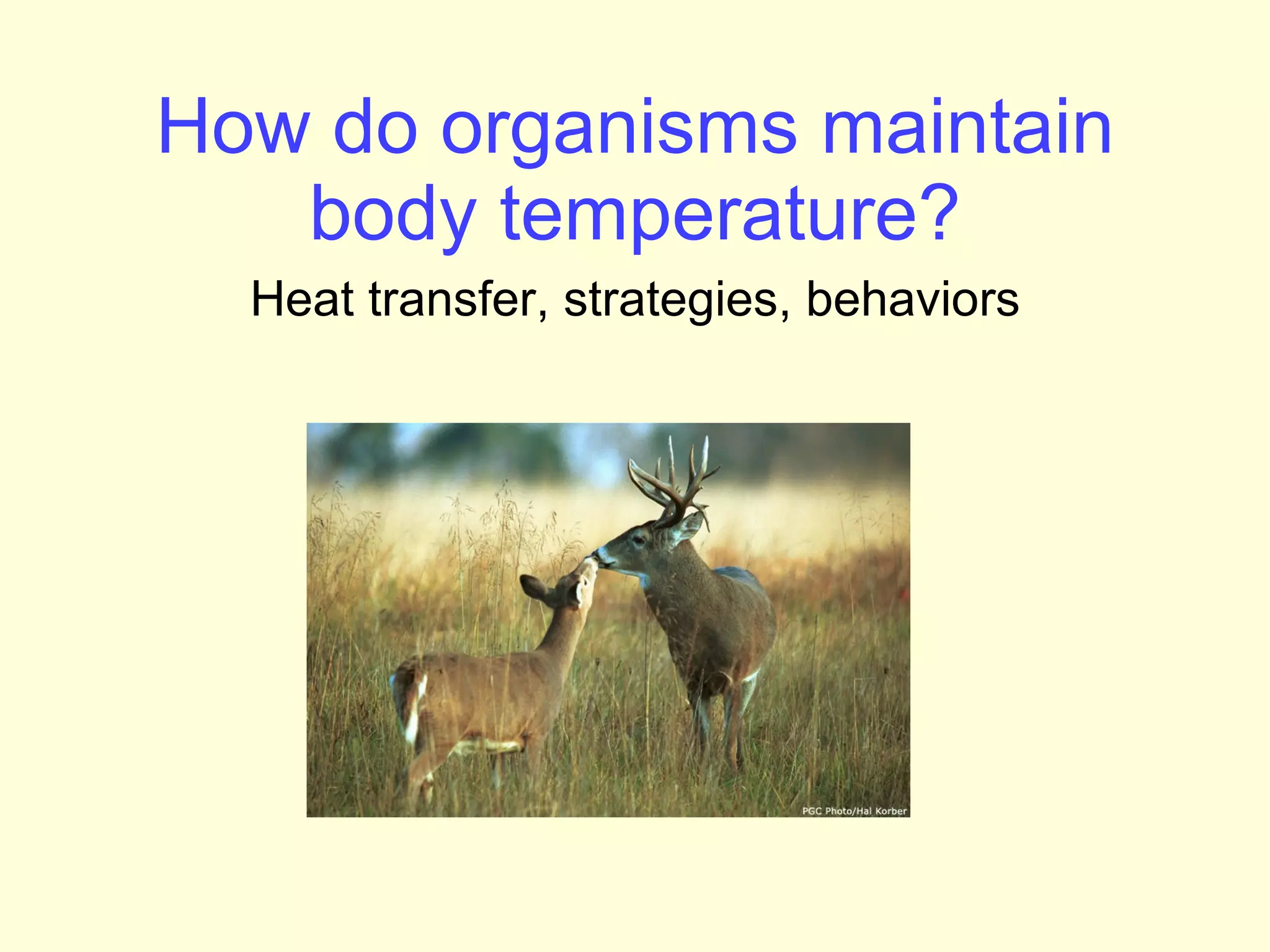
How do organisms maintain body temperature? Heat transfer, strategies, behaviors
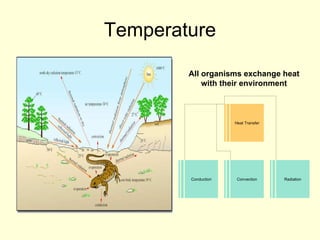
Temperature All organisms exchange heat with their environment Heat Transfer Conduction Convection Radiation
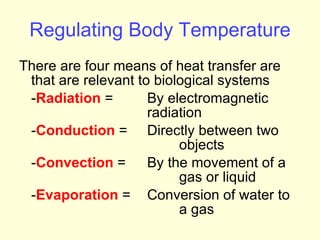
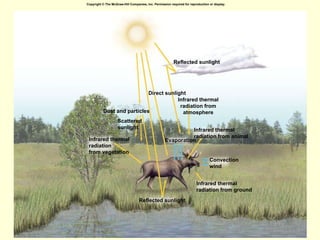
Regulating Body Temperature There are four means of heat transfer are that are relevant to biological systems - Radiation  =   By electromagnetic  radiation - Conduction  =   Directly between two  objects - Convection  =   By the movement of a  gas or liquid - Evaporation  =   Conversion of water to  a gas
Plants Control Body Heat Who knew? Plants are fixed in place, trapped in sunlight or in cold.  Temperatures above and below the soil can vary 20 or more degrees. Leaves collect solar radiation on their surfaces and reflect some radiation back into the atmosphere. Photosynthesis in the plant is heat sensitive.
Problems and Strategies in Regulating Body Temperature The rate of any chemical reaction is affected by temperature -the effect of temperature is mainly on the enzymes involved in metabolism -Terrestrial plants lose heat by convection and evaporation through their stomata -aquatic plants lose heat by convection
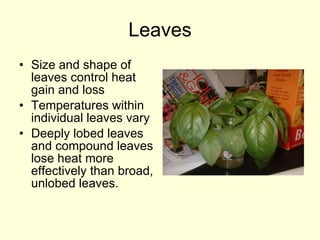
Leaves Size and shape of leaves control heat gain and loss Temperatures within individual leaves vary Deeply lobed leaves and compound leaves lose heat more effectively than broad, unlobed leaves.
Regulating Body Temperature Body temperature is determined by internal factors, such as metabolism, external factors that affect heat transfer, as well as behavior Body heat = heat produced + heat transferred -Note that the heat transferred can be either positive or negative -Can be used for both heating and  cooling
Direct sunlight Infrared thermal radiation from atmosphere Infrared thermal radiation from animal Convection wind Evaporation Dust and particles Scattered sunlight Infrared thermal radiation from vegetation Reflected sunlight Reflected sunlight Infrared thermal radiation from ground Copyright © The McGraw-Hill Companies, Inc. Permission required for reproduction or display.
Regulating Body Temperature Heat transfer also depends on other factors, that influence these four physical processes  -Surface area to mass ratio (or the difference between a shrew and an elephant) -Difference between ambient and body temperature -Specific   heat conduction
Classification of Organisms For many years, animals were classified according to whether they maintained a constant body temperature - Homeotherms  =   Regulate their body temperature about a set point -Also called “warm-blooded” (like you!) - Poikilotherms  =   Allow their body temperature to conform to the environment -Also called “cold-blooded” (like a fish)
Classification of Organisms Limitations to these two classifications led to another view based on how body heat is generated - Endotherms  =   Use metabolism to generate body heat and maintain temperature above ambient temperature - Ectotherms  =   Do not use metabolism to produce heat and have body temperature that conforms to ambient temperature -Heterotherms  fall between these extremes sometimes using endothermy and sometimes ectothermy (Bees, bats and hummingbirds)
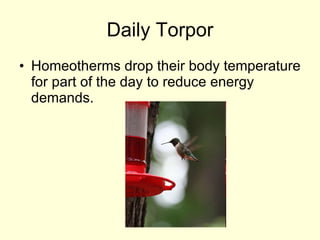
Daily Torpor Homeotherms drop their body temperature for part of the day to reduce energy demands.
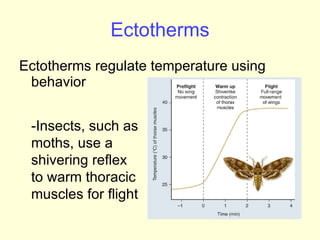
Ectotherms Ectotherms regulate temperature using behavior -Insects, such as moths, use a shivering reflex to warm thoracic muscles for flight
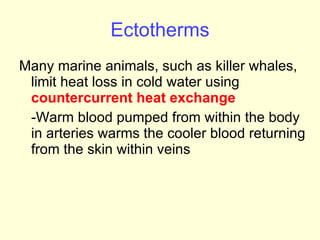
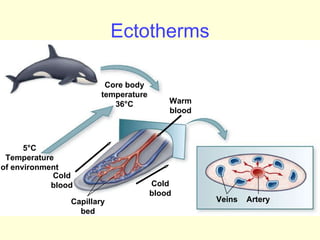
Ectotherms Many marine animals, such as killer whales, limit heat loss in cold water using  countercurrent heat exchange -Warm blood pumped from within the body in arteries warms the cooler blood returning from the skin within veins
Ectotherms Cold blood Cold blood Capillary bed 5°C Temperature of environment Core body temperature 36°C Veins Artery Warm blood
Ectotherms Reptiles place themselves in varying locations of sunlight and shade -Some can maximize the effect of behavioral regulation by also controlling blood flow In general, ectotherms have low metabolic rates, which have the advantage of low energy intake -However, they are not capable of sustained high-energy activity
Endotherms A high metabolic rate can be used to warm the endotherm if it is cold The simplest way to regulate body temperature is by the control of blood flow to the surface of the animal -dilation of vessels (vasodilatation) increases blood flow, thereby increasing heat dissipation -constriction of blood vessels (vasoconstriction) decreases blood flow, thus limiting heat loss
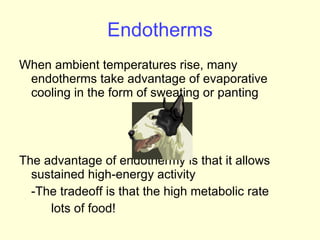
Endotherms When ambient temperatures rise, many endotherms take advantage of evaporative cooling in the form of sweating or panting The advantage of endothermy is that it allows sustained high-energy activity -The tradeoff is that the high metabolic rate lots of food!
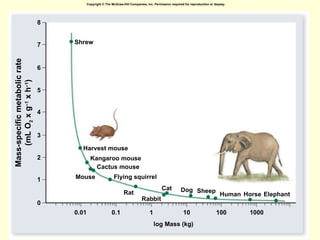
Endotherms In animal physiology, size does matter! -Smaller animals have much higher metabolic rates per unit body mass relative to larger animals -Small endotherms in cold environments  require significant insulation to maintain  their body temperature -Large endotherms in hot environments  usually have little insulation
Mass-specific metabolic rate (mL O 2  x g –1  x h –1 ) log Mass (kg) Shrew Harvest mouse Kangaroo mouse Cactus mouse Mouse Flying squirrel Cat Rat Rabbit Dog Sheep Human Horse 1000 100 10 1 1 0 2 3 4 5 6 7 8 0.1 0.01 Elephant Copyright © The McGraw-Hill Companies, Inc. Permission required for reproduction or display.
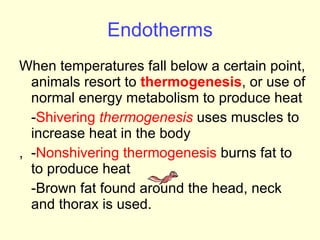
Endotherms When temperatures fall below a certain point, animals resort to  thermogenesis , or use of normal energy metabolism to produce heat - Shivering  thermogenesis  uses muscles to increase heat in the body ,  - Nonshivering thermogenesis  burns fat to to produce heat  -Brown fat found around the head, neck and thorax is used.
STOP Chapter 6,  p.55 Do you have these defined? conduction    poikilotherm   convection heterotherm thermal radiation daily torpor evaporation hibernation ectotherm endotherm countercurrent circulation supercooling homeotherm nonshivering thermogenesis

How do organisms maintain body temperature

  • 1.
    How do organismsmaintain body temperature? Heat transfer, strategies, behaviors
  • 2.
    Temperature All organismsexchange heat with their environment Heat Transfer Conduction Convection Radiation
  • 3.
    Regulating Body TemperatureThere are four means of heat transfer are that are relevant to biological systems - Radiation = By electromagnetic radiation - Conduction = Directly between two objects - Convection = By the movement of a gas or liquid - Evaporation = Conversion of water to a gas
  • 4.
    Plants Control BodyHeat Who knew? Plants are fixed in place, trapped in sunlight or in cold. Temperatures above and below the soil can vary 20 or more degrees. Leaves collect solar radiation on their surfaces and reflect some radiation back into the atmosphere. Photosynthesis in the plant is heat sensitive.
  • 5.
    Problems and Strategiesin Regulating Body Temperature The rate of any chemical reaction is affected by temperature -the effect of temperature is mainly on the enzymes involved in metabolism -Terrestrial plants lose heat by convection and evaporation through their stomata -aquatic plants lose heat by convection
  • 6.
    Leaves Size andshape of leaves control heat gain and loss Temperatures within individual leaves vary Deeply lobed leaves and compound leaves lose heat more effectively than broad, unlobed leaves.
  • 7.
    Regulating Body TemperatureBody temperature is determined by internal factors, such as metabolism, external factors that affect heat transfer, as well as behavior Body heat = heat produced + heat transferred -Note that the heat transferred can be either positive or negative -Can be used for both heating and cooling
  • 8.
    Direct sunlight Infraredthermal radiation from atmosphere Infrared thermal radiation from animal Convection wind Evaporation Dust and particles Scattered sunlight Infrared thermal radiation from vegetation Reflected sunlight Reflected sunlight Infrared thermal radiation from ground Copyright © The McGraw-Hill Companies, Inc. Permission required for reproduction or display.
  • 9.
    Regulating Body TemperatureHeat transfer also depends on other factors, that influence these four physical processes -Surface area to mass ratio (or the difference between a shrew and an elephant) -Difference between ambient and body temperature -Specific heat conduction
  • 10.
    Classification of OrganismsFor many years, animals were classified according to whether they maintained a constant body temperature - Homeotherms = Regulate their body temperature about a set point -Also called “warm-blooded” (like you!) - Poikilotherms = Allow their body temperature to conform to the environment -Also called “cold-blooded” (like a fish)
  • 11.
    Classification of OrganismsLimitations to these two classifications led to another view based on how body heat is generated - Endotherms = Use metabolism to generate body heat and maintain temperature above ambient temperature - Ectotherms = Do not use metabolism to produce heat and have body temperature that conforms to ambient temperature -Heterotherms fall between these extremes sometimes using endothermy and sometimes ectothermy (Bees, bats and hummingbirds)
  • 12.
    Daily Torpor Homeothermsdrop their body temperature for part of the day to reduce energy demands.
  • 13.
    Ectotherms Ectotherms regulatetemperature using behavior -Insects, such as moths, use a shivering reflex to warm thoracic muscles for flight
  • 14.
    Ectotherms Many marineanimals, such as killer whales, limit heat loss in cold water using countercurrent heat exchange -Warm blood pumped from within the body in arteries warms the cooler blood returning from the skin within veins
  • 15.
    Ectotherms Cold bloodCold blood Capillary bed 5°C Temperature of environment Core body temperature 36°C Veins Artery Warm blood
  • 16.
    Ectotherms Reptiles placethemselves in varying locations of sunlight and shade -Some can maximize the effect of behavioral regulation by also controlling blood flow In general, ectotherms have low metabolic rates, which have the advantage of low energy intake -However, they are not capable of sustained high-energy activity
  • 17.
    Endotherms A highmetabolic rate can be used to warm the endotherm if it is cold The simplest way to regulate body temperature is by the control of blood flow to the surface of the animal -dilation of vessels (vasodilatation) increases blood flow, thereby increasing heat dissipation -constriction of blood vessels (vasoconstriction) decreases blood flow, thus limiting heat loss
  • 18.
    Endotherms When ambienttemperatures rise, many endotherms take advantage of evaporative cooling in the form of sweating or panting The advantage of endothermy is that it allows sustained high-energy activity -The tradeoff is that the high metabolic rate lots of food!
  • 19.
    Endotherms In animalphysiology, size does matter! -Smaller animals have much higher metabolic rates per unit body mass relative to larger animals -Small endotherms in cold environments require significant insulation to maintain their body temperature -Large endotherms in hot environments usually have little insulation
  • 20.
    Mass-specific metabolic rate(mL O 2 x g –1 x h –1 ) log Mass (kg) Shrew Harvest mouse Kangaroo mouse Cactus mouse Mouse Flying squirrel Cat Rat Rabbit Dog Sheep Human Horse 1000 100 10 1 1 0 2 3 4 5 6 7 8 0.1 0.01 Elephant Copyright © The McGraw-Hill Companies, Inc. Permission required for reproduction or display.
  • 21.
    Endotherms When temperaturesfall below a certain point, animals resort to thermogenesis , or use of normal energy metabolism to produce heat - Shivering thermogenesis uses muscles to increase heat in the body , - Nonshivering thermogenesis burns fat to to produce heat -Brown fat found around the head, neck and thorax is used.
  • 22.
    STOP Chapter 6, p.55 Do you have these defined? conduction poikilotherm convection heterotherm thermal radiation daily torpor evaporation hibernation ectotherm endotherm countercurrent circulation supercooling homeotherm nonshivering thermogenesis