Introduction to Docker
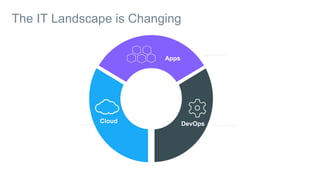
The IT Landscape is Changing
Docker Survey: State of App development : Q1 - 2016
Apps
DevOpsCloud
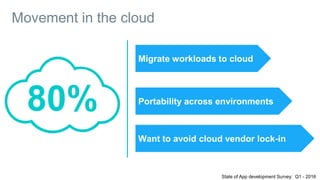
80%
Migrate workloads to cloud
Portability across environments
Want to avoid cloud vendor lock-in
Movement in the cloud
State of App development Survey: Q1 - 2016
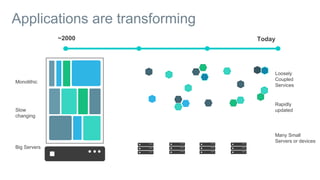
Applications are transforming
Loosely
Coupled
Services
Many Small
Servers or devices
~2000 Today
Monolithic
Big Servers
Slow
changing
Rapidly
updated
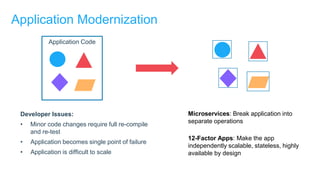
Application Modernization
Application Code
Developer Issues:
• Minor code changes require full re-compile
and re-test
• Application becomes single point of failure
• Application is difficult to scale
Microservices: Break application into
separate operations
12-Factor Apps: Make the app
independently scalable, stateless, highly
available by design
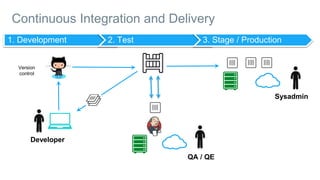
Continuous Integration and Delivery
Developer
Version
control
1. Development 2. Test 3. Stage / Production
QA / QE
Sysadmin
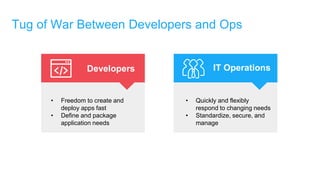
Tug of War Between Developers and Ops
Developers IT Operations
• Freedom to create and
deploy apps fast
• Define and package
application needs
• Quickly and flexibly
respond to changing needs
• Standardize, secure, and
manage
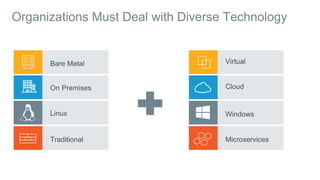
Bare Metal
Linux
On Premises
Traditional
Virtual
Windows
Cloud
Microservices
Organizations Must Deal with Diverse Technology
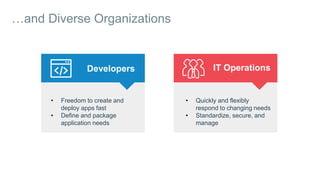
Developers IT Operations
• Freedom to create and
deploy apps fast
• Define and package
application needs
• Quickly and flexibly
respond to changing needs
• Standardize, secure, and
manage
…and Diverse Organizations
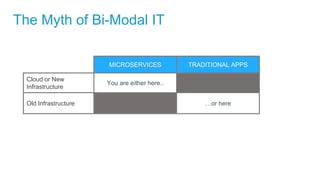
The Myth of Bi-Modal IT
MICROSERVICES TRADITIONAL APPS
Cloud or New
Infrastructure
You are either here..
Old Infrastructure …or here
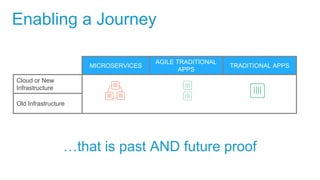
Enabling a Journey
MICROSERVICES
AGILE TRADITIONAL
APPS
TRADITIONAL APPS
Cloud or New
Infrastructure
Old Infrastructure
…that is past AND future proof
Docker and Container
Overview
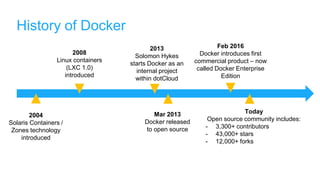
History of Docker
2004
Solaris Containers /
Zones technology
introduced
2008
Linux containers
(LXC 1.0)
introduced
2013
Solomon Hykes
starts Docker as an
internal project
within dotCloud
Mar 2013
Docker released
to open source
Feb 2016
Docker introduces first
commercial product – now
called Docker Enterprise
Edition
Today
Open source community includes:
- 3,300+ contributors
- 43,000+ stars
- 12,000+ forks
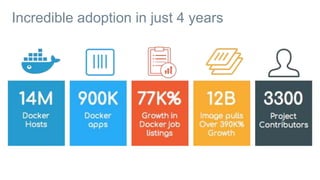
Incredible adoption in just 4 years
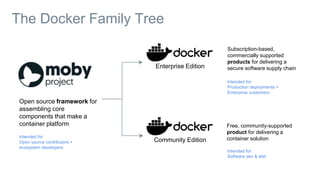
Community Edition
Enterprise Edition
Open source framework for
assembling core
components that make a
container platform Free, community-supported
product for delivering a
container solution
Subscription-based,
commercially supported
products for delivering a
secure software supply chain
Intended for:
Production deployments +
Enterprise customers
Intended for:
Software dev & test
Intended for:
Open source contributors +
ecosystem developers
The Docker Family Tree
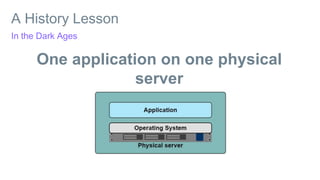
A History Lesson
One application on one physical
server
In the Dark Ages
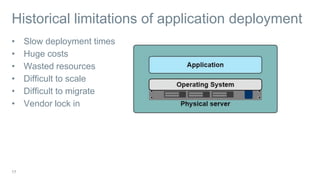
Historical limitations of application deployment
• Slow deployment times
• Huge costs
• Wasted resources
• Difficult to scale
• Difficult to migrate
• Vendor lock in
17
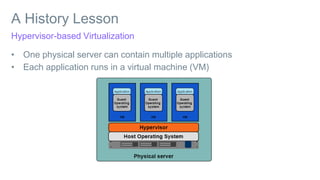
A History Lesson
• One physical server can contain multiple applications
• Each application runs in a virtual machine (VM)
Hypervisor-based Virtualization
Benefits of VMs
• Better resource pooling
– One physical machine divided into multiple virtual machines
• Easier to scale
• VMs in the cloud
– Rapid elasticity
– Pay as you go model
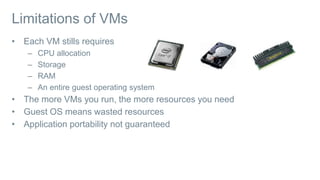
Limitations of VMs
• Each VM stills requires
– CPU allocation
– Storage
– RAM
– An entire guest operating system
• The more VMs you run, the more resources you need
• Guest OS means wasted resources
• Application portability not guaranteed
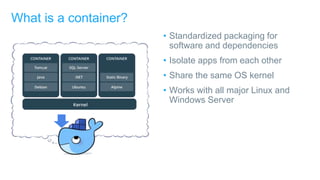
• Standardized packaging for
software and dependencies
• Isolate apps from each other
• Share the same OS kernel
• Works with all major Linux and
Windows Server
What is a container?
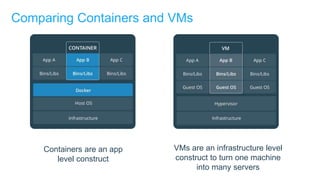
Comparing Containers and VMs
Containers are an app
level construct
VMs are an infrastructure level
construct to turn one machine
into many servers
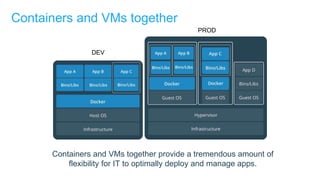
Containers and VMs together
Containers and VMs together provide a tremendous amount of
flexibility for IT to optimally deploy and manage apps.
DEV
PROD
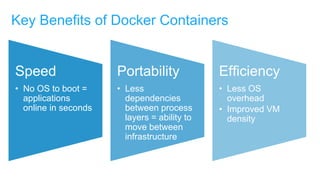
Key Benefits of Docker Containers
Speed
• No OS to boot =
applications
online in seconds
Portability
• Less
dependencies
between process
layers = ability to
move between
infrastructure
Efficiency
• Less OS
overhead
• Improved VM
density
Container Solutions &
Landscape
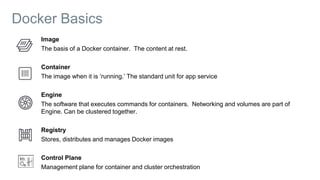
Docker Basics
Image
The basis of a Docker container. The content at rest.
Container
The image when it is ‘running.’ The standard unit for app service
Engine
The software that executes commands for containers. Networking and volumes are part of
Engine. Can be clustered together.
Registry
Stores, distributes and manages Docker images
Control Plane
Management plane for container and cluster orchestration
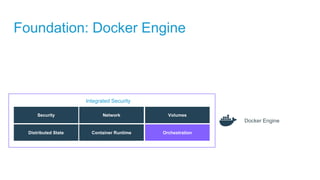
Security
Distributed State
Network
Container Runtime
Volumes
Orchestration
Docker Engine
Integrated Security
Foundation: Docker Engine
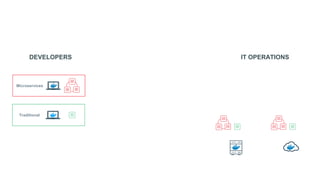
Traditional
Microservices
DEVELOPERS IT OPERATIONS
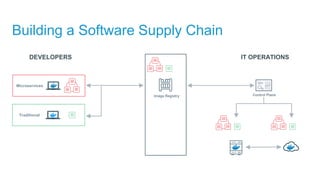
Building a Software Supply Chain
Image Registry
Traditional
Microservices
DEVELOPERS IT OPERATIONS
Control Plane
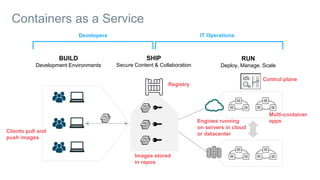
Containers as a Service
Developers IT Operations
BUILD
Development Environments
SHIP
Secure Content & Collaboration
RUN
Deploy, Manage, Scale
Registry
Control plane
Multi-container
appsEngines running
on servers in cloud
or datacenter
Images stored
in repos
Clients pull and
push images
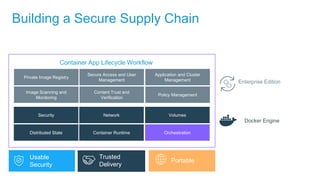
Container App Lifecycle Workflow
Private Image Registry
Image Scanning and
Monitoring
Secure Access and User
Management
Content Trust and
Verification
Application and Cluster
Management
Policy Management
Enterprise Edition
Security
Distributed State
Network
Container Runtime
Volumes
Orchestration
Docker Engine
Building a Secure Supply Chain
Usable
Security
Trusted
Delivery
Portable
Docker Enterprise
Edition
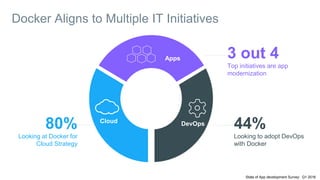
Docker Aligns to Multiple IT Initiatives
80%
Looking at Docker for
Cloud Strategy
Docker Survey: State of App development : Q1 - 2016
3 out 4
Top initiatives are app
modernization
44%
Looking to adopt DevOps
with Docker
Apps
DevOpsCloud
State of App development Survey: Q1 2016
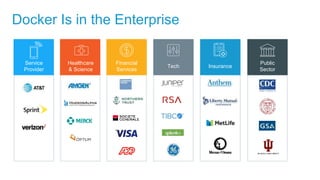
Docker Is in the Enterprise
Service
Provider
Tech
Public
Sector
Insurance
Healthcare
& Science
Financial
Services
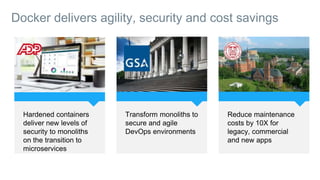
Docker delivers agility, security and cost savings
Hardened containers
deliver new levels of
security to monoliths
on the transition to
microservices
Transform monoliths to
secure and agile
DevOps environments
Reduce maintenance
costs by 10X for
legacy, commercial
and new apps
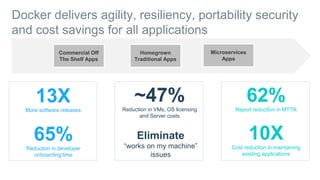
Docker delivers agility, resiliency, portability security
and cost savings for all applications
13XMore software releases
62%Report reduction in MTTR
10XCost reduction in maintaining
existing applications
Eliminate
“works on my machine”
issues
~47%Reduction in VMs, OS licensing
and Server costs
65%Reduction in developer
onboarding time
Commercial Off
The Shelf Apps
Homegrown
Traditional Apps
Microservices
Apps
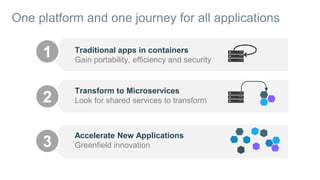
One platform and one journey for all applications
1 Traditional apps in containers
Gain portability, efficiency and security
2
3
Transform to Microservices
Look for shared services to transform
Accelerate New Applications
Greenfield innovation
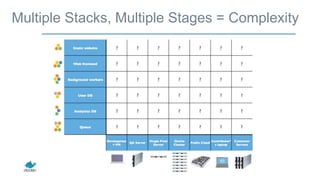
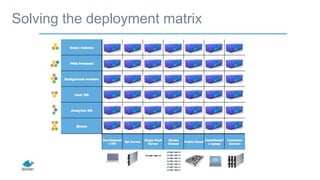
Multiple Stacks, Multiple Stages = Complexity
Solving the deployment matrix
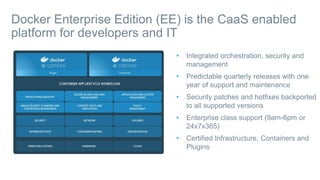
Docker Enterprise Edition (EE) is the CaaS enabled
platform for developers and IT
• Integrated orchestration, security and
management
• Predictable quarterly releases with one
year of support and maintenance
• Security patches and hotfixes backported
to all supported versions
• Enterprise class support (9am-6pm or
24x7x365)
• Certified Infrastructure, Containers and
Plugins
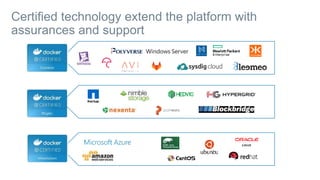
Certified technology extend the platform with
assurances and support

Introduction to Docker - 2017

  • 1.
  • 2.
    The IT Landscapeis Changing Docker Survey: State of App development : Q1 - 2016 Apps DevOpsCloud
  • 3.
    80% Migrate workloads tocloud Portability across environments Want to avoid cloud vendor lock-in Movement in the cloud State of App development Survey: Q1 - 2016
  • 4.
    Applications are transforming Loosely Coupled Services ManySmall Servers or devices ~2000 Today Monolithic Big Servers Slow changing Rapidly updated
  • 5.
    Application Modernization Application Code DeveloperIssues: • Minor code changes require full re-compile and re-test • Application becomes single point of failure • Application is difficult to scale Microservices: Break application into separate operations 12-Factor Apps: Make the app independently scalable, stateless, highly available by design
  • 6.
    Continuous Integration andDelivery Developer Version control 1. Development 2. Test 3. Stage / Production QA / QE Sysadmin
  • 7.
    Tug of WarBetween Developers and Ops Developers IT Operations • Freedom to create and deploy apps fast • Define and package application needs • Quickly and flexibly respond to changing needs • Standardize, secure, and manage
  • 8.
  • 9.
    Developers IT Operations •Freedom to create and deploy apps fast • Define and package application needs • Quickly and flexibly respond to changing needs • Standardize, secure, and manage …and Diverse Organizations
  • 10.
    The Myth ofBi-Modal IT MICROSERVICES TRADITIONAL APPS Cloud or New Infrastructure You are either here.. Old Infrastructure …or here
  • 11.
    Enabling a Journey MICROSERVICES AGILETRADITIONAL APPS TRADITIONAL APPS Cloud or New Infrastructure Old Infrastructure …that is past AND future proof
  • 12.
  • 13.
    History of Docker 2004 SolarisContainers / Zones technology introduced 2008 Linux containers (LXC 1.0) introduced 2013 Solomon Hykes starts Docker as an internal project within dotCloud Mar 2013 Docker released to open source Feb 2016 Docker introduces first commercial product – now called Docker Enterprise Edition Today Open source community includes: - 3,300+ contributors - 43,000+ stars - 12,000+ forks
  • 14.
  • 15.
    Community Edition Enterprise Edition Opensource framework for assembling core components that make a container platform Free, community-supported product for delivering a container solution Subscription-based, commercially supported products for delivering a secure software supply chain Intended for: Production deployments + Enterprise customers Intended for: Software dev & test Intended for: Open source contributors + ecosystem developers The Docker Family Tree
  • 16.
    A History Lesson Oneapplication on one physical server In the Dark Ages
  • 17.
    Historical limitations ofapplication deployment • Slow deployment times • Huge costs • Wasted resources • Difficult to scale • Difficult to migrate • Vendor lock in 17
  • 18.
    A History Lesson •One physical server can contain multiple applications • Each application runs in a virtual machine (VM) Hypervisor-based Virtualization
  • 19.
    Benefits of VMs •Better resource pooling – One physical machine divided into multiple virtual machines • Easier to scale • VMs in the cloud – Rapid elasticity – Pay as you go model
  • 20.
    Limitations of VMs •Each VM stills requires – CPU allocation – Storage – RAM – An entire guest operating system • The more VMs you run, the more resources you need • Guest OS means wasted resources • Application portability not guaranteed
  • 21.
    • Standardized packagingfor software and dependencies • Isolate apps from each other • Share the same OS kernel • Works with all major Linux and Windows Server What is a container?
  • 22.
    Comparing Containers andVMs Containers are an app level construct VMs are an infrastructure level construct to turn one machine into many servers
  • 23.
    Containers and VMstogether Containers and VMs together provide a tremendous amount of flexibility for IT to optimally deploy and manage apps. DEV PROD
  • 24.
    Key Benefits ofDocker Containers Speed • No OS to boot = applications online in seconds Portability • Less dependencies between process layers = ability to move between infrastructure Efficiency • Less OS overhead • Improved VM density
  • 25.
  • 26.
    Docker Basics Image The basisof a Docker container. The content at rest. Container The image when it is ‘running.’ The standard unit for app service Engine The software that executes commands for containers. Networking and volumes are part of Engine. Can be clustered together. Registry Stores, distributes and manages Docker images Control Plane Management plane for container and cluster orchestration
  • 27.
  • 28.
  • 29.
    Building a SoftwareSupply Chain Image Registry Traditional Microservices DEVELOPERS IT OPERATIONS Control Plane
  • 30.
    Containers as aService Developers IT Operations BUILD Development Environments SHIP Secure Content & Collaboration RUN Deploy, Manage, Scale Registry Control plane Multi-container appsEngines running on servers in cloud or datacenter Images stored in repos Clients pull and push images
  • 31.
    Container App LifecycleWorkflow Private Image Registry Image Scanning and Monitoring Secure Access and User Management Content Trust and Verification Application and Cluster Management Policy Management Enterprise Edition Security Distributed State Network Container Runtime Volumes Orchestration Docker Engine Building a Secure Supply Chain Usable Security Trusted Delivery Portable
  • 32.
  • 33.
    Docker Aligns toMultiple IT Initiatives 80% Looking at Docker for Cloud Strategy Docker Survey: State of App development : Q1 - 2016 3 out 4 Top initiatives are app modernization 44% Looking to adopt DevOps with Docker Apps DevOpsCloud State of App development Survey: Q1 2016
  • 34.
    Docker Is inthe Enterprise Service Provider Tech Public Sector Insurance Healthcare & Science Financial Services
  • 35.
    Docker delivers agility,security and cost savings Hardened containers deliver new levels of security to monoliths on the transition to microservices Transform monoliths to secure and agile DevOps environments Reduce maintenance costs by 10X for legacy, commercial and new apps
  • 36.
    Docker delivers agility,resiliency, portability security and cost savings for all applications 13XMore software releases 62%Report reduction in MTTR 10XCost reduction in maintaining existing applications Eliminate “works on my machine” issues ~47%Reduction in VMs, OS licensing and Server costs 65%Reduction in developer onboarding time Commercial Off The Shelf Apps Homegrown Traditional Apps Microservices Apps
  • 37.
    One platform andone journey for all applications 1 Traditional apps in containers Gain portability, efficiency and security 2 3 Transform to Microservices Look for shared services to transform Accelerate New Applications Greenfield innovation
  • 38.
    Multiple Stacks, MultipleStages = Complexity
  • 39.
  • 40.
    Docker Enterprise Edition(EE) is the CaaS enabled platform for developers and IT • Integrated orchestration, security and management • Predictable quarterly releases with one year of support and maintenance • Security patches and hotfixes backported to all supported versions • Enterprise class support (9am-6pm or 24x7x365) • Certified Infrastructure, Containers and Plugins
  • 41.
    Certified technology extendthe platform with assurances and support