bucketbench
Benchmarking Container Runtime Performance
Phil Estes
Senior Technical Staff, IBM Cloud; Office of the CTO
Architecture Technical Team, Containers
@estesp
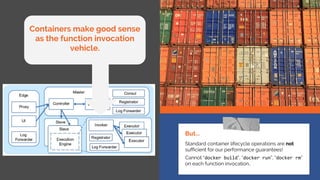
But...
Standard container lifecycle operations are not
sufficient for our performance guarantees!
Cannot “docker build”, “docker run”, “docker rm”
on each function invocation..
Containers make good sense
as the function invocation
vehicle.
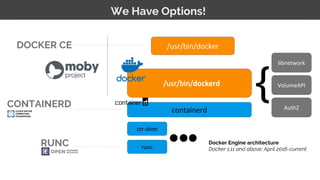
{
DOCKER CE
CONTAINERD
RUNC
We Have Options!
Docker Engine architecture
Docker 1.11 and above; April 2016-current
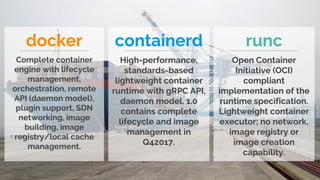
docker
Complete container
engine with lifecycle
management,
orchestration, remote
API (daemon model),
plugin support, SDN
networking, image
building, image
registry/local cache
management.
containerd
High-performance,
standards-based
lightweight container
runtime with gRPC API,
daemon model. 1.0
contains complete
lifecycle and image
management in
Q42017.
runc
Open Container
Initiative (OCI)
compliant
implementation of the
runtime specification.
Lightweight container
executor; no network,
image registry or
image creation
capability.
https://github.com/estesp/bucketbench
A Go-based framework for benchmarking container
lifecycle operations (using concurrency and load)
against docker, containerd (0.2.x and 1.0), and runc.
The YAML file provided via the --benchmark flag will determine which
lifecycle container commands to run against which container runtimes, specifying
iterations and number of concurrent threads. Results will be displayed afterwards.
Usage:
bucketbench run [flags]
Flags:
-b, --benchmark string YAML file with benchmark definition
-h, --help help for run
-s, --skip-limit Skip 'limit' benchmark run
-t, --trace Enable per-container tracing during benchmark runs
Global Flags:
--log-level string set the logging level (info,warn,err,debug) (default "warn")
H
O
W
CAN
W
E
BEN
CH
M
ARK
VARIO
U
S
CO
N
TAIN
ER
RU
N
TIM
E
O
PTIO
N
S?
examples/basic.yaml
name: BasicBench
image: alpine:latest
rootfs: /home/estesp/containers/alpine
detached: true
drivers:
-
type: Docker
threads: 5
iterations: 15
-
type: Runc
threads: 5
iterations: 50
commands:
- run
- stop
- remove
Goals
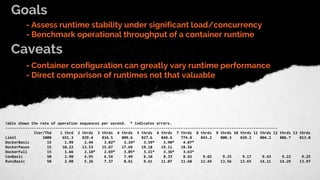
- Assess runtime stability under significant load/concurrency
- Benchmark operational throughput of a container runtime
Table shows the rate of operation sequences per second. * indicates errors.
----------------------------------------------------------------------------------------------------------------------------
Iter/Thd 1 thrd 2 thrds 3 thrds 4 thrds 5 thrds 6 thrds 7 thrds 8 thrds 9 thrds 10 thrds 11 thrds 12 thrds 13 thrds
Limit 1000 651.3 829.4 834.5 809.6 827.6 848.6 774.8 843.2 800.3 839.2 804.2 806.7 813.0
DockerBasic 15 1.99 2.44 3.02* 3.24* 3.59* 3.90* 4.07*
DockerPause 15 10.22 13.53 15.67 17.69 19.18 19.11 18.56
DockerFull 15 1.66 2.18* 2.69* 3.05* 3.21* 3.36* 3.63*
ConBasic 50 2.90 4.95 6.54 7.49 8.10 8.33 8.65 9.02 9.25 9.17 9.43 9.22 9.25
RuncBasic 50 2.90 5.26 7.37 8.61 9.61 11.07 11.68 12.44 13.56 13.65 14.11 14.29 13.97
Caveats
- Container configuration can greatly vary runtime performance
- Direct comparison of runtimes not that valuable
Architecture
Two key interfaces:
Driver
Drives the container runtime
Bench
Defines the container operations
and provides results/statistics
type Driver interface {
Type() Type
Info() (string, error)
Create(name, image string, detached bool, trace bool) (Container, error)
Clean() error
Run(ctr Container) (string, int, error)
Stop(ctr Container) (string, int, error)
Remove(ctr Container) (string, int, error)
Pause(ctr Container) (string, int, error)
Unpause(ctr Container) (string, int, error)
}
type Bench interface {
Init(driverType driver.Type, binaryPath,
imageInfo string, trace bool) error
Validate() error
Run(threads, iterations int) error
Stats() []RunStatistics
Elapsed() time.Duration
State() State
Type() Type
Info() string
}
Driver implementations support:
docker, containerd (1.0 via gRPC Go client
API; 0.2.x via `ctr` binary), and runc today
Can easily be extended to support any
runtime which can implement the Driver
interface
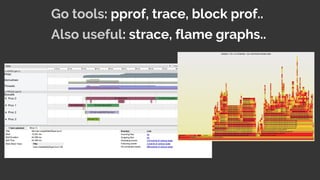
Go tools: pprof, trace, block prof..
Also useful: strace, flame graphs..
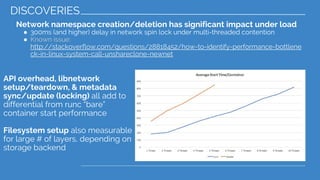
API overhead, libnetwork
setup/teardown, & metadata
sync/update (locking) all add to
differential from runc “bare”
container start performance
Filesystem setup also measurable
for large # of layers, depending on
storage backend
Network namespace creation/deletion has significant impact under load
● 300ms (and higher) delay in network spin lock under multi-threaded contention
● Known issue:
http://stackoverflow.com/questions/28818452/how-to-identify-performance-bottlene
ck-in-linux-system-call-unshareclone-newnet
DISCOVERIES
Bucketbench: TODOs
1. Structured Output Format
○ JSON and/or CSV output
2. Other Driver Implementations
○ rkt? cri-o?
○ Drive via CRI versus clients?
3. Integrate with Trace/Debug Tooling
○ Randomized trace output (% of operations)
○ “Real” performance metrics/tooling?
Thank You!
1. Check out, critique, contribute to:
http://github.com/estesp/bucketbench
2. Connect with me to ask questions, or
provide your own perspective and
findings at @estesp on Twitter or
estesp@gmail.com

Bucketbench: Benchmarking Container Runtime Performance

  • 1.
    bucketbench Benchmarking Container RuntimePerformance Phil Estes Senior Technical Staff, IBM Cloud; Office of the CTO Architecture Technical Team, Containers @estesp
  • 3.
    But... Standard container lifecycleoperations are not sufficient for our performance guarantees! Cannot “docker build”, “docker run”, “docker rm” on each function invocation.. Containers make good sense as the function invocation vehicle.
  • 4.
    { DOCKER CE CONTAINERD RUNC We HaveOptions! Docker Engine architecture Docker 1.11 and above; April 2016-current
  • 5.
    docker Complete container engine withlifecycle management, orchestration, remote API (daemon model), plugin support, SDN networking, image building, image registry/local cache management. containerd High-performance, standards-based lightweight container runtime with gRPC API, daemon model. 1.0 contains complete lifecycle and image management in Q42017. runc Open Container Initiative (OCI) compliant implementation of the runtime specification. Lightweight container executor; no network, image registry or image creation capability.
  • 6.
    https://github.com/estesp/bucketbench A Go-based frameworkfor benchmarking container lifecycle operations (using concurrency and load) against docker, containerd (0.2.x and 1.0), and runc. The YAML file provided via the --benchmark flag will determine which lifecycle container commands to run against which container runtimes, specifying iterations and number of concurrent threads. Results will be displayed afterwards. Usage: bucketbench run [flags] Flags: -b, --benchmark string YAML file with benchmark definition -h, --help help for run -s, --skip-limit Skip 'limit' benchmark run -t, --trace Enable per-container tracing during benchmark runs Global Flags: --log-level string set the logging level (info,warn,err,debug) (default "warn") H O W CAN W E BEN CH M ARK VARIO U S CO N TAIN ER RU N TIM E O PTIO N S? examples/basic.yaml name: BasicBench image: alpine:latest rootfs: /home/estesp/containers/alpine detached: true drivers: - type: Docker threads: 5 iterations: 15 - type: Runc threads: 5 iterations: 50 commands: - run - stop - remove
  • 7.
    Goals - Assess runtimestability under significant load/concurrency - Benchmark operational throughput of a container runtime Table shows the rate of operation sequences per second. * indicates errors. ---------------------------------------------------------------------------------------------------------------------------- Iter/Thd 1 thrd 2 thrds 3 thrds 4 thrds 5 thrds 6 thrds 7 thrds 8 thrds 9 thrds 10 thrds 11 thrds 12 thrds 13 thrds Limit 1000 651.3 829.4 834.5 809.6 827.6 848.6 774.8 843.2 800.3 839.2 804.2 806.7 813.0 DockerBasic 15 1.99 2.44 3.02* 3.24* 3.59* 3.90* 4.07* DockerPause 15 10.22 13.53 15.67 17.69 19.18 19.11 18.56 DockerFull 15 1.66 2.18* 2.69* 3.05* 3.21* 3.36* 3.63* ConBasic 50 2.90 4.95 6.54 7.49 8.10 8.33 8.65 9.02 9.25 9.17 9.43 9.22 9.25 RuncBasic 50 2.90 5.26 7.37 8.61 9.61 11.07 11.68 12.44 13.56 13.65 14.11 14.29 13.97 Caveats - Container configuration can greatly vary runtime performance - Direct comparison of runtimes not that valuable
  • 8.
    Architecture Two key interfaces: Driver Drivesthe container runtime Bench Defines the container operations and provides results/statistics type Driver interface { Type() Type Info() (string, error) Create(name, image string, detached bool, trace bool) (Container, error) Clean() error Run(ctr Container) (string, int, error) Stop(ctr Container) (string, int, error) Remove(ctr Container) (string, int, error) Pause(ctr Container) (string, int, error) Unpause(ctr Container) (string, int, error) } type Bench interface { Init(driverType driver.Type, binaryPath, imageInfo string, trace bool) error Validate() error Run(threads, iterations int) error Stats() []RunStatistics Elapsed() time.Duration State() State Type() Type Info() string } Driver implementations support: docker, containerd (1.0 via gRPC Go client API; 0.2.x via `ctr` binary), and runc today Can easily be extended to support any runtime which can implement the Driver interface
  • 9.
    Go tools: pprof,trace, block prof.. Also useful: strace, flame graphs..
  • 10.
    API overhead, libnetwork setup/teardown,& metadata sync/update (locking) all add to differential from runc “bare” container start performance Filesystem setup also measurable for large # of layers, depending on storage backend Network namespace creation/deletion has significant impact under load ● 300ms (and higher) delay in network spin lock under multi-threaded contention ● Known issue: http://stackoverflow.com/questions/28818452/how-to-identify-performance-bottlene ck-in-linux-system-call-unshareclone-newnet DISCOVERIES
  • 11.
    Bucketbench: TODOs 1. StructuredOutput Format ○ JSON and/or CSV output 2. Other Driver Implementations ○ rkt? cri-o? ○ Drive via CRI versus clients? 3. Integrate with Trace/Debug Tooling ○ Randomized trace output (% of operations) ○ “Real” performance metrics/tooling?
  • 12.
    Thank You! 1. Checkout, critique, contribute to: http://github.com/estesp/bucketbench 2. Connect with me to ask questions, or provide your own perspective and findings at @estesp on Twitter or estesp@gmail.com