Banjot
Chanana
Sr Director of Product
Docker for the
Enterprise with
Containers as
a Service
What is a CaaS
• Why CaaS is needed
• Introducing Docker
Datacenter
• Agility, Portability and
Control Benefits
Agenda
How Enterprises Get Started
• Monoliths vs Microservices
• Case Studies of Container
Adoption
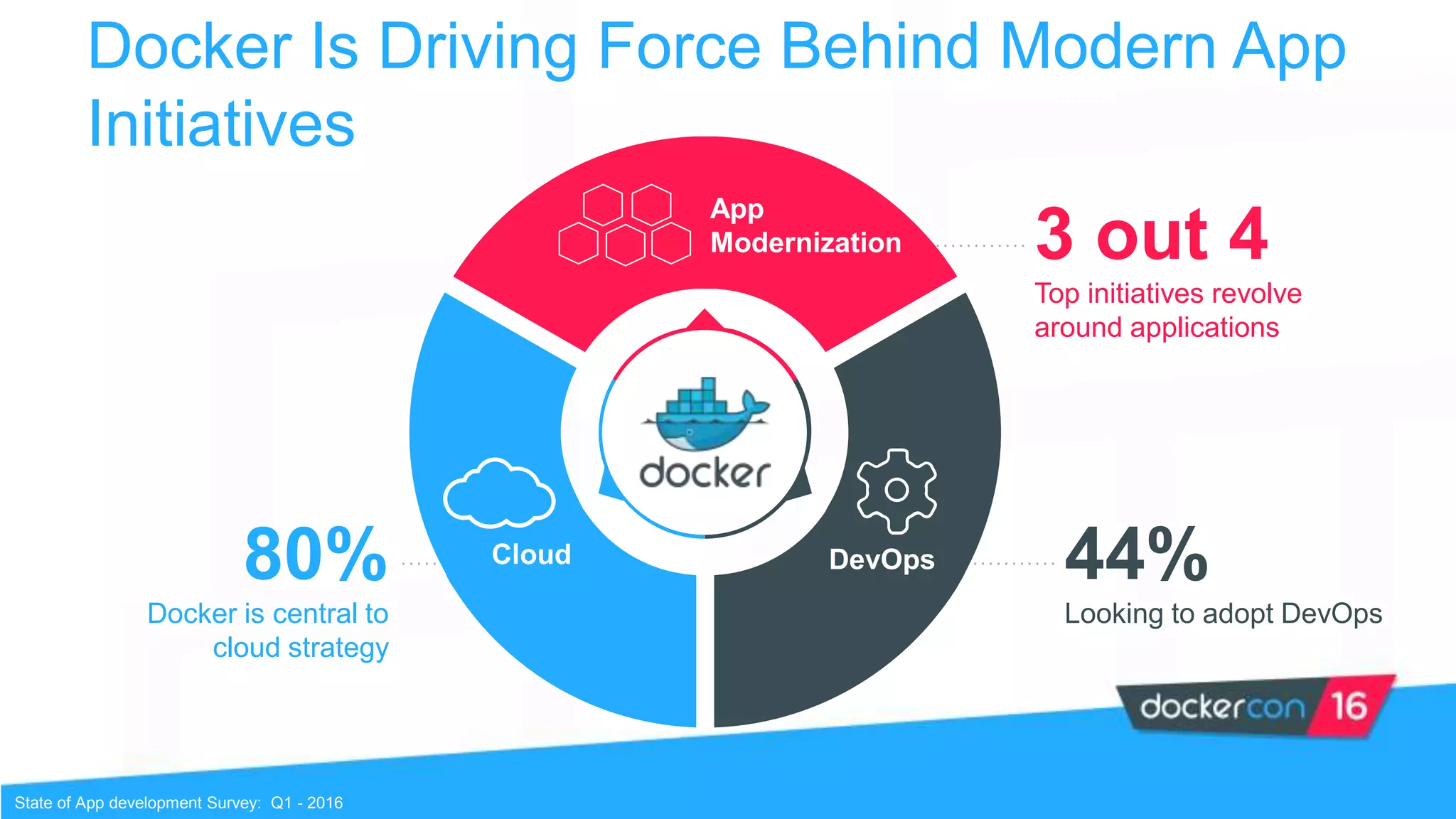
Docker Is Driving Force Behind Modern App
Initiatives
80%
Docker is central to
cloud strategy
State of App development Survey: Q1 - 2016
3 out 4
Top initiatives revolve
around applications
44%
Looking to adopt DevOps
App
Modernization
DevOpsCloud
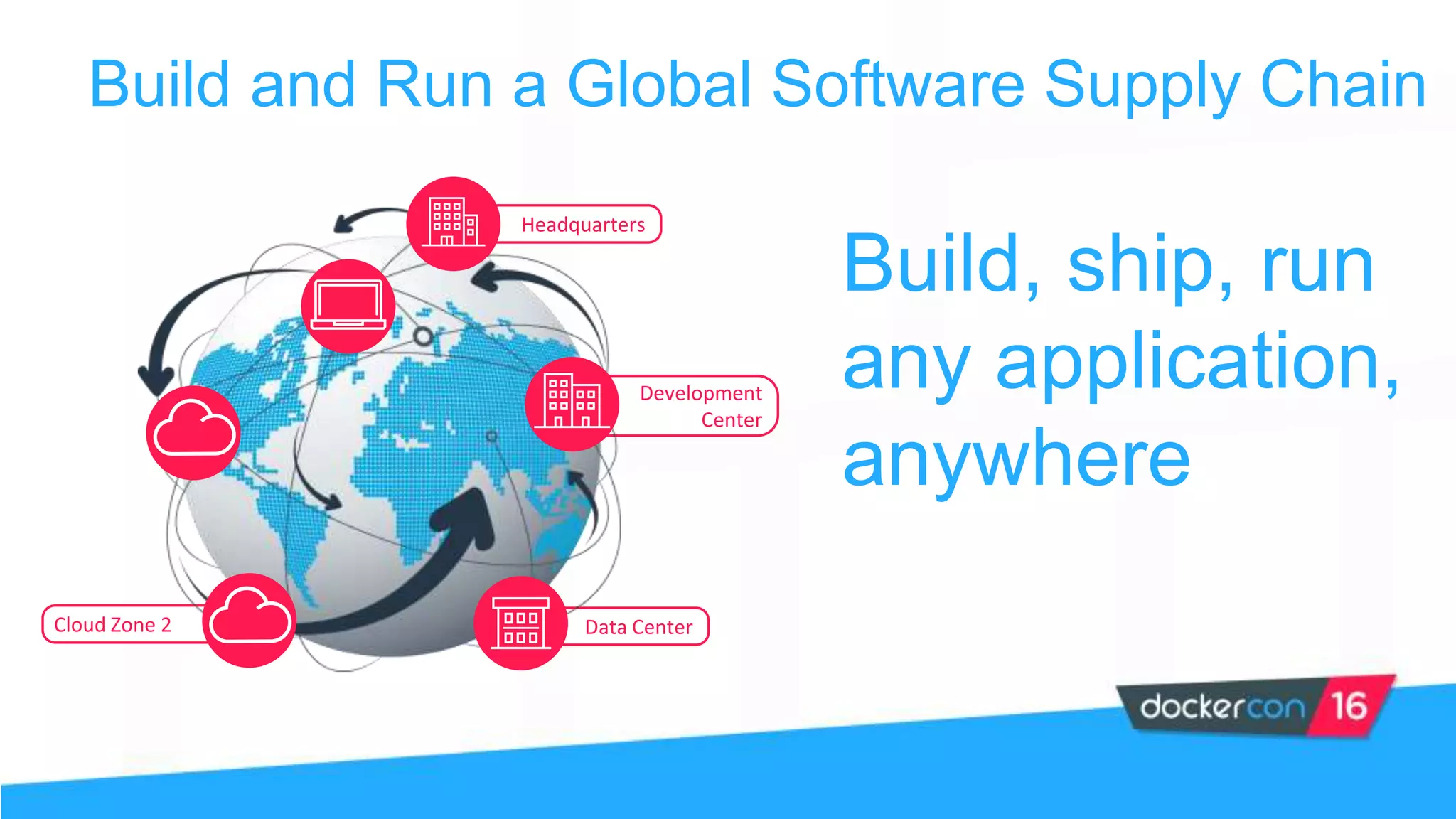
Cloud Zone 2 Data Center
Development
Center
Headquarters
Build and Run a Global Software Supply Chain
Build, ship, run
any application,
anywhere
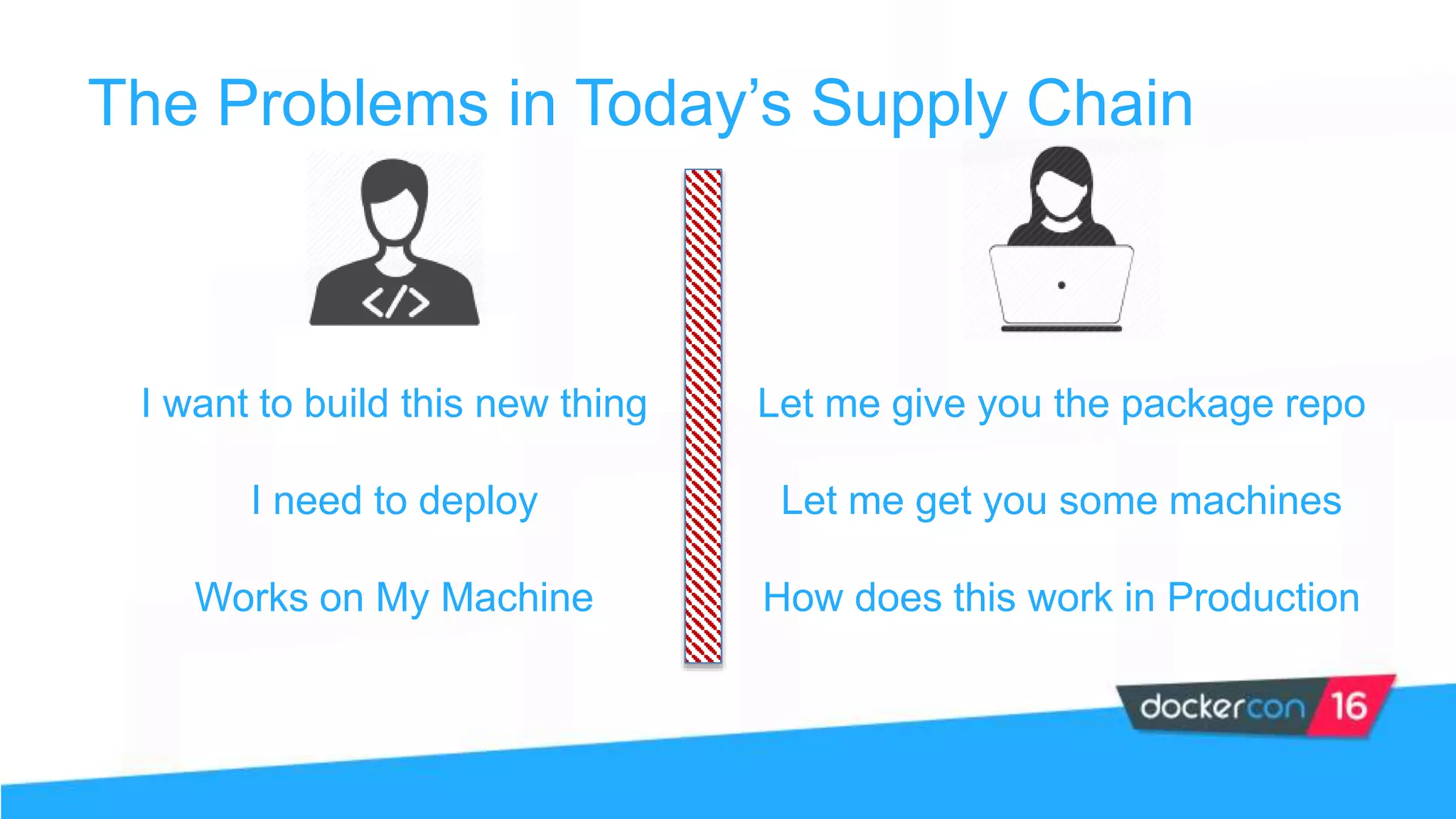
The Problems in Today’s Supply Chain
I want to build this new thing
I need to deploy
Works on My Machine
Let me give you the package repo
Let me get you some machines
How does this work in Production
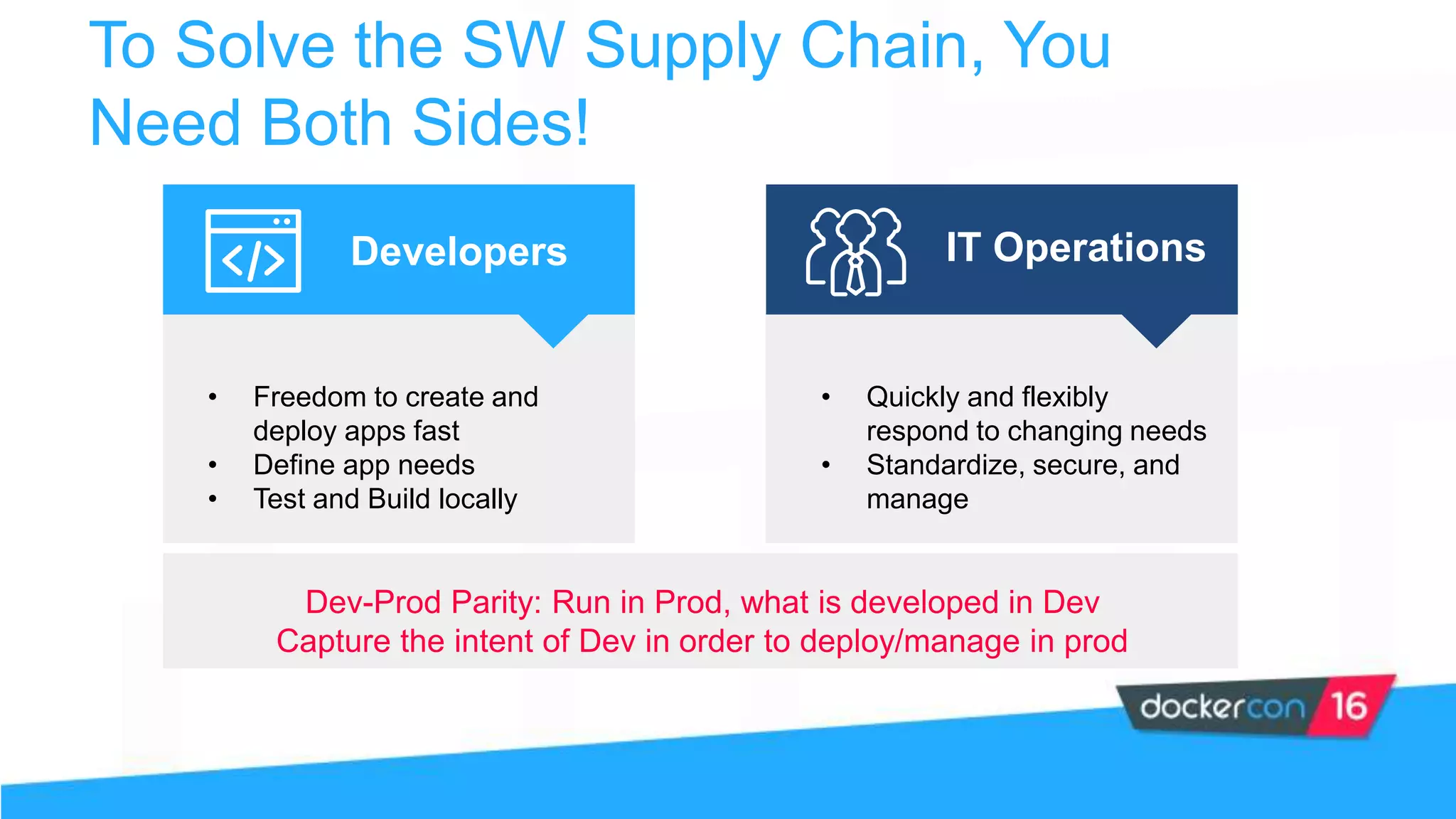
To Solve the SW Supply Chain, You
Need Both Sides!
Developers IT Operations
• Freedom to create and
deploy apps fast
• Define app needs
• Test and Build locally
• Quickly and flexibly
respond to changing needs
• Standardize, secure, and
manage
Dev-Prod Parity: Run in Prod, what is developed in Dev
Capture the intent of Dev in order to deploy/manage in prod
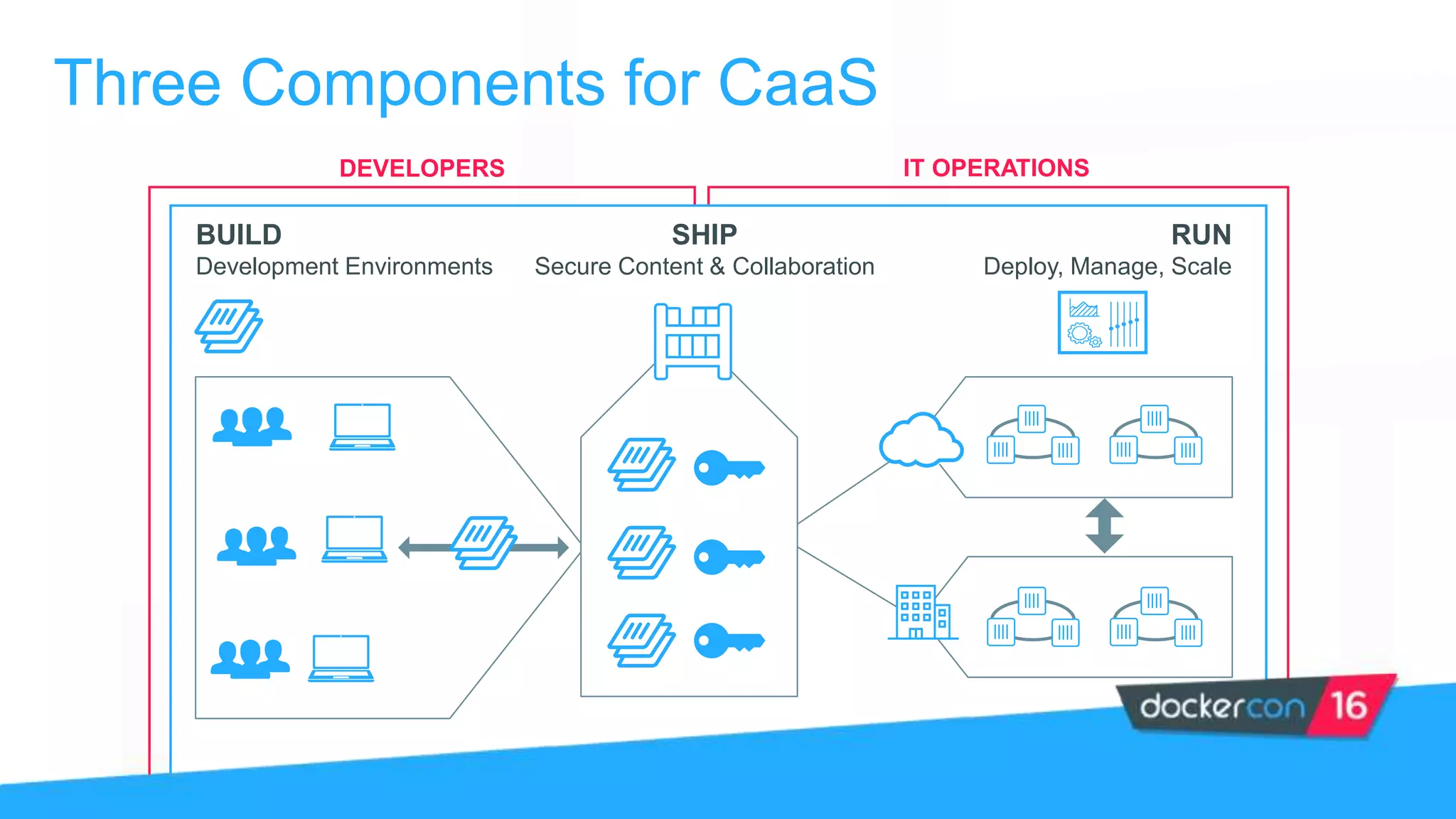
Three Components for CaaS
DEVELOPERS IT OPERATIONS
BUILD
Development Environments
SHIP
Secure Content & Collaboration
RUN
Deploy, Manage, Scale
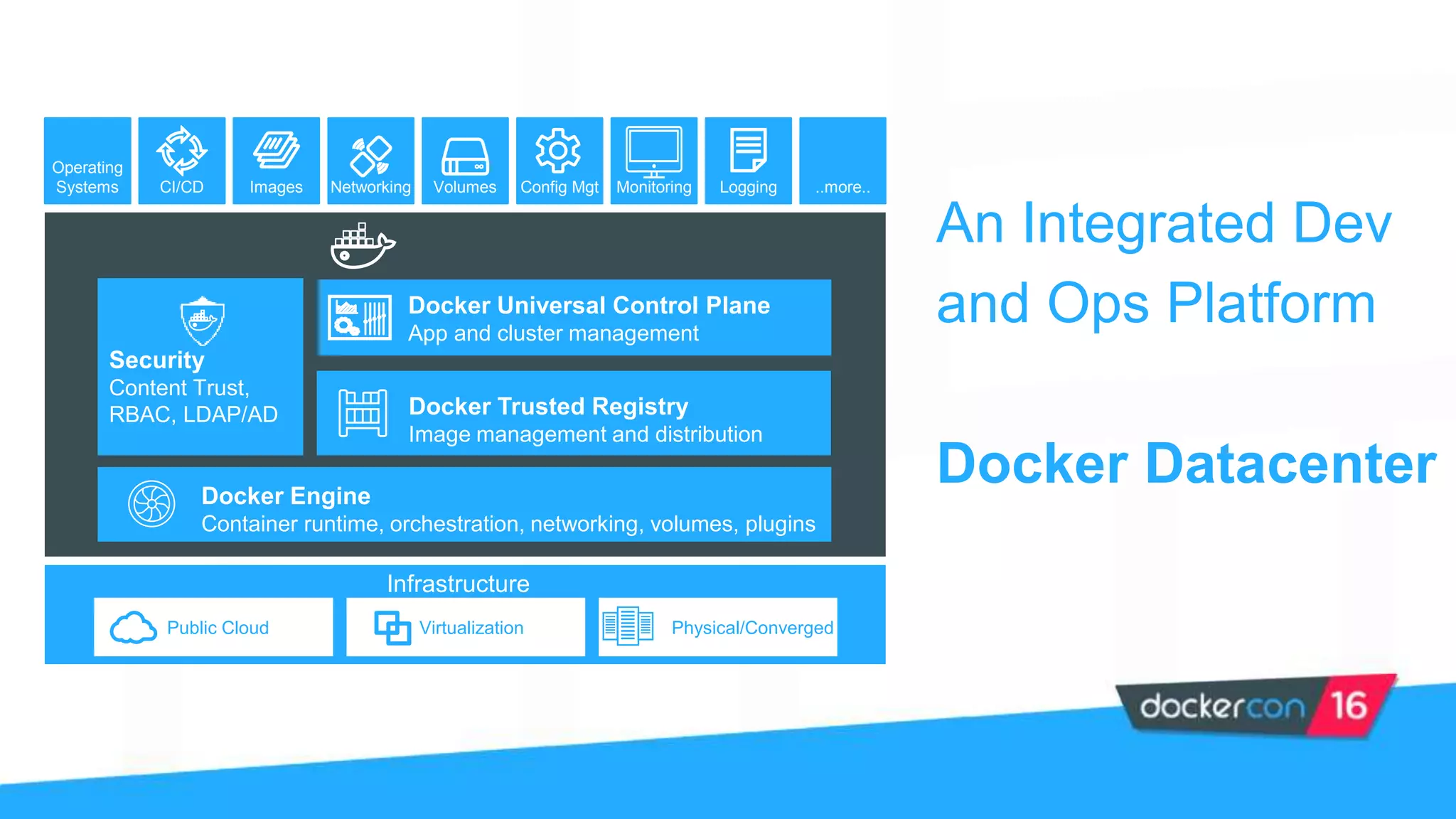
Operating
Systems Config Mgt Monitoring LoggingCI/CD ..more..
Infrastructure
Docker Universal Control Plane
App and cluster management
Security
Content Trust,
RBAC, LDAP/AD
Docker Engine
Container runtime, orchestration, networking, volumes, plugins
Docker Trusted Registry
Image management and distribution
Images Networking Volumes
VirtualizationPublic Cloud Physical/Converged
An Integrated Dev
and Ops Platform
Docker Datacenter
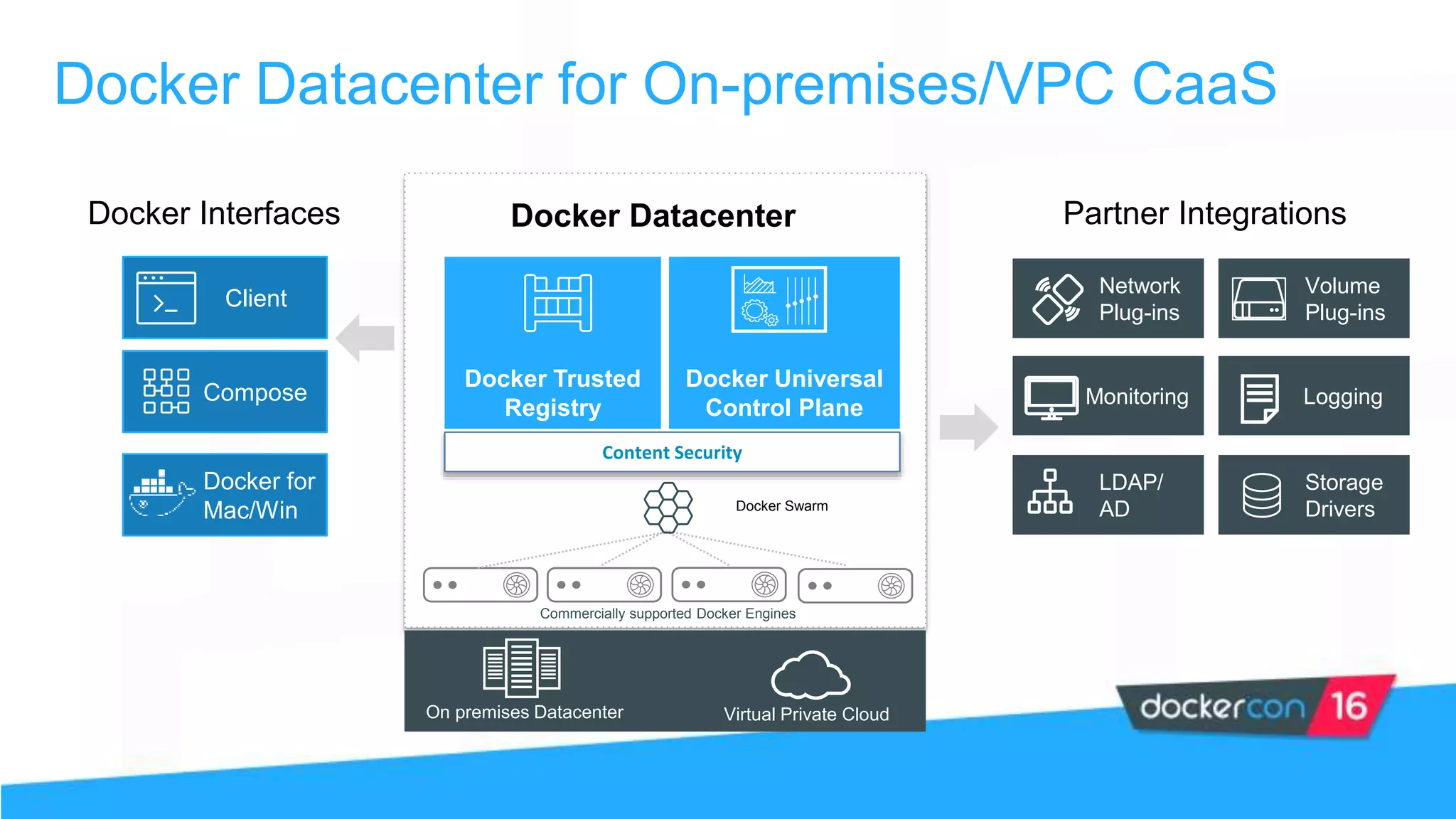
Docker Datacenter for On-premises/VPC CaaS
Client
Compose
Partner IntegrationsDocker Interfaces
Volume
Plug-ins
Monitoring Logging
Network
Plug-ins
Docker Universal
Control Plane
Docker Trusted
Registry
On premises Datacenter Virtual Private Cloud
Commercially supported Docker Engines
Docker Swarm
Docker Datacenter
Content Security
Storage
Drivers
LDAP/
AD
Docker for
Mac/Win
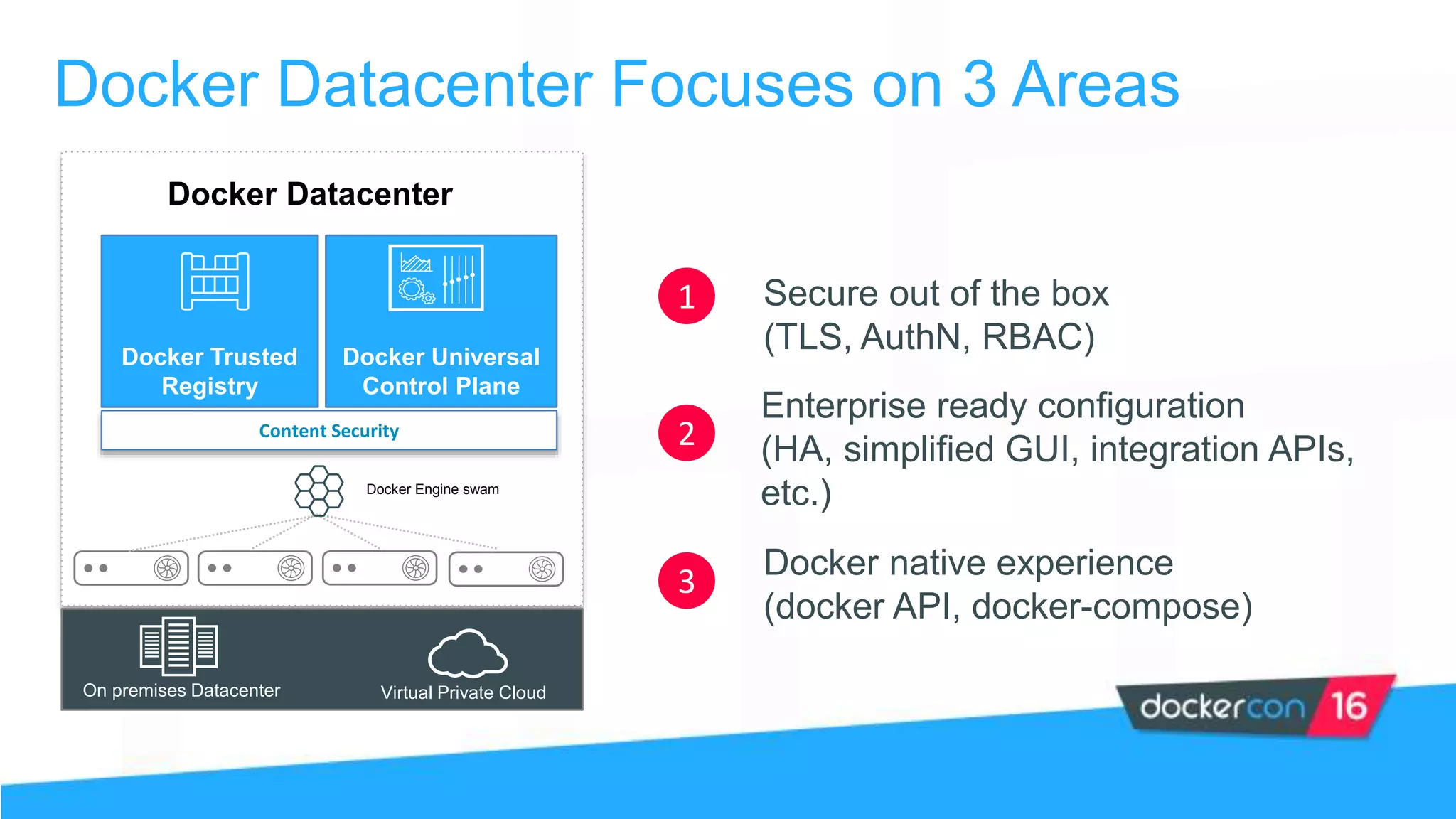
Docker Datacenter Focuses on 3 Areas
Docker Universal
Control Plane
Docker Trusted
Registry
On premises Datacenter Virtual Private Cloud
Docker Datacenter
Content Security
1 Secure out of the box
(TLS, AuthN, RBAC)
2
Enterprise ready configuration
(HA, simplified GUI, integration APIs,
etc.)
3 Docker native experience
(docker API, docker-compose)
Docker Engine swam
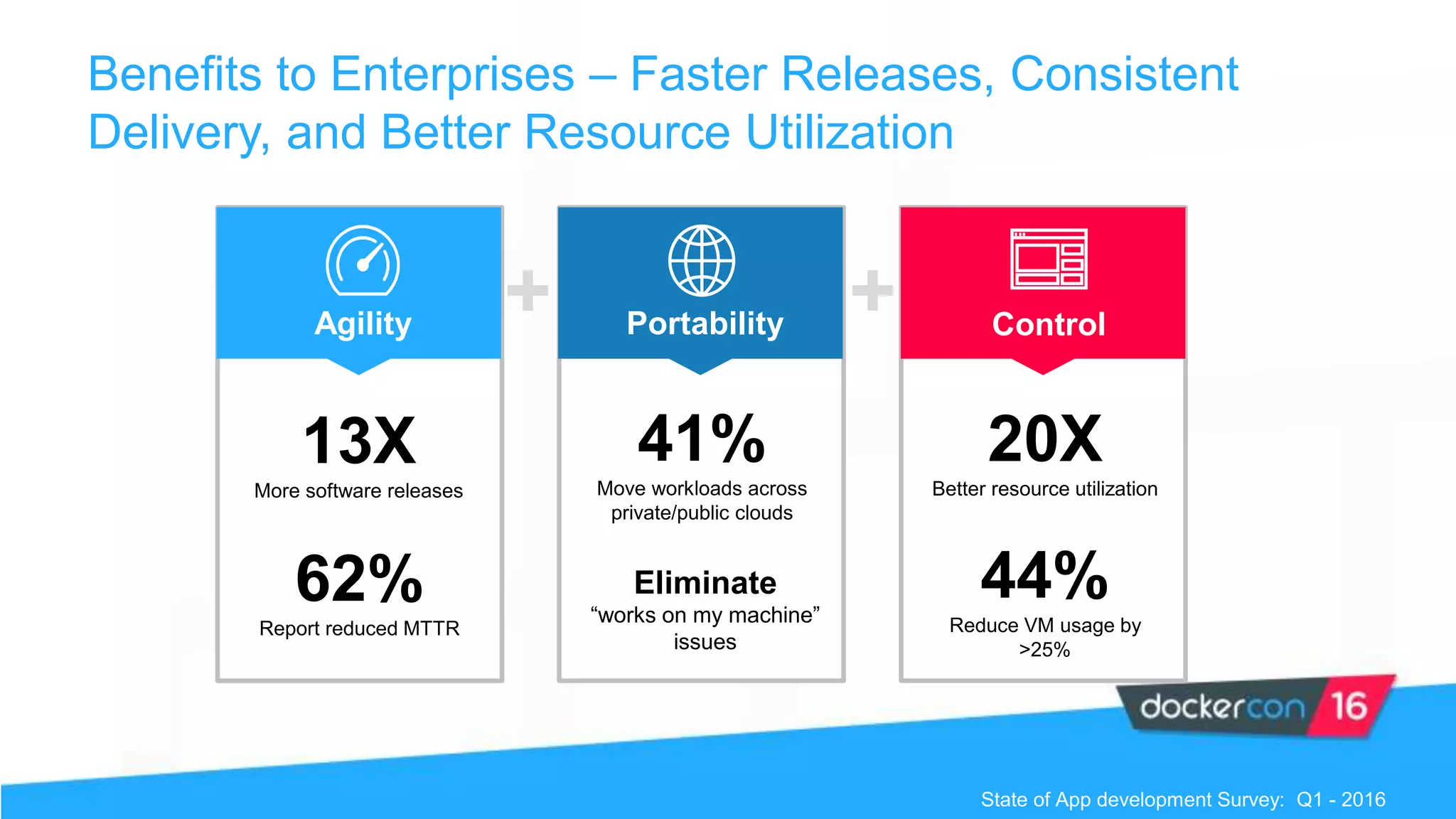
Benefits to Enterprises – Faster Releases, Consistent
Delivery, and Better Resource Utilization
State of App development Survey: Q1 - 2016
+ +Agility Portability Control
13X
More software releases
20X
Better resource utilization
44%
Reduce VM usage by
>25%
Eliminate
“works on my machine”
issues
41%
Move workloads across
private/public clouds
62%
Report reduced MTTR
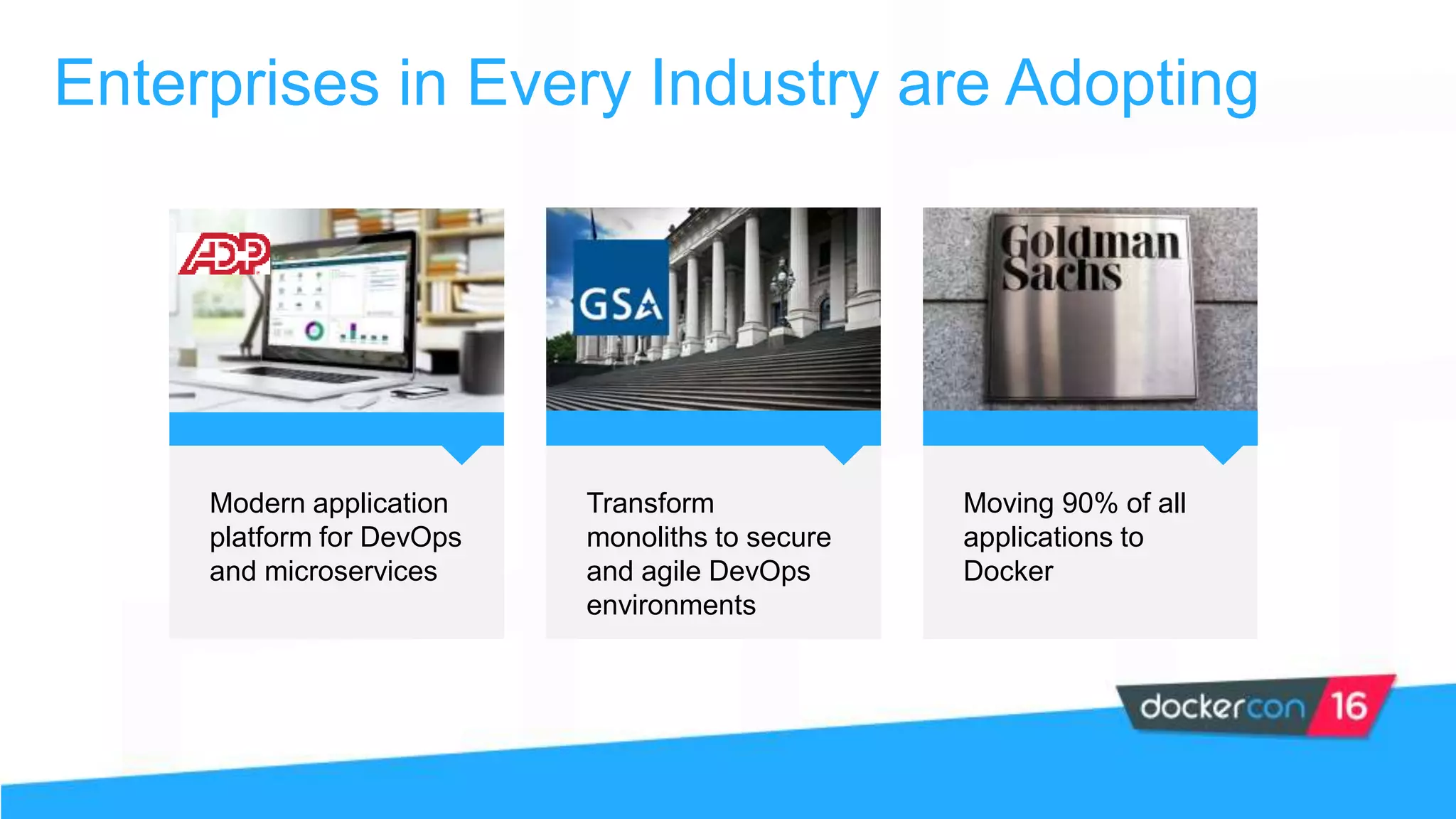
Enterprises in Every Industry are Adopting
Modern application
platform for DevOps
and microservices
Transform
monoliths to secure
and agile DevOps
environments
Moving 90% of all
applications to
Docker
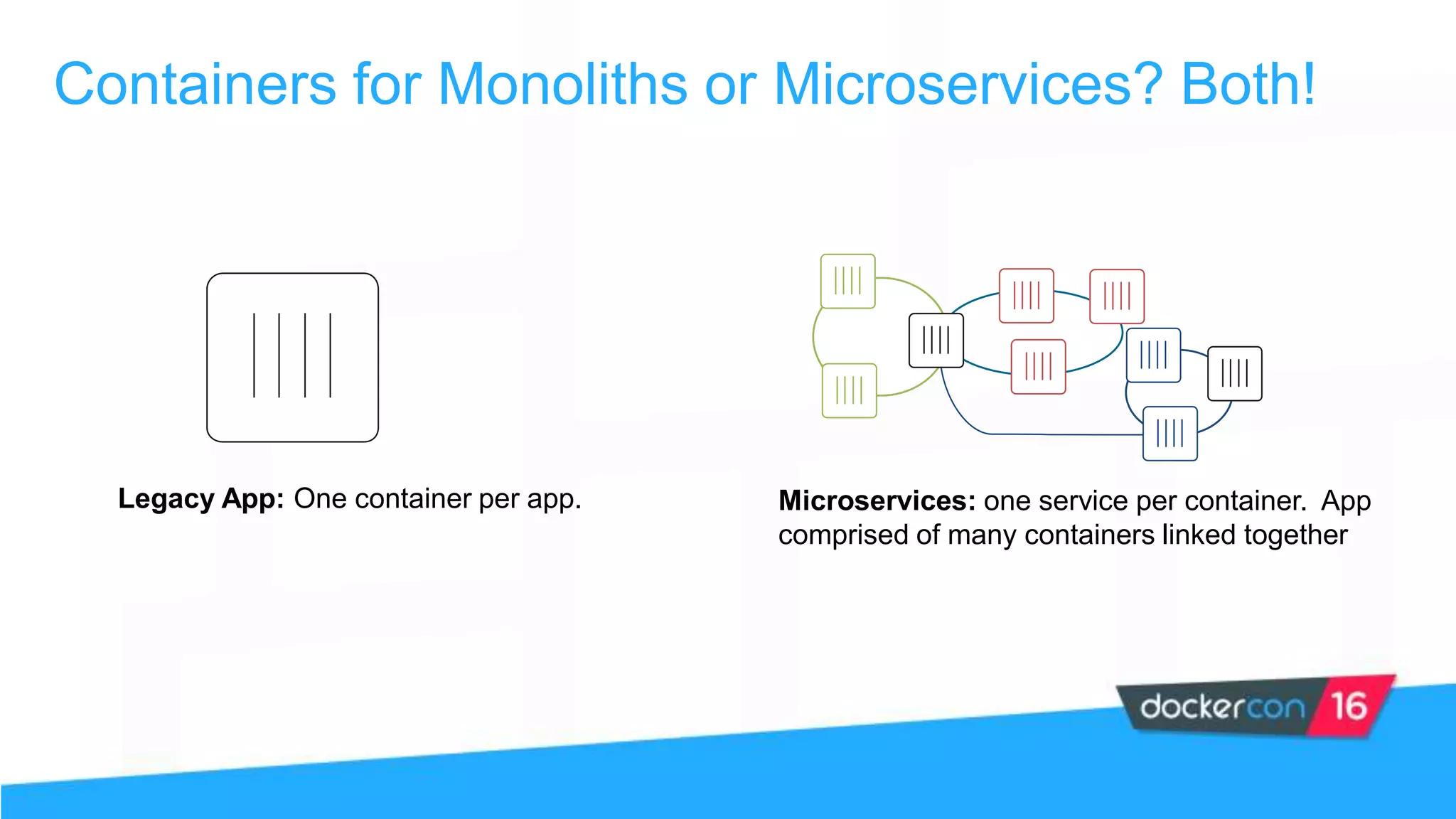
Containers for Monoliths or Microservices? Both!
Legacy App: One container per app. Microservices: one service per container. App
comprised of many containers linked together
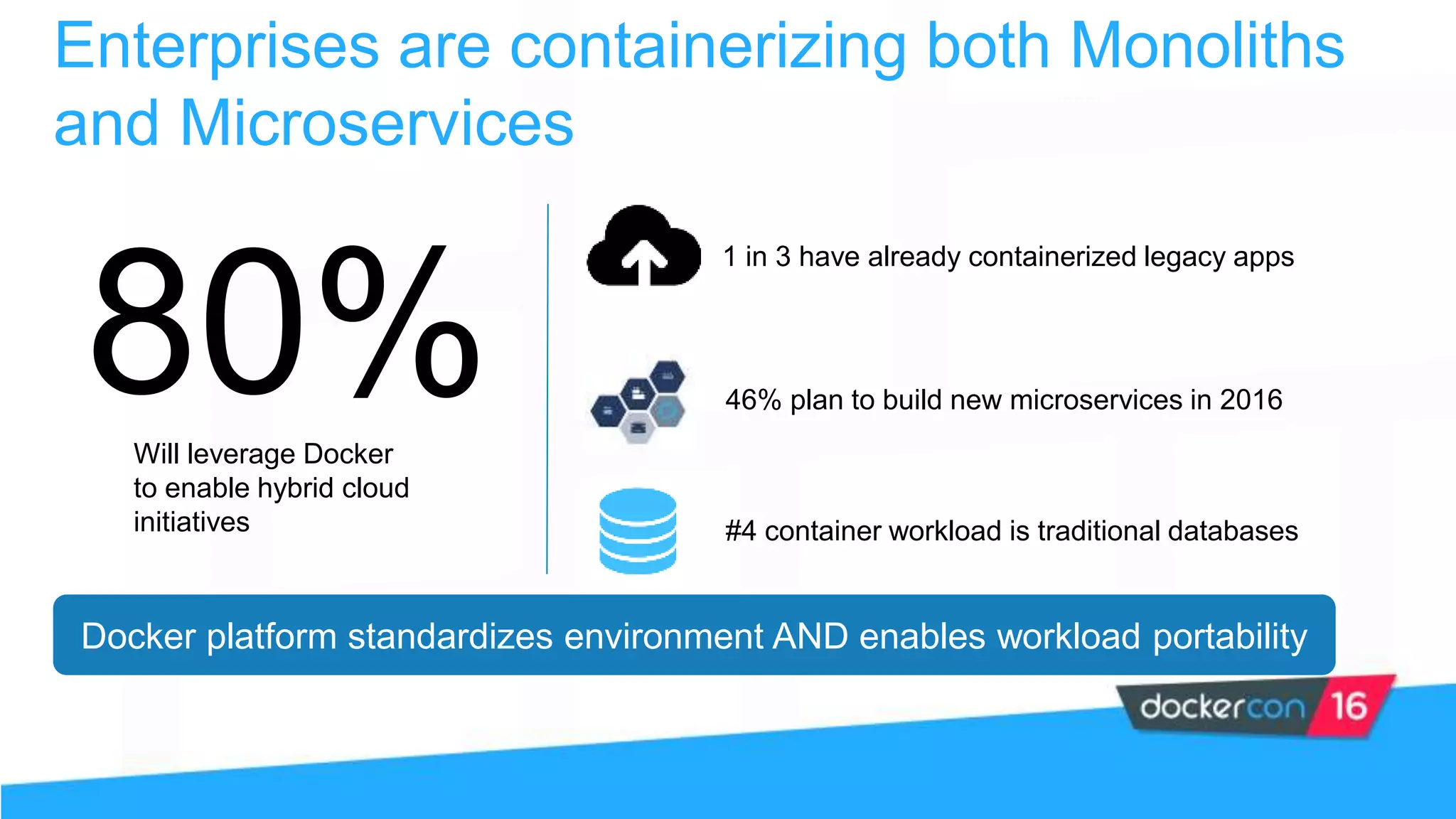
Enterprises are containerizing both Monoliths
and Microservices
Docker platform standardizes environment AND enables workload portability
80% 46% plan to build new microservices in 2016
#4 container workload is traditional databases
1 in 3 have already containerized legacy apps
Will leverage Docker
to enable hybrid cloud
initiatives
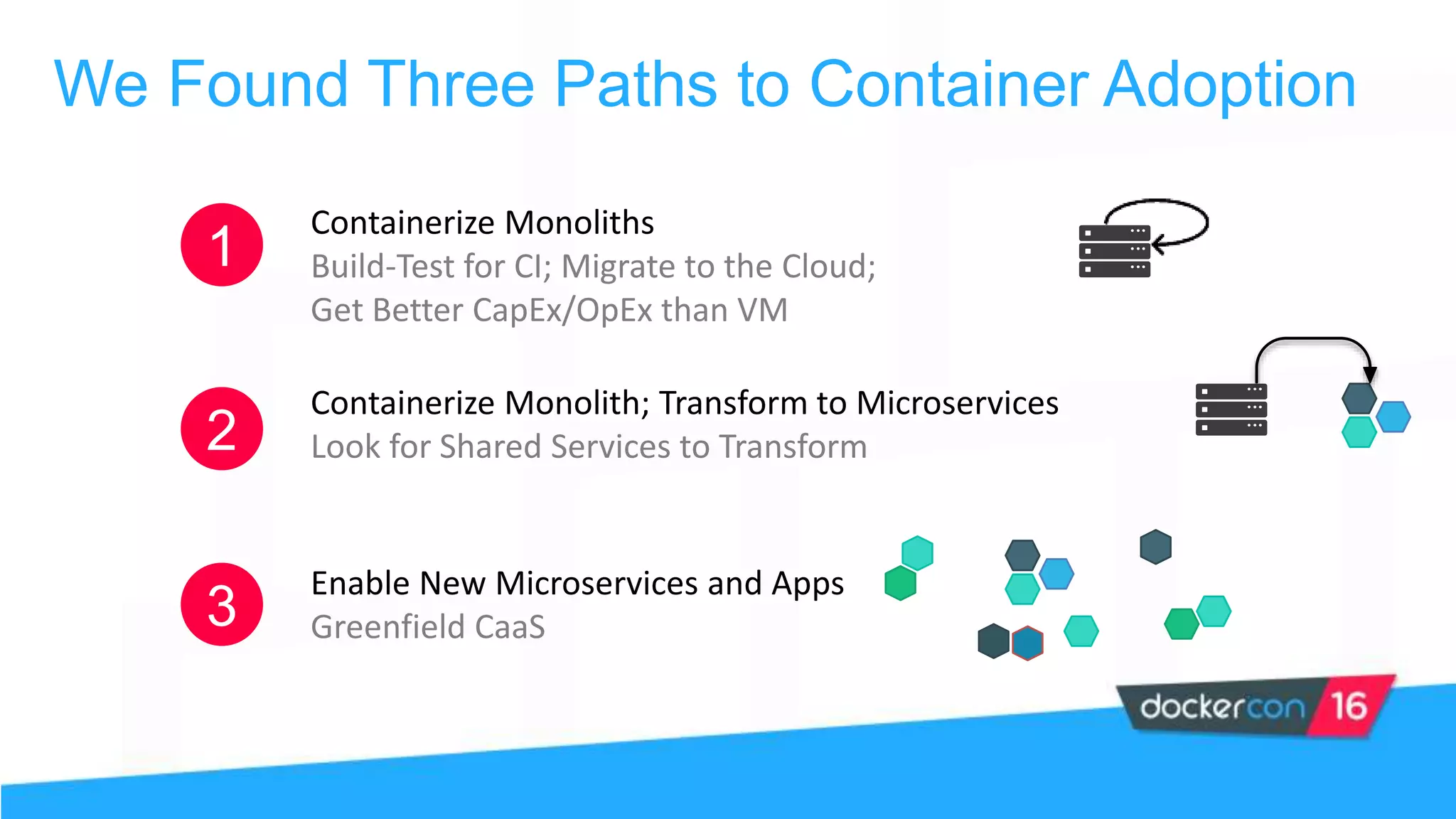
We Found Three Paths to Container Adoption
1
Containerize Monoliths
Build-Test for CI; Migrate to the Cloud;
Get Better CapEx/OpEx than VM
2
3
Containerize Monolith; Transform to Microservices
Look for Shared Services to Transform
Enable New Microservices and Apps
Greenfield CaaS
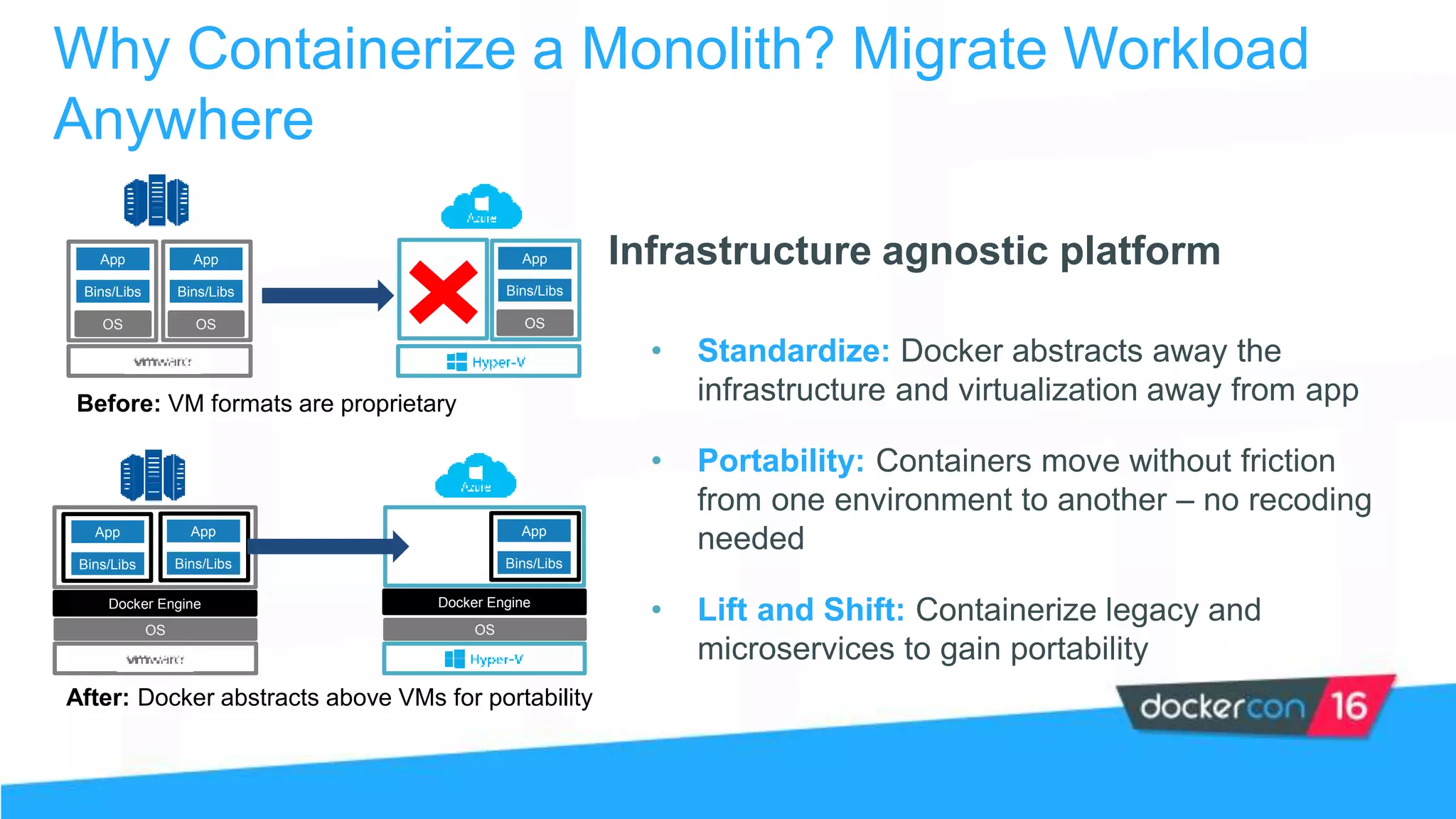
Why Containerize a Monolith? Migrate Workload
Anywhere
Infrastructure agnostic platform
• Standardize: Docker abstracts away the
infrastructure and virtualization away from app
• Portability: Containers move without friction
from one environment to another – no recoding
needed
• Lift and Shift: Containerize legacy and
microservices to gain portability
Bins/Libs
App
OS
Bins/Libs
App
OS
Bins/Libs
App
OS
Before: VM formats are proprietary
Bins/Libs
App
Bins/Libs
App
Bins/Libs
App
OS
After: Docker abstracts above VMs for portability
Docker Engine
OS
Docker Engine
Why Containerize a Monolith
Case Studies: Swisscom and Energy Company
Swisscom
• 400 MongoDB VMs
• Now 400 containers in 20 VMs
• Reduce Capex and Opex costs
Energy Company
• Containerize apps for portability
• Migrated from cloud to
datacenter in 5 months
• Accelerated release process
• Reduce VMs by 1/3 in non-prod
environments
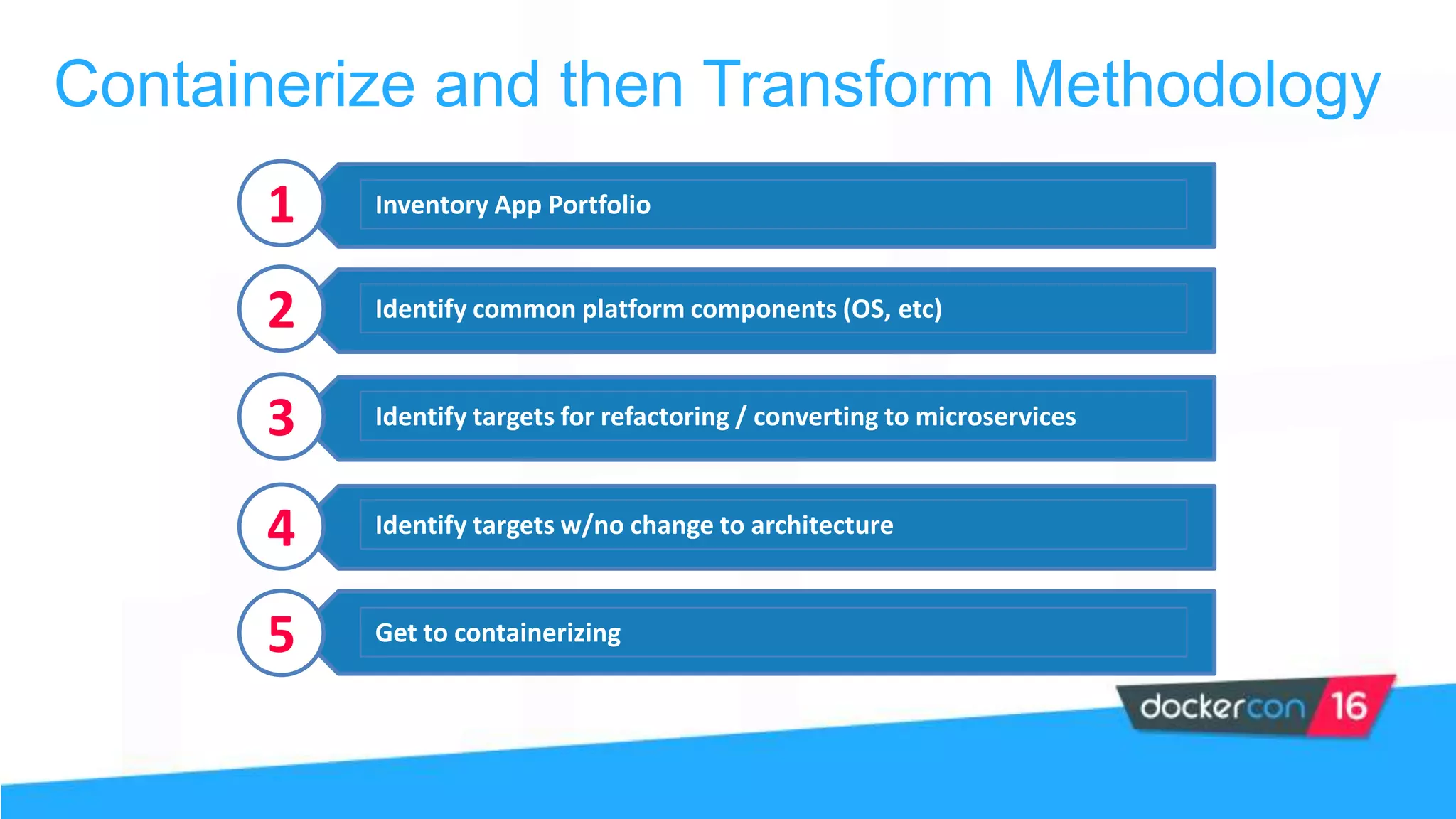
Containerize and then Transform Methodology
1
2
3
4
5
Inventory App Portfolio
Identify common platform components (OS, etc)
Identify targets for refactoring / converting to microservices
Identify targets w/no change to architecture
Get to containerizing
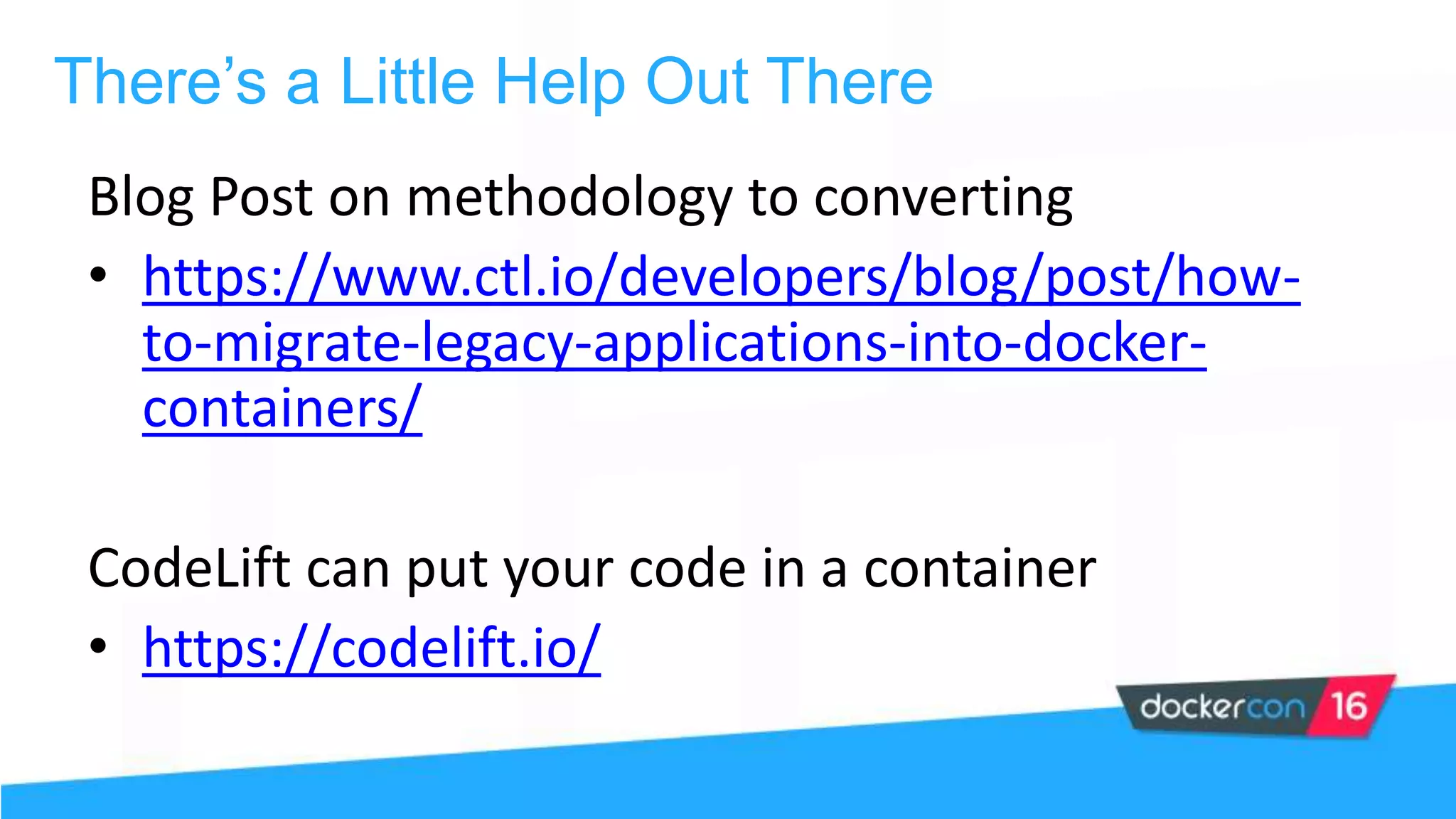
Blog Post on methodology to converting
• https://www.ctl.io/developers/blog/post/how-
to-migrate-legacy-applications-into-docker-
containers/
CodeLift can put your code in a container
• https://codelift.io/
There’s a Little Help Out There
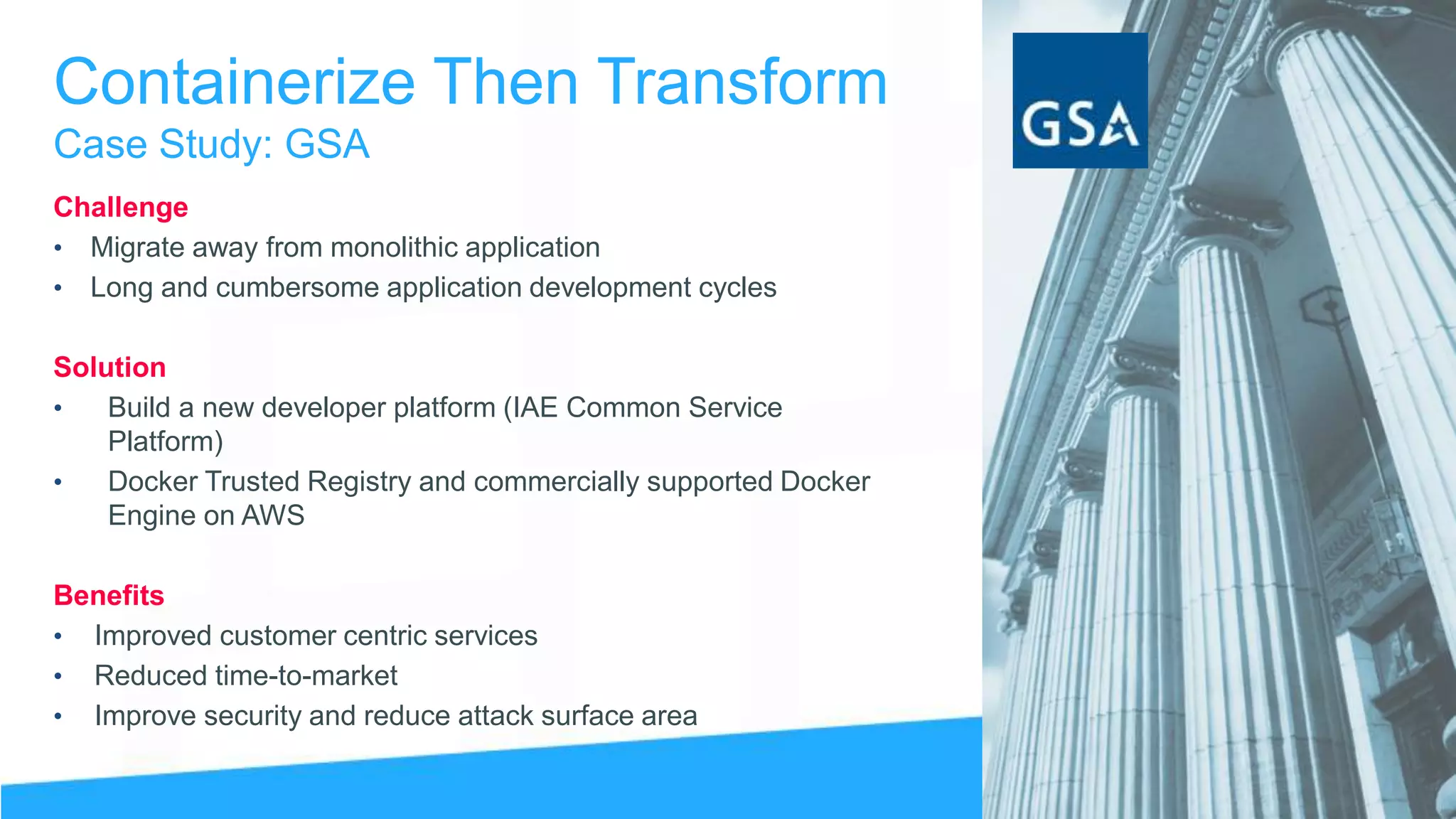
Containerize Then Transform
Case Study: GSA
Challenge
• Migrate away from monolithic application
• Long and cumbersome application development cycles
Solution
• Build a new developer platform (IAE Common Service
Platform)
• Docker Trusted Registry and commercially supported Docker
Engine on AWS
Benefits
• Improved customer centric services
• Reduced time-to-market
• Improve security and reduce attack surface area
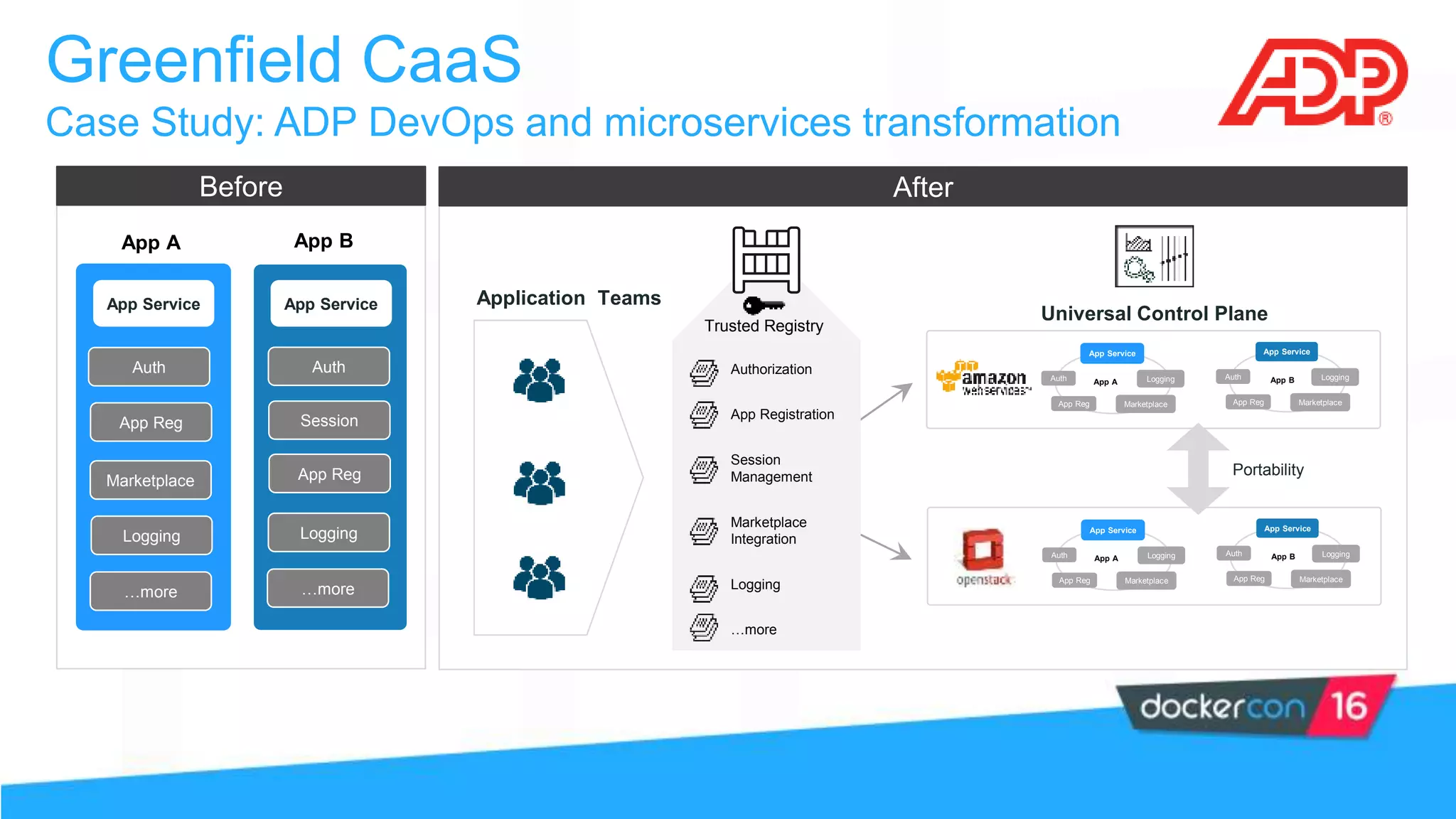
After
Greenfield CaaS
Case Study: ADP DevOps and microservices transformation
App Service App Service
App A App B
Auth
…more
App Reg
Marketplace
Logging
Auth
Session
…more
App Reg
Logging
Before
App BAuth
App Reg Marketplace
Logging
App Service
Application Teams
Universal Control Plane
App AAuth
App Reg Marketplace
Logging
App Service
App BAuth
App Reg Marketplace
Logging
App Service
App AAuth
App Reg Marketplace
Logging
App Service
Portability
Authorization
App Registration
Session
Management
Marketplace
Integration
Logging
…more
Trusted Registry
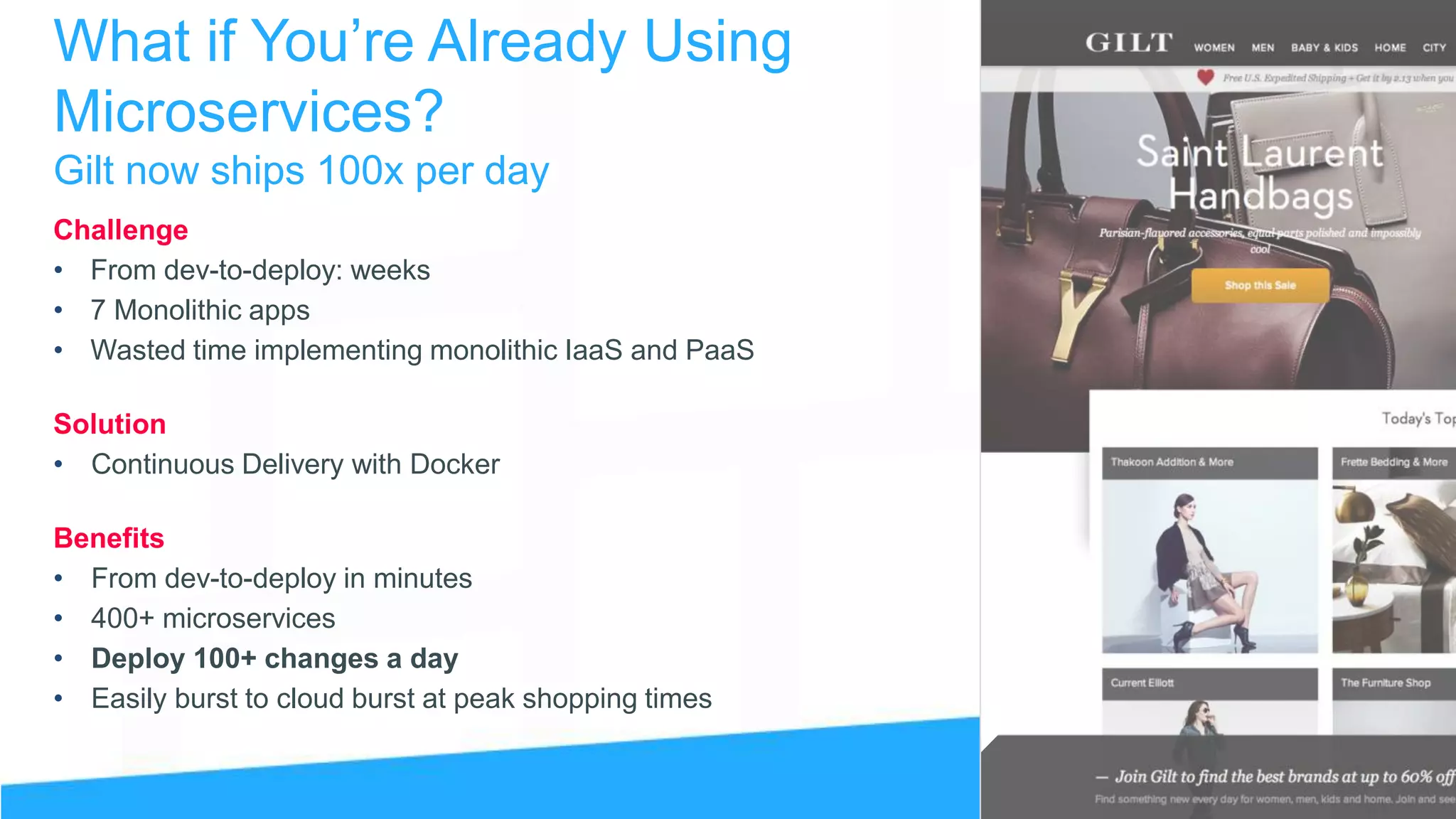
What if You’re Already Using
Microservices?
Gilt now ships 100x per day
Challenge
• From dev-to-deploy: weeks
• 7 Monolithic apps
• Wasted time implementing monolithic IaaS and PaaS
Solution
• Continuous Delivery with Docker
Benefits
• From dev-to-deploy in minutes
• 400+ microservices
• Deploy 100+ changes a day
• Easily burst to cloud burst at peak shopping times
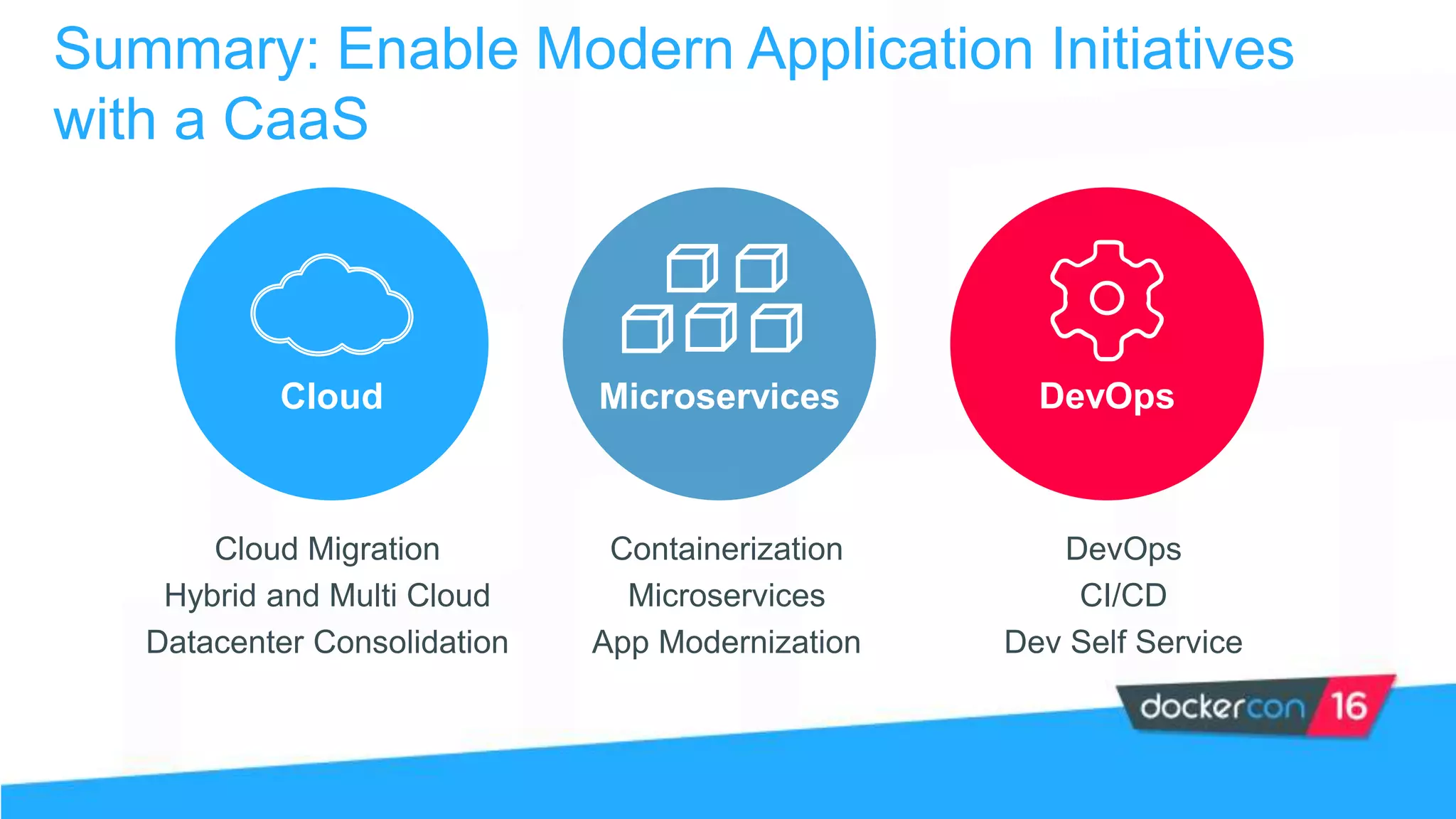
Summary: Enable Modern Application Initiatives
with a CaaS
Cloud Microservices
Cloud Migration
Hybrid and Multi Cloud
Datacenter Consolidation
Containerization
Microservices
App Modernization
DevOps
CI/CD
Dev Self Service
DevOps
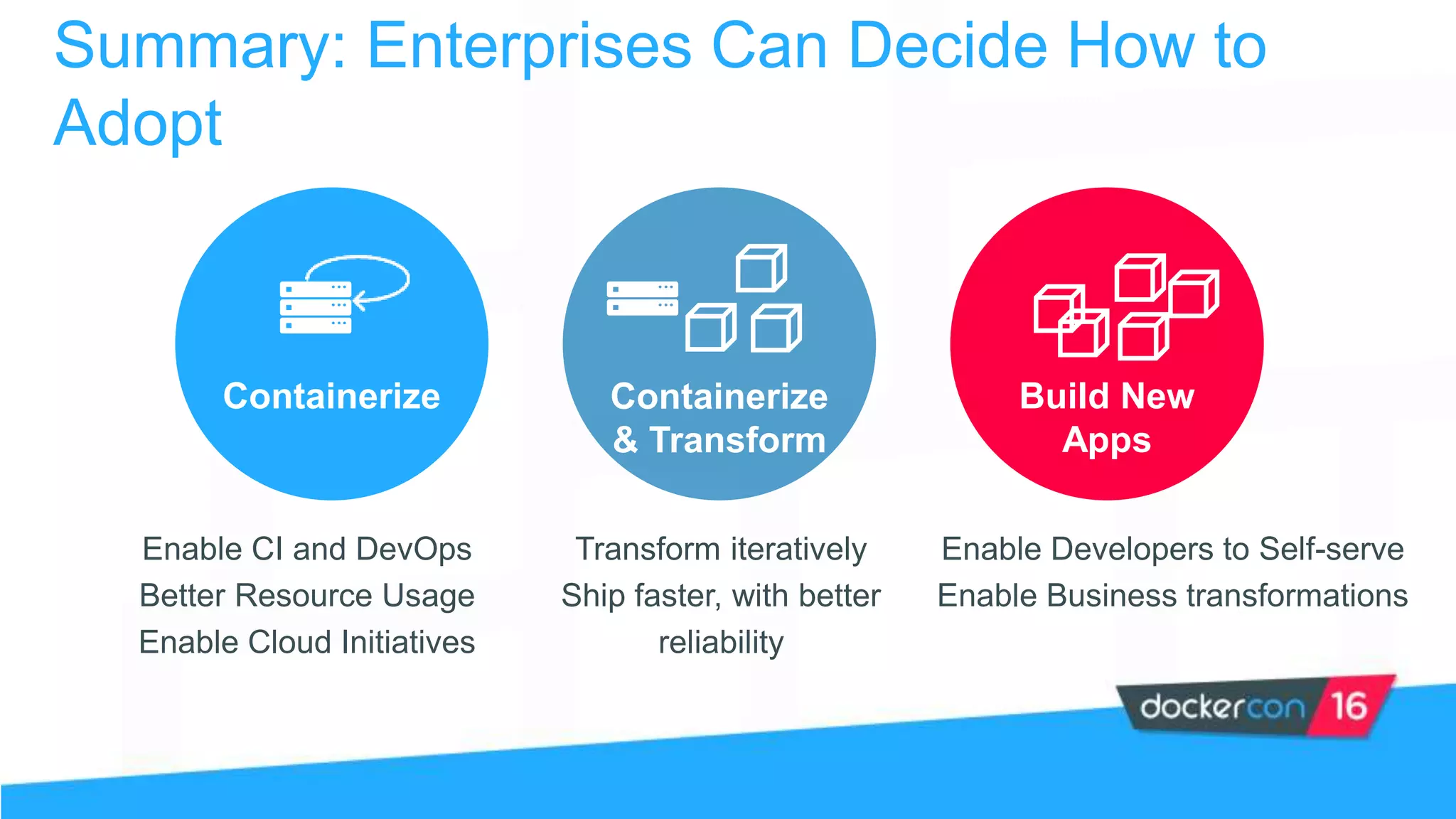
Summary: Enterprises Can Decide How to
Adopt
Containerize Containerize
& Transform
Build New
Apps
Enable CI and DevOps
Better Resource Usage
Enable Cloud Initiatives
Transform iteratively
Ship faster, with better
reliability
Enable Developers to Self-serve
Enable Business transformations
• Learn More about Docker Datacenter
https://www.docker.com/products/docker-datacenter
• Get a Trial or Purchase @ https://store.docker.com
• Come Talk to Us at the Docker Datacenter Booth!
• Try Docker Datacenter at the Hands On Lab
Get Started with Docker CaaS Solutions!
Thank you!

Docker for the Enterprise with Containers as a Service by Banjot Chanana

  • 1.
    Banjot Chanana Sr Director ofProduct Docker for the Enterprise with Containers as a Service
  • 2.
    What is aCaaS • Why CaaS is needed • Introducing Docker Datacenter • Agility, Portability and Control Benefits Agenda How Enterprises Get Started • Monoliths vs Microservices • Case Studies of Container Adoption
  • 3.
    Docker Is DrivingForce Behind Modern App Initiatives 80% Docker is central to cloud strategy State of App development Survey: Q1 - 2016 3 out 4 Top initiatives revolve around applications 44% Looking to adopt DevOps App Modernization DevOpsCloud
  • 4.
    Cloud Zone 2Data Center Development Center Headquarters Build and Run a Global Software Supply Chain Build, ship, run any application, anywhere
  • 5.
    The Problems inToday’s Supply Chain I want to build this new thing I need to deploy Works on My Machine Let me give you the package repo Let me get you some machines How does this work in Production
  • 6.
    To Solve theSW Supply Chain, You Need Both Sides! Developers IT Operations • Freedom to create and deploy apps fast • Define app needs • Test and Build locally • Quickly and flexibly respond to changing needs • Standardize, secure, and manage Dev-Prod Parity: Run in Prod, what is developed in Dev Capture the intent of Dev in order to deploy/manage in prod
  • 7.
    Three Components forCaaS DEVELOPERS IT OPERATIONS BUILD Development Environments SHIP Secure Content & Collaboration RUN Deploy, Manage, Scale
  • 8.
    Operating Systems Config MgtMonitoring LoggingCI/CD ..more.. Infrastructure Docker Universal Control Plane App and cluster management Security Content Trust, RBAC, LDAP/AD Docker Engine Container runtime, orchestration, networking, volumes, plugins Docker Trusted Registry Image management and distribution Images Networking Volumes VirtualizationPublic Cloud Physical/Converged An Integrated Dev and Ops Platform Docker Datacenter
  • 9.
    Docker Datacenter forOn-premises/VPC CaaS Client Compose Partner IntegrationsDocker Interfaces Volume Plug-ins Monitoring Logging Network Plug-ins Docker Universal Control Plane Docker Trusted Registry On premises Datacenter Virtual Private Cloud Commercially supported Docker Engines Docker Swarm Docker Datacenter Content Security Storage Drivers LDAP/ AD Docker for Mac/Win
  • 10.
    Docker Datacenter Focuseson 3 Areas Docker Universal Control Plane Docker Trusted Registry On premises Datacenter Virtual Private Cloud Docker Datacenter Content Security 1 Secure out of the box (TLS, AuthN, RBAC) 2 Enterprise ready configuration (HA, simplified GUI, integration APIs, etc.) 3 Docker native experience (docker API, docker-compose) Docker Engine swam
  • 11.
    Benefits to Enterprises– Faster Releases, Consistent Delivery, and Better Resource Utilization State of App development Survey: Q1 - 2016 + +Agility Portability Control 13X More software releases 20X Better resource utilization 44% Reduce VM usage by >25% Eliminate “works on my machine” issues 41% Move workloads across private/public clouds 62% Report reduced MTTR
  • 12.
    Enterprises in EveryIndustry are Adopting Modern application platform for DevOps and microservices Transform monoliths to secure and agile DevOps environments Moving 90% of all applications to Docker
  • 13.
    Containers for Monolithsor Microservices? Both! Legacy App: One container per app. Microservices: one service per container. App comprised of many containers linked together
  • 14.
    Enterprises are containerizingboth Monoliths and Microservices Docker platform standardizes environment AND enables workload portability 80% 46% plan to build new microservices in 2016 #4 container workload is traditional databases 1 in 3 have already containerized legacy apps Will leverage Docker to enable hybrid cloud initiatives
  • 15.
    We Found ThreePaths to Container Adoption 1 Containerize Monoliths Build-Test for CI; Migrate to the Cloud; Get Better CapEx/OpEx than VM 2 3 Containerize Monolith; Transform to Microservices Look for Shared Services to Transform Enable New Microservices and Apps Greenfield CaaS
  • 16.
    Why Containerize aMonolith? Migrate Workload Anywhere Infrastructure agnostic platform • Standardize: Docker abstracts away the infrastructure and virtualization away from app • Portability: Containers move without friction from one environment to another – no recoding needed • Lift and Shift: Containerize legacy and microservices to gain portability Bins/Libs App OS Bins/Libs App OS Bins/Libs App OS Before: VM formats are proprietary Bins/Libs App Bins/Libs App Bins/Libs App OS After: Docker abstracts above VMs for portability Docker Engine OS Docker Engine
  • 17.
    Why Containerize aMonolith Case Studies: Swisscom and Energy Company Swisscom • 400 MongoDB VMs • Now 400 containers in 20 VMs • Reduce Capex and Opex costs Energy Company • Containerize apps for portability • Migrated from cloud to datacenter in 5 months • Accelerated release process • Reduce VMs by 1/3 in non-prod environments
  • 18.
    Containerize and thenTransform Methodology 1 2 3 4 5 Inventory App Portfolio Identify common platform components (OS, etc) Identify targets for refactoring / converting to microservices Identify targets w/no change to architecture Get to containerizing
  • 19.
    Blog Post onmethodology to converting • https://www.ctl.io/developers/blog/post/how- to-migrate-legacy-applications-into-docker- containers/ CodeLift can put your code in a container • https://codelift.io/ There’s a Little Help Out There
  • 20.
    Containerize Then Transform CaseStudy: GSA Challenge • Migrate away from monolithic application • Long and cumbersome application development cycles Solution • Build a new developer platform (IAE Common Service Platform) • Docker Trusted Registry and commercially supported Docker Engine on AWS Benefits • Improved customer centric services • Reduced time-to-market • Improve security and reduce attack surface area
  • 21.
    After Greenfield CaaS Case Study:ADP DevOps and microservices transformation App Service App Service App A App B Auth …more App Reg Marketplace Logging Auth Session …more App Reg Logging Before App BAuth App Reg Marketplace Logging App Service Application Teams Universal Control Plane App AAuth App Reg Marketplace Logging App Service App BAuth App Reg Marketplace Logging App Service App AAuth App Reg Marketplace Logging App Service Portability Authorization App Registration Session Management Marketplace Integration Logging …more Trusted Registry
  • 22.
    What if You’reAlready Using Microservices? Gilt now ships 100x per day Challenge • From dev-to-deploy: weeks • 7 Monolithic apps • Wasted time implementing monolithic IaaS and PaaS Solution • Continuous Delivery with Docker Benefits • From dev-to-deploy in minutes • 400+ microservices • Deploy 100+ changes a day • Easily burst to cloud burst at peak shopping times
  • 23.
    Summary: Enable ModernApplication Initiatives with a CaaS Cloud Microservices Cloud Migration Hybrid and Multi Cloud Datacenter Consolidation Containerization Microservices App Modernization DevOps CI/CD Dev Self Service DevOps
  • 24.
    Summary: Enterprises CanDecide How to Adopt Containerize Containerize & Transform Build New Apps Enable CI and DevOps Better Resource Usage Enable Cloud Initiatives Transform iteratively Ship faster, with better reliability Enable Developers to Self-serve Enable Business transformations
  • 25.
    • Learn Moreabout Docker Datacenter https://www.docker.com/products/docker-datacenter • Get a Trial or Purchase @ https://store.docker.com • Come Talk to Us at the Docker Datacenter Booth! • Try Docker Datacenter at the Hands On Lab Get Started with Docker CaaS Solutions!
  • 26.

Editor's Notes

  • #4 Software is the lifeblood of your organization, whether automating internal processes or creating unique and engaging ways for you to service your customer, every company considers themselves a “digital” or “tech” company to some extent. To that end, many organizations like yours are looking at strategies to… - Modernize their apps (refactor or build cloud native apps) - Adopt microservces / distributed app architectures - migrate to containers - Cloud adoption, migration or multi cloud approaches But getting tthere isn’t always easy becuase you have legacy applications and envrionment to take care while you try to do new innovatinv things. Your organizational processes might not be ready to go all in and how do you avoid the worries of just getting locked into a cloud from your datacenter?
  • #5 How Can Enterprises Build a Supply Chain?
  • #7 The only way forward that is the best for the application and the organization is a solution that encompasses both agility AND control. Normally these two things are in direct conflict with each other but – both must be achievable for companies to be able to innovate rapidly to remain competitive but do so in a way that is secure and managed. Both developers and IT ops needs the freedom and flexibility to create or quickly respond to changes while being empowered to control the elements they are responsible for. Agility: speed and freedom for developers to create the best apps and change them whenever they see fit. Flexibility for IT to quickly respond to changes to scale up/down or redeploy app somewhere else. Control: more control, visibility and manageability. For developers it is the ability to own all the app code, how the app services interact, and what they require from the infrastructure. For IT it is the ability the secure and manage the operating environment in a way that’s scalable and cost effective Portability: ability to move the apps around from dev, test to prod…from my laptop to my team mates and across the datacenter and different cloud providers
  • #8 Local development environments Self service app images Build, Test, Deploy applications Define app behavior and infra needs Registry services for image storage, management and distribution IT Ops maintains library of secure base content Manage role based access to repos/images Management consoles Provision, manage infrastructure resources Monitor, manage, scale infrastructure and applications
  • #12 The Docker CaaS platform delivers these benefits for organizations and is already proven by the thousands of organizations who embarked on the Docker journey starting in 2013 Agility – The speed and simplicity of Docker is what originally drew developers to Docker. They were fundamentally able to ship more software faster. This fundamentally changed the way in which companies could innovate - ING went from shipping once every 9 months to shipping over 1,500 times a year by adoption Docker and DevOps - CapitalOne was able to use Docker to transform how they use data to empower their data scientists and business decisions. Portability – Just by the nature of the Docker technology, these developers realized they could easily move that containerized app from dev to test and ultimately to prod without any issue. No more finger pointing about why the app that worked fine in dev doesn’t work in prod. Having the app and dependencies packaged together made the container a self contained and independent unit. And beyond that, teams realized they could also move these apps across data centers and clouds – giving them a level of freedom and leverage not possible before. No more lock-in. The combination of agility and portability led to the #1 most popular use case for Docker – Continuous Integration. But that’s only half the value. To realize the full value of Docker, these apps need to move to production and new requirements around manageability, security and monitoring are required to enforce SLAs. Control – The Docker platform is the only solution that provides Agility AND Portability AND Control. Docker standardizes your application environment, with native tooling to manage the infrastructure and applications. And we provide you the levers so YOU can decide how much control and freedom is appropriate for YOUR business. We don’t prescribe that for you. Our tools help unify your heterogeneous infrastructure, languages and systems.
  • #13 Because every application team and company deserve to have these kinds of results. To innovate fast at any scale…and to enable new use cases that can expand their business.
  • #15 State of App development Survey: Q1 – 2016 https://www.docker.com/survey-2016 42% respondents run traditional databases in containers ALREADY 41 % use docker for app portability Intent to build new microservices up 14% from 2015 Intent to containerize legacy apps remains the same over 2015
  • #17 Public and private cloud infrastructure providers all have different software formats that are not compatible with each other. Migrations are not easily possible and environments have to be re-built from scratch. Going from physical to virtual or even virtual to virtual will be the same process of building VMs from scratch, installing OS, packages and then the application After: Docker provides a common platform layer above the physical and virtual machines. Workloads are containerized and then able to migrate to new hosts at different sites without modifications to the service. Consolidate datacenter sites or move workloads to the cloud. Works for ANY type of workload: legacy monoliths or microservices.
  • #18 Swoss
  • #21 Before Infrastructure built on monolithic applications Manual Continuous Integration (CI) and Continuous Delivery (CD) processes with long build time Infrequent and cumbersome updates After Creates shared micro-services running on the cloud Accelerates time to market Decreases Costs Creates opportunities for new business Provides target state of 2 week production sprint for new applications “I am creating a whole infrastructure from the ground up using Docker containers. This technology will change how services are delivered from one government agency to another.” Navin Vembar, Director of the GSA IAE
  • #22 ADP operates in a more traditional centralized IT model where IT manages and operates the application and environment ongoing. ADP looked at Docker as they began their transition to DevOps. They were interested in gaining more efficiencies and reuse of code by moving to a shared services model instead of monoliths with a lot of repeat services. ADP has OpenStack for their private cloud and AWS for their public cloud. As part of the transition, ADP would will setup a central marketplace where the shared services apps are available for the app teams. In the ADP example both the environment and ongoing management remains centralized. Use Cases - Transition to Micro services - Enable Dev Ops - CI/CD Why Docker? Need app portability so they can choose to move across AWS / Openstack Agility Streamline lifecycle time to move apps from dev to prod Enable a central repository of “app templates” for common services Portability Support AWS cloud and OpenStack private cloud environments Control Centralized management and control of images, apps and infrastructure Enable secure content lifecycle with integrated image signing and verification
  • #24 So these
  • #25 So these