Size Separation
BY-
Dipesh Gamare
Topics covered- Introduction and official standards for sieves, standard for sieves
and dimensions and notations, materials used for sieve, punch plates, modes of
motion in size separation.
INTRODUCTION :-
The Size Separation is defined as the process of separation of mixture of
various size of particles into two or more portion by means of screening
surface .
The Size Separation is also known as sieving, sifting, grinding , classifying
or screening .
Objectives :-
 To classify materials into different size for the desired purpose .
 To control size variation in the materials.
 To judge uniformity in a mixing material .
 To avoid variation in the bulk properties of materials.
 To enhance performance , efficacy and stability of dosage form .
 To specify the quality parameter of a intermediate and finished dosage form .
Application :-
Official standards of powder size
 Standards of powder used in pharmaceutical are required in the
British Pharmacopoeia (BP) which states that "the degree of
coarsness or fineness of powder is differentiated and expressed
by the size of the mesh of the sieve through which the powder
is able to pass .
 The BP state that the powder is described by a number , all
particles must pass through the specified sieve and when a
vegetable drug is being ground and sifted ,none must be
rejected .
 This classification is must if the character of a vegetable drug is
compared with a chemical substance .
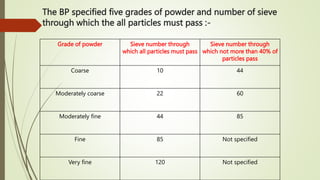
The BP specified five grades of powder and number of sieve
through which the all particles must pass :-
Grade of powder Sieve number through
which all particles must pass
Sieve number through
which not more than 40% of
particles pass
Coarse 10 44
Moderately coarse 22 60
Moderately fine 44 85
Fine 85 Not specified
Very fine 120 Not specified
 The Indian pharmacopoeia makes two statement with regards to "official grades of powder" in practice
1. It it required that when a powder is described by a number of all particles must pass through the specified
sieve.
2. When a vegetable drug is being ground and sifted, none must be rejected .
 The British Pharmaceutical codex has given a further grade of powder known as "Ultra- fine powder" .
 For this grade of powder required maximum dimension at least 90% of particles must be not greter than
5μm and none must be graeter than 50μm .
 Determination of particle size for this grades carried out by a microscopic method .
SIEVES
Definition:
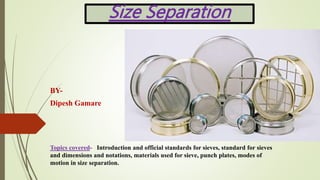
A sieve also called sifter, is a device for separating desired elements from
Unwanted material or for characteristics the particle size distribution of a
Sample. The word sift is derived from sieve. Sieve are the most commonly Used
devices for particle size analysis. Each sieve has a specific number that denotes
the number of meshes in a length of 2.54 cm(~1 inch).
Construction Of Sieve:
1. Sieves for pharmaceutical testing are constructed from wire cloth with square
meshes, woven from wire of brass, bronze, stainless steel or any suitable
materials.
2. Sieves should not be played or coated. There must be no reaction between
the material of the sieve and the substance to be sieved.
Types Of Sieves
1. Woven wire Sieves: wire woven Sieves are general purpose Sieves and widely used in
the pharmacy particle. There are two types :1) Plain weave Sieve 2) Twilled weave
sieve.For fine sieving metal wire woven Sieves are used.
2. Bolting cloth Sieves: Silk,nylon and cotton are generally woven from twisted multi-
strand fibers.Nylon cloths are generally designated by their micrometer opening and
available in different grades.These are used for the separation of fine powders.
3. Bar screens: Bar screens are generally used in handling large and heavy pieces of
material.The bars are fixed in parallel position and held by cross bars and spacers.
4. Punched plates: These are used for coarse size.The screen are prepared by using a
sheet metal of variyng thickness with perforated holes.
Standards of Sieves, Dimensions and Notations: Common
standards used for Sieves are:
a) Tyler standard sieve series(in USA)
b) US standard sieve series (in USA)
c) British standard sieve series (in UK)
d) German (in Germany and Europe)
e) If standard sieve series (in India)
f) International test sieve series.
-Tyler and US standards can be interchangeable, since difference between the two standards is less than
the allowable tolerance in weaving of the screens. These is also known as test sieve.
-Sieves used for pharmacopoeial testing must match with the following specifications:
1) Number of Sieves : Sieve number indicates the number of meshes per linear length of 25.4
millimeters.
2) Nomial size of aperture: Nominal size of aperture indicates the distance between the two adjacent
wires. It represents the side of a square aperture. IP 1996 gives the Nominal mesh aperture size for
majority of sieves in mm or in micrometer.
3) Nomial diameter of the wire: Wire mesh sieves are made from the wire having the specified diameter in
order to give a suitable aperture size and sufficient strength to avoid distortion of the sieve.
4) Approximate percentage sieving area: This standard expresses the area of the mesh as a percentage of
the total area of the sieve. It depends on the size of the wire used for any particular sieve. Generally,
sieving area is kept within the range of 35 to 40% in order to give suitable strength to the sieve.
5) Aperture tolerance average size: This variation is expressed as a percentage and is known as the
aperture tolerance average. Fine meshes cannot be woven with the same occurs as a coarse meshes.
Hence, the aperture tolerance average is lower for coarse sieves than the fine Sieves.
SIEVES
Sieves are used for size separation. Test sieves determine the efficiency of screening devices. Most of Sieves
used for pharmaceutical purpose are of wire mesh type. Each sieve is given a definite number which denotes
number of the meshes present in a length of 2.54 cm or one inch.
Material of construction:
 Sieves are woven from wire of brass, bronze, stainless steel.
 Sieves should not be coated with any material. It should be non reactive with material used The material
used for construction should be resistant to corrosion.
 Generally Iron nice is used as screen material because it is cheap but their disadvantage are corrosive
nature and chance of contamination by iron. These disadvantages can be overcome by coating two with
galvanizing agent which increase the strength and also make it corrosion resistant.
Brass , Phosphorous-bronze and stainless steel are the metals used due to their
corrosion resistant, good strength and non contamination qualities.
Non metals such as nylon and terylene are also suitable because they avoid risk of
metallic contamination. For special purpose punched plates or perforated screens
are used.
These sieves are made by drilling holes of varying thickness in metal plate. The
holes may be round, rectangular or square.
Punch plates
What is punch plates?
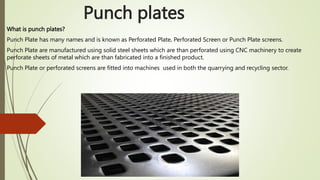
Punch Plate has many names and is known as Perforated Plate, Perforated Screen or Punch Plate screens.
Punch Plate are manufactured using solid steel sheets which are than perforated using CNC machinery to create
perforate sheets of metal which are than fabricated into a finished product.
Punch Plate or perforated screens are fitted into machines used in both the quarrying and recycling sector.
 Punch plate is installed into machines with the smooth side facing the materials which
are to be screened. To reduce the chances of pegging, it is important to consider the
shape of the material in relation to the perforation shape. Regular shaped material is
suited to square perforations and irregular shaped material is suited to round
perforations.
Punch plate capabilities
 Technical information for Perforated screens/Punch Plate.
 Hole size: 0.5mm – 150mm
 Thickness:0.5 – 12mm. However, Graepel can perforate up to 25mm thick on special request
 Sheet sizes: Plate sizes up to 4m x 2m
 Perforation Shapes: Round and square perforations are most suited for screening.
Advantages of punch plates
 Cost Effective
 Solid State Screens
 Longer screen life then that of woven mesh
 Fewer wear issues
 Smooth with a high strength ratio especially when round holes are used
 Maintenance of sizing accuracy
 Great strength in sfcreens
Applications of punch plates
 Screening and Grading in;
 Quarrying
 Recycling
 Milling
Modes of size separation
1)Agitation
2)Brushing
3)Centrifugal
Size separation is useful since particles are sorted into categories
solely on the basis of size, independently of other properties such
as density, surface, etc. It can be used to classify dry or wet
powders and generates narrowly classified fractions. While doing
this mechanical
sieving equipment's used works on the principle of agitation,
brushing and centrifugal force.
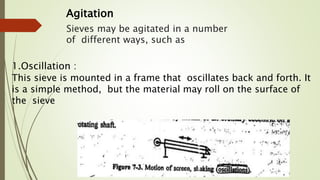
Sieves may be agitated in a number
of different ways, such as
1.Oscillation :
This sieve is mounted in a frame that oscillates back and forth. It
is a simple method, but the material may roll on the surface of
the sieve
Agitation
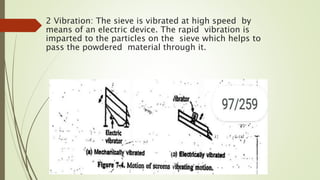
2 Vibration: The sieve is vibrated at high speed by
means of an electric device. The rapid vibration is
imparted to the particles on the sieve which helps to
pass the powdered material through it.
3. Gyration : In this method, a system is made so that
sieve is on rubber mounting and connected to an
eccentric fly wheel. This gives a rotary movement of
small amplitude to sieve which hi turn gives spinning
motion to the particles that helps to pass them through
a sieve. Agitation methods are not continuous
methods but can be made so by inclination of the sieve
and the provision of separate outlets for ubdersize and
oversize particles
Advantages
1) Agitation method is inexpensive. 2)Simple
and rapid
Disadvantage
1)Agitation method have a lower limit of
particle size
2)If the power is not dried ,apparatus become
clogged with particles leading to improve
sieving.
3)During agitation ,attrition causing size
reduction.
Brushing method
In this case, a brush is used to move the
particles on the surface of the sieve and to keep
the meshes clear. The brush is rotated in the
middle in the case of circular sieve but spiral
brush is rotated on the longitudinal axis in case
of a horizontal cylindrical sieve
Centrifugal method
In this method, a high speed rotor is fixed
inside the vertical cylindrical sieve, so that on
rotation of rotor the particles are thrown
outwards by centrifugal force. The current of air
which is produced due to high speed of rotor
helps in sieving the powder
1) Centrifugal method are extremely in cases
where conventional sieving tends to block the
sieves.
2) Extremely used for powder , because sieves
have the limitation of mesh sieve.
Advantages
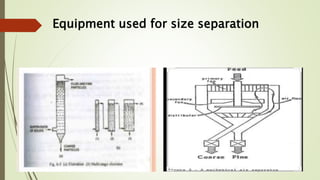
Equipment used for size separation

Size Separation.pptx

  • 1.
    Size Separation BY- Dipesh Gamare Topicscovered- Introduction and official standards for sieves, standard for sieves and dimensions and notations, materials used for sieve, punch plates, modes of motion in size separation.
  • 2.
    INTRODUCTION :- The SizeSeparation is defined as the process of separation of mixture of various size of particles into two or more portion by means of screening surface . The Size Separation is also known as sieving, sifting, grinding , classifying or screening .
  • 3.
    Objectives :-  Toclassify materials into different size for the desired purpose .  To control size variation in the materials.  To judge uniformity in a mixing material .  To avoid variation in the bulk properties of materials.  To enhance performance , efficacy and stability of dosage form .  To specify the quality parameter of a intermediate and finished dosage form .
  • 4.
  • 5.
    Official standards ofpowder size  Standards of powder used in pharmaceutical are required in the British Pharmacopoeia (BP) which states that "the degree of coarsness or fineness of powder is differentiated and expressed by the size of the mesh of the sieve through which the powder is able to pass .  The BP state that the powder is described by a number , all particles must pass through the specified sieve and when a vegetable drug is being ground and sifted ,none must be rejected .  This classification is must if the character of a vegetable drug is compared with a chemical substance .
  • 6.
    The BP specifiedfive grades of powder and number of sieve through which the all particles must pass :- Grade of powder Sieve number through which all particles must pass Sieve number through which not more than 40% of particles pass Coarse 10 44 Moderately coarse 22 60 Moderately fine 44 85 Fine 85 Not specified Very fine 120 Not specified
  • 7.
     The Indianpharmacopoeia makes two statement with regards to "official grades of powder" in practice 1. It it required that when a powder is described by a number of all particles must pass through the specified sieve. 2. When a vegetable drug is being ground and sifted, none must be rejected .  The British Pharmaceutical codex has given a further grade of powder known as "Ultra- fine powder" .  For this grade of powder required maximum dimension at least 90% of particles must be not greter than 5μm and none must be graeter than 50μm .  Determination of particle size for this grades carried out by a microscopic method .
  • 8.
    SIEVES Definition: A sieve alsocalled sifter, is a device for separating desired elements from Unwanted material or for characteristics the particle size distribution of a Sample. The word sift is derived from sieve. Sieve are the most commonly Used devices for particle size analysis. Each sieve has a specific number that denotes the number of meshes in a length of 2.54 cm(~1 inch). Construction Of Sieve: 1. Sieves for pharmaceutical testing are constructed from wire cloth with square meshes, woven from wire of brass, bronze, stainless steel or any suitable materials. 2. Sieves should not be played or coated. There must be no reaction between the material of the sieve and the substance to be sieved.
  • 9.
    Types Of Sieves 1.Woven wire Sieves: wire woven Sieves are general purpose Sieves and widely used in the pharmacy particle. There are two types :1) Plain weave Sieve 2) Twilled weave sieve.For fine sieving metal wire woven Sieves are used. 2. Bolting cloth Sieves: Silk,nylon and cotton are generally woven from twisted multi- strand fibers.Nylon cloths are generally designated by their micrometer opening and available in different grades.These are used for the separation of fine powders. 3. Bar screens: Bar screens are generally used in handling large and heavy pieces of material.The bars are fixed in parallel position and held by cross bars and spacers. 4. Punched plates: These are used for coarse size.The screen are prepared by using a sheet metal of variyng thickness with perforated holes.
  • 10.
    Standards of Sieves,Dimensions and Notations: Common standards used for Sieves are: a) Tyler standard sieve series(in USA) b) US standard sieve series (in USA) c) British standard sieve series (in UK) d) German (in Germany and Europe) e) If standard sieve series (in India) f) International test sieve series.
  • 11.
    -Tyler and USstandards can be interchangeable, since difference between the two standards is less than the allowable tolerance in weaving of the screens. These is also known as test sieve. -Sieves used for pharmacopoeial testing must match with the following specifications: 1) Number of Sieves : Sieve number indicates the number of meshes per linear length of 25.4 millimeters. 2) Nomial size of aperture: Nominal size of aperture indicates the distance between the two adjacent wires. It represents the side of a square aperture. IP 1996 gives the Nominal mesh aperture size for majority of sieves in mm or in micrometer. 3) Nomial diameter of the wire: Wire mesh sieves are made from the wire having the specified diameter in order to give a suitable aperture size and sufficient strength to avoid distortion of the sieve.
  • 12.
    4) Approximate percentagesieving area: This standard expresses the area of the mesh as a percentage of the total area of the sieve. It depends on the size of the wire used for any particular sieve. Generally, sieving area is kept within the range of 35 to 40% in order to give suitable strength to the sieve. 5) Aperture tolerance average size: This variation is expressed as a percentage and is known as the aperture tolerance average. Fine meshes cannot be woven with the same occurs as a coarse meshes. Hence, the aperture tolerance average is lower for coarse sieves than the fine Sieves.
  • 13.
    SIEVES Sieves are usedfor size separation. Test sieves determine the efficiency of screening devices. Most of Sieves used for pharmaceutical purpose are of wire mesh type. Each sieve is given a definite number which denotes number of the meshes present in a length of 2.54 cm or one inch. Material of construction:  Sieves are woven from wire of brass, bronze, stainless steel.  Sieves should not be coated with any material. It should be non reactive with material used The material used for construction should be resistant to corrosion.  Generally Iron nice is used as screen material because it is cheap but their disadvantage are corrosive nature and chance of contamination by iron. These disadvantages can be overcome by coating two with galvanizing agent which increase the strength and also make it corrosion resistant.
  • 14.
    Brass , Phosphorous-bronzeand stainless steel are the metals used due to their corrosion resistant, good strength and non contamination qualities. Non metals such as nylon and terylene are also suitable because they avoid risk of metallic contamination. For special purpose punched plates or perforated screens are used. These sieves are made by drilling holes of varying thickness in metal plate. The holes may be round, rectangular or square.
  • 15.
    Punch plates What ispunch plates? Punch Plate has many names and is known as Perforated Plate, Perforated Screen or Punch Plate screens. Punch Plate are manufactured using solid steel sheets which are than perforated using CNC machinery to create perforate sheets of metal which are than fabricated into a finished product. Punch Plate or perforated screens are fitted into machines used in both the quarrying and recycling sector.
  • 16.
     Punch plateis installed into machines with the smooth side facing the materials which are to be screened. To reduce the chances of pegging, it is important to consider the shape of the material in relation to the perforation shape. Regular shaped material is suited to square perforations and irregular shaped material is suited to round perforations.
  • 17.
    Punch plate capabilities Technical information for Perforated screens/Punch Plate.  Hole size: 0.5mm – 150mm  Thickness:0.5 – 12mm. However, Graepel can perforate up to 25mm thick on special request  Sheet sizes: Plate sizes up to 4m x 2m  Perforation Shapes: Round and square perforations are most suited for screening.
  • 18.
    Advantages of punchplates  Cost Effective  Solid State Screens  Longer screen life then that of woven mesh  Fewer wear issues  Smooth with a high strength ratio especially when round holes are used  Maintenance of sizing accuracy  Great strength in sfcreens
  • 19.
    Applications of punchplates  Screening and Grading in;  Quarrying  Recycling  Milling
  • 20.
    Modes of sizeseparation 1)Agitation 2)Brushing 3)Centrifugal
  • 21.
    Size separation isuseful since particles are sorted into categories solely on the basis of size, independently of other properties such as density, surface, etc. It can be used to classify dry or wet powders and generates narrowly classified fractions. While doing this mechanical sieving equipment's used works on the principle of agitation, brushing and centrifugal force.
  • 22.
    Sieves may beagitated in a number of different ways, such as 1.Oscillation : This sieve is mounted in a frame that oscillates back and forth. It is a simple method, but the material may roll on the surface of the sieve Agitation
  • 23.
    2 Vibration: Thesieve is vibrated at high speed by means of an electric device. The rapid vibration is imparted to the particles on the sieve which helps to pass the powdered material through it.
  • 24.
    3. Gyration :In this method, a system is made so that sieve is on rubber mounting and connected to an eccentric fly wheel. This gives a rotary movement of small amplitude to sieve which hi turn gives spinning motion to the particles that helps to pass them through a sieve. Agitation methods are not continuous methods but can be made so by inclination of the sieve and the provision of separate outlets for ubdersize and oversize particles
  • 25.
    Advantages 1) Agitation methodis inexpensive. 2)Simple and rapid Disadvantage 1)Agitation method have a lower limit of particle size 2)If the power is not dried ,apparatus become clogged with particles leading to improve sieving. 3)During agitation ,attrition causing size reduction.
  • 26.
    Brushing method In thiscase, a brush is used to move the particles on the surface of the sieve and to keep the meshes clear. The brush is rotated in the middle in the case of circular sieve but spiral brush is rotated on the longitudinal axis in case of a horizontal cylindrical sieve
  • 27.
    Centrifugal method In thismethod, a high speed rotor is fixed inside the vertical cylindrical sieve, so that on rotation of rotor the particles are thrown outwards by centrifugal force. The current of air which is produced due to high speed of rotor helps in sieving the powder
  • 28.
    1) Centrifugal methodare extremely in cases where conventional sieving tends to block the sieves. 2) Extremely used for powder , because sieves have the limitation of mesh sieve. Advantages
  • 29.
    Equipment used forsize separation