SIZE SEPARATION
1
PRESENTED BY,
Ms. JIJIMOL T
ASST. PROFESSOR
MCPSR, MUVATTUPUZHA
CONTENTS
Objectives
Applications and mechanism of size separation
Official standards of powders
Sieves
Principle, construction, working, uses, merits and demerits of
• Sieve shaker
• Cyclone separator
• Air separator
• Bag filters
• Elutriation tank.
2
• Size separation is a unit operation that involves separation of a
mixture of various sizes of particles into two or more portions by
means of screening surfaces.
• Also known as sieving, sifting, classifying or screening.
• Screening is a method of separating particles according to size
alone.
• Particles can be separated into individual sizes using sieves.
• The final particles consists of more uniform sizes.
• The material that remains on the screening surface is known as
oversize or plus material.
• The material passing through the screening surface is known as
undersize or minus material.
3
APPLICATIONS
Size separation of solids has important applications
• As a method to determine particle size and size distribution, which
are useful in the production of tablets and capsules.
• As a quality control tool for the analysis of raw materials such as
griseofulvin and aspirin.
• To test the efficiency of a size of a size reduction equipment or
process.
• To optimise the process conditions such as method of agitation,
time of screening, feed rate etc.
• To recover valuable products or by products.
• To prevent environmental pollution.
4
MECHANISM
Size separation is mainly assisted by three methods
1. Agitation
2. Brushing
3. Centrifugal force
These modes of shaking help to shake the material so that sieving
will be quick and entire sieving area can be utilised.
5
AGITATION METHOD
Sieves are agitated in a number of ways. Some of them are discussed
below.
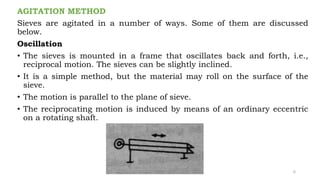
Oscillation
• The sieves is mounted in a frame that oscillates back and forth, i.e.,
reciprocal motion. The sieves can be slightly inclined.
• It is a simple method, but the material may roll on the surface of the
sieve.
• The motion is parallel to the plane of sieve.
• The reciprocating motion is induced by means of an ordinary eccentric
on a rotating shaft.
6
Vibration
• The sieve is vibrated at high speed by means of an eccentric device
either electrically or mechanically.
• Rapid vibration is imparted to the particles that helps the powder to
pass through the sieve.
• Electrically vibrated screens are particularly useful in the chemical
industry.
• Inducing vibrations also prevents blinding of meshes.
7
Gyration
• In this method, a system is made so that sieve is on rubber
mounting and connected to an eccentric flywheel.
• This gives a rotary movement of small amplitude to the sieve,
which in turn gives spinning motion to the particles that helps to
pass them through the sieve.
8
• Gyratory screens are box like equipment, either round or square,
with a series of screen cloths nested atop on another.
• Most gyratory screens have auxiliary vibrations caused by balls
bouncing against the lower surface of the screen.
• These methods can be made continuous by inclination of the
sieves.
• Separate outlets are made for undersize and oversize particles.
• Normally, all the three modes of agitation are used simultaneously
for an efficient size separation.
• Rotex screen works on this principle.
9
Advantages
• Agitation methods are inexpensive
• Simple and rapid
Disadvantages
• Agitation methods have lower limit of the particle size.
• If the powder is not dried, apertures become clogged with particles
leading to improper sieving.
• During agitation, attrition occurs causing size reduction.
10
BRUSHING METHOD
• A brush is used to move the particles on the surface of the sieve
and to keep the meshes clear.
• The brush is rotated in the middle in the case of circular sieve, but
spiral brush is rotated on the longitudinal axis in case of horizontal
cylinder sieve.
• Eg: brush sifter- used for size separation of greasy or sticky
powders such as waxes and soaps.
11
CENTRIFUGAL METHOD
• A high-speed rotator is fixed inside a vertical cylindrical sieve, so
that on rotation the particles are thrown outwards by centrifugal
force.
• The currents of air can be generated by means of a jet of air in to
the equipment, which helps in separating the particles.
• Eg: cyclone separator and air separator
Advantages
• These are extremely useful in case where conventional sieving
tends to block the sieves.
• For fine powder, because sieves have the limitation of mesh size.
12
OFFICIAL STANDARDS FOR POWDERS
• Powders are vaguely described as coarse and fine powders. Thus it
is essential to identify with some guiding specification.
• IP has prescribed standards for powders for pharmaceutical
purposes.
• Accordingly, degree of coarseness or fineness is expressed with
reference to the nominal aperture size of sieve through which
powder is able to pass.
• The IP 1996 specifies five grades of powder.
13
Sl.no Grades of powder Sieve
through
which all
particles
must pass
Nominal
mesh
aperture
size
Sieve
through
which 40%
particles
pass
Nominal
mesh
aperture
size
1 Coarse powder 10 1.7mm 44 355µm
2 Moderately coarse
powder
22 710µ𝑚 60 250µm
3 Moderately fine
powder
44 355µm 85 180µm
4 Fine powder 85 180µm - -
5 Very fine powder 120 125µm - -
14
• Coarse powder: a powder, all the particles of which pass through a
sieve with nominal mesh aperture of 170 mm (No. 10 sieve) and not
more than 40.0% through a sieve with nominal mesh aperture of
355µm (No.44 sieve) is called coarse powder.
• When fineness of a powder is described by means of a number, it is
an indication that all the particles of the powder shall pass through
the sieve of which the nominal mesh aperture in µm is equal to the
number.
• Fine powders- compound powders
• Moderately coarse powder- tinctures
• Coarse powders without fine- percolation process
15
Liquid extract Useful parts Grade of powder
Ashoka Stem bark Coarse
Nux vomica Seeds Moderately coarse
Rauwolfia Roots Moderately coarse
Ergot Sclerotia Moderately fine
Ipecac Root Fine
Ephedra Stem Fine
16
SIEVES
• Sieves for pharmacopeial testing are constructed from wire cloth
with square meshes, woven from wires of brass, bronze, stainless
steel etc.,
Types of sieves
1. Woven wire sieves
2. Bolting cloth sieves
3. Closely spaced bars
4. Punched plates
17
• Woven wire sieves:
Plain weave
Twilled weave
• Fine sieving: metal wire woven sieve
18
• Bolting cloth sieves: silk, nylon and cotton are generally woven
from twisted multi-strand fibres. Nylon cloths are generally
designated by their micrometre opening and available in different
grades. These are used for the separation of fine powders.
• Bar screens: these are generally used in handling large and heavy
pieces of materials. The bars are fixed in parallel position and held
by cross bars and spacers. Bars which taper in thickness from one
end to the other are recommended, because they tend to avoid
blinding.
• Punches plate (perforated screens): These are used for coarse
sizing. The screens are prepared by using a metal sheet of varying
thickness with perforated holes. The holes may be round, oval,
square, or rectangular. These are used in hammer mill.
19
• A plate with a large number of holes and a small amount of
residual metal will have a large capacity, but will wear rapidly and
vice versa.
20
Perforation shape Use Comments
Round holes Fibrous materials Clogs more quickly, lower
hole size is limited,
because of structural
strength.
Herringbone screen
(slots)
Amorphous and
crystalline materials
Slightly coarse powder
than equal-diameter
round perforations.
Cross-slots Amorphous materials
and slurries with
coarse particles
Same grind size as of
equal sized round
perforation: finer slot size
attainable than round
perforations.
21
• Herringbone design: It consists of a series of slotted holes
repeated across the surface of the screen. These are made at an
angle of 45 0 to the length of the screen. It is preferred for grinding
crystalline materials and for continuous operation. If the width of
the slot is equal to the diameter of a round hole, it grinds the
particles coarser than the round hole.
• Cross-slot screens: In this type, openings are at right angles to the
path travelled by milling mechanism. These are used for milling
slurries, but not used for fine grinding in hammer mills as it clogs
readily.
22
STANDARDS OF SIEVES, DIMENSIONS AND NOTATIONS
• Common standards used for sieves are:
a. Tyler standard sieve series(in USA)
b. US standard sieve series(in USA)
c. British standard sieve series(in UK)
d. German DIN(Deutsche Industrienormein) (in Germany and
Europe)
e. IP standard sieve series (in India)
f. International test sieve series (ISO) (World wide)
• Tyler & US standards can be interchangeable, since the difference
between the two standards is less than the allowable tolerance in
weaving screens.
23
• Sieves used for pharmacopoeial testing must match the following
specifications:
Number of sieves: Sieve number indicates the number of meshes
per linear length of 25.4mm
Nominal size of aperture: It indicates the distance between the two
adjacent wires. It represents the side of a square aperture. IP 1996
gives the nominal mesh aperture size for majority of sieves in mm
or in µm.
Nominal diameter of the wire: Wire mesh sieves are made from the
wire having the specified diameter in order to give a suitable
aperture size and sufficient strength to avoid distortion of the sieve.
Approximate percentage sieving area: This standard expresses the
area of the mesh as a percentage of the total area of the sieve. It
depends on the size of the wire used for any particular sieve.
24
Aperture tolerance average size: Some variation in the aperture size
is unavoidable. This variation is expressed as a percentage and is
known as the aperture tolerance average. Finer wires are likely to
be subject to a greater proportional variation in diameter than
coarse mesh. Hence, the aperture tolerance average is smaller for
sieves of 5 to 10 mesh than in case of 300mesh.
25
26
SIEVE SHAKER MACHINE
Principle
• The powdered drug is separated according to
its particle size using a number of sieves in a
nest.
• These are subjected to different types of
agitation, so that size separation is rapid.
Construction
• Standard sieves of different mesh numbers
are available commercially as per the
specifications of IP & USP.
• These sieves are fixed in a mechanical shaker
apparatus.
27
Working
• Sieves are arranged in a nest with the coarsest at the top. A sample
(50g) of the powder is placed on the top sieve.
• This sieve set is fixed to the mechanical shaker apparatus and
shaken for a certain period of time (20min).
• The powder retained on each sieve is weighed.
Advantages
• It is inexpensive, simple and rapid with reproducible results.
Disadvantages
• Lower limit of particle size is 50 µm
• If powder is not dry, apertures get clogged with particles, leading to
improper sieving.
• During shaking, attrition occurs causing size reduction of particles.
This leads to error in estimation.
28
CYCLONE SEPARATOR
Principle
• In cyclone separator centrifugal force is used to separate solid from
fluids.
• The separation process depends on particle size and particle density.
• It is also possible to allow fine particles to be carried with the fluid.
Construction
• It consists of a short vertical, cylindrical vessel with a conical base.
• The upper part of the vessel is fitted with a tangential inlet. The solid
outlet is at the base.
• Fluid outlet is provided at the center of the top portion, which
extends inwardly into the separator.
• Such an arrangement prevents the air short-circuiting directly from
the inlet to the outlet of the fluid.
29
Working
• The solids to be separated are suspended
in a stream of fluid (usually air or water).
• Such feed is introduced tangentially at a
very high velocity, so that rotary
movement takes place within the vessel.
• The centrifugal force throws the particles
to the wall of the vessel.
• As the speed of the fluid (air) diminishes,
the particles fall to the base and collected
at the solid outlet.
• The fluid (air) can escape from the central
outlet at the top.
30
Uses
• Cyclone separators are used to separate solid particles from gases.
• It is also used for size separation of solids in liquids.
• It is used to separate the heavy and coarse fraction from fine dust.
31
AIR SEPARATOR
Principle
• The cyclone separator alone cannot carry out size separation on
fine materials.
• For such separations a current of air combined with centrifugal
force is used.
• The finer particles are carried away by air and the coarser particles
are thrown by centrifugal force, which fall at the bottom.
Construction
• It consists of a cylindrical vessel with a conical base. A rotating
plate is fitted on a shaft placed at the center of the vessel.
• A set of fan blades are also fitted with the same shaft.
• At the base of the vessel two outlets are provided: one for the finer
particles and the other for coarse particles.
32
Working
• The disc and the fan are rotated by means
of a motor. The feed (powder) enters at the
center of the vessel and falls of the rotating
plate.
• The rotating fan blades produce a draft
(flow) of air in the direction as shown in the
diagram.
• The fine particles are picked up by the draft
of air and carried into space of settling
chamber, where the air velocity is
sufficiently reduced so that the fine
particles are dropped and removed through
the fine particle outlet.
• Particles too heavy to be picked up by the
air stream are removed at the coarse
particle outlet.
33
Uses
• Air separators are often attached to the ball mill or hammer mill to
separate and return over sized particles for further size reduction.
34
BAG FILTER
Principle
• In a bag filter, size separation of fines (or dust) from the milled
powder is achieved in two steps.
• In the first step, the milled powder is passed through a bag (made
from cloth) by applying suction on the opposite side of the feed
entry.
• This facilitates the separation.
• In the next step, pressure is applied in order to shake the bags so
that powder adhering to the bag falls off, which is collected from
the conical base.
35
Construction
• It consists of a number of bags made
of cotton or wool fabric.
• These are suspended in a metal
container.
• A hopper is arranged at the bottom
of the filter to receive the feed.
• At the top of the metal container, a
provision is made for vacuum fan
and exhaust through discharge
manifold.
• At the top of the vessel a bell-crank
lever arrangement is made to change
the action from filtering to shaking.
36
Working
Filtering period: During this period the vacuum fan produce a
pressure lower than the atmospheric pressure within the vessel.
• Gas to be filtered enters the hopper, passes through the bags, and
out of the top of the apparatus.
• The particles are retained within the bags.
Shaking period: During this period the bell-crank lever first close the
discharge manifold and air enters through the top so the vacuum is
broken.
• At the same time it gives a violent jerking action to the bags so that
they are freed from the dust.
• The fine particles are collected at the conical base.
37
Uses
• Bag filters are used along with other size separation equipment,
e.g. a cyclone separator.
• They are use on the top of fluidized bed dryer for drying to separate
the dusts.
• They are used to clean the air of a room.
• Household vacuum cleaner is a simple version of bag filter.
Disadvantages
• Bag filter is not size separation equipment as such.
38
ELUTRIATION
• It is a method of separation of particles in a powder based on the
low density of fine particles and high density of the coarse particles
using fluid flow.
• In elutriation, fluid flows in opposite direction of the settling
movement. The upward velocity of fluid is less than the settling
velocity of the particles.
39
Uses
• Applicable to insoluble solids such as kaolin or chalk, which are
subjected to wet grinding followed by sedimentation or elutriation.
Advantages
More compact than that are used in sedimentation methods.
Disadvantages
The suspension should be diluted, which may not be desirable in
certain cases.
40
STATIC TANK METHOD
• The dry powder or paste made by levigation
is kept in an elutriation tank.
• It is mixed with a large quantity of water.
• The solid particles are distributed
uniformly in the liquid during stirring.
• Then the particles are allowed to settle.
• Depending on the density, the solids
particles may either settle down or remain
suspended in water.
• Samples are withdrawn at different heights
through the outlets.
• The powders are dried and thus various
size fractions are collected.
41
Single separation with mobile liquid
• In this elutriation process, the particles are suspended in a moving fluid,
generally water.
• The apparatus consists of a vertical column of glass tube with a inlet
near the bottom for introducing the suspension.
• An outlet is provided at the top for the overflow of fluid of fine particles.
• The feed is introduced from the bottom. The movement of particles is as
follows.
• Generally, fluid is allowed to flow upward direction, while particles move
downwards due to gravitation force, depending on the experimental
conditions.
If the upward velocity of the fluid is less than the settling velocity of
the particles, sedimentation occurs.
Conversely, if the settling velocity of the particle is less than the
upward fluid velocity, particle moves upwards with the fluid flow.
42
• Thus, the fluid flow contributes significantly for the separation of
particles.
• Therefore, in elutriation, powder is divided into different size
fractions.
• A single column will give single separation into two fractions.
43
Separation as multiple fractions
• Several vertical liquid columns may be arranged in series.
• Each subsequent tube must have an increasing area of cross sections.
• In such a case, each column will give the separation od only two
fractions.
• The velocity of the fluid decreases in successive tubes, as the area of
cross section increases.
• Thus, several fractions are separated, collected and dried.
44

SIZE SEPARATION Pharmaceutical Engineering.pptx

  • 1.
    SIZE SEPARATION 1 PRESENTED BY, Ms.JIJIMOL T ASST. PROFESSOR MCPSR, MUVATTUPUZHA
  • 2.
    CONTENTS Objectives Applications and mechanismof size separation Official standards of powders Sieves Principle, construction, working, uses, merits and demerits of • Sieve shaker • Cyclone separator • Air separator • Bag filters • Elutriation tank. 2
  • 3.
    • Size separationis a unit operation that involves separation of a mixture of various sizes of particles into two or more portions by means of screening surfaces. • Also known as sieving, sifting, classifying or screening. • Screening is a method of separating particles according to size alone. • Particles can be separated into individual sizes using sieves. • The final particles consists of more uniform sizes. • The material that remains on the screening surface is known as oversize or plus material. • The material passing through the screening surface is known as undersize or minus material. 3
  • 4.
    APPLICATIONS Size separation ofsolids has important applications • As a method to determine particle size and size distribution, which are useful in the production of tablets and capsules. • As a quality control tool for the analysis of raw materials such as griseofulvin and aspirin. • To test the efficiency of a size of a size reduction equipment or process. • To optimise the process conditions such as method of agitation, time of screening, feed rate etc. • To recover valuable products or by products. • To prevent environmental pollution. 4
  • 5.
    MECHANISM Size separation ismainly assisted by three methods 1. Agitation 2. Brushing 3. Centrifugal force These modes of shaking help to shake the material so that sieving will be quick and entire sieving area can be utilised. 5
  • 6.
    AGITATION METHOD Sieves areagitated in a number of ways. Some of them are discussed below. Oscillation • The sieves is mounted in a frame that oscillates back and forth, i.e., reciprocal motion. The sieves can be slightly inclined. • It is a simple method, but the material may roll on the surface of the sieve. • The motion is parallel to the plane of sieve. • The reciprocating motion is induced by means of an ordinary eccentric on a rotating shaft. 6
  • 7.
    Vibration • The sieveis vibrated at high speed by means of an eccentric device either electrically or mechanically. • Rapid vibration is imparted to the particles that helps the powder to pass through the sieve. • Electrically vibrated screens are particularly useful in the chemical industry. • Inducing vibrations also prevents blinding of meshes. 7
  • 8.
    Gyration • In thismethod, a system is made so that sieve is on rubber mounting and connected to an eccentric flywheel. • This gives a rotary movement of small amplitude to the sieve, which in turn gives spinning motion to the particles that helps to pass them through the sieve. 8
  • 9.
    • Gyratory screensare box like equipment, either round or square, with a series of screen cloths nested atop on another. • Most gyratory screens have auxiliary vibrations caused by balls bouncing against the lower surface of the screen. • These methods can be made continuous by inclination of the sieves. • Separate outlets are made for undersize and oversize particles. • Normally, all the three modes of agitation are used simultaneously for an efficient size separation. • Rotex screen works on this principle. 9
  • 10.
    Advantages • Agitation methodsare inexpensive • Simple and rapid Disadvantages • Agitation methods have lower limit of the particle size. • If the powder is not dried, apertures become clogged with particles leading to improper sieving. • During agitation, attrition occurs causing size reduction. 10
  • 11.
    BRUSHING METHOD • Abrush is used to move the particles on the surface of the sieve and to keep the meshes clear. • The brush is rotated in the middle in the case of circular sieve, but spiral brush is rotated on the longitudinal axis in case of horizontal cylinder sieve. • Eg: brush sifter- used for size separation of greasy or sticky powders such as waxes and soaps. 11
  • 12.
    CENTRIFUGAL METHOD • Ahigh-speed rotator is fixed inside a vertical cylindrical sieve, so that on rotation the particles are thrown outwards by centrifugal force. • The currents of air can be generated by means of a jet of air in to the equipment, which helps in separating the particles. • Eg: cyclone separator and air separator Advantages • These are extremely useful in case where conventional sieving tends to block the sieves. • For fine powder, because sieves have the limitation of mesh size. 12
  • 13.
    OFFICIAL STANDARDS FORPOWDERS • Powders are vaguely described as coarse and fine powders. Thus it is essential to identify with some guiding specification. • IP has prescribed standards for powders for pharmaceutical purposes. • Accordingly, degree of coarseness or fineness is expressed with reference to the nominal aperture size of sieve through which powder is able to pass. • The IP 1996 specifies five grades of powder. 13
  • 14.
    Sl.no Grades ofpowder Sieve through which all particles must pass Nominal mesh aperture size Sieve through which 40% particles pass Nominal mesh aperture size 1 Coarse powder 10 1.7mm 44 355µm 2 Moderately coarse powder 22 710µ𝑚 60 250µm 3 Moderately fine powder 44 355µm 85 180µm 4 Fine powder 85 180µm - - 5 Very fine powder 120 125µm - - 14
  • 15.
    • Coarse powder:a powder, all the particles of which pass through a sieve with nominal mesh aperture of 170 mm (No. 10 sieve) and not more than 40.0% through a sieve with nominal mesh aperture of 355µm (No.44 sieve) is called coarse powder. • When fineness of a powder is described by means of a number, it is an indication that all the particles of the powder shall pass through the sieve of which the nominal mesh aperture in µm is equal to the number. • Fine powders- compound powders • Moderately coarse powder- tinctures • Coarse powders without fine- percolation process 15
  • 16.
    Liquid extract Usefulparts Grade of powder Ashoka Stem bark Coarse Nux vomica Seeds Moderately coarse Rauwolfia Roots Moderately coarse Ergot Sclerotia Moderately fine Ipecac Root Fine Ephedra Stem Fine 16
  • 17.
    SIEVES • Sieves forpharmacopeial testing are constructed from wire cloth with square meshes, woven from wires of brass, bronze, stainless steel etc., Types of sieves 1. Woven wire sieves 2. Bolting cloth sieves 3. Closely spaced bars 4. Punched plates 17
  • 18.
    • Woven wiresieves: Plain weave Twilled weave • Fine sieving: metal wire woven sieve 18
  • 19.
    • Bolting clothsieves: silk, nylon and cotton are generally woven from twisted multi-strand fibres. Nylon cloths are generally designated by their micrometre opening and available in different grades. These are used for the separation of fine powders. • Bar screens: these are generally used in handling large and heavy pieces of materials. The bars are fixed in parallel position and held by cross bars and spacers. Bars which taper in thickness from one end to the other are recommended, because they tend to avoid blinding. • Punches plate (perforated screens): These are used for coarse sizing. The screens are prepared by using a metal sheet of varying thickness with perforated holes. The holes may be round, oval, square, or rectangular. These are used in hammer mill. 19
  • 20.
    • A platewith a large number of holes and a small amount of residual metal will have a large capacity, but will wear rapidly and vice versa. 20
  • 21.
    Perforation shape UseComments Round holes Fibrous materials Clogs more quickly, lower hole size is limited, because of structural strength. Herringbone screen (slots) Amorphous and crystalline materials Slightly coarse powder than equal-diameter round perforations. Cross-slots Amorphous materials and slurries with coarse particles Same grind size as of equal sized round perforation: finer slot size attainable than round perforations. 21
  • 22.
    • Herringbone design:It consists of a series of slotted holes repeated across the surface of the screen. These are made at an angle of 45 0 to the length of the screen. It is preferred for grinding crystalline materials and for continuous operation. If the width of the slot is equal to the diameter of a round hole, it grinds the particles coarser than the round hole. • Cross-slot screens: In this type, openings are at right angles to the path travelled by milling mechanism. These are used for milling slurries, but not used for fine grinding in hammer mills as it clogs readily. 22
  • 23.
    STANDARDS OF SIEVES,DIMENSIONS AND NOTATIONS • Common standards used for sieves are: a. Tyler standard sieve series(in USA) b. US standard sieve series(in USA) c. British standard sieve series(in UK) d. German DIN(Deutsche Industrienormein) (in Germany and Europe) e. IP standard sieve series (in India) f. International test sieve series (ISO) (World wide) • Tyler & US standards can be interchangeable, since the difference between the two standards is less than the allowable tolerance in weaving screens. 23
  • 24.
    • Sieves usedfor pharmacopoeial testing must match the following specifications: Number of sieves: Sieve number indicates the number of meshes per linear length of 25.4mm Nominal size of aperture: It indicates the distance between the two adjacent wires. It represents the side of a square aperture. IP 1996 gives the nominal mesh aperture size for majority of sieves in mm or in µm. Nominal diameter of the wire: Wire mesh sieves are made from the wire having the specified diameter in order to give a suitable aperture size and sufficient strength to avoid distortion of the sieve. Approximate percentage sieving area: This standard expresses the area of the mesh as a percentage of the total area of the sieve. It depends on the size of the wire used for any particular sieve. 24
  • 25.
    Aperture tolerance averagesize: Some variation in the aperture size is unavoidable. This variation is expressed as a percentage and is known as the aperture tolerance average. Finer wires are likely to be subject to a greater proportional variation in diameter than coarse mesh. Hence, the aperture tolerance average is smaller for sieves of 5 to 10 mesh than in case of 300mesh. 25
  • 26.
  • 27.
    SIEVE SHAKER MACHINE Principle •The powdered drug is separated according to its particle size using a number of sieves in a nest. • These are subjected to different types of agitation, so that size separation is rapid. Construction • Standard sieves of different mesh numbers are available commercially as per the specifications of IP & USP. • These sieves are fixed in a mechanical shaker apparatus. 27
  • 28.
    Working • Sieves arearranged in a nest with the coarsest at the top. A sample (50g) of the powder is placed on the top sieve. • This sieve set is fixed to the mechanical shaker apparatus and shaken for a certain period of time (20min). • The powder retained on each sieve is weighed. Advantages • It is inexpensive, simple and rapid with reproducible results. Disadvantages • Lower limit of particle size is 50 µm • If powder is not dry, apertures get clogged with particles, leading to improper sieving. • During shaking, attrition occurs causing size reduction of particles. This leads to error in estimation. 28
  • 29.
    CYCLONE SEPARATOR Principle • Incyclone separator centrifugal force is used to separate solid from fluids. • The separation process depends on particle size and particle density. • It is also possible to allow fine particles to be carried with the fluid. Construction • It consists of a short vertical, cylindrical vessel with a conical base. • The upper part of the vessel is fitted with a tangential inlet. The solid outlet is at the base. • Fluid outlet is provided at the center of the top portion, which extends inwardly into the separator. • Such an arrangement prevents the air short-circuiting directly from the inlet to the outlet of the fluid. 29
  • 30.
    Working • The solidsto be separated are suspended in a stream of fluid (usually air or water). • Such feed is introduced tangentially at a very high velocity, so that rotary movement takes place within the vessel. • The centrifugal force throws the particles to the wall of the vessel. • As the speed of the fluid (air) diminishes, the particles fall to the base and collected at the solid outlet. • The fluid (air) can escape from the central outlet at the top. 30
  • 31.
    Uses • Cyclone separatorsare used to separate solid particles from gases. • It is also used for size separation of solids in liquids. • It is used to separate the heavy and coarse fraction from fine dust. 31
  • 32.
    AIR SEPARATOR Principle • Thecyclone separator alone cannot carry out size separation on fine materials. • For such separations a current of air combined with centrifugal force is used. • The finer particles are carried away by air and the coarser particles are thrown by centrifugal force, which fall at the bottom. Construction • It consists of a cylindrical vessel with a conical base. A rotating plate is fitted on a shaft placed at the center of the vessel. • A set of fan blades are also fitted with the same shaft. • At the base of the vessel two outlets are provided: one for the finer particles and the other for coarse particles. 32
  • 33.
    Working • The discand the fan are rotated by means of a motor. The feed (powder) enters at the center of the vessel and falls of the rotating plate. • The rotating fan blades produce a draft (flow) of air in the direction as shown in the diagram. • The fine particles are picked up by the draft of air and carried into space of settling chamber, where the air velocity is sufficiently reduced so that the fine particles are dropped and removed through the fine particle outlet. • Particles too heavy to be picked up by the air stream are removed at the coarse particle outlet. 33
  • 34.
    Uses • Air separatorsare often attached to the ball mill or hammer mill to separate and return over sized particles for further size reduction. 34
  • 35.
    BAG FILTER Principle • Ina bag filter, size separation of fines (or dust) from the milled powder is achieved in two steps. • In the first step, the milled powder is passed through a bag (made from cloth) by applying suction on the opposite side of the feed entry. • This facilitates the separation. • In the next step, pressure is applied in order to shake the bags so that powder adhering to the bag falls off, which is collected from the conical base. 35
  • 36.
    Construction • It consistsof a number of bags made of cotton or wool fabric. • These are suspended in a metal container. • A hopper is arranged at the bottom of the filter to receive the feed. • At the top of the metal container, a provision is made for vacuum fan and exhaust through discharge manifold. • At the top of the vessel a bell-crank lever arrangement is made to change the action from filtering to shaking. 36
  • 37.
    Working Filtering period: Duringthis period the vacuum fan produce a pressure lower than the atmospheric pressure within the vessel. • Gas to be filtered enters the hopper, passes through the bags, and out of the top of the apparatus. • The particles are retained within the bags. Shaking period: During this period the bell-crank lever first close the discharge manifold and air enters through the top so the vacuum is broken. • At the same time it gives a violent jerking action to the bags so that they are freed from the dust. • The fine particles are collected at the conical base. 37
  • 38.
    Uses • Bag filtersare used along with other size separation equipment, e.g. a cyclone separator. • They are use on the top of fluidized bed dryer for drying to separate the dusts. • They are used to clean the air of a room. • Household vacuum cleaner is a simple version of bag filter. Disadvantages • Bag filter is not size separation equipment as such. 38
  • 39.
    ELUTRIATION • It isa method of separation of particles in a powder based on the low density of fine particles and high density of the coarse particles using fluid flow. • In elutriation, fluid flows in opposite direction of the settling movement. The upward velocity of fluid is less than the settling velocity of the particles. 39
  • 40.
    Uses • Applicable toinsoluble solids such as kaolin or chalk, which are subjected to wet grinding followed by sedimentation or elutriation. Advantages More compact than that are used in sedimentation methods. Disadvantages The suspension should be diluted, which may not be desirable in certain cases. 40
  • 41.
    STATIC TANK METHOD •The dry powder or paste made by levigation is kept in an elutriation tank. • It is mixed with a large quantity of water. • The solid particles are distributed uniformly in the liquid during stirring. • Then the particles are allowed to settle. • Depending on the density, the solids particles may either settle down or remain suspended in water. • Samples are withdrawn at different heights through the outlets. • The powders are dried and thus various size fractions are collected. 41
  • 42.
    Single separation withmobile liquid • In this elutriation process, the particles are suspended in a moving fluid, generally water. • The apparatus consists of a vertical column of glass tube with a inlet near the bottom for introducing the suspension. • An outlet is provided at the top for the overflow of fluid of fine particles. • The feed is introduced from the bottom. The movement of particles is as follows. • Generally, fluid is allowed to flow upward direction, while particles move downwards due to gravitation force, depending on the experimental conditions. If the upward velocity of the fluid is less than the settling velocity of the particles, sedimentation occurs. Conversely, if the settling velocity of the particle is less than the upward fluid velocity, particle moves upwards with the fluid flow. 42
  • 43.
    • Thus, thefluid flow contributes significantly for the separation of particles. • Therefore, in elutriation, powder is divided into different size fractions. • A single column will give single separation into two fractions. 43
  • 44.
    Separation as multiplefractions • Several vertical liquid columns may be arranged in series. • Each subsequent tube must have an increasing area of cross sections. • In such a case, each column will give the separation od only two fractions. • The velocity of the fluid decreases in successive tubes, as the area of cross section increases. • Thus, several fractions are separated, collected and dried. 44