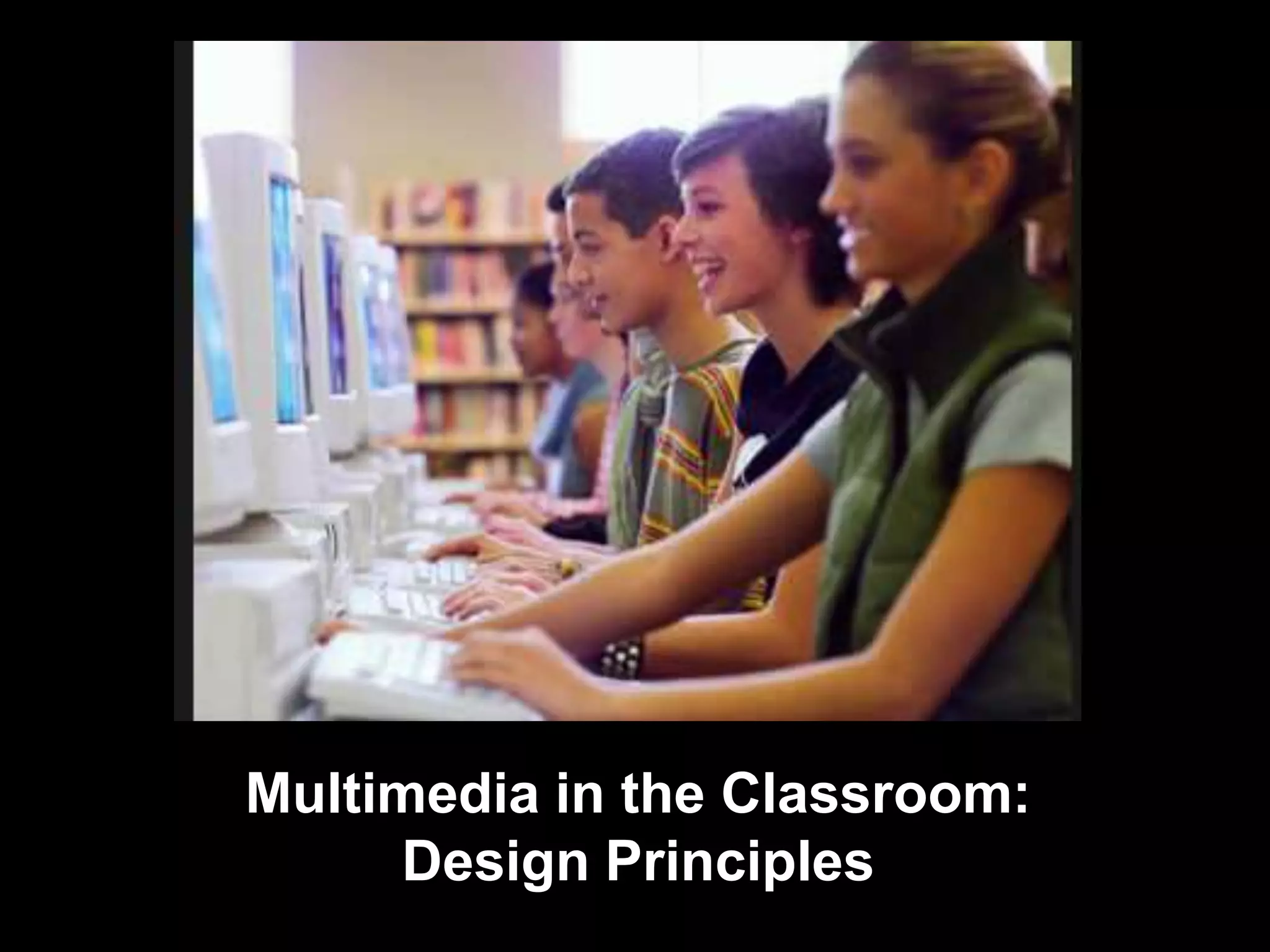
Multimedia in the Classroom:
Design Principles
The RMCAD Summer Girls
Instructional Design Team,
August 2013
Katy Mathes, Project Manager
Margaret Libertini, Subject Matter Expert
Jenna Cronk, Instructional Designer
Diane Cecere, Multimedia Developer
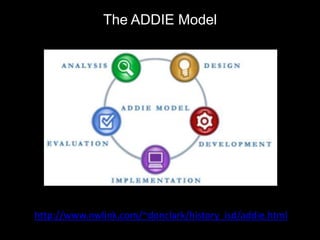
The ADDIE Model
http://www.nwlink.com/~donclark/history_isd/addie.html
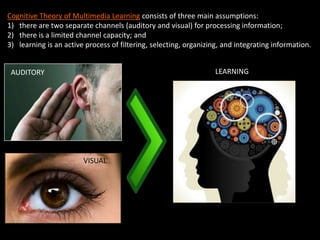
Cognitive Theory of Multimedia Learning consists of three main assumptions:
1) there are two separate channels (auditory and visual) for processing information;
2) there is a limited channel capacity; and
3) learning is an active process of filtering, selecting, organizing, and integrating information.
LEARNINGAUDITORY
VISUAL
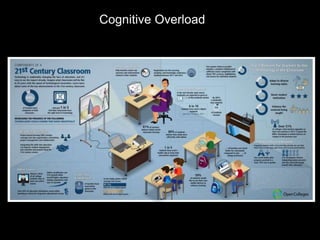
Cognitive Overload
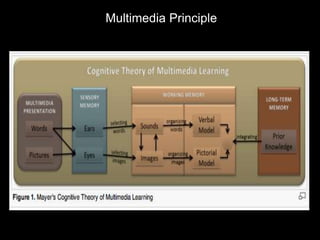
Multimedia Principle
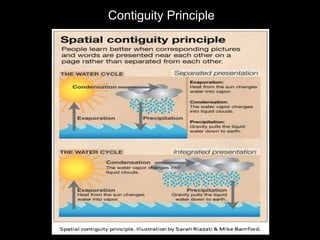
Contiguity Principle
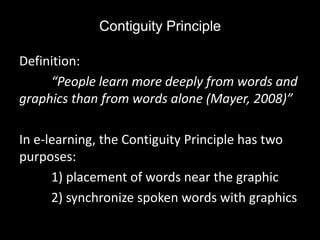
Definition:
“People learn more deeply from words and
graphics than from words alone (Mayer, 2008)”
In e-learning, the Contiguity Principle has two
purposes:
1) placement of words near the graphic
2) synchronize spoken words with graphics
Contiguity Principle
FORMATIVE ASSESSMENT
The goal of formative assessment is to monitor student learning to provide ongoing
feedback that can be used by instructors to improve their teaching and by students to
improve their learning.
More specifically, formative assessments:
• help faculty recognize where students are struggling and address problems
immediately
• help students identify their strengths and weaknesses and target areas that need
work
Formative assessments are generally low stakes, which means that they have low or no
point value. Examples of formative assessments include asking students to:
• draw a concept map in class to represent their understanding of a topic
• submit one or two sentences identifying the main point of a lecture
• turn in a research proposal for early feedback
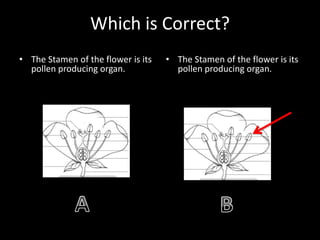
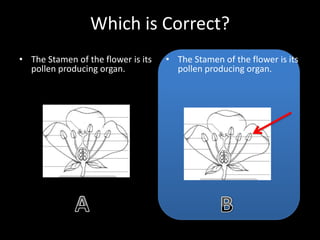
Which is Correct?
• The Stamen of the flower is its
pollen producing organ.
• The Stamen of the flower is its
pollen producing organ.
Which is Correct?
• The Stamen of the flower is its
pollen producing organ.
• The Stamen of the flower is its
pollen producing organ.
Modality Principle
uses narration and graphics simultaneously to
enhance the users comprehension of what is
being displayed in the presentation in
conjunction with the verbal content.
SYMBOLS
OF
EDUCATION
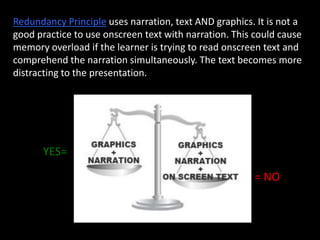
Redundancy Principle uses narration, text AND graphics. It is not a
good practice to use onscreen text with narration. This could cause
memory overload if the learner is trying to read onscreen text and
comprehend the narration simultaneously. The text becomes more
distracting to the presentation.
YES=
= NO
http://www.youtube.com/watch?v=MjcO2ExtHso
SUMMATIVE ASSESSMENT
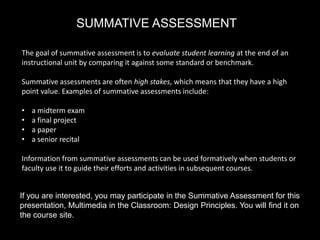
The goal of summative assessment is to evaluate student learning at the end of an
instructional unit by comparing it against some standard or benchmark.
Summative assessments are often high stakes, which means that they have a high
point value. Examples of summative assessments include:
• a midterm exam
• a final project
• a paper
• a senior recital
Information from summative assessments can be used formatively when students or
faculty use it to guide their efforts and activities in subsequent courses.
If you are interested, you may participate in the Summative Assessment for this
presentation, Multimedia in the Classroom: Design Principles. You will find it on
the course site.
RESOURCES
ADDIE model. 2013. Retrieved from http://elearning.niu.edu/edtech/courseDevelopmentdemo/courseDevelopmenttxt_demo.html
Auditory. 2013. Retrieved from http://www.factrange.com/our-left-ear-is-better-at-listening-music-while-the-right-ear-is-better-for-hearing/
Brain/Learning. 2013. Retrieved from www.blueoceanbrain.com
Contiguity principle. 2013. Retrieved from http://www.learnnc.org/lp/editions/every-learner/6693
Flower parts diagram. 2013. Retrieved from SAPS_Reproduction_Life_Cycles_PartB.pdf
Formative and summative assessments. 2013.Retrieved from http://www.cmu.edu/teaching/assessment/basics/formative-summative.html
Formative assessment slides: flower. 2013. Retrieved from
Modality principle. 2013. Symbols of Education: Apple, Books, & Laptop Computer. Retrieved from http://akeynotespeaker.com/education-
technology-speaker-schools/
Multimedia design principles. 2013. Retrieved from http://www.learningsolutionsmag.com/articles/222/designing-for-mobile-learning-clark-
and-mayers-principles-applied/page2
Multimedia principle chart. 2013. Retrieved from http://etec.ctlt.ubc.ca/510wiki/
Music. 2013. “All Summer Long”. Retrieved from iTunes.
Pie charts. 2013. Retrieved from http://www.pbs.org/about/news/archive/2012/teacher-survey-fetc/
Redundancy principle scales. 2013. Retrieved from http://blog.commlabindia.com/elearning/modality-principle-in-elearning
Students at computers. 2013. Retrieved from http://www.technapex.com/category/culture/teacher-student/page/10/
Twenty-first century classroom graphic. 2013. Retrieved from http://edudemic.com/wp-content/uploads/2012/07/21st_century_classroom.jpg
Visual. 2013. Retrieved from http://abcnews.go.com/Health/writing-eyes-researchers-make/story?id=16861469
YouTube video: Life after death by powerpoint. 2013. Retrieved from http://www.youtube.com/watch?v=MjcO2ExtHso
THANK YOU FOR WATCHING!
If you would like more information, please contact our team
members:
Katy Mathes, Project Manager:
katherine.mathes@rmcad.edu
Margaret Libertini, Subject Matter Expert:
margaret.libertinilucero@rmcad.edu
Jenna Cronk, Instructional Designer:
jenna.cronk@rmcad.edu
Diane Cecere, Multimedia Developer:
diane.cecere@rmcad.edu
Education, Leadership, & Emerging Technology
Graduate Degree Students at the
Rocky Mountain College of Art & Design
Denver, Colorado

ELET5160 Multimedia Design Principles

  • 1.
    Multimedia in theClassroom: Design Principles
  • 2.
    The RMCAD SummerGirls Instructional Design Team, August 2013 Katy Mathes, Project Manager Margaret Libertini, Subject Matter Expert Jenna Cronk, Instructional Designer Diane Cecere, Multimedia Developer
  • 3.
  • 5.
    Cognitive Theory ofMultimedia Learning consists of three main assumptions: 1) there are two separate channels (auditory and visual) for processing information; 2) there is a limited channel capacity; and 3) learning is an active process of filtering, selecting, organizing, and integrating information. LEARNINGAUDITORY VISUAL
  • 6.
  • 7.
  • 8.
    Contiguity Principle Definition: “People learnmore deeply from words and graphics than from words alone (Mayer, 2008)” In e-learning, the Contiguity Principle has two purposes: 1) placement of words near the graphic 2) synchronize spoken words with graphics
  • 9.
  • 10.
    FORMATIVE ASSESSMENT The goalof formative assessment is to monitor student learning to provide ongoing feedback that can be used by instructors to improve their teaching and by students to improve their learning. More specifically, formative assessments: • help faculty recognize where students are struggling and address problems immediately • help students identify their strengths and weaknesses and target areas that need work Formative assessments are generally low stakes, which means that they have low or no point value. Examples of formative assessments include asking students to: • draw a concept map in class to represent their understanding of a topic • submit one or two sentences identifying the main point of a lecture • turn in a research proposal for early feedback
  • 11.
    Which is Correct? •The Stamen of the flower is its pollen producing organ. • The Stamen of the flower is its pollen producing organ.
  • 12.
    Which is Correct? •The Stamen of the flower is its pollen producing organ. • The Stamen of the flower is its pollen producing organ.
  • 13.
    Modality Principle uses narrationand graphics simultaneously to enhance the users comprehension of what is being displayed in the presentation in conjunction with the verbal content.
  • 14.
  • 15.
    Redundancy Principle usesnarration, text AND graphics. It is not a good practice to use onscreen text with narration. This could cause memory overload if the learner is trying to read onscreen text and comprehend the narration simultaneously. The text becomes more distracting to the presentation. YES= = NO
  • 16.
  • 17.
    SUMMATIVE ASSESSMENT The goalof summative assessment is to evaluate student learning at the end of an instructional unit by comparing it against some standard or benchmark. Summative assessments are often high stakes, which means that they have a high point value. Examples of summative assessments include: • a midterm exam • a final project • a paper • a senior recital Information from summative assessments can be used formatively when students or faculty use it to guide their efforts and activities in subsequent courses. If you are interested, you may participate in the Summative Assessment for this presentation, Multimedia in the Classroom: Design Principles. You will find it on the course site.
  • 18.
    RESOURCES ADDIE model. 2013.Retrieved from http://elearning.niu.edu/edtech/courseDevelopmentdemo/courseDevelopmenttxt_demo.html Auditory. 2013. Retrieved from http://www.factrange.com/our-left-ear-is-better-at-listening-music-while-the-right-ear-is-better-for-hearing/ Brain/Learning. 2013. Retrieved from www.blueoceanbrain.com Contiguity principle. 2013. Retrieved from http://www.learnnc.org/lp/editions/every-learner/6693 Flower parts diagram. 2013. Retrieved from SAPS_Reproduction_Life_Cycles_PartB.pdf Formative and summative assessments. 2013.Retrieved from http://www.cmu.edu/teaching/assessment/basics/formative-summative.html Formative assessment slides: flower. 2013. Retrieved from Modality principle. 2013. Symbols of Education: Apple, Books, & Laptop Computer. Retrieved from http://akeynotespeaker.com/education- technology-speaker-schools/ Multimedia design principles. 2013. Retrieved from http://www.learningsolutionsmag.com/articles/222/designing-for-mobile-learning-clark- and-mayers-principles-applied/page2 Multimedia principle chart. 2013. Retrieved from http://etec.ctlt.ubc.ca/510wiki/ Music. 2013. “All Summer Long”. Retrieved from iTunes. Pie charts. 2013. Retrieved from http://www.pbs.org/about/news/archive/2012/teacher-survey-fetc/ Redundancy principle scales. 2013. Retrieved from http://blog.commlabindia.com/elearning/modality-principle-in-elearning Students at computers. 2013. Retrieved from http://www.technapex.com/category/culture/teacher-student/page/10/ Twenty-first century classroom graphic. 2013. Retrieved from http://edudemic.com/wp-content/uploads/2012/07/21st_century_classroom.jpg Visual. 2013. Retrieved from http://abcnews.go.com/Health/writing-eyes-researchers-make/story?id=16861469 YouTube video: Life after death by powerpoint. 2013. Retrieved from http://www.youtube.com/watch?v=MjcO2ExtHso
  • 19.
    THANK YOU FORWATCHING! If you would like more information, please contact our team members: Katy Mathes, Project Manager: katherine.mathes@rmcad.edu Margaret Libertini, Subject Matter Expert: margaret.libertinilucero@rmcad.edu Jenna Cronk, Instructional Designer: jenna.cronk@rmcad.edu Diane Cecere, Multimedia Developer: diane.cecere@rmcad.edu Education, Leadership, & Emerging Technology Graduate Degree Students at the Rocky Mountain College of Art & Design Denver, Colorado