 CLL is part of a more general instructional approach
  also known as Collaborative Learning (CL)
 It is an approach that makes maximum use of
  cooperative activities involving pairs and small groups
  of learners in the classroom.
Cooperative learning is group learning activity
organized so that learning is dependent on the socially
structured exchange of information between learners
in groups and in which each learner is held
accountable for his or her own learning and is
motivated to increase the learning of others. (Olsen
and Kagan 1992:8)
 U.S. educator John Dewey is usually credited with
  promoting the idea of building cooperation in
  learning into regular classrooms on a regular and
  systematic basis.
 It was more generally promoted and developed in the
  United States in the 1960’s and 1970’s as a response to
  the forced integration of public schools.
 Educators were concerned that traditional models
  of classroom learning were teacher-fronted,
  fostered competition rather than cooperation, and
  favored majority students. They believed that
  minority students might fall behind higher-
  achieving students.
 Raise the achievement of all students, including those who
  are gifted or academically handicapped
 Help the teacher build positive relationships among
  students
 Give students the experiences they need for healthy social,
  psychological and cognitive development
 Replace the competitive organizational structure of most
  classrooms and schools with a team-based, high
  performance organizational structure.
 In second language teaching, CLL has been embraced
  as a way of promoting communicative interaction in
  the classroom and is seen as an extension of the
  principles of Communicative Language Teaching.
 It is viewed as a learner-centered approach to teaching
  held to offer advantages over teacher-fronted
  classroom methods.
 To provide opportunities for naturalistic second
  language acquisition through the use of interactive
  pair and group activities
 To provide teachers with a methodology to enable
  them to achieve this goal and one that can be applied
  in a variety of curriculum settings (e.g., content-
  based, foreign language classrooms)
 To enable focused attention to particular lexical items,
  language structures, and communicative functions
  through the use of interactive tasks
 To provide opportunities for learners to develop
  successful learning and communication strategies
 To enhance learner motivation and reduce learner
  stress and to create a positive affective classroom
  climate
 Theory of Language

  Cooperative Language Learning is founded on some basic
   premises about the interactive/cooperative nature of
   language and language learning.
“all normal children growing up in a normal
environment learn to talk. We ere born to talk . . . We
may think of ourselves as having been programmed to
talk . . . Communication is generally considered to be
the primary purpose of language.” (Weeks 1979:1)
“Human beings spend a large part of their lives
engaging in conversation and for most of them,
conversation is among their most significant and
engrossing activities.” (Richards and Schmidt 1983:117)
 Theory of Learning
    Cooperative learning advocates on the theoretical work
    of developmental psychologists Jean Piaget and Lev
    Vygotsky. A central premise of CLL is that learners
    develop communicative competence in a language by
    conversing in socially or pedagogically structured
    situations. CLL also seeks to develop learners’ critical
    thinking skills.
One approach to integrating the teaching of
critical thinking adopted by CLL advocates is called
the Question Matrix (Wiederhold 1995). Wiederhold
has developed a battery of cooperative activities built
on the matrix that encourages learners to ask and
respond to a deeper array of alternative question types.
(The matrix is based on the well-known Taxonomy of
Educational Objectives devised by Bloom, which
assumes a hierarchy of learning objectives ranging
from simple recall of information to forming
conceptual judgments.)
 Increased frequency and variety of second language
  practice through different types of interaction
 Possibility for development or use of language in ways
  that support cognitive development and increased
  language skills
 Opportunities to integrate language with content-
  based instruction
 Opportunities to include a greater variety of curricular
  materials to stimulate language as well as concept
  learning
 Freedom for teachers to master new professional skills,
  particularly those emphasizing communication
 Opportunities for students to act as resources for each
  other, thus assuming a more active role in their
  learning
 Objectives

       To develop critical thinking skills
       To develop communicative competence through
        socially structured interaction activities
 The syllabus

       CLL does not assume any particular form of language
        syllabus, since activities from a wide variety of
        curriculum orientations can be taught via cooperative
        learning. Thus we find CLL used in teaching content
        classes, ESP, the four skills, grammar, pronunciation,
        and vocabulary. CLL is the systematic and carefully
        planned use of group-based procedures in teaching as
        an alternative to teacher-fronted teaching.
 The types of learning ad teaching activities


          Johnson et al., describe three types of cooperative
     learning groups.
1.    Formal cooperative learning groups- established for a
      specific task and involve students working together to
      achieve shared learning groups
2. Informal cooperative learning groups- used to focus
    students’ attention or to facilitate learning during direct
    learning

3. Cooperative base groups- allows members to give each
    other the support, help, encouragement, and assistance
    they need to succeed academically
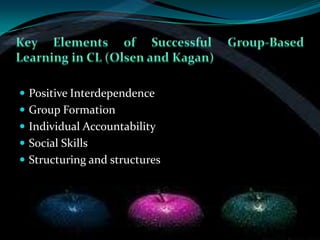
 Positive Interdependence
 Group Formation
 Individual Accountability
 Social Skills
 Structuring and structures
 This occurs when group members feel that what helps
 one member helps all and what hurts one member
 hurts all. It is created by the structure of CL tasks and
 by building a spirit of mutual support within the
 group.
Factors involved in setting up groups:

 Deciding on the size of the group
 Assigning students to groups
 Student roles in groups
 This involves both group and individual performance.


  This determines the way students interact with each
  other as teammates.
 This refer to ways of organizing student interaction
 and different ways students are to interact such as
 Three-step interview or Round Robin.
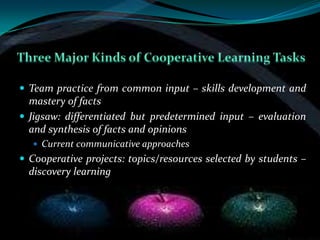
 Team practice from common input – skills development and
  mastery of facts
 Jigsaw: differentiated but predetermined input – evaluation
  and synthesis of facts and opinions
    Current communicative approaches
 Cooperative projects: topics/resources selected by students –
  discovery learning
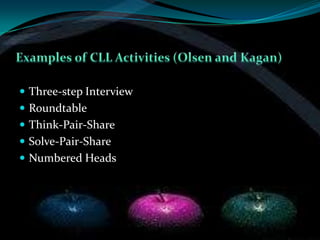
 Three-step Interview
 Roundtable
 Think-Pair-Share
 Solve-Pair-Share
 Numbered Heads
 Learner roles

   The learner is as a member of a group who must work
    collaboratively on tasks with other group members.
    They have to learn teamwork skills.
   Learners are also directors of their own learning. They
    are taught to plan, monitor, and evaluate their own
    learning.
 Teacher roles
   The teacher has to create a highly structured and well-
    organized learning environment in the classroom, setting
    goals, planning and structuring tasks, establishing the
    physical arrangement of the classroom, assigning students to
    groups and roles, and selecting materials and time.
   The teacher is the facilitator of learning.
   Teachers speak less than in teacher-fronted class.
   They provide broad questions to challenge thinking.
 Teacher roles

   They prepare students for the tasks they will carry out.
   They assist students with the learning tasks and they
    give few commands, imposing less disciplinary control.
   They restructure lessons so that students can work on
    them cooperatively.
 The role of instructional materials

   Materials    play an important part in creating
    opportunities for students to work cooperatively.
   Materials might be specially designed for CLL learning
    (such as commercially sold jigsaw and information-gap
    activities), modified from existing materials, or
    borrowed from other disciplines.
 The teacher assigns students to pairs with at least one good
  reader in each pair.
 Student A describes what he or she is planning to write to
  Student B, who listens carefully, probes with a set of
  questions, and outlines Student A’s ideas. Student B gives
  the written outline to Student A.
 This procedure is reversed, with Student B describing what
  he or she is going to write and Student A listening and
  completing an outline of Student B’s ideas, which is then
  given to Student B.
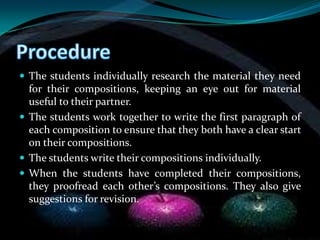
 The students individually research the material they need
  for their compositions, keeping an eye out for material
  useful to their partner.
 The students work together to write the first paragraph of
  each composition to ensure that they both have a clear start
  on their compositions.
 The students write their compositions individually.
 When the students have completed their compositions,
  they proofread each other’s compositions. They also give
  suggestions for revision.
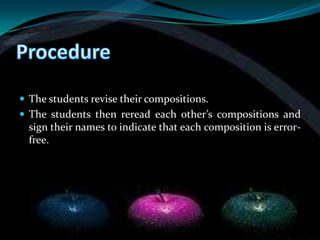
 The students revise their compositions.
 The students then reread each other’s compositions and
  sign their names to indicate that each composition is error-
  free.
 In Cooperative Learning, group activities are the major
  mode of learning and are part of a comprehensive theory
  and system for the use of group work in teaching.
 Group activities are carefully planned to maximize
  students’ interaction and to facilitate students’
  contributions to each other’s learning.
 Proponents of CLL stress that it enhances both learning
  and learners’ interaction skills.

Cooperative language learning

  • 2.
     CLL ispart of a more general instructional approach also known as Collaborative Learning (CL)  It is an approach that makes maximum use of cooperative activities involving pairs and small groups of learners in the classroom.
  • 3.
    Cooperative learning isgroup learning activity organized so that learning is dependent on the socially structured exchange of information between learners in groups and in which each learner is held accountable for his or her own learning and is motivated to increase the learning of others. (Olsen and Kagan 1992:8)
  • 4.
     U.S. educatorJohn Dewey is usually credited with promoting the idea of building cooperation in learning into regular classrooms on a regular and systematic basis.  It was more generally promoted and developed in the United States in the 1960’s and 1970’s as a response to the forced integration of public schools.
  • 5.
     Educators wereconcerned that traditional models of classroom learning were teacher-fronted, fostered competition rather than cooperation, and favored majority students. They believed that minority students might fall behind higher- achieving students.
  • 6.
     Raise theachievement of all students, including those who are gifted or academically handicapped  Help the teacher build positive relationships among students  Give students the experiences they need for healthy social, psychological and cognitive development  Replace the competitive organizational structure of most classrooms and schools with a team-based, high performance organizational structure.
  • 7.
     In secondlanguage teaching, CLL has been embraced as a way of promoting communicative interaction in the classroom and is seen as an extension of the principles of Communicative Language Teaching.  It is viewed as a learner-centered approach to teaching held to offer advantages over teacher-fronted classroom methods.
  • 8.
     To provideopportunities for naturalistic second language acquisition through the use of interactive pair and group activities  To provide teachers with a methodology to enable them to achieve this goal and one that can be applied in a variety of curriculum settings (e.g., content- based, foreign language classrooms)
  • 9.
     To enablefocused attention to particular lexical items, language structures, and communicative functions through the use of interactive tasks  To provide opportunities for learners to develop successful learning and communication strategies  To enhance learner motivation and reduce learner stress and to create a positive affective classroom climate
  • 10.
     Theory ofLanguage Cooperative Language Learning is founded on some basic premises about the interactive/cooperative nature of language and language learning.
  • 11.
    “all normal childrengrowing up in a normal environment learn to talk. We ere born to talk . . . We may think of ourselves as having been programmed to talk . . . Communication is generally considered to be the primary purpose of language.” (Weeks 1979:1)
  • 12.
    “Human beings spenda large part of their lives engaging in conversation and for most of them, conversation is among their most significant and engrossing activities.” (Richards and Schmidt 1983:117)
  • 15.
     Theory ofLearning Cooperative learning advocates on the theoretical work of developmental psychologists Jean Piaget and Lev Vygotsky. A central premise of CLL is that learners develop communicative competence in a language by conversing in socially or pedagogically structured situations. CLL also seeks to develop learners’ critical thinking skills.
  • 16.
    One approach tointegrating the teaching of critical thinking adopted by CLL advocates is called the Question Matrix (Wiederhold 1995). Wiederhold has developed a battery of cooperative activities built on the matrix that encourages learners to ask and respond to a deeper array of alternative question types. (The matrix is based on the well-known Taxonomy of Educational Objectives devised by Bloom, which assumes a hierarchy of learning objectives ranging from simple recall of information to forming conceptual judgments.)
  • 17.
     Increased frequencyand variety of second language practice through different types of interaction  Possibility for development or use of language in ways that support cognitive development and increased language skills  Opportunities to integrate language with content- based instruction
  • 18.
     Opportunities toinclude a greater variety of curricular materials to stimulate language as well as concept learning  Freedom for teachers to master new professional skills, particularly those emphasizing communication  Opportunities for students to act as resources for each other, thus assuming a more active role in their learning
  • 19.
     Objectives  To develop critical thinking skills  To develop communicative competence through socially structured interaction activities
  • 20.
     The syllabus  CLL does not assume any particular form of language syllabus, since activities from a wide variety of curriculum orientations can be taught via cooperative learning. Thus we find CLL used in teaching content classes, ESP, the four skills, grammar, pronunciation, and vocabulary. CLL is the systematic and carefully planned use of group-based procedures in teaching as an alternative to teacher-fronted teaching.
  • 21.
     The typesof learning ad teaching activities Johnson et al., describe three types of cooperative learning groups. 1. Formal cooperative learning groups- established for a specific task and involve students working together to achieve shared learning groups
  • 22.
    2. Informal cooperativelearning groups- used to focus students’ attention or to facilitate learning during direct learning 3. Cooperative base groups- allows members to give each other the support, help, encouragement, and assistance they need to succeed academically
  • 23.
     Positive Interdependence Group Formation  Individual Accountability  Social Skills  Structuring and structures
  • 24.
     This occurswhen group members feel that what helps one member helps all and what hurts one member hurts all. It is created by the structure of CL tasks and by building a spirit of mutual support within the group.
  • 25.
    Factors involved insetting up groups:  Deciding on the size of the group  Assigning students to groups  Student roles in groups
  • 26.
     This involvesboth group and individual performance.  This determines the way students interact with each other as teammates.
  • 27.
     This referto ways of organizing student interaction and different ways students are to interact such as Three-step interview or Round Robin.
  • 28.
     Team practicefrom common input – skills development and mastery of facts  Jigsaw: differentiated but predetermined input – evaluation and synthesis of facts and opinions  Current communicative approaches  Cooperative projects: topics/resources selected by students – discovery learning
  • 29.
     Three-step Interview Roundtable  Think-Pair-Share  Solve-Pair-Share  Numbered Heads
  • 30.
     Learner roles  The learner is as a member of a group who must work collaboratively on tasks with other group members. They have to learn teamwork skills.  Learners are also directors of their own learning. They are taught to plan, monitor, and evaluate their own learning.
  • 31.
     Teacher roles  The teacher has to create a highly structured and well- organized learning environment in the classroom, setting goals, planning and structuring tasks, establishing the physical arrangement of the classroom, assigning students to groups and roles, and selecting materials and time.  The teacher is the facilitator of learning.  Teachers speak less than in teacher-fronted class.  They provide broad questions to challenge thinking.
  • 32.
     Teacher roles  They prepare students for the tasks they will carry out.  They assist students with the learning tasks and they give few commands, imposing less disciplinary control.  They restructure lessons so that students can work on them cooperatively.
  • 33.
     The roleof instructional materials  Materials play an important part in creating opportunities for students to work cooperatively.  Materials might be specially designed for CLL learning (such as commercially sold jigsaw and information-gap activities), modified from existing materials, or borrowed from other disciplines.
  • 34.
     The teacherassigns students to pairs with at least one good reader in each pair.  Student A describes what he or she is planning to write to Student B, who listens carefully, probes with a set of questions, and outlines Student A’s ideas. Student B gives the written outline to Student A.  This procedure is reversed, with Student B describing what he or she is going to write and Student A listening and completing an outline of Student B’s ideas, which is then given to Student B.
  • 35.
     The studentsindividually research the material they need for their compositions, keeping an eye out for material useful to their partner.  The students work together to write the first paragraph of each composition to ensure that they both have a clear start on their compositions.  The students write their compositions individually.  When the students have completed their compositions, they proofread each other’s compositions. They also give suggestions for revision.
  • 36.
     The studentsrevise their compositions.  The students then reread each other’s compositions and sign their names to indicate that each composition is error- free.
  • 37.
     In CooperativeLearning, group activities are the major mode of learning and are part of a comprehensive theory and system for the use of group work in teaching.  Group activities are carefully planned to maximize students’ interaction and to facilitate students’ contributions to each other’s learning.  Proponents of CLL stress that it enhances both learning and learners’ interaction skills.