By:
Deepanshu Kumar Yadav
B.Sc. B.Ed. (CBZ)

Identity Formation
 Identity formation is the fundamental development task
of psychological maturity.
 It is a striving to achieve unified, integrated sense of self.
 Identity is a definition of self shared by the person, other
people and society at large.
 2 important features:
 Continuity – people can count on you to be the same person
tomorrow as you are today (e.g. gender, surname)
 Contrast – your social identity differentiates you from other
people.

Identity - The distinct personality of an individual
regarded as A persisting entity; "you can lose
your identity when you join the army".
In philosophy, identity, from Latin: identitas
(“sameness”), is the relation each thing bears
just to itself. The concept of sameness has given
rise to the general concept of identity, as in
personal identity and social identity.
IDENTITY

Eric Erikson, a prominent researcher on
adolescence, described the task of identity
formation as one of making choices by exploring
alternatives and committing to roles.
As one moves through adolescence, if these
values, beliefs, goals, and practices are no
longer appropriate, the individual can engage in
a task of identity redefinition and refinement.
Self-identity is clearly not stable, but is instead
an ongoing process of self-reflection and
change as one move through life.

 Psychosocial development by Erikson:
 Adolescent struggle between feelings of identity
versus role confusion.
 Marcia (1966, 1976, 1980) expanded Erikson’s initial
theory – the balance between identity and confusion
lies in making a commitment to an identity.
 4 identity statuses:
 Identity achievement – gone through exploration of
different identities and made a commitment to one.
 Moratorium – only involved in exploring different
identities.
 Foreclosure – made a commitment without attempting
identity exploration.
 Identity diffusion - neither an identity crisis or
commitment.

 Identity achievement: are individuals who have
experienced a decision-making period and are pursuing
self-chosen occupation and ideological goals
 Foreclosure: are persons who are also committed to
occupational and ideological positions, but these have
been parentally chosen rather than self-chosen. They
show little or no evidence of "crisis."
 Identity Diffusions: are young people who have no set
occupational or ideological direction, regardless of
whether or not they may have experienced a decision-
making period.
 Moratorium: are individuals who are currently struggling
with occupational and/or ideological issues; they are in
an identity crisis.

 Self-concept is a multi-dimensional construct that refers
to an individual's perception of "self" in relation to any
number of characteristics, such as academics ,gender
roles and sexuality, racial identity, and many others.
Self-Concept

Self-Concept
 Person’s self understanding about himself or herself.
 Self-knowledge: 3 domains
 Self-assessment (SA): The desire to learn accurate information
about oneself
 Self-verification(SV): The desire to confirm what one already
knows about oneself
 Self-enhancement(SE): The desire to hear favorable, flattering
things about oneself.
Motives:
1. SA – accurate information about the self is most useful.
2. SV – maintaining a stable understanding of self and world is
useful too.
3. SE – hearing favorable things about oneself creates pleasant
emotional states but when these are not accurate they should
have little or no practical value

 Self-assessment is the first step of the career
planning process. It is the process of gathering
information about yourself in order to make an
informed career decision.
 A self-assessment should include a look at the
following: values, interests, personality, and
skills.
Self-Assessment

Self-Assessment
Is a process on how an individual perceive
themselves based on personality, skills and
abilities, occupation(s) and hobbies, physical
characteristics, etc.
Self assessment is a ongoing process that
form one's self-concept.

• A schema is a cognitive framework or concept that helps
organize and interpret information.
• Schemas can be useful, because they allow us to take
shortcuts in interpreting a vast amount of information.
• However, these mental frameworks also cause us to
exclude pertinent information in favor of information that
confirms our pre-existing beliefs and ideas.
• Schemas can contribute to stereotypes and make it
difficult to retain new information that does not conform
to our established schemas.
Self-Schema

Self-Schema
 Self-schema (schema is singular; schemata is plural)
 specific knowledge structure, or cognitive
representation, of the self-concept.
 Self-schemata are the networks of associated building
blocks of the self-concept.
 Cognitive structures that are built on past experiences
and that guide the processing of information about the
self, particularly in social interaction.

Self-Schema
 It usually refer to past and current aspects of the self.
 Schemata for future selves which people are able to
imagine – possible selves.
 It describes the many ideas people have about who
they might become, who they hope to become, or who
they fear they will become.
 It allow people to stay on schedule, to work toward
self-improvement

Self-Schema
 Tory Higgins (1987, 1997, 1999)
 Self-guides:
 Standards that use to organize information and
motivate appropriate behavior.
 2 types of possible selves:
 Ideal self (promotion focus): what persons themselves
want to be.
 Ought self (prevention focus): person’s understanding
of what others want them to be.
 Both are root of different emotions.

• The term self-esteem comes from a Greek word
meaning "reverence for self“.
• The "self" part of self-esteem pertains to the values,
beliefs and attitudes that we hold about ourselves. The
"esteem" part of self-esteem describes the value and
worth that one gives oneself.
• The term self-esteem is used to describe a person's
overall sense of self-worth or personal value.
• Self-esteem is often seen as a personality trait, which
means that it tends to be stable and enduring. Self-
esteem can involve a variety of beliefs about the self,
such as the appraisal of one's own appearance, beliefs,
emotions and behaviors.
Self-Esteem

Self-esteem (SE)
 Is essentially the evaluation dimension of the self-concept.
 High SE
 hold firm, highly favorable beliefs about themselves.
 Have clear, consistent, and definite ideas about self.
 Low SE
 lack those beliefs, generally do not hold firm unfavorable
beliefs about themselves.
 Self-concept confusion and lack of firm self knowledge.
 In general, human tends to increase self-esteem (self
enhancement), desire to avoid loss of self-esteem (self
protection).

Self-Esteem (SE)
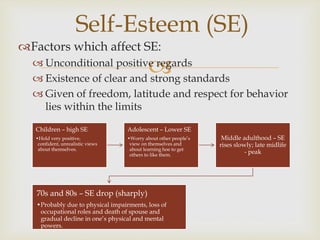
Factors which affect SE:
 Unconditional positive regards
 Existence of clear and strong standards
 Given of freedom, latitude and respect for behavior
lies within the limits
Children – high SE
•Hold very positive,
confident, unrealistic views
about themselves.
Adolescent – Lower SE
•Worry about other people’s
view on themselves and
about learning hoe to get
others to like them.
Middle adulthood – SE
rises slowly; late midlife
- peak
70s and 80s – SE drop (sharply)
•Probably due to physical impairments, loss of
occupational roles and death of spouse and
gradual decline in one’s physical and mental
powers.

• Self-confidence is the expected probability that a person
will achieve a goal in a certain situation.
• Self-confidence is the difference between feeling
unstoppable and feeling scared out of your wits. Your
perception of yourself has an enormous impact on how
others perceive you.
• Perception is reality - the more self-confidence you have,
the more likely it is you’ll succeed.
Self-Confidence

Self-confident
 a belief of a person that he or she can successfully perform a
desired behavior. (Foundations of Sport and Exercise
Psychology, By Robert S. Weinberg, Daniel Gould)
 Vealey (2001) (Psychological Dynamics of Sport and
Exercise, By Diane Gill, Williams, Lavon) - 3 general categories
of self-confidence:
 Sources of achievement include mastery and demonstrating
ability
 Self-regulation includes physical and mental preparation and
physical self-presentation
 Social climate includes social support, vicarious experiences,
coach leadership, environmental comfort, and situational
favorableness.
 A lack of self-confidence precludes ambitious action and foster
passivity, indecisiveness, timidity, and withdrawal from
activity.
 It foster failure in life. (The Psychology of Self-Esteem, By
Seymour Keitlen)

Human dynamics
 The actions and interactions of personal,
interpersonal, and social/contextual factors and their
effects on behavioral outcomes.
 Influenced by factors such as economics, religion,
politics, and culture (the particular norms and beliefs
held by every human, that impact how individuals,
groups and societies perceive, behave and interact.
(http://www.acq.osd.mil/dsb/reports/ADA495025.
pdf)

Human dynamics
 Is a term given to new understandings of human
functioning.
 Interaction in people of 3 universal principles:
 mental – related to the mind – the thinking values,
structure, focus, objectivity and perspective.
 emotional (or relational) – more subjective, concern with
relationships – with feelings, communication, organization,
and synthesis.
 physical (or practical) – pragmatic, the making, doing and
operationalizing part of us.
 3 principles combine in a dynamic interplay in people in
specific ways, to form distinct personality dynamics or
ways of being, each characterized by fundamentally
different inner process and ways of functioning in world.
 (http://www.humandynamics.com/index.php/about-
human-dynamics?Name=Value)

• Human Dynamics comprises the actions and interactions
of personal, interpersonal, and social/contextual factors
and their effects on behavioral outcomes.
• Human Dynamics are influenced by factors such as
economics, religion, politics, and culture.
• A pivotal work describing human functioning that will
impact management, education, and families.
• Human Dynamics is a systemic approach to the
complexities and wonders of how we process
information, learn, communicate, maintain well-being,
respond to stress, and develop as unique human beings,
individually and collectively.
Human Dynamics

 Human Dynamics is identifies fundamental distinctions
in human functioning that cross age, culture, race, and
gender.
 When the differences are recognized and understood,
people are better able to appreciate their diverse ways of
functioning, and to relate, manage, parent and teach in
ways that accommodate the differences, enabling all to
function at their individual and collective best.

IDENTITY FORMATION

  • 1.
  • 2.
     Identity Formation  Identityformation is the fundamental development task of psychological maturity.  It is a striving to achieve unified, integrated sense of self.  Identity is a definition of self shared by the person, other people and society at large.  2 important features:  Continuity – people can count on you to be the same person tomorrow as you are today (e.g. gender, surname)  Contrast – your social identity differentiates you from other people.
  • 3.
     Identity - Thedistinct personality of an individual regarded as A persisting entity; "you can lose your identity when you join the army". In philosophy, identity, from Latin: identitas (“sameness”), is the relation each thing bears just to itself. The concept of sameness has given rise to the general concept of identity, as in personal identity and social identity. IDENTITY
  • 4.
     Eric Erikson, aprominent researcher on adolescence, described the task of identity formation as one of making choices by exploring alternatives and committing to roles. As one moves through adolescence, if these values, beliefs, goals, and practices are no longer appropriate, the individual can engage in a task of identity redefinition and refinement. Self-identity is clearly not stable, but is instead an ongoing process of self-reflection and change as one move through life.
  • 5.
      Psychosocial developmentby Erikson:  Adolescent struggle between feelings of identity versus role confusion.  Marcia (1966, 1976, 1980) expanded Erikson’s initial theory – the balance between identity and confusion lies in making a commitment to an identity.  4 identity statuses:  Identity achievement – gone through exploration of different identities and made a commitment to one.  Moratorium – only involved in exploring different identities.  Foreclosure – made a commitment without attempting identity exploration.  Identity diffusion - neither an identity crisis or commitment.
  • 6.
      Identity achievement:are individuals who have experienced a decision-making period and are pursuing self-chosen occupation and ideological goals  Foreclosure: are persons who are also committed to occupational and ideological positions, but these have been parentally chosen rather than self-chosen. They show little or no evidence of "crisis."  Identity Diffusions: are young people who have no set occupational or ideological direction, regardless of whether or not they may have experienced a decision- making period.  Moratorium: are individuals who are currently struggling with occupational and/or ideological issues; they are in an identity crisis.
  • 7.
      Self-concept isa multi-dimensional construct that refers to an individual's perception of "self" in relation to any number of characteristics, such as academics ,gender roles and sexuality, racial identity, and many others. Self-Concept
  • 8.
     Self-Concept  Person’s selfunderstanding about himself or herself.  Self-knowledge: 3 domains  Self-assessment (SA): The desire to learn accurate information about oneself  Self-verification(SV): The desire to confirm what one already knows about oneself  Self-enhancement(SE): The desire to hear favorable, flattering things about oneself. Motives: 1. SA – accurate information about the self is most useful. 2. SV – maintaining a stable understanding of self and world is useful too. 3. SE – hearing favorable things about oneself creates pleasant emotional states but when these are not accurate they should have little or no practical value
  • 9.
      Self-assessment isthe first step of the career planning process. It is the process of gathering information about yourself in order to make an informed career decision.  A self-assessment should include a look at the following: values, interests, personality, and skills. Self-Assessment
  • 10.
     Self-Assessment Is a processon how an individual perceive themselves based on personality, skills and abilities, occupation(s) and hobbies, physical characteristics, etc. Self assessment is a ongoing process that form one's self-concept.
  • 11.
     • A schemais a cognitive framework or concept that helps organize and interpret information. • Schemas can be useful, because they allow us to take shortcuts in interpreting a vast amount of information. • However, these mental frameworks also cause us to exclude pertinent information in favor of information that confirms our pre-existing beliefs and ideas. • Schemas can contribute to stereotypes and make it difficult to retain new information that does not conform to our established schemas. Self-Schema
  • 12.
     Self-Schema  Self-schema (schemais singular; schemata is plural)  specific knowledge structure, or cognitive representation, of the self-concept.  Self-schemata are the networks of associated building blocks of the self-concept.  Cognitive structures that are built on past experiences and that guide the processing of information about the self, particularly in social interaction.
  • 13.
     Self-Schema  It usuallyrefer to past and current aspects of the self.  Schemata for future selves which people are able to imagine – possible selves.  It describes the many ideas people have about who they might become, who they hope to become, or who they fear they will become.  It allow people to stay on schedule, to work toward self-improvement
  • 14.
     Self-Schema  Tory Higgins(1987, 1997, 1999)  Self-guides:  Standards that use to organize information and motivate appropriate behavior.  2 types of possible selves:  Ideal self (promotion focus): what persons themselves want to be.  Ought self (prevention focus): person’s understanding of what others want them to be.  Both are root of different emotions.
  • 15.
     • The termself-esteem comes from a Greek word meaning "reverence for self“. • The "self" part of self-esteem pertains to the values, beliefs and attitudes that we hold about ourselves. The "esteem" part of self-esteem describes the value and worth that one gives oneself. • The term self-esteem is used to describe a person's overall sense of self-worth or personal value. • Self-esteem is often seen as a personality trait, which means that it tends to be stable and enduring. Self- esteem can involve a variety of beliefs about the self, such as the appraisal of one's own appearance, beliefs, emotions and behaviors. Self-Esteem
  • 16.
     Self-esteem (SE)  Isessentially the evaluation dimension of the self-concept.  High SE  hold firm, highly favorable beliefs about themselves.  Have clear, consistent, and definite ideas about self.  Low SE  lack those beliefs, generally do not hold firm unfavorable beliefs about themselves.  Self-concept confusion and lack of firm self knowledge.  In general, human tends to increase self-esteem (self enhancement), desire to avoid loss of self-esteem (self protection).
  • 17.
     Self-Esteem (SE) Factors whichaffect SE:  Unconditional positive regards  Existence of clear and strong standards  Given of freedom, latitude and respect for behavior lies within the limits Children – high SE •Hold very positive, confident, unrealistic views about themselves. Adolescent – Lower SE •Worry about other people’s view on themselves and about learning hoe to get others to like them. Middle adulthood – SE rises slowly; late midlife - peak 70s and 80s – SE drop (sharply) •Probably due to physical impairments, loss of occupational roles and death of spouse and gradual decline in one’s physical and mental powers.
  • 18.
     • Self-confidence isthe expected probability that a person will achieve a goal in a certain situation. • Self-confidence is the difference between feeling unstoppable and feeling scared out of your wits. Your perception of yourself has an enormous impact on how others perceive you. • Perception is reality - the more self-confidence you have, the more likely it is you’ll succeed. Self-Confidence
  • 19.
     Self-confident  a beliefof a person that he or she can successfully perform a desired behavior. (Foundations of Sport and Exercise Psychology, By Robert S. Weinberg, Daniel Gould)  Vealey (2001) (Psychological Dynamics of Sport and Exercise, By Diane Gill, Williams, Lavon) - 3 general categories of self-confidence:  Sources of achievement include mastery and demonstrating ability  Self-regulation includes physical and mental preparation and physical self-presentation  Social climate includes social support, vicarious experiences, coach leadership, environmental comfort, and situational favorableness.  A lack of self-confidence precludes ambitious action and foster passivity, indecisiveness, timidity, and withdrawal from activity.  It foster failure in life. (The Psychology of Self-Esteem, By Seymour Keitlen)
  • 20.
     Human dynamics  Theactions and interactions of personal, interpersonal, and social/contextual factors and their effects on behavioral outcomes.  Influenced by factors such as economics, religion, politics, and culture (the particular norms and beliefs held by every human, that impact how individuals, groups and societies perceive, behave and interact. (http://www.acq.osd.mil/dsb/reports/ADA495025. pdf)
  • 21.
     Human dynamics  Isa term given to new understandings of human functioning.  Interaction in people of 3 universal principles:  mental – related to the mind – the thinking values, structure, focus, objectivity and perspective.  emotional (or relational) – more subjective, concern with relationships – with feelings, communication, organization, and synthesis.  physical (or practical) – pragmatic, the making, doing and operationalizing part of us.  3 principles combine in a dynamic interplay in people in specific ways, to form distinct personality dynamics or ways of being, each characterized by fundamentally different inner process and ways of functioning in world.  (http://www.humandynamics.com/index.php/about- human-dynamics?Name=Value)
  • 22.
     • Human Dynamicscomprises the actions and interactions of personal, interpersonal, and social/contextual factors and their effects on behavioral outcomes. • Human Dynamics are influenced by factors such as economics, religion, politics, and culture. • A pivotal work describing human functioning that will impact management, education, and families. • Human Dynamics is a systemic approach to the complexities and wonders of how we process information, learn, communicate, maintain well-being, respond to stress, and develop as unique human beings, individually and collectively. Human Dynamics
  • 23.
      Human Dynamicsis identifies fundamental distinctions in human functioning that cross age, culture, race, and gender.  When the differences are recognized and understood, people are better able to appreciate their diverse ways of functioning, and to relate, manage, parent and teach in ways that accommodate the differences, enabling all to function at their individual and collective best.