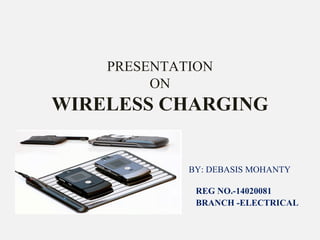
PRESENTATION
ON
WIRELESS CHARGING
BY BY: DEBASIS MOHANTY
REG NO.-14020081
BRANCH -ELECTRICAL
INTRODUCTION
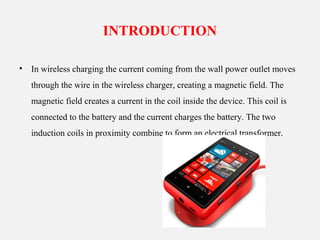
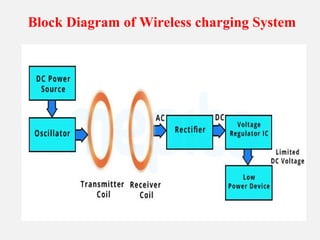
• In wireless charging the current coming from the wall power outlet moves
through the wire in the wireless charger, creating a magnetic field. The
magnetic field creates a current in the coil inside the device. This coil is
connected to the battery and the current charges the battery. The two
induction coils in proximity combine to form an electrical transformer.
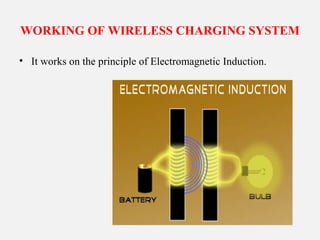
WORKING OF WIRELESS CHARGING SYSTEM
• It works on the principle of Electromagnetic Induction.
Methods of Wireless Charging
There are three types of wireless charging :-
• Resonance Charging ( Ex-Electric Cars, Robots,
Vacuum Cleaners, Laptops and other high power
devices.)
• Inductive Charging ( Ex-MP3 Players, PDAs and other
mid-sized items.)
• Radio Charging ( Ex-Watches,Hearing Aids,Wireless
Keyboards,Medical Implants and other low power
devices.)
Block Diagram of Wireless charging System
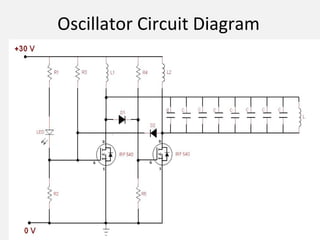
Oscillator Circuit Diagram
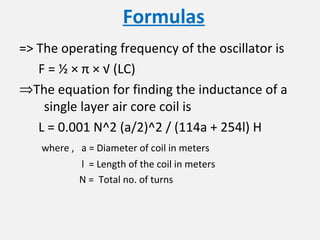
Formulas
=> The operating frequency of the oscillator is
F = ½ × π × √ (LC)
⇒The equation for finding the inductance of a
single layer air core coil is
L = 0.001 N^2 (a/2)^2 / (114a + 254l) H
where , a = Diameter of coil in meters
l = Length of the coil in meters
N = Total no. of turns
NEED OF WIRELESS CHARGING
To make the recharging of the mobile phones independent of
their manufacturer and battery make.
 A new proposal has been made so as to make the recharging
of the mobile phones is done automatically as you talk in your
mobile phone.
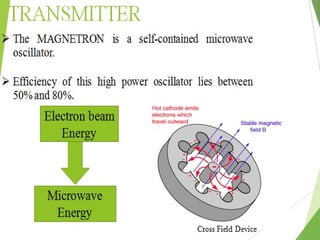
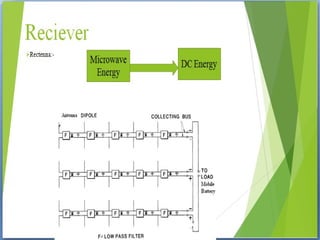
The microwave signal is transmitted from the transmitter along
with the message signal using special kind of antennas called
slotted wave guide antenna at a frequency is 2.45 GHz.
Advantages of Wireless Charging
 The need of different types of chargers by different
manufacturers is totally eliminated
 Lower risk of ELECTRICAL SHOCK or shorting.
 Convenience
 Wireless energy transfer can potentially recharge the mobile
phones without chords.
Disadvantages of Wireless Charging
The transmitter and receiver also should be very powerful
devices as the distance increases.
Slower Charging.
Wireless transmission of the energy causes some drastic effects
to human body, because of its radiation.
More costly.
Practical possibilities are not yet applicable as there is no much
advancement in this field.
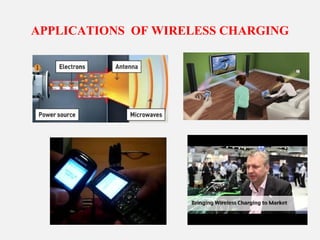
APPLICATIONS OF WIRELESS CHARGING
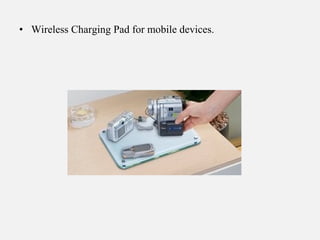
• Wireless Charging Pad for mobile devices.
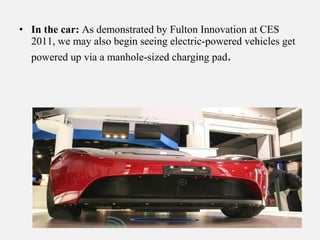
• In the car: As demonstrated by Fulton Innovation at CES
2011, we may also begin seeing electric-powered vehicles get
powered up via a manhole-sized charging pad.
Conclusion
A novel method of using the power of the microwave to charge
the mobile phones without the use of wired chargers.
This method provides great advantage to the mobile phone
users to carry their phones anywhere even if the place is devoid
of facilities for charging.
References
• GOOGLE
• Power Electronics Course Book by P.S Bimbhra

WIRELESS CHARGING

  • 1.
    PRESENTATION ON WIRELESS CHARGING BY BY:DEBASIS MOHANTY REG NO.-14020081 BRANCH -ELECTRICAL
  • 2.
    INTRODUCTION • In wirelesscharging the current coming from the wall power outlet moves through the wire in the wireless charger, creating a magnetic field. The magnetic field creates a current in the coil inside the device. This coil is connected to the battery and the current charges the battery. The two induction coils in proximity combine to form an electrical transformer.
  • 3.
    WORKING OF WIRELESSCHARGING SYSTEM • It works on the principle of Electromagnetic Induction.
  • 4.
    Methods of WirelessCharging There are three types of wireless charging :- • Resonance Charging ( Ex-Electric Cars, Robots, Vacuum Cleaners, Laptops and other high power devices.) • Inductive Charging ( Ex-MP3 Players, PDAs and other mid-sized items.) • Radio Charging ( Ex-Watches,Hearing Aids,Wireless Keyboards,Medical Implants and other low power devices.)
  • 5.
    Block Diagram ofWireless charging System
  • 7.
  • 8.
    Formulas => The operatingfrequency of the oscillator is F = ½ × π × √ (LC) ⇒The equation for finding the inductance of a single layer air core coil is L = 0.001 N^2 (a/2)^2 / (114a + 254l) H where , a = Diameter of coil in meters l = Length of the coil in meters N = Total no. of turns
  • 10.
    NEED OF WIRELESSCHARGING To make the recharging of the mobile phones independent of their manufacturer and battery make.  A new proposal has been made so as to make the recharging of the mobile phones is done automatically as you talk in your mobile phone. The microwave signal is transmitted from the transmitter along with the message signal using special kind of antennas called slotted wave guide antenna at a frequency is 2.45 GHz.
  • 11.
    Advantages of WirelessCharging  The need of different types of chargers by different manufacturers is totally eliminated  Lower risk of ELECTRICAL SHOCK or shorting.  Convenience  Wireless energy transfer can potentially recharge the mobile phones without chords.
  • 12.
    Disadvantages of WirelessCharging The transmitter and receiver also should be very powerful devices as the distance increases. Slower Charging. Wireless transmission of the energy causes some drastic effects to human body, because of its radiation. More costly. Practical possibilities are not yet applicable as there is no much advancement in this field.
  • 13.
  • 14.
    • Wireless ChargingPad for mobile devices.
  • 15.
    • In thecar: As demonstrated by Fulton Innovation at CES 2011, we may also begin seeing electric-powered vehicles get powered up via a manhole-sized charging pad.
  • 16.
    Conclusion A novel methodof using the power of the microwave to charge the mobile phones without the use of wired chargers. This method provides great advantage to the mobile phone users to carry their phones anywhere even if the place is devoid of facilities for charging.
  • 17.
    References • GOOGLE • PowerElectronics Course Book by P.S Bimbhra