WIRELESS CHARGING
TECHNOLOGY
contents
• INTRODUCTION
• WORKING PRINCIPLE
• BASIC BLOCK DIAGRAM
• PARTS DESIGN TRANSMITTER
• PARTS DESIGN RECEIVER
• PARTS DESIGN ANTENNA
• INDUCTIVE CHARGING
• RADIO CHARGING
• RESONACE CHARGING
• STATIC WIRELESS CHARGING
• DYNAMIC WIRELESS CHARGING SYSTEM
• ADVANTAGES
• DISADVANTAGES
• APPLICATIONS
• CONCLUSION
INTRODUCTION
Why do we need
wireless
charging
technology
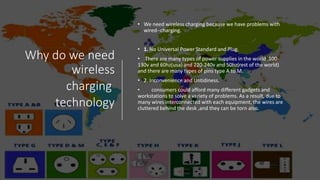
• We need wireless charging because we have problems with
wired--charging.
• 1. No Universal Power Standard and Plug.
• There are many types of power supplies in the world .100-
130v and 60hz(usa) and 220-240v and 50hz(rest of the world)
and there are many types of pins type A to M.
• 2. Inconvenience and Untidiness.
• consumers could afford many different gadgets and
workstations to solve a variety of problems. As a result, due to
many wires interconnected with each equipment, the wires are
cluttered behind the desk ,and they can be torn also.
WORKING PRINCIPLE
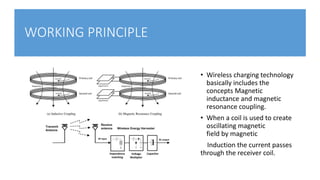
• Wireless charging technology
basically includes the
concepts Magnetic
inductance and magnetic
resonance coupling.
• When a coil is used to create
oscillating magnetic
field by magnetic
Induction the current passes
through the receiver coil.
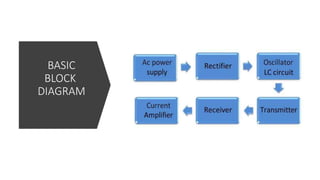
BASIC
BLOCK
DIAGRAM
PARTS
DESIGN
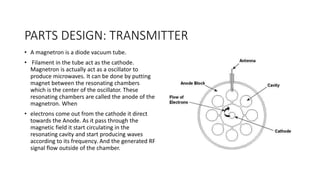
PARTS DESIGN: TRANSMITTER
• A magnetron is a diode vacuum tube.
• Filament in the tube act as the cathode.
Magnetron is actually act as a oscillator to
produce microwaves. It can be done by putting
magnet between the resonating chambers
which is the center of the oscillator. These
resonating chambers are called the anode of the
magnetron. When
• electrons come out from the cathode it direct
towards the Anode. As it pass through the
magnetic field it start circulating in the
resonating cavity and start producing waves
according to its frequency. And the generated RF
signal flow outside of the chamber.
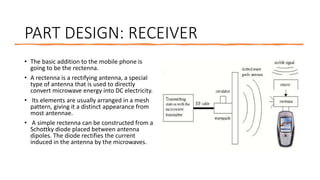
PART DESIGN: RECEIVER
• The basic addition to the mobile phone is
going to be the rectenna.
• A rectenna is a rectifying antenna, a special
type of antenna that is used to directly
convert microwave energy into DC electricity.
• Its elements are usually arranged in a mesh
pattern, giving it a distinct appearance from
most antennae.
• A simple rectenna can be constructed from a
Schottky diode placed between antenna
dipoles. The diode rectifies the current
induced in the antenna by the microwaves.
PART DESIGN :
ANTENNA
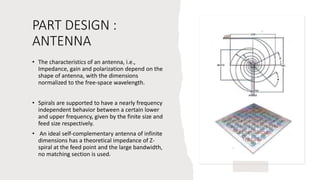
• The characteristics of an antenna, i.e.,
Impedance, gain and polarization depend on the
shape of antenna, with the dimensions
normalized to the free-space wavelength.
• Spirals are supported to have a nearly frequency
independent behavior between a certain lower
and upper frequency, given by the finite size and
feed size respectively.
• An ideal self-complementary antenna of infinite
dimensions has a theoretical impedance of Z-
spiral at the feed point and the large bandwidth,
no matching section is used.
Uses of Wireless charging
1.MOBILE PHONES 2.ELECTRIC CARS 3. ELECTRIC TOYS
INDUCTIVE
CHARGING
• It uses electromagnetic induction to provide electricity to
portable devices.
Inductive charging is named so because it transfers energy
through inductive coupling. First, alternating current passes
through an induction coil in the charging station or pad. The
moving electric charge creates a magnetic field, which
fluctuates in strength because the electric current's
amplitude is fluctuating. This changing magnetic field creates
an alternating electric current in the portable device's
induction coil, which in turn passes through a rectifier to
convert it to direct current. Finally, the direct current charges
a battery or provides operating power.
TYPES OF WIRELESS CHARGING FOR MOBILES
RADIO
CHARGING
• It works by the use of radio waves
• Radio waves are already in use to transmit and receive
cellular telephone, television, radio and Wi-Fi signals.
Wireless radio charging works similarly. A transmitter,
plugged into a socket, generates radio waves. When the
receiver attached to the device is set to the same
frequency as the transmitter, it will charge the device's
battery.
• It is used for charging items with small batteries and low
power requirements, such as watches, hearing aids,
medical implants, cell phones, MP3 players and wireless
keyboard and mice.
RESONANCE
CHARGING
• In resonance charging, a copper coil attached to a power
source is the sending unit. Another coil, attached to the
device to be charged, is the receiver. Both coils are tuned
to the same electromagnetic frequency, which makes it
possible for energy to be transferred from one to the other.
The method works over short distances (3-5 meters).
• It is used for items that require large amounts of power,
such as an electric car, robot, vacuum cleaner or laptop
computer.
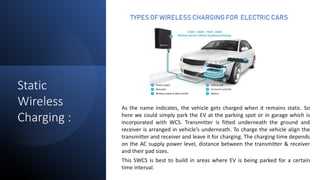
TYPES OF WIRELESS CHARGING FOR ELECTRIC CARS
As the name indicates, the vehicle gets charged when it remains static. So
here we could simply park the EV at the parking spot or in garage which is
incorporated with WCS. Transmitter is fitted underneath the ground and
receiver is arranged in vehicle’s underneath. To charge the vehicle align the
transmitter and receiver and leave it for charging. The charging time depends
on the AC supply power level, distance between the transmitter & receiver
and their pad sizes.
This SWCS is best to build in areas where EV is being parked for a certain
time interval.
Static
Wireless
Charging :
Dynamic
Wireless Char
ging System
(DWCS):
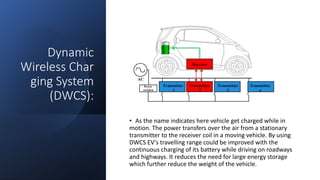
• As the name indicates here vehicle get charged while in
motion. The power transfers over the air from a stationary
transmitter to the receiver coil in a moving vehicle. By using
DWCS EV's travelling range could be improved with the
continuous charging of its battery while driving on roadways
and highways. It reduces the need for large energy storage
which further reduce the weight of the vehicle.
ADVANTAGES
• We can save time for charging mobiles.
• The waste of power is less.
• Better than WiTricity as the distance the WiTricity can
cover is about 20 meters whereas in this technology we
are using a base station for transmission that can cover
more area.
• Mobile gets charged as we make calls even during long
journeys.
• Secure method of charging your device.
• Reduces the complexity of cords and adapters.
• Minimizes the chance of electrical and device failures.
DISADVANTAGES
• Radiation problems may occur.
• Network traffic may cause problems in
charging.
• Charging depends on network coverage.
• Rate of charging may be minute range.
• Low charging efficiency.
CONCLUSION
With electric devices becoming a basic part of life, the
recharging of batteries has always been a problem. The devices
vary in their battery standby according to their manufacturer
and batteries. All these devices irrespective of their
manufacturer and batteries have to be recharged after
the battery has drained out. The main objective of this current
proposal is to make the recharging of the electric devices
independent of their manufacturer and battery they make.
References
•phonesbattery/articleshow/89542496.cms
•https://www.computerworld.com/article/3235176/wireless-chargingexplained-what-is-it-and-how-does-it-
work.html
• Wireless Electric Vehicle Charging System (WEVCS) (circuitdigest.com)

JNK PPT WIRELESS CHARGING.pptx

  • 1.
  • 2.
    contents • INTRODUCTION • WORKINGPRINCIPLE • BASIC BLOCK DIAGRAM • PARTS DESIGN TRANSMITTER • PARTS DESIGN RECEIVER • PARTS DESIGN ANTENNA • INDUCTIVE CHARGING • RADIO CHARGING • RESONACE CHARGING • STATIC WIRELESS CHARGING • DYNAMIC WIRELESS CHARGING SYSTEM • ADVANTAGES • DISADVANTAGES • APPLICATIONS • CONCLUSION
  • 3.
  • 4.
    Why do weneed wireless charging technology • We need wireless charging because we have problems with wired--charging. • 1. No Universal Power Standard and Plug. • There are many types of power supplies in the world .100- 130v and 60hz(usa) and 220-240v and 50hz(rest of the world) and there are many types of pins type A to M. • 2. Inconvenience and Untidiness. • consumers could afford many different gadgets and workstations to solve a variety of problems. As a result, due to many wires interconnected with each equipment, the wires are cluttered behind the desk ,and they can be torn also.
  • 5.
    WORKING PRINCIPLE • Wirelesscharging technology basically includes the concepts Magnetic inductance and magnetic resonance coupling. • When a coil is used to create oscillating magnetic field by magnetic Induction the current passes through the receiver coil.
  • 6.
  • 7.
  • 8.
    PARTS DESIGN: TRANSMITTER •A magnetron is a diode vacuum tube. • Filament in the tube act as the cathode. Magnetron is actually act as a oscillator to produce microwaves. It can be done by putting magnet between the resonating chambers which is the center of the oscillator. These resonating chambers are called the anode of the magnetron. When • electrons come out from the cathode it direct towards the Anode. As it pass through the magnetic field it start circulating in the resonating cavity and start producing waves according to its frequency. And the generated RF signal flow outside of the chamber.
  • 9.
    PART DESIGN: RECEIVER •The basic addition to the mobile phone is going to be the rectenna. • A rectenna is a rectifying antenna, a special type of antenna that is used to directly convert microwave energy into DC electricity. • Its elements are usually arranged in a mesh pattern, giving it a distinct appearance from most antennae. • A simple rectenna can be constructed from a Schottky diode placed between antenna dipoles. The diode rectifies the current induced in the antenna by the microwaves.
  • 10.
    PART DESIGN : ANTENNA •The characteristics of an antenna, i.e., Impedance, gain and polarization depend on the shape of antenna, with the dimensions normalized to the free-space wavelength. • Spirals are supported to have a nearly frequency independent behavior between a certain lower and upper frequency, given by the finite size and feed size respectively. • An ideal self-complementary antenna of infinite dimensions has a theoretical impedance of Z- spiral at the feed point and the large bandwidth, no matching section is used.
  • 11.
    Uses of Wirelesscharging 1.MOBILE PHONES 2.ELECTRIC CARS 3. ELECTRIC TOYS
  • 12.
    INDUCTIVE CHARGING • It useselectromagnetic induction to provide electricity to portable devices. Inductive charging is named so because it transfers energy through inductive coupling. First, alternating current passes through an induction coil in the charging station or pad. The moving electric charge creates a magnetic field, which fluctuates in strength because the electric current's amplitude is fluctuating. This changing magnetic field creates an alternating electric current in the portable device's induction coil, which in turn passes through a rectifier to convert it to direct current. Finally, the direct current charges a battery or provides operating power. TYPES OF WIRELESS CHARGING FOR MOBILES
  • 13.
    RADIO CHARGING • It worksby the use of radio waves • Radio waves are already in use to transmit and receive cellular telephone, television, radio and Wi-Fi signals. Wireless radio charging works similarly. A transmitter, plugged into a socket, generates radio waves. When the receiver attached to the device is set to the same frequency as the transmitter, it will charge the device's battery. • It is used for charging items with small batteries and low power requirements, such as watches, hearing aids, medical implants, cell phones, MP3 players and wireless keyboard and mice.
  • 14.
    RESONANCE CHARGING • In resonancecharging, a copper coil attached to a power source is the sending unit. Another coil, attached to the device to be charged, is the receiver. Both coils are tuned to the same electromagnetic frequency, which makes it possible for energy to be transferred from one to the other. The method works over short distances (3-5 meters). • It is used for items that require large amounts of power, such as an electric car, robot, vacuum cleaner or laptop computer.
  • 15.
    TYPES OF WIRELESSCHARGING FOR ELECTRIC CARS As the name indicates, the vehicle gets charged when it remains static. So here we could simply park the EV at the parking spot or in garage which is incorporated with WCS. Transmitter is fitted underneath the ground and receiver is arranged in vehicle’s underneath. To charge the vehicle align the transmitter and receiver and leave it for charging. The charging time depends on the AC supply power level, distance between the transmitter & receiver and their pad sizes. This SWCS is best to build in areas where EV is being parked for a certain time interval. Static Wireless Charging :
  • 16.
    Dynamic Wireless Char ging System (DWCS): •As the name indicates here vehicle get charged while in motion. The power transfers over the air from a stationary transmitter to the receiver coil in a moving vehicle. By using DWCS EV's travelling range could be improved with the continuous charging of its battery while driving on roadways and highways. It reduces the need for large energy storage which further reduce the weight of the vehicle.
  • 17.
    ADVANTAGES • We cansave time for charging mobiles. • The waste of power is less. • Better than WiTricity as the distance the WiTricity can cover is about 20 meters whereas in this technology we are using a base station for transmission that can cover more area. • Mobile gets charged as we make calls even during long journeys. • Secure method of charging your device. • Reduces the complexity of cords and adapters. • Minimizes the chance of electrical and device failures.
  • 18.
    DISADVANTAGES • Radiation problemsmay occur. • Network traffic may cause problems in charging. • Charging depends on network coverage. • Rate of charging may be minute range. • Low charging efficiency.
  • 19.
    CONCLUSION With electric devicesbecoming a basic part of life, the recharging of batteries has always been a problem. The devices vary in their battery standby according to their manufacturer and batteries. All these devices irrespective of their manufacturer and batteries have to be recharged after the battery has drained out. The main objective of this current proposal is to make the recharging of the electric devices independent of their manufacturer and battery they make.
  • 20.