PRESENTATION
ON
WIRELESS CHARGING
Submitted by: Venus Bilandi (00415004914)
INTRODUCTION
• In wireless charging the current coming from the wall power outlet moves
through the wire in the wireless charger, creating a magnetic field. The
magnetic field creates a current in the coil inside the device. This coil is
connected to the battery and the current charges the battery. The two
induction coils in proximity combine to form an electrical transformer.
WORKING OF WIRELESS CHARGING SYSTEM
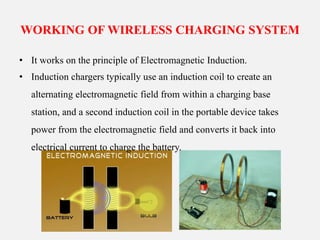
• It works on the principle of Electromagnetic Induction.
• Induction chargers typically use an induction coil to create an
alternating electromagnetic field from within a charging base
station, and a second induction coil in the portable device takes
power from the electromagnetic field and converts it back into
electrical current to charge the battery.
Methods of Wireless Charging
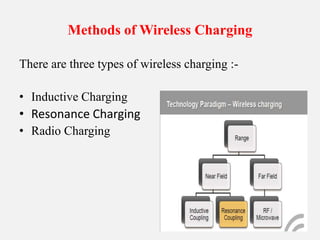
There are three types of wireless charging :-
• Inductive Charging
• Resonance Charging
• Radio Charging
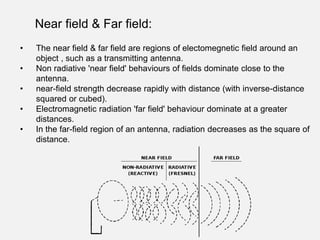
• The near field & far field are regions of electomegnetic field around an
object , such as a transmitting antenna.
• Non radiative 'near field' behaviours of fields dominate close to the
antenna.
• near-field strength decrease rapidly with distance (with inverse-distance
squared or cubed).
• Electromagnetic radiation 'far field' behaviour dominate at a greater
distances.
• In the far-field region of an antenna, radiation decreases as the square of
distance.
Near field & Far field:
Inductive Charging :
• Inductive charging is one kind of short distance wireless charging.
• This method works on the principle of
“ELECTROMAGNETIC INDUCTION” where the charger device
will create an E.M field with alternating polarity using a coil of
insulated copper wire & a similar coil will be placed inside the
mobile device which will convert E.M field back to electric current
there by charging the battery.
Resonance Charging :
• It uses phenomenon of “RESONANCE”, that causes an object
to vibrate when energy of certain frequency is applied.
• Two copper coils are used one attached to transmitter &
another to receiver.
• Both coils are tuned to same electromagnetic frequency.
• These coils when placed close to one another power is
transferred.
Radio Charging :
• This method is on the basis that Radio Waves are widely in use to
transmit and receive cellular telephone, television, radio and Wi-Fi.
• A Radio wave once transmitted, propagates in all directions until it
reaches an antenna tuned to proper frequency to receive it.
• A transmitter plugged in to a socket, generates radio waves, when
the receiver attached to the device is set to the same frequency as the
transmitter, it will charge the device’s battery
Examples:-
• Watches.
• Hearing aids.
• Medical implants.
• Cell phones.
• Wireless keyboards &
Other charging devices with small batteries and low power
requirements.
Advances in Wireless Energy Transfer
• Stanford University scientists have overcome a
major hurdle by wirelessly transmitting electricity
to a nearby moving object.
• They are using magnetic resonance to transfer
the power more efficiently.
• They are using voltage amplifier & feedback
resistor circuit as a substitute to radio frequency
source.This system automatically figures out the
right frequency for different distances without the
need for human interference.
Energy transfer to moving object
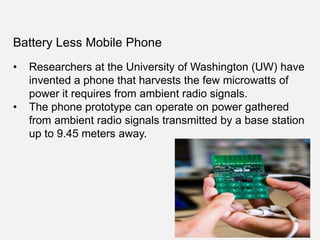
• Researchers at the University of Washington (UW) have
invented a phone that harvests the few microwatts of
power it requires from ambient radio signals.
• The phone prototype can operate on power gathered
from ambient radio signals transmitted by a base station
up to 9.45 meters away.
Battery Less Mobile Phone
NEED OF WIRELESS CHARGING
To make the recharging of the mobile phones independent of
their manufacturer and battery make.
 A new proposal has been made so as to make the recharging
of the mobile phones is done automatically as you talk in your
mobile phone.
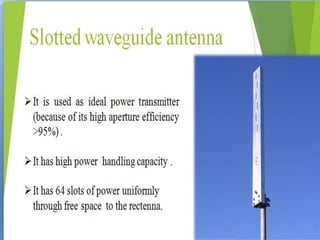
The microwave signal is transmitted from the transmitter along
with the message signal using special kind of antennas called
slotted wave guide antenna at a frequency is 2.45 GHz.
Advantages of Wireless Charging
 The need of different types of chargers by different
manufacturers is totally eliminated
 Lower risk of ELECTRICAL SHOCK or shorting.
 Convenience
 Wireless energy transfer can potentially recharge the mobile
phones without chords.
Disadvantages of Wireless Charging
The transmitter and receiver also should be very powerful
devices as the distance increases.
Slower Charging.
Wireless transmission of the energy causes some drastic effects
to human body, because of its radiation.
More costly.
Practical possibilities are not yet applicable as there is no much
advancement in this field.
Other Applications:
• Inductive Coupling-RFID.
• In-Vehicle Charging.
• Radio Charging.
• Ultra Wideband.
WIRELESS CHARGING STANDARDS
• Qi is a set of guidelines for inductive charging units. Right now
it is a default standard.
• It's rounded up 84 manufacturers, semiconductors, and telecom
providers under its wing so far, a number which no other
organizations have come close to matching.
Other Standards :
FUTURE SCOPE
 The wireless charging can even be done using the data exchange as now
only its only been implemented for voice calls.
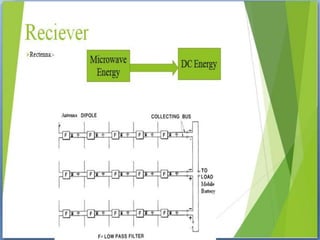
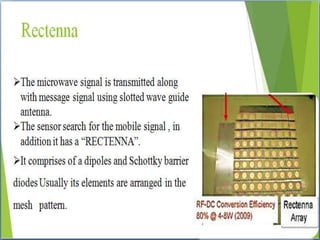
 With the advent of nanotechnology and MEMS the size of these rectennas
can be brought down to molecular level. It has been theorized that similar
devices, scaled down to the proportions used in nanotechnology, could be
used to convert light into electricity at much greater efficiencies than what
is currently possible with solar cells. This type of device is called an
optical rectenna.
Wirelesschargingppt 150311052625-conversion-gate01

Wirelesschargingppt 150311052625-conversion-gate01

  • 1.
  • 2.
    INTRODUCTION • In wirelesscharging the current coming from the wall power outlet moves through the wire in the wireless charger, creating a magnetic field. The magnetic field creates a current in the coil inside the device. This coil is connected to the battery and the current charges the battery. The two induction coils in proximity combine to form an electrical transformer.
  • 3.
    WORKING OF WIRELESSCHARGING SYSTEM • It works on the principle of Electromagnetic Induction. • Induction chargers typically use an induction coil to create an alternating electromagnetic field from within a charging base station, and a second induction coil in the portable device takes power from the electromagnetic field and converts it back into electrical current to charge the battery.
  • 4.
    Methods of WirelessCharging There are three types of wireless charging :- • Inductive Charging • Resonance Charging • Radio Charging
  • 5.
    • The nearfield & far field are regions of electomegnetic field around an object , such as a transmitting antenna. • Non radiative 'near field' behaviours of fields dominate close to the antenna. • near-field strength decrease rapidly with distance (with inverse-distance squared or cubed). • Electromagnetic radiation 'far field' behaviour dominate at a greater distances. • In the far-field region of an antenna, radiation decreases as the square of distance. Near field & Far field:
  • 6.
    Inductive Charging : •Inductive charging is one kind of short distance wireless charging. • This method works on the principle of “ELECTROMAGNETIC INDUCTION” where the charger device will create an E.M field with alternating polarity using a coil of insulated copper wire & a similar coil will be placed inside the mobile device which will convert E.M field back to electric current there by charging the battery.
  • 7.
    Resonance Charging : •It uses phenomenon of “RESONANCE”, that causes an object to vibrate when energy of certain frequency is applied. • Two copper coils are used one attached to transmitter & another to receiver. • Both coils are tuned to same electromagnetic frequency. • These coils when placed close to one another power is transferred.
  • 8.
    Radio Charging : •This method is on the basis that Radio Waves are widely in use to transmit and receive cellular telephone, television, radio and Wi-Fi. • A Radio wave once transmitted, propagates in all directions until it reaches an antenna tuned to proper frequency to receive it. • A transmitter plugged in to a socket, generates radio waves, when the receiver attached to the device is set to the same frequency as the transmitter, it will charge the device’s battery
  • 9.
    Examples:- • Watches. • Hearingaids. • Medical implants. • Cell phones. • Wireless keyboards & Other charging devices with small batteries and low power requirements.
  • 10.
    Advances in WirelessEnergy Transfer • Stanford University scientists have overcome a major hurdle by wirelessly transmitting electricity to a nearby moving object. • They are using magnetic resonance to transfer the power more efficiently. • They are using voltage amplifier & feedback resistor circuit as a substitute to radio frequency source.This system automatically figures out the right frequency for different distances without the need for human interference. Energy transfer to moving object
  • 11.
    • Researchers atthe University of Washington (UW) have invented a phone that harvests the few microwatts of power it requires from ambient radio signals. • The phone prototype can operate on power gathered from ambient radio signals transmitted by a base station up to 9.45 meters away. Battery Less Mobile Phone
  • 16.
    NEED OF WIRELESSCHARGING To make the recharging of the mobile phones independent of their manufacturer and battery make.  A new proposal has been made so as to make the recharging of the mobile phones is done automatically as you talk in your mobile phone. The microwave signal is transmitted from the transmitter along with the message signal using special kind of antennas called slotted wave guide antenna at a frequency is 2.45 GHz.
  • 17.
    Advantages of WirelessCharging  The need of different types of chargers by different manufacturers is totally eliminated  Lower risk of ELECTRICAL SHOCK or shorting.  Convenience  Wireless energy transfer can potentially recharge the mobile phones without chords.
  • 18.
    Disadvantages of WirelessCharging The transmitter and receiver also should be very powerful devices as the distance increases. Slower Charging. Wireless transmission of the energy causes some drastic effects to human body, because of its radiation. More costly. Practical possibilities are not yet applicable as there is no much advancement in this field.
  • 19.
    Other Applications: • InductiveCoupling-RFID. • In-Vehicle Charging. • Radio Charging. • Ultra Wideband.
  • 20.
    WIRELESS CHARGING STANDARDS •Qi is a set of guidelines for inductive charging units. Right now it is a default standard. • It's rounded up 84 manufacturers, semiconductors, and telecom providers under its wing so far, a number which no other organizations have come close to matching.
  • 21.
  • 22.
    FUTURE SCOPE  Thewireless charging can even be done using the data exchange as now only its only been implemented for voice calls.  With the advent of nanotechnology and MEMS the size of these rectennas can be brought down to molecular level. It has been theorized that similar devices, scaled down to the proportions used in nanotechnology, could be used to convert light into electricity at much greater efficiencies than what is currently possible with solar cells. This type of device is called an optical rectenna.