{
SIGNALLING,
COMMANDS,
MORSE CODE
Sctr. JOHN DAVE S. RICARE
What is signalling?
 Signalling is well worth knowing. It is good and
fun to be able to signal your friend across the
street without other people understanding what
you are talking about. Before the development
of telephones or radios, signal codes allowed
many people to communicate over long
distances.
What is signalling?
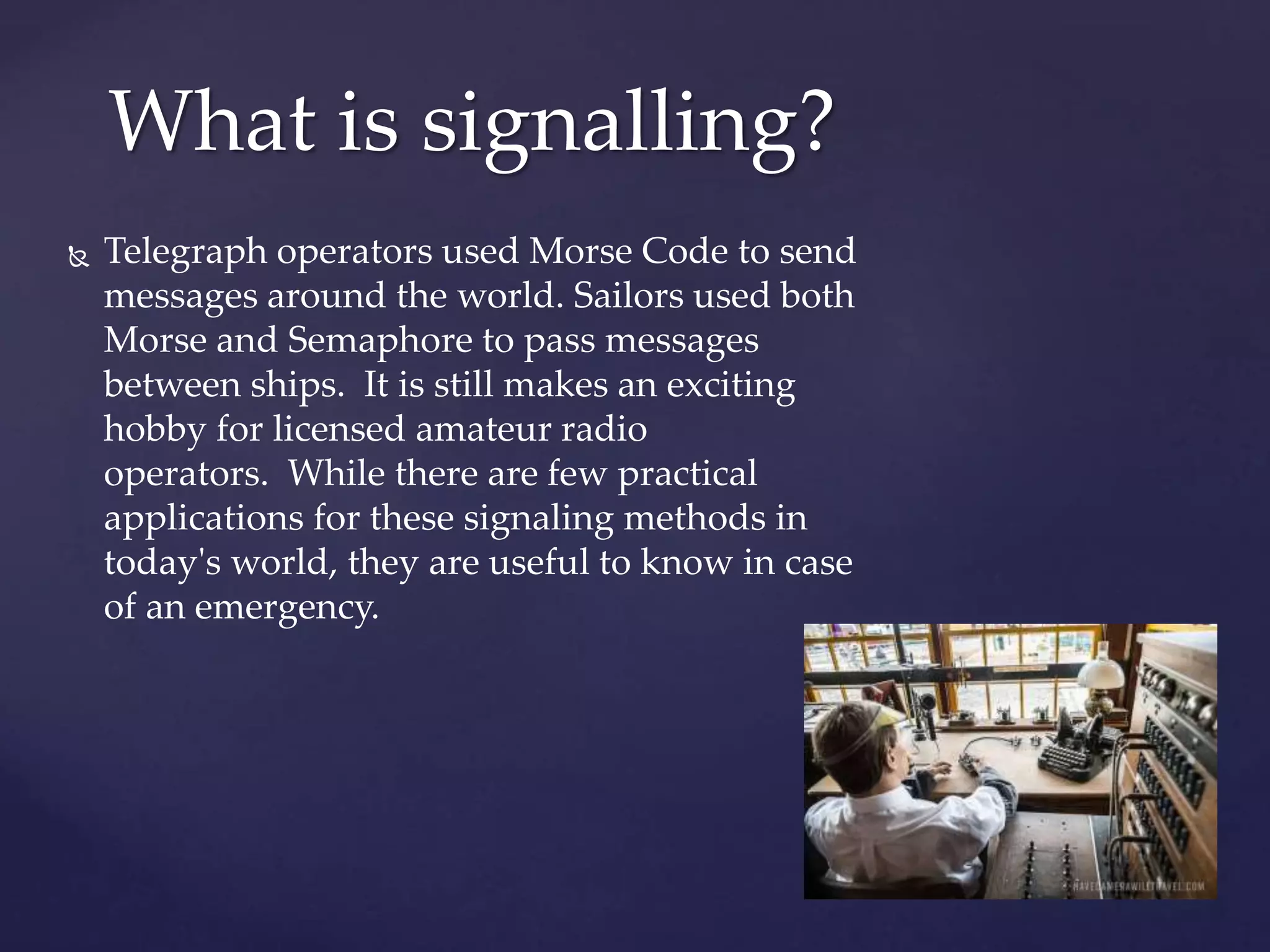
 Telegraph operators used Morse Code to send
messages around the world. Sailors used both
Morse and Semaphore to pass messages
between ships. It is still makes an exciting
hobby for licensed amateur radio
operators. While there are few practical
applications for these signaling methods in
today's world, they are useful to know in case
of an emergency.
What is signalling?
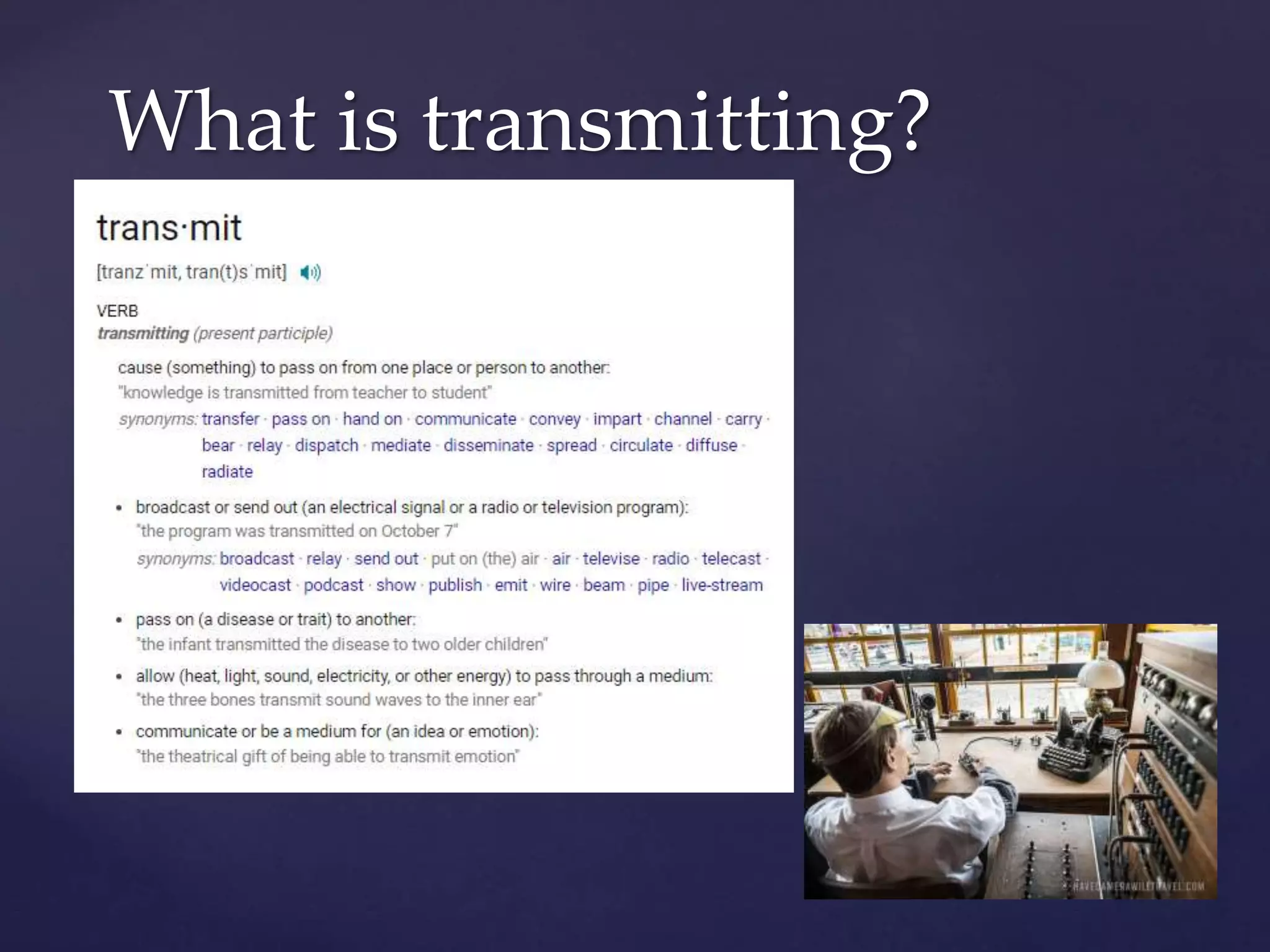
What is transmitting?
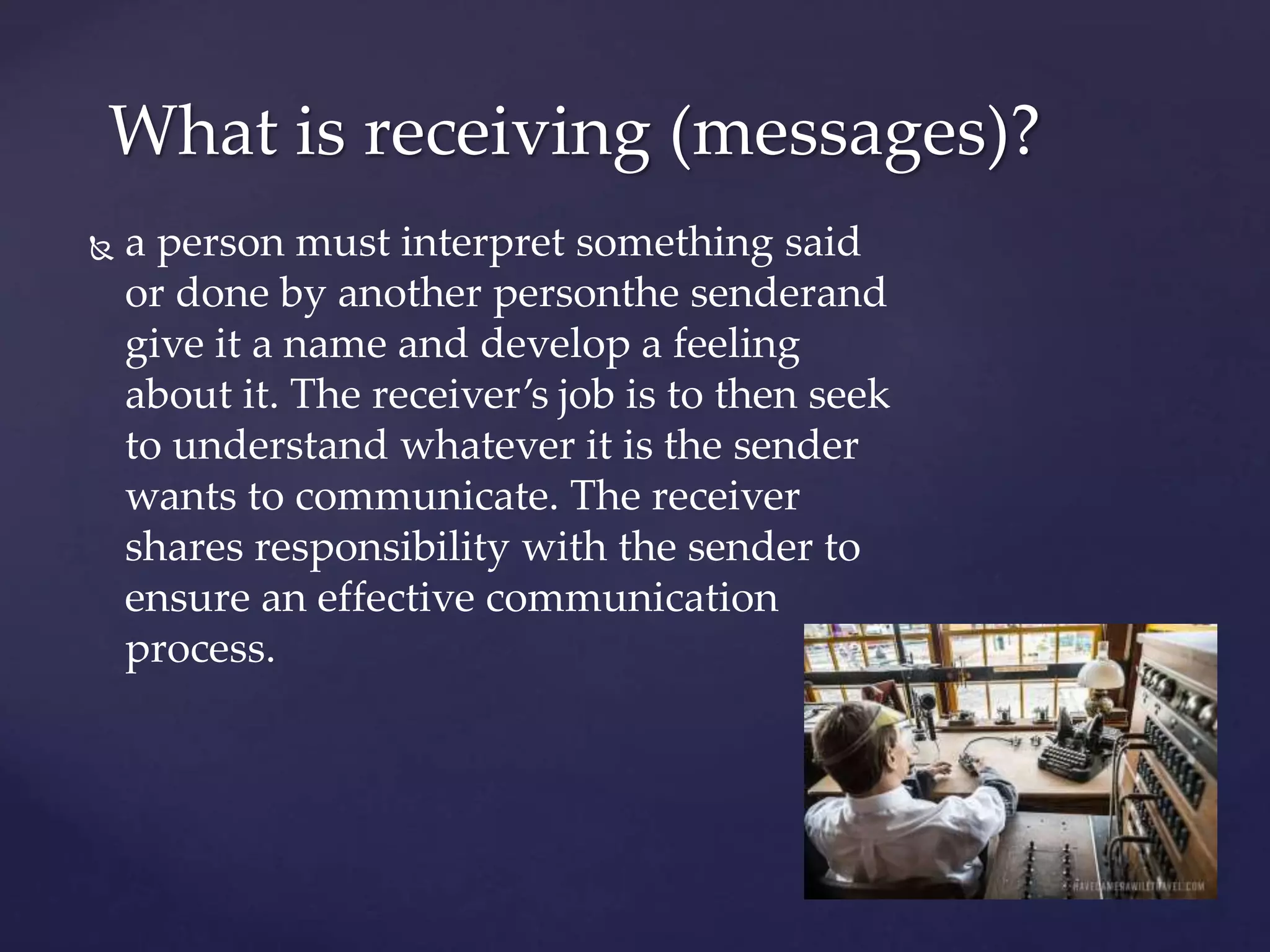
What is receiving (messages)?
 a person must interpret something said
or done by another personthe senderand
give it a name and develop a feeling
about it. The receiver’s job is to then seek
to understand whatever it is the sender
wants to communicate. The receiver
shares responsibility with the sender to
ensure an effective communication
process.
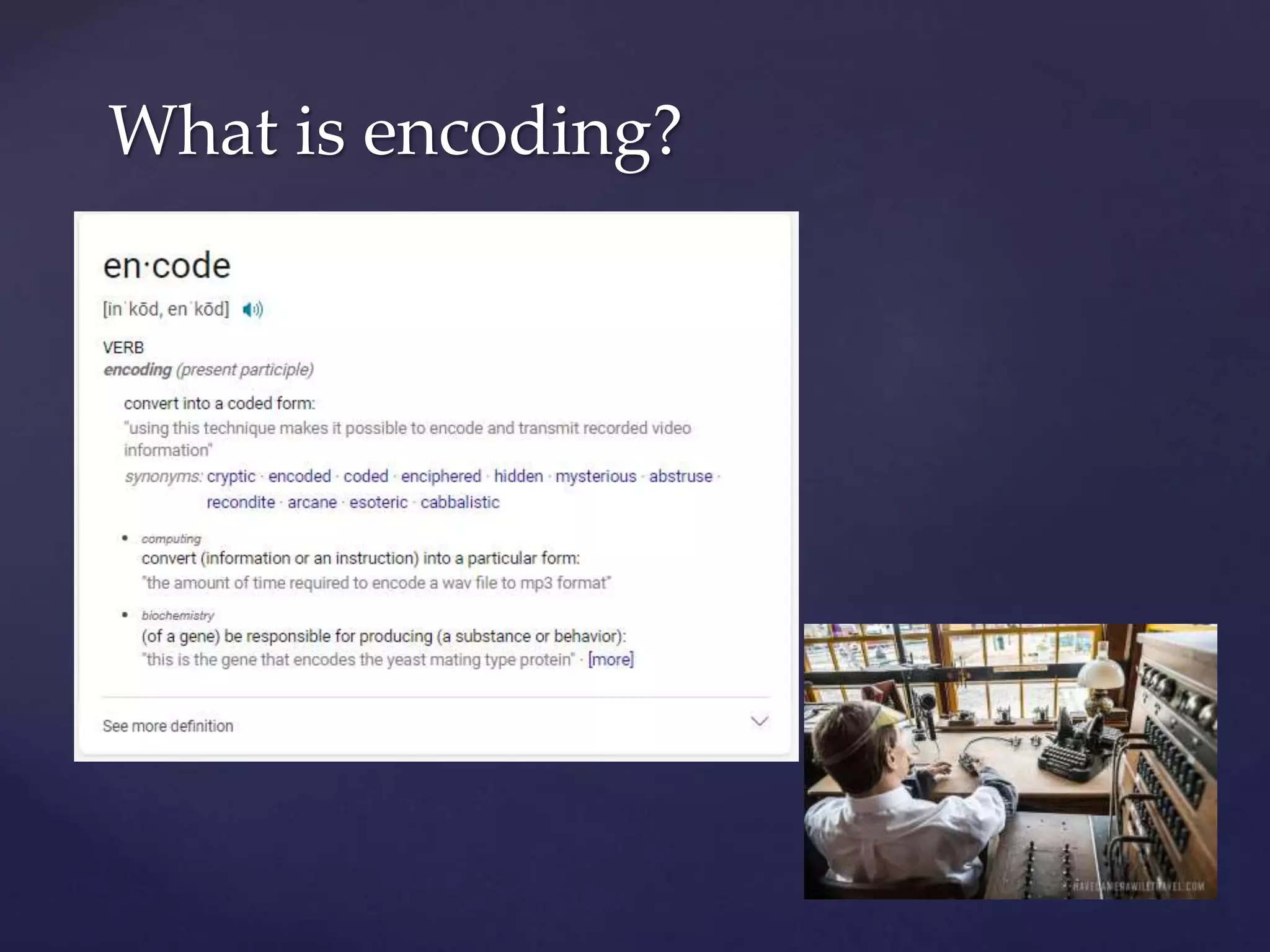
What is encoding?
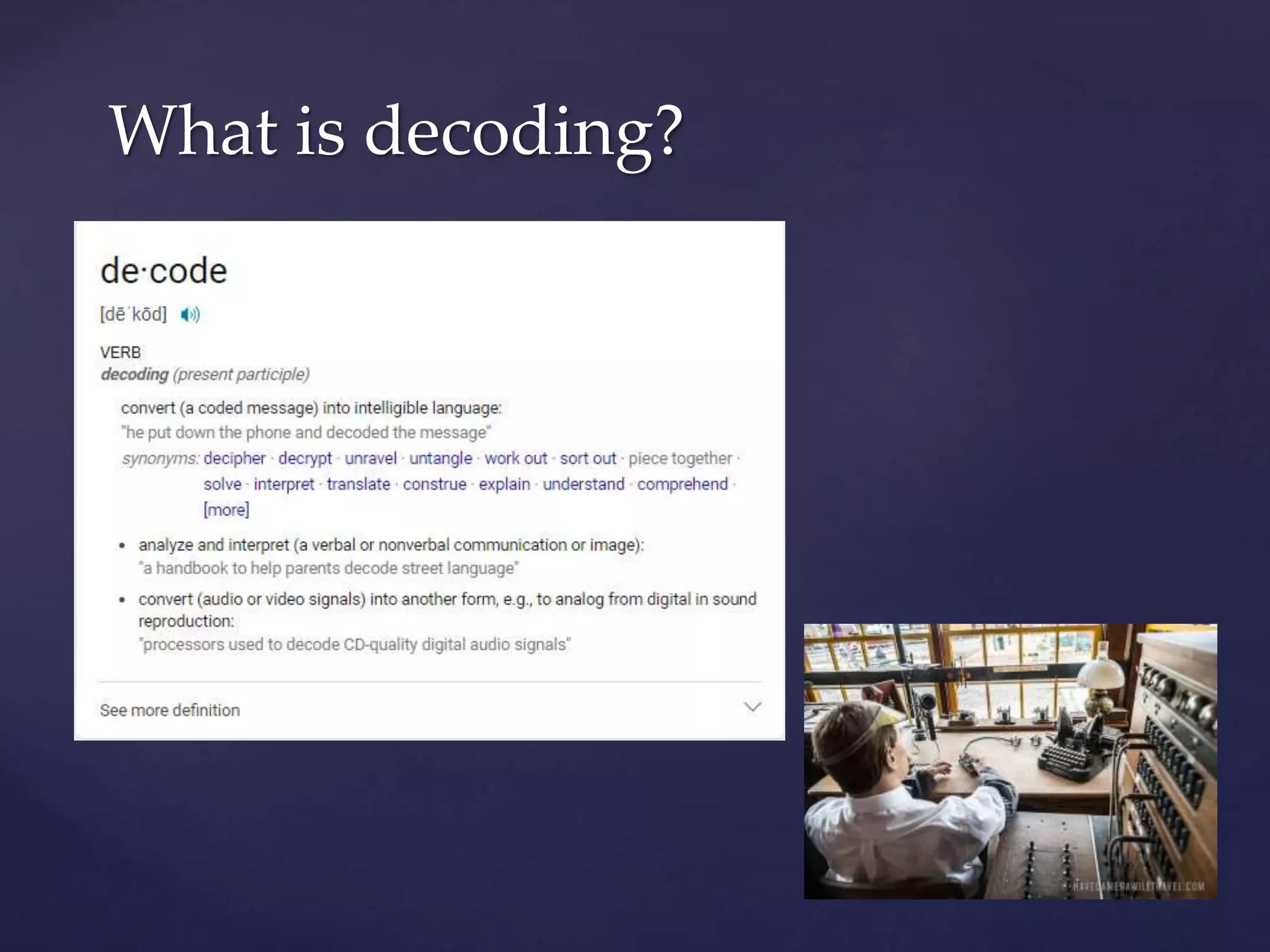
What is decoding?
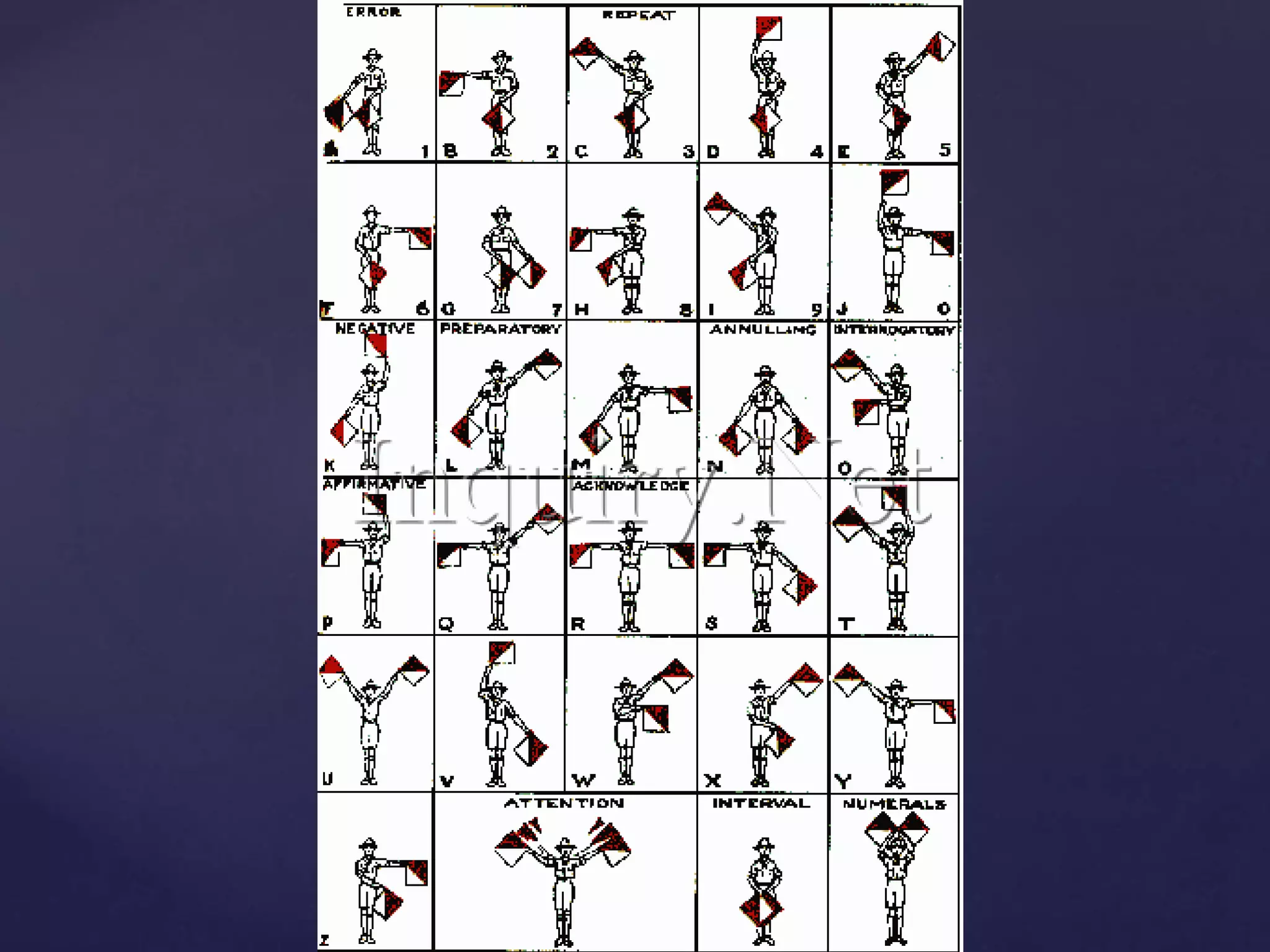
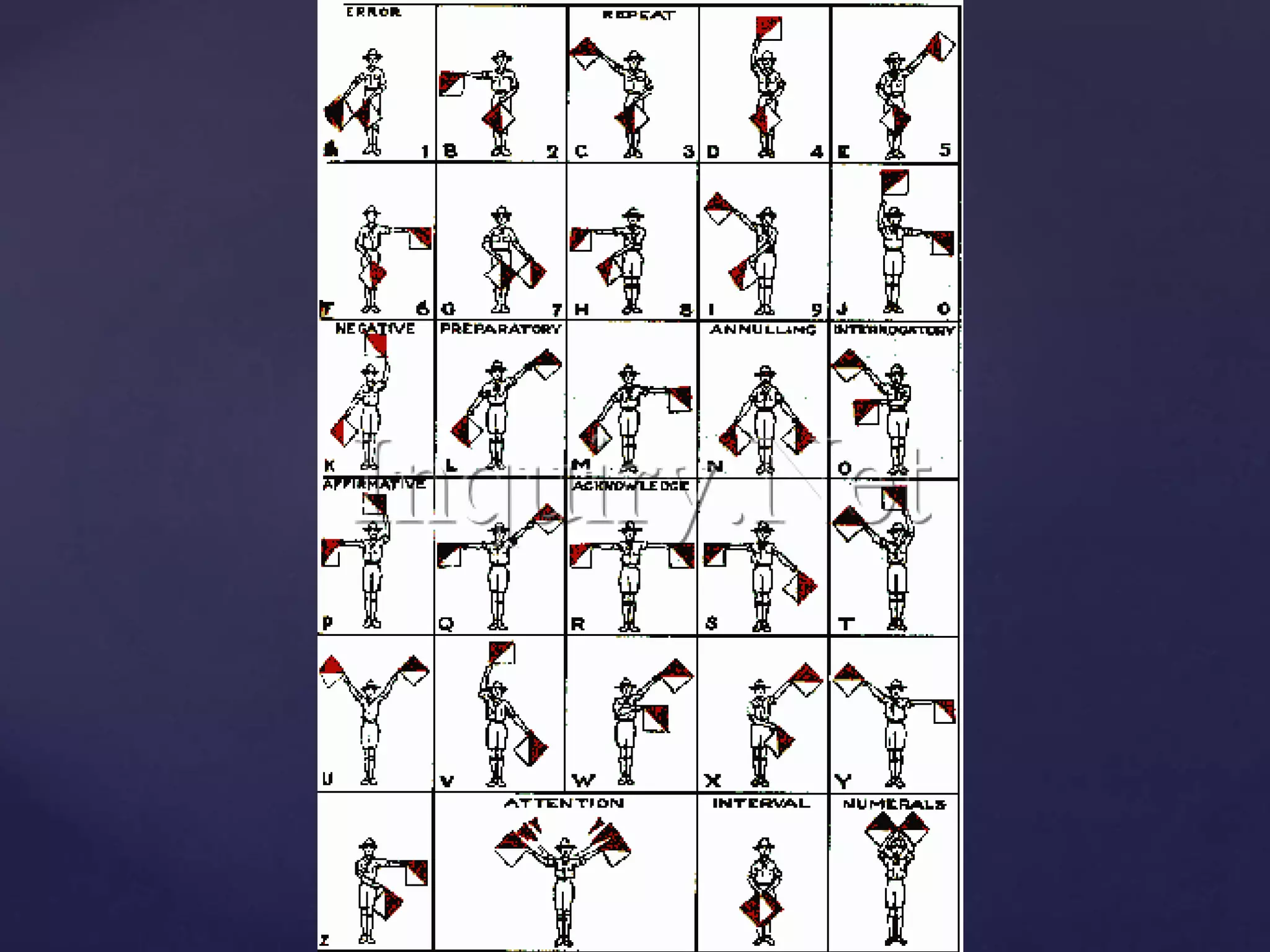
SEMAPHOR
Semaphore signalling
is used mainly for
short distance
communications.
Some points to
remember:
Signalling is useful
only when it can
be read. The letters
must be made
perfectly and must
be clearly seen.
The sender must
exactly face the
person they are
signalling. They
must stand firmly,
with the feet apart.
The flags must
be at arms reach,
arm and flag
making a
straight line.
The arms must
be in the exact
position for each
letter.
When making T, O,
and W the flags
must not cover one
another.
Do not send too
quickly. Never
send faster than
the other person
can read.
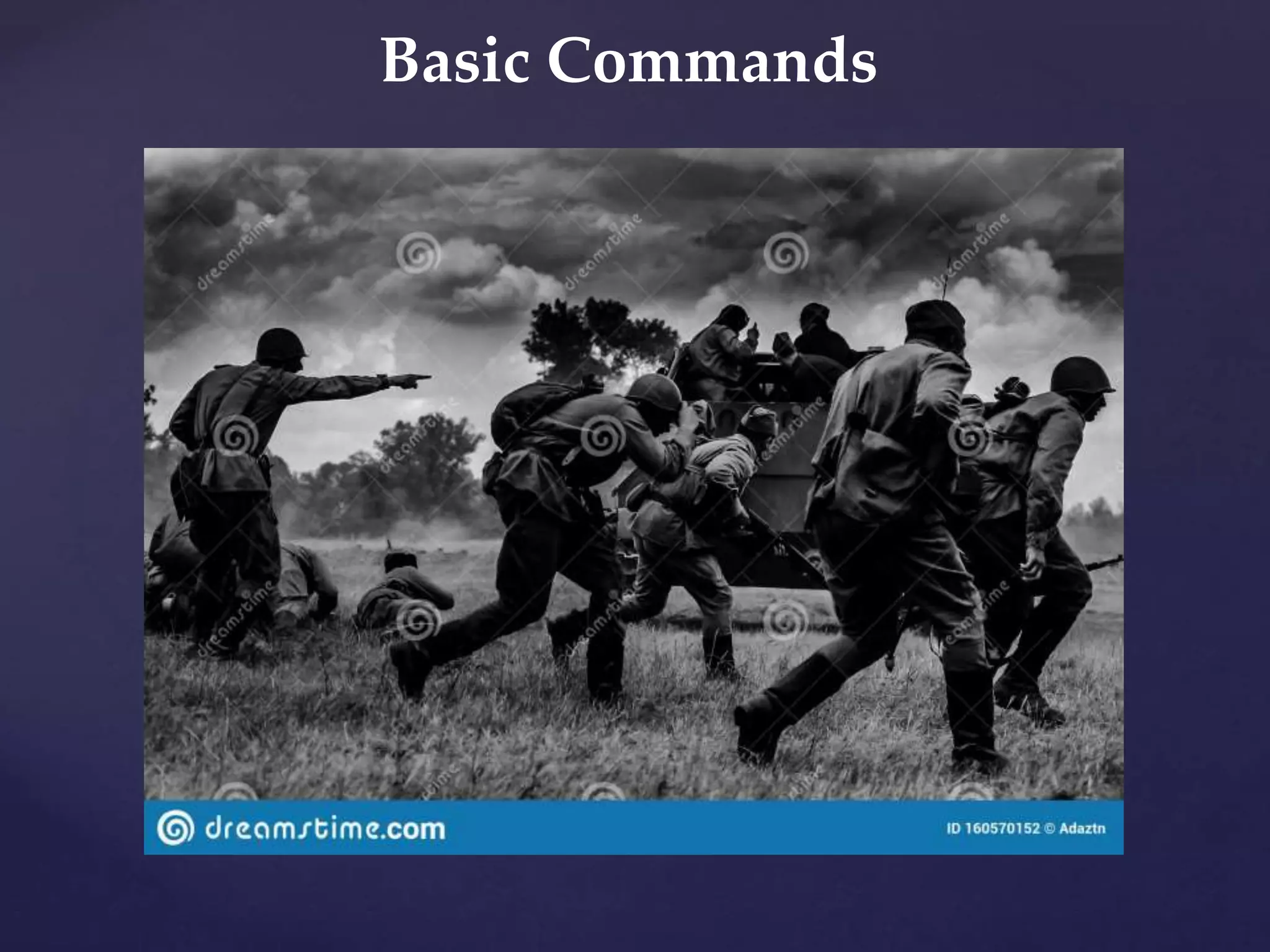
Basic Commands
Why Have
Formation
Drills?
Since Baden-Powell first introduced
the concept in “Scouting for Boys”,
Scout Troops have always used specific
formations to bring order and
discipline to Troop Meetings.
Most commonly, a Troop “falls in” to
the formation at the beginning and end
of meetings and on any occasion
where special announcements are
made.
However, many Scout Troops have
forgotten the full utility of formations.
In the past, there were many different
formation shapes, each with a different
purpose for different situations. Scouts
were drilled in these formations, and
had a lot of fun trying to make each
formation faster and neater than the
one before.
Rest Positions
These are performed
from a halt at a position
of attention. There are
four rest positions:
parade rest, at ease, rest,
and fall out.
Parade Rest
Command: Parade, REST
On the command REST, the left foot is
raised from the hip (knee straight) to barely
clear the ground and moved quickly to the
left, so your heels are 12 inches apart on the
inside of the heels.
Your legs are straight and heels are in line.
(keep knees slightly bent – do not lock your
knees or you will pass out when standing
at attention or parade rest for long periods
of time)
At the same time as the left foot moves, the
arms are brought to the back of the body
while fully extended.
At Ease
Command: AT EASE
On the command AT EASE, you
must keep your right foot in place
and remain silent and in position
in formation.
You can otherwise relax in a
standing position.
Fall Out
Command: FALL OUT
On the command FALL OUT, you can
either relax while standing or you can
break ranks but remain in the
immediate area.
You can disperse however you wish.
You are allowed to speak moderately.
About Face
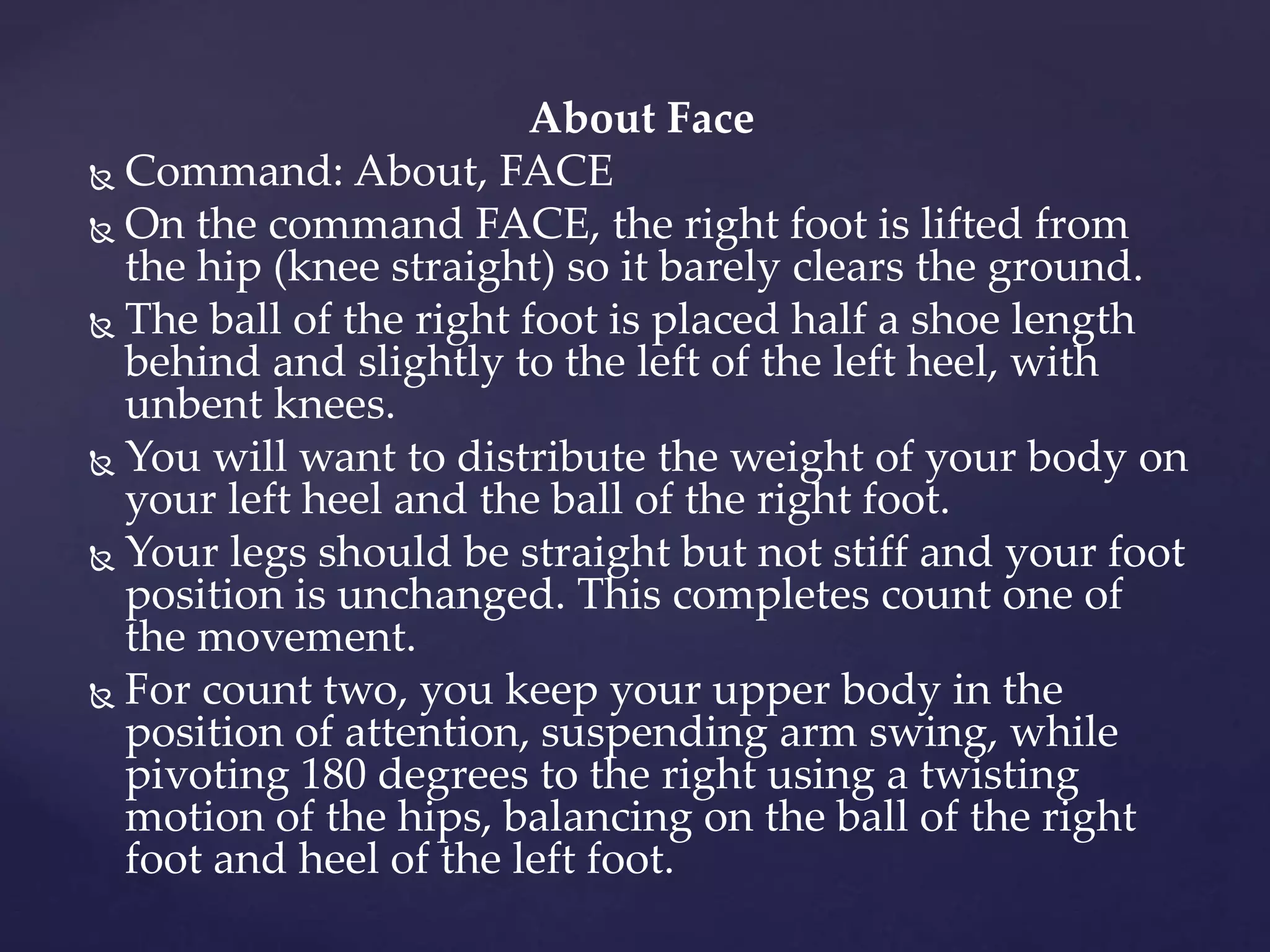
 Command: About, FACE
 On the command FACE, the right foot is lifted from
the hip (knee straight) so it barely clears the ground.
 The ball of the right foot is placed half a shoe length
behind and slightly to the left of the left heel, with
unbent knees.
 You will want to distribute the weight of your body on
your left heel and the ball of the right foot.
 Your legs should be straight but not stiff and your foot
position is unchanged. This completes count one of
the movement.
 For count two, you keep your upper body in the
position of attention, suspending arm swing, while
pivoting 180 degrees to the right using a twisting
motion of the hips, balancing on the ball of the right
foot and heel of the left foot.
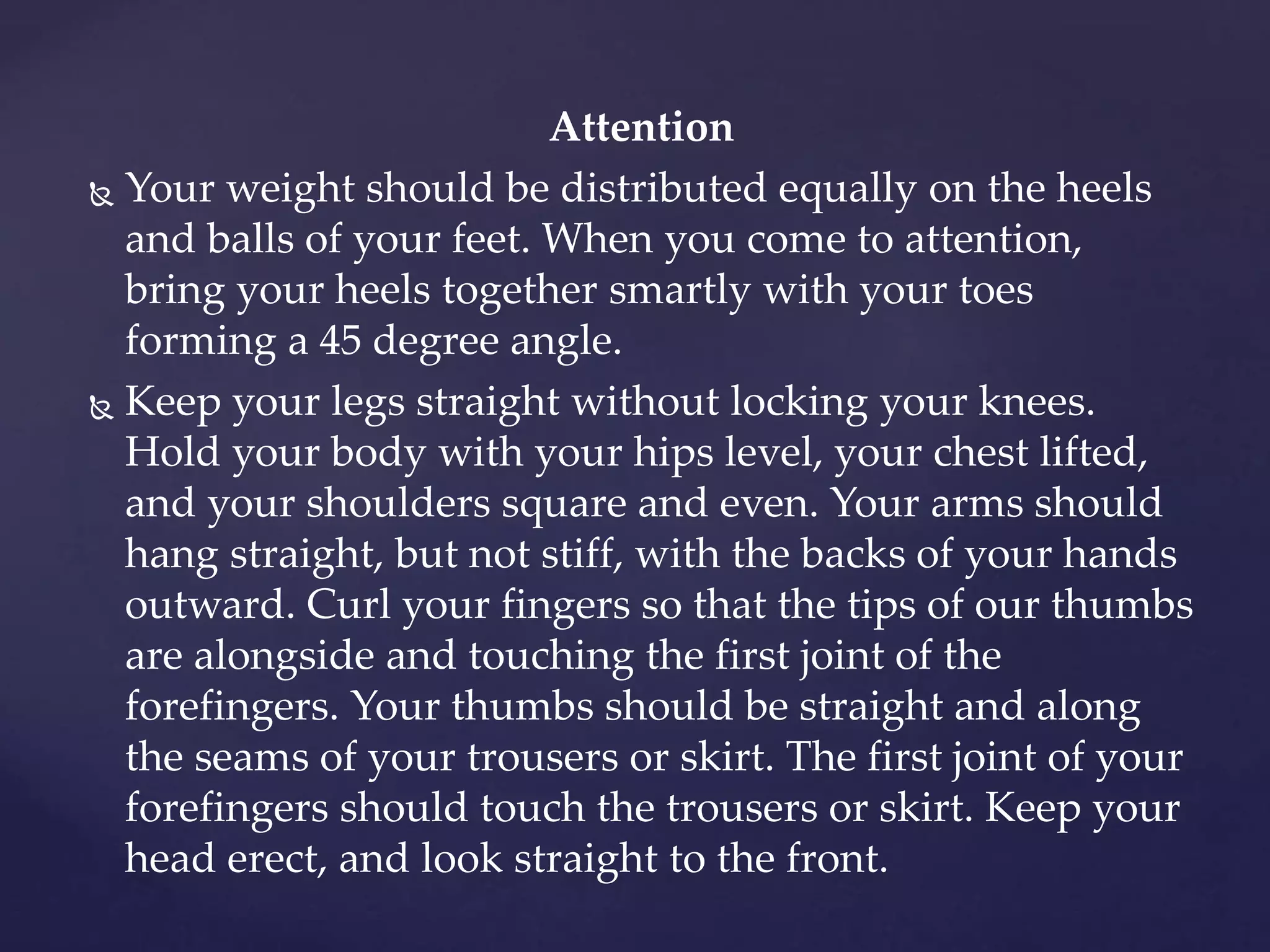
Attention
 Your weight should be distributed equally on the heels
and balls of your feet. When you come to attention,
bring your heels together smartly with your toes
forming a 45 degree angle.
 Keep your legs straight without locking your knees.
Hold your body with your hips level, your chest lifted,
and your shoulders square and even. Your arms should
hang straight, but not stiff, with the backs of your hands
outward. Curl your fingers so that the tips of our thumbs
are alongside and touching the first joint of the
forefingers. Your thumbs should be straight and along
the seams of your trousers or skirt. The first joint of your
forefingers should touch the trousers or skirt. Keep your
head erect, and look straight to the front.
The following are
translation into Tagalog /
Filipino of English-
language drill commands.
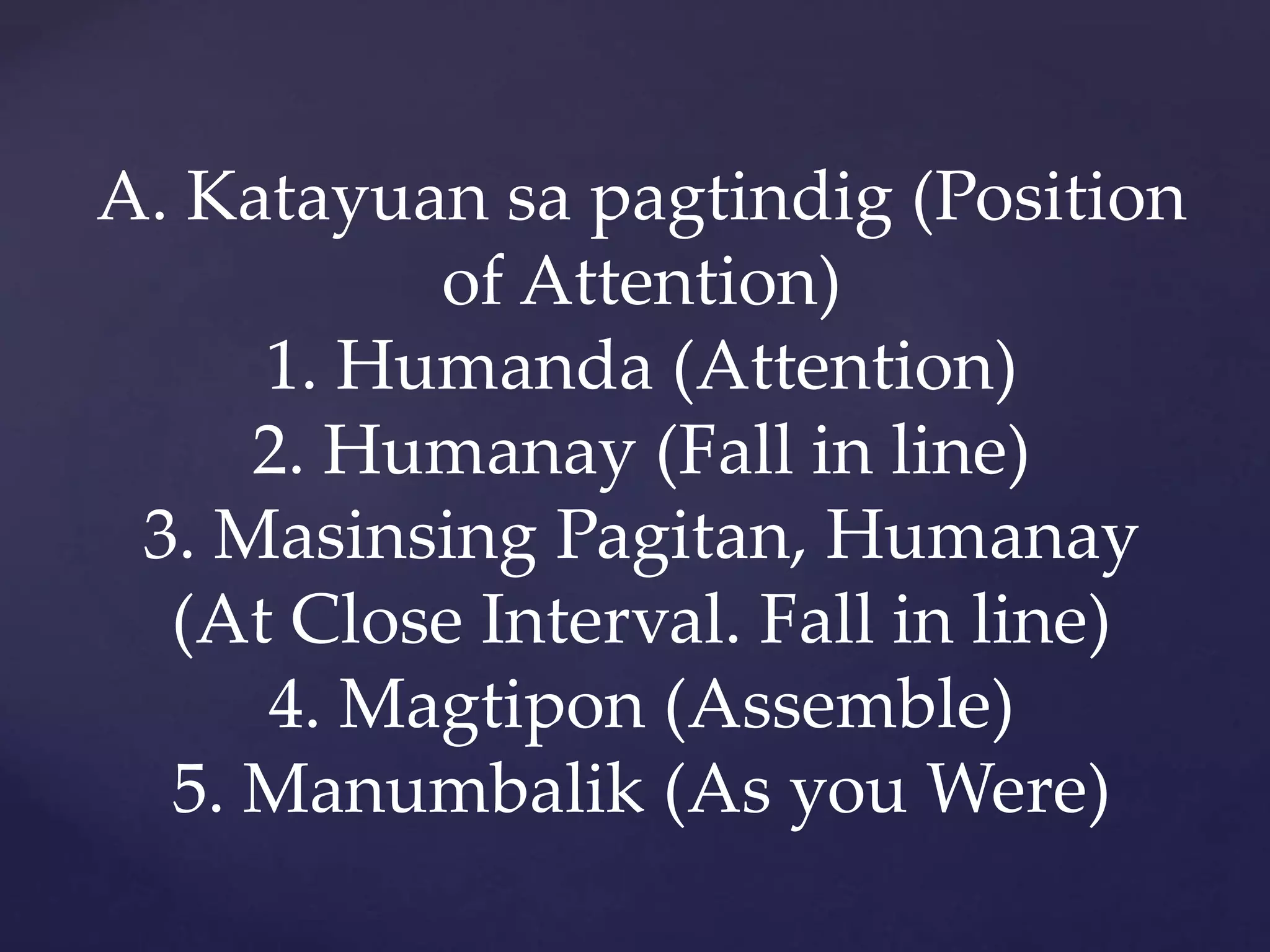
A. Katayuan sa pagtindig (Position
of Attention)
1. Humanda (Attention)
2. Humanay (Fall in line)
3. Masinsing Pagitan, Humanay
(At Close Interval. Fall in line)
4. Magtipon (Assemble)
5. Manumbalik (As you Were)
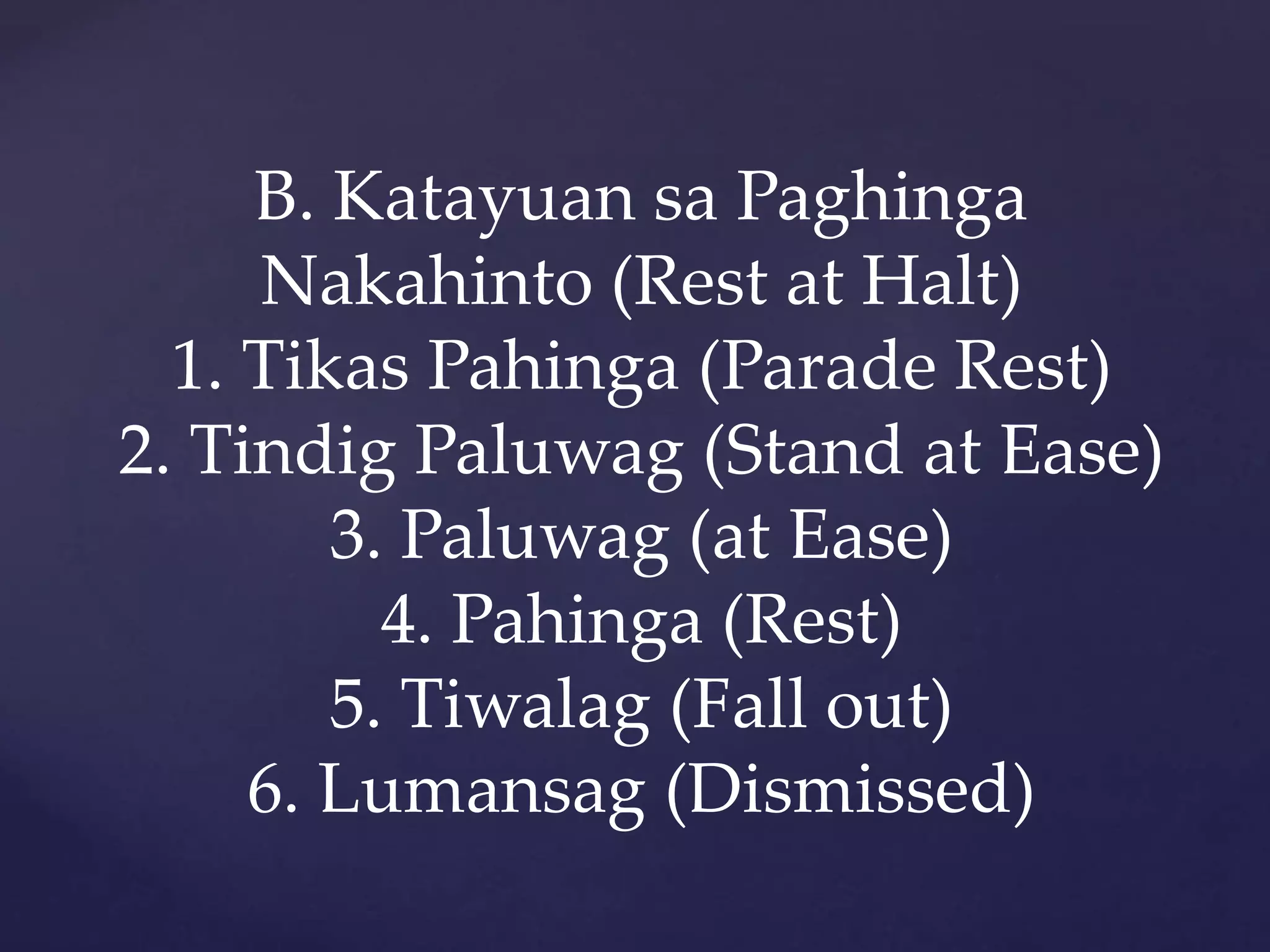
B. Katayuan sa Paghinga
Nakahinto (Rest at Halt)
1. Tikas Pahinga (Parade Rest)
2. Tindig Paluwag (Stand at Ease)
3. Paluwag (at Ease)
4. Pahinga (Rest)
5. Tiwalag (Fall out)
6. Lumansag (Dismissed)
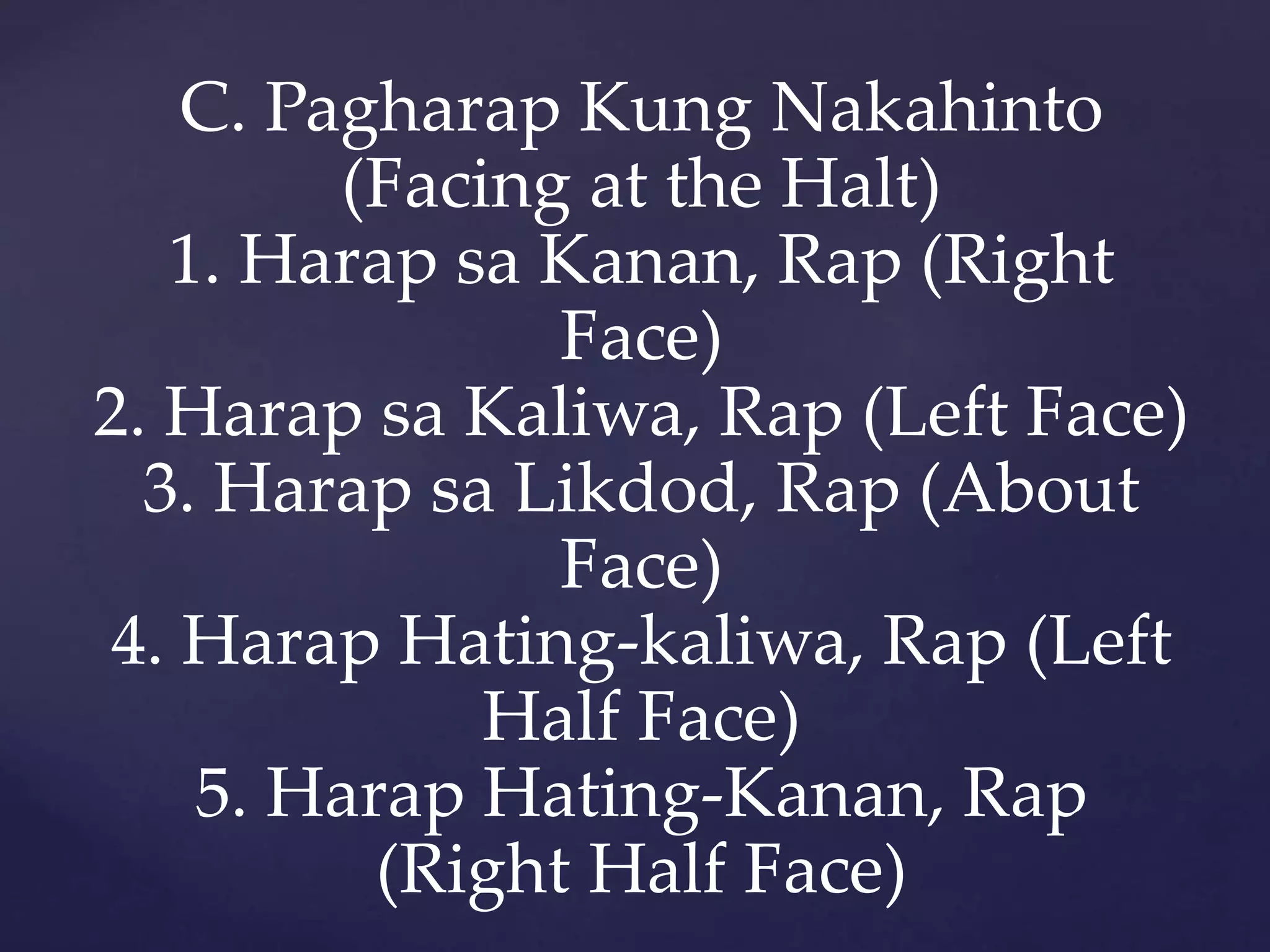
C. Pagharap Kung Nakahinto
(Facing at the Halt)
1. Harap sa Kanan, Rap (Right
Face)
2. Harap sa Kaliwa, Rap (Left Face)
3. Harap sa Likdod, Rap (About
Face)
4. Harap Hating-kaliwa, Rap (Left
Half Face)
5. Harap Hating-Kanan, Rap
(Right Half Face)
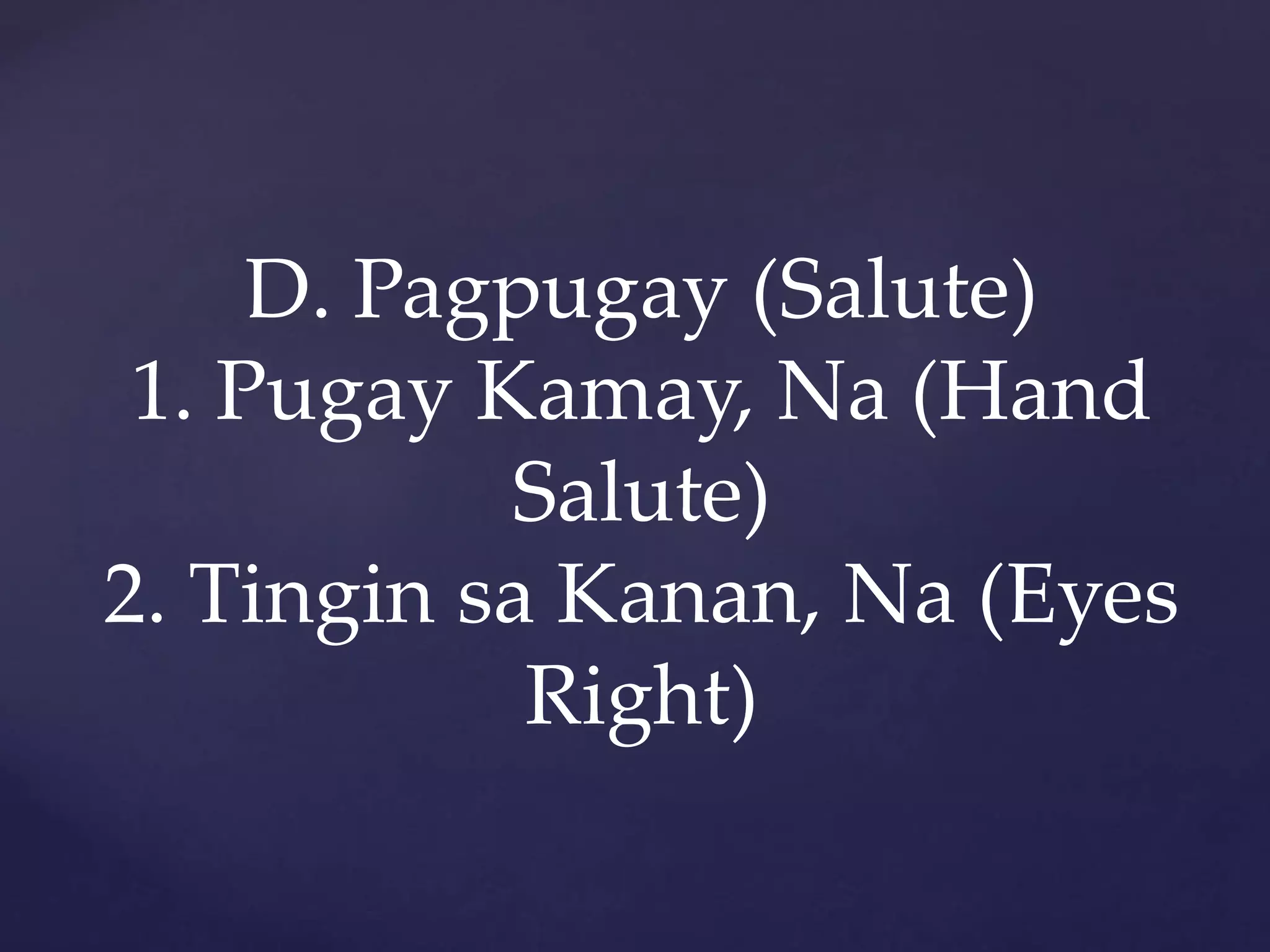
D. Pagpugay (Salute)
1. Pugay Kamay, Na (Hand
Salute)
2. Tingin sa Kanan, Na (Eyes
Right)
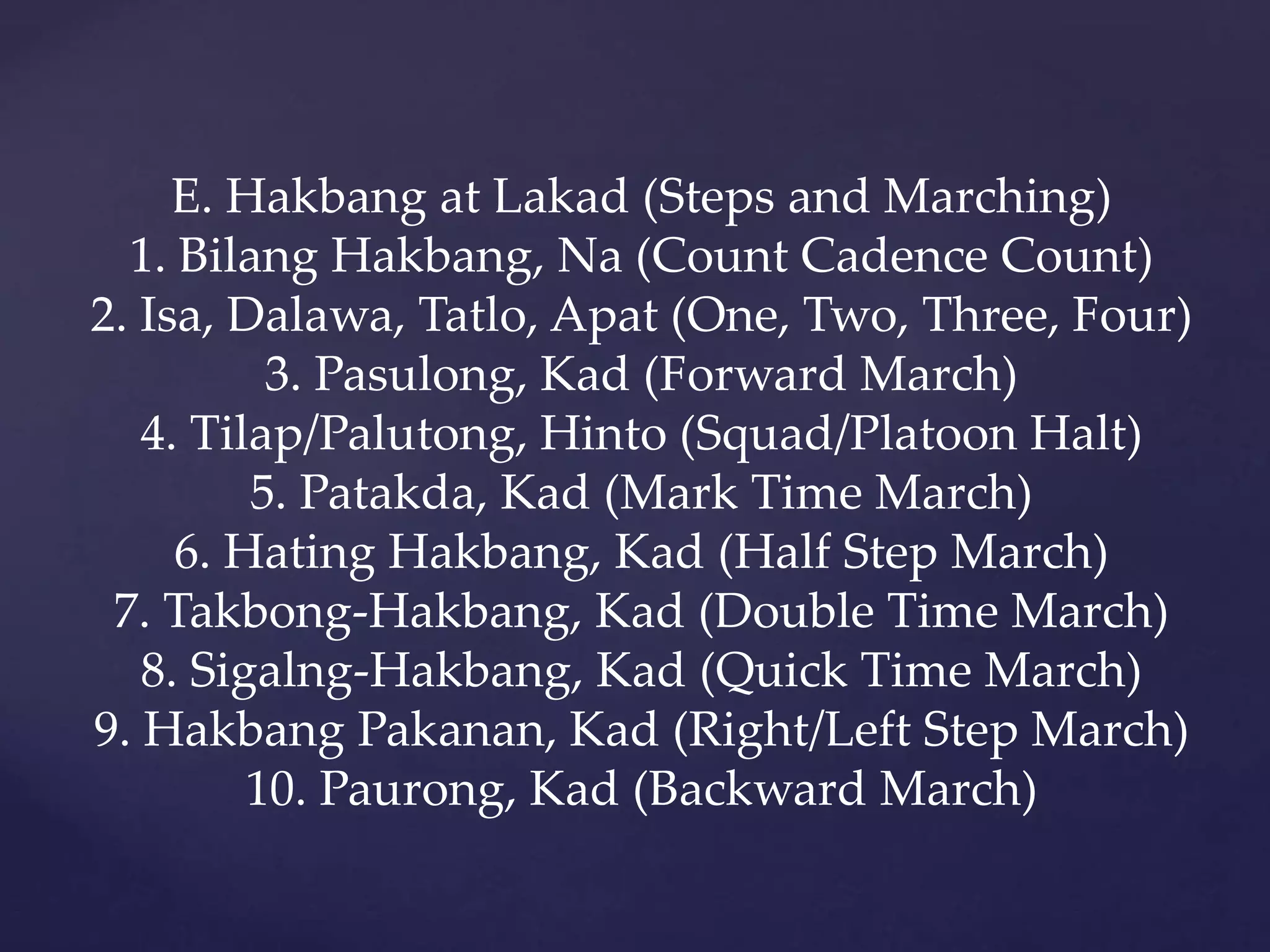
E. Hakbang at Lakad (Steps and Marching)
1. Bilang Hakbang, Na (Count Cadence Count)
2. Isa, Dalawa, Tatlo, Apat (One, Two, Three, Four)
3. Pasulong, Kad (Forward March)
4. Tilap/Palutong, Hinto (Squad/Platoon Halt)
5. Patakda, Kad (Mark Time March)
6. Hating Hakbang, Kad (Half Step March)
7. Takbong-Hakbang, Kad (Double Time March)
8. Sigalng-Hakbang, Kad (Quick Time March)
9. Hakbang Pakanan, Kad (Right/Left Step March)
10. Paurong, Kad (Backward March)
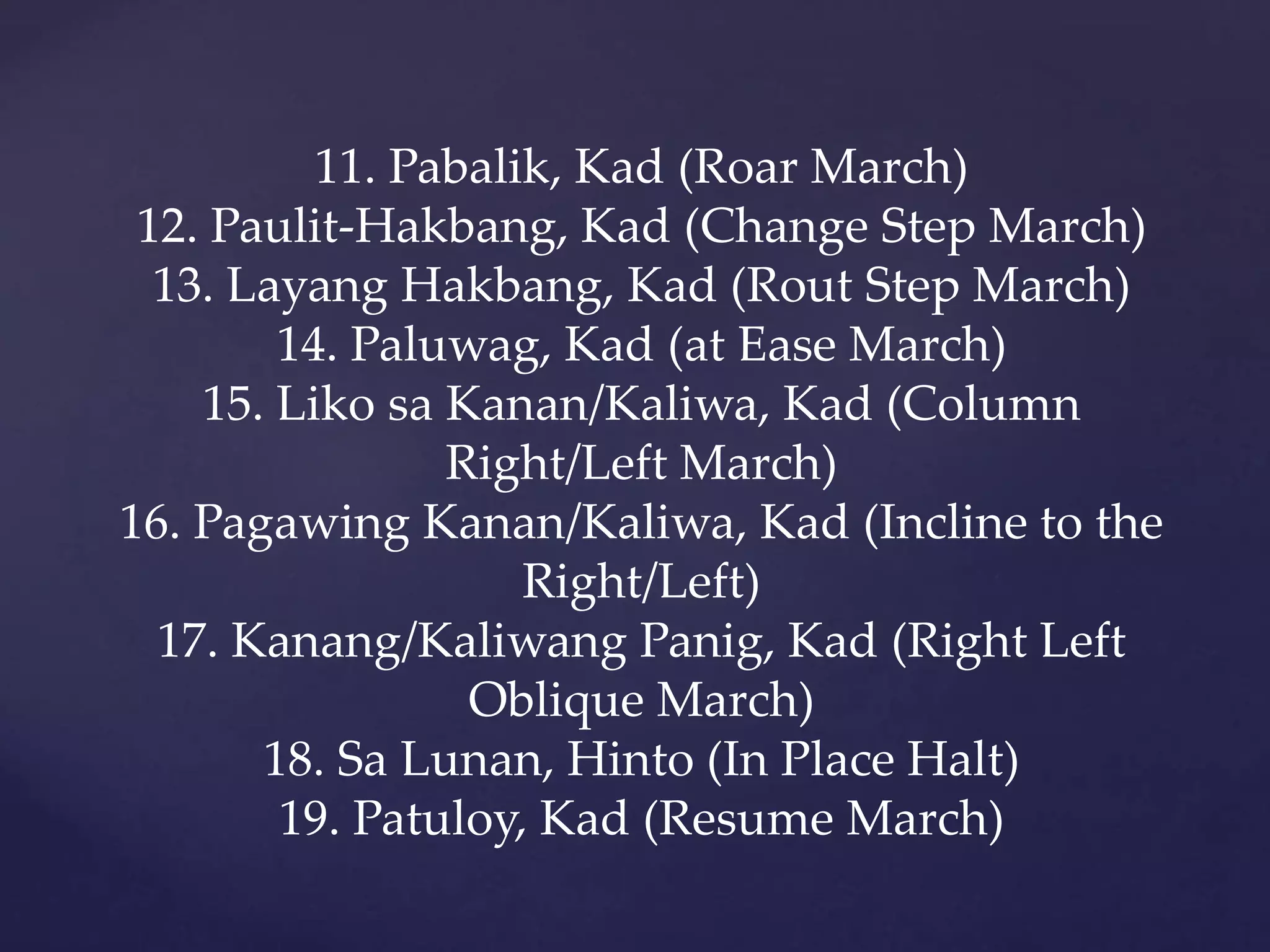
11. Pabalik, Kad (Roar March)
12. Paulit-Hakbang, Kad (Change Step March)
13. Layang Hakbang, Kad (Rout Step March)
14. Paluwag, Kad (at Ease March)
15. Liko sa Kanan/Kaliwa, Kad (Column
Right/Left March)
16. Pagawing Kanan/Kaliwa, Kad (Incline to the
Right/Left)
17. Kanang/Kaliwang Panig, Kad (Right Left
Oblique March)
18. Sa Lunan, Hinto (In Place Halt)
19. Patuloy, Kad (Resume March)
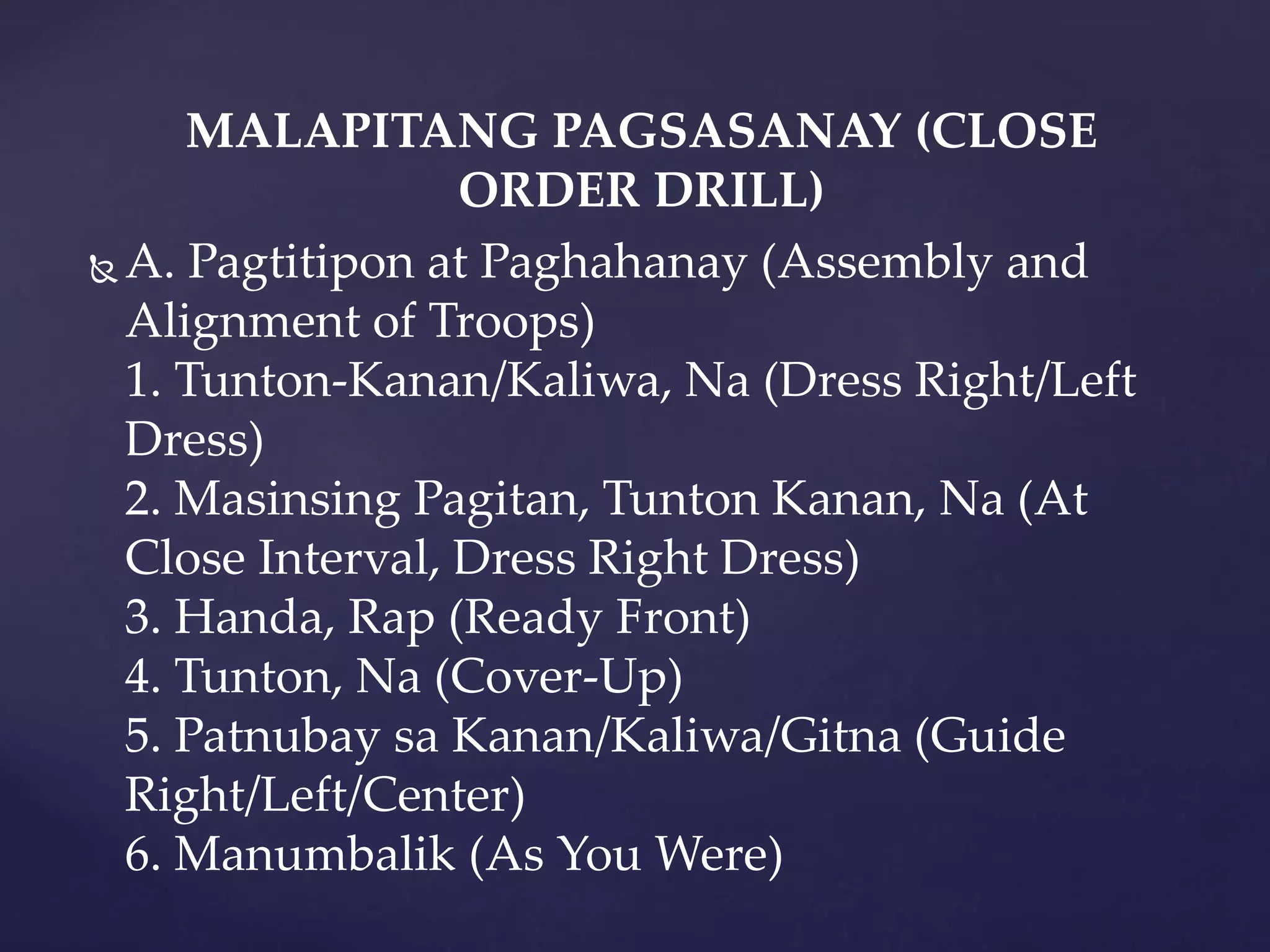
MALAPITANG PAGSASANAY (CLOSE
ORDER DRILL)
 A. Pagtitipon at Paghahanay (Assembly and
Alignment of Troops)
1. Tunton-Kanan/Kaliwa, Na (Dress Right/Left
Dress)
2. Masinsing Pagitan, Tunton Kanan, Na (At
Close Interval, Dress Right Dress)
3. Handa, Rap (Ready Front)
4. Tunton, Na (Cover-Up)
5. Patnubay sa Kanan/Kaliwa/Gitna (Guide
Right/Left/Center)
6. Manumbalik (As You Were)
MORSE CODE
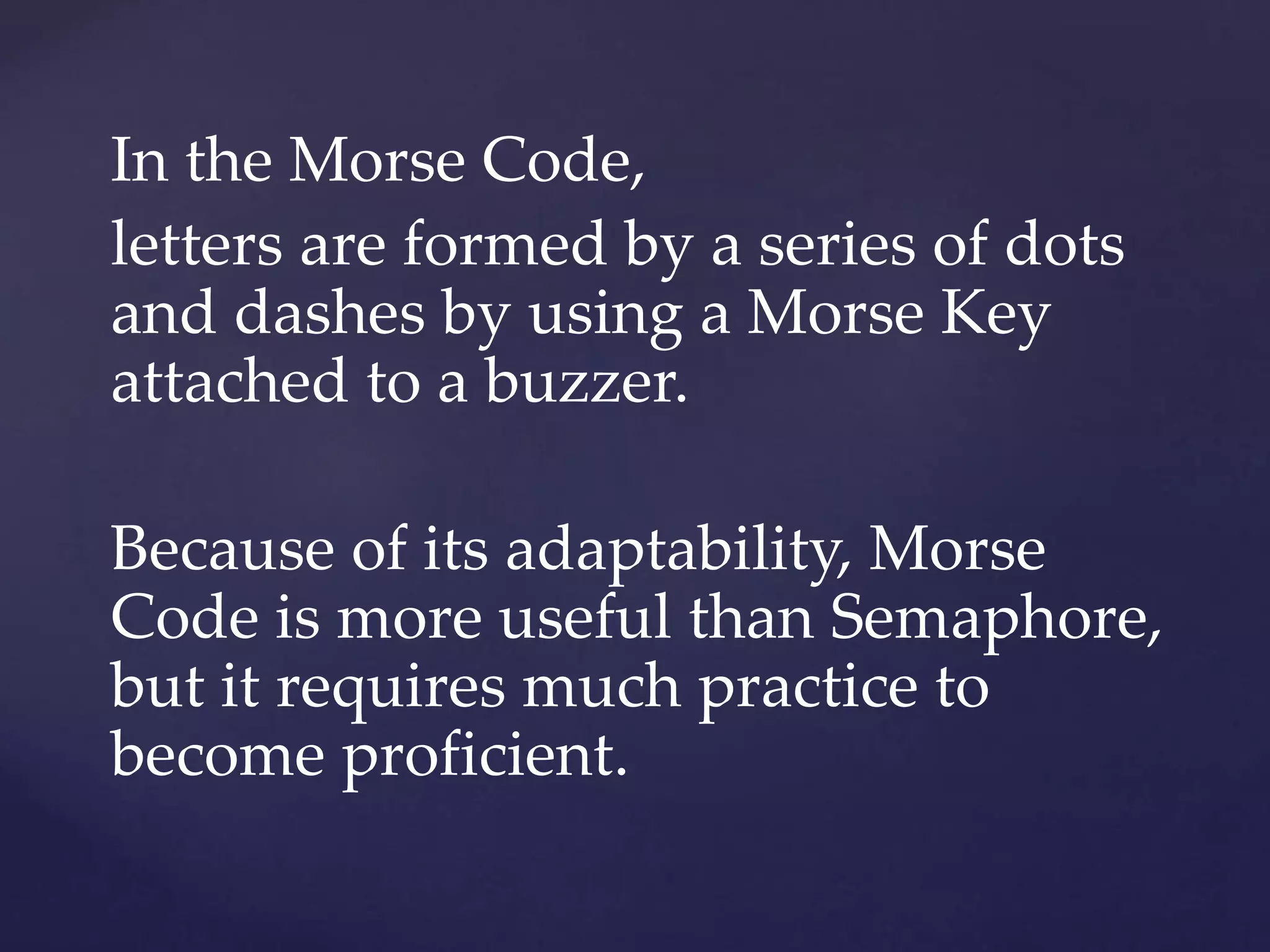
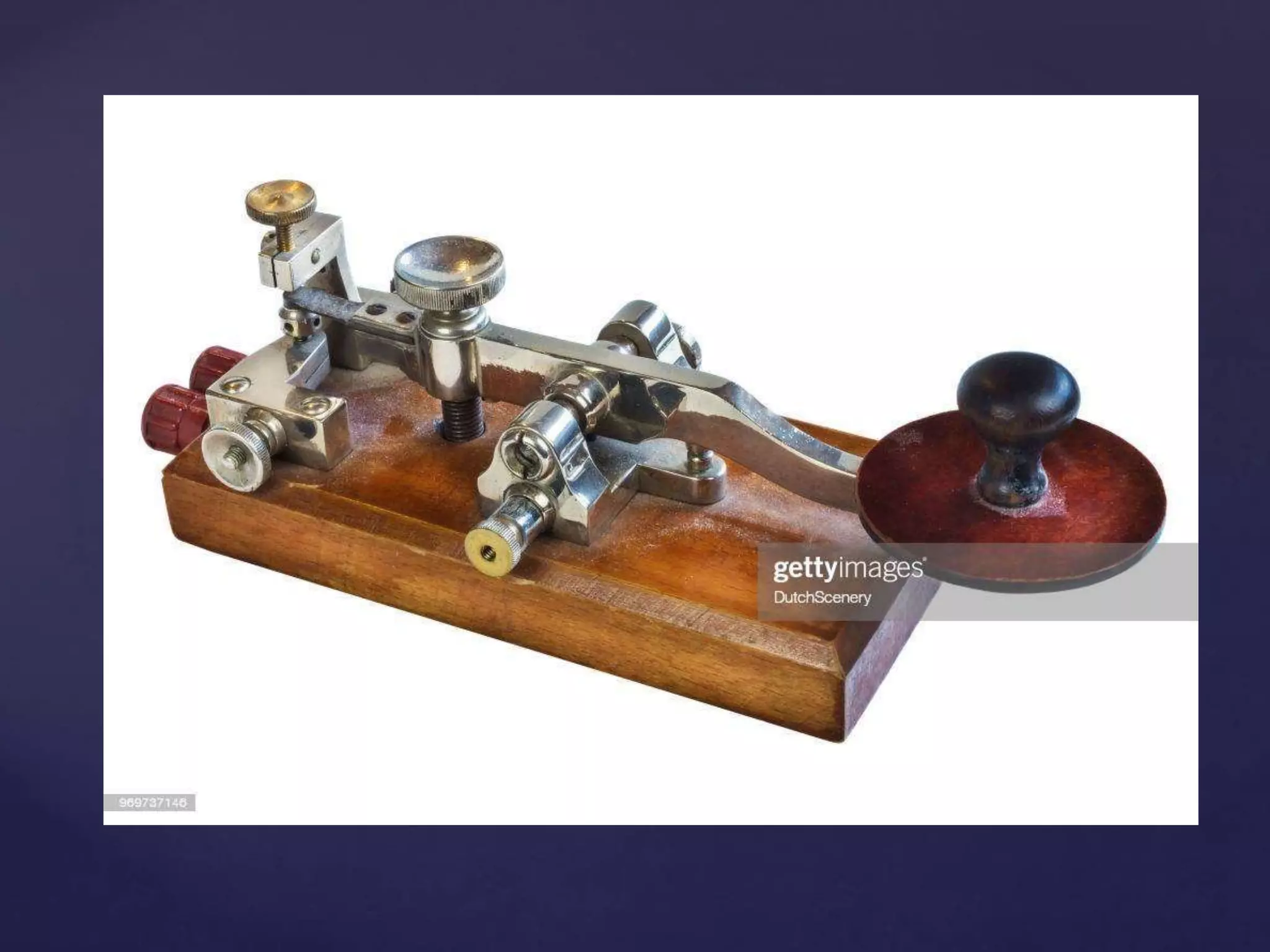
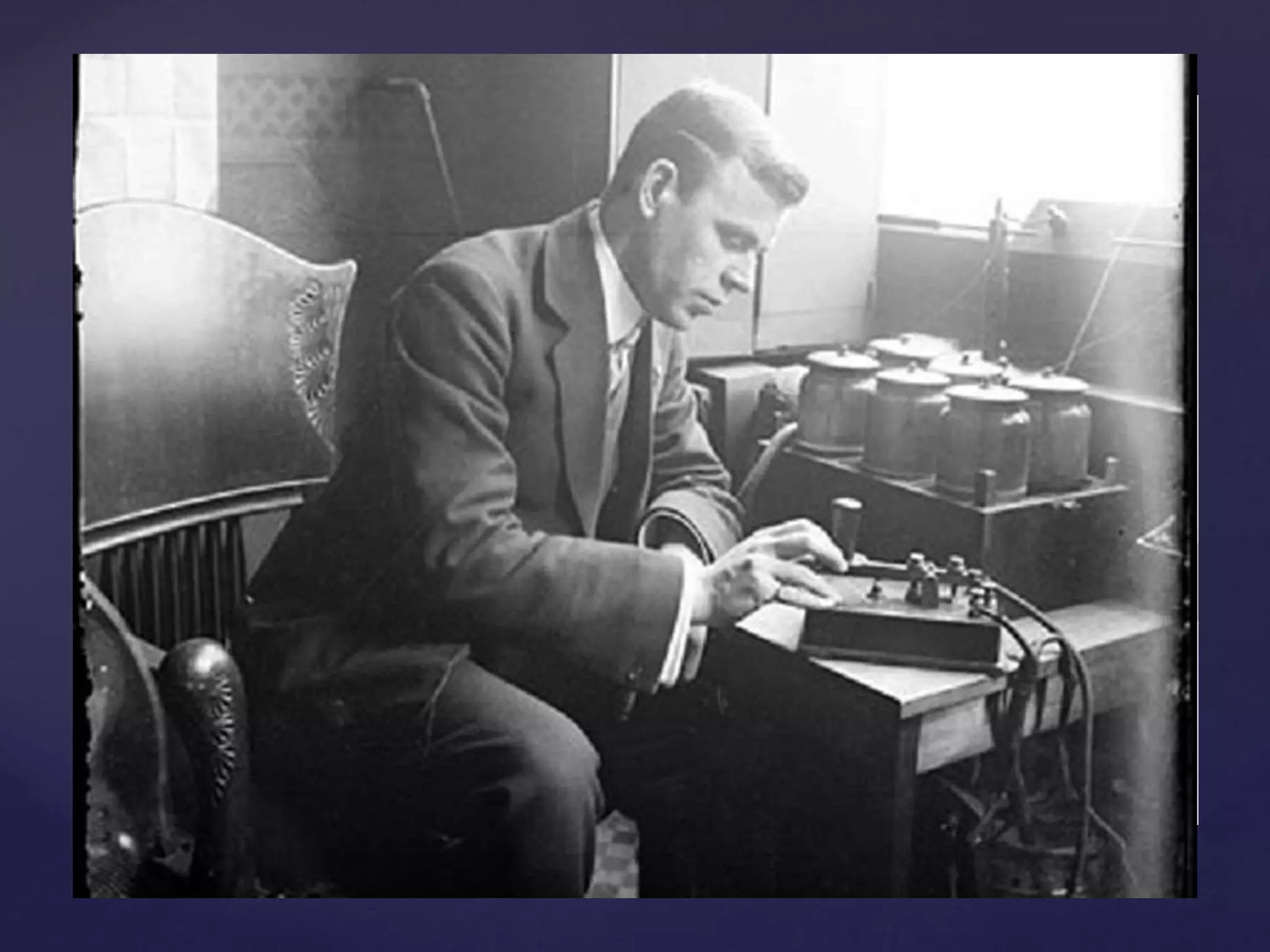
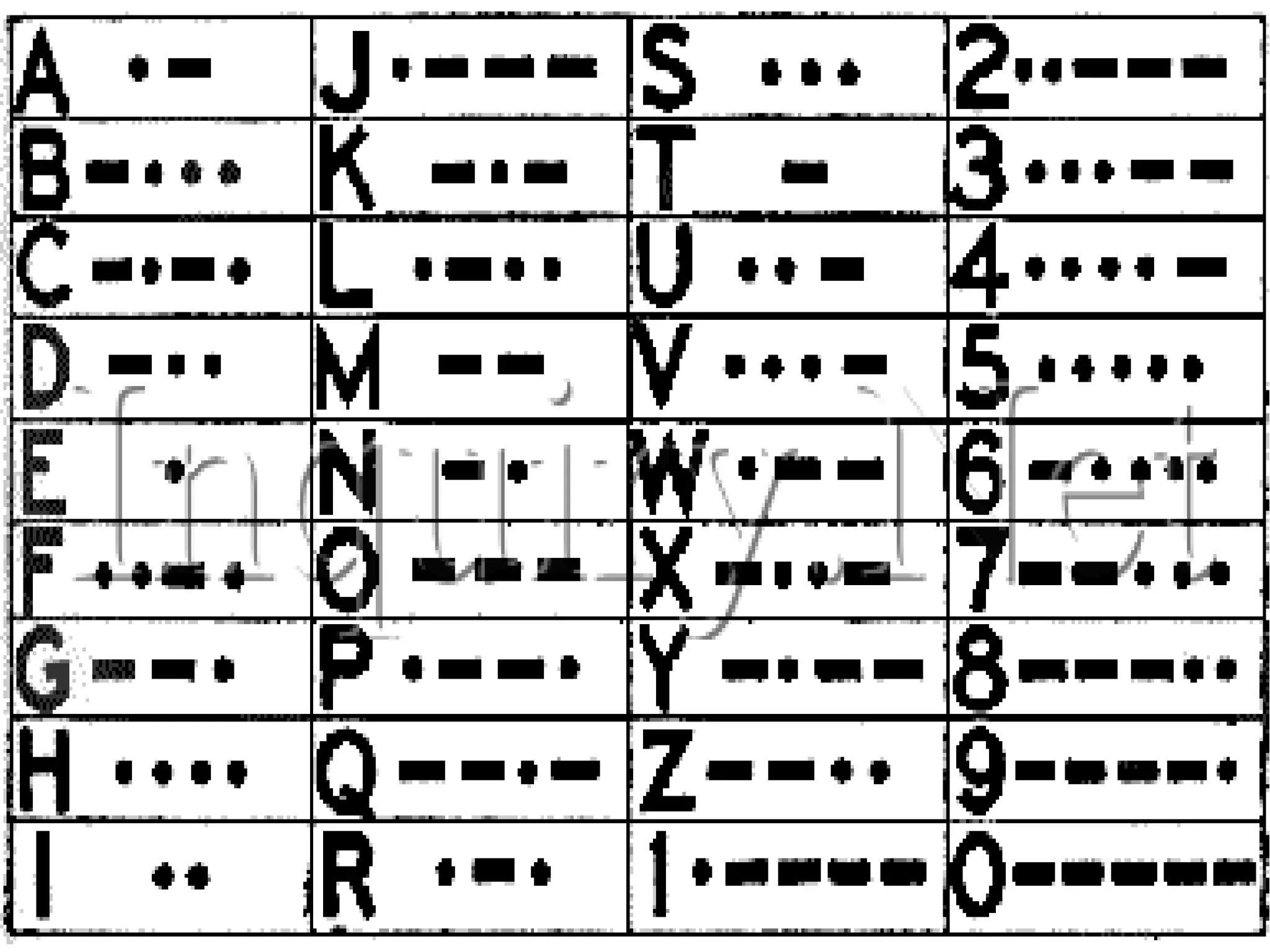
In the Morse Code,
letters are formed by a series of dots
and dashes by using a Morse Key
attached to a buzzer.
Because of its adaptability, Morse
Code is more useful than Semaphore,
but it requires much practice to
become proficient.
VE VE VE Calling up signal
K Carry On. (Answer to VE, if ready to
receive message)
Q Wait. (Answer to VE if not ready to
receive message.)
T General answer
AAA Period or decimal
AR End of message
R Message received correctly
8 dots Erase.
GB Good Bye. (used when closing down)
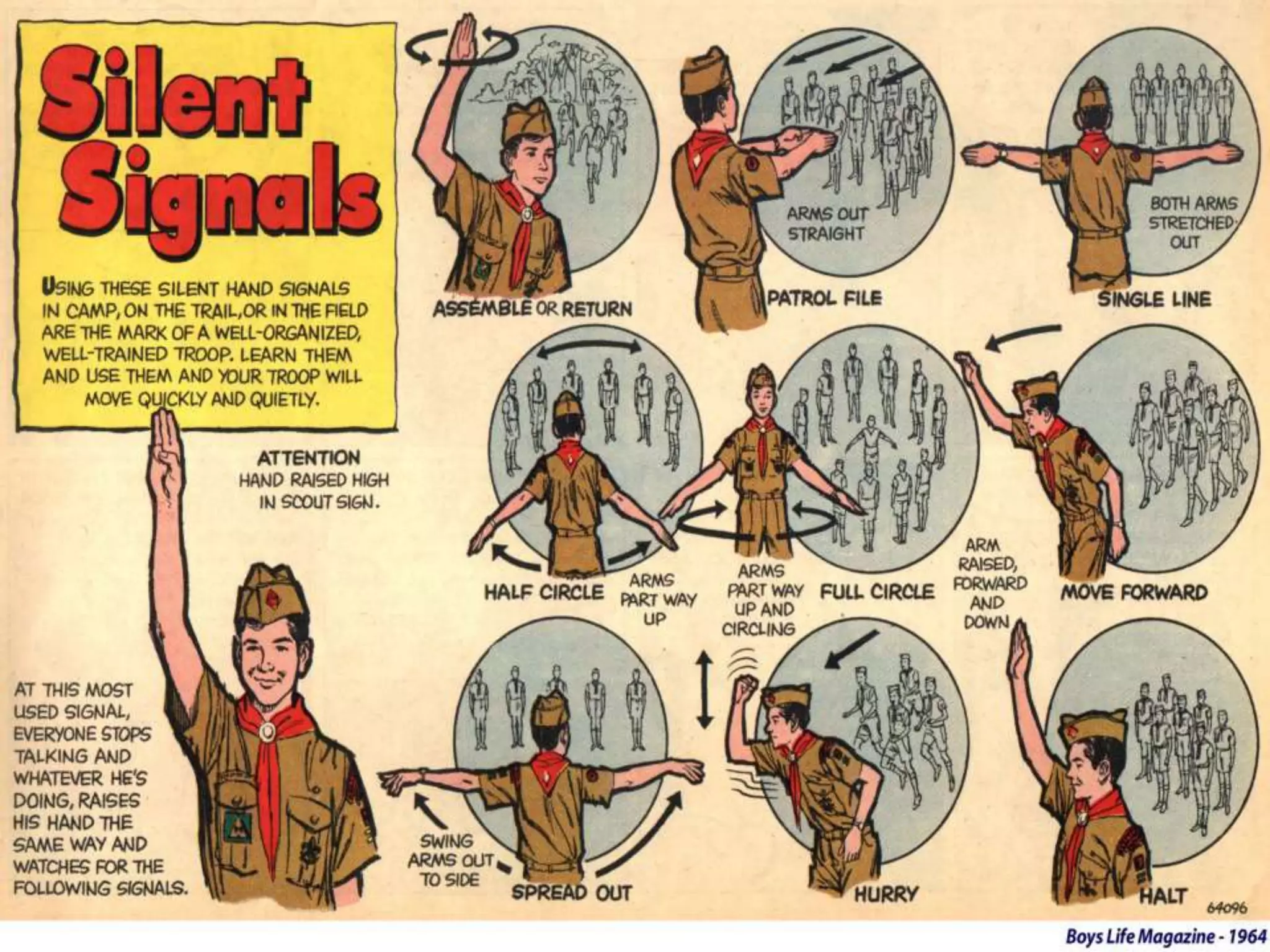
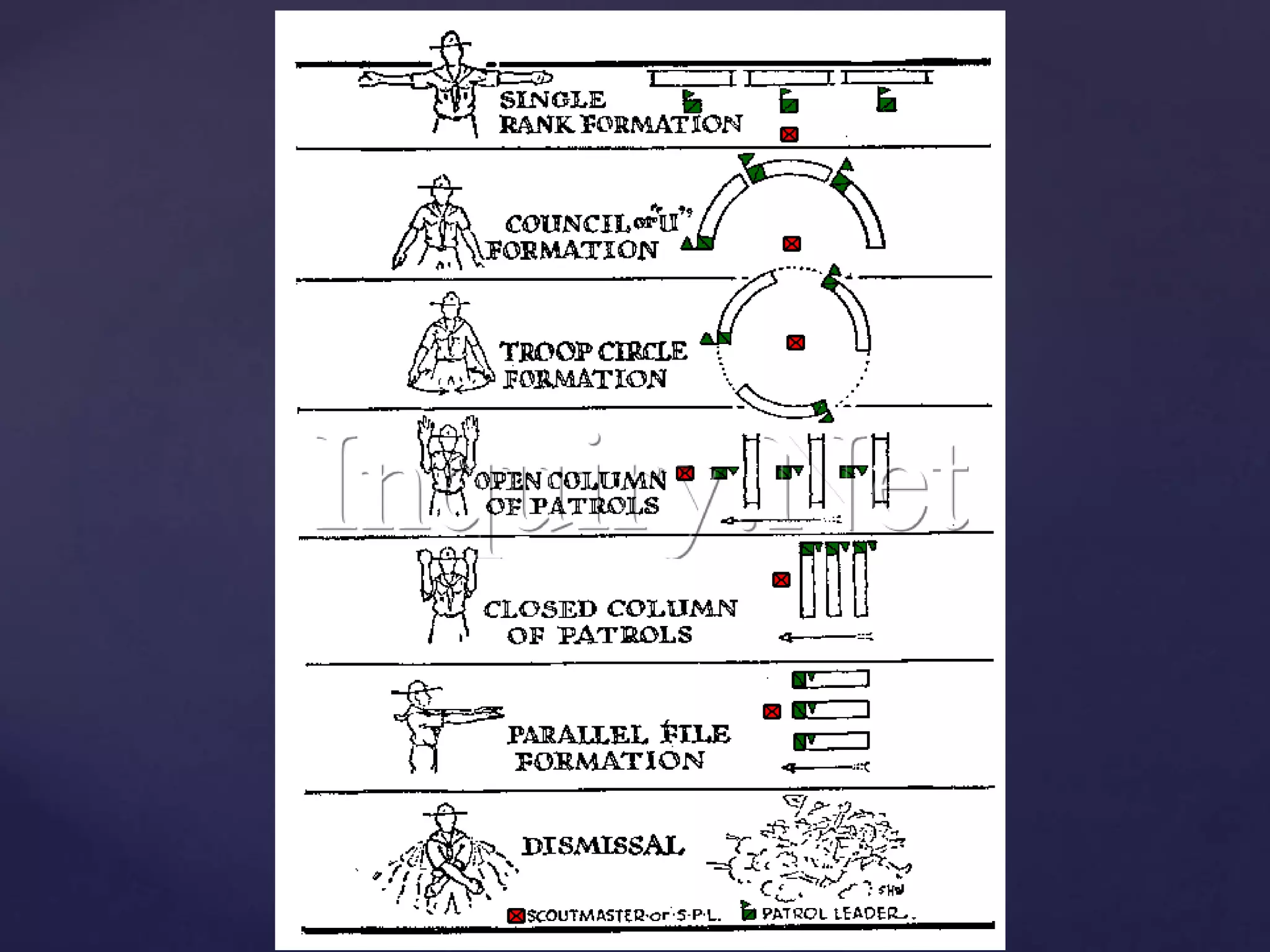
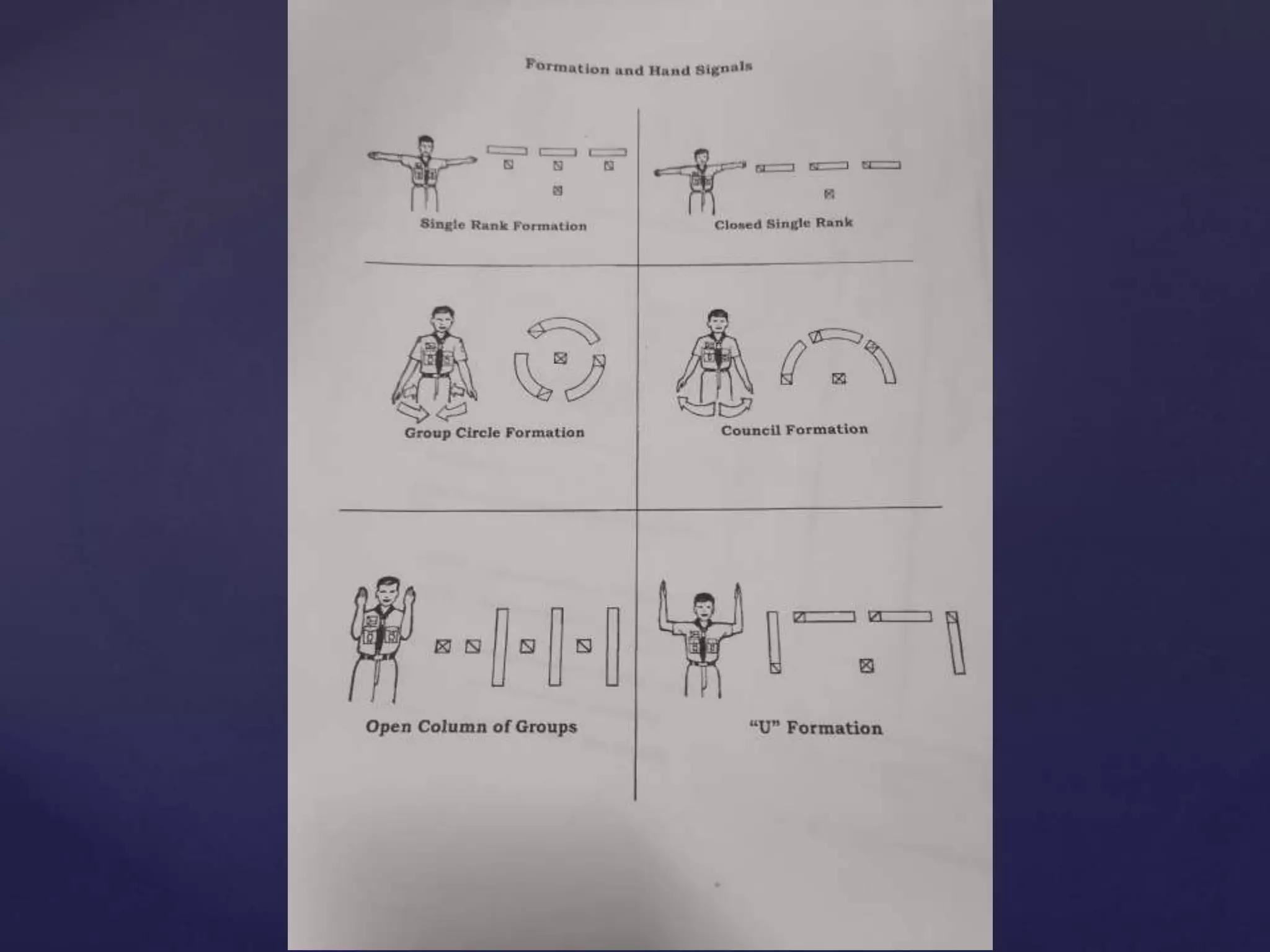
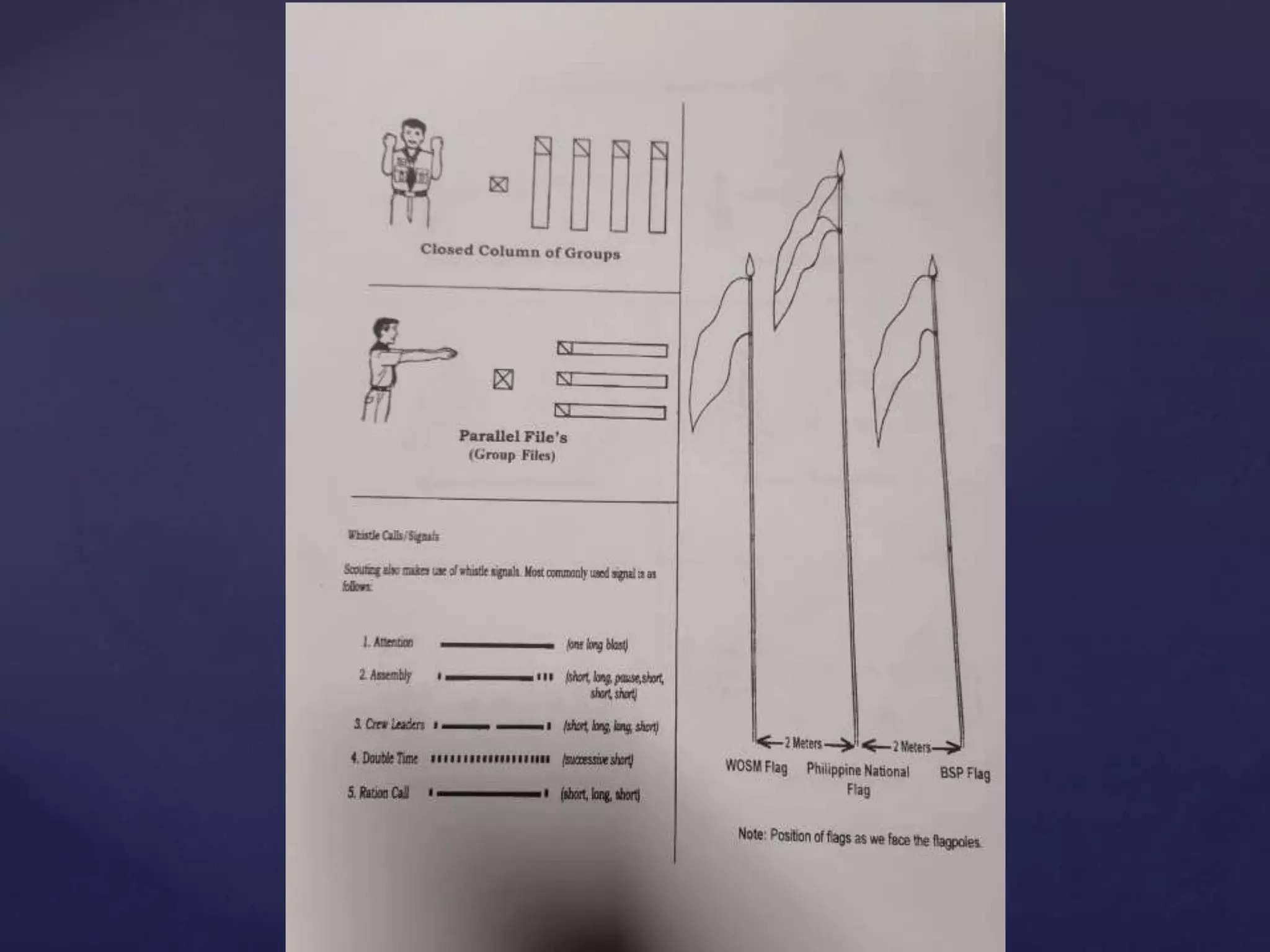
FORMATION and HAND SIGNALS
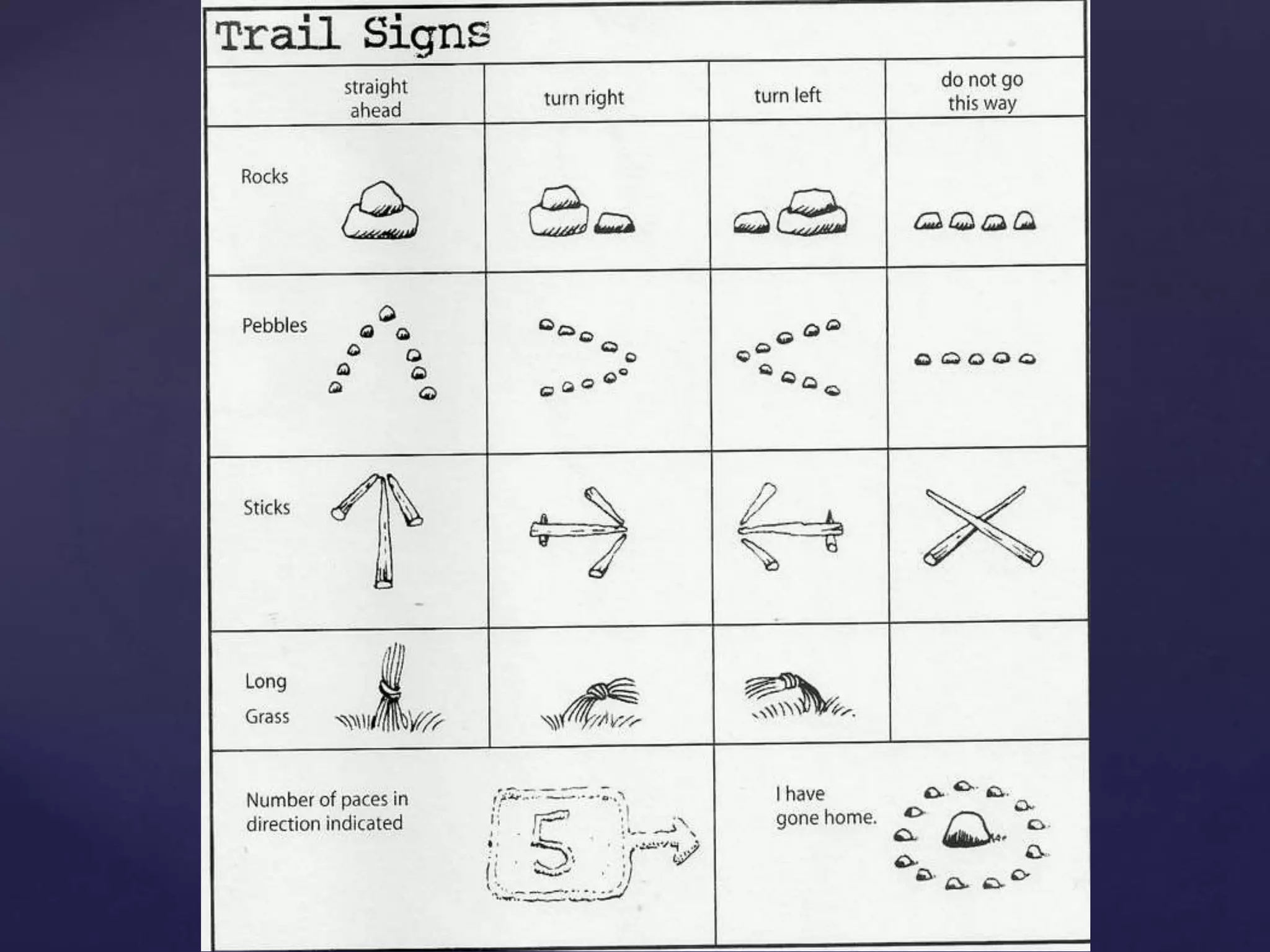
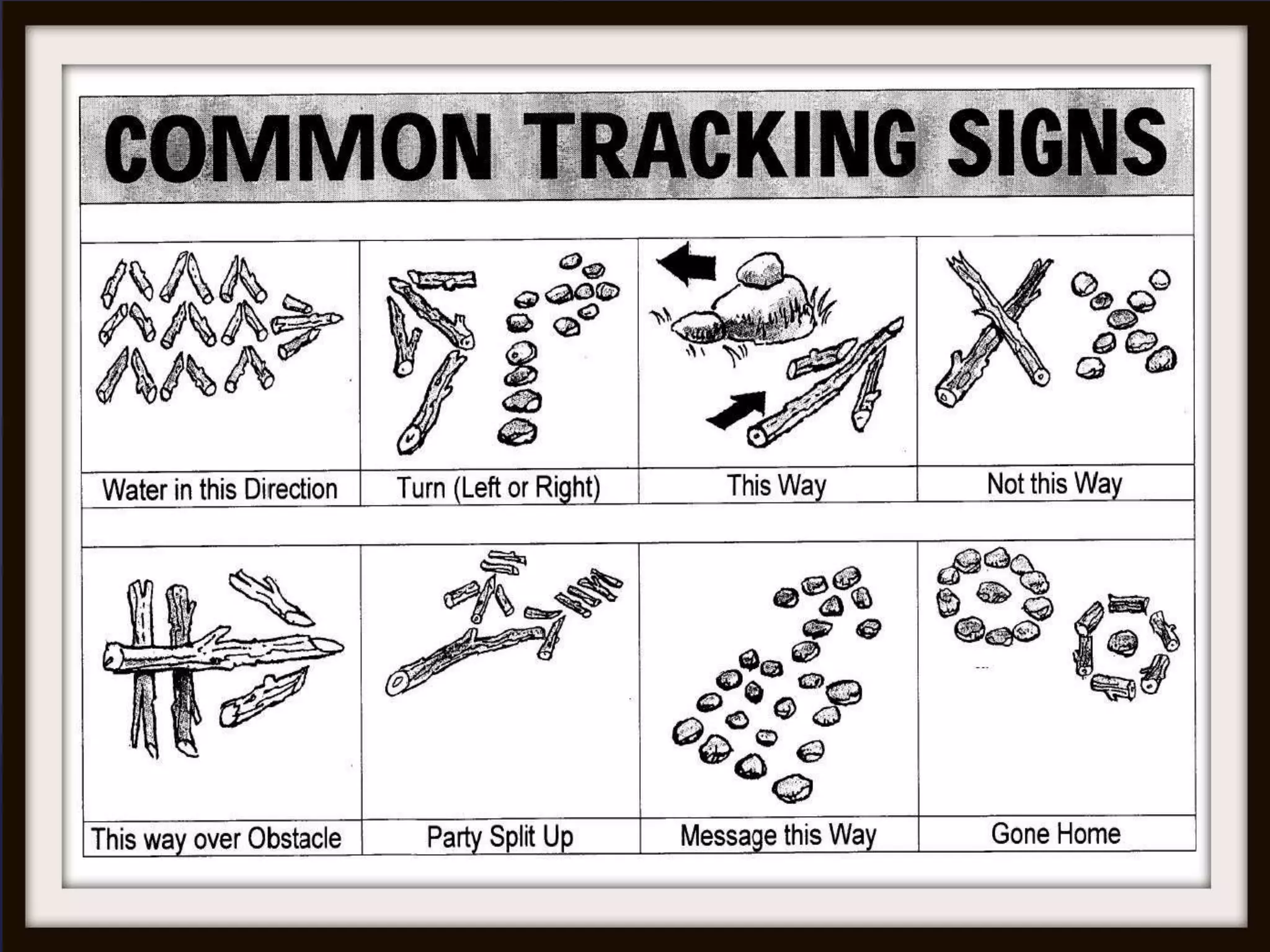
TRAIL SIGNS
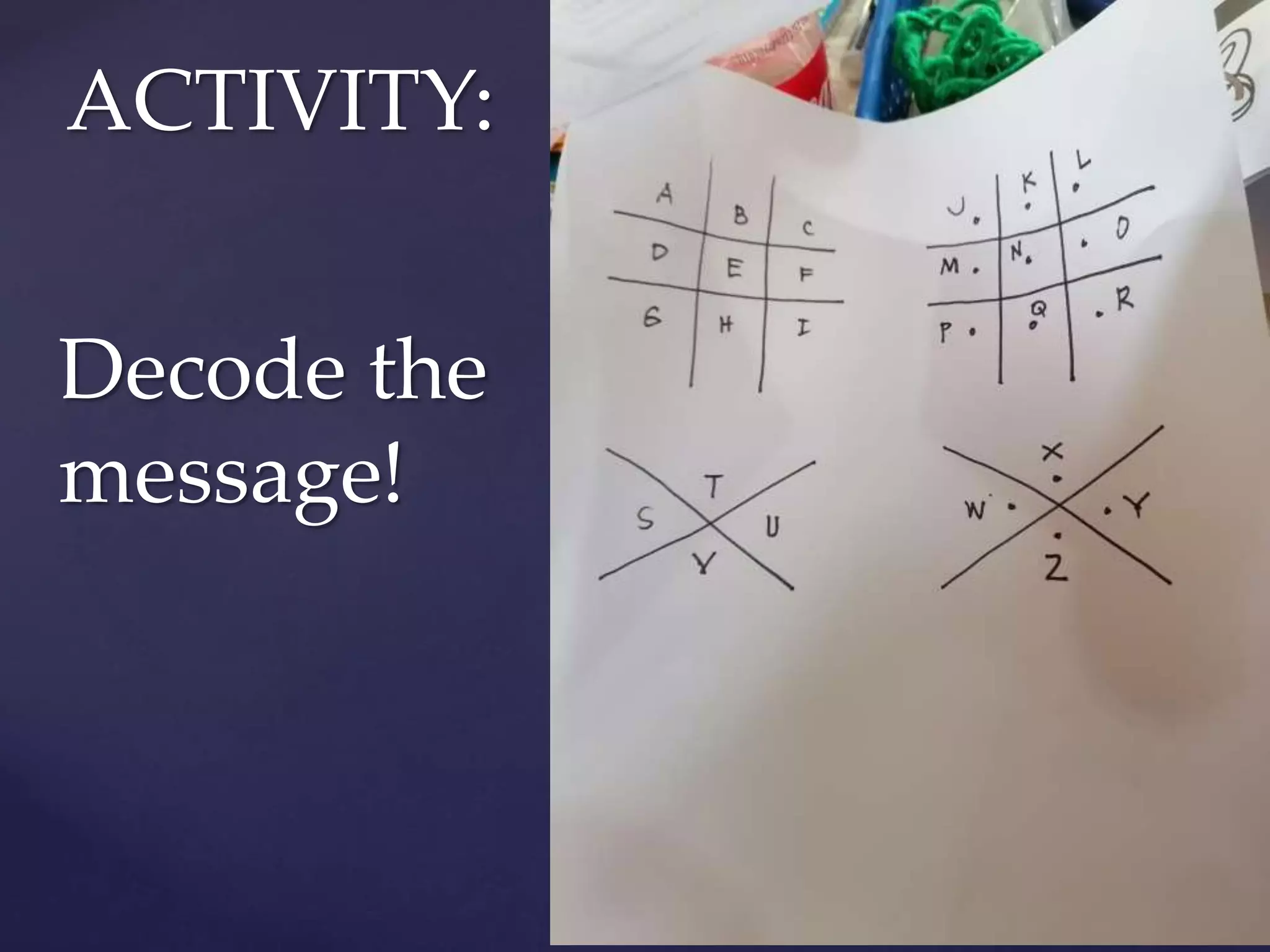
ACTIVITY:
Decode the
message!
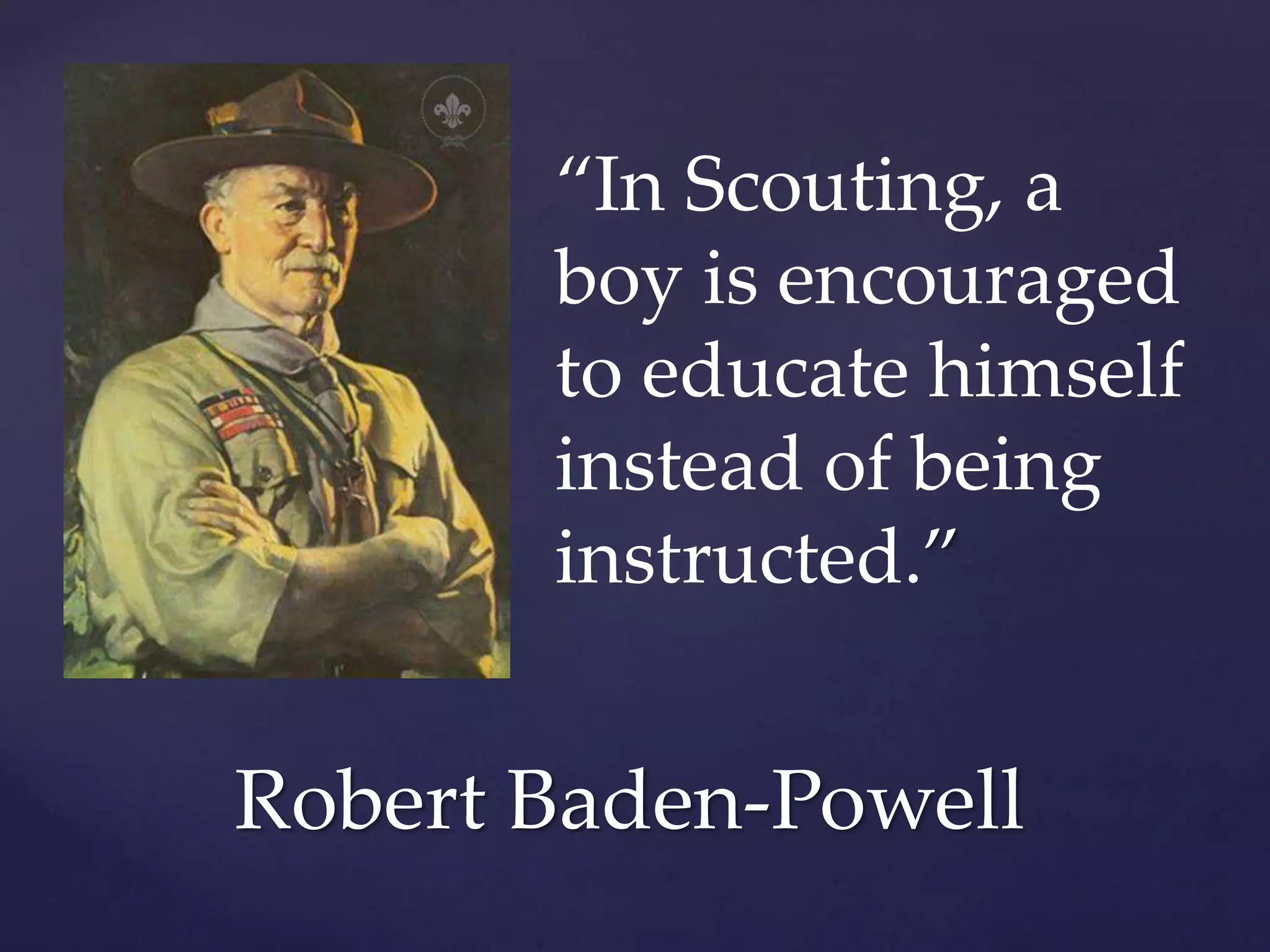
“In Scouting, a
boy is encouraged
to educate himself
instead of being
instructed.”
Robert Baden-Powell

BSP SIGNALLING, COMMANDS, MORSE CODE.pptx

  • 2.
  • 3.
  • 4.
     Signalling iswell worth knowing. It is good and fun to be able to signal your friend across the street without other people understanding what you are talking about. Before the development of telephones or radios, signal codes allowed many people to communicate over long distances. What is signalling?
  • 5.
     Telegraph operatorsused Morse Code to send messages around the world. Sailors used both Morse and Semaphore to pass messages between ships. It is still makes an exciting hobby for licensed amateur radio operators. While there are few practical applications for these signaling methods in today's world, they are useful to know in case of an emergency. What is signalling?
  • 6.
  • 7.
    What is receiving(messages)?  a person must interpret something said or done by another personthe senderand give it a name and develop a feeling about it. The receiver’s job is to then seek to understand whatever it is the sender wants to communicate. The receiver shares responsibility with the sender to ensure an effective communication process.
  • 8.
  • 9.
  • 10.
  • 12.
    Semaphore signalling is usedmainly for short distance communications.
  • 13.
  • 14.
    Signalling is useful onlywhen it can be read. The letters must be made perfectly and must be clearly seen.
  • 15.
    The sender must exactlyface the person they are signalling. They must stand firmly, with the feet apart.
  • 16.
    The flags must beat arms reach, arm and flag making a straight line.
  • 17.
    The arms must bein the exact position for each letter.
  • 18.
    When making T,O, and W the flags must not cover one another.
  • 19.
    Do not sendtoo quickly. Never send faster than the other person can read.
  • 21.
  • 22.
  • 23.
    Since Baden-Powell firstintroduced the concept in “Scouting for Boys”, Scout Troops have always used specific formations to bring order and discipline to Troop Meetings.
  • 24.
    Most commonly, aTroop “falls in” to the formation at the beginning and end of meetings and on any occasion where special announcements are made.
  • 25.
    However, many ScoutTroops have forgotten the full utility of formations. In the past, there were many different formation shapes, each with a different purpose for different situations. Scouts were drilled in these formations, and had a lot of fun trying to make each formation faster and neater than the one before.
  • 26.
    Rest Positions These areperformed from a halt at a position of attention. There are four rest positions: parade rest, at ease, rest, and fall out.
  • 27.
    Parade Rest Command: Parade,REST On the command REST, the left foot is raised from the hip (knee straight) to barely clear the ground and moved quickly to the left, so your heels are 12 inches apart on the inside of the heels. Your legs are straight and heels are in line. (keep knees slightly bent – do not lock your knees or you will pass out when standing at attention or parade rest for long periods of time) At the same time as the left foot moves, the arms are brought to the back of the body while fully extended.
  • 28.
    At Ease Command: ATEASE On the command AT EASE, you must keep your right foot in place and remain silent and in position in formation. You can otherwise relax in a standing position.
  • 29.
    Fall Out Command: FALLOUT On the command FALL OUT, you can either relax while standing or you can break ranks but remain in the immediate area. You can disperse however you wish. You are allowed to speak moderately.
  • 30.
    About Face  Command:About, FACE  On the command FACE, the right foot is lifted from the hip (knee straight) so it barely clears the ground.  The ball of the right foot is placed half a shoe length behind and slightly to the left of the left heel, with unbent knees.  You will want to distribute the weight of your body on your left heel and the ball of the right foot.  Your legs should be straight but not stiff and your foot position is unchanged. This completes count one of the movement.  For count two, you keep your upper body in the position of attention, suspending arm swing, while pivoting 180 degrees to the right using a twisting motion of the hips, balancing on the ball of the right foot and heel of the left foot.
  • 31.
    Attention  Your weightshould be distributed equally on the heels and balls of your feet. When you come to attention, bring your heels together smartly with your toes forming a 45 degree angle.  Keep your legs straight without locking your knees. Hold your body with your hips level, your chest lifted, and your shoulders square and even. Your arms should hang straight, but not stiff, with the backs of your hands outward. Curl your fingers so that the tips of our thumbs are alongside and touching the first joint of the forefingers. Your thumbs should be straight and along the seams of your trousers or skirt. The first joint of your forefingers should touch the trousers or skirt. Keep your head erect, and look straight to the front.
  • 32.
    The following are translationinto Tagalog / Filipino of English- language drill commands.
  • 33.
    A. Katayuan sapagtindig (Position of Attention) 1. Humanda (Attention) 2. Humanay (Fall in line) 3. Masinsing Pagitan, Humanay (At Close Interval. Fall in line) 4. Magtipon (Assemble) 5. Manumbalik (As you Were)
  • 34.
    B. Katayuan saPaghinga Nakahinto (Rest at Halt) 1. Tikas Pahinga (Parade Rest) 2. Tindig Paluwag (Stand at Ease) 3. Paluwag (at Ease) 4. Pahinga (Rest) 5. Tiwalag (Fall out) 6. Lumansag (Dismissed)
  • 35.
    C. Pagharap KungNakahinto (Facing at the Halt) 1. Harap sa Kanan, Rap (Right Face) 2. Harap sa Kaliwa, Rap (Left Face) 3. Harap sa Likdod, Rap (About Face) 4. Harap Hating-kaliwa, Rap (Left Half Face) 5. Harap Hating-Kanan, Rap (Right Half Face)
  • 36.
    D. Pagpugay (Salute) 1.Pugay Kamay, Na (Hand Salute) 2. Tingin sa Kanan, Na (Eyes Right)
  • 37.
    E. Hakbang atLakad (Steps and Marching) 1. Bilang Hakbang, Na (Count Cadence Count) 2. Isa, Dalawa, Tatlo, Apat (One, Two, Three, Four) 3. Pasulong, Kad (Forward March) 4. Tilap/Palutong, Hinto (Squad/Platoon Halt) 5. Patakda, Kad (Mark Time March) 6. Hating Hakbang, Kad (Half Step March) 7. Takbong-Hakbang, Kad (Double Time March) 8. Sigalng-Hakbang, Kad (Quick Time March) 9. Hakbang Pakanan, Kad (Right/Left Step March) 10. Paurong, Kad (Backward March)
  • 38.
    11. Pabalik, Kad(Roar March) 12. Paulit-Hakbang, Kad (Change Step March) 13. Layang Hakbang, Kad (Rout Step March) 14. Paluwag, Kad (at Ease March) 15. Liko sa Kanan/Kaliwa, Kad (Column Right/Left March) 16. Pagawing Kanan/Kaliwa, Kad (Incline to the Right/Left) 17. Kanang/Kaliwang Panig, Kad (Right Left Oblique March) 18. Sa Lunan, Hinto (In Place Halt) 19. Patuloy, Kad (Resume March)
  • 39.
    MALAPITANG PAGSASANAY (CLOSE ORDERDRILL)  A. Pagtitipon at Paghahanay (Assembly and Alignment of Troops) 1. Tunton-Kanan/Kaliwa, Na (Dress Right/Left Dress) 2. Masinsing Pagitan, Tunton Kanan, Na (At Close Interval, Dress Right Dress) 3. Handa, Rap (Ready Front) 4. Tunton, Na (Cover-Up) 5. Patnubay sa Kanan/Kaliwa/Gitna (Guide Right/Left/Center) 6. Manumbalik (As You Were)
  • 40.
  • 41.
    In the MorseCode, letters are formed by a series of dots and dashes by using a Morse Key attached to a buzzer. Because of its adaptability, Morse Code is more useful than Semaphore, but it requires much practice to become proficient.
  • 45.
    VE VE VECalling up signal K Carry On. (Answer to VE, if ready to receive message) Q Wait. (Answer to VE if not ready to receive message.) T General answer AAA Period or decimal AR End of message R Message received correctly 8 dots Erase. GB Good Bye. (used when closing down)
  • 46.
  • 51.
  • 54.
  • 55.
    “In Scouting, a boyis encouraged to educate himself instead of being instructed.” Robert Baden-Powell