1
THE HOME OF NAVAL RESERVISTS IN THE NORTH
BASIC SIGNAL
COMMUNICATION
NAVY 2020 STRONG AND CREDIBE
OBJECTIVE:
IDENTIFY THE FIVE (5) MEANS OF BASIC
SIGNAL COMMUNICATION
DEMONSTRATE THE STANDARD ARM AND
HANDS SIGNAL.
DEMONSTRATE SIGNALS FOR COMBAT
FORMATIONS AND BATTLE DRILLS.
EXPLAIN RADIO COMMUNICATION
PROCEDURES.
Signals are used to transmit commands
or information when radio and other means of
communication are not available or during
instances when silence must be maintained.
The use of signals is particularly useful
during conduct of patrols or during the thick of
firefight where verbal commands are difficult to
understand.
The use of signals are generally embodied
in a unit ‘s Standing Operating Procedures (SOP)
and all members are expected to know them by
heart.
INTRODUCTION:
NAVY 2020 STRONG AND CREDIBE
A. FIVE (5) MEANS OF COMMUNICATION
1. WHISTLE
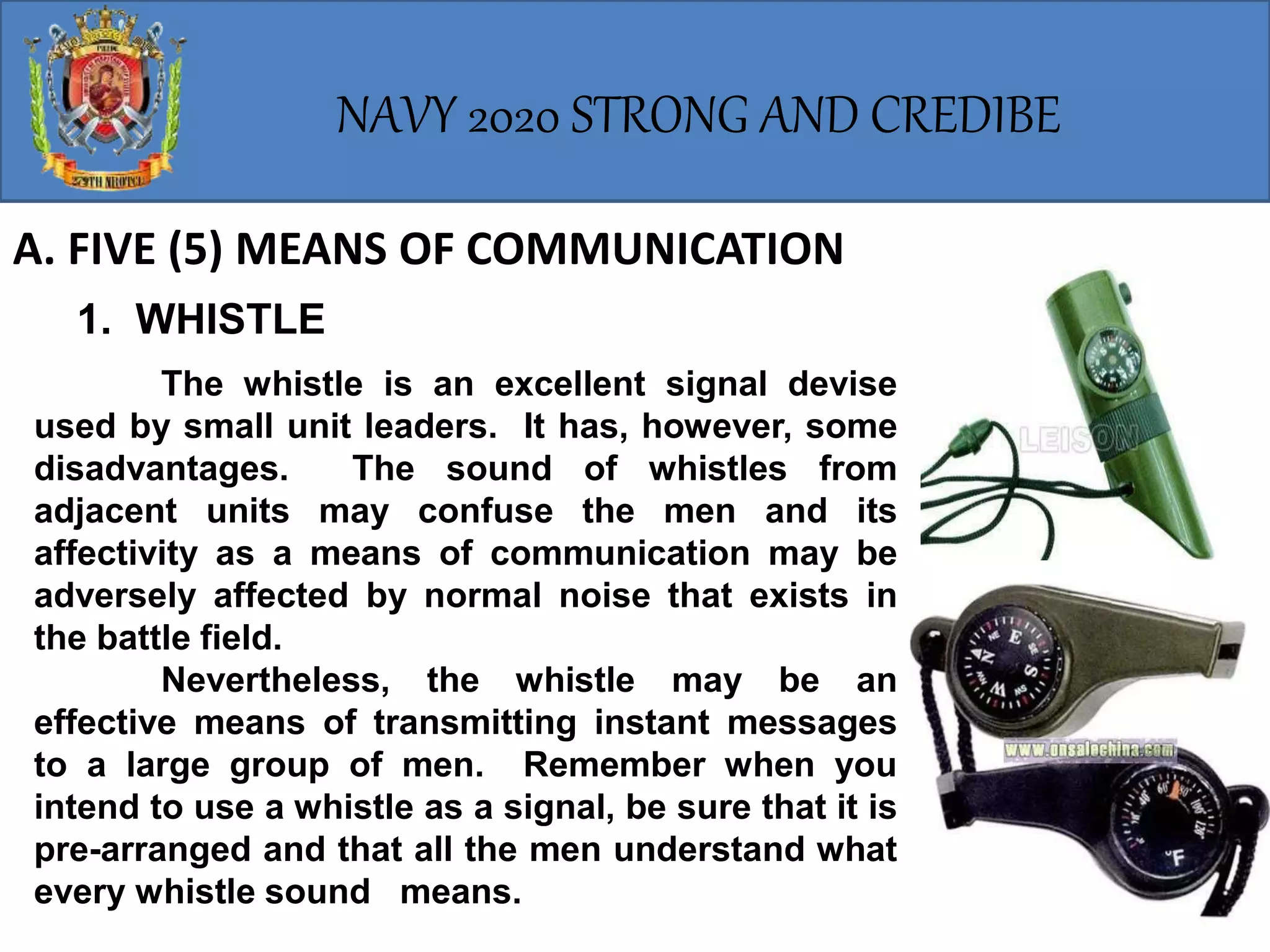
The whistle is an excellent signal devise
used by small unit leaders. It has, however, some
disadvantages. The sound of whistles from
adjacent units may confuse the men and its
affectivity as a means of communication may be
adversely affected by normal noise that exists in
the battle field.
Nevertheless, the whistle may be an
effective means of transmitting instant messages
to a large group of men. Remember when you
intend to use a whistle as a signal, be sure that it is
pre-arranged and that all the men understand what
every whistle sound means.
NAVY 2020 STRONG AND CREDIBE
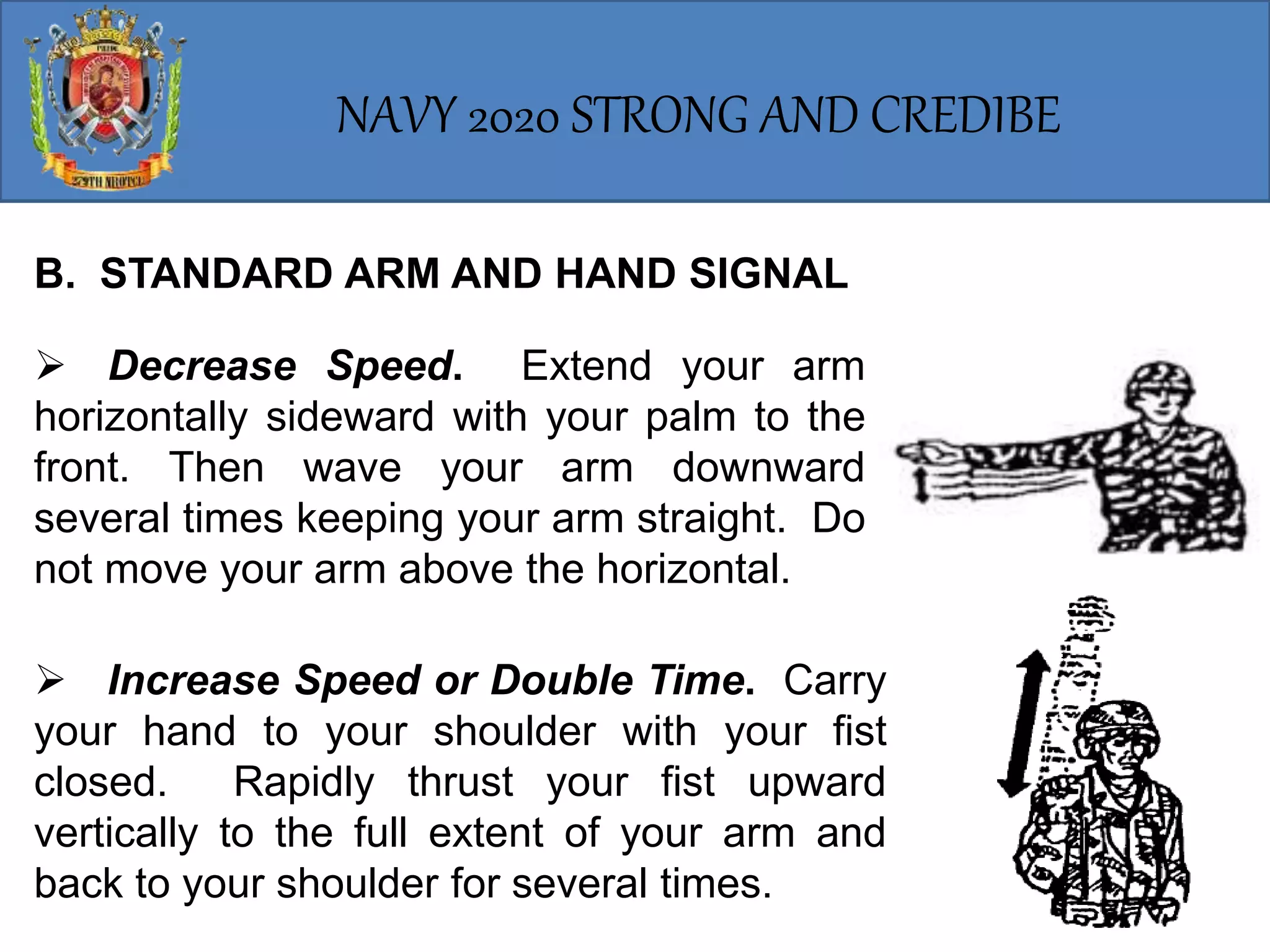
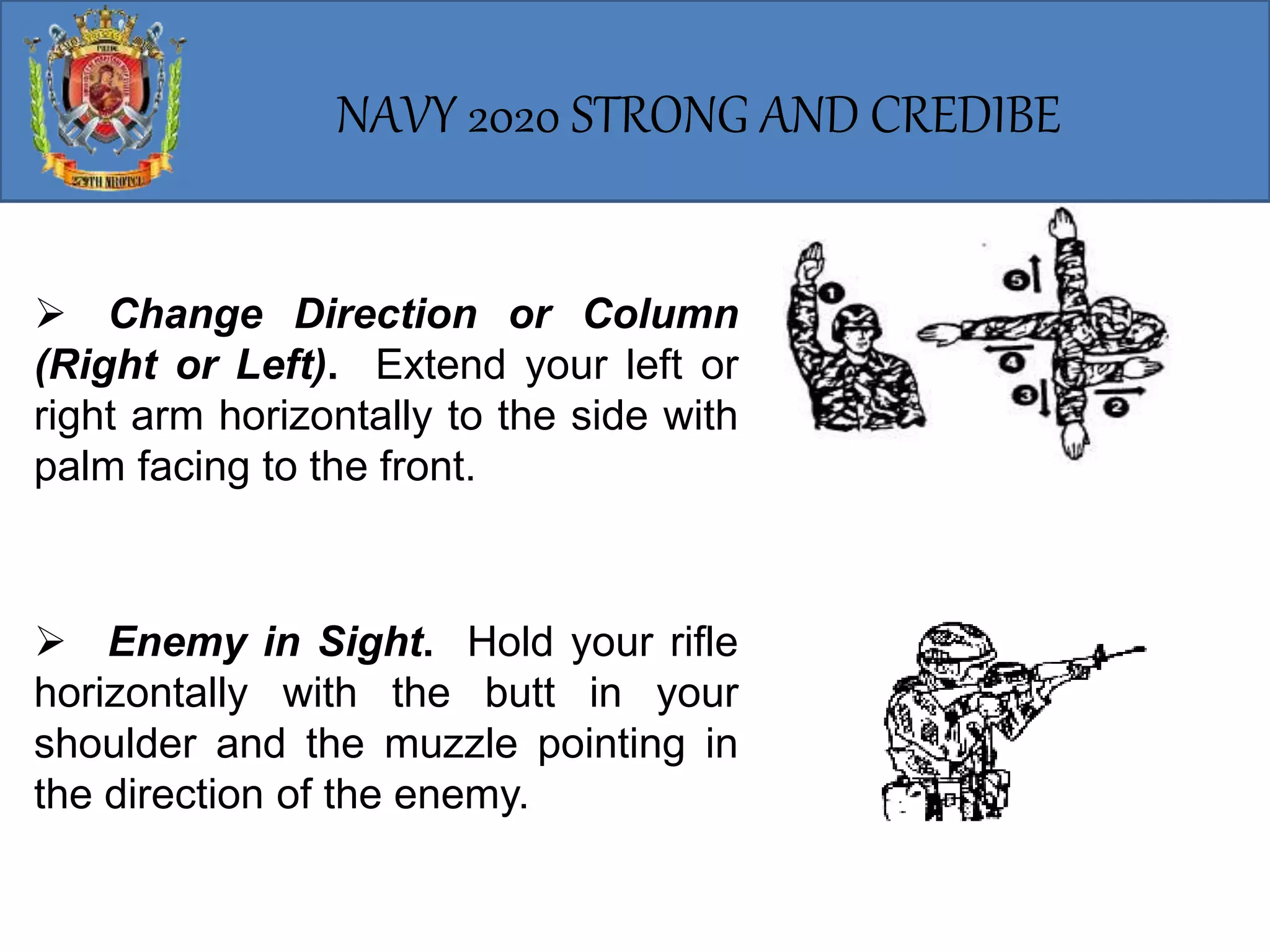
2. SEMAPHORE
Semaphore flag
signaling is rarely used
today except in the
Navy where such
method of
communication is still
being used as a back-up
communication means
between ships at sea.
NAVY 2020 STRONG AND CREDIBE
3. MORSE CODE
Morse Code is an
internationally known communication
code used as an alternate to voice-
radio communication. Message
transmission through the use of
Morse Code is much slower
than through voice-radio
communication, but it is as reliable.
Morse code messages may be
relayed through dots and dashes on
the telephone or through short and
long flashes on signal lights.
NAVY 2020 STRONG AND CREDIBE
4. SPECIAL SIGNAL
Special signals consist of all special
methods and devices used to transmit
commands or information. These may take the
form of taps on the helmet or rifle stock to
signal “halt”, “danger”, “move forward” or
“assemble here”. Necessity and common sense
usually dictate the appropriate special signal to
be used in communicating with the men.
Nevertheless, these signals must be clearly
understood and properly rehearsed by the unit
before they are used.
Various pyrotechnic and smoke signals
may also be effective to signal the time to
attack, to withdraw or to commence performing
a specific task, such as to cease or shift
supporting fires.
NAVY 2020 STRONG AND CREDIBE
5. ARM AND HAND SIGNAL
Arm and hand signal are often
made a part of a unit’s SOP and it may
vary from one unit to another. This
silent means of relaying commands to
the men are usually used during patrols
or infiltration missions when silence is
extremely important. Following are the
standard arm and hand signals.
However, you may device your own for
your unit, but be sure your men
understand their meanings before you
use them.
NAVY 2020 STRONG AND CREDIBE
B. STANDARD ARM AND HAND SIGNAL
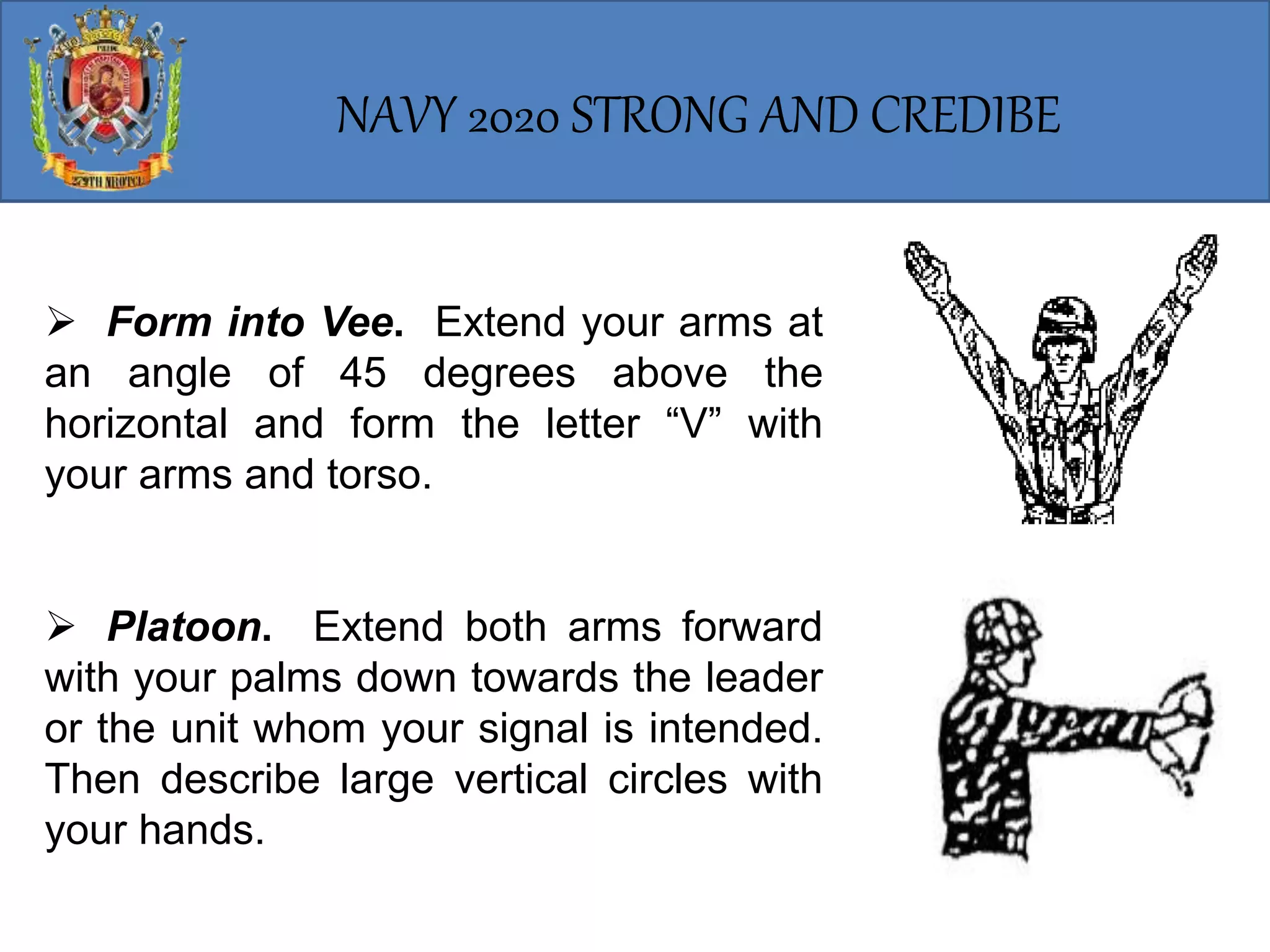
 Decrease Speed. Extend your arm
horizontally sideward with your palm to the
front. Then wave your arm downward
several times keeping your arm straight. Do
not move your arm above the horizontal.
 Increase Speed or Double Time. Carry
your hand to your shoulder with your fist
closed. Rapidly thrust your fist upward
vertically to the full extent of your arm and
back to your shoulder for several times.
NAVY 2020 STRONG AND CREDIBE
 Change Direction or Column
(Right or Left). Extend your left or
right arm horizontally to the side with
palm facing to the front.
 Enemy in Sight. Hold your rifle
horizontally with the butt in your
shoulder and the muzzle pointing in
the direction of the enemy.
NAVY 2020 STRONG AND CREDIBE
Commence fire. Extend the
arm in front of the body, hip
high, palm down
 Commence Firing. Extend your
arm in front of your body, hip high with
your palm down. Move it through a
wide horizontal arc several times.
 Fire Faster. Execute rapidly the
signal “Commence Firing”. For the
machine gunner, this signal means
change to a higher rate of fire.
 Fire Slower. Execute slowly
the signal “Commence Firing”. For
the machine gunner, this signal
means to slow-down rate of fire.
Fire Faster - execute
the Commences
Fire signal rapidly.
To slow the rate of
fire, move the arm
slower.
NAVY 2020 STRONG AND CREDIBE
 Cease Firing. Raise your hand in front
of the forehead with your palm facing to the
front. Then swing your hand and forearm
up and down several times in front of your
face.
 Assemble. Raise your hand vertically
to the full extent of your arm with your
fingers extended and joined with palm
facing to the front. Then wave in large
horizontal circles with your arm and hand.
NAVY 2020 STRONG AND CREDIBE
 Form into Column. Raise either of
your arm to the vertical position. Drop
your arm to the rear, describing
complete circles in a vertical plane,
parallel to your body. This signal may
be used to form troop or vehicular
columns.
NAVY 2020 STRONG AND CREDIBE
 Form into Echelon (Right or Left).
Face the unit being signaled and extend
one arm 45 degrees above and your
other arm 45 degrees below the
horizontal with your palm facing to the
front. Your lower arm shall indicate the
direction of the echelon. Supplementary
commands may be given to ensure
prompt and proper execution.
NAVY 2020 STRONG AND CREDIBE
 Form into Skirmishers (Fire Team).
Raise your both arms laterally until they are
horizontal. Keep your arms and hands
extended with the palms down. If it is
necessary to indicate a direction, move in the
desired direction at the same time you execute
the signal. This signal is also used to
command a squad to form into a line formation.
 Form into Wedge. Extend your both arms
downward and to your side at an angle of 45
degrees below the horizontal with your palms
facing to the front.
NAVY 2020 STRONG AND CREDIBE
 Form into Vee. Extend your arms at
an angle of 45 degrees above the
horizontal and form the letter “V” with
your arms and torso.
 Platoon. Extend both arms forward
with your palms down towards the leader
or the unit whom your signal is intended.
Then describe large vertical circles with
your hands.
NAVY 2020 STRONG AND CREDIBE
 Squad. Extend your hand and arm
with your palm down, towards the squad
leader of the squad you are addressing.
Then distinctly move your hand up and
down several times from the wrist,
keeping your arm steady
 Fire Team. Bring your right
arm diagonally across your
chest.
NAVY 2020 STRONG AND CREDIBE
 Close Up. Start your signal with your
both arms extended sideward and palms
forward. Then bring your palms together in
front of your body momentarily. When
repetition of this signal is necessary, bring
your arms back to the starting position by
a movement along the front of your body.
NAVY 2020 STRONG AND CREDIBE
 Open Up or Extend. Start your signal
with your arms extended in front of your
body and palms together. Then bring
arms to the horizontal position of your
sides with palms facing forward. When
repetition of this signal is necessary, return
your arms along the front of your body as
in the starting position. You may repeat
the signal until you are understood.
NAVY 2020 STRONG AND CREDIBE
 Disperse. Extend your either arm vertically overhead.
Wave the hand and arm to the front, left, right and rear with
your palm facing towards the direction of each movement.
NAVY 2020 STRONG AND CREDIBE
 Forward, Advance to the Right
(Left). This signal is always used
when starting from a halt. Face and
move in the desired direction of the
march and at the same time extend
your arm horizontally to the rear. Then
swing it overhead and forward in the
direction of the movement until it is
horizontal with your palms down.
NAVY 2020 STRONG AND CREDIBE
 Halt. Carry your hand to
your shoulder with your palm
facing to the front. Then thrust
the hand upward vertically to the
full extent of your arm and hold it
in that position until the signal is
understood.
 Freeze. Make the signal for
“halt” and clinch your hand into a
fist.
NAVY 2020 STRONG AND CREDIBE
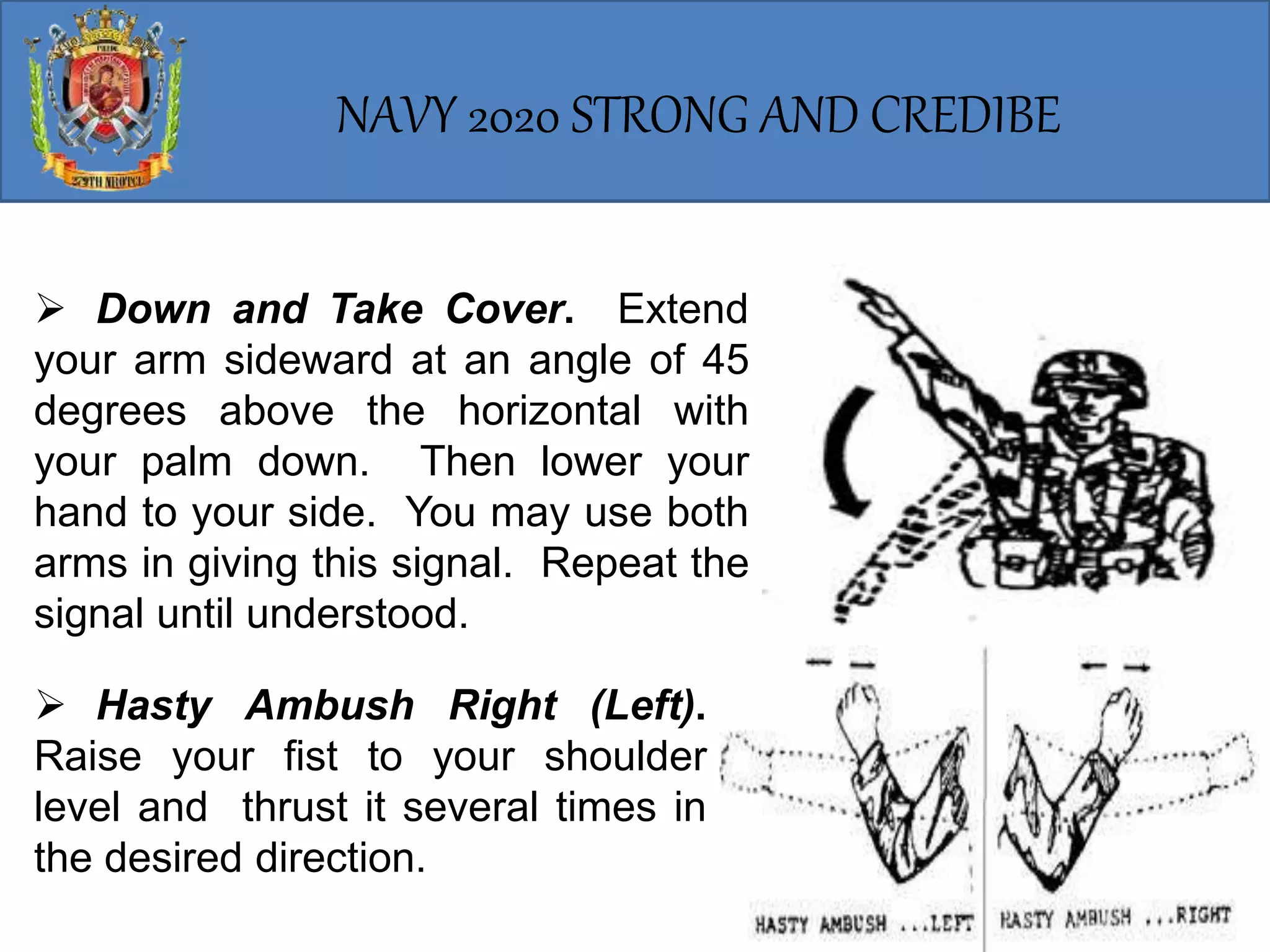
 Down and Take Cover. Extend
your arm sideward at an angle of 45
degrees above the horizontal with
your palm down. Then lower your
hand to your side. You may use both
arms in giving this signal. Repeat the
signal until understood.
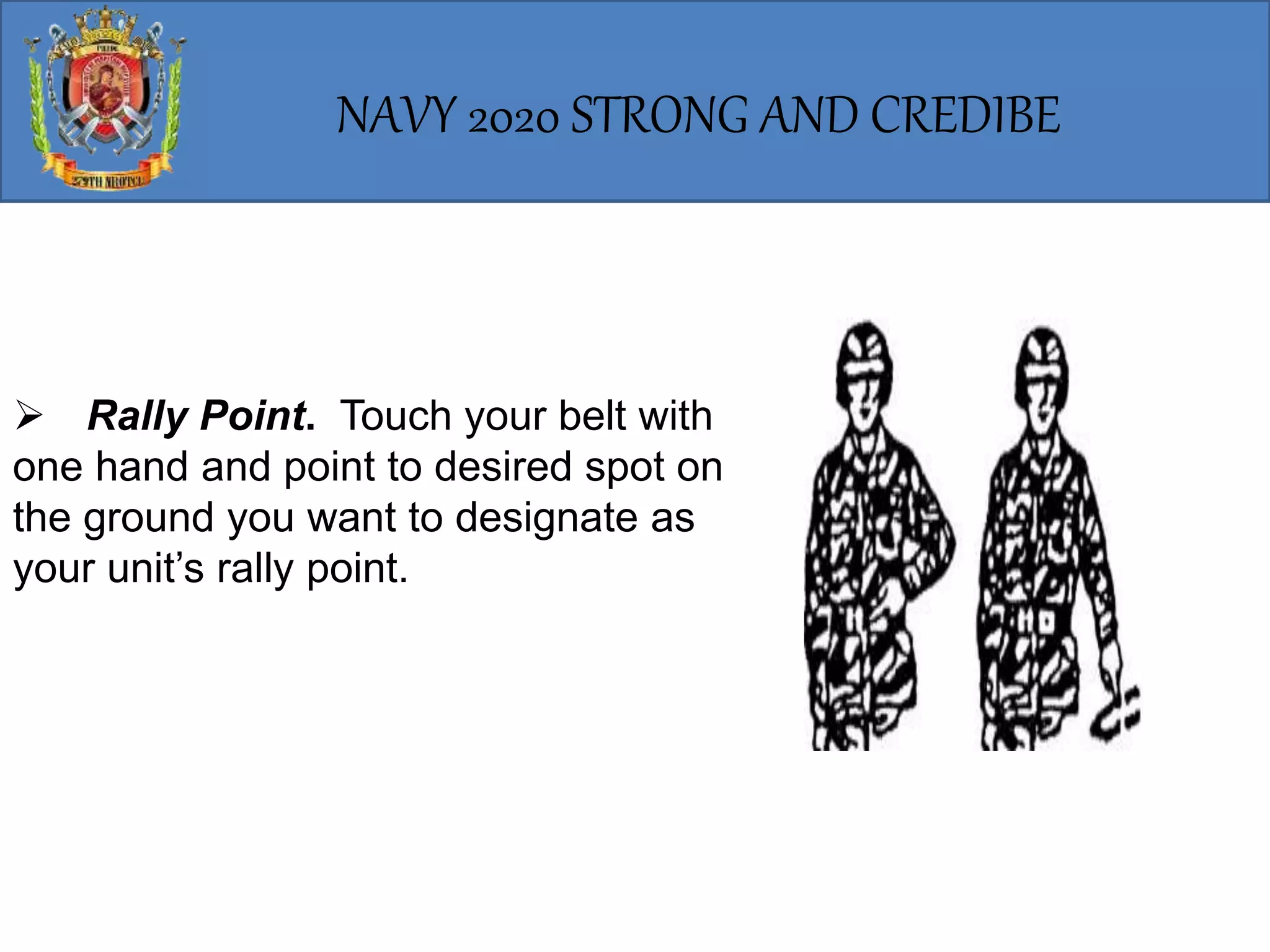
 Hasty Ambush Right (Left).
Raise your fist to your shoulder
level and thrust it several times in
the desired direction.
NAVY 2020 STRONG AND CREDIBE
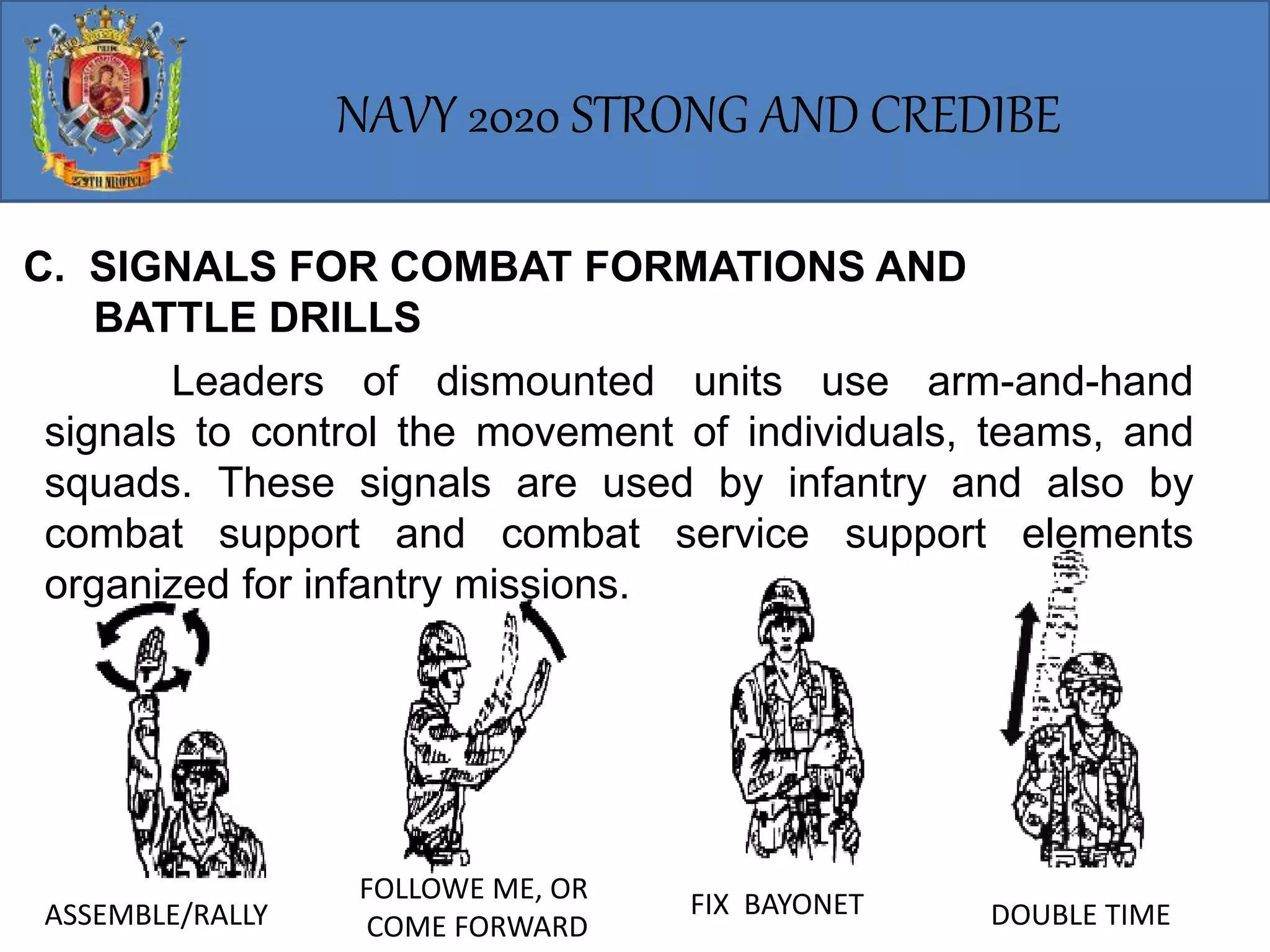
 Rally Point. Touch your belt with
one hand and point to desired spot on
the ground you want to designate as
your unit’s rally point.
NAVY 2020 STRONG AND CREDIBE
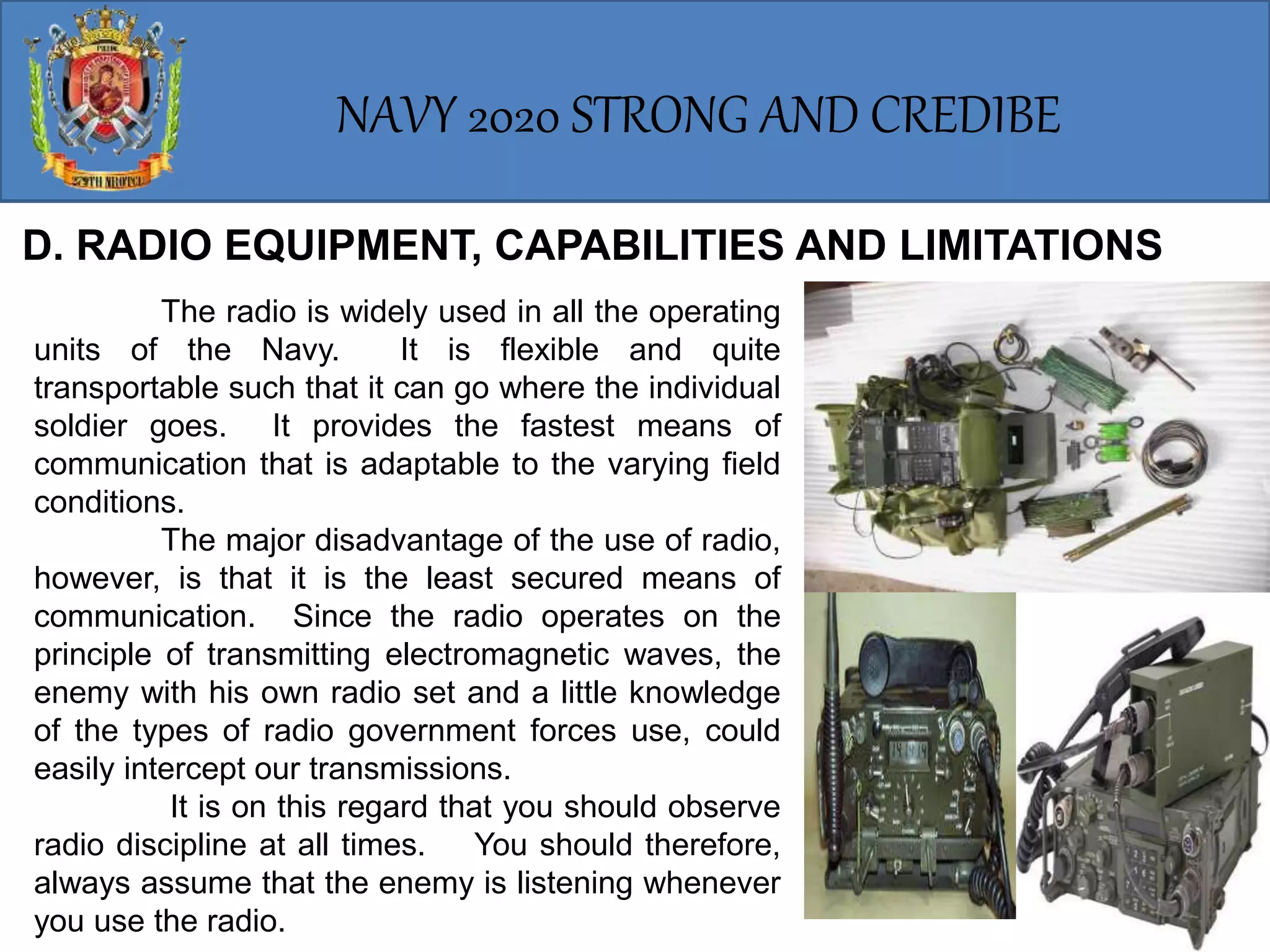
C. SIGNALS FOR COMBAT FORMATIONS AND
BATTLE DRILLS
ASSEMBLE/RALLY
FOLLOWE ME, OR
COME FORWARD
FIX BAYONET
Leaders of dismounted units use arm-and-hand
signals to control the movement of individuals, teams, and
squads. These signals are used by infantry and also by
combat support and combat service support elements
organized for infantry missions.
DOUBLE TIME
NAVY 2020 STRONG AND CREDIBE
Cont’d
DISPERSE ENEMY IN SIGHT TAKE COVER
WEDGE VEE LINE ECHELON LEFT ECHELON RIGHT
NAVY 2020 STRONG AND CREDIBE
PATROLLING ARM-AND-HAND SIGNALS
Patrolling is conducted by many type units. Infantry units
patrol in order to conduct combat operations. Other units patrol for
reconnaissance and security. Successful patrols require clearly
understood communication signals among members of a patrol
MAP CHECK FREEZE OR HALT HEAD COUNT DANGER AREA
NAVY 2020 STRONG AND CREDIBE
D. RADIO EQUIPMENT, CAPABILITIES AND LIMITATIONS
NAVY 2020 STRONG AND CREDIBE
The radio is widely used in all the operating
units of the Navy. It is flexible and quite
transportable such that it can go where the individual
soldier goes. It provides the fastest means of
communication that is adaptable to the varying field
conditions.
The major disadvantage of the use of radio,
however, is that it is the least secured means of
communication. Since the radio operates on the
principle of transmitting electromagnetic waves, the
enemy with his own radio set and a little knowledge
of the types of radio government forces use, could
easily intercept our transmissions.
It is on this regard that you should observe
radio discipline at all times. You should therefore,
always assume that the enemy is listening whenever
you use the radio.
1. Guidelines For Radio Transmission:
NAVY 2020 STRONG AND CREDIBE
 Always plan or write down your message before
transmitting.
 Always listen before starting to talk so as not to
interrupt other conversations. When about to talk,
press down the button on the side of the hand set and
do not talk until the hissing sound ceases.
 Speak distinctly and enunciate each word in normal
tone. If the receiving operator must write down your
transmission, allow him time for copying.
 Follow the standard voice-radio procedures when
transmitting.
 Release the push-to-talk button immediately after the
completion of your transmission.
 Camouflage your radio set when carrying it on you
back. Bend the whip antennae slightly downward and
to the rear to make it inconspicuous to the enemy.
Several radio men became casualties because they
failed to take this measure.
2. Radio Telephone Procedures
Radio Telephone procedures refer to
the system of transmission through the use of
voice and formalized language to simplify
radio communications.
Included in this system are a call
signs authorized to be used by radio stations
and short procedure words (prowords) and
phrases that a radio operator uses to
establish communication with another station.
The rationale behind the use of
prowords is to prevent misunderstanding
between radio operators and repetition of
transmissions.
NAVY 2020 STRONG AND CREDIBE
Cont’d
To preclude the possibility of
committing errors in the transmission of
messages thereby giving rise to confusion
between radio operators, the phonetic
alphabet, which is of universal applications is
used.
Since words have similar sounds,
confusion may develop and this can be
eliminated by the use of the phonetic
alphabet.
NAVY 2020 STRONG AND CREDIBE
Cont’d
This brings us to the purposes
behind the use of phonetic alphabet which
are as follows:
a. To prevent the radio operator from
getting confused when confronted with
words having similar sounds.
b. To spell out words that are difficult
to pronounce.
Call signs are used to identify each station within a radio
net. This is one security aspect of radio communication that
prevents the entry of an unauthorized entity into the net. The
improper use of call signs may signify that a violation is already
committed
NAVY 2020 STRONG AND CREDIBE
Cont’d
Procedure words or phrases that
have been assigned meanings are used
as substitutes for long sentences for the
purpose of expediting message
handling.
This is one way of keeping voice
transmission as short and clear as
possible.
For instance, the prowords “out”
means “This is the end of my
transmission to you and no answer is
required or expected”.
NAVY 2020 STRONG AND CREDIBE
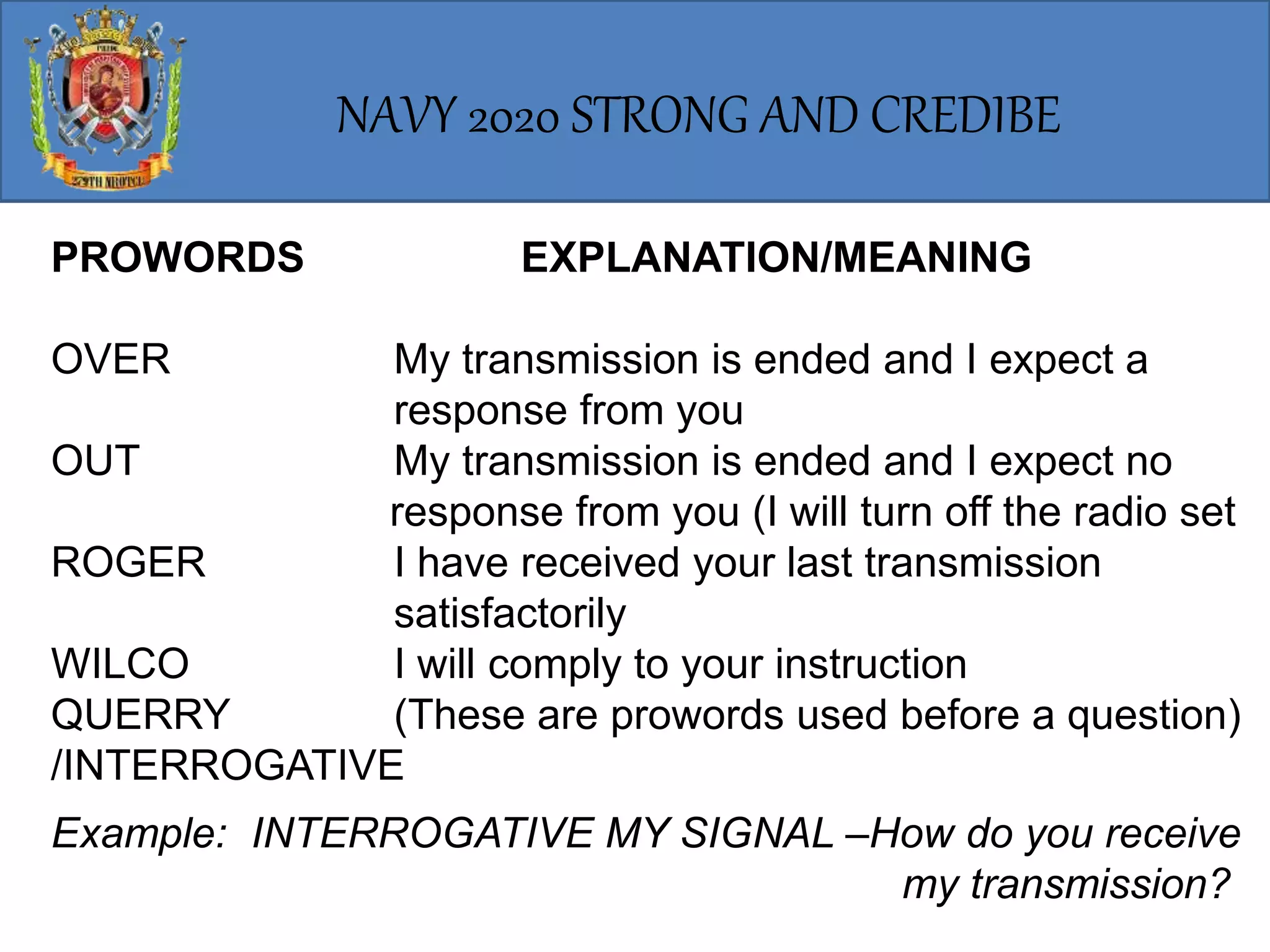
PROWORDS EXPLANATION/MEANING
OVER My transmission is ended and I expect a
response from you
OUT My transmission is ended and I expect no
response from you (I will turn off the radio set
ROGER I have received your last transmission
satisfactorily
WILCO I will comply to your instruction
QUERRY (These are prowords used before a question)
/INTERROGATIVE
Example: INTERROGATIVE MY SIGNAL –How do you receive
my transmission?
NAVY 2020 STRONG AND CREDIBE
Cont’d
LIMA CHARLIE I received your message loud
(LIMA)and clear (CHARLIE)
SAY AGAIN I did not understand your transmission.
Request repeat your transmission
I SAY AGAIN I am repeating the transmission or
portion thereof as indicated
REPEAT ALL AFTER Request repeat all your transmission
after the word.
WAIT ONE Request that you wait for about one
minute.
BREAK . . BREAK Emergency, stop your conversation
and allow me to use this net for a very
urgent transmission
NAVY 2020 STRONG AND CREDIBE
THE PHONETIC ALPHABET
A Alpha N November
B Bravo O Oscar
C Charlie P Papa
D Delta Q Quebec
E Echo R Romeo
F Foxtrot S Sierra
G Golf T Tango
H Hotel U Uniform
I India V Victor
J Juliet W Whiskey
K Kilo X X-ray
L Lima Y Yankee
M Mike Z Zulu
NAVY 2020 STRONG AND CREDIBE
NUMERAL PRONUNCIATION
0 Zero
1 Wun
2 Too
3 Thu-ree
4 Fower
5 Fi-yiv
6 Sixc
7 Seven
8 Ate
9 Niner
10 Wun-Zero
NAVY 2020 STRONG AND CREDIBE
END of topic

BASIC SIGNAL COMMUNICATION.pptx

  • 1.
    1 THE HOME OFNAVAL RESERVISTS IN THE NORTH BASIC SIGNAL COMMUNICATION
  • 2.
    NAVY 2020 STRONGAND CREDIBE OBJECTIVE: IDENTIFY THE FIVE (5) MEANS OF BASIC SIGNAL COMMUNICATION DEMONSTRATE THE STANDARD ARM AND HANDS SIGNAL. DEMONSTRATE SIGNALS FOR COMBAT FORMATIONS AND BATTLE DRILLS. EXPLAIN RADIO COMMUNICATION PROCEDURES.
  • 3.
    Signals are usedto transmit commands or information when radio and other means of communication are not available or during instances when silence must be maintained. The use of signals is particularly useful during conduct of patrols or during the thick of firefight where verbal commands are difficult to understand. The use of signals are generally embodied in a unit ‘s Standing Operating Procedures (SOP) and all members are expected to know them by heart. INTRODUCTION: NAVY 2020 STRONG AND CREDIBE
  • 4.
    A. FIVE (5)MEANS OF COMMUNICATION 1. WHISTLE The whistle is an excellent signal devise used by small unit leaders. It has, however, some disadvantages. The sound of whistles from adjacent units may confuse the men and its affectivity as a means of communication may be adversely affected by normal noise that exists in the battle field. Nevertheless, the whistle may be an effective means of transmitting instant messages to a large group of men. Remember when you intend to use a whistle as a signal, be sure that it is pre-arranged and that all the men understand what every whistle sound means. NAVY 2020 STRONG AND CREDIBE
  • 5.
    2. SEMAPHORE Semaphore flag signalingis rarely used today except in the Navy where such method of communication is still being used as a back-up communication means between ships at sea. NAVY 2020 STRONG AND CREDIBE
  • 6.
    3. MORSE CODE MorseCode is an internationally known communication code used as an alternate to voice- radio communication. Message transmission through the use of Morse Code is much slower than through voice-radio communication, but it is as reliable. Morse code messages may be relayed through dots and dashes on the telephone or through short and long flashes on signal lights. NAVY 2020 STRONG AND CREDIBE
  • 7.
    4. SPECIAL SIGNAL Specialsignals consist of all special methods and devices used to transmit commands or information. These may take the form of taps on the helmet or rifle stock to signal “halt”, “danger”, “move forward” or “assemble here”. Necessity and common sense usually dictate the appropriate special signal to be used in communicating with the men. Nevertheless, these signals must be clearly understood and properly rehearsed by the unit before they are used. Various pyrotechnic and smoke signals may also be effective to signal the time to attack, to withdraw or to commence performing a specific task, such as to cease or shift supporting fires. NAVY 2020 STRONG AND CREDIBE
  • 8.
    5. ARM ANDHAND SIGNAL Arm and hand signal are often made a part of a unit’s SOP and it may vary from one unit to another. This silent means of relaying commands to the men are usually used during patrols or infiltration missions when silence is extremely important. Following are the standard arm and hand signals. However, you may device your own for your unit, but be sure your men understand their meanings before you use them. NAVY 2020 STRONG AND CREDIBE
  • 9.
    B. STANDARD ARMAND HAND SIGNAL  Decrease Speed. Extend your arm horizontally sideward with your palm to the front. Then wave your arm downward several times keeping your arm straight. Do not move your arm above the horizontal.  Increase Speed or Double Time. Carry your hand to your shoulder with your fist closed. Rapidly thrust your fist upward vertically to the full extent of your arm and back to your shoulder for several times. NAVY 2020 STRONG AND CREDIBE
  • 10.
     Change Directionor Column (Right or Left). Extend your left or right arm horizontally to the side with palm facing to the front.  Enemy in Sight. Hold your rifle horizontally with the butt in your shoulder and the muzzle pointing in the direction of the enemy. NAVY 2020 STRONG AND CREDIBE
  • 11.
    Commence fire. Extendthe arm in front of the body, hip high, palm down  Commence Firing. Extend your arm in front of your body, hip high with your palm down. Move it through a wide horizontal arc several times.  Fire Faster. Execute rapidly the signal “Commence Firing”. For the machine gunner, this signal means change to a higher rate of fire.  Fire Slower. Execute slowly the signal “Commence Firing”. For the machine gunner, this signal means to slow-down rate of fire. Fire Faster - execute the Commences Fire signal rapidly. To slow the rate of fire, move the arm slower. NAVY 2020 STRONG AND CREDIBE
  • 12.
     Cease Firing.Raise your hand in front of the forehead with your palm facing to the front. Then swing your hand and forearm up and down several times in front of your face.  Assemble. Raise your hand vertically to the full extent of your arm with your fingers extended and joined with palm facing to the front. Then wave in large horizontal circles with your arm and hand. NAVY 2020 STRONG AND CREDIBE
  • 13.
     Form intoColumn. Raise either of your arm to the vertical position. Drop your arm to the rear, describing complete circles in a vertical plane, parallel to your body. This signal may be used to form troop or vehicular columns. NAVY 2020 STRONG AND CREDIBE
  • 14.
     Form intoEchelon (Right or Left). Face the unit being signaled and extend one arm 45 degrees above and your other arm 45 degrees below the horizontal with your palm facing to the front. Your lower arm shall indicate the direction of the echelon. Supplementary commands may be given to ensure prompt and proper execution. NAVY 2020 STRONG AND CREDIBE
  • 15.
     Form intoSkirmishers (Fire Team). Raise your both arms laterally until they are horizontal. Keep your arms and hands extended with the palms down. If it is necessary to indicate a direction, move in the desired direction at the same time you execute the signal. This signal is also used to command a squad to form into a line formation.  Form into Wedge. Extend your both arms downward and to your side at an angle of 45 degrees below the horizontal with your palms facing to the front. NAVY 2020 STRONG AND CREDIBE
  • 16.
     Form intoVee. Extend your arms at an angle of 45 degrees above the horizontal and form the letter “V” with your arms and torso.  Platoon. Extend both arms forward with your palms down towards the leader or the unit whom your signal is intended. Then describe large vertical circles with your hands. NAVY 2020 STRONG AND CREDIBE
  • 17.
     Squad. Extendyour hand and arm with your palm down, towards the squad leader of the squad you are addressing. Then distinctly move your hand up and down several times from the wrist, keeping your arm steady  Fire Team. Bring your right arm diagonally across your chest. NAVY 2020 STRONG AND CREDIBE
  • 18.
     Close Up.Start your signal with your both arms extended sideward and palms forward. Then bring your palms together in front of your body momentarily. When repetition of this signal is necessary, bring your arms back to the starting position by a movement along the front of your body. NAVY 2020 STRONG AND CREDIBE
  • 19.
     Open Upor Extend. Start your signal with your arms extended in front of your body and palms together. Then bring arms to the horizontal position of your sides with palms facing forward. When repetition of this signal is necessary, return your arms along the front of your body as in the starting position. You may repeat the signal until you are understood. NAVY 2020 STRONG AND CREDIBE
  • 20.
     Disperse. Extendyour either arm vertically overhead. Wave the hand and arm to the front, left, right and rear with your palm facing towards the direction of each movement. NAVY 2020 STRONG AND CREDIBE
  • 21.
     Forward, Advanceto the Right (Left). This signal is always used when starting from a halt. Face and move in the desired direction of the march and at the same time extend your arm horizontally to the rear. Then swing it overhead and forward in the direction of the movement until it is horizontal with your palms down. NAVY 2020 STRONG AND CREDIBE
  • 22.
     Halt. Carryyour hand to your shoulder with your palm facing to the front. Then thrust the hand upward vertically to the full extent of your arm and hold it in that position until the signal is understood.  Freeze. Make the signal for “halt” and clinch your hand into a fist. NAVY 2020 STRONG AND CREDIBE
  • 23.
     Down andTake Cover. Extend your arm sideward at an angle of 45 degrees above the horizontal with your palm down. Then lower your hand to your side. You may use both arms in giving this signal. Repeat the signal until understood.  Hasty Ambush Right (Left). Raise your fist to your shoulder level and thrust it several times in the desired direction. NAVY 2020 STRONG AND CREDIBE
  • 24.
     Rally Point.Touch your belt with one hand and point to desired spot on the ground you want to designate as your unit’s rally point. NAVY 2020 STRONG AND CREDIBE
  • 25.
    C. SIGNALS FORCOMBAT FORMATIONS AND BATTLE DRILLS ASSEMBLE/RALLY FOLLOWE ME, OR COME FORWARD FIX BAYONET Leaders of dismounted units use arm-and-hand signals to control the movement of individuals, teams, and squads. These signals are used by infantry and also by combat support and combat service support elements organized for infantry missions. DOUBLE TIME NAVY 2020 STRONG AND CREDIBE
  • 26.
    Cont’d DISPERSE ENEMY INSIGHT TAKE COVER WEDGE VEE LINE ECHELON LEFT ECHELON RIGHT NAVY 2020 STRONG AND CREDIBE
  • 27.
    PATROLLING ARM-AND-HAND SIGNALS Patrollingis conducted by many type units. Infantry units patrol in order to conduct combat operations. Other units patrol for reconnaissance and security. Successful patrols require clearly understood communication signals among members of a patrol MAP CHECK FREEZE OR HALT HEAD COUNT DANGER AREA NAVY 2020 STRONG AND CREDIBE
  • 28.
    D. RADIO EQUIPMENT,CAPABILITIES AND LIMITATIONS NAVY 2020 STRONG AND CREDIBE The radio is widely used in all the operating units of the Navy. It is flexible and quite transportable such that it can go where the individual soldier goes. It provides the fastest means of communication that is adaptable to the varying field conditions. The major disadvantage of the use of radio, however, is that it is the least secured means of communication. Since the radio operates on the principle of transmitting electromagnetic waves, the enemy with his own radio set and a little knowledge of the types of radio government forces use, could easily intercept our transmissions. It is on this regard that you should observe radio discipline at all times. You should therefore, always assume that the enemy is listening whenever you use the radio.
  • 29.
    1. Guidelines ForRadio Transmission: NAVY 2020 STRONG AND CREDIBE  Always plan or write down your message before transmitting.  Always listen before starting to talk so as not to interrupt other conversations. When about to talk, press down the button on the side of the hand set and do not talk until the hissing sound ceases.  Speak distinctly and enunciate each word in normal tone. If the receiving operator must write down your transmission, allow him time for copying.  Follow the standard voice-radio procedures when transmitting.  Release the push-to-talk button immediately after the completion of your transmission.  Camouflage your radio set when carrying it on you back. Bend the whip antennae slightly downward and to the rear to make it inconspicuous to the enemy. Several radio men became casualties because they failed to take this measure.
  • 30.
    2. Radio TelephoneProcedures Radio Telephone procedures refer to the system of transmission through the use of voice and formalized language to simplify radio communications. Included in this system are a call signs authorized to be used by radio stations and short procedure words (prowords) and phrases that a radio operator uses to establish communication with another station. The rationale behind the use of prowords is to prevent misunderstanding between radio operators and repetition of transmissions. NAVY 2020 STRONG AND CREDIBE
  • 31.
    Cont’d To preclude thepossibility of committing errors in the transmission of messages thereby giving rise to confusion between radio operators, the phonetic alphabet, which is of universal applications is used. Since words have similar sounds, confusion may develop and this can be eliminated by the use of the phonetic alphabet. NAVY 2020 STRONG AND CREDIBE
  • 32.
    Cont’d This brings usto the purposes behind the use of phonetic alphabet which are as follows: a. To prevent the radio operator from getting confused when confronted with words having similar sounds. b. To spell out words that are difficult to pronounce. Call signs are used to identify each station within a radio net. This is one security aspect of radio communication that prevents the entry of an unauthorized entity into the net. The improper use of call signs may signify that a violation is already committed NAVY 2020 STRONG AND CREDIBE
  • 33.
    Cont’d Procedure words orphrases that have been assigned meanings are used as substitutes for long sentences for the purpose of expediting message handling. This is one way of keeping voice transmission as short and clear as possible. For instance, the prowords “out” means “This is the end of my transmission to you and no answer is required or expected”. NAVY 2020 STRONG AND CREDIBE
  • 34.
    PROWORDS EXPLANATION/MEANING OVER Mytransmission is ended and I expect a response from you OUT My transmission is ended and I expect no response from you (I will turn off the radio set ROGER I have received your last transmission satisfactorily WILCO I will comply to your instruction QUERRY (These are prowords used before a question) /INTERROGATIVE Example: INTERROGATIVE MY SIGNAL –How do you receive my transmission? NAVY 2020 STRONG AND CREDIBE
  • 35.
    Cont’d LIMA CHARLIE Ireceived your message loud (LIMA)and clear (CHARLIE) SAY AGAIN I did not understand your transmission. Request repeat your transmission I SAY AGAIN I am repeating the transmission or portion thereof as indicated REPEAT ALL AFTER Request repeat all your transmission after the word. WAIT ONE Request that you wait for about one minute. BREAK . . BREAK Emergency, stop your conversation and allow me to use this net for a very urgent transmission NAVY 2020 STRONG AND CREDIBE
  • 36.
    THE PHONETIC ALPHABET AAlpha N November B Bravo O Oscar C Charlie P Papa D Delta Q Quebec E Echo R Romeo F Foxtrot S Sierra G Golf T Tango H Hotel U Uniform I India V Victor J Juliet W Whiskey K Kilo X X-ray L Lima Y Yankee M Mike Z Zulu NAVY 2020 STRONG AND CREDIBE
  • 37.
    NUMERAL PRONUNCIATION 0 Zero 1Wun 2 Too 3 Thu-ree 4 Fower 5 Fi-yiv 6 Sixc 7 Seven 8 Ate 9 Niner 10 Wun-Zero NAVY 2020 STRONG AND CREDIBE
  • 38.

Editor's Notes

  • #2 NRCenNL BRIEFING HNRC COMMAND CONFERENCE 29 JUNE 2012 HNFNL, Poro Point, SFCLU AMENITIES . . . . SLIDE #1. Good morning sir, welcome to the home of Naval Reservist in the North, the Naval Reserve Center Northern Luzon stationed at Naval Detachment Bonuan, Bonuan Gueset, Dagupan City, I am ENS TABUGAN and I am task to present to you our unit briefing.