
Cervical Part
of
Sympathetic Trunks
Introduction
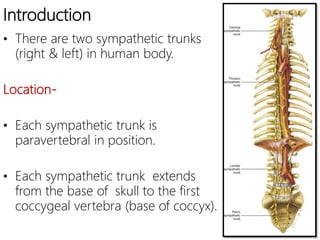
• There are two sympathetic trunks
(right & left) in human body.
Location-
• Each sympathetic trunk is
paravertebral in position.
• Each sympathetic trunk extends
from the base of skull to the first
coccygeal vertebra (base of coccyx).
Introduction contd…
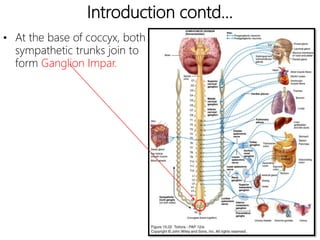
• At the base of coccyx, both
sympathetic trunks join to
form Ganglion Impar.
Sympathetic Trunks In The Neck
Location-
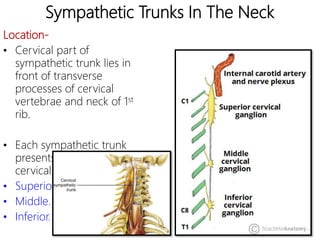
• Cervical part of
sympathetic trunk lies in
front of transverse
processes of cervical
vertebrae and neck of 1st
rib.
• Each sympathetic trunk
presents 3 ganglia in the
cervical part:-
• Superior.
• Middle.
• Inferior.
Sympathetic Trunks In The Neck
contd…
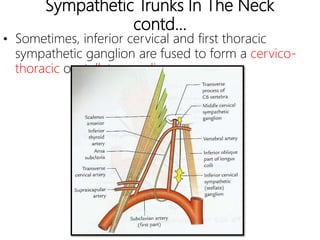
• Sometimes, inferior cervical and first thoracic
sympathetic ganglion are fused to form a cervico-
thoracic or stellate ganglion.
Sympathetic Trunks In The Neck contd…
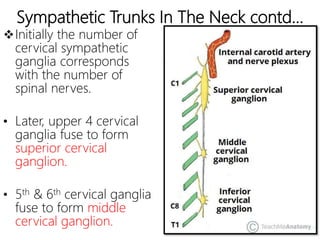
Initially the number of
cervical sympathetic
ganglia corresponds
with the number of
spinal nerves.
• Later, upper 4 cervical
ganglia fuse to form
superior cervical
ganglion.
• 5th & 6th cervical ganglia
fuse to form middle
cervical ganglion.
Cervical Part Of Sympathetic Trunk Contd…
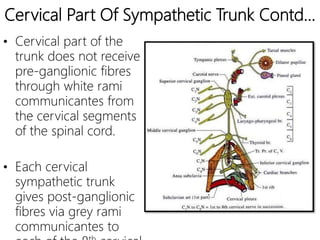
• Cervical part of the
trunk does not receive
pre-ganglionic fibres
through white rami
communicantes from
the cervical segments
of the spinal cord.
• Each cervical
sympathetic trunk
gives post-ganglionic
fibres via grey rami
communicantes to
Cervical Part Of Sympathetic Trunk Contd…
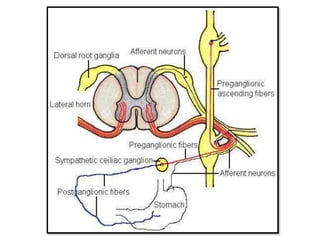
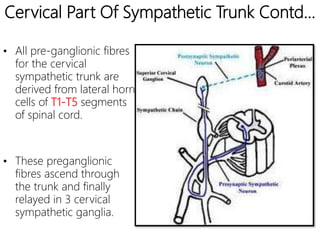
• All pre-ganglionic fibres
for the cervical
sympathetic trunk are
derived from lateral horn
cells of T1-T5 segments
of spinal cord.
• These preganglionic
fibres ascend through
the trunk and finally
relayed in 3 cervical
sympathetic ganglia.
Superior Cervical Ganglion
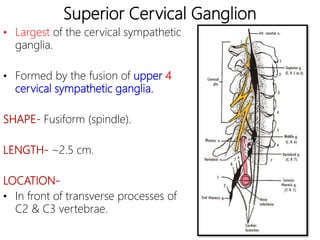
• Largest of the cervical sympathetic
ganglia.
• Formed by the fusion of upper 4
cervical sympathetic ganglia.
SHAPE- Fusiform (spindle).
LENGTH- ~2.5 cm.
LOCATION-
• In front of transverse processes of
C2 & C3 vertebrae.
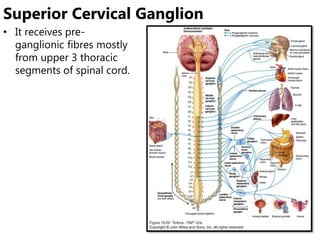
• It receives pre-
ganglionic fibres mostly
from upper 3 thoracic
segments of spinal cord.
Superior Cervical Ganglion
Branches Of Superior Cervical Ganglion
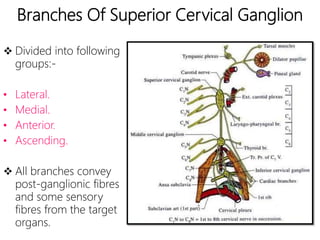
 Divided into following
groups:-
• Lateral.
• Medial.
• Anterior.
• Ascending.
 All branches convey
post-ganglionic fibres
and some sensory
fibres from the target
organs.
Lateral Branches Of Superior Cervical
Ganglion
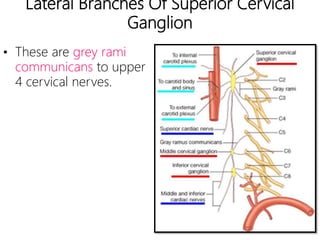
• These are grey rami
communicans to upper
4 cervical nerves.
Medial Branches Of Superior Cervical
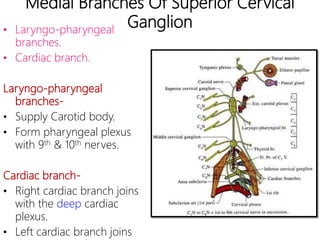
Ganglion• Laryngo-pharyngeal
branches.
• Cardiac branch.
Laryngo-pharyngeal
branches-
• Supply Carotid body.
• Form pharyngeal plexus
with 9th & 10th nerves.
Cardiac branch-
• Right cardiac branch joins
with the deep cardiac
plexus.
• Left cardiac branch joins
Anterior Branches Of Superior Cervical
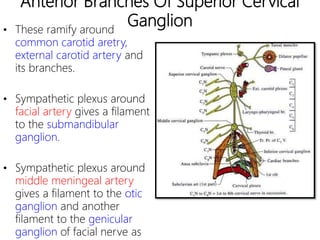
Ganglion• These ramify around
common carotid aretry,
external carotid artery and
its branches.
• Sympathetic plexus around
facial artery gives a filament
to the submandibular
ganglion.
• Sympathetic plexus around
middle meningeal artery
gives a filament to the otic
ganglion and another
filament to the genicular
ganglion of facial nerve as
Ascending Branches Of Superior Cervical
Ganglion
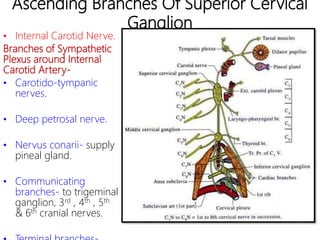
• Internal Carotid Nerve.
Branches of Sympathetic
Plexus around Internal
Carotid Artery-
• Carotido-tympanic
nerves.
• Deep petrosal nerve.
• Nervus conarii- supply
pineal gland.
• Communicating
branches- to trigeminal
ganglion, 3rd , 4th , 5th
& 6th cranial nerves.
Middle Cervical Ganglion
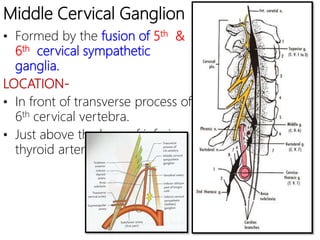
• Formed by the fusion of 5th &
6th cervical sympathetic
ganglia.
LOCATION-
• In front of transverse process of
6th cervical vertebra.
• Just above the loop of inferior
thyroid artery .
Middle Cervical Ganglion Contd…
COMMUNICATIONS-
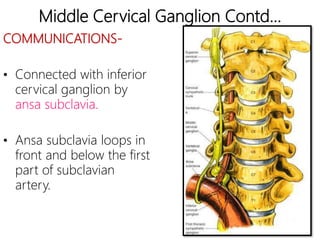
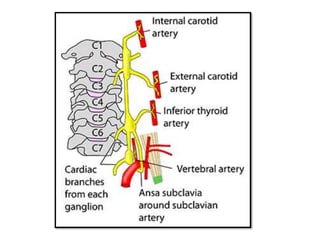
• Connected with inferior
cervical ganglion by
ansa subclavia.
• Ansa subclavia loops in
front and below the first
part of subclavian
artery.
Branches Of Middle Cervical Ganglion
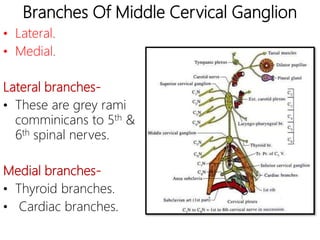
• Lateral.
• Medial.
Lateral branches-
• These are grey rami
comminicans to 5th &
6th spinal nerves.
Medial branches-
• Thyroid branches.
• Cardiac branches.
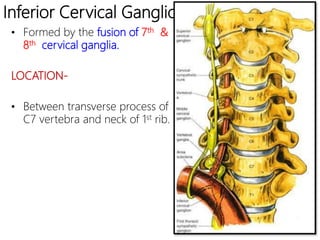
Inferior Cervical Ganglion
• Formed by the fusion of 7th &
8th cervical ganglia.
LOCATION-
• Between transverse process of
C7 vertebra and neck of 1st rib.
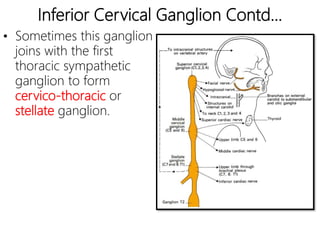
Inferior Cervical Ganglion Contd…
• Sometimes this ganglion
joins with the first
thoracic sympathetic
ganglion to form
cervico-thoracic or
stellate ganglion.
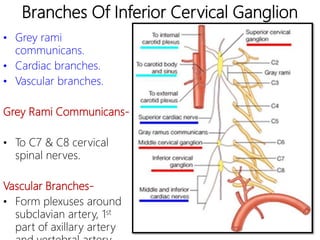
Branches Of Inferior Cervical Ganglion
• Grey rami
communicans.
• Cardiac branches.
• Vascular branches.
Grey Rami Communicans-
• To C7 & C8 cervical
spinal nerves.
Vascular Branches-
• Form plexuses around
subclavian artery, 1st
part of axillary artery
Applied Anatomy
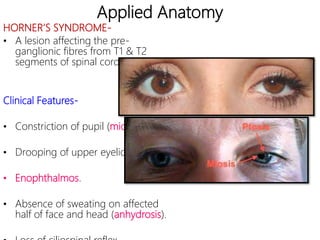
HORNER’S SYNDROME-
• A lesion affecting the pre-
ganglionic fibres from T1 & T2
segments of spinal cord.
Clinical Features-
• Constriction of pupil (miosis).
• Drooping of upper eyelid (ptosis).
• Enophthalmos.
• Absence of sweating on affected
half of face and head (anhydrosis).
Cervical sympathetic trunks ANATOMY

Cervical sympathetic trunks ANATOMY

  • 1.
  • 2.
    Introduction • There aretwo sympathetic trunks (right & left) in human body. Location- • Each sympathetic trunk is paravertebral in position. • Each sympathetic trunk extends from the base of skull to the first coccygeal vertebra (base of coccyx).
  • 3.
    Introduction contd… • Atthe base of coccyx, both sympathetic trunks join to form Ganglion Impar.
  • 4.
    Sympathetic Trunks InThe Neck Location- • Cervical part of sympathetic trunk lies in front of transverse processes of cervical vertebrae and neck of 1st rib. • Each sympathetic trunk presents 3 ganglia in the cervical part:- • Superior. • Middle. • Inferior.
  • 5.
    Sympathetic Trunks InThe Neck contd… • Sometimes, inferior cervical and first thoracic sympathetic ganglion are fused to form a cervico- thoracic or stellate ganglion.
  • 6.
    Sympathetic Trunks InThe Neck contd… Initially the number of cervical sympathetic ganglia corresponds with the number of spinal nerves. • Later, upper 4 cervical ganglia fuse to form superior cervical ganglion. • 5th & 6th cervical ganglia fuse to form middle cervical ganglion.
  • 7.
    Cervical Part OfSympathetic Trunk Contd… • Cervical part of the trunk does not receive pre-ganglionic fibres through white rami communicantes from the cervical segments of the spinal cord. • Each cervical sympathetic trunk gives post-ganglionic fibres via grey rami communicantes to
  • 9.
    Cervical Part OfSympathetic Trunk Contd… • All pre-ganglionic fibres for the cervical sympathetic trunk are derived from lateral horn cells of T1-T5 segments of spinal cord. • These preganglionic fibres ascend through the trunk and finally relayed in 3 cervical sympathetic ganglia.
  • 10.
    Superior Cervical Ganglion •Largest of the cervical sympathetic ganglia. • Formed by the fusion of upper 4 cervical sympathetic ganglia. SHAPE- Fusiform (spindle). LENGTH- ~2.5 cm. LOCATION- • In front of transverse processes of C2 & C3 vertebrae.
  • 11.
    • It receivespre- ganglionic fibres mostly from upper 3 thoracic segments of spinal cord. Superior Cervical Ganglion
  • 12.
    Branches Of SuperiorCervical Ganglion  Divided into following groups:- • Lateral. • Medial. • Anterior. • Ascending.  All branches convey post-ganglionic fibres and some sensory fibres from the target organs.
  • 13.
    Lateral Branches OfSuperior Cervical Ganglion • These are grey rami communicans to upper 4 cervical nerves.
  • 14.
    Medial Branches OfSuperior Cervical Ganglion• Laryngo-pharyngeal branches. • Cardiac branch. Laryngo-pharyngeal branches- • Supply Carotid body. • Form pharyngeal plexus with 9th & 10th nerves. Cardiac branch- • Right cardiac branch joins with the deep cardiac plexus. • Left cardiac branch joins
  • 15.
    Anterior Branches OfSuperior Cervical Ganglion• These ramify around common carotid aretry, external carotid artery and its branches. • Sympathetic plexus around facial artery gives a filament to the submandibular ganglion. • Sympathetic plexus around middle meningeal artery gives a filament to the otic ganglion and another filament to the genicular ganglion of facial nerve as
  • 16.
    Ascending Branches OfSuperior Cervical Ganglion • Internal Carotid Nerve. Branches of Sympathetic Plexus around Internal Carotid Artery- • Carotido-tympanic nerves. • Deep petrosal nerve. • Nervus conarii- supply pineal gland. • Communicating branches- to trigeminal ganglion, 3rd , 4th , 5th & 6th cranial nerves.
  • 17.
    Middle Cervical Ganglion •Formed by the fusion of 5th & 6th cervical sympathetic ganglia. LOCATION- • In front of transverse process of 6th cervical vertebra. • Just above the loop of inferior thyroid artery .
  • 18.
    Middle Cervical GanglionContd… COMMUNICATIONS- • Connected with inferior cervical ganglion by ansa subclavia. • Ansa subclavia loops in front and below the first part of subclavian artery.
  • 19.
    Branches Of MiddleCervical Ganglion • Lateral. • Medial. Lateral branches- • These are grey rami comminicans to 5th & 6th spinal nerves. Medial branches- • Thyroid branches. • Cardiac branches.
  • 21.
    Inferior Cervical Ganglion •Formed by the fusion of 7th & 8th cervical ganglia. LOCATION- • Between transverse process of C7 vertebra and neck of 1st rib.
  • 22.
    Inferior Cervical GanglionContd… • Sometimes this ganglion joins with the first thoracic sympathetic ganglion to form cervico-thoracic or stellate ganglion.
  • 23.
    Branches Of InferiorCervical Ganglion • Grey rami communicans. • Cardiac branches. • Vascular branches. Grey Rami Communicans- • To C7 & C8 cervical spinal nerves. Vascular Branches- • Form plexuses around subclavian artery, 1st part of axillary artery
  • 24.
    Applied Anatomy HORNER’S SYNDROME- •A lesion affecting the pre- ganglionic fibres from T1 & T2 segments of spinal cord. Clinical Features- • Constriction of pupil (miosis). • Drooping of upper eyelid (ptosis). • Enophthalmos. • Absence of sweating on affected half of face and head (anhydrosis).