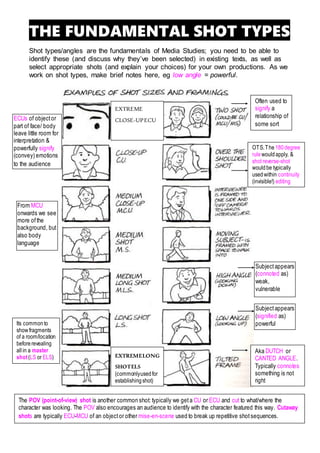
THE FUNDAMENTAL SHOT TYPES
Shot types/angles are the fundamentals of Media Studies; you need to be able to
identify these (and discuss why they’ve been selected) in existing texts, as well as
select appropriate shots (and explain your choices) for your own productions. As we
work on shot types, make brief notes here, eg low angle = powerful.
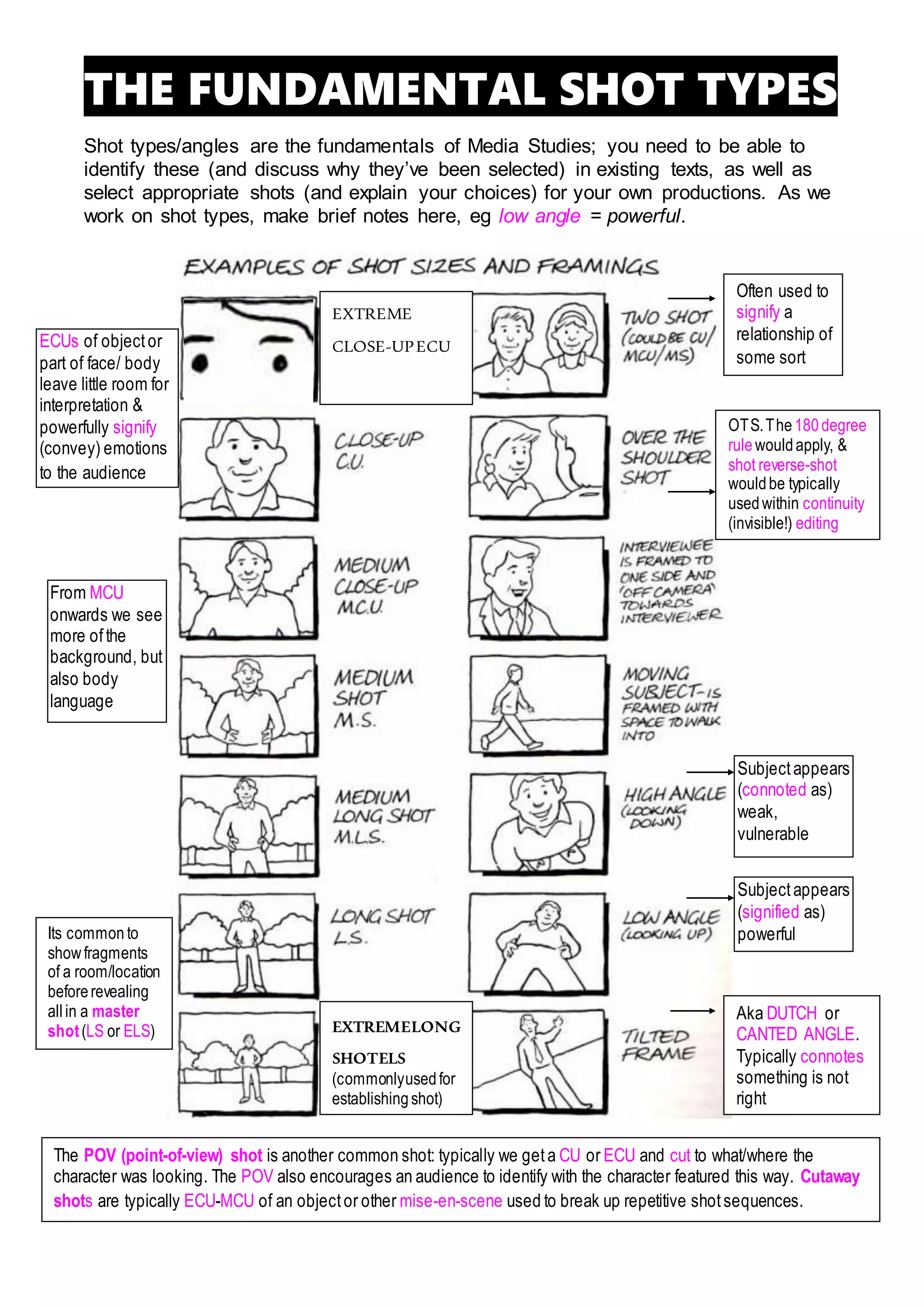
The POV (point-of-view) shot is another common shot: typically we geta CU or ECU and cut to what/where the
character was looking. The POV also encourages an audience to identify with the character featured this way. Cutaway
shots are typically ECU-MCU of an objector other mise-en-scene used to break up repetitive shotsequences.
EXTREMELONG
SHOTELS
(commonlyusedfor
establishingshot)
Aka DUTCH or
CANTED ANGLE.
Typically connotes
something is not
right
EXTREME
CLOSE-UPECU
Subjectappears
(signified as)
powerful
Subjectappears
(connoted as)
weak,
vulnerable
From MCU
onwards we see
more ofthe
background, but
also body
language
OTS.The180degree
rulewouldapply, &
shot reverse-shot
wouldbe typically
usedwithin continuity
(invisible!) editing
Often used to
signify a
relationship of
some sort
ECUs of objector
part of face/ body
leave little room for
interpretation &
powerfully signify
(convey) emotions
to the audience
Its common to
showfragments
of a room/location
beforerevealing
allin a master
shot(LS or ELS)
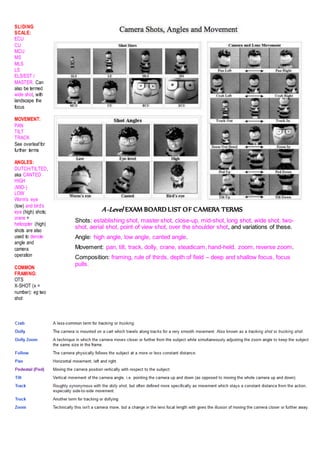
A-Level EXAM BOARD LIST OF CAMERA TERMS
Shots: establishing shot, master shot, close-up, mid-shot, long shot, wide shot, two-
shot, aerial shot, point of view shot, over the shoulder shot, and variations of these.
Angle: high angle, low angle, canted angle.
Movement: pan, tilt, track, dolly, crane, steadicam, hand-held, zoom, reverse zoom.
Composition: framing, rule of thirds, depth of field – deep and shallow focus, focus
pulls.
SLIDING
SCALE:
ECU
CU
MCU
MS
MLS
LS
ELS/EST./
MASTER. Can
also be termed
wide shot, with
landscape the
focus
MOVEMENT:
PAN
TILT
TRACK
See overleaf for
further terms
ANGLES:
DUTCH/TILTED,
aka CANTED
HIGH
(MID-)
LOW
Worm’s eye
(low) and bird’s
eye (high) shots;
crane +
helicopter (high)
shots are also
used to denote
angle and
camera
operation
COMMON
FRAMING:
OTS
X-SHOT (x =
number): eg two
shot

FUNDAMENTAL SHOT TYPES chalkFONT.doc

  • 1.
    THE FUNDAMENTAL SHOTTYPES Shot types/angles are the fundamentals of Media Studies; you need to be able to identify these (and discuss why they’ve been selected) in existing texts, as well as select appropriate shots (and explain your choices) for your own productions. As we work on shot types, make brief notes here, eg low angle = powerful. The POV (point-of-view) shot is another common shot: typically we geta CU or ECU and cut to what/where the character was looking. The POV also encourages an audience to identify with the character featured this way. Cutaway shots are typically ECU-MCU of an objector other mise-en-scene used to break up repetitive shotsequences. EXTREMELONG SHOTELS (commonlyusedfor establishingshot) Aka DUTCH or CANTED ANGLE. Typically connotes something is not right EXTREME CLOSE-UPECU Subjectappears (signified as) powerful Subjectappears (connoted as) weak, vulnerable From MCU onwards we see more ofthe background, but also body language OTS.The180degree rulewouldapply, & shot reverse-shot wouldbe typically usedwithin continuity (invisible!) editing Often used to signify a relationship of some sort ECUs of objector part of face/ body leave little room for interpretation & powerfully signify (convey) emotions to the audience Its common to showfragments of a room/location beforerevealing allin a master shot(LS or ELS)
  • 2.
    A-Level EXAM BOARDLIST OF CAMERA TERMS Shots: establishing shot, master shot, close-up, mid-shot, long shot, wide shot, two- shot, aerial shot, point of view shot, over the shoulder shot, and variations of these. Angle: high angle, low angle, canted angle. Movement: pan, tilt, track, dolly, crane, steadicam, hand-held, zoom, reverse zoom. Composition: framing, rule of thirds, depth of field – deep and shallow focus, focus pulls. SLIDING SCALE: ECU CU MCU MS MLS LS ELS/EST./ MASTER. Can also be termed wide shot, with landscape the focus MOVEMENT: PAN TILT TRACK See overleaf for further terms ANGLES: DUTCH/TILTED, aka CANTED HIGH (MID-) LOW Worm’s eye (low) and bird’s eye (high) shots; crane + helicopter (high) shots are also used to denote angle and camera operation COMMON FRAMING: OTS X-SHOT (x = number): eg two shot