Golf and the Environment
By Chris Cook
About Me
 Golf course superintendent at
Bailey Ranch Golf Club since
January 2007.
 Assistant superintendent at
Wichita Country Club from
2004-07.
 Graduated from KSU with
Bachelor’s in Golf Course
Management in 2004
 Life long golfer
 Outdoor enthusiast
Overview
 Misconceptions about golf’s impact on the
environment
 Facts about environmental impact
 Local efforts to improve environmental stewardship
Misconceptions
 “Golf courses use too much water.”
 “Golf courses don’t benefit the environment.”
 “Pesticides used on golf courses are dangerous to
golfers.”
 “Golf courses can’t support wildlife.”
Environmental Impact
 There are approximately 2.2 million total acres on golf facilities in the
U.S.
 1.5 million acres are maintained turfgrass such as greens, tees, fairways,
and rough, of which, 80% is irrigated. (Environmental Institute for Golf,
2009)
 According to the U.S. Geological Survey, a total of 408 million gallons
of water are consumed every day in the United States. Golf courses
account for only 1/2% of this total. (Hudson et al, 2004)
 Exposures to golfers following full applications turfgrass insecticides
were 19 to 68 times lower than levels set by the U. S. Environmental
Protection Agency designed to protect human health. (Clark,2008)
Environmental Impact Cont.
 U.S. golf facilities have approximately 358,000 acres of natural
habitat, i.e. woodlands, grasslands, deserts, etc. (EIFG, 2007)
 A diverse wildlife population can be achieved by an integrated
landscape of turfgrass, trees, shrubs, and water features, such as
can be found on golf courses. (Green and Marshall, 1987)
 Golf courses provide critical greenspace in urban, and suburban,
areas for wildlife habitat, atmospheric cooling, and absorbing
pollutants such as carbon dioxide. (Watschke, 1990)
 Approximately 55 sq.ft. of healthy turf supplies enough oxygen
for one person for an entire day. (Beard, 1973)
Environmental Impact Cont.
 Golf courses can provide habitat corridors between protected areas,
and become increasingly important as the rate of habitat loss in urban
areas is considered. (Stangel and Distler, 2002)
 Studies have shown the ability of turfgrass to reduce stormwater runoff
and therefore enhance soil water infiltration and groundwater
recharge. (Gross et al.,1991)
 The reduced runoff volume, due to turf cover, may decrease the stormwater
management requirements for urban developments. (Shuyler, 1987)
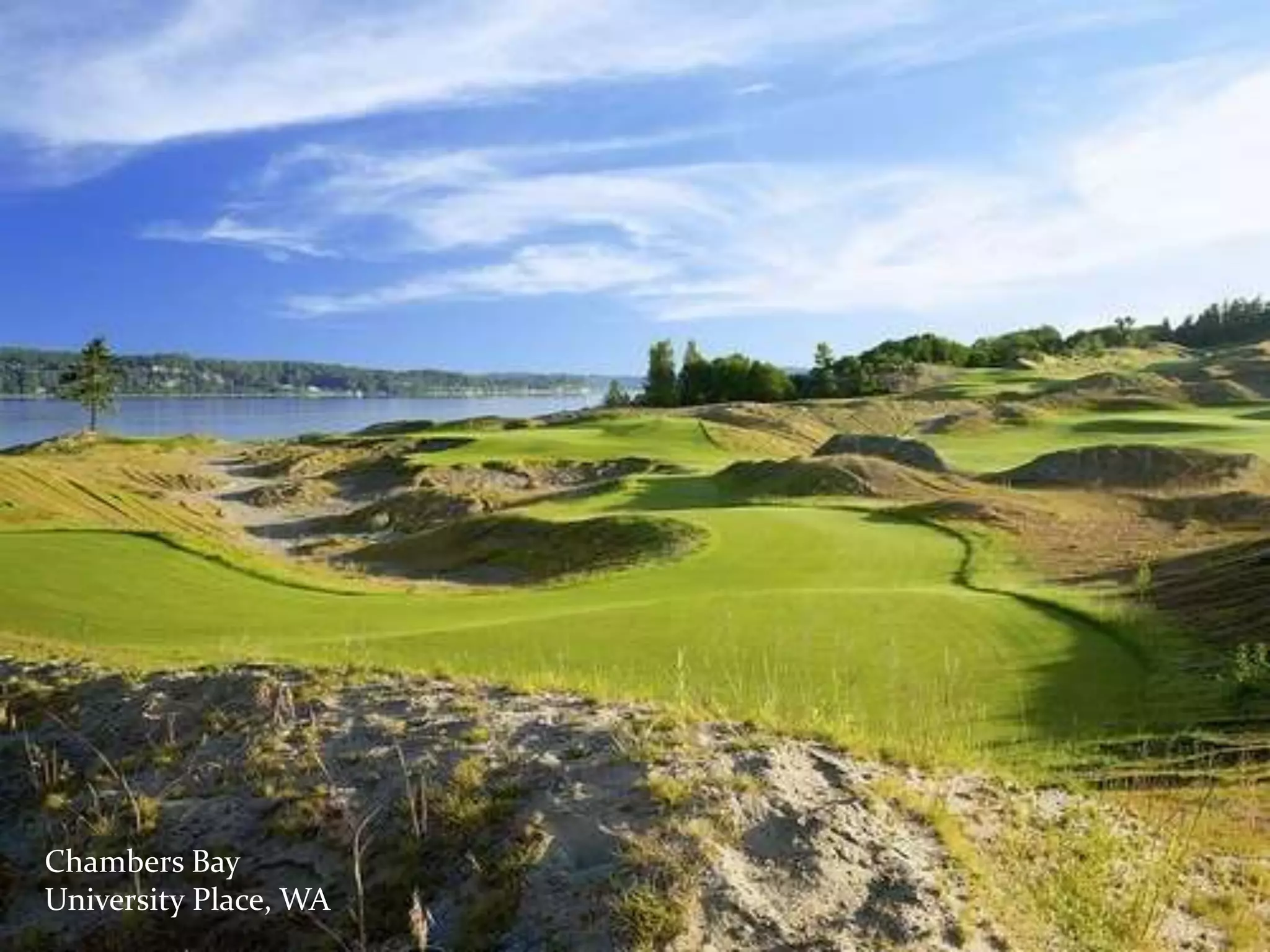
 Golf courses can be a perfect use for reclaimed land such as landfills
and mining operations.
Liberty National
Jersey City, NJ
Chambers Bay
University Place, WA
Streamsong Resort,
Red Course
Fort Meade, FL
Bailey Ranch GC & Environment
 So what are we doing to improve and promote
environmental stewardship?
 Multi-faceted approach:
 Water conservation
 Protection of water quality
 Minimizing inputs through Integrated Pest
Management (IPM), and other Best Management
Practices (BMPs).
 Increasing/Promoting wildlife habitat
Water Conservation
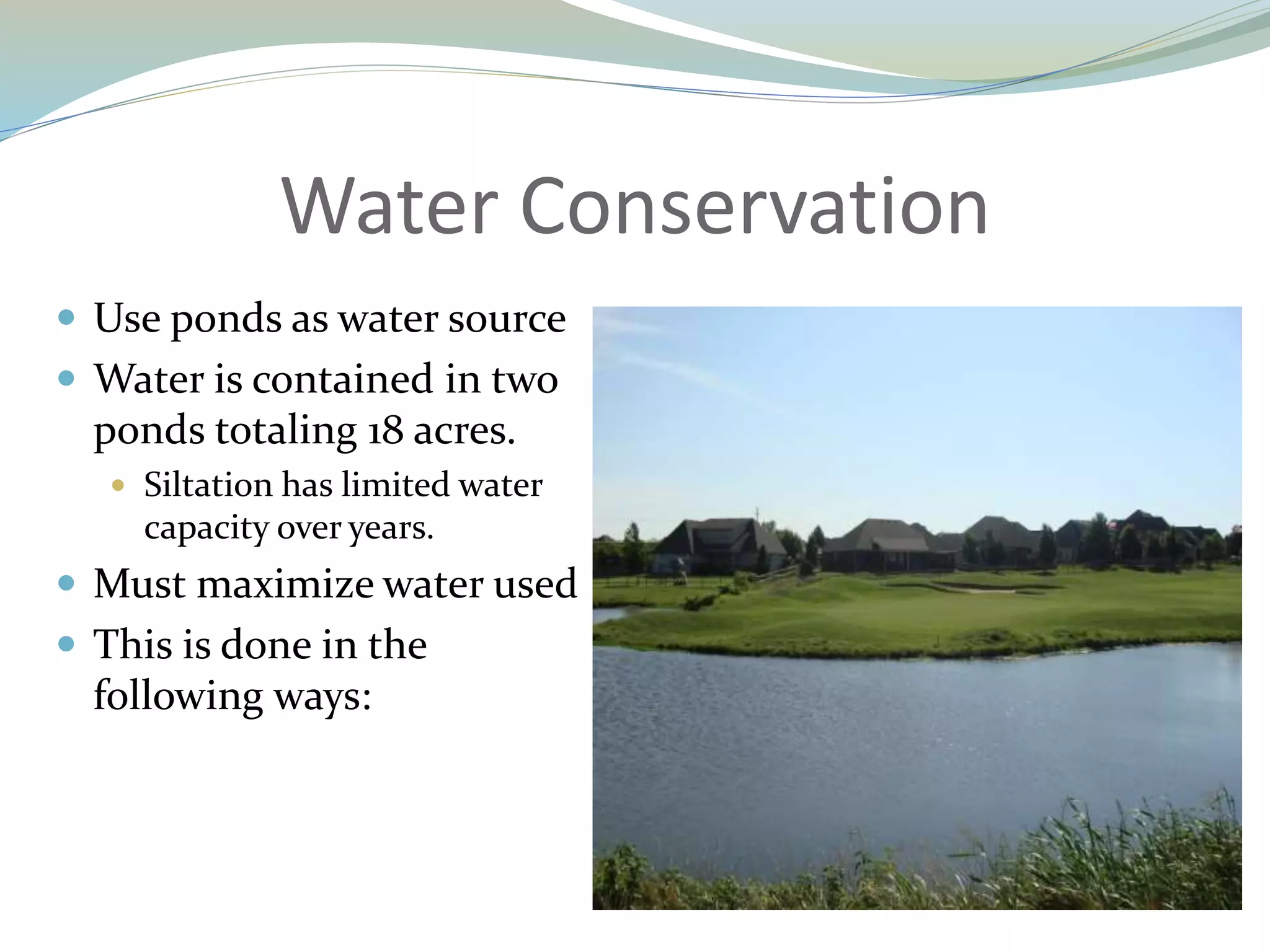
 Use ponds as water source
 Water is contained in two
ponds totaling 18 acres.
 Siltation has limited water
capacity over years.
 Must maximize water used
 This is done in the
following ways:
Water Conservation Cont.
 Daily audits of system to ensure
maximum efficiency and
minimize leaks.
 Computer-controlled irrigation
system
 Use of wetting agents to increase
efficacy of rain/irrigation water.
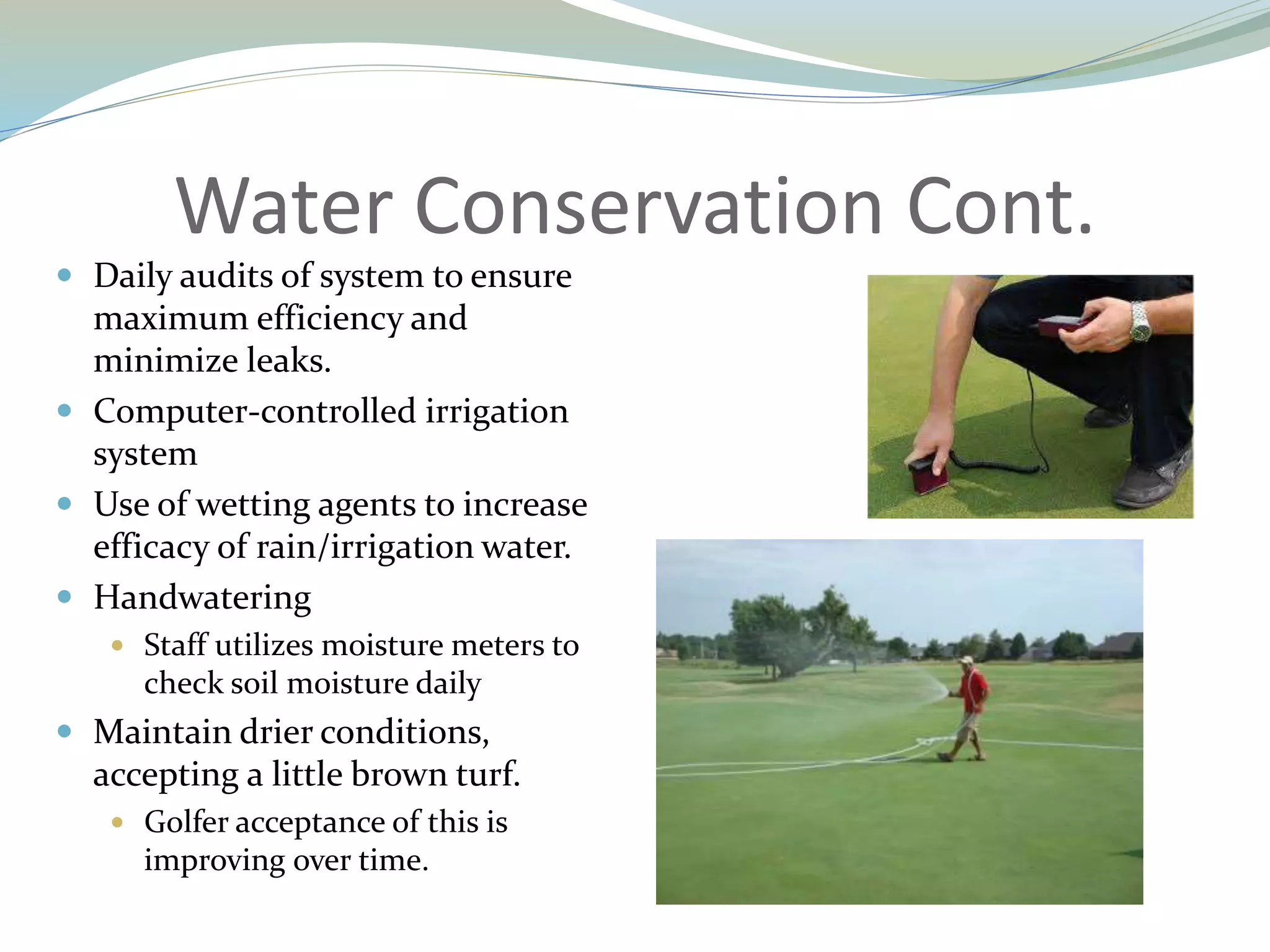
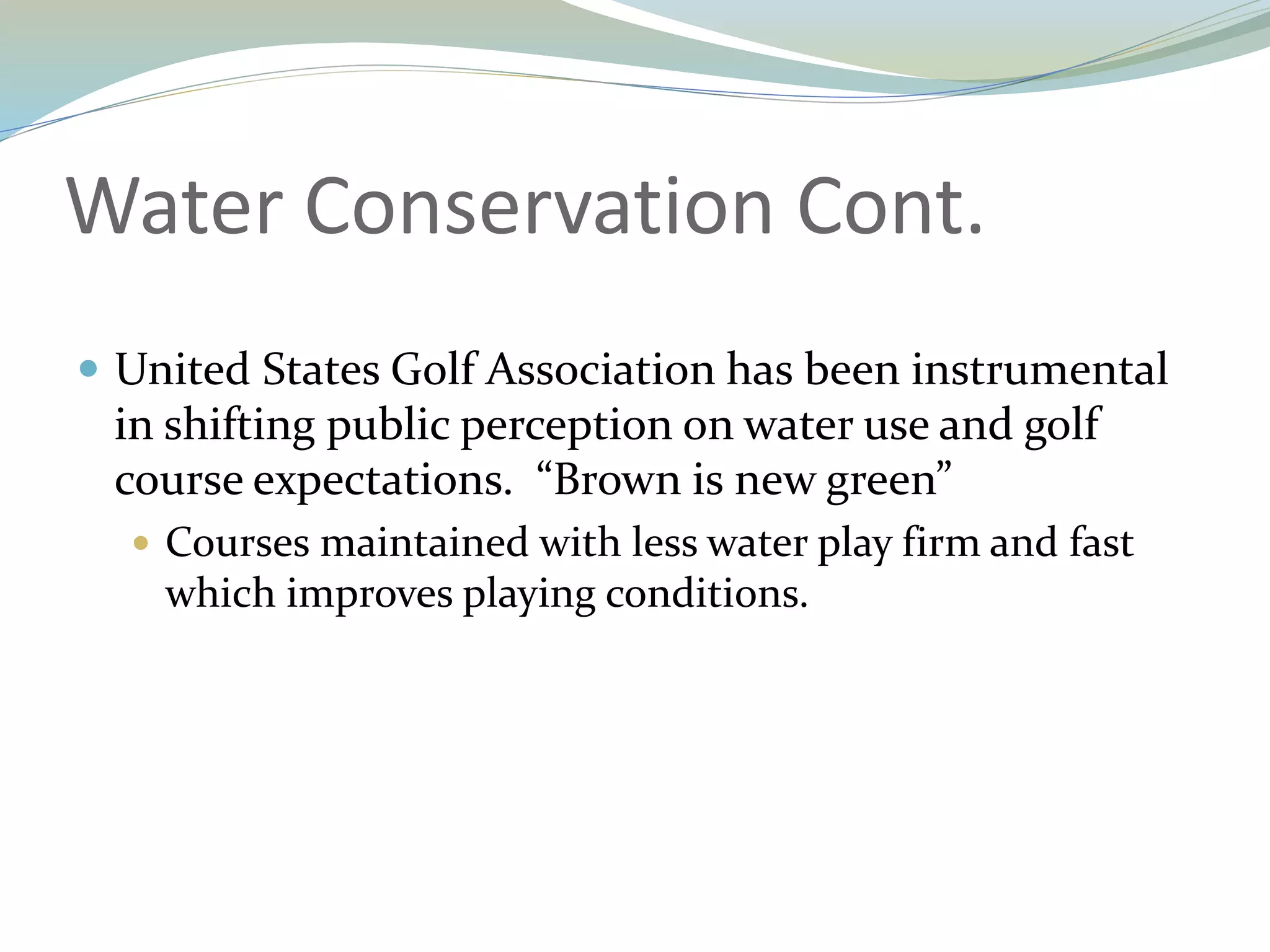
 Handwatering
 Staff utilizes moisture meters to
check soil moisture daily
 Maintain drier conditions,
accepting a little brown turf.
 Golfer acceptance of this is
improving over time.
Water Conservation Cont.
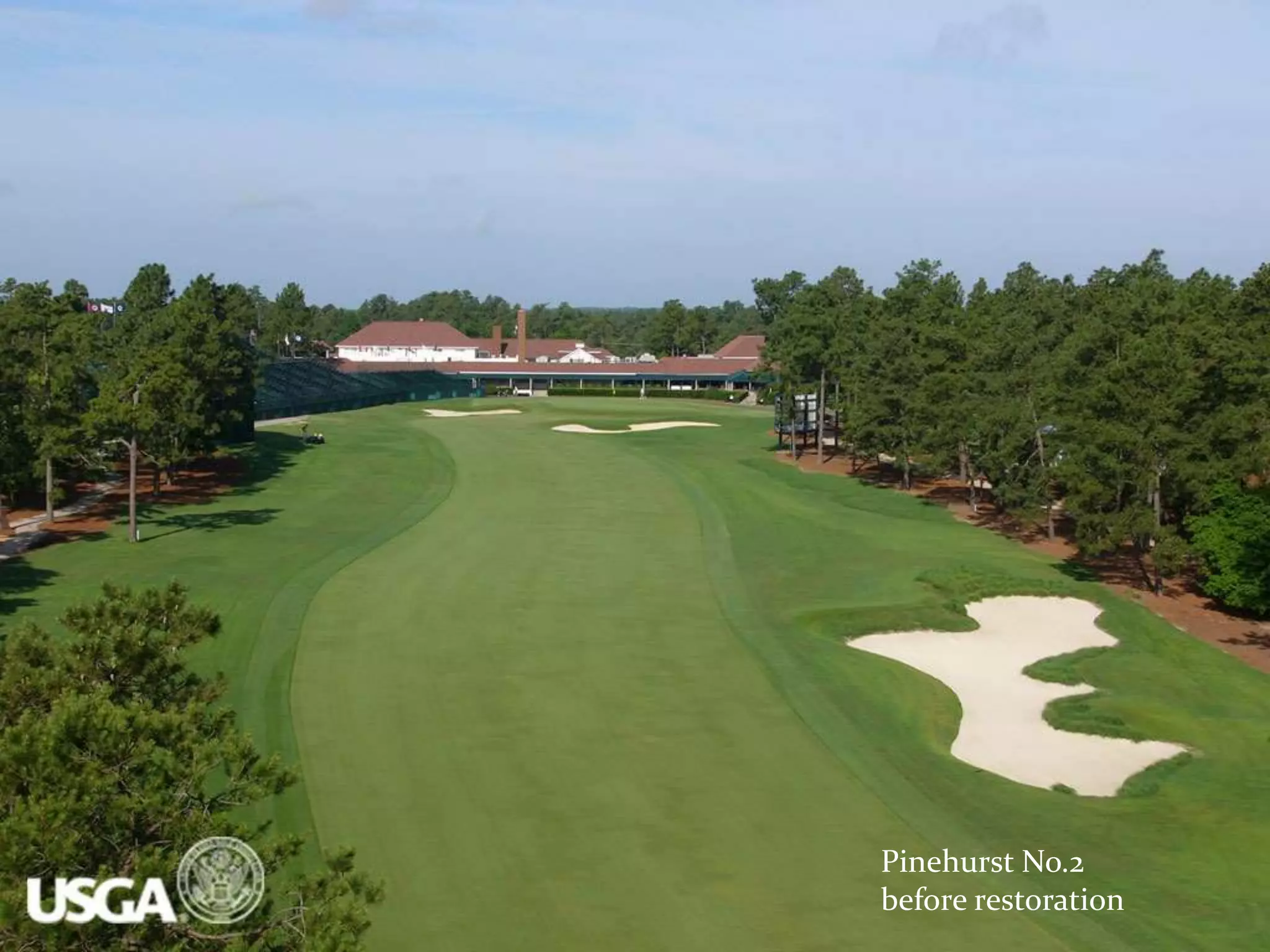
 United States Golf Association has been instrumental
in shifting public perception on water use and golf
course expectations. “Brown is new green”
 Courses maintained with less water play firm and fast
which improves playing conditions.
Muirfield Golf Club
Gullane, Scotland
Pinehurst No.2
before restoration
Pinehurst No. 2
after restoration
Protecting Water Quality
 Riparian buffer zones are
in place to filter storm
water runoff
 Also reduces fuel usage and
labor costs since these areas
are not mowed weekly.
Reducing Inputs
 Due to budget constraints,
Bailey Ranch has always used
resources sparingly.
 Over the years, more focus has
been made to improve efficacy
of applications to further reduce
inputs.
 Aggressive cultural programs are
utilized to help improve turf
health so, in many cases,
pesticides use can be reduced.
 Examples of these are core
aeration and sand topdressing
Reducing Inputs Cont.
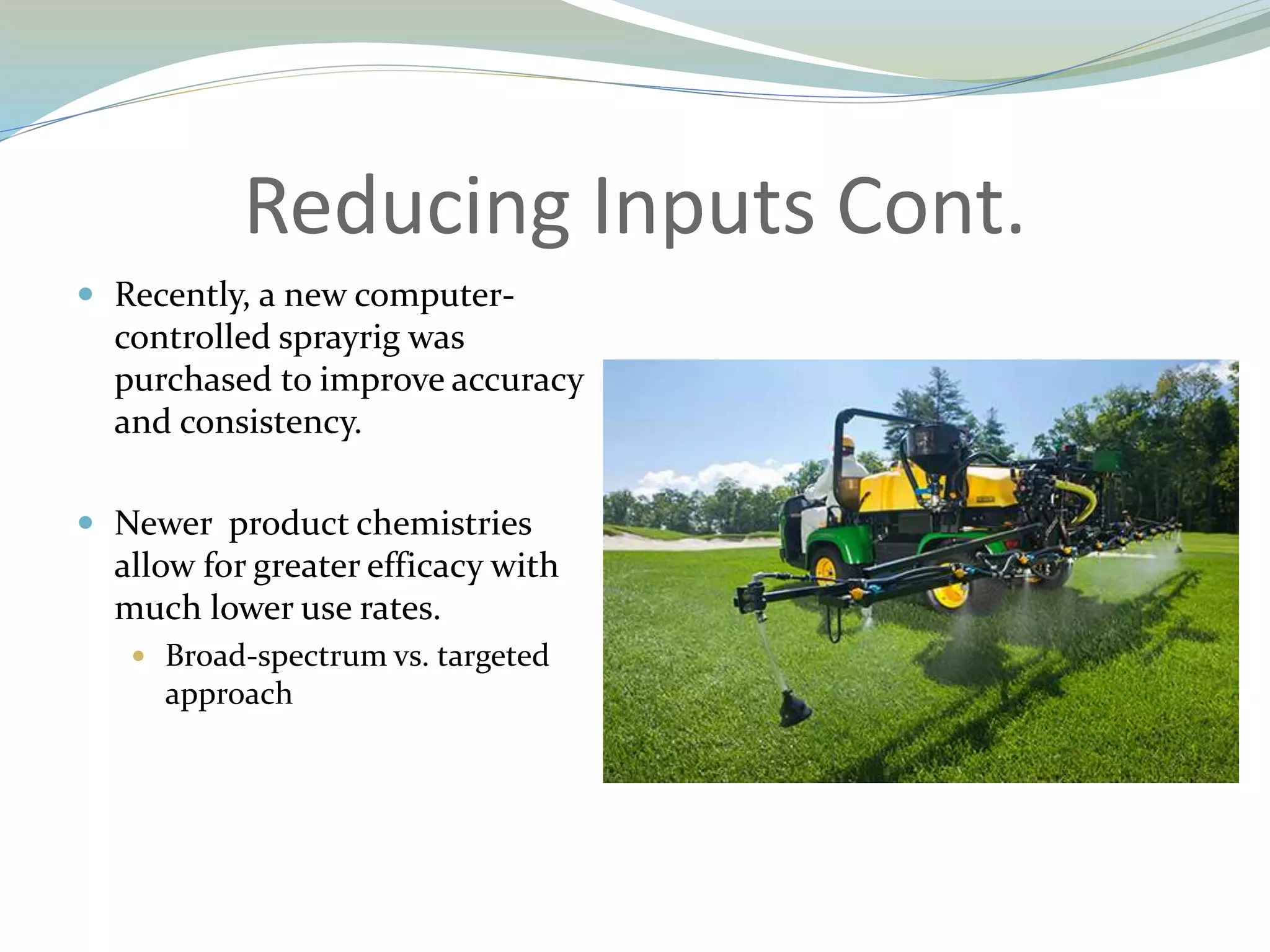
 Recently, a new computer-
controlled sprayrig was
purchased to improve accuracy
and consistency.
 Newer product chemistries
allow for greater efficacy with
much lower use rates.
 Broad-spectrum vs. targeted
approach
Integrated Pest Management
 IPM programs consist of three steps:
 Monitoring (assessing environmental conditions, correct ID of pest,
and knowledge of pest biology).
 Establishing action thresholds
 Acting on those thresholds either preventatively, or curatively, and
selecting a control method (cultural, chemical, biological, manual,
or mechanical).
IPM Pyramid
Native Conversions
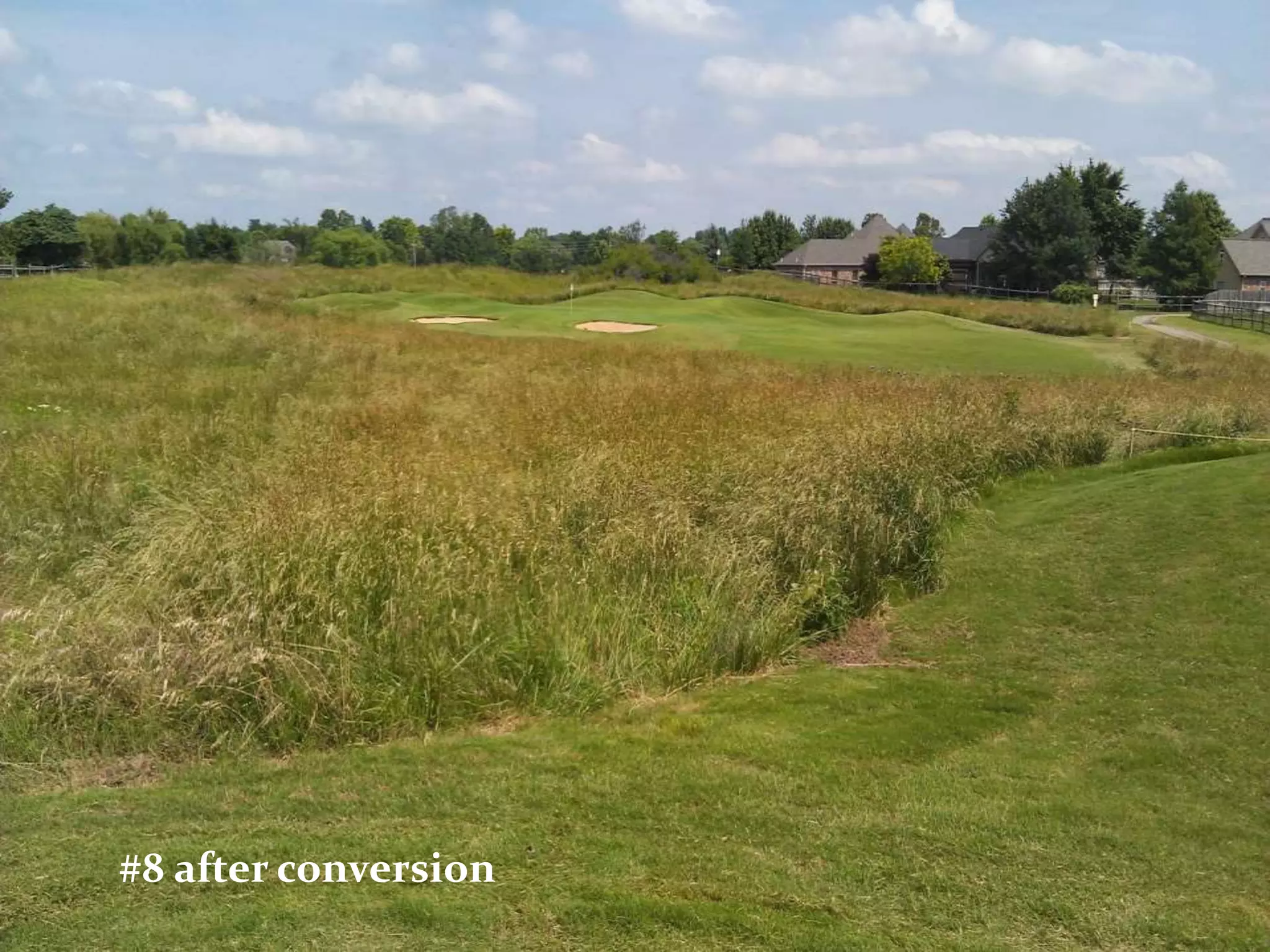
 Converting select areas from maintained rough, to low maintenance
native grass, have had a positive impact.
 Over 7 acres have been converted to grassland habitat.
 This translates into increased wildlife habitat, reduced water usage, less
fuel consumption, labor savings, and reductions in fertilizer and
pesticide use.
 In many cases, native grass improves the design aesthetic of a golf hole.
The par 3 #8 is a prime example.
Native Conversions
#8 before conversion
#8 after conversion
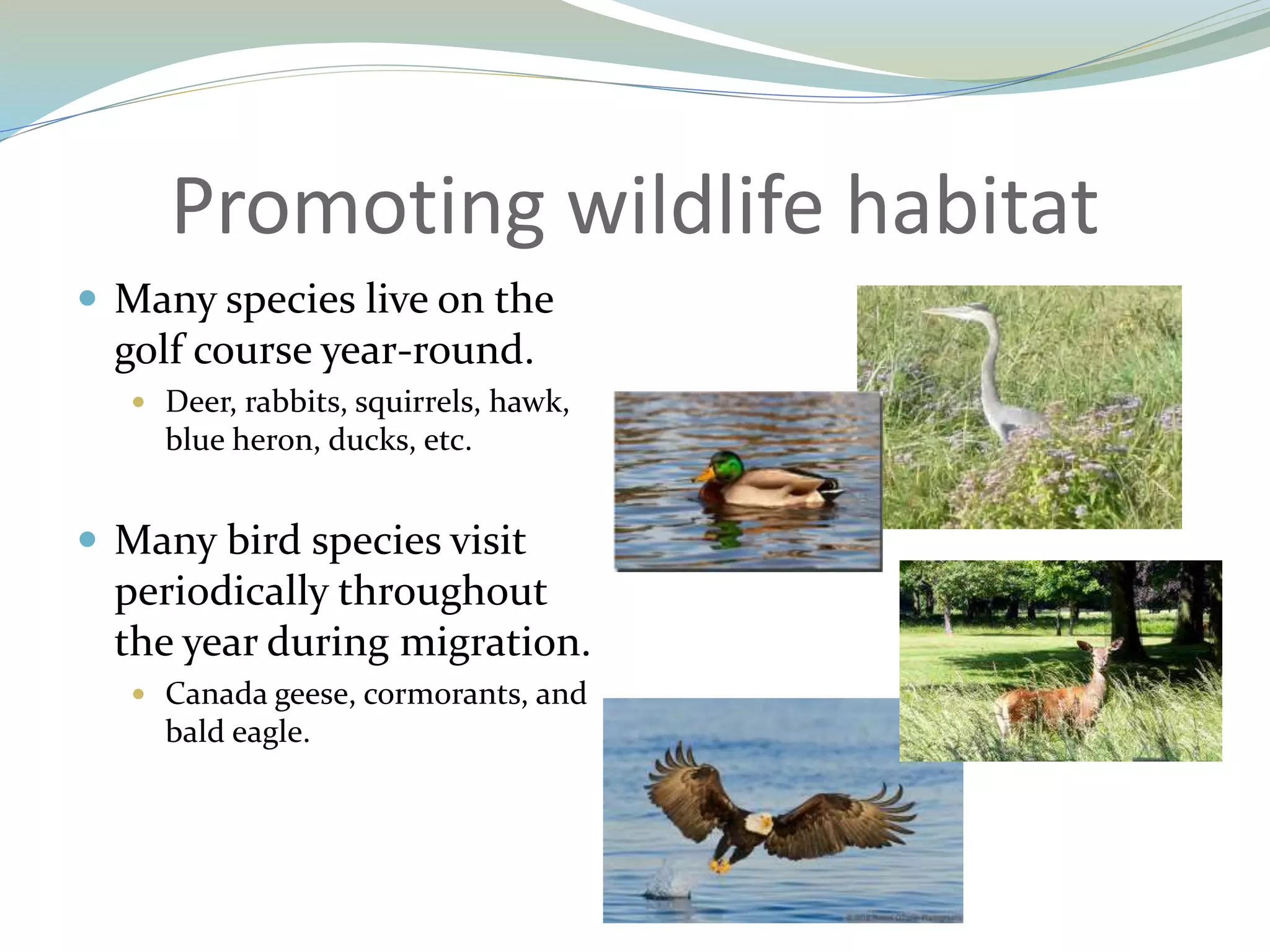
Promoting wildlife habitat
 Many species live on the
golf course year-round.
 Deer, rabbits, squirrels, hawk,
blue heron, ducks, etc.
 Many bird species visit
periodically throughout
the year during migration.
 Canada geese, cormorants, and
bald eagle.
Bluebird project
 This past winter, the staff, with
technical support from the
Oklahoma Bluebird Society,
constructed 6 bluebird boxes
with 6 more planned next
winter.
Other Initiatives
 Recycling
 Scrap metal
 Aluminum cans
 Paper
 ?
References
1. Beard, J.B. 1973. Turfgrass: Science and Culture. Prentice-Hall Inc., Englewood Cliffs, NJ
2. Clark, John. University of Massachusetts Amherst. Veterinary and Animal Science. Golf Course
Insecticides Pose Little Danger to Golfers. 29 July 2008. Web. 22 Apr. 2014.
3. Green, RH. and I.C. Marshall. 1987. An assessment of the role of golf courses in Kent, England, in
protecting wildlife and landscapes. Landscape and Urban Planning. 14:143-154.
4. Gross, C.M., 1.S. Angle, R.L. Hill, and M.S. Welterlen. 1991. Runoff and sediment losses from tall
fescue under simulated rainfall. 1. Environ. Qual. 20:604-607.
5. Hutson, Susan S., Barber, Nancy L., Kenny, Joan F., Linsey, Kristin S., Lumia, Deborah S., and
Maupin, Molly A. Estimated Use of Water in the United States in 2000, U.S. Geological Survey,
USGS Circular 1268, 15 figures, 14 tables (released March 2004, revised April 2004, May 2004,
February 2005)
6. Property Profile and Environmental Stewardship of Golf Courses. Rep. Vol. 2. Environmental
Institute for Golf, 2007. Print
7. Water Use and Conservation Practices on U.S. Golf Courses. Rep. Vol. 2 . Environmental Insitute
for Golf, 2009. Print
8. Watschke, T.L. 1990. The environmental benefits of turfgrass and their impact on the greenhouse
effect. Golf Course Mgmt. February. pp. 150-154.
9. Stangel, Peter, and Katie Distler. Golf Courses for Wildlife: Looking Beyond the Turf. Rep. USGA
Turfgrass and Environmental Research Online, 15 Mar. 2002. Web. 18 Apr. 2014.
Questions?

Golf and the Environment

  • 1.
    Golf and theEnvironment By Chris Cook
  • 2.
    About Me  Golfcourse superintendent at Bailey Ranch Golf Club since January 2007.  Assistant superintendent at Wichita Country Club from 2004-07.  Graduated from KSU with Bachelor’s in Golf Course Management in 2004  Life long golfer  Outdoor enthusiast
  • 3.
    Overview  Misconceptions aboutgolf’s impact on the environment  Facts about environmental impact  Local efforts to improve environmental stewardship
  • 4.
    Misconceptions  “Golf coursesuse too much water.”  “Golf courses don’t benefit the environment.”  “Pesticides used on golf courses are dangerous to golfers.”  “Golf courses can’t support wildlife.”
  • 5.
    Environmental Impact  Thereare approximately 2.2 million total acres on golf facilities in the U.S.  1.5 million acres are maintained turfgrass such as greens, tees, fairways, and rough, of which, 80% is irrigated. (Environmental Institute for Golf, 2009)  According to the U.S. Geological Survey, a total of 408 million gallons of water are consumed every day in the United States. Golf courses account for only 1/2% of this total. (Hudson et al, 2004)  Exposures to golfers following full applications turfgrass insecticides were 19 to 68 times lower than levels set by the U. S. Environmental Protection Agency designed to protect human health. (Clark,2008)
  • 6.
    Environmental Impact Cont. U.S. golf facilities have approximately 358,000 acres of natural habitat, i.e. woodlands, grasslands, deserts, etc. (EIFG, 2007)  A diverse wildlife population can be achieved by an integrated landscape of turfgrass, trees, shrubs, and water features, such as can be found on golf courses. (Green and Marshall, 1987)  Golf courses provide critical greenspace in urban, and suburban, areas for wildlife habitat, atmospheric cooling, and absorbing pollutants such as carbon dioxide. (Watschke, 1990)  Approximately 55 sq.ft. of healthy turf supplies enough oxygen for one person for an entire day. (Beard, 1973)
  • 7.
    Environmental Impact Cont. Golf courses can provide habitat corridors between protected areas, and become increasingly important as the rate of habitat loss in urban areas is considered. (Stangel and Distler, 2002)  Studies have shown the ability of turfgrass to reduce stormwater runoff and therefore enhance soil water infiltration and groundwater recharge. (Gross et al.,1991)  The reduced runoff volume, due to turf cover, may decrease the stormwater management requirements for urban developments. (Shuyler, 1987)  Golf courses can be a perfect use for reclaimed land such as landfills and mining operations.
  • 8.
  • 9.
  • 10.
  • 11.
    Bailey Ranch GC& Environment  So what are we doing to improve and promote environmental stewardship?  Multi-faceted approach:  Water conservation  Protection of water quality  Minimizing inputs through Integrated Pest Management (IPM), and other Best Management Practices (BMPs).  Increasing/Promoting wildlife habitat
  • 12.
    Water Conservation  Useponds as water source  Water is contained in two ponds totaling 18 acres.  Siltation has limited water capacity over years.  Must maximize water used  This is done in the following ways:
  • 13.
    Water Conservation Cont. Daily audits of system to ensure maximum efficiency and minimize leaks.  Computer-controlled irrigation system  Use of wetting agents to increase efficacy of rain/irrigation water.  Handwatering  Staff utilizes moisture meters to check soil moisture daily  Maintain drier conditions, accepting a little brown turf.  Golfer acceptance of this is improving over time.
  • 14.
    Water Conservation Cont. United States Golf Association has been instrumental in shifting public perception on water use and golf course expectations. “Brown is new green”  Courses maintained with less water play firm and fast which improves playing conditions.
  • 15.
  • 16.
  • 17.
  • 18.
    Protecting Water Quality Riparian buffer zones are in place to filter storm water runoff  Also reduces fuel usage and labor costs since these areas are not mowed weekly.
  • 19.
    Reducing Inputs  Dueto budget constraints, Bailey Ranch has always used resources sparingly.  Over the years, more focus has been made to improve efficacy of applications to further reduce inputs.  Aggressive cultural programs are utilized to help improve turf health so, in many cases, pesticides use can be reduced.  Examples of these are core aeration and sand topdressing
  • 20.
    Reducing Inputs Cont. Recently, a new computer- controlled sprayrig was purchased to improve accuracy and consistency.  Newer product chemistries allow for greater efficacy with much lower use rates.  Broad-spectrum vs. targeted approach
  • 21.
    Integrated Pest Management IPM programs consist of three steps:  Monitoring (assessing environmental conditions, correct ID of pest, and knowledge of pest biology).  Establishing action thresholds  Acting on those thresholds either preventatively, or curatively, and selecting a control method (cultural, chemical, biological, manual, or mechanical).
  • 22.
  • 23.
    Native Conversions  Convertingselect areas from maintained rough, to low maintenance native grass, have had a positive impact.  Over 7 acres have been converted to grassland habitat.  This translates into increased wildlife habitat, reduced water usage, less fuel consumption, labor savings, and reductions in fertilizer and pesticide use.  In many cases, native grass improves the design aesthetic of a golf hole. The par 3 #8 is a prime example.
  • 24.
  • 25.
  • 26.
    Promoting wildlife habitat Many species live on the golf course year-round.  Deer, rabbits, squirrels, hawk, blue heron, ducks, etc.  Many bird species visit periodically throughout the year during migration.  Canada geese, cormorants, and bald eagle.
  • 27.
    Bluebird project  Thispast winter, the staff, with technical support from the Oklahoma Bluebird Society, constructed 6 bluebird boxes with 6 more planned next winter.
  • 28.
    Other Initiatives  Recycling Scrap metal  Aluminum cans  Paper  ?
  • 29.
    References 1. Beard, J.B.1973. Turfgrass: Science and Culture. Prentice-Hall Inc., Englewood Cliffs, NJ 2. Clark, John. University of Massachusetts Amherst. Veterinary and Animal Science. Golf Course Insecticides Pose Little Danger to Golfers. 29 July 2008. Web. 22 Apr. 2014. 3. Green, RH. and I.C. Marshall. 1987. An assessment of the role of golf courses in Kent, England, in protecting wildlife and landscapes. Landscape and Urban Planning. 14:143-154. 4. Gross, C.M., 1.S. Angle, R.L. Hill, and M.S. Welterlen. 1991. Runoff and sediment losses from tall fescue under simulated rainfall. 1. Environ. Qual. 20:604-607. 5. Hutson, Susan S., Barber, Nancy L., Kenny, Joan F., Linsey, Kristin S., Lumia, Deborah S., and Maupin, Molly A. Estimated Use of Water in the United States in 2000, U.S. Geological Survey, USGS Circular 1268, 15 figures, 14 tables (released March 2004, revised April 2004, May 2004, February 2005) 6. Property Profile and Environmental Stewardship of Golf Courses. Rep. Vol. 2. Environmental Institute for Golf, 2007. Print 7. Water Use and Conservation Practices on U.S. Golf Courses. Rep. Vol. 2 . Environmental Insitute for Golf, 2009. Print 8. Watschke, T.L. 1990. The environmental benefits of turfgrass and their impact on the greenhouse effect. Golf Course Mgmt. February. pp. 150-154. 9. Stangel, Peter, and Katie Distler. Golf Courses for Wildlife: Looking Beyond the Turf. Rep. USGA Turfgrass and Environmental Research Online, 15 Mar. 2002. Web. 18 Apr. 2014.
  • 30.