Spark and Storm at Yahoo 
Wh y c h o o s e o n e o v e r t h e o t h e r ? 
P R E S E N T E D B Y B o b b y E v a n s a n d T o m G r a v e s
Tom Graves 
Bobby Evans (bobby@apache.org) 
2 
 Committers and PMC/PPMC Members for 
› Apache Storm incubating (Bobby) 
› Apache Hadoop (Tom and Bobby) 
› Apache Spark (Tom and Bobby) 
› Apache TEZ (Tom and Bobby) 
 Low Latency Big Data team at Yahoo (Part of the Hadoop Team) 
› Apache Storm as a service 
• 1,300+ nodes total, 250 node cluster (soon to be 4000 nodes). 
› Apache Spark on YARN 
• 40,000 nodes total, 5000+ node cluster 
› Help with distributed ML and deep learning.
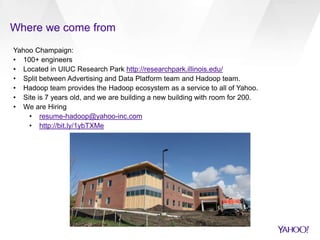
Where we come from 
Yahoo Champaign: 
• 100+ engineers 
• Located in UIUC Research Park http://researchpark.illinois.edu/ 
• Split between Advertising and Data Platform team and Hadoop team. 
• Hadoop team provides the Hadoop ecosystem as a service to all of Yahoo. 
• Site is 7 years old, and we are building a new building with room for 200. 
• We are Hiring 
• resume-hadoop@yahoo-inc.com 
• http://bit.ly/1ybTXMe
Agenda 
Spark Overview (1.1) 
Storm Overview (0.9.2) 
Things to Consider 
Example Architectures 
4 Yahoo Confidential & Proprietary
Apache Spark 
5
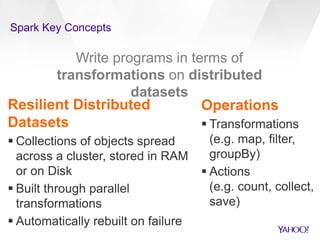
Spark Key Concepts 
Write programs in terms of 
transformations on distributed 
Resilient Distributed 
Datasets 
 Collections of objects spread 
across a cluster, stored in RAM 
or on Disk 
 Built through parallel 
transformations 
 Automatically rebuilt on failure 
Operations 
 Transformations 
(e.g. map, filter, 
groupBy) 
 Actions 
(e.g. count, collect, 
save) 
datasets
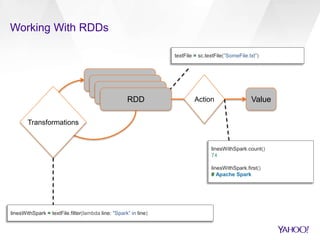
Working With RDDs 
RDD 
RDD 
RDD 
RDD 
Transformations 
textFile = sc.textFile(”SomeFile.txt”) 
Action Value 
linesWithSpark = textFile.filter(lambda line: "Spark” in line) 
linesWithSpark.count() 
74 
linesWithSpark.first() 
# Apache Spark
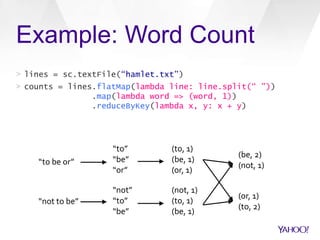
Example: Word Count 
> lines = sc.textFile(“hamlet.txt”) 
> counts = lines.flatMap(lambda line: line.split(“ ”)) 
.map(lambda word => (word, 1)) 
.reduceByKey(lambda x, y: x + y) 
“to be or” 
“not to be” 
“to” 
“be” 
“or” 
“not” 
“to” 
“be” 
(to, 1) 
(be, 1) 
(or, 1) 
(not, 1) 
(to, 1) 
(be, 1) 
(be, 2) 
(not, 1) 
(or, 1) 
(to, 2)
Spark Streaming Word Count 
updateFunc = (values: Seq[Int], state: Option[Int]) => { 
val currentCount = values.foldLeft(0)(_ + _) 
val previousCount = state.getOrElse(0) 
Some(currentCount + previousCount) 
} 
… 
lines = ssc.socketTextStream(args(0), args(1).toInt) 
Words = lines.flatMap(lambda line: line.split(“ ”)) 
wordDstream = words.map(lambda word => (word, 1)) 
stateDstream = wordDstream.updateStateByKey[Int](updateFunc) 
ssc.start() 
ssc.awaitTermination()
10 
Apache Storm
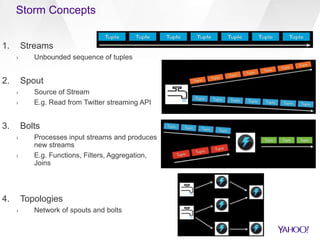
Storm Concepts 
1. Streams 
› Unbounded sequence of tuples 
2. Spout 
› Source of Stream 
› E.g. Read from Twitter streaming API 
3. Bolts 
› Processes input streams and produces 
new streams 
› E.g. Functions, Filters, Aggregation, 
Joins 
4. Topologies 
› Network of spouts and bolts
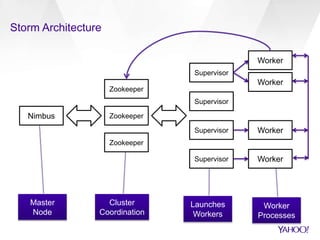
Storm Architecture 
Master 
Node 
Cluster 
Coordination 
Worker 
Worker 
Worker 
Worker 
Processes 
Nimbus 
Zookeeper 
Zookeeper 
Zookeeper 
Supervisor 
Supervisor 
Supervisor 
Supervisor Worker 
Launches 
Workers
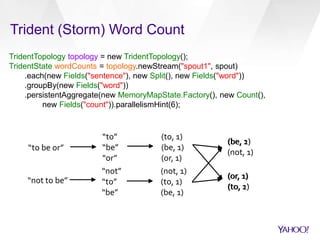
Trident (Storm) Word Count 
TridentTopology topology = new TridentTopology(); 
TridentState wordCounts = topology.newStream("spout1", spout) 
.each(new Fields("sentence"), new Split(), new Fields("word")) 
.groupBy(new Fields("word")) 
.persistentAggregate(new MemoryMapState.Factory(), new Count(), 
new Fields("count")).parallelismHint(6); 
“to be or” 
“to” 
“be” 
“or” 
(to, 1) 
(be, 1) 
(or, 1) 
1) 
1) 
“not to be” 
“not” 
“to” 
“be” 
(not, 1) 
(to, 1) 
(be, 1) 
(be, 2) 
(not, 1) 
(or, 1) 
(to, 2)
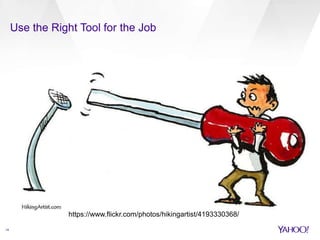
Use the Right Tool for the Job 
14 
https://www.flickr.com/photos/hikingartist/4193330368/
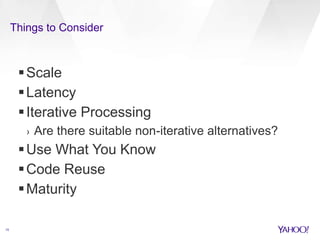
Things to Consider 
15 
Scale 
Latency 
 Iterative Processing 
› Are there suitable non-iterative alternatives? 
Use What You Know 
Code Reuse 
Maturity
When We Recommend Spark 
16 
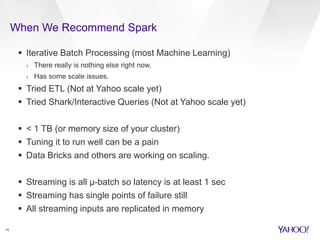
 Iterative Batch Processing (most Machine Learning) 
› There really is nothing else right now. 
› Has some scale issues. 
 Tried ETL (Not at Yahoo scale yet) 
 Tried Shark/Interactive Queries (Not at Yahoo scale yet) 
 < 1 TB (or memory size of your cluster) 
 Tuning it to run well can be a pain 
 Data Bricks and others are working on scaling. 
 Streaming is all μ-batch so latency is at least 1 sec 
 Streaming has single points of failure still 
 All streaming inputs are replicated in memory
When We Recommend Storm 
17 
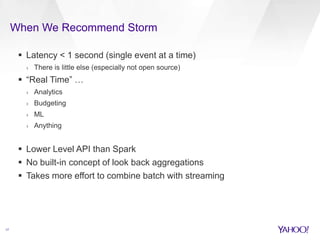
 Latency < 1 second (single event at a time) 
› There is little else (especially not open source) 
 “Real Time” … 
› Analytics 
› Budgeting 
› ML 
› Anything 
 Lower Level API than Spark 
 No built-in concept of look back aggregations 
 Takes more effort to combine batch with streaming
Fictitious Example: My Commute App 
18 
 Mobile App that lets users track their commute. 
 Cities, users, companies, etc. compete daily for 
› Shortest commute time 
› Greenest commute 
 Make money by selling location based ads and aggregate data to 
› Governments 
› Advertisers 
 Feel free to steal my crazy idea, I just want to be invited to the launch 
party, and I wouldn't say no to some stock.
Chicago vs. Champaign Urbana 
19 
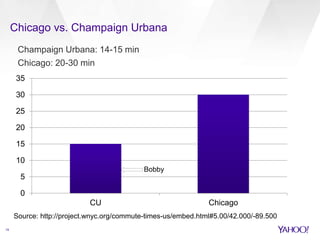
Champaign Urbana: 14-15 min 
Chicago: 20-30 min 
35 
30 
25 
20 
15 
10 
5 
0 
Bobby 
CU Chicago 
Source: http://project.wnyc.org/commute-times-us/embed.html#5.00/42.000/-89.500
Things to Consider 
20 
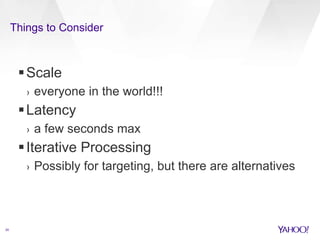
Scale 
› everyone in the world!!! 
Latency 
› a few seconds max 
 Iterative Processing 
› Possibly for targeting, but there are alternatives
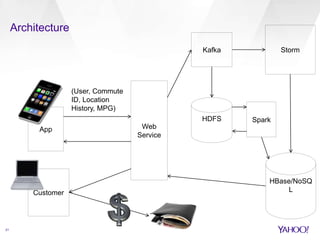
Architecture 
App Web 
Service 
(User, Commute 
ID, Location 
History, MPG) 
Kafka Storm 
HBase/NoSQ 
L 
HDFS Spark 
Customer 
21
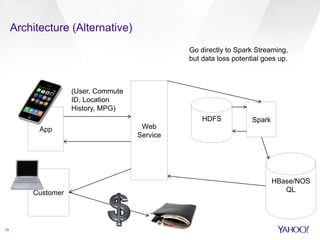
Architecture (Alternative) 
App Web 
Service 
(User, Commute 
ID, Location 
History, MPG) 
HBase/NOS 
QL 
HDFS Spark 
Customer 
22 
Go directly to Spark Streaming, 
but data loss potential goes up.
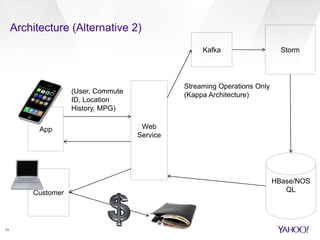
Architecture (Alternative 2) 
App Web 
Service 
(User, Commute 
ID, Location 
History, MPG) 
Kafka Storm 
HBase/NOS 
QL 
Customer 
23 
Streaming Operations Only 
(Kappa Architecture)
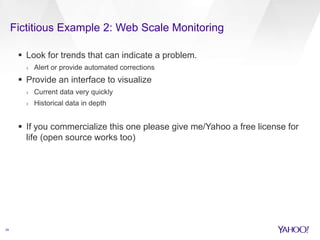
Fictitious Example 2: Web Scale Monitoring 
24 
 Look for trends that can indicate a problem. 
› Alert or provide automated corrections 
 Provide an interface to visualize 
› Current data very quickly 
› Historical data in depth 
 If you commercialize this one please give me/Yahoo a free license for 
life (open source works too)
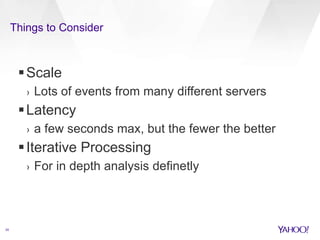
Things to Consider 
25 
Scale 
› Lots of events from many different servers 
Latency 
› a few seconds max, but the fewer the better 
 Iterative Processing 
› For in depth analysis definetly
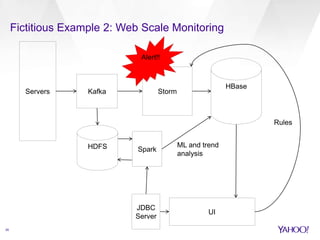
Fictitious Example 2: Web Scale Monitoring 
26 
Servers 
HBase 
Kafka Storm 
HDFS Spark 
UI 
Alert!! 
JDBC 
Server 
Rules 
ML and trend 
analysis
Questions? 
bobby@apache.org resume-hadoop@yahoo-inc.com 
http://bit.ly/1ybTXMe

Yahoo compares Storm and Spark

  • 1.
    Spark and Stormat Yahoo Wh y c h o o s e o n e o v e r t h e o t h e r ? P R E S E N T E D B Y B o b b y E v a n s a n d T o m G r a v e s
  • 2.
    Tom Graves BobbyEvans (bobby@apache.org) 2  Committers and PMC/PPMC Members for › Apache Storm incubating (Bobby) › Apache Hadoop (Tom and Bobby) › Apache Spark (Tom and Bobby) › Apache TEZ (Tom and Bobby)  Low Latency Big Data team at Yahoo (Part of the Hadoop Team) › Apache Storm as a service • 1,300+ nodes total, 250 node cluster (soon to be 4000 nodes). › Apache Spark on YARN • 40,000 nodes total, 5000+ node cluster › Help with distributed ML and deep learning.
  • 3.
    Where we comefrom Yahoo Champaign: • 100+ engineers • Located in UIUC Research Park http://researchpark.illinois.edu/ • Split between Advertising and Data Platform team and Hadoop team. • Hadoop team provides the Hadoop ecosystem as a service to all of Yahoo. • Site is 7 years old, and we are building a new building with room for 200. • We are Hiring • resume-hadoop@yahoo-inc.com • http://bit.ly/1ybTXMe
  • 4.
    Agenda Spark Overview(1.1) Storm Overview (0.9.2) Things to Consider Example Architectures 4 Yahoo Confidential & Proprietary
  • 5.
  • 6.
    Spark Key Concepts Write programs in terms of transformations on distributed Resilient Distributed Datasets  Collections of objects spread across a cluster, stored in RAM or on Disk  Built through parallel transformations  Automatically rebuilt on failure Operations  Transformations (e.g. map, filter, groupBy)  Actions (e.g. count, collect, save) datasets
  • 7.
    Working With RDDs RDD RDD RDD RDD Transformations textFile = sc.textFile(”SomeFile.txt”) Action Value linesWithSpark = textFile.filter(lambda line: "Spark” in line) linesWithSpark.count() 74 linesWithSpark.first() # Apache Spark
  • 8.
    Example: Word Count > lines = sc.textFile(“hamlet.txt”) > counts = lines.flatMap(lambda line: line.split(“ ”)) .map(lambda word => (word, 1)) .reduceByKey(lambda x, y: x + y) “to be or” “not to be” “to” “be” “or” “not” “to” “be” (to, 1) (be, 1) (or, 1) (not, 1) (to, 1) (be, 1) (be, 2) (not, 1) (or, 1) (to, 2)
  • 9.
    Spark Streaming WordCount updateFunc = (values: Seq[Int], state: Option[Int]) => { val currentCount = values.foldLeft(0)(_ + _) val previousCount = state.getOrElse(0) Some(currentCount + previousCount) } … lines = ssc.socketTextStream(args(0), args(1).toInt) Words = lines.flatMap(lambda line: line.split(“ ”)) wordDstream = words.map(lambda word => (word, 1)) stateDstream = wordDstream.updateStateByKey[Int](updateFunc) ssc.start() ssc.awaitTermination()
  • 10.
  • 11.
    Storm Concepts 1.Streams › Unbounded sequence of tuples 2. Spout › Source of Stream › E.g. Read from Twitter streaming API 3. Bolts › Processes input streams and produces new streams › E.g. Functions, Filters, Aggregation, Joins 4. Topologies › Network of spouts and bolts
  • 12.
    Storm Architecture Master Node Cluster Coordination Worker Worker Worker Worker Processes Nimbus Zookeeper Zookeeper Zookeeper Supervisor Supervisor Supervisor Supervisor Worker Launches Workers
  • 13.
    Trident (Storm) WordCount TridentTopology topology = new TridentTopology(); TridentState wordCounts = topology.newStream("spout1", spout) .each(new Fields("sentence"), new Split(), new Fields("word")) .groupBy(new Fields("word")) .persistentAggregate(new MemoryMapState.Factory(), new Count(), new Fields("count")).parallelismHint(6); “to be or” “to” “be” “or” (to, 1) (be, 1) (or, 1) 1) 1) “not to be” “not” “to” “be” (not, 1) (to, 1) (be, 1) (be, 2) (not, 1) (or, 1) (to, 2)
  • 14.
    Use the RightTool for the Job 14 https://www.flickr.com/photos/hikingartist/4193330368/
  • 15.
    Things to Consider 15 Scale Latency  Iterative Processing › Are there suitable non-iterative alternatives? Use What You Know Code Reuse Maturity
  • 16.
    When We RecommendSpark 16  Iterative Batch Processing (most Machine Learning) › There really is nothing else right now. › Has some scale issues.  Tried ETL (Not at Yahoo scale yet)  Tried Shark/Interactive Queries (Not at Yahoo scale yet)  < 1 TB (or memory size of your cluster)  Tuning it to run well can be a pain  Data Bricks and others are working on scaling.  Streaming is all μ-batch so latency is at least 1 sec  Streaming has single points of failure still  All streaming inputs are replicated in memory
  • 17.
    When We RecommendStorm 17  Latency < 1 second (single event at a time) › There is little else (especially not open source)  “Real Time” … › Analytics › Budgeting › ML › Anything  Lower Level API than Spark  No built-in concept of look back aggregations  Takes more effort to combine batch with streaming
  • 18.
    Fictitious Example: MyCommute App 18  Mobile App that lets users track their commute.  Cities, users, companies, etc. compete daily for › Shortest commute time › Greenest commute  Make money by selling location based ads and aggregate data to › Governments › Advertisers  Feel free to steal my crazy idea, I just want to be invited to the launch party, and I wouldn't say no to some stock.
  • 19.
    Chicago vs. ChampaignUrbana 19 Champaign Urbana: 14-15 min Chicago: 20-30 min 35 30 25 20 15 10 5 0 Bobby CU Chicago Source: http://project.wnyc.org/commute-times-us/embed.html#5.00/42.000/-89.500
  • 20.
    Things to Consider 20 Scale › everyone in the world!!! Latency › a few seconds max  Iterative Processing › Possibly for targeting, but there are alternatives
  • 21.
    Architecture App Web Service (User, Commute ID, Location History, MPG) Kafka Storm HBase/NoSQ L HDFS Spark Customer 21
  • 22.
    Architecture (Alternative) AppWeb Service (User, Commute ID, Location History, MPG) HBase/NOS QL HDFS Spark Customer 22 Go directly to Spark Streaming, but data loss potential goes up.
  • 23.
    Architecture (Alternative 2) App Web Service (User, Commute ID, Location History, MPG) Kafka Storm HBase/NOS QL Customer 23 Streaming Operations Only (Kappa Architecture)
  • 24.
    Fictitious Example 2:Web Scale Monitoring 24  Look for trends that can indicate a problem. › Alert or provide automated corrections  Provide an interface to visualize › Current data very quickly › Historical data in depth  If you commercialize this one please give me/Yahoo a free license for life (open source works too)
  • 25.
    Things to Consider 25 Scale › Lots of events from many different servers Latency › a few seconds max, but the fewer the better  Iterative Processing › For in depth analysis definetly
  • 26.
    Fictitious Example 2:Web Scale Monitoring 26 Servers HBase Kafka Storm HDFS Spark UI Alert!! JDBC Server Rules ML and trend analysis
  • 27.

Editor's Notes

  • #7 RDD  Colloquially referred to as RDDs (e.g. caching in RAM) Lazy operations to build RDDs from other RDDs Return a result or write it to storage
  • #8 Let me illustrate this with some bad powerpoint diagrams and animations This diagram is LOGICAL,
  • #24 Trend analysis is difficult but sketches for approximations on many aggregates and Gradient Decent or VW for ML make this still an attractive option.