Essentials of Anatomy & Physiology, 4th Edition
Martini/Bartholomew
PowerPoint® Lecture Outlines
prepared by Alan Magid, Duke University
The Muscular
System7
BY;
KURGAT GILBERT
IIIBSc.BIOCHEMISTRY
What is blotting?
Blots are techniques for transferring DNA , RNA
and proteins onto a carrier so they can be
separated, and often follows the use of a gel
electrophoresis. The Southern blot is used for
transferring DNA, the Northern blot for RNA and
the western blot for PROTEIN.
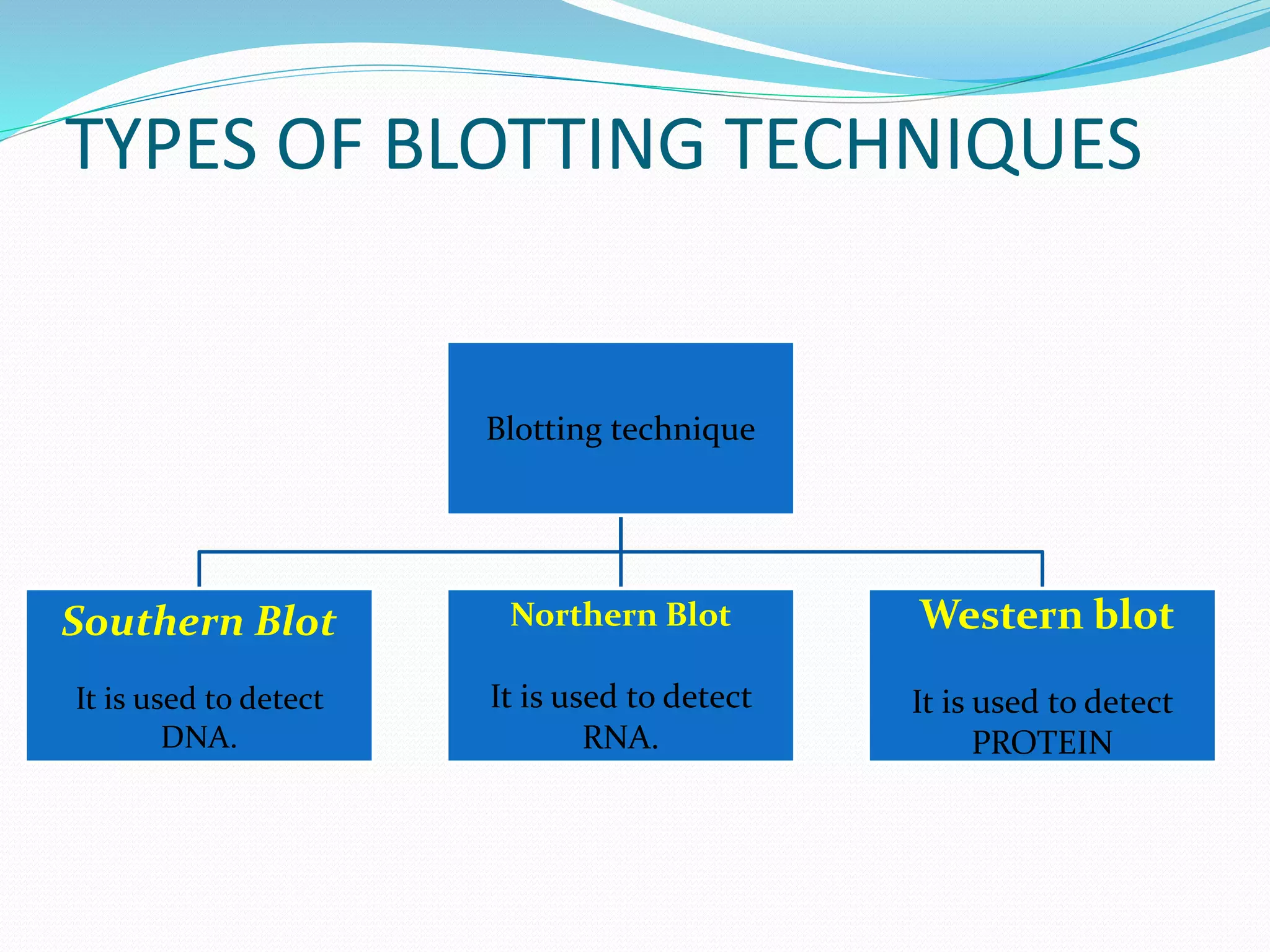
TYPES OF BLOTTING TECHNIQUES
Blotting technique
Southern Blot
It is used to detect
DNA.
Northern Blot
It is used to detect
RNA.
Western blot
It is used to detect
PROTEIN
SOUTHERN BLOTTING
 Professor Sir Edwin Southern,
Professor of Biochemistry and
Fellow of Trinity developed this
method in 1975.
 Southern won the Lasker Award
for Clinical Medical Research
prize for the method of finding
specific DNA sequences he
developed this procedure at
Edinburgh University more than
30 years ago. The technique is
known as DNA transfer or
'Southern blotting'
Professor Sir Edwin Southern
Cont….
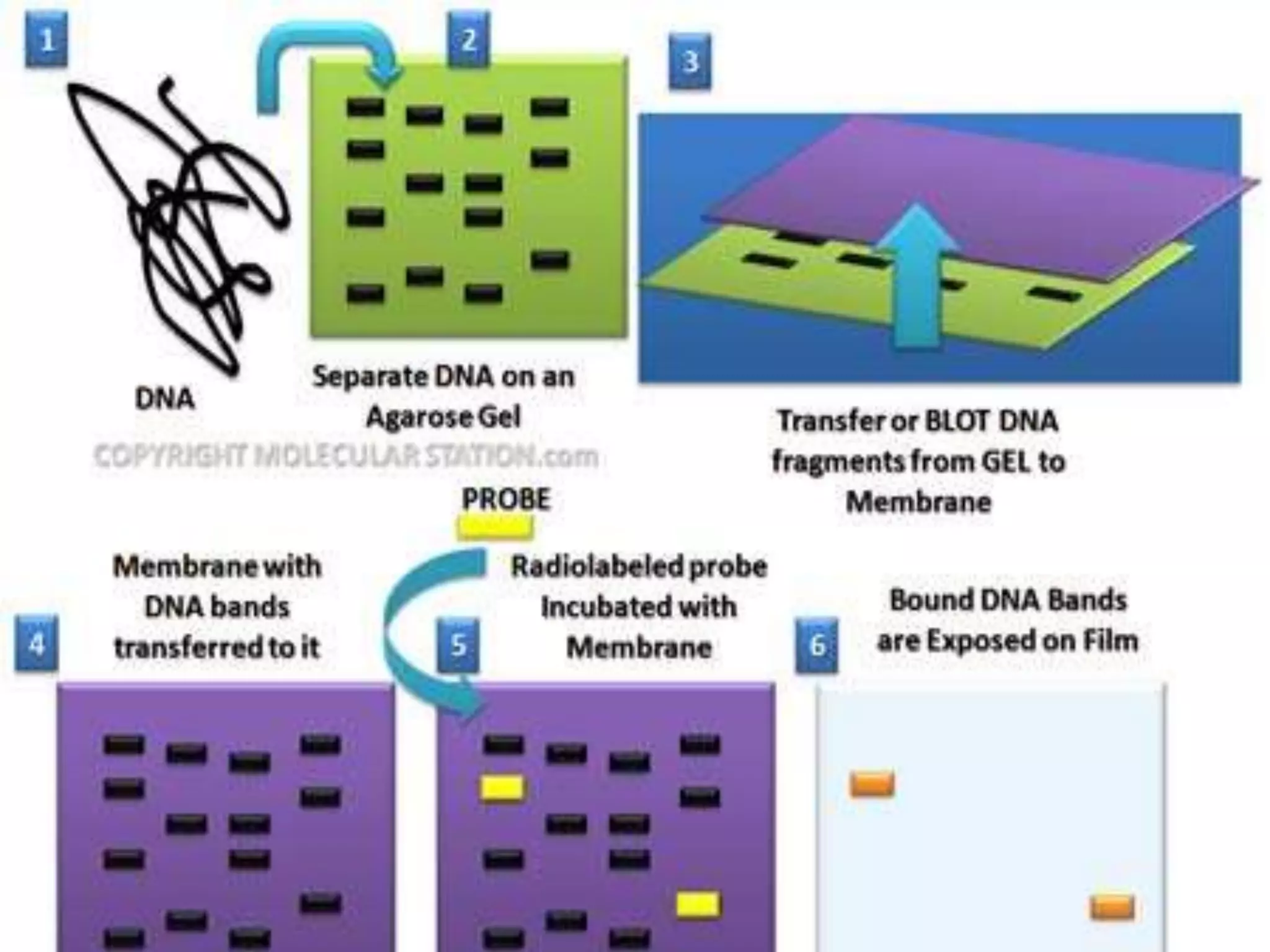
 This method Involves separation, transfer and hybridization.
 It is a method routinely used in molecular biology for
detection of a specific DNA sequence in DNA samples. The
DNA detected can be a single gene, or it can be part of a
larger piece of DNA such as a viral genome.
Cont….
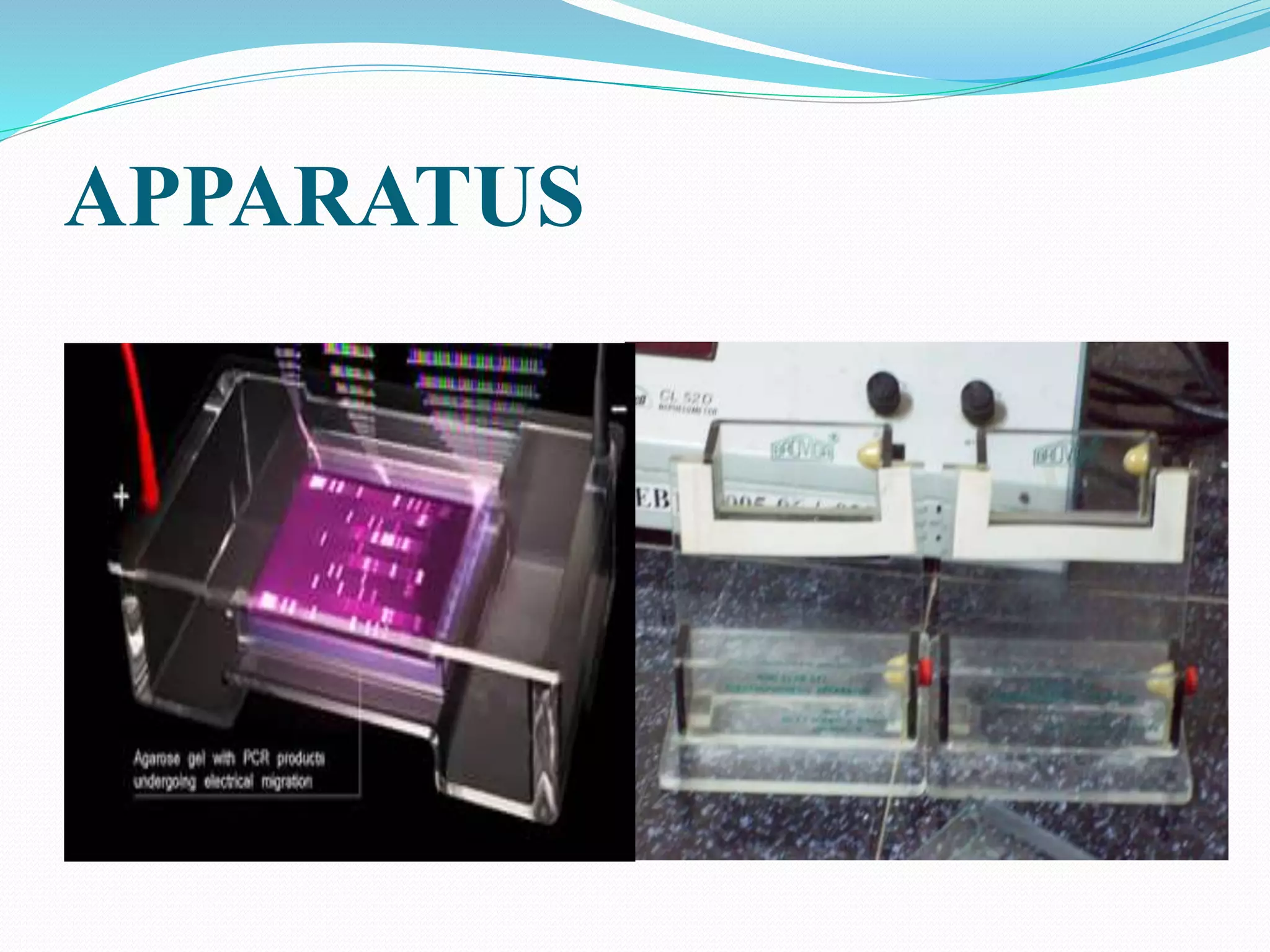
 Southern blotting combines agarose gel electrophoresis for
size separation of DNA with methods to transfer the size
separated DNA to a filter membrane for probe hybridization.
 The key to this method is Hybridization.
 Hybridization - Process of forming a double-stranded DNA
molecule between a single-stranded DNA probe and a
single-stranded target patient DNA.
PRINCIPLE
1. The mixture of molecules is separated.
2. The molecules are immobilized on a matrix.
3. The probe is added to the matrix to bind to the
molecules.
4. Any unbound probes are then removed.
5. The place where the probe is connected corresponds to
the location of the immobilized target molecule.
APPARATUS
Cont;
Whatman 3MM paper nitrocellulosemembrane
Southern blotting set up
Capillary plotting apparatus
Steps in southern blotting
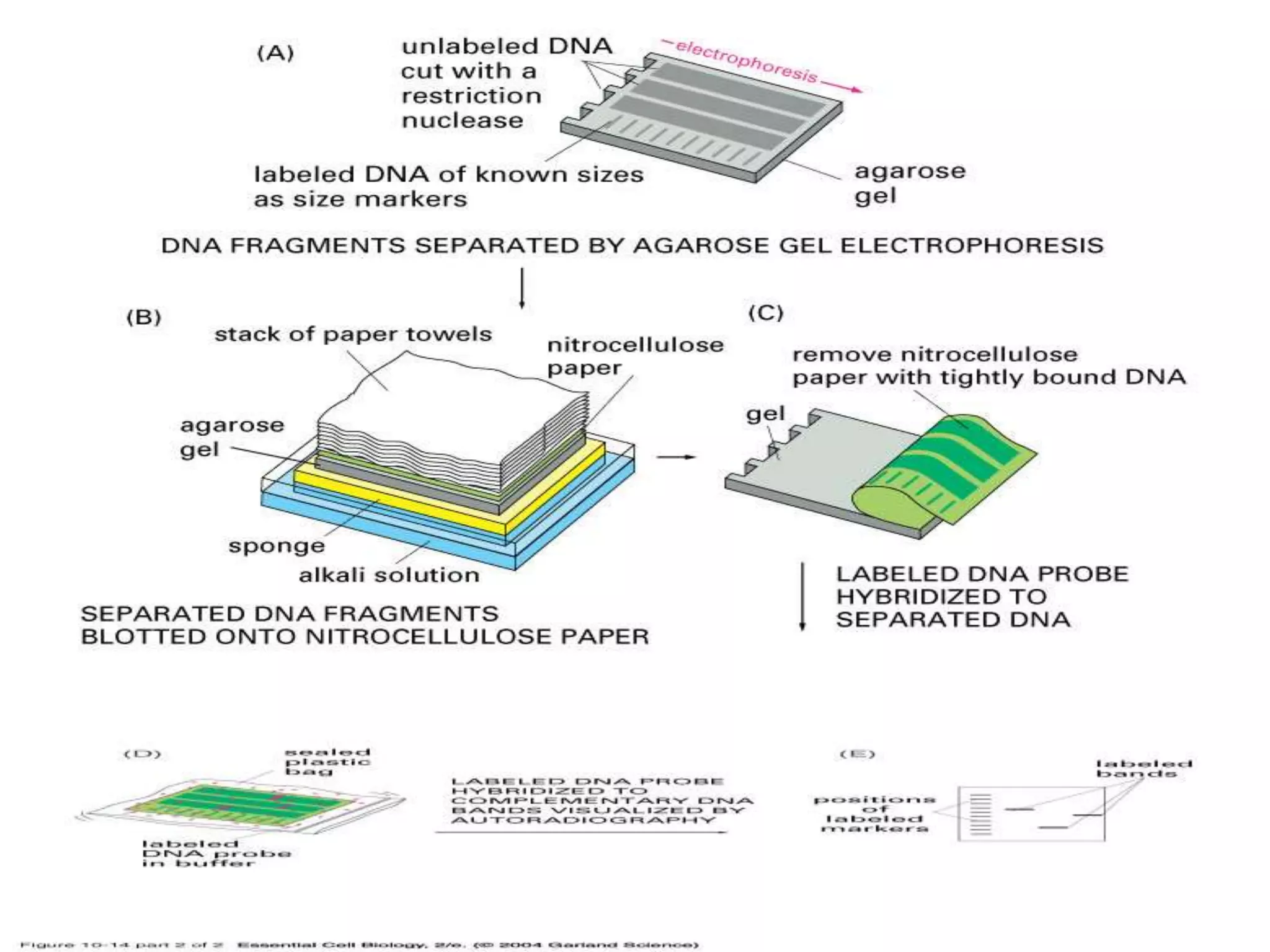
1. Digest the DNA with an
appropriate restriction
enzyme.
2.The complex mixture of
fragments is subjected to gel
electrophoresis to separate
the fragments according to
size.
Cont….
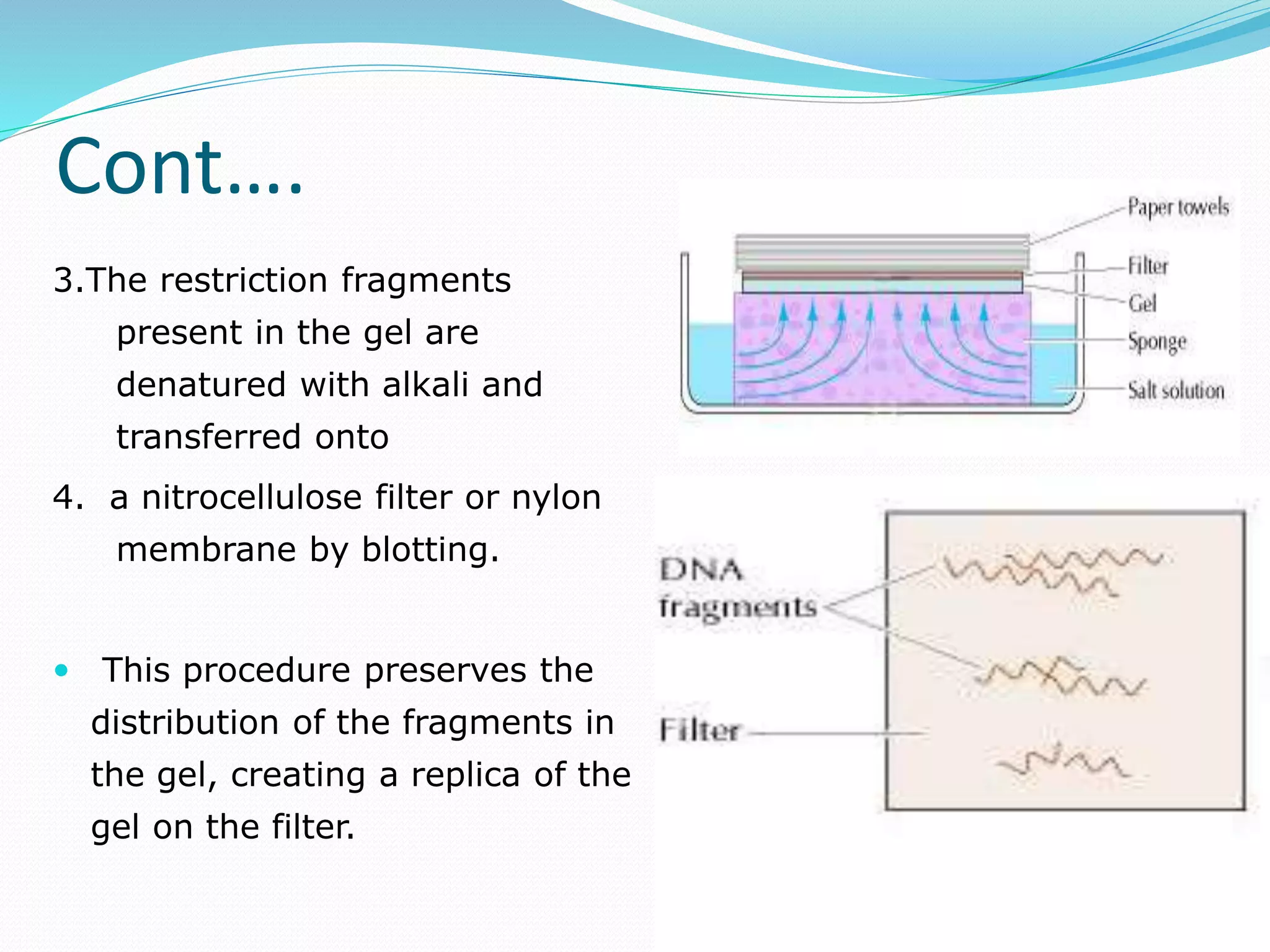
3.The restriction fragments
present in the gel are
denatured with alkali and
transferred onto
4. a nitrocellulose filter or nylon
membrane by blotting.
 This procedure preserves the
distribution of the fragments in
the gel, creating a replica of the
gel on the filter.
Cont….
5.The filter is incubated under
hybridization conditions with
a specific radiolabeled DNA
probe.
 The probe hybridizes to the
complementary DNA
restriction fragment.
Cont….
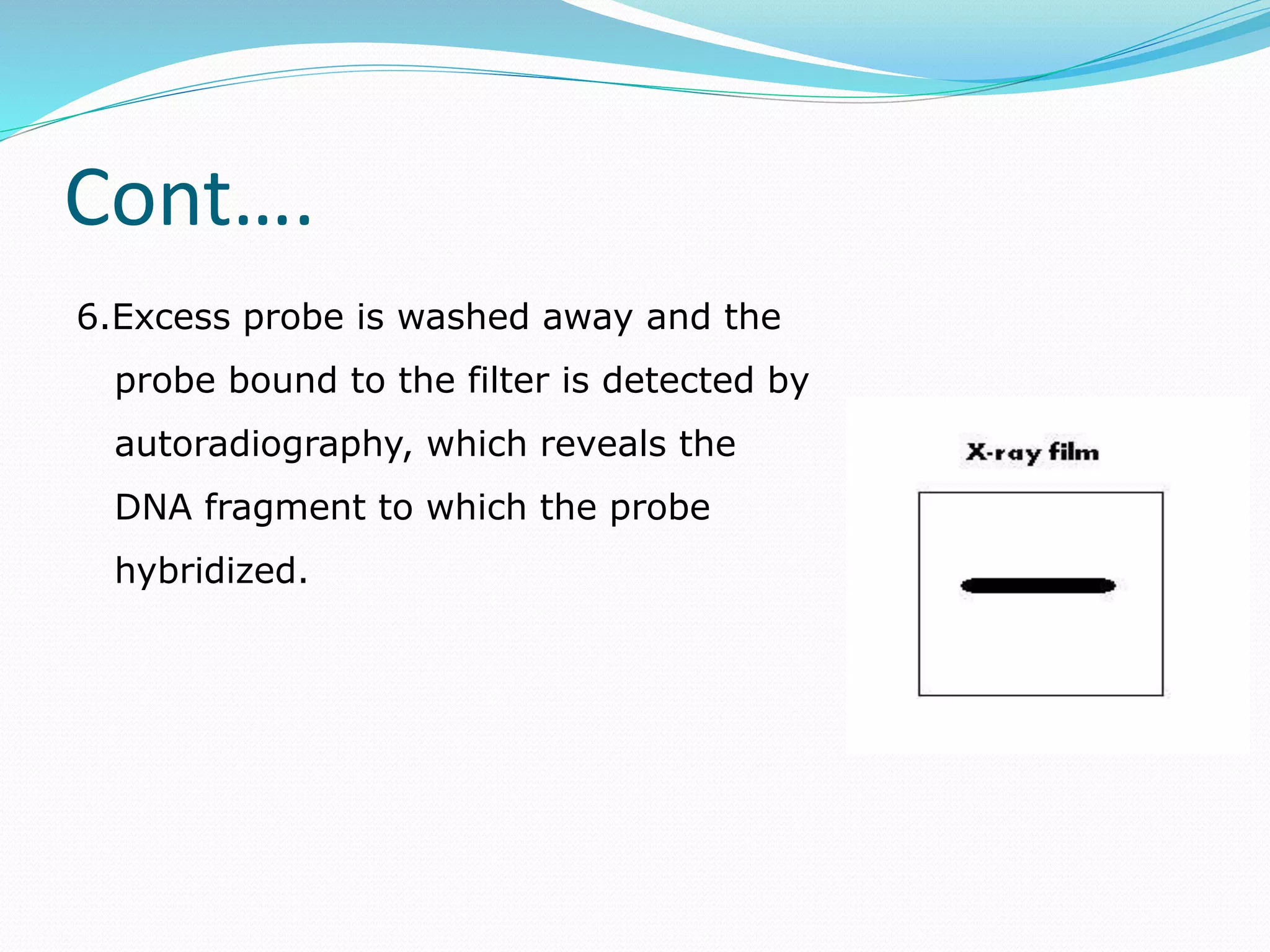
6.Excess probe is washed away and the
probe bound to the filter is detected by
autoradiography, which reveals the
DNA fragment to which the probe
hybridized.
APPLICATIONS
 Southern blots are used in gene discovery , mapping,
evolution and development studies, diagnostics and
forensics (It is used for DNA fingerprinting, preparation of RFLP
maps)
 identification of the transferred genes in transgenic individuals, etc.
APPLICATIONS
 Southern blots allow investigators to determine the
molecular weight of a restriction fragment and to measure
relative amounts in different samples.
 Southern blot is used to detect the presence of a particular
bit of DNA in a sample
 analyze the genetic patterns which appear in a person's
DNA.
Northern Blotting
Northern blotting is a technique for detection of
specific RNA sequences. Northern blotting was
developed by James Alwine and George Stark at
Stanford University (1979) and was named such by
analogy to Southern blotting
Steps involved in Northern
blotting
1. RNA is isolated from several
biological samples (e.g.
various tissues, various
developmental stages of same
tissue etc.)
* RNA is more susceptible to
degradation than DNA.
Cont……
2. Sample’s are loaded on gel and the
RNA samples are separated
according to their size on an
agarose gel .
 The resulting gel following after the
electrophoresis run.
Cont……
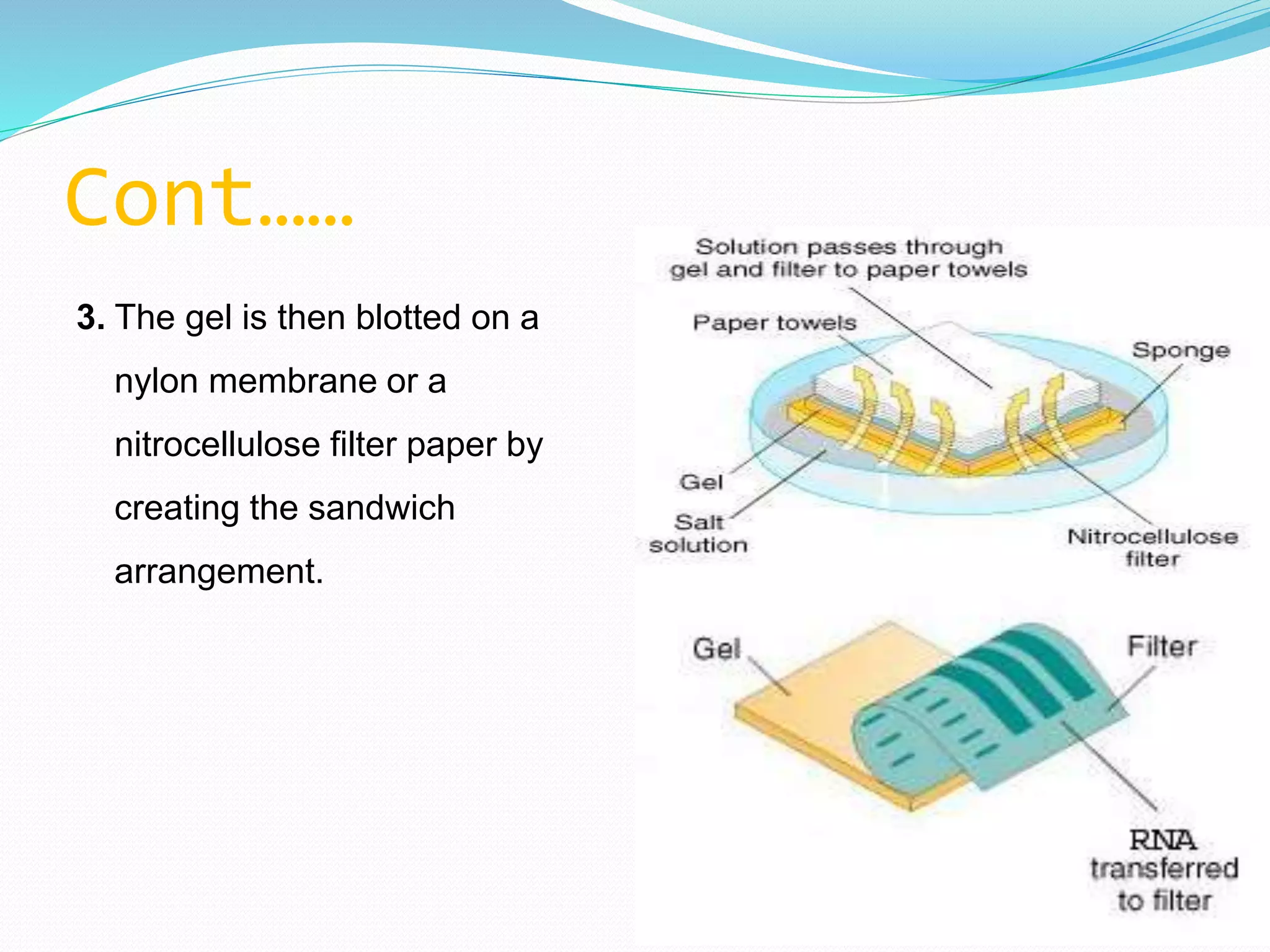
3. The gel is then blotted on a
nylon membrane or a
nitrocellulose filter paper by
creating the sandwich
arrangement.
Cont……
4. The membrane is placed in a dish containing
hybridization buffer with a labeled probe.
 Thus, it will hybridize to the RNA on the blot
that corresponds to the sequence of
interest.
5. The membrane is washed to remove
unbound probe.
Cont……
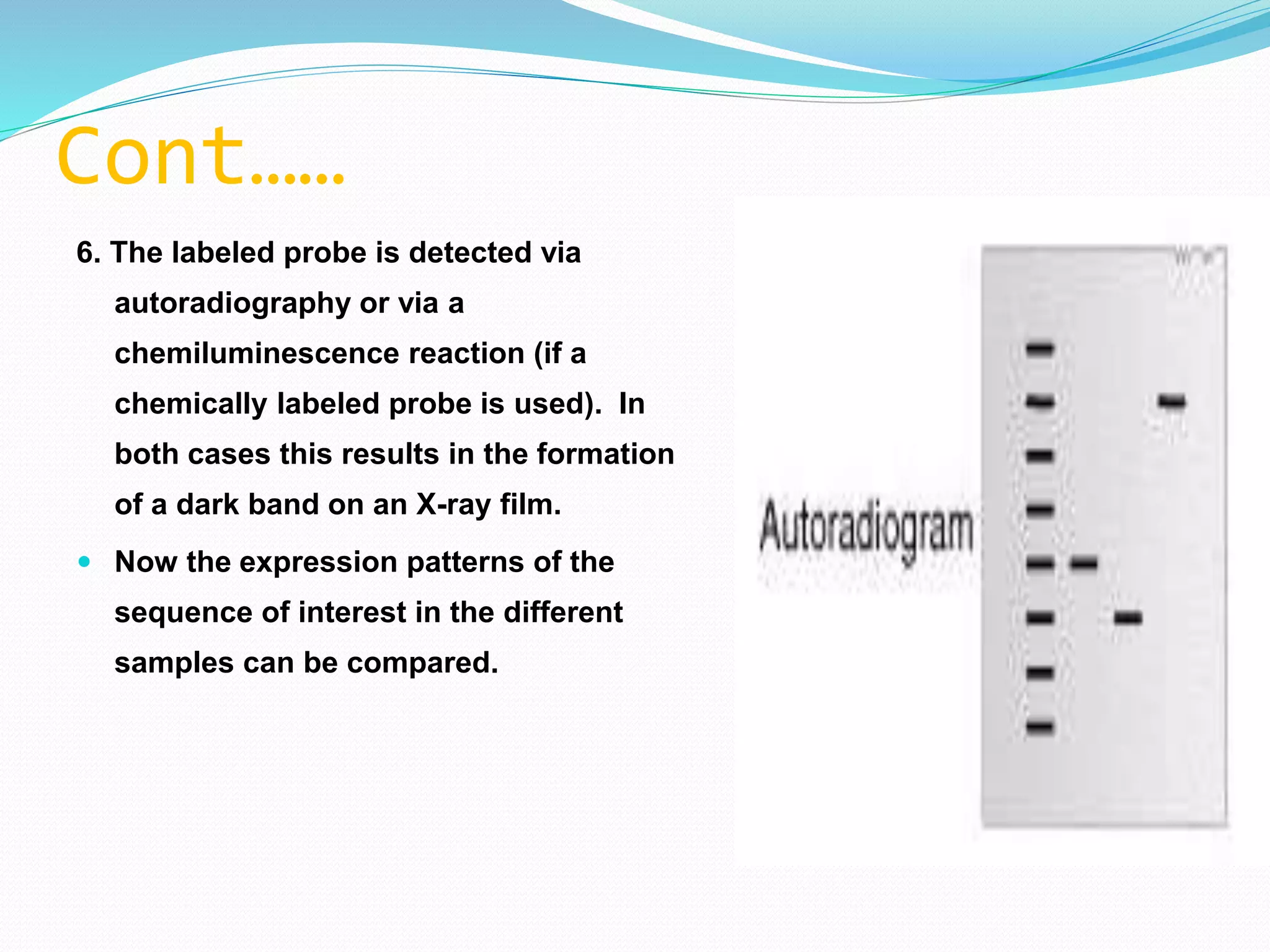
6. The labeled probe is detected via
autoradiography or via a
chemiluminescence reaction (if a
chemically labeled probe is used). In
both cases this results in the formation
of a dark band on an X-ray film.
 Now the expression patterns of the
sequence of interest in the different
samples can be compared.
APPLICATIONS
 A standard for the study of gene expression at the level of
mRNA (messenger RNA transcripts)
 Detection of mRNA transcript size
 Study RNA degradation
 Study RNA splicing
 Study RNA half-life
 Often used to confirm and check transgenic / knockout mice
(animals)
Disadvantage of Northern
blotting
1.The standard northern blot method is relatively less sensitive than
nuclease protection assays and RT-PCR
2. Detection with multiple probes is a problem
3. If RNA samples are even slightly degraded by RNases, the quality of
the data and quantitation of expression is quite negatively affected.
Western blotting
 Western blotting (1981) is an Immunoblotting technique which rely on
the specificity of binding between a protein of interest and a probe
(antibody raised against that particular protein) to allow detection of the
protein of interest in a mixture of many other similar molecules.
 The SDS PAGE technique is a prerequisite for Western blotting .
Steps in western blotting
1. A protein sample is subjected to
electrophoresis on an SDS-
polyacrylamide gel.
2. Electroblotting transfers the
separated proteins from the gel to the
surface of a nitrocellulose membrane.
Cont…
3. The blot is incubated with a generic protein (such as milk
proteins or BSA) which binds to any remaining sticky places
on the nitrocellulose.
4. An antibody that is specific for the protein of interest (the
primary antibody - Ab1) is added to the nitrocellulose sheet
and reacts with the antigen. Only the band containing the
protein of interest binds the antibody, forming a layer of
antibody molecules .
Cont…
5. After washing for removal of non-specifically bound
Ab1, second antibody (Ab2)is added, which
specifically recognizes the Fc domain of the
primary antibody and binds it. Ab2 is radioactively
labeled, or is covalently linked to a reporter enzyme,
which allows to visualize the protein-Ab1-Ab2
complex.
An example
Application
1.The confirmatory HIV test
2.Western blot is also used as the definitive test for
Bovine spongiform encephalopathy (BSE(
3.Some forms of Lyme disease testing employ Western
blotting .
GOD BLESS YOU

Blotting Techniques

  • 1.
    Essentials of Anatomy& Physiology, 4th Edition Martini/Bartholomew PowerPoint® Lecture Outlines prepared by Alan Magid, Duke University The Muscular System7 BY; KURGAT GILBERT IIIBSc.BIOCHEMISTRY
  • 2.
    What is blotting? Blotsare techniques for transferring DNA , RNA and proteins onto a carrier so they can be separated, and often follows the use of a gel electrophoresis. The Southern blot is used for transferring DNA, the Northern blot for RNA and the western blot for PROTEIN.
  • 3.
    TYPES OF BLOTTINGTECHNIQUES Blotting technique Southern Blot It is used to detect DNA. Northern Blot It is used to detect RNA. Western blot It is used to detect PROTEIN
  • 4.
    SOUTHERN BLOTTING  ProfessorSir Edwin Southern, Professor of Biochemistry and Fellow of Trinity developed this method in 1975.  Southern won the Lasker Award for Clinical Medical Research prize for the method of finding specific DNA sequences he developed this procedure at Edinburgh University more than 30 years ago. The technique is known as DNA transfer or 'Southern blotting' Professor Sir Edwin Southern
  • 5.
    Cont….  This methodInvolves separation, transfer and hybridization.  It is a method routinely used in molecular biology for detection of a specific DNA sequence in DNA samples. The DNA detected can be a single gene, or it can be part of a larger piece of DNA such as a viral genome.
  • 6.
    Cont….  Southern blottingcombines agarose gel electrophoresis for size separation of DNA with methods to transfer the size separated DNA to a filter membrane for probe hybridization.  The key to this method is Hybridization.  Hybridization - Process of forming a double-stranded DNA molecule between a single-stranded DNA probe and a single-stranded target patient DNA.
  • 7.
    PRINCIPLE 1. The mixtureof molecules is separated. 2. The molecules are immobilized on a matrix. 3. The probe is added to the matrix to bind to the molecules. 4. Any unbound probes are then removed. 5. The place where the probe is connected corresponds to the location of the immobilized target molecule.
  • 8.
  • 9.
    Cont; Whatman 3MM papernitrocellulosemembrane
  • 10.
    Southern blotting setup Capillary plotting apparatus
  • 11.
    Steps in southernblotting 1. Digest the DNA with an appropriate restriction enzyme. 2.The complex mixture of fragments is subjected to gel electrophoresis to separate the fragments according to size.
  • 12.
    Cont…. 3.The restriction fragments presentin the gel are denatured with alkali and transferred onto 4. a nitrocellulose filter or nylon membrane by blotting.  This procedure preserves the distribution of the fragments in the gel, creating a replica of the gel on the filter.
  • 13.
    Cont…. 5.The filter isincubated under hybridization conditions with a specific radiolabeled DNA probe.  The probe hybridizes to the complementary DNA restriction fragment.
  • 14.
    Cont…. 6.Excess probe iswashed away and the probe bound to the filter is detected by autoradiography, which reveals the DNA fragment to which the probe hybridized.
  • 17.
    APPLICATIONS  Southern blotsare used in gene discovery , mapping, evolution and development studies, diagnostics and forensics (It is used for DNA fingerprinting, preparation of RFLP maps)  identification of the transferred genes in transgenic individuals, etc.
  • 18.
    APPLICATIONS  Southern blotsallow investigators to determine the molecular weight of a restriction fragment and to measure relative amounts in different samples.  Southern blot is used to detect the presence of a particular bit of DNA in a sample  analyze the genetic patterns which appear in a person's DNA.
  • 19.
    Northern Blotting Northern blottingis a technique for detection of specific RNA sequences. Northern blotting was developed by James Alwine and George Stark at Stanford University (1979) and was named such by analogy to Southern blotting
  • 20.
    Steps involved inNorthern blotting 1. RNA is isolated from several biological samples (e.g. various tissues, various developmental stages of same tissue etc.) * RNA is more susceptible to degradation than DNA.
  • 21.
    Cont…… 2. Sample’s areloaded on gel and the RNA samples are separated according to their size on an agarose gel .  The resulting gel following after the electrophoresis run.
  • 22.
    Cont…… 3. The gelis then blotted on a nylon membrane or a nitrocellulose filter paper by creating the sandwich arrangement.
  • 23.
    Cont…… 4. The membraneis placed in a dish containing hybridization buffer with a labeled probe.  Thus, it will hybridize to the RNA on the blot that corresponds to the sequence of interest. 5. The membrane is washed to remove unbound probe.
  • 24.
    Cont…… 6. The labeledprobe is detected via autoradiography or via a chemiluminescence reaction (if a chemically labeled probe is used). In both cases this results in the formation of a dark band on an X-ray film.  Now the expression patterns of the sequence of interest in the different samples can be compared.
  • 25.
    APPLICATIONS  A standardfor the study of gene expression at the level of mRNA (messenger RNA transcripts)  Detection of mRNA transcript size  Study RNA degradation  Study RNA splicing  Study RNA half-life  Often used to confirm and check transgenic / knockout mice (animals)
  • 26.
    Disadvantage of Northern blotting 1.Thestandard northern blot method is relatively less sensitive than nuclease protection assays and RT-PCR 2. Detection with multiple probes is a problem 3. If RNA samples are even slightly degraded by RNases, the quality of the data and quantitation of expression is quite negatively affected.
  • 27.
    Western blotting  Westernblotting (1981) is an Immunoblotting technique which rely on the specificity of binding between a protein of interest and a probe (antibody raised against that particular protein) to allow detection of the protein of interest in a mixture of many other similar molecules.  The SDS PAGE technique is a prerequisite for Western blotting .
  • 28.
    Steps in westernblotting 1. A protein sample is subjected to electrophoresis on an SDS- polyacrylamide gel. 2. Electroblotting transfers the separated proteins from the gel to the surface of a nitrocellulose membrane.
  • 29.
    Cont… 3. The blotis incubated with a generic protein (such as milk proteins or BSA) which binds to any remaining sticky places on the nitrocellulose. 4. An antibody that is specific for the protein of interest (the primary antibody - Ab1) is added to the nitrocellulose sheet and reacts with the antigen. Only the band containing the protein of interest binds the antibody, forming a layer of antibody molecules .
  • 30.
    Cont… 5. After washingfor removal of non-specifically bound Ab1, second antibody (Ab2)is added, which specifically recognizes the Fc domain of the primary antibody and binds it. Ab2 is radioactively labeled, or is covalently linked to a reporter enzyme, which allows to visualize the protein-Ab1-Ab2 complex.
  • 31.
  • 32.
    Application 1.The confirmatory HIVtest 2.Western blot is also used as the definitive test for Bovine spongiform encephalopathy (BSE( 3.Some forms of Lyme disease testing employ Western blotting .
  • 33.