LAYING THE FOUNDATION TO BUILD A NEW MICHIGAN
BUSINESSLEADERSFORMICHIGAN
I2012
IMICHIGANTURNAROUNDPLAN
PAGES
1 I 2
2 Letter from the Chairman and CEO
3 Executive Summary
4 The Case for Change
5 The Impact on Michigan
7 Michigan’s Competitive Position
12 Progress
14 2012 Michigan Turnaround Plan Overview
25 The Six Step Turnaround Plan
27 Where We Could Be
Who We Are
Dedicated to making Michigan a “Top Ten” state for job, economic and personal income growth.
The state’s business roundtable: composed of the chairpersons, chief executives or most senior
executives of the state’s largest job providers and universities.
Driving nearly one-quarter of the state’s economy: provide over 320,000 direct jobs in Michigan,
generate over $1 trillion in annual revenue, and serve over 135,000 students.
www.BusinessLeadersForMichigan.com
Business Leaders for Michigan (BLM) is an organization dedicated to making Michigan a “Top Ten” state for job and
economic growth.We serve as a catalyst for change, a visionary organization that supports its ideas with careful
research, thorough planning, and accountability for results.
In 2009, we unveiled the Michigan Turnaround Plan (MTP), an aggressive agenda to make Michigan a Top Ten State
for job and economic growth. The Plan set forward the case for change, naming achievable goals, identifying action
steps and explaining the potential impact of change.The Plan is organized around a five-step strategy: improving the
way the state manages its finances, improving the efficiency and effectiveness of the public sector, getting Michigan
competitive to attract and retain jobs, making investments that will create a great job environment and accelerating
job growth through innovation and entrepreneurship.
We have worked closely with government, policy and business leaders to affect meaningful advancement of each
MTP objective. Citizens and stakeholders have rallied around the MTP. Thanks to policy makers in Lansing, the past
twelve months have been game-changers for our state and many components of the MTP are now in place.
Using our Michigan Turnaround Plan as a checklist, we can see how much has been done to strengthen our state
and reshape its economy. Our state finances are managed better, our tax policy has been improved, our regulatory
environment makes more sense, and the conditions are right to foster growth in our state, creating new jobs and
bringing life to our communities. As you read this report, we think you’ll see that much has been done to strengthen
Michigan’s economic environment. Our economy might not be a Top Ten State yet, but we’re well on our way.
In the 2012 Michigan Turnaround Plan, we identify what work remains in Steps 1-5 to further strengthen our state’s
competitiveness and put our state on a solid path to prosperity.
Now that our foundation is more solid, it is time to add a sixth step to the MTP – Leveraging Assets to Grow the New
Michigan. We identify existing Michigan assets that we believe, based on solid data, can be leveraged to accelerate
growth and transition to the New Michigan. It’s a 10+ year vision that builds on the first five steps of the Plan. We
detail the possibilities we see in each “growth opportunity” to reshape and strengthen the Michigan of tomorrow.
But this will require a shared vision for the future,one that allows us to effectively allocate resources,evaluate plans,and
maintain a coherent approach beyond election cycles.We have the capacity to move into a future that glows with promise.
We invite you to be part of this work. Each of us can have a role in Michigan’s turnaround.Together, we can seize control
of our destiny, make a shift in how we approach the future, and drive lasting change for the people of our great state.
Sincerely,
James B. Nicholson Doug Rothwell
Chair of the Board President & CEO
BUSINESSLEADERSFORMICHIGAN
I2012
IMICHIGANTURNAROUNDPLAN
PAGES
3 I 4
EXECUTIVE SUMMARY
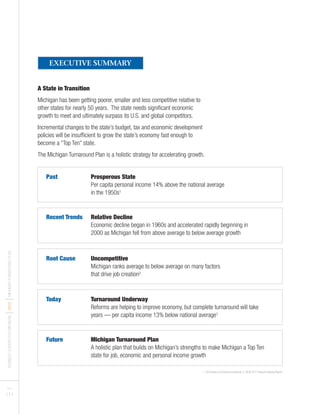
A State in Transition
Michigan has been getting poorer, smaller and less competitive relative to
other states for nearly 50 years. The state needs significant economic
growth to meet and ultimately surpass its U.S. and global competitors.
Incremental changes to the state’s budget, tax and economic development
policies will be insufficient to grow the state’s economy fast enough to
become a “Top Ten” state.
The Michigan Turnaround Plan is a holistic strategy for accelerating growth.
1. US Bureau of Economic Analysis, 2. BLM 2011 Benchmarking Report
Past Prosperous State
Per capita personal income 14% above the national average
in the 1950s1
Recent Trends Relative Decline
Economic decline began in 1960s and accelerated rapidly beginning in
2000 as Michigan fell from above average to below average growth
Root Cause Uncompetitive
Michigan ranks average to below average on many factors
that drive job creation2
Today Turnaround Underway
Reforms are helping to improve economy, but complete turnaround will take
years — per capita income 13% below national average1
Future Michigan Turnaround Plan
A holistic plan that builds on Michigan’s strengths to make Michigan a Top Ten
state for job, economic and personal income growth
THECASEFORCHANGE
One million jobs were lost in Michigan over the last decade
across virtually all industry sectors.
THE CASE FOR CHANGE
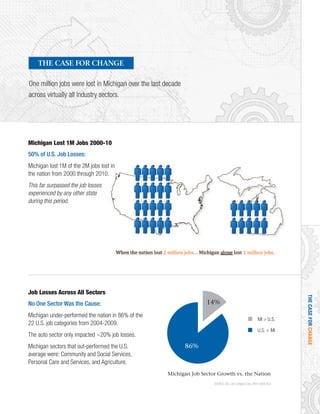
Michigan Lost 1M Jobs 2000-10
50% of U.S. Job Losses:
Michigan lost 1M of the 2M jobs lost in
the nation from 2000 through 2010.
This far surpassed the job losses
experienced by any other state
during this period.
Job Losses Across All Sectors
No One Sector Was the Cause:
Michigan under-performed the nation in 86% of the
22 U.S. job categories from 2004-2009.
The auto sector only impacted ~20% job losses.
Michigan sectors that out-performed the U.S.
average were: Community and Social Services,
Personal Care and Services, and Agriculture.
MI > U.S.
U.S. < MI
Michigan Job Sector Growth vs. the Nation
14%
86%
SOURCE: SOC Job Category Data 2004-2009, BLS
BUSINESSLEADERSFORMICHIGAN
I2012
IMICHIGANTURNAROUNDPLAN
PAGES
5 I 6
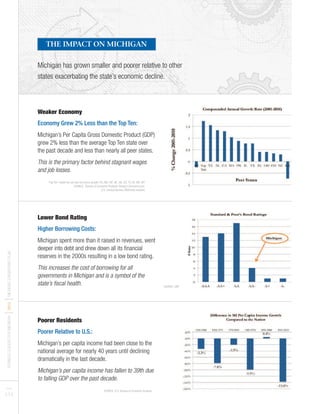
Weaker Economy
Economy Grew 2% Less than the Top Ten:
Michigan’s Per Capita Gross Domestic Product (GDP)
grew 2% less than the average Top Ten state over
the past decade and less than nearly all peer states.
This is the primary factor behind stagnant wages
and job losses.
Lower Bond Rating
Higher Borrowing Costs:
Michigan spent more than it raised in revenues, went
deeper into debt and drew down all its financial
reserves in the 2000s resulting in a low bond rating.
This increases the cost of borrowing for all
governments in Michigan and is a symbol of the
state’s fiscal health.
Poorer Residents
Poorer Relative to U.S.:
Michigan’s per capita income had been close to the
national average for nearly 40 years until declining
dramatically in the last decade.
Michigan’s per capita income has fallen to 39th due
to falling GDP over the past decade.
Michigan has grown smaller and poorer relative to other
states exacerbating the state’s economic decline.
THE IMPACT ON MICHIGAN
“Top Ten” states for job and economic growth: KS, MD, MT, NE, ND, SD, TX, VA, WA, WY
SOURCE: Bureau of Economic Analysis; Moody’s Economy.com;
U.S. Census Bureau; McKinsey analysis
SOURCE: S&P
SOURCE: U.S. Bureau of Economic Analysis
THEIMPACTONMICHIGAN
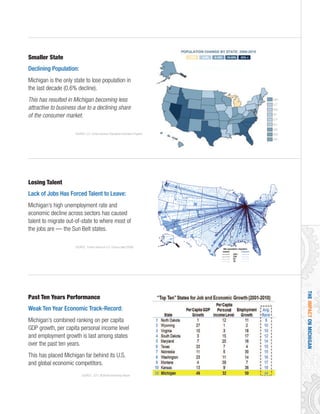
Smaller State
Declining Population:
Michigan is the only state to lose population in
the last decade (0.6% decline).
This has resulted in Michigan becoming less
attractive to business due to a declining share
of the consumer market.
Losing Talent
Lack of Jobs Has Forced Talent to Leave:
Michigan’s high unemployment rate and
economic decline across sectors has caused
talent to migrate out-of-state to where most of
the jobs are — the Sun Belt states.
Past Ten Years Performance
Weak Ten Year Economic Track-Record:
Michigan’s combined ranking on per capita
GDP growth, per capita personal income level
and employment growth is last among states
over the past ten years.
This has placed Michigan far behind its U.S.
and global economic competitors.
SOURCE: U.S. Census Bureau Population Estimates Program
SOURCE: Forbes based on U.S. Census data (2008)
SOURCE: 2011 BLM Benchmarking Report
BUSINESSLEADERSFORMICHIGAN
I2012
IMICHIGANTURNAROUNDPLAN
PAGES
7 I 8
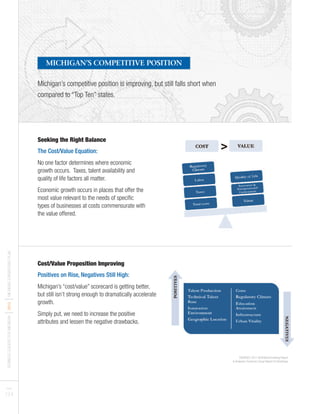
Seeking the Right Balance
The Cost/Value Equation:
No one factor determines where economic
growth occurs. Taxes, talent availability and
quality of life factors all matter.
Economic growth occurs in places that offer the
most value relevant to the needs of specific
types of businesses at costs commensurate with
the value offered.
Cost/Value Proposition Improving
Positives on Rise, Negatives Still High:
Michigan’s “cost/value” scorecard is getting better,
but still isn’t strong enough to dramatically accelerate
growth.
Simply put, we need to increase the positive
attributes and lessen the negative drawbacks.
Michigan’s competitive position is improving, but still falls short when
compared to “Top Ten” states.
MICHIGAN’S COMPETITIVE POSITION
SOURCES: 2011 BLM Benchmarking Report
& Anderson Economic Group Report for Brookings
MICHIGAN’SCOMPETITIVEPOSITION
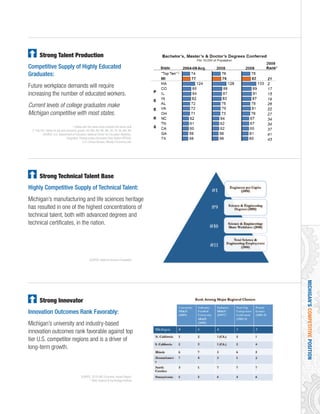
Strong Talent Production
Competitive Supply of Highly Educated
Graduates:
Future workplace demands will require
increasing the number of educated workers.
Current levels of college graduates make
Michigan competitive with most states.
Strong Technical Talent Base
Highly Competitive Supply of Technical Talent:
Michigan’s manufacturing and life sciences heritage
has resulted in one of the highest concentrations of
technical talent, both with advanced degrees and
technical certificates, in the nation.
Strong Innovator
Innovation Outcomes Rank Favorably:
Michigan’s university and industry-based
innovation outcomes rank favorable against top
tier U.S. competitor regions and is a driver of
long-term growth.
SOURCE: National Science Foundation
SOURCE: 2010 URC Economic Impact Report,
* State Science & Technology Institute
1 States with the same score received the same rank
2 “Top Ten” states for job and economic growth: KS, MD, MT, NE, ND, SD, TX, VA, WA, WY
SOURCE: U.S. Department of Education, National Center for Education Statistics,
Integrated Postsecondary Education Data System (IPEDS);
U.S. Census Bureau; Moody’s Economy.com
BUSINESSLEADERSFORMICHIGAN
I2012
IMICHIGANTURNAROUNDPLAN
PAGES
9 I 10
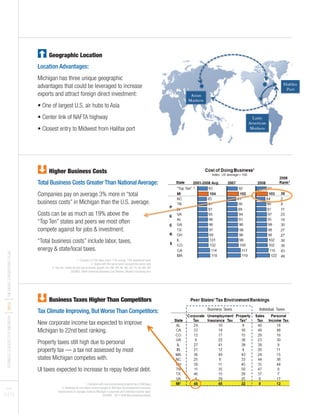
Higher Business Costs
Total Business Costs Greater Than National Average:
Companies pay on average 3% more in “total
business costs” in Michigan than the U.S. average.
Costs can be as much as 19% above the
“Top Ten” states and peers we most often
compete against for jobs & investment.
“Total business costs” include labor, taxes,
energy & state/local taxes.
Geographic Location
Location Advantages:
Michigan has three unique geographic
advantages that could be leveraged to increase
exports and attract foreign direct investment:
• One of largest U.S. air hubs to Asia
• Center link of NAFTA highway
• Closest entry to Midwest from Halifax port
Business Taxes Higher Than Competitors
Tax Climate Improving, But Worse Than Competitors:
New corporate income tax expected to improve
Michigan to 22nd best ranking.
Property taxes still high due to personal
property tax — a tax not assessed by most
states Michigan competes with.
UI taxes expected to increase to repay federal debt.
1 Consists of 75% labor costs, 15% energy, 10% state/local taxes
2 States with the same score received the same rank
3 “Top Ten” states for job and economic growth: KS, MD, MT, NE, ND, SD, TX, VA, WA, WY
SOURCE: North American Business Cost Review; Moody's Economy.com
1. Includes both real and personal property tax in Michigan
2. Rankings do not reflect recent changes to Michigan Unemployment Insurance
requirements or changes made to Michigan’s corporate and individual income taxes
SOURCE: 2011 BLM Benchmarking Report
MICHIGAN’SCOMPETITIVEPOSITION
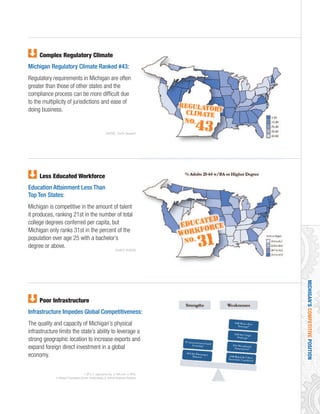
Complex Regulatory Climate
Michigan Regulatory Climate Ranked #43:
Regulatory requirements in Michigan are often
greater than those of other states and the
compliance process can be more difficult due
to the multiplicity of jurisdictions and ease of
doing business.
Less Educated Workforce
Education Attainment Less Than
Top Ten States:
Michigan is competitive in the amount of talent
it produces, ranking 21st in the number of total
college degrees conferred per capita, but
Michigan only ranks 31st in the percent of the
population over age 25 with a bachelor’s
degree or above.
Poor Infrastructure
Infrastructure Impedes Global Competitiveness:
The quality and capacity of Michigan’s physical
infrastructure limits the state’s ability to leverage a
strong geographic location to increase exports and
expand foreign direct investment in a global
economy.
SOURCE: Pacific Research
SOURCE: NCHEMS
1. BTS, 2. aapa-ports.org, 3. FAA.com, 4. NTIA,
5. Reason Foundation (Comb. Rural/urban), 6. Detroit Regional Chamber
BUSINESSLEADERSFORMICHIGAN
I2012
IMICHIGANTURNAROUNDPLAN
PAGES
11 I 12
Global Competition Escalating
Michigan Competes in a Global Economy:
The fastest economic growth is expected
to continue to occur in emerging
global markets.
Michigan’s ability to accelerate
economic growth is tied to the state’s
ability to compete in the global
economy.
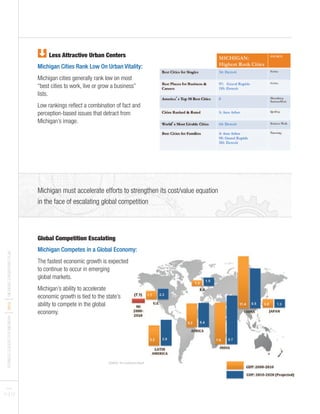
Less Attractive Urban Centers
Michigan Cities Rank Low On Urban Vitality:
Michigan cities generally rank low on most
“best cities to work, live or grow a business”
lists.
Low rankings reflect a combination of fact and
perception-based issues that detract from
Michigan’s image.
Michigan must accelerate efforts to strengthen its cost/value equation
in the face of escalating global competition
SOURCE: The Conference Board
PROGRESS
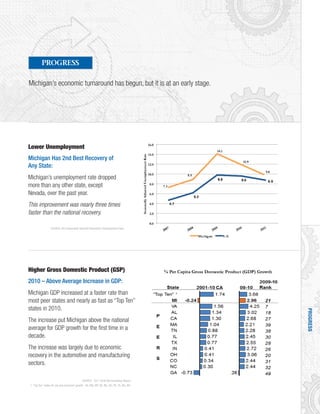
Michigan’s economic turnaround has begun, but it is at an early stage.
PROGRESS
Lower Unemployment
Michigan Has 2nd Best Recovery of
Any State:
Michigan’s unemployment rate dropped
more than any other state, except
Nevada, over the past year.
This improvement was nearly three times
faster than the national recovery.
Higher Gross Domestic Product (GSP)
2010 – Above Average Increase in GDP:
Michigan GDP increased at a faster rate than
most peer states and nearly as fast as “Top Ten”
states in 2010.
The increase put Michigan above the national
average for GDP growth for the first time in a
decade.
The increase was largely due to economic
recovery in the automotive and manufacturing
sectors.
SOURCE: BLS Seasonally Adjusted November Unemployment Rate
SOURCE: 2011 BLM Benchmarking Report
1 “Top Ten” states for job and economic growth: KS, MD, MT, NE, ND, SD, TN, TX, WA, WY
BUSINESSLEADERSFORMICHIGAN
I2012
IMICHIGANTURNAROUNDPLAN
PAGES
13 I 14
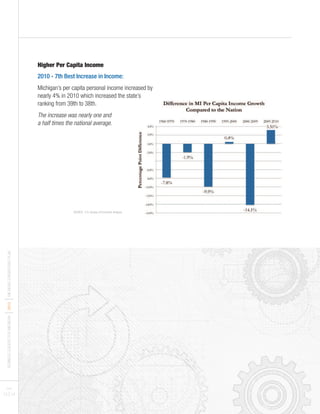
Higher Per Capita Income
2010 - 7th Best Increase in Income:
Michigan’s per capita personal income increased by
nearly 4% in 2010 which increased the state’s
ranking from 39th to 38th.
The increase was nearly one and
a half times the national average.
SOURCE: U.S. Bureau of Economic Analysis
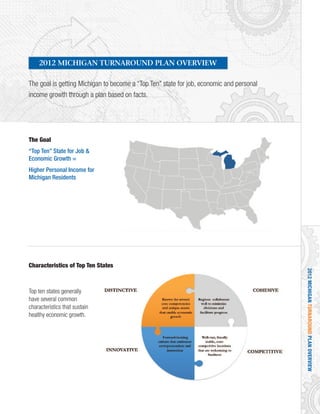
2012MICHIGANTURNAROUNDPLANOVERVIEW
The Goal
“Top Ten” State for Job &
Economic Growth =
Higher Personal Income for
Michigan Residents
Characteristics of Top Ten States
Top ten states generally
have several common
characteristics that sustain
healthy economic growth.
The goal is getting Michigan to become a “Top Ten” state for job, economic and personal
income growth through a plan based on facts.
2012 MICHIGAN TURNAROUND PLAN OVERVIEW
BUSINESSLEADERSFORMICHIGAN
I2012
IMICHIGANTURNAROUNDPLAN
PAGES
15 I 16
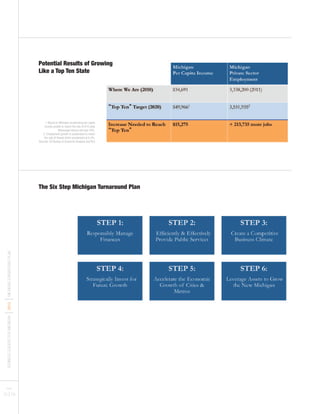
Potential Results of Growing
Like a Top Ten State
The Six Step Michigan Turnaround Plan
1. Based on Michigan accelerating per capita
income growth to match the rate of #10 state
Mississippi whose rate was 44%.
2. Employment growth is accelerated to match
the rate of Hawaii which accelerated at 6.4%.
Sources: US Bureau of Economic Analysis and BLS
ORIGINAL MTP GOALS
AND RECENT PROGRESS
3 Public-private revenue estimating
council to improve forecasting
3 Quarterly survey of Michigan
businesses to improve forecasting
3 Multi-year financial & budget plans
to improve fiscal discipline
3 Citizen-friendly balance sheet to
improve transparency
3 Zero-based budgeting or other
system to increase results
3 No new programs unless others
eliminated or revenues grow
• Strategic plan to set priorities
• Require fiscal notes to identify
compliance and other costs
WHERE WE STAND
• 19 states adopt biennial budgets¹
• Revenue estimates are more
volatile in changing economy²
• Michigan, as a relatively poor
state, must set fiscal priorities
more than the average state
• Increasing Michigan’s bond rating
from AA- to AAA would save
interest costs
• State borrowing has increased
over three times the growth of
personal income in the past
twenty years and now exceeds
annual state revenues³
• State unfunded pension liabilities
exceed $18B³
• Michigan’s unemployment
insurance debt was retired
through an innovative bond
issuance.
2012 MTP GOALS
• Set clear spending priorities
- Adopt a strategic plan setting
goals & expected outcomes
- Adopt performance-based
budgeting with ROI
measures
• “Price” the cost to comply
with proposed legislation
- Adopt fiscal notes for all
legislation
• Memorialize sound fiscal
management practices in
legislation or policy
(e.g., timely adoption of a
structurally-balanced budget,
two-year budget plan, citizen-
friendly balance sheet)
• Reduce debt levels to
achieve AAA bond rating
3 = Accomplished or significant progress
• = Not accomplished
¹ NCSL
² Pew Center for the States
³ 2011 Citizen’s Guide to MI Fiscal Health
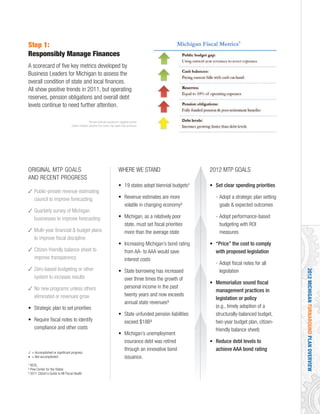
2012MICHIGANTURNAROUNDPLANOVERVIEW
Step 1:
Responsibly Manage Finances
A scorecard of five key metrics developed by
Business Leaders for Michigan to assess the
overall condition of state and local finances.
All show positive trends in 2011, but operating
reserves, pension obligations and overall debt
levels continue to need further attention.
*Arrows indicate positive or negative trends
Colors indicate whether the metric has been fully achieved
BUSINESSLEADERSFORMICHIGAN
I2012
IMICHIGANTURNAROUNDPLAN
PAGES
17 I 18
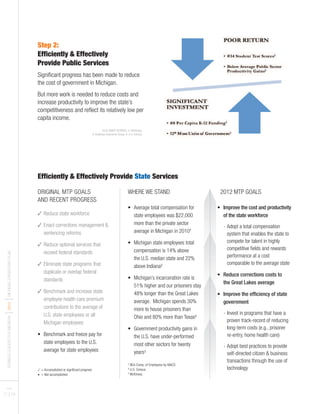
Step 2:
Efficiently & Effectively
Provide Public Services
Significant progress has been made to reduce
the cost of government in Michigan.
But more work is needed to reduce costs and
increase productivity to improve the state’s
competitiveness and reflect its relatively low per
capita income.
ALEC (NAEP SCORES), 2. McKinsey,
3. Anderson Economic Group, 4. U.S. Census
Efficiently & Effectively Provide State Services
ORIGINAL MTP GOALS
AND RECENT PROGRESS
3 Reduce state workforce
3 Enact corrections management &
sentencing reforms
3 Reduce optional services that
exceed federal standards
3 Eliminate state programs that
duplicate or overlap federal
standards
3 Benchmark and increase state
employee health care premium
contributions to the average of
U.S. state employees or all
Michigan employees
• Benchmark and freeze pay for
state employees to the U.S.
average for state employees
WHERE WE STAND
• Average total compensation for
state employees was $22,000
more than the private sector
average in Michigan in 2010¹
• Michigan state employees total
compensation is 14% above
the U.S. median state and 22%
above Indiana²
• Michigan’s incarceration rate is
51% higher and our prisoners stay
48% longer than the Great Lakes
average. Michigan spends 30%
more to house prisoners than
Ohio and 80% more than Texas²
• Government productivity gains in
the U.S. have under-performed
most other sectors for twenty
years3
2012 MTP GOALS
• Improve the cost and productivity
of the state workforce
- Adopt a total compensation
system that enables the state to
compete for talent in highly
competitive fields and rewards
performance at a cost
comparable to the average state
• Reduce corrections costs to
the Great Lakes average
• Improve the efficiency of state
government
- Invest in programs that have a
proven track-record of reducing
long-term costs (e.g., prisoner
re-entry, home health care)
- Adopt best practices to provide
self-directed citizen & business
transactions through the use of
technology
¹ BEA Comp. of Employees by NAICS
² U.S. Census
3
McKinsey
3 = Accomplished or significant progress
• = Not accomplished
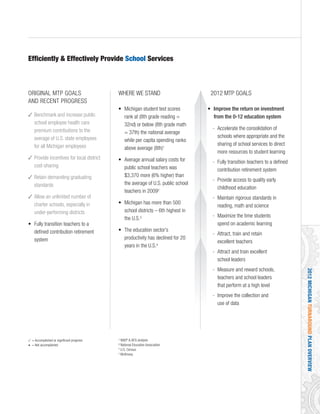
Efficiently & Effectively Provide School Services
2012MICHIGANTURNAROUNDPLANOVERVIEW
¹ NAEP & AEG analysis
² National Education Association
3
U.S. Census
4
McKinsey
3 = Accomplished or significant progress
• = Not accomplished
ORIGINAL MTP GOALS
AND RECENT PROGRESS
3 Benchmark and increase public
school employee health care
premium contributions to the
average of U.S. state employees
for all Michigan employees
3 Provide incentives for local district
cost-sharing
3 Retain demanding graduating
standards
3 Allow an unlimited number of
charter schools, especially in
under-performing districts
• Fully transition teachers to a
defined contribution retirement
system
WHERE WE STAND
• Michigan student test scores
rank at (8th grade reading =
32nd) or below (8th grade math
= 37th) the national average
while per capita spending ranks
above average (8th)1
• Average annual salary costs for
public school teachers was
$3,370 more (6% higher) than
the average of U.S. public school
teachers in 20092
• Michigan has more than 500
school districts – 6th highest in
the U.S.3
• The education sector’s
productivity has declined for 20
years in the U.S.4
2012 MTP GOALS
• Improve the return on investment
from the 0-12 education system
- Accelerate the consolidation of
schools where appropriate and the
sharing of school services to direct
more resources to student learning
- Fully transition teachers to a defined
contribution retirement system
- Provide access to quality early
childhood education
- Maintain rigorous standards in
reading, math and science
- Maximize the time students
spend on academic learning
- Attract, train and retain
excellent teachers
- Attract and train excellent
school leaders
- Measure and reward schools,
teachers and school leaders
that perform at a high level
- Improve the collection and
use of data
BUSINESSLEADERSFORMICHIGAN
I2012
IMICHIGANTURNAROUNDPLAN
PAGES
19 I 20
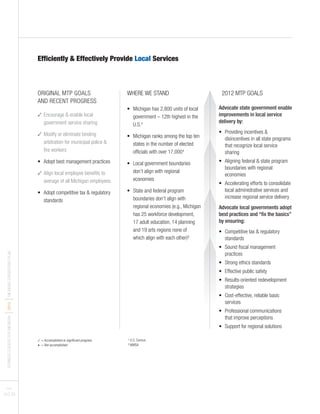
Efficiently & Effectively Provide Local Services
ORIGINAL MTP GOALS
AND RECENT PROGRESS
3 Encourage & enable local
government service sharing
3 Modify or eliminate binding
arbitration for municipal police &
fire workers
• Adopt best management practices
3 Align local employee benefits to
average of all Michigan employees
• Adopt competitive tax & regulatory
standards
WHERE WE STAND
• Michigan has 2,800 units of local
government – 12th highest in the
U.S.¹
• Michigan ranks among the top ten
states in the number of elected
officials with over 17,000¹
• Local government boundaries
don’t align with regional
economies
• State and federal program
boundaries don’t align with
regional economies (e.g., Michigan
has 25 workforce development,
17 adult education, 14 planning
and 19 arts regions none of
which align with each other)²
2012 MTP GOALS
Advocate state government enable
improvements in local service
delivery by:
• Providing incentives &
disincentives in all state programs
that recognize local service
sharing
• Aligning federal & state program
boundaries with regional
economies
• Accelerating efforts to consolidate
local administrative services and
increase regional service delivery
Advocate local governments adopt
best practices and “fix the basics”
by ensuring:
• Competitive tax & regulatory
standards
• Sound fiscal management
practices
• Strong ethics standards
• Effective public safety
• Results-oriented redevelopment
strategies
• Cost-effective, reliable basic
services
• Professional communications
that improve perceptions
• Support for regional solutions
¹ U.S. Census
² WMSA
3 = Accomplished or significant progress
• = Not accomplished
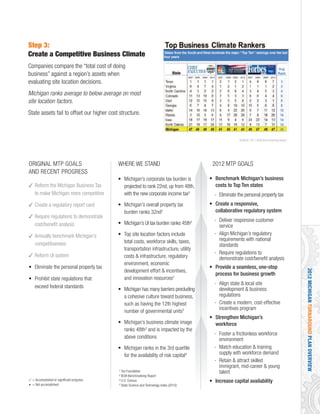
Step 3:
Create a Competitive Business Climate
Companies compare the “total cost of doing
business” against a region’s assets when
evaluating site location decisions.
Michigan ranks average to below average on most
site location factors.
State assets fail to offset our higher cost structure.
2012MICHIGANTURNAROUNDPLANOVERVIEW
SOURCE: 2011 BLM Benchmarking Report
ORIGINAL MTP GOALS
AND RECENT PROGRESS
3 Reform the Michigan Business Tax
to make Michigan more competitive
3 Create a regulatory report card
3 Require regulations to demonstrate
cost/benefit analysis
3 Annually benchmark Michigan’s
competitiveness
3 Reform UI system
• Eliminate the personal property tax
• Prohibit state regulations that
exceed federal standards
WHERE WE STAND
• Michigan’s corporate tax burden is
projected to rank 22nd, up from 48th,
with the new corporate income tax¹
• Michigan’s overall property tax
burden ranks 32nd2
• Michigan’s UI tax burden ranks 45th2
• Top site location factors include
total costs, workforce skills, taxes,
transportation infrastructure, utility
costs & infrastructure, regulatory
environment, economic
development effort & incentives,
and innovation resources2
• Michigan has many barriers precluding
a cohesive culture toward business,
such as having the 12th highest
number of governmental units3
• Michigan’s business climate image
ranks 48th2 and is impacted by the
above conditions
• Michigan ranks in the 3rd quartile
for the availability of risk capital4
2012 MTP GOALS
• Benchmark Michigan’s business
costs to Top Ten states
- Eliminate the personal property tax
• Create a responsive,
collaborative regulatory system
- Deliver responsive customer
service
- Align Michigan’s regulatory
requirements with national
standards
- Require regulations to
demonstrate cost/benefit analysis
• Provide a seamless, one-stop
process for business growth
- Align state & local site
development & business
regulations
- Create a modern, cost-effective
incentives program
• Strengthen Michigan’s
workforce
- Foster a frictionless workforce
environment
- Match education & training
supply with workforce demand
- Retain & attract skilled
immigrant, mid-career & young
talent
• Increase capital availability
¹ Tax Foundation
² BLM Benchmarking Report
³ U.S. Census
4
State Science and Technology Index (2010)
3 = Accomplished or significant progress
• = Not accomplished
BUSINESSLEADERSFORMICHIGAN
I2012
IMICHIGANTURNAROUNDPLAN
PAGES
21 I 22
Step 4:
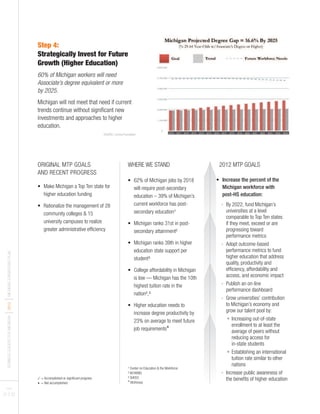
Strategically Invest for Future
Growth (Higher Education)
60% of Michigan workers will need
Associate’s degree equivalent or more
by 2025.
Michigan will not meet that need if current
trends continue without significant new
investments and approaches to higher
education.
SOURCE: Lumina Foundation
ORIGINAL MTP GOALS
AND RECENT PROGRESS
• Make Michigan a Top Ten state for
higher education funding
• Rationalize the management of 28
community colleges & 15
university campuses to realize
greater administrative efficiency
WHERE WE STAND
• 62% of Michigan jobs by 2018
will require post-secondary
education – 39% of Michigan’s
current workforce has post-
secondary education¹
• Michigan ranks 31st in post-
secondary attainment²
• Michigan ranks 39th in higher
education state support per
student³
• College affordability in Michigan
is low — Michigan has the 10th
highest tuition rate in the
nation²,³
• Higher education needs to
increase degree productivity by
23% on average to meet future
job requirements⁴
2012 MTP GOALS
• Increase the percent of the
Michigan workforce with
post-HS education:
- By 2022, fund Michigan’s
universities at a level
comparable to Top Ten states
if they meet, exceed or are
progressing toward
performance metrics
- Adopt outcome-based
performance metrics to fund
higher education that address
quality, productivity and
efficiency, affordability and
access, and economic impact
- Publish an on-line
performance dashboard
- Grow universities’ contribution
to Michigan’s economy and
grow our talent pool by:
• Increasing out-of-state
enrollment to at least the
average of peers without
reducing access for
in-state students
• Establishing an international
tuition rate similar to other
nations
- Increase public awareness of
the benefits of higher education
¹ Center on Education & the Workforce
² NCHEMS
³ SHEEO
⁴ McKinsey
3 = Accomplished or significant progress
• = Not accomplished
2012MICHIGANTURNAROUNDPLANOVERVIEW
¹ Reason Foundation
² FHWA
³ Detroit Regional Chamber
4
FAA.gov
3 = Accomplished or significant progress
• = Not accomplished
ORIGINAL MTP GOALS
AND RECENT PROGRESS
3 Advocate for incentives and provide
support for the Detroit Region
Aerotropolis
• Adopt new funding formulas to
support a Top Ten transportation
infrastructure
WHERE WE STAND
• Michigan ranks #38 in the U.S.
in urban interstate highway
condition & #47 in urban
congestion¹
• State & local highway spending
in Michigan ranks #48 in the
U.S. per capita²
• Michigan has the 15th busiest
airport in the U.S. (Detroit Metro)4
• Michigan has the 38th busiest air
cargo airport in the U.S. (Detroit
Metro)4
• Detroit is the busiest land border
crossing in the U.S.³
2012 MTP GOALS
• Connect Michigan with the global
economy through strategic
investments in infrastructure
- Build the New International Trade
Crossing
- Expand international rail freight
access
- Develop the Aerotropolis
- Develop an inter-modal freight
facility
- Increase bandwidth capacity and
access
- Fund investments that improve
Michigan’s highway system to
Top Ten quality
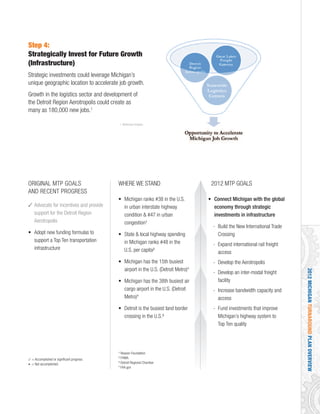
Step 4:
Strategically Invest for Future Growth
(Infrastructure)
Strategic investments could leverage Michigan’s
unique geographic location to accelerate job growth.
Growth in the logistics sector and development of
the Detroit Region Aerotropolis could create as
many as 180,000 new jobs.1
1. McKinsey Analysis
BUSINESSLEADERSFORMICHIGAN
I2012
IMICHIGANTURNAROUNDPLAN
PAGES
23 I 24
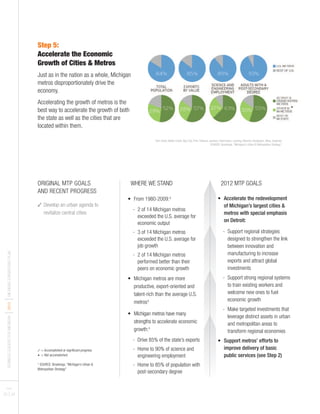
Step 5:
Accelerate the Economic
Growth of Cities & Metros
Just as in the nation as a whole, Michigan
metros disproportionately drive the
economy.
Accelerating the growth of metros is the
best way to accelerate the growth of both
the state as well as the cities that are
located within them.
*Ann Arbor, Battle Creek, Bay City, Flint, Holland, Jackson, Kalamazoo, Lansing, Monroe, Muskegon, Niles, Saginaw
SOURCE: Brookings, “Michigan’s Urban & Metropolitan Strategy”
ORIGINAL MTP GOALS
AND RECENT PROGRESS
3 Develop an urban agenda to
revitalize central cities
WHERE WE STAND
• From 1980-2009:¹
- 2 of 14 Michigan metros
exceeded the U.S. average for
economic output
- 3 of 14 Michigan metros
exceeded the U.S. average for
job growth
- 2 of 14 Michigan metros
performed better than their
peers on economic growth
• Michigan metros are more
productive, export-oriented and
talent-rich than the average U.S.
metros¹
• Michigan metros have many
strengths to accelerate economic
growth:¹
- Drive 85% of the state’s exports
- Home to 90% of science and
engineering employment
- Home to 85% of population with
post-secondary degree
2012 MTP GOALS
• Accelerate the redevelopment
of Michigan’s largest cities &
metros with special emphasis
on Detroit:
- Support regional strategies
designed to strengthen the link
between innovation and
manufacturing to increase
exports and attract global
investments
- Support strong regional systems
to train existing workers and
welcome new ones to fuel
economic growth
- Make targeted investments that
leverage distinct assets in urban
and metropolitan areas to
transform regional economies
• Support metros’ efforts to
improve delivery of basic
public services (see Step 2)
3 = Accomplished or significant progress
• = Not accomplished
¹ SOURCE: Brookings, “Michigan’s Urban &
Metropolitan Strategy”
2012MICHIGANTURNAROUNDPLANOVERVIEW
3 = Accomplished or significant progress
• = Not accomplished
ORIGINAL MTP GOALS
AND RECENT PROGRESS
3 Support job growth in all sectors
3 Grow the entrepreneurial
infrastructure
3 Develop strategies to grow broad
business sectors that leverage key
assets
3 Strengthen university-business
collaboration
WHERE WE STAND
• Michigan must dramatically
accelerate performance to
achieve Top Ten job, economic
and personal income growth
• Actions taken through Steps 1-5
of the Michigan Turnaround Plan
lay the foundation for Michigan
to accelerate growth
• Michigan lacks a consistent,
long-term strategy to leverage
key assets that transcend
election cycles
• The link between
entrepreneurship, innovation and
manufacturing will be a major
driver of future growth
• The nation and world are largely
unaware of the progress
Michigan has taken to rebuild its
economy
2012 MTP GOALS
• Champion strategies that leverage
Michigan’s unique assets to
accelerate long-term economic
growth:
- Global Engineering Village
- Gateway to the Midwest
- Higher Education Marketplace
- Natural Resource Economy
- Global Center for Mobility
- Life Sciences Hub
• Build support among key
stakeholders for growth
strategies that transcend election
cycles
• Support a strong foundation of
entrepreneurship, innovation and
manufacturing
• Raise awareness of progress
being made toward building a
New Michigan
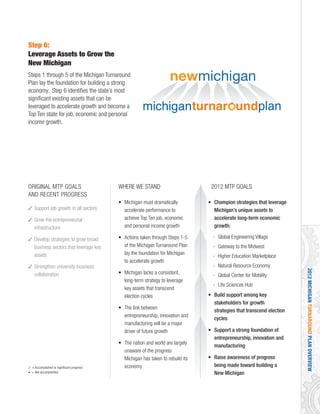
Step 6:
Leverage Assets to Grow the
New Michigan
Steps 1 through 5 of the Michigan Turnaround
Plan lay the foundation for building a strong
economy. Step 6 identifies the state’s most
significant existing assets that can be
leveraged to accelerate growth and become a
Top Ten state for job, economic and personal
income growth.
BUSINESSLEADERSFORMICHIGAN
I2012
IMICHIGANTURNAROUNDPLAN
PAGES
25 I 26
Step 6:
Leverage Assets to Grow the New Michigan
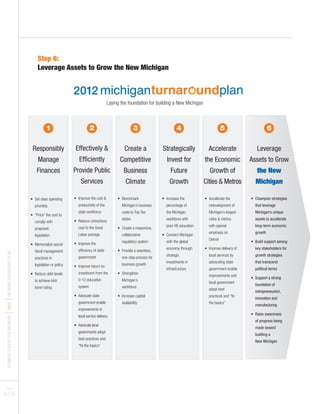
1
Responsibly
Manage
Finances
• Set clear spending
priorities
• “Price” the cost to
comply with
proposed
legislation
• Memorialize sound
fiscal management
practices in
legislation or policy
• Reduce debt levels
to achieve AAA
bond rating
2
Effectively &
Efficiently
Provide Public
Services
• Improve the cost &
productivity of the
state workforce
• Reduce corrections
cost to the Great
Lakes average
• Improve the
efficiency of state
government
• Improve return on
investment from the
0-12 education
system
• Advocate state
government enable
improvements in
local service delivery
• Advocate local
governments adopt
best practices and
“fix the basics”
3
Create a
Competitive
Business
Climate
• Benchmark
Michigan’s business
costs to Top Ten
states
• Create a responsive,
collaborative
regulatory system
• Provide a seamless,
one-stop process for
business growth
• Strengthen
Michigan’s
workforce
• Increase capital
availability
4
Strategically
Invest for
Future
Growth
• Increase the
percentage of
the Michigan
workforce with
post-HS education
• Connect Michigan
with the global
economy through
strategic
investments in
infrastructure
5
Accelerate
the Economic
Growth of
Cities & Metros
• Accelerate the
redevelopment of
Michigan’s largest
cities & metros
with special
emphasis on
Detroit
• Improve delivery of
local services by
advocating state
government enable
improvements and
local government
adopt best
practices and “fix
the basics”
6
Leverage
Assets to Grow
the New
Michigan
• Champion strategies
that leverage
Michigan’s unique
assets to accelerate
long-term economic
growth
• Build support among
key stakeholders for
growth strategies
that transcend
political terms
• Support a strong
foundation of
entrepreneurism,
innovation and
manufacturing
• Raise awareness
of progress being
made toward
building a
New Michigan
Laying the foundation for building a New Michigan
2012MICHIGANTURNAROUNDPLANOVERVIEW
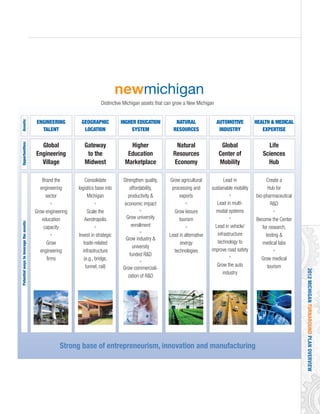
ENGINEERING
TALENT
Global
Engineering
Village
Brand the
engineering
sector
•
Grow engineering
education
capacity
•
Grow
engineering
firms
Potentialwaystoleveragetheassets:Opportunities:Assets:
GEOGRAPHIC
LOCATION
Gateway
to the
Midwest
Consolidate
logistics base into
Michigan
•
Scale the
Aerotropolis
•
Invest in strategic
trade-related
infrastructure
(e.g., bridge,
tunnel, rail)
HIGHER EDUCATION
SYSTEM
Higher
Education
Marketplace
Strengthen quality,
affordability,
productivity &
economic impact
•
Grow university
enrollment
•
Grow industry &
university
funded R&D
•
Grow commerciali-
zation of R&D
NATURAL
RESOURCES
Natural
Resources
Economy
Grow agricultural
processing and
exports
•
Grow leisure
tourism
•
Lead in alternative
energy
technologies
AUTOMOTIVE
INDUSTRY
Global
Center of
Mobility
Lead in
sustainable mobility
•
Lead in multi-
modal systems
•
Lead in vehicle/
infrastructure
technology to
improve road safety
•
Grow the auto
industry
HEALTH & MEDICAL
EXPERTISE
Life
Sciences
Hub
Create a
Hub for
bio-pharmaceutical
R&D
•
Become the Center
for research,
testing &
medical labs
•
Grow medical
tourism
Distinctive Michigan assets that can grow a New Michigan
Strong base of entrepreneurism, innovation and manufacturing
newmichigan
BUSINESSLEADERSFORMICHIGAN
I2012
IMICHIGANTURNAROUNDPLAN
PAGES
27 I 28
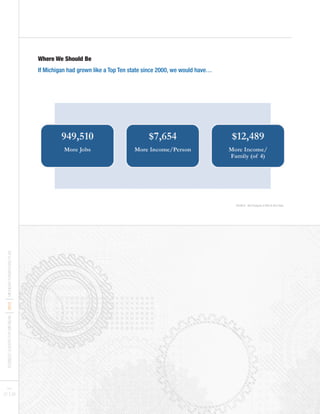
Where We Should Be
If Michigan had grown like a Top Ten state since 2000, we would have…
SOURCE: AEG Analysis of BEA & BLS Data
Where We Could Be
Michigan can once again be a “Top Ten” state for job,
economic and personal income growth.
The first five steps of the Michigan Turnaround Plan allow us to undertake an important 6th step —
leveraging Michigan’s unique assets to grow the New Michigan.
If we capitalize on our most significant existing assets, we have the potential to increase our
current growth projections by as much as 40 percent by 2020. We can also add up to
half a million jobs and grow the personal income of each Michigan resident by as
much as $18,000 during the same time period.
Turn this booklet around to see what the New Michigan can look like.
newmichigan Distinctive Michigan assets that can grow a New Michigan
LAYING THE FOUNDATION TO BUILD A NEW MICHIGAN
newmichigan Distinctive Michigan assets that can grow a New Michigan
BUSINESSLEADERSFORMICHIGAN
I2012
ITHENEWMICHIGAN
PAGES
1 I 2
2 Letter from the Chairman and CEO
3 Executive Summary
5 Developing The New Michigan
9 A New Michigan: One Vision, Six Opportunities
11 Global Engineering Village
13 Gateway to the Midwest
15 Higher Education Marketplace
17 Natural Resources Economy
19 Global Center of Mobility
11 Life Sciences Hub
23 Conclusion
25 Business Leaders for Michigan Board of Directors
Note: You are starting at Step 6 of the Michigan Turnaround Plan.
Flip the book to read about the first five steps.
The people of Michigan have been struggling with challenging economic conditions for some
time. We are the only state in the union to have lost population during the 21st century and one
of the few to have experienced negative economic growth. Those who remain here struggle with
slower than average job and personal income growth.
These challenges have acted as a unifying, motivating force for change. Business Leaders for
Michigan is collectively and singularly dedicated to turning Michigan’s circumstances around by
capitalizing on the existing natural and human resources we possess, including:
• A strong research and development hub, co-located with the manufacturing facilities
necessary to produce what we invent;
• An exceptional talent pool, including researchers, engineers, and technically-trained workers; and
• A unique geographic location that is rich with natural resources and the logistical access
necessary to bring goods to market worldwide.
Business Leaders for Michigan believes that by leveraging these and other assets, Michigan can
fully take advantage of the solid economic foundation laid by the first five steps of the Michigan
Turnaround Plan to accelerate economic growth. We call this a “New Michigan” strategy and it
identifies six areas, each of which promises tremendous opportunities for success. Taken
together with the first five steps of the Michigan Turnaround Plan, this “New Michigan” strategy
can propel Michigan into becoming a Top Ten state for economic, job and personal income growth.
Specifically, we forecast that Michigan has the potential to increase our current growth projections
by as much as 40 percent by 2020.We can also add up to half a million jobs and grow the personal
income of each Michigan resident by as much as $18,000 during the same time period.
Our plans are thoroughly researched, and — most important of all — they are attainable.We are in
particular indebted to McKinsey & Company for their invaluable research assistance in preparing this
document. By working together, we can right Michigan’s economic ship and realize our full potential.
Let us show you what Michigan can become — and how together we can make it happen.
Sincerely,
James B. Nicholson Doug Rothwell
Chair of the Board President & CEO
BUSINESSLEADERSFORMICHIGAN
I2012
ITHENEWMICHIGAN
PAGES
3 I 4
In 2009, Business Leaders for Michigan (BLM) unveiled
the Michigan Turnaround Plan, an aggressive agenda to
make Michigan a Top Ten State for job and economic
growth.
The Plan included five steps for a better Michigan:
• Changing the way we manage our finances
• Right-sizing and enacting structural budget reforms
• Getting Michigan competitive to attract and retain
jobs
• Making investments that create a great job
environment
• Accelerating job growth through innovation and
entrepreneurship
We have worked closely with government, civic and
business leaders to effect meaningful advancement of
each Michigan Turnaround Plan objective. Citizens and
stakeholders have rallied around the plan, many
components of which are now in place. We are
encouraged that significant progress is being made in
laying the building blocks for a more durable future.
Now that our foundation is more solid, it is time to add
a sixth step to the Plan – the identification of drivers
and strategies that would allow us to begin
transitioning to the “New Michigan” we wish to see.
This will require our state to have a shared vision for
the future, one that enables us to prioritize the use of
limited resources and sustains efforts beyond election
cycles.
The objective of this sixth step of the Michigan
Turnaround Plan is to provide a ten year vision for growing
the “New Michigan” economy. Within this objective, we
built a series of opportunities/drivers, each of which:
• Has the potential to move Michigan to top 10
performance on output metrics including GDP
growth, unemployment rate, and GDP per capita
• Generates excitement among stakeholders,
government, and the Michigan population at large
through development of opportunities which:
- Leverage unique Michigan strengths
- Are compelling and “fit” what Michigan is
- Are powerful game changers if executed properly
• Is informed, but not constrained, by global mega-
trends
• Includes tangible near-term actions which
demonstrate early commitment and show traction
against the new vision
To support our thinking, we gathered an array of input —
from BLM members, policy leaders, economic analysts,
and others — and collected a wealth of data to support
sound thinking about what Michigan can become. We
evaluated case studies and turnaround models from
similarly situated economies across the globe, to learn
how we might make their success stories our own.
McKinsey & Company played a significant role in this
effort.
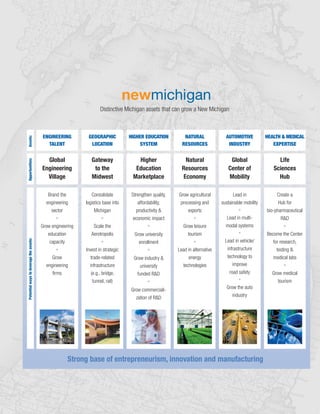
This work identified six distinctive assets that can help
Michigan dramatically accelerate growth if we focus
our efforts and resources. Each of these opportunities
is grounded in careful, fact-based analysis and
accounts for available resources, markets, and expertise.
Executive Summary
EXECUTIVESUMMARY
The six assets we believe have the greatest potential to
accelerate Michigan’s growth are the following:
• Grow and brand our industrial, production and
talent capacity to develop a reputation as a
Global Engineering Village
• Capitalize on our strategic location and
available resources to become the premier
Gateway to the Midwest
• Invest in a Higher Education Marketplace that
boosts the state’s talent base and leverages its
innovative strengths
• Take advantage of Michigan’s natural resources to
grow a Natural Resource Economy, that
sustainably drives exports
• Amplify our automotive and manufacturing expertise
to become a Global Center of Mobility
• Develop a Life Sciences Hub based on our robust
health, medical and bio-pharmaceutical capabilities
While there are other areas for growth beyond these six
opportunities, we believe these are best positioned to
deliver significant results. They offer the best
opportunities for growing good paying jobs and changing
Michigan’s economy in ways that are meaningful and
lasting for the people of our great state.
BUSINESSLEADERSFORMICHIGAN
I2012
ITHENEWMICHIGAN
PAGES
5 I 6
Michigan’s legacy as the powerhouse of
American industry has suffered significantly
over the last decade or so. Michigan’s economy has
shrunk. The state has created fewer jobs than any other state
since 2000, and per capita income fell to the bottom quartile
of all states. We are the only state in the union to have lost
population in the 21st century.
Yet Michigan retains valuable natural and human assets that provide an unprecedented
opportunity for a fundamental turnaround. Building on recent policy changes consistent
with the proposals outlined in the Michigan Turnaround Plan, now is the time to leverage
these assets to accelerate growth. We have a talented labor pool and strong flow of
university graduates eager for new work, underutilized facilities primed for new activity,
and a strong tradition of innovation and entrepreneurism ready to drive renewal. The
conditions at hand, in fact, offer us both the motivation and the means to craft a future
that puts Michigan at the center of trends that will shape the economic development of
our world in the decades to come.
Challenges and opportunities for driving growth
Developing The New Michigan
DEVELOPINGTHENEWMICHIGAN
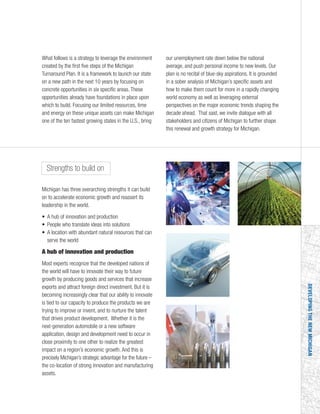
What follows is a strategy to leverage the environment
created by the first five steps of the Michigan
Turnaround Plan. It is a framework to launch our state
on a new path in the next 10 years by focusing on
concrete opportunities in six specific areas. These
opportunities already have foundations in place upon
which to build. Focusing our limited resources, time
and energy on these unique assets can make Michigan
one of the ten fastest growing states in the U.S., bring
our unemployment rate down below the national
average, and push personal income to new levels. Our
plan is no recital of blue-sky aspirations. It is grounded
in a sober analysis of Michigan’s specific assets and
how to make them count for more in a rapidly changing
world economy as well as leveraging external
perspectives on the major economic trends shaping the
decade ahead. That said, we invite dialogue with all
stakeholders and citizens of Michigan to further shape
this renewal and growth strategy for Michigan.
Strengths to build on
Michigan has three overarching strengths it can build
on to accelerate economic growth and reassert its
leadership in the world.
• A hub of innovation and production
• People who translate ideas into solutions
• A location with abundant natural resources that can
serve the world
A hub of innovation and production
Most experts recognize that the developed nations of
the world will have to innovate their way to future
growth by producing goods and services that increase
exports and attract foreign direct investment. But it is
becoming increasingly clear that our ability to innovate
is tied to our capacity to produce the products we are
trying to improve or invent, and to nurture the talent
that drives product development. Whether it is the
next-generation automobile or a new software
application, design and development need to occur in
close proximity to one other to realize the greatest
impact on a region’s economic growth. And this is
precisely Michigan’s strategic advantage for the future –
the co-location of strong innovation and manufacturing
assets.
BUSINESSLEADERSFORMICHIGAN
I2012
ITHENEWMICHIGAN
PAGES
7 I 8
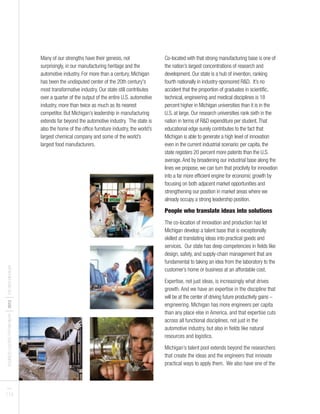
Many of our strengths have their genesis, not
surprisingly, in our manufacturing heritage and the
automotive industry. For more than a century, Michigan
has been the undisputed center of the 20th century's
most transformative industry. Our state still contributes
over a quarter of the output of the entire U.S. automotive
industry, more than twice as much as its nearest
competitor. But Michigan’s leadership in manufacturing
extends far beyond the automotive industry. The state is
also the home of the office furniture industry, the world’s
largest chemical company and some of the world’s
largest food manufacturers.
Co-located with that strong manufacturing base is one of
the nation’s largest concentrations of research and
development. Our state is a hub of invention, ranking
fourth nationally in industry-sponsored R&D. It’s no
accident that the proportion of graduates in scientific,
technical, engineering and medical disciplines is 18
percent higher in Michigan universities than it is in the
U.S. at large. Our research universities rank sixth in the
nation in terms of R&D expenditure per student.That
educational edge surely contributes to the fact that
Michigan is able to generate a high level of innovation
even in the current industrial scenario: per capita, the
state registers 20 percent more patents than the U.S.
average.And by broadening our industrial base along the
lines we propose, we can turn that proclivity for innovation
into a far more efficient engine for economic growth by
focusing on both adjacent market opportunities and
strengthening our position in market areas where we
already occupy a strong leadership position.
People who translate ideas into solutions
The co-location of innovation and production has let
Michigan develop a talent base that is exceptionally
skilled at translating ideas into practical goods and
services. Our state has deep competencies in fields like
design, safety, and supply-chain management that are
fundamental to taking an idea from the laboratory to the
customer’s home or business at an affordable cost.
Expertise, not just ideas, is increasingly what drives
growth. And we have an expertise in the discipline that
will be at the center of driving future productivity gains –
engineering. Michigan has more engineers per capita
than any place else in America, and that expertise cuts
across all functional disciplines, not just in the
automotive industry, but also in fields like natural
resources and logistics.
Michigan’s talent pool extends beyond the researchers
that create the ideas and the engineers that innovate
practical ways to apply them. We also have one of the
DEVELOPINGTHENEWMICHIGAN
nation’s greatest concentrations of technically-trained
workers, who can translate these innovations into
everyday products and solutions. Our expertise in the
medical and health arena is also important as growth
in the healthcare and the related medical services is
far outstripping that of the economy as a whole.
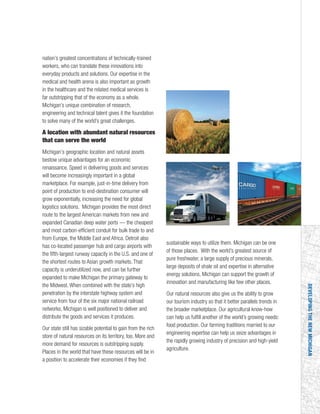
Michigan’s unique combination of research,
engineering and technical talent gives it the foundation
to solve many of the world’s great challenges.
A location with abundant natural resources
that can serve the world
Michigan’s geographic location and natural assets
bestow unique advantages for an economic
renaissance. Speed in delivering goods and services
will become increasingly important in a global
marketplace. For example, just-in-time delivery from
point of production to end-destination consumer will
grow exponentially, increasing the need for global
logistics solutions. Michigan provides the most direct
route to the largest American markets from new and
expanded Canadian deep water ports — the cheapest
and most carbon-efficient conduit for bulk trade to and
from Europe, the Middle East and Africa. Detroit also
has co-located passenger hub and cargo airports with
the fifth-largest runway capacity in the U.S. and one of
the shortest routes to Asian growth markets. That
capacity is underutilized now, and can be further
expanded to make Michigan the primary gateway to
the Midwest. When combined with the state’s high
penetration by the interstate highway system and
service from four of the six major national railroad
networks, Michigan is well positioned to deliver and
distribute the goods and services it produces.
Our state still has sizable potential to gain from the rich
store of natural resources on its territory, too. More and
more demand for resources is outstripping supply.
Places in the world that have these resources will be in
a position to accelerate their economies if they find
sustainable ways to utilize them. Michigan can be one
of those places. With the world’s greatest source of
pure freshwater, a large supply of precious minerals,
large deposits of shale oil and expertise in alternative
energy solutions, Michigan can support the growth of
innovation and manufacturing like few other places.
Our natural resources also give us the ability to grow
our tourism industry so that it better parallels trends in
the broader marketplace. Our agricultural know-how
can help us fulfill another of the world’s growing needs:
food production. Our farming traditions married to our
engineering expertise can help us seize advantages in
the rapidly growing industry of precision and high-yield
agriculture.
BUSINESSLEADERSFORMICHIGAN
I2012
ITHENEWMICHIGAN
PAGES
9 I 10
ONE VISION, SIX OPPORTUNITIES
A NEW MICHIGAN:
In this document, we lay out how Michigan’s fundamental
assets — described on the following page — can be
leveraged to accelerate economic growth by seizing
upon six high-potential growth opportunities. Like the
rest of the Michigan Turnaround Plan, these opportunities
were identified through extensive research and are
based on facts.They are the opportunities we found
would have the greatest impact in a ten year time period
to accelerate growth, but they do not represent an
exhaustive list.They merely constitute some of the best
possibilities.We outline how these opportunities might be
realized in the sections that follow, and provide more
details at businessleadersformichigan.com.
We also identify how leveraging these six opportunities
might impact our job, economic and personal income
growth. For example, if all six opportunities were fully
realized, based on current economic models, Michigan
could outpace our current growth projections by as much
as 40 percent and increase the per capita annual income
of our residents by as much as $18,000 by 2020.These
changes would vault our state into the top of the class in
terms of growth and add as many as half a million new
jobs in that period.These projections can’t anticipate
how well Michigan will seize each opportunity or how
global economic conditions might change during the
next decade. But they do identify the economic potential
of these opportunities and their power in dramatically
reversing a decade’s long downward trend into a brighter
future in the decades beyond.
But no one is going to give us that growth; we have to
earn it.We have to recognize that we compete in a
global marketplace and embrace leadership, policies and
attitudes that accelerate growth.We have to focus our
limited resources on building the infrastructure and
assets that will contribute most to growth.We have to
forge a sense of common purpose among government,
the private sector, and the institutions and organizations
that bolster our economic life.And we have to remain
vigilant so we recognize changing economic conditions
and seize new opportunities as they arise.
The all-important point is that new levels of growth are
eminently achievable for Michigan, but we can increase
the odds and accelerate the pace of achievement if we
take advantage of some unique opportunities. It can be
done, and here are six ways to make it happen.
If all six opportunities
were fully realized,
Michigan could increase
per capita annual
income by as much as
$18,000 by 2020 and
add as many as half a
million new jobs.
Source: AEG analysis, US Census, Statistiska Centralbyra (SCB),
BLM higher education economic impact analysis, MGI
ENGINEERING
TALENT
Global
Engineering
Village
Brand the
engineering
sector
•
Grow engineering
education
capacity
•
Grow
engineering
firms
Potentialwaystoleveragetheassets:Opportunities:Assets:
GEOGRAPHIC
LOCATION
Gateway
to the
Midwest
Consolidate
logistics base into
Michigan
•
Scale the
Aerotropolis
•
Invest in strategic
trade-related
infrastructure
(e.g., bridge,
tunnel, rail)
HIGHER EDUCATION
SYSTEM
Higher
Education
Marketplace
Strengthen quality,
affordability,
productivity &
economic impact
•
Grow university
enrollment
•
Grow industry &
university
funded R&D
•
Grow commerciali-
zation of R&D
NATURAL
RESOURCES
Natural
Resources
Economy
Grow agricultural
processing and
exports
•
Grow leisure
tourism
•
Lead in alternative
energy
technologies
AUTOMOTIVE
INDUSTRY
Global
Center of
Mobility
Lead in
sustainable mobility
•
Lead in multi-
modal systems
•
Lead in vehicle/
infrastructure
technology to
improve
road safety
•
Grow the auto
industry
HEALTH & MEDICAL
EXPERTISE
Life
Sciences
Hub
Create a
Hub for
bio-pharmaceutical
R&D
•
Become the Center
for research,
testing &
medical labs
•
Grow medical
tourism
Distinctive Michigan assets that can grow a New Michigan
Strong base of entrepreneurism, innovation and manufacturing
newmichigan
BUSINESSLEADERSFORMICHIGAN
I2012
ITHENEWMICHIGAN
PAGES
11 I 12
Global Engineering Village
The opportunity
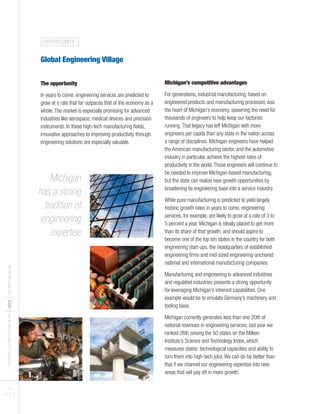
In years to come, engineering services are predicted to
grow at a rate that far outpaces that of the economy as a
whole.The market is especially promising for advanced
industries like aerospace, medical devices and precision
instruments. In these high-tech manufacturing fields,
innovative approaches to improving productivity through
engineering solutions are especially valuable.
Michigan’s competitive advantages
For generations, industrial manufacturing, based on
engineered products and manufacturing processes was
the heart of Michigan’s economy, spawning the need for
thousands of engineers to help keep our factories
running.That legacy has left Michigan with more
engineers per capita than any state in the nation across
a range of disciplines. Michigan engineers have helped
the American manufacturing sector, and the automotive
industry in particular, achieve the highest rates of
productivity in the world.Those engineers will continue to
be needed to improve Michigan-based manufacturing,
but the state can realize new growth opportunities by
broadening its engineering base into a service industry.
While pure manufacturing is predicted to yield largely
historic growth rates in years to come, engineering
services, for example, are likely to grow at a rate of 3 to
5 percent a year. Michigan is ideally placed to get more
than its share of that growth, and should aspire to
become one of the top ten states in the country for both
engineering start-ups, the headquarters of established
engineering firms and mid-sized engineering-anchored
national and international manufacturing companies.
Manufacturing and engineering in advanced industries
and regulated industries presents a strong opportunity
for leveraging Michigan’s inherent capabilities. One
example would be to emulate Germany’s machinery and
tooling base.
Michigan currently generates less than one 20th of
national revenues in engineering services; last year we
ranked 26th among the 50 states on the Milken
Institute’s Science and Technology Index, which
measures states’ technological capacities and ability to
turn them into high-tech jobs.We can do far better than
that if we channel our engineering expertise into new
areas that will pay off in more growth.
Michigan
has a strong
tradition of
engineering
expertise
OPPORTUNITY
$ Thousands
Status Quo
(current
projected
growth)
200
150
100
50
0
2010
Baseline
Top 5
US Growth
(2.8%)
2020 Projection Scenarios
Top 1
US Growth
(7.9%)
Top 5
Growth
(9.5%)
Top 1
Growth
(20.2%)
88 71
116
188
6
4
2
0
.9 1.1 2.1
5.3
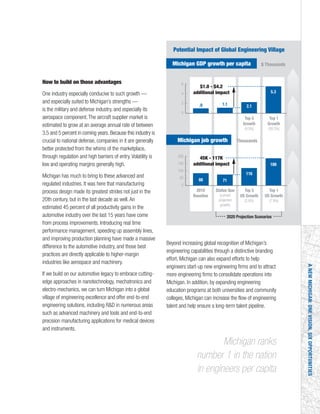
Michigan GDP growth per capita
Potential Impact of Global Engineering Village
ThousandsMichigan job growth
$1.0 - $4.2
additional impact
45K - 117K
additional impact
ANEWMICHIGAN:ONEVISION,SIXOPPORTUNITIES
How to build on those advantages
One industry especially conducive to such growth —
and especially suited to Michigan’s strengths —
is the military and defense industry, and especially its
aerospace component.The aircraft supplier market is
estimated to grow at an average annual rate of between
3.5 and 5 percent in coming years. Because this industry is
crucial to national defense, companies in it are generally
better protected from the whims of the marketplace,
through regulation and high barriers of entry.Volatility is
low and operating margins generally high.
Michigan has much to bring to these advanced and
regulated industries. It was here that manufacturing
process design made its greatest strides not just in the
20th century, but in the last decade as well.An
estimated 45 percent of all productivity gains in the
automotive industry over the last 15 years have come
from process improvements. Introducing real time
performance management, speeding up assembly lines,
and improving production planning have made a massive
difference to the automotive industry, and those best
practices are directly applicable to higher-margin
industries like aerospace and machinery.
If we build on our automotive legacy to embrace cutting-
edge approaches in nanotechnology, mechatronics and
electro-mechanics, we can turn Michigan into a global
village of engineering excellence and offer end-to-end
engineering solutions, including R&D in numerous areas
such as advanced machinery and tools and end-to-end
precision manufacturing applications for medical devices
and instruments.
Beyond increasing global recognition of Michigan’s
engineering capabilities through a distinctive branding
effort, Michigan can also expand efforts to help
engineers start-up new engineering firms and to attract
more engineering firms to consolidate operations into
Michigan. In addition, by expanding engineering
education programs at both universities and community
colleges, Michigan can increase the flow of engineering
talent and help ensure a long-term talent pipeline.
Michigan ranks
number 1 in the nation
in engineers per capita
BUSINESSLEADERSFORMICHIGAN
I2012
ITHENEWMICHIGAN
PAGES
13 I 14
Gateway to the Midwest
The opportunity
The emergence of the global marketplace has spurred
an exponential growth in the movement of goods and
people. According to the World Trade Organization,
international trade increased at an average annual rate
of 6.2 percent from 1950 to 2007, far faster than
economic output in general.Trade and travel rates are
slowly returning to those attained before the 2008-2009
recession. Longer-term forecasts suggest an upward
trend fed by the growth of just-in-time supply chain
management, manufacturer-to-consumer delivery and
global engagement of employee teams.
Michigan’s competitive advantages
Half the population of the U.S. and Canada lives within
500 miles of Michigan.While Chicago has been
America’s traditional gateway to the vast market of the
Midwest, its hub airport is land-locked, its highways are
congested and its water port is too remote to
accommodate much additional growth.
Whether accessed via road, rail, sea or air, Michigan has
powerful inherent advantages that make it an ideal
epicenter for trade between the Midwest and the rest of
the world.Already, 374,000 logistics jobs are located in
the state. Michigan has exemplary access to the
Interstate highway system and its Canadian counterpart,
and excellent rail links serviced by four of the nation’s six
main railroads.The Port of Detroit has water depths
capable of handling the deepest vessels which can
operate on the Great Lakes, and can add to the
Midwest’s freight route to Europe, the Middle East,
South America and Africa. Our two Detroit area airports,
Detroit Metro and Willow Run, give us the fifth largest
runway capacity in the U.S., and this capacity is currently
underutilized.
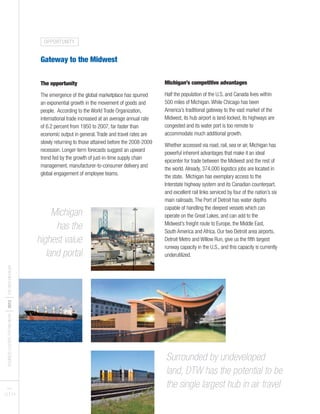
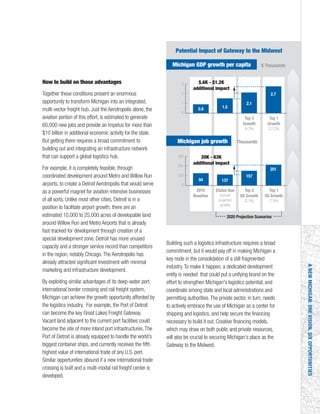
Surrounded by undeveloped
land, DTW has the potential to be
the single largest hub in air travel
Michigan
has the
highest value
land portal
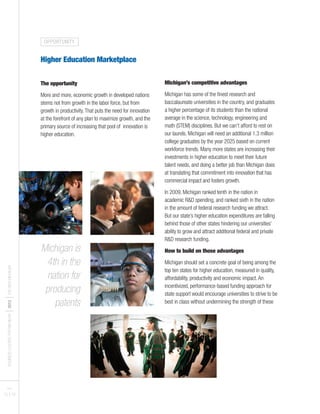
OPPORTUNITY
Status Quo
(current
projected
growth)
300
200
100
0
2010
Baseline
Top 5
US Growth
(5.3%)
2020 Projection Scenarios
Top 1
US Growth
(7.9%)
Top 3
Growth
(9.3%)
Top 1
Growth
(12.2%)
94 137
157
201
3
2
1
0
0.9 1.5
2.1
2.7
$.6K - $1.2K
additional impact
20K - 63K
additional impact
$ ThousandsMichigan GDP growth per capita
Potential Impact of Gateway to the Midwest
ThousandsMichigan job growth
ANEWMICHIGAN:ONEVISION,SIXOPPORTUNITIES
How to build on those advantages
Together these conditions present an enormous
opportunity to transform Michigan into an integrated,
multi-vector freight hub. Just the Aerotropolis alone, the
aviation portion of this effort, is estimated to generate
60,000 new jobs and provide an impetus for more than
$10 billion in additional economic activity for the state.
But getting there requires a broad commitment to
building out and integrating an infrastructure network
that can support a global logistics hub.
For example, it is completely feasible, through
coordinated development around Metro and Willow Run
airports, to create a Detroit Aerotropolis that would serve
as a powerful magnet for aviation-intensive businesses
of all sorts. Unlike most other cities, Detroit is in a
position to facilitate airport growth; there are an
estimated 10,000 to 25,000 acres of developable land
around Willow Run and Metro Airports that is already
fast-tracked for development through creation of a
special development zone. Detroit has more unused
capacity and a stronger service record than competitors
in the region, notably Chicago.The Aerotropolis has
already attracted significant investment with minimal
marketing and infrastructure development.
By exploiting similar advantages of its deep-water port,
international border crossing and rail freight system,
Michigan can achieve the growth opportunity afforded by
the logistics industry. For example, the Port of Detroit
can become the key Great Lakes Freight Gateway.
Vacant land adjacent to the current port facilities could
become the site of more inland port infrastructures.The
Port of Detroit is already equipped to handle the world’s
biggest container ships, and currently receives the fifth
highest value of international trade of any U.S. port.
Similar opportunities abound if a new international trade
crossing is built and a multi-modal rail freight center is
developed.
Building such a logistics infrastructure requires a broad
commitment, but it would pay off in making Michigan a
key node in the consolidation of a still fragmented
industry.To make it happen, a dedicated development
entity is needed that could put a unifying brand on the
effort to strengthen Michigan's logistics potential, and
coordinate among state and local administrations and
permitting authorities.The private sector, in turn, needs
to actively embrace the use of Michigan as a center for
shipping and logistics, and help secure the financing
necessary to build it out. Creative financing models,
which may draw on both public and private resources,
will also be crucial to securing Michigan’s place as the
Gateway to the Midwest.
BUSINESSLEADERSFORMICHIGAN
I2012
ITHENEWMICHIGAN
Higher Education Marketplace
The opportunity
More and more, economic growth in developed nations
stems not from growth in the labor force, but from
growth in productivity.That puts the need for innovation
at the forefront of any plan to maximize growth, and the
primary source of increasing that pool of innovation is
higher education.
Michigan’s competitive advantages
Michigan has some of the finest research and
baccalaureate universities in the country, and graduates
a higher percentage of its students than the national
average in the science, technology, engineering and
math (STEM) disciplines. But we can’t afford to rest on
our laurels. Michigan will need an additional 1.3 million
college graduates by the year 2025 based on current
workforce trends. Many more states are increasing their
investments in higher education to meet their future
talent needs, and doing a better job than Michigan does
at translating that commitment into innovation that has
commercial impact and fosters growth.
In 2009, Michigan ranked tenth in the nation in
academic R&D spending, and ranked sixth in the nation
in the amount of federal research funding we attract.
But our state’s higher education expenditures are falling
behind those of other states hindering our universities’
ability to grow and attract additional federal and private
R&D research funding.
How to build on those advantages
Michigan should set a concrete goal of being among the
top ten states for higher education, measured in quality,
affordability, productivity and economic impact.An
incentivized, performance-based funding approach for
state support would encourage universities to strive to be
best in class without undermining the strength of these
PAGES
15 I 16
Michigan is
4th in the
nation for
producing
patents
OPPORTUNITY
Status Quo
(current
projected
growth)
150
100
50
0
2010
Baseline
Top 5
US Growth
(4.3%)
2020 Projection Scenarios
Top 1
US Growth
(13.0%)
Top 5
Growth
(1.6%)
Top 1
Growth
(9.2%)
39 50
59
132
4
2
0
1.4 1.5 1.6 3.4
$0.2K - $1.9K
additional impact
10K - 83K
additional impact
$ ThousandsMichigan GDP growth per capita
Potential Impact of Higher Education Marketplace
ThousandsMichigan job growth
ANEWMICHIGAN:ONEVISION,SIXOPPORTUNITIES
institutions. Such a funding approach would also help
convince an increasingly skeptical public that investing
in higher education translates into good jobs and
innovation, and thus to a better economy for Michigan.
Michigan also could realize a significant economic
opportunity by encouraging universities to increase their
enrollment of out-of-state students, without reducing
access for in-state students. Michigan universities are in
demand, but they under-enroll out-of-state students
compared to comparable peer institutions elsewhere.With
Michigan’s indigenous youth population getting smaller,
this portends a serious talent shortfall in the future.
Increasing the enrollment of out-of-state students could
add over 20,000 additional students to the state’s pipeline
of future talent, bringing in more than $200 million per
year in increased direct revenue. While Michigan
universities rank sixth in the nation in attracting federal
R&D expenditures per capita, given the importance of R&D
to the growth of productivity, we must do better.This will
require a concerted effort to attract both more federal and
industry-sponsored R&D to Michigan. Federal monies
support 57 percent of all basic research conducted in the
U.S., and the bulk of it flows to universities.These funds,
properly allotted, can seed innovation and foster
substantial economic development.As well as Michigan
does in this regard, the national leader, Massachusetts,
attracts more than twice what we do per student, helping
that state to foster 79 percent more startups than
Michigan did per R&D dollar. For example, Michigan’s
University Research Corridor (comprised of Michigan State
University, University of Michigan and Wayne State
University) ranks next to last in attracting industry R&D
relative to six other U.S. research clusters.
While Michigan is among the nation's leaders in patent
activity and innovation output, we can better leverage
those achievements by strengthening university-
business-entrepreneurial partnerships. Great progress
has been made in this area over the past decade in
Michigan through new university business engagement
centers, business accelerators and entrepreneurial
programs. But we are still in the early stages of
developing these partnerships to accelerate
commercialization and business growth.
Finally, while the vast majority of the jobs of the future
will require education beyond high school, not all will
necessarily require a bachelor’s degree.These needs
can be met by expanding technical education programs
at community colleges and through better awareness of
the skills tomorrow’s workforce will require.
Michigan ranks 9th
in the nation in
Science & Engineering
graduates
BUSINESSLEADERSFORMICHIGAN
I2012
ITHENEWMICHIGAN
PAGES
17 I 18
Natural Resources Economy
The opportunity
Globalization, increasing world population and rising
income levels in developing nations are all increasing the
demand for natural resources – chiefly food, energy
sources, precious materials, and water.This creates a
massive opportunity not only for those providing those
commodities, but also for those in a position to develop
technologies and approaches that maximize the
productivity of ever-scarcer resources.
Michigan’s competitive advantages
Michigan’s varied agricultural industry has flourished in
part because of the local engineering capabilities that
have been brought to bear on improving it.That dynamic
between farmer and innovator offers Michigan a marked
advantage in the field of precision agriculture, where
automation control and satellite imagery are applied to
bring new levels of efficiency to planting, fertilizing and
harvesting crops.The industry is booming at a projected
rate of more than 19 percent per year, and for good
reason: farm productivity matters more than ever as
populations swell, land suitable for cultivation becomes
more scarce and a complex world commodity
marketplace increases price volatility. Michigan has all
the pieces in place to lead this trend.With global
demand for food expected to rise by 70 percent between
2000 and 2050 and Michigan farms producing 50
percent more feed-grains than state residents consume,
Michigan can become a key provider of the world’s food
supply by increasing exports and growing its food
processing capacity.
Michigan can also leverage its natural beauty in the
lucrative tourism market, which brought the state an
estimated $17.2 billion in revenue in 2010.Tourism
outlays are highly sensitive to the overall economy, and
have dropped off in general since the recession, but
Michigan’s tourism industry has been hurt
proportionately less than that of other U.S. states.
The industry provides jobs for some 156,200 Michigan
residents as it is, and the growing trend towards niche
markets plays to the state’s strengths.
Finally, Michigan has the greatest supply of freshwater in
the world, large wind corridors and an expertise in
alternative energy technologies that give it an opportunity
to help meet the world’s need for new manufacturing
and energy sources.
Michigan is the
leading state
for agricultural
diversity, expert
in food
production
OPPORTUNITY
Status Quo
(current
projected
growth)
300
200
100
0
2010
Baseline
Top 5
US Growth
(0.73%)
2020 Projection Scenarios
Top 1
US Growth
(2.4%)
Top 5
Growth
(2.8%)
Top 1
Growth
(5.5%)
217
177
233
276
3
2
1
0
1.7
1.3
2.2
2.9
$0.9K - $1.5K
additional impact
56K - 99K
additional impact
$ ThousandsMichigan GDP growth per capita
Potential Impact of Natural Resources Economy
ThousandsMichigan job growth
ANEWMICHIGAN:ONEVISION,SIXOPPORTUNITIES
How to build on those advantages
Agricultural processing and exports can be increased by
supporting policies and regulations designed to grow the
industry, increasing agricultural engineering solutions,
expanding the export transportation infrastructure and
helping expand overseas markets.
As for tourism, Michigan’s easy access to major
population centers, its relatively low costs, and the
intrinsic and varied attractiveness of its natural amenities
position the state’s industry well for future growth. But
those assets need to be appropriately marketed and
supported by strategic development of travel and
hospitality infrastructures.
In the longer run, Michigan’s plentiful supply of fresh
water could be an economic asset, as diminishing
supplies begin to have an impact on companies’
decisions about where to locate their facilities. Michigan
can work now to attract water-intensive industries to the
state that adopt safe, sustainable practices to prevent
the diversion of water outside of Michigan. It’s critical
that Michigan remain mindful that protecting our water
stocks and keeping them secure will leave the state with
an incalculable advantage for decades to come. In
addition we can leverage our engineering and
manufacturing assets to define future products and
services for the water management value chain to meet
the needs of water scarce regions in the world.
Concurrently, our specialized expertise in alternative
energy technologies should continue to be expanded
through the education of new talent, research
investments and engineering solutions that apply
automotive learnings across disciplines. Prudent
utilization of natural shale, wind and precious minerals
should also be pursued.
Michigan is
surrounded by 95%
of the total US fresh
water supply
BUSINESSLEADERSFORMICHIGAN
I2012
ITHENEWMICHIGAN
PAGES
19 I 20
Global Center of Mobility
The opportunity
The global automotive industry is projected to expand by
31 percent by 2020 as the world’s growing middle class
acquires personal transportation. In addition, the
industry is rapidly transforming to enable the automobile
to serve as an extension of an individual’s office or home
while becoming more energy efficient. By 2020, almost a
quarter of units produced are expected to be hybrid
vehicles, and by 2050, the internal combustion engine
and the hybrid alike are expected to be eclipsed by
electric cars powered exclusively by fuel cells and
batteries.
Michigan’s competitive advantages
For more than a century, Michigan has been the center
of the American automotive industry, and for almost as
long the center of the global industry. Michigan is the
number one state for vehicle research and development,
the number one state for vehicle production and home to
47 of the top 50 automotive suppliers. It is now uniquely
equipped to broaden its unmatched network of suppliers,
talent, and R&D capabilities and become the global
center of mobility.
How to build on those advantages
Michigan should aspire to lead the trend toward
sustainable mobility, and it is well-placed to do so.
Whenever disruptive technologies create or transform an
industry, established actors serve as nuclei for clusters of
related economic activity. Consider how Silicon Valley
grew up around Hewlett Packard and other early
computer technology companies. Or how Norway’s oil
field and supply equipment sector, now a world leader,
developed around existing exploration companies, largely
because the oil shock forced companies to find new
revenue streams and the government was foresighted
enough to provide the business climate, research
support, and vision needed to seed change.
Michigan is the
number 1 state
for vehicle research
and development
OPPORTUNITY
Status Quo
(current
projected
growth)
300
200
100
0
2010
Baseline
Top 5
US Growth
(3.5%)
2020 Projection Scenarios
Top 1
US Growth
(4.9%)
Top 5
Growth
(11.5%)
Top 1
Growth
(16.7%)
131
86
185
211
15
10
5
0
2.3 2.3 6.7
10.6
$4.4K - $8.2K
additional impact
100K- 126K
additional impact
$ ThousandsMichigan GDP growth per capita
Potential Impact of Global Center of Mobility
ThousandsMichigan job growth
ANEWMICHIGAN:ONEVISION,SIXOPPORTUNITIES
The conditions exist for Michigan to make a similar
transformation.We should aspire to make our existing
automotive cluster the hub of many more, related
clusters in areas we know will emerge given the
demands of the global mobility market. For instance,
Michigan should be home to the greatest concentration
anywhere of R&D and manufacturing of the most
technologically challenging parts of electric vehicles. It is
here, in our labs and factories, that we should strive to
develop the next-generation of electric powertrains,
battery cells and cathode materials, which must meet
consumer needs in terms of value and affordability; it is
here that we can design, test and manufacture electric
motors, and work to improve the efficiency of
conventional power trains as well.And whatever
technologies emerge to power the cars of the future,
there is bound to be a premium on lighter-weight
materials that can be recycled. Michigan should push to
assure that the materials cluster that explores and
exploits those possibilities puts roots down here.To enter
this next stage of advanced products in the global
mobility arena, we need to cross-fertilize the expertise of
multiple industry value chains, within and outside the
automotive realm. Michigan can be the hub of the future
mobility center.
Similarly, this should be the place where the
cutting-edge research occurs on connected vehicle
technologies, such as GPS-assisted parking.With proper
support and planning, there is no reason why Michigan
shouldn’t be the location where game-changing,
driverless automated vehicles become a commercial
reality.These are products that make their own market;
consumers don’t even realize they want them, much as
they didn't know they wanted Model Ts until Henry Ford
designed them, or iPods or iPads until Steve Jobs
pushed them into an unsuspecting world.
Finally, our automotive expertise can also be leveraged
into developing multi-modal systems of transportation for
an increasingly urbanized world. For example, solutions
that allow personal forms of transportation to integrate
seamlessly with public transit systems would minimize
congestion and reduce emissions. These opportunities
can help to draw out-of-state talent and create an
ongoing circle of technological development in this
industry.
47 of the top 50
automotive suppliers
are located in Michigan
BUSINESSLEADERSFORMICHIGAN
I2012
ITHENEWMICHIGAN
Life Sciences Hub
The opportunity
The aging of the population in developed nations, a
growing middle class in the developing world and the
demand for a higher quality of life among all populations
is driving demand for life sciences solutions. Healthcare
expenditure in the developed world is already outpacing
GDP, and the gap is widening. Few industries can come
close to matching the long-term growth potential of bio-
science industries.
Michigan’s competitive advantages
Michigan is well placed to capitalize on this demand.
We turn out the eighth highest number of university
bio-science degrees and rank 15th in employment in
this arena. For example, we confer 5,500 degrees in the
bio-science field every year and registered more than
1800 bio-science patents in the five years from 2004 to
2009, giving us a tenth-place ranking in the nation.
We have a unique combination of excellent high-end
medical research facilities and an overcapacity of
hospital acute care facilities.And there is an existing
industry to build on, as well.The bio-pharma industry
employed more than 20,000 people directly in the state
in 2008, and another 75,000 in related industries. It
contributed $8 billion directly to our state output, and
seeded a further $12 billion in revenue in related
industries.
How to build on those advantages
One place to start is with bio-pharma products.This area
has a strong cluster effect and a great potential for
further growth, and we could jumpstart it by cultivating
an incubation hub for bio-pharma.Accelerating efforts
would help foster more startups and encourage them
into profitability, and create the broader connections
across the entrepreneurial community to help this
industry grow in Michigan.
In the bio-science arena as in engineering, services are
growing at a much faster rate than products, a trend we
PAGES
21 I 22
The life sciences
multiplier effect:
one job creates four
spin-off jobs
OPPORTUNITY
Status Quo
(current
projected
growth)
100
50
0
2010
Baseline
Top 5
US Growth
(2.8%)
2020 Projection Scenarios
Top 1
US Growth
(5.5%)
Top 5
Growth
(7.5%)
Top 1
Growth
(15.4%)
45
51
60
77
3
2
1
0 0.6
0.9 1.1
2.3
$0.2K - $1.4K
additional impact
9K - 27K
additional impact
$ ThousandsMichigan GDP growth per capita
Potential Impact of Life Sciences Hub
ThousandsMichigan job growth
ANEWMICHIGAN:ONEVISION,SIXOPPORTUNITIES
should be mindful of as we promote this asset.The
biopharmaceutical service industry provides more jobs
across the nation than the manufacturing of drugs does,
and national employment there rose by more than 50
percent from 2004 to 2008.We should concentrate our
efforts on becoming a center of excellence for such
services. Specifically, that means developing research,
testing and medical lab services to serve the broader life
science industry.We have a great starting point: In
recent years we conferred 17 percent more bachelor’s
degrees in bio-science and engineering per capita than
the national average.And we rank 13th in the country in
running clinical trials for drugs and medical devices, a
service that plays to our strengths.
Finally, we should pursue all available means to make
Michigan a destination of excellence for medical care of
out-of-state and foreign patients, both in the high-end
and lower-price markets. Healthcare expenditure in the
developed world is already outpacing GDP, and the gap is
widening. In the U.S., the wellness industry has grown at
an average annual pace of more than 22 percent in the
last decade.A focused commitment could put us in an
excellent position to reap far more than our natural share
of that growth.
Our state’s more than 150 hospitals, 50 of them with
large acute care facilities, are less than 70 percent
occupied and many are nationally recognized centers of
excellence.These are all good circumstances for
Michigan to get to the front of the line in attracting
patients from elsewhere, particularly in light of our
central geographical location and transport
infrastructure. Michigan hospitals can compete
successfully for long-term health maintenance and even
surgical contracts from out-of-state employers and
insurers interested in managing rising healthcare costs
while providing excellent care to employees.
What’s needed to fulfill our potential is a clear road map
that demonstrates a long-term commitment to the
growth of the life sciences industry.That should include
long-horizon investments, a rational regulatory and legal
environment, strong support for the universities and their
efforts to pursue cutting-edge research and attract top-
quality students and faculty, and entrepreneurial support
for start-ups and scaling of successful small and
medium-sized companies.
Michigan turns out
the 8th highest
number of university
bio-science degrees
We are convinced that Michigan can move to a far
brighter future if it embraces these six growth
opportunities. Each one of them builds on specific,
existing strengths that offer a high probability, our
research suggests, of improving our state’s overall
output, our productivity, and our jobs picture.
That’s not to say, however, that they represent the final
word. We welcome suggestions from all quarters
toward shaping and refining these initiatives, and
toward identifying other ways to leverage our assets
today into greater opportunities tomorrow.
We hope this document sparks a broad and fertile
discussion about additional initiatives for growth, and
eventually a concrete plan on achieving them. But the
plan, of course, is only the beginning. Implementing it
will require the commitment of all stakeholders —
private enterprise, the public sector, and supporting
associations and entities responsible for guiding
economic development.
Forging a shared vision is vital. The regions of the world
that have been most successful at achieving strong,
sustained economic growth tend to be those that could
forge a common approach on how to do it. Only with
clarity and shared purpose can any region sustain the
work needed to realize a vision of economic growth
over decades. The southern states after World War II
present one example of how this can be done
successfully. While some succeeded better than others,
most realized they needed to embrace economic
transformation, prioritize their investments in a few
areas that would accelerate economic growth, and
build broad alliances across all segments of the
community to sustain the effort. Germany in the same
period offers another example. From a starting point of
absolute devastation, the country recast itself, building
on its strong tradition of technical innovation to strike
out on a new path of phenomenal growth, encouraged
by access to free markets and a stable financial
environment.
For too long, Michigan has lacked that sense of a
common purpose. It has been a state divided by region,
political party, class, race and labor status. Only
recently have these divisions begun to fade as the
stresses associated with a weak economy delivered a
painful reminder of an often forgotten truth: that
Michigan will rise or fall based on the success of our
collective efforts. Success spawns more success. And
with a common sense of direction, we can retain the
momentum needed for longterm prosperity.
BUSINESSLEADERSFORMICHIGAN
I2012
ITHENEWMICHIGAN
PAGES
23 I 24
In Conclusion
New Michigan Champion
William Clay Ford, Jr., Executive Chairman,
Ford Motor Company
Global Engineering Village co-champions
James P. Hackett, President & CEO, Steelcase Inc.
Charles G. McClure, Chairman, President & CEO,
Meritor, Inc.
Gateway to the Midwest co-champions
Stephen E. Gorman, Executive VP & COO,
Delta Air Lines
Douglas W. Stotlar, President & CEO,
Con-way Inc.
Higher Education Marketplace co-champions
J. Patrick Doyle, President & CEO, Domino’s Pizza
Mary Sue Coleman, President, University of Michigan
Natural Resources Economy co-champions
Stephen M. Kircher, President & CEO,
Boyne Eastern Operations - Boyne Resorts
Lou Anna K. Simon, President, Michigan State University
Global Center of Mobility co-champions
William Clay Ford, Jr., Executive Chairman,
Ford Motor Company
Stephen K. Carlisle, GM Vice President,
Global Product Planning, General Motors Company
Life Sciences Hub co-champions
William U. Parfet, Chairman & CEO, MPI Research
Michael J.Jandernoa,Board of Directors,Perrigo Company
Business Leaders for Michigan is committed to
engaging major stakeholder groups to work together to
advance the six opportunities we have outlined in this
document. We will do all we can to champion these
opportunities. When needed, we hope to serve as a
catalyst to encourage other organizations to collaborate
on furthering these efforts across the state. BLM will
convene regular meetings of key stakeholders to push
ahead and share best practices.We are committed, too,
to keeping the public abreast of the progress our state
is making.
We hope this plan spurs interest and engagement
across our state, from elected leaders, business
groups, civic organizations and citizens. Our central
message is that Michigan has enormous economic
assets, and that with genuine commitment, hard work
and a dedication to positive change, we can shift
Michigan back to a pathway of sustainable growth. Let
the discussion begin in earnest about what a New
Michigan can be and how to get there. We’ve laid out
our vision of the goal. Now we need your input, your
engagement, and your passion to make it a reality.
For more information about Business Leaders
for Michigan, the 2012 Michigan Turnaround Plan
and the path to a New Michigan, visit:
www.BusinessLeadersforMichigan.com
CONCLUSION
BUSINESSLEADERSFORMICHIGAN
I2012
ITHENEWMICHIGAN
PAGES
25 I 26
JAMES B. NICHOLSON
CHAIR OF THE BOARD
PVS Chemicals Inc.
TERENCE E. ADDERLEY
Kelly Services, Inc.
DANIEL F. AKERSON
General Motors Company
MARK ALYEA
Alro Steel Corporation
GERARD M. ANDERSON
DTE Energy Company
JON E. BARFIELD
The Bartech Group, Inc.
ALBERT M. BERRIZ
McKinley, Inc.
MARK J. BISSELL
BISSELL Inc.
STEPHEN J, BOSHOVEN
Farmers Insurance Group
STEPHEN K. CARLISLE
General Motors Company
MARY SUE COLEMAN
University of Michigan
TIMOTHY P. COLLINS
Comcast Cable
ROBERT S. CUBBIN
Meadowbrook Insurance Group, Inc.
KURT L. DARROW
La-Z-Boy Incorporated
DAVID C. DAUCH
American Axle & Manufacturing
RICHARD L. DeVORE
PNC Financial Services Group
DOUGLAS L. DeVOS
Amway
J. PATRICK DOYLE
Domino’s Pizza
JAMES E. DUNLAP
Huntington
FREDERICK H. EPPINGER
The Hanover Insurance Group
JEFF M. FETTIG
Whirlpool Corporation
WILLIAM CLAY FORD, JR.
Ford Motor Company
YOUSIF B. GHAFARI
GHAFARI, Inc.
DANIEL GILBERT
Quicken Loans Inc.
ALLAN D. GILMOUR
Wayne State University
ALFRED R. GLANCY III
Unico Investment Group LLC
DAN GORDON
Gordon Food Service, Inc.
STEPHEN E. GORMAN
Delta Air Lines, Inc.
JAMES P. HACKETT
Steelcase Inc.
RONALD E. HALL
Bridgewater Interiors, LLC
RICHARD G. HAWORTH
Haworth, Inc.
CHRISTOPHER ILITCH
Ilitch Holdings, Inc.
MICHAEL J. JANDERNOA
Perrigo Company
MILES E. JONES
Dawn Food Products, Inc.
DAVID W. JOOS
CMS Energy Corporation
HANS-WERNER KAAS
McKinsey & Company
ALAN JAY KAUFMAN
Kaufman Financial Group
JOHN C. KENNEDY
Autocam
STEPHEN M. KIRCHER
Boyne Resorts
BLAKE W. KRUEGER
Wolverine World Wide, Inc.
ANDREW N. LIVERIS
Dow Chemical Company
DANIEL J. LOEPP
Blue Cross Blue Shield of Michigan
STEPHEN P. MacMILLAN
Stryker Corporation
BEN C. MAIBACH III
Barton Malow Company
TIMOTHY M. MANGANELLO
BorgWarner Inc.
RICHARD A. MANOOGIAN
Masco Corporation
FLORINE MARK
The WW Group, Inc.
SARAH L. McCLELLAND
Chase
CHARLES G. McCLURE
Meritor, Inc.
DAVID E. MEADOR
DTE Energy
HANK MEIJER
Meijer, Inc.
MICHAEL MILLER
Google, Inc.
MARK A. MURRAY
Meijer, Inc.
CATHLEEN H. NASH
Citizens Republic Bancorp
THOMAS D. OGDEN
Comerica Bank
JAMES O’LEARY
Kaydon Corporation
WILLIAM U. PARFET
MPI Research
Business Leaders for Michigan - 2012 Board of Directors
BUSINESSLEADERSFORMICHIGAN2012BOARDOFDIRECTORS
CYNTHIA J. PASKY
Strategic Staffing Solutions
ROGER S. PENSKE
Penske Corporation
WILLIAM F. PICKARD
GlobalAutomotiveAlliance
SANDRA E. PIERCE
Charter One - Michigan
GERRY PODESTA
BASF
CHARLES H. PODOWSKI
The Auto Club Group
STEPHEN R. POLK
R. L. Polk & Co.
JOHN RAKOLTA, JR.
Walbridge
DOUG ROTHWELL
Business Leaders for Michigan
ANDRA M. RUSH
Dakkota Integrated Systems, LLC
JOHN G. RUSSELL
CMS Energy Corporation/
Consumers Energy Co.
RICHARD F. RUSSELL
Amerisure Companies
ALAN F. SCHULTZ
Valassis
ALAN E. SCHWARTZ
HONIGMAN
J. DONALD SHEETS
Dow Corning
BRAD SIMMONS
Ford Motor Company
LOU ANNA K. SIMON, Ph.D.
Michigan State University
SAM SIMON
Atlas Oil Company
MATTHEW J. SIMONCINI
Lear Corporation
BRIG SORBER
Two Men and a Truck International
DONALD J. STEBBINS
Visteon Corporation
DOUGLAS W. STOTLAR
Con-Way Inc.
ROBERT S. TAUBMAN
Taubman, Inc.
SAMUEL VALENTI III
TriMas Corporation
STEPHEN A. VAN ANDEL
Amway
MICHELLE L. VAN DYKE
Fifth Third Bank
TIMOTHY WADHAMS
Masco Corporation
BRIAN C. WALKER
Herman Miller, Inc.
WILLIAM H. WEIDEMAN
The Dow Chemical Company
WILLIAM C. YOUNG
Plastipak Holdings, Inc.
Bank of America
Energy Conversion Devices, Inc.
We commit to serving as a catalyst,
advocate and champion to transform
Michigan’s economy.
Michigan is our home: We live, work and raise
our families here.
We believe a vibrant Michigan economy will
make our state a place where business wants
to invest and people want to live and work.
A Commitment and a Promise: From Business Leaders for Michigan
We promise to sustain our effort for the
long-term and take an active role in leading
this transformation.
We will work beyond political terms to sustain
the effort.
We will focus on achieving the plan’s goals and
welcome different ideas for achieving them.

The Michigan Turnaround Plan (2012)

  • 1.
    LAYING THE FOUNDATIONTO BUILD A NEW MICHIGAN
  • 2.
    BUSINESSLEADERSFORMICHIGAN I2012 IMICHIGANTURNAROUNDPLAN PAGES 1 I 2 2Letter from the Chairman and CEO 3 Executive Summary 4 The Case for Change 5 The Impact on Michigan 7 Michigan’s Competitive Position 12 Progress 14 2012 Michigan Turnaround Plan Overview 25 The Six Step Turnaround Plan 27 Where We Could Be Who We Are Dedicated to making Michigan a “Top Ten” state for job, economic and personal income growth. The state’s business roundtable: composed of the chairpersons, chief executives or most senior executives of the state’s largest job providers and universities. Driving nearly one-quarter of the state’s economy: provide over 320,000 direct jobs in Michigan, generate over $1 trillion in annual revenue, and serve over 135,000 students. www.BusinessLeadersForMichigan.com
  • 3.
    Business Leaders forMichigan (BLM) is an organization dedicated to making Michigan a “Top Ten” state for job and economic growth.We serve as a catalyst for change, a visionary organization that supports its ideas with careful research, thorough planning, and accountability for results. In 2009, we unveiled the Michigan Turnaround Plan (MTP), an aggressive agenda to make Michigan a Top Ten State for job and economic growth. The Plan set forward the case for change, naming achievable goals, identifying action steps and explaining the potential impact of change.The Plan is organized around a five-step strategy: improving the way the state manages its finances, improving the efficiency and effectiveness of the public sector, getting Michigan competitive to attract and retain jobs, making investments that will create a great job environment and accelerating job growth through innovation and entrepreneurship. We have worked closely with government, policy and business leaders to affect meaningful advancement of each MTP objective. Citizens and stakeholders have rallied around the MTP. Thanks to policy makers in Lansing, the past twelve months have been game-changers for our state and many components of the MTP are now in place. Using our Michigan Turnaround Plan as a checklist, we can see how much has been done to strengthen our state and reshape its economy. Our state finances are managed better, our tax policy has been improved, our regulatory environment makes more sense, and the conditions are right to foster growth in our state, creating new jobs and bringing life to our communities. As you read this report, we think you’ll see that much has been done to strengthen Michigan’s economic environment. Our economy might not be a Top Ten State yet, but we’re well on our way. In the 2012 Michigan Turnaround Plan, we identify what work remains in Steps 1-5 to further strengthen our state’s competitiveness and put our state on a solid path to prosperity. Now that our foundation is more solid, it is time to add a sixth step to the MTP – Leveraging Assets to Grow the New Michigan. We identify existing Michigan assets that we believe, based on solid data, can be leveraged to accelerate growth and transition to the New Michigan. It’s a 10+ year vision that builds on the first five steps of the Plan. We detail the possibilities we see in each “growth opportunity” to reshape and strengthen the Michigan of tomorrow. But this will require a shared vision for the future,one that allows us to effectively allocate resources,evaluate plans,and maintain a coherent approach beyond election cycles.We have the capacity to move into a future that glows with promise. We invite you to be part of this work. Each of us can have a role in Michigan’s turnaround.Together, we can seize control of our destiny, make a shift in how we approach the future, and drive lasting change for the people of our great state. Sincerely, James B. Nicholson Doug Rothwell Chair of the Board President & CEO
  • 4.
    BUSINESSLEADERSFORMICHIGAN I2012 IMICHIGANTURNAROUNDPLAN PAGES 3 I 4 EXECUTIVESUMMARY A State in Transition Michigan has been getting poorer, smaller and less competitive relative to other states for nearly 50 years. The state needs significant economic growth to meet and ultimately surpass its U.S. and global competitors. Incremental changes to the state’s budget, tax and economic development policies will be insufficient to grow the state’s economy fast enough to become a “Top Ten” state. The Michigan Turnaround Plan is a holistic strategy for accelerating growth. 1. US Bureau of Economic Analysis, 2. BLM 2011 Benchmarking Report Past Prosperous State Per capita personal income 14% above the national average in the 1950s1 Recent Trends Relative Decline Economic decline began in 1960s and accelerated rapidly beginning in 2000 as Michigan fell from above average to below average growth Root Cause Uncompetitive Michigan ranks average to below average on many factors that drive job creation2 Today Turnaround Underway Reforms are helping to improve economy, but complete turnaround will take years — per capita income 13% below national average1 Future Michigan Turnaround Plan A holistic plan that builds on Michigan’s strengths to make Michigan a Top Ten state for job, economic and personal income growth
  • 5.
    THECASEFORCHANGE One million jobswere lost in Michigan over the last decade across virtually all industry sectors. THE CASE FOR CHANGE Michigan Lost 1M Jobs 2000-10 50% of U.S. Job Losses: Michigan lost 1M of the 2M jobs lost in the nation from 2000 through 2010. This far surpassed the job losses experienced by any other state during this period. Job Losses Across All Sectors No One Sector Was the Cause: Michigan under-performed the nation in 86% of the 22 U.S. job categories from 2004-2009. The auto sector only impacted ~20% job losses. Michigan sectors that out-performed the U.S. average were: Community and Social Services, Personal Care and Services, and Agriculture. MI > U.S. U.S. < MI Michigan Job Sector Growth vs. the Nation 14% 86% SOURCE: SOC Job Category Data 2004-2009, BLS
  • 6.
    BUSINESSLEADERSFORMICHIGAN I2012 IMICHIGANTURNAROUNDPLAN PAGES 5 I 6 WeakerEconomy Economy Grew 2% Less than the Top Ten: Michigan’s Per Capita Gross Domestic Product (GDP) grew 2% less than the average Top Ten state over the past decade and less than nearly all peer states. This is the primary factor behind stagnant wages and job losses. Lower Bond Rating Higher Borrowing Costs: Michigan spent more than it raised in revenues, went deeper into debt and drew down all its financial reserves in the 2000s resulting in a low bond rating. This increases the cost of borrowing for all governments in Michigan and is a symbol of the state’s fiscal health. Poorer Residents Poorer Relative to U.S.: Michigan’s per capita income had been close to the national average for nearly 40 years until declining dramatically in the last decade. Michigan’s per capita income has fallen to 39th due to falling GDP over the past decade. Michigan has grown smaller and poorer relative to other states exacerbating the state’s economic decline. THE IMPACT ON MICHIGAN “Top Ten” states for job and economic growth: KS, MD, MT, NE, ND, SD, TX, VA, WA, WY SOURCE: Bureau of Economic Analysis; Moody’s Economy.com; U.S. Census Bureau; McKinsey analysis SOURCE: S&P SOURCE: U.S. Bureau of Economic Analysis
  • 7.
    THEIMPACTONMICHIGAN Smaller State Declining Population: Michiganis the only state to lose population in the last decade (0.6% decline). This has resulted in Michigan becoming less attractive to business due to a declining share of the consumer market. Losing Talent Lack of Jobs Has Forced Talent to Leave: Michigan’s high unemployment rate and economic decline across sectors has caused talent to migrate out-of-state to where most of the jobs are — the Sun Belt states. Past Ten Years Performance Weak Ten Year Economic Track-Record: Michigan’s combined ranking on per capita GDP growth, per capita personal income level and employment growth is last among states over the past ten years. This has placed Michigan far behind its U.S. and global economic competitors. SOURCE: U.S. Census Bureau Population Estimates Program SOURCE: Forbes based on U.S. Census data (2008) SOURCE: 2011 BLM Benchmarking Report
  • 8.
    BUSINESSLEADERSFORMICHIGAN I2012 IMICHIGANTURNAROUNDPLAN PAGES 7 I 8 Seekingthe Right Balance The Cost/Value Equation: No one factor determines where economic growth occurs. Taxes, talent availability and quality of life factors all matter. Economic growth occurs in places that offer the most value relevant to the needs of specific types of businesses at costs commensurate with the value offered. Cost/Value Proposition Improving Positives on Rise, Negatives Still High: Michigan’s “cost/value” scorecard is getting better, but still isn’t strong enough to dramatically accelerate growth. Simply put, we need to increase the positive attributes and lessen the negative drawbacks. Michigan’s competitive position is improving, but still falls short when compared to “Top Ten” states. MICHIGAN’S COMPETITIVE POSITION SOURCES: 2011 BLM Benchmarking Report & Anderson Economic Group Report for Brookings
  • 9.
    MICHIGAN’SCOMPETITIVEPOSITION Strong Talent Production CompetitiveSupply of Highly Educated Graduates: Future workplace demands will require increasing the number of educated workers. Current levels of college graduates make Michigan competitive with most states. Strong Technical Talent Base Highly Competitive Supply of Technical Talent: Michigan’s manufacturing and life sciences heritage has resulted in one of the highest concentrations of technical talent, both with advanced degrees and technical certificates, in the nation. Strong Innovator Innovation Outcomes Rank Favorably: Michigan’s university and industry-based innovation outcomes rank favorable against top tier U.S. competitor regions and is a driver of long-term growth. SOURCE: National Science Foundation SOURCE: 2010 URC Economic Impact Report, * State Science & Technology Institute 1 States with the same score received the same rank 2 “Top Ten” states for job and economic growth: KS, MD, MT, NE, ND, SD, TX, VA, WA, WY SOURCE: U.S. Department of Education, National Center for Education Statistics, Integrated Postsecondary Education Data System (IPEDS); U.S. Census Bureau; Moody’s Economy.com
  • 10.
    BUSINESSLEADERSFORMICHIGAN I2012 IMICHIGANTURNAROUNDPLAN PAGES 9 I 10 HigherBusiness Costs Total Business Costs Greater Than National Average: Companies pay on average 3% more in “total business costs” in Michigan than the U.S. average. Costs can be as much as 19% above the “Top Ten” states and peers we most often compete against for jobs & investment. “Total business costs” include labor, taxes, energy & state/local taxes. Geographic Location Location Advantages: Michigan has three unique geographic advantages that could be leveraged to increase exports and attract foreign direct investment: • One of largest U.S. air hubs to Asia • Center link of NAFTA highway • Closest entry to Midwest from Halifax port Business Taxes Higher Than Competitors Tax Climate Improving, But Worse Than Competitors: New corporate income tax expected to improve Michigan to 22nd best ranking. Property taxes still high due to personal property tax — a tax not assessed by most states Michigan competes with. UI taxes expected to increase to repay federal debt. 1 Consists of 75% labor costs, 15% energy, 10% state/local taxes 2 States with the same score received the same rank 3 “Top Ten” states for job and economic growth: KS, MD, MT, NE, ND, SD, TX, VA, WA, WY SOURCE: North American Business Cost Review; Moody's Economy.com 1. Includes both real and personal property tax in Michigan 2. Rankings do not reflect recent changes to Michigan Unemployment Insurance requirements or changes made to Michigan’s corporate and individual income taxes SOURCE: 2011 BLM Benchmarking Report
  • 11.
    MICHIGAN’SCOMPETITIVEPOSITION Complex Regulatory Climate MichiganRegulatory Climate Ranked #43: Regulatory requirements in Michigan are often greater than those of other states and the compliance process can be more difficult due to the multiplicity of jurisdictions and ease of doing business. Less Educated Workforce Education Attainment Less Than Top Ten States: Michigan is competitive in the amount of talent it produces, ranking 21st in the number of total college degrees conferred per capita, but Michigan only ranks 31st in the percent of the population over age 25 with a bachelor’s degree or above. Poor Infrastructure Infrastructure Impedes Global Competitiveness: The quality and capacity of Michigan’s physical infrastructure limits the state’s ability to leverage a strong geographic location to increase exports and expand foreign direct investment in a global economy. SOURCE: Pacific Research SOURCE: NCHEMS 1. BTS, 2. aapa-ports.org, 3. FAA.com, 4. NTIA, 5. Reason Foundation (Comb. Rural/urban), 6. Detroit Regional Chamber
  • 12.
    BUSINESSLEADERSFORMICHIGAN I2012 IMICHIGANTURNAROUNDPLAN PAGES 11 I 12 GlobalCompetition Escalating Michigan Competes in a Global Economy: The fastest economic growth is expected to continue to occur in emerging global markets. Michigan’s ability to accelerate economic growth is tied to the state’s ability to compete in the global economy. Less Attractive Urban Centers Michigan Cities Rank Low On Urban Vitality: Michigan cities generally rank low on most “best cities to work, live or grow a business” lists. Low rankings reflect a combination of fact and perception-based issues that detract from Michigan’s image. Michigan must accelerate efforts to strengthen its cost/value equation in the face of escalating global competition SOURCE: The Conference Board
  • 13.
    PROGRESS Michigan’s economic turnaroundhas begun, but it is at an early stage. PROGRESS Lower Unemployment Michigan Has 2nd Best Recovery of Any State: Michigan’s unemployment rate dropped more than any other state, except Nevada, over the past year. This improvement was nearly three times faster than the national recovery. Higher Gross Domestic Product (GSP) 2010 – Above Average Increase in GDP: Michigan GDP increased at a faster rate than most peer states and nearly as fast as “Top Ten” states in 2010. The increase put Michigan above the national average for GDP growth for the first time in a decade. The increase was largely due to economic recovery in the automotive and manufacturing sectors. SOURCE: BLS Seasonally Adjusted November Unemployment Rate SOURCE: 2011 BLM Benchmarking Report 1 “Top Ten” states for job and economic growth: KS, MD, MT, NE, ND, SD, TN, TX, WA, WY
  • 14.
    BUSINESSLEADERSFORMICHIGAN I2012 IMICHIGANTURNAROUNDPLAN PAGES 13 I 14 HigherPer Capita Income 2010 - 7th Best Increase in Income: Michigan’s per capita personal income increased by nearly 4% in 2010 which increased the state’s ranking from 39th to 38th. The increase was nearly one and a half times the national average. SOURCE: U.S. Bureau of Economic Analysis
  • 15.
    2012MICHIGANTURNAROUNDPLANOVERVIEW The Goal “Top Ten”State for Job & Economic Growth = Higher Personal Income for Michigan Residents Characteristics of Top Ten States Top ten states generally have several common characteristics that sustain healthy economic growth. The goal is getting Michigan to become a “Top Ten” state for job, economic and personal income growth through a plan based on facts. 2012 MICHIGAN TURNAROUND PLAN OVERVIEW
  • 16.
    BUSINESSLEADERSFORMICHIGAN I2012 IMICHIGANTURNAROUNDPLAN PAGES 15 I 16 PotentialResults of Growing Like a Top Ten State The Six Step Michigan Turnaround Plan 1. Based on Michigan accelerating per capita income growth to match the rate of #10 state Mississippi whose rate was 44%. 2. Employment growth is accelerated to match the rate of Hawaii which accelerated at 6.4%. Sources: US Bureau of Economic Analysis and BLS
  • 17.
    ORIGINAL MTP GOALS ANDRECENT PROGRESS 3 Public-private revenue estimating council to improve forecasting 3 Quarterly survey of Michigan businesses to improve forecasting 3 Multi-year financial & budget plans to improve fiscal discipline 3 Citizen-friendly balance sheet to improve transparency 3 Zero-based budgeting or other system to increase results 3 No new programs unless others eliminated or revenues grow • Strategic plan to set priorities • Require fiscal notes to identify compliance and other costs WHERE WE STAND • 19 states adopt biennial budgets¹ • Revenue estimates are more volatile in changing economy² • Michigan, as a relatively poor state, must set fiscal priorities more than the average state • Increasing Michigan’s bond rating from AA- to AAA would save interest costs • State borrowing has increased over three times the growth of personal income in the past twenty years and now exceeds annual state revenues³ • State unfunded pension liabilities exceed $18B³ • Michigan’s unemployment insurance debt was retired through an innovative bond issuance. 2012 MTP GOALS • Set clear spending priorities - Adopt a strategic plan setting goals & expected outcomes - Adopt performance-based budgeting with ROI measures • “Price” the cost to comply with proposed legislation - Adopt fiscal notes for all legislation • Memorialize sound fiscal management practices in legislation or policy (e.g., timely adoption of a structurally-balanced budget, two-year budget plan, citizen- friendly balance sheet) • Reduce debt levels to achieve AAA bond rating 3 = Accomplished or significant progress • = Not accomplished ¹ NCSL ² Pew Center for the States ³ 2011 Citizen’s Guide to MI Fiscal Health 2012MICHIGANTURNAROUNDPLANOVERVIEW Step 1: Responsibly Manage Finances A scorecard of five key metrics developed by Business Leaders for Michigan to assess the overall condition of state and local finances. All show positive trends in 2011, but operating reserves, pension obligations and overall debt levels continue to need further attention. *Arrows indicate positive or negative trends Colors indicate whether the metric has been fully achieved
  • 18.
    BUSINESSLEADERSFORMICHIGAN I2012 IMICHIGANTURNAROUNDPLAN PAGES 17 I 18 Step2: Efficiently & Effectively Provide Public Services Significant progress has been made to reduce the cost of government in Michigan. But more work is needed to reduce costs and increase productivity to improve the state’s competitiveness and reflect its relatively low per capita income. ALEC (NAEP SCORES), 2. McKinsey, 3. Anderson Economic Group, 4. U.S. Census Efficiently & Effectively Provide State Services ORIGINAL MTP GOALS AND RECENT PROGRESS 3 Reduce state workforce 3 Enact corrections management & sentencing reforms 3 Reduce optional services that exceed federal standards 3 Eliminate state programs that duplicate or overlap federal standards 3 Benchmark and increase state employee health care premium contributions to the average of U.S. state employees or all Michigan employees • Benchmark and freeze pay for state employees to the U.S. average for state employees WHERE WE STAND • Average total compensation for state employees was $22,000 more than the private sector average in Michigan in 2010¹ • Michigan state employees total compensation is 14% above the U.S. median state and 22% above Indiana² • Michigan’s incarceration rate is 51% higher and our prisoners stay 48% longer than the Great Lakes average. Michigan spends 30% more to house prisoners than Ohio and 80% more than Texas² • Government productivity gains in the U.S. have under-performed most other sectors for twenty years3 2012 MTP GOALS • Improve the cost and productivity of the state workforce - Adopt a total compensation system that enables the state to compete for talent in highly competitive fields and rewards performance at a cost comparable to the average state • Reduce corrections costs to the Great Lakes average • Improve the efficiency of state government - Invest in programs that have a proven track-record of reducing long-term costs (e.g., prisoner re-entry, home health care) - Adopt best practices to provide self-directed citizen & business transactions through the use of technology ¹ BEA Comp. of Employees by NAICS ² U.S. Census 3 McKinsey 3 = Accomplished or significant progress • = Not accomplished
  • 19.
    Efficiently & EffectivelyProvide School Services 2012MICHIGANTURNAROUNDPLANOVERVIEW ¹ NAEP & AEG analysis ² National Education Association 3 U.S. Census 4 McKinsey 3 = Accomplished or significant progress • = Not accomplished ORIGINAL MTP GOALS AND RECENT PROGRESS 3 Benchmark and increase public school employee health care premium contributions to the average of U.S. state employees for all Michigan employees 3 Provide incentives for local district cost-sharing 3 Retain demanding graduating standards 3 Allow an unlimited number of charter schools, especially in under-performing districts • Fully transition teachers to a defined contribution retirement system WHERE WE STAND • Michigan student test scores rank at (8th grade reading = 32nd) or below (8th grade math = 37th) the national average while per capita spending ranks above average (8th)1 • Average annual salary costs for public school teachers was $3,370 more (6% higher) than the average of U.S. public school teachers in 20092 • Michigan has more than 500 school districts – 6th highest in the U.S.3 • The education sector’s productivity has declined for 20 years in the U.S.4 2012 MTP GOALS • Improve the return on investment from the 0-12 education system - Accelerate the consolidation of schools where appropriate and the sharing of school services to direct more resources to student learning - Fully transition teachers to a defined contribution retirement system - Provide access to quality early childhood education - Maintain rigorous standards in reading, math and science - Maximize the time students spend on academic learning - Attract, train and retain excellent teachers - Attract and train excellent school leaders - Measure and reward schools, teachers and school leaders that perform at a high level - Improve the collection and use of data
  • 20.
    BUSINESSLEADERSFORMICHIGAN I2012 IMICHIGANTURNAROUNDPLAN PAGES 19 I 20 Efficiently& Effectively Provide Local Services ORIGINAL MTP GOALS AND RECENT PROGRESS 3 Encourage & enable local government service sharing 3 Modify or eliminate binding arbitration for municipal police & fire workers • Adopt best management practices 3 Align local employee benefits to average of all Michigan employees • Adopt competitive tax & regulatory standards WHERE WE STAND • Michigan has 2,800 units of local government – 12th highest in the U.S.¹ • Michigan ranks among the top ten states in the number of elected officials with over 17,000¹ • Local government boundaries don’t align with regional economies • State and federal program boundaries don’t align with regional economies (e.g., Michigan has 25 workforce development, 17 adult education, 14 planning and 19 arts regions none of which align with each other)² 2012 MTP GOALS Advocate state government enable improvements in local service delivery by: • Providing incentives & disincentives in all state programs that recognize local service sharing • Aligning federal & state program boundaries with regional economies • Accelerating efforts to consolidate local administrative services and increase regional service delivery Advocate local governments adopt best practices and “fix the basics” by ensuring: • Competitive tax & regulatory standards • Sound fiscal management practices • Strong ethics standards • Effective public safety • Results-oriented redevelopment strategies • Cost-effective, reliable basic services • Professional communications that improve perceptions • Support for regional solutions ¹ U.S. Census ² WMSA 3 = Accomplished or significant progress • = Not accomplished
  • 21.
    Step 3: Create aCompetitive Business Climate Companies compare the “total cost of doing business” against a region’s assets when evaluating site location decisions. Michigan ranks average to below average on most site location factors. State assets fail to offset our higher cost structure. 2012MICHIGANTURNAROUNDPLANOVERVIEW SOURCE: 2011 BLM Benchmarking Report ORIGINAL MTP GOALS AND RECENT PROGRESS 3 Reform the Michigan Business Tax to make Michigan more competitive 3 Create a regulatory report card 3 Require regulations to demonstrate cost/benefit analysis 3 Annually benchmark Michigan’s competitiveness 3 Reform UI system • Eliminate the personal property tax • Prohibit state regulations that exceed federal standards WHERE WE STAND • Michigan’s corporate tax burden is projected to rank 22nd, up from 48th, with the new corporate income tax¹ • Michigan’s overall property tax burden ranks 32nd2 • Michigan’s UI tax burden ranks 45th2 • Top site location factors include total costs, workforce skills, taxes, transportation infrastructure, utility costs & infrastructure, regulatory environment, economic development effort & incentives, and innovation resources2 • Michigan has many barriers precluding a cohesive culture toward business, such as having the 12th highest number of governmental units3 • Michigan’s business climate image ranks 48th2 and is impacted by the above conditions • Michigan ranks in the 3rd quartile for the availability of risk capital4 2012 MTP GOALS • Benchmark Michigan’s business costs to Top Ten states - Eliminate the personal property tax • Create a responsive, collaborative regulatory system - Deliver responsive customer service - Align Michigan’s regulatory requirements with national standards - Require regulations to demonstrate cost/benefit analysis • Provide a seamless, one-stop process for business growth - Align state & local site development & business regulations - Create a modern, cost-effective incentives program • Strengthen Michigan’s workforce - Foster a frictionless workforce environment - Match education & training supply with workforce demand - Retain & attract skilled immigrant, mid-career & young talent • Increase capital availability ¹ Tax Foundation ² BLM Benchmarking Report ³ U.S. Census 4 State Science and Technology Index (2010) 3 = Accomplished or significant progress • = Not accomplished
  • 22.
    BUSINESSLEADERSFORMICHIGAN I2012 IMICHIGANTURNAROUNDPLAN PAGES 21 I 22 Step4: Strategically Invest for Future Growth (Higher Education) 60% of Michigan workers will need Associate’s degree equivalent or more by 2025. Michigan will not meet that need if current trends continue without significant new investments and approaches to higher education. SOURCE: Lumina Foundation ORIGINAL MTP GOALS AND RECENT PROGRESS • Make Michigan a Top Ten state for higher education funding • Rationalize the management of 28 community colleges & 15 university campuses to realize greater administrative efficiency WHERE WE STAND • 62% of Michigan jobs by 2018 will require post-secondary education – 39% of Michigan’s current workforce has post- secondary education¹ • Michigan ranks 31st in post- secondary attainment² • Michigan ranks 39th in higher education state support per student³ • College affordability in Michigan is low — Michigan has the 10th highest tuition rate in the nation²,³ • Higher education needs to increase degree productivity by 23% on average to meet future job requirements⁴ 2012 MTP GOALS • Increase the percent of the Michigan workforce with post-HS education: - By 2022, fund Michigan’s universities at a level comparable to Top Ten states if they meet, exceed or are progressing toward performance metrics - Adopt outcome-based performance metrics to fund higher education that address quality, productivity and efficiency, affordability and access, and economic impact - Publish an on-line performance dashboard - Grow universities’ contribution to Michigan’s economy and grow our talent pool by: • Increasing out-of-state enrollment to at least the average of peers without reducing access for in-state students • Establishing an international tuition rate similar to other nations - Increase public awareness of the benefits of higher education ¹ Center on Education & the Workforce ² NCHEMS ³ SHEEO ⁴ McKinsey 3 = Accomplished or significant progress • = Not accomplished
  • 23.
    2012MICHIGANTURNAROUNDPLANOVERVIEW ¹ Reason Foundation ²FHWA ³ Detroit Regional Chamber 4 FAA.gov 3 = Accomplished or significant progress • = Not accomplished ORIGINAL MTP GOALS AND RECENT PROGRESS 3 Advocate for incentives and provide support for the Detroit Region Aerotropolis • Adopt new funding formulas to support a Top Ten transportation infrastructure WHERE WE STAND • Michigan ranks #38 in the U.S. in urban interstate highway condition & #47 in urban congestion¹ • State & local highway spending in Michigan ranks #48 in the U.S. per capita² • Michigan has the 15th busiest airport in the U.S. (Detroit Metro)4 • Michigan has the 38th busiest air cargo airport in the U.S. (Detroit Metro)4 • Detroit is the busiest land border crossing in the U.S.³ 2012 MTP GOALS • Connect Michigan with the global economy through strategic investments in infrastructure - Build the New International Trade Crossing - Expand international rail freight access - Develop the Aerotropolis - Develop an inter-modal freight facility - Increase bandwidth capacity and access - Fund investments that improve Michigan’s highway system to Top Ten quality Step 4: Strategically Invest for Future Growth (Infrastructure) Strategic investments could leverage Michigan’s unique geographic location to accelerate job growth. Growth in the logistics sector and development of the Detroit Region Aerotropolis could create as many as 180,000 new jobs.1 1. McKinsey Analysis
  • 24.
    BUSINESSLEADERSFORMICHIGAN I2012 IMICHIGANTURNAROUNDPLAN PAGES 23 I 24 Step5: Accelerate the Economic Growth of Cities & Metros Just as in the nation as a whole, Michigan metros disproportionately drive the economy. Accelerating the growth of metros is the best way to accelerate the growth of both the state as well as the cities that are located within them. *Ann Arbor, Battle Creek, Bay City, Flint, Holland, Jackson, Kalamazoo, Lansing, Monroe, Muskegon, Niles, Saginaw SOURCE: Brookings, “Michigan’s Urban & Metropolitan Strategy” ORIGINAL MTP GOALS AND RECENT PROGRESS 3 Develop an urban agenda to revitalize central cities WHERE WE STAND • From 1980-2009:¹ - 2 of 14 Michigan metros exceeded the U.S. average for economic output - 3 of 14 Michigan metros exceeded the U.S. average for job growth - 2 of 14 Michigan metros performed better than their peers on economic growth • Michigan metros are more productive, export-oriented and talent-rich than the average U.S. metros¹ • Michigan metros have many strengths to accelerate economic growth:¹ - Drive 85% of the state’s exports - Home to 90% of science and engineering employment - Home to 85% of population with post-secondary degree 2012 MTP GOALS • Accelerate the redevelopment of Michigan’s largest cities & metros with special emphasis on Detroit: - Support regional strategies designed to strengthen the link between innovation and manufacturing to increase exports and attract global investments - Support strong regional systems to train existing workers and welcome new ones to fuel economic growth - Make targeted investments that leverage distinct assets in urban and metropolitan areas to transform regional economies • Support metros’ efforts to improve delivery of basic public services (see Step 2) 3 = Accomplished or significant progress • = Not accomplished ¹ SOURCE: Brookings, “Michigan’s Urban & Metropolitan Strategy”
  • 25.
    2012MICHIGANTURNAROUNDPLANOVERVIEW 3 = Accomplishedor significant progress • = Not accomplished ORIGINAL MTP GOALS AND RECENT PROGRESS 3 Support job growth in all sectors 3 Grow the entrepreneurial infrastructure 3 Develop strategies to grow broad business sectors that leverage key assets 3 Strengthen university-business collaboration WHERE WE STAND • Michigan must dramatically accelerate performance to achieve Top Ten job, economic and personal income growth • Actions taken through Steps 1-5 of the Michigan Turnaround Plan lay the foundation for Michigan to accelerate growth • Michigan lacks a consistent, long-term strategy to leverage key assets that transcend election cycles • The link between entrepreneurship, innovation and manufacturing will be a major driver of future growth • The nation and world are largely unaware of the progress Michigan has taken to rebuild its economy 2012 MTP GOALS • Champion strategies that leverage Michigan’s unique assets to accelerate long-term economic growth: - Global Engineering Village - Gateway to the Midwest - Higher Education Marketplace - Natural Resource Economy - Global Center for Mobility - Life Sciences Hub • Build support among key stakeholders for growth strategies that transcend election cycles • Support a strong foundation of entrepreneurship, innovation and manufacturing • Raise awareness of progress being made toward building a New Michigan Step 6: Leverage Assets to Grow the New Michigan Steps 1 through 5 of the Michigan Turnaround Plan lay the foundation for building a strong economy. Step 6 identifies the state’s most significant existing assets that can be leveraged to accelerate growth and become a Top Ten state for job, economic and personal income growth.
  • 26.
    BUSINESSLEADERSFORMICHIGAN I2012 IMICHIGANTURNAROUNDPLAN PAGES 25 I 26 Step6: Leverage Assets to Grow the New Michigan 1 Responsibly Manage Finances • Set clear spending priorities • “Price” the cost to comply with proposed legislation • Memorialize sound fiscal management practices in legislation or policy • Reduce debt levels to achieve AAA bond rating 2 Effectively & Efficiently Provide Public Services • Improve the cost & productivity of the state workforce • Reduce corrections cost to the Great Lakes average • Improve the efficiency of state government • Improve return on investment from the 0-12 education system • Advocate state government enable improvements in local service delivery • Advocate local governments adopt best practices and “fix the basics” 3 Create a Competitive Business Climate • Benchmark Michigan’s business costs to Top Ten states • Create a responsive, collaborative regulatory system • Provide a seamless, one-stop process for business growth • Strengthen Michigan’s workforce • Increase capital availability 4 Strategically Invest for Future Growth • Increase the percentage of the Michigan workforce with post-HS education • Connect Michigan with the global economy through strategic investments in infrastructure 5 Accelerate the Economic Growth of Cities & Metros • Accelerate the redevelopment of Michigan’s largest cities & metros with special emphasis on Detroit • Improve delivery of local services by advocating state government enable improvements and local government adopt best practices and “fix the basics” 6 Leverage Assets to Grow the New Michigan • Champion strategies that leverage Michigan’s unique assets to accelerate long-term economic growth • Build support among key stakeholders for growth strategies that transcend political terms • Support a strong foundation of entrepreneurism, innovation and manufacturing • Raise awareness of progress being made toward building a New Michigan Laying the foundation for building a New Michigan
  • 27.
    2012MICHIGANTURNAROUNDPLANOVERVIEW ENGINEERING TALENT Global Engineering Village Brand the engineering sector • Grow engineering education capacity • Grow engineering firms Potentialwaystoleveragetheassets:Opportunities:Assets: GEOGRAPHIC LOCATION Gateway tothe Midwest Consolidate logistics base into Michigan • Scale the Aerotropolis • Invest in strategic trade-related infrastructure (e.g., bridge, tunnel, rail) HIGHER EDUCATION SYSTEM Higher Education Marketplace Strengthen quality, affordability, productivity & economic impact • Grow university enrollment • Grow industry & university funded R&D • Grow commerciali- zation of R&D NATURAL RESOURCES Natural Resources Economy Grow agricultural processing and exports • Grow leisure tourism • Lead in alternative energy technologies AUTOMOTIVE INDUSTRY Global Center of Mobility Lead in sustainable mobility • Lead in multi- modal systems • Lead in vehicle/ infrastructure technology to improve road safety • Grow the auto industry HEALTH & MEDICAL EXPERTISE Life Sciences Hub Create a Hub for bio-pharmaceutical R&D • Become the Center for research, testing & medical labs • Grow medical tourism Distinctive Michigan assets that can grow a New Michigan Strong base of entrepreneurism, innovation and manufacturing newmichigan
  • 28.
    BUSINESSLEADERSFORMICHIGAN I2012 IMICHIGANTURNAROUNDPLAN PAGES 27 I 28 WhereWe Should Be If Michigan had grown like a Top Ten state since 2000, we would have… SOURCE: AEG Analysis of BEA & BLS Data
  • 29.
    Where We CouldBe Michigan can once again be a “Top Ten” state for job, economic and personal income growth. The first five steps of the Michigan Turnaround Plan allow us to undertake an important 6th step — leveraging Michigan’s unique assets to grow the New Michigan. If we capitalize on our most significant existing assets, we have the potential to increase our current growth projections by as much as 40 percent by 2020. We can also add up to half a million jobs and grow the personal income of each Michigan resident by as much as $18,000 during the same time period. Turn this booklet around to see what the New Michigan can look like. newmichigan Distinctive Michigan assets that can grow a New Michigan
  • 30.
    LAYING THE FOUNDATIONTO BUILD A NEW MICHIGAN
  • 31.
    newmichigan Distinctive Michiganassets that can grow a New Michigan
  • 32.
    BUSINESSLEADERSFORMICHIGAN I2012 ITHENEWMICHIGAN PAGES 1 I 2 2Letter from the Chairman and CEO 3 Executive Summary 5 Developing The New Michigan 9 A New Michigan: One Vision, Six Opportunities 11 Global Engineering Village 13 Gateway to the Midwest 15 Higher Education Marketplace 17 Natural Resources Economy 19 Global Center of Mobility 11 Life Sciences Hub 23 Conclusion 25 Business Leaders for Michigan Board of Directors Note: You are starting at Step 6 of the Michigan Turnaround Plan. Flip the book to read about the first five steps.
  • 33.
    The people ofMichigan have been struggling with challenging economic conditions for some time. We are the only state in the union to have lost population during the 21st century and one of the few to have experienced negative economic growth. Those who remain here struggle with slower than average job and personal income growth. These challenges have acted as a unifying, motivating force for change. Business Leaders for Michigan is collectively and singularly dedicated to turning Michigan’s circumstances around by capitalizing on the existing natural and human resources we possess, including: • A strong research and development hub, co-located with the manufacturing facilities necessary to produce what we invent; • An exceptional talent pool, including researchers, engineers, and technically-trained workers; and • A unique geographic location that is rich with natural resources and the logistical access necessary to bring goods to market worldwide. Business Leaders for Michigan believes that by leveraging these and other assets, Michigan can fully take advantage of the solid economic foundation laid by the first five steps of the Michigan Turnaround Plan to accelerate economic growth. We call this a “New Michigan” strategy and it identifies six areas, each of which promises tremendous opportunities for success. Taken together with the first five steps of the Michigan Turnaround Plan, this “New Michigan” strategy can propel Michigan into becoming a Top Ten state for economic, job and personal income growth. Specifically, we forecast that Michigan has the potential to increase our current growth projections by as much as 40 percent by 2020.We can also add up to half a million jobs and grow the personal income of each Michigan resident by as much as $18,000 during the same time period. Our plans are thoroughly researched, and — most important of all — they are attainable.We are in particular indebted to McKinsey & Company for their invaluable research assistance in preparing this document. By working together, we can right Michigan’s economic ship and realize our full potential. Let us show you what Michigan can become — and how together we can make it happen. Sincerely, James B. Nicholson Doug Rothwell Chair of the Board President & CEO
  • 34.
    BUSINESSLEADERSFORMICHIGAN I2012 ITHENEWMICHIGAN PAGES 3 I 4 In2009, Business Leaders for Michigan (BLM) unveiled the Michigan Turnaround Plan, an aggressive agenda to make Michigan a Top Ten State for job and economic growth. The Plan included five steps for a better Michigan: • Changing the way we manage our finances • Right-sizing and enacting structural budget reforms • Getting Michigan competitive to attract and retain jobs • Making investments that create a great job environment • Accelerating job growth through innovation and entrepreneurship We have worked closely with government, civic and business leaders to effect meaningful advancement of each Michigan Turnaround Plan objective. Citizens and stakeholders have rallied around the plan, many components of which are now in place. We are encouraged that significant progress is being made in laying the building blocks for a more durable future. Now that our foundation is more solid, it is time to add a sixth step to the Plan – the identification of drivers and strategies that would allow us to begin transitioning to the “New Michigan” we wish to see. This will require our state to have a shared vision for the future, one that enables us to prioritize the use of limited resources and sustains efforts beyond election cycles. The objective of this sixth step of the Michigan Turnaround Plan is to provide a ten year vision for growing the “New Michigan” economy. Within this objective, we built a series of opportunities/drivers, each of which: • Has the potential to move Michigan to top 10 performance on output metrics including GDP growth, unemployment rate, and GDP per capita • Generates excitement among stakeholders, government, and the Michigan population at large through development of opportunities which: - Leverage unique Michigan strengths - Are compelling and “fit” what Michigan is - Are powerful game changers if executed properly • Is informed, but not constrained, by global mega- trends • Includes tangible near-term actions which demonstrate early commitment and show traction against the new vision To support our thinking, we gathered an array of input — from BLM members, policy leaders, economic analysts, and others — and collected a wealth of data to support sound thinking about what Michigan can become. We evaluated case studies and turnaround models from similarly situated economies across the globe, to learn how we might make their success stories our own. McKinsey & Company played a significant role in this effort. This work identified six distinctive assets that can help Michigan dramatically accelerate growth if we focus our efforts and resources. Each of these opportunities is grounded in careful, fact-based analysis and accounts for available resources, markets, and expertise. Executive Summary
  • 35.
    EXECUTIVESUMMARY The six assetswe believe have the greatest potential to accelerate Michigan’s growth are the following: • Grow and brand our industrial, production and talent capacity to develop a reputation as a Global Engineering Village • Capitalize on our strategic location and available resources to become the premier Gateway to the Midwest • Invest in a Higher Education Marketplace that boosts the state’s talent base and leverages its innovative strengths • Take advantage of Michigan’s natural resources to grow a Natural Resource Economy, that sustainably drives exports • Amplify our automotive and manufacturing expertise to become a Global Center of Mobility • Develop a Life Sciences Hub based on our robust health, medical and bio-pharmaceutical capabilities While there are other areas for growth beyond these six opportunities, we believe these are best positioned to deliver significant results. They offer the best opportunities for growing good paying jobs and changing Michigan’s economy in ways that are meaningful and lasting for the people of our great state.
  • 36.
    BUSINESSLEADERSFORMICHIGAN I2012 ITHENEWMICHIGAN PAGES 5 I 6 Michigan’slegacy as the powerhouse of American industry has suffered significantly over the last decade or so. Michigan’s economy has shrunk. The state has created fewer jobs than any other state since 2000, and per capita income fell to the bottom quartile of all states. We are the only state in the union to have lost population in the 21st century. Yet Michigan retains valuable natural and human assets that provide an unprecedented opportunity for a fundamental turnaround. Building on recent policy changes consistent with the proposals outlined in the Michigan Turnaround Plan, now is the time to leverage these assets to accelerate growth. We have a talented labor pool and strong flow of university graduates eager for new work, underutilized facilities primed for new activity, and a strong tradition of innovation and entrepreneurism ready to drive renewal. The conditions at hand, in fact, offer us both the motivation and the means to craft a future that puts Michigan at the center of trends that will shape the economic development of our world in the decades to come. Challenges and opportunities for driving growth Developing The New Michigan
  • 37.
    DEVELOPINGTHENEWMICHIGAN What follows isa strategy to leverage the environment created by the first five steps of the Michigan Turnaround Plan. It is a framework to launch our state on a new path in the next 10 years by focusing on concrete opportunities in six specific areas. These opportunities already have foundations in place upon which to build. Focusing our limited resources, time and energy on these unique assets can make Michigan one of the ten fastest growing states in the U.S., bring our unemployment rate down below the national average, and push personal income to new levels. Our plan is no recital of blue-sky aspirations. It is grounded in a sober analysis of Michigan’s specific assets and how to make them count for more in a rapidly changing world economy as well as leveraging external perspectives on the major economic trends shaping the decade ahead. That said, we invite dialogue with all stakeholders and citizens of Michigan to further shape this renewal and growth strategy for Michigan. Strengths to build on Michigan has three overarching strengths it can build on to accelerate economic growth and reassert its leadership in the world. • A hub of innovation and production • People who translate ideas into solutions • A location with abundant natural resources that can serve the world A hub of innovation and production Most experts recognize that the developed nations of the world will have to innovate their way to future growth by producing goods and services that increase exports and attract foreign direct investment. But it is becoming increasingly clear that our ability to innovate is tied to our capacity to produce the products we are trying to improve or invent, and to nurture the talent that drives product development. Whether it is the next-generation automobile or a new software application, design and development need to occur in close proximity to one other to realize the greatest impact on a region’s economic growth. And this is precisely Michigan’s strategic advantage for the future – the co-location of strong innovation and manufacturing assets.
  • 38.
    BUSINESSLEADERSFORMICHIGAN I2012 ITHENEWMICHIGAN PAGES 7 I 8 Manyof our strengths have their genesis, not surprisingly, in our manufacturing heritage and the automotive industry. For more than a century, Michigan has been the undisputed center of the 20th century's most transformative industry. Our state still contributes over a quarter of the output of the entire U.S. automotive industry, more than twice as much as its nearest competitor. But Michigan’s leadership in manufacturing extends far beyond the automotive industry. The state is also the home of the office furniture industry, the world’s largest chemical company and some of the world’s largest food manufacturers. Co-located with that strong manufacturing base is one of the nation’s largest concentrations of research and development. Our state is a hub of invention, ranking fourth nationally in industry-sponsored R&D. It’s no accident that the proportion of graduates in scientific, technical, engineering and medical disciplines is 18 percent higher in Michigan universities than it is in the U.S. at large. Our research universities rank sixth in the nation in terms of R&D expenditure per student.That educational edge surely contributes to the fact that Michigan is able to generate a high level of innovation even in the current industrial scenario: per capita, the state registers 20 percent more patents than the U.S. average.And by broadening our industrial base along the lines we propose, we can turn that proclivity for innovation into a far more efficient engine for economic growth by focusing on both adjacent market opportunities and strengthening our position in market areas where we already occupy a strong leadership position. People who translate ideas into solutions The co-location of innovation and production has let Michigan develop a talent base that is exceptionally skilled at translating ideas into practical goods and services. Our state has deep competencies in fields like design, safety, and supply-chain management that are fundamental to taking an idea from the laboratory to the customer’s home or business at an affordable cost. Expertise, not just ideas, is increasingly what drives growth. And we have an expertise in the discipline that will be at the center of driving future productivity gains – engineering. Michigan has more engineers per capita than any place else in America, and that expertise cuts across all functional disciplines, not just in the automotive industry, but also in fields like natural resources and logistics. Michigan’s talent pool extends beyond the researchers that create the ideas and the engineers that innovate practical ways to apply them. We also have one of the
  • 39.
    DEVELOPINGTHENEWMICHIGAN nation’s greatest concentrationsof technically-trained workers, who can translate these innovations into everyday products and solutions. Our expertise in the medical and health arena is also important as growth in the healthcare and the related medical services is far outstripping that of the economy as a whole. Michigan’s unique combination of research, engineering and technical talent gives it the foundation to solve many of the world’s great challenges. A location with abundant natural resources that can serve the world Michigan’s geographic location and natural assets bestow unique advantages for an economic renaissance. Speed in delivering goods and services will become increasingly important in a global marketplace. For example, just-in-time delivery from point of production to end-destination consumer will grow exponentially, increasing the need for global logistics solutions. Michigan provides the most direct route to the largest American markets from new and expanded Canadian deep water ports — the cheapest and most carbon-efficient conduit for bulk trade to and from Europe, the Middle East and Africa. Detroit also has co-located passenger hub and cargo airports with the fifth-largest runway capacity in the U.S. and one of the shortest routes to Asian growth markets. That capacity is underutilized now, and can be further expanded to make Michigan the primary gateway to the Midwest. When combined with the state’s high penetration by the interstate highway system and service from four of the six major national railroad networks, Michigan is well positioned to deliver and distribute the goods and services it produces. Our state still has sizable potential to gain from the rich store of natural resources on its territory, too. More and more demand for resources is outstripping supply. Places in the world that have these resources will be in a position to accelerate their economies if they find sustainable ways to utilize them. Michigan can be one of those places. With the world’s greatest source of pure freshwater, a large supply of precious minerals, large deposits of shale oil and expertise in alternative energy solutions, Michigan can support the growth of innovation and manufacturing like few other places. Our natural resources also give us the ability to grow our tourism industry so that it better parallels trends in the broader marketplace. Our agricultural know-how can help us fulfill another of the world’s growing needs: food production. Our farming traditions married to our engineering expertise can help us seize advantages in the rapidly growing industry of precision and high-yield agriculture.
  • 40.
    BUSINESSLEADERSFORMICHIGAN I2012 ITHENEWMICHIGAN PAGES 9 I 10 ONEVISION, SIX OPPORTUNITIES A NEW MICHIGAN: In this document, we lay out how Michigan’s fundamental assets — described on the following page — can be leveraged to accelerate economic growth by seizing upon six high-potential growth opportunities. Like the rest of the Michigan Turnaround Plan, these opportunities were identified through extensive research and are based on facts.They are the opportunities we found would have the greatest impact in a ten year time period to accelerate growth, but they do not represent an exhaustive list.They merely constitute some of the best possibilities.We outline how these opportunities might be realized in the sections that follow, and provide more details at businessleadersformichigan.com. We also identify how leveraging these six opportunities might impact our job, economic and personal income growth. For example, if all six opportunities were fully realized, based on current economic models, Michigan could outpace our current growth projections by as much as 40 percent and increase the per capita annual income of our residents by as much as $18,000 by 2020.These changes would vault our state into the top of the class in terms of growth and add as many as half a million new jobs in that period.These projections can’t anticipate how well Michigan will seize each opportunity or how global economic conditions might change during the next decade. But they do identify the economic potential of these opportunities and their power in dramatically reversing a decade’s long downward trend into a brighter future in the decades beyond. But no one is going to give us that growth; we have to earn it.We have to recognize that we compete in a global marketplace and embrace leadership, policies and attitudes that accelerate growth.We have to focus our limited resources on building the infrastructure and assets that will contribute most to growth.We have to forge a sense of common purpose among government, the private sector, and the institutions and organizations that bolster our economic life.And we have to remain vigilant so we recognize changing economic conditions and seize new opportunities as they arise. The all-important point is that new levels of growth are eminently achievable for Michigan, but we can increase the odds and accelerate the pace of achievement if we take advantage of some unique opportunities. It can be done, and here are six ways to make it happen. If all six opportunities were fully realized, Michigan could increase per capita annual income by as much as $18,000 by 2020 and add as many as half a million new jobs. Source: AEG analysis, US Census, Statistiska Centralbyra (SCB), BLM higher education economic impact analysis, MGI
  • 41.
    ENGINEERING TALENT Global Engineering Village Brand the engineering sector • Grow engineering education capacity • Grow engineering firms Potentialwaystoleveragetheassets:Opportunities:Assets: GEOGRAPHIC LOCATION Gateway tothe Midwest Consolidate logistics base into Michigan • Scale the Aerotropolis • Invest in strategic trade-related infrastructure (e.g., bridge, tunnel, rail) HIGHER EDUCATION SYSTEM Higher Education Marketplace Strengthen quality, affordability, productivity & economic impact • Grow university enrollment • Grow industry & university funded R&D • Grow commerciali- zation of R&D NATURAL RESOURCES Natural Resources Economy Grow agricultural processing and exports • Grow leisure tourism • Lead in alternative energy technologies AUTOMOTIVE INDUSTRY Global Center of Mobility Lead in sustainable mobility • Lead in multi- modal systems • Lead in vehicle/ infrastructure technology to improve road safety • Grow the auto industry HEALTH & MEDICAL EXPERTISE Life Sciences Hub Create a Hub for bio-pharmaceutical R&D • Become the Center for research, testing & medical labs • Grow medical tourism Distinctive Michigan assets that can grow a New Michigan Strong base of entrepreneurism, innovation and manufacturing newmichigan
  • 42.
    BUSINESSLEADERSFORMICHIGAN I2012 ITHENEWMICHIGAN PAGES 11 I 12 GlobalEngineering Village The opportunity In years to come, engineering services are predicted to grow at a rate that far outpaces that of the economy as a whole.The market is especially promising for advanced industries like aerospace, medical devices and precision instruments. In these high-tech manufacturing fields, innovative approaches to improving productivity through engineering solutions are especially valuable. Michigan’s competitive advantages For generations, industrial manufacturing, based on engineered products and manufacturing processes was the heart of Michigan’s economy, spawning the need for thousands of engineers to help keep our factories running.That legacy has left Michigan with more engineers per capita than any state in the nation across a range of disciplines. Michigan engineers have helped the American manufacturing sector, and the automotive industry in particular, achieve the highest rates of productivity in the world.Those engineers will continue to be needed to improve Michigan-based manufacturing, but the state can realize new growth opportunities by broadening its engineering base into a service industry. While pure manufacturing is predicted to yield largely historic growth rates in years to come, engineering services, for example, are likely to grow at a rate of 3 to 5 percent a year. Michigan is ideally placed to get more than its share of that growth, and should aspire to become one of the top ten states in the country for both engineering start-ups, the headquarters of established engineering firms and mid-sized engineering-anchored national and international manufacturing companies. Manufacturing and engineering in advanced industries and regulated industries presents a strong opportunity for leveraging Michigan’s inherent capabilities. One example would be to emulate Germany’s machinery and tooling base. Michigan currently generates less than one 20th of national revenues in engineering services; last year we ranked 26th among the 50 states on the Milken Institute’s Science and Technology Index, which measures states’ technological capacities and ability to turn them into high-tech jobs.We can do far better than that if we channel our engineering expertise into new areas that will pay off in more growth. Michigan has a strong tradition of engineering expertise OPPORTUNITY
  • 43.
    $ Thousands Status Quo (current projected growth) 200 150 100 50 0 2010 Baseline Top5 US Growth (2.8%) 2020 Projection Scenarios Top 1 US Growth (7.9%) Top 5 Growth (9.5%) Top 1 Growth (20.2%) 88 71 116 188 6 4 2 0 .9 1.1 2.1 5.3 Michigan GDP growth per capita Potential Impact of Global Engineering Village ThousandsMichigan job growth $1.0 - $4.2 additional impact 45K - 117K additional impact ANEWMICHIGAN:ONEVISION,SIXOPPORTUNITIES How to build on those advantages One industry especially conducive to such growth — and especially suited to Michigan’s strengths — is the military and defense industry, and especially its aerospace component.The aircraft supplier market is estimated to grow at an average annual rate of between 3.5 and 5 percent in coming years. Because this industry is crucial to national defense, companies in it are generally better protected from the whims of the marketplace, through regulation and high barriers of entry.Volatility is low and operating margins generally high. Michigan has much to bring to these advanced and regulated industries. It was here that manufacturing process design made its greatest strides not just in the 20th century, but in the last decade as well.An estimated 45 percent of all productivity gains in the automotive industry over the last 15 years have come from process improvements. Introducing real time performance management, speeding up assembly lines, and improving production planning have made a massive difference to the automotive industry, and those best practices are directly applicable to higher-margin industries like aerospace and machinery. If we build on our automotive legacy to embrace cutting- edge approaches in nanotechnology, mechatronics and electro-mechanics, we can turn Michigan into a global village of engineering excellence and offer end-to-end engineering solutions, including R&D in numerous areas such as advanced machinery and tools and end-to-end precision manufacturing applications for medical devices and instruments. Beyond increasing global recognition of Michigan’s engineering capabilities through a distinctive branding effort, Michigan can also expand efforts to help engineers start-up new engineering firms and to attract more engineering firms to consolidate operations into Michigan. In addition, by expanding engineering education programs at both universities and community colleges, Michigan can increase the flow of engineering talent and help ensure a long-term talent pipeline. Michigan ranks number 1 in the nation in engineers per capita
  • 44.
    BUSINESSLEADERSFORMICHIGAN I2012 ITHENEWMICHIGAN PAGES 13 I 14 Gatewayto the Midwest The opportunity The emergence of the global marketplace has spurred an exponential growth in the movement of goods and people. According to the World Trade Organization, international trade increased at an average annual rate of 6.2 percent from 1950 to 2007, far faster than economic output in general.Trade and travel rates are slowly returning to those attained before the 2008-2009 recession. Longer-term forecasts suggest an upward trend fed by the growth of just-in-time supply chain management, manufacturer-to-consumer delivery and global engagement of employee teams. Michigan’s competitive advantages Half the population of the U.S. and Canada lives within 500 miles of Michigan.While Chicago has been America’s traditional gateway to the vast market of the Midwest, its hub airport is land-locked, its highways are congested and its water port is too remote to accommodate much additional growth. Whether accessed via road, rail, sea or air, Michigan has powerful inherent advantages that make it an ideal epicenter for trade between the Midwest and the rest of the world.Already, 374,000 logistics jobs are located in the state. Michigan has exemplary access to the Interstate highway system and its Canadian counterpart, and excellent rail links serviced by four of the nation’s six main railroads.The Port of Detroit has water depths capable of handling the deepest vessels which can operate on the Great Lakes, and can add to the Midwest’s freight route to Europe, the Middle East, South America and Africa. Our two Detroit area airports, Detroit Metro and Willow Run, give us the fifth largest runway capacity in the U.S., and this capacity is currently underutilized. Surrounded by undeveloped land, DTW has the potential to be the single largest hub in air travel Michigan has the highest value land portal OPPORTUNITY
  • 45.
    Status Quo (current projected growth) 300 200 100 0 2010 Baseline Top 5 USGrowth (5.3%) 2020 Projection Scenarios Top 1 US Growth (7.9%) Top 3 Growth (9.3%) Top 1 Growth (12.2%) 94 137 157 201 3 2 1 0 0.9 1.5 2.1 2.7 $.6K - $1.2K additional impact 20K - 63K additional impact $ ThousandsMichigan GDP growth per capita Potential Impact of Gateway to the Midwest ThousandsMichigan job growth ANEWMICHIGAN:ONEVISION,SIXOPPORTUNITIES How to build on those advantages Together these conditions present an enormous opportunity to transform Michigan into an integrated, multi-vector freight hub. Just the Aerotropolis alone, the aviation portion of this effort, is estimated to generate 60,000 new jobs and provide an impetus for more than $10 billion in additional economic activity for the state. But getting there requires a broad commitment to building out and integrating an infrastructure network that can support a global logistics hub. For example, it is completely feasible, through coordinated development around Metro and Willow Run airports, to create a Detroit Aerotropolis that would serve as a powerful magnet for aviation-intensive businesses of all sorts. Unlike most other cities, Detroit is in a position to facilitate airport growth; there are an estimated 10,000 to 25,000 acres of developable land around Willow Run and Metro Airports that is already fast-tracked for development through creation of a special development zone. Detroit has more unused capacity and a stronger service record than competitors in the region, notably Chicago.The Aerotropolis has already attracted significant investment with minimal marketing and infrastructure development. By exploiting similar advantages of its deep-water port, international border crossing and rail freight system, Michigan can achieve the growth opportunity afforded by the logistics industry. For example, the Port of Detroit can become the key Great Lakes Freight Gateway. Vacant land adjacent to the current port facilities could become the site of more inland port infrastructures.The Port of Detroit is already equipped to handle the world’s biggest container ships, and currently receives the fifth highest value of international trade of any U.S. port. Similar opportunities abound if a new international trade crossing is built and a multi-modal rail freight center is developed. Building such a logistics infrastructure requires a broad commitment, but it would pay off in making Michigan a key node in the consolidation of a still fragmented industry.To make it happen, a dedicated development entity is needed that could put a unifying brand on the effort to strengthen Michigan's logistics potential, and coordinate among state and local administrations and permitting authorities.The private sector, in turn, needs to actively embrace the use of Michigan as a center for shipping and logistics, and help secure the financing necessary to build it out. Creative financing models, which may draw on both public and private resources, will also be crucial to securing Michigan’s place as the Gateway to the Midwest.
  • 46.
    BUSINESSLEADERSFORMICHIGAN I2012 ITHENEWMICHIGAN Higher Education Marketplace Theopportunity More and more, economic growth in developed nations stems not from growth in the labor force, but from growth in productivity.That puts the need for innovation at the forefront of any plan to maximize growth, and the primary source of increasing that pool of innovation is higher education. Michigan’s competitive advantages Michigan has some of the finest research and baccalaureate universities in the country, and graduates a higher percentage of its students than the national average in the science, technology, engineering and math (STEM) disciplines. But we can’t afford to rest on our laurels. Michigan will need an additional 1.3 million college graduates by the year 2025 based on current workforce trends. Many more states are increasing their investments in higher education to meet their future talent needs, and doing a better job than Michigan does at translating that commitment into innovation that has commercial impact and fosters growth. In 2009, Michigan ranked tenth in the nation in academic R&D spending, and ranked sixth in the nation in the amount of federal research funding we attract. But our state’s higher education expenditures are falling behind those of other states hindering our universities’ ability to grow and attract additional federal and private R&D research funding. How to build on those advantages Michigan should set a concrete goal of being among the top ten states for higher education, measured in quality, affordability, productivity and economic impact.An incentivized, performance-based funding approach for state support would encourage universities to strive to be best in class without undermining the strength of these PAGES 15 I 16 Michigan is 4th in the nation for producing patents OPPORTUNITY
  • 47.
    Status Quo (current projected growth) 150 100 50 0 2010 Baseline Top 5 USGrowth (4.3%) 2020 Projection Scenarios Top 1 US Growth (13.0%) Top 5 Growth (1.6%) Top 1 Growth (9.2%) 39 50 59 132 4 2 0 1.4 1.5 1.6 3.4 $0.2K - $1.9K additional impact 10K - 83K additional impact $ ThousandsMichigan GDP growth per capita Potential Impact of Higher Education Marketplace ThousandsMichigan job growth ANEWMICHIGAN:ONEVISION,SIXOPPORTUNITIES institutions. Such a funding approach would also help convince an increasingly skeptical public that investing in higher education translates into good jobs and innovation, and thus to a better economy for Michigan. Michigan also could realize a significant economic opportunity by encouraging universities to increase their enrollment of out-of-state students, without reducing access for in-state students. Michigan universities are in demand, but they under-enroll out-of-state students compared to comparable peer institutions elsewhere.With Michigan’s indigenous youth population getting smaller, this portends a serious talent shortfall in the future. Increasing the enrollment of out-of-state students could add over 20,000 additional students to the state’s pipeline of future talent, bringing in more than $200 million per year in increased direct revenue. While Michigan universities rank sixth in the nation in attracting federal R&D expenditures per capita, given the importance of R&D to the growth of productivity, we must do better.This will require a concerted effort to attract both more federal and industry-sponsored R&D to Michigan. Federal monies support 57 percent of all basic research conducted in the U.S., and the bulk of it flows to universities.These funds, properly allotted, can seed innovation and foster substantial economic development.As well as Michigan does in this regard, the national leader, Massachusetts, attracts more than twice what we do per student, helping that state to foster 79 percent more startups than Michigan did per R&D dollar. For example, Michigan’s University Research Corridor (comprised of Michigan State University, University of Michigan and Wayne State University) ranks next to last in attracting industry R&D relative to six other U.S. research clusters. While Michigan is among the nation's leaders in patent activity and innovation output, we can better leverage those achievements by strengthening university- business-entrepreneurial partnerships. Great progress has been made in this area over the past decade in Michigan through new university business engagement centers, business accelerators and entrepreneurial programs. But we are still in the early stages of developing these partnerships to accelerate commercialization and business growth. Finally, while the vast majority of the jobs of the future will require education beyond high school, not all will necessarily require a bachelor’s degree.These needs can be met by expanding technical education programs at community colleges and through better awareness of the skills tomorrow’s workforce will require. Michigan ranks 9th in the nation in Science & Engineering graduates
  • 48.
    BUSINESSLEADERSFORMICHIGAN I2012 ITHENEWMICHIGAN PAGES 17 I 18 NaturalResources Economy The opportunity Globalization, increasing world population and rising income levels in developing nations are all increasing the demand for natural resources – chiefly food, energy sources, precious materials, and water.This creates a massive opportunity not only for those providing those commodities, but also for those in a position to develop technologies and approaches that maximize the productivity of ever-scarcer resources. Michigan’s competitive advantages Michigan’s varied agricultural industry has flourished in part because of the local engineering capabilities that have been brought to bear on improving it.That dynamic between farmer and innovator offers Michigan a marked advantage in the field of precision agriculture, where automation control and satellite imagery are applied to bring new levels of efficiency to planting, fertilizing and harvesting crops.The industry is booming at a projected rate of more than 19 percent per year, and for good reason: farm productivity matters more than ever as populations swell, land suitable for cultivation becomes more scarce and a complex world commodity marketplace increases price volatility. Michigan has all the pieces in place to lead this trend.With global demand for food expected to rise by 70 percent between 2000 and 2050 and Michigan farms producing 50 percent more feed-grains than state residents consume, Michigan can become a key provider of the world’s food supply by increasing exports and growing its food processing capacity. Michigan can also leverage its natural beauty in the lucrative tourism market, which brought the state an estimated $17.2 billion in revenue in 2010.Tourism outlays are highly sensitive to the overall economy, and have dropped off in general since the recession, but Michigan’s tourism industry has been hurt proportionately less than that of other U.S. states. The industry provides jobs for some 156,200 Michigan residents as it is, and the growing trend towards niche markets plays to the state’s strengths. Finally, Michigan has the greatest supply of freshwater in the world, large wind corridors and an expertise in alternative energy technologies that give it an opportunity to help meet the world’s need for new manufacturing and energy sources. Michigan is the leading state for agricultural diversity, expert in food production OPPORTUNITY
  • 49.
    Status Quo (current projected growth) 300 200 100 0 2010 Baseline Top 5 USGrowth (0.73%) 2020 Projection Scenarios Top 1 US Growth (2.4%) Top 5 Growth (2.8%) Top 1 Growth (5.5%) 217 177 233 276 3 2 1 0 1.7 1.3 2.2 2.9 $0.9K - $1.5K additional impact 56K - 99K additional impact $ ThousandsMichigan GDP growth per capita Potential Impact of Natural Resources Economy ThousandsMichigan job growth ANEWMICHIGAN:ONEVISION,SIXOPPORTUNITIES How to build on those advantages Agricultural processing and exports can be increased by supporting policies and regulations designed to grow the industry, increasing agricultural engineering solutions, expanding the export transportation infrastructure and helping expand overseas markets. As for tourism, Michigan’s easy access to major population centers, its relatively low costs, and the intrinsic and varied attractiveness of its natural amenities position the state’s industry well for future growth. But those assets need to be appropriately marketed and supported by strategic development of travel and hospitality infrastructures. In the longer run, Michigan’s plentiful supply of fresh water could be an economic asset, as diminishing supplies begin to have an impact on companies’ decisions about where to locate their facilities. Michigan can work now to attract water-intensive industries to the state that adopt safe, sustainable practices to prevent the diversion of water outside of Michigan. It’s critical that Michigan remain mindful that protecting our water stocks and keeping them secure will leave the state with an incalculable advantage for decades to come. In addition we can leverage our engineering and manufacturing assets to define future products and services for the water management value chain to meet the needs of water scarce regions in the world. Concurrently, our specialized expertise in alternative energy technologies should continue to be expanded through the education of new talent, research investments and engineering solutions that apply automotive learnings across disciplines. Prudent utilization of natural shale, wind and precious minerals should also be pursued. Michigan is surrounded by 95% of the total US fresh water supply
  • 50.
    BUSINESSLEADERSFORMICHIGAN I2012 ITHENEWMICHIGAN PAGES 19 I 20 GlobalCenter of Mobility The opportunity The global automotive industry is projected to expand by 31 percent by 2020 as the world’s growing middle class acquires personal transportation. In addition, the industry is rapidly transforming to enable the automobile to serve as an extension of an individual’s office or home while becoming more energy efficient. By 2020, almost a quarter of units produced are expected to be hybrid vehicles, and by 2050, the internal combustion engine and the hybrid alike are expected to be eclipsed by electric cars powered exclusively by fuel cells and batteries. Michigan’s competitive advantages For more than a century, Michigan has been the center of the American automotive industry, and for almost as long the center of the global industry. Michigan is the number one state for vehicle research and development, the number one state for vehicle production and home to 47 of the top 50 automotive suppliers. It is now uniquely equipped to broaden its unmatched network of suppliers, talent, and R&D capabilities and become the global center of mobility. How to build on those advantages Michigan should aspire to lead the trend toward sustainable mobility, and it is well-placed to do so. Whenever disruptive technologies create or transform an industry, established actors serve as nuclei for clusters of related economic activity. Consider how Silicon Valley grew up around Hewlett Packard and other early computer technology companies. Or how Norway’s oil field and supply equipment sector, now a world leader, developed around existing exploration companies, largely because the oil shock forced companies to find new revenue streams and the government was foresighted enough to provide the business climate, research support, and vision needed to seed change. Michigan is the number 1 state for vehicle research and development OPPORTUNITY
  • 51.
    Status Quo (current projected growth) 300 200 100 0 2010 Baseline Top 5 USGrowth (3.5%) 2020 Projection Scenarios Top 1 US Growth (4.9%) Top 5 Growth (11.5%) Top 1 Growth (16.7%) 131 86 185 211 15 10 5 0 2.3 2.3 6.7 10.6 $4.4K - $8.2K additional impact 100K- 126K additional impact $ ThousandsMichigan GDP growth per capita Potential Impact of Global Center of Mobility ThousandsMichigan job growth ANEWMICHIGAN:ONEVISION,SIXOPPORTUNITIES The conditions exist for Michigan to make a similar transformation.We should aspire to make our existing automotive cluster the hub of many more, related clusters in areas we know will emerge given the demands of the global mobility market. For instance, Michigan should be home to the greatest concentration anywhere of R&D and manufacturing of the most technologically challenging parts of electric vehicles. It is here, in our labs and factories, that we should strive to develop the next-generation of electric powertrains, battery cells and cathode materials, which must meet consumer needs in terms of value and affordability; it is here that we can design, test and manufacture electric motors, and work to improve the efficiency of conventional power trains as well.And whatever technologies emerge to power the cars of the future, there is bound to be a premium on lighter-weight materials that can be recycled. Michigan should push to assure that the materials cluster that explores and exploits those possibilities puts roots down here.To enter this next stage of advanced products in the global mobility arena, we need to cross-fertilize the expertise of multiple industry value chains, within and outside the automotive realm. Michigan can be the hub of the future mobility center. Similarly, this should be the place where the cutting-edge research occurs on connected vehicle technologies, such as GPS-assisted parking.With proper support and planning, there is no reason why Michigan shouldn’t be the location where game-changing, driverless automated vehicles become a commercial reality.These are products that make their own market; consumers don’t even realize they want them, much as they didn't know they wanted Model Ts until Henry Ford designed them, or iPods or iPads until Steve Jobs pushed them into an unsuspecting world. Finally, our automotive expertise can also be leveraged into developing multi-modal systems of transportation for an increasingly urbanized world. For example, solutions that allow personal forms of transportation to integrate seamlessly with public transit systems would minimize congestion and reduce emissions. These opportunities can help to draw out-of-state talent and create an ongoing circle of technological development in this industry. 47 of the top 50 automotive suppliers are located in Michigan
  • 52.
    BUSINESSLEADERSFORMICHIGAN I2012 ITHENEWMICHIGAN Life Sciences Hub Theopportunity The aging of the population in developed nations, a growing middle class in the developing world and the demand for a higher quality of life among all populations is driving demand for life sciences solutions. Healthcare expenditure in the developed world is already outpacing GDP, and the gap is widening. Few industries can come close to matching the long-term growth potential of bio- science industries. Michigan’s competitive advantages Michigan is well placed to capitalize on this demand. We turn out the eighth highest number of university bio-science degrees and rank 15th in employment in this arena. For example, we confer 5,500 degrees in the bio-science field every year and registered more than 1800 bio-science patents in the five years from 2004 to 2009, giving us a tenth-place ranking in the nation. We have a unique combination of excellent high-end medical research facilities and an overcapacity of hospital acute care facilities.And there is an existing industry to build on, as well.The bio-pharma industry employed more than 20,000 people directly in the state in 2008, and another 75,000 in related industries. It contributed $8 billion directly to our state output, and seeded a further $12 billion in revenue in related industries. How to build on those advantages One place to start is with bio-pharma products.This area has a strong cluster effect and a great potential for further growth, and we could jumpstart it by cultivating an incubation hub for bio-pharma.Accelerating efforts would help foster more startups and encourage them into profitability, and create the broader connections across the entrepreneurial community to help this industry grow in Michigan. In the bio-science arena as in engineering, services are growing at a much faster rate than products, a trend we PAGES 21 I 22 The life sciences multiplier effect: one job creates four spin-off jobs OPPORTUNITY
  • 53.
    Status Quo (current projected growth) 100 50 0 2010 Baseline Top 5 USGrowth (2.8%) 2020 Projection Scenarios Top 1 US Growth (5.5%) Top 5 Growth (7.5%) Top 1 Growth (15.4%) 45 51 60 77 3 2 1 0 0.6 0.9 1.1 2.3 $0.2K - $1.4K additional impact 9K - 27K additional impact $ ThousandsMichigan GDP growth per capita Potential Impact of Life Sciences Hub ThousandsMichigan job growth ANEWMICHIGAN:ONEVISION,SIXOPPORTUNITIES should be mindful of as we promote this asset.The biopharmaceutical service industry provides more jobs across the nation than the manufacturing of drugs does, and national employment there rose by more than 50 percent from 2004 to 2008.We should concentrate our efforts on becoming a center of excellence for such services. Specifically, that means developing research, testing and medical lab services to serve the broader life science industry.We have a great starting point: In recent years we conferred 17 percent more bachelor’s degrees in bio-science and engineering per capita than the national average.And we rank 13th in the country in running clinical trials for drugs and medical devices, a service that plays to our strengths. Finally, we should pursue all available means to make Michigan a destination of excellence for medical care of out-of-state and foreign patients, both in the high-end and lower-price markets. Healthcare expenditure in the developed world is already outpacing GDP, and the gap is widening. In the U.S., the wellness industry has grown at an average annual pace of more than 22 percent in the last decade.A focused commitment could put us in an excellent position to reap far more than our natural share of that growth. Our state’s more than 150 hospitals, 50 of them with large acute care facilities, are less than 70 percent occupied and many are nationally recognized centers of excellence.These are all good circumstances for Michigan to get to the front of the line in attracting patients from elsewhere, particularly in light of our central geographical location and transport infrastructure. Michigan hospitals can compete successfully for long-term health maintenance and even surgical contracts from out-of-state employers and insurers interested in managing rising healthcare costs while providing excellent care to employees. What’s needed to fulfill our potential is a clear road map that demonstrates a long-term commitment to the growth of the life sciences industry.That should include long-horizon investments, a rational regulatory and legal environment, strong support for the universities and their efforts to pursue cutting-edge research and attract top- quality students and faculty, and entrepreneurial support for start-ups and scaling of successful small and medium-sized companies. Michigan turns out the 8th highest number of university bio-science degrees
  • 54.
    We are convincedthat Michigan can move to a far brighter future if it embraces these six growth opportunities. Each one of them builds on specific, existing strengths that offer a high probability, our research suggests, of improving our state’s overall output, our productivity, and our jobs picture. That’s not to say, however, that they represent the final word. We welcome suggestions from all quarters toward shaping and refining these initiatives, and toward identifying other ways to leverage our assets today into greater opportunities tomorrow. We hope this document sparks a broad and fertile discussion about additional initiatives for growth, and eventually a concrete plan on achieving them. But the plan, of course, is only the beginning. Implementing it will require the commitment of all stakeholders — private enterprise, the public sector, and supporting associations and entities responsible for guiding economic development. Forging a shared vision is vital. The regions of the world that have been most successful at achieving strong, sustained economic growth tend to be those that could forge a common approach on how to do it. Only with clarity and shared purpose can any region sustain the work needed to realize a vision of economic growth over decades. The southern states after World War II present one example of how this can be done successfully. While some succeeded better than others, most realized they needed to embrace economic transformation, prioritize their investments in a few areas that would accelerate economic growth, and build broad alliances across all segments of the community to sustain the effort. Germany in the same period offers another example. From a starting point of absolute devastation, the country recast itself, building on its strong tradition of technical innovation to strike out on a new path of phenomenal growth, encouraged by access to free markets and a stable financial environment. For too long, Michigan has lacked that sense of a common purpose. It has been a state divided by region, political party, class, race and labor status. Only recently have these divisions begun to fade as the stresses associated with a weak economy delivered a painful reminder of an often forgotten truth: that Michigan will rise or fall based on the success of our collective efforts. Success spawns more success. And with a common sense of direction, we can retain the momentum needed for longterm prosperity. BUSINESSLEADERSFORMICHIGAN I2012 ITHENEWMICHIGAN PAGES 23 I 24 In Conclusion
  • 55.
    New Michigan Champion WilliamClay Ford, Jr., Executive Chairman, Ford Motor Company Global Engineering Village co-champions James P. Hackett, President & CEO, Steelcase Inc. Charles G. McClure, Chairman, President & CEO, Meritor, Inc. Gateway to the Midwest co-champions Stephen E. Gorman, Executive VP & COO, Delta Air Lines Douglas W. Stotlar, President & CEO, Con-way Inc. Higher Education Marketplace co-champions J. Patrick Doyle, President & CEO, Domino’s Pizza Mary Sue Coleman, President, University of Michigan Natural Resources Economy co-champions Stephen M. Kircher, President & CEO, Boyne Eastern Operations - Boyne Resorts Lou Anna K. Simon, President, Michigan State University Global Center of Mobility co-champions William Clay Ford, Jr., Executive Chairman, Ford Motor Company Stephen K. Carlisle, GM Vice President, Global Product Planning, General Motors Company Life Sciences Hub co-champions William U. Parfet, Chairman & CEO, MPI Research Michael J.Jandernoa,Board of Directors,Perrigo Company Business Leaders for Michigan is committed to engaging major stakeholder groups to work together to advance the six opportunities we have outlined in this document. We will do all we can to champion these opportunities. When needed, we hope to serve as a catalyst to encourage other organizations to collaborate on furthering these efforts across the state. BLM will convene regular meetings of key stakeholders to push ahead and share best practices.We are committed, too, to keeping the public abreast of the progress our state is making. We hope this plan spurs interest and engagement across our state, from elected leaders, business groups, civic organizations and citizens. Our central message is that Michigan has enormous economic assets, and that with genuine commitment, hard work and a dedication to positive change, we can shift Michigan back to a pathway of sustainable growth. Let the discussion begin in earnest about what a New Michigan can be and how to get there. We’ve laid out our vision of the goal. Now we need your input, your engagement, and your passion to make it a reality. For more information about Business Leaders for Michigan, the 2012 Michigan Turnaround Plan and the path to a New Michigan, visit: www.BusinessLeadersforMichigan.com CONCLUSION
  • 56.
    BUSINESSLEADERSFORMICHIGAN I2012 ITHENEWMICHIGAN PAGES 25 I 26 JAMESB. NICHOLSON CHAIR OF THE BOARD PVS Chemicals Inc. TERENCE E. ADDERLEY Kelly Services, Inc. DANIEL F. AKERSON General Motors Company MARK ALYEA Alro Steel Corporation GERARD M. ANDERSON DTE Energy Company JON E. BARFIELD The Bartech Group, Inc. ALBERT M. BERRIZ McKinley, Inc. MARK J. BISSELL BISSELL Inc. STEPHEN J, BOSHOVEN Farmers Insurance Group STEPHEN K. CARLISLE General Motors Company MARY SUE COLEMAN University of Michigan TIMOTHY P. COLLINS Comcast Cable ROBERT S. CUBBIN Meadowbrook Insurance Group, Inc. KURT L. DARROW La-Z-Boy Incorporated DAVID C. DAUCH American Axle & Manufacturing RICHARD L. DeVORE PNC Financial Services Group DOUGLAS L. DeVOS Amway J. PATRICK DOYLE Domino’s Pizza JAMES E. DUNLAP Huntington FREDERICK H. EPPINGER The Hanover Insurance Group JEFF M. FETTIG Whirlpool Corporation WILLIAM CLAY FORD, JR. Ford Motor Company YOUSIF B. GHAFARI GHAFARI, Inc. DANIEL GILBERT Quicken Loans Inc. ALLAN D. GILMOUR Wayne State University ALFRED R. GLANCY III Unico Investment Group LLC DAN GORDON Gordon Food Service, Inc. STEPHEN E. GORMAN Delta Air Lines, Inc. JAMES P. HACKETT Steelcase Inc. RONALD E. HALL Bridgewater Interiors, LLC RICHARD G. HAWORTH Haworth, Inc. CHRISTOPHER ILITCH Ilitch Holdings, Inc. MICHAEL J. JANDERNOA Perrigo Company MILES E. JONES Dawn Food Products, Inc. DAVID W. JOOS CMS Energy Corporation HANS-WERNER KAAS McKinsey & Company ALAN JAY KAUFMAN Kaufman Financial Group JOHN C. KENNEDY Autocam STEPHEN M. KIRCHER Boyne Resorts BLAKE W. KRUEGER Wolverine World Wide, Inc. ANDREW N. LIVERIS Dow Chemical Company DANIEL J. LOEPP Blue Cross Blue Shield of Michigan STEPHEN P. MacMILLAN Stryker Corporation BEN C. MAIBACH III Barton Malow Company TIMOTHY M. MANGANELLO BorgWarner Inc. RICHARD A. MANOOGIAN Masco Corporation FLORINE MARK The WW Group, Inc. SARAH L. McCLELLAND Chase CHARLES G. McCLURE Meritor, Inc. DAVID E. MEADOR DTE Energy HANK MEIJER Meijer, Inc. MICHAEL MILLER Google, Inc. MARK A. MURRAY Meijer, Inc. CATHLEEN H. NASH Citizens Republic Bancorp THOMAS D. OGDEN Comerica Bank JAMES O’LEARY Kaydon Corporation WILLIAM U. PARFET MPI Research Business Leaders for Michigan - 2012 Board of Directors
  • 57.
    BUSINESSLEADERSFORMICHIGAN2012BOARDOFDIRECTORS CYNTHIA J. PASKY StrategicStaffing Solutions ROGER S. PENSKE Penske Corporation WILLIAM F. PICKARD GlobalAutomotiveAlliance SANDRA E. PIERCE Charter One - Michigan GERRY PODESTA BASF CHARLES H. PODOWSKI The Auto Club Group STEPHEN R. POLK R. L. Polk & Co. JOHN RAKOLTA, JR. Walbridge DOUG ROTHWELL Business Leaders for Michigan ANDRA M. RUSH Dakkota Integrated Systems, LLC JOHN G. RUSSELL CMS Energy Corporation/ Consumers Energy Co. RICHARD F. RUSSELL Amerisure Companies ALAN F. SCHULTZ Valassis ALAN E. SCHWARTZ HONIGMAN J. DONALD SHEETS Dow Corning BRAD SIMMONS Ford Motor Company LOU ANNA K. SIMON, Ph.D. Michigan State University SAM SIMON Atlas Oil Company MATTHEW J. SIMONCINI Lear Corporation BRIG SORBER Two Men and a Truck International DONALD J. STEBBINS Visteon Corporation DOUGLAS W. STOTLAR Con-Way Inc. ROBERT S. TAUBMAN Taubman, Inc. SAMUEL VALENTI III TriMas Corporation STEPHEN A. VAN ANDEL Amway MICHELLE L. VAN DYKE Fifth Third Bank TIMOTHY WADHAMS Masco Corporation BRIAN C. WALKER Herman Miller, Inc. WILLIAM H. WEIDEMAN The Dow Chemical Company WILLIAM C. YOUNG Plastipak Holdings, Inc. Bank of America Energy Conversion Devices, Inc. We commit to serving as a catalyst, advocate and champion to transform Michigan’s economy. Michigan is our home: We live, work and raise our families here. We believe a vibrant Michigan economy will make our state a place where business wants to invest and people want to live and work. A Commitment and a Promise: From Business Leaders for Michigan We promise to sustain our effort for the long-term and take an active role in leading this transformation. We will work beyond political terms to sustain the effort. We will focus on achieving the plan’s goals and welcome different ideas for achieving them.