CIT: Voice of the Middle Market
Perspectives from the Heart of the U.S. Economy
Full Report of Survey Research Findings
October 2013
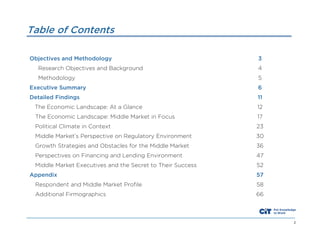
Table of Contents
Objectives and Methodology

3

Research Objectives and Background

4

Methodology

5

Executive Summary

6

Detailed Findings

11

The Economic Landscape: At a Glance

12

The Economic Landscape: Middle Market in Focus

17

Political Climate in Context

23

Middle Market’s Perspective on Regulatory Environment

30

Growth Strategies and Obstacles for the Middle Market

36

Perspectives on Financing and Lending Environment

47

Middle Market Executives and the Secret to Their Success

52

Appendix

57

Respondent and Middle Market Profile

58

Additional Firmographics

66

2
Objectives and Methodology
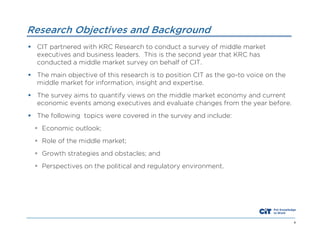
Research Objectives and Background
 CIT partnered with KRC Research to conduct a survey of middle market
executives and business leaders. This is the second year that KRC has
conducted a middle market survey on behalf of CIT.
 The main objective of this research is to position CIT as the go-to voice on the
middle market for information, insight and expertise.
 The survey aims to quantify views on the middle market economy and current
economic events among executives and evaluate changes from the year before.
 The following topics were covered in the survey and include:
 Economic outlook;
 Role of the middle market;
 Growth strategies and obstacles; and
 Perspectives on the political and regulatory environment.

4
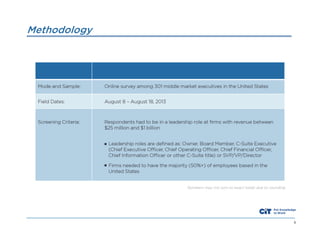
Methodology

Numbers may not sum to exact totals due to rounding

5
Executive Summary
The Middle Market and the U.S. Economy in 2013
 Many middle market executives offer a favorable assessment of their
companies right now: the majority not only say they are in a strong position
now but also that they are stronger than compared to a year ago.
 Most believe the middle market has a major impact on the U.S. economy, with
about three in four holding this opinion.
 Still, only a minority believe the U.S. economy is doing well right now. They
believe the global economy is even weaker.
 There is optimism much closer to home, with a sizeable minority describing
their local economy as strong.
 This audience also proves optimistic about the direction of the U.S. economy:
half expect it to be stronger in 12 months.

7
Views on Congress and Current Legislative Agenda
 Views of the middle market track against the general public when it comes to
Congress. In fact, nearly all disapprove of Congress. Further, two-thirds
disapprove of both Congress and President Obama.
 Most also think Congress pays too little attention to the middle market.
 Contrary to their own opinions about how the middle market bolsters the
economy, only a minority think Congress recognizes the middle market’s
contribution to the U.S. economy.
 Thinking about the current legislative agenda, middle market executives are
most likely to say tax reform, balancing the budget and healthcare reform will
significantly impact their businesses.

8
The Road Forward: Growth and Challenges Ahead
 Across revenue categories, middle market executives are most likely to say
they will be increasing the range of products and services offered in current
markets.
 Almost half are forecasting growth within other U.S. regions. International
growth proves less common.
 Middle market executives see many challenges ahead, however. Most are
worried about continued economic uncertainty within the U.S. and
internationally, tax increases and compliance with the Affordable Care Act.
 There is widespread agreement that interest rates will rise in the coming year,
and the majority think higher rates will negatively impact their companies.
 Additionally, hiring and retaining talent remains a challenge for the majority of
those surveyed.

9
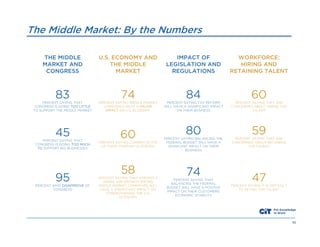
The Middle Market: By the Numbers
THE MIDDLE
MARKET AND
CONGRESS

U.S. ECONOMY AND
THE MIDDLE
MARKET

IMPACT OF
LEGISLATION AND
REGULATIONS

WORKFORCE:
HIRING AND
RETAINING TALENT

83

74

84

60

PERCENT SAYING THAT
CONGRESS IS DOING TOO LITTLE
TO SUPPORT THE MIDDLE MARKET

PERCENT SAYING MIDDLE MARKET
COMPANIES HAVE A MAJOR
IMPACT ON U.S. ECONOMY

PERCENT SAYING TAX REFORM
WILL HAVE A SIGNIFICANT IMPACT
ON THEIR BUSINESS

PERCENT SAYING THEY ARE
CONCERNED ABOUT HIRING TOP
TALENT

45
PERCENT SAYING THAT
CONGRESS IS DOING TOO MUCH
TO SUPPORT BIG BUSINESSES

95
PERCENT WHO DISAPPROVE OF
CONGRESS

60
PERCENT SAYING CURRENT STATE
OF THEIR COMPANY IS STRONG

58
PERCENT SAYING THEY STRONGLY
AGREE JOB GROWTH AMONG
MIDDLE MARKET COMPANIES WILL
HAVE A SIGNIFICANT IMPACT ON
STRENGTHENING THE U.S.
ECONOMY

80

59

PERCENT SAYING BALANCING THE
FEDERAL BUDGET WILL HAVE A
SIGINICANT IMPACT ON THEIR
BUSINESS

PERCENT SAYING THEY ARE
CONCERNED ABOUT RETAINING
TOP TALENT

74
PERCENT SAYING THAT
BALANCING THE FEDERAL
BUDGET WILL HAVE A POSITIVE
IMPACT ON THEIR CUSTOMERS’
ECONOMIC STABILITY

47
PERCENT SAYING IT IS DIFFICULT
TO RETAIN TOP TALENT

10
Detailed Findings
The Economic Landscape:
At a Glance
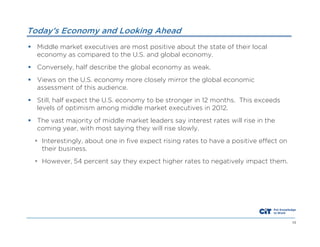
Today’s Economy and Looking Ahead
 Middle market executives are most positive about the state of their local
economy as compared to the U.S. and global economy.
 Conversely, half describe the global economy as weak.
 Views on the U.S. economy more closely mirror the global economic
assessment of this audience.
 Still, half expect the U.S. economy to be stronger in 12 months. This exceeds
levels of optimism among middle market executives in 2012.
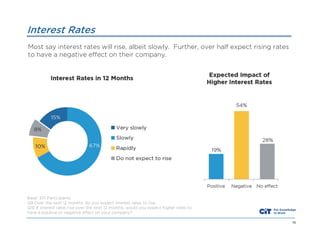
 The vast majority of middle market leaders say interest rates will rise in the
coming year, with most saying they will rise slowly.
 Interestingly, about one in five expect rising rates to have a positive effect on
their business.
 However, 54 percent say they expect higher rates to negatively impact them.

13
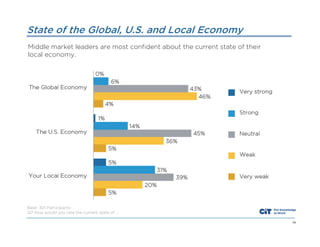
State of the Global, U.S. and Local Economy
Middle market leaders are most confident about the current state of their
local economy.

Base: 301 Participants
Q7 How would you rate the current state of …
14
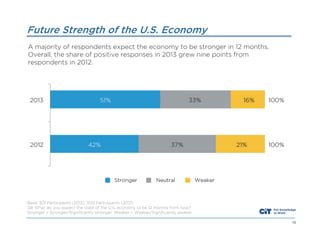
Future Strength of the U.S. Economy
A majority of respondents expect the economy to be stronger in 12 months.
Overall, the share of positive responses in 2013 grew nine points from
respondents in 2012.

Base: 301 Participants (2013), 300 Participants (2012)
Q8 What do you expect the state of the U.S. economy to be 12 months from now?
Stronger = Stronger/Significantly stronger; Weaker = Weaker/Significantly weaker
15
Interest Rates
Most say interest rates will rise, albeit slowly. Further, over half expect rising rates
to have a negative effect on their company.

Base: 301 Participants
Q9 Over the next 12 months, do you expect interest rates to rise…
Q10 If interest rates rise over the next 12 months, would you expect higher rates to
have a positive or negative effect on your company?
16
The Economic Landscape:
Middle Market in Focus
Putting the Middle Market in Context
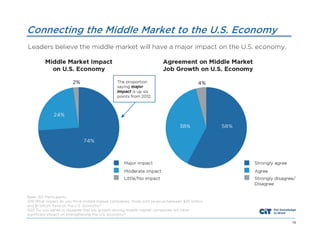
 About three in four middle market leaders say that their companies have a
major impact on the U.S. economy, up six points since last year.
 Similarly, most of this audience agrees that job growth within the middle market
will also have significant impact on the U.S. economy.
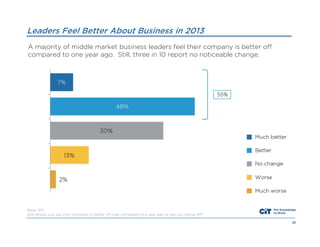
 These leaders are also upbeat about their own companies, with 55 percent
saying they are better off compared to a year ago.
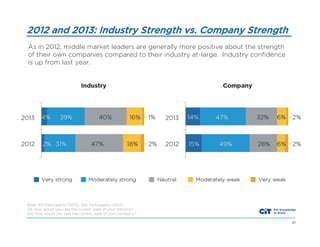
 As in 2012, however, they are much more positive about the state of their own
companies than their industries. Importantly, though, industry ratings – that is,
the proportion describing their industry as strong – are up from a year ago.

18
Connecting the Middle Market to the U.S. Economy
Leaders believe the middle market will have a major impact on the U.S. economy.

Base: 301 Participants
Q19 What impact do you think middle market companies, those with revenue between $25 million
and $1 billion, have on the U.S. economy?
Q20 Do you agree or disagree that job growth among middle market companies will have
significant impact on strengthening the U.S. economy?
19
Leaders Feel Better About Business in 2013
A majority of middle market business leaders feel their company is better off
compared to one year ago. Still, three in 10 report no noticeable change.
Base: 301
Q13 Would you say your company is better off now compared to a year ago or are you worse off?
20
2012 and 2013: Industry Strength vs. Company Strength
As in 2012, middle market leaders are generally more positive about the strength
of their own companies compared to their industry at-large. Industry confidence
is up from last year.

Base: 301 Participants (2013), 300 Participants (2012)
Q11 How would you rate the current state of your industry?
Q12 How would you rate the current state of your company?
21
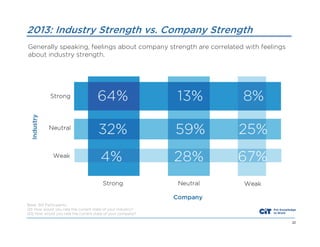
2013: Industry Strength vs. Company Strength
Generally speaking, feelings about company strength are correlated with feelings
about industry strength.

Base: 301 Participants
Q11 How would you rate the current state of your industry?
Q12 How would you rate the current state of your company?
22
Political Climate in Context
Politics and the Middle Market
 Three in 10 approve of President Obama, and just five percent approve of
Congress. In fact, half strongly disapprove of Congress.
 Most middle market leaders say that Congress is not doing enough to support
their businesses—the middle market—and small businesses.
 Fully two-thirds disagree with the notion that Congress recognizes the
contributions middle market businesses have on the economy.
 Among the issues recently discussed in Congress, 85 percent agree that
tax reform will have a significant impact on their business.

24
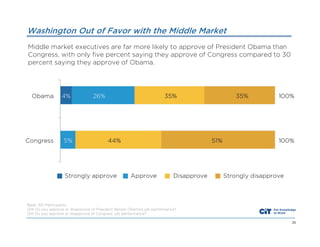
Washington Out of Favor with the Middle Market
Middle market executives are far more likely to approve of President Obama than
Congress, with only five percent saying they approve of Congress compared to 30
percent saying they approve of Obama.

Base: 301 Participants
Q14 Do you approve or disapprove of President Barack Obama’s job performance?
Q15 Do you approve or disapprove of Congress’ job performance?
25
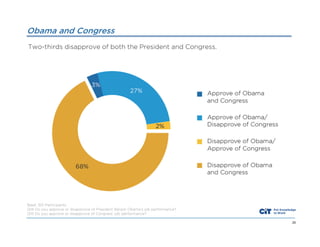
Obama and Congress
Two-thirds disapprove of both the President and Congress.

Base: 301 Participants
Q14 Do you approve or disapprove of President Barack Obama’s job performance?
Q15 Do you approve or disapprove of Congress’ job performance?
26
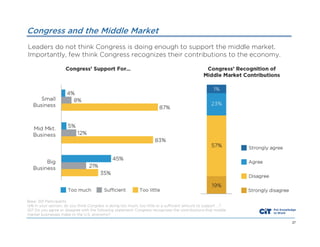
Congress and the Middle Market
Leaders do not think Congress is doing enough to support the middle market.
Importantly, few think Congress recognizes their contributions to the economy.

Base: 301 Participants
Q16 In your opinion, do you think Congress is doing too much, too little or a sufficient amount to support …?
Q17 Do you agree or disagree with the following statement: Congress recognizes the contributions that middle
market businesses make to the U.S. economy?
27
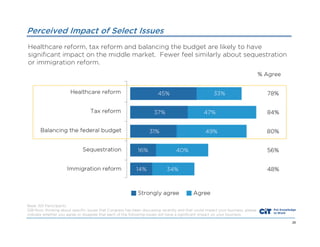
Perceived Impact of Select Issues
Healthcare reform, tax reform and balancing the budget are likely to have
significant impact on the middle market. Fewer feel similarly about sequestration
or immigration reform.

Base: 301 Participants
Q18 Now, thinking about specific issues that Congress has been discussing recently and that could impact your business, please
indicate whether you agree or disagree that each of the following issues will have a significant impact on your business.
28
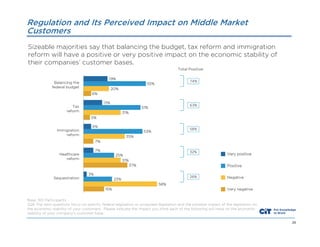
Regulation and Its Perceived Impact on Middle Market
Customers
Sizeable majorities say that balancing the budget, tax reform and immigration
reform will have a positive or very positive impact on the economic stability of
their companies’ customer bases.

Base: 301 Participants
Q26 The next questions focus on specific federal legislation or proposed legislation and the possible impact of the legislation on
the economic stability of your customers. Please indicate the impact you think each of the following will have on the economic
stability of your company’s customer base.
29
Middle Market’s Perspective
on Regulatory Environment
Perspectives on the Regulatory Environment
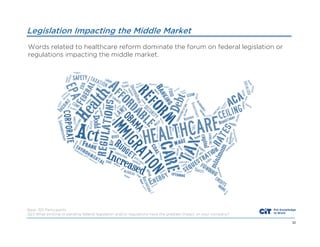
 When asked to weigh in on any legislation that will have a significant impact on
their company, a few words stand out: “healthcare” and “reform.”
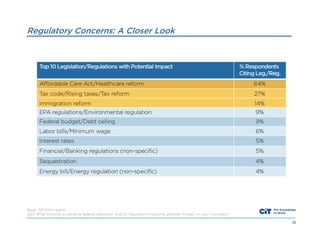
 Nearly two-thirds expressed words and phrases mentioning health, healthcare
legislation or the Affordable Care Act. Tax reform and immigration followed,
but in much smaller numbers.
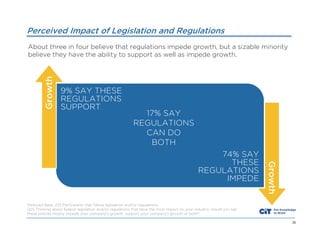
 A large majority of middle market executives say these regulations that impact
their company will impede growth, while less than 10 percent of respondents
feel that regulations support growth.
 Similarly to 2012, a small but sizeable minority believe federal legislation and
regulations can both support and impede growth.

31
Legislation Impacting the Middle Market
Words related to healthcare reform dominate the forum on federal legislation or
regulations impacting the middle market.

Base: 301 Participants
Q23 What existing or pending federal legislation and/or regulations have the greatest impact on your company?
32
Regulatory Concerns: A Closer Look

Base: 301 Participants
Q23 What existing or pending federal legislation and/or regulations have the greatest impact on your company?
33
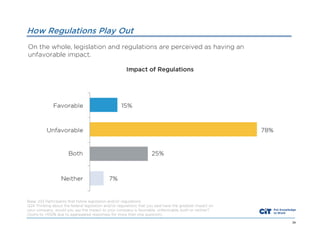
How Regulations Play Out
On the whole, legislation and regulations are perceived as having an
unfavorable impact.

Base: 223 Participants that follow legislation and/or regulations
Q24 Thinking about the federal legislation and/or regulations that you said have the greatest impact on
your company, would you say the impact to your company is favorable, unfavorable, both or neither?
(Sums to >100% due to aggregated responses for more than one question)
34
Perceived Impact of Legislation and Regulations

Growth

About three in four believe that regulations impede growth, but a sizable minority
believe they have the ability to support as well as impede growth.

9% SAY THESE
REGULATIONS
SUPPORT

17% SAY
REGULATIONS
CAN DO
BOTH

Growth

74% SAY
THESE
REGULATIONS
IMPEDE

Reduced Base: 223 Participants that follow legislation and/or regulations
Q25 Thinking about federal legislation and/or regulations that have the most impact on your industry, would you say
these policies mostly impede your company’s growth, support your company’s growth or both?
35
Growth Strategies and Obstacles
for the Middle Market
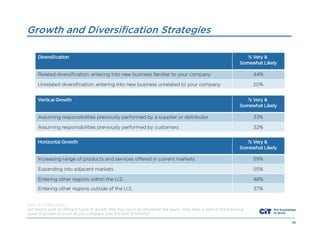
Growth Strategies and Obstacles
 Middle market executives expect to grow over the next year;
they intend to do so through a combination of horizontal
growth, vertical growth and diversification.
 A majority say they plan to increase their range of products
and services or expand into adjacent markets.
 Nearly half expect to enter other regions within the U.S., though
fewer anticipate growing globally.
 Economic uncertainty (at home and abroad), tax increases and
healthcare reform are the top obstacles to growth concerning
middle market leaders.
 Hiring and retaining talent are also concerns.
 Middle market leaders are most likely to say current economic conditions
affect their ability to hire.
 Forty-seven percent say retaining top talent is difficult.

37
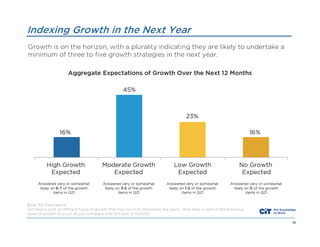
Indexing Growth in the Next Year
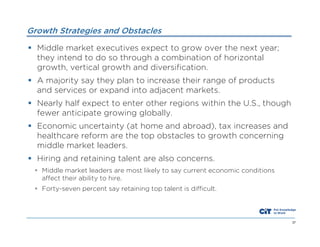
Growth is on the horizon, with a plurality indicating they are likely to undertake a
minimum of three to five growth strategies in the next year.

Base: 301 Participants
Q21 Here is a list of different types of growth that may occur at companies like yours. How likely is each of the following
types of growth to occur at your company over the next 12 months?
38
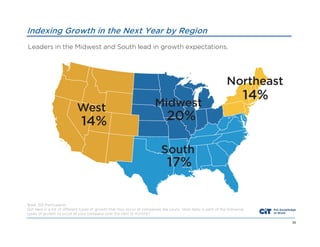
Indexing Growth in the Next Year by Region
Leaders in the Midwest and South lead in growth expectations.

Base: 301 Participants
Q21 Here is a list of different types of growth that may occur at companies like yours. How likely is each of the following
types of growth to occur at your company over the next 12 months?
39
Growth and Diversification Strategies

Base: 301 Participants
Q21 Here is a list of different types of growth that may occur at companies like yours. How likely is each of the following
types of growth to occur at your company over the next 12 months?
40
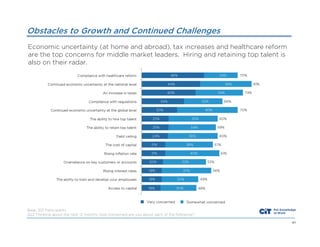
Obstacles to Growth and Continued Challenges
Economic uncertainty (at home and abroad), tax increases and healthcare reform
are the top concerns for middle market leaders. Hiring and retaining top talent is
also on their radar.

Base: 301 Participants
Q22 Thinking about the next 12 months, how concerned are you about each of the following?
41
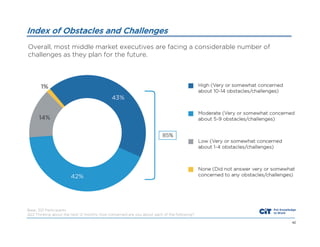
Index of Obstacles and Challenges
Overall, most middle market executives are facing a considerable number of
challenges as they plan for the future.

Base: 301 Participants
Q22 Thinking about the next 12 months, how concerned are you about each of the following?
42
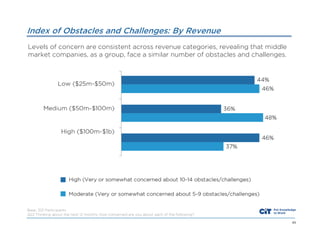
Index of Obstacles and Challenges: By Revenue
Levels of concern are consistent across revenue categories, revealing that middle
market companies, as a group, face a similar number of obstacles and challenges.

Base: 301 Participants
Q22 Thinking about the next 12 months, how concerned are you about each of the following?
43
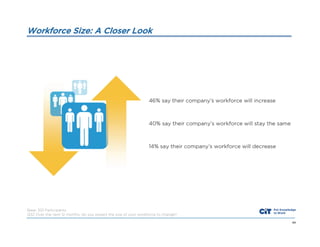
Workforce Size: A Closer Look

Base: 301 Participants
Q32 Over the next 12 months, do you expect the size of your workforce to change?
44
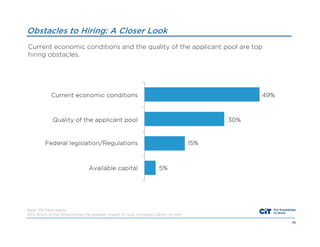
Obstacles to Hiring: A Closer Look
Current economic conditions and the quality of the applicant pool are top
hiring obstacles.

Base: 301 Participants
Q33 Which of the following has the greatest impact on your company’s ability to hire?
45
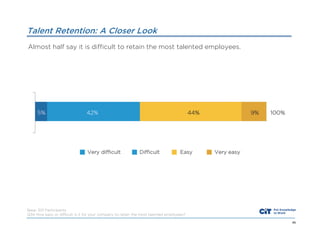
Talent Retention: A Closer Look
Almost half say it is difficult to retain the most talented employees.

Base: 301 Participants
Q34 How easy or difficult is it for your company to retain the most talented employees?
46
Perspectives on Financing and
Lending Environment
Perspectives on Financing and Lending Environment
 Not much has changed in the last 12 months and the middle market’s attitude
toward financing: a substantial majority agree that they are satisfied with their
access, cost and financing alternatives.
 Types of financing vary by revenue. Overall, the most common types of
financing include secured loans and internal sources of funding.
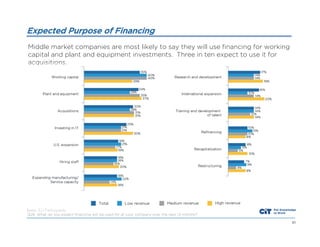
 Middle market executives are most likely to say they will use financing for
working capital, followed by plant and equipment investments.
 Fewer say they will make investments in R&D or training and development.

48
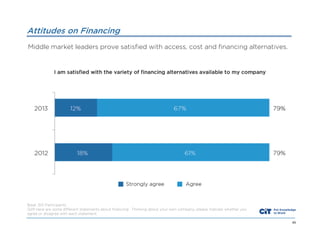
Attitudes on Financing
Middle market leaders prove satisfied with access, cost and financing alternatives.

Base: 301 Participants
Q29 Here are some different statements about financing. Thinking about your own company, please indicate whether you
agree or disagree with each statement.
49
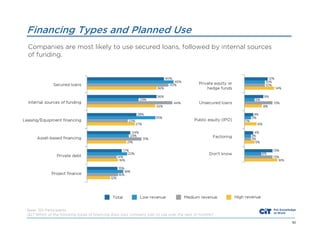
Financing Types and Planned Use
Companies are most likely to use secured loans, followed by internal sources
of funding.

Base: 301 Participants
Q27 Which of the following types of financing does your company plan to use over the next 12 months?
50
Expected Purpose of Financing
Middle market companies are most likely to say they will use financing for working
capital and plant and equipment investments. Three in ten expect to use it for
acquisitions.

Base: 301 Participants
Q28 What do you expect financing will be used for at your company over the next 12 months?
51
Middle Market Executives and the
Secret to their Success
What Explains Middle Market Leaders’ Success?
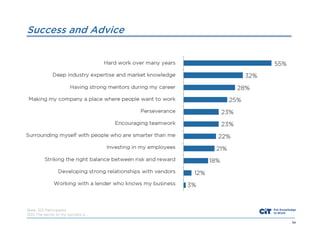
 By a wide margin, middle market executives are most likely to say their success
is due to hard work over many years.
 In a second tier, these executives credit deep industry expertise.
 The company you keep – whether it be mentors, being surrounded by smart
people or teamwork – is valued as well.
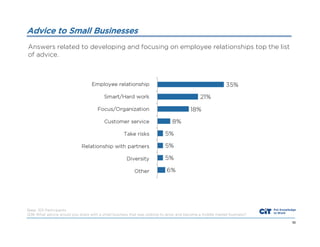
 When thinking about advice to pass on to small businesses looking to grow,
middle market leaders emphasize employee relationships over other factors.

53
Success and Advice

Base: 301 Participants
Q35 The secret to my success is …
54
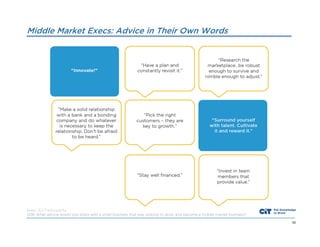
Middle Market Execs: Advice in Their Own Words

Base: 301 Participants
Q36 What advice would you share with a small business that was looking to grow and become a middle market business?
55
Advice to Small Businesses
Answers related to developing and focusing on employee relationships top the list
of advice.

Base: 301 Participants
Q36 What advice would you share with a small business that was looking to grow and become a middle market business?
56
Appendix
Respondent and Middle Market Profile
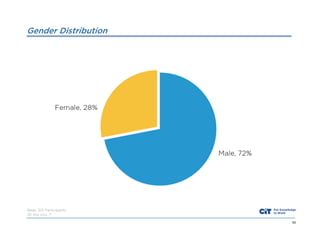
Gender Distribution

Base: 301 Participants
Q1 Are you…?
59
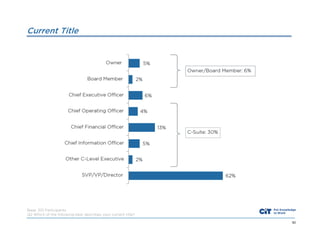
Current Title

Base: 301 Participants
Q2 Which of the following best describes your current title?
60
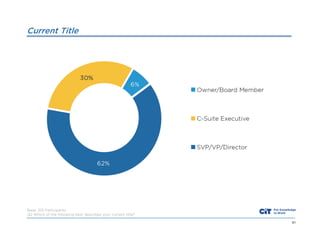
Current Title

Base: 301 Participants
Q2 Which of the following best describes your current title?
61
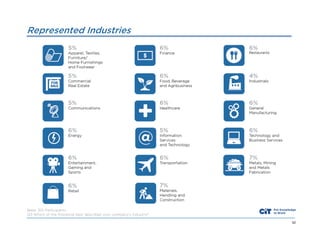
Represented Industries

Base: 301 Participants
Q3 Which of the following best describes your company’s industry?
62
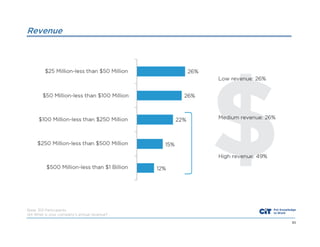
Revenue

Base: 301 Participants
Q4 What is your company’s annual revenue?
63
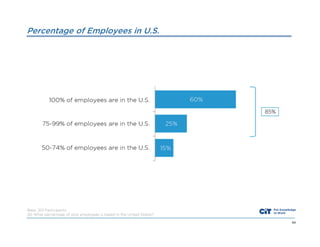
Percentage of Employees in U.S.

Base: 301 Participants
Q5 What percentage of your employees is based in the United States?
64
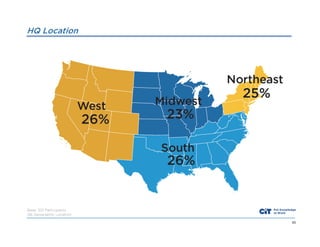
HQ Location

Base: 301 Participants
Q6 Geographic Location
65
Additional Firmographics
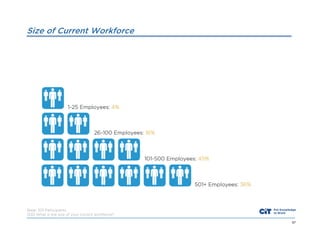
Size of Current Workforce

Base: 301 Participants
Q30 What is the size of your current workforce?
67
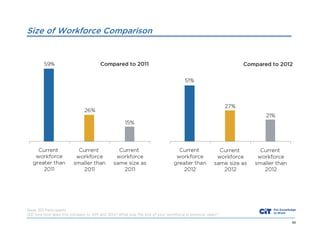
Size of Workforce Comparison

Base: 301 Participants
Q31 And how does this compare to 2011 and 2012? What was the size of your workforce in previous years?
68
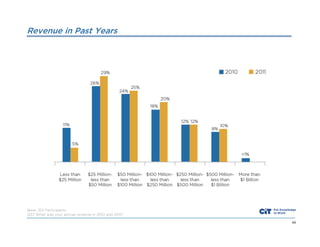
Revenue in Past Years

Base: 301 Participants
Q37 What was your annual revenue in 2010 and 2011?
69
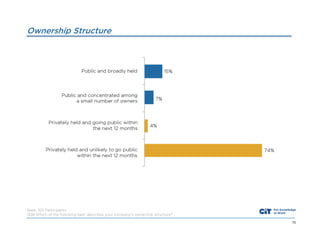
Ownership Structure

Base: 301 Participants
Q38 Which of the following best describes your company’s ownership structure?
70
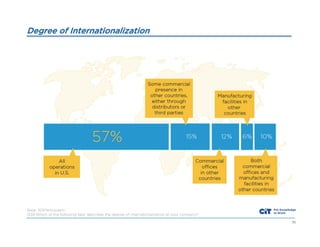
Degree of Internationalization

Base: 301Participants
Q39 Which of the following best describes the degree of internationalization at your company?
71

CIT: Voice of the Middle Market – Perspectives from the Heart of the U.S. Economy

  • 1.
    CIT: Voice ofthe Middle Market Perspectives from the Heart of the U.S. Economy Full Report of Survey Research Findings October 2013
  • 2.
    Table of Contents Objectivesand Methodology 3 Research Objectives and Background 4 Methodology 5 Executive Summary 6 Detailed Findings 11 The Economic Landscape: At a Glance 12 The Economic Landscape: Middle Market in Focus 17 Political Climate in Context 23 Middle Market’s Perspective on Regulatory Environment 30 Growth Strategies and Obstacles for the Middle Market 36 Perspectives on Financing and Lending Environment 47 Middle Market Executives and the Secret to Their Success 52 Appendix 57 Respondent and Middle Market Profile 58 Additional Firmographics 66 2
  • 3.
  • 4.
    Research Objectives andBackground  CIT partnered with KRC Research to conduct a survey of middle market executives and business leaders. This is the second year that KRC has conducted a middle market survey on behalf of CIT.  The main objective of this research is to position CIT as the go-to voice on the middle market for information, insight and expertise.  The survey aims to quantify views on the middle market economy and current economic events among executives and evaluate changes from the year before.  The following topics were covered in the survey and include:  Economic outlook;  Role of the middle market;  Growth strategies and obstacles; and  Perspectives on the political and regulatory environment. 4
  • 5.
    Methodology Numbers may notsum to exact totals due to rounding 5
  • 6.
  • 7.
    The Middle Marketand the U.S. Economy in 2013  Many middle market executives offer a favorable assessment of their companies right now: the majority not only say they are in a strong position now but also that they are stronger than compared to a year ago.  Most believe the middle market has a major impact on the U.S. economy, with about three in four holding this opinion.  Still, only a minority believe the U.S. economy is doing well right now. They believe the global economy is even weaker.  There is optimism much closer to home, with a sizeable minority describing their local economy as strong.  This audience also proves optimistic about the direction of the U.S. economy: half expect it to be stronger in 12 months. 7
  • 8.
    Views on Congressand Current Legislative Agenda  Views of the middle market track against the general public when it comes to Congress. In fact, nearly all disapprove of Congress. Further, two-thirds disapprove of both Congress and President Obama.  Most also think Congress pays too little attention to the middle market.  Contrary to their own opinions about how the middle market bolsters the economy, only a minority think Congress recognizes the middle market’s contribution to the U.S. economy.  Thinking about the current legislative agenda, middle market executives are most likely to say tax reform, balancing the budget and healthcare reform will significantly impact their businesses. 8
  • 9.
    The Road Forward:Growth and Challenges Ahead  Across revenue categories, middle market executives are most likely to say they will be increasing the range of products and services offered in current markets.  Almost half are forecasting growth within other U.S. regions. International growth proves less common.  Middle market executives see many challenges ahead, however. Most are worried about continued economic uncertainty within the U.S. and internationally, tax increases and compliance with the Affordable Care Act.  There is widespread agreement that interest rates will rise in the coming year, and the majority think higher rates will negatively impact their companies.  Additionally, hiring and retaining talent remains a challenge for the majority of those surveyed. 9
  • 10.
    The Middle Market:By the Numbers THE MIDDLE MARKET AND CONGRESS U.S. ECONOMY AND THE MIDDLE MARKET IMPACT OF LEGISLATION AND REGULATIONS WORKFORCE: HIRING AND RETAINING TALENT 83 74 84 60 PERCENT SAYING THAT CONGRESS IS DOING TOO LITTLE TO SUPPORT THE MIDDLE MARKET PERCENT SAYING MIDDLE MARKET COMPANIES HAVE A MAJOR IMPACT ON U.S. ECONOMY PERCENT SAYING TAX REFORM WILL HAVE A SIGNIFICANT IMPACT ON THEIR BUSINESS PERCENT SAYING THEY ARE CONCERNED ABOUT HIRING TOP TALENT 45 PERCENT SAYING THAT CONGRESS IS DOING TOO MUCH TO SUPPORT BIG BUSINESSES 95 PERCENT WHO DISAPPROVE OF CONGRESS 60 PERCENT SAYING CURRENT STATE OF THEIR COMPANY IS STRONG 58 PERCENT SAYING THEY STRONGLY AGREE JOB GROWTH AMONG MIDDLE MARKET COMPANIES WILL HAVE A SIGNIFICANT IMPACT ON STRENGTHENING THE U.S. ECONOMY 80 59 PERCENT SAYING BALANCING THE FEDERAL BUDGET WILL HAVE A SIGINICANT IMPACT ON THEIR BUSINESS PERCENT SAYING THEY ARE CONCERNED ABOUT RETAINING TOP TALENT 74 PERCENT SAYING THAT BALANCING THE FEDERAL BUDGET WILL HAVE A POSITIVE IMPACT ON THEIR CUSTOMERS’ ECONOMIC STABILITY 47 PERCENT SAYING IT IS DIFFICULT TO RETAIN TOP TALENT 10
  • 11.
  • 12.
  • 13.
    Today’s Economy andLooking Ahead  Middle market executives are most positive about the state of their local economy as compared to the U.S. and global economy.  Conversely, half describe the global economy as weak.  Views on the U.S. economy more closely mirror the global economic assessment of this audience.  Still, half expect the U.S. economy to be stronger in 12 months. This exceeds levels of optimism among middle market executives in 2012.  The vast majority of middle market leaders say interest rates will rise in the coming year, with most saying they will rise slowly.  Interestingly, about one in five expect rising rates to have a positive effect on their business.  However, 54 percent say they expect higher rates to negatively impact them. 13
  • 14.
    State of theGlobal, U.S. and Local Economy Middle market leaders are most confident about the current state of their local economy. Base: 301 Participants Q7 How would you rate the current state of … 14
  • 15.
    Future Strength ofthe U.S. Economy A majority of respondents expect the economy to be stronger in 12 months. Overall, the share of positive responses in 2013 grew nine points from respondents in 2012. Base: 301 Participants (2013), 300 Participants (2012) Q8 What do you expect the state of the U.S. economy to be 12 months from now? Stronger = Stronger/Significantly stronger; Weaker = Weaker/Significantly weaker 15
  • 16.
    Interest Rates Most sayinterest rates will rise, albeit slowly. Further, over half expect rising rates to have a negative effect on their company. Base: 301 Participants Q9 Over the next 12 months, do you expect interest rates to rise… Q10 If interest rates rise over the next 12 months, would you expect higher rates to have a positive or negative effect on your company? 16
  • 17.
  • 18.
    Putting the MiddleMarket in Context  About three in four middle market leaders say that their companies have a major impact on the U.S. economy, up six points since last year.  Similarly, most of this audience agrees that job growth within the middle market will also have significant impact on the U.S. economy.  These leaders are also upbeat about their own companies, with 55 percent saying they are better off compared to a year ago.  As in 2012, however, they are much more positive about the state of their own companies than their industries. Importantly, though, industry ratings – that is, the proportion describing their industry as strong – are up from a year ago. 18
  • 19.
    Connecting the MiddleMarket to the U.S. Economy Leaders believe the middle market will have a major impact on the U.S. economy. Base: 301 Participants Q19 What impact do you think middle market companies, those with revenue between $25 million and $1 billion, have on the U.S. economy? Q20 Do you agree or disagree that job growth among middle market companies will have significant impact on strengthening the U.S. economy? 19
  • 20.
    Leaders Feel BetterAbout Business in 2013 A majority of middle market business leaders feel their company is better off compared to one year ago. Still, three in 10 report no noticeable change. Base: 301 Q13 Would you say your company is better off now compared to a year ago or are you worse off? 20
  • 21.
    2012 and 2013:Industry Strength vs. Company Strength As in 2012, middle market leaders are generally more positive about the strength of their own companies compared to their industry at-large. Industry confidence is up from last year. Base: 301 Participants (2013), 300 Participants (2012) Q11 How would you rate the current state of your industry? Q12 How would you rate the current state of your company? 21
  • 22.
    2013: Industry Strengthvs. Company Strength Generally speaking, feelings about company strength are correlated with feelings about industry strength. Base: 301 Participants Q11 How would you rate the current state of your industry? Q12 How would you rate the current state of your company? 22
  • 23.
  • 24.
    Politics and theMiddle Market  Three in 10 approve of President Obama, and just five percent approve of Congress. In fact, half strongly disapprove of Congress.  Most middle market leaders say that Congress is not doing enough to support their businesses—the middle market—and small businesses.  Fully two-thirds disagree with the notion that Congress recognizes the contributions middle market businesses have on the economy.  Among the issues recently discussed in Congress, 85 percent agree that tax reform will have a significant impact on their business. 24
  • 25.
    Washington Out ofFavor with the Middle Market Middle market executives are far more likely to approve of President Obama than Congress, with only five percent saying they approve of Congress compared to 30 percent saying they approve of Obama. Base: 301 Participants Q14 Do you approve or disapprove of President Barack Obama’s job performance? Q15 Do you approve or disapprove of Congress’ job performance? 25
  • 26.
    Obama and Congress Two-thirdsdisapprove of both the President and Congress. Base: 301 Participants Q14 Do you approve or disapprove of President Barack Obama’s job performance? Q15 Do you approve or disapprove of Congress’ job performance? 26
  • 27.
    Congress and theMiddle Market Leaders do not think Congress is doing enough to support the middle market. Importantly, few think Congress recognizes their contributions to the economy. Base: 301 Participants Q16 In your opinion, do you think Congress is doing too much, too little or a sufficient amount to support …? Q17 Do you agree or disagree with the following statement: Congress recognizes the contributions that middle market businesses make to the U.S. economy? 27
  • 28.
    Perceived Impact ofSelect Issues Healthcare reform, tax reform and balancing the budget are likely to have significant impact on the middle market. Fewer feel similarly about sequestration or immigration reform. Base: 301 Participants Q18 Now, thinking about specific issues that Congress has been discussing recently and that could impact your business, please indicate whether you agree or disagree that each of the following issues will have a significant impact on your business. 28
  • 29.
    Regulation and ItsPerceived Impact on Middle Market Customers Sizeable majorities say that balancing the budget, tax reform and immigration reform will have a positive or very positive impact on the economic stability of their companies’ customer bases. Base: 301 Participants Q26 The next questions focus on specific federal legislation or proposed legislation and the possible impact of the legislation on the economic stability of your customers. Please indicate the impact you think each of the following will have on the economic stability of your company’s customer base. 29
  • 30.
    Middle Market’s Perspective onRegulatory Environment
  • 31.
    Perspectives on theRegulatory Environment  When asked to weigh in on any legislation that will have a significant impact on their company, a few words stand out: “healthcare” and “reform.”  Nearly two-thirds expressed words and phrases mentioning health, healthcare legislation or the Affordable Care Act. Tax reform and immigration followed, but in much smaller numbers.  A large majority of middle market executives say these regulations that impact their company will impede growth, while less than 10 percent of respondents feel that regulations support growth.  Similarly to 2012, a small but sizeable minority believe federal legislation and regulations can both support and impede growth. 31
  • 32.
    Legislation Impacting theMiddle Market Words related to healthcare reform dominate the forum on federal legislation or regulations impacting the middle market. Base: 301 Participants Q23 What existing or pending federal legislation and/or regulations have the greatest impact on your company? 32
  • 33.
    Regulatory Concerns: ACloser Look Base: 301 Participants Q23 What existing or pending federal legislation and/or regulations have the greatest impact on your company? 33
  • 34.
    How Regulations PlayOut On the whole, legislation and regulations are perceived as having an unfavorable impact. Base: 223 Participants that follow legislation and/or regulations Q24 Thinking about the federal legislation and/or regulations that you said have the greatest impact on your company, would you say the impact to your company is favorable, unfavorable, both or neither? (Sums to >100% due to aggregated responses for more than one question) 34
  • 35.
    Perceived Impact ofLegislation and Regulations Growth About three in four believe that regulations impede growth, but a sizable minority believe they have the ability to support as well as impede growth. 9% SAY THESE REGULATIONS SUPPORT 17% SAY REGULATIONS CAN DO BOTH Growth 74% SAY THESE REGULATIONS IMPEDE Reduced Base: 223 Participants that follow legislation and/or regulations Q25 Thinking about federal legislation and/or regulations that have the most impact on your industry, would you say these policies mostly impede your company’s growth, support your company’s growth or both? 35
  • 36.
    Growth Strategies andObstacles for the Middle Market
  • 37.
    Growth Strategies andObstacles  Middle market executives expect to grow over the next year; they intend to do so through a combination of horizontal growth, vertical growth and diversification.  A majority say they plan to increase their range of products and services or expand into adjacent markets.  Nearly half expect to enter other regions within the U.S., though fewer anticipate growing globally.  Economic uncertainty (at home and abroad), tax increases and healthcare reform are the top obstacles to growth concerning middle market leaders.  Hiring and retaining talent are also concerns.  Middle market leaders are most likely to say current economic conditions affect their ability to hire.  Forty-seven percent say retaining top talent is difficult. 37
  • 38.
    Indexing Growth inthe Next Year Growth is on the horizon, with a plurality indicating they are likely to undertake a minimum of three to five growth strategies in the next year. Base: 301 Participants Q21 Here is a list of different types of growth that may occur at companies like yours. How likely is each of the following types of growth to occur at your company over the next 12 months? 38
  • 39.
    Indexing Growth inthe Next Year by Region Leaders in the Midwest and South lead in growth expectations. Base: 301 Participants Q21 Here is a list of different types of growth that may occur at companies like yours. How likely is each of the following types of growth to occur at your company over the next 12 months? 39
  • 40.
    Growth and DiversificationStrategies Base: 301 Participants Q21 Here is a list of different types of growth that may occur at companies like yours. How likely is each of the following types of growth to occur at your company over the next 12 months? 40
  • 41.
    Obstacles to Growthand Continued Challenges Economic uncertainty (at home and abroad), tax increases and healthcare reform are the top concerns for middle market leaders. Hiring and retaining top talent is also on their radar. Base: 301 Participants Q22 Thinking about the next 12 months, how concerned are you about each of the following? 41
  • 42.
    Index of Obstaclesand Challenges Overall, most middle market executives are facing a considerable number of challenges as they plan for the future. Base: 301 Participants Q22 Thinking about the next 12 months, how concerned are you about each of the following? 42
  • 43.
    Index of Obstaclesand Challenges: By Revenue Levels of concern are consistent across revenue categories, revealing that middle market companies, as a group, face a similar number of obstacles and challenges. Base: 301 Participants Q22 Thinking about the next 12 months, how concerned are you about each of the following? 43
  • 44.
    Workforce Size: ACloser Look Base: 301 Participants Q32 Over the next 12 months, do you expect the size of your workforce to change? 44
  • 45.
    Obstacles to Hiring:A Closer Look Current economic conditions and the quality of the applicant pool are top hiring obstacles. Base: 301 Participants Q33 Which of the following has the greatest impact on your company’s ability to hire? 45
  • 46.
    Talent Retention: ACloser Look Almost half say it is difficult to retain the most talented employees. Base: 301 Participants Q34 How easy or difficult is it for your company to retain the most talented employees? 46
  • 47.
    Perspectives on Financingand Lending Environment
  • 48.
    Perspectives on Financingand Lending Environment  Not much has changed in the last 12 months and the middle market’s attitude toward financing: a substantial majority agree that they are satisfied with their access, cost and financing alternatives.  Types of financing vary by revenue. Overall, the most common types of financing include secured loans and internal sources of funding.  Middle market executives are most likely to say they will use financing for working capital, followed by plant and equipment investments.  Fewer say they will make investments in R&D or training and development. 48
  • 49.
    Attitudes on Financing Middlemarket leaders prove satisfied with access, cost and financing alternatives. Base: 301 Participants Q29 Here are some different statements about financing. Thinking about your own company, please indicate whether you agree or disagree with each statement. 49
  • 50.
    Financing Types andPlanned Use Companies are most likely to use secured loans, followed by internal sources of funding. Base: 301 Participants Q27 Which of the following types of financing does your company plan to use over the next 12 months? 50
  • 51.
    Expected Purpose ofFinancing Middle market companies are most likely to say they will use financing for working capital and plant and equipment investments. Three in ten expect to use it for acquisitions. Base: 301 Participants Q28 What do you expect financing will be used for at your company over the next 12 months? 51
  • 52.
    Middle Market Executivesand the Secret to their Success
  • 53.
    What Explains MiddleMarket Leaders’ Success?  By a wide margin, middle market executives are most likely to say their success is due to hard work over many years.  In a second tier, these executives credit deep industry expertise.  The company you keep – whether it be mentors, being surrounded by smart people or teamwork – is valued as well.  When thinking about advice to pass on to small businesses looking to grow, middle market leaders emphasize employee relationships over other factors. 53
  • 54.
    Success and Advice Base:301 Participants Q35 The secret to my success is … 54
  • 55.
    Middle Market Execs:Advice in Their Own Words Base: 301 Participants Q36 What advice would you share with a small business that was looking to grow and become a middle market business? 55
  • 56.
    Advice to SmallBusinesses Answers related to developing and focusing on employee relationships top the list of advice. Base: 301 Participants Q36 What advice would you share with a small business that was looking to grow and become a middle market business? 56
  • 57.
  • 58.
    Respondent and MiddleMarket Profile
  • 59.
    Gender Distribution Base: 301Participants Q1 Are you…? 59
  • 60.
    Current Title Base: 301Participants Q2 Which of the following best describes your current title? 60
  • 61.
    Current Title Base: 301Participants Q2 Which of the following best describes your current title? 61
  • 62.
    Represented Industries Base: 301Participants Q3 Which of the following best describes your company’s industry? 62
  • 63.
    Revenue Base: 301 Participants Q4What is your company’s annual revenue? 63
  • 64.
    Percentage of Employeesin U.S. Base: 301 Participants Q5 What percentage of your employees is based in the United States? 64
  • 65.
    HQ Location Base: 301Participants Q6 Geographic Location 65
  • 66.
  • 67.
    Size of CurrentWorkforce Base: 301 Participants Q30 What is the size of your current workforce? 67
  • 68.
    Size of WorkforceComparison Base: 301 Participants Q31 And how does this compare to 2011 and 2012? What was the size of your workforce in previous years? 68
  • 69.
    Revenue in PastYears Base: 301 Participants Q37 What was your annual revenue in 2010 and 2011? 69
  • 70.
    Ownership Structure Base: 301Participants Q38 Which of the following best describes your company’s ownership structure? 70
  • 71.
    Degree of Internationalization Base:301Participants Q39 Which of the following best describes the degree of internationalization at your company? 71