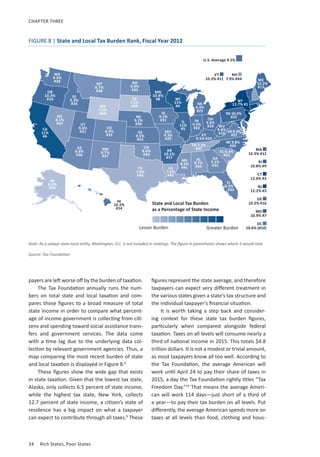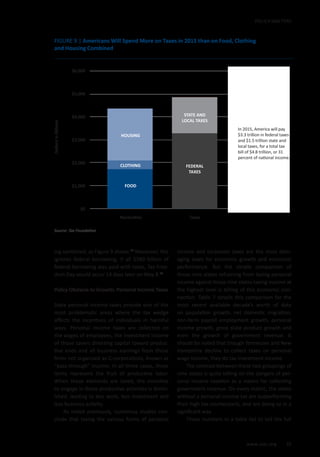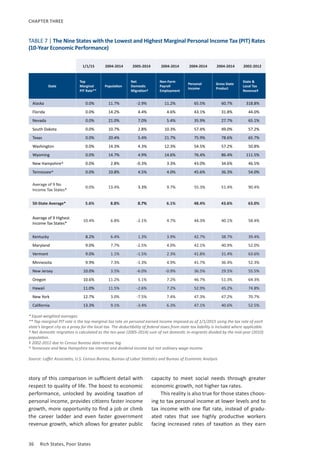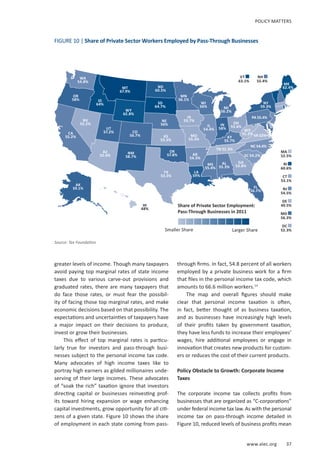


Rich States, Poor States
ALEC-Laffer State Economic Competitiveness Index
Arthur B. Laffer
Stephen Moore
Jonathan Williams
Rich States, Poor States
ALEC-Laffer State Economic Competitiveness Index
© 2015 American Legislative Exchange Council
All rights reserved. Except as permitted under the United States Copyright Act of 1976, no part of this
publication may be reproduced or distributed in any form or by any means, or stored in a database or
retrieval system without the prior permission of the publisher.
Published by
American Legislative Exchange Council
2900 Crystal Drive, Suite 600
Arlington, VA 22202
www.alec.org
Dr. Arthur B. Laffer, Stephen Moore
and Jonathan Williams, Authors
ISBN 978-0-9853779-6-0
Rich States, Poor States: ALEC-Laffer State Economic Competitiveness Index has been published by the
American Legislative Exchange Council, America’s largest nonpartisan, voluntary membership organiza-
tion of state legislators. Made up of nearly one-third of America’s state elected officials, the Council
provides a unique opportunity for state lawmakers, business leaders and citizen organizations from
around the country to share experiences and develop state-based, pro-growth models based on aca-
demic research, existing state policy and proven business practices.
The American Legislative Exchange Council is classified by the Internal Revenue Service as a 501(c)(3)
nonprofit and public policy and educational organization. Individuals, philanthropic foundations, corpora-
tions, companies or associations are eligible to support the Council’s work through tax-deductible gifts.
ii	 Rich States, Poor States
About the Authors
Acknowledgements
Foreword
Executive Summary
Preface: 10 Golden Rules of Effective Taxation
CHAPTER 1—State of the States
On the Move: Analyzing American Mobility
Decision 2014: Voters Choose Economic Opportunity
State Tax Cut Roundup 2014: Both Blue and Red States Champion Tax Reform
Governors Outline Pro-Growth Agendas in 2015
The 2015 Legislative Session: Wins and Losses for Taxpayers
Taxpayer Victories
Partial Victories for Taxpayers
Setbacks for Taxpayers
Conclusion
CHAPTER 2—Tax Cronyism is Not Tax Reform
The Good: States Take Steps Toward Ending Tax Cronyism
The Bad: New York’s START-UP NY Spends $45 Million, Only “Creates” 76 Jobs
The Ugly: States Resist Transparency Reform on Tax Expenditures
Conclusion
CHAPTER 3—Policy Matters: How States Can Compete to Win
Policy Obstacle to Growth: Taxation
Policy Obstacle to Growth: Overall Tax Burden
Policy Obstacle to Growth: Personal Income Taxes
Policy Obstacle to Growth: Corporate Income Taxes
Policy Obstacle to Growth: State Death Taxes
Policy Obstacle to Growth: Tax Cronyism and Complexity
Policy Obstacle to Growth: Business as Usual Budgeting
Policy Obstacle to Growth: Underfunded Public Employee Pensions and Other Long-Term Obligations
Policy Obstacle to Growth: Welfare Dependence Instead of a Safety Net
Policy Obstacle to Growth: Ignoring the Role of Charitable Giving and Civil Society
Policy Obstacle to Growth: Forced-Unionization
Conclusion
CHAPTER 4—Lessons from Kansas:
A Behind the Scenes Look at America’s Most Discussed Tax Reform Effort
The 2012 Tax Reforms
Kansas in the Spotlight
Where is Kansas Now?
Conclusion—Lessons for State Lawmakers
CHAPTER 5—State Rankings: 2015 ALEC-Laffer State Economic Competitiveness Index
Appendix. Economic Outlook Methodology
About the American Legislative Exchange Council
iv
v
vi
vii
ix
1
2
7
7
8
10
10
13
15
16
19
20
23
23
25
29
31
33
35
37
39
44
45
47
50
54
58
60
65
66
68
76
78
83
136
138
Table of Contents
www.alec.org iii
About the Authors
DR. ARTHUR B. LAFFER
Arthur B. Laffer is the founder and chairman of Laffer Associates and Laffer Investments, and many
publications have named him “The Father of Supply-Side Economics.” Dr. Laffer served as a member
of President Reagan’s Economic Policy Advisory Board for both terms and also advised Prime Minister
Margaret Thatcher on fiscal policy in the U.K. during the 1980s. He has been a faculty member at the
University of Chicago, University of Southern California and Pepperdine University. In March 1999, he
was noted by Time Magazine as one of “the Century’s Greatest Minds” for his invention of the Laffer
Curve, which has been called one of “a few of the advances that powered this extraordinary century.”
He has received many awards for his economic research, including two Graham and Dodd Awards from
the Financial Analyst Federation. He graduated from Yale with a Bachelor’s degree in economics in 1963
and received both his MBA and Ph.D. in economics from Stanford University.
STEPHEN MOORE
Stephen Moore, who formerly wrote on the economy and public policy for The Wall Street Journal, is a
distinguished visiting fellow with Project for Economic Growth at The Heritage Foundation. Moore was
previously the founder and president of the Club for Growth and founded the Free Enterprise Fund. Over
the years, Moore has served as a senior economist at the Congressional Joint Economic Committee and
as a senior economics fellow at the Cato Institute. He was also a consultant to the National Economic
Commission in 1987 and research director for President Reagan’s Commission on Privatization. Moore is
a Fox News contributor along with writing regularly for National Review, Forbes, Investor’s Business Daily,
The Washington Times and the Orange County Register. Moore holds a master’s of arts in economics
from George Mason University. He has authored numerous books, including Who’s the Fairest of Them
All, It’s Getting Better All the Time, Still an Open Door and An Inquiry into the Nature and Causes of the
Wealth of States.
JONATHAN WILLIAMS
Jonathan Williams is the vice president for the Center for State Fiscal Reform at the American Legislative
Exchange Council (ALEC), where he works with state policymakers, congressional leaders and members
of the private sector to develop fiscal policy solutions for the states. Prior to joining ALEC, Williams
served as staff economist at the nonpartisan Tax Foundation, authoring numerous tax policy studies.
Williams’s work has appeared in many publications, including The Wall Street Journal, Forbes and
Investor’s Business Daily. He is a columnist for Tax Analysts, the leading provider of tax news and analysis
for the global community. He has written for the Ash Center for Democratic Governance and Innovation
at Harvard’s Kennedy School of Government. In addition, Williams was a contributing author of In
Defense of Capitalism (Northwood University Press). Williams has testified before numerous legislative
bodies and spoken to audiences across America. He is a frequent guest on talk radio shows and has
appeared on numerous television outlets, including the PBS NewsHour with Jim Lehrer, Fox Business
News and Bloomberg. He serves on the board of directors for State Budget Solutions, a non-partisan
good government group that pursues fiscal reform in the states. Williams was also the recipient of the
prestigious Ludwig von Mises Award in Economics.
iv	 Rich States, Poor States
www.alec.org v
Acknowledgements
We wish to thank the following for making this publication possible:
First, our sincere thanks go to the Searle Freedom Trust for their generous support of this research.
Next, we thank Lisa B. Nelson, Bill Meierling, Molly Drenkard, Ashley Varner, Christine Phipps, Shana
Sally, William Freeland, Theodore Lafferty, Kati Siconolfi, Ben Wilterdink, Joel Griffith, Dita Aisyah, John
Hanlon, Jonathon Hauenschild, Gary Haglund, Patrick McDonough, Meaghan O’Connor, Harry Riegel,
Matthew Sifert and the professional staff of the American Legislative Exchange Council for publishing
this in a timely manner. We also appreciate the insight from Dave Trabert, president of the Kansas Policy
Institute. Finally, we also appreciate the research assistance of Ford Scudder, Nicholas Drinkwater and
Ali Ansari. We hope these research findings will continue to be a good resource for America’s state leg-
islators and members of the public interested in pro-growth tax reform.
vi	 Rich States, Poor States
ABOUT THE AUTHORS
Foreword
he U.S. economy is burdened with a staggering national debt, ever increasing taxes and a growing
number of stifling regulations on businesses. In Arizona, we refuse to allow our economy to be held
back by lack of leadership in Washington, D.C. We’re reducing government spending, lowering taxes
and adopting pro-growth policies to unleash our state’s economic potential and create opportunity
for more Arizonans. Forbes magazine recently took note of our bright economic future, announcing
Arizona as the number one state for future job growth.
This year, state lawmakers and I passed Arizona’s first structurally balanced budget since 2007.
Our historically lean budget protects Arizona’s values and key government functions in addition to
protecting the most vulnerable by ensuring a social safety net that is fiscally sustainable. We are now on
a three-year path to eliminate the state’s structural deficit. A truly balanced budget has already resulted
in good news for Arizona. In May, both Moody’s Investor Service and Standard & Poor’s Rating Service
upgraded Arizona’s credit rating. It’s no coincidence that two of the world’s top credit rating services
have improved their outlook of Arizona’s financial condition. The upgraded ratings were attributed to
Arizona’s improving economy and steps taken to eliminate the structural budget imbalance. We started
this fiscal year with $312 million in cash carryforward and our rainy day fund sits at $457 million. By
every measure Arizona’s fiscal health has vastly improved.
Our state will have to live within its means and save taxpayers’ hard-earned money wherever
possible. Through consolidations and a state government hiring freeze, we’ve reduced inefficiencies
and redundancies by decreasing the size of government and realizing savings. Arizonans will start to
notice these savings and budget decisions as taxes decrease. I was pleased to sign legislation reducing
the insurance premium tax and indexing the income tax for inflation, thus eliminating a pernicious
hidden tax increase every year. Along with tax reductions, I’ve called for a statewide evaluation on
administrative rules, with the goal of eliminating burdensome and unnecessary regulations on
businesses. We’ve passed laws that encourage innovation for companies like Uber and Lyft, spur
entrepreneurship by increasing access to capital through crowdfunding mechanisms and eliminate
arbitrary restrictions on the growing craft brew industry.
For Arizona, it came down to good decision-making, fiscal responsibility and a fulfilled promise to
balance the state budget once and for all. That’s what we’ve done in our state, and that’s the playbook
we’re going to continue to follow. Governing on many of the economic policy principles advocated
in Rich States, Poor States has led our state on a path to prosperity. The work done by Arthur Laffer,
Stephen Moore and Jonathan Williams is second to none. There is always more work to be done, but
I am confident that these priorities—to rein in government spending, reduce regulations on business,
keep taxes low for Arizonans and right the state’s fiscal ship—have combined to significantly improve
Arizona’s economic future.
Sincerely,
Douglas A. Ducey
Governor of Arizona
T
EXECUTIVE SUMMARY
www.alec.org vii
Executive Summary
For some time now the federal govern-
ment has struggled to resolve its debt
crisis. Similarly, state governments must
also confront their own economic challenges, but
each approaches this problem in a different man-
ner. States that have adopted pro-growth policies
have generally witnessed their economies grow,
offering greater wage growth and more opportu-
nities for citizens. Yet, despite years of empirical
evidence supporting free market policies, some
states choose a different path.
In this 8th edition of Rich States, Poor States,
authors Dr. Arthur Laffer, Stephen Moore and
Jonathan Williams analyze policy choices made
throughoutthe50states,andwhetherornotthose
choices have been conducive to economic compet-
itiveness. The authors provide the 2015 ALEC-Laf-
fer State Economic Competitiveness Index, based
on state economic variables. The empirical evi-
dence and analysis contained in this edition of Rich
States, Poor States makes clear which policies lead
to greater levels of opportunity and which policies
are obstacles to growth.
In chapter one, the authors discuss impor-
tant state developments since the last edition of
this publication, including the results of the 2014
elections. Laffer, Moore and Williams look at what
states are doing to become more competitive for
jobs and capital. Americans in states with poor
economic policies are voting with their feet and
moving to states that offer better economic envi-
ronments.
Chapter two addresses the widespread prob-
lem of tax cronyism throughout the states. As the
authors discuss, tax cronyism is a poor substitute
for pro-growth tax reform. Not only does tax cro-
nyism fail to create real economic opportunity, but
it also gives rise to corruption and stifles innova-
tion. The authors offer important strategies for
implementing fair and effective tax reform that
reduces or eliminates cronyist tax policies. This
chapter concludes that pro-growth tax policy, that
avoids picking winners and losers, provides a fair
and competitive environment for all hardworking
taxpayers.
There are many policy obstacles that lawmak-
ers face when trying to create a competitive eco-
nomic environment. Chapter three discusses the
policy tools that are necessary to overcome these
obstacles. These tools include lowering or elimi-
nating the corporate and personal income taxes,
reducing overall tax burdens, reducing or eliminat-
ing state death taxes, simplifying tax codes and
supporting worker freedom. Moreover, this chap-
ter highlights the need for state policymakers to
fix their budgets and address long-term pension
liabilities.
Chapter four tells the real story of the highly
discussed tax reforms in Kansas over the past sev-
eral years. There is much that state policymakers
can learn from the Kansas experience. It is worth
examining just what happened in Kansas, how it
happened, why it happened and what other states
can learn from it. The Kansas experience demon-
strates that states cannot significantly reduce
taxes without also prioritizing spending reform.
While there has been a nonstop drumbeat of criti-
cism from Left-leaning pundits, this chapter sepa-
rates myth from fact.
Finally, chapter five provides the highly antici-
pated 2015 ALEC-Laffer State Economic Competi-
tiveness Index. The index is comprised of two sep-
arate economic rankings. The first ranking is the
economic performance ranking, which is based
on three important metrics over the past decade.
Growth in gross state product (GSP), absolute
domestic migration and growth in non-farm pay-
roll employment are calculated for each state
viii	 Rich States, Poor States
EXECUTIVE SUMMARY
using the most recent data available. The second
ranking provides a forecast for state economic
outlook. This forecast is based on a state’s current
standing in 15 equally weighted policy areas that
are influenced directly by state lawmakers. These
15 policy areas are among the most influential fac-
tors in determining a state’s potential for future
economic growth. Generally, states that spend
less, especially on transfer payments, and states
that tax less, particularly on productive activities
such as work or investment, tend to experience
higher rates of economic growth than states that
tax and spend more.
The following 15 policy variables are mea-
sured in the 2015 ALEC-Laffer State Economic
Competitiveness Index:
•	 Highest Marginal Personal Income Tax Rate
•	 Highest Marginal Corporate Income Tax Rate
•	 Personal Income Tax Progressivity
•	 Property Tax Burden
•	 Sales Tax Burden
•	 Tax Burden from All Remaining Taxes
•	 Estate/Inheritance Tax (Yes or No)
•	 Recently Legislated Tax Policy Changes (Over
the past two years)
•	 Debt Service as a Share of Tax Revenue
•	 Public Employees per 10,000 Residents
•	 Quality of State Legal System
•	 Workers’ Compensation Costs
•	 State Minimum Wage
•	 Right-to-Work State (Yes or No)
•	 Tax or Expenditure Limits
With the latest data on state economic growth
and well-founded empirical research, this 8th edi-
tion of Rich States, Poor States offers insightful
perspectives into each state’s economy. The evi-
dence is clear that pro-growth state tax and fiscal
policies lead to more opportunities for all Ameri-
cans. Competitive tax rates, thoughtful regulations
and responsible spending can help states spark
economic growth and opportunity.
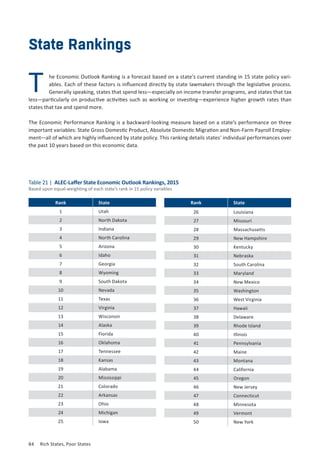
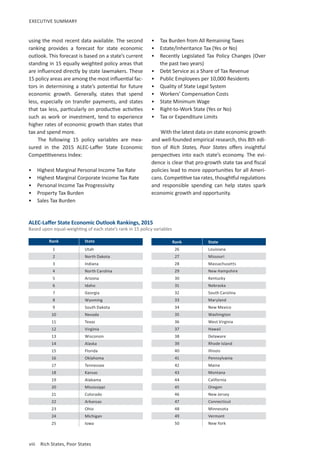
Rank State
1 Utah
2 North Dakota
3 Indiana
4 North Carolina
5 Arizona
6 Idaho
7 Georgia
8 Wyoming
9 South Dakota
10 Nevada
11 Texas
12 Virginia
13 Wisconsin
14 Alaska
15 Florida
16 Oklahoma
17 Tennessee
18 Kansas
19 Alabama
20 Mississippi
21 Colorado
22 Arkansas
23 Ohio
24 Michigan
25 Iowa
ALEC-Laffer State Economic Outlook Rankings, 2015
Based upon equal-weighting of each state’s rank in 15 policy variables
Rank State
26 Louisiana
27 Missouri
28 Massachusetts
29 New Hampshire
30 Kentucky
31 Nebraska
32 South Carolina
33 Maryland
34 New Mexico
35 Washington
36 West Virginia
37 Hawaii
38 Delaware
39 Rhode Island
40 Illinois
41 Pennsylvania
42 Maine
43 Montana
44 California
45 Oregon
46 New Jersey
47 Connecticut
48 Minnesota
49 Vermont
50 New York
www.alec.org ix
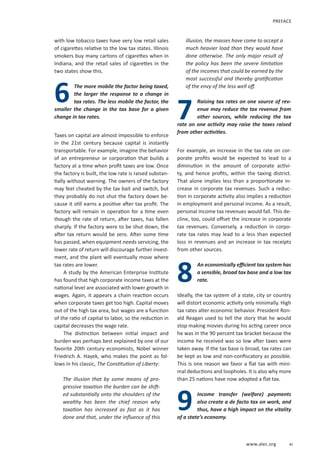
When you tax something more you get
less of it, and when you tax something
less you get more of it.
Tax policy is all about reward and punishment.
Most politicians know instinctively that taxes
reduce the activity being taxed—even if they do
not care to admit it. Congress and state lawmak-
ers routinely tax things that they consider “bad”
to discourage the activity. We reduce, or in some
cases entirely eliminate, taxes on behavior that
we want to encourage, such as home buying, go-
ing to college, giving money to charity and so on.
By lowering the tax rate in some cases to zero, we
lower the after tax cost, in the hopes that this will
lead more people to engage in a desirable activ-
ity. It is wise to keep taxes on work, savings and
investment as low as possible in order not to de-
ter people from participating in these activities.
Individuals work and produce goods and
services to earn money for present or fu-
ture consumption.
Workers save, but they do so for the purpose of
conserving resources so they or their children can
consume in the future. A corollary to this is that
people do not work to pay taxes—although some
politicians seem to think they do.
Taxes create a wedge between the
cost of working and the rewards from
working.
To state this in economic terms, the difference
between the price paid by people who demand
goods and services for consumption and the price
received by people who provide these goods and
4
1
2
3
10 Golden Rules of Effective Taxation
services—the suppliers—is called the wedge.
Income and other payroll taxes, as well as reg-
ulations, restrictions and government require-
ments, separate the wages employers pay from
the wages employees receive. If a worker pays
15 percent of his income in payroll taxes, 25 per-
cent in federal income taxes and 5 percent in state
income taxes, his $50,000 wage is reduced to
roughly $27,500 after taxes. The lost $22,500 of
income is the tax wedge, or approximately 45 per-
cent. As large as the wedge seems in this exam-
ple, it is just part of the total wedge. The wedge
also includes excise, sales and property taxes, plus
an assortment of costs, such as the market value
of the accountants and lawyers hired to main-
tain compliance with government regulations.
As the wedge grows, the total cost to a firm of
employing a person goes up, but the net payment
received by the person goes down. Thus, both the
quantity of labor demanded and quantity sup-
plied fall to a new, lower equilibrium level, and
a lower level of economic activity ensues. This
is why all taxes ultimately affect people’s incen-
tive to work and invest, though some taxes clearly
have a more detrimental effect than others.
An increase in tax rates will not lead to
a dollar-for-dollar increase in tax rev-
enues, and a reduction in tax rates that
encourages production will lead to less than a
dollar-for-dollar reduction in tax revenues.
Lower marginal tax rates reduce the tax wedge
and lead to an expansion in the production base
and improved resource allocation. Thus, while
less tax revenue may be collected per unit of tax
base, the tax base itself increases. This expansion
of the tax base will, therefore, offset some (and in
Rule #2: People don’t work for the privilege of
paying taxes, so if all their earnings are taken in
taxes, they do not work, or at least they do not
earn income the government knows about. And
thus, the government receives no revenues.)
Now, within what is referred to as the “nor-
mal range,” an increase in tax rates will lead to
an increase in tax revenues. At some point, how-
ever, higher tax rates become counterproductive.
Above this point, called the “prohibitive range,” an
increase in tax rates leads to a reduction in tax rev-
enues and vice versa. Over the entire range, with a
tax rate reduction, the revenues collected per dol-
lar of tax base falls. This is the arithmetic effect.
But the number of units in the tax base expands.
Lower tax rates lead to higher levels of personal
income, employment, retail sales, investment and
general economic activity. This is the economic,
or incentive, effect. Tax avoidance also declines.
In the normal range, the arithmetic effect of a tax
rate reduction dominates. In the prohibitive range,
the economic effect is dominant.
Of course, where a state’s tax rate lies along
the Laffer Curve depends on many factors, includ-
ing tax rates in neighboring jurisdictions. If a state
with a high employment or payroll tax borders a
state with large population centers along that bor-
der, businesses will have an incentive to shift their
operations from inside the jurisdiction of the high
tax state to the jurisdiction of the low tax state.
Economists have observed a clear Laffer Curve
effect with respect to cigarette taxes. States with
high tobacco taxes that are located next to states
x	 Rich States, Poor States
some cases, all) of the loss in revenues because of
the now lower rates.
Tax rate changes also affect the amount of tax
avoidance. It is important to note that legal tax
avoidance is differentiated throughout this report
from illegal tax evasion. The higher the marginal
tax rate, the greater the incentive to reduce tax-
able income. Tax avoidance takes many forms,
from workers electing to take an improvement in
nontaxable fringe benefits in lieu of higher gross
wages to investment in tax shelter programs.
Business decisions, too, are increasingly based on
tax considerations as opposed to market efficien-
cy. For example, the incentive to avoid a 40 per-
cent tax, which takes $40 of every $100 earned,
is twice as high as the incentive to avoid a 20 per-
cent tax, for which a worker forfeits $20 of every
$100 earned.
An obvious way to avoid paying a tax is to
eliminate market transactions upon which the
tax is applied. This can be accomplished through
vertical integration: Manufacturers can establish
wholesale outlets; retailers can purchase goods
directly from manufacturers; companies can ac-
quire suppliers or distributors. The number of
steps remains the same, but fewer and fewer
steps involve market transactions and thereby
avoid the tax. If states refrain from applying their
sales taxes on business-to-business transactions,
they will avoid the numerous economic distor-
tions caused by tax cascading. Michigan, for ex-
ample, should not tax the sale of rubber to a tire
company, then tax the tire when it is sold to the
auto company, then tax the sale of the car from
the auto company to the dealer, then tax the
dealer’s sale of the car to the final purchaser of
the car, or the rubber and wheels are taxed multi-
ple times. Additionally, the tax cost becomes em-
bedded in the price of the product and remains
hidden from the consumer.
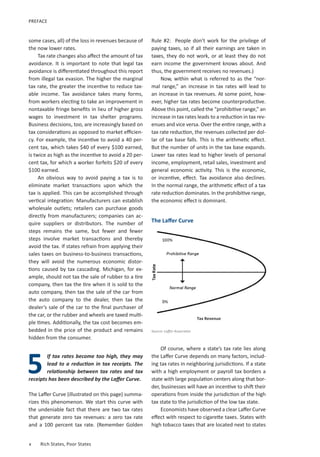
If tax rates become too high, they may
lead to a reduction in tax receipts. The
relationship between tax rates and tax
receipts has been described by the Laffer Curve.
The Laffer Curve (illustrated on this page) summa-
rizes this phenomenon. We start this curve with
the undeniable fact that there are two tax rates
that generate zero tax revenues: a zero tax rate
and a 100 percent tax rate. (Remember Golden
5
Source: Laffer Associates
The Laffer Curve
Tax Revenue
PREFACE
www.alec.org xi
with low tobacco taxes have very low retail sales
of cigarettes relative to the low tax states. Illinois
smokers buy many cartons of cigarettes when in
Indiana, and the retail sales of cigarettes in the
two states show this.
The more mobile the factor being taxed,
the larger the response to a change in
tax rates. The less mobile the factor, the
smaller the change in the tax base for a given
change in tax rates.
Taxes on capital are almost impossible to enforce
in the 21st century because capital is instantly
transportable. For example, imagine the behavior
of an entrepreneur or corporation that builds a
factory at a time when profit taxes are low. Once
the factory is built, the low rate is raised substan-
tially without warning. The owners of the factory
may feel cheated by the tax bait and switch, but
they probably do not shut the factory down be-
cause it still earns a positive after tax profit. The
factory will remain in operation for a time even
though the rate of return, after taxes, has fallen
sharply. If the factory were to be shut down, the
after tax return would be zero. After some time
has passed, when equipment needs servicing, the
lower rate of return will discourage further invest-
ment, and the plant will eventually move where
tax rates are lower.
A study by the American Enterprise Institute
has found that high corporate income taxes at the
national level are associated with lower growth in
wages. Again, it appears a chain reaction occurs
when corporate taxes get too high. Capital moves
out of the high tax area, but wages are a function
of the ratio of capital to labor, so the reduction in
capital decreases the wage rate.
The distinction between initial impact and
burden was perhaps best explained by one of our
favorite 20th century economists, Nobel winner
Friedrich A. Hayek, who makes the point as fol-
lows in his classic, The Constitution of Liberty:
The illusion that by some means of pro-
gressive taxation the burden can be shift-
ed substantially onto the shoulders of the
wealthy has been the chief reason why
taxation has increased as fast as it has
done and that, under the influence of this
illusion, the masses have come to accept a
much heavier load than they would have
done otherwise. The only major result of
the policy has been the severe limitation
of the incomes that could be earned by the
most successful and thereby gratification
of the envy of the less well off.
Raising tax rates on one source of rev-
enue may reduce the tax revenue from
other sources, while reducing the tax
rate on one activity may raise the taxes raised
from other activities.
For example, an increase in the tax rate on cor-
porate profits would be expected to lead to a
diminution in the amount of corporate activi-
ty, and hence profits, within the taxing district.
That alone implies less than a proportionate in-
crease in corporate tax revenues. Such a reduc-
tion in corporate activity also implies a reduction
in employment and personal income. As a result,
personal income tax revenues would fall. This de-
cline, too, could offset the increase in corporate
tax revenues. Conversely, a reduction in corpo-
rate tax rates may lead to a less than expected
loss in revenues and an increase in tax receipts
from other sources.
An economically efficient tax system has
a sensible, broad tax base and a low tax
rate.
Ideally, the tax system of a state, city or country
will distort economic activity only minimally. High
tax rates alter economic behavior. President Ron-
ald Reagan used to tell the story that he would
stop making movies during his acting career once
he was in the 90 percent tax bracket because the
income he received was so low after taxes were
taken away. If the tax base is broad, tax rates can
be kept as low and non-confiscatory as possible.
This is one reason we favor a flat tax with mini-
mal deductions and loopholes. It is also why more
than 25 nations have now adopted a flat tax.
Income transfer (welfare) payments
also create a de facto tax on work, and
thus, have a high impact on the vitality
of a state’s economy.
6
7
8
PREFACE
9
xii	 Rich States, Poor States
PREFACE
Unemployment benefits, welfare payments and
subsidies all represent a redistribution of income.
For every transfer recipient, there is an equivalent
tax payment or future tax liability. Thus, income
effects cancel. In many instances, these payments
are given to people only in the absence of work
or output. Examples include food stamps (in-
come tests), Social Security benefits (retirement
tests), agricultural subsidies and of course, unem-
ployment compensation itself. Thus, the wedge
on work effort is growing at the same time that
subsidies for not working are increasing. Transfer
payments represent a tax on production and a
subsidy to leisure. Their automatic increase in the
event of a fall in market income leads to an even
sharper drop in output.
In some high benefit states, such as Hawaii,
Massachusetts and New York, the entire package
of welfare payments can pay people the equiva-
lent of a $10 per hour job (and let us not forget:
welfare benefits are not taxed, but wages and
10
salaries are). Because these benefits shrink as in-
come levels from work climb, welfare can impose
very high marginal tax rates (60 percent or more)
on low-income Americans. Those disincentives to
work have a deleterious effect. We found a high,
statistically significant, negative relationship be-
tween the level of benefits in a state and the per-
centage reduction in caseloads.
In sum, high welfare benefits magnify the tax
wedge between effort and reward. As such, out-
put is expected to fall as a consequence of making
benefits from not working more generous. Thus,
an increase in unemployment benefits is expect-
ed to lead to a rise in unemployment.
Finally, and most important of all for state leg-
islators to remember:
If A and B are two locations, and if
taxes are raised in B and lowered
in A, producers and manufacturers
will have a greater incentive to move from B to A.
1
CHAPTERCHAPTER
State of the States
Cheyenne, Wyoming
2	 Rich States, Poor States
CHAPTER ONE
he balance of economic and political
power is shifting in America. As some
states welcome thousands of new resi-
dents and businesses, others are seeing them flee
at an alarming rate. The reason for this is simple:
Americans continue to vote with their feet and
go where they have the best economic oppor-
tunities. State economic policies vary consider-
ably and the evidence is clear that these policies
are having a huge effect on where Americans
choose to live. In this chapter, we look at what
these trends mean for the states and the coun-
try before reviewing what significant economic
policy developments have occurred in the last
year in the wake of the 2014 elections. For the
most part, pro-growth economic reforms are
gaining momentum throughout the states, and it
is encouraging to see leaders from both sides of
the aisle take research from this publication and
call for reform.
On the Move: Analyzing American Mobility
Population movements between state lines illus-
trate the importance of wise policy decisions.
Specifically, this chapter examines net domestic
migration and adjusted gross income (AGI) data.
No matter what way you look at it, Americans are
moving to economically competitive states and
taking their incomes with them.
Net domestic migration measures the
amount of people who file taxes in one state one
year, and file taxes in another state the next year.
The Internal Revenue Service (IRS) collects and
publishes the data. Net domestic migration is dif-
ferent than general population growth because it
does not include birth rates or immigrants from
outside the United States. This measure captures
State of the States
T
the decisions that Americans make to move from
their home state to another.
From 1992 to 2011, approximately 62 million
taxpayers moved from one state to another.1
That
is an estimated total greater than the popula-
tions of Illinois, New York and Florida combined.2
In most cases, people are voting with their feet
and moving to states that offer better economic
opportunities.
American mobility has a huge price tag for
the states. From 1992 to 2011, approximately
$2.2 trillion in AGI has migrated from one state to
another.3
AGI only measures tax filers, so the $2.2
trillion figure does not include Americans who do
not file tax returns. For local business and com-
merce, $2.2 trillion is a lot of money flowing to
the economically competitive states.
The Best and Worst Places for Economic
Opportunity
Generally, this publication’s 2015 rankings show
that Utah, Wyoming, North Carolina, Florida and
Texas are economic hotspots for growth. Further-
more, many of the no income tax states such as
Nevada and South Dakota are also economically
promising.
On the other hand, most states in the North-
east and some states in the Rust Belt are facing
economic decline. In the Rust Belt, Michigan,
Indiana and Wisconsin deserve major credit for
positive pro-growth reforms they have recently
enacted after decades of poor policy choices.
Additionally, Minnesota and Illinois both face sig-
nificant fiscal challenges. While Governor Bruce
Rauner is doing his best to protect taxpayers in
Illinois, Minnesota policymakers continue to pass
tax and spend policies. Economic opportunities in
www.alec.org 3
STATE OF THE STATES
the Northeast are even worse. However, Maine
Governor Paul LePage and New Jersey Governor
Chris Christie are heroically trying to turn things
around.
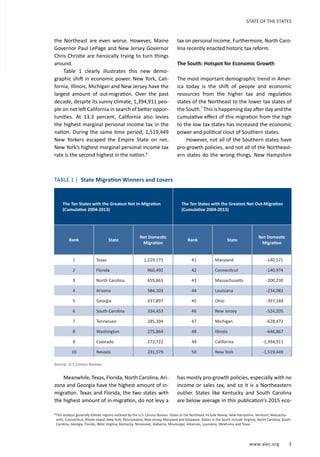
Table 1 clearly illustrates this new demo-
graphic shift in economic power. New York, Cali-
fornia, Illinois, Michigan and New Jersey have the
largest amount of out-migration. Over the past
decade, despite its sunny climate, 1,394,911 peo-
ple on net left California in search of better oppor-
tunities. At 13.3 percent, California also levies
the highest marginal personal income tax in the
nation. During the same time period, 1,519,449
New Yorkers escaped the Empire State on net.
New York’s highest marginal personal income tax
rate is the second highest in the nation.4
TABLE 1 | State Migration Winners and Losers
The Ten States with the Greatest Net In-Migration
(Cumulative 2004-2013)
The Ten States with the Greatest Net Out-Migration
(Cumulative 2004-2013)
Rank State
Net Domestic
Migration
Rank State
Net Domestic
Migration
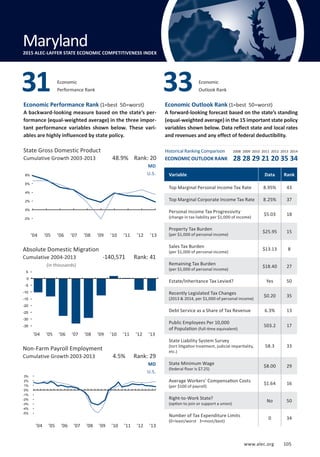
1 Texas 1,229,173 41 Maryland -140,571
2 Florida 960,492 42 Connecticut -140,974
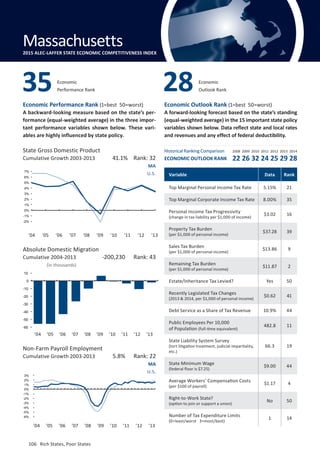
3 North Carolina 655,663 43 Massachusetts -200,230
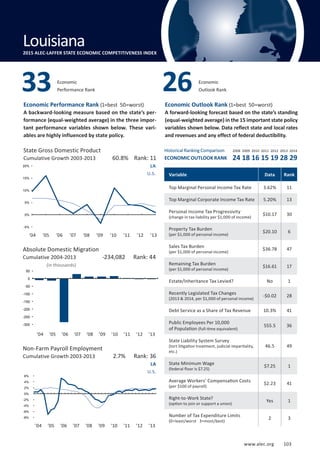
4 Arizona 584,103 44 Louisiana -234,082
5 Georgia 437,897 45 Ohio -397,184
6 South Carolina 334,453 46 New Jersey -524,205
7 Tennessee 285,394 47 Michigan -628,472
8 Washington 275,864 48 Illinois -646,867
9 Colorado 272,722 49 California -1,394,911
10 Nevada 231,579 50 New York -1,519,449
Source: U.S Census Bureau
Meanwhile, Texas, Florida, North Carolina, Ari-
zona and Georgia have the highest amount of in-
migration. Texas and Florida, the two states with
the highest amount of in-migration, do not levy a
tax on personal income. Furthermore, North Caro-
lina recently enacted historic tax reform.
The South: Hotspot for Economic Growth
The most important demographic trend in Amer-
ica today is the shift of people and economic
resources from the higher tax and regulation
states of the Northeast to the lower tax states of
the South.*
This is happening day after day and the
cumulative effect of this migration from the high
to the low tax states has increased the economic
power and political clout of Southern states.
However, not all of the Southern states have
pro-growth policies, and not all of the Northeast-
ern states do the wrong things. New Hampshire
has mostly pro-growth policies, especially with no
income or sales tax, and so it is a Northeastern
outlier. States like Kentucky and South Carolina
are below average in this publication’s 2015 eco-
*This analysis generally follows regions outlined by the U.S. Census Bureau. States in the Northeast include Maine, New Hampshire, Vermont, Massachu-
setts, Connecticut, Rhode Island, New York, Pennsylvania, New Jersey, Maryland and Delaware. States in the South include Virginia, North Carolina, South
Carolina, Georgia, Florida, West Virginia, Kentucky, Tennessee, Alabama, Mississippi, Arkansas, Louisiana, Oklahoma and Texas.
4	 Rich States, Poor States
CHAPTER ONE
nomic outlook rankings, while states like Alabama
and Mississippi are only slightly above average.
Overall, the South and Southwest regions
have long been and continue to be the big win-
ners of this interstate competition. States such as
Texas, Florida, Georgia and Arizona are among the
states that have gained the most Congressional
representation, while states in the Northeast and
Midwest, including New York, Ohio, Pennsylvania
and Illinois have lost the most seats. Incredibly,
states in the Northeast have lost a large share
of their total House seats in the past 50 years as
their citizens have left in search of better eco-
nomic opportunities.5
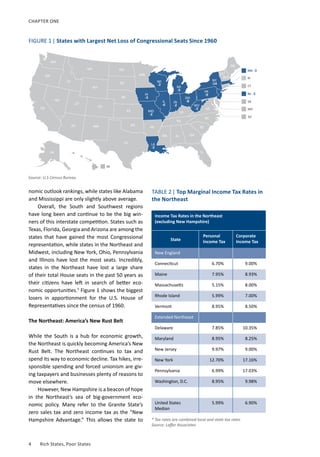
Figure 1 shows the biggest
losers in apportionment for the U.S. House of
Representatives since the census of 1960.
The Northeast: America’s New Rust Belt
While the South is a hub for economic growth,
the Northeast is quickly becoming America’s New
Rust Belt. The Northeast continues to tax and
spend its way to economic decline. Tax hikes, irre-
sponsible spending and forced unionism are giv-
ing taxpayers and businesses plenty of reasons to
move elsewhere.
However, New Hampshire is a beacon of hope
in the Northeast’s sea of big-government eco-
nomic policy. Many refer to the Granite State’s
zero sales tax and zero income tax as the “New
Hampshire Advantage.” This allows the state to
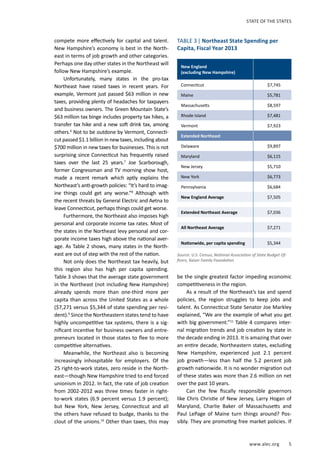
Income Tax Rates in the Northeast
(excluding New Hampshire)
State
Personal
Income Tax
Corporate
Income Tax
New England
Connecticut 6.70% 9.00%
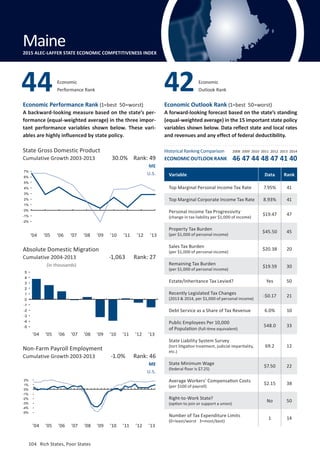
Maine 7.95% 8.93%
Massachusetts 5.15% 8.00%
Rhode Island 5.99% 7.00%
Vermont 8.95% 8.50%
Extended Northeast
Delaware 7.85% 10.35%
Maryland 8.95% 8.25%
New Jersey 9.97% 9.00%
New York 12.70% 17.16%
Pennsylvania 6.99% 17.03%
Washington, D.C. 8.95% 9.98%
United States
Median
5.99% 6.90%
* Tax rates are combined local and state tax rates
Source: Laffer Associates
FIGURE 1| States with Largest Net Loss of Congressional Seats Since 1960
WA
OR
CA
MT
ID
NV
UT
WY
AZ
ND
SD
CO
NM
TX
OK
KS
NE
MN
IA
-3
WI
-2
MO
-2
AR
LA
-2
IL
-6
IN
-2
MI
-5
OH
-8
WV
-2
PA
-9
NY
-14
VT
NH
ME
-3
-3
KY
TN
MS AL GA
SC
VA
NC
FL
HI
AK
Source: U.S Census Bureau
TABLE 2| Top Marginal Income Tax Rates in
the Northeast
www.alec.org 5
STATE OF THE STATES
compete more effectively for capital and talent.
New Hampshire’s economy is best in the North-
east in terms of job growth and other categories.
Perhaps one day other states in the Northeast will
follow New Hampshire’s example.
Unfortunately, many states in the pro-tax
Northeast have raised taxes in recent years. For
example, Vermont just passed $63 million in new
taxes, providing plenty of headaches for taxpayers
and business owners. The Green Mountain State’s
$63 million tax binge includes property tax hikes, a
transfer tax hike and a new soft drink tax, among
others.6
Not to be outdone by Vermont, Connecti-
cut passed $1.1 billion in new taxes, including about
$700 million in new taxes for businesses. This is not
surprising since Connecticut has frequently raised
taxes over the last 25 years.7
Joe Scarborough,
former Congressman and TV morning show host,
made a recent remark which aptly explains the
Northeast’s anti-growth policies: “It’s hard to imag-
ine things could get any worse.”8
Although with
the recent threats by General Electric and Aetna to
leave Connecticut, perhaps things could get worse.
Furthermore, the Northeast also imposes high
personal and corporate income tax rates. Most of
the states in the Northeast levy personal and cor-
porate income taxes high above the national aver-
age. As Table 2 shows, many states in the North-
east are out of step with the rest of the nation.
Not only does the Northeast tax heavily, but
this region also has high per capita spending.
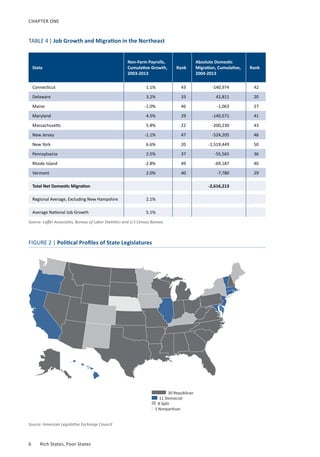
Table 3 shows that the average state government
in the Northeast (not including New Hampshire)
already spends more than one-third more per
capita than across the United States as a whole
($7,271 versus $5,344 of state spending per resi-
dent).9
 Since the Northeastern states tend to have
highly uncompetitive tax systems, there is a sig-
nificant incentive for business owners and entre-
preneurs located in those states to flee to more
competitive alternatives.
Meanwhile, the Northeast also is becoming
increasingly inhospitable for employers. Of the
25 right-to-work states, zero reside in the North-
east—though New Hampshire tried to end forced
unionism in 2012. In fact, the rate of job creation
from 2002-2012 was three times faster in right-
to-work states (6.9 percent versus 1.9 percent);
but New York, New Jersey, Connecticut and all
the others have refused to budge, thanks to the
clout of the unions.10
Other than taxes, this may
New England
(excluding New Hampshire)
 
Connecticut $7,745
Maine $5,781
Massachusetts $8,597
Rhode Island $7,481
Vermont $7,923
Extended Northeast  
Delaware $9,897
Maryland $6,115
New Jersey $5,710
New York $6,773
Pennsylvania $6,684
New England Average $7,505
Extended Northeast Average $7,036
All Northeast Average $7,271
Nationwide, per capita spending $5,344
Source: U.S. Census, National Association of State Budget Of-
ficers, Kaiser Family Foundation
be the single greatest factor impeding economic
competitiveness in the region.
As a result of the Northeast’s tax and spend
policies, the region struggles to keep jobs and
talent. As Connecticut State Senator Joe Markley
explained, “We are the example of what you get
with big government.”11
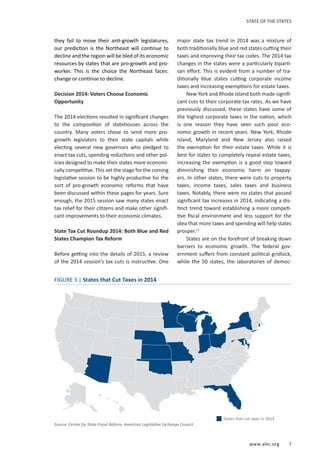
Table 4 compares inter-
nal migration trends and job creation by state in
the decade ending in 2013. It is amazing that over
an entire decade, Northeastern states, excluding
New Hampshire, experienced just 2.1 percent
job growth—less than half the 5.2 percent job
growth nationwide. It is no wonder migration out
of these states was more than 2.6 million on net
over the past 10 years.
Can the few fiscally responsible governors
like Chris Christie of New Jersey, Larry Hogan of
Maryland, Charlie Baker of Massachusetts and
Paul LePage of Maine turn things around? Pos-
sibly. They are promoting free market policies. If
TABLE 3| Northeast State Spending per
Capita, Fiscal Year 2013
6	 Rich States, Poor States
CHAPTER ONE
State
Non-Farm Payrolls,
Cumulative Growth,
2003-2013
Rank
Absolute Domestic
Migration, Cumulative,
2004-2013
Rank
Connecticut 1.1% 43 -140,974 42
Delaware 3.2% 33 42,811 20
Maine -1.0% 46 -1,063 27
Maryland 4.5% 29 -140,571 41
Massachusetts 5.8% 22 -200,230 43
New Jersey -1.1% 47 -524,205 46
New York 6.6% 20 -1,519,449 50
Pennsylvania 2.5% 37 -55,565 36
Rhode Island -2.8% 49 -69,187 40
Vermont 2.0% 40 -7,780 29
Total Net Domestic Migration -2,616,213
Regional Average, Excluding New Hampshire 2.1%
Average National Job Growth 5.1%
Source: Laffer Associates, Bureau of Labor Statistics and U.S Census Bureau
FIGURE 2 | Political Profiles of State Legislatures
TABLE 4| Job Growth and Migration in the Northeast
30 Republican
11 Democrat
8 Split
1 Nonpartisan
Source: American Legislative Exchange Council
www.alec.org 7
STATE OF THE STATES
they fail to move their anti-growth legislatures,
our prediction is the Northeast will continue to
decline and the region will be bled of its economic
resources by states that are pro-growth and pro-
worker. This is the choice the Northeast faces:
change or continue to decline.
Decision 2014: Voters Choose Economic
Opportunity
The 2014 elections resulted in significant changes
to the composition of statehouses across the
country. Many voters chose to send more pro-
growth legislators to their state capitals while
electing several new governors who pledged to
enact tax cuts, spending reductions and other pol-
icies designed to make their states more economi-
cally competitive. This set the stage for the coming
legislative session to be highly productive for the
sort of pro-growth economic reforms that have
been discussed within these pages for years. Sure
enough, the 2015 session saw many states enact
tax relief for their citizens and make other signifi-
cant improvements to their economic climates.
State Tax Cut Roundup 2014: Both Blue and Red
States Champion Tax Reform
Before getting into the details of 2015, a review
of the 2014 session’s tax cuts is instructive. One
major state tax trend in 2014 was a mixture of
both traditionally blue and red states cutting their
taxes and improving their tax codes. The 2014 tax
changes in the states were a particularly biparti-
san effort. This is evident from a number of tra-
ditionally blue states cutting corporate income
taxes and increasing exemptions for estate taxes.
New York and Rhode Island both made signifi-
cant cuts to their corporate tax rates. As we have
previously discussed, these states have some of
the highest corporate taxes in the nation, which
is one reason they have seen such poor eco-
nomic growth in recent years. New York, Rhode
Island, Maryland and New Jersey also raised
the exemption for their estate taxes. While it is
best for states to completely repeal estate taxes,
increasing the exemption is a good step toward
diminishing their economic harm on taxpay-
ers. In other states, there were cuts to property
taxes, income taxes, sales taxes and business
taxes. Notably, there were no states that passed
significant tax increases in 2014, indicating a dis-
tinct trend toward establishing a more competi-
tive fiscal environment and less support for the
idea that more taxes and spending will help states
prosper.12
States are on the forefront of breaking down
barriers to economic growth. The federal gov-
ernment suffers from constant political gridlock,
while the 50 states, the laboratories of democ-
FIGURE 3 | States that Cut Taxes in 2014
States that cut taxes in 2014
Source: Center for State Fiscal Reform, American Legislative Exchange Council
8	 Rich States, Poor States
CHAPTER ONE
racy, are actively pursuing real reforms. Increas-
ingly, tax reform is becoming a bipartisan effort in
the states and the result has been 14 more states
reducing their tax burdens in the 2014 legisla-
tive session. This trend continued in 2015, with
governors proposing many pro-growth tax and
fiscal policy reforms in their state-of-the-state
addresses and many states successfully acting on
those proposals.
Governors Outline Pro-Growth Agendas in 2015
The beginning of 2015 saw many encourag-
ing economic policy proposals in the governors’
state-of-the-state addresses. One of the most
common themes was the call for tax relief. More
governors focused on reducing the tax burden of
their citizens as a path to growth than those who
claimed more taxes and spending would improve
their state’s economy. When looking at the spe-
cific number of proposals for tax increases and tax
reductions, the numbers might not seem dramati-
cally in favor of tax cuts. However, it is important
to remember that not all tax proposals are of the
same scale and most of the tax relief proposals
were more significant in the amount of revenue
they returned to taxpayers than the amount
that taxpayers would lose from the proposed
tax increases. While some governors did sup-
port raising taxes and fees, many of these were
small increases targeted at addressing a specific
expense in the state.13
One way to look at the governor’s tax propos-
als is to compare which governors called for tax
reductions, tax increases or both in their state-
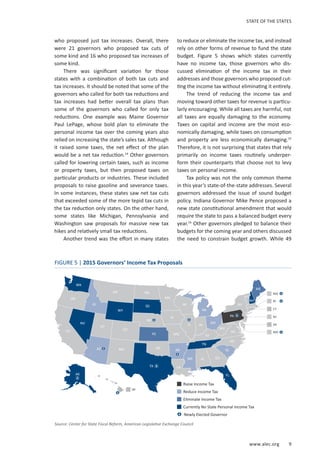
of-the-state addresses. Figure 4 show how the
governors compare to each other in this respect.
Regarding the tax proposals that were counted,
any proposals regarding changes to tax rates,
eliminating or enacting new taxes and any sig-
nificant, broad-based tax credit changes were
included. As can be seen in Figure 4, many gov-
ernors announced some type of tax proposal in
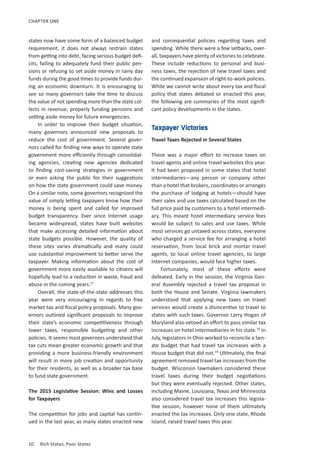
their state-of-the-state address this year. Figure 5
shows that many of these proposals specifically
dealt with state income taxes, and all but one of
these was to eliminate or reduce income taxes.
The good news for taxpayers this year was
that more governors proposed tax cuts in their
state-of-the-state addresses than governors who
proposed tax increases. This year, there were 14
governors who proposed cutting taxes of some
kind without any tax increases, seven who pro-
posed both tax cuts and tax increases and nine
Source: Center for State Fiscal Reform, American Legislative Exchange Council
FIGURE 4| 2015 Governors’ Tax Proposals
WA
OR
CA
MT
ID
NV
UT
WY
AZ
ND
SD
CO
NM
TX
OK
KS
NE
MN
IA
WI
MO
AR
LA
IL IN
MI
OH
WV
PA
NY
VT
NH
ME
KY
TN
MS AL GA
SC
VA
NC
FL
HI
AK
Tax Increases
Tax Reductions
Both Tax Increases and Reductions
Newly Elected Governor
www.alec.org 9
STATE OF THE STATES
who proposed just tax increases. Overall, there
were 21 governors who proposed tax cuts of
some kind and 16 who proposed tax increases of
some kind.
There was significant variation for those
states with a combination of both tax cuts and
tax increases. It should be noted that some of the
governors who called for both tax reductions and
tax increases had better overall tax plans than
some of the governors who called for only tax
reductions. One example was Maine Governor
Paul LePage, whose bold plan to eliminate the
personal income tax over the coming years also
relied on increasing the state’s sales tax. Although
it raised some taxes, the net effect of the plan
would be a net tax reduction.14
Other governors
called for lowering certain taxes, such as income
or property taxes, but then proposed taxes on
particular products or industries. These included
proposals to raise gasoline and severance taxes.
In some instances, these states saw net tax cuts
that exceeded some of the more tepid tax cuts in
the tax reduction only states. On the other hand,
some states like Michigan, Pennsylvania and
Washington saw proposals for massive new tax
hikes and relatively small tax reductions.
Another trend was the effort in many states
to reduce or eliminate the income tax, and instead
rely on other forms of revenue to fund the state
budget. Figure 5 shows which states currently
have no income tax, those governors who dis-
cussed elimination of the income tax in their
addresses and those governors who proposed cut-
ting the income tax without eliminating it entirely.
The trend of reducing the income tax and
moving toward other taxes for revenue is particu-
larly encouraging. While all taxes are harmful, not
all taxes are equally damaging to the economy.
Taxes on capital and income are the most eco-
nomically damaging, while taxes on consumption
and property are less economically damaging.15
Therefore, it is not surprising that states that rely
primarily on income taxes routinely underper-
form their counterparts that choose not to levy
taxes on personal income.
Tax policy was not the only common theme
in this year’s state-of-the-state addresses. Several
governors addressed the issue of sound budget
policy. Indiana Governor Mike Pence proposed a
new state constitutional amendment that would
require the state to pass a balanced budget every
year.16
Other governors pledged to balance their
budgets for the coming year and others discussed
the need to constrain budget growth. While 49
FIGURE 5 | 2015 Governors’ Income Tax Proposals
Source: Center for State Fiscal Reform, American Legislative Exchange Council
WA
OR
CA
MT
ID
NV
UT
WY
AZ
ND
SD
CO
NM
TX
OK
KS
NE
MN
IA
WI
MO
AR
LA
IL IN
MI
OH
WV
PA
NY
VT
NH
ME
KY
TN
MS AL GA
SC
VA
NC
FL
HI
AK
Raise Income Tax
Reduce Income Tax
Eliminate Income Tax
Currently No State Personal Income Tax
Newly Elected Governor
10	 Rich States, Poor States
CHAPTER ONE
states now have some form of a balanced budget
requirement, it does not always restrain states
from getting into debt, facing serious budget defi-
cits, failing to adequately fund their public pen-
sions or refusing to set aside money in rainy day
funds during the good times to provide funds dur-
ing an economic downturn. It is encouraging to
see so many governors take the time to discuss
the value of not spending more than the state col-
lects in revenue, properly funding pensions and
setting aside money for future emergencies.
In order to improve their budget situation,
many governors announced new proposals to
reduce the cost of government. Several gover-
nors called for finding new ways to operate state
government more efficiently through consolidat-
ing agencies, creating new agencies dedicated
to finding cost-saving strategies in government
or even asking the public for their suggestions
on how the state government could save money.
On a similar note, some governors recognized the
value of simply letting taxpayers know how their
money is being spent and called for improved
budget transparency. Ever since Internet usage
became widespread, states have built websites
that make accessing detailed information about
state budgets possible. However, the quality of
these sites varies dramatically and many could
use substantial improvement to better serve the
taxpayer. Making information about the cost of
government more easily available to citizens will
hopefully lead to a reduction in waste, fraud and
abuse in the coming years.17
Overall, the state-of-the-state addresses this
year were very encouraging in regards to free
market tax and fiscal policy proposals. Many gov-
ernors outlined significant proposals to improve
their state’s economic competitiveness through
lower taxes, responsible budgeting and other
policies. It seems most governors understand that
tax cuts mean greater economic growth and that
providing a more business-friendly environment
will result in more job creation and opportunity
for their residents, as well as a broader tax base
to fund state government.
The 2015 Legislative Session: Wins and Losses
for Taxpayers
The competition for jobs and capital has contin-
ued in the last year, as many states enacted new
and consequential policies regarding taxes and
spending. While there were a few setbacks, over-
all, taxpayers have plenty of victories to celebrate.
These include reductions to personal and busi-
ness taxes, the rejection of new travel taxes and
the continued expansion of right-to-work policies.
While we cannot write about every tax and fiscal
policy that states debated or enacted this year,
the following are summaries of the most signifi-
cant policy developments in the states.
Taxpayer Victories
Travel Taxes Rejected in Several States
There was a major effort to increase taxes on
travel agents and online travel websites this year.
It had been proposed in some states that hotel
intermediaries—any person or company other
than a hotel that brokers, coordinates or arranges
the purchase of lodging at hotels—should have
their sales and use taxes calculated based on the
full price paid by customers to a hotel intermedi-
ary. This meant hotel intermediary service fees
would be subject to sales and use taxes. While
most services go untaxed across states, everyone
who charged a service fee for arranging a hotel
reservation, from local brick and mortar travel
agents, to local online travel agencies, to large
Internet companies, would face higher taxes.
Fortunately, most of these efforts were
defeated. Early in the session, the Virginia Gen-
eral Assembly rejected a travel tax proposal in
both the House and Senate. Virginia lawmakers
understood that applying new taxes on travel
services would create a disincentive to travel to
states with such taxes. Governor Larry Hogan of
Maryland also vetoed an effort to pass similar tax
increases on hotel intermediaries in his state.18
In
July, legislators in Ohio worked to reconcile a Sen-
ate budget that had travel tax increases with a
House budget that did not.19
Ultimately, the final
agreement removed travel tax increases from the
budget. Wisconsin lawmakers considered these
travel taxes during their budget negotiations
but they were eventually rejected. Other states,
including Maine, Louisiana, Texas and Minnesota
also considered travel tax increases this legisla-
tive session, however none of them ultimately
enacted the tax increases. Only one state, Rhode
Island, raised travel taxes this year.
www.alec.org 11
STATE OF THE STATES
Additional taxes make travel more expen-
sive, thereby harming a state’s tourism industry
and weakening the economy as a result. Hotel
intermediaries connect potential tourists with a
state’s hotels, and by doing so, help generate tax
revenue from these visitors through their in-state
commerce. Visitors also add to a state’s economy
through purchases at local restaurants, stores,
events and other in-state businesses. In a mod-
ern, digital economy, hotel intermediaries serve
as a crucial facilitator to position a state to benefit
from domestic and global travelers.
Imposing new taxes on a state’s crucial travel
industry is a discriminatory way to raise revenue
and conflicts with the ALEC Principles of Taxation,
which state that tax policies should be competi-
tive, neutral and fair to all businesses, regardless
of industry.
It is worth noting that what a state would
lose in tax revenue from travelers who choose to
stay elsewhere would likely cause the amount of
revenue raised to fall below projections. As the
principle from economics 101 suggests, when you
tax something more, you get less of it; in this case,
visitors to a state.
The defeat of these discriminatory travel
taxes is great news for taxpayers. It means less
expensive hotel rooms for travelers and more
tourism for states.
New Hampshire Passes Business Tax Cuts
New Hampshire has some of the highest busi-
ness tax rates in the country, in what is otherwise
a sound tax policy environment, with a Business
Profit Tax (BPT) rate at 8.5 percent and Business
Enterprise Tax (BET) rate at 0.75 percent. These
high business tax rates burden businesses, result-
ing in stagnant economic growth. States such as
Texas have set an excellent example of how to
promote economic competition by implementing
business tax cuts. In Governor Maggie Hassan’s
annual budget address, she proposed a plan that
would increase taxes on tobacco products while
leaving the harmful business tax rates untouched.
Unhappy with the governor’s budget plan
for 2015, legislators proposed HB 1 and 2, which
would have reduced the BPT and BET from 8.5
percent to 7.9 percent and 0.75 percent to 0.675
percent respectively.20
Governor Hassan vetoed
both of these bills, arguing that the budget was
“unbalanced” and that the tax cuts would result in
a revenue deficit.21
The Governor then presented
a budget which would cut business tax rates, but
make up for the deficit by taxing tobacco prod-
ucts and increasing vehicle registration fees.22
This proposal was not viewed favorably by House
and Senate Republicans, who were not in favor of
these tax hikes.
State legislators worked with Governor Has-
san after months of disagreement, and concluded
with a plan that would reduce business tax rates
over several years. The implementation of this
plan was contingent upon bipartisan support,
which was made possible by Governor Hassan,
who agreed to get Democrats on board after
reaching the agreement.23
In 2016, the BPT will
be reduced from 8.5 percent to 8.2 percent, while
the BET will be reduced from 0.75 percent to 0.72
percent. In 2018, these taxes will be reduced again
to 7.9 percent and 0.675 percent, but with the
stipulation that the general and education trust
fund levels meet certain requirements. While this
tax relief is relatively small, it is directionally cor-
rect and puts New Hampshire on a path toward a
healthier tax climate.
North Carolina Makes Progress, Reduces Taxes
North Carolina Governor Pat McCrory signed a
$21.73 billion compromise budget that will reduce
personal income tax rates, and transition to
single-sales-factor apportionment for corporate
income taxes.24
The bill will reduce the income
tax rate from 5.75 percent to 5.499 percent in
2017. While spending will increase 3.1 percent
overall, the budget will save residents $400 mil-
lion through tax cuts.25
Also, the bill increases the
standard deduction for individual income taxpay-
ers. The reduction of personal income tax rates
is a step in the right direction, as it will reduce
the burden on taxpayers. North Carolina citizens
should be pleased, as the state continues taking
steps toward a healthier tax climate, resulting in a
more stable and prosperous economy. North Car-
olina has gone from 21 in economic outlook in the
first edition of this publication to 4 in this year’s
rankings. While the state used to have the high-
est income tax in the Southeast, with a top rate
of 7.75 percent, after historic tax reform in 2013
that is no longer the case. The decision to reduce
the Tar Heel State’s personal income tax to a flat
12	 Rich States, Poor States
CHAPTER ONE
5.75 percent has helped the state to improve dra-
matically in this publication’s economic outlook
rankings.
The Nation’s Capital Cuts Taxes
Perhaps the most surprising tax cut plan this
year came from the liberal Washington D.C. City
Council. Earlier this year, the D.C. City Council
approved, by a vote of 12-1, the largest tax cut
in more than a decade. Citizens earning between
$25,000 and $100,000 will see their tax rates fall
by as much as a full percentage point and there
will also be a lower tax bracket for those earning
between $40,000 and $60,000. The tax proposal
will also expand the standard tax deduction,
increase the personal exemption and boost the
Earned Income Tax Credit. In addition, the city
increased the estate tax exemption to match the
federal level and reduced the business franchise
tax from 9.975 percent to 8.25 percent. When
even the D.C. City Council realizes that tax cuts
are necessary to improve economic competi-
tiveness, it is time for other states to take notice
and enhance their economic competitiveness as
well.26
Michigan Voters Reject Sales Tax Hike
Taxpayers in Michigan this year voted against Pro-
posal 1, a referendum that would have increased
taxes across the state. Proposal 1 would have
increased the fuel tax to 41.7 cents per gallon or
14.9 percent of a gallon of fuel’s average whole-
sale price, whichever would be greater. The pro-
posal would also have increased the general sales
and use tax on non-fuel items from 6 percent to 7
percent statewide. The legislation was estimated
to cost households, on average, between $477
and $545 in additional taxes per year.27
Despite the supporters of Proposal 1 spending
18 times more than the opposition, more than $9
million in support of the tax increase, the referen-
dum was defeated by an 80-20 margin, the largest
ballot defeat in Michigan in the last 50 years. The
citizens of Michigan could not have been clearer;
they already pay enough in state taxes and expect
lawmakers in Lansing to find savings in the bud-
get so that the state can operate with existing rev-
enue, or at least dedicate new funding to roads.
The state is still fighting to recover after years of
economic decline and major tax increases are the
last thing Michigan needs as it tries to bring new
businesses into the state and keep more of its
own residents from leaving.
While the measure was originally sold as a
way to raise funds for critical road repairs and
other important infrastructure maintenance,
the measure lost public support when citizens
learned that much of the money that would be
raised would not go to transportation spending
at all, but instead would be diverted to several
other areas of the budget. Surveys showed that
voters were willing to support a tax increase if it
was certain that all of the revenue would go to
transportation expenses. This underscores the
importance of the benefit principle, in which rev-
enue coming from gasoline taxes and other road
related fees should be spent exclusively on road
expenses. Those who use a particular state ser-
vice, such as roads, should pay for it in proportion
to their usage.
Wisconsin Enacts Right-to-Work
Back in March, Governor Scott Walker signed a
monumental right-to-work bill in Wisconsin that
makes union dues and participation optional for
employees. The law, SB 44, gave more rights to
workers and will help create a healthy economic
environment.28
Right-to-work is often misconstrued as being
anti-worker, but this is not the case. Under a non-
right-to-work state’s system of forced unionism,
unions are less accountable to members because
employees have no choice but to pay dues.
Optional entry will now create higher quality rep-
resentation as unions must prove their worth to
employees. The result will be better representa-
tion for those employees who do choose to be
part of a union. Historically, right-to-work states
have demonstrated significant economic benefits
in comparison to non-right-to-work states. Right-
to-work states have had more job growth, more
personal income growth and a higher growth in
GDP, in comparison to non-right-to-work states.
Wisconsin is the 25th state to protect an
employee’s freedom to choose whether or not to
belong to and financially contribute to a union.
The state’s actions are part of a growing momen-
tum of states protecting employees’ freedom of
association.
www.alec.org 13
STATE OF THE STATES
Ohio Continues Tax Cut Strategy
Governor John Kasich signed a $71.2 billion, two-
year budget that will result in nearly $1.9 billion
in net tax cuts.29
The governor approved a 6.3 per-
cent state income tax cut that takes effect next
year. This plan lowers the top personal income
tax rate to about 5 percent. The budget mandates
a tax policy commission to recommend how
to move Ohio’s personal income tax to a 3.5 or
3.75 percent flat rate by 2018. The governor’s plan
increases the existing tax exemption on the first
$250,000 of income for business owners of pass-
through entities from 50 to 75 percent and elimi-
nates the tax altogether in 2017.
While there are many positive tax reforms in
Ohio’s budget, not everything was pro-growth.
The budget contained significant spending
increases and some new taxes, including a 35 cent
per pack tax increase on cigarettes.
Texas-Sized Tax Cuts in the Lone Star State
This year, Texas legislators approved a massive tax
reduction. This builds upon Texas’ reputation as a
state that is friendly to businesses and individu-
als. Overall, Texas will cut nearly $3.8 billion in
taxes over the next two years. The plan includes
the following:
•	 Property tax break worth about $125 a year
for the average Texas homeowner in the form
of an increase to the homestead exemption
for school property taxes. However, the voters
must approve an amendment to the Texas Con-
stitution for this to take effect.
•	 25 percent across-the-board cut in business
franchise tax rates
•	 Elimination of certain occupational fees
These reforms, coupled with Texas’ generally
free-market, pro-growth economy, have kept
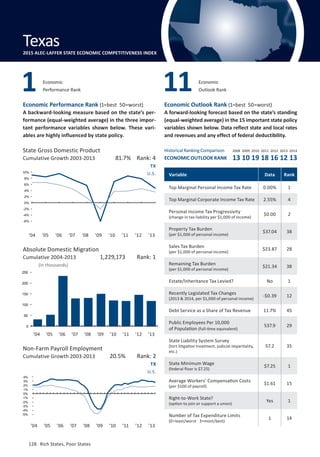
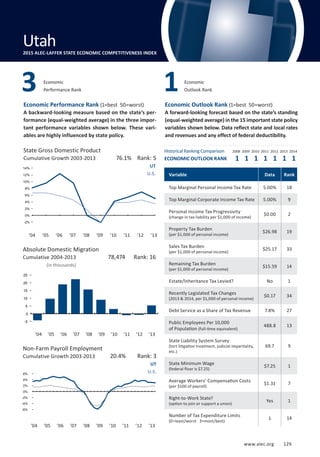
the Lone Star State at number one in economic
performance and boosted them to the number
11 spot in this publication’s economic outlook. In
2014, Texas added more jobs than any other state
and experienced a growth of more than 5 percent
in GDP. According to Governor Greg Abbott, “[the
tax cut] happens at a time when other states
around the country are raising taxes and increas-
ing the cost of doing business—whereas here in …
Texas, we are focused on lowering taxes and mak-
ing the state more affordable for everybody.”30
As
these policies are implemented, in addition to the
other sound policies that Texas has in place, the
state will be primed to be one of the nation’s top
performers in the years to come. Commenting on
these reforms, Texas State Representative and
2015 ALEC National Chairman Phil King said, “We
are very proud that we were able to cut the tax
burden for job creators across Texas this session
while growing spending at a responsible rate and
ensuring the rainy day fund is well maintained.
We hope these changes will continue to move
Texas up in future Rich States, Poor States rank-
ings.”
Florida Cuts Communications Taxes
This session, Governor Rick Scott called for the
elimination of the tax on manufacturing equip-
ment and a cut to communications taxes. This is
particularly notable in a state like Florida, which
has had some of the highest communications ser-
vices taxes in the country. After a special session
in June, Florida’s Legislature passed a $400 mil-
lion tax cut.31
Florida legislators voted to reduce
the Communications Services Tax by 1.73 per-
cent, saving taxpayers roughly $226.1 million. In
addition, lawmakers voted to cut sales taxes on
several products that are estimated to save citi-
zens over $130 million.
These cuts will make Florida more competi-
tive and keep more money in the pockets of tax-
payers. Most importantly, communications tax
relief means better economic opportunities for
families, business owners and entrepreneurs.
While praising Governor Scott’s original proposal,
it was encouraging to hear Representative Matt
Gaetz, chair of the Florida House Finance and Tax
Committee, explain, “In my committee, no tax is
safe. It is the goal of the House of Representatives
to find even more ways to decrease the tax bur-
den on Florida’s families.”
Partial Victories for Taxpayers
Washington Increases Spending and Rejects
Capital Gains Tax
After three special sessions, Washington passed
budget increases for education, worker wages,
14	 Rich States, Poor States
CHAPTER ONE
healthcare and other services. The education
spending increase was mandated by a recent state
Supreme Court order requiring the legislature to
spend more on education or face a $100,000 a
day fine. While budget increases for state services
sound good, the state risks these costs growing to
an unsustainable level.
On the positive side, Washington lawmakers
wisely decided not to adopt Governor Jay Inslee’s
proposed state capital gains tax. Washington is
well below average in this publication’s economic
competitiveness rankings at 35. However, Wash-
ington has a competitive advantage because the
state does not currently levy a tax on personal
income. Even the state’s  own Department of
Commerce agrees, stating, “We offer businesses
some competitive advantages found in few other
states. These include no taxes on capital gains or
personal or corporate income.”32
This session, however, the Department of
Commerce removed the capital gains men-
tion  from their website.33
Governor Inslee pro-
posed a 7 percent tax on the capital gains from the
sale of stocks and bonds of more than $25,000 for
individuals and more than $50,000 for joint filers
to fund an education legacy trust account. The
legislature also considered multiple other capital
gains tax proposals.34
However, as this publication
has argued for years, a capital gains tax is one of
the most unstable sources of revenue and harms
a state’s economic competitiveness.
Capital gains volatility is well-documented in
Washington state. For example, in 2012, the last
time that the Evergreen State considered a capital
gainstax,thestatedepartmentofrevenue warned
about the extreme volatility of capital gains tax
revenue.35
Standard and Poor’s recently noted
that Governor Inslee’s capital gains tax proposal
could “cause the state’s revenues to be more vola-
tile. We have observed that capital gains-related
tax revenues are among the most  cyclical and
difficult to forecast revenues in numerous other
states.”36
Furthermore, the Washington Research
Council, a non-partisan think tank based in Seat-
tle,  recently studied the relationship between
sales tax revenue and capital gains tax revenue.
They found that sales tax revenue remains more
consistent over time, while capital gains revenue
experiences large fluctuations.37
Washington has also gained both residents
and capital over the years from other states. Part
of the reason for that is a competitive tax code,
including no personal income tax. For example,
data from the Oregon Department of Revenue
show that hundreds of taxpayers move annually
from Oregon to just across the Columbia River
into Clark County, Washington.38
Furthermore,
the American Council for Capital Formation states
that Oregon has lost $1.3 billion in net income to
Washington between 1992 and 2006.39
Imposing a
state tax on capital gains would negatively impact
Washington’s ability to compete with other states
for jobs, investments and economic opportunities.
Thankfully, lawmakers realized that a capital
gains tax would introduce economic headaches
for taxpayers and businesses. The capital gains tax
failed to gain to traction in the legislature. Eventu-
ally, even Governor Inslee admitted that the capi-
tal gains tax was no longer on the table.40
He did,
however, end the legislative session by calling for
new tax increases.
Governor LePage Proposes Phase-Out of Maine’s
Income Tax
In Maine, Governor Paul LePage proposed a
bold tax reform plan that would have turned
the economic tide and made Maine one of the
most economically competitive states in the
Northeast.41
The governor called for tax reform
that would begin with a $300 million reduction
in state income taxes. In addition, the governor
also called for eliminating the antiquated estate
tax. Based on our hypothetical calculations, this
tax reform would have catapulted Maine from 42
to 31 in this publication’s economic competitive-
ness ratings. Governor LePage also proposed a
constitutional amendment that would dedicate
future revenue growth to eliminating the state’s
income tax. While the income tax was being
phased-out, sales taxes would be increased to
compensate.
However, the legislature was not convinced
that this was the right plan for Maine this year.
The legislature eventually passed a smaller, $135
million tax cut plan over Governor LePage’s veto,
which included some modest income tax cuts,
and the governor failed to get the two-thirds vote
he needed in the state House to advance a con-
stitutional amendment to end the state income
tax.42
However, Governor LePage has pledged to
continue the fight by trying again next year for a
www.alec.org 15
STATE OF THE STATES
constitutional amendment, and, in the meantime,
is rallying support for a citizens’ initiative to lower
the state income tax.
Setbacks for Taxpayers
Alabama Raises Taxes
Governor Robert Bentley proposed eight separate
tax increases to address the state’s debt problem
and increase education spending. The proposed
tax hikes were estimated to generate $541 million
in revenue. Among the proposed tax hikes were
increasing the sales tax on vehicle sales from 2
percent to 4 percent, generating an estimated
$200 million in revenue, as well as increasing ciga-
rette taxes 82.5 cents.43
The state Senate offered a budget that would
have solved the state’s deficit by cutting $200 mil-
lion in spending, but Governor Bentley promptly
rejected the proposal. After several negotiation
sessions, state lawmakers and the governor were
finally able to come to a budget agreement. Law-
makers declined proposals for combined report-
ing. Programs such as Medicaid, mental health
and human resources saw continued funding,
but other agencies saw funding cuts of around
5.5 percent. Additionally, Alabama residents will
pay higher taxes on cigarettes, raising the price
25 cents per pack, as well as a bed tax on nursing
facilities of $401 per bed.44
It is disappointing to see Alabama approve a
budget that creates new tax burdens on its resi-
dents. However, many state lawmakers deserve
credit for standing up to Governor Bentley and
opposing his proposals for additional tax increases.
Nevada Ignores Voters and Passes Major
Tax Increases
Last year, Nevadans were asked to consider a bal-
lot initiative to create a new gross receipts style
tax to fund increased spending on education. A
gross receipts tax is a tax that is levied on a busi-
ness’ gross revenue rather than its net profits (like
the corporate income tax). The voters rejected
the tax by an overwhelming margin of 79 percent
to 21 percent. Ironically, after opposing the gross
receipts style tax initiative, Governor Brian San-
doval supported a very similar tax this year. This
tax increase included extensions to sales and pay-
roll taxes that were scheduled to sunset as well
as a revised business license fee. This fee would
change from a flat fee system to a graduated sys-
tem based on industry and gross receipts. The
fee, which was $200, was scheduled to drop to
$100, but now would range anywhere from $400
to $4 million, depending on industry and the size
of a business. A modified version of this plan was
eventually brought to the legislature for consider-
ation. It included a simpler increase to the busi-
ness license fee that brought the fee to $500 for
corporations and a new Commerce Tax on gross
revenue.
The legislature eventually passed this and
other tax increases which amounted to the larg-
est tax hikes in Nevada’s history.45
These totaled
almost $1.4 billion in new taxes and included
increasing the business license fee, increasing
payroll taxes, creating a Commerce Tax on gross
revenue, extending certain sales and payroll taxes
that were set to expire and increasing cigarette
taxes by $1 a pack.
While raising any taxes is harmful to a state’s
economy, some of the new taxes in Nevada are
particularly damaging to economic growth. The
Commerce Tax is a gross receipts style tax, which
is one of the most complicated taxes a state can
enact. As mentioned above, gross receipts style
taxes are not collected on business’s profits but
instead on their total revenue. For many firms,
this means owing a large tax bill in years when
no profits have been made. This tax can serve as
a knockout punch for struggling firms that fail to
make a profit.
Perhaps the worst thing about gross receipts
style taxes is that they pick winners and losers in
the market by treating similar businesses differ-
ently. This occurs due to tax pyramiding, where
the price of goods that consumers ultimately pay
includes the economic cost from taxes that com-
panies paid at various levels of production. This is
built into the price of the good and is in addition
to any general sales tax that a consumer might
pay. This occurs because the tax is paid, not by the
final consumer, but at every level of production.
Since gross receipts style taxes do not exempt
business inputs like most sales taxes do, this mul-
tiplies the tax burden that the final consumer
must pay and handicaps businesses that produce
complex goods that inherently require more
stages of production than others. The end result is
16	 Rich States, Poor States
CHAPTER ONE
a highly distorted tax system that artificially raises
the effective tax rate on more complex goods in
an extremely non-transparent fashion.
The cigarette tax increase should also be
noted for being poor tax policy. An important
component of good tax policy is fairness. The tax
code should not be used to target specific prod-
ucts or industries for discriminatory taxation.
A consumption tax should be broad-based and
applied to the final sale of all products equally
and impartially, without exemptions for some
products and additional taxes on others. Also, the
number of smokers has been declining for many
years and relying on a diminishing revenue source
means that there will be less stability in state
finances.
Beyond this, as a practical matter, cigarette
taxes rarely bring in the amount of revenue that
is promised. This is because consumers avoid pay-
ing the taxes by buying cigarettes across state
lines if they can pay a lower price. A study con-
ducted after Minnesota increased their tobacco
taxes proves just how dramatic the decline in
sales can be. In 2013, the Minnesota Legislature
passed a 130 percent increase in the cigarette
excise tax and increased the tax on other tobacco
products from 70 percent of the wholesale price
to 95 percent. The state saw tobacco sales decline
by 50 percent in stores near neighboring states as
consumers began buying tobacco products across
state lines. The decrease in sale of tobacco prod-
ucts statewide resulted in $38 million in lost sales
of non-tobacco products.46
These tax increases are going to diminish
Nevada’s economic competitiveness and are a sur-
prising departure from what has been a business
friendly economic environment for many years.
Conclusion
States can no longer afford to stand still and hope
their existing economic policies will be good
enough to bring in new residents, jobs and capi-
tal. The economic competition among states is
fierce, with many governors proposing significant
tax cuts and other pro-growth reforms and legis-
latures looking for any advantage they can gain
over other states to provide a more favorable
business climate. As the research shows, people
and businesses are moving to states that are will-
ing to let them keep more of their own money
and provide them with more economic freedom.
This trend is changing the distribution of popula-
tion and wealth across the nation, leading some
states to new prosperity and others to economic
decline.
www.alec.org 17
STATE OF THE STATES
(ENDNOTES)
1	 Brown, Travis. How Money Walks. Pelopidas, LLC. 2013.
2	 U.S. Census Bureau, American Community Surveys, State-to-State Migration Flows.
3	 Brown, Travis. How Money Walks. Pelopidas, LLC. 2013.
4	 Laffer and Associates calculations.
5	 Authors calculations based on U.S. Census Bureau data.
6	 Parker, Bruce. “Vermont Taxpayers Feeling After-Effects of Legislature’s $63 Million Tax Binge.” Vermont Watchdog.org. June 18,
2015.
7	 Wright, Mark Antonio. “Joe Scarborough’s Anti-Tax Crusade.” National Review. June 5, 2015.
8	 Ibid.
9	 Calculations by Kaiser Family Foundation based on National Association of State Budget Officers State Expenditure Report:
Examining Fiscal 2012-2014 State Spending; Table 1; and the U.S. Census Bureau Resident Population Data, 2013.
10	 Laffer, Arthur, Moore, Stephen, Sinquefield, Rex and Brown, Travis. An Inquiry into the Nature and Causes of the Wealth of States:
How Taxes, Energy, and Worker Freedom Change Everything. Wiley Publishing. 2014.
11	 Wright, Mark Antonio. “Joe Scarborough’s Anti-Tax Crusade.” National Review. June 5, 2015.
12	 Wilterdink, Ben and Williams, Jonathan. “State Tax Cut Roundup: 2014 Legislative Session.” American Legislative Exchange Coun-
cil. December 2014.
13	 Lafferty, Theodore and Williams, Jonathan. “State of the States: An Analysis of the 2015 Governors’ Addresses.” American Legis-
lative Exchange Council. June 2015.
14	 Ibid.
15	 Ibid.
16	 Pence, Mike. State of the State Address. January 13, 2015.
17	 Lafferty, Theodore and Williams, Jonathan. “State of the States: An Analysis of the 2015 Governors’ Addresses.” American Legis-
lative Exchange Council. June 2015. Page 10.
18	 Hicks, Josh. “Hogan Vetoes Six Bills, Including Measure to Allow Felons to Vote.” The Washington Post. May 22, 2015.
19	 Provance, Jim. “Ohio Sales Tax Would Include Online Hotel Retailers in Latest Budget Proposal.” The Toledo Blade. June 14, 2015.
20	 Jasper, Shawn. “Speaker Jasper Explains Budget Deal to House Members in Email.” NHJournal. September 15, 2015.
21	 Hassan, Maggie. “Governor Hassan’s Veto Message Regarding HB 1  HB 2.” June 25, 2015.
22	 Rayno, Garry. “Gov. Hassan Proposes Budget Compromise Offering Business Tax Cuts, Cigarette Tax Hike; Lawmakers React.” New
Hampshire Union Leader. July 23, 2015.
23	 DePaul, Jennifer. “New Hampshire Governor, Lawmakers Agree to Business Tax Cuts to End Long Budget Stalemate.” Tax Notes.
September 16, 2015.
24	 Sawyer, David. “North Carolina Governor Signs Budget With Tax Cuts, Single Sales Factor.” Tax Notes. September 21, 2015.
25	 Binker, Mark, Burns, Matthew and Leslie, Laura. “Budget Deal Includes Sales Tax, Medicaid Reform.” WRAL. September 14, 2015.
26	 Council of the District of Columbia. “Full Scope of FY 2015 Budget, Explained.”
27	 “Michigan Sales Tax Increase for Transportation Amendment, Proposal 1 (May 2015).” Ballotpedia.
28	 Wisconsin State Legislature. SB 44. 2015.
29	 Carr Smythe, Julie. “Kasich Signs $71B Budget After Vetoing 44 Items.” Cincinnati.com. July 1, 2015.
30	 Garrett, Robert T. “Texas Governor Signs Tax Cuts Worth $3.8 Billion.” The Dallas Morning News. June 15, 2015.
31	 Sweeney, Dan. “Lawmakers Pass $429 Million Tax-Cut Package.” Sun Sentinel. June 16, 2015.
32	 Mercier, Jason. “Choose Washington—No Capital Gains Taxes.” Washington Policy Center. March 3, 2015.
33	 Ibid.
34	 “Improving Washington’s Unfair and Outdated Tax System.” Office of Governor Jay Inslee. December 18, 2014.
35	 Mercier, Jason. “Are Capital Gains Taxes “Secure and Stable” or Highly Volatile?” Washington Policy Center. February 25, 2015.
36	 Petek, Gabriel and Corson, Sussan. “Summary: Washington; General Obligation.” Standard and Poor’s Rating Services. McGraw
Hill Financial. January 30, 2015.
37	 “Policy Brief: Governor Inslee’s Capital Gains Tax Proposal.” Washington Research Council. February 9, 2015.
38	 “Oregon’s Capital Gains Tax is Too High.” The Oregonian. September 30, 2012.
39	 Ibid.
40	 Mercier, Jason. “2015-17 Tax Debate: From “Buck Up” for $1.4 Billion to $180 Million Adopted Net Revenue Increase.” Washing-
ton Policy Center. July 14, 2015.
41	 Brown, Travis. “Most Ambitious Tax-Reform Plan Of 2015 Comes From Maine Governor Paul LePage.” Forbes. January 30, 2015.
42	 Durkin, Alanna. “$6.7B Maine Budget with Income Tax Cuts Sent to Gov. LePage.” The Washington Times. June 17, 2015.
18	 Rich States, Poor States
CHAPTER ONE
43	 Cason, Mike. “Alabama Gov. Robert Bentley Unveils Details About $541 Million Tax Increase.” AL.com. February 27, 2015.
44	 “Alabama Imposes Additional Tax on Nursing Facilities.” Tax Notes. September 16, 2015.
45	 Hagar, Ray and Damon, Anjeanette. “Update: ‘Historic’ Tax Hike for Education Heads to Governor.” Reno Gazette Journal. June 1,
2015.
46.	 “The Economic Consequences of the Recent Cigarette Tax Increase in Minnesota.” John Dunham and Associates and Orzechows-
ki and Walker. June 13, 2014.
www.alec.org 19
Tax Cronyism is Not Tax Reform
2
CHAPTER
Albany, New York
20	 Rich States, Poor States
CHAPTER TWO
Tax Cronyism is Not Tax Reform
Cronyism—the perversion of sound eco-
nomic policy to create a system that
benefits one business at the expense
of others—is a huge public policy problem in
the states. Cronyism in tax policy stifles innova-
tion, hinders competition and introduces a deep
temptation for corruption. The recent ALEC Cen-
ter for State Fiscal Reform study, The Unseen
Costs of Tax Cronyism: Favoritism and Foregone
Growth, found that tax carve-outs totaled $228
billion for personal income and business earnings
tax exemptions, and $260.1 billion for sales tax
exemptions.1
Keep in mind that this figure largely
ignores targeted tax breaks by states to individual
businesses. The report estimates that states have
given out 157,072 grants to specific firms over the
past 20 years.2
When it comes to economic opportunity,
policymakers are faced with two dramatically dif-
ferent strategies. The first option is to support
broad-based competitive tax reform that levels
the playing field for all businesses. This strategy,
which can be referred to as growth through mar-
kets, focuses on improving a state’s economic
climate for everyone. Proponents of the growth
through markets strategy believe that govern-
ment has no business picking winners and losers
in the tax code.
The alternative is for policymakers to engage
in cronyism by providing certain businesses with
special tax carve-outs. Proponents of this strategy,
which can be referred to as  growth through cen-
tral planning, hope that tax carve-outs will some-
how make up for their state’s poor economic cli-
mate. States with high taxes often engage in cro-
nyism, effectively acknowledging that lower taxes
lead to more economic growth. As Table 5 shows,
some of these high tax states have chosen to give
out thousands of tax preferences to make up for
their hostile business environments.
In the year since the ALEC Center for State Fis-
cal Reform released The Unseen Costs of Tax Cro-
nyism: Favoritism and Foregone Growth, many
states have enacted positive reforms that have
increased transparency or eliminated cronyist tax
policies altogether. Other states have continued
to use tax carve-outs in a misguided attempt to
grow their economies. This chapter surveys the
good, the bad and the ugly when it comes to con-
fronting tax cronyism. Based on these case stud-
ies, lawmakers can identify policies that level the
playing field by reducing taxes for all businesses
and individuals. As this chapter clearly demon-
strates, tax cronyism is a poor substitute for prin-
cipled tax reform.
The Good: States Take Steps Toward
Ending Tax Cronyism
The most optimistic development over the last
year has been the number of states that have
done more than measure tax carve-out effec-
tiveness, modified its format or ensured that it
is more transparent. Many states have taken the
important step of ending certain areas of tax cro-
nyism entirely in the tax code. Those states are
to be commended for removing economic distor-
tion, political favoritism and needlessly high rates
on the firms that do not receive special treatment
in their state tax code.
States End Cronyist Tax Measures
The year following the ALEC Center for State Fis-
cal Reform report began with a strong reform in
the nation’s capital. As part of fundamental tax
www.alec.org 21
TAX CRONYISM IS NOT TAX REFORM
reform that lowered income taxes on individuals
and businesses, Washington, D.C. added numer-
ous areas of consumer activity to its sales and use
tax. This included the so-called “yoga tax,” which
far from being a new tax on fitness instruction
and gym memberships, simply added this com-
mercial activity back into its sales tax base.3
Michigan, a state highlighted in the initial
report for enacting important reforms, took addi-
tional steps toward ending tax cronyism in the
past year. The Michigan Economic Development
Corporation saw funding seriously curtailed.4
The
state also began the process of phasing out the
film tax credit. While film production companies
often rely on film tax credits to make projects
financially viable, a less burdensome but more
neutral tax code would be a significant improve-
ment for other industries in the state and almost
certainly for film production companies as well.
A few states reviewed their tax preferences
this year, though not always for the right reasons.
As the ALEC report notes, ending cronyism is an
opportunity to make the state tax code more
competitive, not less competitive, post-reform.
Numerous states took tax carve-out reform as
an opportunity for new revenues, which is only
half-positive, as it removes economic distor-
tions but does not improve competitiveness. For
example, this session Louisiana lawmakers con-
sidered removing numerous business tax carve-
outs. However, their motivation was to close their
budget deficit without increasing tax rates, as
opposed to enacting revenue neutral reform that
creates a level playing field for all businesses and
industries. In Virginia and New York City, Gover-
nor Terry McAuliffe and Mayor Bill de Blasio both
encouraged the end of numerous tax carve-outs
with the desire to bring in new money to spend in
both jurisdictions. However, state and local gov-
ernments should recognize that they will only see
economic benefits from eliminating tax expendi-
tures if they use the savings to cut tax rates, not
as a source of new money to grow government.
Alabama and Nevada Begin Issuing Tax Expendi-
ture Reports
Most of the data collected for The Unseen Costs
of Tax Cronyism: Favoritism and Foregone Growth
came from individual state tax expenditure
reports.5
While these reports vary from state-to-
States Number of Grants to Companies
Alabama 1,732
Alaska 50
Arizona 2,430
Arkansas 489
California 2,696
Colorado 324
Connecticut 293
Delaware 681
D.C. 44
Florida 1,804
Georgia 261
Hawaii 416
Idaho 253
Illinois 1,941
Indiana 1,339
Iowa 2,132
Kansas 808
Kentucky 3,196
Louisiana 2,930
Maine 4,840
Maryland 260
Massachusetts 1,479
Michigan 11,747
Minnesota 1,032
Mississippi 1,202
Missouri 2,552
Montana 60
Nebraska 590
Nevada 457
New Hampshire 400
New Jersey 7,335
New Mexico 183
New York 52,132
North Carolina 1,760
North Dakota 619
Ohio 3,321
Oklahoma 6,933
Oregon 10,027
Pennsylvania 5,506
Rhode Island 597
South Carolina 255
South Dakota 195
Tennessee 143
Texas 2,649
Utah 3,504
Vermont 601
Virginia 1,126
Washington 10,528
West Virginia 308
Wisconsin 903
Wyoming 9
Source: The New York Times
TABLE 5| The New York Times Analysis of
Targeted Business Incentives
22	 Rich States, Poor States
CHAPTER TWO
state in terms of frequency and detail, there were
several states that did not compile a tax expen-
diture report at all. Of the five states that did
not require tax expenditure reports as of 2014,
two states have recently passed legislation that
requires state agencies to produce publicly avail-
able tax expenditure reports. Both Alabama and
Nevada took the crucial first step toward address-
ing the issue of tax cronyism in their states by
requiring these reports.
In Alabama, lawmakers in both houses of the
legislature unanimously passed a bill that would
require the Legislative Fiscal Office to provide an
annual report on the state’s tax expenditures.
This bipartisan effort shines light on a part of Ala-
bama’s tax code that previously was unknown to
many.6
The report will list all tax preferences that
Alabama gives out through its tax code and would
provide a solid basis for an eventual measure-
ment and evaluation process of these various tax
expenditures. The bill also requires biannual pub-
lic hearings on the state’s tax expenditures.
In Nevada, just two months after lawmakers
approved a $1.3 billion tax incentive package to
lure a major company to the state, the Nevada
Department of Taxation released its first tax
expenditure report.7
The report outlined nearly
$4 billion worth of tax carve-outs in the current
fiscal biennium and reported any exemption or
deviation from a broad-based tax. While there is
certainly more work to do to rein in tax cronyism
in Nevada, the introduction of a comprehensive
report detailing tax carve-outs is a major reform
and a move in the right direction.
Though Alabama and Nevada have improved
transparency by implementing tax expenditure
reports, there is still more work to do in curtail-
ing preferential tax treatment and lowering rates.
As of August 2015, Alaska, South Dakota and
Wyoming still lacked an official tax expenditure
report. Requiring state agencies to create a public
tax expenditure report is the first critical move to
address and eliminate tax cronyism.
Letting the Sunshine In: States Implement Evalu-
ation and Oversight of Tax Expenditures
Some of the key conclusions of The Unseen
Costs of Tax Cronyism: Favoritism and Foregone
Growth, short of eliminating cronyism entirely,
were that these programs should have rigorous
standards of oversight, performance metrics to
determine their effectiveness and hard provisions
to eliminate those ineffective tax incentives.
Additionally, the report noted that tax carve-
outs should be “on budget,” meaning that they
should be explicit grant-based spending programs
paying out directly, not reductions to tax burden.
This correctly frames them as economic subsi-
dies, allows for them to be handled through the
annual appropriations process, instead of living
on eternally in the code, and makes them highly
predictable for the state budgeting process.
Over the past year, it was encouraging to
see progress in many states, including the major
step forward Nevada and Alabama have taken in
releasing a tax expenditure report detailing tax
carve-outs for the first time. Numerous states
have instituted or recommended that commit-
tees be formed to study the effectiveness and
prudence of various tax preferences.
Washington, D.C., Nebraska, Tennessee and
Louisiana called on existing agencies such as state
auditors or chief financial officers, or commis-
sions outside the legislature, to review tax expen-
ditures for effectiveness, strategic alternatives
and in some cases, spillover impact on businesses
not receiving preferences.
Maine, Nebraska, Alaska, Minnesota, North
Dakota, Vermont and California called upon vari-
ous non-partisan legislative fiscal offices or other
analysts to conduct evaluations of tax expendi-
tures on whether those provisions are achieving
their stated goals in a cost-effective manner, and
if not, how to improve those programs. Again,
some of these states called for reviews of unin-
tended consequences to businesses not receiving
tax expenditures.
In Texas and Oklahoma, as well as New York
City, new independent advisory boards were
tasked with developing performance metrics for
incentives, evaluating incentives based on those
metrics, recommending programs for state audit
and recommending to policymakers whether
the provisions should be eliminated or how they
might be made more effective.
Indiana, Maryland, Louisiana, New Hamp-
shire, Florida, Mississippi, Rhode Island and
Washington state put into place review systems
of one of the forms mentioned above prior to the
July 2014 publication of The Unseen Costs of Tax
Cronyism: Favoritism and Foregone Growth.
www.alec.org 23
TAX CRONYISM IS NOT TAX REFORM
The Bad: New York’s START-UP NY
Spends $45 Million, Only “Creates”
76 Jobs
While many states have eliminated cronyist tax
measures in their tax codes, New York continues
to rely on tax carve-outs. The Empire State, which
ranks dead last in this publication’s economic out-
look rankings, has given out 52,132 tax carve-outs
to select companies, more than any other state.8
The track record of New York’s latest tax carve-
out program, START-UP NY, demonstrates that tax
cronyism is not a viable economic development
strategy.
In order to qualify for START-UP NY, appli-
cants must be “located 100 percent in a tax free
area” near State University of New York (SUNY)
campuses. Furthermore, applicants must belong
to specific industries in order to qualify.9
Eligible
companies are promised they will not have to
pay business, corporate, sales or property taxes,
as well as no franchise fees for the first 10 years.
Additionally, qualifying employees of these eligi-
ble companies are promised that they will pay no
state or local income taxes for the first five years.
Finally, START-UP NY has a cap of 10,000 jobs that
can qualify for the state and local income tax
carve-outs each year.10
New York State Comptroller Thomas DiNap-
oli’s audit of Empire State Development (ESD),
which oversees START-UP NY, reveals that tax
cronyism hinders growth. From October 2013 to
October 2014, ESD spent $45 million to adver-
tise START-UP NY. During this time period, ESD
received only 18,023 applications, a mere 10 per-
cent of which actually met START-UP NY’s confus-
ing eligibility requirements.11
Thirty companies
began operating under START-UP NY in 2014,
“creating” a grand total of 76 jobs in the state.12
Out of this number, just four companies came
from out of state. In fact, one of the participat-
ing companies, already in New York, moved their
office just one mile to qualify for the program.13
Thus far, for each job created, ESD has spent a
staggering $697,368.14
While ESD officials consider their advertising
efforts a success, the audit notes that “they were
unable to provide any analysis to support their
conclusion.”15
As a result, the Office of the Comp-
troller is considering a separate audit into START-
UP NY. Comptroller DiNapoli explained, “It is time
for us to look at the return for the tax dollars
going in. We need be asking, ‘What are your goals
and how are you going to measure it?’ ‘If you fall
short, do we continue to throw money into it?’
Those are the type of questions we haven’t asked
enough.”16
The American Legislative Exchange Coun-
cil’s Task Force on Tax and Fiscal Policy adopted
model policy, the Tax Expenditure Transparency
Act, which addresses Comptroller DiNapoli’s valid
concerns. This policy requires tax expenditures
to have articulated legislative intent and mea-
sureable performance goals, which would have
greatly helped New York to avoid fiscal headaches
like START-UP NY.17
Instead of picking winners and losers through
the tax code, New York should focus on what
works. In the 2014 legislative session, New York
lawmakers reduced and simplified the corporate
tax, eliminated the individual add-on minimum
tax and reformed the estate tax—all positive
steps toward a more pro-growth economy.18
Low-
ering tax rates gives all businesses a better oppor-
tunity to invest, grow and create jobs in New York.
The Ugly: States Resist Transparency
and Reform on Tax Expenditures
Despite the emerging consensus among economic
experts that specifically targeted tax preferences
are not an effective growth strategy, it can be dif-
ficult politically for some state policymakers not
to offer special treatment to entice desirable
firms to relocate or expand in their states.19
As mentioned previously, Nevada fell into this
trap when state legislators passed a $1.3 billion
tax incentive package to lure one company to the
state in September of 2014.20
In April of 2015,
lawmakers in Georgia also granted preferential
tax treatment to entice Mercedes-Benz to relo-
cate its headquarters to their state.21
In exchange
for relocating their headquarters from New Jer-
sey to Atlanta, lawmakers exempted the company
from having to pay a title fee for leasing cars to
employees. While this $1.3 million per year tax
preference passed, it did meet some opposition
in the legislature from those who argued it was
not fair to grant one company special tax treat-
ment.
A notorious example of this kind of tax cro-
nyism occurred when the state of Washington
24	 Rich States, Poor States
CHAPTER TWO
offered Boeing, a multinational company that
reported almost $87 billion worth of sales in 2013,
about $8.7 billion worth of tax and other specific
benefits to build a new line of aircraft wings in the
state.22
These benefits took the form of an aero-
nautics industry tax credit that was designed spe-
cifically with Boeing in mind.
Additionally, in the hope Boeing might decide
to move its production of aircraft wings out of
Washington, other state policymakers met to pass
targeted tax carve-outs to entice the firm to move
to their states. One egregious example of this was
in Missouri, when Governor Jay Nixon called a
special session for lawmakers to pass a special tax
carve-out agreement in an effort to lure the com-
pany to the state. Ironically, this special session
was called shortly after Governor Nixon vetoed
a small but broad-based income tax cut for Mis-
sourians.23
Besides creating an environment with higher
tax rates on a shrinking number of people and
industries, special tax carve-outs can also be
somewhat of a hypocritical policy for some states.
Often, some will claim that “taxes don’t matter”
in creating economic growth or attracting busi-
nesses and people. But while doing so, these
same states make every effort to extend special
tax favors to companies and industries that relo-
cate to their state.24
Going beyond expansion of preferential tax
expenditures, New Jersey Governor Chris Chris-
tie vetoed legislation that would have required
more transparency in the tax expenditures the
state hands out in the name of economic devel-
opment.25
The bill would have required an annual
evaluation of whether or not a tax expenditure
was reaching its goal, automatically set tax expen-
ditures to sunset after 10 years and enacted other
transparency enhancing measures. Governor
Christie actually agreed with the need to more
closely evaluate tax expenditures, just not the
way this legislation required. The move is a sig-
nificant setback for tax expenditure transparency
in New Jersey.
Connecticut is another state committed to an
approach that relies on high taxes while adopting
targeted tax preferences. This year, Connecticut’s
commitment led to some interesting results that
should be a cautionary tale for other states fol-
lowing the same strategy. Earlier this year, Con-
necticut policymakers proposed significant tax
increases to fill the state’s budget shortfall.26
Despite warnings from some of the state’s largest
businesses, including General Electric and Aetna,
that they would consider relocation if the tax
increases were adopted, a watered-down version
of the tax increase package was eventually passed
and signed by Governor Dan Malloy.
Now, in a bid to keep General Electric in
Connecticut despite its unfriendly economic cli-
mate, Governor Malloy is working on a targeted
tax incentive package specifically for General
Electric.27
Ironically, Governor Malloy is now in
the position of claiming that increased taxes,
especially on business, will not hurt the state’s
economy while simultaneously passing tax pref-
erences for favored businesses so that they will
not relocate and hurt the state’s economy as a
result of increased business taxes. Policymakers
should strive for a competitive playing field for
all businesses rather than becoming caught up in
constant battles for special tax treatment for spe-
cific businesses.
These states’ responses to tax cronyism
are puzzling, given that the economic research
demonstrates that tax cronyism hinders growth.
In fact, a late 2014 report from the Texas Public
Policy Foundation found that corporate tax abate-
ments are an ineffective strategy for promoting
economic growth.28
The report’s author argues
that tax abatements allow government to pick
winners and losers using the tax code. Further-
more, those costs are shifted to other taxpayers
who did not win favorable government tax treat-
ment. Ultimately, the practice is unfair and does
not measurably improve economic growth.
The findings of the Texas Public Policy Foun-
dation were similar to findings of another report
criticizing the proliferation of tax expenditures
by state governments. A Mercatus Center study,
Ranking Known State Subsidies to Private Busi-
nesses, catalogs the amount and frequency of
state tax expenditures for private businesses and
industries.29
Overall, the report notes that while
this practice is widespread, “the empirical stud-
ies on state subsidies find that these programs
have little to no effect in producing their intended
goals.”
Tax cronyism is a poor substitute for a healthy
economic climate. A prosperous and healthy
economy should not require glitzy advertising
campaigns and slick tax incentives to convince
www.alec.org 25
TAX CRONYISM IS NOT TAX REFORM
businesses to invest. When policymakers resort
to tax carve-outs to encourage growth, they are
ignoring the bigger problem—an uncompetitive
tax structure. Competitive tax rates with broad
bases create a pathway to economic opportunity.
Looking to the Future: Best Practices for Address-
ing Tax Cronyism
Policymakers can learn valuable lessons from
the states on creating a principled tax code and
thereby eliminating or reducing cronyism. The
ALEC Principles of Taxation outline key guidelines
for pro-growth tax codes. Pro-growth tax policy
should be transparent, economically neutral,
competitive, fair, equitable, simple, complemen-
tary to local government and reliable.30
When it comes to addressing tax cronyism,
policymakers should consider eliminating current
tax carve-outs that deviate from the tax base.
They should also include lowering tax rates on
productive behavior as part of a revenue neutral
or revenue negative tax reform package.31
If tax
carve-outs are eliminated with no accompanying
rate cuts, the tax code will be fairer but more bur-
densome and economically damaging. Eliminat-
ing tax carve-outs to raise revenue undermines
the key goal of tax reform: improving state eco-
nomic competitiveness.
Transparency is a positive first step toward
ending tax cronyism. For example, in 2013, the
American Legislative Exchange Council’s Tax
Expenditure Transparency Act established key
guidelines for tax expenditure reporting. This
model policy requires that tax expenditures must
include legislative intent and measureable per-
formance objectives. This allows the legislature
to easily identify and eliminate tax carve-outs
that are failing to meet performance objectives.32
Washington state is a great example of these tax
expenditure reporting guidelines in action.33
Furthermore, the Government Accounting
Standards Board (GASB) recently published finan-
cial guidelines for state and local governments
regarding various tax expenditure information
that should be made available to the public.34
The
guidelines include disclosing tax abatements, pro-
cedures and costs of those tax abatements and
commitments included in these types of agree-
ments. The GASB guidelines are particularly use-
ful since most state and local governments follow
GASB guidelines for financial reporting in most,
if not all, other areas of government finance.
Introducing these new rules will set the stage for
increased transparency and accountability for
tax expenditures and can help make the case for
reform.
The National Conference of State Legisla-
tures (NCSL) has also outlined helpful best prac-
tices regarding tax expenditure transparency. The
organization adopted guidelines for tax expendi-
ture reports in August of 2014. These guidelines
prioritize clarity and detail in reporting state tax
expenditures. Most importantly, the guidelines
urge state lawmakers to adopt requirements that
tax expenditure reports include the purpose for
which the tax expenditures were enacted in the
first place.35
Finally, policymakers should also consider
putting tax carve-outs “on budget.” Tax carve-
outs should be cash payments done through the
standard state appropriations process, instead of
elements of the tax code. Many lawmakers are
unaware of the extent of tax carve-outs in state
tax codes, which results in revenue volatility to tax
collections and makes budgeting difficult. By put-
ting tax carve-outs on budget, states can better
forecast their revenue. In Michigan, for example,
Governor Rick Snyder signed a law several years
ago that converts many of the tax preferences
administrated by the Michigan Economic Devel-
opment Corporation into cash payments, which
increases transparency and reliability.36
Conclusion
Tax cronyism is a significant obstacle to economic
opportunity. Cronyism in the tax code stifles inno-
vation, hinders true competition and impedes
growth. Since the publication of the ALEC Center
for State Fiscal Reform study, The Unseen Costs of
Tax Cronyism: Favoritism and Foregone Growth
in 2014, many states have taken steps to address
cronyism, but there is much more work left to be
done.
A survey of the states’ responses to tax crony-
ism, the good, the bad and the ugly provides valu-
able lessons for state policymakers. States such as
Alabama, Nevada and Michigan have taken some
positive steps toward ending tax cronyism. How-
ever, there was also the bad and the ugly. New
York’s tax carve-out program, START-UP NY only
26	 Rich States, Poor States
CHAPTER TWO
“created” 76 jobs, while states such as Kentucky
and Connecticut tried to use tax carve-outs in a
misguided attempt to create economic growth.
Sustainable economic growth is best achieved
when all businesses and industries play by the
same set of rules. Rather than orchestrating com-
plex tax agreements, consumers should decide
which businesses succeed and which ones do not.
By following a strategy of competitive tax rates
with broad bases, which treats all businesses and
industries equally, states can reap the rewards
that come with sustainable economic growth.
www.alec.org 27
TAX CRONYISM IS NOT TAX REFORM
(ENDNOTES)
1	 Freeland, William, Wilterdink, Ben and Williams, Jonathan. “The Unseen Costs of Tax Cronyism: Favoritism and Foregone
Growth.” American Legislative Exchange Council. July 2014.
2	 Ibid.
3	 “Effective October 1 the District of Columbia Sales Tax Extends to Additional Services.” Washington, D.C. Office of Tax and Rev-
enue. September 25, 2014.
4	 Lawler, Emily. “Michigan Economic Development Corp to Lay Off Up to 65 Employees.” MLive. September 15, 2015.
5	 Freeland, William, Wilterdink, Ben and Williams, Jonathan. “The Unseen Costs of Tax Cronyism: Favoritism and Foregone
Growth.” American Legislative Exchange Council. July 2014.
6	 Gundlach, Carol. “2015 Legislative Update: Alabama Legislature Passes Bill to Require Annual Report on State Tax Breaks.” Arise
Citizens’ Policy Project. May 21, 2015.
7	 Whaley, Sean. “Governor Signs Tesla Bills Approved by Nevada Legislature.” Las Vegas Review Journal. September 11, 2015.
8	 Story, Louise, Feher, Tiff and Watkins, David. “United States of Subsidies: New York.” NY Times.com. Accessed October 13, 2015.
9	 “What is START-UP NY?” New York State. Accessed July 6, 2015.
10	 “Marketing Service Performance Monitoring: Empire State Development.” New York State Office of the State Comptroller Thom-
as P. DiNapoli. Division of State Government Accountability. May 2015.
11	 Ibid.
12	 “Last Year, Companies Created 4% of New Jobs Promised Over 5 Years Under Start-Up NY.” Crain’s New York Business. April 3,
2015.
13	 Craig, Susanne and McKinley, Jesse. “Cuomo’s Job Creation Program Is Slow to Take Hold.” The New York Times. May 14, 2015.
14	 Sinquefield, Rex. “With Only 76 Jobs Created Cuomo’s Start-Up NY is a Bust—With the Cost of $697,368 per Job.” Forbes. May
29, 2015.
15	 “Marketing Service Performance Monitoring: Empire State Development.” New York State Office of the State Comptroller Thom-
as P. DiNapoli. Division of State Government Accountability. May 2015.
16	 Craig, Susanne and McKinley, Jesse. “Cuomo’s Job Creation Program Is Slow to Take Hold.” The New York Times. May 14, 2015.
17	 “Tax Expenditure Transparency Act.” Task Force on Tax and Fiscal Policy. American Legislative Exchange Council. August 2013.
18	 Williams, Jonathan and Wilterdink, Ben. “State Tax Cut Roundup: 2014 Legislative Session.” American Legislative Exchange Coun-
cil. December 2014.
19	 Coyne, Christopher and Moberg, Lotta. “The Political Economy of State-Provided Targeted Benefits.” Mercatus Center at George
Mason University. May 16, 2014.
20	 Whaley, Sean. “Governor Signs Tesla Bills Approved by Nevada Legislature.” Las Vegas Review Journal. September 11, 2015.
21	 Williams, Dave. “Gov. Deal Signs Mercedes Tax Break.” Atlanta Business Chronicle. May 6, 2015.
22	 Westneat, Danny. “Tax Breaks for Boeing: We’re No. 1.” The Seattle Times. November 13, 2013.
23	 Freeland, William and Wilterdink, Ben. “Missouri Tax Hypocrisy.” Red State. January 17, 2014.
24	 Freeland, William, Wilterdink, Ben and Williams, Jonathan. “The Unseen Costs of Tax Cronyism: Favoritism and Foregone
Growth.” American Legislative Exchange Council. July 2014.
25	 Marcus, Samantha. “Christie Vetoes Bill Scrutinizing Corporate Tax Breaks.” NJ.com. May 11, 2015.
26	 Wilterdink, Ben. “Connecticut Set to Raise Taxes, Businesses Consider Relocation.” American Legislator. June 16, 2015.
27	 Keating, Christopher. “Malloy Trying to Keep GE Headquarters in Connecticut.” Hartford Courant. August 24, 2015.
28	 Fields, Jess. “The Failure of Tax Abatements: Corporate Handouts That Just Don’t Work for Taxpayers.” Texas Public Policy Foun-
dation. December 2014.
29	 de Rugy, Veronique. “Ranking Known State Subsidies to Private Businesses.” Mercatus Center at George Mason University. October
15, 2014.
30	 “ALEC Principles of Taxation.” Task Force on Tax and Fiscal Policy. American Legislative Exchange Council. 2015.
31	 Freeland, William, Wilterdink, Ben and Williams, Jonathan. “The Unseen Costs of Tax Cronyism: Favoritism and Foregone
Growth.” American Legislative Exchange Council. July 2014.
32	 “Tax Expenditure Transparency Act.” Task Force on Tax and Fiscal Policy. American Legislative Exchange Council. August 2013.
33	 Freeland, William, Wilterdink, Ben and Williams, Jonathan. “The Unseen Costs of Tax Cronyism: Favoritism and Foregone
Growth.” American Legislative Exchange Council. July 2014.
34	 Bramwell, Jason. “GASB Sets New Disclosure Rules for Tax Abatements.” Accounting Web. August 17, 2015.
35	 “Tax Expenditure Budgets and Reports: Best Practices.” National Conference of State Legislatures. August 2014.
36	 LaFaive, Michael. “Good, Bad, Ugly of Gov. Snyder’s Budget.” Michigan Capitol Confidential. February 2011.
28	 Rich States, Poor States
CHAPTER TWO
www.alec.org 29
Policies for Growth
2
CHAPTER
Policy Matters:
How States Can Compete to Win
3
CHAPTER
Indianapolis, Indiana
30	 Rich States, Poor States
F
Policy Matters: How States Can Compete to Win
or eight years, this annual publication has
provided an in-depth analysis of where
growth is happening in America and why
some states grow so much faster than others.
Free market policy matters for economic growth.
Though some on the Left deny this to be true, it
is crucial to where prosperity in America thrives
and where it is failing to advance. In fact, as peo-
ple and capital become more mobile, policy mat-
ters more today than ever.
This publication measures the pro-growth
policies that have a high likelihood of increasing
a state’s employment and its citizens’ incomes,
and thus improving the lives of its citizens. The
relationship between policies and growth is not
based on small samples or a few years’ data. This
relationship has been fairly stable for at least 50
years.1
Many of the key conclusions in terms of the
optimal policy recipe for growth have proven to
be quite predictive of which states will outcom-
pete their neighbors. In fact, many states have
taken the advice of this report to heart. Tax rates
are generally lower than in 2008 and three addi-
tional states have passed right-to-work laws since
then.
Americans can learn a lot about policy from
our 50 states, or as Justice Louis Brandeis called
them, the 50 laboratories of democracy. Policy
choices can make states into huge destination
points or population repellents. While Americans
move for a wide variety of reasons, economic
opportunity is an important factor. States cannot
control their 10-day weather forecasts or their
physical landscapes, but they can control their
economic climates. The right policy choices can
help a state become a destination for economic
opportunity.
As chapter one discusses, regarding the
Northeast and other states facing economic
decline, states can enact policies that hinder
economic opportunity. In fact, states can be their
own worst enemies when it comes to fostering
economic growth for their citizens. By taking a
look at the states that are experiencing economic
decline, policymakers can learn many valuable
lessons about harmful fiscal policies. An examina-
tion of comparative state economic performance
data, comparative international performance
data and decades of academic research on the
effect of public policy on economic performance
tells a clear story about the crucial policies that
most severely hamper economic opportunity.
The policies detailed in this chapter have a
common thread: burdensome government inter-
vention in economic affairs creates large costs
to doing business and handcuffs entrepreneurs
to inflexible rules that prevent innovation. This
chapter highlights the contours of taxation pol-
icy problems faced by businesses and entrepre-
neurs, the labor policy rules that complicate and
burden dynamic employment, the overreliance
on public assistance instead of private charitable
giving, the overspending by government toward
inefficient public expenditures, the corruption of
public policy into cronyism that benefits the well-
connected and politically favored and the criti-
cally underfunded long-term liabilities, such as
the pensions of public employees, that squeeze
budgets and keep taxes high, due to public
expenses accrued decades earlier. The stakes are
high. Getting policy right can help increase jobs,
incomes and economic opportunities, while the
opposite is also true with respect to states that
get policy wrong.
www.alec.org 31
POLICY MATTERS
Policy Obstacle to Growth: Taxation
Tax revenues are essential for providing core
services of government, but, at their most fun-
damental level, taxes create a “wedge” or barrier
between work and reward. The principle of the
tax wedge is discussed annually in this publication
as part of the “10 Golden Rules of Taxation” and
is a standard part of nearly any university-level
public finance course. Whether a citizen is a wage
employee, a financial investor or an entrepreneur
with a small business, what that citizen earns from
their productive efforts is not the same as their
take home pay to spend at their own discretion.
Economists hold that this wedge between gross
earnings and after-tax income affects the willing-
ness of individuals to engage in productive behav-
iors, given that taxes lower the financial incentive
to work, sacrifice leisure, engage in unpleasant
tasks and take potentially damaging career risks
in search of greater success. Economic output and
economic growth both increase when individuals
and businesses are free to save, spend and invest
more of their own money. The concept of the tax
wedge is detailed in a supply and demand graph
in Figure 6.
The majority of mainstream economists agree
that the tax wedge negatively affects economic
output and growth. These findings are confirmed
by the totality of economic literature. In late
2012, Dr. William McBride, then the chief econo-
mist at the Tax Foundation, conducted a literature
review that sought to examine the consensus of
economic research on the relationship between
taxes and economic growth. His conclusions are
succinctly stated as follows:
“While there are a variety of methods and
data sources, the results consistently point
to significant negative effects of taxes on
economic growth even after controlling
for various other factors such as govern-
ment spending, business cycle conditions
and monetary policy. In this review of the
literature, I find twenty-six such studies
going back to 1983, and all but three of
those studies, and every study in the last
fifteen years, find a negative effect of
taxes on growth. Of those studies that dis-
tinguish between types of taxes, corporate
income taxes are found to be most harm-
ful, followed by personal income taxes,
consumption taxes and property taxes.”2
A follow-up study by McBride concluded
that more than 90 percent of studies examin-
FIGURE 6 | The Tax Wedge
Source: Laffer Associates
Price
Supply
Demand
QuantityOutput
Without
Taxes
Output
With
Taxes
Wedge
Price
Paid
Price
Received
Price Without
Taxes
32	 Rich States, Poor States
CHAPTER THREE
ing the relationship between taxes and growth
concludes that taxes negatively affect economic
growth.3
These findings match what should be
the expected outcome: work, production and
investment are the keys to sustainable economic
growth, and taxes reduce the incentive to engage
in these behaviors.
The finding that taxes negatively affect eco-
nomic growth can be found across the political
spectrum. In the 2013 ALEC Center for State Fis-
cal Reform study, Tax Myths Debunked, authors
Dr. Eric Fruits and Dr. Randall Pozdena referenced
a study on the relationship between taxes and
economic growth.4
The study was conducted by
Professor Christina Romer, formerly the chair of
President Obama’s Council of Economic Advisers,
and her husband David Romer. The main findings
of the study were as follows:5
•	 Each 1 percent increase in taxation lowers real
Gross Domestic Product (GDP) by 2 to 3 per-
cent.
•	 Investment falls sharply in response to tax
increases. It is very likely that this strong
retreat of investment is part of the reason the
declines in output are so large and persistent.
•	 These damaging effects on the economy are
persistent and are not diminished by offset-
ting changes in prices.
Of course, mainstream economists will dif-
fer on whether trading off a decline in potential
economic growth for increased taxes and govern-
ment spending is acceptable in terms of public
policy. However, the evidence is clear that such
a trade-off exists and that a higher tax burden
results in lower rates of economic growth.
While all taxes negatively affect economic
growth, some taxes are more damaging to eco-
nomic growth than others. A comprehensive
2011 study from the Organization for Economic
Co-operation and Development (OECD) looked at
economic growth and taxation in 21 OECD coun-
tries from 1971 to 2004. The report found that
corporate income taxes are the most harmful
taxes for economic growth, followed by personal
income taxes and then consumption taxes. Prop-
erty taxes were found to be the least harmful for
economic growth.
Furthermore, these results are not specific
0
10
20
30
40
50
01020304050
2008 Fed Rank
2009 Fed Rank
2010 Fed Rank
2011 Fed Rank
2012 Fed Rank
2012 Regression
2012 Correlation
PhiladelphiaFedStatePerformanceRank,2008-2012
Source: Center for State Fiscal Reform, American Legislative Exchange Council
FIGURE 7 | Higher ALEC-Laffer Ranks are Associated with Higher State Performance Ranks
www.alec.org 33
POLICY MATTERS
to the international and national levels. Research
findings from state-by-state comparisons of tax
and fiscal policy climates and rates of economic
growth show the same growth-hampering effects
of taxation. This publication’s annual economic
competitiveness index tracks state tax and fis-
cal policy climates and how these affect state
economic growth. Technical statistical research
shows that economic freedom, as measured by
previous editions of this study, is responsible for
between 25 percent and 40 percent of the varia-
tion in state economic health, as measured by the
index of the Philadelphia Federal Reserve Bank.6
Given the tremendous number of factors that
affect differences in state economic health, this
is a strong and significant result demonstrating
clearly that public policy does matter to economic
performance. The analysis comes from Dr. Ran-
dall Pozdena and Dr. Eric Fruits in the ALEC Cen-
ter for State Fiscal Reform publication, Tax Myths
Debunked. Figure 7 and Table 6 show the plot of
their results, as well as a table detailing their sta-
tistical conclusions.7
Due to the level of complication in most state
tax codes, there are multiple core features that
must be analyzed when comparing the competi-
tiveness of state taxes. The total amount a state
taxes its citizens, also known as the burden of
taxation, is crucial to understanding how much
of citizens’ earnings government is consuming.
Additionally, beyond the total extent of taxes, the
TABLE 6 | The Correlation of ALEC-Laffer State Policy Ranks and State Economic Performance
Source: Center for State Fiscal Reform, American Legislative Exchange Council
form of taxation matters greatly. Two states can
have identical levels of taxation as a percent of
their citizens’ income, but the form and structure
of taxation create big differences in the competi-
tiveness of these two hypothetical states. Among
these issues of form and structure, this section
will highlight personal income taxes, corporate
income taxes, estate taxes and tax cronyism.
Policy Obstacle to Growth: Overall Tax Burden
Across the 50 states, there are big differences in
how much government captures from citizens
through taxation and subsequently spends. For
some states, such as those states that do not
utilize a personal income tax, corporate income
tax or death tax, this taxation may minimize the
negative incentives created for citizens to be pro-
ductive, which may mute the effect on economic
competitiveness. But it is still the case that the
larger the burden of taxation, the less citizens
have to direct toward their own aims. Moreover,
all taxes cause economic harm.
Money that government taxes does not go
directly toward the financial ends of citizens. Indi-
viduals, not government bureaucrats, are in the
best position to know their needs and to direct
their spending toward ends that satisfy those
needs. To the extent that government taxes at a
high level or spends funds on projects that do not
satisfy the needs and desires of citizens, those tax-
Contemporaneous 38.9% 40.7% 28.7% 26.4% 27.1%
1 Year Ahead 39.6% 38.6% 27.5% 27.4%
2 Years Ahead 37.2% 37.0% 27.0%
3 Years Ahead 35.8% 36.7%
4 Years Ahead 35.7%
Spearman Rank Order Correlation: ALEC-Laffer Ranks vs. FRB State Performance Ranks
2008 2009 2010 2011 2012
34	 Rich States, Poor States
CHAPTER THREE
payers are left worse off by the burden of taxation.
The Tax Foundation annually runs the num-
bers on total state and local taxation and com-
pares those figures to a broad measure of total
state income in order to compare what percent-
age of income government is collecting from citi-
zens and spending toward social assistance trans-
fers and government services. The data come
with a time lag due to the underlying data col-
lection by relevant government agencies. Thus, a
map comparing the most recent burden of state
and local taxation is displayed in Figure 8.8
These figures show the wide gap that exists
in state taxation. Given that the lowest tax state,
Alaska, only collects 6.5 percent of state income,
while the highest tax state, New York, collects
12.7 percent of state income, a citizen’s state of
residence has a big impact on what a taxpayer
can expect to contribute through all taxes.9
These
figures represent the state average, and therefore
taxpayers can expect very different treatment in
the various states given a state’s tax structure and
the individual taxpayer’s financial situation.
It is worth taking a step back and consider-
ing context for these state tax burden figures,
particularly when compared alongside federal
taxation. Taxes on all levels will consume nearly a
third of national income in 2015. This totals $4.8
trillion dollars. It is not a modest or trivial amount,
as most taxpayers know all too well. According to
the Tax Foundation, the average American will
work until April 24 to pay their share of taxes in
2015, a day the Tax Foundation rightly titles “Tax
Freedom Day.”10
That means the average Ameri-
can will work 114 days—just short of a third of
a year—to pay their tax burden on all levels. Put
differently, the average American spends more on
taxes at all levels than food, clothing and hous-
FIGURE 8 | State and Local Tax Burden Rank, Fiscal Year 2012
WY
7.1%
#48
AK
6.5%
#50
SD
7.1%
#49
TX
7.6%
#46
LA
7.6%
#45
TN 7.3%
#47
NV
8.1%
#43
SC 8.4%
#42
AL
8.7%
#39
MS
8.6%
#41
OK
8.6%
#40
MT
8.7%
#38
NM
8.7%
#37
ND
9.0%
#33
GA
9.1%
#32
AZ
8.8%
#36
MO
9.3%
#29
CO
8.9%
#35
FL
8.9%
#34
VA 9.3%
#27
IA
9.2%
#31
UT
9.6%
#21
WA
9.3%
#28
KS
9.5%
#23
NE
9.2%
#30
ID
9.3%
#26
KY
9.5% #24
IN
9.5%
#22
MI
9.4%
#25
HI
10.2%
#14
WV
9.8%
#18
OH
9.8%
#19
NC 9.8%
#20
OR
10.3%
#10
ME
10.2%
#13
IL
11%
#5
AR
10.1%
#17
PA 10.2%
#15
MN
10.8%
#8 WI
11%
#4
CA
11%
#6
NY
12.7% #1
| | | | | | | |
State and Local Tax Burden
as a Percentage of State Income
Lesser Burden Greater Burden
MA
10.3% #12
RI
10.8% #9
CT
12.6% #2
NJ
12.2% #3
DE
10.2% #16
MD
10.9% #7
DC
10.6% (#10)
VT
10.3% #11
NH
7.9% #44
U.S. Average 9.5%
Note: As a unique state-local entity, Washington, D.C. is not included in rankings. The figure in parentheses shows where it would rank.
Source: Tax Foundation
www.alec.org 35
FIGURE 9 | Americans Will Spend More on Taxes in 2015 than on Food, Clothing
and Housing Combined
POLICY MATTERS
ing combined, as Figure 9 shows.11
Moreover, this
ignores federal borrowing; if all $580 billion of
federal borrowing was paid with taxes, Tax Free-
dom Day would occur 14 days later on May 8.12
Policy Obstacle to Growth: Personal Income Taxes
State personal income taxes provide one of the
most problematic areas where the tax wedge
affects the incentives of individuals in harmful
ways. Personal income taxes are collected on
the wages of employees, the investment income
of those savers directing capital toward produc-
tive ends and all business earnings from those
firms not organized as C-corporations, known as
“pass-through” income. In all three cases, these
items represent the fruit of productive labor.
When these elements are taxed, the incentive
to engage in these productive activities is dimin-
ished, leading to less work, less investment and
less business activity.
As noted previously, numerous studies con-
clude that taxing the various forms of personal
Source: Tax Foundation
income and corporate taxes are the most dam-
aging taxes for economic growth and economic
performance. But the simple comparison of
those nine states refraining from taxing personal
income against those nine states taxing income at
the highest level is telling of this economic con-
nection. Table 7 details this comparison for the
most recent available decade’s worth of data
on population growth, net domestic migration,
non-farm payroll employment growth, personal
income growth, gross state product growth and
even the growth of government revenue. It
should be noted that though Tennessee and New
Hampshire decline to collect taxes on personal
wage income, they do tax investment income.
The contrast between these two groupings of
nine states is quite telling on the dangers of per-
sonal income taxation as a means for collecting
government revenue. On every metric, the states
without a personal income tax are outperforming
their high tax counterparts, and are doing so in a
significant way.
These numbers in a table fail to tell the full
$6,000
$5,000
$4,000
$3,000
$2,000
$1,000
$0
Necessities Taxes
CLOTHING
HOUSING
FOOD
STATE AND
LOCAL TAXES
FEDERAL
TAXES
In 2015, America will pay
$3.3 trillion in federal taxes
and $1.5 trillion state and
local taxes, for a total tax
bill of $4.8 trillion, or 31
percent of national income.
DollarsinBillions
36	 Rich States, Poor States
CHAPTER THREE
story of this comparison in sufficient detail with
respect to quality of life. The boost to economic
performance, unlocked by avoiding taxation of
personal income, provides citizens faster income
growth, more opportunity to find a job or climb
the career ladder and even faster government
revenue growth, which allows for greater public
capacity to meet social needs through greater
economic growth, not higher tax rates.
This reality is also true for those states choos-
ing to tax personal income at lower levels and to
tax income with one flat rate, instead of gradu-
ated rates that see highly productive workers
facing increased rates of taxation as they earn
1/1/15 2004-2014 2005-2014 2004-2014 2004-2014 2004-2014 2002-2012
State
Top
Marginal
PIT Rate**
Population
Net
Domestic
Migration†
Non-Farm
Payroll
Employment
Personal
Income
Gross State
Product
State 
Local Tax
Revenue‡
Alaska 0.0% 11.7% -2.9% 11.2% 65.5% 60.7% 318.8%
Florida 0.0% 14.2% 4.4% 4.6% 43.1% 31.8% 44.0%
Nevada 0.0% 21.0% 7.0% 5.4% 35.9% 27.7% 65.1%
South Dakota 0.0% 10.7% 2.8% 10.3% 57.4% 49.0% 57.2%
Texas 0.0% 20.4% 5.4% 21.7% 75.9% 78.6% 65.7%
Washington 0.0% 14.3% 4.3% 12.3% 54.5% 57.2% 50.8%
Wyoming 0.0% 14.7% 4.9% 14.6% 76.4% 86.4% 111.5%
New Hampshire^ 0.0% 2.8% -0.3% 3.3% 43.0% 34.6% 46.5%
Tennessee^ 0.0% 10.8% 4.5% 4.0% 45.6% 36.3% 54.0%
Average of 9 No
Income Tax States*
0.0% 13.4% 3.3% 9.7% 55.3% 51.4% 90.4%
50-State Average* 5.6% 8.8% 0.7% 6.1% 48.4% 43.6% 63.0%
Average of 9 Highest
Income Tax States*
10.4% 6.8% -2.1% 4.7% 44.3% 40.1% 58.4%
Kentucky 8.2% 6.4% 1.3% 3.9% 42.7% 38.7% 39.4%
Maryland 9.0% 7.7% -2.5% 4.0% 42.1% 40.9% 52.0%
Vermont 9.0% 1.1% -1.5% 2.3% 41.8% 31.4% 63.6%
Minnesota 9.9% 7.3% -1.3% 4.9% 41.7% 36.4% 52.3%
New Jersey 10.0% 3.5% -6.0% -0.9% 36.5% 29.5% 55.5%
Oregon 10.6% 11.2% 5.1% 7.2% 46.7% 51.3% 64.3%
Hawaii 11.0% 11.5% -2.6% 7.2% 52.9% 45.2% 74.8%
New York 12.7% 3.0% -7.5% 7.4% 47.3% 47.2% 70.7%
California 13.3% 9.1% -3.4% 6.3% 47.1% 40.6% 52.5%
* Equal-weighted averages.							
** Top marginal PIT rate is the top marginal tax rate on personal earned income imposed as of 1/1/2015 using the tax rate of each
state’s largest city as a proxy for the local tax. The deductibility of federal taxes from state tax liability is included where applicable.
† Net domestic migration is calculated as the ten-year (2005-2014) sum of net domestic in-migrants divided by the mid-year (2010)
population.							
‡ 2002-2012 due to Census Bureau data release lag.					
^ Tennessee and New Hampshire tax interest and dividend income but not ordinary wage income.
Source: Laffer Associates, U.S. Census Bureau, Bureau of Labor Statistics and Bureau of Economic Analysis
							
TABLE 7 | The Nine States with the Lowest and Highest Marginal Personal Income Tax (PIT) Rates
(10-Year Economic Performance)
www.alec.org 37
POLICY MATTERS
greater levels of income. Though many taxpayers
avoid paying top marginal rates of state income
taxes due to various carve-out provisions and
graduated rates, there are many taxpayers that
do face those rates, or must fear the possibil-
ity of facing those top marginal rates, and make
economic decisions based on that possibility. The
expectations and uncertainties of taxpayers have
a major impact on their decisions to produce,
invest or grow their businesses.
This effect of top marginal rates is particu-
larly true for investors and pass-through busi-
nesses subject to the personal income tax code.
Many advocates of high income taxes like to
portray high earners as gilded millionaires unde-
serving of their large incomes. These advocates
of “soak the rich” taxation ignore that investors
directing capital or businesses reinvesting prof-
its toward hiring expansion or wage enhancing
capital investments, grow opportunity for all citi-
zens of a given state. Figure 10 shows the share
of employment in each state coming from pass-
through firms. In fact, 54.8 percent of all workers
employed by a private business work for a firm
that files in the personal income tax code, which
amounts to 66.6 million workers.13
The map and overall figures should make
clear that personal income taxation is often,
in fact, better thought of as business taxation,
and as businesses have increasingly high levels
of their profits taken by government taxation,
they have less funds to increase their employees’
wages, hire additional employees or engage in
innovation that creates new products for custom-
ers or reduces the cost of their current products.
Policy Obstacle to Growth: Corporate Income
Taxes
The corporate income tax collects profits from
businesses that are organized as “C-corporations”
under federal income tax law. As with the personal
income tax on pass-through income detailed in
Figure 10, reduced levels of business profits mean
FIGURE 10 | Share of Private Sector Workers Employed by Pass-Through Businesses
WY
62.8%
AK
59.1%
SD
64.7%
TX
53.3%
LA
59%
TN 51.3%
NV
53.2%
SC 54.2%
AL
55.3%
MS
55.4%
OK
57.8%
MT
67.9%
NM
58.7%
ND
60.5%
GA
53.8%
AZ
52.6%
MO
53.3%
CO
56.7%
FL
56.7%
VA 52%
IA
53.7%
UT
57.2%
WA
54.8%
KS
53.3%
NE
56%
ID
64%
KY
55.7%
IN
58%
MI
56.2%
HI
48%
WV
51.2%
OH
53.6%
NC 54.4%
OR
58%
ME
62.4%
IL
54.4%
AR
54.3%
PA 55.4%
MN
56.1%
WI
56%
CA
55.2%
NY
59.3%
| | | | | | | |
Share of Private Sector Employment:
Pass-Through Businesses in 2011
Smaller Share Larger Share
MA
52.5%
RI
60.6%
CT
53.1%
NJ
54.5%
DE
49.5%
MD
56.3%
DC
52.3%
VT
63.1%
NH
55.4%
Source: Tax Foundation
38	 Rich States, Poor States
CHAPTER THREE
less cash to reinvest in the company. This means
fewer funds to grant raises, less hiring of new
employees and less investment into innovation
efforts that may create new products for custom-
ers or reduce the cost of current products.
As previously noted, the economic research
on taxes and economic performance concludes
that corporate taxation is one of the most harm-
ful forms of taxation to a state or national econ-
omy. As with the personal income tax, the simple
comparison of the seven states with the lowest
corporate income tax rates, including three states
levying no corporate income tax whatsoever,
against the seven states with the highest corpo-
rate income tax rates, provides a stark contrast in
economic outcomes. These results can be viewed
in Table 8. It should be noted that a comparison
of seven versus seven states was chosen given
that a large number of states have the exact same
marginal rate outside of the top and bottom
1/1/15 2004-2014 2005-2014 2004-2014 2004-2014 2004-2014 2002-2012
State
Top
Marginal
CIT Rate**
Population
Net
Domestic
Migration†
Non-Farm
Payroll
Employment
Personal
Income
Gross
State
Product
State 
Local Tax
Revenue‡
Nevada 0.0% 21.0% 7.0% 5.4% 35.9% 27.7% 65.1%
South Dakota 0.0% 10.7% 2.8% 10.3% 57.4% 49.0% 57.2%
Wyoming 0.0% 14.7% 4.9% 14.6% 76.4% 86.4% 111.5%
Texas 2.6% 20.4% 5.4% 21.7% 75.9% 78.6% 65.7%
Ohio 3.6% 1.2% -3.3% -1.4% 35.6% 29.4% 29.5%
Alabama 4.2% 7.0% 2.1% 1.1% 39.0% 34.1% 46.3%
North Dakota 4.5% 14.7% 5.9% 36.6% 111.2% 135.7% 283.3%
Average of 7
Lowest Corporate
Income Tax Rate
States*
2.1% 12.8% 3.5% 12.6% 61.6% 63.0% 94.1%
50-State Average* 6.9% 8.8% 0.7% 6.1% 48.4% 43.6% 63.0%
Average of 7
Highest Corporate
Income Tax Rate
States*
12.1% 7.7% -0.4% 6.1% 47.0% 43.0% 96.7%
Alaska 9.4% 11.7% -2.9% 11.2% 65.5% 60.7% 318.8%
Minnesota 9.8% 7.3% -1.3% 4.9% 41.7% 36.4% 52.3%
Iowa 9.9% 5.2% -0.5% 6.2% 47.1% 43.7% 62.8%
Delaware 10.4% 12.6% 4.6% 3.0% 39.2% 24.0% 56.1%
Oregon 11.3% 11.2% 5.1% 7.2% 46.7% 51.3% 64.3%
Pennsylvania 17.0% 3.0% -0.6% 2.5% 41.8% 37.6% 51.6%
New York 17.2% 3.0% -7.5% 7.4% 47.3% 47.2% 70.7%
* Equal-weighted averages.
** Top marginal CIT rate is the top marginal tax rate imposed as of 1/1/2015 using the tax rate of each state’s largest city as a proxy
for the local tax. The deductibility of federal taxes from state tax liability is included where applicable.
† Net domestic migration is calculated as the ten-year (2005-2014) sum of net domestic in-migrants divided by the mid-year (2010)
population.
‡ 2002-2012 due to Census Bureau data release lag.
Source: Laffer Associates, U.S. Census Bureau, Bureau of Labor Statistics and Bureau of Economic Analysis
TABLE 8 | The Seven States with the Lowest and Highest Marginal Corporate Income Tax (CIT) Rates
(10-Year Economic Performance)
www.alec.org 39
POLICY MATTERS
seven states, making the comparison otherwise
unwieldy.
States with the lowest corporate income tax
substantially outperform their high tax coun-
terparts in population growth, net domestic in-
migration, non-farm payroll employment growth,
personal income growth and gross state product
growth. Only in the growth of state government
revenue do the high corporate income tax states
outperform their low tax counterparts, and by
only a small amount, meaning that in the high
and low corporate income tax states, government
revenue grew at approximately the same rate.
Moreover, these state corporate tax rates
should be considered under the broader con-
text of the federal corporate tax rate. The United
States has the highest top marginal corporate
tax rate in the OECD, in addition to being one of
the few countries with a “worldwide tax system,”
which taxes the foreign profits of firms incorpo-
rated in the United States, in addition to the taxes
paid to foreign governments for foreign profits.14
This is opposed to a “territorial tax system,” which
only taxes domestic corporate profits earned
in the home country in which the firm is incor-
porated, and letting those firms pay only taxes
to foreign governments on foreign profits. Thus,
before even accounting for high state corporate
tax rates, the United States is extremely uncom-
petitive in the global marketplace as businesses
look to incorporate, produce and grow.
It is also worth recognizing that businesses do
not actually bear the burden of taxation. “Tax inci-
dence” is the study of what groups are actually
affected by the cost of taxation and how signifi-
cantly. For the corporate income tax, studies sug-
gest that the incidence of the tax is split between
labor and equity owners at a rate somewhere
between 40-60 and 60-40 percent, respectively.15
This means workers are paying a substantial
portion of the incidence of the corporate income
tax in the form of lower wages. Moreover, these
are likely low-skill workers, as more skilled labor
can demand a firm and inflexible price in labor
markets, thereby pushing tax incidence onto
workers with weaker bargaining power.
Turning to stock equity holders, consider
that for a corporation, not only do equity holders
face the incidence of corporate taxation, reduc-
ing their investment earnings, but shareholders
of those corporations are also taxed on those
profits through personal income taxes, either
realized through capital gains or dividends. Thus,
shareholders, the legal owners of corporations,
face double taxation of their share of corporate
profits, first through the corporate income tax,
and then through investment income taxes in the
personal income tax code.
These critiques of the corporate income tax
also hold true for states employing gross receipts
style taxes. This form of tax, which is levied
against “topline,” gross revenue, and only allows
for some minimal deductions of expenses, which
come nowhere near the extent of the normal cor-
porate profits tax base, are discussed extensively
in chapter one of this publication in regards to
Nevada’s recent adoption of this type of tax. As
that chapter and a previous American Legislator
analysis have noted, firms can face a tax liability
under this form of tax even when they are in the
red.16
Moreover, gross receipts style taxes lead
to “tax pyramiding” by taxing business inputs
not deducted from the tax base. Tax pyramiding
means that the price of goods that consumers
ultimately pay includes the economic cost from
taxes that companies paid at various levels of pro-
duction; this is built into the price of the good and
is in addition to any general sales tax that a con-
sumer might pay.17
This occurs because the tax is
paid, not by the final consumer, but at every level
of production. Given this, gross receipts style
taxes have all the problems of corporate income
taxes and still more. They are a substantial growth
killer and should be avoided by states that aim for
economic growth.
There is a large body of technical research
demonstrating the numerous problems with the
corporate income tax, but even setting it all aside,
the argument against the corporate income tax is
fairly intuitive and simple. The more businesses
pay in taxes, the less they have to reinvest back into
their businesses in the form of higher wages, more
hiring, expanding production facilities and research
and development funding. States that value those
four outcomes should look to reduce, or even bet-
ter, eliminate their corporate income tax.
Policy Obstacle to Growth: State Death Taxes
Estate and inheritance taxes, commonly referred
to as death taxes, exist at the federal level and in
19 states, and tax the wealth of the deceased.
40	 Rich States, Poor States
CHAPTER THREE
This wealth, already facing a lifetime of taxation
at every level of government when originally
earned, often comes in the form of non-liquid
assets, such as a family residence or family busi-
ness. Upon the death of that home or business
owner, the family that has enjoyed and contrib-
uted to that home or business must pay out cash
to the federal and state government simply due
to the legal transfer of ownership within the fam-
ily, unless that transfer is to the spouse of the
deceased. For those families without cash on
hand, this can mean having to sell their cherished
home or business in a desperate attempt to pay
the taxman.
Over recent years, a handful of states, includ-
ing Ohio, Kansas, North Carolina, Oklahoma,
Indiana and Tennessee, have repealed their state
death taxes. Even blue states, such as Maryland
and New York, have enacted legislation which will
gradually raise the state estate tax exemption to
the federal level by 2019, thereby reflecting the
new federal tax regime.
Prior to 2001, states could impose an estate
tax of up to 16 percent with no extra burden on
their residents because a federal tax credit offset
state estate taxes. In other words, regardless of
whether or not a state imposed an estate tax, a
federal tax on estates above a certain level would
be paid. The only question was whether these tax
proceeds would flow to the federal or to the state
government. In the absence of a state estate tax,
up to 16 percent of the estate valuation would
flow to the federal government instead.
However, that policy has ended and now state
death tax levies are paid out of the assets of the
deceased rather than diverted from the amount
due to the federal government. The only federal
estate tax break related to state estate taxes is a
tax deduction in the amount of the state estate
tax imposed. This tax deduction lowers the valua-
tion of the estate for federal estate tax purposes
for the amount of the state estate tax paid. How-
ever, for estates incurring state estate tax liability
but falling beneath the federal threshold, this tax
deduction does not save an estate a single dime.
As a result of the elimination of the state estate
tax credit, the estate tax is no longer “free” to
states. Other than the savings resulting from state
estate deduction discussed above, every dime
collected is in addition to any federal estate tax
owed.
Furthermore, the amount of an estate
“exempted” from taxation at the federal level
has risen drastically during the last 10 years from
$1,500,000 in 2005, to $5,430,000 in 2015.18
However, not all states have followed suit. For
instance, in Nebraska, an inheritance tax of up to
18 percent must be paid on estates with as little
as $10,000 of value.19
Simply put, dying in certain
states is far more expensive than in others.
Unfortunately, the estate tax rules are often
badly misunderstood by some state legislators—
which might explain why the majority of the
states with death taxes still apply a 16 percent
rate—as if federal rules have not changed. These
13 states (plus D.C.), out of the 19 total states that
impose the death tax, still impose huge costs onto
their own citizens at death and thus chase out
capital, jobs and citizens by failing to modernize
their state estate tax laws. Table 9 shows the cur-
rent rates and exemption levels for the states still
imposing the death tax.20
The estate tax is an unfair double tax on
income that was already taxed when it was
earned by individuals who leave an estate for
their family. But the estate tax is not just unfair—
it is a killer of jobs and incomes in states. Many
studies indicate that the death tax is so inefficient,
complicated and adverse to saving and capital
investment, that the states and the federal gov-
ernment would actually recoup much, if not all,
of the revenues lost from repealing this tax with
higher tax receipts resulting from long term eco-
nomic growth.
A 1993 study by George Mason University
economist Richard Wagner suggests that the
economically destructive impact of the death tax
on capital formation is so substantial that states
and the federal government would, over the long
term, enhance their revenue collections without
the tax.21
A 2001 study for the American Council
for Capital Formation, co-authored by Douglas
Holtz-Eakin, former head of the Congressional
Budget Office, and Donald Marples, former senior
economist for the U.S. Government Accountabil-
ity Office,  highlights the negative impact of the
estate tax:
“Entrepreneurs are particularly hard hit by
the estate tax as they face higher average
estate tax rates and higher capital costs
for new investment than do other indi-
www.alec.org 41
POLICY MATTERS
Table 9 | State Death Tax Rates and Exemption Levels
Note: States with no figure for the estate tax exemption level have an exemption threshold that is less than $100,000, both for the
estate tax and inheritance tax, respectively and where applicable.
Source: Tax Foundation and The Heritage Foundation
viduals…The estate tax causes distortions
in household decision-making about work
effort, saving and investment (and the
loss of economic efficiency) that are even
greater in size than those from other taxes
on income from capital.”22
A 2004 National Bureau of Economic Research
study, “Do the Rich Flee from High State Taxes?
Evidence from Federal Estate Tax Returns,” finds
that states lose as many as one out of three dol-
lars from their estate taxes because “wealthy
elderly people change their state of residence to
avoid high state taxes.”23
That was when states
imposed effective estate tax rates that were only
one-third as high as they are now. Under these
new soak the rich schemes, some states could
lose so many wealthy seniors that they may actu-
ally lose revenue over time.
Numerous studies—including one by Presi-
dent Bill Clinton’s Secretary of the Treasury,
Larry Summers—suggest that the desire to leave
a legacy for one’s heirs, rather than just enjoy a
comfortable retirement, incentivizes many to
continue to invest in their enterprises and save
money throughout their entire lifetime.24
Accord-
ing to Summers, et al.:
“The evidence presented in this paper
rules out life cycle hump saving as the
major determinant of capital accumula-
tion in the U.S. economy. Longitudinal age
earnings and age consumption profiles
do not exhibit the kinds of shapes needed
to generate large amounts of life cycle
wealth accumulation. The view of U.S.
capital formation as arising, in the main,
from essentially homogenous individuals
or married spouses saving when young
for their retirement is factually incorrect.
Intergenerational transfers appear to be
the major element determining wealth
accumulation in the U.S.”
In other words, this desire to leave a legacy
accounts for much of the trillions of dollars of
wealth passed from one generation to the next.
All of society benefits when this wealth remains
invested in the productive economy rather than
being siphoned into the coffers of inefficient gov-
ernment agencies. But the higher the death tax
rate, the more this incentive for wealth creation—
and legacy creation—is reduced. The combined
federal and state death tax rate now approaches
50 percent in many states, after accounting for
Connecticut
Delaware
District of Columbia
Hawaii
Illinois
Iowa
Kentucky
Maine
Maryland
Massachusetts
Minnesota
Nebraska
New Jersey
New York
Oregon
Pennsylvania
Rhode Island
Tennessee
Vermont
Washington
7.2% 12%
0.8% 16%
0.8% 16%
0.8% 16%
0.8% 16%
0% 15%
8% 12%
0.8% 16%
0.8% 16%
9% 16%
0.8% 16%
3.06% 16%
0.8% 16%
0% 15%
0.8% 16%
5.5% 9.5%
0.8% 16%
10% 20%
$2,000,000
$5,430,000
$1,000,000
$5,430,000
$4,000,000
-
-
$2,000,000
$1,500,000
$1,000,000
$1,400,000
-
$675,000
$3,125,000
$1,000,000
-
$1,500,000
$5,000,000
$2,750,000
$2,054,000
0% 16%
0% 10%
1% 18%
0% 16%
ESTATE TAX RATES ESTATE TAX EXEMPTION INHERITANCE TAX RATES
42	 Rich States, Poor States
CHAPTER THREE
deductions. This explains why estate tax planning
and tax avoidance is a booming industry.
State death taxes are especially futile because
residents subject to the tax can avoid it by fleeing
before they die. No less an ardent liberal than the
late Senator Howard Metzenbaum—one of the
wealthiest members of Congress—moved to Flor-
ida from Ohio after he retired from politics, thereby
avoiding millions in estate taxes.25
A successful
New York business owner with $50 million of life-
time savings can move his family and company to
Florida, Georgia, Texas or 28 other states and cut his
death tax liability by more than $7 million.26
The estate tax is not just immoral, due to dou-
ble taxation of family assets, and it is not just eco-
nomically harmful, it does not even raise substan-
tial revenue for the government. The latest tax
collection data from the Internal Revenue Service
(IRS) make an overwhelmingly persuasive case for
death tax elimination at the federal level. Here is
what the latest IRS data shows: in 2014, the estate
tax raised less than $20 billion. This is out of $3.2
trillion in total federal tax collections that year. In
other words, a trivial amount, less than 1 percent
of federal tax receipts, came from this tax—less
than $1 of every $100. Its impact on the federal
deficit is miniscule. Eliminate this tax altogether
and the federal government at worst would still
collect 99.4 percent of all federal revenues. Figure
11 details this data.
The same is true at the state level. Death tax
collections are an extremely small part of state
budgets. Table 10 shows the percent of total rev-
enue that gift and death taxes combined make
up for the 19 states that collect this harmful tax.
Since the data available sum the death tax and gift
tax, these figures actually overstate the amount
of revenue brought in by death taxes.27
Moreover, the tax is incredibly inefficient
with respect to compliance. Many estates have to
waste time and money working with accountants
and lawyers to avoid the tax. The joke in legal
circles today is that we have an estate tax not
to raise money, but to put thousands of accoun-
Source: Internal Revenue Service and White House Office of Management and Budget
Figure 11 | Federal Tax Receipts by Source in Fiscal Year 2014
Individual Income Taxes
43.4%
Corporate Income
Taxes, 10.0%
Social Insurance and Retirement
Receipts, 31.9%
All Other Miscellaneous
Receipts, 1.1%
Federal Reserve
Deposits, 3.1%Customs Duties
and Fees, 1.1%
Estate and Gift
Taxes, 0.6%
Excise
Taxes, 2.9% Other
5.9%
www.alec.org 43
State
Total Death and Gift
Tax Revenue
Percent of Total
State Tax Revenue
Number of Days Death and Gift
Taxes Fund State Government
Connecticut $421,065,000 1.3% 5.2 Days
Delaware $20,161,000 0.2% 0.9 Days
Hawaii $14,886,000 0.1% 0.5 Days
Illinois $309,376,000 0.4% 1.5 Days
Iowa $86,785,000 0.4% 1.5 Days
Kentucky $41,326,000 0.1% 0.5 Days
Maine $79,083,000 0.8% 3.2 Days
Maryland $234,552,000 0.6% 2.2 Days
Massachusetts $313,395,000 0.6% 2.0 Days
Minnesota $159,115,000 0.3% 1.5 Days
Nebraska** $0 0.0% 0.0 Days
New Jersey $623,840,000 0.9% 3.4 Days
New York $1,014,862,000 0.5% 2.0 Days
Oregon $101,831,000 0.3% 1.4 Days
Pennsylvania $812,350,000 0.9% 3.4 Days
Rhode Island $31,156,000 0.4% 1.4 Days
Tennessee $114,191,000 0.4% 1.4 Days
Vermont $15,387,000 0.2% 0.9 Days
Washington $104,258,000 0.2% 0.8 Days
*All data reflect 2013 tax collections and expenditures.
**Nebraska’s figures show no revenue because the tax is categorized as a local tax.
Source: Center for State Fiscal Reform, American Legislative Exchange Council
POLICY MATTERS
tants and lawyers in jobs. Numerous studies have
found that far more is spent complying with the
death tax than the tax collects in government rev-
enue, which is the hallmark of poor tax policy.28
Estate taxes are economically self-defeating.
Nobel laureate economist Joseph Stiglitz, who
served as Chair on President Bill Clinton’s Council
of Economic Advisors, once found that the estate
tax may increase inequality by reducing savings
and driving up returns on capital.29
Former Clin-
ton Treasury Secretary and Obama economic
adviser Larry Summers co-authored a 1981 study
finding that the estate tax reduces capital for-
mation.30
 Additionally, a 2012 study by the Joint
Economic Committee Republicans showed that
the estate tax has reduced the capital stock by
approximately $1.1 trillion since its introduction
nearly a century ago.31
This explains why more
socialist-leaning nations like Sweden and Russia
have recently abolished their death taxes. They
Table 10 | State Death and Gift Taxes Provide Minimal Funding to State Governments
concluded the tax was economically counterpro-
ductive.
In summary, death taxes are self-defeating
because they drive out businesses and high
income residents. Even for those choosing to
remain in death tax states, the elderly are incen-
tivized to spend down their assets while alive or
find tax shelters, which results in massive disin-
vestment in family owned businesses—the back-
bone of local economies. Avoiding a 10 to 20
percent tax of a lifetime estate from being con-
fiscated by the state government is easy to do and
financially prudent—citizens can simply move to
another state. The wonder is not that so many
people of wealth leave a state to avoid the estate
tax, but that there are still a few who do not. It is
no accident that the high performing state econo-
mies in America are almost all death tax free. The
evidence on the death tax forces us to continue to
conclude that, “the death tax is a bad tax, associ-
44	 Rich States, Poor States
CHAPTER THREE
ated with huge costs and bad incentives, taking in
almost no revenue and without rational justifica-
tion.”32
Policy Obstacle to Growth: Tax Cronyism and
Complexity
In addition to concerns with the overall tax burden
and the format of taxation, the extent of cronyism
and complexity in the tax code are also a barrier
to economic competitiveness. Tax cronyism is dis-
cussed at length in chapter two of this publication
and makes it clear that tax cronyism presents a
major impediment to sound, pro-growth tax pol-
icy. The endless litany of tax preferences, coupled
with other complex rules, standards and rate
structures, not only create substantial economic
distortion, but a massive cost of tax compliance.
As ALEC research has noted previously, tax
cronyism and poor tax structure alter decisions by
consumers, firms and investors to shift their rel-
evant economic choices toward some firms and
products, and away from others, due to tax treat-
ment.33
Moreover, these provisions complicate
the tax code, creating additional need for costly
tax preparers and government affairs operations
directed toward protecting a firm’s tax status
from being damaged further by new legislation.
Worse still, all of these tax code complexities
require enforcement. Enforcement necessitates
audits, which create large compliance and litiga-
tion costs for businesses, and the possibility of
abusive and unfair audits.34
Just on the federal level, the cost of federal
tax compliance is massive. As former House Ways
and Means Committee Chairman Dave Camp has
pointed out in The Wall Street Journal, “Accord-
ing to Nina Olsen, the National Taxpayer Advocate
at the IRS, Americans overall spend over six bil-
lion hours and $168 billion every year to file their
returns.”35
He follows this revelation up by noting
that the federal tax code “is now 10 times the size
Figure 12 | The Growth of Tax Complexity
Source: Tax Foundation
10,000
20,000
30,000
40,000
50,000
60,000
70,000
80,00012,000,000
10,000,000
8,000,000
6,000,000
4,000,000
2,000,000
1913
1939
1945
1954
1955
1965
1969
1974
1975
1984
1985
1995
2004
2005
2007
2010
2011
2012
2013
2015
Words
Pages
Year
Number of Words in the Federal
Tax Code and Regulations
Number of Pages in the Standard
Federal Tax Reporter
www.alec.org 45
POLICY MATTERS
of the Bible, but with none of the Good News.”
This is before even considering the cost of com-
pliance with all state taxes, as well as the totality
of federal taxes other than the income tax. The
growth in the length of the federal tax code tells
the story, as shown in Figure 12.36
Tax Foundation’s study, Location Matters,
recently updated and republished, provides an
example of the complexity and favoritism of the
tax code in many states. The study looks at seven
different types of hypothetical firms: corporate
headquarters, research and development facili-
ties, retail stores, capital intensive manufacturers,
labor intensive manufacturers, call centers and
distribution centers. Moreover, the report cre-
ates a hypothetical profile for each of those seven
types of businesses as both a new and mature
business. Using these 14 business profiles, it cal-
culates the tax treatment in each state, given all
taxes faced, as well as the details of all tax provi-
sions and tax carve-outs. The results do not lend
themselves to a single graphic display, but the
overarching conclusion is that in nearly all states,
the details of the tax code, beyond rates, make a
big difference to the tax burden an individual busi-
ness can expect.37
The Tax Foundation enlisted
accounting firm KPMG to help compile the details,
which is telling—serious expertise is needed to
determine a business’s tax burden in most states
due to the massive extent of state tax complexity.
Tax cronyism is counterproductive to a healthy
economic climate. Firms and capital investors
require a favorable policy climate for all, not gim-
micks and targeted favors. When policymakers
resort to tax carve-outs to encourage growth, they
are ignoring the bigger problem—an uncompeti-
tive tax structure.
Policy Obstacle to Growth: Business as Usual
Budgeting
Moving from tax policy to the other side of the
proverbial fiscal coin—spending—conventional
budgeting is also an obstacle to growth. While
49 states have some sort of a balanced budget
requirement, with the exception of Vermont,
budget challenges are a stark reality for many
states.38
States face structural budget problems
due to overspending. In fact, a recent Government
Accountability Office (GAO) report estimates that
state and local governments will continue to face
a gap between revenue and spending during the
next 50 years.39
Conventional budgeting often leads to budget
problems, since this approach focuses entirely on
inputs—the amount spent—instead of outputs,
which should consist of quality public services that
broadly improve well-being, and are provided in
a timely and efficient manner. State governments
that ignore outcomes and instead focus on per-
petual, poorly targeted increases to funding tend
to face perpetual structural budget shortfalls, poor
and inefficient provision of services and chronic
underfunding of core services that are properly
within the role of government. The combination
of underfunded core services, waste of taxpayer
dollars on imprudent spending and the perpetual
call for higher taxes to fund endless budget deficits
have an adverse effect on economic performance.
Thus, the payoff for critical and constructive bud-
geting processes is improved state economic com-
petitiveness and elevated well-being of the citi-
zens of that state.
As Table 11 demonstrates, conventional bud-
geting leads to overspending because there is little
emphasis on outcomes, effectiveness or efficiency.
With the conventional budgeting approach,
the current budget is adjusted annually for an
automatic, across the board, “base-line” increase
in funding. In addition, select programs are tar-
geted for an additional increase or decrease based
on the outcome of budget negotiations. A change
relative to the base-line budget increase may
be due to caseload changes, new programs or
responsibilities, lobbying efforts by fund recipients
or the various priorities of policymakers. When
the revenue forecast is lower than the base-line
budget predicted, policymakers are left to scram-
ble for emergency restructuring. This may include
a combination of tax hikes, program cuts or bud-
get gimmicks to make the general fund resources
match forecasted revenue. Conventional budget-
ing resembles an iceberg, with decades-worth of
spending unexamined under the water, while the
debate rages on over the small part that sticks up
out of the water. The longer that state lawmakers
continue to use conventional budgeting, the more
difficult their budget problems will become.
States can address their fiscal challenges
by changing their budgetary system from the
conventional model focused on inputs, which is
clearly flawed, to a system focused on outcomes.
46	 Rich States, Poor States
Priority-based budgeting means that taxpayers
and state officials work together to outline the
core functions of state government. This might
seem like an obvious step, but it is rarely consid-
ered. In order to develop a well-structured bud-
get, the following questions must be answered,
which can be seen below, and come from the
ALEC Center for State Fiscal Reform study, State
Budget Reform Toolkit.
Key Questions to Ask in State Budgeting
Process
•	 What is the role of government?
•	 What are the essential services gov-
ernment must provide to fulfill its pur-
pose?
•	 How will taxpayers know if govern-
ment is doing a good job?
•	 What should all of this cost?
•	 When cuts must be made, how will
they be properly prioritized?
Once the core functions of government are
determined, state officials can focus on deliver-
ing efficient services to taxpayers with excellence.
CHAPTER THREE
Priority-based budgeting ensures that what gov-
ernment is supposed to do, it does well. States
can save money if officials do not spend time
debating how a function can be performed better
if it is not a core function of government. This new
approach to budgeting keeps a taxpayer-focused
perspective on the budget.
In fact, Washington state implemented pri-
ority-based budgeting in 2003 to close a $2.4
billion deficit without increasing taxes.40
Leaders
from both parties recognized that Washington’s
economy was too weak to withstand a tax hike.
Instead of resorting to economically damaging tax
increases, lawmakers focused on the most impor-
tant services that were consistent with the core
role of government.
States should implement priority-based bud-
geting to address their budget challenges. With
this new budgeting system, lawmakers can focus
on delivering excellent and efficient services to
taxpayers. Sound budgeting ensures taxpayer dol-
lars create the maximum value for constituents
while keeping the overall level of taxation low.
This proverbial “one-two punch” of quality, effi-
cient provision of core government services cou-
pled with a focus on maintaining a low tax envi-
ronment provides a state with a major leg-up in
economic competitiveness and ensures the state
TABLE 11| Comparing Conventional Budgeting to Priority-Based Budgeting
Conventional Budget System:
Input-Focused
Baseline Budget
+
Inflation
+
Caseloads
+
Initiative Requirements
+
Additional Policy Changes
=
Business-as-Usual Budget
	
Priority-Based Budget System:
Output-Focused
Core Functions of Government
+
Performance Measurement
+
Prioritized Spending Adjustments
=
Priority-Based Budget
	
Source: Center for State Fiscal Reform, American Legislative Exchange Council
www.alec.org 47
POLICY MATTERS
tax and budget regime is fine-tuned for rapid eco-
nomic growth. Sound budgeting practices ensure
that government functions efficiently and that its
operations minimally impact economic growth.
Policy Obstacle to Growth: Underfunded Public
Employee Pensions and Other Long-Term Obli-
gations
Across the 50 states, state governments have not
paid their bills as they have come due over recent
decades. State and local governments have relied
on defined-benefit pension plans for their work-
ers, where the state promises a certain pension to
workers once those workers retire. To fulfill that
promise, government pledges to annually save
the necessary amount of funds to ensure that suf-
ficient money is available to pay employee pen-
sions once workers enter retirement. At least that
is how public pensions are supposed to work. In
contrast to this, actual practice has consisted of
states creating huge unfunded financial liability
or debt by underfunding these pensions. This
underfunding has occurred due to unreasonable
financial assumptions, overly generous benefits
and simply short-changing pension obligations
in order to spend state funds elsewhere, thereby
kicking the proverbial fiscal can down the road.
This pension debt represents the cost of gov-
ernment services provided in the past. Poor pen-
sion practices rob from employee pensions and
force future generations to pay for the spending
of today. This means one of three things for state
and local budgets: states must spend less on cur-
rent and future services to make budgetary room
for pension payments, states must tax increas-
ingly more now and in the future to cover pres-
ent expenditures and pay for public pensions or
states must choose a mixture of spending less and
taxing more to pay for the obligations from the
past. Moreover, the fiscal vice posed by unfunded
pension debt harms economic competitiveness
and compromises economic growth, as lawmak-
ers are pressured to cut core government services
and raise taxes.
The fiscal hole that has been created in state
budgets by decades of underfunding is so large
it is difficult to comprehend its scope. Accord-
ing to a report by State Budget Solutions, which
calculates pension liabilities using “fair market
valuation,” the extent of state and local unfunded
pension liabilities in 2014 was $4.7 trillion.41
This gaping hole represents what was promised
to workers in the past, but was not paid for by
locking necessary funds away at the time those
promises were made. Table 12 from State Budget
Solutions breaks down this $4.7 trillion across the
50 states.42
This $4.7 trillion hole does not include
explicit debt issued through bonds and owed to
bond investors, unemployment insurance fund
debt owed to the federal government or other
retirement benefits promised to public employ-
ees, such health care, known as other post-
employment benefits (OPEB). State Budget Solu-
tions last tallied these line items in 2013. They
found that on average, 23 percent of total state
debt was comprised by these three non-pension
elements, though this figure varied widely across
states.43
Nebraska had the lowest composition of
non-pension debt at less than 1 percent, whereas
in New Jersey these three elements accounted for
more than 49 percent of the debt burden, despite
New Jersey having the fifth-highest per capita
unfunded pension liability.44
The Mercatus Center recently published a
ranking of the 50 states on their fiscal health, which
includes long-term unfunded obligations. For their
overall rankings, they combine five rankings of
state fiscal health, which they define as follows:
•	 “Cash solvency: Does a state have enough
cash on hand to cover its short-term bills?
•	 Budget solvency: Can a state cover its fiscal
year spending with current revenues? Or does
it have a budget shortfall?
•	 Long-run solvency: Can a state meet its long-
term spending commitments? Will there be
enough money to cushion it from economic
shocks or other long-term fiscal risks?
•	 Service-level solvency: How much fiscal “slack”
does a state have to increase spending should
citizens demand more services?
•	 Trust fund solvency: How much debt does a
state have? How large are its unfunded pen­
sion and healthcare liabilities?”45
The overall indexed results of this Mercatus
Center study can be viewed in Figure 13, which
ranks overall fiscal solvency.
The severity of these numbers should signal
a warning for many states. Though some states
48	 Rich States, Poor States
State Funding Ratio Unfunded Liability*
Unfunded Liability per
Citizen
Unfunded Liability as
Percent of GSP
Alabama 31% $65,016,984 $13,450 34%
Alaska 25% $29,870,006 $40,639 50%
Arizona 35% $58,785,112 $8,871 21%
Arkansas 35% $39,981,107 $13,512 32%
California 39% $754,049,342 $19,671 34%
Colorado 32% $93,097,129 $17,672 32%
Connecticut 23% $86,592,133 $24,080 35%
Delaware 45% $10,115,246 $10,924 16%
Florida 42% $183,400,221 $9,380 23%
Georgia 41% $102,309,417 $10,239 23%
Hawaii 29% $30,679,916 $21,852 41%
Idaho 43% $16,337,125 $10,135 26%
Illinois 22% $331,579,500 $25,740 46%
Indiana 36% $47,994,637 $7,304 15%
Iowa 41% $39,573,833 $12,807 24%
Kansas 28% $36,931,840 $12,762 26%
Kentucky 24% $83,400,125 $18,976 45%
Louisiana 30% $84,469,334 $18,264 33%
Maine 42% $15,991,348 $12,042 29%
Maryland 32% $83,372,848 $14,062 24%
Massachusetts 29% $104,045,210 $15,545 23%
Michigan 30% $136,352,801 $13,779 32%
Minnesota 35% $91,882,093 $16,952 29%
Mississippi 27% $55,998,050 $18,722 53%
Missouri 37% $85,775,967 $14,192 31%
Montana 36% $14,829,838 $14,611 34%
Nebraska 38% $15,676,018 $8,387 14%
Nevada 33% $59,907,102 $21,472 45%
New Hampshire 28% $15,911,056 $12,026 23%
New Jersey 30% $200,150,052 $22,491 37%
New Mexico 33% $46,394,266 $22,251 50%
New York 44% $307,932,488 $15,670 23%
North Carolina 50% $81,001,018 $8,225 17%
North Dakota 29% $8,814,876 $12,192 16%
Ohio 34% $289,603,831 $25,028 51%
Oklahoma 32% $47,188,892 $12,254 26%
Oregon 40% $74,220,901 $18,886 34%
Pennsylvania 32% $181,834,408 $14,235 28%
Rhode Island 31% $16,884,807 $16,050 32%
South Carolina 32% $63,410,798 $13,280 35%
South Dakota 52% $8,036,599 $9,511 17%
Tennessee 46% $42,428,255 $6,531 15%
Texas 39% $296,099,832 $11,196 19%
Utah 41% $34,188,135 $16,350 24%
Vermont 33% $7,132,322 $11,375 24%
Virginia 35% $96,429,613 $11,674 21%
Washington 43% $88,588,884 $12,708 22%
West Virginia 32% $22,144,882 $11,944 30%
Wisconsin 67% $38,593,900 $6,720 14%
Wyoming 38% $11,483,730 $19,698 25%
TOTAL 36% $4,736,487,827 $15,052 29%
*Unfunded liability is the fair market valuation of the combined state plans’ liability. The fair market valuation discount rate for 2013 is
2.734%.
Note: Unfunded liability is in thousands of dollars.
Source: State Budget Solutions
CHAPTER THREE
TABLE 12| Total State Pension Liabilities, 2014
www.alec.org 49
POLICY MATTERS
and localities may be able to adjust the terms
of public employee pensions, thereby lowering
their liability, particularly in local governments
that are forced to enter bankruptcy proceedings,
most states are statutorily or constitutionally
banned from making such adjustments to pen-
sions. Moreover, employees were promised these
benefits and likely made numerous financial deci-
sions based on their reliance on the fulfillment of
these promises.
Thus, governments with big pension debts
find themselves in a tough situation. Take Illinois
and New Jersey, two states that have already
been warned by the United States Securities and
Exchange Commission that their pension under-
funding is so severe that the states are guilty of
civil securities fraud.46
Already in these states,
both well-known for high levels of taxation, the
pressure to increase taxes—thereby further
harming economic competitiveness which harms
economic performance—continues to mount,
while current levels of government services must
be curtailed to pay for the promises of the past.
This budgetary squeeze puts states between the
proverbial rock and a hard place, with growing
pension debt prohibiting necessary tax cuts to
spur economic growth, while still curtailing public
services.
The key reason this debt was accrued also
provides a pathway to a pension solution. States
that move to defined-contribution plans—much
like 82 percent of their private sector counter-
parts, versus only 16 percent in the public sec-
tor—eliminate the temptation to underfund
pensions or lean on unrealistic financial assump-
tions.47
Defined-contribution plans put retirement
funds in an employee’s own retirement account,
hosted by a financial institution, on an annual
basis. As Keeping the Promise: State Solutions for
Government Pension Reform, published by the
ALEC Center for State Fiscal Reform and authored
by former Utah Senator Dan Liljenquist, notes in
detail, defined-contribution plans must be fully
funded annually and offer no possibility of pen-
sion underfunding.48
Employees then own and
possess those assets on a running basis, with no
need to wonder whether their benefits will some-
day be paid.
Moreover, defined-contribution plans allow
government to attract a higher quality and more
dynamic workforce. As ALEC research associate,
William Freeland, noted in a recent article titled
Source: Mercatus Center at George Mason University
WY
#6
AK
#1
SD
#3
TX
#19
LA
#35
TN #8
NV
#12
SC #17
AL
#13
MS
#33
OK
#9
MT
#10
NM
#36
ND
#2
GA
#26
AZ
#32
MO
#14
CO
#22
FL
#5
VA #21
IA
#18
UT
#11
WA
#23
KS
#24
NE
#4
ID
#15
KY
#45
IN
#16
MI
#34
HI
#40
WV
#43
OH
#7
NC #27
OR
#25
ME
#42
IL
#50
AR
#29
PA #41
MN
#31
WI
#28
CA
#44
NY
#46
| | | | | | | |
How do the 50 states rank?
Poor Sound
MA
#48
RI
#38
CT
#47
NJ
#49
DE
#30
MD
#37
VT
#39
NH
#20
FIGURE 13| Overall State Fiscal Solvency
50	 Rich States, Poor States
CHAPTER THREE
“Think Millennials Aren’t Affected by Pension
Reform? Think Again.”
“After college, I began as a researcher at
George Mason University, a public univer-
sity in Fairfax, Virginia. When I started, I
was offered two choices: I could enter into
astatedefined-benefitpensionplan,which
would require me to compile at least five
years of service to the state of Virginia in
order to ever collect a single payment, or I
could enter the state defined-contribution
plan, which works much like a 401k. From
day one, all of the retirement contribu-
tions made by my employer on my behalf
would go into my own personal account.
Whenever I chose to leave public service
in Virginia, I would take 100 percent of the
retirement contributions I made and those
made on my behalf by the state with me
to my next job.
This arrangement is in stark contrast
to what some states offer their young
employees. Had I started in a state where
my only option was a defined-benefit plan,
I may have been forced to accumulate
10-20 years of service to even qualify for
a dollar of retirement benefits to be paid
to me. If I ever considered leaving pub-
lic service before that threshold, I would
have been faced with leaving a significant
amount of money on the table that, in the-
ory, I was supposed to have earned as an
element of my total compensation plan.
This is a huge problem for millenni-
als interested in public service. They are
faced with a “lock-in” effect that creates a
sharp disincentive to ever leave public ser-
vice once they begin. Or similarly, young
people who first entered the workforce in
the private sector are disincentivized from
entering government later in their careers
because of the service years requirement
necessary to receive a retirement ben-
efit payment; call this a “lock-out” effect.
Though defined-benefit plans and their
accompanying service year requirements
may create some degree of incentivized
loyalty among government workers, it
likely does more to discourage talented
workers—young and old—from entering
public service due to the “lock-in” and
“lock-out” effects.”49
State and local governments looking to attract
the very best workers with the most dynamic
skill sets can ensure that potential employees
see retirement benefits as actual compensation,
rather than benefits they may well never earn, by
embracing defined-contribution plans.
Luckily, states can take steps to reform pub-
lic pensions, most notably by moving their state
public pension systems to defined-contribution
plans going forward. The ALEC Center for State
Fiscal Reform pension study, Keeping the Promise:
State Solutions for Government Pension Reform,
provides a guidebook for states looking to make
this crucial and necessary policy change, includ-
ing case studies from Michigan, Utah, Alaska and
Rhode Island.50
Such reforms ensure the current
government spending on employee compen-
sation is paid for by current funds, and avoid
unfunded state liabilities that keep taxes high and
squeeze spending on public services.
Policy Obstacle to Growth: Welfare Dependence
Instead of a Safety Net
Though advocates of pro-growth, limited govern-
ment tax and fiscal policies are often viewed by
left-wing apologists for big government as anti-
egalitarian, unconcerned with the plight of the
poor and draconian with respect to their views
on social policy, this is a fundamental misunder-
standing of views held by fiscal reformers. House
Speaker Paul Ryan may have put it best when
contrasting the notion of a social safety net that
catches those who fall upon tough times, with
the hammock of the welfare state which reduces
opportunity and perpetuates dependence.51
In
short, the point of social assistance is to get peo-
ple who become unemployed back to work and
avoid destitution during this intermediate period.
The support for a minimum social safety net
traces back to influential thinkers such as Milton
Friedman and Friedrich Hayek, both of whom sup-
ported an efficient, goal-oriented minimum social
safety net.52
The goal of such provisions was not
at odds with the notion of a capitalist economy,
nor some sort of embrace of a “third-way” eco-
nomic system, consisting of a mix between capi-
talism and socialism, but instead a social insur-
www.alec.org 51
$90,000
$80,000
$70,000
$60,000
$50,000
$40,000
$30,000
$20,000
$10,000
$0
POLICY MATTERS
ance system to maximize economic productivity
and growth while tempering the downside of
risks posed by a high-risk and high-reward capital-
ist system. This support for social assistance gen-
erally was accompanied with a concern for the
inefficient, socialist direct provision of goods bet-
ter provided by the market—as opposed to direct
income support—as well as concerns with overly
generous and dependence-fostering welfare sys-
tems that encourage able-bodied adults to refrain
from productive work.
Across the 50 states, there is ample evidence
to suggest that the states are granting a large
amount of social assistance, for too long of a
duration and in an inefficient manner. Consider an
anecdote from Pennsylvania, presented by Gary
Alexander, former Secretary of Public Welfare for
the Commonwealth of Pennsylvania, and pre-
sented at the American Enterprise Institute. As
Figure 14 displays and Gary Alexander’s remarks
noted, when social assistance benefits and taxes
Figure 14 | Low Income Welfare Cliffs: Household Income and Benefits in Pennsylvania
Source: Former Pennsylvania Secretary of Public Welfare Gary Alexander’s Presentation at the American Enterprise Institute
are considered, a single mother in Pennsylvania
is better off earning a market income of $29,000
from a job, while receiving a net income and
social assistance benefits package of $57,327,
rather than taking a job with a market income of
$69,000, yielding the hypothetical mother with
$57,045 in net income after benefits and taxes.53
In Secretary Alexander’s same presentation,
he noted that at the time, the nation had an esti-
mated 66.1 million welfare recipients, 21.2 million
government employed persons and only 109.3
million privately employed persons. Given that, he
concluded there are only 1.65 privately employed
individuals for every person receiving public assis-
tance, and only 1.25 privately employed individu-
als for every person either receiving public assis-
tance or employed by the government.54
The U.S.
labor force participation rate, the measure of the
number of individuals actively working or looking
for work, now stands below most of our nation’s
developed global competitors, after decades as a
Earned Income Minus Taxes
Negative Income Tax
Cash
Food
Housing
Energy
Childcare
MA
CHIP
Wages
WelfareBenefits+Wages
$5,000
$10,000
$15,000
$20,000
$25,000
$30,000
$35,000
$40,000
$45,000
$50,000
$55,000
$60,000
$65,000
$70,000
$75,000
$80,000
$85,000
$90,000
$95,000
52	 Rich States, Poor States
CHAPTER THREE
leader of the measure, as Figure 15 from The Wall
Street Journal notes. Though the reasons for this
fall in the labor force participation rate are numer-
ous and complex, it is unavoidable that social
assistance policy has played a role.55
For those individuals who are capable of pro-
ductive work but refrain from participating in the
labor force, it is important to not view them as
acting immorally or having status as some sort
of social parasite leeching off the productive
class. Instead, these individuals are responding
to incentives—in this case, perverse incentives
which disincentivize work. As discussed previ-
ously in this chapter regarding tax policy, individu-
als respond to public policy, such as marginal tax
rates, in rational ways and make decisions on the
nature and detail of their productive efforts based
on the incentives public policy establishes. In the
Pennsylvania example from above, the single
mother would be financially harming herself by
taking a job paying more than $29,000. Indeed,
the decision would be irrational and in contradic-
tion to basic human nature to take a higher pay-
ing job that pays less than $69,000. So the issue
with respect to social assistance is one of poorly
Figure 15 | Labor Force Participation Rates in Advanced Economies from 1975 to 2014
Source: The Wall Street Journal
structured policy failing to embrace a pro-growth
agenda, not the moral failings of American citi-
zens.
Cato Institute scholars Michael Tanner and
Charles Hughes took on the task of comparing
the welfare versus work trade-off in 2013, which
updated a previous 1995 study on the topic. The
study compares the social assistance benefits
available to the typical recipient of assistance to
the income one can expect to earn in a typical
entry level job. They offer the following conclu-
sions to their study, relative to their 1995 analysis
of the topic:
“Welfare benefits continue to outpace the
income that most recipients can expect
to earn from an entry-level job, and the
balance between welfare and work may
actually have grown worse in recent years.
The current welfare system provides such
a high level of benefits that it acts as a
disincentive for work. Welfare currently
pays more than a minimum-wage job in
35 states, even after accounting for the
Earned Income Tax Credit, and in 13 states
Canada
Sweden
France
U.K.
Germany
U.S.
Japan
OECD Countries
Spain
90%
85%
80%
75%
70%
65%
60%
55%
50%
1975 1980 1985 1990 1995 2000 2005 2010 2014
www.alec.org 53
POLICY MATTERS
State
Total Welfare
Benefits Package
Pre-Tax Wage Equivalent
of Welfare Benefits
Wage Equivalent as a
Percent of Median Wages
Alabama $26,638 $23,310 78.1%
Alaska $29,275 $26,400 61.5%
Arizona $21,364 $15,320 44.9%
Arkansas $17,423 $12,230 43.0%
California $35,287 $37,160 96.5%
Colorado $20,750 $14,750 39.8%
Connecticut $38,761 $44,370 107.4%
Delaware $30,375 $29,220 80.7%
District of Columbia $43,099 $50,820 83.1%
Florida $18,121 $12,600 41.1%
Georgia $19,797 $14,060 44.3%
Hawaii $49,175 $60,590 167.0%
Idaho $17,766 $11,150 36.9%
Illinois $19,442 $13,580 38.5%
Indiana $26,891 $22,900 73.2%
Iowa $20,101 $14,200 45.5%
Kansas $29,396 $26,490 85.9%
Kentucky $18,763 $13,350 43.9%
Louisiana $26,538 $22,250 72.4%
Maine $19,871 $13,920 42.8%
Maryland $35,672 $38,160 94.3%
Massachusetts $42,515 $50,540 118.3%
Michigan $28,872 $26,430 77.2%
Minnesota $31,603 $29,350 80.4%
Mississippi $16,984 $11,830 43.4%
Missouri $26,837 $22,800 73.1%
Montana $29,123 $26,930 91.6%
Nebraska $20,798 $14,420 46.8%
Nevada $31,409 $29,820 91.3%
New Hampshire $37,160 $39,750 112.5%
New Jersey $38,728 $43,450 109.9%
New Mexico $30,435 $27,900 92.9%
New York $38,004 $43,700 110.5%
North Carolina $28,142 $25,760 81.7%
North Dakota $30,681 $28,830 90.0%
Ohio $28,723 $26,200 80.4%
Oklahoma $26,784 $22,480 75.8%
Oregon $31,674 $34,300 97.6%
Pennsylvania $29,817 $28,670 82.5%
Rhode Island $38,632 $43,330 117.6%
South Carolina $26,536 $21,910 72.9%
South Dakota $29,439 $26,610 92.8%
Tennessee $17,413 $12,120 40.0%
Texas $18,037 $12,550 39.1%
Utah $19,612 $13,950 43.5%
Vermont $37,705 $42,350 124.5%
Virginia $20,884 $14,870 41.0%
Washington $30,816 $28,840 71.8%
West Virginia $27,727 $24,900 88.9%
Wisconsin $21,483 $14,890 44.6%
Wyoming $33,119 $32,620 90.3%
US Average $28,122 $26,254 75.4%
Source: Cato Institute				
TABLE 13| Welfare Benefits in the 50 States
54	 Rich States, Poor States
CHAPTER THREE
it pays more than $15 per hour.
If Congress and state legislatures are
serious about reducing welfare depen-
dence and rewarding work, they should
consider strengthening welfare work
requirements, removing exemptions, and
narrowing the definition of work. More-
over, states should consider ways to shrink
the gap between the value of welfare and
work by reducing current benefit levels
and tightening eligibility requirements.”56
Table 13 uses data from the Cato study and
ranks the states by the total size of their benefits,
the equivalent wage of those benefits and the
equivalent wage of welfare benefits as a percent-
age of the median wage in that given state.57
In a follow-up study by Cato’s Tanner and
Hughes, they compared the work versus wel-
fare trade-off in the United States to European
nations, and came to the following conclusion:
“Benefits in the United States fit comfort-
ably into the mainstream of welfare states.
Excluding Medicaid, the United States
would rank 10th among the EU nations
analyzed, more generous than France and
slightly less generous than Sweden. Thirty-
five states offer a package more generous
than the mean benefit package offered in
the European countries analyzed.”58
The Heartland Institute recently ranked the
welfare systems and welfare reform efforts in the
50 states in a study titled Welfare Reform Report
Card. The study, published in 2015, ranks both
the success of anti-poverty measures, as well
the extent to which states have embraced wel-
fare reform focused on getting individuals back
to work and reconnected to labor markets.59
The
results from the study can be viewed in Table 14.
Additionally, it’s worth dispelling the myth
that since transfer payments to individuals allow
for increased spending, those transfer payments
therefore advance economic growth, rather than
hinder it. In 2011, former Tax Foundation Chief
Economist Will McBride summarized the results of
anOECDstudylookingattheimpactofgovernment
spending on economic growth. The study found,
consistent with economic theory, that spending on
transfer payments is generally not growth enhanc-
ing.60
This should be unsurprising to those mindful
of incentives and economic theory, given that this
spending takes from those individuals engaging
in productive behavior, reducing the incentive for
productive activities by these working individuals,
and gives to those individuals largely not produc-
ing while receiving transfer payments, thereby
reducing their incentive and necessity to engage
in productive activity.61
Therefore, society tends to
produce less as government transfers increasingly
more income. In sum, while social assistance can
aid individuals in reattaching to the labor force, it
is not a strategy for economic growth.
State policymakers should recognize the
importance of incentivizing work and ensuring
that their social assistance systems are geared
toward fostering economic growth. The problem
is not the citizens receiving benefits, who are sim-
ply responding to economic incentives. Incentives
matter with social assistance policy, just as with
taxes. Social assistance policy must be focused on
balancing the needs of those struggling against the
objective of producing rapid economic growth to
provide those citizens with economic opportunity.
States must soberly and critically analyze their
social assistance policy in order to ensure they
are providing a social safety net geared toward
growth, and not a welfare state hammock which
harms the well-being of those it sets out to help.
Policy Obstacle to Growth: Ignoring the Role of
Charitable Giving and Civil Society
Policy debates around the levels of state taxation
and state spending generally focus on the nega-
tive economic impact of taxes, the relative effec-
tiveness and social utility of current government
spending, the proper role of government and
whether high spending and the taxes that fund
that spending make the least fortunate worse
off, offering them financial assistance but no job.
What is often excluded from these debates is the
role of charitable giving in filling social needs, and
how government taxes and spending affect that
charitable giving by citizens.
In 2014, total charitable giving was $358.4
billion according to estimates by Giving USA, or
about 2.1 percent of total GDP. In addition to giv-
ing funds toward charitable endeavors, Americans
give substantially of their time and labor in volun-
teer work. The National Center for Charitable Sta-
www.alec.org 55
POLICY MATTERS
State Welfare Reform Policies Anti-Poverty Performance
Points Ranking Grade Points Ranking
South Dakota 87.0 1 A 51.8 25
Idaho 86.0 2 A 68.4 7
Nevada 85.7 3 A 30.6 47
Utah 85.7 3 A 43.4 34
Wisconsin 85.7 3 A 26.8 50
Michigan 85.0 6 A 38.4 40
Louisiana 83.0 7 A- 58.2 17
Delaware 82.3 8 A- 41.0 36
North Carolina 81.0 9 A- 52.8 24
Texas 80.3 10 B+ 72.6 3
North Dakota 77.0 11 B+ 65.8 9
Florida 75.7 12 B 68.8 6
Virginia 75.3 13 B 56.0 20
Alaska 74.3 14 B 58.4 16
New Jersey 74.3 14 B 50.0 29
Pennsylvania 74.3 14 B 50.2 28
Colorado 73.0 17 B 42.6 35
West Virgnia 73.0 17 B 59.4 13
Maryland 72.3 19 B 66.0 8
Illinois 72.0 20 C+ 62.6 10
Arkansas 71.3 21 C+ 49.0 30
Arizona 71.0 22 C 51.2 27
Tennessee 70.3 23 C 31.8 45
California 69.3 24 C 57.8 18
New Mexico 69.0 25 C 51.6 26
Indiana 68.0 26 C 29.8 49
Minnesota 67.7 27 C- 55.4 21
Connecticut 63.3 28 C- 70.0 5
Mississippi 63.0 29 C- 58.6 15
Kentucky 62.3 30 C- 56.4 19
Montana 62.3 30 C- 61.6 12
Kansas 60.3 32 D+ 38.4 40
Ohio 59.0 33 D 45.8 32
Maine 56.0 34 D 48.8 31
Washington 56.0 34 D 39.4 38
Hawaii 55.7 36 D 70.8 4
Nebraska 55.7 36 D 39.4 38
South Carolina 55.7 36 D 38.2 43
New York 54.7 39 D- 73.0 2
New Hampshire 54.3 40 D- 53.4 23
Iowa 52.3 41 D- 31.0 46
Oklahoma 52.3 41 D- 54.4 22
Wyoming 52.3 41 D- 75.6 1
Georgia 52.0 44 F 59.4 13
Alabama 51.0 45 F 43.6 33
Oregon 51.0 45 F 33.2 44
Rhode Island 51.0 45 F 38.4 40
Vermont 46.0 48 F 62.6 10
Massachusetts 24.7 49 F 40.0 37
Missouri 24.3 50 F 30.4 48
Source: Heartland Institute
TABLE 14| 2015 Welfare Reform Report Card
56	 Rich States, Poor States
CHAPTER THREE
Figure 16 | 2014 Charitable Contributions by Type of Recipient Organization
tistics estimates that in 2012, 64.5 million people,
about 26.5 percent of the U.S. population, volun-
teered at least once. Overall in 2012, the Center
estimates 12.7 billion hours were spent volun-
teering, with an estimated valuation of $259.6
billion. According to the National Center for
Charitable Statistics, there are currently 1,507,231
tax-exempt organizations operating in the United
States and serving many of the same social needs
as government. Figure 16 segments these organi-
zations by the nature of their charitable work and
displays the extent of donations directed to the
given area of charity.
The combined size of charitable giving and
volunteer work should suggest that the impact
of non-governmental efforts to solve social
problems is not trivial. Moreover, analyzing the
types of causes that giving is directed toward
demonstrates that private citizens are attempt-
ing to tackle social problems or areas of social
shortfall in private, market-based spending with
their money and time, not just with higher taxes,
expansion to government programs or new gov-
ernment programs. Still, these efforts, while large
in magnitude nationally, differ greatly across the
50 states in terms of their size.
A recent ALEC Center for State Fiscal Reform
study, The Effect of State Taxes on Charitable Giv-
ing, analyzed the differences in state charitable
giving by individuals using IRS data, which was
available from 1997 to 2012. The study examined
and published the top and bottom 10 states in
terms of charitable giving per dollar of income,
as well as the top and bottom 10 states in terms
of growth of giving per dollar of income. Those
results are displayed in Table 15.62
Notably, many of the states with the lowest
total tax burden, lowest total personal income
tax burden and best ALEC-Laffer economic out-
look ranking are among the most generous states
and are where giving is growing most quickly.
The opposite is also true: states with the high-
est total tax burden, highest personal income tax
burden and lowest economic outlook experienced
the lowest levels of charitable giving and giving
growth. The study’s researchers examined the
correlation and found the statistical connection to
be substantial. First, by comparing the level of giv-
Religion
$114.90
Education
$54.62
Health
$30.37
Public-Society Benefit
$26.29
Arts, Culture, Humanities
$17.23
Human Services
$42.10
Gifts to Foundations
$41.62
International Affairs
$15.10
Environment/Animals
$10.50 – 3%
Gifts to Individuals
$6.42 – 2%
32%
15%
12%
12%
8%
7%
5%
4%
Note: Amounts in billions of dollars.
Source: Giving USA
www.alec.org 57
POLICY MATTERS
ing in low tax states and high tax states in a simple
top 10 versus bottom 10 comparison, the authors
concluded that by nearly every metric, low tax
states did indeed give more and grew giving more
quickly than their high tax counterparts.
Moreover, the study went on to use the tools
of econometric statistical analysis to attempt to
rigorously determine the strength and nature of
the relationship between state taxes and chari-
table giving. The data show that the link between
lower taxes and both lower levels of charitable
giving and lower growth of charitable giving is sta-
tistically strong in correlation and notable in size
of the relationship. Those results are summarized
and quoted below. Note that total state charita-
ble giving as a percentage of income ranges from
roughly 5.20 percent down to 1.15 percent across
states and years.
“State Personal Income Tax Burden
•	 Growth: Considering the growth rate of chari-
table giving and growth rate of the state per-
sonal income tax burden, a 1 percent increase
in a state’s personal income tax burden is
associated with a 0.35 percent decrease in the
state’s rate of charitable giving as a percent of
total state income.
•	 Level: Considering the level of charitable
giving and the level of the state personal
income tax burden, this research found that
an increase in a state’s personal income tax
burden of roughly 1 percentage point of total
state income results in a roughly 0.10 percent-
age point decrease in measured charitable
donations as a percent of income.
Total State Tax Burden
•	 Growth: Considering the growth rate of chari-
table giving and growth rate of the total state
tax burden, a 1 percent increase in a state’s
total tax burden is associated with a 1.16 per-
cent decrease in the state’s rate of charitable
giving.
•	 Level: Considering the level of charitable giv-
ing and the level of the total state tax bur-
den, this research found that an increase in
a state’s total tax burden of roughly 1 per-
centage point of total state income results in
a roughly 0.09 percentage point decrease in
measured charitable donations.”63
It is clear a state’s tax and fiscal policy climate has
a significant effect on rates of charitable dona-
tions, with higher taxes generally correlating with
less philanthropy. Therefore, it is important that
discussions about tax and fiscal policy also take
Most Generous States
per Dollar of Income in
Descending Order,
1997-2012
Rank State
1 Utah
2 Wyoming
3 Georgia
4 Alabama
5 Oklahoma
6 South Carolina
7 Maryland
8 Idaho
9 North Carolina
10 Mississippi
Table 15 | Comparing Levels of Charitable Giving and Growth of Charitable Giving
Source: Center for State Fiscal Reform, American Legislative Exchange Council
Least Generous States
per Dollar of Income in
Descending Order,
1997-2012
Rank State
41 Ohio
42 Wisconsin
43 New Mexico
44 Rhode Island
45 Vermont
46 Alaska
47 Maine
48 New Hampshire
49 North Dakota
50 West Virginia
Fastest Growth in Total
Charitable Giving in
Descending Order,
1997-2012
Rank State
1 Wyoming
2 Texas
3 South Dakota
4 Montana
5 North Dakota
6 Nevada
7 Oklahoma
8 Georgia
9 Kansas
10 Washington
Slowest Growth in Total
Charitable Giving in
Descending Order,
1997-2012
Rank State
41 Pennsylvania
42 Indiana
43 Wisconsin
44 New Hampshire
45 Rhode Island
46 New Jersey
47 Delaware
48 Ohio
49 Maine
50 Michigan
58	 Rich States, Poor States
CHAPTER THREE
into account these effects. Charity is uniquely
equipped to address a wide variety of social con-
cerns and challenges. States that have voted for
lower taxes tend to give more of their income to
charity, filling gaps in social assistance and social
endeavors where those gaps exist. Moreover,
taxes directly affect the level and growth of chari-
table giving by lowering current income, lower-
ing future income and otherwise “crowding out”
charitable giving as citizens decide that the more
they pay in taxes, the less they need to give to
private charity. Through a better understanding
of these effects and tradeoffs, state policymakers
can more effectively make decisions to respect
the hardworking taxpayers in their states.
Policy Obstacle to Growth: Forced-Unionization
In previous editions of this study, we have argued
that although the economic outlook index’s 15
crucial policy variables are not weighted, taxation
on state income—personal, investment and busi-
ness—along with right-to-work laws, are by far
the most important elements of state economic
performance. This is still true. Right-to-work laws
are provisions that ensure workers are not forced
as a condition of employment to join a labor
union. Workers are free to join a labor union, and
their membership is in no way inhibited by these
laws, but if a labor union does not serve their
interests, they are free to decline union member-
ship while keeping their current job.
Far from being “anti-worker,” as many oppo-
nents of right-to-work have argued, right-to-work
is emphatically pro-worker. Workers are empow-
ered with the right of free association and the
right to freely determine whether a labor union,
or more importantly, the specific labor union
they would otherwise be forced to join, serves
their interest. This includes their specific inter-
ests at their job, as well as their outside private
political interests, as they are able to refrain from
contributing to a labor union with political goals
not aligned with their own.
Moreover, unions are forced to respond
to their workers by serving their interests and
ensuring that union dues are spent in a man-
ner that benefits their members.64
This consists
of spending time and capital on collective bar-
gaining, and ensuring that fees that are optional
for political activities are indeed the only funds
being used for such political activities.65
The repercussions of labor unions not being
efficient and accountable will be that members
who no longer agree with the union’s spending
and efforts will refuse to join, leaving the coffers
empty. If unions are as effective and accountable
as they claim to be, they will have no problem
retaining members that truly feel they are being
well represented. Union leaders must work hard
toward the goal of aligning members and labor
representatives to a common interest that serves
the members better. The unions have noticed
these shortfalls, with AFSCME President Lee
Saunders stating:
“I think we took things for granted, we
stopped communicating with people,
because we didn’t feel like we needed to.
That was the wrong approach, and we
don’t want to fall back into that trap.”66
Union representatives have been far too
removed from the workplace for some time
now in forced-union states, with little focus on
membership recruitment, partially because all
workers are compelled by law to fund a large
share of the union’s operations. Too many labor
unions spend too much of their funds on politi-
cal activities, leadership conferences, salaries
and benefits for the union staff and overhead.
This spending includes dollars from workers who
have no interest in being union members, as well
as members that support the union but feel the
representation is lacking.
Time and time again union members feel
either underrepresented, or worse, not rep-
resented at all by the union to which they pay
full union dues or so-called “fair share fees.” The
fees are, in theory, for the collective bargaining
rights that members should benefit from; how-
ever, workers often feel their bargaining interests
are underserved by labor unions. These mount-
ing frustrations call into question the benefits of
these fees and on what they are being spent.
Right-to-work provides workers the opportu-
nity to exert real influence in their relationship
with their union. Far from ineffectual complain-
ing and weak influence in labor union elections,
workers can simply walk away from a union not
serving their interests. The right of true free
choice in labor relations, much as it exists among
www.alec.org 59
POLICY MATTERS
consumers in the marketplace for goods and ser-
vices, provides workers meaningful control over
the union claiming to serve them.
Moreover, states that have embraced right-
to-work perform better economically, while
better serving the interests of workers in an
arrangement that is truly pro-worker. Econo-
mists studying right-to-work have largely con-
cluded that states that embrace labor freedom
see major economic benefits. Dr. Eric Fruits and
Dr. Randall Pozdena note in their recent analy-
sis of right-to-work laws, published by the Cas-
cade Policy Institute, that 8 out of 11 credible
studies find those laws to have a positive eco-
nomic impact in states, once implemented.67
Dr.
Pozdena and Dr. Fruits raise that figure to 9 of
12 credible studies in their publication, as they
demonstrate with their own analysis the virtues
of right-to-work, focusing on the economic effect
in Oregon. These results can also be generalized
to the other 24 forced-union states, after adjust-
ing findings to specific economic conditions
in each of those states. Looking backward, the
analysis finds if the state of Oregon had enacted
right-to-work legislation in 1985, relative to their
publication year of 2012:
•	 “Oregon’s employment in 2010 would have
been approximately 14 percent higher
(233,000 more jobs).
•	 Oregon’s 2010 personal income would have
been 10 percent higher ($14.6 billion).
•	 Oregon’s wage and salary income would have
been 13 percent higher ($9.7 billion). Looking
forward, if Oregon enacts right-to-work leg-
islation in 2012, the empirical results indicate
that the state would see a permanent boost in
employment and income growth.
•	 After five years, in 2016, Oregon would have
50,000 more people working as a right-to-
work state. By 2021, 110,000 more people
would be working in Oregon.
•	 By 2016, the state’s personal income would
be $4.1 billion higher and wage and salary
income would be $2.7 billion higher.
•	 By 2021, the state’s personal income would
be $10.8 billion higher and wage and salary
income would be $7 billion higher.
A right-to-work law can be viewed as part of
a pro-business package that encourages firms
to locate and expand in the state. In turn, the
improved opportunities would have the effect of
increasing migration into the state and slowing
migration out of the state. This study’s statisti-
cal analysis of IRS data on taxpayer mobility finds
that:
•	 Having a right-to-work policy in Oregon
would increase household net in-migration
from non-right-to-work states by 14 percent
from what it otherwise would be, everything
else being equal.
•	 Having a right-to-work policy in Oregon
would increase net in-migration of household
incomes from non-right-to-work states by
17.9 percent from what it otherwise would
be, everything else being equal.”68
Not only does rigorous academic study sug-
gest that states embracing right-to-work perform
better economically, a simple comparison of
the last decade’s worth of performance for the
right-to-work states, as compared to their forced-
union counterparts, provides a telling compari-
son. Table 16 compares 10 years’ worth of avail-
able economic performance data for those states
that have had right-to-work through the majority
of the decade, and thus excludes Indiana, Michi-
gan and Wisconsin.
Comparing the 22 states that had right-to-
work through the majority of the 10-year period
to the 28 forced-union states, a contrast in per-
formance is clearly decipherable. In right-to-
work states, population grew faster, net domes-
tic migration was larger, non-farm-payroll grew
faster, personal income grew faster, gross state
product grew faster and even state and local
tax revenue grew faster. Far from the mantra of
“right-to-work for less” that apologists for forced-
unionism attempt to advance, workers are better
off in right-to-work states.
Right-to-work is not anti-worker, as this
section makes clear. Instead, right-to-work is
emphatically pro-worker and advances the inter-
ests of workers over their union when those
interests are in conflict. Voluntary union mem-
bership maximizes the freedom of association,
forces unions to be responsive to the needs and
interests of their affiliated workers and advances
more robust economic performance.
60	 Rich States, Poor States
CHAPTER THREE
Conclusion
This publication, now in its eighth edition, has
always contained two separate rankings—a his-
toric economic performance index based on 10
years of economic data and a forward-looking eco-
nomic outlook index based on variables measur-
ing a state’s public policy climate. This symmetry
of both historic and forward-looking data analysis
is deliberate in its design. Public policy has real
consequences. The economic outlook of today
impacts the economic performance of the future.
The determinants of economic performance
are numerous and stretch beyond policy, but con-
trary to those with little or no concern for the size
and scope of government, we continue to hold
that policy matters to economic performance and
economic opportunity. The evidence, economic
theory and intuitive arguments in this chapter
demonstrate this is true. Policymakers cannot con-
trol factors like state weather patterns or geogra-
phy, but they directly control the details of policy.
As this chapter and previous editions of this
study have detailed, spending above the modest
level needed to provide the core level of govern-
ment services is not a solution to attract capital,
migrating firms, business expansion and talented
labor.69
The public needs and demands core gov-
ernment services to facilitate a free economy, but
beyond that level, the costs of taxation and regula-
tion outweigh the benefits of additional spending.
Moreover, this chapter demonstrates the
problems that arise with poor social assistance
policy, poorly designed and funded employee
retirement compensation and imprudent bud-
geting practices. States are faced with a fiscal
vice, where current tax revenues are squeezed by
waste, inefficient spending and mounting debt.
Poor spending practices too often cut into the effi-
cient provision of government services while forc-
ing taxes to inefficiently high levels, thereby harm-
ing state economic competitiveness and hamper-
ing state economic opportunity. States would do
better to lean more heavily on charitable giving,
particularly given that high taxes diminish those
philanthropic efforts.70
The 15 policy variables composing this study’s
economic outlook index provide a guide for state
2004-2014 2005-2014 2004-2014 2004-2014 2004-2014 2002-2012
State Population
Net Domestic
Migration†
Non-Farm
Payroll
Employment
Personal
Income
Gross State
Product
State 
Local Tax
Revenue‡
Average of 22
Right-to-Work
States*
12.4% 3.1% 9.1% 54.7% 50.6% 65.6%
50-State
Average*
8.8% 0.7% 6.1% 48.4% 43.6% 63.0%
Average of 28
Forced-Union
States*
6.0% -1.1% 3.9% 43.5% 38.0% 60.9%
* Equal-weighted averages.							
** RTW status is as of 1/1/2012. Since that date, Indiana, Michigan and Wisconsin have passed RTW laws. We have decided not to
include these three states as RTW states because they have only been RTW for a very brief portion of the analysis period. 	
† Net domestic migration is calculated as the ten-year (2005-2014) sum of net domestic in-migrants divided by the mid-year (2010)
population.
‡ 2002-2012 due to Census Bureau data release lag.
Source: Laffer Associates, U.S. Census Bureau, Bureau of Labor Statistics and Bureau of Economic Analysis	
TABLE 16| Right-to-Work States Perform Better Economically
www.alec.org 61
policymakers looking to improve their economic
performance. In the current edition of this study
and previous editions, the case is laid out in detail
that these 15 variables matter crucially to eco-
nomic performance and economic opportunity.
State policymakers attempting to super-charge
economic growth should look to reduce their
overall tax burden, reduce or eliminate their per-
sonal income tax, reduce or eliminate their cor-
porate income tax, reduce or eliminate their state
death tax and simplify their tax code. Moreover,
they should embrace worker freedom through
right-to-work.
Though state policy is trending in a pro-growth
direction, far too many states are still ignoring the
low-hanging fruits of reform by refusing to cast
off the chains of poor policy. As chapter one of
this publication notes, many states are embracing
economic growth and economic opportunity by
embracing free markets and limited government.
The evidence is clear: sound public policy makes a
difference. This study continues to provide a guide
to policymakers interested in pursuing evidence-
based policy and enacting economic reforms that
will bring about a more prosperous state economy
for all citizens.
POLICY MATTERS
62	 Rich States, Poor States
CHAPTER THREE
(ENDNOTES)
1	 Laffer, Arthur, Moore, Stephen and Williams, Jonathan. Rich States, Poor States: ALEC-Laffer State Economic Competitiveness
Index, 6th edition. American Legislative Exchange Council. 2013.
2	 McBride, William. “What Is the Evidence on Taxes and Growth?” Tax Foundation. December 2012.
3	 McBride, William. “Empirical Evidence on Taxes and Growth: A Response to CBPP.” Tax Foundation. February 2014.
4	 Fruits, Eric and Pozdena, Randall. Tax Myths Debunked. American Legislative Exchange Council. February 2013.
5	 Romer, Christina and Romer, David. “The Macroeconomic Effects of Tax Changes: Estimates Based on a New Measure of Fiscal
Shocks.” American Economic Review. 2010.
6	 Fruits, Eric and Pozdena, Randall. Tax Myths Debunked. American Legislative Exchange Council. February 2013.
7	 Ibid.
8	 Malm, Liz, Prante, Gerald and Drenkard, Scott. “Annual State-Local Tax Burden Ranking FY 2012.” Tax Foundation. Forthcoming.
9	 Ibid.
10	 Pomerleau, Kyle. “Tax Freedom Day 2015 is April 24th.” Tax Foundation. March 2015.
11	 Ibid.
12	 Ibid.
13	 Pomerleau, Kyle. “Most of the Private Sector Workforce is Employed by Pass-Through Businesses.” Tax Foundation. October
2014.
14	 Pomerleau, Kyle. “Corporate Income Tax Rates Around the World, 2015.” Tax Foundation. October 2015.
15	 Gentry, William. “A Review of the Evidence on the Incidence of the Corporate Income Tax.” U.S. Department of the Treasury,
Office of Tax Analysis. December 2007.
16	 Wilterdink, Ben and Freeland, William. “The Margins Tax is the Epitome of Bad Tax Policy.” American Legislator. July 2014.
17	 Cline, Robert, Phillips, Andrew and Neubig, Tom. “What’s Wrong with Taxing Business Services.” Council on State Taxation. April
2013.
18	 “What’s New - Estate and Gift Tax.” Internal Revenue Service. August 2015.
19	 Clark, Dick. “Nebraska’s Destructive Inheritance Tax.” Platte Institute for Economic Research. July 2014.
20	 Drenkard, Scott and Borean, Richard. “Does Your State Have an Estate or Inheritance Tax.” Tax Foundation. May 2015. See also:
Moore, Stephen and Griffith, Joel. “State Death Tax is a Killer.” The Heritage Foundation. July 2015.
21	 Wagner, Richard. “Federal Transfer Taxation: A Study in Social Cost.” Institute for Research on the Economics of Taxation. 1993.
22	 Holtz-Eakin, Douglas and Marples, Donald. “Estate Taxes, Labor Supply, and Economic Inefficiency.” American Council for Capital
Formation, Center for Policy Research. January 2001.
23	 Bakija, Jon and Slemrod, Joel. “Do the Rich Flee from High State Taxes? Evidence from Federal Estate Tax Returns.” National
Bureau of Economic Research. July 2004.
24	 Kotlikoff, Laurence and Summers, Lawrence. “The Role of Intergenerational Transfers in Aggregate Capital Accumulation.”
National Bureau of Economic Research. February 1980.
25	 Guy, Kingsley. “Ohioans Move to Florida for More than Weather.” Sun-Sentinel. May 2008.
26	 Moore, Stephen and Griffith, Joel. “State Death Tax is a Killer.” The Heritage Foundation. July 2015.
27	 Freeland, William and Portu, Matt. “The Death Tax–Taxes on Death.” American Legislator. September 2013.
28	 Block, David and Drenkard, Scott. “The Estate Tax: Even Worse Than Republicans Say.” Tax Foundation. August 2012.
29	 Stiglitz, Joseph. “Notes on Estate Taxes, Redistribution, and the Concept of Balanced Growth Path Incidence.” Journal of Political
Economy. April 1978.
30	 Kotlikoff, Laurence and Summers, Lawrence. “The Role of Intergenerational Transfers in Aggregate Capital Accumulation.”
National Bureau of Economic Research. February 1980.
31	 “Cost and Consequences of the Federal Estate Tax.” Joint Economic Committee Republican Staff. July 2012.
32	 Freeland, William and Portu, Matt. “The Death Tax–Taxes on Death.” American Legislator. September 2013.
33	 Freeland, William, Wilterdink, Ben and Williams, Jonathan. “The Unseen Costs of Tax Cronyism: Favoritism and Foregone
Growth.” American Legislative Exchange Council. July 2014. See also: Freeland, William and Sullivan, Cara. “Fair Business Com-
petition Requires a Neutral, Consumption-Based Tax System.” American Legislator. July 2013. See also: Freeland, William and
Wilterdink, Ben. “Tax Neutrality Key to Pro-Growth Economy.” American Legislator. August 2013.
34	 Freeland, William. “Michigan: Protecting Taxpayers from Unfair Audits.” American Legislator. December 2013.
35	 Camp, Dave. “How to Fix Our Appalling Tax Code.” The Wall Street Journal. February 2014.
36	 Henchman, Joseph. “How Many Words are in the Tax Code.” Tax Foundation. April 2014. See also: Greenberg, Scott. “Federal Tax
Laws and Regulations are Now Over 10 Million Words Long.” Tax Foundation. October 2015.
37	 “Location Matters.” Tax Foundation and KPMG. August 2015.
38	 “Truth and Integrity in State Budgeting: Lessons from Three States.” The Volcker Alliance. 2015.
www.alec.org 63
POLICY MATTERS
39	 “State and Local Governments’ Fiscal Outlook, 2014 Update.” United States Government Accountability Office. 2014.
40	 Gilroy, Leonard and Williams, Jonathan. State Budget Reform Toolkit. American Legislative Exchange Council. 2011.
41	 Luppino-Esposito, Joe. “Promises Made, Promises Broken 2014: Unfunded Liabilities Hit $4.7 Trillion.” State Budget Solutions.
November 2014. See also: Eucalitto, Cory. “Promises Made, Promises Broken - The Betrayal of Pensioners and Taxpayers.” State
Budget Solutions. September 2013.
42	 Ibid.
43	 Eucalitto, Cory. “State Budget Solutions’ Fourth Annual State Debt Report.” State Budget Solutions. January 2014.
44	 Ibid.
45	 Norcross, Eileen. “Ranking the States by Fiscal Condition.” The Mercatus Center at George Mason University. July 2015.
46	 Bender, Andrew. “SEC: Illinois’ Underfunded Pensions Are Fraud.” American Legislator. March 2013.
47	 “Retirement Benefits Survey. Retirement Benefits: Access, Participation, and Take-Up Rates.” Bureau of Labor Statistics. March
2015.
48	 Liljenquist, Dan. Keeping the Promise: State Solutions for Government Pension Reform. American Legislative Exchange Council.
2013.
49	 Freeland, William. “Think Millennials Aren’t Affected by Pension Reform? Think Again.” Policy.Mic. September 2013.
50	 Liljenquist, Dan. Keeping the Promise: State Solutions for Government Pension Reform. American Legislative Exchange Council.
2013.
51	 J.P.P. “Paul Ryan’s Latest Plan: Second Verse, Different from the First.” The Economist. July 2014.
52	 Friedman, Milton. “Capitalism and Freedom.” University of Chicago Press. 1962. See also: Hayek, Friedrich. “The Road to Serf-
dom.” University of Chicago Press. 1944.
53	 Alexander, Gary. “Welfare’s Failure and the Solution.” Presentation at the American Enterprise Institute. July 2012.
54	 Ibid.
55	 Harrison, David. “The U.S. Stands Out on Labor Force Participation Rates.” The Wall Street Journal. June 2015.
56	 Tanner, Michael and Hughes, Charles. “Work Versus Welfare Trade-Off: 2013.” Cato Institute. August 2013.
57	 Ibid.
58	 Tanner, Michael and Hughes, Charles. “Work Versus Welfare Trade-Off: Europe.” Cato Institute. August 2015.
59	 Bast, Diane, Glans, Matthew, Pike, Logan and MacDougal, Gary. “2015 Welfare Reform Report Card.” Heartland Institute. March
2015.
60	 McBride, William. “Not All Government Spending is Keynesian Stimulus.” Tax Foundation. August 2011.
61	 Ibid.
62	 Freeland, William, Wilterdink, Ben and Williams, Jonathan. “The Effect of State Taxes on Charitable Giving.” American Legislative
Exchange Council. September 2015.
63	 Ibid.
64	 Freeland, William, McDonough, Patrick and Maliha, Gabriel. “Right-to-Work Makes Labor Unions Accountable to Workers.”
American Legislator. November 2015.
65	 Ibid.
66	 DePillis, Lydia. “The Supreme Court’s Threat to Gut Unions is Giving the Labor Movement New Life.” Washington Post Wonkblog.
July 2015.
67	 Fruits, Eric and Pozdena, Randall. “A Comprehensive Analysis of the Benefits of Enacting a Right-to-Work Law: Right-to-Work is
Right for Oregon.” Cascade Policy Institute. February 2012.
68	 Ibid.
69	 Laffer, Arthur, Moore, Stephen and Williams, Jonathan. Rich States, Poor States: ALEC-Laffer State Economic Competitiveness
Index, 7th edition. American Legislative Exchange Council. 2014.
70	 Freeland, William, Wilterdink, Ben and Williams, Jonathan. “The Effect of State Taxes on Charitable Giving.” American Legislative
Exchange Council. September 2015.
64	 Rich States, Poor States
CHAPTER TWO
www.alec.org 65
CHAPTER TITLE: Subtitle
Topeka, Kansas
Lessons from Kansas: A Behind the Scenes Look at
America’s Most Discussed Tax Reform Effort
4
CHAPTER
66	 Rich States, Poor States
CHAPTER TWO
ositioned in the center of the United
States, Kansas has often served as a stand-
in for the preferences of non-coastal
America. Perhaps this unique position is why a
2012 tax reform has garnered more media atten-
tion, both positive and negative, than just about
any other recent state level tax reform effort. From
a pure public finance perspective, the tax overhaul
in North Carolina in 20131
or Nevada’s imposition
of a gross receipts style tax in early 20152
would
likely warrant more attention than the 2012 Kan-
sas tax reforms. While the exact causes behind the
media flurry around the Kansas tax reform effort
might not be clear, it is clear to most observers of
state policy at this point that Kansas was, and con-
tinues to be, a flashpoint in debates about state
tax policy.
That flashpoint has served as something of
a proxy war between big government advocates
and those who would prefer to shrink the size and
scope of state government. Both sides have con-
tinuously piled on with headlines that can some-
times miss important details, but it was not until
the tax cuts were partially altered that Kansas
became the poster child of the pro-tax Left. New
York Times columnist, and former Enron adviser,
Paul Krugman devoted a column to Kansas, claim-
ing that those in favor of the 2012 tax reform
efforts were charlatans and cranks.3
The Los Ange-
les Times published an editorial titled, “How Tea
Party tax cuts are turning Kansas into a smoking
ruin,” which argues that the tax cuts have been
severely detrimental to the Kansas economy.4
Notwithstanding the far-Left commentators,
the situation in Kansas is far less dire than it might
appear on first glance. State spending, including
education spending, continues to set records, and
revenues look far better in context—these are
P
Lessons from Kansas: A Behind the Scenes Look
at America’s Most Discussed Tax Reform Effort
often the opposite of now popularly held beliefs.
This is not to say that there have not been some
discouraging economic statistics, but the reality of
the situation is more complex.
Perhaps the most important complexity to
keep in mind is that the Kansas tax reform plan
—neither as initially proposed nor enacted in
2012—was never fully implemented. Spending
reductions necessary to implement the plan were
eschewed in favor of other tax increases, making
any honest judgement of the original plan’s suc-
cess or failure impossible.
Hyperbolic ad hominem attacks aside, there is
much that can be learned from the Kansas expe-
rience. With so much misinformation, or more
often, selectively reported information, being pro-
moted, it is well worth examining just what hap-
pened, how it happened, why it happened and
what other states can learn from it.
The 2012 Tax Reforms
Nearly the entirety of this debate centers on the
tax reforms that were enacted in 2012. At the start
of 2012, the top marginal personal income tax rate
in Kansas was 6.45 percent and its top marginal
corporate income tax rate was 7 percent. Both of
these top rates were higher than neighboring Col-
orado (with a top marginal personal and corporate
income tax rate of 4.63 percent) and Oklahoma
(with a top marginal personal income tax rate of
5.25 percent and a top marginal corporate income
tax rate of 6 percent).5
Still recovering from the
great recession like most other states, Kansas was
still facing an unemployment rate of 6.1 percent,
roughly the national average at the time.6
Additionally, Kansas ranked 26 out of 50 in
economic outlook in this publication’s 2012 index,
www.alec.org 67
beating out only Nebraska (31) in the region. The
rest of the region, Colorado (8), Oklahoma (14),
Missouri (7), Iowa (22), Arkansas (11), Wyoming
(4), South Dakota (2) and Texas (16) all ranked
more economically competitive.7
Politically, 2012 was the second year that
Governor Sam Brownback was in office and after
campaigning on tax reform, Governor Brown-
back found his efforts held up in the Kansas state
Senate, which was dominated by left-of-center
Republicans at the time. Although tax reduc-
tion proposals were being passed by the Kansas
House of Representatives, the liberal Republicans
in the Kansas Senate were blocking many of these
reform efforts.8
It was in this economic and politi-
cal climate the now widely discussed tax reduc-
tions were first adopted.
Early in the 2012 legislative session, Governor
Brownback did not get involved in the primaries
of Republican state lawmakers. However, after
encountering substantial opposition to tax reform
proposals,heeventuallydecidedtosupportprimary
opponents of some state lawmakers. “Because of
the alliance in the State Senate between Democrats
and some Republicans that join together to pro-
mote a Democrat agenda, the primary has effec-
tively become the general,” Brownback said in July
of 2012. “Therefore, I am going to be involved in a
limited number of primaries.”9
Perhaps facing opposition from the Governor,
the Kansas Senate eventually passed a tax reduc-
tion bill that had already passed out of the Kansas
House. However, before the Senate passed the
bill, lawmakers amended the reform package to
strip out the revenue raising offsets, such as the
extension of a temporary sales tax increase and
the removal of the mortgage interest deduction.
By taking out the revenue offsetting measures
from the tax reform proposal, the Senate passed
a much more expensive tax reform package, likely
thinking that Governor Brownback would then
be forced to veto the plan. But, calling their bluff,
Governor Brownback signed the package into law
with the expectation of adding back in the reve-
nue offsetting measures in a future session with a
more amenable Senate.10
The final tax reduction package that passed
included several key points:
•	 Simplified personal income taxes from a three-
tiered system to two
•	 Reduced the top tax rate on income over
$30,000 (single) / $60,000 (joint) from 6.45
percent to 4.9 percent
•	 Income between $15,000 and $30,000 (single)
/ $30,000 and $60,000 (joint) that had been
taxed at 6.25 percent in a middle bracket was
reduced to the new maximum rate of 4.9 per-
cent
•	 Reduced the tax rate on income below $15,000
(single) / $30,000 (joint) from 3.5 percent to
3.0 percent
•	 Exempted non-wage personal income from
taxation entirely; effectively eliminating
income taxes for pass-through business profits,
estimated to be worth $160 million per year
•	 Enacted an estimated $4.5 billion in tax relief
over five years, about 80 percent of which was
for individuals and 20 percent for business
pass-through income
These major changes were intended to get the ball
rolling toward a goal of eventually eliminating the
state’s income tax. In a 2013 article, Representa-
tive Richard Carlson, the Chairman of the Taxation
Committee, touted the state’s reforms but also
noted that, “Legislators never get everything they
want in a bill. The governor and I both made some
compromises, but we believe we have accom-
plished our policy goals of dramatic tax reform
in Kansas that will advance the agenda of limited
government for years to come.”11
Governor Brownback had repeated his over-
all goal of increasing the economic competitive-
ness of Kansas and the well-being of its citizens
by eliminating this tax, one of the most damag-
ing taxes for economic growth. With that goal in
mind, the 2012 tax reform’s key provision was the
exemption from taxation of all non-wage income
generated by pass-through business—businesses
filing through the personal income tax code, such
as sole proprietorships, partnerships and limited
liability companies.
The exemption of non-wage pass-through
income, termed the “Small Business Accelera-
tor,” quickly became one of the more controver-
sial parts of the plan. Some groups praised the
change as a way to spur small business creation
and make it easier for Kansans to start and grow
businesses12
while others argued that the measure
inappropriately tipped the scales in favor of pass-
LESSONS FROM KANSAS
68	 Rich States, Poor States
CHAPTER FOUR
through business classifications over traditional
C-Corporations, which are subject to the corpo-
rate income tax rather than the personal income
tax.13
The pass-through exemption was also criti-
cized as being unfair to individuals who had to pay
income taxes, but those businesses were not the
first group to be exempt from state income taxes;
state and local government retirees’ pensions
have been largely exempt from the state income
tax for decades.14
That fairness issue was oddly not
raised as a concern by tax reform opponents.
But while this largely technical debate was
raging among traditional allies of pro-growth tax
reform, proponents of more government programs
and higher taxes began attacking the reforms as
radical and the ultimate embodiment of so-called
“voodoo economics.” Objections raised by the
proponents of higher taxes were distinct from the
objections raised by those concerned with the
possible misaligned structural incentives, but both
objections were unfortunately many times lumped
together to give the impression that a wide variety
of experts opposed decreasing income taxes gen-
erally.15
As media attention around the Kansas tax
reform effort grew, starting what is now a well-
known back and forth, these nuanced differences
began to give way to larger narratives about
whether or not states should reduce taxes more
generally, especially taxes on income. Every new
data point on the Kansas economy and revenue
situation became another skirmish between pro-
ponents of pro-growth tax reform and advocates
for high taxes and big government programs.
Kansas in the Spotlight
With Kansas tax reform in the spotlight, commen-
tators and policy experts began to analyze the
preliminary results of the plan. The initial results
were very positive. In 2012, Kansas had more than
15,000 new small business filings; more than in any
other year.16
Furthermore, Kansas began 2013 with
an unemployment rate of 5.5 percent and finished
the year with the rate dropping to 4.9 percent.
This was a full percentage point lower than the 5.9
percent unemployment in Missouri at the end of
2013.17
Additionally, the Kauffman Foundation, an
organization that rates the small business climates
of states, gave Kansas an “A” in 2013. Neighboring
Missouri received a “C” in the same year.
With these early signs of a healthier Kansas
economy and the 2012 elections providing a more
free market oriented legislature, Governor Brown-
back and Kansas lawmakers moved ahead with the
“March to Zero” plan to phase out the income tax
bypassingmoretaxreductions,thegreatestimpact
of which occurred in later years, along with some
revenue offsets that went into effect immediately.
Additional cuts to the personal income tax were
set to phase in over five years to lower the rate to
2.3 percent on the first $30,000 of income and 3.9
percent on income over that. In terms of revenue
offsets, the legislature allowed a sales tax increase
to only partially expire rather than fully expire, set-
ting the overall rate at 6.15 percent, down from 6.3
percent, but not the scheduled drop to 5.7 percent.
The 2013 tax plan also repealed a portion of the
increased standard deduction that was included in
the original 2012 tax plan.18
The final piece of the 2013 tax package was
a nod to the goal of eliminating the state’s per-
sonal income tax by setting up revenue triggers.
After 2018, when the statutory personal income
tax rate reductions would have been completely
phased in, if general fund revenue exceeded what
it had been in the previous year by at least 2 per-
cent, that would trigger an additional personal
income tax rate reduction. It is important to note
at this point that the revenue increasing offsets
included in the 2013 tax plan were nowhere near
as comprehensive as the revenue raising offsets
in Governor Brownback’s original 2012 tax reform
proposal. It was this discrepancy in revenue rais-
ing offsets and the failure to rein in state spending
that would ultimately lead to revenue problems
for Kansas down the road.
By mid-2013, things had taken a turn for the
worse in Kansas. State revenues were down, par-
tially because of the tax reductions without suffi-
cient revenue raising offsets or spending restraint,
but also because of changes in federal tax law at
the time. The end of 2012 brought the “fiscal cliff”
negotiations that resulted in the Budget Control
Act and the Sequester, among other things. One
notable compromise from the fiscal cliff negotia-
tions was an increase in the capital gains tax rate,
scheduled to take effect in 2013.
In May of 2013 the Congressional Budget
Office noted that, “The large increase in payments
accompanying people’s income tax returns prob-
ably reflects the fact that higher-income taxpay-
www.alec.org 69
ers, anticipating changes in tax law, realized more
income in 2012.”19
In fact, this was noted as a likely
outcome of the fiscal cliff negotiations by several
experts before the disappointing revenue figures
came in.20
As far as revenue shortfalls go, Kansas
was hardly alone in this time period. Oklahoma,
Connecticut and Kentucky also had revenues come
in that were far below projections, even without
significant tax reductions.21
Unfortunately, it was also during this time
that Kansas received a credit downgrade from
Moody’s. With disappointing revenue figures and
a debt downgrade, commentators pounced, pro-
moting a narrative that tax reductions are detri-
mental to the economy. Contrary to this popularly
reported narrative, Moody’s cited much more
than just recent tax cuts as the rationale for a
downgrade, specifically failure to reduce spending
to offset tax cuts, pension liabilities and state debt.
Notwithstanding, the misleading narratives
about the Kansas fiscal situation progressed and
grew beyond expectation, perhaps due to the
impending 2014 re-election campaign of Gov-
ernor Brownback. By mid to late 2014, there
were rumors that Kansas was experiencing mas-
sive budget shortfalls, slashing education spend-
ing and ballooning deficits. In the lead up to the
2014 elections, the election that would essentially
serve as a referendum on Governor Brownback
and the 2012 tax reforms, the media focused on
Kansas with doomsday headlines. This coverage
was no doubt in part an attempt to oust Governor
Brownback, to scare other governors away from
proposing bold tax reduction plans and to discour-
age other state candidates from campaigning on
tax reform. With the benefit of hindsight, and the
economic evidence, these myths deserve to be
addressed each in turn.
Revenue Shortfalls and Budget Deficits
One of the most enduring myths about the Kansas
2012 tax reform saga has been the often comically
hyperbolic claims regarding Kansas’ budget defi-
cits. It is certainly true that in the years following
the tax reductions, Kansas did experience lower
revenue collections, even lower than what had
been projected. But, part of the goal of the Kan-
sas tax reform was to reduce the amount of money
taken in by state government and enhance the
resources available to the private sector. Impor-
tantly, however, was the resistance to any mean-
ingful spending reductions. Even as the 2012 tax
reductions were projected to let Kansans keep
$4.5 billion more of their own money, the state
increased spending in 2012 by $432 million.22
A budget deficit occurs when a state’s pro-
posed budget expenditures surpass the state’s
total anticipated revenue collections and available
cash reserves in a given year. Kansas, like 48 other
states, has a state law mandating that the state
end the year with a balanced budget. However,
the cautionary tale from the Kansas reform pack-
age comes from the fact that the state coupled
a reduction in state revenues with a significant
increase in overall state spending. Spending and
taxes are two sides of the same fiscal coin, and
ultimately, if taxes are going to be dramatically
reduced, spending must also be prioritized. A
state simply cannot have a conservative tax plan
while maintaining a liberal spending plan.
Of course, there are dynamic economic
growth effects associated with lowering taxes, but
these can too often be overestimated in the short
term. The vast majority of economic literature
confirms that taxes negatively impact economic
growth and that reducing taxes will very likely
increase economic growth in the long term; but
that does not mean that every tax cut will “pay for
itself.” In a late 2012 literature review on this topic,
William McBride, former Chief Economist for the
Tax Foundation, found that of 26 peer-reviewed
academic studies since 1983, only three fail to find
a negative effect on economic growth from taxes.23
Furthermore, not all taxes affect economic
growth equally. A comprehensive 2011 study from
the Organization for Economic Cooperation and
Development (OECD) found that taxes on capital
are the most damaging to economic growth, such
as taxes on capital gains, corporate income or per-
sonal income. Researchers also found that taxes
on property and on consumption were far less
damaging to economic growth overall.24
From an
economic growth-maximizing perspective, capi-
tal-based taxes provide the most “bang for your
buck” in terms of expected increases in economic
growth. There is no magic formula, however. Some
proponents of the Kansas tax reform were far too
eager to overpromise immediate substantial eco-
nomic growth as a result of the tax changes. This
overselling was certainly a contributing factor to
the narrative that the tax reforms had “failed”
LESSONS FROM KANSAS
70	 Rich States, Poor States
CHAPTER FOUR
despite some encouraging economic trends.
Even with the positive impact of increased
economic growth from the tax changes, Kansas
still failed to reduce spending to a point where
there would not be a projected budget deficit. An
August 2012 dynamic analysis from the Kansas
Policy Institute projected that a one-time adjust-
ment to state spending of just 8.5 percent would
put the state on a viable path toward balanced
budgets and sustainable revenue growth.25
These
spending adjustments, however, were never
enacted and the state continued to spend more
than it had and was projected to collect in taxes;
bolstering the narrative that the tax reductions
alone “caused” the budget deficits. This was not
new behavior either, as Figure 17 shows, Kansas
has increased actual annual spending by more
than $2.94 billion since 1995, much more than the
rate of inflation.26
If Kansas had kept state spending more in line
with the rate of inflation, state revenue would
have been able to cover that level of increased
spending. As Figure 18 demonstrates, even with
the effect of the 2012 tax reforms, state revenue
collections have been above the rate of inflation
overall. Tax revenue grew 28.4 percent between
2004 and 2014 while inflation was only 24.3 per-
cent; official revenue estimates from April 2015
(based on then-existent law) had tax revenue con-
tinuing to outpace inflation.
It is an often overlooked but crucial point that
both state spending and general fund tax rev-
enues in Kansas had been growing consistently
more than inflation; spending just grew much
faster. Perhaps the most significant lesson states
can learn from the Kansas experience is that taxes
cannot be dramatically reduced while spending
continues to dramatically increase. However, law-
makers’ reluctance to reduce state spending is
certainly understandable. Even small reductions in
spending, or in some cases just reductions in the
rate of spending growth, can lead to cries of “dra-
conian” slashes to state spending. Nowhere was
this more prevalent in the Kansas context than in
the area of state education spending.
Education Spending
To those following state fiscal policy, and espe-
cially the Kansas tax reform saga, claims like these
will be commonplace: “Education is the newest
target of Kansas Budget Cuts,”27
or even, “Slashing
Income Taxes and Slashing Education Funding.”28
Headlines like these give the impression that
Governor Brownback and the legislature took a
sledgehammer to education funding. Here again,
however, baseline budgeting and rhetorical tricks
help to obscure the reality of education funding.
As in most other states, education funding in
Kansas did slightly decline as a result of the reces-
sion; average per-pupil funding dipped 3 percent
over two years, to $12,283 for the 2011 school
year. However, contrary to claims of “dramatic
cuts,” per-pupil funding increased each year since.
Furthermore, per-pupil education spending
in Kansas, which was $13,124 in 2015, set a new
record for per-pupil funding—for the third year
in a row.29
In fact, total state education spending
in 2015 was $6.08 billion in 2015, setting a new
record for education spending for the fourth con-
secutive year. Figure 19 shows these record levels
of spending are far above what spending simply
tied to inflation would reach.
Some of the claims regarding “reductions” in
education funding have centered on reductions
in previously scheduled increases to one aspect
of funding, without regard to increases elsewhere
in the funding system. Government often por-
trays getting a smaller than desired increase as
a “cut” but state funding of education increased
every year since 2011. It is also worth noting that
most research on the topic shows no actual link
between greater education funding and student
performance beyond a minimum baseline. Even
if Kansas had reduced education spending as it
did during the recession, there is no evidence the
reduction would lead to worse outcomes in terms
of student achievement.30
Credit Downgrades
Another aspect to the Kansas tax reform contro-
versy has been the downgrading of the state’s
debt. In late April of 2014, Moody’s Investors Ser-
vice downgraded the rating on Kansas bond debt,
reflecting a perceived increased risk to investors
in the state’s bonds. Opponents of the 2012 tax
reforms immediately jumped on the news as a
time to reflect on the state’s “mistake” and make
plans to move away from the reforms by increas-
ing taxes. Despite these immediate calls for tax
increases, there is absolutely no evidence from
www.alec.org 71
LESSONS FROM KANSAS
FIGURE 17 | Kansas State Spending
FIGURE 18 | Kansas General Fund Tax Revenue Growth
’04 ’05 ’06 ’07 ’08 ’09 ’10 ’11 ’12 ’13 ’14 ’15 ’16 ’17
50%
40%
30%
20%
10%
0%
Actual / Projected Alternate Scenario: Tied to Inflation
Actual / Budgeted Alternate Scenario: Tied to Inflation
$7.0
$6.5
$6.0
$5.5
$5.0
$4.5
$4.0
$3.5
$3.0
’95 ’96 ’97 ’98 ’99 ’00 ’01 ’02 ’03 ’04 ’05 ’06 ’07 ’08 ’09 ’10 ’11 ’12 ’13 ’14 ’15 ’16 ’17
Source: Kansas Policy Institute
BillionsofDollars
72	 Rich States, Poor States
CHAPTER FOUR
the Moody’s report that the tax reductions alone
are to blame for the state’s credit downgrade;
rather, the issue is with pension costs and the
state’s spending being far above projected rev-
enue collections.
Reliance on revenues that would only be col-
lected in a single year or only a few years, a lack of
spending cuts matching outlays to expected rev-
enues, depletion of the rainy day fund, slow eco-
nomic growth and the underfunded state pension
system were all noted as budget problems facing
the state. It is clear from their analysis that Kan-
sas can improve their bond rating by addressing
spending issues and boosting economic growth,
not just raising taxes.31
 Moody’s even makes clear
in their analysis of Kansas that they do not view
the lack of a state income tax as a source of credit
risk.32
 Standard  Poor’s has gone as far as to call
low reliance on income taxes a boon to strong
credit ratings, stating, “Sales tax-based revenue
structure that exhibits sensitivity to economic
cycles, but to a lesser degree than those of states
that rely primarily on personal and corporate
income taxes.”33
States with lower taxes in general, and
lower income taxes in particular, generally see
higher economic growth.34
As we have consistently
pointed out, the nine states with no income tax
perform better on job growth, economic growth,
migration and even tax revenue growth than their
high-tax counterparts. But, spending must still be
kept in line with revenue collections. Relying less
on highly volatile revenue sources, such as cor-
porate income and personal income taxes, makes
revenue collections more stable and the budget-
ing process far more predictable. As Figure 20
demonstrates, broad-based consumption taxes,
such as retail sales taxes, are among the least
volatile sources of revenue, as sales generating
the revenue generally do not fluctuate as much
as capital-based taxes. In Kansas, for example,
personal and corporate income taxes collectively
declined 21 percent between 2008 and 2010, but
retail sales tax only dipped by 3 percent.35
The combination of adopting a tax structure
that relies less on capital-based taxes, such as
taxes on income, capital gains or estates, in favor
of more stable and less economically damaging
consumption taxes would put states on a sustain-
able revenue path and make it easier to pay debt.
FIGURE 19 | Total Kansas Education Aid per Pupil
’98 ’99 ’00 ’01 ’02 ’03 ’04 ’05 ’06 ’07 ’08 ’09 ’10 ’11 ’12 ’13 ’14 ’15
Actual / Budgeted Alternate Scenario: Tied to Inflation
$14
$12
$10
$8
$6
$4
$2
$0
Source: Kansas Policy Institute
$13,124$9,931
ThousandsofDollars
www.alec.org 73
The “ability to pay” metric is key when it comes
to maintaining good bond ratings. Had Kansas
lawmakers reformed their tax code and not con-
tinued to increase unsustainable spending, the
state would almost certainly have maintained bet-
ter bond ratings.
As was pointed out at the time of the Kansas
debt downgrade, states with lower taxes tend to
have better credit ratings overall. Table 17 com-
pares the states with the highest and lowest tax
burdens and their credit ratings with Moody’s and
Standard and Poor’s, as of 2014. The pattern that
emerges is clear; states that have lower taxes are
generally outperforming their high tax counter-
parts.36
The 2014 Election
Amidst all the commentary and analysis of the
2014 mid-term elections at the federal level, which
gave Republicans the majority in the United States
Senate, economists and public finance experts
were watching the Kansas gubernatorial race
closely. The race in Kansas was seen not just as a
referendum on the 2012 tax reforms, but also a ref-
erendum on state-level tax relief more generally.
Governor Brownback’s opponent was Demo-
cratic State Representative Paul Davis, who made
the centerpiece of his campaign freezing the yet-
to-be-implemented parts of the 2012 tax reduc-
tions and restoring the state’s “decimated” fund-
ing for education and social programs.37
The left-
of-center Republicans that Governor Brownback
targeted in the 2012 elections, after they failed to
work seriously on tax relief proposals, were now
coming back into the spotlight to support the
Democratic candidate, Paul Davis. Even Steve Mor-
ris, the president of the Senate during the 2012
tax reform debate who lost in that year’s election,
campaigned with Davis in an effort to help him
defeat incumbent Governor Brownback.38
Facing revenue shortfalls, hyperbolic media
claims about the state of Kansas education fund-
ing levels, and attacks from prominent Kansas
Republicans, Governor Brownback was considered
a long shot to win re-election. Statistician and poll-
ster Nate Silver of FiveThirtyEight.com projected
that Davis would win by 2.5 points and had more
than an 80 percent chance of winning the election
and unseating Governor Brownback.39
Despite the odds, Governor Brownback was
re-elected to a second term, beating Davis by
nearly 4 percentage points.40
Indeed the guber-
natorial race in Kansas was a referendum on the
2012 tax reforms, and voters made their support
of lower taxes known. This trend carried through
to gubernatorial races nationwide. As Figure 21
shows, other governors that pursued significant
tax reductions were also re-elected. Governor Paul
LePage of Maine, Governor Rick Snyder of Michi-
FIGURE 20 | State Tax and Revenue Volatility
Personal Income Tax (PIT) Corporate Income Tax (CIT) General Sales Tax
300%
350%
200%
150%
100%
50%
0%
-50%
-100%
2004 2005 2006 2007 2008 2009 2010 2011 2012 2013
15%
10%
5%
0%
-5%
-10%
-15%
-20%
’04 ’05 ’06 ’07 ’08 ’09 ’10 ’11 ’12 ’13
A closer look at PIT Percentage Change
and General Sales Tax Percentage Change
Source: Center for State Fiscal Reform, American Legislative Exchange Council
PercentageChange
LESSONS FROM KANSAS
74	 Rich States, Poor States
CHAPTER FOUR
gan and Governor John Kasich of Ohio all won
their bids for re-election. Governor Scott Walker of
Wisconsin cut taxes several years in a row and won
his third statewide election.41
Significantly, these
purple states tend to alternate between Demo-
crats and Republicans for their statewide elected
offices. Victories of governors reducing taxes in
these purple states are particularly significant. The
message of lower taxes resonates even in states
that are not by any means bastions of conserva-
tism.
Arizona voters sent state treasurer and busi-
nessman Doug Ducey to the governor’s man-
sion by a margin of more than 12 percentage
points. Ducey had campaigned on reducing the
state’s personal and corporate income taxes and
even saying that he wanted to get the state’s 4.54
percent income tax rate “as close to zero as pos-
sible.” The Arizona economy was a central part of
his campaign and voters decisively approved of his
pro-growth message.
In deep blue Illinois, Bruce Rauner defeated
Governor Pat Quinn by almost five points. Gover-
nor Quinn had pushed for “millionaires” taxes, a
move from a flat income tax to a tiered income tax
and making temporary income tax hikes perma-
nent. Rauner openly opposed Governor Quinn’s
tax hike proposals and made it clear that he
favored returning tax rates to pre-hike levels.42
The
message sent by voters was clear: no more taxes.
In one of the biggest upsets of the year, Larry
Hogan beat Lieutenant Governor Anthony Brown
in the Maryland gubernatorial race. Lieutenant
Governor Brown had served under Governor
Martin O’Malley, who had raised taxes more than
40 times since he took office, totaling  $9.5 bil-
lion in new or higher taxes for Maryland residents
through fiscal year 2014.43
Hogan campaigned on
lowering taxes and making it easier to start and
grow businesses in the state.
Although taxes were certainly not the only
issue that brought voters to the polls in 2014, the
results show a clear message. Just days before
the 2014 election, The Economist released a story
with the headline, “Brownbackonomics on the
Ballot: Voters in Kansas Will Pass Judgement on a
Bold Experiment in Tax Cutting.”44
Ultimately, the
voters supported Governor Brownback in a year
when nearly every debate and soundbite focused
around the controversial 2012 tax reforms. Indeed,
State
Tax Burden
Rank
Tax Burden as
Percentage of
Income
SP Credit Rating Moody’s Credit Rating
New York 1 12.6% AA Aa1
New Jersey 2 12.3% A+ A1
Connecticut 3 11.9% AA Aa3
California 4 11.4% A Aa3
Wisconsin 5 11.0% AA Aa2
Minnesota 6 10.7% AA+ Aa1
Maryland 7 10.6% AAA Aaa
Rhode Island 8 10.5% AA Aa2
Vermont 9 10.5% AA+ Aaa
Pennsylvania 10 10.3% AA Aa2
Alabama 41 8.3% AA Aa1
South Carolina 42 8.3% AA+ Aaa
Nevada 43 8.1% AA Aaa
New Hampshire 44 8.0% AA Aa1
Tennessee 45 7.6% AA+ Aaa
Louisiana 46 7.6% AA Aa2
Texas 47 7.5% AAA Aaa
South Dakota 48 7.1% AA+ Aa2
Alaska 49 7.0% AAA Aaa
Wyoming 50 6.9% NR NR
Source: Center for State Fiscal Reform, American Legislative Exchange Council
TABLE 17 | 2014 Credit Ratings: Highest Tax Burden States vs. Lowest Tax Burden States
www.alec.org 75
LESSONS FROM KANSAS
31 Republican 18 Democrat 1 Independent
AFTER 2014
MIDTERMS
29 Republican 21 Democrat
BEFORE 2014
MIDTERMS
FIGURE 21 | Political Profiles of America’s Governors
Source: American Legislative Exchange Council
76	 Rich States, Poor States
CHAPTER FOUR
the results of this referendum prove that people
are tired of paying an ever increasing amount of
taxes and sacrificing higher economic growth.45
Where is Kansas Now?
After the surprising election results, lawmakers in
Kansas still had work to do. The revenue projec-
tions that the state was producing were higher
than the previous year but not enough to keep
up with spending increases and a new budget gap
began to be discussed. The recently re-elected
governor and pro-growth lawmakers entered the
2015 session with a mixture of elation and disap-
pointment as they began discussing how to move
the state forward.
The 2015 Kansas Budget Debate
The 2015 legislative session centered on a pro-
jected $400 million budget deficit that lawmak-
ers would have to fill. Factions quickly formed
with lawmakers taking sides on how to solve the
issue. A popular proposal floated early on was to
roll back the 2012 tax reductions, especially the
exemption of non-wage income of pass-through
businesses, from the personal income tax. Other
ideas included cutting state spending or increasing
various “sin taxes” across the state.
Kansas, like many states, is a part-time legis-
lature. However, the 2015 legislative session was
uniquely contentious and went for 113 days in
total, the longest session in the state’s history. A
block of legislators held out for reductions in the
cost of government rather than tax increases but
they were unable to get a majority. The session
concluded with a close vote in the Kansas House
of Representatives, where the final vote to pass
a compromise package took place at about 4:00
A.M.46
Some reports even claim that several law-
makers were moved to tears as they cast votes for
one of the largest tax increases in state history.47
The final plan that passed both houses and
was signed by Governor Brownback included two
main tax increases. The state raised the cigarette
tax by 50 cents per pack and increased the sales
tax rate from 6.15 percent to 6.5 percent. The two
tax increase proposals added up to $384 million
in new state revenue and were bolstered by $50
million in spending cuts, although there was still
a net increase in spending.48
While several ideas
were discussed during the record-length session,
the final plan was largely considered a tough but
workable compromise that preserved the exemp-
tion of non-wage income of pass-through entities
from the personal income tax. Another provision
of the final tax package was to freeze, rather than
unwind, the scheduled reductions to the personal
income tax. The lower income bracket would
remain at 2.7 percent, while the upper income
bracket would remain at 4.6 percent.
What Does the Kansas Economy Look Like Now?
With a relatively close re-election bid, a record-
length legislative session and a large tax increase,
it would not be unreasonable for an outside
observer to assume the worst about the 2012
Kansas tax reforms. These facts miss the larger
picture, however, as the 2012 tax reforms were
never intended to simply supply larger revenues
to a growing government. Rather, the intent from
the start was always to boost the Kansas economy
and provide greater opportunity for the citizens of
Kansas. It is certainly relevant and helpful to exam-
ine the effects of the Kansas tax reforms through
this lens.
When evaluating such a large change to a
state’s tax code, there are various economic indi-
cators that can provide insight into how the plan is
working, or not working. One of the most contro-
versial parts of the tax reform plan from 2012 was
the exemption of non-wage business income of
pass-through entities from taxation. It is notewor-
thy that 2012—the year this plan was discussed
and eventually passed—was also when Kansas set
a new record for most new business filings in a
year with more than 15,000 new businesses regis-
tering.49
The 2012 record was broken in 2013, and
again in 2014, with 15,780 new filings.50
Furthermore, in 2013, when the tax cuts were
beginning to take effect, the Kauffman Foundation
rated the Kansas climate for small business as an
“A.” Meanwhile, neighboring Missouri received a
“C” rating in the same year.51
Similarly, since the
2012 tax reforms, Kansas has jumped up in Rich
States, Poor States, from 26 in economic outlook,
to 18 in the most recent edition. Although, before
recent tax increases, Kansas ranked as high as 11
for economic outlook in the 2013 edition of this
publication.
In October of 2014, Creighton University
www.alec.org 77
released an edition of  The Mainstreet Economy
Report that detailed some positive results of the
2012 Kansas tax reductions, especially in terms of
personal income growth.52
Since the fourth quar-
ter of 2012, Kansas has experienced a growth rate
of 2.92 percent in personal income, beating out
the U.S. average of 2.85 percent and outperform-
ing all of its neighbors except Colorado. Tellingly,
Colorado is the only neighbor of Kansas that main-
tained a lower personal income tax rate, a flat 4.63
percent, at the time.  The Mainstreet Economy
Report also discusses average weekly earnings:
“Addition-ally [sic] in terms of average
weekly earnings, Kansas experienced an
increase of 4.82% which was almost four
times that of the U.S., more than four times
thatofMissouri,approximatelyseventimes
that of Nebraska, and nearly four times
that of Oklahoma. Of Kansas’ neighbors,
only Colorado with 4.82% average weekly
wage growth outperformed Kansas.”53
The report concludes with a bold prediction
about Kansas’ neighboring states, saying that
“Kansas job and income data since the tax cut
show that, except for Colorado, the state economy
has outperformed, by a wide margin, that of each
of its neighbors and the U.S. To remain competi-
tive, expect Kansas’ neighbors to reduce state and
local taxes in the years ahead.”54
Critics of the Kansas tax reform efforts are
quick to note that the numbers cited by the
Creighton report have since been revised down-
ward. While this is true, and Kansas only expe-
rienced a growth in private gross state product
(GSP) of 1.9 percent in 2013, the disappointing fig-
ure can be traced to other economic factors unre-
LESSONS FROM KANSAS
Source: Kansas Policy Institute
State
1998-2012
Rank
1998-2012
Growth
2013
Rank
2013
Growth
2014
Rank
2014
Growth
Kansas 38 2.2% 27 1.6% 21 1.9%
Missouri 44 -1.0% 35 1.3% 39 1.2%
Nebraska 17 9.8% 31 1.4% 33 1.4%
Oklahoma 19 8.5% 26 1.6% 26 1.5%
Colorado 15 10.6% 5 3.1% 3 3.8%
TABLE 19 | Private Sector Job Growth and Rankings
State Grouping
Pre-Tax Reform Post-Tax Reform
1998-2012
Kansas as a
Percentage of State
Groupings
2013-2015*
Kansas as a
Percentage of State
Groupings
No Income Tax States 15.03% 14.78% 9.00% 48.29%
States with Income Taxes 3.64% 61.01% 5.87% 74.09%
Kansas 2.22% 4.35%
TABLE 18 | Private Sector Job Change
*Average through August of 2015
Source: Kansas Policy Institute
78	 Rich States, Poor States
CHAPTER FOUR
lated to the tax changes. Like many other states,
Kansas was hit hard by the 2013 drop in oil prices
and had some of its aviation sector continue to
perform poorly. When these sectors are not taken
into account, the rest of the Kansas economy grew
by 5.5 percent, beating the national average of 4.3
percent. Rather than having a struggling economy
with most sectors shrinking or performing poorly,
Kansas has a growing economy with two unique
sectors that are doing poorly for reasons unre-
lated to the 2012 tax reforms.55
The Kansas City metropolitan area also pro-
vides an excellent case study in what the 2012
tax reforms have accomplished. On the Kansas
side of the metropolitan area, the top personal
income tax rate is 4.9 percent, compared to a top
rate of 7 percent on the Missouri side of the line.
In May 2015, The Wall Street Journal noted that
“Over the past two calendar years, private-sector
jobs increased by 5.6 percent on the Kansas side
and only 2.2 percent on the Missouri [side]. In
the same period hourly wages grew $1.22 on the
Kansas side, compared with $0.61 on the Missouri
side.”56
Another crucial metric to examine when mea-
suring economic health and vitality is private sec-
tor employment. If more jobs are being added
and more citizens are finding work, the result is
a truly sustainable and growing economy. Crit-
ics will sometimes argue that Kansas’ economic
performance is lagging behind other states, but
what these critics miss is that Kansas was already
lagging behind other states before the 2012 tax
reform and that this lag was the reason for such
dramatic and bold reforms.
The Kansas Policy Institute has looked at
employment growth in Kansas and reached some
interesting conclusions. Since the 2012 tax reforms
were enacted, Kansas has improved its standing
among fellow states that tax personal income, as
Table 18 shows.
According to Table 19, employment statistics
show that Kansas has increased private sector
employment from 2013 to 2015 by 4.39 percent
and is improving its rate of private sector job
growth.
From 1998 to 2012, Kansas lagged behind all of
its neighbors except Missouri in private sector job
growth. Since the 2012 tax reforms were enacted,
however, Colorado is the only neighboring state
that can boast a higher level of private sector job
growth. As an important side note, Colorado’s top
personal income tax rate is, and has been for some
time, set at a flat 4.63 percent. Only recently has
the Kansas top marginal personal income tax rate
dropped to a slightly lower rate of 4.6 percent.
Unemployment rates tell a story similar to the
narrative from private sector job growth.57
The
unemployment rate for the U.S. as a whole was
5.5 percent as of May 2015. As Table 20 demon-
strates, Kansas’ unemployment rate is 2 percent-
age points lower than the U.S. average.
Though the full effects of Kansas’ bold tax
reform will take years to materialize, the early
signs are vastly more encouraging than critics
would have the public believe. Assuming that
Governor Brownback and Kansas lawmakers are
able to preserve the key elements of the 2012
tax reforms, the potential for strong economic
growth in the long term is very likely.
Conclusion—Lessons for State
Lawmakers
Ultimately, the story of the 2012 Kansas tax
reforms provides some important lessons for
state lawmakers across the country. In 2012, Gov-
ernor Brownback and legislative allies set out to
improve their state’s economy, which had been
trailing the national average. As time goes on with
the new lower tax rates, economic evidence will
continue to accumulate and give ever-increasing
clarity to the question of to what degree the
reforms succeeded. Economic theory and the
experience of low-tax states suggest that they
will, as long as anti-growth tax changes are not
implemented in their place.
State 2012 2015
Kansas 6.1% 4.3%
Nebraska 4.0% 2.5%
Missouri 7.5% 5.7%
Colorado 7.8% 4.2%
Oklahoma 6.1% 4.1%
Source: U.S. Census Bureau
TABLE 20 | State Unemployment Rates
www.alec.org 79
The first lesson to glean from the Kansas
experience is that politics affects policy. The final
reforms that passed in 2012 were not the reforms
that anybody wanted. Specific tax reform ideas
are easily diluted and changed, and without the
political will to fix imperfect reforms, unintended
consequences can be difficult to avoid.
The second important lesson that can be
learned from the Kansas experience is that the
economic growth resulting from bold tax reduc-
tions takes time. Governor Brownback’s previous
comments about the Kansas tax reforms being
“a shot of adrenaline” to the state’s economy
continued to hound him throughout the ups and
downs of revenue and economic reports. Set-
ting expectations too high or too early can make
pushing forward with future reforms nearly
impossible, while setting unrealistic expectations
can lead to the unwinding of sound economic
reforms.
With these lessons in mind, it is certainly
worth reiterating that if the desired result was to
improve the Kansas economy and give the citizens
of Kansas more opportunity and income, the case
can certainly be made that the reforms are hav-
ing a positive effect. However, that does not mean
they were perfect. Even though the tax reductions
improved economic growth, the lack of commen-
surate spending reductions led to trouble for the
state’s budget. Budget shortfalls and tough nego-
tiations about possible tax increases mean uncer-
tainty for businesses and families, which can
hamper some of the positive economic effects of
decreasing taxes.
Contrast the experience of Kansas with the
experience of North Carolina. In 2013, North Car-
olina lawmakers undertook substantial, even his-
toric tax reform of their own. The specifics of the
bill are far ranging and have a significant effect
on most areas of North Carolina’s tax system, but
some of the bill’s highlights include:
•	 Moving the progressive income tax to one flat
rate of 5.8 percent in 2014 and 5.75 percent in
2015
•	 Lowering the corporate tax rate to 6 percent
in 2014 and 5 percent in 2015. Additional
revenue triggers will lower the rate to 4 per-
cent in 2016 and 3 percent in 2017, if revenue
growth targets are met
•	 Eliminating the estate tax
•	 Expanding the sales tax to include some ser-
vice contracts in an effort to move the state
toward a consumption tax model
•	 Eliminating multiple gross receipts franchise
taxes, privilege taxes and preferential sales tax
rates
In all, the reform bill cut taxes more than $500
million in the first two years alone and more than
$650 million a year by the 2017-2018 fiscal year.58
The results for North Carolina’s economy so far
have been striking.
One of this report’s authors, Stephen Moore,
discussed some of the results of North Carolina’s
reforms in an editorial for The Wall Street Journal
earlier this year:
“After a few months, the unemployment
rate started to decline rapidly and job
growth climbed. Not just a little. Nearly
200,000 jobs have been added since 2013
and the unemployment rate has fallen to
5.5% from 7.9%. There is a debate about
how many of North Carolina’s unemployed
got jobs and how many dropped out of the
workforce or moved to another state. But
the job market is vastly improved and peo-
ple didn’t go hungry in the streets. On the
Tax Foundation index of business condi-
tions, North Carolina has been catapulted
to 16th from a dismal 44th since 2013…
An even bigger surprise—even to sup-
porters—is the tax cut’s impact on rev-
enue. Even with lower rates, tax revenues
are up about 6% this year according to
the state budget office. On May 6, Gov.
McCrory announced that the state has a
budget surplus of $400 million while many
other states are scrambling to fill gaps.
This is the opposite of what has hap-
pened in Kansas, where jobs have been
created but revenues have fallen since
the top personal income-tax rate was cut
from 6.45% in 2012 to 4.6% today and the
income tax for small business owners who
file as individuals has been eliminated.
North Carolina’s former budget direc-
tor, Art Pope, says one difference between
the two states is that ‘we cut spending
too. Kansas didn’t.’”59
LESSONS FROM KANSAS
80	 Rich States, Poor States
CHAPTER FOUR
The comment from Art Pope aptly demon-
strates the most important lesson that state law-
makers can learn from the Kansas experience:
states cannot significantly reduce taxes without
also reducing spending. This lesson is evidenced
by North Carolina maintaining a AAA bond rating,
even while undertaking historic tax reductions and
reforms.
As state lawmakers across the country con-
tinue to look for ways to improve their state’s
business climate and encourage more economic
growth, Kansas provides examples of both reforms
to strive for and pitfalls to avoid. As more eco-
nomic evidence becomes available, there will cer-
tainly be much more written about Kansas and the
effects of bold tax reforms. But, with the lesson of
matching tax reductions with spending reductions
firmly demonstrated, state lawmakers now have
an opportunity to learn from both the successes
and mistakes of others when proposing their
own plans to provide better lives for their citizens
through fundamental tax reform.
www.alec.org 81
(ENDNOTES)
1	 Freeland, Will. “Pro-Growth Tax Reform Crosses the Finish Line in North Carolina.” American Legislator. July 23, 2013.
2	 Walczak, Jared. “Nevada Approves New Tax on Business Gross Receipts.” Tax Foundation. June 8, 2015.
3	 Krugman, Paul. “Charlatans, Cranks and Kansas.” The New York Times. June 29, 2014.
4	 Hiltzik, Michael. “How Tea Party Tax Cuts are Turning Kansas into a Smoking Ruin.” Los Angeles Times. July 10, 2014.
5	 Laffer, Arthur, Moore, Stephen and Williams, Jonathan. Rich States, Poor States: ALEC-Laffer Economic Competitiveness Index, 5th
Edition. 2012.
6	 U.S. Census Bureau
7	 Laffer, Arthur, Moore, Stephen and Williams, Jonathan. Rich States, Poor States: ALEC-Laffer Economic Competitiveness Index, 5th
Edition. 2012.
8	 “A Governor with Guts.” Kaw and Border. May 9, 2012.
9	 Marso, Andy. “Brownback Reverses Course on Primary Endorsements.” The Topeka Capital-Journal. July 13, 2012.
10	 “A Governor with Guts.” Kaw and Border. May 9, 2012.
11	 Carlson, Richard. “Tax Reform in Kansas.” Inside ALEC. January/February 2013.
12	 Callahan, Katie. “The Next Tax Reform Model for the Nation to Come from Kansas.” The Daily Caller. March 3, 2014.
13	 Robyn, Mark. “Not in Kansas Anymore: Income Taxes on Pass-Through Businesses Eliminated.” Tax Foundation. May 29, 2012.
14	 Trabert, Dave. “If Fairness is Really the Issue, Tax Government Pensions.” Kansas Policy Institute. May 1, 2015.
15	 Lefler, Dion. “Analysts, from Left and Right, Call Kansas Tax Plan Worst in Nation.” The Wichita Eagle. April 14, 2013.
16	 Arnold, Kelly. “Brownback, GOP Put Kansas Back in Game.” The Wichita Eagle. April 19, 2013.
17	 Upton, Will. “Kansas Tax Cuts Are Working.” Americans for Tax Reform. July 2, 2014.
18	 Wilterdink, Ben and Williams, Jonathan. “State Tax Cut Roundup: 2013 Legislative Session.” American Legislative Exchange
Council. November 2013.
19	 “Monthly Budget Review for April 2013.” Congressional Budget Office. May 7, 2013.
20	 Henchman, Joseph. “States See Spring “Surge” in Income Tax Revenues.” Tax Foundation. June 6, 2013.
21	 Upton, Will. “CBO Disproves Paul Davis’s Talking Points on Kansas Revenue Numbers.” Americans for Tax Reform. May 5, 2014.
22	 Trabert, Dave. “Kansas General Fund Spending Sets New Records.” Kansas Policy Institute. September 9, 2015.
23	 McBride, William. “What is the Evidence on Taxes and Growth?” Tax Foundation. December 18, 2012.
24	 Arnold, Jens, Brys, Bert, Heady, Christopher, Johansson, Åsa, Schwellnus, Cyrille and Vartia, Laura. “Tax Policy for Economic Recov-
ery and Growth.” The Economic Journal. Vol. 121. Issue 550. pp.F59-F80. February 2011.
25	 Davidson, Todd and Tuerck, David. “Tax Reform Gears Kansas for Growth: A Dynamic Analysis of Additional Revenue and Jobs
Generated by Tax Reform.” Kansas Policy Institute. July 2012.
26	 Trabert, Dave. “Kansas General Fund Spending Sets New Records.” Kansas Policy Institute. September 9, 2015.
27	 Eligon, John. “Education Is Newest Target of Kansas Budget Cuts.” The New York Times. February 11, 2015.
28	 “Slashing Income Taxes and Slashing Education Funding: The Truth about Funding for the Kansas City, Kansas School District.”
Schools for Fair Funding. June 2, 2015.
29	 Dorsey, David. “School Spending, State Aid Set Another Record.” Kansas Policy Institute. October 19, 2015.
30	 Scafidi, Benjamin. “The School Staffing Surge.” Friedman Foundation for Educational Choice. October 2012.
31	 Freeland, Will. “Revenue Shortfalls and Debt Downgrades in Kansas.” American Legislator. May 9, 2014.
32	 Moody’s Investors Service. “Downgrade Affects over $2.8 Billion of Outstanding Bonds.” April 30, 2014.
33	 Petek, Gabriel. “Washington; Appropriations; General Obligation.” Standard and Poor’s. January 27, 2014.
34	 McBride, William. “Empirical Evidence on Taxes and Growth: A Response to CBPP.” Tax Foundation. February 21, 2014.
35	 “State of Kansas Comparison Report.” Kansas Division of the Budget. July 2015.
36	 Freeland, Will. “Krugman: Wrong on Taxes, Wrong on Kansas.” American Legislator. July 11, 2014.
37	 Lowry, Bryan. “Gubernatorial Candidate Paul Davis Unveils Plans for Tax Policy, Economic Development.” The Wichita Eagle. June
30, 2014.
38	 LoGiurato, Brett. “Meet the Republicans Who Are Raising Hell Over Kansas’ Conservative ‘Experiment’.” Business Insider. October
29, 2014.
39	 Silver, Nate. “FiveThirtyEight’s Gubernatorial Forecasts: A Lot of Really Close Races.” FiveThirtyEight.com. October 31, 2014.
40	 “2014 Kansas Governor Election Results.” Politico. December 17, 2014.
41	 Wilterdink, Ben. “Gubernatorial Elections and the Message on Taxes.” American Legislator. November 14, 2014.
42	 Drenkard, Scott. “What Do the 2014 Midterm Election Results Mean for State Tax Policy?” Tax Foundation. November 5, 2014.
43	 Brownfield, Andy. “Gov. Martin O’Malley Rings Up $9.5 Billion in New Taxes.” Washington Examiner. June 11, 2013.
44	 “Brownbackonomics on the Ballot.” The Economist. November 1, 2014.
LESSONS FROM KANSAS
82	 Rich States, Poor States
CHAPTER FOUR
45	 Wilterdink, Ben. “Gubernatorial Elections and the Message on Taxes.” American Legislator. November 14, 2014.
46	 Eligon, John. “Gridlock Over Deficit is Broken in Kansas.” The New York Times. June 12, 2015.
47	 Lowry, Bryan. “Tax Plan Passes Kansas House and Senate, Brownback Set to Sign.” The Kansas City Star. June 12, 2015.
48	 Ibid.
49	 Arnold, Kelly. “Brownback, GOP Put Kansas Back in Game.” The Wichita Eagle. April 19, 2013.
50	 “Business Formation Report.” Kansas Secretary of State. February 17, 2015.
51	 Ibid.
52	 Goss, Ernie. “The Mainstreet Economy Report.” Creighton University. October 2014.
53	 Ibid.
54	 Ibid.
55	 Bureau of Economic Analysis
56	 Trabert, Dave. “KC Star Misleads Again on Kansas Economic Growth.” Kansas Policy Institute. April 26, 2015.
57	 U.S. Census Bureau
58	 Freeland, Will. “Pro-Growth Tax Reform Crosses the Finish Line in North Carolina.” American Legislator. July 23, 2013.
59	 Moore, Stephen. “The Tax-Cut Payoff in Carolina.” The Wall Street Journal. June 3, 2015.
www.alec.org 83
CHAPTER TITLE: Subtitle
Austin, Texas
State Rankings
5
CHAPTER
84	 Rich States, Poor States
State Rankings
Rank State
1 Utah
2 North Dakota
3 Indiana
4 North Carolina
5 Arizona
6 Idaho
7 Georgia
8 Wyoming
9 South Dakota
10 Nevada
11 Texas
12 Virginia
13 Wisconsin
14 Alaska
15 Florida
16 Oklahoma
17 Tennessee
18 Kansas
19 Alabama
20 Mississippi
21 Colorado
22 Arkansas
23 Ohio
24 Michigan
25 Iowa
Table 21 | ALEC-Laffer State Economic Outlook Rankings, 2015
Based upon equal-weighting of each state’s rank in 15 policy variables
Rank State
26 Louisiana
27 Missouri
28 Massachusetts
29 New Hampshire
30 Kentucky
31 Nebraska
32 South Carolina
33 Maryland
34 New Mexico
35 Washington
36 West Virginia
37 Hawaii
38 Delaware
39 Rhode Island
40 Illinois
41 Pennsylvania
42 Maine
43 Montana
44 California
45 Oregon
46 New Jersey
47 Connecticut
48 Minnesota
49 Vermont
50 New York
he Economic Outlook Ranking is a forecast based on a state’s current standing in 15 state policy vari-
ables. Each of these factors is influenced directly by state lawmakers through the legislative process.
Generally speaking, states that spend less—especially on income transfer programs, and states that tax
less—particularly on productive activities such as working or investing—experience higher growth rates than
states that tax and spend more.
The Economic Performance Ranking is a backward-looking measure based on a state’s performance on three
important variables: State Gross Domestic Product, Absolute Domestic Migration and Non-Farm Payroll Employ-
ment—all of which are highly influenced by state policy. This ranking details states’ individual performances over
the past 10 years based on this economic data.
T
www.alec.org 85
2015 ALEC-LAFFER STATE ECONOMIC COMPETITIVENESS INDEX
Rank State State Gross Domestic Product Absolute Domestic Migration Non-Farm Payroll
1 Texas 4 1 2
2 North Dakota 1 21 1
3 Utah 5 16 3
4 Oklahoma 7 14 6
5 Wyoming 2 22 4
6 Washington 13 8 10
7 Oregon 6 11 17
8 Montana 8 19 7
9 Colorado 18 9 8
10 North Carolina 19 3 14
11 Alaska 3 30 5
12 Arizona 24 4 12
13 Idaho 17 15 9
14 South Dakota 9 23 11
15 Nevada 23 10 16
16 Virginia 22 12 18
17 Nebraska 10 32 15
18 Hawaii 15 33 13
19 West Virginia 12 24 26
20 South Carolina 36 6 21
21 Iowa 16 31 19
22 Arkansas 14 17 35
23 Florida 40 2 25
24 Tennessee 35 7 31
25 Georgia 42 5 28
26 New Mexico 26 25 30
27 Kentucky 30 18 34
28 Kansas 21 38 24
29 Alabama 29 13 41
30 Minnesota 28 39 23
31 Maryland 20 41 29
32 Delaware 38 20 33
33 Louisiana 11 44 36
34 New York 25 50 20
35 Massachusetts 32 43 22
36 New Hampshire 44 26 32
37 California 27 49 27
38 Vermont 37 29 40
39 Pennsylvania 33 36 37
40 Indiana 34 34 42
41 Mississippi 31 35 45
42 Missouri 46 28 38
43 Wisconsin 39 37 39
44 Maine 49 27 46
45 Connecticut 41 42 43
46 Illinois 43 48 44
47 Rhode Island 48 40 49
48 New Jersey 45 46 47
49 Ohio 47 45 48
50 Michigan 50 47 50
Table 22 | ALEC-Laffer State Economic Performance Rankings, 2003-2013
86	 Rich States, Poor States
Absolute Domestic Migration
Cumulative 2004-2013
Economic
Outlook Rank1929 Economic
Performance Rank
Non-Farm Payroll Employment
Cumulative Growth 2003-2013
’04 ’05 ’06 ’07 ’08 ’09 ’10 ’11 ’12 ’13
Variable Data Rank
Top Marginal Personal Income Tax Rate 4.02% 13
Top Marginal Corporate Income Tax Rate 4.23% 6
Personal Income Tax Progressivity
(change in tax liability per $1,000 of income)
-$1.81 1
Property Tax Burden
(per $1,000 of personal income)
$14.97 1
Sales Tax Burden
(per $1,000 of personal income)
$24.34 32
Remaining Tax Burden
(per $1,000 of personal income)
$22.63 41
Estate/Inheritance Tax Levied? No 1
Recently Legislated Tax Changes
(2013  2014, per $1,000 of personal income)
-$0.04 27
Debt Service as a Share of Tax Revenue 7.6% 24
Public Employees Per 10,000
of Population (full-time equivalent)
583.4 41
State Liability System Survey
(tort litigation treatment, judicial impartiality,
etc.)
52.8 43
State Minimum Wage
(federal floor is $7.25)
$7.25 1
Average Workers’ Compensation Costs
(per $100 of payroll)
$1.81 22
Right-to-Work State?
(option to join or support a union)
Yes 1
Number of Tax Expenditure Limits
(0=least/worst 3=most/best)
0 34
State Gross Domestic Product
Cumulative Growth 2003-2013 42.4% Rank: 29
Economic Performance Rank (1=best 50=worst)
A backward-looking measure based on the state’s per-
formance (equal-weighted average) in the three impor-
tant performance variables shown below. These vari-
ables are highly influenced by state policy.
Economic Outlook Rank (1=best 50=worst)
A forward-looking forecast based on the state’s standing
(equal-weighted average) in the 15 important state policy
variables shown below. Data reflect state and local rates
and revenues and any effect of federal deductibility.
105,798 Rank: 13
1.8% Rank: 41
AL
U.S.
AL
U.S.
(in thousands)
Connecticut
Alabama2015 ALEC-LAFFER STATE ECONOMIC COMPETITIVENESS INDEX
’04 ’05 ’06 ’07 ’08 ’09 ’10 ’11 ’12 ’13
-5
0
5
10
15
20
25
30
35
’04 ’05 ’06 ’07 ’08 ’09 ’10 ’11 ’12 ’13
Historical Ranking Comparison
ECONOMIC OUTLOOK RANK
2008 2009 2010 2011 2012 2013 2014
15 16 17 20 21 17 20
-4%
-2%
0%
2%
4%
6%
8%
10%
-6%
-5%
-4%
-3%
-2%
-1%
0%
1%
2%
4%
86	 Rich States, Poor States
www.alec.org 87
Non-Farm Payroll Employment
Cumulative Growth 2003-2013
Absolute Domestic Migration
Cumulative 2004-2013
11Economic
Performance Rank
Variable Data Rank
Top Marginal Personal Income Tax Rate 0.00% 1
Top Marginal Corporate Income Tax Rate 9.40% 44
Personal Income Tax Progressivity
(change in tax liability per $1,000 of income)
$0.00 2
Property Tax Burden
(per $1,000 of personal income)
$42.08 40
Sales Tax Burden
(per $1,000 of personal income)
$5.81 5
Remaining Tax Burden
(per $1,000 of personal income)
$14.00 8
Estate/Inheritance Tax Levied? No 1
Recently Legislated Tax Changes
(2013  2014, per $1,000 of personal income)
-$18.85 1
Debt Service as a Share of Tax Revenue 5.1% 4
Public Employees Per 10,000
of Population (full-time equivalent)
753.9 49
State Liability System Survey
(tort litigation treatment, judicial impartiality,
etc.)
69.1 13
State Minimum Wage
(federal floor is $7.25)
$7.75 26
Average Workers’ Compensation Costs
(per $100 of payroll)
$2.68 46
Right-to-Work State?
(option to join or support a union)
No 50
Number of Tax Expenditure Limits
(0=least/worst 3=most/best)
1 14
State Gross Domestic Product
Cumulative Growth 2003-2013
Economic
Outlook Rank
Economic Performance Rank (1=best 50=worst)
A backward-looking measure based on the state’s per-
formance (equal-weighted average) in the three impor-
tant performance variables shown below. These vari-
ables are highly influenced by state policy.
Economic Outlook Rank (1=best 50=worst)
A forward-looking forecast based on the state’s standing
(equal-weighted average) in the 15 important state policy
variables shown below. Data reflect state and local rates
and revenues and any effect of federal deductibility.
14
AK
U.S.
AK
U.S.
(in thousands)
Delaware
Alaska2015 ALEC-LAFFER STATE ECONOMIC COMPETITIVENESS INDEX
84.7% Rank: 3
-8,750 Rank: 30
13.0% Rank: 5
’04 ’05 ’06 ’07 ’08 ’09 ’10 ’11 ’12 ’13
’04 ’05 ’06 ’07 ’08 ’09 ’10 ’11 ’12 ’13
Historical Ranking Comparison
ECONOMIC OUTLOOK RANK
2008 2009 2010 2011 2012 2013 2014
37 38 22 29 29 21 18
-5%
-4%
-3%
-2%
-1%
0%
1%
2%
3%
-10%
-5%
0%
5%
10%
15%
’04 ’05 ’06 ’07 ’08 ’09 ’10 ’11 ’12 ’13
-4
-3
-2
-1
0
1
2
3
4
5
www.alec.org 87
88	 Rich States, Poor States
’04 ’05 ’06 ’07 ’08 ’09 ’10 ’11 ’12 ’13
’04 ’05 ’06 ’07 ’08 ’09 ’10 ’11 ’12 ’13
Non-Farm Payroll Employment
Cumulative Growth 2003-2013
12 Economic
Performance Rank
Variable Data Rank
Top Marginal Personal Income Tax Rate 4.54% 14
Top Marginal Corporate Income Tax Rate 6.00% 15
Personal Income Tax Progressivity
(change in tax liability per $1,000 of income)
$10.62 32
Property Tax Burden
(per $1,000 of personal income)
$29.21 23
Sales Tax Burden
(per $1,000 of personal income)
$36.74 46
Remaining Tax Burden
(per $1,000 of personal income)
$12.58 5
Estate/Inheritance Tax Levied? No 1
Recently Legislated Tax Changes
(2013  2014, per $1,000 of personal income)
-$0.24 20
Debt Service as a Share of Tax Revenue 9.8% 39
Public Employees Per 10,000
of Population (full-time equivalent)
427.8 2
State Liability System Survey
(tort litigation treatment, judicial impartiality,
etc.)
66.8 17
State Minimum Wage
(federal floor is $7.25)
$8.05 33
Average Workers’ Compensation Costs
(per $100 of payroll)
$1.60 14
Right-to-Work State?
(option to join or support a union)
Yes 1
Number of Tax Expenditure Limits
(0=least/worst 3=most/best)
2 3
State Gross Domestic Product
Cumulative Growth 2003-2013 45.2% Rank: 24
Absolute Domestic Migration
Cumulative 2004-2013
Economic
Outlook Rank
Economic Performance Rank (1=best 50=worst)
A backward-looking measure based on the state’s per-
formance (equal-weighted average) in the three impor-
tant performance variables shown below. These vari-
ables are highly influenced by state policy.
Economic Outlook Rank (1=best 50=worst)
A forward-looking forecast based on the state’s standing
(equal-weighted average) in the 15 important state policy
variables shown below. Data reflect state and local rates
and revenues and any effect of federal deductibility.
5
584,103 Rank: 4
9.1% Rank: 12
AZ
U.S.
AZ
U.S.
(in thousands)
Connecticut
Arizona2015 ALEC-LAFFER STATE ECONOMIC COMPETITIVENESS INDEX
-8%
-6%
-4%
-2%
0%
2%
4%
6%
8%
’04 ’05 ’06 ’07 ’08 ’09 ’10 ’11 ’12 ’13
0
20
40
60
80
100
120
140
-6%
-4%
-2%
0%
2%
4%
6%
8%
10%
12%
Historical Ranking Comparison
ECONOMIC OUTLOOK RANK
2008 2009 2010 2011 2012 2013 2014
6 3 3 12 9 6 7
88	 Rich States, Poor States
www.alec.org 89
Non-Farm Payroll Employment
Cumulative Growth 2003-2013
Absolute Domestic Migration
Cumulative 2004-2013
22 Economic
Performance Rank
Variable Data Rank
Top Marginal Personal Income Tax Rate 6.90% 32
Top Marginal Corporate Income Tax Rate 6.50% 22
Personal Income Tax Progressivity
(change in tax liability per $1,000 of income)
$14.91 40
Property Tax Burden
(per $1,000 of personal income)
$18.81 4
Sales Tax Burden
(per $1,000 of personal income)
$36.11 45
Remaining Tax Burden
(per $1,000 of personal income)
$17.48 23
Estate/Inheritance Tax Levied? No 1
Recently Legislated Tax Changes
(2013  2014, per $1,000 of personal income)
-$0.31 18
Debt Service as a Share of Tax Revenue 5.3% 6
Public Employees Per 10,000
of Population (full-time equivalent)
570.3 40
State Liability System Survey
(tort litigation treatment, judicial impartiality,
etc.)
57.2 35
State Minimum Wage
(federal floor is $7.25)
$7.50 22
Average Workers’ Compensation Costs
(per $100 of payroll)
$1.08 3
Right-to-Work State?
(option to join or support a union)
Yes 1
Number of Tax Expenditure Limits
(0=least/worst 3=most/best)
1 14
State Gross Domestic Product
Cumulative Growth 2003-2013
Economic
Outlook Rank
Economic Performance Rank (1=best 50=worst)
A backward-looking measure based on the state’s per-
formance (equal-weighted average) in the three impor-
tant performance variables shown below. These vari-
ables are highly influenced by state policy.
Economic Outlook Rank (1=best 50=worst)
A forward-looking forecast based on the state’s standing
(equal-weighted average) in the 15 important state policy
variables shown below. Data reflect state and local rates
and revenues and any effect of federal deductibility.
22
AR
U.S.
AR
U.S.
(in thousands)
Delaware
Arkansas2015 ALEC-LAFFER STATE ECONOMIC COMPETITIVENESS INDEX
’04 ’05 ’06 ’07 ’08 ’09 ’10 ’11 ’12 ’13
’04 ’05 ’06 ’07 ’08 ’09 ’10 ’11 ’12 ’13
’04 ’05 ’06 ’07 ’08 ’09 ’10 ’11 ’12 ’13
56.1% Rank: 14
76,520 Rank: 17
2.8% Rank: 35
-5%
-4%
-3%
-2%
-1%
0%
1%
2%
3%
-5
0
5
10
15
20
25
-2%
0%
2%
4%
6%
8%
10%
Historical Ranking Comparison
ECONOMIC OUTLOOK RANK
2008 2009 2010 2011 2012 2013 2014
11 12 13 13 11 24 26
www.alec.org 89
90	 Rich States, Poor States
(in thousands)
Absolute Domestic Migration
Cumulative 2004-2013
State Gross Domestic Product
Cumulative Growth 2003-2013
CA
U.S. Variable Data Rank
Top Marginal Personal Income Tax Rate 13.30% 50
Top Marginal Corporate Income Tax Rate 8.84% 40
Personal Income Tax Progressivity
(change in tax liability per $1,000 of income)
$38.34 50
Property Tax Burden
(per $1,000 of personal income)
$29.72 25
Sales Tax Burden
(per $1,000 of personal income)
$23.60 27
Remaining Tax Burden
(per $1,000 of personal income)
$16.21 16
Estate/Inheritance Tax Levied? No 1
Recently Legislated Tax Changes
(2013  2014, per $1,000 of personal income)
-$0.47 10
Debt Service as a Share of Tax Revenue 10.5% 42
Public Employees Per 10,000
of Population (full-time equivalent)
446.3 6
State Liability System Survey
(tort litigation treatment, judicial impartiality,
etc.)
50.6 47
State Minimum Wage
(federal floor is $7.25)
$9.00 44
Average Workers’ Compensation Costs
(per $100 of payroll)
$3.48 50
Right-to-Work State?
(option to join or support a union)
No 50
Number of Tax Expenditure Limits
(0=least/worst 3=most/best)
2 3
CA
U.S.
4.9% Rank: 27
-1,394,911 Rank: 49
43.5% Rank: 27
’04 ’05 ’06 ’07 ’08 ’09 ’10 ’11 ’12 ’13
’04 ’05 ’06 ’07 ’08 ’09 ’10 ’11 ’12 ’13
’04 ’05 ’06 ’07 ’08 ’09 ’10 ’11 ’12 ’13
Non-Farm Payroll Employment
Cumulative Growth 2003-2013
Economic
Outlook Rank
Economic Performance Rank (1=best 50=worst)
A backward-looking measure based on the state’s per-
formance (equal-weighted average) in the three impor-
tant performance variables shown below. These vari-
ables are highly influenced by state policy.
Economic Outlook Rank (1=best 50=worst)
A forward-looking forecast based on the state’s standing
(equal-weighted average) in the 15 important state policy
variables shown below. Data reflect state and local rates
and revenues and any effect of federal deductibility.
4437Economic
Performance Rank
Connecticut
California2015 ALEC-LAFFER STATE ECONOMIC COMPETITIVENESS INDEX
-350
-300
-250
-200
-150
-100
-50
0
-4%
-2%
0%
2%
4%
6%
8%
-8%
-6%
-4%
-2%
0%
2%
4%
Historical Ranking Comparison
ECONOMIC OUTLOOK RANK
2008 2009 2010 2011 2012 2013 2014
42 43 46 47 38 47 47
90	 Rich States, Poor States
www.alec.org 91
Economic Performance Rank (1=best 50=worst)
A backward-looking measure based on the state’s per-
formance (equal-weighted average) in the three impor-
tant performance variables shown below. These vari-
ables are highly influenced by state policy.
Economic Outlook Rank (1=best 50=worst)
A forward-looking forecast based on the state’s standing
(equal-weighted average) in the 15 important state policy
variables shown below. Data reflect state and local rates
and revenues and any effect of federal deductibility.
(in thousands)
Absolute Domestic Migration
Cumulative 2004-2013
State Gross Domestic Product
Cumulative Growth 2003-2013
CO
U.S. Variable Data Rank
Top Marginal Personal Income Tax Rate 4.63% 16
Top Marginal Corporate Income Tax Rate 4.63% 8
Personal Income Tax Progressivity
(change in tax liability per $1,000 of income)
$6.36 21
Property Tax Burden
(per $1,000 of personal income)
$29.87 27
Sales Tax Burden
(per $1,000 of personal income)
$23.35 26
Remaining Tax Burden
(per $1,000 of personal income)
$13.94 7
Estate/Inheritance Tax Levied? No 1
Recently Legislated Tax Changes
(2013  2014, per $1,000 of personal income)
$0.25 37
Debt Service as a Share of Tax Revenue 11.8% 47
Public Employees Per 10,000
of Population (full-time equivalent)
524.4 24
State Liability System Survey
(tort litigation treatment, judicial impartiality,
etc.)
64.2 23
State Minimum Wage
(federal floor is $7.25)
$8.23 38
Average Workers’ Compensation Costs
(per $100 of payroll)
$1.50 10
Right-to-Work State?
(option to join or support a union)
No 50
Number of Tax Expenditure Limits
(0=least/worst 3=most/best)
3 1
Economic
Outlook Rank219 Economic
Performance Rank
CO
U.S.
Non-Farm Payroll Employment
Cumulative Growth 2003-2013
Delaware
Colorado2015 ALEC-LAFFER STATE ECONOMIC COMPETITIVENESS INDEX
11.6% Rank: 8
272,722 Rank: 9
51.3% Rank: 18
’04 ’05 ’06 ’07 ’08 ’09 ’10 ’11 ’12 ’13
’04 ’05 ’06 ’07 ’08 ’09 ’10 ’11 ’12 ’13
’04 ’05 ’06 ’07 ’08 ’09 ’10 ’11 ’12 ’13
-6%
-5%
-4%
-3%
-2%
-1%
0%
1%
2%
3%
-5
0
5
10
15
20
25
30
35
40
Historical Ranking Comparison
ECONOMIC OUTLOOK RANK
2008 2009 2010 2011 2012 2013 2014
9 2 2 6 8 16 22
-4%
-2%
0%
2%
4%
6%
8%
10%
www.alec.org 91
92	 Rich States, Poor States
Economic Performance Rank (1=best 50=worst)
A backward-looking measure based on the state’s per-
formance (equal-weighted average) in the three impor-
tant performance variables shown below. These vari-
ables are highly influenced by state policy.
Economic Outlook Rank (1=best 50=worst)
A forward-looking forecast based on the state’s standing
(equal-weighted average) in the 15 important state policy
variables shown below. Data reflect state and local rates
and revenues and any effect of federal deductibility.
(in thousands)
Absolute Domestic Migration
Cumulative 2004-2013
State Gross Domestic Product
Cumulative Growth 2003-2013
Non-Farm Payroll Employment
Cumulative Growth 2003-2013
CT
U.S.
CT
U.S.
1.1% Rank: 43
-140,974 Rank: 42
36.6% Rank: 41
Variable Data Rank
Top Marginal Personal Income Tax Rate 6.70% 30
Top Marginal Corporate Income Tax Rate 9.00% 42
Personal Income Tax Progressivity
(change in tax liability per $1,000 of income)
$7.67 27
Property Tax Burden
(per $1,000 of personal income)
$44.80 43
Sales Tax Burden
(per $1,000 of personal income)
$17.98 14
Remaining Tax Burden
(per $1,000 of personal income)
$17.83 26
Estate/Inheritance Tax Levied? Yes 50
Recently Legislated Tax Changes
(2013  2014, per $1,000 of personal income)
$1.66 46
Debt Service as a Share of Tax Revenue 7.8% 26
Public Employees Per 10,000
of Population (full-time equivalent)
516.9 22
State Liability System Survey
(tort litigation treatment, judicial impartiality,
etc.)
63.8 25
State Minimum Wage
(federal floor is $7.25)
$9.15 47
Average Workers’ Compensation Costs
(per $100 of payroll)
$2.87 49
Right-to-Work State?
(option to join or support a union)
No 50
Number of Tax Expenditure Limits
(0=least/worst 3=most/best)
1 14
Economic
Performance Rank45 Economic
Outlook Rank47
Connecticut
Connecticut2015 ALEC-LAFFER STATE ECONOMIC COMPETITIVENESS INDEX
’04 ’05 ’06 ’07 ’08 ’09 ’10 ’11 ’12 ’13
’04 ’05 ’06 ’07 ’08 ’09 ’10 ’11 ’12 ’13
’04 ’05 ’06 ’07 ’08 ’09 ’10 ’11 ’12 ’13
-6%
-5%
-4%
-3%
-2%
-1%
0%
1%
2%
-25
-20
-15
-10
-5
0
-4%
-2%
0%
2%
4%
6%
8%
10%
Historical Ranking Comparison
ECONOMIC OUTLOOK RANK
2008 2009 2010 2011 2012 2013 2014
40 32 36 35 44 43 44
92	 Rich States, Poor States
Absolute Domestic Migration
Cumulative 2004-2013
www.alec.org 93
Economic Performance Rank (1=best 50=worst)
A backward-looking measure based on the state’s per-
formance (equal-weighted average) in the three impor-
tant performance variables shown below. These vari-
ables are highly influenced by state policy.
Economic Outlook Rank (1=best 50=worst)
A forward-looking forecast based on the state’s standing
(equal-weighted average) in the 15 important state policy
variables shown below. Data reflect state and local rates
and revenues and any effect of federal deductibility.
(in thousands)
State Gross Domestic Product
Cumulative Growth 2003-2013
Non-Farm Payroll Employment
Cumulative Growth 2003-2013
DE
U.S.
DE
U.S.
3.2% Rank: 33
42,811 Rank: 20
38.1% Rank: 38
Variable Data Rank
Top Marginal Personal Income Tax Rate 7.85% 40
Top Marginal Corporate Income Tax Rate 10.35% 47
Personal Income Tax Progressivity
(change in tax liability per $1,000 of income)
$13.70 38
Property Tax Burden
(per $1,000 of personal income)
$17.59 3
Sales Tax Burden
(per $1,000 of personal income)
$0.00 1
Remaining Tax Burden
(per $1,000 of personal income)
$50.16 50
Estate/Inheritance Tax Levied? Yes 50
Recently Legislated Tax Changes
(2013  2014, per $1,000 of personal income)
$1.24 45
Debt Service as a Share of Tax Revenue 8.1% 29
Public Employees Per 10,000
of Population (full-time equivalent)
542.7 32
State Liability System Survey
(tort litigation treatment, judicial impartiality,
etc.)
75.8 1
State Minimum Wage
(federal floor is $7.25)
$7.75 26
Average Workers’ Compensation Costs
(per $100 of payroll)
$2.31 42
Right-to-Work State?
(option to join or support a union)
No 50
Number of Tax Expenditure Limits
(0=least/worst 3=most/best)
2 3
Economic
Performance Rank32 Economic
Outlook Rank38
Delaware
Delaware2015 ALEC-LAFFER STATE ECONOMIC COMPETITIVENESS INDEX
’04 ’05 ’06 ’07 ’08 ’09 ’10 ’11 ’12 ’13
’04 ’05 ’06 ’07 ’08 ’09 ’10 ’11 ’12 ’13
’04 ’05 ’06 ’07 ’08 ’09 ’10 ’11 ’12 ’13
-6%
-5%
-4%
-3%
-2%
-1%
0%
1%
2%
3%
0
1
2
3
4
5
6
7
8
-4%
-2%
0%
2%
4%
6%
8%
10%
Historical Ranking Comparison
ECONOMIC OUTLOOK RANK
2008 2009 2010 2011 2012 2013 2014
31 31 37 34 34 30 27
www.alec.org 93
Absolute Domestic Migration
Cumulative 2004-2013
94	 Rich States, Poor States
Economic Performance Rank (1=best 50=worst)
A backward-looking measure based on the state’s per-
formance (equal-weighted average) in the three impor-
tant performance variables shown below. These vari-
ables are highly influenced by state policy.
Economic Outlook Rank (1=best 50=worst)
A forward-looking forecast based on the state’s standing
(equal-weighted average) in the 15 important state policy
variables shown below. Data reflect state and local rates
and revenues and any effect of federal deductibility.
(in thousands)
State Gross Domestic Product
Cumulative Growth 2003-2013
’04 ’05 ’06 ’07 ’08 ’09 ’10 ’11 ’12 ’13
Non-Farm Payroll Employment
Cumulative Growth 2003-2013
Economic
Performance Rank
FL
U.S.
FL
U.S.
5.3% Rank: 25
960,492 Rank: 2
37.0% Rank: 40
Variable Data Rank
Top Marginal Personal Income Tax Rate 0.00% 1
Top Marginal Corporate Income Tax Rate 5.50% 14
Personal Income Tax Progressivity
(change in tax liability per $1,000 of income)
$0.00 2
Property Tax Burden
(per $1,000 of personal income)
$31.65 30
Sales Tax Burden
(per $1,000 of personal income)
$27.32 36
Remaining Tax Burden
(per $1,000 of personal income)
$21.53 39
Estate/Inheritance Tax Levied? No 1
Recently Legislated Tax Changes
(2013  2014, per $1,000 of personal income)
-$0.15 22
Debt Service as a Share of Tax Revenue 9.4% 36
Public Employees Per 10,000
of Population (full-time equivalent)
441.0 4
State Liability System Survey
(tort litigation treatment, judicial impartiality,
etc.)
55.3 41
State Minimum Wage
(federal floor is $7.25)
$8.05 33
Average Workers’ Compensation Costs
(per $100 of payroll)
$1.82 23
Right-to-Work State?
(option to join or support a union)
Yes 1
Number of Tax Expenditure Limits
(0=least/worst 3=most/best)
2 3
23 Economic
Outlook Rank15
Florida2015 ALEC-LAFFER STATE ECONOMIC COMPETITIVENESS INDEX
’04 ’05 ’06 ’07 ’08 ’09 ’10 ’11 ’12 ’13
’04 ’05 ’06 ’07 ’08 ’09 ’10 ’11 ’12 ’13
-8%
-6%
-4%
-2%
0%
2%
4%
6%
-50
0
50
100
150
200
250
300
-4%
-2%
0%
2%
4%
6%
8%
10%
Historical Ranking Comparison
ECONOMIC OUTLOOK RANK
2008 2009 2010 2011 2012 2013 2014
16 11 5 10 13 9 16
94	 Rich States, Poor States
Absolute Domestic Migration
Cumulative 2004-2013
www.alec.org 95
Economic Performance Rank (1=best 50=worst)
A backward-looking measure based on the state’s per-
formance (equal-weighted average) in the three impor-
tant performance variables shown below. These vari-
ables are highly influenced by state policy.
Economic Outlook Rank (1=best 50=worst)
A forward-looking forecast based on the state’s standing
(equal-weighted average) in the 15 important state policy
variables shown below. Data reflect state and local rates
and revenues and any effect of federal deductibility.
(in thousands)
State Gross Domestic Product
Cumulative Growth 2003-2013
Non-Farm Payroll Employment
Cumulative Growth 2003-2013
GA
U.S.
GA
U.S.
4.8% Rank: 28
437,897 Rank: 5
35.6% Rank: 42
Variable Data Rank
Top Marginal Personal Income Tax Rate 6.00% 27
Top Marginal Corporate Income Tax Rate 6.00% 15
Personal Income Tax Progressivity
(change in tax liability per $1,000 of income)
$6.53 23
Property Tax Burden
(per $1,000 of personal income)
$28.56 21
Sales Tax Burden
(per $1,000 of personal income)
$25.25 34
Remaining Tax Burden
(per $1,000 of personal income)
$11.18 1
Estate/Inheritance Tax Levied? No 1
Recently Legislated Tax Changes
(2013  2014, per $1,000 of personal income)
-$0.30 19
Debt Service as a Share of Tax Revenue 7.5% 18
Public Employees Per 10,000
of Population (full-time equivalent)
512.6 20
State Liability System Survey
(tort litigation treatment, judicial impartiality,
etc.)
64.0 24
State Minimum Wage
(federal floor is $7.25)
$7.25 1
Average Workers’ Compensation Costs
(per $100 of payroll)
$1.75 19
Right-to-Work State?
(option to join or support a union)
Yes 1
Number of Tax Expenditure Limits
(0=least/worst 3=most/best)
0 34
Economic
Performance Rank25 Economic
Outlook Rank7
Georgia2015 ALEC-LAFFER STATE ECONOMIC COMPETITIVENESS INDEX
’04 ’05 ’06 ’07 ’08 ’09 ’10 ’11 ’12 ’13
’04 ’05 ’06 ’07 ’08 ’09 ’10 ’11 ’12 ’13
’04 ’05 ’06 ’07 ’08 ’09 ’10 ’11 ’12 ’13
-6%
-5%
-4%
-3%
-2%
-1%
0%
1%
2%
3%
4%
-20
0
20
40
60
80
100
120
140
-2%
-1%
0%
1%
2%
3%
4%
5%
6%
7%
Historical Ranking Comparison
ECONOMIC OUTLOOK RANK
2008 2009 2010 2011 2012 2013 2014
8 8 9 11 10 8 9
www.alec.org 95
Absolute Domestic Migration
Cumulative 2004-2013
96	 Rich States, Poor States
Economic Performance Rank (1=best 50=worst)
A backward-looking measure based on the state’s per-
formance (equal-weighted average) in the three impor-
tant performance variables shown below. These vari-
ables are highly influenced by state policy.
Economic Outlook Rank (1=best 50=worst)
A forward-looking forecast based on the state’s standing
(equal-weighted average) in the 15 important state policy
variables shown below. Data reflect state and local rates
and revenues and any effect of federal deductibility.
(in thousands)
State Gross Domestic Product
Cumulative Growth 2003-2013
’04 ’05 ’06 ’07 ’08 ’09 ’10 ’11 ’12 ’13
Non-Farm Payroll Employment
Cumulative Growth 2003-2013
HI
U.S.
HI
U.S.
8.9% Rank: 13
-30,719 Rank: 33
54.9% Rank: 15
Variable Data Rank
Top Marginal Personal Income Tax Rate 11.00% 48
Top Marginal Corporate Income Tax Rate 6.40% 21
Personal Income Tax Progressivity
(change in tax liability per $1,000 of income)
$13.54 37
Property Tax Burden
(per $1,000 of personal income)
$21.66 9
Sales Tax Burden
(per $1,000 of personal income)
$47.74 50
Remaining Tax Burden
(per $1,000 of personal income)
$26.29 46
Estate/Inheritance Tax Levied? Yes 50
Recently Legislated Tax Changes
(2013  2014, per $1,000 of personal income)
-$0.57 8
Debt Service as a Share of Tax Revenue 7.4% 17
Public Employees Per 10,000
of Population (full-time equivalent)
515.7 21
State Liability System Survey
(tort litigation treatment, judicial impartiality,
etc.)
62.5 29
State Minimum Wage
(federal floor is $7.25)
$7.75 26
Average Workers’ Compensation Costs
(per $100 of payroll)
$1.85 24
Right-to-Work State?
(option to join or support a union)
No 50
Number of Tax Expenditure Limits
(0=least/worst 3=most/best)
1 14
Economic
Performance Rank18 Economic
Outlook Rank37
Hawaii2015 ALEC-LAFFER STATE ECONOMIC COMPETITIVENESS INDEX
’04 ’05 ’06 ’07 ’08 ’09 ’10 ’11 ’12 ’13
’04 ’05 ’06 ’07 ’08 ’09 ’10 ’11 ’12 ’13
-6%
-5%
-4%
-3%
-2%
-1%
0%
1%
2%
3%
4%
-14
-12
-10
-8
-6
-4
-2
0
2
-4%
-2%
0%
2%
4%
6%
8%
10%
Historical Ranking Comparison
ECONOMIC OUTLOOK RANK
2008 2009 2010 2011 2012 2013 2014
41 41 39 46 46 40 36
96	 Rich States, Poor States
www.alec.org 97
Economic Performance Rank (1=best 50=worst)
A backward-looking measure based on the state’s per-
formance (equal-weighted average) in the three impor-
tant performance variables shown below. These vari-
ables are highly influenced by state policy.
Economic Outlook Rank (1=best 50=worst)
A forward-looking forecast based on the state’s standing
(equal-weighted average) in the 15 important state policy
variables shown below. Data reflect state and local rates
and revenues and any effect of federal deductibility.
(in thousands)
State Gross Domestic Product
Cumulative Growth 2003-2013
Economic
Outlook Rank
Absolute Domestic Migration
Cumulative 2004-2013
Non-Farm Payroll Employment
Cumulative Growth 2003-2013
ID
U.S.
ID
U.S.
92,462 Rank: 15
51.4% Rank: 17
Variable Data Rank
Top Marginal Personal Income Tax Rate 7.40% 37
Top Marginal Corporate Income Tax Rate 7.40% 30
Personal Income Tax Progressivity
(change in tax liability per $1,000 of income)
$13.40 36
Property Tax Burden
(per $1,000 of personal income)
$25.57 14
Sales Tax Burden
(per $1,000 of personal income)
$22.48 24
Remaining Tax Burden
(per $1,000 of personal income)
$15.18 11
Estate/Inheritance Tax Levied? No 1
Recently Legislated Tax Changes
(2013  2014, per $1,000 of personal income)
-$0.34 17
Debt Service as a Share of Tax Revenue 5.4% 7
Public Employees Per 10,000
of Population (full-time equivalent)
496.0 14
State Liability System Survey
(tort litigation treatment, judicial impartiality,
etc.)
70.5 6
State Minimum Wage
(federal floor is $7.25)
$7.25 1
Average Workers’ Compensation Costs
(per $100 of payroll)
$2.01 37
Right-to-Work State?
(option to join or support a union)
Yes 1
Number of Tax Expenditure Limits
(0=least/worst 3=most/best)
1 14
Economic
Performance Rank13
Idaho2015 ALEC-LAFFER STATE ECONOMIC COMPETITIVENESS INDEX
’04 ’05 ’06 ’07 ’08 ’09 ’10 ’11 ’12 ’13
’04 ’05 ’06 ’07 ’08 ’09 ’10 ’11 ’12 ’13
’04 ’05 ’06 ’07 ’08 ’09 ’10 ’11 ’12 ’13
6
11.1% Rank: 9
Historical Ranking Comparison
ECONOMIC OUTLOOK RANK
2008 2009 2010 2011 2012 2013 2014
10 14 7 5 6 7 5
-4%
-2%
0%
2%
4%
6%
8%
-5
0
5
10
15
20
25
-8%
-6%
-4%
-2%
0%
2%
4%
6%
www.alec.org 97
Absolute Domestic Migration
Cumulative 2004-2013
98	 Rich States, Poor States
Economic Performance Rank (1=best 50=worst)
A backward-looking measure based on the state’s per-
formance (equal-weighted average) in the three impor-
tant performance variables shown below. These vari-
ables are highly influenced by state policy.
Economic Outlook Rank (1=best 50=worst)
A forward-looking forecast based on the state’s standing
(equal-weighted average) in the 15 important state policy
variables shown below. Data reflect state and local rates
and revenues and any effect of federal deductibility.
(in thousands)
State Gross Domestic Product
Cumulative Growth 2003-2013
Non-Farm Payroll Employment
Cumulative Growth 2003-2013
IL
U.S.
IL
U.S.
0.5% Rank: 44
-646,867 Rank: 48
35.6% Rank: 43
Variable Data Rank
Top Marginal Personal Income Tax Rate 3.75% 12
Top Marginal Corporate Income Tax Rate 7.75% 32
Personal Income Tax Progressivity
(change in tax liability per $1,000 of income)
$1.08 14
Property Tax Burden
(per $1,000 of personal income)
$44.14 42
Sales Tax Burden
(per $1,000 of personal income)
$16.66 10
Remaining Tax Burden
(per $1,000 of personal income)
$21.26 37
Estate/Inheritance Tax Levied? Yes 50
Recently Legislated Tax Changes
(2013  2014, per $1,000 of personal income)
-$2.99 3
Debt Service as a Share of Tax Revenue 10.2% 40
Public Employees Per 10,000
of Population (full-time equivalent)
501.0 15
State Liability System Survey
(tort litigation treatment, judicial impartiality,
etc.)
51.3 46
State Minimum Wage
(federal floor is $7.25)
$8.25 39
Average Workers’ Compensation Costs
(per $100 of payroll)
$2.35 44
Right-to-Work State?
(option to join or support a union)
No 50
Number of Tax Expenditure Limits
(0=least/worst 3=most/best)
0 34
Economic
Performance Rank46 Economic
Outlook Rank40
Illinois2015 ALEC-LAFFER STATE ECONOMIC COMPETITIVENESS INDEX
’04 ’05 ’06 ’07 ’08 ’09 ’10 ’11 ’12 ’13
’04 ’05 ’06 ’07 ’08 ’09 ’10 ’11 ’12 ’13
’04 ’05 ’06 ’07 ’08 ’09 ’10 ’11 ’12 ’13
Historical Ranking Comparison
ECONOMIC OUTLOOK RANK
2008 2009 2010 2011 2012 2013 2014
43 44 47 44 48 48 48
-2%
-1%
0%
1%
2%
3%
4%
5%
6%
7%
8%
-90
-80
-70
-60
-50
-40
-30
-20
-10
0
-6%
-5%
-4%
-3%
-2%
-1%
0%
1%
2%
98	 Rich States, Poor States
Absolute Domestic Migration
Cumulative 2004-2013
www.alec.org 99
Economic Performance Rank (1=best 50=worst)
A backward-looking measure based on the state’s per-
formance (equal-weighted average) in the three impor-
tant performance variables shown below. These vari-
ables are highly influenced by state policy.
Economic Outlook Rank (1=best 50=worst)
A forward-looking forecast based on the state’s standing
(equal-weighted average) in the 15 important state policy
variables shown below. Data reflect state and local rates
and revenues and any effect of federal deductibility.
(in thousands)
State Gross Domestic Product
Cumulative Growth 2003-2013
Non-Farm Payroll Employment
Cumulative Growth 2003-2013
IN
U.S.
IN
U.S.
1.8% Rank: 42
-35,692 Rank: 34
39.9% Rank: 34
Variable Data Rank
Top Marginal Personal Income Tax Rate 5.07% 20
Top Marginal Corporate Income Tax Rate 7.00% 27
Personal Income Tax Progressivity
(change in tax liability per $1,000 of income)
$0.68 13
Property Tax Burden
(per $1,000 of personal income)
$26.68 17
Sales Tax Burden
(per $1,000 of personal income)
$27.23 35
Remaining Tax Burden
(per $1,000 of personal income)
$18.54 28
Estate/Inheritance Tax Levied? No 1
Recently Legislated Tax Changes
(2013  2014, per $1,000 of personal income)
-$0.37 15
Debt Service as a Share of Tax Revenue 8.6% 31
Public Employees Per 10,000
of Population (full-time equivalent)
486.3 12
State Liability System Survey
(tort litigation treatment, judicial impartiality,
etc.)
69.0 14
State Minimum Wage
(federal floor is $7.25)
$7.25 1
Average Workers’ Compensation Costs
(per $100 of payroll)
$1.06 2
Right-to-Work State?
(option to join or support a union)
Yes 1
Number of Tax Expenditure Limits
(0=least/worst 3=most/best)
1 14
Economic
Performance Rank40 Economic
Outlook Rank3
Indiana2015 ALEC-LAFFER STATE ECONOMIC COMPETITIVENESS INDEX
’04 ’05 ’06 ’07 ’08 ’09 ’10 ’11 ’12 ’13
’04 ’05 ’06 ’07 ’08 ’09 ’10 ’11 ’12 ’13
’04 ’05 ’06 ’07 ’08 ’09 ’10 ’11 ’12 ’13
Historical Ranking Comparison
ECONOMIC OUTLOOK RANK
2008 2009 2010 2011 2012 2013 2014
12 17 20 16 24 14 3
-6%
-4%
-2%
0%
2%
4%
6%
8%
-15
-10
-5
0
5
10
-7%
-6%
-5%
-4%
-3%
-2%
-1%
0%
1%
2%
3%
www.alec.org 99
Absolute Domestic Migration
Cumulative 2004-2013
100	 Rich States, Poor States
Economic Performance Rank (1=best 50=worst)
A backward-looking measure based on the state’s per-
formance (equal-weighted average) in the three impor-
tant performance variables shown below. These vari-
ables are highly influenced by state policy.
Economic Outlook Rank (1=best 50=worst)
A forward-looking forecast based on the state’s standing
(equal-weighted average) in the 15 important state policy
variables shown below. Data reflect state and local rates
and revenues and any effect of federal deductibility.
(in thousands)
State Gross Domestic Product
Cumulative Growth 2003-2013
’04 ’05 ’06 ’07 ’08 ’09 ’10 ’11 ’12 ’13
Non-Farm Payroll Employment
Cumulative Growth 2003-2013
IA
U.S.
IA
U.S.
6.7% Rank: 19
-19,319 Rank: 31
54.8% Rank: 16
Variable Data Rank
Top Marginal Personal Income Tax Rate 5.42% 23
Top Marginal Corporate Income Tax Rate 9.90% 46
Personal Income Tax Progressivity
(change in tax liability per $1,000 of income)
$11.87 33
Property Tax Burden
(per $1,000 of personal income)
$34.02 34
Sales Tax Burden
(per $1,000 of personal income)
$24.09 30
Remaining Tax Burden
(per $1,000 of personal income)
$16.92 20
Estate/Inheritance Tax Levied? Yes 50
Recently Legislated Tax Changes
(2013  2014, per $1,000 of personal income)
-$0.35 16
Debt Service as a Share of Tax Revenue 5.1% 3
Public Employees Per 10,000
of Population (full-time equivalent)
552.4 35
State Liability System Survey
(tort litigation treatment, judicial impartiality,
etc.)
69.5 10
State Minimum Wage
(federal floor is $7.25)
$7.25 1
Average Workers’ Compensation Costs
(per $100 of payroll)
$1.88 27
Right-to-Work State?
(option to join or support a union)
Yes 1
Number of Tax Expenditure Limits
(0=least/worst 3=most/best)
1 14
Economic
Performance Rank21 Economic
Outlook Rank25
Iowa2015 ALEC-LAFFER STATE ECONOMIC COMPETITIVENESS INDEX
’04 ’05 ’06 ’07 ’08 ’09 ’10 ’11 ’12 ’13
’04 ’05 ’06 ’07 ’08 ’09 ’10 ’11 ’12 ’13
Historical Ranking Comparison
ECONOMIC OUTLOOK RANK
2008 2009 2010 2011 2012 2013 2014
25 35 28 23 22 25 25
-2%
0%
2%
4%
6%
8%
10%
12%
-6
-5
-4
-3
-2
-1
0
1
-5%
-4%
-3%
-2%
-1%
0%
1%
2%
3%
100	 Rich States, Poor States
Absolute Domestic Migration
Cumulative 2004-2013
www.alec.org 101
Economic Performance Rank (1=best 50=worst)
A backward-looking measure based on the state’s per-
formance (equal-weighted average) in the three impor-
tant performance variables shown below. These vari-
ables are highly influenced by state policy.
Economic Outlook Rank (1=best 50=worst)
A forward-looking forecast based on the state’s standing
(equal-weighted average) in the 15 important state policy
variables shown below. Data reflect state and local rates
and revenues and any effect of federal deductibility.
(in thousands)
State Gross Domestic Product
Cumulative Growth 2003-2013
Non-Farm Payroll Employment
Cumulative Growth 2003-2013
KS
U.S.
KS
U.S.
5.5% Rank: 24
-57,018 Rank: 38
48.8% Rank: 21
Variable Data Rank
Top Marginal Personal Income Tax Rate 4.60% 15
Top Marginal Corporate Income Tax Rate 7.00% 27
Personal Income Tax Progressivity
(change in tax liability per $1,000 of income)
$7.02 25
Property Tax Burden
(per $1,000 of personal income)
$31.82 32
Sales Tax Burden
(per $1,000 of personal income)
$30.11 38
Remaining Tax Burden
(per $1,000 of personal income)
$12.34 4
Estate/Inheritance Tax Levied? No 1
Recently Legislated Tax Changes
(2013  2014, per $1,000 of personal income)
-$0.57 7
Debt Service as a Share of Tax Revenue 9.0% 35
Public Employees Per 10,000
of Population (full-time equivalent)
695.4 48
State Liability System Survey
(tort litigation treatment, judicial impartiality,
etc.)
70.6 5
State Minimum Wage
(federal floor is $7.25)
$7.25 1
Average Workers’ Compensation Costs
(per $100 of payroll)
$1.55 12
Right-to-Work State?
(option to join or support a union)
Yes 1
Number of Tax Expenditure Limits
(0=least/worst 3=most/best)
0 34
Economic
Performance Rank28 Economic
Outlook Rank18
Kansas2015 ALEC-LAFFER STATE ECONOMIC COMPETITIVENESS INDEX
’04 ’05 ’06 ’07 ’08 ’09 ’10 ’11 ’12 ’13
’04 ’05 ’06 ’07 ’08 ’09 ’10 ’11 ’12 ’13
’04 ’05 ’06 ’07 ’08 ’09 ’10 ’11 ’12 ’13
Historical Ranking Comparison
ECONOMIC OUTLOOK RANK
2008 2009 2010 2011 2012 2013 2014
29 24 25 27 26 11 15
-5%
-4%
-3%
-2%
-1%
0%
1%
2%
3%
-14
-12
-10
-8
-6
-4
-2
0
2
4
-4%
-2%
0%
2%
4%
6%
8%
www.alec.org 101
Absolute Domestic Migration
Cumulative 2004-2013
102	 Rich States, Poor States
Economic Performance Rank (1=best 50=worst)
A backward-looking measure based on the state’s per-
formance (equal-weighted average) in the three impor-
tant performance variables shown below. These vari-
ables are highly influenced by state policy.
Economic Outlook Rank (1=best 50=worst)
A forward-looking forecast based on the state’s standing
(equal-weighted average) in the 15 important state policy
variables shown below. Data reflect state and local rates
and revenues and any effect of federal deductibility.
(in thousands)
State Gross Domestic Product
Cumulative Growth 2003-2013
Non-Farm Payroll Employment
Cumulative Growth 2003-2013
KY
U.S.
KY
U.S.
2.9% Rank: 34
65,970 Rank: 18
42.4% Rank: 30
Variable Data Rank
Top Marginal Personal Income Tax Rate 8.20% 42
Top Marginal Corporate Income Tax Rate 6.00% 15
Personal Income Tax Progressivity
(change in tax liability per $1,000 of income)
$5.44 19
Property Tax Burden
(per $1,000 of personal income)
$20.29 7
Sales Tax Burden
(per $1,000 of personal income)
$19.78 17
Remaining Tax Burden
(per $1,000 of personal income)
$20.57 33
Estate/Inheritance Tax Levied? Yes 50
Recently Legislated Tax Changes
(2013  2014, per $1,000 of personal income)
-$0.12 25
Debt Service as a Share of Tax Revenue 13.6% 50
Public Employees Per 10,000
of Population (full-time equivalent)
537.4 28
State Liability System Survey
(tort litigation treatment, judicial impartiality,
etc.)
56.8 38
State Minimum Wage
(federal floor is $7.25)
$7.25 1
Average Workers’ Compensation Costs
(per $100 of payroll)
$1.51 11
Right-to-Work State?
(option to join or support a union)
No 50
Number of Tax Expenditure Limits
(0=least/worst 3=most/best)
1 14
Economic
Performance Rank27 Economic
Outlook Rank30
Kentucky2015 ALEC-LAFFER STATE ECONOMIC COMPETITIVENESS INDEX
’04 ’05 ’06 ’07 ’08 ’09 ’10 ’11 ’12 ’13
’04 ’05 ’06 ’07 ’08 ’09 ’10 ’11 ’12 ’13
Historical Ranking Comparison
ECONOMIC OUTLOOK RANK
2008 2009 2010 2011 2012 2013 2014
44 36 40 40 39 38 39
-5%
-4%
-3%
-2%
-1%
0%
1%
2%
-10
-5
0
5
10
15
20
-2%
-1%
0%
1%
2%
3%
4%
5%
6%
7%
’04 ’05 ’06 ’07 ’08 ’09 ’10 ’11 ’12 ’13
102	 Rich States, Poor States
Absolute Domestic Migration
Cumulative 2004-2013
www.alec.org 103
Economic Performance Rank (1=best 50=worst)
A backward-looking measure based on the state’s per-
formance (equal-weighted average) in the three impor-
tant performance variables shown below. These vari-
ables are highly influenced by state policy.
Economic Outlook Rank (1=best 50=worst)
A forward-looking forecast based on the state’s standing
(equal-weighted average) in the 15 important state policy
variables shown below. Data reflect state and local rates
and revenues and any effect of federal deductibility.
(in thousands)
State Gross Domestic Product
Cumulative Growth 2003-2013
Non-Farm Payroll Employment
Cumulative Growth 2003-2013
LA
U.S.
LA
U.S.
2.7% Rank: 36
-234,082 Rank: 44
60.8% Rank: 11
Variable Data Rank
Top Marginal Personal Income Tax Rate 3.62% 11
Top Marginal Corporate Income Tax Rate 5.20% 13
Personal Income Tax Progressivity
(change in tax liability per $1,000 of income)
$10.17 30
Property Tax Burden
(per $1,000 of personal income)
$20.10 6
Sales Tax Burden
(per $1,000 of personal income)
$36.78 47
Remaining Tax Burden
(per $1,000 of personal income)
$16.61 17
Estate/Inheritance Tax Levied? No 1
Recently Legislated Tax Changes
(2013  2014, per $1,000 of personal income)
-$0.02 28
Debt Service as a Share of Tax Revenue 10.3% 41
Public Employees Per 10,000
of Population (full-time equivalent)
555.5 36
State Liability System Survey
(tort litigation treatment, judicial impartiality,
etc.)
46.5 49
State Minimum Wage
(federal floor is $7.25)
$7.25 1
Average Workers’ Compensation Costs
(per $100 of payroll)
$2.23 41
Right-to-Work State?
(option to join or support a union)
Yes 1
Number of Tax Expenditure Limits
(0=least/worst 3=most/best)
2 3
Economic
Performance Rank33 Economic
Outlook Rank26
Louisiana2015 ALEC-LAFFER STATE ECONOMIC COMPETITIVENESS INDEX
’04 ’05 ’06 ’07 ’08 ’09 ’10 ’11 ’12 ’13
Historical Ranking Comparison
ECONOMIC OUTLOOK RANK
2008 2009 2010 2011 2012 2013 2014
24 18 16 15 19 28 29
’04 ’05 ’06 ’07 ’08 ’09 ’10 ’11 ’12 ’13
’04 ’05 ’06 ’07 ’08 ’09 ’10 ’11 ’12 ’13
-8%
-6%
-4%
-2%
0%
2%
4%
6%
-300
-250
-200
-150
-100
-50
0
50
-5%
0%
5%
10%
15%
20%
www.alec.org 103
Absolute Domestic Migration
Cumulative 2004-2013
104	 Rich States, Poor States
Economic Performance Rank (1=best 50=worst)
A backward-looking measure based on the state’s per-
formance (equal-weighted average) in the three impor-
tant performance variables shown below. These vari-
ables are highly influenced by state policy.
Economic Outlook Rank (1=best 50=worst)
A forward-looking forecast based on the state’s standing
(equal-weighted average) in the 15 important state policy
variables shown below. Data reflect state and local rates
and revenues and any effect of federal deductibility.
(in thousands)
State Gross Domestic Product
Cumulative Growth 2003-2013
Non-Farm Payroll Employment
Cumulative Growth 2003-2013
ME
U.S.
ME
U.S.
-1.0% Rank: 46
-1,063 Rank: 27
30.0% Rank: 49
Variable Data Rank
Top Marginal Personal Income Tax Rate 7.95% 41
Top Marginal Corporate Income Tax Rate 8.93% 41
Personal Income Tax Progressivity
(change in tax liability per $1,000 of income)
$19.47 47
Property Tax Burden
(per $1,000 of personal income)
$45.50 45
Sales Tax Burden
(per $1,000 of personal income)
$20.38 20
Remaining Tax Burden
(per $1,000 of personal income)
$19.59 30
Estate/Inheritance Tax Levied? Yes 50
Recently Legislated Tax Changes
(2013  2014, per $1,000 of personal income)
-$0.17 21
Debt Service as a Share of Tax Revenue 6.0% 10
Public Employees Per 10,000
of Population (full-time equivalent)
548.0 33
State Liability System Survey
(tort litigation treatment, judicial impartiality,
etc.)
69.2 12
State Minimum Wage
(federal floor is $7.25)
$7.50 22
Average Workers’ Compensation Costs
(per $100 of payroll)
$2.15 38
Right-to-Work State?
(option to join or support a union)
No 50
Number of Tax Expenditure Limits
(0=least/worst 3=most/best)
1 14
Economic
Performance Rank44 Economic
Outlook Rank42
Maine
Maine2015 ALEC-LAFFER STATE ECONOMIC COMPETITIVENESS INDEX
Historical Ranking Comparison
ECONOMIC OUTLOOK RANK
2008 2009 2010 2011 2012 2013 2014
46 47 44 48 47 41 40
’04 ’05 ’06 ’07 ’08 ’09 ’10 ’11 ’12 ’13
’04 ’05 ’06 ’07 ’08 ’09 ’10 ’11 ’12 ’13
’04 ’05 ’06 ’07 ’08 ’09 ’10 ’11 ’12 ’13
-5
-4
-3
-2
-1
0
1
2
3
4
5
-2%
-1%
0%
1%
2%
3%
4%
5%
6%
7%
-5%
-4%
-3%
-2%
-1%
0%
1%
2%
104	 Rich States, Poor States
Absolute Domestic Migration
Cumulative 2004-2013
www.alec.org 105
Economic Performance Rank (1=best 50=worst)
A backward-looking measure based on the state’s per-
formance (equal-weighted average) in the three impor-
tant performance variables shown below. These vari-
ables are highly influenced by state policy.
Economic Outlook Rank (1=best 50=worst)
A forward-looking forecast based on the state’s standing
(equal-weighted average) in the 15 important state policy
variables shown below. Data reflect state and local rates
and revenues and any effect of federal deductibility.
(in thousands)
State Gross Domestic Product
Cumulative Growth 2003-2013
Non-Farm Payroll Employment
Cumulative Growth 2003-2013
MD
U.S.
MD
U.S.
4.5% Rank: 29
-140,571 Rank: 41
48.9% Rank: 20
Variable Data Rank
Top Marginal Personal Income Tax Rate 8.95% 43
Top Marginal Corporate Income Tax Rate 8.25% 37
Personal Income Tax Progressivity
(change in tax liability per $1,000 of income)
$5.03 18
Property Tax Burden
(per $1,000 of personal income)
$25.95 15
Sales Tax Burden
(per $1,000 of personal income)
$13.13 8
Remaining Tax Burden
(per $1,000 of personal income)
$18.40 27
Estate/Inheritance Tax Levied? Yes 50
Recently Legislated Tax Changes
(2013  2014, per $1,000 of personal income)
$0.20 35
Debt Service as a Share of Tax Revenue 6.3% 13
Public Employees Per 10,000
of Population (full-time equivalent)
503.2 17
State Liability System Survey
(tort litigation treatment, judicial impartiality,
etc.)
58.3 33
State Minimum Wage
(federal floor is $7.25)
$8.00 29
Average Workers’ Compensation Costs
(per $100 of payroll)
$1.64 16
Right-to-Work State?
(option to join or support a union)
No 50
Number of Tax Expenditure Limits
(0=least/worst 3=most/best)
0 34
Economic
Performance Rank31 Economic
Outlook Rank33
Maryland
Maryland2015 ALEC-LAFFER STATE ECONOMIC COMPETITIVENESS INDEX
’04 ’05 ’06 ’07 ’08 ’09 ’10 ’11 ’12 ’13
Historical Ranking Comparison
ECONOMIC OUTLOOK RANK
2008 2009 2010 2011 2012 2013 2014
28 28 29 21 20 35 34
’04 ’05 ’06 ’07 ’08 ’09 ’10 ’11 ’12 ’13
’04 ’05 ’06 ’07 ’08 ’09 ’10 ’11 ’12 ’13
-5%
-4%
-3%
-2%
-1%
0%
1%
2%
3%
-35
-30
-25
-20
-15
-10
-5
0
5
-2%
0%
2%
4%
6%
8%
www.alec.org 105
Absolute Domestic Migration
Cumulative 2004-2013
106	 Rich States, Poor States
Economic Performance Rank (1=best 50=worst)
A backward-looking measure based on the state’s per-
formance (equal-weighted average) in the three impor-
tant performance variables shown below. These vari-
ables are highly influenced by state policy.
Economic Outlook Rank (1=best 50=worst)
A forward-looking forecast based on the state’s standing
(equal-weighted average) in the 15 important state policy
variables shown below. Data reflect state and local rates
and revenues and any effect of federal deductibility.
(in thousands)
State Gross Domestic Product
Cumulative Growth 2003-2013
’04 ’05 ’06 ’07 ’08 ’09 ’10 ’11 ’12 ’13
Non-Farm Payroll Employment
Cumulative Growth 2003-2013
MA
U.S.
MA
U.S.
5.8% Rank: 22
-200,230 Rank: 43
41.1% Rank: 32
Variable Data Rank
Top Marginal Personal Income Tax Rate 5.15% 21
Top Marginal Corporate Income Tax Rate 8.00% 35
Personal Income Tax Progressivity
(change in tax liability per $1,000 of income)
$3.02 16
Property Tax Burden
(per $1,000 of personal income)
$37.28 39
Sales Tax Burden
(per $1,000 of personal income)
$13.86 9
Remaining Tax Burden
(per $1,000 of personal income)
$11.87 2
Estate/Inheritance Tax Levied? Yes 50
Recently Legislated Tax Changes
(2013  2014, per $1,000 of personal income)
$0.62 41
Debt Service as a Share of Tax Revenue 10.9% 44
Public Employees Per 10,000
of Population (full-time equivalent)
482.8 11
State Liability System Survey
(tort litigation treatment, judicial impartiality,
etc.)
66.3 19
State Minimum Wage
(federal floor is $7.25)
$9.00 44
Average Workers’ Compensation Costs
(per $100 of payroll)
$1.17 4
Right-to-Work State?
(option to join or support a union)
No 50
Number of Tax Expenditure Limits
(0=least/worst 3=most/best)
1 14
Economic
Performance Rank35 Economic
Outlook Rank28
Massachusetts2015 ALEC-LAFFER STATE ECONOMIC COMPETITIVENESS INDEX
’04 ’05 ’06 ’07 ’08 ’09 ’10 ’11 ’12 ’13
Historical Ranking Comparison
ECONOMIC OUTLOOK RANK
2008 2009 2010 2011 2012 2013 2014
22 26 32 24 25 29 28
’04 ’05 ’06 ’07 ’08 ’09 ’10 ’11 ’12 ’13
-6%
-5%
-4%
-3%
-2%
-1%
0%
1%
2%
3%
-60
-50
-40
-30
-20
-10
0
10
-2%
-1%
0%
1%
2%
3%
4%
5%
6%
7%
106	 Rich States, Poor States
Absolute Domestic Migration
Cumulative 2004-2013
www.alec.org 107
Economic Performance Rank (1=best 50=worst)
A backward-looking measure based on the state’s per-
formance (equal-weighted average) in the three impor-
tant performance variables shown below. These vari-
ables are highly influenced by state policy.
Economic Outlook Rank (1=best 50=worst)
A forward-looking forecast based on the state’s standing
(equal-weighted average) in the 15 important state policy
variables shown below. Data reflect state and local rates
and revenues and any effect of federal deductibility.
(in thousands)
State Gross Domestic Product
Cumulative Growth 2003-2013
Non-Farm Payroll Employment
Cumulative Growth 2003-2013
MI
U.S.
MI
U.S.
-6.4% Rank: 50
-628,472 Rank: 47
14.4% Rank: 50
Variable Data Rank
Top Marginal Personal Income Tax Rate 6.65% 29
Top Marginal Corporate Income Tax Rate 8.00% 35
Personal Income Tax Progressivity
(change in tax liability per $1,000 of income)
$2.27 15
Property Tax Burden
(per $1,000 of personal income)
$35.50 35
Sales Tax Burden
(per $1,000 of personal income)
$23.88 29
Remaining Tax Burden
(per $1,000 of personal income)
$15.51 13
Estate/Inheritance Tax Levied? No 1
Recently Legislated Tax Changes
(2013  2014, per $1,000 of personal income)
$0.66 42
Debt Service as a Share of Tax Revenue 8.3% 30
Public Employees Per 10,000
of Population (full-time equivalent)
438.5 3
State Liability System Survey
(tort litigation treatment, judicial impartiality,
etc.)
63.0 27
State Minimum Wage
(federal floor is $7.25)
$8.15 37
Average Workers’ Compensation Costs
(per $100 of payroll)
$1.68 17
Right-to-Work State?
(option to join or support a union)
Yes 1
Number of Tax Expenditure Limits
(0=least/worst 3=most/best)
2 3
Economic
Performance Rank50 Economic
Outlook Rank24
Michigan2015 ALEC-LAFFER STATE ECONOMIC COMPETITIVENESS INDEX
’04 ’05 ’06 ’07 ’08 ’09 ’10 ’11 ’12 ’13
Historical Ranking Comparison
ECONOMIC OUTLOOK RANK
2008 2009 2010 2011 2012 2013 2014
17 34 26 25 17 20 12
’04 ’05 ’06 ’07 ’08 ’09 ’10 ’11 ’12 ’13
’04 ’05 ’06 ’07 ’08 ’09 ’10 ’11 ’12 ’13
-8%
-6%
-4%
-2%
0%
2%
4%
-120
-100
-80
-60
-40
-20
0
-6%
-4%
-2%
0%
2%
4%
6%
8%
www.alec.org 107
Absolute Domestic Migration
Cumulative 2004-2013
108	 Rich States, Poor States
Economic Performance Rank (1=best 50=worst)
A backward-looking measure based on the state’s per-
formance (equal-weighted average) in the three impor-
tant performance variables shown below. These vari-
ables are highly influenced by state policy.
Economic Outlook Rank (1=best 50=worst)
A forward-looking forecast based on the state’s standing
(equal-weighted average) in the 15 important state policy
variables shown below. Data reflect state and local rates
and revenues and any effect of federal deductibility.
(in thousands)
-2%
-1%
0%
1%
2%
3%
4%
5%
6%
7%
State Gross Domestic Product
Cumulative Growth 2003-2013
Non-Farm Payroll Employment
Cumulative Growth 2003-2013
MN
U.S.
MN
U.S.
5.5% Rank: 23
-68,644 Rank: 39
42.8% Rank: 28
Variable Data Rank
Top Marginal Personal Income Tax Rate 9.85% 45
Top Marginal Corporate Income Tax Rate 9.80% 45
Personal Income Tax Progressivity
(change in tax liability per $1,000 of income)
$18.42 45
Property Tax Burden
(per $1,000 of personal income)
$31.75 31
Sales Tax Burden
(per $1,000 of personal income)
$20.44 21
Remaining Tax Burden
(per $1,000 of personal income)
$24.58 45
Estate/Inheritance Tax Levied? Yes 50
Recently Legislated Tax Changes
(2013  2014, per $1,000 of personal income)
$2.36 49
Debt Service as a Share of Tax Revenue 7.5% 20
Public Employees Per 10,000
of Population (full-time equivalent)
509.7 19
State Liability System Survey
(tort litigation treatment, judicial impartiality,
etc.)
71.4 4
State Minimum Wage
(federal floor is $7.25)
$8.00 29
Average Workers’ Compensation Costs
(per $100 of payroll)
$1.99 31
Right-to-Work State?
(option to join or support a union)
No 50
Number of Tax Expenditure Limits
(0=least/worst 3=most/best)
0 34
Economic
Performance Rank30 Economic
Outlook Rank48
Minnesota2015 ALEC-LAFFER STATE ECONOMIC COMPETITIVENESS INDEX
Historical Ranking Comparison
ECONOMIC OUTLOOK RANK
2008 2009 2010 2011 2012 2013 2014
39 40 38 37 41 46 46
-5%
-4%
-3%
-2%
-1%
0%
1%
2%
3%
-14
-12
-10
-8
-6
-4
-2
0
’04 ’05 ’06 ’07 ’08 ’09 ’10 ’11 ’12 ’13
’04 ’05 ’06 ’07 ’08 ’09 ’10 ’11 ’12 ’13
’04 ’05 ’06 ’07 ’08 ’09 ’10 ’11 ’12 ’13
108	 Rich States, Poor States
Absolute Domestic Migration
Cumulative 2004-2013
www.alec.org 109
Economic Performance Rank (1=best 50=worst)
A backward-looking measure based on the state’s per-
formance (equal-weighted average) in the three impor-
tant performance variables shown below. These vari-
ables are highly influenced by state policy.
Economic Outlook Rank (1=best 50=worst)
A forward-looking forecast based on the state’s standing
(equal-weighted average) in the 15 important state policy
variables shown below. Data reflect state and local rates
and revenues and any effect of federal deductibility.
(in thousands)
State Gross Domestic Product
Cumulative Growth 2003-2013
Non-Farm Payroll Employment
Cumulative Growth 2003-2013
MS
U.S.
MS
U.S.
0.0% Rank: 45
-41,744 Rank: 35
41.8% Rank: 31
Variable Data Rank
Top Marginal Personal Income Tax Rate 5.00% 18
Top Marginal Corporate Income Tax Rate 5.00% 9
Personal Income Tax Progressivity
(change in tax liability per $1,000 of income)
$7.53 26
Property Tax Burden
(per $1,000 of personal income)
$26.51 16
Sales Tax Burden
(per $1,000 of personal income)
$31.41 40
Remaining Tax Burden
(per $1,000 of personal income)
$20.79 36
Estate/Inheritance Tax Levied? No 1
Recently Legislated Tax Changes
(2013  2014, per $1,000 of personal income)
-$0.05 26
Debt Service as a Share of Tax Revenue 6.2% 11
Public Employees Per 10,000
of Population (full-time equivalent)
644.9 47
State Liability System Survey
(tort litigation treatment, judicial impartiality,
etc.)
46.6 48
State Minimum Wage
(federal floor is $7.25)
$7.25 1
Average Workers’ Compensation Costs
(per $100 of payroll)
$1.59 13
Right-to-Work State?
(option to join or support a union)
Yes 1
Number of Tax Expenditure Limits
(0=least/worst 3=most/best)
2 3
Economic
Performance Rank41 Economic
Outlook Rank20
Mississippi2015 ALEC-LAFFER STATE ECONOMIC COMPETITIVENESS INDEX
Historical Ranking Comparison
ECONOMIC OUTLOOK RANK
2008 2009 2010 2011 2012 2013 2014
19 19 18 19 15 10 14
’04 ’05 ’06 ’07 ’08 ’09 ’10 ’11 ’12 ’13
’04 ’05 ’06 ’07 ’08 ’09 ’10 ’11 ’12 ’13
’04 ’05 ’06 ’07 ’08 ’09 ’10 ’11 ’12 ’13
-5%
-4%
-3%
-2%
-1%
0%
1%
2%
3%
-20
-15
-10
-5
0
5
-4%
-2%
0%
2%
4%
6%
8%
www.alec.org 109
110	 Rich States, Poor States
Economic Performance Rank (1=best 50=worst)
A backward-looking measure based on the state’s per-
formance (equal-weighted average) in the three impor-
tant performance variables shown below. These vari-
ables are highly influenced by state policy.
Economic Outlook Rank (1=best 50=worst)
A forward-looking forecast based on the state’s standing
(equal-weighted average) in the 15 important state policy
variables shown below. Data reflect state and local rates
and revenues and any effect of federal deductibility.
State Gross Domestic Product
Cumulative Growth 2003-2013
Absolute Domestic Migration
Cumulative 2004-2013
(in thousands)
Non-Farm Payroll Employment
Cumulative Growth 2003-2013
MO
U.S.
MO
U.S.
2.5% Rank: 38
-6,229 Rank: 28
34.0% Rank: 46
Variable Data Rank
Top Marginal Personal Income Tax Rate 7.00% 35
Top Marginal Corporate Income Tax Rate 6.16% 19
Personal Income Tax Progressivity
(change in tax liability per $1,000 of income)
$14.00 39
Property Tax Burden
(per $1,000 of personal income)
$24.59 13
Sales Tax Burden
(per $1,000 of personal income)
$22.30 23
Remaining Tax Burden
(per $1,000 of personal income)
$15.37 12
Estate/Inheritance Tax Levied? No 1
Recently Legislated Tax Changes
(2013  2014, per $1,000 of personal income)
$0.00 29
Debt Service as a Share of Tax Revenue 9.0% 34
Public Employees Per 10,000
of Population (full-time equivalent)
525.0 25
State Liability System Survey
(tort litigation treatment, judicial impartiality,
etc.)
57.8 34
State Minimum Wage
(federal floor is $7.25)
$7.65 25
Average Workers’ Compensation Costs
(per $100 of payroll)
$1.98 30
Right-to-Work State?
(option to join or support a union)
No 50
Number of Tax Expenditure Limits
(0=least/worst 3=most/best)
3 1
42 Economic
Performance Rank
Economic
Outlook Rank27
Missouri
Missouri2015 ALEC-LAFFER STATE ECONOMIC COMPETITIVENESS INDEX
’04 ’05 ’06 ’07 ’08 ’09 ’10 ’11 ’12 ’13
’04 ’05 ’06 ’07 ’08 ’09 ’10 ’11 ’12 ’13
’04 ’05 ’06 ’07 ’08 ’09 ’10 ’11 ’12 ’13
Historical Ranking Comparison
ECONOMIC OUTLOOK RANK
2008 2009 2010 2011 2012 2013 2014
25 23 15 9 7 23 24
-2%
-1%
0%
1%
2%
3%
4%
5%
6%
7%
-15
-10
-5
0
5
10
15
-5%
-4%
-3%
-2%
-1%
0%
1%
2%
3%
110	 Rich States, Poor States
Absolute Domestic Migration
Cumulative 2004-2013
www.alec.org 111
Economic Performance Rank (1=best 50=worst)
A backward-looking measure based on the state’s per-
formance (equal-weighted average) in the three impor-
tant performance variables shown below. These vari-
ables are highly influenced by state policy.
Economic Outlook Rank (1=best 50=worst)
A forward-looking forecast based on the state’s standing
(equal-weighted average) in the 15 important state policy
variables shown below. Data reflect state and local rates
and revenues and any effect of federal deductibility.
(in thousands)
State Gross Domestic Product
Cumulative Growth 2003-2013
Non-Farm Payroll Employment
Cumulative Growth 2003-2013
Economic
Performance Rank
MT
U.S.
MT
U.S.
11.7% Rank: 7
48,162 Rank: 19
69.4% Rank: 8
Variable Data Rank
Top Marginal Personal Income Tax Rate 6.90% 32
Top Marginal Corporate Income Tax Rate 6.75% 25
Personal Income Tax Progressivity
(change in tax liability per $1,000 of income)
$18.02 44
Property Tax Burden
(per $1,000 of personal income)
$36.26 37
Sales Tax Burden
(per $1,000 of personal income)
$0.00 1
Remaining Tax Burden
(per $1,000 of personal income)
$23.77 43
Estate/Inheritance Tax Levied? No 1
Recently Legislated Tax Changes
(2013  2014, per $1,000 of personal income)
-$0.13 24
Debt Service as a Share of Tax Revenue 5.8% 9
Public Employees Per 10,000
of Population (full-time equivalent)
562.0 38
State Liability System Survey
(tort litigation treatment, judicial impartiality,
etc.)
52.2 45
State Minimum Wage
(federal floor is $7.25)
$8.05 33
Average Workers’ Compensation Costs
(per $100 of payroll)
$2.21 40
Right-to-Work State?
(option to join or support a union)
No 50
Number of Tax Expenditure Limits
(0=least/worst 3=most/best)
0 34
8 Economic
Outlook Rank43
Montana
Montana2015 ALEC-LAFFER STATE ECONOMIC COMPETITIVENESS INDEX
’04 ’05 ’06 ’07 ’08 ’09 ’10 ’11 ’12 ’13
’04 ’05 ’06 ’07 ’08 ’09 ’10 ’11 ’12 ’13
’04 ’05 ’06 ’07 ’08 ’09 ’10 ’11 ’12 ’13
Historical Ranking Comparison
ECONOMIC OUTLOOK RANK
2008 2009 2010 2011 2012 2013 2014
32 30 33 36 36 42 43
0
1
2
3
4
5
6
7
8
-4%
-2%
0%
2%
4%
6%
8%
10%
-5%
-4%
-3%
-2%
-1%
0%
1%
2%
3%
4%
5%
www.alec.org 111
Absolute Domestic Migration
Cumulative 2004-2013
112	 Rich States, Poor States
Economic Performance Rank (1=best 50=worst)
A backward-looking measure based on the state’s per-
formance (equal-weighted average) in the three impor-
tant performance variables shown below. These vari-
ables are highly influenced by state policy.
Economic Outlook Rank (1=best 50=worst)
A forward-looking forecast based on the state’s standing
(equal-weighted average) in the 15 important state policy
variables shown below. Data reflect state and local rates
and revenues and any effect of federal deductibility.
(in thousands)
State Gross Domestic Product
Cumulative Growth 2003-2013
’04 ’05 ’06 ’07 ’08 ’09 ’10 ’11 ’12 ’13
Non-Farm Payroll Employment
Cumulative Growth 2003-2013
NE
U.S.
NE
U.S.
7.5% Rank: 15
-24,274 Rank: 32
62.5% Rank: 10
Variable Data Rank
Top Marginal Personal Income Tax Rate 6.84% 31
Top Marginal Corporate Income Tax Rate 7.81% 33
Personal Income Tax Progressivity
(change in tax liability per $1,000 of income)
$18.52 46
Property Tax Burden
(per $1,000 of personal income)
$35.68 36
Sales Tax Burden
(per $1,000 of personal income)
$22.80 25
Remaining Tax Burden
(per $1,000 of personal income)
$14.57 10
Estate/Inheritance Tax Levied? Yes 50
Recently Legislated Tax Changes
(2013  2014, per $1,000 of personal income)
-$0.49 9
Debt Service as a Share of Tax Revenue 7.5% 19
Public Employees Per 10,000
of Population (full-time equivalent)
639.9 46
State Liability System Survey
(tort litigation treatment, judicial impartiality,
etc.)
74.1 2
State Minimum Wage
(federal floor is $7.25)
$8.00 29
Average Workers’ Compensation Costs
(per $100 of payroll)
$1.78 21
Right-to-Work State?
(option to join or support a union)
Yes 1
Number of Tax Expenditure Limits
(0=least/worst 3=most/best)
0 34
Economic
Performance Rank17 Economic
Outlook Rank31
Nebraska2015 ALEC-LAFFER STATE ECONOMIC COMPETITIVENESS INDEX
’04 ’05 ’06 ’07 ’08 ’09 ’10 ’11 ’12 ’13
’04 ’05 ’06 ’07 ’08 ’09 ’10 ’11 ’12 ’13
Historical Ranking Comparison
ECONOMIC OUTLOOK RANK
2008 2009 2010 2011 2012 2013 2014
34 29 34 32 31 37 35
-5%
-4%
-3%
-2%
-1%
0%
1%
2%
3%
-6
-5
-4
-3
-2
-1
0
1
-2%
0%
2%
4%
6%
8%
112	 Rich States, Poor States
Absolute Domestic Migration
Cumulative 2004-2013
www.alec.org 113
Economic Performance Rank (1=best 50=worst)
A backward-looking measure based on the state’s per-
formance (equal-weighted average) in the three impor-
tant performance variables shown below. These vari-
ables are highly influenced by state policy.
Economic Outlook Rank (1=best 50=worst)
A forward-looking forecast based on the state’s standing
(equal-weighted average) in the 15 important state policy
variables shown below. Data reflect state and local rates
and revenues and any effect of federal deductibility.
(in thousands)
State Gross Domestic Product
Cumulative Growth 2003-2013
Non-Farm Payroll Employment
Cumulative Growth 2003-2013
NV
U.S.
NV
U.S.
7.2 Rank: 16
231,579 Rank: 10
46.2% Rank: 23
Variable Data Rank
Top Marginal Personal Income Tax Rate 0.00% 1
Top Marginal Corporate Income Tax Rate 0.00% 1
Personal Income Tax Progressivity
(change in tax liability per $1,000 of income)
$0.00 2
Property Tax Burden
(per $1,000 of personal income)
$27.20 20
Sales Tax Burden
(per $1,000 of personal income)
$35.96 44
Remaining Tax Burden
(per $1,000 of personal income)
$35.54 49
Estate/Inheritance Tax Levied? No 1
Recently Legislated Tax Changes
(2013  2014, per $1,000 of personal income)
$0.00 30
Debt Service as a Share of Tax Revenue 10.7% 43
Public Employees Per 10,000
of Population (full-time equivalent)
367.6 1
State Liability System Survey
(tort litigation treatment, judicial impartiality,
etc.)
57.0 37
State Minimum Wage
(federal floor is $7.25)
$8.25 39
Average Workers’ Compensation Costs
(per $100 of payroll)
$1.26 6
Right-to-Work State?
(option to join or support a union)
Yes 1
Number of Tax Expenditure Limits
(0=least/worst 3=most/best)
2 3
Economic
Performance Rank15 Economic
Outlook Rank10
Nevada2015 ALEC-LAFFER STATE ECONOMIC COMPETITIVENESS INDEX
’04 ’05 ’06 ’07 ’08 ’09 ’10 ’11 ’12 ’13
’04 ’05 ’06 ’07 ’08 ’09 ’10 ’11 ’12 ’13
’04 ’05 ’06 ’07 ’08 ’09 ’10 ’11 ’12 ’13
Historical Ranking Comparison
ECONOMIC OUTLOOK RANK
2008 2009 2010 2011 2012 2013 2014
7 7 11 17 18 13 8
-20
-10
0
10
20
30
40
50
60
70
-10%
-5%
0%
5%
10%
15%
-10%
-8%
-6%
-4%
-2%
0%
2%
4%
6%
8%
www.alec.org 113
114	 Rich States, Poor States
Economic Performance Rank (1=best 50=worst)
A backward-looking measure based on the state’s per-
formance (equal-weighted average) in the three impor-
tant performance variables shown below. These vari-
ables are highly influenced by state policy.
Economic Outlook Rank (1=best 50=worst)
A forward-looking forecast based on the state’s standing
(equal-weighted average) in the 15 important state policy
variables shown below. Data reflect state and local rates
and revenues and any effect of federal deductibility.
State Gross Domestic Product
Cumulative Growth 2003-2013
Absolute Domestic Migration
Cumulative 2004-2013
(in thousands)
Non-Farm Payroll Employment
Cumulative Growth 2003-2013
NH
U.S.
NH
U.S.
3.6% Rank: 32
-19 Rank: 26
35.0% Rank: 44
Variable Data Rank
Top Marginal Personal Income Tax Rate 0.00% 1
Top Marginal Corporate Income Tax Rate 8.50% 38
Personal Income Tax Progressivity
(change in tax liability per $1,000 of income)
$0.00 2
Property Tax Burden
(per $1,000 of personal income)
$53.07 49
Sales Tax Burden
(per $1,000 of personal income)
$0.00 1
Remaining Tax Burden
(per $1,000 of personal income)
$19.54 29
Estate/Inheritance Tax Levied? No 1
Recently Legislated Tax Changes
(2013  2014, per $1,000 of personal income)
$0.48 40
Debt Service as a Share of Tax Revenue 9.7% 38
Public Employees Per 10,000
of Population (full-time equivalent)
520.6 23
State Liability System Survey
(tort litigation treatment, judicial impartiality,
etc.)
65.7 21
State Minimum Wage
(federal floor is $7.25)
$7.25 1
Average Workers’ Compensation Costs
(per $100 of payroll)
$2.18 39
Right-to-Work State?
(option to join or support a union)
No 50
Number of Tax Expenditure Limits
(0=least/worst 3=most/best)
0 34
Economic
Performance Rank36 Economic
Outlook Rank29
New Hampshire2015 ALEC-LAFFER STATE ECONOMIC COMPETITIVENESS INDEX
’04 ’05 ’06 ’07 ’08 ’09 ’10 ’11 ’12 ’13
’04 ’05 ’06 ’07 ’08 ’09 ’10 ’11 ’12 ’13
Historical Ranking Comparison
ECONOMIC OUTLOOK RANK
2008 2009 2010 2011 2012 2013 2014
26 37 30 28 28 27 32
-6%
-5%
-4%
-3%
-2%
-1%
0%
1%
2%
3%
-4
-3
-2
-1
0
1
2
3
4
5
6
’04 ’05 ’06 ’07 ’08 ’09 ’10 ’11 ’12 ’13
-3%
-2%
-1%
0%
1%
2%
3%
4%
5%
6%
7%
8%
114	 Rich States, Poor States
www.alec.org 115
Economic Performance Rank (1=best 50=worst)
A backward-looking measure based on the state’s per-
formance (equal-weighted average) in the three impor-
tant performance variables shown below. These vari-
ables are highly influenced by state policy.
Economic Outlook Rank (1=best 50=worst)
A forward-looking forecast based on the state’s standing
(equal-weighted average) in the 15 important state policy
variables shown below. Data reflect state and local rates
and revenues and any effect of federal deductibility.
State Gross Domestic Product
Cumulative Growth 2003-2013
Absolute Domestic Migration
Cumulative 2004-2013
(in thousands)
Non-Farm Payroll Employment
Cumulative Growth 2003-2013
NJ
U.S.
NJ
U.S.
-1.1% Rank: 47
-524,205 Rank: 46
34.6% Rank: 45
Variable Data Rank
Top Marginal Personal Income Tax Rate 9.97% 46
Top Marginal Corporate Income Tax Rate 9.00% 42
Personal Income Tax Progressivity
(change in tax liability per $1,000 of income)
$24.81 48
Property Tax Burden
(per $1,000 of personal income)
$54.07 50
Sales Tax Burden
(per $1,000 of personal income)
$16.92 11
Remaining Tax Burden
(per $1,000 of personal income)
$14.22 9
Estate/Inheritance Tax Levied? Yes 50
Recently Legislated Tax Changes
(2013  2014, per $1,000 of personal income)
-$0.39 13
Debt Service as a Share of Tax Revenue 6.6% 15
Public Employees Per 10,000
of Population (full-time equivalent)
531.2 26
State Liability System Survey
(tort litigation treatment, judicial impartiality,
etc.)
60.1 32
State Minimum Wage
(federal floor is $7.25)
$8.38 41
Average Workers’ Compensation Costs
(per $100 of payroll)
$2.82 48
Right-to-Work State?
(option to join or support a union)
No 50
Number of Tax Expenditure Limits
(0=least/worst 3=most/best)
1 14
Economic
Performance Rank48 Economic
Outlook Rank46
New Jersey2015 ALEC-LAFFER STATE ECONOMIC COMPETITIVENESS INDEX
’04 ’05 ’06 ’07 ’08 ’09 ’10 ’11 ’12 ’13
’04 ’05 ’06 ’07 ’08 ’09 ’10 ’11 ’12 ’13
Historical Ranking Comparison
ECONOMIC OUTLOOK RANK
2008 2009 2010 2011 2012 2013 2014
48 46 48 45 42 39 45
-90
-80
-70
-60
-50
-40
-30
-20
-10
0
’04 ’05 ’06 ’07 ’08 ’09 ’10 ’11 ’12 ’13
-2%
-1%
0%
1%
2%
3%
4%
5%
6%
7%
-5%
-4%
-3%
-2%
-1%
0%
1%
2%
3%
www.alec.org 115
116	 Rich States, Poor States
Economic Performance Rank (1=best 50=worst)
A backward-looking measure based on the state’s per-
formance (equal-weighted average) in the three impor-
tant performance variables shown below. These vari-
ables are highly influenced by state policy.
Economic Outlook Rank (1=best 50=worst)
A forward-looking forecast based on the state’s standing
(equal-weighted average) in the 15 important state policy
variables shown below. Data reflect state and local rates
and revenues and any effect of federal deductibility.
-6%
-4%
-2%
0%
2%
4%
6%
8%
10%
12%
State Gross Domestic Product
Cumulative Growth 2003-2013
(in thousands)
’04 ’05 ’06 ’07 ’08 ’09 ’10 ’11 ’12 ’13
Absolute Domestic Migration
Cumulative 2004-2013
Non-Farm Payroll Employment
Cumulative Growth 2003-2013
NM
U.S.
NM
U.S.
3.9% Rank: 30
19,783 Rank: 25
44.7% Rank: 26
Variable Data Rank
Top Marginal Personal Income Tax Rate 4.90% 17
Top Marginal Corporate Income Tax Rate 6.90% 26
Personal Income Tax Progressivity
(change in tax liability per $1,000 of income)
$10.46 31
Property Tax Burden
(per $1,000 of personal income)
$19.36 5
Sales Tax Burden
(per $1,000 of personal income)
$39.78 48
Remaining Tax Burden
(per $1,000 of personal income)
$13.59 6
Estate/Inheritance Tax Levied? No 1
Recently Legislated Tax Changes
(2013  2014, per $1,000 of personal income)
$0.05 32
Debt Service as a Share of Tax Revenue 7.6% 23
Public Employees Per 10,000
of Population (full-time equivalent)
595.5 42
State Liability System Survey
(tort litigation treatment, judicial impartiality,
etc.)
52.7 44
State Minimum Wage
(federal floor is $7.25)
$7.50 22
Average Workers’ Compensation Costs
(per $100 of payroll)
$1.99 31
Right-to-Work State?
(option to join or support a union)
No 50
Number of Tax Expenditure Limits
(0 least/worst 3=most/best)
0 34
Economic
Performance Rank26 Economic
Outlook Rank34
New Mexico2015 ALEC-LAFFER STATE ECONOMIC COMPETITIVENESS INDEX
’04 ’05 ’06 ’07 ’08 ’09 ’10 ’11 ’12 ’13
’04 ’05 ’06 ’07 ’08 ’09 ’10 ’11 ’12 ’13
Historical Ranking Comparison
ECONOMIC OUTLOOK RANK
2008 2009 2010 2011 2012 2013 2014
27 25 35 39 35 33 37
-15
-10
-5
0
5
10
-5%
-4%
-3%
-2%
-1%
0%
1%
2%
3%
4%
116	 Rich States, Poor States
Absolute Domestic Migration
Cumulative 2004-2013
www.alec.org 117
Economic Performance Rank (1=best 50=worst)
A backward-looking measure based on the state’s per-
formance (equal-weighted average) in the three impor-
tant performance variables shown below. These vari-
ables are highly influenced by state policy.
Economic Outlook Rank (1=best 50=worst)
A forward-looking forecast based on the state’s standing
(equal-weighted average) in the 15 important state policy
variables shown below. Data reflect state and local rates
and revenues and any effect of federal deductibility.
(in thousands)
State Gross Domestic Product
Cumulative Growth 2003-2013
Non-Farm Payroll Employment
Cumulative Growth 2003-2013 NY
U.S.
NY
U.S.
6.6% Rank: 20
-1,519,449 Rank: 50
45.2% Rank: 25
Variable Data Rank
Top Marginal Personal Income Tax Rate 12.70% 49
Top Marginal Corporate Income Tax Rate 17.16% 50
Personal Income Tax Progressivity
(change in tax liability per $1,000 of income)
$12.66 34
Property Tax Burden
(per $1,000 of personal income)
$46.19 46
Sales Tax Burden
(per $1,000 of personal income)
$24.21 31
Remaining Tax Burden
(per $1,000 of personal income)
$20.59 35
Estate/Inheritance Tax Levied? Yes 50
Recently Legislated Tax Changes
(2013  2014, per $1,000 of personal income)
-$1.48 6
Debt Service as a Share of Tax Revenue 9.4% 37
Public Employees Per 10,000
of Population (full-time equivalent)
596.4 43
State Liability System Survey
(tort litigation treatment, judicial impartiality,
etc.)
66.4 18
State Minimum Wage
(federal floor is $7.25)
$8.75 43
Average Workers’ Compensation Costs
(per $100 of payroll)
$2.75 47
Right-to-Work State?
(option to join or support a union)
No 50
Number of Tax Expenditure Limits
(0=least/worst 3=most/best)
0 34
Economic
Performance Rank34 Economic
Outlook Rank50
New York2015 ALEC-LAFFER STATE ECONOMIC COMPETITIVENESS INDEX
’04 ’05 ’06 ’07 ’08 ’09 ’10 ’11 ’12 ’13
’04 ’05 ’06 ’07 ’08 ’09 ’10 ’11 ’12 ’13
’04 ’05 ’06 ’07 ’08 ’09 ’10 ’11 ’12 ’13
Historical Ranking Comparison
ECONOMIC OUTLOOK RANK
2008 2009 2010 2011 2012 2013 2014
49 50 50 50 50 49 50
-5%
-4%
-3%
-2%
-1%
0%
1%
2%
3%
-300
-250
-200
-150
-100
-50
0
-2%
-1%
0%
1%
2%
3%
4%
5%
6%
7%
8%
www.alec.org 117
Absolute Domestic Migration
Cumulative 2004-2013
118	 Rich States, Poor States
Economic Performance Rank (1=best 50=worst)
A backward-looking measure based on the state’s per-
formance (equal-weighted average) in the three impor-
tant performance variables shown below. These vari-
ables are highly influenced by state policy.
Economic Outlook Rank (1=best 50=worst)
A forward-looking forecast based on the state’s standing
(equal-weighted average) in the 15 important state policy
variables shown below. Data reflect state and local rates
and revenues and any effect of federal deductibility.
(in thousands)
State Gross Domestic Product
Cumulative Growth 2003-2013
’04 ’05 ’06 ’07 ’08 ’09 ’10 ’11 ’12 ’13
Non-Farm Payroll Employment
Cumulative Growth 2003-2013
NC
U.S.
NC
U.S.
8.3% Rank: 14
655,663 Rank: 3
50.5% Rank: 19
Variable Data Rank
Top Marginal Personal Income Tax Rate 5.75% 24
Top Marginal Corporate Income Tax Rate 5.00% 9
Personal Income Tax Progressivity
(change in tax liability per $1,000 of income)
$5.75 20
Property Tax Burden
(per $1,000 of personal income)
$24.49 12
Sales Tax Burden
(per $1,000 of personal income)
$21.54 22
Remaining Tax Burden
(per $1,000 of personal income)
$16.89 19
Estate/Inheritance Tax Levied? No 1
Recently Legislated Tax Changes
(2013  2014, per $1,000 of personal income)
-$0.43 11
Debt Service as a Share of Tax Revenue 7.5% 21
Public Employees Per 10,000
of Population (full-time equivalent)
558.0 37
State Liability System Survey
(tort litigation treatment, judicial impartiality,
etc.)
65.8 20
State Minimum Wage
(federal floor is $7.25)
$7.25 1
Average Workers’ Compensation Costs
(per $100 of payroll)
$1.85 24
Right-to-Work State?
(option to join or support a union)
Yes 1
Number of Tax Expenditure Limits
(0=least/worst 3=most/best)
1 14
Economic
Performance Rank10 Economic
Outlook Rank4
North Carolina2015 ALEC-LAFFER STATE ECONOMIC COMPETITIVENESS INDEX
’04 ’05 ’06 ’07 ’08 ’09 ’10 ’11 ’12 ’13
’04 ’05 ’06 ’07 ’08 ’09 ’10 ’11 ’12 ’13
Historical Ranking Comparison
ECONOMIC OUTLOOK RANK
2008 2009 2010 2011 2012 2013 2014
21 21 21 26 23 22 6
-6%
-4%
-2%
0%
2%
4%
6%
-4%
-2%
0%
2%
4%
6%
8%
0
20
40
60
80
100
120
140
118	 Rich States, Poor States
www.alec.org 119
Economic Performance Rank (1=best 50=worst)
A backward-looking measure based on the state’s per-
formance (equal-weighted average) in the three impor-
tant performance variables shown below. These vari-
ables are highly influenced by state policy.
Economic Outlook Rank (1=best 50=worst)
A forward-looking forecast based on the state’s standing
(equal-weighted average) in the 15 important state policy
variables shown below. Data reflect state and local rates
and revenues and any effect of federal deductibility.
State Gross Domestic Product
Cumulative Growth 2003-2013
(in thousands)
Absolute Domestic Migration
Cumulative 2004-2013
Non-Farm Payroll Employment
Cumulative Growth 2003-2013
Economic
Performance Rank
Economic
Outlook Rank
ND
U.S.
ND
U.S.
35.0% Rank: 1
32,185 Rank: 21
149.4% Rank: 1
Variable Data Rank
Top Marginal Personal Income Tax Rate 3.22% 10
Top Marginal Corporate Income Tax Rate 4.53% 7
Personal Income Tax Progressivity
(change in tax liability per $1,000 of income)
$9.12 29
Property Tax Burden
(per $1,000 of personal income)
$22.01 10
Sales Tax Burden
(per $1,000 of personal income)
$35.62 43
Remaining Tax Burden
(per $1,000 of personal income)
$19.68 31
Estate/Inheritance Tax Levied? No 1
Recently Legislated Tax Changes
(2013  2014, per $1,000 of personal income)
-$3.78 2
Debt Service as a Share of Tax Revenue 2.7% 2
Public Employees Per 10,000
of Population (full-time equivalent)
625.1 44
State Liability System Survey
(tort litigation treatment, judicial impartiality,
etc.)
69.8 8
State Minimum Wage
(federal floor is $7.25)
$7.25 1
Average Workers’ Compensation Costs
(per $100 of payroll)
$0.88 1
Right-to-Work State?
(option to join or support a union)
Yes 1
Number of Tax Expenditure Limits
(0=least/worst 3=most/best)
0 34
2 2
North Dakota
North Dakota2015 ALEC-LAFFER STATE ECONOMIC COMPETITIVENESS INDEX
’04 ’05 ’06 ’07 ’08 ’09 ’10 ’11 ’12 ’13
’04 ’05 ’06 ’07 ’08 ’09 ’10 ’11 ’12 ’13
Historical Ranking Comparison
ECONOMIC OUTLOOK RANK
2008 2009 2010 2011 2012 2013 2014
18 13 12 7 5 2 4
-4%
-2%
0%
2%
4%
6%
8%
10%
-5
0
5
10
15
20
’04 ’05 ’06 ’07 ’08 ’09 ’10 ’11 ’12 ’13
-5%
0%
5%
10%
15%
20%
25%
www.alec.org 119
Absolute Domestic Migration
Cumulative 2004-2013
120	 Rich States, Poor States
Economic Performance Rank (1=best 50=worst)
A backward-looking measure based on the state’s per-
formance (equal-weighted average) in the three impor-
tant performance variables shown below. These vari-
ables are highly influenced by state policy.
Economic Outlook Rank (1=best 50=worst)
A forward-looking forecast based on the state’s standing
(equal-weighted average) in the 15 important state policy
variables shown below. Data reflect state and local rates
and revenues and any effect of federal deductibility.
(in thousands)
State Gross Domestic Product
Cumulative Growth 2003-2013
Non-Farm Payroll Employment
Cumulative Growth 2003-2013
OH
U.S.
OH
U.S.
-2.3% Rank: 48
-397,184 Rank: 45
32.6% Rank: 47
Variable Data Rank
Top Marginal Personal Income Tax Rate 7.83% 39
Top Marginal Corporate Income Tax Rate 3.58% 5
Personal Income Tax Progressivity
(change in tax liability per $1,000 of income)
$12.73 35
Property Tax Burden
(per $1,000 of personal income)
$29.76 26
Sales Tax Burden
(per $1,000 of personal income)
$18.66 15
Remaining Tax Burden
(per $1,000 of personal income)
$20.58 34
Estate/Inheritance Tax Levied? No 1
Recently Legislated Tax Changes
(2013  2014, per $1,000 of personal income)
-$2.53 4
Debt Service as a Share of Tax Revenue 6.2% 12
Public Employees Per 10,000
of Population (full-time equivalent)
501.6 16
State Liability System Survey
(tort litigation treatment, judicial impartiality,
etc.)
62.1 30
State Minimum Wage
(federal floor is $7.25)
$8.10 36
Average Workers’ Compensation Costs
(per $100 of payroll)
$1.74 18
Right-to-Work State?
(option to join or support a union)
No 50
Number of Tax Expenditure Limits
(0=least/worst 3=most/best)
1 14
Economic
Performance Rank49 Economic
Outlook Rank23
Ohio2015 ALEC-LAFFER STATE ECONOMIC COMPETITIVENESS INDEX
’04 ’05 ’06 ’07 ’08 ’09 ’10 ’11 ’12 ’13
’04 ’05 ’06 ’07 ’08 ’09 ’10 ’11 ’12 ’13
’04 ’05 ’06 ’07 ’08 ’09 ’10 ’11 ’12 ’13
Historical Ranking Comparison
ECONOMIC OUTLOOK RANK
2008 2009 2010 2011 2012 2013 2014
47 45 42 38 37 26 23
-7%
-6%
-5%
-4%
-3%
-2%
-1%
0%
1.%
2%
-50
-45
-40
-35
-30
-25
-20
-15
-10
-5
0
-4%
-2%
0%
2%
4%
6%
8%
120	 Rich States, Poor States
www.alec.org 121
Economic Performance Rank (1=best 50=worst)
A backward-looking measure based on the state’s per-
formance (equal-weighted average) in the three impor-
tant performance variables shown below. These vari-
ables are highly influenced by state policy.
Economic Outlook Rank (1=best 50=worst)
A forward-looking forecast based on the state’s standing
(equal-weighted average) in the 15 important state policy
variables shown below. Data reflect state and local rates
and revenues and any effect of federal deductibility.
State Gross Domestic Product
Cumulative Growth 2003-2013
(in thousands)
Absolute Domestic Migration
Cumulative 2004-2013
Non-Farm Payroll Employment
Cumulative Growth 2003-2013
OK
U.S.
OK
U.S.
11.7% Rank: 6
97,612 Rank: 14
71.0% Rank: 7
Variable Data Rank
Top Marginal Personal Income Tax Rate 5.25% 22
Top Marginal Corporate Income Tax Rate 6.00% 15
Personal Income Tax Progressivity
(change in tax liability per $1,000 of income)
$7.91 28
Property Tax Burden
(per $1,000 of personal income)
$14.99 2
Sales Tax Burden
(per $1,000 of personal income)
$28.14 37
Remaining Tax Burden
(per $1,000 of personal income)
$17.08 21
Estate/Inheritance Tax Levied? No 1
Recently Legislated Tax Changes
(2013  2014, per $1,000 of personal income)
-$0.38 14
Debt Service as a Share of Tax Revenue 6.4% 14
Public Employees Per 10,000
of Population (full-time equivalent)
541.3 31
State Liability System Survey
(tort litigation treatment, judicial impartiality,
etc.)
55.0 42
State Minimum Wage
(federal floor is $7.25)
$7.25 1
Average Workers’ Compensation Costs
(per $100 of payroll)
$2.55 45
Right-to-Work State?
(option to join or support a union)
Yes 1
Number of Tax Expenditure Limits
(0=least/worst 3=most/best)
2 3
Economic
Performance Rank4 Economic
Outlook Rank16
Oklahoma2015 ALEC-LAFFER STATE ECONOMIC COMPETITIVENESS INDEX
’04 ’05 ’06 ’07 ’08 ’09 ’10 ’11 ’12 ’13
’04 ’05 ’06 ’07 ’08 ’09 ’10 ’11 ’12 ’13
’04 ’05 ’06 ’07 ’08 ’09 ’10 ’11 ’12 ’13
Historical Ranking Comparison
ECONOMIC OUTLOOK RANK
2008 2009 2010 2011 2012 2013 2014
14 15 14 14 14 19 21
-5%
-4%
-3%
-2%
-1%
0%
1%
2%
3%
4%
-5
0
5
10
15,
20
-10%
-5%
0%
5%
10%
15%
www.alec.org 121
Absolute Domestic Migration
Cumulative 2004-2013
122	 Rich States, Poor States
Economic Performance Rank (1=best 50=worst)
A backward-looking measure based on the state’s per-
formance (equal-weighted average) in the three impor-
tant performance variables shown below. These vari-
ables are highly influenced by state policy.
Economic Outlook Rank (1=best 50=worst)
A forward-looking forecast based on the state’s standing
(equal-weighted average) in the 15 important state policy
variables shown below. Data reflect state and local rates
and revenues and any effect of federal deductibility.
(in thousands)
State Gross Domestic Product
Cumulative Growth 2003-2013
Non-Farm Payroll Employment
Cumulative Growth 2003-2013
OR
U.S.
OR
U.S.
7.1% Rank: 17
174,782 Rank: 11
71.4% Rank: 6
Variable Data Rank
Top Marginal Personal Income Tax Rate 10.62% 47
Top Marginal Corporate Income Tax Rate 11.25% 48
Personal Income Tax Progressivity
(change in tax liability per $1,000 of income)
$15.54 42
Property Tax Burden
(per $1,000 of personal income)
$33.69 33
Sales Tax Burden
(per $1,000 of personal income)
$0.00 1
Remaining Tax Burden
(per $1,000 of personal income)
$22.87 42
Estate/Inheritance Tax Levied? Yes 50
Recently Legislated Tax Changes
(2013  2014, per $1,000 of personal income)
$0.88 43
Debt Service as a Share of Tax Revenue 8.9% 33
Public Employees Per 10,000
of Population (full-time equivalent)
482.8 10
State Liability System Survey
(tort litigation treatment, judicial impartiality,
etc.)
62.6 28
State Minimum Wage
(federal floor is $7.25)
$9.25 49
Average Workers’ Compensation Costs
(per $100 of payroll)
$1.37 8
Right-to-Work State?
(option to join or support a union)
No 50
Number of Tax Expenditure Limits
(0= east/worst 3=most/best)
2 3
Economic
Performance Rank7 Economic
Outlook Rank45
Oregon2015 ALEC-LAFFER STATE ECONOMIC COMPETITIVENESS INDEX
’04 ’05 ’06 ’07 ’08 ’09 ’10 ’11 ’12 ’13
’04 ’05 ’06 ’07 ’08 ’09 ’10 ’11 ’12 ’13
Historical Ranking Comparison
ECONOMIC OUTLOOK RANK
2008 2009 2010 2011 2012 2013 2014
35 39 41 43 45 44 42
’04 ’05 ’06 ’07 ’08 ’09 ’10 ’11 ’12 ’13
-8%
-6%
-4%
-2%
0%
2%
4%
6%
0
5
10
15
20
25
30
35
-2%
0%
2%
4%
6%
8%
10%
12%
122	 Rich States, Poor States
www.alec.org 123
Economic Performance Rank (1=best 50=worst)
A backward-looking measure based on the state’s per-
formance (equal-weighted average) in the three impor-
tant performance variables shown below. These vari-
ables are highly influenced by state policy.
Economic Outlook Rank (1=best 50=worst)
A forward-looking forecast based on the state’s standing
(equal-weighted average) in the 15 important state policy
variables shown below. Data reflect state and local rates
and revenues and any effect of federal deductibility.
Absolute Domestic Migration
Cumulative 2004-2013
(in thousands)
Non-Farm Payroll Employment
Cumulative Growth 2003-2013
PA
U.S.
PA
U.S.
2.5% Rank: 37
-55,565 Rank: 36
40.3% Rank: 33
Variable Data Rank
Top Marginal Personal Income Tax Rate 6.99% 34
Top Marginal Corporate Income Tax Rate 17.03% 49
Personal Income Tax Progressivity
(change in tax liability per $1,000 of income)
$0.00 2
Property Tax Burden
(per $1,000 of personal income)
$29.98 29
Sales Tax Burden
(per $1,000 of personal income)
$17.25 12
Remaining Tax Burden
(per $1,000 of personal income)
$24.04 44
Estate/Inheritance Tax Levied? Yes 50
Recently Legislated Tax Changes
(2013  2014, per $1,000 of personal income)
$1.82 47
Debt Service as a Share of Tax Revenue 8.6% 32
Public Employees Per 10,000
of Population (full-time equivalent)
444.9 5
State Liability System Survey
(tort litigation treatment, judicial impartiality,
etc.)
56.3 39
State Minimum Wage
(federal floor is $7.25)
$7.25 1
Average Workers’ Compensation Costs
(per $100 of payroll)
$2.00 34
Right-to-Work State?
(option to join or support a union)
No 50
Number of Tax Expenditure Limits
(0=least/worst 3=most/best)
0 34
Economic
Performance Rank39 Economic
Outlook Rank41
Pennsylvania2015 ALEC-LAFFER STATE ECONOMIC COMPETITIVENESS INDEX
State Gross Domestic Product
Cumulative Growth 2003-2013
Historical Ranking Comparison
ECONOMIC OUTLOOK RANK
2008 2009 2010 2011 2012 2013 2014
36 42 43 41 40 34 33
’04 ’05 ’06 ’07 ’08 ’09 ’10 ’11 ’12 ’13
’04 ’05 ’06 ’07 ’08 ’09 ’10 ’11 ’12 ’13
’04 ’05 ’06 ’07 ’08 ’09 ’10 ’11 ’12 ’13
-35
-30
-25
-20
-15
-10
-5
0
5
10
-2%
-1%
0%
1%
2%
3%
4%
5%
6%
7%
-5%
-4%
-3%
-2%
-1%
0%
1%
2%
www.alec.org 123
Absolute Domestic Migration
Cumulative 2004-2013
124	 Rich States, Poor States
Economic Performance Rank (1=best 50=worst)
A backward-looking measure based on the state’s per-
formance (equal-weighted average) in the three impor-
tant performance variables shown below. These vari-
ables are highly influenced by state policy.
Economic Outlook Rank (1=best 50=worst)
A forward-looking forecast based on the state’s standing
(equal-weighted average) in the 15 important state policy
variables shown below. Data reflect state and local rates
and revenues and any effect of federal deductibility.
(in thousands)
State Gross Domestic Product
Cumulative Growth 2003-2013
Non-Farm Payroll Employment
Cumulative Growth 2003-2013
RI
U.S.
RI
U.S.
-2.8% Rank: 49
-69,187 Rank: 40
31.6% Rank: 48
Variable Data Rank
Top Marginal Personal Income Tax Rate 5.99% 26
Top Marginal Corporate Income Tax Rate 7.00% 27
Personal Income Tax Progressivity
(change in tax liability per $1,000 of income)
$6.98 24
Property Tax Burden
(per $1,000 of personal income)
$49.27 47
Sales Tax Burden
(per $1,000 of personal income)
$17.68 13
Remaining Tax Burden
(per $1,000 of personal income)
$17.56 24
Estate/Inheritance Tax Levied? Yes 50
Recently Legislated Tax Changes
(2013  2014 per $1,000 of personal income)
-$0.14 23
Debt Service as a Share of Tax Revenue 12.2% 48
Public Employees Per 10,000
of Population (full-time equivalent)
458.1 7
State Liability System Survey
(tort litigation treatment, judicial impartiality,
etc.)
60.9 31
State Minimum Wage
(federal floor is $7.25)
$9.00 44
Average Workers’ Compensation Costs
(per $100 of payroll)
$1.99 31
Right-to-Work State?
(option to join or support a union)
No 50
Number of Tax Expenditure Limits
(0=least/worst 3=most/best)
1 14
Economic
Performance Rank47 Economic
Outlook Rank39
Rhode Island2015 ALEC-LAFFER STATE ECONOMIC COMPETITIVENESS INDEX
Historical Ranking Comparison
ECONOMIC OUTLOOK RANK
2008 2009 2010 2011 2012 2013 2014
45 48 45 42 43 45 41
’04 ’05 ’06 ’07 ’08 ’09 ’10 ’11 ’12 ’13
’04 ’05 ’06 ’07 ’08 ’09 ’10 ’11 ’12 ’13
’04 ’05 ’06 ’07 ’08 ’09 ’10 ’11 ’12 ’13
-2%
0%
2%
4%
6%
8%
-6%
-5%
-4%
-3%
-2%
-1%
0%
1%
2%
-12
-10
-8
-6
-4
-2
0
124	 Rich States, Poor States
www.alec.org 125
Economic Performance Rank (1=best 50=worst)
A backward-looking measure based on the state’s per-
formance (equal-weighted average) in the three impor-
tant performance variables shown below. These vari-
ables are highly influenced by state policy.
Economic Outlook Rank (1=best 50=worst)
A forward-looking forecast based on the state’s standing
(equal-weighted average) in the 15 important state policy
variables shown below. Data reflect state and local rates
and revenues and any effect of federal deductibility.
State Gross Domestic Product
Cumulative Growth 2003-2013
Absolute Domestic Migration
Cumulative 2004-2013
(in thousands)
Non-Farm Payroll Employment
Cumulative Growth 2003-2013
SC
U.S.
SC
U.S.
6.2% Rank: 21
334,453 Rank: 6
39.2% Rank: 36
Variable Data Rank
Top Marginal Personal Income Tax Rate 7.00% 36
Top Marginal Corporate Income Tax Rate 5.00% 9
Personal Income Tax Progressivity
(change in tax liability per $1,000 of income)
$16.14 43
Property Tax Burden
(per $1,000 of personal income)
$29.96 28
Sales Tax Burden
(per $1,000 of personal income)
$20.25 19
Remaining Tax Burden
(per $1,000 of personal income)
$16.77 18
Estate/Inheritance Tax Levied? No 1
Recently Legislated Tax Changes
(2013  2014, per $1,000 of personal income)
$0.21 36
Debt Service as a Share of Tax Revenue 12.8% 49
Public Employees Per 10,000
of Population (full-time equivalent)
539.4 30
State Liability System Survey
(tort litigation treatment, judicial impartiality,
etc.)
56.3 39
State Minimum Wage
(federal floor is $7.25)
$7.25 1
Average Workers’ Compensation Costs
(per $100 of payroll)
$2.00 34
Right-to-Work State?
(option to join or support a union)
Yes 1
Number of Tax Expenditure Limits
(0=least/worst 3=most/best)
1 14
Economic
Performance Rank20 Economic
Outlook Rank32
South Carolina2015 ALEC-LAFFER STATE ECONOMIC COMPETITIVENESS INDEX
Historical Ranking Comparison
ECONOMIC OUTLOOK RANK
2008 2009 2010 2011 2012 2013 2014
20 20 31 22 27 31 31
’04 ’05 ’06 ’07 ’08 ’09 ’10 ’11 ’12 ’13
’04 ’05 ’06 ’07 ’08 ’09 ’10 ’11 ’12 ’13
’04 ’05 ’06 ’07 ’08 ’09 ’10 ’11 ’12 ’13
-7%
-6.%
-5%
-4%
-3%
-2%
-1%
0%
1%
2%
3%
0
10
20
30
40
50
60
-2%
-1%
0%
1%
2%
3%
4%
5%
6%
7%
www.alec.org 125
Absolute Domestic Migration
Cumulative 2004-2013
126	 Rich States, Poor States
Economic Performance Rank (1=best 50=worst)
A backward-looking measure based on the state’s per-
formance (equal-weighted average) in the three impor-
tant performance variables shown below. These vari-
ables are highly influenced by state policy.
Economic Outlook Rank (1=best 50=worst)
A forward-looking forecast based on the state’s standing
(equal-weighted average) in the 15 important state policy
variables shown below. Data reflect state and local rates
and revenues and any effect of federal deductibility.
(in thousands)
State Gross Domestic Product
Cumulative Growth 2003-2013
Non-Farm Payroll Employment
Cumulative Growth 2003-2013
Economic
Outlook Rank
SD
U.S.
SD
U.S.
10.0% Rank: 11
23,748 Rank: 23
63.0% Rank: 9
Variable Data Rank
Top Marginal Personal Income Tax Rate 0.00% 1
Top Marginal Corporate Income Tax Rate 0.00% 1
Personal Income Tax Progressivity
(change in tax liability per $1,000 of income)
$0.00 2
Property Tax Burden
(per $1,000 of personal income)
$26.81 18
Sales Tax Burden
(per $1,000 of personal income)
$30.46 39
Remaining Tax Burden
(per $1,000 of personal income)
$17.76 25
Estate/Inheritance Tax Levied? No 1
Recently Legislated Tax Changes
(2013  2014, per $1,000 of personal income)
$0.00 31
Debt Service as a Share of Tax Revenue 7.7% 25
Public Employees Per 10,000
of Population (full-time equivalent)
548.3 34
State Liability System Survey
(tort litigation treatment, judicial impartiality,
etc.)
69.5 10
State Minimum Wage
(federal floor is $7.25)
$8.50 42
Average Workers’ Compensation Costs
(per $100 of payroll)
$1.86 26
Right-to-Work State?
(option to join or support a union)
Yes 1
Number of Tax Expenditure Limits
(0=least/worst 3=most/best)
1 14
Economic
Performance Rank14 9
South Dakota2015 ALEC-LAFFER STATE ECONOMIC COMPETITIVENESS INDEX
Historical Ranking Comparison
ECONOMIC OUTLOOK RANK
2008 2009 2010 2011 2012 2013 2014
2 5 4 2 2 3 2
’04 ’05 ’06 ’07 ’08 ’09 ’10 ’11 ’12 ’13
’04 ’05 ’06 ’07 ’08 ’09 ’10 ’11 ’12 ’13
’04 ’05 ’06 ’07 ’08 ’09 ’10 ’11 ’12 ’13
-5%
-4%
-3%
-2%
-1%
0%
1%
2%
3%
-1
0
1
2
3
4
5
-2%
0%
2%
4%
6%
8%
10%
126	 Rich States, Poor States
www.alec.org 127
Economic Performance Rank (1=best 50=worst)
A backward-looking measure based on the state’s per-
formance (equal-weighted average) in the three impor-
tant performance variables shown below. These vari-
ables are highly influenced by state policy.
Economic Outlook Rank (1=best 50=worst)
A forward-looking forecast based on the state’s standing
(equal-weighted average) in the 15 important state policy
variables shown below. Data reflect state and local rates
and revenues and any effect of federal deductibility.
State Gross Domestic Product
Cumulative Growth 2003-2013
Absolute Domestic Migration
Cumulative 2004-2013
(in thousands)
Economic
Outlook Rank
TN
U.S.
TN
U.S.
3.8% Rank: 31
285,394 Rank: 7
39.2% Rank: 35
Variable Data Rank
Top Marginal Personal Income Tax Rate 0.00% 1
Top Marginal Corporate Income Tax Rate 6.50% 22
Personal Income Tax Progressivity
(change in tax liability per $1,000 of income)
$0.00 2
Property Tax Burden
(per $1,000 of personal income)
$21.00 8
Sales Tax Burden
(per $1,000 of personal income)
$34.85 42
Remaining Tax Burden
(per $1,000 of personal income)
$20.08 32
Estate/Inheritance Tax Levied? Yes 50
Recently Legislated Tax Changes
(2013  2014, per $1,000 of personal income)
$0.12 33
Debt Service as a Share of Tax Revenue 7.6% 22
Public Employees Per 10,000
of Population (full-time equivalent)
504.7 18
State Liability System Survey
(tort litigation treatment, judicial impartiality,
etc.)
63.7 26
State Minimum Wage
(federal floor is $7.25)
$7.25 1
Average Workers’ Compensation Costs
(per $100 of payroll)
$1.95 29
Right-to-Work State?
(option to join or support a union)
Yes 1
Number of Tax Expenditure Limits
(0=least/worst 3=most/best)
1 14
Economic
Performance Rank24 17
Tennessee2015 ALEC-LAFFER STATE ECONOMIC COMPETITIVENESS INDEX
Historical Ranking Comparison
ECONOMIC OUTLOOK RANK
2008 2009 2010 2011 2012 2013 2014
3 9 10 8 12 18 19
Non-Farm Payroll Employment
Cumulative Growth 2003-2013
’04 ’05 ’06 ’07 ’08 ’09 ’10 ’11 ’12 ’13
’04 ’05 ’06 ’07 ’08 ’09 ’10 ’11 ’12 ’13
’04 ’05 ’06 ’07 ’08 ’09 ’10 ’11 ’12 ’13
-6%
-5%
-4%
-3%
-2%
-1%
0%
1%
2%
3%
0
10
20
30
40
50
60
-2%
-1%
0%
1%
2%
3%
4%
5%
6%
7%
www.alec.org 127
Absolute Domestic Migration
Cumulative 2004-2013
128	 Rich States, Poor States
Economic Performance Rank (1=best 50=worst)
A backward-looking measure based on the state’s per-
formance (equal-weighted average) in the three impor-
tant performance variables shown below. These vari-
ables are highly influenced by state policy.
Economic Outlook Rank (1=best 50=worst)
A forward-looking forecast based on the state’s standing
(equal-weighted average) in the 15 important state policy
variables shown below. Data reflect state and local rates
and revenues and any effect of federal deductibility.
(in thousands)
State Gross Domestic Product
Cumulative Growth 2003-2013
Non-Farm Payroll Employment
Cumulative Growth 2003-2013
TX
U.S.
TX
U.S.
20.5% Rank: 2
1,229,173 Rank: 1
81.7% Rank: 4
Variable Data Rank
Top Marginal Personal Income Tax Rate 0.00% 1
Top Marginal Corporate Income Tax Rate 2.55% 4
Personal Income Tax Progressivity
(change in tax liability per $1,000 of income)
$0.00 2
Property Tax Burden
(per $1,000 of personal income)
$37.04 38
Sales Tax Burden
(per $1,000 of personal income)
$23.87 28
Remaining Tax Burden
(per $1,000 of personal income)
$21.34 38
Estate/Inheritance Tax Levied? No 1
Recently Legislated Tax Changes
(2013  2014, per $1,000 of personal income)
-$0.39 12
Debt Service as a Share of Tax Revenue 11.7% 45
Public Employees Per 10,000
of Population (full-time equivalent)
537.9 29
State Liability System Survey
(tort litigation treatment, judicial impartiality,
etc.)
57.2 35
State Minimum Wage
(federal floor is $7.25)
$7.25 1
Average Workers’ Compensation Costs
(per $100 of payroll)
$1.61 15
Right-to-Work State?
(option to join or support a union)
Yes 1
Number of Tax Expenditure Limits
(0=least/worst 3=most/best)
1 14
Economic
Outlook Rank11Economic
Performance Rank1
Texas2015 ALEC-LAFFER STATE ECONOMIC COMPETITIVENESS INDEX
Historical Ranking Comparison
ECONOMIC OUTLOOK RANK
2008 2009 2010 2011 2012 2013 2014
13 10 19 18 16 12 13
’04 ’05 ’06 ’07 ’08 ’09 ’10 ’11 ’12 ’13
’04 ’05 ’06 ’07 ’08 ’09 ’10 ’11 ’12 ’13
’04 ’05 ’06 ’07 ’08 ’09 ’10 ’11 ’12 ’13
-5%
-4%
-3%
-2%
-1%
0%
1%
2%
3%
4%
0
50
100
150
200
250
-6%
-4%
-2%
0%
2%
4%
6%
8%
10%
128	 Rich States, Poor States
Absolute Domestic Migration
Cumulative 2004-2013
www.alec.org 129
Economic Performance Rank (1=best 50=worst)
A backward-looking measure based on the state’s per-
formance (equal-weighted average) in the three impor-
tant performance variables shown below. These vari-
ables are highly influenced by state policy.
Economic Outlook Rank (1=best 50=worst)
A forward-looking forecast based on the state’s standing
(equal-weighted average) in the 15 important state policy
variables shown below. Data reflect state and local rates
and revenues and any effect of federal deductibility.
(in thousands)
State Gross Domestic Product
Cumulative Growth 2003-2013
Economic
Outlook Rank
Non-Farm Payroll Employment
Cumulative Growth 2003-2013
UT
U.S.
UT
U.S.
20.4% Rank: 3
78,474 Rank: 16
76.1% Rank: 5
Variable Data Rank
Top Marginal Personal Income Tax Rate 5.00% 18
Top Marginal Corporate Income Tax Rate 5.00% 9
Personal Income Tax Progressivity
(change in tax liability per $1,000 of income)
$0.00 2
Property Tax Burden
(per $1,000 of personal income)
$26.98 19
Sales Tax Burden
(per $1,000 of personal income)
$25.17 33
Remaining Tax Burden
(per $1,000 of personal income)
$15.59 14
Estate/Inheritance Tax Levied? No 1
Recently Legislated Tax Changes
(2013  2014, per $1,000 of personal income)
$0.17 34
Debt Service as a Share of Tax Revenue 7.8% 27
Public Employees Per 10,000
of Population (full-time equivalent)
488.8 13
State Liability System Survey
(tort litigation treatment, judicial impartiality,
etc.)
69.7 9
State Minimum Wage
(federal floor is $7.25)
$7.25 1
Average Workers’ Compensation Costs
(per $100 of payroll)
$1.31 7
Right-to-Work State?
(option to join or support a union)
Yes 1
Number of Tax Expenditure Limits
(0=least/worst 3=most/best)
1 14
Economic
Performance Rank3 1
Utah2015 ALEC-LAFFER STATE ECONOMIC COMPETITIVENESS INDEX
Historical Ranking Comparison
ECONOMIC OUTLOOK RANK
2008 2009 2010 2011 2012 2013 2014
1 1 1 1 1 1 1
’04 ’05 ’06 ’07 ’08 ’09 ’10 ’11 ’12 ’13
’04 ’05 ’06 ’07 ’08 ’09 ’10 ’11 ’12 ’13
’04 ’05 ’06 ’07 ’08 ’09 ’10 ’11 ’12 ’13
-6%
-4%
-2%
0%
2%
4%
6%
-5
0
5
10
15
20
25
-2%
0%
2%
4%
6%
8%
10%
12%
14%
www.alec.org 129
130	 Rich States, Poor States
Economic Performance Rank (1=best 50=worst)
A backward-looking measure based on the state’s per-
formance (equal-weighted average) in the three impor-
tant performance variables shown below. These vari-
ables are highly influenced by state policy.
Economic Outlook Rank (1=best 50=worst)
A forward-looking forecast based on the state’s standing
(equal-weighted average) in the 15 important state policy
variables shown below. Data reflect state and local rates
and revenues and any effect of federal deductibility.
State Gross Domestic Product
Cumulative Growth 2003-2013
Absolute Domestic Migration
Cumulative 2004-2013
(in thousands)
Non-Farm Payroll Employment
Cumulative Growth 2003-2013
VT
U.S.
VT
U.S.
2.0% Rank: 40
-7,780 Rank: 29
38.8% Rank: 37
Variable Data Rank
Top Marginal Personal Income Tax Rate 8.95% 43
Top Marginal Corporate Income Tax Rate 8.50% 38
Personal Income Tax Progressivity
(change in tax liability per $1,000 of income)
$28.69 49
Property Tax Burden
(per $1,000 of personal income)
$50.32 48
Sales Tax Burden
(per $1,000 of personal income)
$12.83 7
Remaining Tax Burden
(per $1,000 of personal income)
$28.85 48
Estate/Inheritance Tax Levied? Yes 50
Recently Legislated Tax Changes
(2013  2014, per $1,000 of personal income)
$2.60 50
Debt Service as a Share of Tax Revenue 5.3% 5
Public Employees Per 10,000
of Population (full-time equivalent)
632.2 45
State Liability System Survey
(tort litigation treatment, judicial impartiality,
etc.)
67.1 16
State Minimum Wage
(federal floor is $7.25)
$9.15 47
Average Workers’ Compensation Costs
(per $100 of payroll)
$2.33 43
Right-to-Work State?
(option to join or support a union)
No 50
Number of Tax Expenditure Limits
(0=least/worst 3=most/best)
0 34
Economic
Performance Rank38 Economic
Outlook Rank49
Vermont2015 ALEC-LAFFER STATE ECONOMIC COMPETITIVENESS INDEX
Historical Ranking Comparison
ECONOMIC OUTLOOK RANK
2008 2009 2010 2011 2012 2013 2014
50 49 49 49 49 50 49
’04 ’05 ’06 ’07 ’08 ’09 ’10 ’11 ’12 ’13
’04 ’05 ’06 ’07 ’08 ’09 ’10 ’11 ’12 ’13
’04 ’05 ’06 ’07 ’08 ’09 ’10 ’11 ’12 ’13
-5%
-4%
-3%
-2%
-1%
0%
1%
2%
-2
-1.5
-1
-0.5
0
0.5
-2%
-1%
0%
1%
2%
3%
4%
5%
6%
7%
130	 Rich States, Poor States
Absolute Domestic Migration
Cumulative 2004-2013
www.alec.org 131
Economic Performance Rank (1=best 50=worst)
A backward-looking measure based on the state’s per-
formance (equal-weighted average) in the three impor-
tant performance variables shown below. These vari-
ables are highly influenced by state policy.
Economic Outlook Rank (1=best 50=worst)
A forward-looking forecast based on the state’s standing
(equal-weighted average) in the 15 important state policy
variables shown below. Data reflect state and local rates
and revenues and any effect of federal deductibility.
(in thousands)
State Gross Domestic Product
Cumulative Growth 2003-2013
Non-Farm Payroll Employment
Cumulative Growth 2003-2013
Economic
Performance Rank
Economic
Outlook Rank
VA
U.S.
VA
U.S.
6.9% Rank: 18
120,136 Rank: 12
47.3% Rank: 22
Variable Data Rank
Top Marginal Personal Income Tax Rate 5.75% 24
Top Marginal Corporate Income Tax Rate 7.49% 31
Personal Income Tax Progressivity
(change in tax liability per $1,000 of income)
$6.45 22
Property Tax Burden
(per $1,000 of personal income)
$29.09 22
Sales Tax Burden
(per $1,000 of personal income)
$11.69 6
Remaining Tax Burden
(per $1,000 of personal income)
$15.84 15
Estate/Inheritance Tax Levied? No 1
Recently Legislated Tax Changes
(2013  2014, per $1,000 of personal income)
$1.02 44
Debt Service as a Share of Tax Revenue 7.9% 28
Public Employees Per 10,000
of Population (full-time equivalent)
532.2 27
State Liability System Survey
(tort litigation treatment, judicial impartiality,
etc.)
70.2 7
State Minimum Wage
(federal floor is $7.25)
$7.25 1
Average Workers’ Compensation Costs
(per $100 of payroll)
$1.17 4
Right-to-Work State?
(option to join or support a union)
Yes 1
Number of Tax Expenditure Limits
(0=least/worst 3=most/best)
0 34
16 12
Virginia2015 ALEC-LAFFER STATE ECONOMIC COMPETITIVENESS INDEX
Historical Ranking Comparison
ECONOMIC OUTLOOK RANK
2008 2009 2010 2011 2012 2013 2014
5 4 8 3 3 5 11
’04 ’05 ’06 ’07 ’08 ’09 ’10 ’11 ’12 ’13
’04 ’05 ’06 ’07 ’08 ’09 ’10 ’11 ’12 ’13
’04 ’05 ’06 ’07 ’08 ’09 ’10 ’11 ’12 ’13
-5%
-4%
-3%
-2%
-1%
0%
1%
2%
3%
-5
0
5
10
15
20
25
30
-2%
0%
2%
4%
6%
8%
www.alec.org 131
Absolute Domestic Migration
Cumulative 2004-2013
132	 Rich States, Poor States
Economic Performance Rank (1=best 50=worst)
A backward-looking measure based on the state’s per-
formance (equal-weighted average) in the three impor-
tant performance variables shown below. These vari-
ables are highly influenced by state policy.
Economic Outlook Rank (1=best 50=worst)
A forward-looking forecast based on the state’s standing
(equal-weighted average) in the 15 important state policy
variables shown below. Data reflect state and local rates
and revenues and any effect of federal deductibility.
(in thousands)
State Gross Domestic Product
Cumulative Growth 2003-2013
’04 ’05 ’06 ’07 ’08 ’09 ’10 ’11 ’12 ’13
Non-Farm Payroll Employment
Cumulative Growth 2003-2013
WA
U.S.
WA
U.S.
11.0% Rank: 10
275,864 Rank: 8
57.3% Rank: 13
Variable Data Rank
Top Marginal Personal Income Tax Rate 0.00% 1
Top Marginal Corporate Income Tax Rate 6.23% 20
Personal Income Tax Progressivity
(change in tax liability per $1,000 of income)
$0.00 2
Property Tax Burden
(per $1,000 of personal income)
$29.41 24
Sales Tax Burden
(per $1,000 of personal income)
$31.73 41
Remaining Tax Burden
(per $1,000 of personal income)
$22.58 40
Estate/Inheritance Tax Levied? Yes 50
Recently Legislated Tax Changes
(2013  2014, per $1,000 of personal income)
$0.36 39
Debt Service as a Share of Tax Revenue 11.7% 46
Public Employees Per 10,000
of Population (full-time equivalent)
460.2 8
State Liability System Survey
(tort litigation treatment, judicial impartiality,
etc.)
65.4 22
State Minimum Wage
(federal floor is $7.25)
$9.47 50
Average Workers’ Compensation Costs
(per $100 of payroll)
$2.00 34
Right-to-Work State?
(option to join or support a union)
No 50
Number of Tax Expenditure Limits
(0=least/worst 3=most/best)
1 14
Economic
Performance Rank6 Economic
Outlook Rank35
Washington2015 ALEC-LAFFER STATE ECONOMIC COMPETITIVENESS INDEX
’04 ’05 ’06 ’07 ’08 ’09 ’10 ’11 ’12 ’13
’04 ’05 ’06 ’07 ’08 ’09 ’10 ’11 ’12 ’13
Historical Ranking Comparison
ECONOMIC OUTLOOK RANK
2008 2009 2010 2011 2012 2013 2014
30 22 24 33 33 36 38
-6%
-5%
-4%
-3%
-2%
-1%
0%
1%
2%
3%
4%
0
10
20
30
40
50
60
-2%
0%
2%
4%
6%
8%
10%
132	 Rich States, Poor States
Absolute Domestic Migration
Cumulative 2004-2013
www.alec.org 133
Economic Performance Rank (1=best 50=worst)
A backward-looking measure based on the state’s per-
formance (equal-weighted average) in the three impor-
tant performance variables shown below. These vari-
ables are highly influenced by state policy.
Economic Outlook Rank (1=best 50=worst)
A forward-looking forecast based on the state’s standing
(equal-weighted average) in the 15 important state policy
variables shown below. Data reflect state and local rates
and revenues and any effect of federal deductibility.
(in thousands)
State Gross Domestic Product
Cumulative Growth 2003-2013
Non-Farm Payroll Employment
Cumulative Growth 2003-2013
WV
U.S.
WV
U.S.
5.0% Rank: 26
23,390 Rank: 24
59.1% Rank: 12
Variable Data Rank
Top Marginal Personal Income Tax Rate 6.50% 28
Top Marginal Corporate Income Tax Rate 6.50% 22
Personal Income Tax Progressivity
(change in tax liability per $1,000 of income)
$15.53 41
Property Tax Burden
(per $1,000 of personal income)
$22.31 11
Sales Tax Burden
(per $1,000 of personal income)
$19.85 18
Remaining Tax Burden
(per $1,000 of personal income)
$27.58 47
Estate/Inheritance Tax Levied? No 1
Recently Legislated Tax Changes
(2013  2014, per $1,000 of personal income)
$0.26 38
Debt Service as a Share of Tax Revenue 5.4% 8
Public Employees Per 10,000
of Population (full-time equivalent)
564.2 39
State Liability System Survey
(tort litigation treatment, judicial impartiality,
etc.)
44.8 50
State Minimum Wage
(federal floor is $7.25)
$8.00 29
Average Workers’ Compensation Costs
(per $100 of payroll)
$1.37 8
Right-to-Work State?
(option to join or support a union)
No 50
Number of Tax Expenditure Limits
(0=least/worst 3=most/best)
0 34
Economic
Performance Rank19 Economic
Outlook Rank36
West Virginia2015 ALEC-LAFFER STATE ECONOMIC COMPETITIVENESS INDEX
’04 ’05 ’06 ’07 ’08 ’09 ’10 ’11 ’12 ’13
’04 ’05 ’06 ’07 ’08 ’09 ’10 ’11 ’12 ’13
’04 ’05 ’06 ’07 ’08 ’09 ’10 ’11 ’12 ’13
Historical Ranking Comparison
ECONOMIC OUTLOOK RANK
2008 2009 2010 2011 2012 2013 2014
38 33 27 31 30 32 30
-2%
0%
2%
4%
6%
8%
10%
-5%
-4%
-3%
-2%
-1%
0%
1%
2%
3%
-3
-2
-1
0
1
2
3
4
5
www.alec.org 133
134	 Rich States, Poor States
Economic Performance Rank (1=best 50=worst)
A backward-looking measure based on the state’s per-
formance (equal-weighted average) in the three impor-
tant performance variables shown below. These vari-
ables are highly influenced by state policy.
Economic Outlook Rank (1=best 50=worst)
A forward-looking forecast based on the state’s standing
(equal-weighted average) in the 15 important state policy
variables shown below. Data reflect state and local rates
and revenues and any effect of federal deductibility.
State Gross Domestic Product
Cumulative Growth 2003-2013
Absolute Domestic Migration
Cumulative 2004-2013
(in thousands)
’04 ’05 ’06 ’07 ’08 ’09 ’10 ’11 ’12 ’13
Non-Farm Payroll Employment
Cumulative Growth 2003-2013
WI
U.S.
-56,632 Rank: 37
37.7% Rank: 39
Variable Data Rank
Top Marginal Personal Income Tax Rate 7.65% 38
Top Marginal Corporate Income Tax Rate 7.90% 34
Personal Income Tax Progressivity
(change in tax liability per $1,000 of income)
$4.51 17
Property Tax Burden
(per $1,000 of personal income)
$42.29 41
Sales Tax Burden
(per $1,000 of personal income)
$19.46 16
Remaining Tax Burden
(per $1,000 of personal income)
$17.33 22
Estate/Inheritance Tax Levied? No 1
Recently Legislated Tax Changes
(2013  2014, per $1,000 of personal income)
-$1.84 5
Debt Service as a Share of Tax Revenue 7.1% 16
Public Employees Per 10,000
of Population (full-time equivalent)
477.8 9
State Liability System Survey
(tort litigation treatment, judicial impartiality,
etc.)
68.4 15
State Minimum Wage
(federal floor is $7.25)
$7.25 1
Average Workers’ Compensation Costs
(per $100 of payroll)
$1.92 28
Right-to-Work State?
(option to join or support a union)
No 50
Number of Tax Expenditure Limits
(0=least/worst 3=most/best)
2 3
Economic
Performance Rank43 Economic
Outlook Rank13
WI
U.S.
2.3% Rank: 39
Wisconsin2015 ALEC-LAFFER STATE ECONOMIC COMPETITIVENESS INDEX
’04 ’05 ’06 ’07 ’08 ’09 ’10 ’11 ’12 ’13
Historical Ranking Comparison
ECONOMIC OUTLOOK RANK
2008 2009 2010 2011 2012 2013 2014
33 27 23 30 32 15 17
’04 ’05 ’06 ’07 ’08 ’09 ’10 ’11 ’12 ’13
-5%
-4%
-3%
-2%
-1%
0%
1%
2%
3%
-12
-10
-8
-6
-4
-2
0
2
-2%
-1%
0%
1%
2%
3%
4%
5%
6%
7%
134	 Rich States, Poor States
www.alec.org 135
Economic Performance Rank (1=best 50=worst)
A backward-looking measure based on the state’s per-
formance (equal-weighted average) in the three impor-
tant performance variables shown below. These vari-
ables are highly influenced by state policy.
Economic Outlook Rank (1=best 50=worst)
A forward-looking forecast based on the state’s standing
(equal-weighted average) in the 15 important state policy
variables shown below. Data reflect state and local rates
and revenues and any effect of federal deductibility.
State Gross Domestic Product
Cumulative Growth 2003-2013
Absolute Domestic Migration
Cumulative 2004-2013
(in thousands)
5
Non-Farm Payroll Employment
Cumulative Growth 2003-2013
WY
U.S.
15.8% Rank: 4
Economic
Performance Rank
Economic
Outlook Rank
WY
U.S.
31,416 Rank: 22
113.5% Rank: 2
Variable Data Rank
Top Marginal Personal Income Tax Rate 0.00% 1
Top Marginal Corporate Income Tax Rate 0.00% 1
Personal Income Tax Progressivity
(change in tax liability per $1,000 of income)
$0.00 2
Property Tax Burden
(per $1,000 of personal income)
$45.43 44
Sales Tax Burden
(per $1,000 of personal income)
$41.38 49
Remaining Tax Burden
(per $1,000 of personal income)
$12.20 3
Estate/Inheritance Tax Levied? No 1
Recently Legislated Tax Changes
(2013  2014, per $1,000 of personal income)
$2.34 48
Debt Service as a Share of Tax Revenue 2.5% 1
Public Employees Per 10,000
of Population (full-time equivalent)
865.5 50
State Liability System Survey
(tort litigation treatment, judicial impartiality,
etc.)
72.6 3
State Minimum Wage
(federal floor is $7.25)
$7.25 1
Average Workers’ Compensation Costs
(per $100 of payroll)
$1.76 20
Right-to-Work State?
(option to join or support a union)
Yes 1
Number of Tax Expenditure Limits
(0=least/worst 3=most/best)
0 34
8
Wyoming2015 ALEC-LAFFER STATE ECONOMIC COMPETITIVENESS INDEX
’04 ’05 ’06 ’07 ’08 ’09 ’10 ’11 ’12 ’13
’04 ’05 ’06 ’07 ’08 ’09 ’10 ’11 ’12 ’13
Historical Ranking Comparison
ECONOMIC OUTLOOK RANK
2008 2009 2010 2011 2012 2013 2014
4 6 6 6 6 6 10
’04 ’05 ’06 ’07 ’08 ’09 ’10 ’11 ’12 ’13
-6%
-4%
-2%
0%
2%
4%
6%
8%
-1
0
1
2
3
4
5
6
7
8
-15%
-10%
-5%
0%
5%
10%
15%
20%
www.alec.org 135
136	 Rich States, Poor States
Appendix
2015 ALEC-Laffer State Economic Competitiveness
Index: Economic Outlook Methodology
I
APPENDIX
HIGHEST MARGINAL PERSONAL INCOME
TAX RATE
This ranking includes local taxes, if any, and any
impact of federal deductibility, if allowed. A state’s
largest city was used as a proxy for local tax rates.
Data were drawn from: Tax Analysts, Federation
of Tax Administrators, and individual state tax re-
turn forms. Tax rates are as of January 1, 2015.
HIGHEST MARGINAL CORPORATE INCOME
TAX RATE
This variable includes local taxes, if any, and in-
cludes the effect of federal deductibility, if al-
lowed. A state’s largest city was used as a proxy
for local tax rates. In the case of gross receipts
or business franchise taxes, an effective tax rate
was approximated using NIPA profits, rental and
proprietor’s income, and gross domestic product
data. The Texas franchise tax is not a traditional
gross receipts tax, but is instead a “margin” tax
with more than one rate. A margin tax creates
less distortion than does a gross receipts tax.
Therefore, what we believe is the best measure-
ment for an effective corporate tax rate for Texas
is to average the 4.15 percent measure we would
use if the tax was a gross receipts tax and the 0.95
percent highest rate on its margin tax, leading to
our measure of 2.55 percent. Data were drawn
from: Tax Analysts, Federation of Tax Administra-
tors, individual state tax return forms, and the
Bureau of Economic Analysis. Tax rates are as of
January 1, 2015.
PERSONAL INCOME TAX PROGRESSIVITY
This variable was measured as the difference
between the average tax liability per $1,000 at
incomes of $50,000 and $150,000. The tax liabili-
ties were measured using a combination of effec-
tive tax rates, exemptions, and deductions at both
state and federal levels, which are calculations
from Laffer Associates.
PROPERTY TAX BURDEN
This variable was calculated by taking tax rev-
enues from property taxes per $1,000 of personal
income. We have used U.S. Census Bureau data,
for which the most recent year available is 2012.
These data were released in December 2014.
SALES TAX BURDEN
This variable was calculated by taking tax rev-
enues from sales taxes per $1,000 of personal in-
come. Sales taxes taken into consideration include
the general sales tax and specific sales taxes. We
have used U.S. Census Bureau Data, for which the
most recent year available is 2012. Where appro-
priate, gross receipts or business franchise taxes,
counted as sales taxes in the Census data, were
subtracted from a state’s total sales taxes in order
to avoid double-counting tax burden in a state.
These data were released in December 2014.
REMAINING TAX BURDEN
This variable was calculated by taking tax rev-
enues from all taxes—excluding personal income,
corporate income (including corporate license),
property, sales, and severance per $1,000 of per-
sonal income. We used U.S. Census Bureau Data,
for which the most recent year available is 2012.
These data were released in December 2014.
ESTATE OR INHERITANCE TAX (YES OR NO)
This variable assesses if a state levies an estate
or an inheritance tax. We chose to score states
n previous editions of this report we introduced 15 policy variables that have a proven impact on
the migration of capital—both investment and human—into and out of states. The end result of
an equal-weighted combination of these variables is the 2015 ALEC-Laffer Economic Outlook rank-
ings of the states. Each of these factors is influenced directly by state lawmakers through the legislative
process. The 15 factors and a basic description of their purposes, sourcing, and subsequent calculation
methodologies are as follows:
www.alec.org 137
based on either a “yes” for the presence of a
state-level estate or inheritance tax, or a “no” for
the lack thereof. We chose to score states based
on either a “yes” for the presence of a state-level
estate or inheritance tax, or a “no” for the lack
thereof. Data were drawn from: McGuire Woods
LLP, “State Death Tax Chart: Revised January 26,
2015,” and indicate the presence of an estate or
inheritance tax as of January 1, 2015.
RECENTLY LEGISLATED TAX CHANGES
This variable calculates each state’s relative
change in tax burden over a two-year period (in
this case, the 2013 and 2014 legislative session)
for the next fiscal year, using revenue estimates
of legislated tax changes per $1,000 of personal
income. This timeframe ensures that tax changes
will impact a state’s ranking immediately enough
to overcome any lags in the tax revenue data. Laf-
fer Associates calculations used raw data from
state legislative fiscal notes, state budget offices,
state revenue offices, and other sources, includ-
ing the National Conference of State Legislators.
DEBT SERVICE AS A SHARE OF TAX REVENUE
Interest paid on debt as a percentage of total tax
revenue. This information comes from 2012 U.S.
Census Bureau data. These data were released in
December 2014.
PUBLIC EMPLOYEES PER 10,000 RESIDENTS
This variable shows the full-time equivalent public
employees per 10,000 of population. This infor-
mation comes from 2013 U.S. Census Bureau data.
These data were released in December 2014.
QUALITY OF STATE LEGAL SYSTEM
This variable ranks tort systems by state. Informa-
tion comes from the 2012 U.S. Chamber of Com-
merce State Liability Systems Ranking.
STATE MINIMUM WAGE
Minimum wage enforced on a state-by-state
baMinimum wage enforced on a state-by-state
basis. If a state does not have a minimum wage,
we use the federal minimum wage floor. This in-
formation comes from the U.S. Department of La-
bor, as of January 1, 2015.
WORKERS’ COMPENSATION COSTS
This variable highlights the 2014 Workers’ Com-
pensation Index Rate (cost per $100 of payroll).
This survey is conducted biennially by the Oregon
Department of Consumer  Business Services, In-
formation Management Division.
RIGHT-TO-WORK STATE (YES OR NO)
This variable assesses whether or not a state re-
quires union membership for its employees. We
have chosen to score states based on either a
“yes” for the presence of a right-to-work law or a
“no” for the lack thereof. This information comes
from the National Right to Work Legal Defense
and Education Foundation, Inc. Right-to-work sta-
tus is as of January 1, 2015.
TAX OR EXPENDITURE LIMIT
States were ranked only by the number of state
tax or expenditure limits in place. We measure
this by i) a state expenditure limit, ii) mandato-
ry voter approval of tax increases, and iii) a su-
permajority requirement for tax increases. One
point is awarded for each type of tax or expendi-
ture limitation a state has. All tax or expenditure
limitations measured apply directly to state gov-
ernment. This information comes from the Cato
Institute and other sources.
138	 Rich States, Poor States
TASK FORCE ON COMMERCE,
INSURANCE AND ECONOMIC
DEVELOPMENT
•	 Limiting Government Mandates on Business
•	 Transportation and Infrastructure
•	 Employee Rights and Freedoms
TASK FORCE ON ENERGY,
ENVIRONMENT AND AGRICULTURE
•	 Energy Affordability and Reliability
•	 Regulatory Reform
•	 Agriculture and Land Use
TASK FORCE ON EDUCATION
•	 Education Reform
•	 Parental Choice
•	 Efficiency, Accountability and Transparency
TASK FORCE ON HEALTH AND HUMAN
SERVICES
•	 Pro-Patient, Free Market Health Policy
•	 Private and Public Health Insurance
•	 Federal Health Reform
TASK FORCE ON INTERNATIONAL
RELATIONS
•	 International Trade
•	 Intellectual Property Rights Protection
•	Federalism
TASK FORCE ON TAX AND FISCAL POLICY
•	 Pro-Growth Tax Reform
•	 Priority-Based Budgeting
•	 Pension Reform
TASK FORCE ON COMMUNICATIONS
AND TECHNOLOGY
•	 Broadband Deployment
•	 Consumer Privacy
•	 E-Commerce
JUSTICE PERFORMANCE PROJECT
•	 Recidivism Reduction
•	 Overcriminalization
•	 Data-Driven Criminal Justice Reform
About the American Legislative Exchange Council
he American Legislative Exchange Coun-
cil is America’s largest nonpartisan, vol-
untary membership organization of state
legislators. Made up of nearly one-third of Amer-
ica’s state elected officials, the Council provides a
unique opportunity for state lawmakers, business
leaders and citizen organizations from around the
country to share experiences and develop state-
based, pro-growth models based on academic
research, existing state policy and proven busi-
ness practices. The ultimate goal of the Exchange
Council is to help state lawmakers make govern-
ment work more efficiently and move government
closer to the communities they serve, thereby cre-
ating opportunity for all Americans.
In state legislatures around the country, citizen
groups foster ideas, participate in discussions and
provide their points of view to lawmakers. This pro-
cess is an important part of American Democracy.
The Exchange Council and its nine task forces
closely imitate the state legislative process: resolu-
tions are introduced and assigned to an appropri-
ate task force based on subject and scope; meet-
ings are conducted where experts present facts
and opinion for discussion, just as they would in
committee hearings; these discussions are fol-
lowed by a vote.
Council task forces serve as testing grounds to
judge whether resolutions can achieve consen-
sus and enough support to survive the legislative
process in a state capitol. All adopted model poli-
cies are published at www.alec.org to promote in-
creased education and the open exchange of ideas
across America.
The Exchange Council’s Nine Task Forces and
Issue Areas Include:
T
TASK FORCE ON CIVIL JUSTICE
•	 Civil Liability Predictability
•	 Fairness in Damages
•	 Discouraging Lawsuit Abuse
American Legislative Exchange Council
2900 Crystal Drive, Suite 600
Arlington, VA 22202
www.alec.org
9 780985 377960
90000
ISBN 978-0-9853779-6-0
“State policymakers across America depend on Rich States, Poor States to provide an annual
report on their current standing in economic competitiveness. Hardworking taxpayers want
their states to follow the best policy solutions that will lead to greater economic opportunity for
all. This publication provides exactly that roadmap for economic success in the states.”
Senator Leah Vukmir, Assistant Senate Majority Leader, Wisconsin
2016 ALEC National Chairman
“We have made modest progress by lowering the income tax, streamlining agencies and bringing
fiscal responsibility to state government, but Maine still ranks near the bottom of the ALEC-
Laffer State Economic Competitiveness Index. Rich States, Poor States shows policymakers just
how much work we have to do to make Maine truly competitive nationally. We need only look
at the states now enjoying economic success to see that lower taxes, less regulation and more
free-market policies lead the way to prosperity.”
Governor Paul R. LePage, Maine
“By promoting pro-growth tax and fiscal policies, we can help every American unleash their
full potential. In South Carolina, we have seen these policies lead to an economic boom, with
companies large and small choosing to locate and succeed in our great state. Publications such
as this one serve as valuable tools to provide policymakers with a blueprint for job creation and
economic success.”
U.S. Senator Tim Scott, South Carolina
 
“As the national economy continues to remain far below trend, ALEC’s measures of state economic
policies and how these policies contribute to state-level economic performance are more
important than ever for understanding economic growth and opportunities. This publication
provides fundamental knowledge for evaluating the policies that enhance economic growth, and
those that lead to economic stagnation. It is a must-read for policymakers and anyone interested
in how our states can grow and provide their residents more opportunities to succeed.”
Lee Ohanian, Professor of Economics, University of California, Los Angeles
  

Rich States, Poor States 2015 Edition

  • 3.
    Rich States, PoorStates ALEC-Laffer State Economic Competitiveness Index Arthur B. Laffer Stephen Moore Jonathan Williams
  • 4.
    Rich States, PoorStates ALEC-Laffer State Economic Competitiveness Index © 2015 American Legislative Exchange Council All rights reserved. Except as permitted under the United States Copyright Act of 1976, no part of this publication may be reproduced or distributed in any form or by any means, or stored in a database or retrieval system without the prior permission of the publisher. Published by American Legislative Exchange Council 2900 Crystal Drive, Suite 600 Arlington, VA 22202 www.alec.org Dr. Arthur B. Laffer, Stephen Moore and Jonathan Williams, Authors ISBN 978-0-9853779-6-0 Rich States, Poor States: ALEC-Laffer State Economic Competitiveness Index has been published by the American Legislative Exchange Council, America’s largest nonpartisan, voluntary membership organiza- tion of state legislators. Made up of nearly one-third of America’s state elected officials, the Council provides a unique opportunity for state lawmakers, business leaders and citizen organizations from around the country to share experiences and develop state-based, pro-growth models based on aca- demic research, existing state policy and proven business practices. The American Legislative Exchange Council is classified by the Internal Revenue Service as a 501(c)(3) nonprofit and public policy and educational organization. Individuals, philanthropic foundations, corpora- tions, companies or associations are eligible to support the Council’s work through tax-deductible gifts. ii Rich States, Poor States
  • 5.
    About the Authors Acknowledgements Foreword ExecutiveSummary Preface: 10 Golden Rules of Effective Taxation CHAPTER 1—State of the States On the Move: Analyzing American Mobility Decision 2014: Voters Choose Economic Opportunity State Tax Cut Roundup 2014: Both Blue and Red States Champion Tax Reform Governors Outline Pro-Growth Agendas in 2015 The 2015 Legislative Session: Wins and Losses for Taxpayers Taxpayer Victories Partial Victories for Taxpayers Setbacks for Taxpayers Conclusion CHAPTER 2—Tax Cronyism is Not Tax Reform The Good: States Take Steps Toward Ending Tax Cronyism The Bad: New York’s START-UP NY Spends $45 Million, Only “Creates” 76 Jobs The Ugly: States Resist Transparency Reform on Tax Expenditures Conclusion CHAPTER 3—Policy Matters: How States Can Compete to Win Policy Obstacle to Growth: Taxation Policy Obstacle to Growth: Overall Tax Burden Policy Obstacle to Growth: Personal Income Taxes Policy Obstacle to Growth: Corporate Income Taxes Policy Obstacle to Growth: State Death Taxes Policy Obstacle to Growth: Tax Cronyism and Complexity Policy Obstacle to Growth: Business as Usual Budgeting Policy Obstacle to Growth: Underfunded Public Employee Pensions and Other Long-Term Obligations Policy Obstacle to Growth: Welfare Dependence Instead of a Safety Net Policy Obstacle to Growth: Ignoring the Role of Charitable Giving and Civil Society Policy Obstacle to Growth: Forced-Unionization Conclusion CHAPTER 4—Lessons from Kansas: A Behind the Scenes Look at America’s Most Discussed Tax Reform Effort The 2012 Tax Reforms Kansas in the Spotlight Where is Kansas Now? Conclusion—Lessons for State Lawmakers CHAPTER 5—State Rankings: 2015 ALEC-Laffer State Economic Competitiveness Index Appendix. Economic Outlook Methodology About the American Legislative Exchange Council iv v vi vii ix 1 2 7 7 8 10 10 13 15 16 19 20 23 23 25 29 31 33 35 37 39 44 45 47 50 54 58 60 65 66 68 76 78 83 136 138 Table of Contents www.alec.org iii
  • 6.
    About the Authors DR.ARTHUR B. LAFFER Arthur B. Laffer is the founder and chairman of Laffer Associates and Laffer Investments, and many publications have named him “The Father of Supply-Side Economics.” Dr. Laffer served as a member of President Reagan’s Economic Policy Advisory Board for both terms and also advised Prime Minister Margaret Thatcher on fiscal policy in the U.K. during the 1980s. He has been a faculty member at the University of Chicago, University of Southern California and Pepperdine University. In March 1999, he was noted by Time Magazine as one of “the Century’s Greatest Minds” for his invention of the Laffer Curve, which has been called one of “a few of the advances that powered this extraordinary century.” He has received many awards for his economic research, including two Graham and Dodd Awards from the Financial Analyst Federation. He graduated from Yale with a Bachelor’s degree in economics in 1963 and received both his MBA and Ph.D. in economics from Stanford University. STEPHEN MOORE Stephen Moore, who formerly wrote on the economy and public policy for The Wall Street Journal, is a distinguished visiting fellow with Project for Economic Growth at The Heritage Foundation. Moore was previously the founder and president of the Club for Growth and founded the Free Enterprise Fund. Over the years, Moore has served as a senior economist at the Congressional Joint Economic Committee and as a senior economics fellow at the Cato Institute. He was also a consultant to the National Economic Commission in 1987 and research director for President Reagan’s Commission on Privatization. Moore is a Fox News contributor along with writing regularly for National Review, Forbes, Investor’s Business Daily, The Washington Times and the Orange County Register. Moore holds a master’s of arts in economics from George Mason University. He has authored numerous books, including Who’s the Fairest of Them All, It’s Getting Better All the Time, Still an Open Door and An Inquiry into the Nature and Causes of the Wealth of States. JONATHAN WILLIAMS Jonathan Williams is the vice president for the Center for State Fiscal Reform at the American Legislative Exchange Council (ALEC), where he works with state policymakers, congressional leaders and members of the private sector to develop fiscal policy solutions for the states. Prior to joining ALEC, Williams served as staff economist at the nonpartisan Tax Foundation, authoring numerous tax policy studies. Williams’s work has appeared in many publications, including The Wall Street Journal, Forbes and Investor’s Business Daily. He is a columnist for Tax Analysts, the leading provider of tax news and analysis for the global community. He has written for the Ash Center for Democratic Governance and Innovation at Harvard’s Kennedy School of Government. In addition, Williams was a contributing author of In Defense of Capitalism (Northwood University Press). Williams has testified before numerous legislative bodies and spoken to audiences across America. He is a frequent guest on talk radio shows and has appeared on numerous television outlets, including the PBS NewsHour with Jim Lehrer, Fox Business News and Bloomberg. He serves on the board of directors for State Budget Solutions, a non-partisan good government group that pursues fiscal reform in the states. Williams was also the recipient of the prestigious Ludwig von Mises Award in Economics. iv Rich States, Poor States
  • 7.
    www.alec.org v Acknowledgements We wishto thank the following for making this publication possible: First, our sincere thanks go to the Searle Freedom Trust for their generous support of this research. Next, we thank Lisa B. Nelson, Bill Meierling, Molly Drenkard, Ashley Varner, Christine Phipps, Shana Sally, William Freeland, Theodore Lafferty, Kati Siconolfi, Ben Wilterdink, Joel Griffith, Dita Aisyah, John Hanlon, Jonathon Hauenschild, Gary Haglund, Patrick McDonough, Meaghan O’Connor, Harry Riegel, Matthew Sifert and the professional staff of the American Legislative Exchange Council for publishing this in a timely manner. We also appreciate the insight from Dave Trabert, president of the Kansas Policy Institute. Finally, we also appreciate the research assistance of Ford Scudder, Nicholas Drinkwater and Ali Ansari. We hope these research findings will continue to be a good resource for America’s state leg- islators and members of the public interested in pro-growth tax reform.
  • 8.
    vi Rich States,Poor States ABOUT THE AUTHORS Foreword he U.S. economy is burdened with a staggering national debt, ever increasing taxes and a growing number of stifling regulations on businesses. In Arizona, we refuse to allow our economy to be held back by lack of leadership in Washington, D.C. We’re reducing government spending, lowering taxes and adopting pro-growth policies to unleash our state’s economic potential and create opportunity for more Arizonans. Forbes magazine recently took note of our bright economic future, announcing Arizona as the number one state for future job growth. This year, state lawmakers and I passed Arizona’s first structurally balanced budget since 2007. Our historically lean budget protects Arizona’s values and key government functions in addition to protecting the most vulnerable by ensuring a social safety net that is fiscally sustainable. We are now on a three-year path to eliminate the state’s structural deficit. A truly balanced budget has already resulted in good news for Arizona. In May, both Moody’s Investor Service and Standard & Poor’s Rating Service upgraded Arizona’s credit rating. It’s no coincidence that two of the world’s top credit rating services have improved their outlook of Arizona’s financial condition. The upgraded ratings were attributed to Arizona’s improving economy and steps taken to eliminate the structural budget imbalance. We started this fiscal year with $312 million in cash carryforward and our rainy day fund sits at $457 million. By every measure Arizona’s fiscal health has vastly improved. Our state will have to live within its means and save taxpayers’ hard-earned money wherever possible. Through consolidations and a state government hiring freeze, we’ve reduced inefficiencies and redundancies by decreasing the size of government and realizing savings. Arizonans will start to notice these savings and budget decisions as taxes decrease. I was pleased to sign legislation reducing the insurance premium tax and indexing the income tax for inflation, thus eliminating a pernicious hidden tax increase every year. Along with tax reductions, I’ve called for a statewide evaluation on administrative rules, with the goal of eliminating burdensome and unnecessary regulations on businesses. We’ve passed laws that encourage innovation for companies like Uber and Lyft, spur entrepreneurship by increasing access to capital through crowdfunding mechanisms and eliminate arbitrary restrictions on the growing craft brew industry. For Arizona, it came down to good decision-making, fiscal responsibility and a fulfilled promise to balance the state budget once and for all. That’s what we’ve done in our state, and that’s the playbook we’re going to continue to follow. Governing on many of the economic policy principles advocated in Rich States, Poor States has led our state on a path to prosperity. The work done by Arthur Laffer, Stephen Moore and Jonathan Williams is second to none. There is always more work to be done, but I am confident that these priorities—to rein in government spending, reduce regulations on business, keep taxes low for Arizonans and right the state’s fiscal ship—have combined to significantly improve Arizona’s economic future. Sincerely, Douglas A. Ducey Governor of Arizona T
  • 9.
    EXECUTIVE SUMMARY www.alec.org vii ExecutiveSummary For some time now the federal govern- ment has struggled to resolve its debt crisis. Similarly, state governments must also confront their own economic challenges, but each approaches this problem in a different man- ner. States that have adopted pro-growth policies have generally witnessed their economies grow, offering greater wage growth and more opportu- nities for citizens. Yet, despite years of empirical evidence supporting free market policies, some states choose a different path. In this 8th edition of Rich States, Poor States, authors Dr. Arthur Laffer, Stephen Moore and Jonathan Williams analyze policy choices made throughoutthe50states,andwhetherornotthose choices have been conducive to economic compet- itiveness. The authors provide the 2015 ALEC-Laf- fer State Economic Competitiveness Index, based on state economic variables. The empirical evi- dence and analysis contained in this edition of Rich States, Poor States makes clear which policies lead to greater levels of opportunity and which policies are obstacles to growth. In chapter one, the authors discuss impor- tant state developments since the last edition of this publication, including the results of the 2014 elections. Laffer, Moore and Williams look at what states are doing to become more competitive for jobs and capital. Americans in states with poor economic policies are voting with their feet and moving to states that offer better economic envi- ronments. Chapter two addresses the widespread prob- lem of tax cronyism throughout the states. As the authors discuss, tax cronyism is a poor substitute for pro-growth tax reform. Not only does tax cro- nyism fail to create real economic opportunity, but it also gives rise to corruption and stifles innova- tion. The authors offer important strategies for implementing fair and effective tax reform that reduces or eliminates cronyist tax policies. This chapter concludes that pro-growth tax policy, that avoids picking winners and losers, provides a fair and competitive environment for all hardworking taxpayers. There are many policy obstacles that lawmak- ers face when trying to create a competitive eco- nomic environment. Chapter three discusses the policy tools that are necessary to overcome these obstacles. These tools include lowering or elimi- nating the corporate and personal income taxes, reducing overall tax burdens, reducing or eliminat- ing state death taxes, simplifying tax codes and supporting worker freedom. Moreover, this chap- ter highlights the need for state policymakers to fix their budgets and address long-term pension liabilities. Chapter four tells the real story of the highly discussed tax reforms in Kansas over the past sev- eral years. There is much that state policymakers can learn from the Kansas experience. It is worth examining just what happened in Kansas, how it happened, why it happened and what other states can learn from it. The Kansas experience demon- strates that states cannot significantly reduce taxes without also prioritizing spending reform. While there has been a nonstop drumbeat of criti- cism from Left-leaning pundits, this chapter sepa- rates myth from fact. Finally, chapter five provides the highly antici- pated 2015 ALEC-Laffer State Economic Competi- tiveness Index. The index is comprised of two sep- arate economic rankings. The first ranking is the economic performance ranking, which is based on three important metrics over the past decade. Growth in gross state product (GSP), absolute domestic migration and growth in non-farm pay- roll employment are calculated for each state
  • 10.
    viii Rich States,Poor States EXECUTIVE SUMMARY using the most recent data available. The second ranking provides a forecast for state economic outlook. This forecast is based on a state’s current standing in 15 equally weighted policy areas that are influenced directly by state lawmakers. These 15 policy areas are among the most influential fac- tors in determining a state’s potential for future economic growth. Generally, states that spend less, especially on transfer payments, and states that tax less, particularly on productive activities such as work or investment, tend to experience higher rates of economic growth than states that tax and spend more. The following 15 policy variables are mea- sured in the 2015 ALEC-Laffer State Economic Competitiveness Index: • Highest Marginal Personal Income Tax Rate • Highest Marginal Corporate Income Tax Rate • Personal Income Tax Progressivity • Property Tax Burden • Sales Tax Burden • Tax Burden from All Remaining Taxes • Estate/Inheritance Tax (Yes or No) • Recently Legislated Tax Policy Changes (Over the past two years) • Debt Service as a Share of Tax Revenue • Public Employees per 10,000 Residents • Quality of State Legal System • Workers’ Compensation Costs • State Minimum Wage • Right-to-Work State (Yes or No) • Tax or Expenditure Limits With the latest data on state economic growth and well-founded empirical research, this 8th edi- tion of Rich States, Poor States offers insightful perspectives into each state’s economy. The evi- dence is clear that pro-growth state tax and fiscal policies lead to more opportunities for all Ameri- cans. Competitive tax rates, thoughtful regulations and responsible spending can help states spark economic growth and opportunity. Rank State 1 Utah 2 North Dakota 3 Indiana 4 North Carolina 5 Arizona 6 Idaho 7 Georgia 8 Wyoming 9 South Dakota 10 Nevada 11 Texas 12 Virginia 13 Wisconsin 14 Alaska 15 Florida 16 Oklahoma 17 Tennessee 18 Kansas 19 Alabama 20 Mississippi 21 Colorado 22 Arkansas 23 Ohio 24 Michigan 25 Iowa ALEC-Laffer State Economic Outlook Rankings, 2015 Based upon equal-weighting of each state’s rank in 15 policy variables Rank State 26 Louisiana 27 Missouri 28 Massachusetts 29 New Hampshire 30 Kentucky 31 Nebraska 32 South Carolina 33 Maryland 34 New Mexico 35 Washington 36 West Virginia 37 Hawaii 38 Delaware 39 Rhode Island 40 Illinois 41 Pennsylvania 42 Maine 43 Montana 44 California 45 Oregon 46 New Jersey 47 Connecticut 48 Minnesota 49 Vermont 50 New York
  • 11.
    www.alec.org ix When youtax something more you get less of it, and when you tax something less you get more of it. Tax policy is all about reward and punishment. Most politicians know instinctively that taxes reduce the activity being taxed—even if they do not care to admit it. Congress and state lawmak- ers routinely tax things that they consider “bad” to discourage the activity. We reduce, or in some cases entirely eliminate, taxes on behavior that we want to encourage, such as home buying, go- ing to college, giving money to charity and so on. By lowering the tax rate in some cases to zero, we lower the after tax cost, in the hopes that this will lead more people to engage in a desirable activ- ity. It is wise to keep taxes on work, savings and investment as low as possible in order not to de- ter people from participating in these activities. Individuals work and produce goods and services to earn money for present or fu- ture consumption. Workers save, but they do so for the purpose of conserving resources so they or their children can consume in the future. A corollary to this is that people do not work to pay taxes—although some politicians seem to think they do. Taxes create a wedge between the cost of working and the rewards from working. To state this in economic terms, the difference between the price paid by people who demand goods and services for consumption and the price received by people who provide these goods and 4 1 2 3 10 Golden Rules of Effective Taxation services—the suppliers—is called the wedge. Income and other payroll taxes, as well as reg- ulations, restrictions and government require- ments, separate the wages employers pay from the wages employees receive. If a worker pays 15 percent of his income in payroll taxes, 25 per- cent in federal income taxes and 5 percent in state income taxes, his $50,000 wage is reduced to roughly $27,500 after taxes. The lost $22,500 of income is the tax wedge, or approximately 45 per- cent. As large as the wedge seems in this exam- ple, it is just part of the total wedge. The wedge also includes excise, sales and property taxes, plus an assortment of costs, such as the market value of the accountants and lawyers hired to main- tain compliance with government regulations. As the wedge grows, the total cost to a firm of employing a person goes up, but the net payment received by the person goes down. Thus, both the quantity of labor demanded and quantity sup- plied fall to a new, lower equilibrium level, and a lower level of economic activity ensues. This is why all taxes ultimately affect people’s incen- tive to work and invest, though some taxes clearly have a more detrimental effect than others. An increase in tax rates will not lead to a dollar-for-dollar increase in tax rev- enues, and a reduction in tax rates that encourages production will lead to less than a dollar-for-dollar reduction in tax revenues. Lower marginal tax rates reduce the tax wedge and lead to an expansion in the production base and improved resource allocation. Thus, while less tax revenue may be collected per unit of tax base, the tax base itself increases. This expansion of the tax base will, therefore, offset some (and in
  • 12.
    Rule #2: Peopledon’t work for the privilege of paying taxes, so if all their earnings are taken in taxes, they do not work, or at least they do not earn income the government knows about. And thus, the government receives no revenues.) Now, within what is referred to as the “nor- mal range,” an increase in tax rates will lead to an increase in tax revenues. At some point, how- ever, higher tax rates become counterproductive. Above this point, called the “prohibitive range,” an increase in tax rates leads to a reduction in tax rev- enues and vice versa. Over the entire range, with a tax rate reduction, the revenues collected per dol- lar of tax base falls. This is the arithmetic effect. But the number of units in the tax base expands. Lower tax rates lead to higher levels of personal income, employment, retail sales, investment and general economic activity. This is the economic, or incentive, effect. Tax avoidance also declines. In the normal range, the arithmetic effect of a tax rate reduction dominates. In the prohibitive range, the economic effect is dominant. Of course, where a state’s tax rate lies along the Laffer Curve depends on many factors, includ- ing tax rates in neighboring jurisdictions. If a state with a high employment or payroll tax borders a state with large population centers along that bor- der, businesses will have an incentive to shift their operations from inside the jurisdiction of the high tax state to the jurisdiction of the low tax state. Economists have observed a clear Laffer Curve effect with respect to cigarette taxes. States with high tobacco taxes that are located next to states x Rich States, Poor States some cases, all) of the loss in revenues because of the now lower rates. Tax rate changes also affect the amount of tax avoidance. It is important to note that legal tax avoidance is differentiated throughout this report from illegal tax evasion. The higher the marginal tax rate, the greater the incentive to reduce tax- able income. Tax avoidance takes many forms, from workers electing to take an improvement in nontaxable fringe benefits in lieu of higher gross wages to investment in tax shelter programs. Business decisions, too, are increasingly based on tax considerations as opposed to market efficien- cy. For example, the incentive to avoid a 40 per- cent tax, which takes $40 of every $100 earned, is twice as high as the incentive to avoid a 20 per- cent tax, for which a worker forfeits $20 of every $100 earned. An obvious way to avoid paying a tax is to eliminate market transactions upon which the tax is applied. This can be accomplished through vertical integration: Manufacturers can establish wholesale outlets; retailers can purchase goods directly from manufacturers; companies can ac- quire suppliers or distributors. The number of steps remains the same, but fewer and fewer steps involve market transactions and thereby avoid the tax. If states refrain from applying their sales taxes on business-to-business transactions, they will avoid the numerous economic distor- tions caused by tax cascading. Michigan, for ex- ample, should not tax the sale of rubber to a tire company, then tax the tire when it is sold to the auto company, then tax the sale of the car from the auto company to the dealer, then tax the dealer’s sale of the car to the final purchaser of the car, or the rubber and wheels are taxed multi- ple times. Additionally, the tax cost becomes em- bedded in the price of the product and remains hidden from the consumer. If tax rates become too high, they may lead to a reduction in tax receipts. The relationship between tax rates and tax receipts has been described by the Laffer Curve. The Laffer Curve (illustrated on this page) summa- rizes this phenomenon. We start this curve with the undeniable fact that there are two tax rates that generate zero tax revenues: a zero tax rate and a 100 percent tax rate. (Remember Golden 5 Source: Laffer Associates The Laffer Curve Tax Revenue PREFACE
  • 13.
    www.alec.org xi with lowtobacco taxes have very low retail sales of cigarettes relative to the low tax states. Illinois smokers buy many cartons of cigarettes when in Indiana, and the retail sales of cigarettes in the two states show this. The more mobile the factor being taxed, the larger the response to a change in tax rates. The less mobile the factor, the smaller the change in the tax base for a given change in tax rates. Taxes on capital are almost impossible to enforce in the 21st century because capital is instantly transportable. For example, imagine the behavior of an entrepreneur or corporation that builds a factory at a time when profit taxes are low. Once the factory is built, the low rate is raised substan- tially without warning. The owners of the factory may feel cheated by the tax bait and switch, but they probably do not shut the factory down be- cause it still earns a positive after tax profit. The factory will remain in operation for a time even though the rate of return, after taxes, has fallen sharply. If the factory were to be shut down, the after tax return would be zero. After some time has passed, when equipment needs servicing, the lower rate of return will discourage further invest- ment, and the plant will eventually move where tax rates are lower. A study by the American Enterprise Institute has found that high corporate income taxes at the national level are associated with lower growth in wages. Again, it appears a chain reaction occurs when corporate taxes get too high. Capital moves out of the high tax area, but wages are a function of the ratio of capital to labor, so the reduction in capital decreases the wage rate. The distinction between initial impact and burden was perhaps best explained by one of our favorite 20th century economists, Nobel winner Friedrich A. Hayek, who makes the point as fol- lows in his classic, The Constitution of Liberty: The illusion that by some means of pro- gressive taxation the burden can be shift- ed substantially onto the shoulders of the wealthy has been the chief reason why taxation has increased as fast as it has done and that, under the influence of this illusion, the masses have come to accept a much heavier load than they would have done otherwise. The only major result of the policy has been the severe limitation of the incomes that could be earned by the most successful and thereby gratification of the envy of the less well off. Raising tax rates on one source of rev- enue may reduce the tax revenue from other sources, while reducing the tax rate on one activity may raise the taxes raised from other activities. For example, an increase in the tax rate on cor- porate profits would be expected to lead to a diminution in the amount of corporate activi- ty, and hence profits, within the taxing district. That alone implies less than a proportionate in- crease in corporate tax revenues. Such a reduc- tion in corporate activity also implies a reduction in employment and personal income. As a result, personal income tax revenues would fall. This de- cline, too, could offset the increase in corporate tax revenues. Conversely, a reduction in corpo- rate tax rates may lead to a less than expected loss in revenues and an increase in tax receipts from other sources. An economically efficient tax system has a sensible, broad tax base and a low tax rate. Ideally, the tax system of a state, city or country will distort economic activity only minimally. High tax rates alter economic behavior. President Ron- ald Reagan used to tell the story that he would stop making movies during his acting career once he was in the 90 percent tax bracket because the income he received was so low after taxes were taken away. If the tax base is broad, tax rates can be kept as low and non-confiscatory as possible. This is one reason we favor a flat tax with mini- mal deductions and loopholes. It is also why more than 25 nations have now adopted a flat tax. Income transfer (welfare) payments also create a de facto tax on work, and thus, have a high impact on the vitality of a state’s economy. 6 7 8 PREFACE 9
  • 14.
    xii Rich States,Poor States PREFACE Unemployment benefits, welfare payments and subsidies all represent a redistribution of income. For every transfer recipient, there is an equivalent tax payment or future tax liability. Thus, income effects cancel. In many instances, these payments are given to people only in the absence of work or output. Examples include food stamps (in- come tests), Social Security benefits (retirement tests), agricultural subsidies and of course, unem- ployment compensation itself. Thus, the wedge on work effort is growing at the same time that subsidies for not working are increasing. Transfer payments represent a tax on production and a subsidy to leisure. Their automatic increase in the event of a fall in market income leads to an even sharper drop in output. In some high benefit states, such as Hawaii, Massachusetts and New York, the entire package of welfare payments can pay people the equiva- lent of a $10 per hour job (and let us not forget: welfare benefits are not taxed, but wages and 10 salaries are). Because these benefits shrink as in- come levels from work climb, welfare can impose very high marginal tax rates (60 percent or more) on low-income Americans. Those disincentives to work have a deleterious effect. We found a high, statistically significant, negative relationship be- tween the level of benefits in a state and the per- centage reduction in caseloads. In sum, high welfare benefits magnify the tax wedge between effort and reward. As such, out- put is expected to fall as a consequence of making benefits from not working more generous. Thus, an increase in unemployment benefits is expect- ed to lead to a rise in unemployment. Finally, and most important of all for state leg- islators to remember: If A and B are two locations, and if taxes are raised in B and lowered in A, producers and manufacturers will have a greater incentive to move from B to A.
  • 15.
    1 CHAPTERCHAPTER State of theStates Cheyenne, Wyoming
  • 16.
    2 Rich States,Poor States CHAPTER ONE he balance of economic and political power is shifting in America. As some states welcome thousands of new resi- dents and businesses, others are seeing them flee at an alarming rate. The reason for this is simple: Americans continue to vote with their feet and go where they have the best economic oppor- tunities. State economic policies vary consider- ably and the evidence is clear that these policies are having a huge effect on where Americans choose to live. In this chapter, we look at what these trends mean for the states and the coun- try before reviewing what significant economic policy developments have occurred in the last year in the wake of the 2014 elections. For the most part, pro-growth economic reforms are gaining momentum throughout the states, and it is encouraging to see leaders from both sides of the aisle take research from this publication and call for reform. On the Move: Analyzing American Mobility Population movements between state lines illus- trate the importance of wise policy decisions. Specifically, this chapter examines net domestic migration and adjusted gross income (AGI) data. No matter what way you look at it, Americans are moving to economically competitive states and taking their incomes with them. Net domestic migration measures the amount of people who file taxes in one state one year, and file taxes in another state the next year. The Internal Revenue Service (IRS) collects and publishes the data. Net domestic migration is dif- ferent than general population growth because it does not include birth rates or immigrants from outside the United States. This measure captures State of the States T the decisions that Americans make to move from their home state to another. From 1992 to 2011, approximately 62 million taxpayers moved from one state to another.1 That is an estimated total greater than the popula- tions of Illinois, New York and Florida combined.2 In most cases, people are voting with their feet and moving to states that offer better economic opportunities. American mobility has a huge price tag for the states. From 1992 to 2011, approximately $2.2 trillion in AGI has migrated from one state to another.3 AGI only measures tax filers, so the $2.2 trillion figure does not include Americans who do not file tax returns. For local business and com- merce, $2.2 trillion is a lot of money flowing to the economically competitive states. The Best and Worst Places for Economic Opportunity Generally, this publication’s 2015 rankings show that Utah, Wyoming, North Carolina, Florida and Texas are economic hotspots for growth. Further- more, many of the no income tax states such as Nevada and South Dakota are also economically promising. On the other hand, most states in the North- east and some states in the Rust Belt are facing economic decline. In the Rust Belt, Michigan, Indiana and Wisconsin deserve major credit for positive pro-growth reforms they have recently enacted after decades of poor policy choices. Additionally, Minnesota and Illinois both face sig- nificant fiscal challenges. While Governor Bruce Rauner is doing his best to protect taxpayers in Illinois, Minnesota policymakers continue to pass tax and spend policies. Economic opportunities in
  • 17.
    www.alec.org 3 STATE OFTHE STATES the Northeast are even worse. However, Maine Governor Paul LePage and New Jersey Governor Chris Christie are heroically trying to turn things around. Table 1 clearly illustrates this new demo- graphic shift in economic power. New York, Cali- fornia, Illinois, Michigan and New Jersey have the largest amount of out-migration. Over the past decade, despite its sunny climate, 1,394,911 peo- ple on net left California in search of better oppor- tunities. At 13.3 percent, California also levies the highest marginal personal income tax in the nation. During the same time period, 1,519,449 New Yorkers escaped the Empire State on net. New York’s highest marginal personal income tax rate is the second highest in the nation.4 TABLE 1 | State Migration Winners and Losers The Ten States with the Greatest Net In-Migration (Cumulative 2004-2013) The Ten States with the Greatest Net Out-Migration (Cumulative 2004-2013) Rank State Net Domestic Migration Rank State Net Domestic Migration 1 Texas 1,229,173 41 Maryland -140,571 2 Florida 960,492 42 Connecticut -140,974 3 North Carolina 655,663 43 Massachusetts -200,230 4 Arizona 584,103 44 Louisiana -234,082 5 Georgia 437,897 45 Ohio -397,184 6 South Carolina 334,453 46 New Jersey -524,205 7 Tennessee 285,394 47 Michigan -628,472 8 Washington 275,864 48 Illinois -646,867 9 Colorado 272,722 49 California -1,394,911 10 Nevada 231,579 50 New York -1,519,449 Source: U.S Census Bureau Meanwhile, Texas, Florida, North Carolina, Ari- zona and Georgia have the highest amount of in- migration. Texas and Florida, the two states with the highest amount of in-migration, do not levy a tax on personal income. Furthermore, North Caro- lina recently enacted historic tax reform. The South: Hotspot for Economic Growth The most important demographic trend in Amer- ica today is the shift of people and economic resources from the higher tax and regulation states of the Northeast to the lower tax states of the South.* This is happening day after day and the cumulative effect of this migration from the high to the low tax states has increased the economic power and political clout of Southern states. However, not all of the Southern states have pro-growth policies, and not all of the Northeast- ern states do the wrong things. New Hampshire has mostly pro-growth policies, especially with no has mostly pro-growth policies, especially with no income or sales tax, and so it is a Northeastern outlier. States like Kentucky and South Carolina are below average in this publication’s 2015 eco- *This analysis generally follows regions outlined by the U.S. Census Bureau. States in the Northeast include Maine, New Hampshire, Vermont, Massachu- setts, Connecticut, Rhode Island, New York, Pennsylvania, New Jersey, Maryland and Delaware. States in the South include Virginia, North Carolina, South Carolina, Georgia, Florida, West Virginia, Kentucky, Tennessee, Alabama, Mississippi, Arkansas, Louisiana, Oklahoma and Texas.
  • 18.
    4 Rich States,Poor States CHAPTER ONE nomic outlook rankings, while states like Alabama and Mississippi are only slightly above average. Overall, the South and Southwest regions have long been and continue to be the big win- ners of this interstate competition. States such as Texas, Florida, Georgia and Arizona are among the states that have gained the most Congressional representation, while states in the Northeast and Midwest, including New York, Ohio, Pennsylvania and Illinois have lost the most seats. Incredibly, states in the Northeast have lost a large share of their total House seats in the past 50 years as their citizens have left in search of better eco- nomic opportunities.5 Figure 1 shows the biggest losers in apportionment for the U.S. House of Representatives since the census of 1960. The Northeast: America’s New Rust Belt While the South is a hub for economic growth, the Northeast is quickly becoming America’s New Rust Belt. The Northeast continues to tax and spend its way to economic decline. Tax hikes, irre- sponsible spending and forced unionism are giv- ing taxpayers and businesses plenty of reasons to move elsewhere. However, New Hampshire is a beacon of hope in the Northeast’s sea of big-government eco- nomic policy. Many refer to the Granite State’s zero sales tax and zero income tax as the “New Hampshire Advantage.” This allows the state to Income Tax Rates in the Northeast (excluding New Hampshire) State Personal Income Tax Corporate Income Tax New England Connecticut 6.70% 9.00% Maine 7.95% 8.93% Massachusetts 5.15% 8.00% Rhode Island 5.99% 7.00% Vermont 8.95% 8.50% Extended Northeast Delaware 7.85% 10.35% Maryland 8.95% 8.25% New Jersey 9.97% 9.00% New York 12.70% 17.16% Pennsylvania 6.99% 17.03% Washington, D.C. 8.95% 9.98% United States Median 5.99% 6.90% * Tax rates are combined local and state tax rates Source: Laffer Associates FIGURE 1| States with Largest Net Loss of Congressional Seats Since 1960 WA OR CA MT ID NV UT WY AZ ND SD CO NM TX OK KS NE MN IA -3 WI -2 MO -2 AR LA -2 IL -6 IN -2 MI -5 OH -8 WV -2 PA -9 NY -14 VT NH ME -3 -3 KY TN MS AL GA SC VA NC FL HI AK Source: U.S Census Bureau TABLE 2| Top Marginal Income Tax Rates in the Northeast
  • 19.
    www.alec.org 5 STATE OFTHE STATES compete more effectively for capital and talent. New Hampshire’s economy is best in the North- east in terms of job growth and other categories. Perhaps one day other states in the Northeast will follow New Hampshire’s example. Unfortunately, many states in the pro-tax Northeast have raised taxes in recent years. For example, Vermont just passed $63 million in new taxes, providing plenty of headaches for taxpayers and business owners. The Green Mountain State’s $63 million tax binge includes property tax hikes, a transfer tax hike and a new soft drink tax, among others.6 Not to be outdone by Vermont, Connecti- cut passed $1.1 billion in new taxes, including about $700 million in new taxes for businesses. This is not surprising since Connecticut has frequently raised taxes over the last 25 years.7 Joe Scarborough, former Congressman and TV morning show host, made a recent remark which aptly explains the Northeast’s anti-growth policies: “It’s hard to imag- ine things could get any worse.”8 Although with the recent threats by General Electric and Aetna to leave Connecticut, perhaps things could get worse. Furthermore, the Northeast also imposes high personal and corporate income tax rates. Most of the states in the Northeast levy personal and cor- porate income taxes high above the national aver- age. As Table 2 shows, many states in the North- east are out of step with the rest of the nation. Not only does the Northeast tax heavily, but this region also has high per capita spending. Table 3 shows that the average state government in the Northeast (not including New Hampshire) already spends more than one-third more per capita than across the United States as a whole ($7,271 versus $5,344 of state spending per resi- dent).9  Since the Northeastern states tend to have highly uncompetitive tax systems, there is a sig- nificant incentive for business owners and entre- preneurs located in those states to flee to more competitive alternatives. Meanwhile, the Northeast also is becoming increasingly inhospitable for employers. Of the 25 right-to-work states, zero reside in the North- east—though New Hampshire tried to end forced unionism in 2012. In fact, the rate of job creation from 2002-2012 was three times faster in right- to-work states (6.9 percent versus 1.9 percent); but New York, New Jersey, Connecticut and all the others have refused to budge, thanks to the clout of the unions.10 Other than taxes, this may New England (excluding New Hampshire)   Connecticut $7,745 Maine $5,781 Massachusetts $8,597 Rhode Island $7,481 Vermont $7,923 Extended Northeast   Delaware $9,897 Maryland $6,115 New Jersey $5,710 New York $6,773 Pennsylvania $6,684 New England Average $7,505 Extended Northeast Average $7,036 All Northeast Average $7,271 Nationwide, per capita spending $5,344 Source: U.S. Census, National Association of State Budget Of- ficers, Kaiser Family Foundation be the single greatest factor impeding economic competitiveness in the region. As a result of the Northeast’s tax and spend policies, the region struggles to keep jobs and talent. As Connecticut State Senator Joe Markley explained, “We are the example of what you get with big government.”11 Table 4 compares inter- nal migration trends and job creation by state in the decade ending in 2013. It is amazing that over an entire decade, Northeastern states, excluding New Hampshire, experienced just 2.1 percent job growth—less than half the 5.2 percent job growth nationwide. It is no wonder migration out of these states was more than 2.6 million on net over the past 10 years. Can the few fiscally responsible governors like Chris Christie of New Jersey, Larry Hogan of Maryland, Charlie Baker of Massachusetts and Paul LePage of Maine turn things around? Pos- sibly. They are promoting free market policies. If TABLE 3| Northeast State Spending per Capita, Fiscal Year 2013
  • 20.
    6 Rich States,Poor States CHAPTER ONE State Non-Farm Payrolls, Cumulative Growth, 2003-2013 Rank Absolute Domestic Migration, Cumulative, 2004-2013 Rank Connecticut 1.1% 43 -140,974 42 Delaware 3.2% 33 42,811 20 Maine -1.0% 46 -1,063 27 Maryland 4.5% 29 -140,571 41 Massachusetts 5.8% 22 -200,230 43 New Jersey -1.1% 47 -524,205 46 New York 6.6% 20 -1,519,449 50 Pennsylvania 2.5% 37 -55,565 36 Rhode Island -2.8% 49 -69,187 40 Vermont 2.0% 40 -7,780 29 Total Net Domestic Migration -2,616,213 Regional Average, Excluding New Hampshire 2.1% Average National Job Growth 5.1% Source: Laffer Associates, Bureau of Labor Statistics and U.S Census Bureau FIGURE 2 | Political Profiles of State Legislatures TABLE 4| Job Growth and Migration in the Northeast 30 Republican 11 Democrat 8 Split 1 Nonpartisan Source: American Legislative Exchange Council
  • 21.
    www.alec.org 7 STATE OFTHE STATES they fail to move their anti-growth legislatures, our prediction is the Northeast will continue to decline and the region will be bled of its economic resources by states that are pro-growth and pro- worker. This is the choice the Northeast faces: change or continue to decline. Decision 2014: Voters Choose Economic Opportunity The 2014 elections resulted in significant changes to the composition of statehouses across the country. Many voters chose to send more pro- growth legislators to their state capitals while electing several new governors who pledged to enact tax cuts, spending reductions and other pol- icies designed to make their states more economi- cally competitive. This set the stage for the coming legislative session to be highly productive for the sort of pro-growth economic reforms that have been discussed within these pages for years. Sure enough, the 2015 session saw many states enact tax relief for their citizens and make other signifi- cant improvements to their economic climates. State Tax Cut Roundup 2014: Both Blue and Red States Champion Tax Reform Before getting into the details of 2015, a review of the 2014 session’s tax cuts is instructive. One major state tax trend in 2014 was a mixture of both traditionally blue and red states cutting their taxes and improving their tax codes. The 2014 tax changes in the states were a particularly biparti- san effort. This is evident from a number of tra- ditionally blue states cutting corporate income taxes and increasing exemptions for estate taxes. New York and Rhode Island both made signifi- cant cuts to their corporate tax rates. As we have previously discussed, these states have some of the highest corporate taxes in the nation, which is one reason they have seen such poor eco- nomic growth in recent years. New York, Rhode Island, Maryland and New Jersey also raised the exemption for their estate taxes. While it is best for states to completely repeal estate taxes, increasing the exemption is a good step toward diminishing their economic harm on taxpay- ers. In other states, there were cuts to property taxes, income taxes, sales taxes and business taxes. Notably, there were no states that passed significant tax increases in 2014, indicating a dis- tinct trend toward establishing a more competi- tive fiscal environment and less support for the idea that more taxes and spending will help states prosper.12 States are on the forefront of breaking down barriers to economic growth. The federal gov- ernment suffers from constant political gridlock, while the 50 states, the laboratories of democ- FIGURE 3 | States that Cut Taxes in 2014 States that cut taxes in 2014 Source: Center for State Fiscal Reform, American Legislative Exchange Council
  • 22.
    8 Rich States,Poor States CHAPTER ONE racy, are actively pursuing real reforms. Increas- ingly, tax reform is becoming a bipartisan effort in the states and the result has been 14 more states reducing their tax burdens in the 2014 legisla- tive session. This trend continued in 2015, with governors proposing many pro-growth tax and fiscal policy reforms in their state-of-the-state addresses and many states successfully acting on those proposals. Governors Outline Pro-Growth Agendas in 2015 The beginning of 2015 saw many encourag- ing economic policy proposals in the governors’ state-of-the-state addresses. One of the most common themes was the call for tax relief. More governors focused on reducing the tax burden of their citizens as a path to growth than those who claimed more taxes and spending would improve their state’s economy. When looking at the spe- cific number of proposals for tax increases and tax reductions, the numbers might not seem dramati- cally in favor of tax cuts. However, it is important to remember that not all tax proposals are of the same scale and most of the tax relief proposals were more significant in the amount of revenue they returned to taxpayers than the amount that taxpayers would lose from the proposed tax increases. While some governors did sup- port raising taxes and fees, many of these were small increases targeted at addressing a specific expense in the state.13 One way to look at the governor’s tax propos- als is to compare which governors called for tax reductions, tax increases or both in their state- of-the-state addresses. Figure 4 show how the governors compare to each other in this respect. Regarding the tax proposals that were counted, any proposals regarding changes to tax rates, eliminating or enacting new taxes and any sig- nificant, broad-based tax credit changes were included. As can be seen in Figure 4, many gov- ernors announced some type of tax proposal in their state-of-the-state address this year. Figure 5 shows that many of these proposals specifically dealt with state income taxes, and all but one of these was to eliminate or reduce income taxes. The good news for taxpayers this year was that more governors proposed tax cuts in their state-of-the-state addresses than governors who proposed tax increases. This year, there were 14 governors who proposed cutting taxes of some kind without any tax increases, seven who pro- posed both tax cuts and tax increases and nine Source: Center for State Fiscal Reform, American Legislative Exchange Council FIGURE 4| 2015 Governors’ Tax Proposals WA OR CA MT ID NV UT WY AZ ND SD CO NM TX OK KS NE MN IA WI MO AR LA IL IN MI OH WV PA NY VT NH ME KY TN MS AL GA SC VA NC FL HI AK Tax Increases Tax Reductions Both Tax Increases and Reductions Newly Elected Governor
  • 23.
    www.alec.org 9 STATE OFTHE STATES who proposed just tax increases. Overall, there were 21 governors who proposed tax cuts of some kind and 16 who proposed tax increases of some kind. There was significant variation for those states with a combination of both tax cuts and tax increases. It should be noted that some of the governors who called for both tax reductions and tax increases had better overall tax plans than some of the governors who called for only tax reductions. One example was Maine Governor Paul LePage, whose bold plan to eliminate the personal income tax over the coming years also relied on increasing the state’s sales tax. Although it raised some taxes, the net effect of the plan would be a net tax reduction.14 Other governors called for lowering certain taxes, such as income or property taxes, but then proposed taxes on particular products or industries. These included proposals to raise gasoline and severance taxes. In some instances, these states saw net tax cuts that exceeded some of the more tepid tax cuts in the tax reduction only states. On the other hand, some states like Michigan, Pennsylvania and Washington saw proposals for massive new tax hikes and relatively small tax reductions. Another trend was the effort in many states to reduce or eliminate the income tax, and instead rely on other forms of revenue to fund the state budget. Figure 5 shows which states currently have no income tax, those governors who dis- cussed elimination of the income tax in their addresses and those governors who proposed cut- ting the income tax without eliminating it entirely. The trend of reducing the income tax and moving toward other taxes for revenue is particu- larly encouraging. While all taxes are harmful, not all taxes are equally damaging to the economy. Taxes on capital and income are the most eco- nomically damaging, while taxes on consumption and property are less economically damaging.15 Therefore, it is not surprising that states that rely primarily on income taxes routinely underper- form their counterparts that choose not to levy taxes on personal income. Tax policy was not the only common theme in this year’s state-of-the-state addresses. Several governors addressed the issue of sound budget policy. Indiana Governor Mike Pence proposed a new state constitutional amendment that would require the state to pass a balanced budget every year.16 Other governors pledged to balance their budgets for the coming year and others discussed the need to constrain budget growth. While 49 FIGURE 5 | 2015 Governors’ Income Tax Proposals Source: Center for State Fiscal Reform, American Legislative Exchange Council WA OR CA MT ID NV UT WY AZ ND SD CO NM TX OK KS NE MN IA WI MO AR LA IL IN MI OH WV PA NY VT NH ME KY TN MS AL GA SC VA NC FL HI AK Raise Income Tax Reduce Income Tax Eliminate Income Tax Currently No State Personal Income Tax Newly Elected Governor
  • 24.
    10 Rich States,Poor States CHAPTER ONE states now have some form of a balanced budget requirement, it does not always restrain states from getting into debt, facing serious budget defi- cits, failing to adequately fund their public pen- sions or refusing to set aside money in rainy day funds during the good times to provide funds dur- ing an economic downturn. It is encouraging to see so many governors take the time to discuss the value of not spending more than the state col- lects in revenue, properly funding pensions and setting aside money for future emergencies. In order to improve their budget situation, many governors announced new proposals to reduce the cost of government. Several gover- nors called for finding new ways to operate state government more efficiently through consolidat- ing agencies, creating new agencies dedicated to finding cost-saving strategies in government or even asking the public for their suggestions on how the state government could save money. On a similar note, some governors recognized the value of simply letting taxpayers know how their money is being spent and called for improved budget transparency. Ever since Internet usage became widespread, states have built websites that make accessing detailed information about state budgets possible. However, the quality of these sites varies dramatically and many could use substantial improvement to better serve the taxpayer. Making information about the cost of government more easily available to citizens will hopefully lead to a reduction in waste, fraud and abuse in the coming years.17 Overall, the state-of-the-state addresses this year were very encouraging in regards to free market tax and fiscal policy proposals. Many gov- ernors outlined significant proposals to improve their state’s economic competitiveness through lower taxes, responsible budgeting and other policies. It seems most governors understand that tax cuts mean greater economic growth and that providing a more business-friendly environment will result in more job creation and opportunity for their residents, as well as a broader tax base to fund state government. The 2015 Legislative Session: Wins and Losses for Taxpayers The competition for jobs and capital has contin- ued in the last year, as many states enacted new and consequential policies regarding taxes and spending. While there were a few setbacks, over- all, taxpayers have plenty of victories to celebrate. These include reductions to personal and busi- ness taxes, the rejection of new travel taxes and the continued expansion of right-to-work policies. While we cannot write about every tax and fiscal policy that states debated or enacted this year, the following are summaries of the most signifi- cant policy developments in the states. Taxpayer Victories Travel Taxes Rejected in Several States There was a major effort to increase taxes on travel agents and online travel websites this year. It had been proposed in some states that hotel intermediaries—any person or company other than a hotel that brokers, coordinates or arranges the purchase of lodging at hotels—should have their sales and use taxes calculated based on the full price paid by customers to a hotel intermedi- ary. This meant hotel intermediary service fees would be subject to sales and use taxes. While most services go untaxed across states, everyone who charged a service fee for arranging a hotel reservation, from local brick and mortar travel agents, to local online travel agencies, to large Internet companies, would face higher taxes. Fortunately, most of these efforts were defeated. Early in the session, the Virginia Gen- eral Assembly rejected a travel tax proposal in both the House and Senate. Virginia lawmakers understood that applying new taxes on travel services would create a disincentive to travel to states with such taxes. Governor Larry Hogan of Maryland also vetoed an effort to pass similar tax increases on hotel intermediaries in his state.18 In July, legislators in Ohio worked to reconcile a Sen- ate budget that had travel tax increases with a House budget that did not.19 Ultimately, the final agreement removed travel tax increases from the budget. Wisconsin lawmakers considered these travel taxes during their budget negotiations but they were eventually rejected. Other states, including Maine, Louisiana, Texas and Minnesota also considered travel tax increases this legisla- tive session, however none of them ultimately enacted the tax increases. Only one state, Rhode Island, raised travel taxes this year.
  • 25.
    www.alec.org 11 STATE OFTHE STATES Additional taxes make travel more expen- sive, thereby harming a state’s tourism industry and weakening the economy as a result. Hotel intermediaries connect potential tourists with a state’s hotels, and by doing so, help generate tax revenue from these visitors through their in-state commerce. Visitors also add to a state’s economy through purchases at local restaurants, stores, events and other in-state businesses. In a mod- ern, digital economy, hotel intermediaries serve as a crucial facilitator to position a state to benefit from domestic and global travelers. Imposing new taxes on a state’s crucial travel industry is a discriminatory way to raise revenue and conflicts with the ALEC Principles of Taxation, which state that tax policies should be competi- tive, neutral and fair to all businesses, regardless of industry. It is worth noting that what a state would lose in tax revenue from travelers who choose to stay elsewhere would likely cause the amount of revenue raised to fall below projections. As the principle from economics 101 suggests, when you tax something more, you get less of it; in this case, visitors to a state. The defeat of these discriminatory travel taxes is great news for taxpayers. It means less expensive hotel rooms for travelers and more tourism for states. New Hampshire Passes Business Tax Cuts New Hampshire has some of the highest busi- ness tax rates in the country, in what is otherwise a sound tax policy environment, with a Business Profit Tax (BPT) rate at 8.5 percent and Business Enterprise Tax (BET) rate at 0.75 percent. These high business tax rates burden businesses, result- ing in stagnant economic growth. States such as Texas have set an excellent example of how to promote economic competition by implementing business tax cuts. In Governor Maggie Hassan’s annual budget address, she proposed a plan that would increase taxes on tobacco products while leaving the harmful business tax rates untouched. Unhappy with the governor’s budget plan for 2015, legislators proposed HB 1 and 2, which would have reduced the BPT and BET from 8.5 percent to 7.9 percent and 0.75 percent to 0.675 percent respectively.20 Governor Hassan vetoed both of these bills, arguing that the budget was “unbalanced” and that the tax cuts would result in a revenue deficit.21 The Governor then presented a budget which would cut business tax rates, but make up for the deficit by taxing tobacco prod- ucts and increasing vehicle registration fees.22 This proposal was not viewed favorably by House and Senate Republicans, who were not in favor of these tax hikes. State legislators worked with Governor Has- san after months of disagreement, and concluded with a plan that would reduce business tax rates over several years. The implementation of this plan was contingent upon bipartisan support, which was made possible by Governor Hassan, who agreed to get Democrats on board after reaching the agreement.23 In 2016, the BPT will be reduced from 8.5 percent to 8.2 percent, while the BET will be reduced from 0.75 percent to 0.72 percent. In 2018, these taxes will be reduced again to 7.9 percent and 0.675 percent, but with the stipulation that the general and education trust fund levels meet certain requirements. While this tax relief is relatively small, it is directionally cor- rect and puts New Hampshire on a path toward a healthier tax climate. North Carolina Makes Progress, Reduces Taxes North Carolina Governor Pat McCrory signed a $21.73 billion compromise budget that will reduce personal income tax rates, and transition to single-sales-factor apportionment for corporate income taxes.24 The bill will reduce the income tax rate from 5.75 percent to 5.499 percent in 2017. While spending will increase 3.1 percent overall, the budget will save residents $400 mil- lion through tax cuts.25 Also, the bill increases the standard deduction for individual income taxpay- ers. The reduction of personal income tax rates is a step in the right direction, as it will reduce the burden on taxpayers. North Carolina citizens should be pleased, as the state continues taking steps toward a healthier tax climate, resulting in a more stable and prosperous economy. North Car- olina has gone from 21 in economic outlook in the first edition of this publication to 4 in this year’s rankings. While the state used to have the high- est income tax in the Southeast, with a top rate of 7.75 percent, after historic tax reform in 2013 that is no longer the case. The decision to reduce the Tar Heel State’s personal income tax to a flat
  • 26.
    12 Rich States,Poor States CHAPTER ONE 5.75 percent has helped the state to improve dra- matically in this publication’s economic outlook rankings. The Nation’s Capital Cuts Taxes Perhaps the most surprising tax cut plan this year came from the liberal Washington D.C. City Council. Earlier this year, the D.C. City Council approved, by a vote of 12-1, the largest tax cut in more than a decade. Citizens earning between $25,000 and $100,000 will see their tax rates fall by as much as a full percentage point and there will also be a lower tax bracket for those earning between $40,000 and $60,000. The tax proposal will also expand the standard tax deduction, increase the personal exemption and boost the Earned Income Tax Credit. In addition, the city increased the estate tax exemption to match the federal level and reduced the business franchise tax from 9.975 percent to 8.25 percent. When even the D.C. City Council realizes that tax cuts are necessary to improve economic competi- tiveness, it is time for other states to take notice and enhance their economic competitiveness as well.26 Michigan Voters Reject Sales Tax Hike Taxpayers in Michigan this year voted against Pro- posal 1, a referendum that would have increased taxes across the state. Proposal 1 would have increased the fuel tax to 41.7 cents per gallon or 14.9 percent of a gallon of fuel’s average whole- sale price, whichever would be greater. The pro- posal would also have increased the general sales and use tax on non-fuel items from 6 percent to 7 percent statewide. The legislation was estimated to cost households, on average, between $477 and $545 in additional taxes per year.27 Despite the supporters of Proposal 1 spending 18 times more than the opposition, more than $9 million in support of the tax increase, the referen- dum was defeated by an 80-20 margin, the largest ballot defeat in Michigan in the last 50 years. The citizens of Michigan could not have been clearer; they already pay enough in state taxes and expect lawmakers in Lansing to find savings in the bud- get so that the state can operate with existing rev- enue, or at least dedicate new funding to roads. The state is still fighting to recover after years of economic decline and major tax increases are the last thing Michigan needs as it tries to bring new businesses into the state and keep more of its own residents from leaving. While the measure was originally sold as a way to raise funds for critical road repairs and other important infrastructure maintenance, the measure lost public support when citizens learned that much of the money that would be raised would not go to transportation spending at all, but instead would be diverted to several other areas of the budget. Surveys showed that voters were willing to support a tax increase if it was certain that all of the revenue would go to transportation expenses. This underscores the importance of the benefit principle, in which rev- enue coming from gasoline taxes and other road related fees should be spent exclusively on road expenses. Those who use a particular state ser- vice, such as roads, should pay for it in proportion to their usage. Wisconsin Enacts Right-to-Work Back in March, Governor Scott Walker signed a monumental right-to-work bill in Wisconsin that makes union dues and participation optional for employees. The law, SB 44, gave more rights to workers and will help create a healthy economic environment.28 Right-to-work is often misconstrued as being anti-worker, but this is not the case. Under a non- right-to-work state’s system of forced unionism, unions are less accountable to members because employees have no choice but to pay dues. Optional entry will now create higher quality rep- resentation as unions must prove their worth to employees. The result will be better representa- tion for those employees who do choose to be part of a union. Historically, right-to-work states have demonstrated significant economic benefits in comparison to non-right-to-work states. Right- to-work states have had more job growth, more personal income growth and a higher growth in GDP, in comparison to non-right-to-work states. Wisconsin is the 25th state to protect an employee’s freedom to choose whether or not to belong to and financially contribute to a union. The state’s actions are part of a growing momen- tum of states protecting employees’ freedom of association.
  • 27.
    www.alec.org 13 STATE OFTHE STATES Ohio Continues Tax Cut Strategy Governor John Kasich signed a $71.2 billion, two- year budget that will result in nearly $1.9 billion in net tax cuts.29 The governor approved a 6.3 per- cent state income tax cut that takes effect next year. This plan lowers the top personal income tax rate to about 5 percent. The budget mandates a tax policy commission to recommend how to move Ohio’s personal income tax to a 3.5 or 3.75 percent flat rate by 2018. The governor’s plan increases the existing tax exemption on the first $250,000 of income for business owners of pass- through entities from 50 to 75 percent and elimi- nates the tax altogether in 2017. While there are many positive tax reforms in Ohio’s budget, not everything was pro-growth. The budget contained significant spending increases and some new taxes, including a 35 cent per pack tax increase on cigarettes. Texas-Sized Tax Cuts in the Lone Star State This year, Texas legislators approved a massive tax reduction. This builds upon Texas’ reputation as a state that is friendly to businesses and individu- als. Overall, Texas will cut nearly $3.8 billion in taxes over the next two years. The plan includes the following: • Property tax break worth about $125 a year for the average Texas homeowner in the form of an increase to the homestead exemption for school property taxes. However, the voters must approve an amendment to the Texas Con- stitution for this to take effect. • 25 percent across-the-board cut in business franchise tax rates • Elimination of certain occupational fees These reforms, coupled with Texas’ generally free-market, pro-growth economy, have kept the Lone Star State at number one in economic performance and boosted them to the number 11 spot in this publication’s economic outlook. In 2014, Texas added more jobs than any other state and experienced a growth of more than 5 percent in GDP. According to Governor Greg Abbott, “[the tax cut] happens at a time when other states around the country are raising taxes and increas- ing the cost of doing business—whereas here in … Texas, we are focused on lowering taxes and mak- ing the state more affordable for everybody.”30 As these policies are implemented, in addition to the other sound policies that Texas has in place, the state will be primed to be one of the nation’s top performers in the years to come. Commenting on these reforms, Texas State Representative and 2015 ALEC National Chairman Phil King said, “We are very proud that we were able to cut the tax burden for job creators across Texas this session while growing spending at a responsible rate and ensuring the rainy day fund is well maintained. We hope these changes will continue to move Texas up in future Rich States, Poor States rank- ings.” Florida Cuts Communications Taxes This session, Governor Rick Scott called for the elimination of the tax on manufacturing equip- ment and a cut to communications taxes. This is particularly notable in a state like Florida, which has had some of the highest communications ser- vices taxes in the country. After a special session in June, Florida’s Legislature passed a $400 mil- lion tax cut.31 Florida legislators voted to reduce the Communications Services Tax by 1.73 per- cent, saving taxpayers roughly $226.1 million. In addition, lawmakers voted to cut sales taxes on several products that are estimated to save citi- zens over $130 million. These cuts will make Florida more competi- tive and keep more money in the pockets of tax- payers. Most importantly, communications tax relief means better economic opportunities for families, business owners and entrepreneurs. While praising Governor Scott’s original proposal, it was encouraging to hear Representative Matt Gaetz, chair of the Florida House Finance and Tax Committee, explain, “In my committee, no tax is safe. It is the goal of the House of Representatives to find even more ways to decrease the tax bur- den on Florida’s families.” Partial Victories for Taxpayers Washington Increases Spending and Rejects Capital Gains Tax After three special sessions, Washington passed budget increases for education, worker wages,
  • 28.
    14 Rich States,Poor States CHAPTER ONE healthcare and other services. The education spending increase was mandated by a recent state Supreme Court order requiring the legislature to spend more on education or face a $100,000 a day fine. While budget increases for state services sound good, the state risks these costs growing to an unsustainable level. On the positive side, Washington lawmakers wisely decided not to adopt Governor Jay Inslee’s proposed state capital gains tax. Washington is well below average in this publication’s economic competitiveness rankings at 35. However, Wash- ington has a competitive advantage because the state does not currently levy a tax on personal income. Even the state’s  own Department of Commerce agrees, stating, “We offer businesses some competitive advantages found in few other states. These include no taxes on capital gains or personal or corporate income.”32 This session, however, the Department of Commerce removed the capital gains men- tion  from their website.33 Governor Inslee pro- posed a 7 percent tax on the capital gains from the sale of stocks and bonds of more than $25,000 for individuals and more than $50,000 for joint filers to fund an education legacy trust account. The legislature also considered multiple other capital gains tax proposals.34 However, as this publication has argued for years, a capital gains tax is one of the most unstable sources of revenue and harms a state’s economic competitiveness. Capital gains volatility is well-documented in Washington state. For example, in 2012, the last time that the Evergreen State considered a capital gainstax,thestatedepartmentofrevenue warned about the extreme volatility of capital gains tax revenue.35 Standard and Poor’s recently noted that Governor Inslee’s capital gains tax proposal could “cause the state’s revenues to be more vola- tile. We have observed that capital gains-related tax revenues are among the most  cyclical and difficult to forecast revenues in numerous other states.”36 Furthermore, the Washington Research Council, a non-partisan think tank based in Seat- tle,  recently studied the relationship between sales tax revenue and capital gains tax revenue. They found that sales tax revenue remains more consistent over time, while capital gains revenue experiences large fluctuations.37 Washington has also gained both residents and capital over the years from other states. Part of the reason for that is a competitive tax code, including no personal income tax. For example, data from the Oregon Department of Revenue show that hundreds of taxpayers move annually from Oregon to just across the Columbia River into Clark County, Washington.38 Furthermore, the American Council for Capital Formation states that Oregon has lost $1.3 billion in net income to Washington between 1992 and 2006.39 Imposing a state tax on capital gains would negatively impact Washington’s ability to compete with other states for jobs, investments and economic opportunities. Thankfully, lawmakers realized that a capital gains tax would introduce economic headaches for taxpayers and businesses. The capital gains tax failed to gain to traction in the legislature. Eventu- ally, even Governor Inslee admitted that the capi- tal gains tax was no longer on the table.40 He did, however, end the legislative session by calling for new tax increases. Governor LePage Proposes Phase-Out of Maine’s Income Tax In Maine, Governor Paul LePage proposed a bold tax reform plan that would have turned the economic tide and made Maine one of the most economically competitive states in the Northeast.41 The governor called for tax reform that would begin with a $300 million reduction in state income taxes. In addition, the governor also called for eliminating the antiquated estate tax. Based on our hypothetical calculations, this tax reform would have catapulted Maine from 42 to 31 in this publication’s economic competitive- ness ratings. Governor LePage also proposed a constitutional amendment that would dedicate future revenue growth to eliminating the state’s income tax. While the income tax was being phased-out, sales taxes would be increased to compensate. However, the legislature was not convinced that this was the right plan for Maine this year. The legislature eventually passed a smaller, $135 million tax cut plan over Governor LePage’s veto, which included some modest income tax cuts, and the governor failed to get the two-thirds vote he needed in the state House to advance a con- stitutional amendment to end the state income tax.42 However, Governor LePage has pledged to continue the fight by trying again next year for a
  • 29.
    www.alec.org 15 STATE OFTHE STATES constitutional amendment, and, in the meantime, is rallying support for a citizens’ initiative to lower the state income tax. Setbacks for Taxpayers Alabama Raises Taxes Governor Robert Bentley proposed eight separate tax increases to address the state’s debt problem and increase education spending. The proposed tax hikes were estimated to generate $541 million in revenue. Among the proposed tax hikes were increasing the sales tax on vehicle sales from 2 percent to 4 percent, generating an estimated $200 million in revenue, as well as increasing ciga- rette taxes 82.5 cents.43 The state Senate offered a budget that would have solved the state’s deficit by cutting $200 mil- lion in spending, but Governor Bentley promptly rejected the proposal. After several negotiation sessions, state lawmakers and the governor were finally able to come to a budget agreement. Law- makers declined proposals for combined report- ing. Programs such as Medicaid, mental health and human resources saw continued funding, but other agencies saw funding cuts of around 5.5 percent. Additionally, Alabama residents will pay higher taxes on cigarettes, raising the price 25 cents per pack, as well as a bed tax on nursing facilities of $401 per bed.44 It is disappointing to see Alabama approve a budget that creates new tax burdens on its resi- dents. However, many state lawmakers deserve credit for standing up to Governor Bentley and opposing his proposals for additional tax increases. Nevada Ignores Voters and Passes Major Tax Increases Last year, Nevadans were asked to consider a bal- lot initiative to create a new gross receipts style tax to fund increased spending on education. A gross receipts tax is a tax that is levied on a busi- ness’ gross revenue rather than its net profits (like the corporate income tax). The voters rejected the tax by an overwhelming margin of 79 percent to 21 percent. Ironically, after opposing the gross receipts style tax initiative, Governor Brian San- doval supported a very similar tax this year. This tax increase included extensions to sales and pay- roll taxes that were scheduled to sunset as well as a revised business license fee. This fee would change from a flat fee system to a graduated sys- tem based on industry and gross receipts. The fee, which was $200, was scheduled to drop to $100, but now would range anywhere from $400 to $4 million, depending on industry and the size of a business. A modified version of this plan was eventually brought to the legislature for consider- ation. It included a simpler increase to the busi- ness license fee that brought the fee to $500 for corporations and a new Commerce Tax on gross revenue. The legislature eventually passed this and other tax increases which amounted to the larg- est tax hikes in Nevada’s history.45 These totaled almost $1.4 billion in new taxes and included increasing the business license fee, increasing payroll taxes, creating a Commerce Tax on gross revenue, extending certain sales and payroll taxes that were set to expire and increasing cigarette taxes by $1 a pack. While raising any taxes is harmful to a state’s economy, some of the new taxes in Nevada are particularly damaging to economic growth. The Commerce Tax is a gross receipts style tax, which is one of the most complicated taxes a state can enact. As mentioned above, gross receipts style taxes are not collected on business’s profits but instead on their total revenue. For many firms, this means owing a large tax bill in years when no profits have been made. This tax can serve as a knockout punch for struggling firms that fail to make a profit. Perhaps the worst thing about gross receipts style taxes is that they pick winners and losers in the market by treating similar businesses differ- ently. This occurs due to tax pyramiding, where the price of goods that consumers ultimately pay includes the economic cost from taxes that com- panies paid at various levels of production. This is built into the price of the good and is in addition to any general sales tax that a consumer might pay. This occurs because the tax is paid, not by the final consumer, but at every level of production. Since gross receipts style taxes do not exempt business inputs like most sales taxes do, this mul- tiplies the tax burden that the final consumer must pay and handicaps businesses that produce complex goods that inherently require more stages of production than others. The end result is
  • 30.
    16 Rich States,Poor States CHAPTER ONE a highly distorted tax system that artificially raises the effective tax rate on more complex goods in an extremely non-transparent fashion. The cigarette tax increase should also be noted for being poor tax policy. An important component of good tax policy is fairness. The tax code should not be used to target specific prod- ucts or industries for discriminatory taxation. A consumption tax should be broad-based and applied to the final sale of all products equally and impartially, without exemptions for some products and additional taxes on others. Also, the number of smokers has been declining for many years and relying on a diminishing revenue source means that there will be less stability in state finances. Beyond this, as a practical matter, cigarette taxes rarely bring in the amount of revenue that is promised. This is because consumers avoid pay- ing the taxes by buying cigarettes across state lines if they can pay a lower price. A study con- ducted after Minnesota increased their tobacco taxes proves just how dramatic the decline in sales can be. In 2013, the Minnesota Legislature passed a 130 percent increase in the cigarette excise tax and increased the tax on other tobacco products from 70 percent of the wholesale price to 95 percent. The state saw tobacco sales decline by 50 percent in stores near neighboring states as consumers began buying tobacco products across state lines. The decrease in sale of tobacco prod- ucts statewide resulted in $38 million in lost sales of non-tobacco products.46 These tax increases are going to diminish Nevada’s economic competitiveness and are a sur- prising departure from what has been a business friendly economic environment for many years. Conclusion States can no longer afford to stand still and hope their existing economic policies will be good enough to bring in new residents, jobs and capi- tal. The economic competition among states is fierce, with many governors proposing significant tax cuts and other pro-growth reforms and legis- latures looking for any advantage they can gain over other states to provide a more favorable business climate. As the research shows, people and businesses are moving to states that are will- ing to let them keep more of their own money and provide them with more economic freedom. This trend is changing the distribution of popula- tion and wealth across the nation, leading some states to new prosperity and others to economic decline.
  • 31.
    www.alec.org 17 STATE OFTHE STATES (ENDNOTES) 1 Brown, Travis. How Money Walks. Pelopidas, LLC. 2013. 2 U.S. Census Bureau, American Community Surveys, State-to-State Migration Flows. 3 Brown, Travis. How Money Walks. Pelopidas, LLC. 2013. 4 Laffer and Associates calculations. 5 Authors calculations based on U.S. Census Bureau data. 6 Parker, Bruce. “Vermont Taxpayers Feeling After-Effects of Legislature’s $63 Million Tax Binge.” Vermont Watchdog.org. June 18, 2015. 7 Wright, Mark Antonio. “Joe Scarborough’s Anti-Tax Crusade.” National Review. June 5, 2015. 8 Ibid. 9 Calculations by Kaiser Family Foundation based on National Association of State Budget Officers State Expenditure Report: Examining Fiscal 2012-2014 State Spending; Table 1; and the U.S. Census Bureau Resident Population Data, 2013. 10 Laffer, Arthur, Moore, Stephen, Sinquefield, Rex and Brown, Travis. An Inquiry into the Nature and Causes of the Wealth of States: How Taxes, Energy, and Worker Freedom Change Everything. Wiley Publishing. 2014. 11 Wright, Mark Antonio. “Joe Scarborough’s Anti-Tax Crusade.” National Review. June 5, 2015. 12 Wilterdink, Ben and Williams, Jonathan. “State Tax Cut Roundup: 2014 Legislative Session.” American Legislative Exchange Coun- cil. December 2014. 13 Lafferty, Theodore and Williams, Jonathan. “State of the States: An Analysis of the 2015 Governors’ Addresses.” American Legis- lative Exchange Council. June 2015. 14 Ibid. 15 Ibid. 16 Pence, Mike. State of the State Address. January 13, 2015. 17 Lafferty, Theodore and Williams, Jonathan. “State of the States: An Analysis of the 2015 Governors’ Addresses.” American Legis- lative Exchange Council. June 2015. Page 10. 18 Hicks, Josh. “Hogan Vetoes Six Bills, Including Measure to Allow Felons to Vote.” The Washington Post. May 22, 2015. 19 Provance, Jim. “Ohio Sales Tax Would Include Online Hotel Retailers in Latest Budget Proposal.” The Toledo Blade. June 14, 2015. 20 Jasper, Shawn. “Speaker Jasper Explains Budget Deal to House Members in Email.” NHJournal. September 15, 2015. 21 Hassan, Maggie. “Governor Hassan’s Veto Message Regarding HB 1 HB 2.” June 25, 2015. 22 Rayno, Garry. “Gov. Hassan Proposes Budget Compromise Offering Business Tax Cuts, Cigarette Tax Hike; Lawmakers React.” New Hampshire Union Leader. July 23, 2015. 23 DePaul, Jennifer. “New Hampshire Governor, Lawmakers Agree to Business Tax Cuts to End Long Budget Stalemate.” Tax Notes. September 16, 2015. 24 Sawyer, David. “North Carolina Governor Signs Budget With Tax Cuts, Single Sales Factor.” Tax Notes. September 21, 2015. 25 Binker, Mark, Burns, Matthew and Leslie, Laura. “Budget Deal Includes Sales Tax, Medicaid Reform.” WRAL. September 14, 2015. 26 Council of the District of Columbia. “Full Scope of FY 2015 Budget, Explained.” 27 “Michigan Sales Tax Increase for Transportation Amendment, Proposal 1 (May 2015).” Ballotpedia. 28 Wisconsin State Legislature. SB 44. 2015. 29 Carr Smythe, Julie. “Kasich Signs $71B Budget After Vetoing 44 Items.” Cincinnati.com. July 1, 2015. 30 Garrett, Robert T. “Texas Governor Signs Tax Cuts Worth $3.8 Billion.” The Dallas Morning News. June 15, 2015. 31 Sweeney, Dan. “Lawmakers Pass $429 Million Tax-Cut Package.” Sun Sentinel. June 16, 2015. 32 Mercier, Jason. “Choose Washington—No Capital Gains Taxes.” Washington Policy Center. March 3, 2015. 33 Ibid. 34 “Improving Washington’s Unfair and Outdated Tax System.” Office of Governor Jay Inslee. December 18, 2014. 35 Mercier, Jason. “Are Capital Gains Taxes “Secure and Stable” or Highly Volatile?” Washington Policy Center. February 25, 2015. 36 Petek, Gabriel and Corson, Sussan. “Summary: Washington; General Obligation.” Standard and Poor’s Rating Services. McGraw Hill Financial. January 30, 2015. 37 “Policy Brief: Governor Inslee’s Capital Gains Tax Proposal.” Washington Research Council. February 9, 2015. 38 “Oregon’s Capital Gains Tax is Too High.” The Oregonian. September 30, 2012. 39 Ibid. 40 Mercier, Jason. “2015-17 Tax Debate: From “Buck Up” for $1.4 Billion to $180 Million Adopted Net Revenue Increase.” Washing- ton Policy Center. July 14, 2015. 41 Brown, Travis. “Most Ambitious Tax-Reform Plan Of 2015 Comes From Maine Governor Paul LePage.” Forbes. January 30, 2015. 42 Durkin, Alanna. “$6.7B Maine Budget with Income Tax Cuts Sent to Gov. LePage.” The Washington Times. June 17, 2015.
  • 32.
    18 Rich States,Poor States CHAPTER ONE 43 Cason, Mike. “Alabama Gov. Robert Bentley Unveils Details About $541 Million Tax Increase.” AL.com. February 27, 2015. 44 “Alabama Imposes Additional Tax on Nursing Facilities.” Tax Notes. September 16, 2015. 45 Hagar, Ray and Damon, Anjeanette. “Update: ‘Historic’ Tax Hike for Education Heads to Governor.” Reno Gazette Journal. June 1, 2015. 46. “The Economic Consequences of the Recent Cigarette Tax Increase in Minnesota.” John Dunham and Associates and Orzechows- ki and Walker. June 13, 2014.
  • 33.
    www.alec.org 19 Tax Cronyismis Not Tax Reform 2 CHAPTER Albany, New York
  • 34.
    20 Rich States,Poor States CHAPTER TWO Tax Cronyism is Not Tax Reform Cronyism—the perversion of sound eco- nomic policy to create a system that benefits one business at the expense of others—is a huge public policy problem in the states. Cronyism in tax policy stifles innova- tion, hinders competition and introduces a deep temptation for corruption. The recent ALEC Cen- ter for State Fiscal Reform study, The Unseen Costs of Tax Cronyism: Favoritism and Foregone Growth, found that tax carve-outs totaled $228 billion for personal income and business earnings tax exemptions, and $260.1 billion for sales tax exemptions.1 Keep in mind that this figure largely ignores targeted tax breaks by states to individual businesses. The report estimates that states have given out 157,072 grants to specific firms over the past 20 years.2 When it comes to economic opportunity, policymakers are faced with two dramatically dif- ferent strategies. The first option is to support broad-based competitive tax reform that levels the playing field for all businesses. This strategy, which can be referred to as growth through mar- kets, focuses on improving a state’s economic climate for everyone. Proponents of the growth through markets strategy believe that govern- ment has no business picking winners and losers in the tax code. The alternative is for policymakers to engage in cronyism by providing certain businesses with special tax carve-outs. Proponents of this strategy, which can be referred to as  growth through cen- tral planning, hope that tax carve-outs will some- how make up for their state’s poor economic cli- mate. States with high taxes often engage in cro- nyism, effectively acknowledging that lower taxes lead to more economic growth. As Table 5 shows, some of these high tax states have chosen to give out thousands of tax preferences to make up for their hostile business environments. In the year since the ALEC Center for State Fis- cal Reform released The Unseen Costs of Tax Cro- nyism: Favoritism and Foregone Growth, many states have enacted positive reforms that have increased transparency or eliminated cronyist tax policies altogether. Other states have continued to use tax carve-outs in a misguided attempt to grow their economies. This chapter surveys the good, the bad and the ugly when it comes to con- fronting tax cronyism. Based on these case stud- ies, lawmakers can identify policies that level the playing field by reducing taxes for all businesses and individuals. As this chapter clearly demon- strates, tax cronyism is a poor substitute for prin- cipled tax reform. The Good: States Take Steps Toward Ending Tax Cronyism The most optimistic development over the last year has been the number of states that have done more than measure tax carve-out effec- tiveness, modified its format or ensured that it is more transparent. Many states have taken the important step of ending certain areas of tax cro- nyism entirely in the tax code. Those states are to be commended for removing economic distor- tion, political favoritism and needlessly high rates on the firms that do not receive special treatment in their state tax code. States End Cronyist Tax Measures The year following the ALEC Center for State Fis- cal Reform report began with a strong reform in the nation’s capital. As part of fundamental tax
  • 35.
    www.alec.org 21 TAX CRONYISMIS NOT TAX REFORM reform that lowered income taxes on individuals and businesses, Washington, D.C. added numer- ous areas of consumer activity to its sales and use tax. This included the so-called “yoga tax,” which far from being a new tax on fitness instruction and gym memberships, simply added this com- mercial activity back into its sales tax base.3 Michigan, a state highlighted in the initial report for enacting important reforms, took addi- tional steps toward ending tax cronyism in the past year. The Michigan Economic Development Corporation saw funding seriously curtailed.4 The state also began the process of phasing out the film tax credit. While film production companies often rely on film tax credits to make projects financially viable, a less burdensome but more neutral tax code would be a significant improve- ment for other industries in the state and almost certainly for film production companies as well. A few states reviewed their tax preferences this year, though not always for the right reasons. As the ALEC report notes, ending cronyism is an opportunity to make the state tax code more competitive, not less competitive, post-reform. Numerous states took tax carve-out reform as an opportunity for new revenues, which is only half-positive, as it removes economic distor- tions but does not improve competitiveness. For example, this session Louisiana lawmakers con- sidered removing numerous business tax carve- outs. However, their motivation was to close their budget deficit without increasing tax rates, as opposed to enacting revenue neutral reform that creates a level playing field for all businesses and industries. In Virginia and New York City, Gover- nor Terry McAuliffe and Mayor Bill de Blasio both encouraged the end of numerous tax carve-outs with the desire to bring in new money to spend in both jurisdictions. However, state and local gov- ernments should recognize that they will only see economic benefits from eliminating tax expendi- tures if they use the savings to cut tax rates, not as a source of new money to grow government. Alabama and Nevada Begin Issuing Tax Expendi- ture Reports Most of the data collected for The Unseen Costs of Tax Cronyism: Favoritism and Foregone Growth came from individual state tax expenditure reports.5 While these reports vary from state-to- States Number of Grants to Companies Alabama 1,732 Alaska 50 Arizona 2,430 Arkansas 489 California 2,696 Colorado 324 Connecticut 293 Delaware 681 D.C. 44 Florida 1,804 Georgia 261 Hawaii 416 Idaho 253 Illinois 1,941 Indiana 1,339 Iowa 2,132 Kansas 808 Kentucky 3,196 Louisiana 2,930 Maine 4,840 Maryland 260 Massachusetts 1,479 Michigan 11,747 Minnesota 1,032 Mississippi 1,202 Missouri 2,552 Montana 60 Nebraska 590 Nevada 457 New Hampshire 400 New Jersey 7,335 New Mexico 183 New York 52,132 North Carolina 1,760 North Dakota 619 Ohio 3,321 Oklahoma 6,933 Oregon 10,027 Pennsylvania 5,506 Rhode Island 597 South Carolina 255 South Dakota 195 Tennessee 143 Texas 2,649 Utah 3,504 Vermont 601 Virginia 1,126 Washington 10,528 West Virginia 308 Wisconsin 903 Wyoming 9 Source: The New York Times TABLE 5| The New York Times Analysis of Targeted Business Incentives
  • 36.
    22 Rich States,Poor States CHAPTER TWO state in terms of frequency and detail, there were several states that did not compile a tax expen- diture report at all. Of the five states that did not require tax expenditure reports as of 2014, two states have recently passed legislation that requires state agencies to produce publicly avail- able tax expenditure reports. Both Alabama and Nevada took the crucial first step toward address- ing the issue of tax cronyism in their states by requiring these reports. In Alabama, lawmakers in both houses of the legislature unanimously passed a bill that would require the Legislative Fiscal Office to provide an annual report on the state’s tax expenditures. This bipartisan effort shines light on a part of Ala- bama’s tax code that previously was unknown to many.6 The report will list all tax preferences that Alabama gives out through its tax code and would provide a solid basis for an eventual measure- ment and evaluation process of these various tax expenditures. The bill also requires biannual pub- lic hearings on the state’s tax expenditures. In Nevada, just two months after lawmakers approved a $1.3 billion tax incentive package to lure a major company to the state, the Nevada Department of Taxation released its first tax expenditure report.7 The report outlined nearly $4 billion worth of tax carve-outs in the current fiscal biennium and reported any exemption or deviation from a broad-based tax. While there is certainly more work to do to rein in tax cronyism in Nevada, the introduction of a comprehensive report detailing tax carve-outs is a major reform and a move in the right direction. Though Alabama and Nevada have improved transparency by implementing tax expenditure reports, there is still more work to do in curtail- ing preferential tax treatment and lowering rates. As of August 2015, Alaska, South Dakota and Wyoming still lacked an official tax expenditure report. Requiring state agencies to create a public tax expenditure report is the first critical move to address and eliminate tax cronyism. Letting the Sunshine In: States Implement Evalu- ation and Oversight of Tax Expenditures Some of the key conclusions of The Unseen Costs of Tax Cronyism: Favoritism and Foregone Growth, short of eliminating cronyism entirely, were that these programs should have rigorous standards of oversight, performance metrics to determine their effectiveness and hard provisions to eliminate those ineffective tax incentives. Additionally, the report noted that tax carve- outs should be “on budget,” meaning that they should be explicit grant-based spending programs paying out directly, not reductions to tax burden. This correctly frames them as economic subsi- dies, allows for them to be handled through the annual appropriations process, instead of living on eternally in the code, and makes them highly predictable for the state budgeting process. Over the past year, it was encouraging to see progress in many states, including the major step forward Nevada and Alabama have taken in releasing a tax expenditure report detailing tax carve-outs for the first time. Numerous states have instituted or recommended that commit- tees be formed to study the effectiveness and prudence of various tax preferences. Washington, D.C., Nebraska, Tennessee and Louisiana called on existing agencies such as state auditors or chief financial officers, or commis- sions outside the legislature, to review tax expen- ditures for effectiveness, strategic alternatives and in some cases, spillover impact on businesses not receiving preferences. Maine, Nebraska, Alaska, Minnesota, North Dakota, Vermont and California called upon vari- ous non-partisan legislative fiscal offices or other analysts to conduct evaluations of tax expendi- tures on whether those provisions are achieving their stated goals in a cost-effective manner, and if not, how to improve those programs. Again, some of these states called for reviews of unin- tended consequences to businesses not receiving tax expenditures. In Texas and Oklahoma, as well as New York City, new independent advisory boards were tasked with developing performance metrics for incentives, evaluating incentives based on those metrics, recommending programs for state audit and recommending to policymakers whether the provisions should be eliminated or how they might be made more effective. Indiana, Maryland, Louisiana, New Hamp- shire, Florida, Mississippi, Rhode Island and Washington state put into place review systems of one of the forms mentioned above prior to the July 2014 publication of The Unseen Costs of Tax Cronyism: Favoritism and Foregone Growth.
  • 37.
    www.alec.org 23 TAX CRONYISMIS NOT TAX REFORM The Bad: New York’s START-UP NY Spends $45 Million, Only “Creates” 76 Jobs While many states have eliminated cronyist tax measures in their tax codes, New York continues to rely on tax carve-outs. The Empire State, which ranks dead last in this publication’s economic out- look rankings, has given out 52,132 tax carve-outs to select companies, more than any other state.8 The track record of New York’s latest tax carve- out program, START-UP NY, demonstrates that tax cronyism is not a viable economic development strategy. In order to qualify for START-UP NY, appli- cants must be “located 100 percent in a tax free area” near State University of New York (SUNY) campuses. Furthermore, applicants must belong to specific industries in order to qualify.9 Eligible companies are promised they will not have to pay business, corporate, sales or property taxes, as well as no franchise fees for the first 10 years. Additionally, qualifying employees of these eligi- ble companies are promised that they will pay no state or local income taxes for the first five years. Finally, START-UP NY has a cap of 10,000 jobs that can qualify for the state and local income tax carve-outs each year.10 New York State Comptroller Thomas DiNap- oli’s audit of Empire State Development (ESD), which oversees START-UP NY, reveals that tax cronyism hinders growth. From October 2013 to October 2014, ESD spent $45 million to adver- tise START-UP NY. During this time period, ESD received only 18,023 applications, a mere 10 per- cent of which actually met START-UP NY’s confus- ing eligibility requirements.11 Thirty companies began operating under START-UP NY in 2014, “creating” a grand total of 76 jobs in the state.12 Out of this number, just four companies came from out of state. In fact, one of the participat- ing companies, already in New York, moved their office just one mile to qualify for the program.13 Thus far, for each job created, ESD has spent a staggering $697,368.14 While ESD officials consider their advertising efforts a success, the audit notes that “they were unable to provide any analysis to support their conclusion.”15 As a result, the Office of the Comp- troller is considering a separate audit into START- UP NY. Comptroller DiNapoli explained, “It is time for us to look at the return for the tax dollars going in. We need be asking, ‘What are your goals and how are you going to measure it?’ ‘If you fall short, do we continue to throw money into it?’ Those are the type of questions we haven’t asked enough.”16 The American Legislative Exchange Coun- cil’s Task Force on Tax and Fiscal Policy adopted model policy, the Tax Expenditure Transparency Act, which addresses Comptroller DiNapoli’s valid concerns. This policy requires tax expenditures to have articulated legislative intent and mea- sureable performance goals, which would have greatly helped New York to avoid fiscal headaches like START-UP NY.17 Instead of picking winners and losers through the tax code, New York should focus on what works. In the 2014 legislative session, New York lawmakers reduced and simplified the corporate tax, eliminated the individual add-on minimum tax and reformed the estate tax—all positive steps toward a more pro-growth economy.18 Low- ering tax rates gives all businesses a better oppor- tunity to invest, grow and create jobs in New York. The Ugly: States Resist Transparency and Reform on Tax Expenditures Despite the emerging consensus among economic experts that specifically targeted tax preferences are not an effective growth strategy, it can be dif- ficult politically for some state policymakers not to offer special treatment to entice desirable firms to relocate or expand in their states.19 As mentioned previously, Nevada fell into this trap when state legislators passed a $1.3 billion tax incentive package to lure one company to the state in September of 2014.20 In April of 2015, lawmakers in Georgia also granted preferential tax treatment to entice Mercedes-Benz to relo- cate its headquarters to their state.21 In exchange for relocating their headquarters from New Jer- sey to Atlanta, lawmakers exempted the company from having to pay a title fee for leasing cars to employees. While this $1.3 million per year tax preference passed, it did meet some opposition in the legislature from those who argued it was not fair to grant one company special tax treat- ment. A notorious example of this kind of tax cro- nyism occurred when the state of Washington
  • 38.
    24 Rich States,Poor States CHAPTER TWO offered Boeing, a multinational company that reported almost $87 billion worth of sales in 2013, about $8.7 billion worth of tax and other specific benefits to build a new line of aircraft wings in the state.22 These benefits took the form of an aero- nautics industry tax credit that was designed spe- cifically with Boeing in mind. Additionally, in the hope Boeing might decide to move its production of aircraft wings out of Washington, other state policymakers met to pass targeted tax carve-outs to entice the firm to move to their states. One egregious example of this was in Missouri, when Governor Jay Nixon called a special session for lawmakers to pass a special tax carve-out agreement in an effort to lure the com- pany to the state. Ironically, this special session was called shortly after Governor Nixon vetoed a small but broad-based income tax cut for Mis- sourians.23 Besides creating an environment with higher tax rates on a shrinking number of people and industries, special tax carve-outs can also be somewhat of a hypocritical policy for some states. Often, some will claim that “taxes don’t matter” in creating economic growth or attracting busi- nesses and people. But while doing so, these same states make every effort to extend special tax favors to companies and industries that relo- cate to their state.24 Going beyond expansion of preferential tax expenditures, New Jersey Governor Chris Chris- tie vetoed legislation that would have required more transparency in the tax expenditures the state hands out in the name of economic devel- opment.25 The bill would have required an annual evaluation of whether or not a tax expenditure was reaching its goal, automatically set tax expen- ditures to sunset after 10 years and enacted other transparency enhancing measures. Governor Christie actually agreed with the need to more closely evaluate tax expenditures, just not the way this legislation required. The move is a sig- nificant setback for tax expenditure transparency in New Jersey. Connecticut is another state committed to an approach that relies on high taxes while adopting targeted tax preferences. This year, Connecticut’s commitment led to some interesting results that should be a cautionary tale for other states fol- lowing the same strategy. Earlier this year, Con- necticut policymakers proposed significant tax increases to fill the state’s budget shortfall.26 Despite warnings from some of the state’s largest businesses, including General Electric and Aetna, that they would consider relocation if the tax increases were adopted, a watered-down version of the tax increase package was eventually passed and signed by Governor Dan Malloy. Now, in a bid to keep General Electric in Connecticut despite its unfriendly economic cli- mate, Governor Malloy is working on a targeted tax incentive package specifically for General Electric.27 Ironically, Governor Malloy is now in the position of claiming that increased taxes, especially on business, will not hurt the state’s economy while simultaneously passing tax pref- erences for favored businesses so that they will not relocate and hurt the state’s economy as a result of increased business taxes. Policymakers should strive for a competitive playing field for all businesses rather than becoming caught up in constant battles for special tax treatment for spe- cific businesses. These states’ responses to tax cronyism are puzzling, given that the economic research demonstrates that tax cronyism hinders growth. In fact, a late 2014 report from the Texas Public Policy Foundation found that corporate tax abate- ments are an ineffective strategy for promoting economic growth.28 The report’s author argues that tax abatements allow government to pick winners and losers using the tax code. Further- more, those costs are shifted to other taxpayers who did not win favorable government tax treat- ment. Ultimately, the practice is unfair and does not measurably improve economic growth. The findings of the Texas Public Policy Foun- dation were similar to findings of another report criticizing the proliferation of tax expenditures by state governments. A Mercatus Center study, Ranking Known State Subsidies to Private Busi- nesses, catalogs the amount and frequency of state tax expenditures for private businesses and industries.29 Overall, the report notes that while this practice is widespread, “the empirical stud- ies on state subsidies find that these programs have little to no effect in producing their intended goals.” Tax cronyism is a poor substitute for a healthy economic climate. A prosperous and healthy economy should not require glitzy advertising campaigns and slick tax incentives to convince
  • 39.
    www.alec.org 25 TAX CRONYISMIS NOT TAX REFORM businesses to invest. When policymakers resort to tax carve-outs to encourage growth, they are ignoring the bigger problem—an uncompetitive tax structure. Competitive tax rates with broad bases create a pathway to economic opportunity. Looking to the Future: Best Practices for Address- ing Tax Cronyism Policymakers can learn valuable lessons from the states on creating a principled tax code and thereby eliminating or reducing cronyism. The ALEC Principles of Taxation outline key guidelines for pro-growth tax codes. Pro-growth tax policy should be transparent, economically neutral, competitive, fair, equitable, simple, complemen- tary to local government and reliable.30 When it comes to addressing tax cronyism, policymakers should consider eliminating current tax carve-outs that deviate from the tax base. They should also include lowering tax rates on productive behavior as part of a revenue neutral or revenue negative tax reform package.31 If tax carve-outs are eliminated with no accompanying rate cuts, the tax code will be fairer but more bur- densome and economically damaging. Eliminat- ing tax carve-outs to raise revenue undermines the key goal of tax reform: improving state eco- nomic competitiveness. Transparency is a positive first step toward ending tax cronyism. For example, in 2013, the American Legislative Exchange Council’s Tax Expenditure Transparency Act established key guidelines for tax expenditure reporting. This model policy requires that tax expenditures must include legislative intent and measureable per- formance objectives. This allows the legislature to easily identify and eliminate tax carve-outs that are failing to meet performance objectives.32 Washington state is a great example of these tax expenditure reporting guidelines in action.33 Furthermore, the Government Accounting Standards Board (GASB) recently published finan- cial guidelines for state and local governments regarding various tax expenditure information that should be made available to the public.34 The guidelines include disclosing tax abatements, pro- cedures and costs of those tax abatements and commitments included in these types of agree- ments. The GASB guidelines are particularly use- ful since most state and local governments follow GASB guidelines for financial reporting in most, if not all, other areas of government finance. Introducing these new rules will set the stage for increased transparency and accountability for tax expenditures and can help make the case for reform. The National Conference of State Legisla- tures (NCSL) has also outlined helpful best prac- tices regarding tax expenditure transparency. The organization adopted guidelines for tax expendi- ture reports in August of 2014. These guidelines prioritize clarity and detail in reporting state tax expenditures. Most importantly, the guidelines urge state lawmakers to adopt requirements that tax expenditure reports include the purpose for which the tax expenditures were enacted in the first place.35 Finally, policymakers should also consider putting tax carve-outs “on budget.” Tax carve- outs should be cash payments done through the standard state appropriations process, instead of elements of the tax code. Many lawmakers are unaware of the extent of tax carve-outs in state tax codes, which results in revenue volatility to tax collections and makes budgeting difficult. By put- ting tax carve-outs on budget, states can better forecast their revenue. In Michigan, for example, Governor Rick Snyder signed a law several years ago that converts many of the tax preferences administrated by the Michigan Economic Devel- opment Corporation into cash payments, which increases transparency and reliability.36 Conclusion Tax cronyism is a significant obstacle to economic opportunity. Cronyism in the tax code stifles inno- vation, hinders true competition and impedes growth. Since the publication of the ALEC Center for State Fiscal Reform study, The Unseen Costs of Tax Cronyism: Favoritism and Foregone Growth in 2014, many states have taken steps to address cronyism, but there is much more work left to be done. A survey of the states’ responses to tax crony- ism, the good, the bad and the ugly provides valu- able lessons for state policymakers. States such as Alabama, Nevada and Michigan have taken some positive steps toward ending tax cronyism. How- ever, there was also the bad and the ugly. New York’s tax carve-out program, START-UP NY only
  • 40.
    26 Rich States,Poor States CHAPTER TWO “created” 76 jobs, while states such as Kentucky and Connecticut tried to use tax carve-outs in a misguided attempt to create economic growth. Sustainable economic growth is best achieved when all businesses and industries play by the same set of rules. Rather than orchestrating com- plex tax agreements, consumers should decide which businesses succeed and which ones do not. By following a strategy of competitive tax rates with broad bases, which treats all businesses and industries equally, states can reap the rewards that come with sustainable economic growth.
  • 41.
    www.alec.org 27 TAX CRONYISMIS NOT TAX REFORM (ENDNOTES) 1 Freeland, William, Wilterdink, Ben and Williams, Jonathan. “The Unseen Costs of Tax Cronyism: Favoritism and Foregone Growth.” American Legislative Exchange Council. July 2014. 2 Ibid. 3 “Effective October 1 the District of Columbia Sales Tax Extends to Additional Services.” Washington, D.C. Office of Tax and Rev- enue. September 25, 2014. 4 Lawler, Emily. “Michigan Economic Development Corp to Lay Off Up to 65 Employees.” MLive. September 15, 2015. 5 Freeland, William, Wilterdink, Ben and Williams, Jonathan. “The Unseen Costs of Tax Cronyism: Favoritism and Foregone Growth.” American Legislative Exchange Council. July 2014. 6 Gundlach, Carol. “2015 Legislative Update: Alabama Legislature Passes Bill to Require Annual Report on State Tax Breaks.” Arise Citizens’ Policy Project. May 21, 2015. 7 Whaley, Sean. “Governor Signs Tesla Bills Approved by Nevada Legislature.” Las Vegas Review Journal. September 11, 2015. 8 Story, Louise, Feher, Tiff and Watkins, David. “United States of Subsidies: New York.” NY Times.com. Accessed October 13, 2015. 9 “What is START-UP NY?” New York State. Accessed July 6, 2015. 10 “Marketing Service Performance Monitoring: Empire State Development.” New York State Office of the State Comptroller Thom- as P. DiNapoli. Division of State Government Accountability. May 2015. 11 Ibid. 12 “Last Year, Companies Created 4% of New Jobs Promised Over 5 Years Under Start-Up NY.” Crain’s New York Business. April 3, 2015. 13 Craig, Susanne and McKinley, Jesse. “Cuomo’s Job Creation Program Is Slow to Take Hold.” The New York Times. May 14, 2015. 14 Sinquefield, Rex. “With Only 76 Jobs Created Cuomo’s Start-Up NY is a Bust—With the Cost of $697,368 per Job.” Forbes. May 29, 2015. 15 “Marketing Service Performance Monitoring: Empire State Development.” New York State Office of the State Comptroller Thom- as P. DiNapoli. Division of State Government Accountability. May 2015. 16 Craig, Susanne and McKinley, Jesse. “Cuomo’s Job Creation Program Is Slow to Take Hold.” The New York Times. May 14, 2015. 17 “Tax Expenditure Transparency Act.” Task Force on Tax and Fiscal Policy. American Legislative Exchange Council. August 2013. 18 Williams, Jonathan and Wilterdink, Ben. “State Tax Cut Roundup: 2014 Legislative Session.” American Legislative Exchange Coun- cil. December 2014. 19 Coyne, Christopher and Moberg, Lotta. “The Political Economy of State-Provided Targeted Benefits.” Mercatus Center at George Mason University. May 16, 2014. 20 Whaley, Sean. “Governor Signs Tesla Bills Approved by Nevada Legislature.” Las Vegas Review Journal. September 11, 2015. 21 Williams, Dave. “Gov. Deal Signs Mercedes Tax Break.” Atlanta Business Chronicle. May 6, 2015. 22 Westneat, Danny. “Tax Breaks for Boeing: We’re No. 1.” The Seattle Times. November 13, 2013. 23 Freeland, William and Wilterdink, Ben. “Missouri Tax Hypocrisy.” Red State. January 17, 2014. 24 Freeland, William, Wilterdink, Ben and Williams, Jonathan. “The Unseen Costs of Tax Cronyism: Favoritism and Foregone Growth.” American Legislative Exchange Council. July 2014. 25 Marcus, Samantha. “Christie Vetoes Bill Scrutinizing Corporate Tax Breaks.” NJ.com. May 11, 2015. 26 Wilterdink, Ben. “Connecticut Set to Raise Taxes, Businesses Consider Relocation.” American Legislator. June 16, 2015. 27 Keating, Christopher. “Malloy Trying to Keep GE Headquarters in Connecticut.” Hartford Courant. August 24, 2015. 28 Fields, Jess. “The Failure of Tax Abatements: Corporate Handouts That Just Don’t Work for Taxpayers.” Texas Public Policy Foun- dation. December 2014. 29 de Rugy, Veronique. “Ranking Known State Subsidies to Private Businesses.” Mercatus Center at George Mason University. October 15, 2014. 30 “ALEC Principles of Taxation.” Task Force on Tax and Fiscal Policy. American Legislative Exchange Council. 2015. 31 Freeland, William, Wilterdink, Ben and Williams, Jonathan. “The Unseen Costs of Tax Cronyism: Favoritism and Foregone Growth.” American Legislative Exchange Council. July 2014. 32 “Tax Expenditure Transparency Act.” Task Force on Tax and Fiscal Policy. American Legislative Exchange Council. August 2013. 33 Freeland, William, Wilterdink, Ben and Williams, Jonathan. “The Unseen Costs of Tax Cronyism: Favoritism and Foregone Growth.” American Legislative Exchange Council. July 2014. 34 Bramwell, Jason. “GASB Sets New Disclosure Rules for Tax Abatements.” Accounting Web. August 17, 2015. 35 “Tax Expenditure Budgets and Reports: Best Practices.” National Conference of State Legislatures. August 2014. 36 LaFaive, Michael. “Good, Bad, Ugly of Gov. Snyder’s Budget.” Michigan Capitol Confidential. February 2011.
  • 42.
    28 Rich States,Poor States CHAPTER TWO
  • 43.
    www.alec.org 29 Policies forGrowth 2 CHAPTER Policy Matters: How States Can Compete to Win 3 CHAPTER Indianapolis, Indiana
  • 44.
    30 Rich States,Poor States F Policy Matters: How States Can Compete to Win or eight years, this annual publication has provided an in-depth analysis of where growth is happening in America and why some states grow so much faster than others. Free market policy matters for economic growth. Though some on the Left deny this to be true, it is crucial to where prosperity in America thrives and where it is failing to advance. In fact, as peo- ple and capital become more mobile, policy mat- ters more today than ever. This publication measures the pro-growth policies that have a high likelihood of increasing a state’s employment and its citizens’ incomes, and thus improving the lives of its citizens. The relationship between policies and growth is not based on small samples or a few years’ data. This relationship has been fairly stable for at least 50 years.1 Many of the key conclusions in terms of the optimal policy recipe for growth have proven to be quite predictive of which states will outcom- pete their neighbors. In fact, many states have taken the advice of this report to heart. Tax rates are generally lower than in 2008 and three addi- tional states have passed right-to-work laws since then. Americans can learn a lot about policy from our 50 states, or as Justice Louis Brandeis called them, the 50 laboratories of democracy. Policy choices can make states into huge destination points or population repellents. While Americans move for a wide variety of reasons, economic opportunity is an important factor. States cannot control their 10-day weather forecasts or their physical landscapes, but they can control their economic climates. The right policy choices can help a state become a destination for economic opportunity. As chapter one discusses, regarding the Northeast and other states facing economic decline, states can enact policies that hinder economic opportunity. In fact, states can be their own worst enemies when it comes to fostering economic growth for their citizens. By taking a look at the states that are experiencing economic decline, policymakers can learn many valuable lessons about harmful fiscal policies. An examina- tion of comparative state economic performance data, comparative international performance data and decades of academic research on the effect of public policy on economic performance tells a clear story about the crucial policies that most severely hamper economic opportunity. The policies detailed in this chapter have a common thread: burdensome government inter- vention in economic affairs creates large costs to doing business and handcuffs entrepreneurs to inflexible rules that prevent innovation. This chapter highlights the contours of taxation pol- icy problems faced by businesses and entrepre- neurs, the labor policy rules that complicate and burden dynamic employment, the overreliance on public assistance instead of private charitable giving, the overspending by government toward inefficient public expenditures, the corruption of public policy into cronyism that benefits the well- connected and politically favored and the criti- cally underfunded long-term liabilities, such as the pensions of public employees, that squeeze budgets and keep taxes high, due to public expenses accrued decades earlier. The stakes are high. Getting policy right can help increase jobs, incomes and economic opportunities, while the opposite is also true with respect to states that get policy wrong.
  • 45.
    www.alec.org 31 POLICY MATTERS PolicyObstacle to Growth: Taxation Tax revenues are essential for providing core services of government, but, at their most fun- damental level, taxes create a “wedge” or barrier between work and reward. The principle of the tax wedge is discussed annually in this publication as part of the “10 Golden Rules of Taxation” and is a standard part of nearly any university-level public finance course. Whether a citizen is a wage employee, a financial investor or an entrepreneur with a small business, what that citizen earns from their productive efforts is not the same as their take home pay to spend at their own discretion. Economists hold that this wedge between gross earnings and after-tax income affects the willing- ness of individuals to engage in productive behav- iors, given that taxes lower the financial incentive to work, sacrifice leisure, engage in unpleasant tasks and take potentially damaging career risks in search of greater success. Economic output and economic growth both increase when individuals and businesses are free to save, spend and invest more of their own money. The concept of the tax wedge is detailed in a supply and demand graph in Figure 6. The majority of mainstream economists agree that the tax wedge negatively affects economic output and growth. These findings are confirmed by the totality of economic literature. In late 2012, Dr. William McBride, then the chief econo- mist at the Tax Foundation, conducted a literature review that sought to examine the consensus of economic research on the relationship between taxes and economic growth. His conclusions are succinctly stated as follows: “While there are a variety of methods and data sources, the results consistently point to significant negative effects of taxes on economic growth even after controlling for various other factors such as govern- ment spending, business cycle conditions and monetary policy. In this review of the literature, I find twenty-six such studies going back to 1983, and all but three of those studies, and every study in the last fifteen years, find a negative effect of taxes on growth. Of those studies that dis- tinguish between types of taxes, corporate income taxes are found to be most harm- ful, followed by personal income taxes, consumption taxes and property taxes.”2 A follow-up study by McBride concluded that more than 90 percent of studies examin- FIGURE 6 | The Tax Wedge Source: Laffer Associates Price Supply Demand QuantityOutput Without Taxes Output With Taxes Wedge Price Paid Price Received Price Without Taxes
  • 46.
    32 Rich States,Poor States CHAPTER THREE ing the relationship between taxes and growth concludes that taxes negatively affect economic growth.3 These findings match what should be the expected outcome: work, production and investment are the keys to sustainable economic growth, and taxes reduce the incentive to engage in these behaviors. The finding that taxes negatively affect eco- nomic growth can be found across the political spectrum. In the 2013 ALEC Center for State Fis- cal Reform study, Tax Myths Debunked, authors Dr. Eric Fruits and Dr. Randall Pozdena referenced a study on the relationship between taxes and economic growth.4 The study was conducted by Professor Christina Romer, formerly the chair of President Obama’s Council of Economic Advisers, and her husband David Romer. The main findings of the study were as follows:5 • Each 1 percent increase in taxation lowers real Gross Domestic Product (GDP) by 2 to 3 per- cent. • Investment falls sharply in response to tax increases. It is very likely that this strong retreat of investment is part of the reason the declines in output are so large and persistent. • These damaging effects on the economy are persistent and are not diminished by offset- ting changes in prices. Of course, mainstream economists will dif- fer on whether trading off a decline in potential economic growth for increased taxes and govern- ment spending is acceptable in terms of public policy. However, the evidence is clear that such a trade-off exists and that a higher tax burden results in lower rates of economic growth. While all taxes negatively affect economic growth, some taxes are more damaging to eco- nomic growth than others. A comprehensive 2011 study from the Organization for Economic Co-operation and Development (OECD) looked at economic growth and taxation in 21 OECD coun- tries from 1971 to 2004. The report found that corporate income taxes are the most harmful taxes for economic growth, followed by personal income taxes and then consumption taxes. Prop- erty taxes were found to be the least harmful for economic growth. Furthermore, these results are not specific 0 10 20 30 40 50 01020304050 2008 Fed Rank 2009 Fed Rank 2010 Fed Rank 2011 Fed Rank 2012 Fed Rank 2012 Regression 2012 Correlation PhiladelphiaFedStatePerformanceRank,2008-2012 Source: Center for State Fiscal Reform, American Legislative Exchange Council FIGURE 7 | Higher ALEC-Laffer Ranks are Associated with Higher State Performance Ranks
  • 47.
    www.alec.org 33 POLICY MATTERS tothe international and national levels. Research findings from state-by-state comparisons of tax and fiscal policy climates and rates of economic growth show the same growth-hampering effects of taxation. This publication’s annual economic competitiveness index tracks state tax and fis- cal policy climates and how these affect state economic growth. Technical statistical research shows that economic freedom, as measured by previous editions of this study, is responsible for between 25 percent and 40 percent of the varia- tion in state economic health, as measured by the index of the Philadelphia Federal Reserve Bank.6 Given the tremendous number of factors that affect differences in state economic health, this is a strong and significant result demonstrating clearly that public policy does matter to economic performance. The analysis comes from Dr. Ran- dall Pozdena and Dr. Eric Fruits in the ALEC Cen- ter for State Fiscal Reform publication, Tax Myths Debunked. Figure 7 and Table 6 show the plot of their results, as well as a table detailing their sta- tistical conclusions.7 Due to the level of complication in most state tax codes, there are multiple core features that must be analyzed when comparing the competi- tiveness of state taxes. The total amount a state taxes its citizens, also known as the burden of taxation, is crucial to understanding how much of citizens’ earnings government is consuming. Additionally, beyond the total extent of taxes, the TABLE 6 | The Correlation of ALEC-Laffer State Policy Ranks and State Economic Performance Source: Center for State Fiscal Reform, American Legislative Exchange Council form of taxation matters greatly. Two states can have identical levels of taxation as a percent of their citizens’ income, but the form and structure of taxation create big differences in the competi- tiveness of these two hypothetical states. Among these issues of form and structure, this section will highlight personal income taxes, corporate income taxes, estate taxes and tax cronyism. Policy Obstacle to Growth: Overall Tax Burden Across the 50 states, there are big differences in how much government captures from citizens through taxation and subsequently spends. For some states, such as those states that do not utilize a personal income tax, corporate income tax or death tax, this taxation may minimize the negative incentives created for citizens to be pro- ductive, which may mute the effect on economic competitiveness. But it is still the case that the larger the burden of taxation, the less citizens have to direct toward their own aims. Moreover, all taxes cause economic harm. Money that government taxes does not go directly toward the financial ends of citizens. Indi- viduals, not government bureaucrats, are in the best position to know their needs and to direct their spending toward ends that satisfy those needs. To the extent that government taxes at a high level or spends funds on projects that do not satisfy the needs and desires of citizens, those tax- Contemporaneous 38.9% 40.7% 28.7% 26.4% 27.1% 1 Year Ahead 39.6% 38.6% 27.5% 27.4% 2 Years Ahead 37.2% 37.0% 27.0% 3 Years Ahead 35.8% 36.7% 4 Years Ahead 35.7% Spearman Rank Order Correlation: ALEC-Laffer Ranks vs. FRB State Performance Ranks 2008 2009 2010 2011 2012
  • 48.
    34 Rich States,Poor States CHAPTER THREE payers are left worse off by the burden of taxation. The Tax Foundation annually runs the num- bers on total state and local taxation and com- pares those figures to a broad measure of total state income in order to compare what percent- age of income government is collecting from citi- zens and spending toward social assistance trans- fers and government services. The data come with a time lag due to the underlying data col- lection by relevant government agencies. Thus, a map comparing the most recent burden of state and local taxation is displayed in Figure 8.8 These figures show the wide gap that exists in state taxation. Given that the lowest tax state, Alaska, only collects 6.5 percent of state income, while the highest tax state, New York, collects 12.7 percent of state income, a citizen’s state of residence has a big impact on what a taxpayer can expect to contribute through all taxes.9 These figures represent the state average, and therefore taxpayers can expect very different treatment in the various states given a state’s tax structure and the individual taxpayer’s financial situation. It is worth taking a step back and consider- ing context for these state tax burden figures, particularly when compared alongside federal taxation. Taxes on all levels will consume nearly a third of national income in 2015. This totals $4.8 trillion dollars. It is not a modest or trivial amount, as most taxpayers know all too well. According to the Tax Foundation, the average American will work until April 24 to pay their share of taxes in 2015, a day the Tax Foundation rightly titles “Tax Freedom Day.”10 That means the average Ameri- can will work 114 days—just short of a third of a year—to pay their tax burden on all levels. Put differently, the average American spends more on taxes at all levels than food, clothing and hous- FIGURE 8 | State and Local Tax Burden Rank, Fiscal Year 2012 WY 7.1% #48 AK 6.5% #50 SD 7.1% #49 TX 7.6% #46 LA 7.6% #45 TN 7.3% #47 NV 8.1% #43 SC 8.4% #42 AL 8.7% #39 MS 8.6% #41 OK 8.6% #40 MT 8.7% #38 NM 8.7% #37 ND 9.0% #33 GA 9.1% #32 AZ 8.8% #36 MO 9.3% #29 CO 8.9% #35 FL 8.9% #34 VA 9.3% #27 IA 9.2% #31 UT 9.6% #21 WA 9.3% #28 KS 9.5% #23 NE 9.2% #30 ID 9.3% #26 KY 9.5% #24 IN 9.5% #22 MI 9.4% #25 HI 10.2% #14 WV 9.8% #18 OH 9.8% #19 NC 9.8% #20 OR 10.3% #10 ME 10.2% #13 IL 11% #5 AR 10.1% #17 PA 10.2% #15 MN 10.8% #8 WI 11% #4 CA 11% #6 NY 12.7% #1 | | | | | | | | State and Local Tax Burden as a Percentage of State Income Lesser Burden Greater Burden MA 10.3% #12 RI 10.8% #9 CT 12.6% #2 NJ 12.2% #3 DE 10.2% #16 MD 10.9% #7 DC 10.6% (#10) VT 10.3% #11 NH 7.9% #44 U.S. Average 9.5% Note: As a unique state-local entity, Washington, D.C. is not included in rankings. The figure in parentheses shows where it would rank. Source: Tax Foundation
  • 49.
    www.alec.org 35 FIGURE 9| Americans Will Spend More on Taxes in 2015 than on Food, Clothing and Housing Combined POLICY MATTERS ing combined, as Figure 9 shows.11 Moreover, this ignores federal borrowing; if all $580 billion of federal borrowing was paid with taxes, Tax Free- dom Day would occur 14 days later on May 8.12 Policy Obstacle to Growth: Personal Income Taxes State personal income taxes provide one of the most problematic areas where the tax wedge affects the incentives of individuals in harmful ways. Personal income taxes are collected on the wages of employees, the investment income of those savers directing capital toward produc- tive ends and all business earnings from those firms not organized as C-corporations, known as “pass-through” income. In all three cases, these items represent the fruit of productive labor. When these elements are taxed, the incentive to engage in these productive activities is dimin- ished, leading to less work, less investment and less business activity. As noted previously, numerous studies con- clude that taxing the various forms of personal Source: Tax Foundation income and corporate taxes are the most dam- aging taxes for economic growth and economic performance. But the simple comparison of those nine states refraining from taxing personal income against those nine states taxing income at the highest level is telling of this economic con- nection. Table 7 details this comparison for the most recent available decade’s worth of data on population growth, net domestic migration, non-farm payroll employment growth, personal income growth, gross state product growth and even the growth of government revenue. It should be noted that though Tennessee and New Hampshire decline to collect taxes on personal wage income, they do tax investment income. The contrast between these two groupings of nine states is quite telling on the dangers of per- sonal income taxation as a means for collecting government revenue. On every metric, the states without a personal income tax are outperforming their high tax counterparts, and are doing so in a significant way. These numbers in a table fail to tell the full $6,000 $5,000 $4,000 $3,000 $2,000 $1,000 $0 Necessities Taxes CLOTHING HOUSING FOOD STATE AND LOCAL TAXES FEDERAL TAXES In 2015, America will pay $3.3 trillion in federal taxes and $1.5 trillion state and local taxes, for a total tax bill of $4.8 trillion, or 31 percent of national income. DollarsinBillions
  • 50.
    36 Rich States,Poor States CHAPTER THREE story of this comparison in sufficient detail with respect to quality of life. The boost to economic performance, unlocked by avoiding taxation of personal income, provides citizens faster income growth, more opportunity to find a job or climb the career ladder and even faster government revenue growth, which allows for greater public capacity to meet social needs through greater economic growth, not higher tax rates. This reality is also true for those states choos- ing to tax personal income at lower levels and to tax income with one flat rate, instead of gradu- ated rates that see highly productive workers facing increased rates of taxation as they earn 1/1/15 2004-2014 2005-2014 2004-2014 2004-2014 2004-2014 2002-2012 State Top Marginal PIT Rate** Population Net Domestic Migration† Non-Farm Payroll Employment Personal Income Gross State Product State Local Tax Revenue‡ Alaska 0.0% 11.7% -2.9% 11.2% 65.5% 60.7% 318.8% Florida 0.0% 14.2% 4.4% 4.6% 43.1% 31.8% 44.0% Nevada 0.0% 21.0% 7.0% 5.4% 35.9% 27.7% 65.1% South Dakota 0.0% 10.7% 2.8% 10.3% 57.4% 49.0% 57.2% Texas 0.0% 20.4% 5.4% 21.7% 75.9% 78.6% 65.7% Washington 0.0% 14.3% 4.3% 12.3% 54.5% 57.2% 50.8% Wyoming 0.0% 14.7% 4.9% 14.6% 76.4% 86.4% 111.5% New Hampshire^ 0.0% 2.8% -0.3% 3.3% 43.0% 34.6% 46.5% Tennessee^ 0.0% 10.8% 4.5% 4.0% 45.6% 36.3% 54.0% Average of 9 No Income Tax States* 0.0% 13.4% 3.3% 9.7% 55.3% 51.4% 90.4% 50-State Average* 5.6% 8.8% 0.7% 6.1% 48.4% 43.6% 63.0% Average of 9 Highest Income Tax States* 10.4% 6.8% -2.1% 4.7% 44.3% 40.1% 58.4% Kentucky 8.2% 6.4% 1.3% 3.9% 42.7% 38.7% 39.4% Maryland 9.0% 7.7% -2.5% 4.0% 42.1% 40.9% 52.0% Vermont 9.0% 1.1% -1.5% 2.3% 41.8% 31.4% 63.6% Minnesota 9.9% 7.3% -1.3% 4.9% 41.7% 36.4% 52.3% New Jersey 10.0% 3.5% -6.0% -0.9% 36.5% 29.5% 55.5% Oregon 10.6% 11.2% 5.1% 7.2% 46.7% 51.3% 64.3% Hawaii 11.0% 11.5% -2.6% 7.2% 52.9% 45.2% 74.8% New York 12.7% 3.0% -7.5% 7.4% 47.3% 47.2% 70.7% California 13.3% 9.1% -3.4% 6.3% 47.1% 40.6% 52.5% * Equal-weighted averages. ** Top marginal PIT rate is the top marginal tax rate on personal earned income imposed as of 1/1/2015 using the tax rate of each state’s largest city as a proxy for the local tax. The deductibility of federal taxes from state tax liability is included where applicable. † Net domestic migration is calculated as the ten-year (2005-2014) sum of net domestic in-migrants divided by the mid-year (2010) population. ‡ 2002-2012 due to Census Bureau data release lag. ^ Tennessee and New Hampshire tax interest and dividend income but not ordinary wage income. Source: Laffer Associates, U.S. Census Bureau, Bureau of Labor Statistics and Bureau of Economic Analysis TABLE 7 | The Nine States with the Lowest and Highest Marginal Personal Income Tax (PIT) Rates (10-Year Economic Performance)
  • 51.
    www.alec.org 37 POLICY MATTERS greaterlevels of income. Though many taxpayers avoid paying top marginal rates of state income taxes due to various carve-out provisions and graduated rates, there are many taxpayers that do face those rates, or must fear the possibil- ity of facing those top marginal rates, and make economic decisions based on that possibility. The expectations and uncertainties of taxpayers have a major impact on their decisions to produce, invest or grow their businesses. This effect of top marginal rates is particu- larly true for investors and pass-through busi- nesses subject to the personal income tax code. Many advocates of high income taxes like to portray high earners as gilded millionaires unde- serving of their large incomes. These advocates of “soak the rich” taxation ignore that investors directing capital or businesses reinvesting prof- its toward hiring expansion or wage enhancing capital investments, grow opportunity for all citi- zens of a given state. Figure 10 shows the share of employment in each state coming from pass- through firms. In fact, 54.8 percent of all workers employed by a private business work for a firm that files in the personal income tax code, which amounts to 66.6 million workers.13 The map and overall figures should make clear that personal income taxation is often, in fact, better thought of as business taxation, and as businesses have increasingly high levels of their profits taken by government taxation, they have less funds to increase their employees’ wages, hire additional employees or engage in innovation that creates new products for custom- ers or reduces the cost of their current products. Policy Obstacle to Growth: Corporate Income Taxes The corporate income tax collects profits from businesses that are organized as “C-corporations” under federal income tax law. As with the personal income tax on pass-through income detailed in Figure 10, reduced levels of business profits mean FIGURE 10 | Share of Private Sector Workers Employed by Pass-Through Businesses WY 62.8% AK 59.1% SD 64.7% TX 53.3% LA 59% TN 51.3% NV 53.2% SC 54.2% AL 55.3% MS 55.4% OK 57.8% MT 67.9% NM 58.7% ND 60.5% GA 53.8% AZ 52.6% MO 53.3% CO 56.7% FL 56.7% VA 52% IA 53.7% UT 57.2% WA 54.8% KS 53.3% NE 56% ID 64% KY 55.7% IN 58% MI 56.2% HI 48% WV 51.2% OH 53.6% NC 54.4% OR 58% ME 62.4% IL 54.4% AR 54.3% PA 55.4% MN 56.1% WI 56% CA 55.2% NY 59.3% | | | | | | | | Share of Private Sector Employment: Pass-Through Businesses in 2011 Smaller Share Larger Share MA 52.5% RI 60.6% CT 53.1% NJ 54.5% DE 49.5% MD 56.3% DC 52.3% VT 63.1% NH 55.4% Source: Tax Foundation
  • 52.
    38 Rich States,Poor States CHAPTER THREE less cash to reinvest in the company. This means fewer funds to grant raises, less hiring of new employees and less investment into innovation efforts that may create new products for custom- ers or reduce the cost of current products. As previously noted, the economic research on taxes and economic performance concludes that corporate taxation is one of the most harm- ful forms of taxation to a state or national econ- omy. As with the personal income tax, the simple comparison of the seven states with the lowest corporate income tax rates, including three states levying no corporate income tax whatsoever, against the seven states with the highest corpo- rate income tax rates, provides a stark contrast in economic outcomes. These results can be viewed in Table 8. It should be noted that a comparison of seven versus seven states was chosen given that a large number of states have the exact same marginal rate outside of the top and bottom 1/1/15 2004-2014 2005-2014 2004-2014 2004-2014 2004-2014 2002-2012 State Top Marginal CIT Rate** Population Net Domestic Migration† Non-Farm Payroll Employment Personal Income Gross State Product State Local Tax Revenue‡ Nevada 0.0% 21.0% 7.0% 5.4% 35.9% 27.7% 65.1% South Dakota 0.0% 10.7% 2.8% 10.3% 57.4% 49.0% 57.2% Wyoming 0.0% 14.7% 4.9% 14.6% 76.4% 86.4% 111.5% Texas 2.6% 20.4% 5.4% 21.7% 75.9% 78.6% 65.7% Ohio 3.6% 1.2% -3.3% -1.4% 35.6% 29.4% 29.5% Alabama 4.2% 7.0% 2.1% 1.1% 39.0% 34.1% 46.3% North Dakota 4.5% 14.7% 5.9% 36.6% 111.2% 135.7% 283.3% Average of 7 Lowest Corporate Income Tax Rate States* 2.1% 12.8% 3.5% 12.6% 61.6% 63.0% 94.1% 50-State Average* 6.9% 8.8% 0.7% 6.1% 48.4% 43.6% 63.0% Average of 7 Highest Corporate Income Tax Rate States* 12.1% 7.7% -0.4% 6.1% 47.0% 43.0% 96.7% Alaska 9.4% 11.7% -2.9% 11.2% 65.5% 60.7% 318.8% Minnesota 9.8% 7.3% -1.3% 4.9% 41.7% 36.4% 52.3% Iowa 9.9% 5.2% -0.5% 6.2% 47.1% 43.7% 62.8% Delaware 10.4% 12.6% 4.6% 3.0% 39.2% 24.0% 56.1% Oregon 11.3% 11.2% 5.1% 7.2% 46.7% 51.3% 64.3% Pennsylvania 17.0% 3.0% -0.6% 2.5% 41.8% 37.6% 51.6% New York 17.2% 3.0% -7.5% 7.4% 47.3% 47.2% 70.7% * Equal-weighted averages. ** Top marginal CIT rate is the top marginal tax rate imposed as of 1/1/2015 using the tax rate of each state’s largest city as a proxy for the local tax. The deductibility of federal taxes from state tax liability is included where applicable. † Net domestic migration is calculated as the ten-year (2005-2014) sum of net domestic in-migrants divided by the mid-year (2010) population. ‡ 2002-2012 due to Census Bureau data release lag. Source: Laffer Associates, U.S. Census Bureau, Bureau of Labor Statistics and Bureau of Economic Analysis TABLE 8 | The Seven States with the Lowest and Highest Marginal Corporate Income Tax (CIT) Rates (10-Year Economic Performance)
  • 53.
    www.alec.org 39 POLICY MATTERS sevenstates, making the comparison otherwise unwieldy. States with the lowest corporate income tax substantially outperform their high tax coun- terparts in population growth, net domestic in- migration, non-farm payroll employment growth, personal income growth and gross state product growth. Only in the growth of state government revenue do the high corporate income tax states outperform their low tax counterparts, and by only a small amount, meaning that in the high and low corporate income tax states, government revenue grew at approximately the same rate. Moreover, these state corporate tax rates should be considered under the broader con- text of the federal corporate tax rate. The United States has the highest top marginal corporate tax rate in the OECD, in addition to being one of the few countries with a “worldwide tax system,” which taxes the foreign profits of firms incorpo- rated in the United States, in addition to the taxes paid to foreign governments for foreign profits.14 This is opposed to a “territorial tax system,” which only taxes domestic corporate profits earned in the home country in which the firm is incor- porated, and letting those firms pay only taxes to foreign governments on foreign profits. Thus, before even accounting for high state corporate tax rates, the United States is extremely uncom- petitive in the global marketplace as businesses look to incorporate, produce and grow. It is also worth recognizing that businesses do not actually bear the burden of taxation. “Tax inci- dence” is the study of what groups are actually affected by the cost of taxation and how signifi- cantly. For the corporate income tax, studies sug- gest that the incidence of the tax is split between labor and equity owners at a rate somewhere between 40-60 and 60-40 percent, respectively.15 This means workers are paying a substantial portion of the incidence of the corporate income tax in the form of lower wages. Moreover, these are likely low-skill workers, as more skilled labor can demand a firm and inflexible price in labor markets, thereby pushing tax incidence onto workers with weaker bargaining power. Turning to stock equity holders, consider that for a corporation, not only do equity holders face the incidence of corporate taxation, reduc- ing their investment earnings, but shareholders of those corporations are also taxed on those profits through personal income taxes, either realized through capital gains or dividends. Thus, shareholders, the legal owners of corporations, face double taxation of their share of corporate profits, first through the corporate income tax, and then through investment income taxes in the personal income tax code. These critiques of the corporate income tax also hold true for states employing gross receipts style taxes. This form of tax, which is levied against “topline,” gross revenue, and only allows for some minimal deductions of expenses, which come nowhere near the extent of the normal cor- porate profits tax base, are discussed extensively in chapter one of this publication in regards to Nevada’s recent adoption of this type of tax. As that chapter and a previous American Legislator analysis have noted, firms can face a tax liability under this form of tax even when they are in the red.16 Moreover, gross receipts style taxes lead to “tax pyramiding” by taxing business inputs not deducted from the tax base. Tax pyramiding means that the price of goods that consumers ultimately pay includes the economic cost from taxes that companies paid at various levels of pro- duction; this is built into the price of the good and is in addition to any general sales tax that a con- sumer might pay.17 This occurs because the tax is paid, not by the final consumer, but at every level of production. Given this, gross receipts style taxes have all the problems of corporate income taxes and still more. They are a substantial growth killer and should be avoided by states that aim for economic growth. There is a large body of technical research demonstrating the numerous problems with the corporate income tax, but even setting it all aside, the argument against the corporate income tax is fairly intuitive and simple. The more businesses pay in taxes, the less they have to reinvest back into their businesses in the form of higher wages, more hiring, expanding production facilities and research and development funding. States that value those four outcomes should look to reduce, or even bet- ter, eliminate their corporate income tax. Policy Obstacle to Growth: State Death Taxes Estate and inheritance taxes, commonly referred to as death taxes, exist at the federal level and in 19 states, and tax the wealth of the deceased.
  • 54.
    40 Rich States,Poor States CHAPTER THREE This wealth, already facing a lifetime of taxation at every level of government when originally earned, often comes in the form of non-liquid assets, such as a family residence or family busi- ness. Upon the death of that home or business owner, the family that has enjoyed and contrib- uted to that home or business must pay out cash to the federal and state government simply due to the legal transfer of ownership within the fam- ily, unless that transfer is to the spouse of the deceased. For those families without cash on hand, this can mean having to sell their cherished home or business in a desperate attempt to pay the taxman. Over recent years, a handful of states, includ- ing Ohio, Kansas, North Carolina, Oklahoma, Indiana and Tennessee, have repealed their state death taxes. Even blue states, such as Maryland and New York, have enacted legislation which will gradually raise the state estate tax exemption to the federal level by 2019, thereby reflecting the new federal tax regime. Prior to 2001, states could impose an estate tax of up to 16 percent with no extra burden on their residents because a federal tax credit offset state estate taxes. In other words, regardless of whether or not a state imposed an estate tax, a federal tax on estates above a certain level would be paid. The only question was whether these tax proceeds would flow to the federal or to the state government. In the absence of a state estate tax, up to 16 percent of the estate valuation would flow to the federal government instead. However, that policy has ended and now state death tax levies are paid out of the assets of the deceased rather than diverted from the amount due to the federal government. The only federal estate tax break related to state estate taxes is a tax deduction in the amount of the state estate tax imposed. This tax deduction lowers the valua- tion of the estate for federal estate tax purposes for the amount of the state estate tax paid. How- ever, for estates incurring state estate tax liability but falling beneath the federal threshold, this tax deduction does not save an estate a single dime. As a result of the elimination of the state estate tax credit, the estate tax is no longer “free” to states. Other than the savings resulting from state estate deduction discussed above, every dime collected is in addition to any federal estate tax owed. Furthermore, the amount of an estate “exempted” from taxation at the federal level has risen drastically during the last 10 years from $1,500,000 in 2005, to $5,430,000 in 2015.18 However, not all states have followed suit. For instance, in Nebraska, an inheritance tax of up to 18 percent must be paid on estates with as little as $10,000 of value.19 Simply put, dying in certain states is far more expensive than in others. Unfortunately, the estate tax rules are often badly misunderstood by some state legislators— which might explain why the majority of the states with death taxes still apply a 16 percent rate—as if federal rules have not changed. These 13 states (plus D.C.), out of the 19 total states that impose the death tax, still impose huge costs onto their own citizens at death and thus chase out capital, jobs and citizens by failing to modernize their state estate tax laws. Table 9 shows the cur- rent rates and exemption levels for the states still imposing the death tax.20 The estate tax is an unfair double tax on income that was already taxed when it was earned by individuals who leave an estate for their family. But the estate tax is not just unfair— it is a killer of jobs and incomes in states. Many studies indicate that the death tax is so inefficient, complicated and adverse to saving and capital investment, that the states and the federal gov- ernment would actually recoup much, if not all, of the revenues lost from repealing this tax with higher tax receipts resulting from long term eco- nomic growth. A 1993 study by George Mason University economist Richard Wagner suggests that the economically destructive impact of the death tax on capital formation is so substantial that states and the federal government would, over the long term, enhance their revenue collections without the tax.21 A 2001 study for the American Council for Capital Formation, co-authored by Douglas Holtz-Eakin, former head of the Congressional Budget Office, and Donald Marples, former senior economist for the U.S. Government Accountabil- ity Office,  highlights the negative impact of the estate tax: “Entrepreneurs are particularly hard hit by the estate tax as they face higher average estate tax rates and higher capital costs for new investment than do other indi-
  • 55.
    www.alec.org 41 POLICY MATTERS Table9 | State Death Tax Rates and Exemption Levels Note: States with no figure for the estate tax exemption level have an exemption threshold that is less than $100,000, both for the estate tax and inheritance tax, respectively and where applicable. Source: Tax Foundation and The Heritage Foundation viduals…The estate tax causes distortions in household decision-making about work effort, saving and investment (and the loss of economic efficiency) that are even greater in size than those from other taxes on income from capital.”22 A 2004 National Bureau of Economic Research study, “Do the Rich Flee from High State Taxes? Evidence from Federal Estate Tax Returns,” finds that states lose as many as one out of three dol- lars from their estate taxes because “wealthy elderly people change their state of residence to avoid high state taxes.”23 That was when states imposed effective estate tax rates that were only one-third as high as they are now. Under these new soak the rich schemes, some states could lose so many wealthy seniors that they may actu- ally lose revenue over time. Numerous studies—including one by Presi- dent Bill Clinton’s Secretary of the Treasury, Larry Summers—suggest that the desire to leave a legacy for one’s heirs, rather than just enjoy a comfortable retirement, incentivizes many to continue to invest in their enterprises and save money throughout their entire lifetime.24 Accord- ing to Summers, et al.: “The evidence presented in this paper rules out life cycle hump saving as the major determinant of capital accumula- tion in the U.S. economy. Longitudinal age earnings and age consumption profiles do not exhibit the kinds of shapes needed to generate large amounts of life cycle wealth accumulation. The view of U.S. capital formation as arising, in the main, from essentially homogenous individuals or married spouses saving when young for their retirement is factually incorrect. Intergenerational transfers appear to be the major element determining wealth accumulation in the U.S.” In other words, this desire to leave a legacy accounts for much of the trillions of dollars of wealth passed from one generation to the next. All of society benefits when this wealth remains invested in the productive economy rather than being siphoned into the coffers of inefficient gov- ernment agencies. But the higher the death tax rate, the more this incentive for wealth creation— and legacy creation—is reduced. The combined federal and state death tax rate now approaches 50 percent in many states, after accounting for Connecticut Delaware District of Columbia Hawaii Illinois Iowa Kentucky Maine Maryland Massachusetts Minnesota Nebraska New Jersey New York Oregon Pennsylvania Rhode Island Tennessee Vermont Washington 7.2% 12% 0.8% 16% 0.8% 16% 0.8% 16% 0.8% 16% 0% 15% 8% 12% 0.8% 16% 0.8% 16% 9% 16% 0.8% 16% 3.06% 16% 0.8% 16% 0% 15% 0.8% 16% 5.5% 9.5% 0.8% 16% 10% 20% $2,000,000 $5,430,000 $1,000,000 $5,430,000 $4,000,000 - - $2,000,000 $1,500,000 $1,000,000 $1,400,000 - $675,000 $3,125,000 $1,000,000 - $1,500,000 $5,000,000 $2,750,000 $2,054,000 0% 16% 0% 10% 1% 18% 0% 16% ESTATE TAX RATES ESTATE TAX EXEMPTION INHERITANCE TAX RATES
  • 56.
    42 Rich States,Poor States CHAPTER THREE deductions. This explains why estate tax planning and tax avoidance is a booming industry. State death taxes are especially futile because residents subject to the tax can avoid it by fleeing before they die. No less an ardent liberal than the late Senator Howard Metzenbaum—one of the wealthiest members of Congress—moved to Flor- ida from Ohio after he retired from politics, thereby avoiding millions in estate taxes.25 A successful New York business owner with $50 million of life- time savings can move his family and company to Florida, Georgia, Texas or 28 other states and cut his death tax liability by more than $7 million.26 The estate tax is not just immoral, due to dou- ble taxation of family assets, and it is not just eco- nomically harmful, it does not even raise substan- tial revenue for the government. The latest tax collection data from the Internal Revenue Service (IRS) make an overwhelmingly persuasive case for death tax elimination at the federal level. Here is what the latest IRS data shows: in 2014, the estate tax raised less than $20 billion. This is out of $3.2 trillion in total federal tax collections that year. In other words, a trivial amount, less than 1 percent of federal tax receipts, came from this tax—less than $1 of every $100. Its impact on the federal deficit is miniscule. Eliminate this tax altogether and the federal government at worst would still collect 99.4 percent of all federal revenues. Figure 11 details this data. The same is true at the state level. Death tax collections are an extremely small part of state budgets. Table 10 shows the percent of total rev- enue that gift and death taxes combined make up for the 19 states that collect this harmful tax. Since the data available sum the death tax and gift tax, these figures actually overstate the amount of revenue brought in by death taxes.27 Moreover, the tax is incredibly inefficient with respect to compliance. Many estates have to waste time and money working with accountants and lawyers to avoid the tax. The joke in legal circles today is that we have an estate tax not to raise money, but to put thousands of accoun- Source: Internal Revenue Service and White House Office of Management and Budget Figure 11 | Federal Tax Receipts by Source in Fiscal Year 2014 Individual Income Taxes 43.4% Corporate Income Taxes, 10.0% Social Insurance and Retirement Receipts, 31.9% All Other Miscellaneous Receipts, 1.1% Federal Reserve Deposits, 3.1%Customs Duties and Fees, 1.1% Estate and Gift Taxes, 0.6% Excise Taxes, 2.9% Other 5.9%
  • 57.
    www.alec.org 43 State Total Deathand Gift Tax Revenue Percent of Total State Tax Revenue Number of Days Death and Gift Taxes Fund State Government Connecticut $421,065,000 1.3% 5.2 Days Delaware $20,161,000 0.2% 0.9 Days Hawaii $14,886,000 0.1% 0.5 Days Illinois $309,376,000 0.4% 1.5 Days Iowa $86,785,000 0.4% 1.5 Days Kentucky $41,326,000 0.1% 0.5 Days Maine $79,083,000 0.8% 3.2 Days Maryland $234,552,000 0.6% 2.2 Days Massachusetts $313,395,000 0.6% 2.0 Days Minnesota $159,115,000 0.3% 1.5 Days Nebraska** $0 0.0% 0.0 Days New Jersey $623,840,000 0.9% 3.4 Days New York $1,014,862,000 0.5% 2.0 Days Oregon $101,831,000 0.3% 1.4 Days Pennsylvania $812,350,000 0.9% 3.4 Days Rhode Island $31,156,000 0.4% 1.4 Days Tennessee $114,191,000 0.4% 1.4 Days Vermont $15,387,000 0.2% 0.9 Days Washington $104,258,000 0.2% 0.8 Days *All data reflect 2013 tax collections and expenditures. **Nebraska’s figures show no revenue because the tax is categorized as a local tax. Source: Center for State Fiscal Reform, American Legislative Exchange Council POLICY MATTERS tants and lawyers in jobs. Numerous studies have found that far more is spent complying with the death tax than the tax collects in government rev- enue, which is the hallmark of poor tax policy.28 Estate taxes are economically self-defeating. Nobel laureate economist Joseph Stiglitz, who served as Chair on President Bill Clinton’s Council of Economic Advisors, once found that the estate tax may increase inequality by reducing savings and driving up returns on capital.29 Former Clin- ton Treasury Secretary and Obama economic adviser Larry Summers co-authored a 1981 study finding that the estate tax reduces capital for- mation.30  Additionally, a 2012 study by the Joint Economic Committee Republicans showed that the estate tax has reduced the capital stock by approximately $1.1 trillion since its introduction nearly a century ago.31 This explains why more socialist-leaning nations like Sweden and Russia have recently abolished their death taxes. They Table 10 | State Death and Gift Taxes Provide Minimal Funding to State Governments concluded the tax was economically counterpro- ductive. In summary, death taxes are self-defeating because they drive out businesses and high income residents. Even for those choosing to remain in death tax states, the elderly are incen- tivized to spend down their assets while alive or find tax shelters, which results in massive disin- vestment in family owned businesses—the back- bone of local economies. Avoiding a 10 to 20 percent tax of a lifetime estate from being con- fiscated by the state government is easy to do and financially prudent—citizens can simply move to another state. The wonder is not that so many people of wealth leave a state to avoid the estate tax, but that there are still a few who do not. It is no accident that the high performing state econo- mies in America are almost all death tax free. The evidence on the death tax forces us to continue to conclude that, “the death tax is a bad tax, associ-
  • 58.
    44 Rich States,Poor States CHAPTER THREE ated with huge costs and bad incentives, taking in almost no revenue and without rational justifica- tion.”32 Policy Obstacle to Growth: Tax Cronyism and Complexity In addition to concerns with the overall tax burden and the format of taxation, the extent of cronyism and complexity in the tax code are also a barrier to economic competitiveness. Tax cronyism is dis- cussed at length in chapter two of this publication and makes it clear that tax cronyism presents a major impediment to sound, pro-growth tax pol- icy. The endless litany of tax preferences, coupled with other complex rules, standards and rate structures, not only create substantial economic distortion, but a massive cost of tax compliance. As ALEC research has noted previously, tax cronyism and poor tax structure alter decisions by consumers, firms and investors to shift their rel- evant economic choices toward some firms and products, and away from others, due to tax treat- ment.33 Moreover, these provisions complicate the tax code, creating additional need for costly tax preparers and government affairs operations directed toward protecting a firm’s tax status from being damaged further by new legislation. Worse still, all of these tax code complexities require enforcement. Enforcement necessitates audits, which create large compliance and litiga- tion costs for businesses, and the possibility of abusive and unfair audits.34 Just on the federal level, the cost of federal tax compliance is massive. As former House Ways and Means Committee Chairman Dave Camp has pointed out in The Wall Street Journal, “Accord- ing to Nina Olsen, the National Taxpayer Advocate at the IRS, Americans overall spend over six bil- lion hours and $168 billion every year to file their returns.”35 He follows this revelation up by noting that the federal tax code “is now 10 times the size Figure 12 | The Growth of Tax Complexity Source: Tax Foundation 10,000 20,000 30,000 40,000 50,000 60,000 70,000 80,00012,000,000 10,000,000 8,000,000 6,000,000 4,000,000 2,000,000 1913 1939 1945 1954 1955 1965 1969 1974 1975 1984 1985 1995 2004 2005 2007 2010 2011 2012 2013 2015 Words Pages Year Number of Words in the Federal Tax Code and Regulations Number of Pages in the Standard Federal Tax Reporter
  • 59.
    www.alec.org 45 POLICY MATTERS ofthe Bible, but with none of the Good News.” This is before even considering the cost of com- pliance with all state taxes, as well as the totality of federal taxes other than the income tax. The growth in the length of the federal tax code tells the story, as shown in Figure 12.36 Tax Foundation’s study, Location Matters, recently updated and republished, provides an example of the complexity and favoritism of the tax code in many states. The study looks at seven different types of hypothetical firms: corporate headquarters, research and development facili- ties, retail stores, capital intensive manufacturers, labor intensive manufacturers, call centers and distribution centers. Moreover, the report cre- ates a hypothetical profile for each of those seven types of businesses as both a new and mature business. Using these 14 business profiles, it cal- culates the tax treatment in each state, given all taxes faced, as well as the details of all tax provi- sions and tax carve-outs. The results do not lend themselves to a single graphic display, but the overarching conclusion is that in nearly all states, the details of the tax code, beyond rates, make a big difference to the tax burden an individual busi- ness can expect.37 The Tax Foundation enlisted accounting firm KPMG to help compile the details, which is telling—serious expertise is needed to determine a business’s tax burden in most states due to the massive extent of state tax complexity. Tax cronyism is counterproductive to a healthy economic climate. Firms and capital investors require a favorable policy climate for all, not gim- micks and targeted favors. When policymakers resort to tax carve-outs to encourage growth, they are ignoring the bigger problem—an uncompeti- tive tax structure. Policy Obstacle to Growth: Business as Usual Budgeting Moving from tax policy to the other side of the proverbial fiscal coin—spending—conventional budgeting is also an obstacle to growth. While 49 states have some sort of a balanced budget requirement, with the exception of Vermont, budget challenges are a stark reality for many states.38 States face structural budget problems due to overspending. In fact, a recent Government Accountability Office (GAO) report estimates that state and local governments will continue to face a gap between revenue and spending during the next 50 years.39 Conventional budgeting often leads to budget problems, since this approach focuses entirely on inputs—the amount spent—instead of outputs, which should consist of quality public services that broadly improve well-being, and are provided in a timely and efficient manner. State governments that ignore outcomes and instead focus on per- petual, poorly targeted increases to funding tend to face perpetual structural budget shortfalls, poor and inefficient provision of services and chronic underfunding of core services that are properly within the role of government. The combination of underfunded core services, waste of taxpayer dollars on imprudent spending and the perpetual call for higher taxes to fund endless budget deficits have an adverse effect on economic performance. Thus, the payoff for critical and constructive bud- geting processes is improved state economic com- petitiveness and elevated well-being of the citi- zens of that state. As Table 11 demonstrates, conventional bud- geting leads to overspending because there is little emphasis on outcomes, effectiveness or efficiency. With the conventional budgeting approach, the current budget is adjusted annually for an automatic, across the board, “base-line” increase in funding. In addition, select programs are tar- geted for an additional increase or decrease based on the outcome of budget negotiations. A change relative to the base-line budget increase may be due to caseload changes, new programs or responsibilities, lobbying efforts by fund recipients or the various priorities of policymakers. When the revenue forecast is lower than the base-line budget predicted, policymakers are left to scram- ble for emergency restructuring. This may include a combination of tax hikes, program cuts or bud- get gimmicks to make the general fund resources match forecasted revenue. Conventional budget- ing resembles an iceberg, with decades-worth of spending unexamined under the water, while the debate rages on over the small part that sticks up out of the water. The longer that state lawmakers continue to use conventional budgeting, the more difficult their budget problems will become. States can address their fiscal challenges by changing their budgetary system from the conventional model focused on inputs, which is clearly flawed, to a system focused on outcomes.
  • 60.
    46 Rich States,Poor States Priority-based budgeting means that taxpayers and state officials work together to outline the core functions of state government. This might seem like an obvious step, but it is rarely consid- ered. In order to develop a well-structured bud- get, the following questions must be answered, which can be seen below, and come from the ALEC Center for State Fiscal Reform study, State Budget Reform Toolkit. Key Questions to Ask in State Budgeting Process • What is the role of government? • What are the essential services gov- ernment must provide to fulfill its pur- pose? • How will taxpayers know if govern- ment is doing a good job? • What should all of this cost? • When cuts must be made, how will they be properly prioritized? Once the core functions of government are determined, state officials can focus on deliver- ing efficient services to taxpayers with excellence. CHAPTER THREE Priority-based budgeting ensures that what gov- ernment is supposed to do, it does well. States can save money if officials do not spend time debating how a function can be performed better if it is not a core function of government. This new approach to budgeting keeps a taxpayer-focused perspective on the budget. In fact, Washington state implemented pri- ority-based budgeting in 2003 to close a $2.4 billion deficit without increasing taxes.40 Leaders from both parties recognized that Washington’s economy was too weak to withstand a tax hike. Instead of resorting to economically damaging tax increases, lawmakers focused on the most impor- tant services that were consistent with the core role of government. States should implement priority-based bud- geting to address their budget challenges. With this new budgeting system, lawmakers can focus on delivering excellent and efficient services to taxpayers. Sound budgeting ensures taxpayer dol- lars create the maximum value for constituents while keeping the overall level of taxation low. This proverbial “one-two punch” of quality, effi- cient provision of core government services cou- pled with a focus on maintaining a low tax envi- ronment provides a state with a major leg-up in economic competitiveness and ensures the state TABLE 11| Comparing Conventional Budgeting to Priority-Based Budgeting Conventional Budget System: Input-Focused Baseline Budget + Inflation + Caseloads + Initiative Requirements + Additional Policy Changes = Business-as-Usual Budget Priority-Based Budget System: Output-Focused Core Functions of Government + Performance Measurement + Prioritized Spending Adjustments = Priority-Based Budget Source: Center for State Fiscal Reform, American Legislative Exchange Council
  • 61.
    www.alec.org 47 POLICY MATTERS taxand budget regime is fine-tuned for rapid eco- nomic growth. Sound budgeting practices ensure that government functions efficiently and that its operations minimally impact economic growth. Policy Obstacle to Growth: Underfunded Public Employee Pensions and Other Long-Term Obli- gations Across the 50 states, state governments have not paid their bills as they have come due over recent decades. State and local governments have relied on defined-benefit pension plans for their work- ers, where the state promises a certain pension to workers once those workers retire. To fulfill that promise, government pledges to annually save the necessary amount of funds to ensure that suf- ficient money is available to pay employee pen- sions once workers enter retirement. At least that is how public pensions are supposed to work. In contrast to this, actual practice has consisted of states creating huge unfunded financial liability or debt by underfunding these pensions. This underfunding has occurred due to unreasonable financial assumptions, overly generous benefits and simply short-changing pension obligations in order to spend state funds elsewhere, thereby kicking the proverbial fiscal can down the road. This pension debt represents the cost of gov- ernment services provided in the past. Poor pen- sion practices rob from employee pensions and force future generations to pay for the spending of today. This means one of three things for state and local budgets: states must spend less on cur- rent and future services to make budgetary room for pension payments, states must tax increas- ingly more now and in the future to cover pres- ent expenditures and pay for public pensions or states must choose a mixture of spending less and taxing more to pay for the obligations from the past. Moreover, the fiscal vice posed by unfunded pension debt harms economic competitiveness and compromises economic growth, as lawmak- ers are pressured to cut core government services and raise taxes. The fiscal hole that has been created in state budgets by decades of underfunding is so large it is difficult to comprehend its scope. Accord- ing to a report by State Budget Solutions, which calculates pension liabilities using “fair market valuation,” the extent of state and local unfunded pension liabilities in 2014 was $4.7 trillion.41 This gaping hole represents what was promised to workers in the past, but was not paid for by locking necessary funds away at the time those promises were made. Table 12 from State Budget Solutions breaks down this $4.7 trillion across the 50 states.42 This $4.7 trillion hole does not include explicit debt issued through bonds and owed to bond investors, unemployment insurance fund debt owed to the federal government or other retirement benefits promised to public employ- ees, such health care, known as other post- employment benefits (OPEB). State Budget Solu- tions last tallied these line items in 2013. They found that on average, 23 percent of total state debt was comprised by these three non-pension elements, though this figure varied widely across states.43 Nebraska had the lowest composition of non-pension debt at less than 1 percent, whereas in New Jersey these three elements accounted for more than 49 percent of the debt burden, despite New Jersey having the fifth-highest per capita unfunded pension liability.44 The Mercatus Center recently published a ranking of the 50 states on their fiscal health, which includes long-term unfunded obligations. For their overall rankings, they combine five rankings of state fiscal health, which they define as follows: • “Cash solvency: Does a state have enough cash on hand to cover its short-term bills? • Budget solvency: Can a state cover its fiscal year spending with current revenues? Or does it have a budget shortfall? • Long-run solvency: Can a state meet its long- term spending commitments? Will there be enough money to cushion it from economic shocks or other long-term fiscal risks? • Service-level solvency: How much fiscal “slack” does a state have to increase spending should citizens demand more services? • Trust fund solvency: How much debt does a state have? How large are its unfunded pen­ sion and healthcare liabilities?”45 The overall indexed results of this Mercatus Center study can be viewed in Figure 13, which ranks overall fiscal solvency. The severity of these numbers should signal a warning for many states. Though some states
  • 62.
    48 Rich States,Poor States State Funding Ratio Unfunded Liability* Unfunded Liability per Citizen Unfunded Liability as Percent of GSP Alabama 31% $65,016,984 $13,450 34% Alaska 25% $29,870,006 $40,639 50% Arizona 35% $58,785,112 $8,871 21% Arkansas 35% $39,981,107 $13,512 32% California 39% $754,049,342 $19,671 34% Colorado 32% $93,097,129 $17,672 32% Connecticut 23% $86,592,133 $24,080 35% Delaware 45% $10,115,246 $10,924 16% Florida 42% $183,400,221 $9,380 23% Georgia 41% $102,309,417 $10,239 23% Hawaii 29% $30,679,916 $21,852 41% Idaho 43% $16,337,125 $10,135 26% Illinois 22% $331,579,500 $25,740 46% Indiana 36% $47,994,637 $7,304 15% Iowa 41% $39,573,833 $12,807 24% Kansas 28% $36,931,840 $12,762 26% Kentucky 24% $83,400,125 $18,976 45% Louisiana 30% $84,469,334 $18,264 33% Maine 42% $15,991,348 $12,042 29% Maryland 32% $83,372,848 $14,062 24% Massachusetts 29% $104,045,210 $15,545 23% Michigan 30% $136,352,801 $13,779 32% Minnesota 35% $91,882,093 $16,952 29% Mississippi 27% $55,998,050 $18,722 53% Missouri 37% $85,775,967 $14,192 31% Montana 36% $14,829,838 $14,611 34% Nebraska 38% $15,676,018 $8,387 14% Nevada 33% $59,907,102 $21,472 45% New Hampshire 28% $15,911,056 $12,026 23% New Jersey 30% $200,150,052 $22,491 37% New Mexico 33% $46,394,266 $22,251 50% New York 44% $307,932,488 $15,670 23% North Carolina 50% $81,001,018 $8,225 17% North Dakota 29% $8,814,876 $12,192 16% Ohio 34% $289,603,831 $25,028 51% Oklahoma 32% $47,188,892 $12,254 26% Oregon 40% $74,220,901 $18,886 34% Pennsylvania 32% $181,834,408 $14,235 28% Rhode Island 31% $16,884,807 $16,050 32% South Carolina 32% $63,410,798 $13,280 35% South Dakota 52% $8,036,599 $9,511 17% Tennessee 46% $42,428,255 $6,531 15% Texas 39% $296,099,832 $11,196 19% Utah 41% $34,188,135 $16,350 24% Vermont 33% $7,132,322 $11,375 24% Virginia 35% $96,429,613 $11,674 21% Washington 43% $88,588,884 $12,708 22% West Virginia 32% $22,144,882 $11,944 30% Wisconsin 67% $38,593,900 $6,720 14% Wyoming 38% $11,483,730 $19,698 25% TOTAL 36% $4,736,487,827 $15,052 29% *Unfunded liability is the fair market valuation of the combined state plans’ liability. The fair market valuation discount rate for 2013 is 2.734%. Note: Unfunded liability is in thousands of dollars. Source: State Budget Solutions CHAPTER THREE TABLE 12| Total State Pension Liabilities, 2014
  • 63.
    www.alec.org 49 POLICY MATTERS andlocalities may be able to adjust the terms of public employee pensions, thereby lowering their liability, particularly in local governments that are forced to enter bankruptcy proceedings, most states are statutorily or constitutionally banned from making such adjustments to pen- sions. Moreover, employees were promised these benefits and likely made numerous financial deci- sions based on their reliance on the fulfillment of these promises. Thus, governments with big pension debts find themselves in a tough situation. Take Illinois and New Jersey, two states that have already been warned by the United States Securities and Exchange Commission that their pension under- funding is so severe that the states are guilty of civil securities fraud.46 Already in these states, both well-known for high levels of taxation, the pressure to increase taxes—thereby further harming economic competitiveness which harms economic performance—continues to mount, while current levels of government services must be curtailed to pay for the promises of the past. This budgetary squeeze puts states between the proverbial rock and a hard place, with growing pension debt prohibiting necessary tax cuts to spur economic growth, while still curtailing public services. The key reason this debt was accrued also provides a pathway to a pension solution. States that move to defined-contribution plans—much like 82 percent of their private sector counter- parts, versus only 16 percent in the public sec- tor—eliminate the temptation to underfund pensions or lean on unrealistic financial assump- tions.47 Defined-contribution plans put retirement funds in an employee’s own retirement account, hosted by a financial institution, on an annual basis. As Keeping the Promise: State Solutions for Government Pension Reform, published by the ALEC Center for State Fiscal Reform and authored by former Utah Senator Dan Liljenquist, notes in detail, defined-contribution plans must be fully funded annually and offer no possibility of pen- sion underfunding.48 Employees then own and possess those assets on a running basis, with no need to wonder whether their benefits will some- day be paid. Moreover, defined-contribution plans allow government to attract a higher quality and more dynamic workforce. As ALEC research associate, William Freeland, noted in a recent article titled Source: Mercatus Center at George Mason University WY #6 AK #1 SD #3 TX #19 LA #35 TN #8 NV #12 SC #17 AL #13 MS #33 OK #9 MT #10 NM #36 ND #2 GA #26 AZ #32 MO #14 CO #22 FL #5 VA #21 IA #18 UT #11 WA #23 KS #24 NE #4 ID #15 KY #45 IN #16 MI #34 HI #40 WV #43 OH #7 NC #27 OR #25 ME #42 IL #50 AR #29 PA #41 MN #31 WI #28 CA #44 NY #46 | | | | | | | | How do the 50 states rank? Poor Sound MA #48 RI #38 CT #47 NJ #49 DE #30 MD #37 VT #39 NH #20 FIGURE 13| Overall State Fiscal Solvency
  • 64.
    50 Rich States,Poor States CHAPTER THREE “Think Millennials Aren’t Affected by Pension Reform? Think Again.” “After college, I began as a researcher at George Mason University, a public univer- sity in Fairfax, Virginia. When I started, I was offered two choices: I could enter into astatedefined-benefitpensionplan,which would require me to compile at least five years of service to the state of Virginia in order to ever collect a single payment, or I could enter the state defined-contribution plan, which works much like a 401k. From day one, all of the retirement contribu- tions made by my employer on my behalf would go into my own personal account. Whenever I chose to leave public service in Virginia, I would take 100 percent of the retirement contributions I made and those made on my behalf by the state with me to my next job. This arrangement is in stark contrast to what some states offer their young employees. Had I started in a state where my only option was a defined-benefit plan, I may have been forced to accumulate 10-20 years of service to even qualify for a dollar of retirement benefits to be paid to me. If I ever considered leaving pub- lic service before that threshold, I would have been faced with leaving a significant amount of money on the table that, in the- ory, I was supposed to have earned as an element of my total compensation plan. This is a huge problem for millenni- als interested in public service. They are faced with a “lock-in” effect that creates a sharp disincentive to ever leave public ser- vice once they begin. Or similarly, young people who first entered the workforce in the private sector are disincentivized from entering government later in their careers because of the service years requirement necessary to receive a retirement ben- efit payment; call this a “lock-out” effect. Though defined-benefit plans and their accompanying service year requirements may create some degree of incentivized loyalty among government workers, it likely does more to discourage talented workers—young and old—from entering public service due to the “lock-in” and “lock-out” effects.”49 State and local governments looking to attract the very best workers with the most dynamic skill sets can ensure that potential employees see retirement benefits as actual compensation, rather than benefits they may well never earn, by embracing defined-contribution plans. Luckily, states can take steps to reform pub- lic pensions, most notably by moving their state public pension systems to defined-contribution plans going forward. The ALEC Center for State Fiscal Reform pension study, Keeping the Promise: State Solutions for Government Pension Reform, provides a guidebook for states looking to make this crucial and necessary policy change, includ- ing case studies from Michigan, Utah, Alaska and Rhode Island.50 Such reforms ensure the current government spending on employee compen- sation is paid for by current funds, and avoid unfunded state liabilities that keep taxes high and squeeze spending on public services. Policy Obstacle to Growth: Welfare Dependence Instead of a Safety Net Though advocates of pro-growth, limited govern- ment tax and fiscal policies are often viewed by left-wing apologists for big government as anti- egalitarian, unconcerned with the plight of the poor and draconian with respect to their views on social policy, this is a fundamental misunder- standing of views held by fiscal reformers. House Speaker Paul Ryan may have put it best when contrasting the notion of a social safety net that catches those who fall upon tough times, with the hammock of the welfare state which reduces opportunity and perpetuates dependence.51 In short, the point of social assistance is to get peo- ple who become unemployed back to work and avoid destitution during this intermediate period. The support for a minimum social safety net traces back to influential thinkers such as Milton Friedman and Friedrich Hayek, both of whom sup- ported an efficient, goal-oriented minimum social safety net.52 The goal of such provisions was not at odds with the notion of a capitalist economy, nor some sort of embrace of a “third-way” eco- nomic system, consisting of a mix between capi- talism and socialism, but instead a social insur-
  • 65.
    www.alec.org 51 $90,000 $80,000 $70,000 $60,000 $50,000 $40,000 $30,000 $20,000 $10,000 $0 POLICY MATTERS ancesystem to maximize economic productivity and growth while tempering the downside of risks posed by a high-risk and high-reward capital- ist system. This support for social assistance gen- erally was accompanied with a concern for the inefficient, socialist direct provision of goods bet- ter provided by the market—as opposed to direct income support—as well as concerns with overly generous and dependence-fostering welfare sys- tems that encourage able-bodied adults to refrain from productive work. Across the 50 states, there is ample evidence to suggest that the states are granting a large amount of social assistance, for too long of a duration and in an inefficient manner. Consider an anecdote from Pennsylvania, presented by Gary Alexander, former Secretary of Public Welfare for the Commonwealth of Pennsylvania, and pre- sented at the American Enterprise Institute. As Figure 14 displays and Gary Alexander’s remarks noted, when social assistance benefits and taxes Figure 14 | Low Income Welfare Cliffs: Household Income and Benefits in Pennsylvania Source: Former Pennsylvania Secretary of Public Welfare Gary Alexander’s Presentation at the American Enterprise Institute are considered, a single mother in Pennsylvania is better off earning a market income of $29,000 from a job, while receiving a net income and social assistance benefits package of $57,327, rather than taking a job with a market income of $69,000, yielding the hypothetical mother with $57,045 in net income after benefits and taxes.53 In Secretary Alexander’s same presentation, he noted that at the time, the nation had an esti- mated 66.1 million welfare recipients, 21.2 million government employed persons and only 109.3 million privately employed persons. Given that, he concluded there are only 1.65 privately employed individuals for every person receiving public assis- tance, and only 1.25 privately employed individu- als for every person either receiving public assis- tance or employed by the government.54 The U.S. labor force participation rate, the measure of the number of individuals actively working or looking for work, now stands below most of our nation’s developed global competitors, after decades as a Earned Income Minus Taxes Negative Income Tax Cash Food Housing Energy Childcare MA CHIP Wages WelfareBenefits+Wages $5,000 $10,000 $15,000 $20,000 $25,000 $30,000 $35,000 $40,000 $45,000 $50,000 $55,000 $60,000 $65,000 $70,000 $75,000 $80,000 $85,000 $90,000 $95,000
  • 66.
    52 Rich States,Poor States CHAPTER THREE leader of the measure, as Figure 15 from The Wall Street Journal notes. Though the reasons for this fall in the labor force participation rate are numer- ous and complex, it is unavoidable that social assistance policy has played a role.55 For those individuals who are capable of pro- ductive work but refrain from participating in the labor force, it is important to not view them as acting immorally or having status as some sort of social parasite leeching off the productive class. Instead, these individuals are responding to incentives—in this case, perverse incentives which disincentivize work. As discussed previ- ously in this chapter regarding tax policy, individu- als respond to public policy, such as marginal tax rates, in rational ways and make decisions on the nature and detail of their productive efforts based on the incentives public policy establishes. In the Pennsylvania example from above, the single mother would be financially harming herself by taking a job paying more than $29,000. Indeed, the decision would be irrational and in contradic- tion to basic human nature to take a higher pay- ing job that pays less than $69,000. So the issue with respect to social assistance is one of poorly Figure 15 | Labor Force Participation Rates in Advanced Economies from 1975 to 2014 Source: The Wall Street Journal structured policy failing to embrace a pro-growth agenda, not the moral failings of American citi- zens. Cato Institute scholars Michael Tanner and Charles Hughes took on the task of comparing the welfare versus work trade-off in 2013, which updated a previous 1995 study on the topic. The study compares the social assistance benefits available to the typical recipient of assistance to the income one can expect to earn in a typical entry level job. They offer the following conclu- sions to their study, relative to their 1995 analysis of the topic: “Welfare benefits continue to outpace the income that most recipients can expect to earn from an entry-level job, and the balance between welfare and work may actually have grown worse in recent years. The current welfare system provides such a high level of benefits that it acts as a disincentive for work. Welfare currently pays more than a minimum-wage job in 35 states, even after accounting for the Earned Income Tax Credit, and in 13 states Canada Sweden France U.K. Germany U.S. Japan OECD Countries Spain 90% 85% 80% 75% 70% 65% 60% 55% 50% 1975 1980 1985 1990 1995 2000 2005 2010 2014
  • 67.
    www.alec.org 53 POLICY MATTERS State TotalWelfare Benefits Package Pre-Tax Wage Equivalent of Welfare Benefits Wage Equivalent as a Percent of Median Wages Alabama $26,638 $23,310 78.1% Alaska $29,275 $26,400 61.5% Arizona $21,364 $15,320 44.9% Arkansas $17,423 $12,230 43.0% California $35,287 $37,160 96.5% Colorado $20,750 $14,750 39.8% Connecticut $38,761 $44,370 107.4% Delaware $30,375 $29,220 80.7% District of Columbia $43,099 $50,820 83.1% Florida $18,121 $12,600 41.1% Georgia $19,797 $14,060 44.3% Hawaii $49,175 $60,590 167.0% Idaho $17,766 $11,150 36.9% Illinois $19,442 $13,580 38.5% Indiana $26,891 $22,900 73.2% Iowa $20,101 $14,200 45.5% Kansas $29,396 $26,490 85.9% Kentucky $18,763 $13,350 43.9% Louisiana $26,538 $22,250 72.4% Maine $19,871 $13,920 42.8% Maryland $35,672 $38,160 94.3% Massachusetts $42,515 $50,540 118.3% Michigan $28,872 $26,430 77.2% Minnesota $31,603 $29,350 80.4% Mississippi $16,984 $11,830 43.4% Missouri $26,837 $22,800 73.1% Montana $29,123 $26,930 91.6% Nebraska $20,798 $14,420 46.8% Nevada $31,409 $29,820 91.3% New Hampshire $37,160 $39,750 112.5% New Jersey $38,728 $43,450 109.9% New Mexico $30,435 $27,900 92.9% New York $38,004 $43,700 110.5% North Carolina $28,142 $25,760 81.7% North Dakota $30,681 $28,830 90.0% Ohio $28,723 $26,200 80.4% Oklahoma $26,784 $22,480 75.8% Oregon $31,674 $34,300 97.6% Pennsylvania $29,817 $28,670 82.5% Rhode Island $38,632 $43,330 117.6% South Carolina $26,536 $21,910 72.9% South Dakota $29,439 $26,610 92.8% Tennessee $17,413 $12,120 40.0% Texas $18,037 $12,550 39.1% Utah $19,612 $13,950 43.5% Vermont $37,705 $42,350 124.5% Virginia $20,884 $14,870 41.0% Washington $30,816 $28,840 71.8% West Virginia $27,727 $24,900 88.9% Wisconsin $21,483 $14,890 44.6% Wyoming $33,119 $32,620 90.3% US Average $28,122 $26,254 75.4% Source: Cato Institute TABLE 13| Welfare Benefits in the 50 States
  • 68.
    54 Rich States,Poor States CHAPTER THREE it pays more than $15 per hour. If Congress and state legislatures are serious about reducing welfare depen- dence and rewarding work, they should consider strengthening welfare work requirements, removing exemptions, and narrowing the definition of work. More- over, states should consider ways to shrink the gap between the value of welfare and work by reducing current benefit levels and tightening eligibility requirements.”56 Table 13 uses data from the Cato study and ranks the states by the total size of their benefits, the equivalent wage of those benefits and the equivalent wage of welfare benefits as a percent- age of the median wage in that given state.57 In a follow-up study by Cato’s Tanner and Hughes, they compared the work versus wel- fare trade-off in the United States to European nations, and came to the following conclusion: “Benefits in the United States fit comfort- ably into the mainstream of welfare states. Excluding Medicaid, the United States would rank 10th among the EU nations analyzed, more generous than France and slightly less generous than Sweden. Thirty- five states offer a package more generous than the mean benefit package offered in the European countries analyzed.”58 The Heartland Institute recently ranked the welfare systems and welfare reform efforts in the 50 states in a study titled Welfare Reform Report Card. The study, published in 2015, ranks both the success of anti-poverty measures, as well the extent to which states have embraced wel- fare reform focused on getting individuals back to work and reconnected to labor markets.59 The results from the study can be viewed in Table 14. Additionally, it’s worth dispelling the myth that since transfer payments to individuals allow for increased spending, those transfer payments therefore advance economic growth, rather than hinder it. In 2011, former Tax Foundation Chief Economist Will McBride summarized the results of anOECDstudylookingattheimpactofgovernment spending on economic growth. The study found, consistent with economic theory, that spending on transfer payments is generally not growth enhanc- ing.60 This should be unsurprising to those mindful of incentives and economic theory, given that this spending takes from those individuals engaging in productive behavior, reducing the incentive for productive activities by these working individuals, and gives to those individuals largely not produc- ing while receiving transfer payments, thereby reducing their incentive and necessity to engage in productive activity.61 Therefore, society tends to produce less as government transfers increasingly more income. In sum, while social assistance can aid individuals in reattaching to the labor force, it is not a strategy for economic growth. State policymakers should recognize the importance of incentivizing work and ensuring that their social assistance systems are geared toward fostering economic growth. The problem is not the citizens receiving benefits, who are sim- ply responding to economic incentives. Incentives matter with social assistance policy, just as with taxes. Social assistance policy must be focused on balancing the needs of those struggling against the objective of producing rapid economic growth to provide those citizens with economic opportunity. States must soberly and critically analyze their social assistance policy in order to ensure they are providing a social safety net geared toward growth, and not a welfare state hammock which harms the well-being of those it sets out to help. Policy Obstacle to Growth: Ignoring the Role of Charitable Giving and Civil Society Policy debates around the levels of state taxation and state spending generally focus on the nega- tive economic impact of taxes, the relative effec- tiveness and social utility of current government spending, the proper role of government and whether high spending and the taxes that fund that spending make the least fortunate worse off, offering them financial assistance but no job. What is often excluded from these debates is the role of charitable giving in filling social needs, and how government taxes and spending affect that charitable giving by citizens. In 2014, total charitable giving was $358.4 billion according to estimates by Giving USA, or about 2.1 percent of total GDP. In addition to giv- ing funds toward charitable endeavors, Americans give substantially of their time and labor in volun- teer work. The National Center for Charitable Sta-
  • 69.
    www.alec.org 55 POLICY MATTERS StateWelfare Reform Policies Anti-Poverty Performance Points Ranking Grade Points Ranking South Dakota 87.0 1 A 51.8 25 Idaho 86.0 2 A 68.4 7 Nevada 85.7 3 A 30.6 47 Utah 85.7 3 A 43.4 34 Wisconsin 85.7 3 A 26.8 50 Michigan 85.0 6 A 38.4 40 Louisiana 83.0 7 A- 58.2 17 Delaware 82.3 8 A- 41.0 36 North Carolina 81.0 9 A- 52.8 24 Texas 80.3 10 B+ 72.6 3 North Dakota 77.0 11 B+ 65.8 9 Florida 75.7 12 B 68.8 6 Virginia 75.3 13 B 56.0 20 Alaska 74.3 14 B 58.4 16 New Jersey 74.3 14 B 50.0 29 Pennsylvania 74.3 14 B 50.2 28 Colorado 73.0 17 B 42.6 35 West Virgnia 73.0 17 B 59.4 13 Maryland 72.3 19 B 66.0 8 Illinois 72.0 20 C+ 62.6 10 Arkansas 71.3 21 C+ 49.0 30 Arizona 71.0 22 C 51.2 27 Tennessee 70.3 23 C 31.8 45 California 69.3 24 C 57.8 18 New Mexico 69.0 25 C 51.6 26 Indiana 68.0 26 C 29.8 49 Minnesota 67.7 27 C- 55.4 21 Connecticut 63.3 28 C- 70.0 5 Mississippi 63.0 29 C- 58.6 15 Kentucky 62.3 30 C- 56.4 19 Montana 62.3 30 C- 61.6 12 Kansas 60.3 32 D+ 38.4 40 Ohio 59.0 33 D 45.8 32 Maine 56.0 34 D 48.8 31 Washington 56.0 34 D 39.4 38 Hawaii 55.7 36 D 70.8 4 Nebraska 55.7 36 D 39.4 38 South Carolina 55.7 36 D 38.2 43 New York 54.7 39 D- 73.0 2 New Hampshire 54.3 40 D- 53.4 23 Iowa 52.3 41 D- 31.0 46 Oklahoma 52.3 41 D- 54.4 22 Wyoming 52.3 41 D- 75.6 1 Georgia 52.0 44 F 59.4 13 Alabama 51.0 45 F 43.6 33 Oregon 51.0 45 F 33.2 44 Rhode Island 51.0 45 F 38.4 40 Vermont 46.0 48 F 62.6 10 Massachusetts 24.7 49 F 40.0 37 Missouri 24.3 50 F 30.4 48 Source: Heartland Institute TABLE 14| 2015 Welfare Reform Report Card
  • 70.
    56 Rich States,Poor States CHAPTER THREE Figure 16 | 2014 Charitable Contributions by Type of Recipient Organization tistics estimates that in 2012, 64.5 million people, about 26.5 percent of the U.S. population, volun- teered at least once. Overall in 2012, the Center estimates 12.7 billion hours were spent volun- teering, with an estimated valuation of $259.6 billion. According to the National Center for Charitable Statistics, there are currently 1,507,231 tax-exempt organizations operating in the United States and serving many of the same social needs as government. Figure 16 segments these organi- zations by the nature of their charitable work and displays the extent of donations directed to the given area of charity. The combined size of charitable giving and volunteer work should suggest that the impact of non-governmental efforts to solve social problems is not trivial. Moreover, analyzing the types of causes that giving is directed toward demonstrates that private citizens are attempt- ing to tackle social problems or areas of social shortfall in private, market-based spending with their money and time, not just with higher taxes, expansion to government programs or new gov- ernment programs. Still, these efforts, while large in magnitude nationally, differ greatly across the 50 states in terms of their size. A recent ALEC Center for State Fiscal Reform study, The Effect of State Taxes on Charitable Giv- ing, analyzed the differences in state charitable giving by individuals using IRS data, which was available from 1997 to 2012. The study examined and published the top and bottom 10 states in terms of charitable giving per dollar of income, as well as the top and bottom 10 states in terms of growth of giving per dollar of income. Those results are displayed in Table 15.62 Notably, many of the states with the lowest total tax burden, lowest total personal income tax burden and best ALEC-Laffer economic out- look ranking are among the most generous states and are where giving is growing most quickly. The opposite is also true: states with the high- est total tax burden, highest personal income tax burden and lowest economic outlook experienced the lowest levels of charitable giving and giving growth. The study’s researchers examined the correlation and found the statistical connection to be substantial. First, by comparing the level of giv- Religion $114.90 Education $54.62 Health $30.37 Public-Society Benefit $26.29 Arts, Culture, Humanities $17.23 Human Services $42.10 Gifts to Foundations $41.62 International Affairs $15.10 Environment/Animals $10.50 – 3% Gifts to Individuals $6.42 – 2% 32% 15% 12% 12% 8% 7% 5% 4% Note: Amounts in billions of dollars. Source: Giving USA
  • 71.
    www.alec.org 57 POLICY MATTERS ingin low tax states and high tax states in a simple top 10 versus bottom 10 comparison, the authors concluded that by nearly every metric, low tax states did indeed give more and grew giving more quickly than their high tax counterparts. Moreover, the study went on to use the tools of econometric statistical analysis to attempt to rigorously determine the strength and nature of the relationship between state taxes and chari- table giving. The data show that the link between lower taxes and both lower levels of charitable giving and lower growth of charitable giving is sta- tistically strong in correlation and notable in size of the relationship. Those results are summarized and quoted below. Note that total state charita- ble giving as a percentage of income ranges from roughly 5.20 percent down to 1.15 percent across states and years. “State Personal Income Tax Burden • Growth: Considering the growth rate of chari- table giving and growth rate of the state per- sonal income tax burden, a 1 percent increase in a state’s personal income tax burden is associated with a 0.35 percent decrease in the state’s rate of charitable giving as a percent of total state income. • Level: Considering the level of charitable giving and the level of the state personal income tax burden, this research found that an increase in a state’s personal income tax burden of roughly 1 percentage point of total state income results in a roughly 0.10 percent- age point decrease in measured charitable donations as a percent of income. Total State Tax Burden • Growth: Considering the growth rate of chari- table giving and growth rate of the total state tax burden, a 1 percent increase in a state’s total tax burden is associated with a 1.16 per- cent decrease in the state’s rate of charitable giving. • Level: Considering the level of charitable giv- ing and the level of the total state tax bur- den, this research found that an increase in a state’s total tax burden of roughly 1 per- centage point of total state income results in a roughly 0.09 percentage point decrease in measured charitable donations.”63 It is clear a state’s tax and fiscal policy climate has a significant effect on rates of charitable dona- tions, with higher taxes generally correlating with less philanthropy. Therefore, it is important that discussions about tax and fiscal policy also take Most Generous States per Dollar of Income in Descending Order, 1997-2012 Rank State 1 Utah 2 Wyoming 3 Georgia 4 Alabama 5 Oklahoma 6 South Carolina 7 Maryland 8 Idaho 9 North Carolina 10 Mississippi Table 15 | Comparing Levels of Charitable Giving and Growth of Charitable Giving Source: Center for State Fiscal Reform, American Legislative Exchange Council Least Generous States per Dollar of Income in Descending Order, 1997-2012 Rank State 41 Ohio 42 Wisconsin 43 New Mexico 44 Rhode Island 45 Vermont 46 Alaska 47 Maine 48 New Hampshire 49 North Dakota 50 West Virginia Fastest Growth in Total Charitable Giving in Descending Order, 1997-2012 Rank State 1 Wyoming 2 Texas 3 South Dakota 4 Montana 5 North Dakota 6 Nevada 7 Oklahoma 8 Georgia 9 Kansas 10 Washington Slowest Growth in Total Charitable Giving in Descending Order, 1997-2012 Rank State 41 Pennsylvania 42 Indiana 43 Wisconsin 44 New Hampshire 45 Rhode Island 46 New Jersey 47 Delaware 48 Ohio 49 Maine 50 Michigan
  • 72.
    58 Rich States,Poor States CHAPTER THREE into account these effects. Charity is uniquely equipped to address a wide variety of social con- cerns and challenges. States that have voted for lower taxes tend to give more of their income to charity, filling gaps in social assistance and social endeavors where those gaps exist. Moreover, taxes directly affect the level and growth of chari- table giving by lowering current income, lower- ing future income and otherwise “crowding out” charitable giving as citizens decide that the more they pay in taxes, the less they need to give to private charity. Through a better understanding of these effects and tradeoffs, state policymakers can more effectively make decisions to respect the hardworking taxpayers in their states. Policy Obstacle to Growth: Forced-Unionization In previous editions of this study, we have argued that although the economic outlook index’s 15 crucial policy variables are not weighted, taxation on state income—personal, investment and busi- ness—along with right-to-work laws, are by far the most important elements of state economic performance. This is still true. Right-to-work laws are provisions that ensure workers are not forced as a condition of employment to join a labor union. Workers are free to join a labor union, and their membership is in no way inhibited by these laws, but if a labor union does not serve their interests, they are free to decline union member- ship while keeping their current job. Far from being “anti-worker,” as many oppo- nents of right-to-work have argued, right-to-work is emphatically pro-worker. Workers are empow- ered with the right of free association and the right to freely determine whether a labor union, or more importantly, the specific labor union they would otherwise be forced to join, serves their interest. This includes their specific inter- ests at their job, as well as their outside private political interests, as they are able to refrain from contributing to a labor union with political goals not aligned with their own. Moreover, unions are forced to respond to their workers by serving their interests and ensuring that union dues are spent in a man- ner that benefits their members.64 This consists of spending time and capital on collective bar- gaining, and ensuring that fees that are optional for political activities are indeed the only funds being used for such political activities.65 The repercussions of labor unions not being efficient and accountable will be that members who no longer agree with the union’s spending and efforts will refuse to join, leaving the coffers empty. If unions are as effective and accountable as they claim to be, they will have no problem retaining members that truly feel they are being well represented. Union leaders must work hard toward the goal of aligning members and labor representatives to a common interest that serves the members better. The unions have noticed these shortfalls, with AFSCME President Lee Saunders stating: “I think we took things for granted, we stopped communicating with people, because we didn’t feel like we needed to. That was the wrong approach, and we don’t want to fall back into that trap.”66 Union representatives have been far too removed from the workplace for some time now in forced-union states, with little focus on membership recruitment, partially because all workers are compelled by law to fund a large share of the union’s operations. Too many labor unions spend too much of their funds on politi- cal activities, leadership conferences, salaries and benefits for the union staff and overhead. This spending includes dollars from workers who have no interest in being union members, as well as members that support the union but feel the representation is lacking. Time and time again union members feel either underrepresented, or worse, not rep- resented at all by the union to which they pay full union dues or so-called “fair share fees.” The fees are, in theory, for the collective bargaining rights that members should benefit from; how- ever, workers often feel their bargaining interests are underserved by labor unions. These mount- ing frustrations call into question the benefits of these fees and on what they are being spent. Right-to-work provides workers the opportu- nity to exert real influence in their relationship with their union. Far from ineffectual complain- ing and weak influence in labor union elections, workers can simply walk away from a union not serving their interests. The right of true free choice in labor relations, much as it exists among
  • 73.
    www.alec.org 59 POLICY MATTERS consumersin the marketplace for goods and ser- vices, provides workers meaningful control over the union claiming to serve them. Moreover, states that have embraced right- to-work perform better economically, while better serving the interests of workers in an arrangement that is truly pro-worker. Econo- mists studying right-to-work have largely con- cluded that states that embrace labor freedom see major economic benefits. Dr. Eric Fruits and Dr. Randall Pozdena note in their recent analy- sis of right-to-work laws, published by the Cas- cade Policy Institute, that 8 out of 11 credible studies find those laws to have a positive eco- nomic impact in states, once implemented.67 Dr. Pozdena and Dr. Fruits raise that figure to 9 of 12 credible studies in their publication, as they demonstrate with their own analysis the virtues of right-to-work, focusing on the economic effect in Oregon. These results can also be generalized to the other 24 forced-union states, after adjust- ing findings to specific economic conditions in each of those states. Looking backward, the analysis finds if the state of Oregon had enacted right-to-work legislation in 1985, relative to their publication year of 2012: • “Oregon’s employment in 2010 would have been approximately 14 percent higher (233,000 more jobs). • Oregon’s 2010 personal income would have been 10 percent higher ($14.6 billion). • Oregon’s wage and salary income would have been 13 percent higher ($9.7 billion). Looking forward, if Oregon enacts right-to-work leg- islation in 2012, the empirical results indicate that the state would see a permanent boost in employment and income growth. • After five years, in 2016, Oregon would have 50,000 more people working as a right-to- work state. By 2021, 110,000 more people would be working in Oregon. • By 2016, the state’s personal income would be $4.1 billion higher and wage and salary income would be $2.7 billion higher. • By 2021, the state’s personal income would be $10.8 billion higher and wage and salary income would be $7 billion higher. A right-to-work law can be viewed as part of a pro-business package that encourages firms to locate and expand in the state. In turn, the improved opportunities would have the effect of increasing migration into the state and slowing migration out of the state. This study’s statisti- cal analysis of IRS data on taxpayer mobility finds that: • Having a right-to-work policy in Oregon would increase household net in-migration from non-right-to-work states by 14 percent from what it otherwise would be, everything else being equal. • Having a right-to-work policy in Oregon would increase net in-migration of household incomes from non-right-to-work states by 17.9 percent from what it otherwise would be, everything else being equal.”68 Not only does rigorous academic study sug- gest that states embracing right-to-work perform better economically, a simple comparison of the last decade’s worth of performance for the right-to-work states, as compared to their forced- union counterparts, provides a telling compari- son. Table 16 compares 10 years’ worth of avail- able economic performance data for those states that have had right-to-work through the majority of the decade, and thus excludes Indiana, Michi- gan and Wisconsin. Comparing the 22 states that had right-to- work through the majority of the 10-year period to the 28 forced-union states, a contrast in per- formance is clearly decipherable. In right-to- work states, population grew faster, net domes- tic migration was larger, non-farm-payroll grew faster, personal income grew faster, gross state product grew faster and even state and local tax revenue grew faster. Far from the mantra of “right-to-work for less” that apologists for forced- unionism attempt to advance, workers are better off in right-to-work states. Right-to-work is not anti-worker, as this section makes clear. Instead, right-to-work is emphatically pro-worker and advances the inter- ests of workers over their union when those interests are in conflict. Voluntary union mem- bership maximizes the freedom of association, forces unions to be responsive to the needs and interests of their affiliated workers and advances more robust economic performance.
  • 74.
    60 Rich States,Poor States CHAPTER THREE Conclusion This publication, now in its eighth edition, has always contained two separate rankings—a his- toric economic performance index based on 10 years of economic data and a forward-looking eco- nomic outlook index based on variables measur- ing a state’s public policy climate. This symmetry of both historic and forward-looking data analysis is deliberate in its design. Public policy has real consequences. The economic outlook of today impacts the economic performance of the future. The determinants of economic performance are numerous and stretch beyond policy, but con- trary to those with little or no concern for the size and scope of government, we continue to hold that policy matters to economic performance and economic opportunity. The evidence, economic theory and intuitive arguments in this chapter demonstrate this is true. Policymakers cannot con- trol factors like state weather patterns or geogra- phy, but they directly control the details of policy. As this chapter and previous editions of this study have detailed, spending above the modest level needed to provide the core level of govern- ment services is not a solution to attract capital, migrating firms, business expansion and talented labor.69 The public needs and demands core gov- ernment services to facilitate a free economy, but beyond that level, the costs of taxation and regula- tion outweigh the benefits of additional spending. Moreover, this chapter demonstrates the problems that arise with poor social assistance policy, poorly designed and funded employee retirement compensation and imprudent bud- geting practices. States are faced with a fiscal vice, where current tax revenues are squeezed by waste, inefficient spending and mounting debt. Poor spending practices too often cut into the effi- cient provision of government services while forc- ing taxes to inefficiently high levels, thereby harm- ing state economic competitiveness and hamper- ing state economic opportunity. States would do better to lean more heavily on charitable giving, particularly given that high taxes diminish those philanthropic efforts.70 The 15 policy variables composing this study’s economic outlook index provide a guide for state 2004-2014 2005-2014 2004-2014 2004-2014 2004-2014 2002-2012 State Population Net Domestic Migration† Non-Farm Payroll Employment Personal Income Gross State Product State Local Tax Revenue‡ Average of 22 Right-to-Work States* 12.4% 3.1% 9.1% 54.7% 50.6% 65.6% 50-State Average* 8.8% 0.7% 6.1% 48.4% 43.6% 63.0% Average of 28 Forced-Union States* 6.0% -1.1% 3.9% 43.5% 38.0% 60.9% * Equal-weighted averages. ** RTW status is as of 1/1/2012. Since that date, Indiana, Michigan and Wisconsin have passed RTW laws. We have decided not to include these three states as RTW states because they have only been RTW for a very brief portion of the analysis period. † Net domestic migration is calculated as the ten-year (2005-2014) sum of net domestic in-migrants divided by the mid-year (2010) population. ‡ 2002-2012 due to Census Bureau data release lag. Source: Laffer Associates, U.S. Census Bureau, Bureau of Labor Statistics and Bureau of Economic Analysis TABLE 16| Right-to-Work States Perform Better Economically
  • 75.
    www.alec.org 61 policymakers lookingto improve their economic performance. In the current edition of this study and previous editions, the case is laid out in detail that these 15 variables matter crucially to eco- nomic performance and economic opportunity. State policymakers attempting to super-charge economic growth should look to reduce their overall tax burden, reduce or eliminate their per- sonal income tax, reduce or eliminate their cor- porate income tax, reduce or eliminate their state death tax and simplify their tax code. Moreover, they should embrace worker freedom through right-to-work. Though state policy is trending in a pro-growth direction, far too many states are still ignoring the low-hanging fruits of reform by refusing to cast off the chains of poor policy. As chapter one of this publication notes, many states are embracing economic growth and economic opportunity by embracing free markets and limited government. The evidence is clear: sound public policy makes a difference. This study continues to provide a guide to policymakers interested in pursuing evidence- based policy and enacting economic reforms that will bring about a more prosperous state economy for all citizens. POLICY MATTERS
  • 76.
    62 Rich States,Poor States CHAPTER THREE (ENDNOTES) 1 Laffer, Arthur, Moore, Stephen and Williams, Jonathan. Rich States, Poor States: ALEC-Laffer State Economic Competitiveness Index, 6th edition. American Legislative Exchange Council. 2013. 2 McBride, William. “What Is the Evidence on Taxes and Growth?” Tax Foundation. December 2012. 3 McBride, William. “Empirical Evidence on Taxes and Growth: A Response to CBPP.” Tax Foundation. February 2014. 4 Fruits, Eric and Pozdena, Randall. Tax Myths Debunked. American Legislative Exchange Council. February 2013. 5 Romer, Christina and Romer, David. “The Macroeconomic Effects of Tax Changes: Estimates Based on a New Measure of Fiscal Shocks.” American Economic Review. 2010. 6 Fruits, Eric and Pozdena, Randall. Tax Myths Debunked. American Legislative Exchange Council. February 2013. 7 Ibid. 8 Malm, Liz, Prante, Gerald and Drenkard, Scott. “Annual State-Local Tax Burden Ranking FY 2012.” Tax Foundation. Forthcoming. 9 Ibid. 10 Pomerleau, Kyle. “Tax Freedom Day 2015 is April 24th.” Tax Foundation. March 2015. 11 Ibid. 12 Ibid. 13 Pomerleau, Kyle. “Most of the Private Sector Workforce is Employed by Pass-Through Businesses.” Tax Foundation. October 2014. 14 Pomerleau, Kyle. “Corporate Income Tax Rates Around the World, 2015.” Tax Foundation. October 2015. 15 Gentry, William. “A Review of the Evidence on the Incidence of the Corporate Income Tax.” U.S. Department of the Treasury, Office of Tax Analysis. December 2007. 16 Wilterdink, Ben and Freeland, William. “The Margins Tax is the Epitome of Bad Tax Policy.” American Legislator. July 2014. 17 Cline, Robert, Phillips, Andrew and Neubig, Tom. “What’s Wrong with Taxing Business Services.” Council on State Taxation. April 2013. 18 “What’s New - Estate and Gift Tax.” Internal Revenue Service. August 2015. 19 Clark, Dick. “Nebraska’s Destructive Inheritance Tax.” Platte Institute for Economic Research. July 2014. 20 Drenkard, Scott and Borean, Richard. “Does Your State Have an Estate or Inheritance Tax.” Tax Foundation. May 2015. See also: Moore, Stephen and Griffith, Joel. “State Death Tax is a Killer.” The Heritage Foundation. July 2015. 21 Wagner, Richard. “Federal Transfer Taxation: A Study in Social Cost.” Institute for Research on the Economics of Taxation. 1993. 22 Holtz-Eakin, Douglas and Marples, Donald. “Estate Taxes, Labor Supply, and Economic Inefficiency.” American Council for Capital Formation, Center for Policy Research. January 2001. 23 Bakija, Jon and Slemrod, Joel. “Do the Rich Flee from High State Taxes? Evidence from Federal Estate Tax Returns.” National Bureau of Economic Research. July 2004. 24 Kotlikoff, Laurence and Summers, Lawrence. “The Role of Intergenerational Transfers in Aggregate Capital Accumulation.” National Bureau of Economic Research. February 1980. 25 Guy, Kingsley. “Ohioans Move to Florida for More than Weather.” Sun-Sentinel. May 2008. 26 Moore, Stephen and Griffith, Joel. “State Death Tax is a Killer.” The Heritage Foundation. July 2015. 27 Freeland, William and Portu, Matt. “The Death Tax–Taxes on Death.” American Legislator. September 2013. 28 Block, David and Drenkard, Scott. “The Estate Tax: Even Worse Than Republicans Say.” Tax Foundation. August 2012. 29 Stiglitz, Joseph. “Notes on Estate Taxes, Redistribution, and the Concept of Balanced Growth Path Incidence.” Journal of Political Economy. April 1978. 30 Kotlikoff, Laurence and Summers, Lawrence. “The Role of Intergenerational Transfers in Aggregate Capital Accumulation.” National Bureau of Economic Research. February 1980. 31 “Cost and Consequences of the Federal Estate Tax.” Joint Economic Committee Republican Staff. July 2012. 32 Freeland, William and Portu, Matt. “The Death Tax–Taxes on Death.” American Legislator. September 2013. 33 Freeland, William, Wilterdink, Ben and Williams, Jonathan. “The Unseen Costs of Tax Cronyism: Favoritism and Foregone Growth.” American Legislative Exchange Council. July 2014. See also: Freeland, William and Sullivan, Cara. “Fair Business Com- petition Requires a Neutral, Consumption-Based Tax System.” American Legislator. July 2013. See also: Freeland, William and Wilterdink, Ben. “Tax Neutrality Key to Pro-Growth Economy.” American Legislator. August 2013. 34 Freeland, William. “Michigan: Protecting Taxpayers from Unfair Audits.” American Legislator. December 2013. 35 Camp, Dave. “How to Fix Our Appalling Tax Code.” The Wall Street Journal. February 2014. 36 Henchman, Joseph. “How Many Words are in the Tax Code.” Tax Foundation. April 2014. See also: Greenberg, Scott. “Federal Tax Laws and Regulations are Now Over 10 Million Words Long.” Tax Foundation. October 2015. 37 “Location Matters.” Tax Foundation and KPMG. August 2015. 38 “Truth and Integrity in State Budgeting: Lessons from Three States.” The Volcker Alliance. 2015.
  • 77.
    www.alec.org 63 POLICY MATTERS 39 “State and Local Governments’ Fiscal Outlook, 2014 Update.” United States Government Accountability Office. 2014. 40 Gilroy, Leonard and Williams, Jonathan. State Budget Reform Toolkit. American Legislative Exchange Council. 2011. 41 Luppino-Esposito, Joe. “Promises Made, Promises Broken 2014: Unfunded Liabilities Hit $4.7 Trillion.” State Budget Solutions. November 2014. See also: Eucalitto, Cory. “Promises Made, Promises Broken - The Betrayal of Pensioners and Taxpayers.” State Budget Solutions. September 2013. 42 Ibid. 43 Eucalitto, Cory. “State Budget Solutions’ Fourth Annual State Debt Report.” State Budget Solutions. January 2014. 44 Ibid. 45 Norcross, Eileen. “Ranking the States by Fiscal Condition.” The Mercatus Center at George Mason University. July 2015. 46 Bender, Andrew. “SEC: Illinois’ Underfunded Pensions Are Fraud.” American Legislator. March 2013. 47 “Retirement Benefits Survey. Retirement Benefits: Access, Participation, and Take-Up Rates.” Bureau of Labor Statistics. March 2015. 48 Liljenquist, Dan. Keeping the Promise: State Solutions for Government Pension Reform. American Legislative Exchange Council. 2013. 49 Freeland, William. “Think Millennials Aren’t Affected by Pension Reform? Think Again.” Policy.Mic. September 2013. 50 Liljenquist, Dan. Keeping the Promise: State Solutions for Government Pension Reform. American Legislative Exchange Council. 2013. 51 J.P.P. “Paul Ryan’s Latest Plan: Second Verse, Different from the First.” The Economist. July 2014. 52 Friedman, Milton. “Capitalism and Freedom.” University of Chicago Press. 1962. See also: Hayek, Friedrich. “The Road to Serf- dom.” University of Chicago Press. 1944. 53 Alexander, Gary. “Welfare’s Failure and the Solution.” Presentation at the American Enterprise Institute. July 2012. 54 Ibid. 55 Harrison, David. “The U.S. Stands Out on Labor Force Participation Rates.” The Wall Street Journal. June 2015. 56 Tanner, Michael and Hughes, Charles. “Work Versus Welfare Trade-Off: 2013.” Cato Institute. August 2013. 57 Ibid. 58 Tanner, Michael and Hughes, Charles. “Work Versus Welfare Trade-Off: Europe.” Cato Institute. August 2015. 59 Bast, Diane, Glans, Matthew, Pike, Logan and MacDougal, Gary. “2015 Welfare Reform Report Card.” Heartland Institute. March 2015. 60 McBride, William. “Not All Government Spending is Keynesian Stimulus.” Tax Foundation. August 2011. 61 Ibid. 62 Freeland, William, Wilterdink, Ben and Williams, Jonathan. “The Effect of State Taxes on Charitable Giving.” American Legislative Exchange Council. September 2015. 63 Ibid. 64 Freeland, William, McDonough, Patrick and Maliha, Gabriel. “Right-to-Work Makes Labor Unions Accountable to Workers.” American Legislator. November 2015. 65 Ibid. 66 DePillis, Lydia. “The Supreme Court’s Threat to Gut Unions is Giving the Labor Movement New Life.” Washington Post Wonkblog. July 2015. 67 Fruits, Eric and Pozdena, Randall. “A Comprehensive Analysis of the Benefits of Enacting a Right-to-Work Law: Right-to-Work is Right for Oregon.” Cascade Policy Institute. February 2012. 68 Ibid. 69 Laffer, Arthur, Moore, Stephen and Williams, Jonathan. Rich States, Poor States: ALEC-Laffer State Economic Competitiveness Index, 7th edition. American Legislative Exchange Council. 2014. 70 Freeland, William, Wilterdink, Ben and Williams, Jonathan. “The Effect of State Taxes on Charitable Giving.” American Legislative Exchange Council. September 2015.
  • 78.
    64 Rich States,Poor States CHAPTER TWO
  • 79.
    www.alec.org 65 CHAPTER TITLE:Subtitle Topeka, Kansas Lessons from Kansas: A Behind the Scenes Look at America’s Most Discussed Tax Reform Effort 4 CHAPTER
  • 80.
    66 Rich States,Poor States CHAPTER TWO ositioned in the center of the United States, Kansas has often served as a stand- in for the preferences of non-coastal America. Perhaps this unique position is why a 2012 tax reform has garnered more media atten- tion, both positive and negative, than just about any other recent state level tax reform effort. From a pure public finance perspective, the tax overhaul in North Carolina in 20131 or Nevada’s imposition of a gross receipts style tax in early 20152 would likely warrant more attention than the 2012 Kan- sas tax reforms. While the exact causes behind the media flurry around the Kansas tax reform effort might not be clear, it is clear to most observers of state policy at this point that Kansas was, and con- tinues to be, a flashpoint in debates about state tax policy. That flashpoint has served as something of a proxy war between big government advocates and those who would prefer to shrink the size and scope of state government. Both sides have con- tinuously piled on with headlines that can some- times miss important details, but it was not until the tax cuts were partially altered that Kansas became the poster child of the pro-tax Left. New York Times columnist, and former Enron adviser, Paul Krugman devoted a column to Kansas, claim- ing that those in favor of the 2012 tax reform efforts were charlatans and cranks.3 The Los Ange- les Times published an editorial titled, “How Tea Party tax cuts are turning Kansas into a smoking ruin,” which argues that the tax cuts have been severely detrimental to the Kansas economy.4 Notwithstanding the far-Left commentators, the situation in Kansas is far less dire than it might appear on first glance. State spending, including education spending, continues to set records, and revenues look far better in context—these are P Lessons from Kansas: A Behind the Scenes Look at America’s Most Discussed Tax Reform Effort often the opposite of now popularly held beliefs. This is not to say that there have not been some discouraging economic statistics, but the reality of the situation is more complex. Perhaps the most important complexity to keep in mind is that the Kansas tax reform plan —neither as initially proposed nor enacted in 2012—was never fully implemented. Spending reductions necessary to implement the plan were eschewed in favor of other tax increases, making any honest judgement of the original plan’s suc- cess or failure impossible. Hyperbolic ad hominem attacks aside, there is much that can be learned from the Kansas expe- rience. With so much misinformation, or more often, selectively reported information, being pro- moted, it is well worth examining just what hap- pened, how it happened, why it happened and what other states can learn from it. The 2012 Tax Reforms Nearly the entirety of this debate centers on the tax reforms that were enacted in 2012. At the start of 2012, the top marginal personal income tax rate in Kansas was 6.45 percent and its top marginal corporate income tax rate was 7 percent. Both of these top rates were higher than neighboring Col- orado (with a top marginal personal and corporate income tax rate of 4.63 percent) and Oklahoma (with a top marginal personal income tax rate of 5.25 percent and a top marginal corporate income tax rate of 6 percent).5 Still recovering from the great recession like most other states, Kansas was still facing an unemployment rate of 6.1 percent, roughly the national average at the time.6 Additionally, Kansas ranked 26 out of 50 in economic outlook in this publication’s 2012 index,
  • 81.
    www.alec.org 67 beating outonly Nebraska (31) in the region. The rest of the region, Colorado (8), Oklahoma (14), Missouri (7), Iowa (22), Arkansas (11), Wyoming (4), South Dakota (2) and Texas (16) all ranked more economically competitive.7 Politically, 2012 was the second year that Governor Sam Brownback was in office and after campaigning on tax reform, Governor Brown- back found his efforts held up in the Kansas state Senate, which was dominated by left-of-center Republicans at the time. Although tax reduc- tion proposals were being passed by the Kansas House of Representatives, the liberal Republicans in the Kansas Senate were blocking many of these reform efforts.8 It was in this economic and politi- cal climate the now widely discussed tax reduc- tions were first adopted. Early in the 2012 legislative session, Governor Brownback did not get involved in the primaries of Republican state lawmakers. However, after encountering substantial opposition to tax reform proposals,heeventuallydecidedtosupportprimary opponents of some state lawmakers. “Because of the alliance in the State Senate between Democrats and some Republicans that join together to pro- mote a Democrat agenda, the primary has effec- tively become the general,” Brownback said in July of 2012. “Therefore, I am going to be involved in a limited number of primaries.”9 Perhaps facing opposition from the Governor, the Kansas Senate eventually passed a tax reduc- tion bill that had already passed out of the Kansas House. However, before the Senate passed the bill, lawmakers amended the reform package to strip out the revenue raising offsets, such as the extension of a temporary sales tax increase and the removal of the mortgage interest deduction. By taking out the revenue offsetting measures from the tax reform proposal, the Senate passed a much more expensive tax reform package, likely thinking that Governor Brownback would then be forced to veto the plan. But, calling their bluff, Governor Brownback signed the package into law with the expectation of adding back in the reve- nue offsetting measures in a future session with a more amenable Senate.10 The final tax reduction package that passed included several key points: • Simplified personal income taxes from a three- tiered system to two • Reduced the top tax rate on income over $30,000 (single) / $60,000 (joint) from 6.45 percent to 4.9 percent • Income between $15,000 and $30,000 (single) / $30,000 and $60,000 (joint) that had been taxed at 6.25 percent in a middle bracket was reduced to the new maximum rate of 4.9 per- cent • Reduced the tax rate on income below $15,000 (single) / $30,000 (joint) from 3.5 percent to 3.0 percent • Exempted non-wage personal income from taxation entirely; effectively eliminating income taxes for pass-through business profits, estimated to be worth $160 million per year • Enacted an estimated $4.5 billion in tax relief over five years, about 80 percent of which was for individuals and 20 percent for business pass-through income These major changes were intended to get the ball rolling toward a goal of eventually eliminating the state’s income tax. In a 2013 article, Representa- tive Richard Carlson, the Chairman of the Taxation Committee, touted the state’s reforms but also noted that, “Legislators never get everything they want in a bill. The governor and I both made some compromises, but we believe we have accom- plished our policy goals of dramatic tax reform in Kansas that will advance the agenda of limited government for years to come.”11 Governor Brownback had repeated his over- all goal of increasing the economic competitive- ness of Kansas and the well-being of its citizens by eliminating this tax, one of the most damag- ing taxes for economic growth. With that goal in mind, the 2012 tax reform’s key provision was the exemption from taxation of all non-wage income generated by pass-through business—businesses filing through the personal income tax code, such as sole proprietorships, partnerships and limited liability companies. The exemption of non-wage pass-through income, termed the “Small Business Accelera- tor,” quickly became one of the more controver- sial parts of the plan. Some groups praised the change as a way to spur small business creation and make it easier for Kansans to start and grow businesses12 while others argued that the measure inappropriately tipped the scales in favor of pass- LESSONS FROM KANSAS
  • 82.
    68 Rich States,Poor States CHAPTER FOUR through business classifications over traditional C-Corporations, which are subject to the corpo- rate income tax rather than the personal income tax.13 The pass-through exemption was also criti- cized as being unfair to individuals who had to pay income taxes, but those businesses were not the first group to be exempt from state income taxes; state and local government retirees’ pensions have been largely exempt from the state income tax for decades.14 That fairness issue was oddly not raised as a concern by tax reform opponents. But while this largely technical debate was raging among traditional allies of pro-growth tax reform, proponents of more government programs and higher taxes began attacking the reforms as radical and the ultimate embodiment of so-called “voodoo economics.” Objections raised by the proponents of higher taxes were distinct from the objections raised by those concerned with the possible misaligned structural incentives, but both objections were unfortunately many times lumped together to give the impression that a wide variety of experts opposed decreasing income taxes gen- erally.15 As media attention around the Kansas tax reform effort grew, starting what is now a well- known back and forth, these nuanced differences began to give way to larger narratives about whether or not states should reduce taxes more generally, especially taxes on income. Every new data point on the Kansas economy and revenue situation became another skirmish between pro- ponents of pro-growth tax reform and advocates for high taxes and big government programs. Kansas in the Spotlight With Kansas tax reform in the spotlight, commen- tators and policy experts began to analyze the preliminary results of the plan. The initial results were very positive. In 2012, Kansas had more than 15,000 new small business filings; more than in any other year.16 Furthermore, Kansas began 2013 with an unemployment rate of 5.5 percent and finished the year with the rate dropping to 4.9 percent. This was a full percentage point lower than the 5.9 percent unemployment in Missouri at the end of 2013.17 Additionally, the Kauffman Foundation, an organization that rates the small business climates of states, gave Kansas an “A” in 2013. Neighboring Missouri received a “C” in the same year. With these early signs of a healthier Kansas economy and the 2012 elections providing a more free market oriented legislature, Governor Brown- back and Kansas lawmakers moved ahead with the “March to Zero” plan to phase out the income tax bypassingmoretaxreductions,thegreatestimpact of which occurred in later years, along with some revenue offsets that went into effect immediately. Additional cuts to the personal income tax were set to phase in over five years to lower the rate to 2.3 percent on the first $30,000 of income and 3.9 percent on income over that. In terms of revenue offsets, the legislature allowed a sales tax increase to only partially expire rather than fully expire, set- ting the overall rate at 6.15 percent, down from 6.3 percent, but not the scheduled drop to 5.7 percent. The 2013 tax plan also repealed a portion of the increased standard deduction that was included in the original 2012 tax plan.18 The final piece of the 2013 tax package was a nod to the goal of eliminating the state’s per- sonal income tax by setting up revenue triggers. After 2018, when the statutory personal income tax rate reductions would have been completely phased in, if general fund revenue exceeded what it had been in the previous year by at least 2 per- cent, that would trigger an additional personal income tax rate reduction. It is important to note at this point that the revenue increasing offsets included in the 2013 tax plan were nowhere near as comprehensive as the revenue raising offsets in Governor Brownback’s original 2012 tax reform proposal. It was this discrepancy in revenue rais- ing offsets and the failure to rein in state spending that would ultimately lead to revenue problems for Kansas down the road. By mid-2013, things had taken a turn for the worse in Kansas. State revenues were down, par- tially because of the tax reductions without suffi- cient revenue raising offsets or spending restraint, but also because of changes in federal tax law at the time. The end of 2012 brought the “fiscal cliff” negotiations that resulted in the Budget Control Act and the Sequester, among other things. One notable compromise from the fiscal cliff negotia- tions was an increase in the capital gains tax rate, scheduled to take effect in 2013. In May of 2013 the Congressional Budget Office noted that, “The large increase in payments accompanying people’s income tax returns prob- ably reflects the fact that higher-income taxpay-
  • 83.
    www.alec.org 69 ers, anticipatingchanges in tax law, realized more income in 2012.”19 In fact, this was noted as a likely outcome of the fiscal cliff negotiations by several experts before the disappointing revenue figures came in.20 As far as revenue shortfalls go, Kansas was hardly alone in this time period. Oklahoma, Connecticut and Kentucky also had revenues come in that were far below projections, even without significant tax reductions.21 Unfortunately, it was also during this time that Kansas received a credit downgrade from Moody’s. With disappointing revenue figures and a debt downgrade, commentators pounced, pro- moting a narrative that tax reductions are detri- mental to the economy. Contrary to this popularly reported narrative, Moody’s cited much more than just recent tax cuts as the rationale for a downgrade, specifically failure to reduce spending to offset tax cuts, pension liabilities and state debt. Notwithstanding, the misleading narratives about the Kansas fiscal situation progressed and grew beyond expectation, perhaps due to the impending 2014 re-election campaign of Gov- ernor Brownback. By mid to late 2014, there were rumors that Kansas was experiencing mas- sive budget shortfalls, slashing education spend- ing and ballooning deficits. In the lead up to the 2014 elections, the election that would essentially serve as a referendum on Governor Brownback and the 2012 tax reforms, the media focused on Kansas with doomsday headlines. This coverage was no doubt in part an attempt to oust Governor Brownback, to scare other governors away from proposing bold tax reduction plans and to discour- age other state candidates from campaigning on tax reform. With the benefit of hindsight, and the economic evidence, these myths deserve to be addressed each in turn. Revenue Shortfalls and Budget Deficits One of the most enduring myths about the Kansas 2012 tax reform saga has been the often comically hyperbolic claims regarding Kansas’ budget defi- cits. It is certainly true that in the years following the tax reductions, Kansas did experience lower revenue collections, even lower than what had been projected. But, part of the goal of the Kan- sas tax reform was to reduce the amount of money taken in by state government and enhance the resources available to the private sector. Impor- tantly, however, was the resistance to any mean- ingful spending reductions. Even as the 2012 tax reductions were projected to let Kansans keep $4.5 billion more of their own money, the state increased spending in 2012 by $432 million.22 A budget deficit occurs when a state’s pro- posed budget expenditures surpass the state’s total anticipated revenue collections and available cash reserves in a given year. Kansas, like 48 other states, has a state law mandating that the state end the year with a balanced budget. However, the cautionary tale from the Kansas reform pack- age comes from the fact that the state coupled a reduction in state revenues with a significant increase in overall state spending. Spending and taxes are two sides of the same fiscal coin, and ultimately, if taxes are going to be dramatically reduced, spending must also be prioritized. A state simply cannot have a conservative tax plan while maintaining a liberal spending plan. Of course, there are dynamic economic growth effects associated with lowering taxes, but these can too often be overestimated in the short term. The vast majority of economic literature confirms that taxes negatively impact economic growth and that reducing taxes will very likely increase economic growth in the long term; but that does not mean that every tax cut will “pay for itself.” In a late 2012 literature review on this topic, William McBride, former Chief Economist for the Tax Foundation, found that of 26 peer-reviewed academic studies since 1983, only three fail to find a negative effect on economic growth from taxes.23 Furthermore, not all taxes affect economic growth equally. A comprehensive 2011 study from the Organization for Economic Cooperation and Development (OECD) found that taxes on capital are the most damaging to economic growth, such as taxes on capital gains, corporate income or per- sonal income. Researchers also found that taxes on property and on consumption were far less damaging to economic growth overall.24 From an economic growth-maximizing perspective, capi- tal-based taxes provide the most “bang for your buck” in terms of expected increases in economic growth. There is no magic formula, however. Some proponents of the Kansas tax reform were far too eager to overpromise immediate substantial eco- nomic growth as a result of the tax changes. This overselling was certainly a contributing factor to the narrative that the tax reforms had “failed” LESSONS FROM KANSAS
  • 84.
    70 Rich States,Poor States CHAPTER FOUR despite some encouraging economic trends. Even with the positive impact of increased economic growth from the tax changes, Kansas still failed to reduce spending to a point where there would not be a projected budget deficit. An August 2012 dynamic analysis from the Kansas Policy Institute projected that a one-time adjust- ment to state spending of just 8.5 percent would put the state on a viable path toward balanced budgets and sustainable revenue growth.25 These spending adjustments, however, were never enacted and the state continued to spend more than it had and was projected to collect in taxes; bolstering the narrative that the tax reductions alone “caused” the budget deficits. This was not new behavior either, as Figure 17 shows, Kansas has increased actual annual spending by more than $2.94 billion since 1995, much more than the rate of inflation.26 If Kansas had kept state spending more in line with the rate of inflation, state revenue would have been able to cover that level of increased spending. As Figure 18 demonstrates, even with the effect of the 2012 tax reforms, state revenue collections have been above the rate of inflation overall. Tax revenue grew 28.4 percent between 2004 and 2014 while inflation was only 24.3 per- cent; official revenue estimates from April 2015 (based on then-existent law) had tax revenue con- tinuing to outpace inflation. It is an often overlooked but crucial point that both state spending and general fund tax rev- enues in Kansas had been growing consistently more than inflation; spending just grew much faster. Perhaps the most significant lesson states can learn from the Kansas experience is that taxes cannot be dramatically reduced while spending continues to dramatically increase. However, law- makers’ reluctance to reduce state spending is certainly understandable. Even small reductions in spending, or in some cases just reductions in the rate of spending growth, can lead to cries of “dra- conian” slashes to state spending. Nowhere was this more prevalent in the Kansas context than in the area of state education spending. Education Spending To those following state fiscal policy, and espe- cially the Kansas tax reform saga, claims like these will be commonplace: “Education is the newest target of Kansas Budget Cuts,”27 or even, “Slashing Income Taxes and Slashing Education Funding.”28 Headlines like these give the impression that Governor Brownback and the legislature took a sledgehammer to education funding. Here again, however, baseline budgeting and rhetorical tricks help to obscure the reality of education funding. As in most other states, education funding in Kansas did slightly decline as a result of the reces- sion; average per-pupil funding dipped 3 percent over two years, to $12,283 for the 2011 school year. However, contrary to claims of “dramatic cuts,” per-pupil funding increased each year since. Furthermore, per-pupil education spending in Kansas, which was $13,124 in 2015, set a new record for per-pupil funding—for the third year in a row.29 In fact, total state education spending in 2015 was $6.08 billion in 2015, setting a new record for education spending for the fourth con- secutive year. Figure 19 shows these record levels of spending are far above what spending simply tied to inflation would reach. Some of the claims regarding “reductions” in education funding have centered on reductions in previously scheduled increases to one aspect of funding, without regard to increases elsewhere in the funding system. Government often por- trays getting a smaller than desired increase as a “cut” but state funding of education increased every year since 2011. It is also worth noting that most research on the topic shows no actual link between greater education funding and student performance beyond a minimum baseline. Even if Kansas had reduced education spending as it did during the recession, there is no evidence the reduction would lead to worse outcomes in terms of student achievement.30 Credit Downgrades Another aspect to the Kansas tax reform contro- versy has been the downgrading of the state’s debt. In late April of 2014, Moody’s Investors Ser- vice downgraded the rating on Kansas bond debt, reflecting a perceived increased risk to investors in the state’s bonds. Opponents of the 2012 tax reforms immediately jumped on the news as a time to reflect on the state’s “mistake” and make plans to move away from the reforms by increas- ing taxes. Despite these immediate calls for tax increases, there is absolutely no evidence from
  • 85.
    www.alec.org 71 LESSONS FROMKANSAS FIGURE 17 | Kansas State Spending FIGURE 18 | Kansas General Fund Tax Revenue Growth ’04 ’05 ’06 ’07 ’08 ’09 ’10 ’11 ’12 ’13 ’14 ’15 ’16 ’17 50% 40% 30% 20% 10% 0% Actual / Projected Alternate Scenario: Tied to Inflation Actual / Budgeted Alternate Scenario: Tied to Inflation $7.0 $6.5 $6.0 $5.5 $5.0 $4.5 $4.0 $3.5 $3.0 ’95 ’96 ’97 ’98 ’99 ’00 ’01 ’02 ’03 ’04 ’05 ’06 ’07 ’08 ’09 ’10 ’11 ’12 ’13 ’14 ’15 ’16 ’17 Source: Kansas Policy Institute Source: Kansas Policy Institute BillionsofDollars
  • 86.
    72 Rich States,Poor States CHAPTER FOUR the Moody’s report that the tax reductions alone are to blame for the state’s credit downgrade; rather, the issue is with pension costs and the state’s spending being far above projected rev- enue collections. Reliance on revenues that would only be col- lected in a single year or only a few years, a lack of spending cuts matching outlays to expected rev- enues, depletion of the rainy day fund, slow eco- nomic growth and the underfunded state pension system were all noted as budget problems facing the state. It is clear from their analysis that Kan- sas can improve their bond rating by addressing spending issues and boosting economic growth, not just raising taxes.31  Moody’s even makes clear in their analysis of Kansas that they do not view the lack of a state income tax as a source of credit risk.32  Standard Poor’s has gone as far as to call low reliance on income taxes a boon to strong credit ratings, stating, “Sales tax-based revenue structure that exhibits sensitivity to economic cycles, but to a lesser degree than those of states that rely primarily on personal and corporate income taxes.”33 States with lower taxes in general, and lower income taxes in particular, generally see higher economic growth.34 As we have consistently pointed out, the nine states with no income tax perform better on job growth, economic growth, migration and even tax revenue growth than their high-tax counterparts. But, spending must still be kept in line with revenue collections. Relying less on highly volatile revenue sources, such as cor- porate income and personal income taxes, makes revenue collections more stable and the budget- ing process far more predictable. As Figure 20 demonstrates, broad-based consumption taxes, such as retail sales taxes, are among the least volatile sources of revenue, as sales generating the revenue generally do not fluctuate as much as capital-based taxes. In Kansas, for example, personal and corporate income taxes collectively declined 21 percent between 2008 and 2010, but retail sales tax only dipped by 3 percent.35 The combination of adopting a tax structure that relies less on capital-based taxes, such as taxes on income, capital gains or estates, in favor of more stable and less economically damaging consumption taxes would put states on a sustain- able revenue path and make it easier to pay debt. FIGURE 19 | Total Kansas Education Aid per Pupil ’98 ’99 ’00 ’01 ’02 ’03 ’04 ’05 ’06 ’07 ’08 ’09 ’10 ’11 ’12 ’13 ’14 ’15 Actual / Budgeted Alternate Scenario: Tied to Inflation $14 $12 $10 $8 $6 $4 $2 $0 Source: Kansas Policy Institute $13,124$9,931 ThousandsofDollars
  • 87.
    www.alec.org 73 The “abilityto pay” metric is key when it comes to maintaining good bond ratings. Had Kansas lawmakers reformed their tax code and not con- tinued to increase unsustainable spending, the state would almost certainly have maintained bet- ter bond ratings. As was pointed out at the time of the Kansas debt downgrade, states with lower taxes tend to have better credit ratings overall. Table 17 com- pares the states with the highest and lowest tax burdens and their credit ratings with Moody’s and Standard and Poor’s, as of 2014. The pattern that emerges is clear; states that have lower taxes are generally outperforming their high tax counter- parts.36 The 2014 Election Amidst all the commentary and analysis of the 2014 mid-term elections at the federal level, which gave Republicans the majority in the United States Senate, economists and public finance experts were watching the Kansas gubernatorial race closely. The race in Kansas was seen not just as a referendum on the 2012 tax reforms, but also a ref- erendum on state-level tax relief more generally. Governor Brownback’s opponent was Demo- cratic State Representative Paul Davis, who made the centerpiece of his campaign freezing the yet- to-be-implemented parts of the 2012 tax reduc- tions and restoring the state’s “decimated” fund- ing for education and social programs.37 The left- of-center Republicans that Governor Brownback targeted in the 2012 elections, after they failed to work seriously on tax relief proposals, were now coming back into the spotlight to support the Democratic candidate, Paul Davis. Even Steve Mor- ris, the president of the Senate during the 2012 tax reform debate who lost in that year’s election, campaigned with Davis in an effort to help him defeat incumbent Governor Brownback.38 Facing revenue shortfalls, hyperbolic media claims about the state of Kansas education fund- ing levels, and attacks from prominent Kansas Republicans, Governor Brownback was considered a long shot to win re-election. Statistician and poll- ster Nate Silver of FiveThirtyEight.com projected that Davis would win by 2.5 points and had more than an 80 percent chance of winning the election and unseating Governor Brownback.39 Despite the odds, Governor Brownback was re-elected to a second term, beating Davis by nearly 4 percentage points.40 Indeed the guber- natorial race in Kansas was a referendum on the 2012 tax reforms, and voters made their support of lower taxes known. This trend carried through to gubernatorial races nationwide. As Figure 21 shows, other governors that pursued significant tax reductions were also re-elected. Governor Paul LePage of Maine, Governor Rick Snyder of Michi- FIGURE 20 | State Tax and Revenue Volatility Personal Income Tax (PIT) Corporate Income Tax (CIT) General Sales Tax 300% 350% 200% 150% 100% 50% 0% -50% -100% 2004 2005 2006 2007 2008 2009 2010 2011 2012 2013 15% 10% 5% 0% -5% -10% -15% -20% ’04 ’05 ’06 ’07 ’08 ’09 ’10 ’11 ’12 ’13 A closer look at PIT Percentage Change and General Sales Tax Percentage Change Source: Center for State Fiscal Reform, American Legislative Exchange Council PercentageChange LESSONS FROM KANSAS
  • 88.
    74 Rich States,Poor States CHAPTER FOUR gan and Governor John Kasich of Ohio all won their bids for re-election. Governor Scott Walker of Wisconsin cut taxes several years in a row and won his third statewide election.41 Significantly, these purple states tend to alternate between Demo- crats and Republicans for their statewide elected offices. Victories of governors reducing taxes in these purple states are particularly significant. The message of lower taxes resonates even in states that are not by any means bastions of conserva- tism. Arizona voters sent state treasurer and busi- nessman Doug Ducey to the governor’s man- sion by a margin of more than 12 percentage points. Ducey had campaigned on reducing the state’s personal and corporate income taxes and even saying that he wanted to get the state’s 4.54 percent income tax rate “as close to zero as pos- sible.” The Arizona economy was a central part of his campaign and voters decisively approved of his pro-growth message. In deep blue Illinois, Bruce Rauner defeated Governor Pat Quinn by almost five points. Gover- nor Quinn had pushed for “millionaires” taxes, a move from a flat income tax to a tiered income tax and making temporary income tax hikes perma- nent. Rauner openly opposed Governor Quinn’s tax hike proposals and made it clear that he favored returning tax rates to pre-hike levels.42 The message sent by voters was clear: no more taxes. In one of the biggest upsets of the year, Larry Hogan beat Lieutenant Governor Anthony Brown in the Maryland gubernatorial race. Lieutenant Governor Brown had served under Governor Martin O’Malley, who had raised taxes more than 40 times since he took office, totaling  $9.5 bil- lion in new or higher taxes for Maryland residents through fiscal year 2014.43 Hogan campaigned on lowering taxes and making it easier to start and grow businesses in the state. Although taxes were certainly not the only issue that brought voters to the polls in 2014, the results show a clear message. Just days before the 2014 election, The Economist released a story with the headline, “Brownbackonomics on the Ballot: Voters in Kansas Will Pass Judgement on a Bold Experiment in Tax Cutting.”44 Ultimately, the voters supported Governor Brownback in a year when nearly every debate and soundbite focused around the controversial 2012 tax reforms. Indeed, State Tax Burden Rank Tax Burden as Percentage of Income SP Credit Rating Moody’s Credit Rating New York 1 12.6% AA Aa1 New Jersey 2 12.3% A+ A1 Connecticut 3 11.9% AA Aa3 California 4 11.4% A Aa3 Wisconsin 5 11.0% AA Aa2 Minnesota 6 10.7% AA+ Aa1 Maryland 7 10.6% AAA Aaa Rhode Island 8 10.5% AA Aa2 Vermont 9 10.5% AA+ Aaa Pennsylvania 10 10.3% AA Aa2 Alabama 41 8.3% AA Aa1 South Carolina 42 8.3% AA+ Aaa Nevada 43 8.1% AA Aaa New Hampshire 44 8.0% AA Aa1 Tennessee 45 7.6% AA+ Aaa Louisiana 46 7.6% AA Aa2 Texas 47 7.5% AAA Aaa South Dakota 48 7.1% AA+ Aa2 Alaska 49 7.0% AAA Aaa Wyoming 50 6.9% NR NR Source: Center for State Fiscal Reform, American Legislative Exchange Council TABLE 17 | 2014 Credit Ratings: Highest Tax Burden States vs. Lowest Tax Burden States
  • 89.
    www.alec.org 75 LESSONS FROMKANSAS 31 Republican 18 Democrat 1 Independent AFTER 2014 MIDTERMS 29 Republican 21 Democrat BEFORE 2014 MIDTERMS FIGURE 21 | Political Profiles of America’s Governors Source: American Legislative Exchange Council
  • 90.
    76 Rich States,Poor States CHAPTER FOUR the results of this referendum prove that people are tired of paying an ever increasing amount of taxes and sacrificing higher economic growth.45 Where is Kansas Now? After the surprising election results, lawmakers in Kansas still had work to do. The revenue projec- tions that the state was producing were higher than the previous year but not enough to keep up with spending increases and a new budget gap began to be discussed. The recently re-elected governor and pro-growth lawmakers entered the 2015 session with a mixture of elation and disap- pointment as they began discussing how to move the state forward. The 2015 Kansas Budget Debate The 2015 legislative session centered on a pro- jected $400 million budget deficit that lawmak- ers would have to fill. Factions quickly formed with lawmakers taking sides on how to solve the issue. A popular proposal floated early on was to roll back the 2012 tax reductions, especially the exemption of non-wage income of pass-through businesses, from the personal income tax. Other ideas included cutting state spending or increasing various “sin taxes” across the state. Kansas, like many states, is a part-time legis- lature. However, the 2015 legislative session was uniquely contentious and went for 113 days in total, the longest session in the state’s history. A block of legislators held out for reductions in the cost of government rather than tax increases but they were unable to get a majority. The session concluded with a close vote in the Kansas House of Representatives, where the final vote to pass a compromise package took place at about 4:00 A.M.46 Some reports even claim that several law- makers were moved to tears as they cast votes for one of the largest tax increases in state history.47 The final plan that passed both houses and was signed by Governor Brownback included two main tax increases. The state raised the cigarette tax by 50 cents per pack and increased the sales tax rate from 6.15 percent to 6.5 percent. The two tax increase proposals added up to $384 million in new state revenue and were bolstered by $50 million in spending cuts, although there was still a net increase in spending.48 While several ideas were discussed during the record-length session, the final plan was largely considered a tough but workable compromise that preserved the exemp- tion of non-wage income of pass-through entities from the personal income tax. Another provision of the final tax package was to freeze, rather than unwind, the scheduled reductions to the personal income tax. The lower income bracket would remain at 2.7 percent, while the upper income bracket would remain at 4.6 percent. What Does the Kansas Economy Look Like Now? With a relatively close re-election bid, a record- length legislative session and a large tax increase, it would not be unreasonable for an outside observer to assume the worst about the 2012 Kansas tax reforms. These facts miss the larger picture, however, as the 2012 tax reforms were never intended to simply supply larger revenues to a growing government. Rather, the intent from the start was always to boost the Kansas economy and provide greater opportunity for the citizens of Kansas. It is certainly relevant and helpful to exam- ine the effects of the Kansas tax reforms through this lens. When evaluating such a large change to a state’s tax code, there are various economic indi- cators that can provide insight into how the plan is working, or not working. One of the most contro- versial parts of the tax reform plan from 2012 was the exemption of non-wage business income of pass-through entities from taxation. It is notewor- thy that 2012—the year this plan was discussed and eventually passed—was also when Kansas set a new record for most new business filings in a year with more than 15,000 new businesses regis- tering.49 The 2012 record was broken in 2013, and again in 2014, with 15,780 new filings.50 Furthermore, in 2013, when the tax cuts were beginning to take effect, the Kauffman Foundation rated the Kansas climate for small business as an “A.” Meanwhile, neighboring Missouri received a “C” rating in the same year.51 Similarly, since the 2012 tax reforms, Kansas has jumped up in Rich States, Poor States, from 26 in economic outlook, to 18 in the most recent edition. Although, before recent tax increases, Kansas ranked as high as 11 for economic outlook in the 2013 edition of this publication. In October of 2014, Creighton University
  • 91.
    www.alec.org 77 released anedition of  The Mainstreet Economy Report that detailed some positive results of the 2012 Kansas tax reductions, especially in terms of personal income growth.52 Since the fourth quar- ter of 2012, Kansas has experienced a growth rate of 2.92 percent in personal income, beating out the U.S. average of 2.85 percent and outperform- ing all of its neighbors except Colorado. Tellingly, Colorado is the only neighbor of Kansas that main- tained a lower personal income tax rate, a flat 4.63 percent, at the time.  The Mainstreet Economy Report also discusses average weekly earnings: “Addition-ally [sic] in terms of average weekly earnings, Kansas experienced an increase of 4.82% which was almost four times that of the U.S., more than four times thatofMissouri,approximatelyseventimes that of Nebraska, and nearly four times that of Oklahoma. Of Kansas’ neighbors, only Colorado with 4.82% average weekly wage growth outperformed Kansas.”53 The report concludes with a bold prediction about Kansas’ neighboring states, saying that “Kansas job and income data since the tax cut show that, except for Colorado, the state economy has outperformed, by a wide margin, that of each of its neighbors and the U.S. To remain competi- tive, expect Kansas’ neighbors to reduce state and local taxes in the years ahead.”54 Critics of the Kansas tax reform efforts are quick to note that the numbers cited by the Creighton report have since been revised down- ward. While this is true, and Kansas only expe- rienced a growth in private gross state product (GSP) of 1.9 percent in 2013, the disappointing fig- ure can be traced to other economic factors unre- LESSONS FROM KANSAS Source: Kansas Policy Institute State 1998-2012 Rank 1998-2012 Growth 2013 Rank 2013 Growth 2014 Rank 2014 Growth Kansas 38 2.2% 27 1.6% 21 1.9% Missouri 44 -1.0% 35 1.3% 39 1.2% Nebraska 17 9.8% 31 1.4% 33 1.4% Oklahoma 19 8.5% 26 1.6% 26 1.5% Colorado 15 10.6% 5 3.1% 3 3.8% TABLE 19 | Private Sector Job Growth and Rankings State Grouping Pre-Tax Reform Post-Tax Reform 1998-2012 Kansas as a Percentage of State Groupings 2013-2015* Kansas as a Percentage of State Groupings No Income Tax States 15.03% 14.78% 9.00% 48.29% States with Income Taxes 3.64% 61.01% 5.87% 74.09% Kansas 2.22% 4.35% TABLE 18 | Private Sector Job Change *Average through August of 2015 Source: Kansas Policy Institute
  • 92.
    78 Rich States,Poor States CHAPTER FOUR lated to the tax changes. Like many other states, Kansas was hit hard by the 2013 drop in oil prices and had some of its aviation sector continue to perform poorly. When these sectors are not taken into account, the rest of the Kansas economy grew by 5.5 percent, beating the national average of 4.3 percent. Rather than having a struggling economy with most sectors shrinking or performing poorly, Kansas has a growing economy with two unique sectors that are doing poorly for reasons unre- lated to the 2012 tax reforms.55 The Kansas City metropolitan area also pro- vides an excellent case study in what the 2012 tax reforms have accomplished. On the Kansas side of the metropolitan area, the top personal income tax rate is 4.9 percent, compared to a top rate of 7 percent on the Missouri side of the line. In May 2015, The Wall Street Journal noted that “Over the past two calendar years, private-sector jobs increased by 5.6 percent on the Kansas side and only 2.2 percent on the Missouri [side]. In the same period hourly wages grew $1.22 on the Kansas side, compared with $0.61 on the Missouri side.”56 Another crucial metric to examine when mea- suring economic health and vitality is private sec- tor employment. If more jobs are being added and more citizens are finding work, the result is a truly sustainable and growing economy. Crit- ics will sometimes argue that Kansas’ economic performance is lagging behind other states, but what these critics miss is that Kansas was already lagging behind other states before the 2012 tax reform and that this lag was the reason for such dramatic and bold reforms. The Kansas Policy Institute has looked at employment growth in Kansas and reached some interesting conclusions. Since the 2012 tax reforms were enacted, Kansas has improved its standing among fellow states that tax personal income, as Table 18 shows. According to Table 19, employment statistics show that Kansas has increased private sector employment from 2013 to 2015 by 4.39 percent and is improving its rate of private sector job growth. From 1998 to 2012, Kansas lagged behind all of its neighbors except Missouri in private sector job growth. Since the 2012 tax reforms were enacted, however, Colorado is the only neighboring state that can boast a higher level of private sector job growth. As an important side note, Colorado’s top personal income tax rate is, and has been for some time, set at a flat 4.63 percent. Only recently has the Kansas top marginal personal income tax rate dropped to a slightly lower rate of 4.6 percent. Unemployment rates tell a story similar to the narrative from private sector job growth.57 The unemployment rate for the U.S. as a whole was 5.5 percent as of May 2015. As Table 20 demon- strates, Kansas’ unemployment rate is 2 percent- age points lower than the U.S. average. Though the full effects of Kansas’ bold tax reform will take years to materialize, the early signs are vastly more encouraging than critics would have the public believe. Assuming that Governor Brownback and Kansas lawmakers are able to preserve the key elements of the 2012 tax reforms, the potential for strong economic growth in the long term is very likely. Conclusion—Lessons for State Lawmakers Ultimately, the story of the 2012 Kansas tax reforms provides some important lessons for state lawmakers across the country. In 2012, Gov- ernor Brownback and legislative allies set out to improve their state’s economy, which had been trailing the national average. As time goes on with the new lower tax rates, economic evidence will continue to accumulate and give ever-increasing clarity to the question of to what degree the reforms succeeded. Economic theory and the experience of low-tax states suggest that they will, as long as anti-growth tax changes are not implemented in their place. State 2012 2015 Kansas 6.1% 4.3% Nebraska 4.0% 2.5% Missouri 7.5% 5.7% Colorado 7.8% 4.2% Oklahoma 6.1% 4.1% Source: U.S. Census Bureau TABLE 20 | State Unemployment Rates
  • 93.
    www.alec.org 79 The firstlesson to glean from the Kansas experience is that politics affects policy. The final reforms that passed in 2012 were not the reforms that anybody wanted. Specific tax reform ideas are easily diluted and changed, and without the political will to fix imperfect reforms, unintended consequences can be difficult to avoid. The second important lesson that can be learned from the Kansas experience is that the economic growth resulting from bold tax reduc- tions takes time. Governor Brownback’s previous comments about the Kansas tax reforms being “a shot of adrenaline” to the state’s economy continued to hound him throughout the ups and downs of revenue and economic reports. Set- ting expectations too high or too early can make pushing forward with future reforms nearly impossible, while setting unrealistic expectations can lead to the unwinding of sound economic reforms. With these lessons in mind, it is certainly worth reiterating that if the desired result was to improve the Kansas economy and give the citizens of Kansas more opportunity and income, the case can certainly be made that the reforms are hav- ing a positive effect. However, that does not mean they were perfect. Even though the tax reductions improved economic growth, the lack of commen- surate spending reductions led to trouble for the state’s budget. Budget shortfalls and tough nego- tiations about possible tax increases mean uncer- tainty for businesses and families, which can hamper some of the positive economic effects of decreasing taxes. Contrast the experience of Kansas with the experience of North Carolina. In 2013, North Car- olina lawmakers undertook substantial, even his- toric tax reform of their own. The specifics of the bill are far ranging and have a significant effect on most areas of North Carolina’s tax system, but some of the bill’s highlights include: • Moving the progressive income tax to one flat rate of 5.8 percent in 2014 and 5.75 percent in 2015 • Lowering the corporate tax rate to 6 percent in 2014 and 5 percent in 2015. Additional revenue triggers will lower the rate to 4 per- cent in 2016 and 3 percent in 2017, if revenue growth targets are met • Eliminating the estate tax • Expanding the sales tax to include some ser- vice contracts in an effort to move the state toward a consumption tax model • Eliminating multiple gross receipts franchise taxes, privilege taxes and preferential sales tax rates In all, the reform bill cut taxes more than $500 million in the first two years alone and more than $650 million a year by the 2017-2018 fiscal year.58 The results for North Carolina’s economy so far have been striking. One of this report’s authors, Stephen Moore, discussed some of the results of North Carolina’s reforms in an editorial for The Wall Street Journal earlier this year: “After a few months, the unemployment rate started to decline rapidly and job growth climbed. Not just a little. Nearly 200,000 jobs have been added since 2013 and the unemployment rate has fallen to 5.5% from 7.9%. There is a debate about how many of North Carolina’s unemployed got jobs and how many dropped out of the workforce or moved to another state. But the job market is vastly improved and peo- ple didn’t go hungry in the streets. On the Tax Foundation index of business condi- tions, North Carolina has been catapulted to 16th from a dismal 44th since 2013… An even bigger surprise—even to sup- porters—is the tax cut’s impact on rev- enue. Even with lower rates, tax revenues are up about 6% this year according to the state budget office. On May 6, Gov. McCrory announced that the state has a budget surplus of $400 million while many other states are scrambling to fill gaps. This is the opposite of what has hap- pened in Kansas, where jobs have been created but revenues have fallen since the top personal income-tax rate was cut from 6.45% in 2012 to 4.6% today and the income tax for small business owners who file as individuals has been eliminated. North Carolina’s former budget direc- tor, Art Pope, says one difference between the two states is that ‘we cut spending too. Kansas didn’t.’”59 LESSONS FROM KANSAS
  • 94.
    80 Rich States,Poor States CHAPTER FOUR The comment from Art Pope aptly demon- strates the most important lesson that state law- makers can learn from the Kansas experience: states cannot significantly reduce taxes without also reducing spending. This lesson is evidenced by North Carolina maintaining a AAA bond rating, even while undertaking historic tax reductions and reforms. As state lawmakers across the country con- tinue to look for ways to improve their state’s business climate and encourage more economic growth, Kansas provides examples of both reforms to strive for and pitfalls to avoid. As more eco- nomic evidence becomes available, there will cer- tainly be much more written about Kansas and the effects of bold tax reforms. But, with the lesson of matching tax reductions with spending reductions firmly demonstrated, state lawmakers now have an opportunity to learn from both the successes and mistakes of others when proposing their own plans to provide better lives for their citizens through fundamental tax reform.
  • 95.
    www.alec.org 81 (ENDNOTES) 1 Freeland,Will. “Pro-Growth Tax Reform Crosses the Finish Line in North Carolina.” American Legislator. July 23, 2013. 2 Walczak, Jared. “Nevada Approves New Tax on Business Gross Receipts.” Tax Foundation. June 8, 2015. 3 Krugman, Paul. “Charlatans, Cranks and Kansas.” The New York Times. June 29, 2014. 4 Hiltzik, Michael. “How Tea Party Tax Cuts are Turning Kansas into a Smoking Ruin.” Los Angeles Times. July 10, 2014. 5 Laffer, Arthur, Moore, Stephen and Williams, Jonathan. Rich States, Poor States: ALEC-Laffer Economic Competitiveness Index, 5th Edition. 2012. 6 U.S. Census Bureau 7 Laffer, Arthur, Moore, Stephen and Williams, Jonathan. Rich States, Poor States: ALEC-Laffer Economic Competitiveness Index, 5th Edition. 2012. 8 “A Governor with Guts.” Kaw and Border. May 9, 2012. 9 Marso, Andy. “Brownback Reverses Course on Primary Endorsements.” The Topeka Capital-Journal. July 13, 2012. 10 “A Governor with Guts.” Kaw and Border. May 9, 2012. 11 Carlson, Richard. “Tax Reform in Kansas.” Inside ALEC. January/February 2013. 12 Callahan, Katie. “The Next Tax Reform Model for the Nation to Come from Kansas.” The Daily Caller. March 3, 2014. 13 Robyn, Mark. “Not in Kansas Anymore: Income Taxes on Pass-Through Businesses Eliminated.” Tax Foundation. May 29, 2012. 14 Trabert, Dave. “If Fairness is Really the Issue, Tax Government Pensions.” Kansas Policy Institute. May 1, 2015. 15 Lefler, Dion. “Analysts, from Left and Right, Call Kansas Tax Plan Worst in Nation.” The Wichita Eagle. April 14, 2013. 16 Arnold, Kelly. “Brownback, GOP Put Kansas Back in Game.” The Wichita Eagle. April 19, 2013. 17 Upton, Will. “Kansas Tax Cuts Are Working.” Americans for Tax Reform. July 2, 2014. 18 Wilterdink, Ben and Williams, Jonathan. “State Tax Cut Roundup: 2013 Legislative Session.” American Legislative Exchange Council. November 2013. 19 “Monthly Budget Review for April 2013.” Congressional Budget Office. May 7, 2013. 20 Henchman, Joseph. “States See Spring “Surge” in Income Tax Revenues.” Tax Foundation. June 6, 2013. 21 Upton, Will. “CBO Disproves Paul Davis’s Talking Points on Kansas Revenue Numbers.” Americans for Tax Reform. May 5, 2014. 22 Trabert, Dave. “Kansas General Fund Spending Sets New Records.” Kansas Policy Institute. September 9, 2015. 23 McBride, William. “What is the Evidence on Taxes and Growth?” Tax Foundation. December 18, 2012. 24 Arnold, Jens, Brys, Bert, Heady, Christopher, Johansson, Åsa, Schwellnus, Cyrille and Vartia, Laura. “Tax Policy for Economic Recov- ery and Growth.” The Economic Journal. Vol. 121. Issue 550. pp.F59-F80. February 2011. 25 Davidson, Todd and Tuerck, David. “Tax Reform Gears Kansas for Growth: A Dynamic Analysis of Additional Revenue and Jobs Generated by Tax Reform.” Kansas Policy Institute. July 2012. 26 Trabert, Dave. “Kansas General Fund Spending Sets New Records.” Kansas Policy Institute. September 9, 2015. 27 Eligon, John. “Education Is Newest Target of Kansas Budget Cuts.” The New York Times. February 11, 2015. 28 “Slashing Income Taxes and Slashing Education Funding: The Truth about Funding for the Kansas City, Kansas School District.” Schools for Fair Funding. June 2, 2015. 29 Dorsey, David. “School Spending, State Aid Set Another Record.” Kansas Policy Institute. October 19, 2015. 30 Scafidi, Benjamin. “The School Staffing Surge.” Friedman Foundation for Educational Choice. October 2012. 31 Freeland, Will. “Revenue Shortfalls and Debt Downgrades in Kansas.” American Legislator. May 9, 2014. 32 Moody’s Investors Service. “Downgrade Affects over $2.8 Billion of Outstanding Bonds.” April 30, 2014. 33 Petek, Gabriel. “Washington; Appropriations; General Obligation.” Standard and Poor’s. January 27, 2014. 34 McBride, William. “Empirical Evidence on Taxes and Growth: A Response to CBPP.” Tax Foundation. February 21, 2014. 35 “State of Kansas Comparison Report.” Kansas Division of the Budget. July 2015. 36 Freeland, Will. “Krugman: Wrong on Taxes, Wrong on Kansas.” American Legislator. July 11, 2014. 37 Lowry, Bryan. “Gubernatorial Candidate Paul Davis Unveils Plans for Tax Policy, Economic Development.” The Wichita Eagle. June 30, 2014. 38 LoGiurato, Brett. “Meet the Republicans Who Are Raising Hell Over Kansas’ Conservative ‘Experiment’.” Business Insider. October 29, 2014. 39 Silver, Nate. “FiveThirtyEight’s Gubernatorial Forecasts: A Lot of Really Close Races.” FiveThirtyEight.com. October 31, 2014. 40 “2014 Kansas Governor Election Results.” Politico. December 17, 2014. 41 Wilterdink, Ben. “Gubernatorial Elections and the Message on Taxes.” American Legislator. November 14, 2014. 42 Drenkard, Scott. “What Do the 2014 Midterm Election Results Mean for State Tax Policy?” Tax Foundation. November 5, 2014. 43 Brownfield, Andy. “Gov. Martin O’Malley Rings Up $9.5 Billion in New Taxes.” Washington Examiner. June 11, 2013. 44 “Brownbackonomics on the Ballot.” The Economist. November 1, 2014. LESSONS FROM KANSAS
  • 96.
    82 Rich States,Poor States CHAPTER FOUR 45 Wilterdink, Ben. “Gubernatorial Elections and the Message on Taxes.” American Legislator. November 14, 2014. 46 Eligon, John. “Gridlock Over Deficit is Broken in Kansas.” The New York Times. June 12, 2015. 47 Lowry, Bryan. “Tax Plan Passes Kansas House and Senate, Brownback Set to Sign.” The Kansas City Star. June 12, 2015. 48 Ibid. 49 Arnold, Kelly. “Brownback, GOP Put Kansas Back in Game.” The Wichita Eagle. April 19, 2013. 50 “Business Formation Report.” Kansas Secretary of State. February 17, 2015. 51 Ibid. 52 Goss, Ernie. “The Mainstreet Economy Report.” Creighton University. October 2014. 53 Ibid. 54 Ibid. 55 Bureau of Economic Analysis 56 Trabert, Dave. “KC Star Misleads Again on Kansas Economic Growth.” Kansas Policy Institute. April 26, 2015. 57 U.S. Census Bureau 58 Freeland, Will. “Pro-Growth Tax Reform Crosses the Finish Line in North Carolina.” American Legislator. July 23, 2013. 59 Moore, Stephen. “The Tax-Cut Payoff in Carolina.” The Wall Street Journal. June 3, 2015.
  • 97.
    www.alec.org 83 CHAPTER TITLE:Subtitle Austin, Texas State Rankings 5 CHAPTER
  • 98.
    84 Rich States,Poor States State Rankings Rank State 1 Utah 2 North Dakota 3 Indiana 4 North Carolina 5 Arizona 6 Idaho 7 Georgia 8 Wyoming 9 South Dakota 10 Nevada 11 Texas 12 Virginia 13 Wisconsin 14 Alaska 15 Florida 16 Oklahoma 17 Tennessee 18 Kansas 19 Alabama 20 Mississippi 21 Colorado 22 Arkansas 23 Ohio 24 Michigan 25 Iowa Table 21 | ALEC-Laffer State Economic Outlook Rankings, 2015 Based upon equal-weighting of each state’s rank in 15 policy variables Rank State 26 Louisiana 27 Missouri 28 Massachusetts 29 New Hampshire 30 Kentucky 31 Nebraska 32 South Carolina 33 Maryland 34 New Mexico 35 Washington 36 West Virginia 37 Hawaii 38 Delaware 39 Rhode Island 40 Illinois 41 Pennsylvania 42 Maine 43 Montana 44 California 45 Oregon 46 New Jersey 47 Connecticut 48 Minnesota 49 Vermont 50 New York he Economic Outlook Ranking is a forecast based on a state’s current standing in 15 state policy vari- ables. Each of these factors is influenced directly by state lawmakers through the legislative process. Generally speaking, states that spend less—especially on income transfer programs, and states that tax less—particularly on productive activities such as working or investing—experience higher growth rates than states that tax and spend more. The Economic Performance Ranking is a backward-looking measure based on a state’s performance on three important variables: State Gross Domestic Product, Absolute Domestic Migration and Non-Farm Payroll Employ- ment—all of which are highly influenced by state policy. This ranking details states’ individual performances over the past 10 years based on this economic data. T
  • 99.
    www.alec.org 85 2015 ALEC-LAFFERSTATE ECONOMIC COMPETITIVENESS INDEX Rank State State Gross Domestic Product Absolute Domestic Migration Non-Farm Payroll 1 Texas 4 1 2 2 North Dakota 1 21 1 3 Utah 5 16 3 4 Oklahoma 7 14 6 5 Wyoming 2 22 4 6 Washington 13 8 10 7 Oregon 6 11 17 8 Montana 8 19 7 9 Colorado 18 9 8 10 North Carolina 19 3 14 11 Alaska 3 30 5 12 Arizona 24 4 12 13 Idaho 17 15 9 14 South Dakota 9 23 11 15 Nevada 23 10 16 16 Virginia 22 12 18 17 Nebraska 10 32 15 18 Hawaii 15 33 13 19 West Virginia 12 24 26 20 South Carolina 36 6 21 21 Iowa 16 31 19 22 Arkansas 14 17 35 23 Florida 40 2 25 24 Tennessee 35 7 31 25 Georgia 42 5 28 26 New Mexico 26 25 30 27 Kentucky 30 18 34 28 Kansas 21 38 24 29 Alabama 29 13 41 30 Minnesota 28 39 23 31 Maryland 20 41 29 32 Delaware 38 20 33 33 Louisiana 11 44 36 34 New York 25 50 20 35 Massachusetts 32 43 22 36 New Hampshire 44 26 32 37 California 27 49 27 38 Vermont 37 29 40 39 Pennsylvania 33 36 37 40 Indiana 34 34 42 41 Mississippi 31 35 45 42 Missouri 46 28 38 43 Wisconsin 39 37 39 44 Maine 49 27 46 45 Connecticut 41 42 43 46 Illinois 43 48 44 47 Rhode Island 48 40 49 48 New Jersey 45 46 47 49 Ohio 47 45 48 50 Michigan 50 47 50 Table 22 | ALEC-Laffer State Economic Performance Rankings, 2003-2013
  • 100.
    86 Rich States,Poor States Absolute Domestic Migration Cumulative 2004-2013 Economic Outlook Rank1929 Economic Performance Rank Non-Farm Payroll Employment Cumulative Growth 2003-2013 ’04 ’05 ’06 ’07 ’08 ’09 ’10 ’11 ’12 ’13 Variable Data Rank Top Marginal Personal Income Tax Rate 4.02% 13 Top Marginal Corporate Income Tax Rate 4.23% 6 Personal Income Tax Progressivity (change in tax liability per $1,000 of income) -$1.81 1 Property Tax Burden (per $1,000 of personal income) $14.97 1 Sales Tax Burden (per $1,000 of personal income) $24.34 32 Remaining Tax Burden (per $1,000 of personal income) $22.63 41 Estate/Inheritance Tax Levied? No 1 Recently Legislated Tax Changes (2013 2014, per $1,000 of personal income) -$0.04 27 Debt Service as a Share of Tax Revenue 7.6% 24 Public Employees Per 10,000 of Population (full-time equivalent) 583.4 41 State Liability System Survey (tort litigation treatment, judicial impartiality, etc.) 52.8 43 State Minimum Wage (federal floor is $7.25) $7.25 1 Average Workers’ Compensation Costs (per $100 of payroll) $1.81 22 Right-to-Work State? (option to join or support a union) Yes 1 Number of Tax Expenditure Limits (0=least/worst 3=most/best) 0 34 State Gross Domestic Product Cumulative Growth 2003-2013 42.4% Rank: 29 Economic Performance Rank (1=best 50=worst) A backward-looking measure based on the state’s per- formance (equal-weighted average) in the three impor- tant performance variables shown below. These vari- ables are highly influenced by state policy. Economic Outlook Rank (1=best 50=worst) A forward-looking forecast based on the state’s standing (equal-weighted average) in the 15 important state policy variables shown below. Data reflect state and local rates and revenues and any effect of federal deductibility. 105,798 Rank: 13 1.8% Rank: 41 AL U.S. AL U.S. (in thousands) Connecticut Alabama2015 ALEC-LAFFER STATE ECONOMIC COMPETITIVENESS INDEX ’04 ’05 ’06 ’07 ’08 ’09 ’10 ’11 ’12 ’13 -5 0 5 10 15 20 25 30 35 ’04 ’05 ’06 ’07 ’08 ’09 ’10 ’11 ’12 ’13 Historical Ranking Comparison ECONOMIC OUTLOOK RANK 2008 2009 2010 2011 2012 2013 2014 15 16 17 20 21 17 20 -4% -2% 0% 2% 4% 6% 8% 10% -6% -5% -4% -3% -2% -1% 0% 1% 2% 4% 86 Rich States, Poor States
  • 101.
    www.alec.org 87 Non-Farm PayrollEmployment Cumulative Growth 2003-2013 Absolute Domestic Migration Cumulative 2004-2013 11Economic Performance Rank Variable Data Rank Top Marginal Personal Income Tax Rate 0.00% 1 Top Marginal Corporate Income Tax Rate 9.40% 44 Personal Income Tax Progressivity (change in tax liability per $1,000 of income) $0.00 2 Property Tax Burden (per $1,000 of personal income) $42.08 40 Sales Tax Burden (per $1,000 of personal income) $5.81 5 Remaining Tax Burden (per $1,000 of personal income) $14.00 8 Estate/Inheritance Tax Levied? No 1 Recently Legislated Tax Changes (2013 2014, per $1,000 of personal income) -$18.85 1 Debt Service as a Share of Tax Revenue 5.1% 4 Public Employees Per 10,000 of Population (full-time equivalent) 753.9 49 State Liability System Survey (tort litigation treatment, judicial impartiality, etc.) 69.1 13 State Minimum Wage (federal floor is $7.25) $7.75 26 Average Workers’ Compensation Costs (per $100 of payroll) $2.68 46 Right-to-Work State? (option to join or support a union) No 50 Number of Tax Expenditure Limits (0=least/worst 3=most/best) 1 14 State Gross Domestic Product Cumulative Growth 2003-2013 Economic Outlook Rank Economic Performance Rank (1=best 50=worst) A backward-looking measure based on the state’s per- formance (equal-weighted average) in the three impor- tant performance variables shown below. These vari- ables are highly influenced by state policy. Economic Outlook Rank (1=best 50=worst) A forward-looking forecast based on the state’s standing (equal-weighted average) in the 15 important state policy variables shown below. Data reflect state and local rates and revenues and any effect of federal deductibility. 14 AK U.S. AK U.S. (in thousands) Delaware Alaska2015 ALEC-LAFFER STATE ECONOMIC COMPETITIVENESS INDEX 84.7% Rank: 3 -8,750 Rank: 30 13.0% Rank: 5 ’04 ’05 ’06 ’07 ’08 ’09 ’10 ’11 ’12 ’13 ’04 ’05 ’06 ’07 ’08 ’09 ’10 ’11 ’12 ’13 Historical Ranking Comparison ECONOMIC OUTLOOK RANK 2008 2009 2010 2011 2012 2013 2014 37 38 22 29 29 21 18 -5% -4% -3% -2% -1% 0% 1% 2% 3% -10% -5% 0% 5% 10% 15% ’04 ’05 ’06 ’07 ’08 ’09 ’10 ’11 ’12 ’13 -4 -3 -2 -1 0 1 2 3 4 5 www.alec.org 87
  • 102.
    88 Rich States,Poor States ’04 ’05 ’06 ’07 ’08 ’09 ’10 ’11 ’12 ’13 ’04 ’05 ’06 ’07 ’08 ’09 ’10 ’11 ’12 ’13 Non-Farm Payroll Employment Cumulative Growth 2003-2013 12 Economic Performance Rank Variable Data Rank Top Marginal Personal Income Tax Rate 4.54% 14 Top Marginal Corporate Income Tax Rate 6.00% 15 Personal Income Tax Progressivity (change in tax liability per $1,000 of income) $10.62 32 Property Tax Burden (per $1,000 of personal income) $29.21 23 Sales Tax Burden (per $1,000 of personal income) $36.74 46 Remaining Tax Burden (per $1,000 of personal income) $12.58 5 Estate/Inheritance Tax Levied? No 1 Recently Legislated Tax Changes (2013 2014, per $1,000 of personal income) -$0.24 20 Debt Service as a Share of Tax Revenue 9.8% 39 Public Employees Per 10,000 of Population (full-time equivalent) 427.8 2 State Liability System Survey (tort litigation treatment, judicial impartiality, etc.) 66.8 17 State Minimum Wage (federal floor is $7.25) $8.05 33 Average Workers’ Compensation Costs (per $100 of payroll) $1.60 14 Right-to-Work State? (option to join or support a union) Yes 1 Number of Tax Expenditure Limits (0=least/worst 3=most/best) 2 3 State Gross Domestic Product Cumulative Growth 2003-2013 45.2% Rank: 24 Absolute Domestic Migration Cumulative 2004-2013 Economic Outlook Rank Economic Performance Rank (1=best 50=worst) A backward-looking measure based on the state’s per- formance (equal-weighted average) in the three impor- tant performance variables shown below. These vari- ables are highly influenced by state policy. Economic Outlook Rank (1=best 50=worst) A forward-looking forecast based on the state’s standing (equal-weighted average) in the 15 important state policy variables shown below. Data reflect state and local rates and revenues and any effect of federal deductibility. 5 584,103 Rank: 4 9.1% Rank: 12 AZ U.S. AZ U.S. (in thousands) Connecticut Arizona2015 ALEC-LAFFER STATE ECONOMIC COMPETITIVENESS INDEX -8% -6% -4% -2% 0% 2% 4% 6% 8% ’04 ’05 ’06 ’07 ’08 ’09 ’10 ’11 ’12 ’13 0 20 40 60 80 100 120 140 -6% -4% -2% 0% 2% 4% 6% 8% 10% 12% Historical Ranking Comparison ECONOMIC OUTLOOK RANK 2008 2009 2010 2011 2012 2013 2014 6 3 3 12 9 6 7 88 Rich States, Poor States
  • 103.
    www.alec.org 89 Non-Farm PayrollEmployment Cumulative Growth 2003-2013 Absolute Domestic Migration Cumulative 2004-2013 22 Economic Performance Rank Variable Data Rank Top Marginal Personal Income Tax Rate 6.90% 32 Top Marginal Corporate Income Tax Rate 6.50% 22 Personal Income Tax Progressivity (change in tax liability per $1,000 of income) $14.91 40 Property Tax Burden (per $1,000 of personal income) $18.81 4 Sales Tax Burden (per $1,000 of personal income) $36.11 45 Remaining Tax Burden (per $1,000 of personal income) $17.48 23 Estate/Inheritance Tax Levied? No 1 Recently Legislated Tax Changes (2013 2014, per $1,000 of personal income) -$0.31 18 Debt Service as a Share of Tax Revenue 5.3% 6 Public Employees Per 10,000 of Population (full-time equivalent) 570.3 40 State Liability System Survey (tort litigation treatment, judicial impartiality, etc.) 57.2 35 State Minimum Wage (federal floor is $7.25) $7.50 22 Average Workers’ Compensation Costs (per $100 of payroll) $1.08 3 Right-to-Work State? (option to join or support a union) Yes 1 Number of Tax Expenditure Limits (0=least/worst 3=most/best) 1 14 State Gross Domestic Product Cumulative Growth 2003-2013 Economic Outlook Rank Economic Performance Rank (1=best 50=worst) A backward-looking measure based on the state’s per- formance (equal-weighted average) in the three impor- tant performance variables shown below. These vari- ables are highly influenced by state policy. Economic Outlook Rank (1=best 50=worst) A forward-looking forecast based on the state’s standing (equal-weighted average) in the 15 important state policy variables shown below. Data reflect state and local rates and revenues and any effect of federal deductibility. 22 AR U.S. AR U.S. (in thousands) Delaware Arkansas2015 ALEC-LAFFER STATE ECONOMIC COMPETITIVENESS INDEX ’04 ’05 ’06 ’07 ’08 ’09 ’10 ’11 ’12 ’13 ’04 ’05 ’06 ’07 ’08 ’09 ’10 ’11 ’12 ’13 ’04 ’05 ’06 ’07 ’08 ’09 ’10 ’11 ’12 ’13 56.1% Rank: 14 76,520 Rank: 17 2.8% Rank: 35 -5% -4% -3% -2% -1% 0% 1% 2% 3% -5 0 5 10 15 20 25 -2% 0% 2% 4% 6% 8% 10% Historical Ranking Comparison ECONOMIC OUTLOOK RANK 2008 2009 2010 2011 2012 2013 2014 11 12 13 13 11 24 26 www.alec.org 89
  • 104.
    90 Rich States,Poor States (in thousands) Absolute Domestic Migration Cumulative 2004-2013 State Gross Domestic Product Cumulative Growth 2003-2013 CA U.S. Variable Data Rank Top Marginal Personal Income Tax Rate 13.30% 50 Top Marginal Corporate Income Tax Rate 8.84% 40 Personal Income Tax Progressivity (change in tax liability per $1,000 of income) $38.34 50 Property Tax Burden (per $1,000 of personal income) $29.72 25 Sales Tax Burden (per $1,000 of personal income) $23.60 27 Remaining Tax Burden (per $1,000 of personal income) $16.21 16 Estate/Inheritance Tax Levied? No 1 Recently Legislated Tax Changes (2013 2014, per $1,000 of personal income) -$0.47 10 Debt Service as a Share of Tax Revenue 10.5% 42 Public Employees Per 10,000 of Population (full-time equivalent) 446.3 6 State Liability System Survey (tort litigation treatment, judicial impartiality, etc.) 50.6 47 State Minimum Wage (federal floor is $7.25) $9.00 44 Average Workers’ Compensation Costs (per $100 of payroll) $3.48 50 Right-to-Work State? (option to join or support a union) No 50 Number of Tax Expenditure Limits (0=least/worst 3=most/best) 2 3 CA U.S. 4.9% Rank: 27 -1,394,911 Rank: 49 43.5% Rank: 27 ’04 ’05 ’06 ’07 ’08 ’09 ’10 ’11 ’12 ’13 ’04 ’05 ’06 ’07 ’08 ’09 ’10 ’11 ’12 ’13 ’04 ’05 ’06 ’07 ’08 ’09 ’10 ’11 ’12 ’13 Non-Farm Payroll Employment Cumulative Growth 2003-2013 Economic Outlook Rank Economic Performance Rank (1=best 50=worst) A backward-looking measure based on the state’s per- formance (equal-weighted average) in the three impor- tant performance variables shown below. These vari- ables are highly influenced by state policy. Economic Outlook Rank (1=best 50=worst) A forward-looking forecast based on the state’s standing (equal-weighted average) in the 15 important state policy variables shown below. Data reflect state and local rates and revenues and any effect of federal deductibility. 4437Economic Performance Rank Connecticut California2015 ALEC-LAFFER STATE ECONOMIC COMPETITIVENESS INDEX -350 -300 -250 -200 -150 -100 -50 0 -4% -2% 0% 2% 4% 6% 8% -8% -6% -4% -2% 0% 2% 4% Historical Ranking Comparison ECONOMIC OUTLOOK RANK 2008 2009 2010 2011 2012 2013 2014 42 43 46 47 38 47 47 90 Rich States, Poor States
  • 105.
    www.alec.org 91 Economic PerformanceRank (1=best 50=worst) A backward-looking measure based on the state’s per- formance (equal-weighted average) in the three impor- tant performance variables shown below. These vari- ables are highly influenced by state policy. Economic Outlook Rank (1=best 50=worst) A forward-looking forecast based on the state’s standing (equal-weighted average) in the 15 important state policy variables shown below. Data reflect state and local rates and revenues and any effect of federal deductibility. (in thousands) Absolute Domestic Migration Cumulative 2004-2013 State Gross Domestic Product Cumulative Growth 2003-2013 CO U.S. Variable Data Rank Top Marginal Personal Income Tax Rate 4.63% 16 Top Marginal Corporate Income Tax Rate 4.63% 8 Personal Income Tax Progressivity (change in tax liability per $1,000 of income) $6.36 21 Property Tax Burden (per $1,000 of personal income) $29.87 27 Sales Tax Burden (per $1,000 of personal income) $23.35 26 Remaining Tax Burden (per $1,000 of personal income) $13.94 7 Estate/Inheritance Tax Levied? No 1 Recently Legislated Tax Changes (2013 2014, per $1,000 of personal income) $0.25 37 Debt Service as a Share of Tax Revenue 11.8% 47 Public Employees Per 10,000 of Population (full-time equivalent) 524.4 24 State Liability System Survey (tort litigation treatment, judicial impartiality, etc.) 64.2 23 State Minimum Wage (federal floor is $7.25) $8.23 38 Average Workers’ Compensation Costs (per $100 of payroll) $1.50 10 Right-to-Work State? (option to join or support a union) No 50 Number of Tax Expenditure Limits (0=least/worst 3=most/best) 3 1 Economic Outlook Rank219 Economic Performance Rank CO U.S. Non-Farm Payroll Employment Cumulative Growth 2003-2013 Delaware Colorado2015 ALEC-LAFFER STATE ECONOMIC COMPETITIVENESS INDEX 11.6% Rank: 8 272,722 Rank: 9 51.3% Rank: 18 ’04 ’05 ’06 ’07 ’08 ’09 ’10 ’11 ’12 ’13 ’04 ’05 ’06 ’07 ’08 ’09 ’10 ’11 ’12 ’13 ’04 ’05 ’06 ’07 ’08 ’09 ’10 ’11 ’12 ’13 -6% -5% -4% -3% -2% -1% 0% 1% 2% 3% -5 0 5 10 15 20 25 30 35 40 Historical Ranking Comparison ECONOMIC OUTLOOK RANK 2008 2009 2010 2011 2012 2013 2014 9 2 2 6 8 16 22 -4% -2% 0% 2% 4% 6% 8% 10% www.alec.org 91
  • 106.
    92 Rich States,Poor States Economic Performance Rank (1=best 50=worst) A backward-looking measure based on the state’s per- formance (equal-weighted average) in the three impor- tant performance variables shown below. These vari- ables are highly influenced by state policy. Economic Outlook Rank (1=best 50=worst) A forward-looking forecast based on the state’s standing (equal-weighted average) in the 15 important state policy variables shown below. Data reflect state and local rates and revenues and any effect of federal deductibility. (in thousands) Absolute Domestic Migration Cumulative 2004-2013 State Gross Domestic Product Cumulative Growth 2003-2013 Non-Farm Payroll Employment Cumulative Growth 2003-2013 CT U.S. CT U.S. 1.1% Rank: 43 -140,974 Rank: 42 36.6% Rank: 41 Variable Data Rank Top Marginal Personal Income Tax Rate 6.70% 30 Top Marginal Corporate Income Tax Rate 9.00% 42 Personal Income Tax Progressivity (change in tax liability per $1,000 of income) $7.67 27 Property Tax Burden (per $1,000 of personal income) $44.80 43 Sales Tax Burden (per $1,000 of personal income) $17.98 14 Remaining Tax Burden (per $1,000 of personal income) $17.83 26 Estate/Inheritance Tax Levied? Yes 50 Recently Legislated Tax Changes (2013 2014, per $1,000 of personal income) $1.66 46 Debt Service as a Share of Tax Revenue 7.8% 26 Public Employees Per 10,000 of Population (full-time equivalent) 516.9 22 State Liability System Survey (tort litigation treatment, judicial impartiality, etc.) 63.8 25 State Minimum Wage (federal floor is $7.25) $9.15 47 Average Workers’ Compensation Costs (per $100 of payroll) $2.87 49 Right-to-Work State? (option to join or support a union) No 50 Number of Tax Expenditure Limits (0=least/worst 3=most/best) 1 14 Economic Performance Rank45 Economic Outlook Rank47 Connecticut Connecticut2015 ALEC-LAFFER STATE ECONOMIC COMPETITIVENESS INDEX ’04 ’05 ’06 ’07 ’08 ’09 ’10 ’11 ’12 ’13 ’04 ’05 ’06 ’07 ’08 ’09 ’10 ’11 ’12 ’13 ’04 ’05 ’06 ’07 ’08 ’09 ’10 ’11 ’12 ’13 -6% -5% -4% -3% -2% -1% 0% 1% 2% -25 -20 -15 -10 -5 0 -4% -2% 0% 2% 4% 6% 8% 10% Historical Ranking Comparison ECONOMIC OUTLOOK RANK 2008 2009 2010 2011 2012 2013 2014 40 32 36 35 44 43 44 92 Rich States, Poor States
  • 107.
    Absolute Domestic Migration Cumulative2004-2013 www.alec.org 93 Economic Performance Rank (1=best 50=worst) A backward-looking measure based on the state’s per- formance (equal-weighted average) in the three impor- tant performance variables shown below. These vari- ables are highly influenced by state policy. Economic Outlook Rank (1=best 50=worst) A forward-looking forecast based on the state’s standing (equal-weighted average) in the 15 important state policy variables shown below. Data reflect state and local rates and revenues and any effect of federal deductibility. (in thousands) State Gross Domestic Product Cumulative Growth 2003-2013 Non-Farm Payroll Employment Cumulative Growth 2003-2013 DE U.S. DE U.S. 3.2% Rank: 33 42,811 Rank: 20 38.1% Rank: 38 Variable Data Rank Top Marginal Personal Income Tax Rate 7.85% 40 Top Marginal Corporate Income Tax Rate 10.35% 47 Personal Income Tax Progressivity (change in tax liability per $1,000 of income) $13.70 38 Property Tax Burden (per $1,000 of personal income) $17.59 3 Sales Tax Burden (per $1,000 of personal income) $0.00 1 Remaining Tax Burden (per $1,000 of personal income) $50.16 50 Estate/Inheritance Tax Levied? Yes 50 Recently Legislated Tax Changes (2013 2014, per $1,000 of personal income) $1.24 45 Debt Service as a Share of Tax Revenue 8.1% 29 Public Employees Per 10,000 of Population (full-time equivalent) 542.7 32 State Liability System Survey (tort litigation treatment, judicial impartiality, etc.) 75.8 1 State Minimum Wage (federal floor is $7.25) $7.75 26 Average Workers’ Compensation Costs (per $100 of payroll) $2.31 42 Right-to-Work State? (option to join or support a union) No 50 Number of Tax Expenditure Limits (0=least/worst 3=most/best) 2 3 Economic Performance Rank32 Economic Outlook Rank38 Delaware Delaware2015 ALEC-LAFFER STATE ECONOMIC COMPETITIVENESS INDEX ’04 ’05 ’06 ’07 ’08 ’09 ’10 ’11 ’12 ’13 ’04 ’05 ’06 ’07 ’08 ’09 ’10 ’11 ’12 ’13 ’04 ’05 ’06 ’07 ’08 ’09 ’10 ’11 ’12 ’13 -6% -5% -4% -3% -2% -1% 0% 1% 2% 3% 0 1 2 3 4 5 6 7 8 -4% -2% 0% 2% 4% 6% 8% 10% Historical Ranking Comparison ECONOMIC OUTLOOK RANK 2008 2009 2010 2011 2012 2013 2014 31 31 37 34 34 30 27 www.alec.org 93
  • 108.
    Absolute Domestic Migration Cumulative2004-2013 94 Rich States, Poor States Economic Performance Rank (1=best 50=worst) A backward-looking measure based on the state’s per- formance (equal-weighted average) in the three impor- tant performance variables shown below. These vari- ables are highly influenced by state policy. Economic Outlook Rank (1=best 50=worst) A forward-looking forecast based on the state’s standing (equal-weighted average) in the 15 important state policy variables shown below. Data reflect state and local rates and revenues and any effect of federal deductibility. (in thousands) State Gross Domestic Product Cumulative Growth 2003-2013 ’04 ’05 ’06 ’07 ’08 ’09 ’10 ’11 ’12 ’13 Non-Farm Payroll Employment Cumulative Growth 2003-2013 Economic Performance Rank FL U.S. FL U.S. 5.3% Rank: 25 960,492 Rank: 2 37.0% Rank: 40 Variable Data Rank Top Marginal Personal Income Tax Rate 0.00% 1 Top Marginal Corporate Income Tax Rate 5.50% 14 Personal Income Tax Progressivity (change in tax liability per $1,000 of income) $0.00 2 Property Tax Burden (per $1,000 of personal income) $31.65 30 Sales Tax Burden (per $1,000 of personal income) $27.32 36 Remaining Tax Burden (per $1,000 of personal income) $21.53 39 Estate/Inheritance Tax Levied? No 1 Recently Legislated Tax Changes (2013 2014, per $1,000 of personal income) -$0.15 22 Debt Service as a Share of Tax Revenue 9.4% 36 Public Employees Per 10,000 of Population (full-time equivalent) 441.0 4 State Liability System Survey (tort litigation treatment, judicial impartiality, etc.) 55.3 41 State Minimum Wage (federal floor is $7.25) $8.05 33 Average Workers’ Compensation Costs (per $100 of payroll) $1.82 23 Right-to-Work State? (option to join or support a union) Yes 1 Number of Tax Expenditure Limits (0=least/worst 3=most/best) 2 3 23 Economic Outlook Rank15 Florida2015 ALEC-LAFFER STATE ECONOMIC COMPETITIVENESS INDEX ’04 ’05 ’06 ’07 ’08 ’09 ’10 ’11 ’12 ’13 ’04 ’05 ’06 ’07 ’08 ’09 ’10 ’11 ’12 ’13 -8% -6% -4% -2% 0% 2% 4% 6% -50 0 50 100 150 200 250 300 -4% -2% 0% 2% 4% 6% 8% 10% Historical Ranking Comparison ECONOMIC OUTLOOK RANK 2008 2009 2010 2011 2012 2013 2014 16 11 5 10 13 9 16 94 Rich States, Poor States
  • 109.
    Absolute Domestic Migration Cumulative2004-2013 www.alec.org 95 Economic Performance Rank (1=best 50=worst) A backward-looking measure based on the state’s per- formance (equal-weighted average) in the three impor- tant performance variables shown below. These vari- ables are highly influenced by state policy. Economic Outlook Rank (1=best 50=worst) A forward-looking forecast based on the state’s standing (equal-weighted average) in the 15 important state policy variables shown below. Data reflect state and local rates and revenues and any effect of federal deductibility. (in thousands) State Gross Domestic Product Cumulative Growth 2003-2013 Non-Farm Payroll Employment Cumulative Growth 2003-2013 GA U.S. GA U.S. 4.8% Rank: 28 437,897 Rank: 5 35.6% Rank: 42 Variable Data Rank Top Marginal Personal Income Tax Rate 6.00% 27 Top Marginal Corporate Income Tax Rate 6.00% 15 Personal Income Tax Progressivity (change in tax liability per $1,000 of income) $6.53 23 Property Tax Burden (per $1,000 of personal income) $28.56 21 Sales Tax Burden (per $1,000 of personal income) $25.25 34 Remaining Tax Burden (per $1,000 of personal income) $11.18 1 Estate/Inheritance Tax Levied? No 1 Recently Legislated Tax Changes (2013 2014, per $1,000 of personal income) -$0.30 19 Debt Service as a Share of Tax Revenue 7.5% 18 Public Employees Per 10,000 of Population (full-time equivalent) 512.6 20 State Liability System Survey (tort litigation treatment, judicial impartiality, etc.) 64.0 24 State Minimum Wage (federal floor is $7.25) $7.25 1 Average Workers’ Compensation Costs (per $100 of payroll) $1.75 19 Right-to-Work State? (option to join or support a union) Yes 1 Number of Tax Expenditure Limits (0=least/worst 3=most/best) 0 34 Economic Performance Rank25 Economic Outlook Rank7 Georgia2015 ALEC-LAFFER STATE ECONOMIC COMPETITIVENESS INDEX ’04 ’05 ’06 ’07 ’08 ’09 ’10 ’11 ’12 ’13 ’04 ’05 ’06 ’07 ’08 ’09 ’10 ’11 ’12 ’13 ’04 ’05 ’06 ’07 ’08 ’09 ’10 ’11 ’12 ’13 -6% -5% -4% -3% -2% -1% 0% 1% 2% 3% 4% -20 0 20 40 60 80 100 120 140 -2% -1% 0% 1% 2% 3% 4% 5% 6% 7% Historical Ranking Comparison ECONOMIC OUTLOOK RANK 2008 2009 2010 2011 2012 2013 2014 8 8 9 11 10 8 9 www.alec.org 95
  • 110.
    Absolute Domestic Migration Cumulative2004-2013 96 Rich States, Poor States Economic Performance Rank (1=best 50=worst) A backward-looking measure based on the state’s per- formance (equal-weighted average) in the three impor- tant performance variables shown below. These vari- ables are highly influenced by state policy. Economic Outlook Rank (1=best 50=worst) A forward-looking forecast based on the state’s standing (equal-weighted average) in the 15 important state policy variables shown below. Data reflect state and local rates and revenues and any effect of federal deductibility. (in thousands) State Gross Domestic Product Cumulative Growth 2003-2013 ’04 ’05 ’06 ’07 ’08 ’09 ’10 ’11 ’12 ’13 Non-Farm Payroll Employment Cumulative Growth 2003-2013 HI U.S. HI U.S. 8.9% Rank: 13 -30,719 Rank: 33 54.9% Rank: 15 Variable Data Rank Top Marginal Personal Income Tax Rate 11.00% 48 Top Marginal Corporate Income Tax Rate 6.40% 21 Personal Income Tax Progressivity (change in tax liability per $1,000 of income) $13.54 37 Property Tax Burden (per $1,000 of personal income) $21.66 9 Sales Tax Burden (per $1,000 of personal income) $47.74 50 Remaining Tax Burden (per $1,000 of personal income) $26.29 46 Estate/Inheritance Tax Levied? Yes 50 Recently Legislated Tax Changes (2013 2014, per $1,000 of personal income) -$0.57 8 Debt Service as a Share of Tax Revenue 7.4% 17 Public Employees Per 10,000 of Population (full-time equivalent) 515.7 21 State Liability System Survey (tort litigation treatment, judicial impartiality, etc.) 62.5 29 State Minimum Wage (federal floor is $7.25) $7.75 26 Average Workers’ Compensation Costs (per $100 of payroll) $1.85 24 Right-to-Work State? (option to join or support a union) No 50 Number of Tax Expenditure Limits (0=least/worst 3=most/best) 1 14 Economic Performance Rank18 Economic Outlook Rank37 Hawaii2015 ALEC-LAFFER STATE ECONOMIC COMPETITIVENESS INDEX ’04 ’05 ’06 ’07 ’08 ’09 ’10 ’11 ’12 ’13 ’04 ’05 ’06 ’07 ’08 ’09 ’10 ’11 ’12 ’13 -6% -5% -4% -3% -2% -1% 0% 1% 2% 3% 4% -14 -12 -10 -8 -6 -4 -2 0 2 -4% -2% 0% 2% 4% 6% 8% 10% Historical Ranking Comparison ECONOMIC OUTLOOK RANK 2008 2009 2010 2011 2012 2013 2014 41 41 39 46 46 40 36 96 Rich States, Poor States
  • 111.
    www.alec.org 97 Economic PerformanceRank (1=best 50=worst) A backward-looking measure based on the state’s per- formance (equal-weighted average) in the three impor- tant performance variables shown below. These vari- ables are highly influenced by state policy. Economic Outlook Rank (1=best 50=worst) A forward-looking forecast based on the state’s standing (equal-weighted average) in the 15 important state policy variables shown below. Data reflect state and local rates and revenues and any effect of federal deductibility. (in thousands) State Gross Domestic Product Cumulative Growth 2003-2013 Economic Outlook Rank Absolute Domestic Migration Cumulative 2004-2013 Non-Farm Payroll Employment Cumulative Growth 2003-2013 ID U.S. ID U.S. 92,462 Rank: 15 51.4% Rank: 17 Variable Data Rank Top Marginal Personal Income Tax Rate 7.40% 37 Top Marginal Corporate Income Tax Rate 7.40% 30 Personal Income Tax Progressivity (change in tax liability per $1,000 of income) $13.40 36 Property Tax Burden (per $1,000 of personal income) $25.57 14 Sales Tax Burden (per $1,000 of personal income) $22.48 24 Remaining Tax Burden (per $1,000 of personal income) $15.18 11 Estate/Inheritance Tax Levied? No 1 Recently Legislated Tax Changes (2013 2014, per $1,000 of personal income) -$0.34 17 Debt Service as a Share of Tax Revenue 5.4% 7 Public Employees Per 10,000 of Population (full-time equivalent) 496.0 14 State Liability System Survey (tort litigation treatment, judicial impartiality, etc.) 70.5 6 State Minimum Wage (federal floor is $7.25) $7.25 1 Average Workers’ Compensation Costs (per $100 of payroll) $2.01 37 Right-to-Work State? (option to join or support a union) Yes 1 Number of Tax Expenditure Limits (0=least/worst 3=most/best) 1 14 Economic Performance Rank13 Idaho2015 ALEC-LAFFER STATE ECONOMIC COMPETITIVENESS INDEX ’04 ’05 ’06 ’07 ’08 ’09 ’10 ’11 ’12 ’13 ’04 ’05 ’06 ’07 ’08 ’09 ’10 ’11 ’12 ’13 ’04 ’05 ’06 ’07 ’08 ’09 ’10 ’11 ’12 ’13 6 11.1% Rank: 9 Historical Ranking Comparison ECONOMIC OUTLOOK RANK 2008 2009 2010 2011 2012 2013 2014 10 14 7 5 6 7 5 -4% -2% 0% 2% 4% 6% 8% -5 0 5 10 15 20 25 -8% -6% -4% -2% 0% 2% 4% 6% www.alec.org 97
  • 112.
    Absolute Domestic Migration Cumulative2004-2013 98 Rich States, Poor States Economic Performance Rank (1=best 50=worst) A backward-looking measure based on the state’s per- formance (equal-weighted average) in the three impor- tant performance variables shown below. These vari- ables are highly influenced by state policy. Economic Outlook Rank (1=best 50=worst) A forward-looking forecast based on the state’s standing (equal-weighted average) in the 15 important state policy variables shown below. Data reflect state and local rates and revenues and any effect of federal deductibility. (in thousands) State Gross Domestic Product Cumulative Growth 2003-2013 Non-Farm Payroll Employment Cumulative Growth 2003-2013 IL U.S. IL U.S. 0.5% Rank: 44 -646,867 Rank: 48 35.6% Rank: 43 Variable Data Rank Top Marginal Personal Income Tax Rate 3.75% 12 Top Marginal Corporate Income Tax Rate 7.75% 32 Personal Income Tax Progressivity (change in tax liability per $1,000 of income) $1.08 14 Property Tax Burden (per $1,000 of personal income) $44.14 42 Sales Tax Burden (per $1,000 of personal income) $16.66 10 Remaining Tax Burden (per $1,000 of personal income) $21.26 37 Estate/Inheritance Tax Levied? Yes 50 Recently Legislated Tax Changes (2013 2014, per $1,000 of personal income) -$2.99 3 Debt Service as a Share of Tax Revenue 10.2% 40 Public Employees Per 10,000 of Population (full-time equivalent) 501.0 15 State Liability System Survey (tort litigation treatment, judicial impartiality, etc.) 51.3 46 State Minimum Wage (federal floor is $7.25) $8.25 39 Average Workers’ Compensation Costs (per $100 of payroll) $2.35 44 Right-to-Work State? (option to join or support a union) No 50 Number of Tax Expenditure Limits (0=least/worst 3=most/best) 0 34 Economic Performance Rank46 Economic Outlook Rank40 Illinois2015 ALEC-LAFFER STATE ECONOMIC COMPETITIVENESS INDEX ’04 ’05 ’06 ’07 ’08 ’09 ’10 ’11 ’12 ’13 ’04 ’05 ’06 ’07 ’08 ’09 ’10 ’11 ’12 ’13 ’04 ’05 ’06 ’07 ’08 ’09 ’10 ’11 ’12 ’13 Historical Ranking Comparison ECONOMIC OUTLOOK RANK 2008 2009 2010 2011 2012 2013 2014 43 44 47 44 48 48 48 -2% -1% 0% 1% 2% 3% 4% 5% 6% 7% 8% -90 -80 -70 -60 -50 -40 -30 -20 -10 0 -6% -5% -4% -3% -2% -1% 0% 1% 2% 98 Rich States, Poor States
  • 113.
    Absolute Domestic Migration Cumulative2004-2013 www.alec.org 99 Economic Performance Rank (1=best 50=worst) A backward-looking measure based on the state’s per- formance (equal-weighted average) in the three impor- tant performance variables shown below. These vari- ables are highly influenced by state policy. Economic Outlook Rank (1=best 50=worst) A forward-looking forecast based on the state’s standing (equal-weighted average) in the 15 important state policy variables shown below. Data reflect state and local rates and revenues and any effect of federal deductibility. (in thousands) State Gross Domestic Product Cumulative Growth 2003-2013 Non-Farm Payroll Employment Cumulative Growth 2003-2013 IN U.S. IN U.S. 1.8% Rank: 42 -35,692 Rank: 34 39.9% Rank: 34 Variable Data Rank Top Marginal Personal Income Tax Rate 5.07% 20 Top Marginal Corporate Income Tax Rate 7.00% 27 Personal Income Tax Progressivity (change in tax liability per $1,000 of income) $0.68 13 Property Tax Burden (per $1,000 of personal income) $26.68 17 Sales Tax Burden (per $1,000 of personal income) $27.23 35 Remaining Tax Burden (per $1,000 of personal income) $18.54 28 Estate/Inheritance Tax Levied? No 1 Recently Legislated Tax Changes (2013 2014, per $1,000 of personal income) -$0.37 15 Debt Service as a Share of Tax Revenue 8.6% 31 Public Employees Per 10,000 of Population (full-time equivalent) 486.3 12 State Liability System Survey (tort litigation treatment, judicial impartiality, etc.) 69.0 14 State Minimum Wage (federal floor is $7.25) $7.25 1 Average Workers’ Compensation Costs (per $100 of payroll) $1.06 2 Right-to-Work State? (option to join or support a union) Yes 1 Number of Tax Expenditure Limits (0=least/worst 3=most/best) 1 14 Economic Performance Rank40 Economic Outlook Rank3 Indiana2015 ALEC-LAFFER STATE ECONOMIC COMPETITIVENESS INDEX ’04 ’05 ’06 ’07 ’08 ’09 ’10 ’11 ’12 ’13 ’04 ’05 ’06 ’07 ’08 ’09 ’10 ’11 ’12 ’13 ’04 ’05 ’06 ’07 ’08 ’09 ’10 ’11 ’12 ’13 Historical Ranking Comparison ECONOMIC OUTLOOK RANK 2008 2009 2010 2011 2012 2013 2014 12 17 20 16 24 14 3 -6% -4% -2% 0% 2% 4% 6% 8% -15 -10 -5 0 5 10 -7% -6% -5% -4% -3% -2% -1% 0% 1% 2% 3% www.alec.org 99
  • 114.
    Absolute Domestic Migration Cumulative2004-2013 100 Rich States, Poor States Economic Performance Rank (1=best 50=worst) A backward-looking measure based on the state’s per- formance (equal-weighted average) in the three impor- tant performance variables shown below. These vari- ables are highly influenced by state policy. Economic Outlook Rank (1=best 50=worst) A forward-looking forecast based on the state’s standing (equal-weighted average) in the 15 important state policy variables shown below. Data reflect state and local rates and revenues and any effect of federal deductibility. (in thousands) State Gross Domestic Product Cumulative Growth 2003-2013 ’04 ’05 ’06 ’07 ’08 ’09 ’10 ’11 ’12 ’13 Non-Farm Payroll Employment Cumulative Growth 2003-2013 IA U.S. IA U.S. 6.7% Rank: 19 -19,319 Rank: 31 54.8% Rank: 16 Variable Data Rank Top Marginal Personal Income Tax Rate 5.42% 23 Top Marginal Corporate Income Tax Rate 9.90% 46 Personal Income Tax Progressivity (change in tax liability per $1,000 of income) $11.87 33 Property Tax Burden (per $1,000 of personal income) $34.02 34 Sales Tax Burden (per $1,000 of personal income) $24.09 30 Remaining Tax Burden (per $1,000 of personal income) $16.92 20 Estate/Inheritance Tax Levied? Yes 50 Recently Legislated Tax Changes (2013 2014, per $1,000 of personal income) -$0.35 16 Debt Service as a Share of Tax Revenue 5.1% 3 Public Employees Per 10,000 of Population (full-time equivalent) 552.4 35 State Liability System Survey (tort litigation treatment, judicial impartiality, etc.) 69.5 10 State Minimum Wage (federal floor is $7.25) $7.25 1 Average Workers’ Compensation Costs (per $100 of payroll) $1.88 27 Right-to-Work State? (option to join or support a union) Yes 1 Number of Tax Expenditure Limits (0=least/worst 3=most/best) 1 14 Economic Performance Rank21 Economic Outlook Rank25 Iowa2015 ALEC-LAFFER STATE ECONOMIC COMPETITIVENESS INDEX ’04 ’05 ’06 ’07 ’08 ’09 ’10 ’11 ’12 ’13 ’04 ’05 ’06 ’07 ’08 ’09 ’10 ’11 ’12 ’13 Historical Ranking Comparison ECONOMIC OUTLOOK RANK 2008 2009 2010 2011 2012 2013 2014 25 35 28 23 22 25 25 -2% 0% 2% 4% 6% 8% 10% 12% -6 -5 -4 -3 -2 -1 0 1 -5% -4% -3% -2% -1% 0% 1% 2% 3% 100 Rich States, Poor States
  • 115.
    Absolute Domestic Migration Cumulative2004-2013 www.alec.org 101 Economic Performance Rank (1=best 50=worst) A backward-looking measure based on the state’s per- formance (equal-weighted average) in the three impor- tant performance variables shown below. These vari- ables are highly influenced by state policy. Economic Outlook Rank (1=best 50=worst) A forward-looking forecast based on the state’s standing (equal-weighted average) in the 15 important state policy variables shown below. Data reflect state and local rates and revenues and any effect of federal deductibility. (in thousands) State Gross Domestic Product Cumulative Growth 2003-2013 Non-Farm Payroll Employment Cumulative Growth 2003-2013 KS U.S. KS U.S. 5.5% Rank: 24 -57,018 Rank: 38 48.8% Rank: 21 Variable Data Rank Top Marginal Personal Income Tax Rate 4.60% 15 Top Marginal Corporate Income Tax Rate 7.00% 27 Personal Income Tax Progressivity (change in tax liability per $1,000 of income) $7.02 25 Property Tax Burden (per $1,000 of personal income) $31.82 32 Sales Tax Burden (per $1,000 of personal income) $30.11 38 Remaining Tax Burden (per $1,000 of personal income) $12.34 4 Estate/Inheritance Tax Levied? No 1 Recently Legislated Tax Changes (2013 2014, per $1,000 of personal income) -$0.57 7 Debt Service as a Share of Tax Revenue 9.0% 35 Public Employees Per 10,000 of Population (full-time equivalent) 695.4 48 State Liability System Survey (tort litigation treatment, judicial impartiality, etc.) 70.6 5 State Minimum Wage (federal floor is $7.25) $7.25 1 Average Workers’ Compensation Costs (per $100 of payroll) $1.55 12 Right-to-Work State? (option to join or support a union) Yes 1 Number of Tax Expenditure Limits (0=least/worst 3=most/best) 0 34 Economic Performance Rank28 Economic Outlook Rank18 Kansas2015 ALEC-LAFFER STATE ECONOMIC COMPETITIVENESS INDEX ’04 ’05 ’06 ’07 ’08 ’09 ’10 ’11 ’12 ’13 ’04 ’05 ’06 ’07 ’08 ’09 ’10 ’11 ’12 ’13 ’04 ’05 ’06 ’07 ’08 ’09 ’10 ’11 ’12 ’13 Historical Ranking Comparison ECONOMIC OUTLOOK RANK 2008 2009 2010 2011 2012 2013 2014 29 24 25 27 26 11 15 -5% -4% -3% -2% -1% 0% 1% 2% 3% -14 -12 -10 -8 -6 -4 -2 0 2 4 -4% -2% 0% 2% 4% 6% 8% www.alec.org 101
  • 116.
    Absolute Domestic Migration Cumulative2004-2013 102 Rich States, Poor States Economic Performance Rank (1=best 50=worst) A backward-looking measure based on the state’s per- formance (equal-weighted average) in the three impor- tant performance variables shown below. These vari- ables are highly influenced by state policy. Economic Outlook Rank (1=best 50=worst) A forward-looking forecast based on the state’s standing (equal-weighted average) in the 15 important state policy variables shown below. Data reflect state and local rates and revenues and any effect of federal deductibility. (in thousands) State Gross Domestic Product Cumulative Growth 2003-2013 Non-Farm Payroll Employment Cumulative Growth 2003-2013 KY U.S. KY U.S. 2.9% Rank: 34 65,970 Rank: 18 42.4% Rank: 30 Variable Data Rank Top Marginal Personal Income Tax Rate 8.20% 42 Top Marginal Corporate Income Tax Rate 6.00% 15 Personal Income Tax Progressivity (change in tax liability per $1,000 of income) $5.44 19 Property Tax Burden (per $1,000 of personal income) $20.29 7 Sales Tax Burden (per $1,000 of personal income) $19.78 17 Remaining Tax Burden (per $1,000 of personal income) $20.57 33 Estate/Inheritance Tax Levied? Yes 50 Recently Legislated Tax Changes (2013 2014, per $1,000 of personal income) -$0.12 25 Debt Service as a Share of Tax Revenue 13.6% 50 Public Employees Per 10,000 of Population (full-time equivalent) 537.4 28 State Liability System Survey (tort litigation treatment, judicial impartiality, etc.) 56.8 38 State Minimum Wage (federal floor is $7.25) $7.25 1 Average Workers’ Compensation Costs (per $100 of payroll) $1.51 11 Right-to-Work State? (option to join or support a union) No 50 Number of Tax Expenditure Limits (0=least/worst 3=most/best) 1 14 Economic Performance Rank27 Economic Outlook Rank30 Kentucky2015 ALEC-LAFFER STATE ECONOMIC COMPETITIVENESS INDEX ’04 ’05 ’06 ’07 ’08 ’09 ’10 ’11 ’12 ’13 ’04 ’05 ’06 ’07 ’08 ’09 ’10 ’11 ’12 ’13 Historical Ranking Comparison ECONOMIC OUTLOOK RANK 2008 2009 2010 2011 2012 2013 2014 44 36 40 40 39 38 39 -5% -4% -3% -2% -1% 0% 1% 2% -10 -5 0 5 10 15 20 -2% -1% 0% 1% 2% 3% 4% 5% 6% 7% ’04 ’05 ’06 ’07 ’08 ’09 ’10 ’11 ’12 ’13 102 Rich States, Poor States
  • 117.
    Absolute Domestic Migration Cumulative2004-2013 www.alec.org 103 Economic Performance Rank (1=best 50=worst) A backward-looking measure based on the state’s per- formance (equal-weighted average) in the three impor- tant performance variables shown below. These vari- ables are highly influenced by state policy. Economic Outlook Rank (1=best 50=worst) A forward-looking forecast based on the state’s standing (equal-weighted average) in the 15 important state policy variables shown below. Data reflect state and local rates and revenues and any effect of federal deductibility. (in thousands) State Gross Domestic Product Cumulative Growth 2003-2013 Non-Farm Payroll Employment Cumulative Growth 2003-2013 LA U.S. LA U.S. 2.7% Rank: 36 -234,082 Rank: 44 60.8% Rank: 11 Variable Data Rank Top Marginal Personal Income Tax Rate 3.62% 11 Top Marginal Corporate Income Tax Rate 5.20% 13 Personal Income Tax Progressivity (change in tax liability per $1,000 of income) $10.17 30 Property Tax Burden (per $1,000 of personal income) $20.10 6 Sales Tax Burden (per $1,000 of personal income) $36.78 47 Remaining Tax Burden (per $1,000 of personal income) $16.61 17 Estate/Inheritance Tax Levied? No 1 Recently Legislated Tax Changes (2013 2014, per $1,000 of personal income) -$0.02 28 Debt Service as a Share of Tax Revenue 10.3% 41 Public Employees Per 10,000 of Population (full-time equivalent) 555.5 36 State Liability System Survey (tort litigation treatment, judicial impartiality, etc.) 46.5 49 State Minimum Wage (federal floor is $7.25) $7.25 1 Average Workers’ Compensation Costs (per $100 of payroll) $2.23 41 Right-to-Work State? (option to join or support a union) Yes 1 Number of Tax Expenditure Limits (0=least/worst 3=most/best) 2 3 Economic Performance Rank33 Economic Outlook Rank26 Louisiana2015 ALEC-LAFFER STATE ECONOMIC COMPETITIVENESS INDEX ’04 ’05 ’06 ’07 ’08 ’09 ’10 ’11 ’12 ’13 Historical Ranking Comparison ECONOMIC OUTLOOK RANK 2008 2009 2010 2011 2012 2013 2014 24 18 16 15 19 28 29 ’04 ’05 ’06 ’07 ’08 ’09 ’10 ’11 ’12 ’13 ’04 ’05 ’06 ’07 ’08 ’09 ’10 ’11 ’12 ’13 -8% -6% -4% -2% 0% 2% 4% 6% -300 -250 -200 -150 -100 -50 0 50 -5% 0% 5% 10% 15% 20% www.alec.org 103
  • 118.
    Absolute Domestic Migration Cumulative2004-2013 104 Rich States, Poor States Economic Performance Rank (1=best 50=worst) A backward-looking measure based on the state’s per- formance (equal-weighted average) in the three impor- tant performance variables shown below. These vari- ables are highly influenced by state policy. Economic Outlook Rank (1=best 50=worst) A forward-looking forecast based on the state’s standing (equal-weighted average) in the 15 important state policy variables shown below. Data reflect state and local rates and revenues and any effect of federal deductibility. (in thousands) State Gross Domestic Product Cumulative Growth 2003-2013 Non-Farm Payroll Employment Cumulative Growth 2003-2013 ME U.S. ME U.S. -1.0% Rank: 46 -1,063 Rank: 27 30.0% Rank: 49 Variable Data Rank Top Marginal Personal Income Tax Rate 7.95% 41 Top Marginal Corporate Income Tax Rate 8.93% 41 Personal Income Tax Progressivity (change in tax liability per $1,000 of income) $19.47 47 Property Tax Burden (per $1,000 of personal income) $45.50 45 Sales Tax Burden (per $1,000 of personal income) $20.38 20 Remaining Tax Burden (per $1,000 of personal income) $19.59 30 Estate/Inheritance Tax Levied? Yes 50 Recently Legislated Tax Changes (2013 2014, per $1,000 of personal income) -$0.17 21 Debt Service as a Share of Tax Revenue 6.0% 10 Public Employees Per 10,000 of Population (full-time equivalent) 548.0 33 State Liability System Survey (tort litigation treatment, judicial impartiality, etc.) 69.2 12 State Minimum Wage (federal floor is $7.25) $7.50 22 Average Workers’ Compensation Costs (per $100 of payroll) $2.15 38 Right-to-Work State? (option to join or support a union) No 50 Number of Tax Expenditure Limits (0=least/worst 3=most/best) 1 14 Economic Performance Rank44 Economic Outlook Rank42 Maine Maine2015 ALEC-LAFFER STATE ECONOMIC COMPETITIVENESS INDEX Historical Ranking Comparison ECONOMIC OUTLOOK RANK 2008 2009 2010 2011 2012 2013 2014 46 47 44 48 47 41 40 ’04 ’05 ’06 ’07 ’08 ’09 ’10 ’11 ’12 ’13 ’04 ’05 ’06 ’07 ’08 ’09 ’10 ’11 ’12 ’13 ’04 ’05 ’06 ’07 ’08 ’09 ’10 ’11 ’12 ’13 -5 -4 -3 -2 -1 0 1 2 3 4 5 -2% -1% 0% 1% 2% 3% 4% 5% 6% 7% -5% -4% -3% -2% -1% 0% 1% 2% 104 Rich States, Poor States
  • 119.
    Absolute Domestic Migration Cumulative2004-2013 www.alec.org 105 Economic Performance Rank (1=best 50=worst) A backward-looking measure based on the state’s per- formance (equal-weighted average) in the three impor- tant performance variables shown below. These vari- ables are highly influenced by state policy. Economic Outlook Rank (1=best 50=worst) A forward-looking forecast based on the state’s standing (equal-weighted average) in the 15 important state policy variables shown below. Data reflect state and local rates and revenues and any effect of federal deductibility. (in thousands) State Gross Domestic Product Cumulative Growth 2003-2013 Non-Farm Payroll Employment Cumulative Growth 2003-2013 MD U.S. MD U.S. 4.5% Rank: 29 -140,571 Rank: 41 48.9% Rank: 20 Variable Data Rank Top Marginal Personal Income Tax Rate 8.95% 43 Top Marginal Corporate Income Tax Rate 8.25% 37 Personal Income Tax Progressivity (change in tax liability per $1,000 of income) $5.03 18 Property Tax Burden (per $1,000 of personal income) $25.95 15 Sales Tax Burden (per $1,000 of personal income) $13.13 8 Remaining Tax Burden (per $1,000 of personal income) $18.40 27 Estate/Inheritance Tax Levied? Yes 50 Recently Legislated Tax Changes (2013 2014, per $1,000 of personal income) $0.20 35 Debt Service as a Share of Tax Revenue 6.3% 13 Public Employees Per 10,000 of Population (full-time equivalent) 503.2 17 State Liability System Survey (tort litigation treatment, judicial impartiality, etc.) 58.3 33 State Minimum Wage (federal floor is $7.25) $8.00 29 Average Workers’ Compensation Costs (per $100 of payroll) $1.64 16 Right-to-Work State? (option to join or support a union) No 50 Number of Tax Expenditure Limits (0=least/worst 3=most/best) 0 34 Economic Performance Rank31 Economic Outlook Rank33 Maryland Maryland2015 ALEC-LAFFER STATE ECONOMIC COMPETITIVENESS INDEX ’04 ’05 ’06 ’07 ’08 ’09 ’10 ’11 ’12 ’13 Historical Ranking Comparison ECONOMIC OUTLOOK RANK 2008 2009 2010 2011 2012 2013 2014 28 28 29 21 20 35 34 ’04 ’05 ’06 ’07 ’08 ’09 ’10 ’11 ’12 ’13 ’04 ’05 ’06 ’07 ’08 ’09 ’10 ’11 ’12 ’13 -5% -4% -3% -2% -1% 0% 1% 2% 3% -35 -30 -25 -20 -15 -10 -5 0 5 -2% 0% 2% 4% 6% 8% www.alec.org 105
  • 120.
    Absolute Domestic Migration Cumulative2004-2013 106 Rich States, Poor States Economic Performance Rank (1=best 50=worst) A backward-looking measure based on the state’s per- formance (equal-weighted average) in the three impor- tant performance variables shown below. These vari- ables are highly influenced by state policy. Economic Outlook Rank (1=best 50=worst) A forward-looking forecast based on the state’s standing (equal-weighted average) in the 15 important state policy variables shown below. Data reflect state and local rates and revenues and any effect of federal deductibility. (in thousands) State Gross Domestic Product Cumulative Growth 2003-2013 ’04 ’05 ’06 ’07 ’08 ’09 ’10 ’11 ’12 ’13 Non-Farm Payroll Employment Cumulative Growth 2003-2013 MA U.S. MA U.S. 5.8% Rank: 22 -200,230 Rank: 43 41.1% Rank: 32 Variable Data Rank Top Marginal Personal Income Tax Rate 5.15% 21 Top Marginal Corporate Income Tax Rate 8.00% 35 Personal Income Tax Progressivity (change in tax liability per $1,000 of income) $3.02 16 Property Tax Burden (per $1,000 of personal income) $37.28 39 Sales Tax Burden (per $1,000 of personal income) $13.86 9 Remaining Tax Burden (per $1,000 of personal income) $11.87 2 Estate/Inheritance Tax Levied? Yes 50 Recently Legislated Tax Changes (2013 2014, per $1,000 of personal income) $0.62 41 Debt Service as a Share of Tax Revenue 10.9% 44 Public Employees Per 10,000 of Population (full-time equivalent) 482.8 11 State Liability System Survey (tort litigation treatment, judicial impartiality, etc.) 66.3 19 State Minimum Wage (federal floor is $7.25) $9.00 44 Average Workers’ Compensation Costs (per $100 of payroll) $1.17 4 Right-to-Work State? (option to join or support a union) No 50 Number of Tax Expenditure Limits (0=least/worst 3=most/best) 1 14 Economic Performance Rank35 Economic Outlook Rank28 Massachusetts2015 ALEC-LAFFER STATE ECONOMIC COMPETITIVENESS INDEX ’04 ’05 ’06 ’07 ’08 ’09 ’10 ’11 ’12 ’13 Historical Ranking Comparison ECONOMIC OUTLOOK RANK 2008 2009 2010 2011 2012 2013 2014 22 26 32 24 25 29 28 ’04 ’05 ’06 ’07 ’08 ’09 ’10 ’11 ’12 ’13 -6% -5% -4% -3% -2% -1% 0% 1% 2% 3% -60 -50 -40 -30 -20 -10 0 10 -2% -1% 0% 1% 2% 3% 4% 5% 6% 7% 106 Rich States, Poor States
  • 121.
    Absolute Domestic Migration Cumulative2004-2013 www.alec.org 107 Economic Performance Rank (1=best 50=worst) A backward-looking measure based on the state’s per- formance (equal-weighted average) in the three impor- tant performance variables shown below. These vari- ables are highly influenced by state policy. Economic Outlook Rank (1=best 50=worst) A forward-looking forecast based on the state’s standing (equal-weighted average) in the 15 important state policy variables shown below. Data reflect state and local rates and revenues and any effect of federal deductibility. (in thousands) State Gross Domestic Product Cumulative Growth 2003-2013 Non-Farm Payroll Employment Cumulative Growth 2003-2013 MI U.S. MI U.S. -6.4% Rank: 50 -628,472 Rank: 47 14.4% Rank: 50 Variable Data Rank Top Marginal Personal Income Tax Rate 6.65% 29 Top Marginal Corporate Income Tax Rate 8.00% 35 Personal Income Tax Progressivity (change in tax liability per $1,000 of income) $2.27 15 Property Tax Burden (per $1,000 of personal income) $35.50 35 Sales Tax Burden (per $1,000 of personal income) $23.88 29 Remaining Tax Burden (per $1,000 of personal income) $15.51 13 Estate/Inheritance Tax Levied? No 1 Recently Legislated Tax Changes (2013 2014, per $1,000 of personal income) $0.66 42 Debt Service as a Share of Tax Revenue 8.3% 30 Public Employees Per 10,000 of Population (full-time equivalent) 438.5 3 State Liability System Survey (tort litigation treatment, judicial impartiality, etc.) 63.0 27 State Minimum Wage (federal floor is $7.25) $8.15 37 Average Workers’ Compensation Costs (per $100 of payroll) $1.68 17 Right-to-Work State? (option to join or support a union) Yes 1 Number of Tax Expenditure Limits (0=least/worst 3=most/best) 2 3 Economic Performance Rank50 Economic Outlook Rank24 Michigan2015 ALEC-LAFFER STATE ECONOMIC COMPETITIVENESS INDEX ’04 ’05 ’06 ’07 ’08 ’09 ’10 ’11 ’12 ’13 Historical Ranking Comparison ECONOMIC OUTLOOK RANK 2008 2009 2010 2011 2012 2013 2014 17 34 26 25 17 20 12 ’04 ’05 ’06 ’07 ’08 ’09 ’10 ’11 ’12 ’13 ’04 ’05 ’06 ’07 ’08 ’09 ’10 ’11 ’12 ’13 -8% -6% -4% -2% 0% 2% 4% -120 -100 -80 -60 -40 -20 0 -6% -4% -2% 0% 2% 4% 6% 8% www.alec.org 107
  • 122.
    Absolute Domestic Migration Cumulative2004-2013 108 Rich States, Poor States Economic Performance Rank (1=best 50=worst) A backward-looking measure based on the state’s per- formance (equal-weighted average) in the three impor- tant performance variables shown below. These vari- ables are highly influenced by state policy. Economic Outlook Rank (1=best 50=worst) A forward-looking forecast based on the state’s standing (equal-weighted average) in the 15 important state policy variables shown below. Data reflect state and local rates and revenues and any effect of federal deductibility. (in thousands) -2% -1% 0% 1% 2% 3% 4% 5% 6% 7% State Gross Domestic Product Cumulative Growth 2003-2013 Non-Farm Payroll Employment Cumulative Growth 2003-2013 MN U.S. MN U.S. 5.5% Rank: 23 -68,644 Rank: 39 42.8% Rank: 28 Variable Data Rank Top Marginal Personal Income Tax Rate 9.85% 45 Top Marginal Corporate Income Tax Rate 9.80% 45 Personal Income Tax Progressivity (change in tax liability per $1,000 of income) $18.42 45 Property Tax Burden (per $1,000 of personal income) $31.75 31 Sales Tax Burden (per $1,000 of personal income) $20.44 21 Remaining Tax Burden (per $1,000 of personal income) $24.58 45 Estate/Inheritance Tax Levied? Yes 50 Recently Legislated Tax Changes (2013 2014, per $1,000 of personal income) $2.36 49 Debt Service as a Share of Tax Revenue 7.5% 20 Public Employees Per 10,000 of Population (full-time equivalent) 509.7 19 State Liability System Survey (tort litigation treatment, judicial impartiality, etc.) 71.4 4 State Minimum Wage (federal floor is $7.25) $8.00 29 Average Workers’ Compensation Costs (per $100 of payroll) $1.99 31 Right-to-Work State? (option to join or support a union) No 50 Number of Tax Expenditure Limits (0=least/worst 3=most/best) 0 34 Economic Performance Rank30 Economic Outlook Rank48 Minnesota2015 ALEC-LAFFER STATE ECONOMIC COMPETITIVENESS INDEX Historical Ranking Comparison ECONOMIC OUTLOOK RANK 2008 2009 2010 2011 2012 2013 2014 39 40 38 37 41 46 46 -5% -4% -3% -2% -1% 0% 1% 2% 3% -14 -12 -10 -8 -6 -4 -2 0 ’04 ’05 ’06 ’07 ’08 ’09 ’10 ’11 ’12 ’13 ’04 ’05 ’06 ’07 ’08 ’09 ’10 ’11 ’12 ’13 ’04 ’05 ’06 ’07 ’08 ’09 ’10 ’11 ’12 ’13 108 Rich States, Poor States
  • 123.
    Absolute Domestic Migration Cumulative2004-2013 www.alec.org 109 Economic Performance Rank (1=best 50=worst) A backward-looking measure based on the state’s per- formance (equal-weighted average) in the three impor- tant performance variables shown below. These vari- ables are highly influenced by state policy. Economic Outlook Rank (1=best 50=worst) A forward-looking forecast based on the state’s standing (equal-weighted average) in the 15 important state policy variables shown below. Data reflect state and local rates and revenues and any effect of federal deductibility. (in thousands) State Gross Domestic Product Cumulative Growth 2003-2013 Non-Farm Payroll Employment Cumulative Growth 2003-2013 MS U.S. MS U.S. 0.0% Rank: 45 -41,744 Rank: 35 41.8% Rank: 31 Variable Data Rank Top Marginal Personal Income Tax Rate 5.00% 18 Top Marginal Corporate Income Tax Rate 5.00% 9 Personal Income Tax Progressivity (change in tax liability per $1,000 of income) $7.53 26 Property Tax Burden (per $1,000 of personal income) $26.51 16 Sales Tax Burden (per $1,000 of personal income) $31.41 40 Remaining Tax Burden (per $1,000 of personal income) $20.79 36 Estate/Inheritance Tax Levied? No 1 Recently Legislated Tax Changes (2013 2014, per $1,000 of personal income) -$0.05 26 Debt Service as a Share of Tax Revenue 6.2% 11 Public Employees Per 10,000 of Population (full-time equivalent) 644.9 47 State Liability System Survey (tort litigation treatment, judicial impartiality, etc.) 46.6 48 State Minimum Wage (federal floor is $7.25) $7.25 1 Average Workers’ Compensation Costs (per $100 of payroll) $1.59 13 Right-to-Work State? (option to join or support a union) Yes 1 Number of Tax Expenditure Limits (0=least/worst 3=most/best) 2 3 Economic Performance Rank41 Economic Outlook Rank20 Mississippi2015 ALEC-LAFFER STATE ECONOMIC COMPETITIVENESS INDEX Historical Ranking Comparison ECONOMIC OUTLOOK RANK 2008 2009 2010 2011 2012 2013 2014 19 19 18 19 15 10 14 ’04 ’05 ’06 ’07 ’08 ’09 ’10 ’11 ’12 ’13 ’04 ’05 ’06 ’07 ’08 ’09 ’10 ’11 ’12 ’13 ’04 ’05 ’06 ’07 ’08 ’09 ’10 ’11 ’12 ’13 -5% -4% -3% -2% -1% 0% 1% 2% 3% -20 -15 -10 -5 0 5 -4% -2% 0% 2% 4% 6% 8% www.alec.org 109
  • 124.
    110 Rich States,Poor States Economic Performance Rank (1=best 50=worst) A backward-looking measure based on the state’s per- formance (equal-weighted average) in the three impor- tant performance variables shown below. These vari- ables are highly influenced by state policy. Economic Outlook Rank (1=best 50=worst) A forward-looking forecast based on the state’s standing (equal-weighted average) in the 15 important state policy variables shown below. Data reflect state and local rates and revenues and any effect of federal deductibility. State Gross Domestic Product Cumulative Growth 2003-2013 Absolute Domestic Migration Cumulative 2004-2013 (in thousands) Non-Farm Payroll Employment Cumulative Growth 2003-2013 MO U.S. MO U.S. 2.5% Rank: 38 -6,229 Rank: 28 34.0% Rank: 46 Variable Data Rank Top Marginal Personal Income Tax Rate 7.00% 35 Top Marginal Corporate Income Tax Rate 6.16% 19 Personal Income Tax Progressivity (change in tax liability per $1,000 of income) $14.00 39 Property Tax Burden (per $1,000 of personal income) $24.59 13 Sales Tax Burden (per $1,000 of personal income) $22.30 23 Remaining Tax Burden (per $1,000 of personal income) $15.37 12 Estate/Inheritance Tax Levied? No 1 Recently Legislated Tax Changes (2013 2014, per $1,000 of personal income) $0.00 29 Debt Service as a Share of Tax Revenue 9.0% 34 Public Employees Per 10,000 of Population (full-time equivalent) 525.0 25 State Liability System Survey (tort litigation treatment, judicial impartiality, etc.) 57.8 34 State Minimum Wage (federal floor is $7.25) $7.65 25 Average Workers’ Compensation Costs (per $100 of payroll) $1.98 30 Right-to-Work State? (option to join or support a union) No 50 Number of Tax Expenditure Limits (0=least/worst 3=most/best) 3 1 42 Economic Performance Rank Economic Outlook Rank27 Missouri Missouri2015 ALEC-LAFFER STATE ECONOMIC COMPETITIVENESS INDEX ’04 ’05 ’06 ’07 ’08 ’09 ’10 ’11 ’12 ’13 ’04 ’05 ’06 ’07 ’08 ’09 ’10 ’11 ’12 ’13 ’04 ’05 ’06 ’07 ’08 ’09 ’10 ’11 ’12 ’13 Historical Ranking Comparison ECONOMIC OUTLOOK RANK 2008 2009 2010 2011 2012 2013 2014 25 23 15 9 7 23 24 -2% -1% 0% 1% 2% 3% 4% 5% 6% 7% -15 -10 -5 0 5 10 15 -5% -4% -3% -2% -1% 0% 1% 2% 3% 110 Rich States, Poor States
  • 125.
    Absolute Domestic Migration Cumulative2004-2013 www.alec.org 111 Economic Performance Rank (1=best 50=worst) A backward-looking measure based on the state’s per- formance (equal-weighted average) in the three impor- tant performance variables shown below. These vari- ables are highly influenced by state policy. Economic Outlook Rank (1=best 50=worst) A forward-looking forecast based on the state’s standing (equal-weighted average) in the 15 important state policy variables shown below. Data reflect state and local rates and revenues and any effect of federal deductibility. (in thousands) State Gross Domestic Product Cumulative Growth 2003-2013 Non-Farm Payroll Employment Cumulative Growth 2003-2013 Economic Performance Rank MT U.S. MT U.S. 11.7% Rank: 7 48,162 Rank: 19 69.4% Rank: 8 Variable Data Rank Top Marginal Personal Income Tax Rate 6.90% 32 Top Marginal Corporate Income Tax Rate 6.75% 25 Personal Income Tax Progressivity (change in tax liability per $1,000 of income) $18.02 44 Property Tax Burden (per $1,000 of personal income) $36.26 37 Sales Tax Burden (per $1,000 of personal income) $0.00 1 Remaining Tax Burden (per $1,000 of personal income) $23.77 43 Estate/Inheritance Tax Levied? No 1 Recently Legislated Tax Changes (2013 2014, per $1,000 of personal income) -$0.13 24 Debt Service as a Share of Tax Revenue 5.8% 9 Public Employees Per 10,000 of Population (full-time equivalent) 562.0 38 State Liability System Survey (tort litigation treatment, judicial impartiality, etc.) 52.2 45 State Minimum Wage (federal floor is $7.25) $8.05 33 Average Workers’ Compensation Costs (per $100 of payroll) $2.21 40 Right-to-Work State? (option to join or support a union) No 50 Number of Tax Expenditure Limits (0=least/worst 3=most/best) 0 34 8 Economic Outlook Rank43 Montana Montana2015 ALEC-LAFFER STATE ECONOMIC COMPETITIVENESS INDEX ’04 ’05 ’06 ’07 ’08 ’09 ’10 ’11 ’12 ’13 ’04 ’05 ’06 ’07 ’08 ’09 ’10 ’11 ’12 ’13 ’04 ’05 ’06 ’07 ’08 ’09 ’10 ’11 ’12 ’13 Historical Ranking Comparison ECONOMIC OUTLOOK RANK 2008 2009 2010 2011 2012 2013 2014 32 30 33 36 36 42 43 0 1 2 3 4 5 6 7 8 -4% -2% 0% 2% 4% 6% 8% 10% -5% -4% -3% -2% -1% 0% 1% 2% 3% 4% 5% www.alec.org 111
  • 126.
    Absolute Domestic Migration Cumulative2004-2013 112 Rich States, Poor States Economic Performance Rank (1=best 50=worst) A backward-looking measure based on the state’s per- formance (equal-weighted average) in the three impor- tant performance variables shown below. These vari- ables are highly influenced by state policy. Economic Outlook Rank (1=best 50=worst) A forward-looking forecast based on the state’s standing (equal-weighted average) in the 15 important state policy variables shown below. Data reflect state and local rates and revenues and any effect of federal deductibility. (in thousands) State Gross Domestic Product Cumulative Growth 2003-2013 ’04 ’05 ’06 ’07 ’08 ’09 ’10 ’11 ’12 ’13 Non-Farm Payroll Employment Cumulative Growth 2003-2013 NE U.S. NE U.S. 7.5% Rank: 15 -24,274 Rank: 32 62.5% Rank: 10 Variable Data Rank Top Marginal Personal Income Tax Rate 6.84% 31 Top Marginal Corporate Income Tax Rate 7.81% 33 Personal Income Tax Progressivity (change in tax liability per $1,000 of income) $18.52 46 Property Tax Burden (per $1,000 of personal income) $35.68 36 Sales Tax Burden (per $1,000 of personal income) $22.80 25 Remaining Tax Burden (per $1,000 of personal income) $14.57 10 Estate/Inheritance Tax Levied? Yes 50 Recently Legislated Tax Changes (2013 2014, per $1,000 of personal income) -$0.49 9 Debt Service as a Share of Tax Revenue 7.5% 19 Public Employees Per 10,000 of Population (full-time equivalent) 639.9 46 State Liability System Survey (tort litigation treatment, judicial impartiality, etc.) 74.1 2 State Minimum Wage (federal floor is $7.25) $8.00 29 Average Workers’ Compensation Costs (per $100 of payroll) $1.78 21 Right-to-Work State? (option to join or support a union) Yes 1 Number of Tax Expenditure Limits (0=least/worst 3=most/best) 0 34 Economic Performance Rank17 Economic Outlook Rank31 Nebraska2015 ALEC-LAFFER STATE ECONOMIC COMPETITIVENESS INDEX ’04 ’05 ’06 ’07 ’08 ’09 ’10 ’11 ’12 ’13 ’04 ’05 ’06 ’07 ’08 ’09 ’10 ’11 ’12 ’13 Historical Ranking Comparison ECONOMIC OUTLOOK RANK 2008 2009 2010 2011 2012 2013 2014 34 29 34 32 31 37 35 -5% -4% -3% -2% -1% 0% 1% 2% 3% -6 -5 -4 -3 -2 -1 0 1 -2% 0% 2% 4% 6% 8% 112 Rich States, Poor States
  • 127.
    Absolute Domestic Migration Cumulative2004-2013 www.alec.org 113 Economic Performance Rank (1=best 50=worst) A backward-looking measure based on the state’s per- formance (equal-weighted average) in the three impor- tant performance variables shown below. These vari- ables are highly influenced by state policy. Economic Outlook Rank (1=best 50=worst) A forward-looking forecast based on the state’s standing (equal-weighted average) in the 15 important state policy variables shown below. Data reflect state and local rates and revenues and any effect of federal deductibility. (in thousands) State Gross Domestic Product Cumulative Growth 2003-2013 Non-Farm Payroll Employment Cumulative Growth 2003-2013 NV U.S. NV U.S. 7.2 Rank: 16 231,579 Rank: 10 46.2% Rank: 23 Variable Data Rank Top Marginal Personal Income Tax Rate 0.00% 1 Top Marginal Corporate Income Tax Rate 0.00% 1 Personal Income Tax Progressivity (change in tax liability per $1,000 of income) $0.00 2 Property Tax Burden (per $1,000 of personal income) $27.20 20 Sales Tax Burden (per $1,000 of personal income) $35.96 44 Remaining Tax Burden (per $1,000 of personal income) $35.54 49 Estate/Inheritance Tax Levied? No 1 Recently Legislated Tax Changes (2013 2014, per $1,000 of personal income) $0.00 30 Debt Service as a Share of Tax Revenue 10.7% 43 Public Employees Per 10,000 of Population (full-time equivalent) 367.6 1 State Liability System Survey (tort litigation treatment, judicial impartiality, etc.) 57.0 37 State Minimum Wage (federal floor is $7.25) $8.25 39 Average Workers’ Compensation Costs (per $100 of payroll) $1.26 6 Right-to-Work State? (option to join or support a union) Yes 1 Number of Tax Expenditure Limits (0=least/worst 3=most/best) 2 3 Economic Performance Rank15 Economic Outlook Rank10 Nevada2015 ALEC-LAFFER STATE ECONOMIC COMPETITIVENESS INDEX ’04 ’05 ’06 ’07 ’08 ’09 ’10 ’11 ’12 ’13 ’04 ’05 ’06 ’07 ’08 ’09 ’10 ’11 ’12 ’13 ’04 ’05 ’06 ’07 ’08 ’09 ’10 ’11 ’12 ’13 Historical Ranking Comparison ECONOMIC OUTLOOK RANK 2008 2009 2010 2011 2012 2013 2014 7 7 11 17 18 13 8 -20 -10 0 10 20 30 40 50 60 70 -10% -5% 0% 5% 10% 15% -10% -8% -6% -4% -2% 0% 2% 4% 6% 8% www.alec.org 113
  • 128.
    114 Rich States,Poor States Economic Performance Rank (1=best 50=worst) A backward-looking measure based on the state’s per- formance (equal-weighted average) in the three impor- tant performance variables shown below. These vari- ables are highly influenced by state policy. Economic Outlook Rank (1=best 50=worst) A forward-looking forecast based on the state’s standing (equal-weighted average) in the 15 important state policy variables shown below. Data reflect state and local rates and revenues and any effect of federal deductibility. State Gross Domestic Product Cumulative Growth 2003-2013 Absolute Domestic Migration Cumulative 2004-2013 (in thousands) Non-Farm Payroll Employment Cumulative Growth 2003-2013 NH U.S. NH U.S. 3.6% Rank: 32 -19 Rank: 26 35.0% Rank: 44 Variable Data Rank Top Marginal Personal Income Tax Rate 0.00% 1 Top Marginal Corporate Income Tax Rate 8.50% 38 Personal Income Tax Progressivity (change in tax liability per $1,000 of income) $0.00 2 Property Tax Burden (per $1,000 of personal income) $53.07 49 Sales Tax Burden (per $1,000 of personal income) $0.00 1 Remaining Tax Burden (per $1,000 of personal income) $19.54 29 Estate/Inheritance Tax Levied? No 1 Recently Legislated Tax Changes (2013 2014, per $1,000 of personal income) $0.48 40 Debt Service as a Share of Tax Revenue 9.7% 38 Public Employees Per 10,000 of Population (full-time equivalent) 520.6 23 State Liability System Survey (tort litigation treatment, judicial impartiality, etc.) 65.7 21 State Minimum Wage (federal floor is $7.25) $7.25 1 Average Workers’ Compensation Costs (per $100 of payroll) $2.18 39 Right-to-Work State? (option to join or support a union) No 50 Number of Tax Expenditure Limits (0=least/worst 3=most/best) 0 34 Economic Performance Rank36 Economic Outlook Rank29 New Hampshire2015 ALEC-LAFFER STATE ECONOMIC COMPETITIVENESS INDEX ’04 ’05 ’06 ’07 ’08 ’09 ’10 ’11 ’12 ’13 ’04 ’05 ’06 ’07 ’08 ’09 ’10 ’11 ’12 ’13 Historical Ranking Comparison ECONOMIC OUTLOOK RANK 2008 2009 2010 2011 2012 2013 2014 26 37 30 28 28 27 32 -6% -5% -4% -3% -2% -1% 0% 1% 2% 3% -4 -3 -2 -1 0 1 2 3 4 5 6 ’04 ’05 ’06 ’07 ’08 ’09 ’10 ’11 ’12 ’13 -3% -2% -1% 0% 1% 2% 3% 4% 5% 6% 7% 8% 114 Rich States, Poor States
  • 129.
    www.alec.org 115 Economic PerformanceRank (1=best 50=worst) A backward-looking measure based on the state’s per- formance (equal-weighted average) in the three impor- tant performance variables shown below. These vari- ables are highly influenced by state policy. Economic Outlook Rank (1=best 50=worst) A forward-looking forecast based on the state’s standing (equal-weighted average) in the 15 important state policy variables shown below. Data reflect state and local rates and revenues and any effect of federal deductibility. State Gross Domestic Product Cumulative Growth 2003-2013 Absolute Domestic Migration Cumulative 2004-2013 (in thousands) Non-Farm Payroll Employment Cumulative Growth 2003-2013 NJ U.S. NJ U.S. -1.1% Rank: 47 -524,205 Rank: 46 34.6% Rank: 45 Variable Data Rank Top Marginal Personal Income Tax Rate 9.97% 46 Top Marginal Corporate Income Tax Rate 9.00% 42 Personal Income Tax Progressivity (change in tax liability per $1,000 of income) $24.81 48 Property Tax Burden (per $1,000 of personal income) $54.07 50 Sales Tax Burden (per $1,000 of personal income) $16.92 11 Remaining Tax Burden (per $1,000 of personal income) $14.22 9 Estate/Inheritance Tax Levied? Yes 50 Recently Legislated Tax Changes (2013 2014, per $1,000 of personal income) -$0.39 13 Debt Service as a Share of Tax Revenue 6.6% 15 Public Employees Per 10,000 of Population (full-time equivalent) 531.2 26 State Liability System Survey (tort litigation treatment, judicial impartiality, etc.) 60.1 32 State Minimum Wage (federal floor is $7.25) $8.38 41 Average Workers’ Compensation Costs (per $100 of payroll) $2.82 48 Right-to-Work State? (option to join or support a union) No 50 Number of Tax Expenditure Limits (0=least/worst 3=most/best) 1 14 Economic Performance Rank48 Economic Outlook Rank46 New Jersey2015 ALEC-LAFFER STATE ECONOMIC COMPETITIVENESS INDEX ’04 ’05 ’06 ’07 ’08 ’09 ’10 ’11 ’12 ’13 ’04 ’05 ’06 ’07 ’08 ’09 ’10 ’11 ’12 ’13 Historical Ranking Comparison ECONOMIC OUTLOOK RANK 2008 2009 2010 2011 2012 2013 2014 48 46 48 45 42 39 45 -90 -80 -70 -60 -50 -40 -30 -20 -10 0 ’04 ’05 ’06 ’07 ’08 ’09 ’10 ’11 ’12 ’13 -2% -1% 0% 1% 2% 3% 4% 5% 6% 7% -5% -4% -3% -2% -1% 0% 1% 2% 3% www.alec.org 115
  • 130.
    116 Rich States,Poor States Economic Performance Rank (1=best 50=worst) A backward-looking measure based on the state’s per- formance (equal-weighted average) in the three impor- tant performance variables shown below. These vari- ables are highly influenced by state policy. Economic Outlook Rank (1=best 50=worst) A forward-looking forecast based on the state’s standing (equal-weighted average) in the 15 important state policy variables shown below. Data reflect state and local rates and revenues and any effect of federal deductibility. -6% -4% -2% 0% 2% 4% 6% 8% 10% 12% State Gross Domestic Product Cumulative Growth 2003-2013 (in thousands) ’04 ’05 ’06 ’07 ’08 ’09 ’10 ’11 ’12 ’13 Absolute Domestic Migration Cumulative 2004-2013 Non-Farm Payroll Employment Cumulative Growth 2003-2013 NM U.S. NM U.S. 3.9% Rank: 30 19,783 Rank: 25 44.7% Rank: 26 Variable Data Rank Top Marginal Personal Income Tax Rate 4.90% 17 Top Marginal Corporate Income Tax Rate 6.90% 26 Personal Income Tax Progressivity (change in tax liability per $1,000 of income) $10.46 31 Property Tax Burden (per $1,000 of personal income) $19.36 5 Sales Tax Burden (per $1,000 of personal income) $39.78 48 Remaining Tax Burden (per $1,000 of personal income) $13.59 6 Estate/Inheritance Tax Levied? No 1 Recently Legislated Tax Changes (2013 2014, per $1,000 of personal income) $0.05 32 Debt Service as a Share of Tax Revenue 7.6% 23 Public Employees Per 10,000 of Population (full-time equivalent) 595.5 42 State Liability System Survey (tort litigation treatment, judicial impartiality, etc.) 52.7 44 State Minimum Wage (federal floor is $7.25) $7.50 22 Average Workers’ Compensation Costs (per $100 of payroll) $1.99 31 Right-to-Work State? (option to join or support a union) No 50 Number of Tax Expenditure Limits (0 least/worst 3=most/best) 0 34 Economic Performance Rank26 Economic Outlook Rank34 New Mexico2015 ALEC-LAFFER STATE ECONOMIC COMPETITIVENESS INDEX ’04 ’05 ’06 ’07 ’08 ’09 ’10 ’11 ’12 ’13 ’04 ’05 ’06 ’07 ’08 ’09 ’10 ’11 ’12 ’13 Historical Ranking Comparison ECONOMIC OUTLOOK RANK 2008 2009 2010 2011 2012 2013 2014 27 25 35 39 35 33 37 -15 -10 -5 0 5 10 -5% -4% -3% -2% -1% 0% 1% 2% 3% 4% 116 Rich States, Poor States
  • 131.
    Absolute Domestic Migration Cumulative2004-2013 www.alec.org 117 Economic Performance Rank (1=best 50=worst) A backward-looking measure based on the state’s per- formance (equal-weighted average) in the three impor- tant performance variables shown below. These vari- ables are highly influenced by state policy. Economic Outlook Rank (1=best 50=worst) A forward-looking forecast based on the state’s standing (equal-weighted average) in the 15 important state policy variables shown below. Data reflect state and local rates and revenues and any effect of federal deductibility. (in thousands) State Gross Domestic Product Cumulative Growth 2003-2013 Non-Farm Payroll Employment Cumulative Growth 2003-2013 NY U.S. NY U.S. 6.6% Rank: 20 -1,519,449 Rank: 50 45.2% Rank: 25 Variable Data Rank Top Marginal Personal Income Tax Rate 12.70% 49 Top Marginal Corporate Income Tax Rate 17.16% 50 Personal Income Tax Progressivity (change in tax liability per $1,000 of income) $12.66 34 Property Tax Burden (per $1,000 of personal income) $46.19 46 Sales Tax Burden (per $1,000 of personal income) $24.21 31 Remaining Tax Burden (per $1,000 of personal income) $20.59 35 Estate/Inheritance Tax Levied? Yes 50 Recently Legislated Tax Changes (2013 2014, per $1,000 of personal income) -$1.48 6 Debt Service as a Share of Tax Revenue 9.4% 37 Public Employees Per 10,000 of Population (full-time equivalent) 596.4 43 State Liability System Survey (tort litigation treatment, judicial impartiality, etc.) 66.4 18 State Minimum Wage (federal floor is $7.25) $8.75 43 Average Workers’ Compensation Costs (per $100 of payroll) $2.75 47 Right-to-Work State? (option to join or support a union) No 50 Number of Tax Expenditure Limits (0=least/worst 3=most/best) 0 34 Economic Performance Rank34 Economic Outlook Rank50 New York2015 ALEC-LAFFER STATE ECONOMIC COMPETITIVENESS INDEX ’04 ’05 ’06 ’07 ’08 ’09 ’10 ’11 ’12 ’13 ’04 ’05 ’06 ’07 ’08 ’09 ’10 ’11 ’12 ’13 ’04 ’05 ’06 ’07 ’08 ’09 ’10 ’11 ’12 ’13 Historical Ranking Comparison ECONOMIC OUTLOOK RANK 2008 2009 2010 2011 2012 2013 2014 49 50 50 50 50 49 50 -5% -4% -3% -2% -1% 0% 1% 2% 3% -300 -250 -200 -150 -100 -50 0 -2% -1% 0% 1% 2% 3% 4% 5% 6% 7% 8% www.alec.org 117
  • 132.
    Absolute Domestic Migration Cumulative2004-2013 118 Rich States, Poor States Economic Performance Rank (1=best 50=worst) A backward-looking measure based on the state’s per- formance (equal-weighted average) in the three impor- tant performance variables shown below. These vari- ables are highly influenced by state policy. Economic Outlook Rank (1=best 50=worst) A forward-looking forecast based on the state’s standing (equal-weighted average) in the 15 important state policy variables shown below. Data reflect state and local rates and revenues and any effect of federal deductibility. (in thousands) State Gross Domestic Product Cumulative Growth 2003-2013 ’04 ’05 ’06 ’07 ’08 ’09 ’10 ’11 ’12 ’13 Non-Farm Payroll Employment Cumulative Growth 2003-2013 NC U.S. NC U.S. 8.3% Rank: 14 655,663 Rank: 3 50.5% Rank: 19 Variable Data Rank Top Marginal Personal Income Tax Rate 5.75% 24 Top Marginal Corporate Income Tax Rate 5.00% 9 Personal Income Tax Progressivity (change in tax liability per $1,000 of income) $5.75 20 Property Tax Burden (per $1,000 of personal income) $24.49 12 Sales Tax Burden (per $1,000 of personal income) $21.54 22 Remaining Tax Burden (per $1,000 of personal income) $16.89 19 Estate/Inheritance Tax Levied? No 1 Recently Legislated Tax Changes (2013 2014, per $1,000 of personal income) -$0.43 11 Debt Service as a Share of Tax Revenue 7.5% 21 Public Employees Per 10,000 of Population (full-time equivalent) 558.0 37 State Liability System Survey (tort litigation treatment, judicial impartiality, etc.) 65.8 20 State Minimum Wage (federal floor is $7.25) $7.25 1 Average Workers’ Compensation Costs (per $100 of payroll) $1.85 24 Right-to-Work State? (option to join or support a union) Yes 1 Number of Tax Expenditure Limits (0=least/worst 3=most/best) 1 14 Economic Performance Rank10 Economic Outlook Rank4 North Carolina2015 ALEC-LAFFER STATE ECONOMIC COMPETITIVENESS INDEX ’04 ’05 ’06 ’07 ’08 ’09 ’10 ’11 ’12 ’13 ’04 ’05 ’06 ’07 ’08 ’09 ’10 ’11 ’12 ’13 Historical Ranking Comparison ECONOMIC OUTLOOK RANK 2008 2009 2010 2011 2012 2013 2014 21 21 21 26 23 22 6 -6% -4% -2% 0% 2% 4% 6% -4% -2% 0% 2% 4% 6% 8% 0 20 40 60 80 100 120 140 118 Rich States, Poor States
  • 133.
    www.alec.org 119 Economic PerformanceRank (1=best 50=worst) A backward-looking measure based on the state’s per- formance (equal-weighted average) in the three impor- tant performance variables shown below. These vari- ables are highly influenced by state policy. Economic Outlook Rank (1=best 50=worst) A forward-looking forecast based on the state’s standing (equal-weighted average) in the 15 important state policy variables shown below. Data reflect state and local rates and revenues and any effect of federal deductibility. State Gross Domestic Product Cumulative Growth 2003-2013 (in thousands) Absolute Domestic Migration Cumulative 2004-2013 Non-Farm Payroll Employment Cumulative Growth 2003-2013 Economic Performance Rank Economic Outlook Rank ND U.S. ND U.S. 35.0% Rank: 1 32,185 Rank: 21 149.4% Rank: 1 Variable Data Rank Top Marginal Personal Income Tax Rate 3.22% 10 Top Marginal Corporate Income Tax Rate 4.53% 7 Personal Income Tax Progressivity (change in tax liability per $1,000 of income) $9.12 29 Property Tax Burden (per $1,000 of personal income) $22.01 10 Sales Tax Burden (per $1,000 of personal income) $35.62 43 Remaining Tax Burden (per $1,000 of personal income) $19.68 31 Estate/Inheritance Tax Levied? No 1 Recently Legislated Tax Changes (2013 2014, per $1,000 of personal income) -$3.78 2 Debt Service as a Share of Tax Revenue 2.7% 2 Public Employees Per 10,000 of Population (full-time equivalent) 625.1 44 State Liability System Survey (tort litigation treatment, judicial impartiality, etc.) 69.8 8 State Minimum Wage (federal floor is $7.25) $7.25 1 Average Workers’ Compensation Costs (per $100 of payroll) $0.88 1 Right-to-Work State? (option to join or support a union) Yes 1 Number of Tax Expenditure Limits (0=least/worst 3=most/best) 0 34 2 2 North Dakota North Dakota2015 ALEC-LAFFER STATE ECONOMIC COMPETITIVENESS INDEX ’04 ’05 ’06 ’07 ’08 ’09 ’10 ’11 ’12 ’13 ’04 ’05 ’06 ’07 ’08 ’09 ’10 ’11 ’12 ’13 Historical Ranking Comparison ECONOMIC OUTLOOK RANK 2008 2009 2010 2011 2012 2013 2014 18 13 12 7 5 2 4 -4% -2% 0% 2% 4% 6% 8% 10% -5 0 5 10 15 20 ’04 ’05 ’06 ’07 ’08 ’09 ’10 ’11 ’12 ’13 -5% 0% 5% 10% 15% 20% 25% www.alec.org 119
  • 134.
    Absolute Domestic Migration Cumulative2004-2013 120 Rich States, Poor States Economic Performance Rank (1=best 50=worst) A backward-looking measure based on the state’s per- formance (equal-weighted average) in the three impor- tant performance variables shown below. These vari- ables are highly influenced by state policy. Economic Outlook Rank (1=best 50=worst) A forward-looking forecast based on the state’s standing (equal-weighted average) in the 15 important state policy variables shown below. Data reflect state and local rates and revenues and any effect of federal deductibility. (in thousands) State Gross Domestic Product Cumulative Growth 2003-2013 Non-Farm Payroll Employment Cumulative Growth 2003-2013 OH U.S. OH U.S. -2.3% Rank: 48 -397,184 Rank: 45 32.6% Rank: 47 Variable Data Rank Top Marginal Personal Income Tax Rate 7.83% 39 Top Marginal Corporate Income Tax Rate 3.58% 5 Personal Income Tax Progressivity (change in tax liability per $1,000 of income) $12.73 35 Property Tax Burden (per $1,000 of personal income) $29.76 26 Sales Tax Burden (per $1,000 of personal income) $18.66 15 Remaining Tax Burden (per $1,000 of personal income) $20.58 34 Estate/Inheritance Tax Levied? No 1 Recently Legislated Tax Changes (2013 2014, per $1,000 of personal income) -$2.53 4 Debt Service as a Share of Tax Revenue 6.2% 12 Public Employees Per 10,000 of Population (full-time equivalent) 501.6 16 State Liability System Survey (tort litigation treatment, judicial impartiality, etc.) 62.1 30 State Minimum Wage (federal floor is $7.25) $8.10 36 Average Workers’ Compensation Costs (per $100 of payroll) $1.74 18 Right-to-Work State? (option to join or support a union) No 50 Number of Tax Expenditure Limits (0=least/worst 3=most/best) 1 14 Economic Performance Rank49 Economic Outlook Rank23 Ohio2015 ALEC-LAFFER STATE ECONOMIC COMPETITIVENESS INDEX ’04 ’05 ’06 ’07 ’08 ’09 ’10 ’11 ’12 ’13 ’04 ’05 ’06 ’07 ’08 ’09 ’10 ’11 ’12 ’13 ’04 ’05 ’06 ’07 ’08 ’09 ’10 ’11 ’12 ’13 Historical Ranking Comparison ECONOMIC OUTLOOK RANK 2008 2009 2010 2011 2012 2013 2014 47 45 42 38 37 26 23 -7% -6% -5% -4% -3% -2% -1% 0% 1.% 2% -50 -45 -40 -35 -30 -25 -20 -15 -10 -5 0 -4% -2% 0% 2% 4% 6% 8% 120 Rich States, Poor States
  • 135.
    www.alec.org 121 Economic PerformanceRank (1=best 50=worst) A backward-looking measure based on the state’s per- formance (equal-weighted average) in the three impor- tant performance variables shown below. These vari- ables are highly influenced by state policy. Economic Outlook Rank (1=best 50=worst) A forward-looking forecast based on the state’s standing (equal-weighted average) in the 15 important state policy variables shown below. Data reflect state and local rates and revenues and any effect of federal deductibility. State Gross Domestic Product Cumulative Growth 2003-2013 (in thousands) Absolute Domestic Migration Cumulative 2004-2013 Non-Farm Payroll Employment Cumulative Growth 2003-2013 OK U.S. OK U.S. 11.7% Rank: 6 97,612 Rank: 14 71.0% Rank: 7 Variable Data Rank Top Marginal Personal Income Tax Rate 5.25% 22 Top Marginal Corporate Income Tax Rate 6.00% 15 Personal Income Tax Progressivity (change in tax liability per $1,000 of income) $7.91 28 Property Tax Burden (per $1,000 of personal income) $14.99 2 Sales Tax Burden (per $1,000 of personal income) $28.14 37 Remaining Tax Burden (per $1,000 of personal income) $17.08 21 Estate/Inheritance Tax Levied? No 1 Recently Legislated Tax Changes (2013 2014, per $1,000 of personal income) -$0.38 14 Debt Service as a Share of Tax Revenue 6.4% 14 Public Employees Per 10,000 of Population (full-time equivalent) 541.3 31 State Liability System Survey (tort litigation treatment, judicial impartiality, etc.) 55.0 42 State Minimum Wage (federal floor is $7.25) $7.25 1 Average Workers’ Compensation Costs (per $100 of payroll) $2.55 45 Right-to-Work State? (option to join or support a union) Yes 1 Number of Tax Expenditure Limits (0=least/worst 3=most/best) 2 3 Economic Performance Rank4 Economic Outlook Rank16 Oklahoma2015 ALEC-LAFFER STATE ECONOMIC COMPETITIVENESS INDEX ’04 ’05 ’06 ’07 ’08 ’09 ’10 ’11 ’12 ’13 ’04 ’05 ’06 ’07 ’08 ’09 ’10 ’11 ’12 ’13 ’04 ’05 ’06 ’07 ’08 ’09 ’10 ’11 ’12 ’13 Historical Ranking Comparison ECONOMIC OUTLOOK RANK 2008 2009 2010 2011 2012 2013 2014 14 15 14 14 14 19 21 -5% -4% -3% -2% -1% 0% 1% 2% 3% 4% -5 0 5 10 15, 20 -10% -5% 0% 5% 10% 15% www.alec.org 121
  • 136.
    Absolute Domestic Migration Cumulative2004-2013 122 Rich States, Poor States Economic Performance Rank (1=best 50=worst) A backward-looking measure based on the state’s per- formance (equal-weighted average) in the three impor- tant performance variables shown below. These vari- ables are highly influenced by state policy. Economic Outlook Rank (1=best 50=worst) A forward-looking forecast based on the state’s standing (equal-weighted average) in the 15 important state policy variables shown below. Data reflect state and local rates and revenues and any effect of federal deductibility. (in thousands) State Gross Domestic Product Cumulative Growth 2003-2013 Non-Farm Payroll Employment Cumulative Growth 2003-2013 OR U.S. OR U.S. 7.1% Rank: 17 174,782 Rank: 11 71.4% Rank: 6 Variable Data Rank Top Marginal Personal Income Tax Rate 10.62% 47 Top Marginal Corporate Income Tax Rate 11.25% 48 Personal Income Tax Progressivity (change in tax liability per $1,000 of income) $15.54 42 Property Tax Burden (per $1,000 of personal income) $33.69 33 Sales Tax Burden (per $1,000 of personal income) $0.00 1 Remaining Tax Burden (per $1,000 of personal income) $22.87 42 Estate/Inheritance Tax Levied? Yes 50 Recently Legislated Tax Changes (2013 2014, per $1,000 of personal income) $0.88 43 Debt Service as a Share of Tax Revenue 8.9% 33 Public Employees Per 10,000 of Population (full-time equivalent) 482.8 10 State Liability System Survey (tort litigation treatment, judicial impartiality, etc.) 62.6 28 State Minimum Wage (federal floor is $7.25) $9.25 49 Average Workers’ Compensation Costs (per $100 of payroll) $1.37 8 Right-to-Work State? (option to join or support a union) No 50 Number of Tax Expenditure Limits (0= east/worst 3=most/best) 2 3 Economic Performance Rank7 Economic Outlook Rank45 Oregon2015 ALEC-LAFFER STATE ECONOMIC COMPETITIVENESS INDEX ’04 ’05 ’06 ’07 ’08 ’09 ’10 ’11 ’12 ’13 ’04 ’05 ’06 ’07 ’08 ’09 ’10 ’11 ’12 ’13 Historical Ranking Comparison ECONOMIC OUTLOOK RANK 2008 2009 2010 2011 2012 2013 2014 35 39 41 43 45 44 42 ’04 ’05 ’06 ’07 ’08 ’09 ’10 ’11 ’12 ’13 -8% -6% -4% -2% 0% 2% 4% 6% 0 5 10 15 20 25 30 35 -2% 0% 2% 4% 6% 8% 10% 12% 122 Rich States, Poor States
  • 137.
    www.alec.org 123 Economic PerformanceRank (1=best 50=worst) A backward-looking measure based on the state’s per- formance (equal-weighted average) in the three impor- tant performance variables shown below. These vari- ables are highly influenced by state policy. Economic Outlook Rank (1=best 50=worst) A forward-looking forecast based on the state’s standing (equal-weighted average) in the 15 important state policy variables shown below. Data reflect state and local rates and revenues and any effect of federal deductibility. Absolute Domestic Migration Cumulative 2004-2013 (in thousands) Non-Farm Payroll Employment Cumulative Growth 2003-2013 PA U.S. PA U.S. 2.5% Rank: 37 -55,565 Rank: 36 40.3% Rank: 33 Variable Data Rank Top Marginal Personal Income Tax Rate 6.99% 34 Top Marginal Corporate Income Tax Rate 17.03% 49 Personal Income Tax Progressivity (change in tax liability per $1,000 of income) $0.00 2 Property Tax Burden (per $1,000 of personal income) $29.98 29 Sales Tax Burden (per $1,000 of personal income) $17.25 12 Remaining Tax Burden (per $1,000 of personal income) $24.04 44 Estate/Inheritance Tax Levied? Yes 50 Recently Legislated Tax Changes (2013 2014, per $1,000 of personal income) $1.82 47 Debt Service as a Share of Tax Revenue 8.6% 32 Public Employees Per 10,000 of Population (full-time equivalent) 444.9 5 State Liability System Survey (tort litigation treatment, judicial impartiality, etc.) 56.3 39 State Minimum Wage (federal floor is $7.25) $7.25 1 Average Workers’ Compensation Costs (per $100 of payroll) $2.00 34 Right-to-Work State? (option to join or support a union) No 50 Number of Tax Expenditure Limits (0=least/worst 3=most/best) 0 34 Economic Performance Rank39 Economic Outlook Rank41 Pennsylvania2015 ALEC-LAFFER STATE ECONOMIC COMPETITIVENESS INDEX State Gross Domestic Product Cumulative Growth 2003-2013 Historical Ranking Comparison ECONOMIC OUTLOOK RANK 2008 2009 2010 2011 2012 2013 2014 36 42 43 41 40 34 33 ’04 ’05 ’06 ’07 ’08 ’09 ’10 ’11 ’12 ’13 ’04 ’05 ’06 ’07 ’08 ’09 ’10 ’11 ’12 ’13 ’04 ’05 ’06 ’07 ’08 ’09 ’10 ’11 ’12 ’13 -35 -30 -25 -20 -15 -10 -5 0 5 10 -2% -1% 0% 1% 2% 3% 4% 5% 6% 7% -5% -4% -3% -2% -1% 0% 1% 2% www.alec.org 123
  • 138.
    Absolute Domestic Migration Cumulative2004-2013 124 Rich States, Poor States Economic Performance Rank (1=best 50=worst) A backward-looking measure based on the state’s per- formance (equal-weighted average) in the three impor- tant performance variables shown below. These vari- ables are highly influenced by state policy. Economic Outlook Rank (1=best 50=worst) A forward-looking forecast based on the state’s standing (equal-weighted average) in the 15 important state policy variables shown below. Data reflect state and local rates and revenues and any effect of federal deductibility. (in thousands) State Gross Domestic Product Cumulative Growth 2003-2013 Non-Farm Payroll Employment Cumulative Growth 2003-2013 RI U.S. RI U.S. -2.8% Rank: 49 -69,187 Rank: 40 31.6% Rank: 48 Variable Data Rank Top Marginal Personal Income Tax Rate 5.99% 26 Top Marginal Corporate Income Tax Rate 7.00% 27 Personal Income Tax Progressivity (change in tax liability per $1,000 of income) $6.98 24 Property Tax Burden (per $1,000 of personal income) $49.27 47 Sales Tax Burden (per $1,000 of personal income) $17.68 13 Remaining Tax Burden (per $1,000 of personal income) $17.56 24 Estate/Inheritance Tax Levied? Yes 50 Recently Legislated Tax Changes (2013 2014 per $1,000 of personal income) -$0.14 23 Debt Service as a Share of Tax Revenue 12.2% 48 Public Employees Per 10,000 of Population (full-time equivalent) 458.1 7 State Liability System Survey (tort litigation treatment, judicial impartiality, etc.) 60.9 31 State Minimum Wage (federal floor is $7.25) $9.00 44 Average Workers’ Compensation Costs (per $100 of payroll) $1.99 31 Right-to-Work State? (option to join or support a union) No 50 Number of Tax Expenditure Limits (0=least/worst 3=most/best) 1 14 Economic Performance Rank47 Economic Outlook Rank39 Rhode Island2015 ALEC-LAFFER STATE ECONOMIC COMPETITIVENESS INDEX Historical Ranking Comparison ECONOMIC OUTLOOK RANK 2008 2009 2010 2011 2012 2013 2014 45 48 45 42 43 45 41 ’04 ’05 ’06 ’07 ’08 ’09 ’10 ’11 ’12 ’13 ’04 ’05 ’06 ’07 ’08 ’09 ’10 ’11 ’12 ’13 ’04 ’05 ’06 ’07 ’08 ’09 ’10 ’11 ’12 ’13 -2% 0% 2% 4% 6% 8% -6% -5% -4% -3% -2% -1% 0% 1% 2% -12 -10 -8 -6 -4 -2 0 124 Rich States, Poor States
  • 139.
    www.alec.org 125 Economic PerformanceRank (1=best 50=worst) A backward-looking measure based on the state’s per- formance (equal-weighted average) in the three impor- tant performance variables shown below. These vari- ables are highly influenced by state policy. Economic Outlook Rank (1=best 50=worst) A forward-looking forecast based on the state’s standing (equal-weighted average) in the 15 important state policy variables shown below. Data reflect state and local rates and revenues and any effect of federal deductibility. State Gross Domestic Product Cumulative Growth 2003-2013 Absolute Domestic Migration Cumulative 2004-2013 (in thousands) Non-Farm Payroll Employment Cumulative Growth 2003-2013 SC U.S. SC U.S. 6.2% Rank: 21 334,453 Rank: 6 39.2% Rank: 36 Variable Data Rank Top Marginal Personal Income Tax Rate 7.00% 36 Top Marginal Corporate Income Tax Rate 5.00% 9 Personal Income Tax Progressivity (change in tax liability per $1,000 of income) $16.14 43 Property Tax Burden (per $1,000 of personal income) $29.96 28 Sales Tax Burden (per $1,000 of personal income) $20.25 19 Remaining Tax Burden (per $1,000 of personal income) $16.77 18 Estate/Inheritance Tax Levied? No 1 Recently Legislated Tax Changes (2013 2014, per $1,000 of personal income) $0.21 36 Debt Service as a Share of Tax Revenue 12.8% 49 Public Employees Per 10,000 of Population (full-time equivalent) 539.4 30 State Liability System Survey (tort litigation treatment, judicial impartiality, etc.) 56.3 39 State Minimum Wage (federal floor is $7.25) $7.25 1 Average Workers’ Compensation Costs (per $100 of payroll) $2.00 34 Right-to-Work State? (option to join or support a union) Yes 1 Number of Tax Expenditure Limits (0=least/worst 3=most/best) 1 14 Economic Performance Rank20 Economic Outlook Rank32 South Carolina2015 ALEC-LAFFER STATE ECONOMIC COMPETITIVENESS INDEX Historical Ranking Comparison ECONOMIC OUTLOOK RANK 2008 2009 2010 2011 2012 2013 2014 20 20 31 22 27 31 31 ’04 ’05 ’06 ’07 ’08 ’09 ’10 ’11 ’12 ’13 ’04 ’05 ’06 ’07 ’08 ’09 ’10 ’11 ’12 ’13 ’04 ’05 ’06 ’07 ’08 ’09 ’10 ’11 ’12 ’13 -7% -6.% -5% -4% -3% -2% -1% 0% 1% 2% 3% 0 10 20 30 40 50 60 -2% -1% 0% 1% 2% 3% 4% 5% 6% 7% www.alec.org 125
  • 140.
    Absolute Domestic Migration Cumulative2004-2013 126 Rich States, Poor States Economic Performance Rank (1=best 50=worst) A backward-looking measure based on the state’s per- formance (equal-weighted average) in the three impor- tant performance variables shown below. These vari- ables are highly influenced by state policy. Economic Outlook Rank (1=best 50=worst) A forward-looking forecast based on the state’s standing (equal-weighted average) in the 15 important state policy variables shown below. Data reflect state and local rates and revenues and any effect of federal deductibility. (in thousands) State Gross Domestic Product Cumulative Growth 2003-2013 Non-Farm Payroll Employment Cumulative Growth 2003-2013 Economic Outlook Rank SD U.S. SD U.S. 10.0% Rank: 11 23,748 Rank: 23 63.0% Rank: 9 Variable Data Rank Top Marginal Personal Income Tax Rate 0.00% 1 Top Marginal Corporate Income Tax Rate 0.00% 1 Personal Income Tax Progressivity (change in tax liability per $1,000 of income) $0.00 2 Property Tax Burden (per $1,000 of personal income) $26.81 18 Sales Tax Burden (per $1,000 of personal income) $30.46 39 Remaining Tax Burden (per $1,000 of personal income) $17.76 25 Estate/Inheritance Tax Levied? No 1 Recently Legislated Tax Changes (2013 2014, per $1,000 of personal income) $0.00 31 Debt Service as a Share of Tax Revenue 7.7% 25 Public Employees Per 10,000 of Population (full-time equivalent) 548.3 34 State Liability System Survey (tort litigation treatment, judicial impartiality, etc.) 69.5 10 State Minimum Wage (federal floor is $7.25) $8.50 42 Average Workers’ Compensation Costs (per $100 of payroll) $1.86 26 Right-to-Work State? (option to join or support a union) Yes 1 Number of Tax Expenditure Limits (0=least/worst 3=most/best) 1 14 Economic Performance Rank14 9 South Dakota2015 ALEC-LAFFER STATE ECONOMIC COMPETITIVENESS INDEX Historical Ranking Comparison ECONOMIC OUTLOOK RANK 2008 2009 2010 2011 2012 2013 2014 2 5 4 2 2 3 2 ’04 ’05 ’06 ’07 ’08 ’09 ’10 ’11 ’12 ’13 ’04 ’05 ’06 ’07 ’08 ’09 ’10 ’11 ’12 ’13 ’04 ’05 ’06 ’07 ’08 ’09 ’10 ’11 ’12 ’13 -5% -4% -3% -2% -1% 0% 1% 2% 3% -1 0 1 2 3 4 5 -2% 0% 2% 4% 6% 8% 10% 126 Rich States, Poor States
  • 141.
    www.alec.org 127 Economic PerformanceRank (1=best 50=worst) A backward-looking measure based on the state’s per- formance (equal-weighted average) in the three impor- tant performance variables shown below. These vari- ables are highly influenced by state policy. Economic Outlook Rank (1=best 50=worst) A forward-looking forecast based on the state’s standing (equal-weighted average) in the 15 important state policy variables shown below. Data reflect state and local rates and revenues and any effect of federal deductibility. State Gross Domestic Product Cumulative Growth 2003-2013 Absolute Domestic Migration Cumulative 2004-2013 (in thousands) Economic Outlook Rank TN U.S. TN U.S. 3.8% Rank: 31 285,394 Rank: 7 39.2% Rank: 35 Variable Data Rank Top Marginal Personal Income Tax Rate 0.00% 1 Top Marginal Corporate Income Tax Rate 6.50% 22 Personal Income Tax Progressivity (change in tax liability per $1,000 of income) $0.00 2 Property Tax Burden (per $1,000 of personal income) $21.00 8 Sales Tax Burden (per $1,000 of personal income) $34.85 42 Remaining Tax Burden (per $1,000 of personal income) $20.08 32 Estate/Inheritance Tax Levied? Yes 50 Recently Legislated Tax Changes (2013 2014, per $1,000 of personal income) $0.12 33 Debt Service as a Share of Tax Revenue 7.6% 22 Public Employees Per 10,000 of Population (full-time equivalent) 504.7 18 State Liability System Survey (tort litigation treatment, judicial impartiality, etc.) 63.7 26 State Minimum Wage (federal floor is $7.25) $7.25 1 Average Workers’ Compensation Costs (per $100 of payroll) $1.95 29 Right-to-Work State? (option to join or support a union) Yes 1 Number of Tax Expenditure Limits (0=least/worst 3=most/best) 1 14 Economic Performance Rank24 17 Tennessee2015 ALEC-LAFFER STATE ECONOMIC COMPETITIVENESS INDEX Historical Ranking Comparison ECONOMIC OUTLOOK RANK 2008 2009 2010 2011 2012 2013 2014 3 9 10 8 12 18 19 Non-Farm Payroll Employment Cumulative Growth 2003-2013 ’04 ’05 ’06 ’07 ’08 ’09 ’10 ’11 ’12 ’13 ’04 ’05 ’06 ’07 ’08 ’09 ’10 ’11 ’12 ’13 ’04 ’05 ’06 ’07 ’08 ’09 ’10 ’11 ’12 ’13 -6% -5% -4% -3% -2% -1% 0% 1% 2% 3% 0 10 20 30 40 50 60 -2% -1% 0% 1% 2% 3% 4% 5% 6% 7% www.alec.org 127
  • 142.
    Absolute Domestic Migration Cumulative2004-2013 128 Rich States, Poor States Economic Performance Rank (1=best 50=worst) A backward-looking measure based on the state’s per- formance (equal-weighted average) in the three impor- tant performance variables shown below. These vari- ables are highly influenced by state policy. Economic Outlook Rank (1=best 50=worst) A forward-looking forecast based on the state’s standing (equal-weighted average) in the 15 important state policy variables shown below. Data reflect state and local rates and revenues and any effect of federal deductibility. (in thousands) State Gross Domestic Product Cumulative Growth 2003-2013 Non-Farm Payroll Employment Cumulative Growth 2003-2013 TX U.S. TX U.S. 20.5% Rank: 2 1,229,173 Rank: 1 81.7% Rank: 4 Variable Data Rank Top Marginal Personal Income Tax Rate 0.00% 1 Top Marginal Corporate Income Tax Rate 2.55% 4 Personal Income Tax Progressivity (change in tax liability per $1,000 of income) $0.00 2 Property Tax Burden (per $1,000 of personal income) $37.04 38 Sales Tax Burden (per $1,000 of personal income) $23.87 28 Remaining Tax Burden (per $1,000 of personal income) $21.34 38 Estate/Inheritance Tax Levied? No 1 Recently Legislated Tax Changes (2013 2014, per $1,000 of personal income) -$0.39 12 Debt Service as a Share of Tax Revenue 11.7% 45 Public Employees Per 10,000 of Population (full-time equivalent) 537.9 29 State Liability System Survey (tort litigation treatment, judicial impartiality, etc.) 57.2 35 State Minimum Wage (federal floor is $7.25) $7.25 1 Average Workers’ Compensation Costs (per $100 of payroll) $1.61 15 Right-to-Work State? (option to join or support a union) Yes 1 Number of Tax Expenditure Limits (0=least/worst 3=most/best) 1 14 Economic Outlook Rank11Economic Performance Rank1 Texas2015 ALEC-LAFFER STATE ECONOMIC COMPETITIVENESS INDEX Historical Ranking Comparison ECONOMIC OUTLOOK RANK 2008 2009 2010 2011 2012 2013 2014 13 10 19 18 16 12 13 ’04 ’05 ’06 ’07 ’08 ’09 ’10 ’11 ’12 ’13 ’04 ’05 ’06 ’07 ’08 ’09 ’10 ’11 ’12 ’13 ’04 ’05 ’06 ’07 ’08 ’09 ’10 ’11 ’12 ’13 -5% -4% -3% -2% -1% 0% 1% 2% 3% 4% 0 50 100 150 200 250 -6% -4% -2% 0% 2% 4% 6% 8% 10% 128 Rich States, Poor States
  • 143.
    Absolute Domestic Migration Cumulative2004-2013 www.alec.org 129 Economic Performance Rank (1=best 50=worst) A backward-looking measure based on the state’s per- formance (equal-weighted average) in the three impor- tant performance variables shown below. These vari- ables are highly influenced by state policy. Economic Outlook Rank (1=best 50=worst) A forward-looking forecast based on the state’s standing (equal-weighted average) in the 15 important state policy variables shown below. Data reflect state and local rates and revenues and any effect of federal deductibility. (in thousands) State Gross Domestic Product Cumulative Growth 2003-2013 Economic Outlook Rank Non-Farm Payroll Employment Cumulative Growth 2003-2013 UT U.S. UT U.S. 20.4% Rank: 3 78,474 Rank: 16 76.1% Rank: 5 Variable Data Rank Top Marginal Personal Income Tax Rate 5.00% 18 Top Marginal Corporate Income Tax Rate 5.00% 9 Personal Income Tax Progressivity (change in tax liability per $1,000 of income) $0.00 2 Property Tax Burden (per $1,000 of personal income) $26.98 19 Sales Tax Burden (per $1,000 of personal income) $25.17 33 Remaining Tax Burden (per $1,000 of personal income) $15.59 14 Estate/Inheritance Tax Levied? No 1 Recently Legislated Tax Changes (2013 2014, per $1,000 of personal income) $0.17 34 Debt Service as a Share of Tax Revenue 7.8% 27 Public Employees Per 10,000 of Population (full-time equivalent) 488.8 13 State Liability System Survey (tort litigation treatment, judicial impartiality, etc.) 69.7 9 State Minimum Wage (federal floor is $7.25) $7.25 1 Average Workers’ Compensation Costs (per $100 of payroll) $1.31 7 Right-to-Work State? (option to join or support a union) Yes 1 Number of Tax Expenditure Limits (0=least/worst 3=most/best) 1 14 Economic Performance Rank3 1 Utah2015 ALEC-LAFFER STATE ECONOMIC COMPETITIVENESS INDEX Historical Ranking Comparison ECONOMIC OUTLOOK RANK 2008 2009 2010 2011 2012 2013 2014 1 1 1 1 1 1 1 ’04 ’05 ’06 ’07 ’08 ’09 ’10 ’11 ’12 ’13 ’04 ’05 ’06 ’07 ’08 ’09 ’10 ’11 ’12 ’13 ’04 ’05 ’06 ’07 ’08 ’09 ’10 ’11 ’12 ’13 -6% -4% -2% 0% 2% 4% 6% -5 0 5 10 15 20 25 -2% 0% 2% 4% 6% 8% 10% 12% 14% www.alec.org 129
  • 144.
    130 Rich States,Poor States Economic Performance Rank (1=best 50=worst) A backward-looking measure based on the state’s per- formance (equal-weighted average) in the three impor- tant performance variables shown below. These vari- ables are highly influenced by state policy. Economic Outlook Rank (1=best 50=worst) A forward-looking forecast based on the state’s standing (equal-weighted average) in the 15 important state policy variables shown below. Data reflect state and local rates and revenues and any effect of federal deductibility. State Gross Domestic Product Cumulative Growth 2003-2013 Absolute Domestic Migration Cumulative 2004-2013 (in thousands) Non-Farm Payroll Employment Cumulative Growth 2003-2013 VT U.S. VT U.S. 2.0% Rank: 40 -7,780 Rank: 29 38.8% Rank: 37 Variable Data Rank Top Marginal Personal Income Tax Rate 8.95% 43 Top Marginal Corporate Income Tax Rate 8.50% 38 Personal Income Tax Progressivity (change in tax liability per $1,000 of income) $28.69 49 Property Tax Burden (per $1,000 of personal income) $50.32 48 Sales Tax Burden (per $1,000 of personal income) $12.83 7 Remaining Tax Burden (per $1,000 of personal income) $28.85 48 Estate/Inheritance Tax Levied? Yes 50 Recently Legislated Tax Changes (2013 2014, per $1,000 of personal income) $2.60 50 Debt Service as a Share of Tax Revenue 5.3% 5 Public Employees Per 10,000 of Population (full-time equivalent) 632.2 45 State Liability System Survey (tort litigation treatment, judicial impartiality, etc.) 67.1 16 State Minimum Wage (federal floor is $7.25) $9.15 47 Average Workers’ Compensation Costs (per $100 of payroll) $2.33 43 Right-to-Work State? (option to join or support a union) No 50 Number of Tax Expenditure Limits (0=least/worst 3=most/best) 0 34 Economic Performance Rank38 Economic Outlook Rank49 Vermont2015 ALEC-LAFFER STATE ECONOMIC COMPETITIVENESS INDEX Historical Ranking Comparison ECONOMIC OUTLOOK RANK 2008 2009 2010 2011 2012 2013 2014 50 49 49 49 49 50 49 ’04 ’05 ’06 ’07 ’08 ’09 ’10 ’11 ’12 ’13 ’04 ’05 ’06 ’07 ’08 ’09 ’10 ’11 ’12 ’13 ’04 ’05 ’06 ’07 ’08 ’09 ’10 ’11 ’12 ’13 -5% -4% -3% -2% -1% 0% 1% 2% -2 -1.5 -1 -0.5 0 0.5 -2% -1% 0% 1% 2% 3% 4% 5% 6% 7% 130 Rich States, Poor States
  • 145.
    Absolute Domestic Migration Cumulative2004-2013 www.alec.org 131 Economic Performance Rank (1=best 50=worst) A backward-looking measure based on the state’s per- formance (equal-weighted average) in the three impor- tant performance variables shown below. These vari- ables are highly influenced by state policy. Economic Outlook Rank (1=best 50=worst) A forward-looking forecast based on the state’s standing (equal-weighted average) in the 15 important state policy variables shown below. Data reflect state and local rates and revenues and any effect of federal deductibility. (in thousands) State Gross Domestic Product Cumulative Growth 2003-2013 Non-Farm Payroll Employment Cumulative Growth 2003-2013 Economic Performance Rank Economic Outlook Rank VA U.S. VA U.S. 6.9% Rank: 18 120,136 Rank: 12 47.3% Rank: 22 Variable Data Rank Top Marginal Personal Income Tax Rate 5.75% 24 Top Marginal Corporate Income Tax Rate 7.49% 31 Personal Income Tax Progressivity (change in tax liability per $1,000 of income) $6.45 22 Property Tax Burden (per $1,000 of personal income) $29.09 22 Sales Tax Burden (per $1,000 of personal income) $11.69 6 Remaining Tax Burden (per $1,000 of personal income) $15.84 15 Estate/Inheritance Tax Levied? No 1 Recently Legislated Tax Changes (2013 2014, per $1,000 of personal income) $1.02 44 Debt Service as a Share of Tax Revenue 7.9% 28 Public Employees Per 10,000 of Population (full-time equivalent) 532.2 27 State Liability System Survey (tort litigation treatment, judicial impartiality, etc.) 70.2 7 State Minimum Wage (federal floor is $7.25) $7.25 1 Average Workers’ Compensation Costs (per $100 of payroll) $1.17 4 Right-to-Work State? (option to join or support a union) Yes 1 Number of Tax Expenditure Limits (0=least/worst 3=most/best) 0 34 16 12 Virginia2015 ALEC-LAFFER STATE ECONOMIC COMPETITIVENESS INDEX Historical Ranking Comparison ECONOMIC OUTLOOK RANK 2008 2009 2010 2011 2012 2013 2014 5 4 8 3 3 5 11 ’04 ’05 ’06 ’07 ’08 ’09 ’10 ’11 ’12 ’13 ’04 ’05 ’06 ’07 ’08 ’09 ’10 ’11 ’12 ’13 ’04 ’05 ’06 ’07 ’08 ’09 ’10 ’11 ’12 ’13 -5% -4% -3% -2% -1% 0% 1% 2% 3% -5 0 5 10 15 20 25 30 -2% 0% 2% 4% 6% 8% www.alec.org 131
  • 146.
    Absolute Domestic Migration Cumulative2004-2013 132 Rich States, Poor States Economic Performance Rank (1=best 50=worst) A backward-looking measure based on the state’s per- formance (equal-weighted average) in the three impor- tant performance variables shown below. These vari- ables are highly influenced by state policy. Economic Outlook Rank (1=best 50=worst) A forward-looking forecast based on the state’s standing (equal-weighted average) in the 15 important state policy variables shown below. Data reflect state and local rates and revenues and any effect of federal deductibility. (in thousands) State Gross Domestic Product Cumulative Growth 2003-2013 ’04 ’05 ’06 ’07 ’08 ’09 ’10 ’11 ’12 ’13 Non-Farm Payroll Employment Cumulative Growth 2003-2013 WA U.S. WA U.S. 11.0% Rank: 10 275,864 Rank: 8 57.3% Rank: 13 Variable Data Rank Top Marginal Personal Income Tax Rate 0.00% 1 Top Marginal Corporate Income Tax Rate 6.23% 20 Personal Income Tax Progressivity (change in tax liability per $1,000 of income) $0.00 2 Property Tax Burden (per $1,000 of personal income) $29.41 24 Sales Tax Burden (per $1,000 of personal income) $31.73 41 Remaining Tax Burden (per $1,000 of personal income) $22.58 40 Estate/Inheritance Tax Levied? Yes 50 Recently Legislated Tax Changes (2013 2014, per $1,000 of personal income) $0.36 39 Debt Service as a Share of Tax Revenue 11.7% 46 Public Employees Per 10,000 of Population (full-time equivalent) 460.2 8 State Liability System Survey (tort litigation treatment, judicial impartiality, etc.) 65.4 22 State Minimum Wage (federal floor is $7.25) $9.47 50 Average Workers’ Compensation Costs (per $100 of payroll) $2.00 34 Right-to-Work State? (option to join or support a union) No 50 Number of Tax Expenditure Limits (0=least/worst 3=most/best) 1 14 Economic Performance Rank6 Economic Outlook Rank35 Washington2015 ALEC-LAFFER STATE ECONOMIC COMPETITIVENESS INDEX ’04 ’05 ’06 ’07 ’08 ’09 ’10 ’11 ’12 ’13 ’04 ’05 ’06 ’07 ’08 ’09 ’10 ’11 ’12 ’13 Historical Ranking Comparison ECONOMIC OUTLOOK RANK 2008 2009 2010 2011 2012 2013 2014 30 22 24 33 33 36 38 -6% -5% -4% -3% -2% -1% 0% 1% 2% 3% 4% 0 10 20 30 40 50 60 -2% 0% 2% 4% 6% 8% 10% 132 Rich States, Poor States
  • 147.
    Absolute Domestic Migration Cumulative2004-2013 www.alec.org 133 Economic Performance Rank (1=best 50=worst) A backward-looking measure based on the state’s per- formance (equal-weighted average) in the three impor- tant performance variables shown below. These vari- ables are highly influenced by state policy. Economic Outlook Rank (1=best 50=worst) A forward-looking forecast based on the state’s standing (equal-weighted average) in the 15 important state policy variables shown below. Data reflect state and local rates and revenues and any effect of federal deductibility. (in thousands) State Gross Domestic Product Cumulative Growth 2003-2013 Non-Farm Payroll Employment Cumulative Growth 2003-2013 WV U.S. WV U.S. 5.0% Rank: 26 23,390 Rank: 24 59.1% Rank: 12 Variable Data Rank Top Marginal Personal Income Tax Rate 6.50% 28 Top Marginal Corporate Income Tax Rate 6.50% 22 Personal Income Tax Progressivity (change in tax liability per $1,000 of income) $15.53 41 Property Tax Burden (per $1,000 of personal income) $22.31 11 Sales Tax Burden (per $1,000 of personal income) $19.85 18 Remaining Tax Burden (per $1,000 of personal income) $27.58 47 Estate/Inheritance Tax Levied? No 1 Recently Legislated Tax Changes (2013 2014, per $1,000 of personal income) $0.26 38 Debt Service as a Share of Tax Revenue 5.4% 8 Public Employees Per 10,000 of Population (full-time equivalent) 564.2 39 State Liability System Survey (tort litigation treatment, judicial impartiality, etc.) 44.8 50 State Minimum Wage (federal floor is $7.25) $8.00 29 Average Workers’ Compensation Costs (per $100 of payroll) $1.37 8 Right-to-Work State? (option to join or support a union) No 50 Number of Tax Expenditure Limits (0=least/worst 3=most/best) 0 34 Economic Performance Rank19 Economic Outlook Rank36 West Virginia2015 ALEC-LAFFER STATE ECONOMIC COMPETITIVENESS INDEX ’04 ’05 ’06 ’07 ’08 ’09 ’10 ’11 ’12 ’13 ’04 ’05 ’06 ’07 ’08 ’09 ’10 ’11 ’12 ’13 ’04 ’05 ’06 ’07 ’08 ’09 ’10 ’11 ’12 ’13 Historical Ranking Comparison ECONOMIC OUTLOOK RANK 2008 2009 2010 2011 2012 2013 2014 38 33 27 31 30 32 30 -2% 0% 2% 4% 6% 8% 10% -5% -4% -3% -2% -1% 0% 1% 2% 3% -3 -2 -1 0 1 2 3 4 5 www.alec.org 133
  • 148.
    134 Rich States,Poor States Economic Performance Rank (1=best 50=worst) A backward-looking measure based on the state’s per- formance (equal-weighted average) in the three impor- tant performance variables shown below. These vari- ables are highly influenced by state policy. Economic Outlook Rank (1=best 50=worst) A forward-looking forecast based on the state’s standing (equal-weighted average) in the 15 important state policy variables shown below. Data reflect state and local rates and revenues and any effect of federal deductibility. State Gross Domestic Product Cumulative Growth 2003-2013 Absolute Domestic Migration Cumulative 2004-2013 (in thousands) ’04 ’05 ’06 ’07 ’08 ’09 ’10 ’11 ’12 ’13 Non-Farm Payroll Employment Cumulative Growth 2003-2013 WI U.S. -56,632 Rank: 37 37.7% Rank: 39 Variable Data Rank Top Marginal Personal Income Tax Rate 7.65% 38 Top Marginal Corporate Income Tax Rate 7.90% 34 Personal Income Tax Progressivity (change in tax liability per $1,000 of income) $4.51 17 Property Tax Burden (per $1,000 of personal income) $42.29 41 Sales Tax Burden (per $1,000 of personal income) $19.46 16 Remaining Tax Burden (per $1,000 of personal income) $17.33 22 Estate/Inheritance Tax Levied? No 1 Recently Legislated Tax Changes (2013 2014, per $1,000 of personal income) -$1.84 5 Debt Service as a Share of Tax Revenue 7.1% 16 Public Employees Per 10,000 of Population (full-time equivalent) 477.8 9 State Liability System Survey (tort litigation treatment, judicial impartiality, etc.) 68.4 15 State Minimum Wage (federal floor is $7.25) $7.25 1 Average Workers’ Compensation Costs (per $100 of payroll) $1.92 28 Right-to-Work State? (option to join or support a union) No 50 Number of Tax Expenditure Limits (0=least/worst 3=most/best) 2 3 Economic Performance Rank43 Economic Outlook Rank13 WI U.S. 2.3% Rank: 39 Wisconsin2015 ALEC-LAFFER STATE ECONOMIC COMPETITIVENESS INDEX ’04 ’05 ’06 ’07 ’08 ’09 ’10 ’11 ’12 ’13 Historical Ranking Comparison ECONOMIC OUTLOOK RANK 2008 2009 2010 2011 2012 2013 2014 33 27 23 30 32 15 17 ’04 ’05 ’06 ’07 ’08 ’09 ’10 ’11 ’12 ’13 -5% -4% -3% -2% -1% 0% 1% 2% 3% -12 -10 -8 -6 -4 -2 0 2 -2% -1% 0% 1% 2% 3% 4% 5% 6% 7% 134 Rich States, Poor States
  • 149.
    www.alec.org 135 Economic PerformanceRank (1=best 50=worst) A backward-looking measure based on the state’s per- formance (equal-weighted average) in the three impor- tant performance variables shown below. These vari- ables are highly influenced by state policy. Economic Outlook Rank (1=best 50=worst) A forward-looking forecast based on the state’s standing (equal-weighted average) in the 15 important state policy variables shown below. Data reflect state and local rates and revenues and any effect of federal deductibility. State Gross Domestic Product Cumulative Growth 2003-2013 Absolute Domestic Migration Cumulative 2004-2013 (in thousands) 5 Non-Farm Payroll Employment Cumulative Growth 2003-2013 WY U.S. 15.8% Rank: 4 Economic Performance Rank Economic Outlook Rank WY U.S. 31,416 Rank: 22 113.5% Rank: 2 Variable Data Rank Top Marginal Personal Income Tax Rate 0.00% 1 Top Marginal Corporate Income Tax Rate 0.00% 1 Personal Income Tax Progressivity (change in tax liability per $1,000 of income) $0.00 2 Property Tax Burden (per $1,000 of personal income) $45.43 44 Sales Tax Burden (per $1,000 of personal income) $41.38 49 Remaining Tax Burden (per $1,000 of personal income) $12.20 3 Estate/Inheritance Tax Levied? No 1 Recently Legislated Tax Changes (2013 2014, per $1,000 of personal income) $2.34 48 Debt Service as a Share of Tax Revenue 2.5% 1 Public Employees Per 10,000 of Population (full-time equivalent) 865.5 50 State Liability System Survey (tort litigation treatment, judicial impartiality, etc.) 72.6 3 State Minimum Wage (federal floor is $7.25) $7.25 1 Average Workers’ Compensation Costs (per $100 of payroll) $1.76 20 Right-to-Work State? (option to join or support a union) Yes 1 Number of Tax Expenditure Limits (0=least/worst 3=most/best) 0 34 8 Wyoming2015 ALEC-LAFFER STATE ECONOMIC COMPETITIVENESS INDEX ’04 ’05 ’06 ’07 ’08 ’09 ’10 ’11 ’12 ’13 ’04 ’05 ’06 ’07 ’08 ’09 ’10 ’11 ’12 ’13 Historical Ranking Comparison ECONOMIC OUTLOOK RANK 2008 2009 2010 2011 2012 2013 2014 4 6 6 6 6 6 10 ’04 ’05 ’06 ’07 ’08 ’09 ’10 ’11 ’12 ’13 -6% -4% -2% 0% 2% 4% 6% 8% -1 0 1 2 3 4 5 6 7 8 -15% -10% -5% 0% 5% 10% 15% 20% www.alec.org 135
  • 150.
    136 Rich States,Poor States Appendix 2015 ALEC-Laffer State Economic Competitiveness Index: Economic Outlook Methodology I APPENDIX HIGHEST MARGINAL PERSONAL INCOME TAX RATE This ranking includes local taxes, if any, and any impact of federal deductibility, if allowed. A state’s largest city was used as a proxy for local tax rates. Data were drawn from: Tax Analysts, Federation of Tax Administrators, and individual state tax re- turn forms. Tax rates are as of January 1, 2015. HIGHEST MARGINAL CORPORATE INCOME TAX RATE This variable includes local taxes, if any, and in- cludes the effect of federal deductibility, if al- lowed. A state’s largest city was used as a proxy for local tax rates. In the case of gross receipts or business franchise taxes, an effective tax rate was approximated using NIPA profits, rental and proprietor’s income, and gross domestic product data. The Texas franchise tax is not a traditional gross receipts tax, but is instead a “margin” tax with more than one rate. A margin tax creates less distortion than does a gross receipts tax. Therefore, what we believe is the best measure- ment for an effective corporate tax rate for Texas is to average the 4.15 percent measure we would use if the tax was a gross receipts tax and the 0.95 percent highest rate on its margin tax, leading to our measure of 2.55 percent. Data were drawn from: Tax Analysts, Federation of Tax Administra- tors, individual state tax return forms, and the Bureau of Economic Analysis. Tax rates are as of January 1, 2015. PERSONAL INCOME TAX PROGRESSIVITY This variable was measured as the difference between the average tax liability per $1,000 at incomes of $50,000 and $150,000. The tax liabili- ties were measured using a combination of effec- tive tax rates, exemptions, and deductions at both state and federal levels, which are calculations from Laffer Associates. PROPERTY TAX BURDEN This variable was calculated by taking tax rev- enues from property taxes per $1,000 of personal income. We have used U.S. Census Bureau data, for which the most recent year available is 2012. These data were released in December 2014. SALES TAX BURDEN This variable was calculated by taking tax rev- enues from sales taxes per $1,000 of personal in- come. Sales taxes taken into consideration include the general sales tax and specific sales taxes. We have used U.S. Census Bureau Data, for which the most recent year available is 2012. Where appro- priate, gross receipts or business franchise taxes, counted as sales taxes in the Census data, were subtracted from a state’s total sales taxes in order to avoid double-counting tax burden in a state. These data were released in December 2014. REMAINING TAX BURDEN This variable was calculated by taking tax rev- enues from all taxes—excluding personal income, corporate income (including corporate license), property, sales, and severance per $1,000 of per- sonal income. We used U.S. Census Bureau Data, for which the most recent year available is 2012. These data were released in December 2014. ESTATE OR INHERITANCE TAX (YES OR NO) This variable assesses if a state levies an estate or an inheritance tax. We chose to score states n previous editions of this report we introduced 15 policy variables that have a proven impact on the migration of capital—both investment and human—into and out of states. The end result of an equal-weighted combination of these variables is the 2015 ALEC-Laffer Economic Outlook rank- ings of the states. Each of these factors is influenced directly by state lawmakers through the legislative process. The 15 factors and a basic description of their purposes, sourcing, and subsequent calculation methodologies are as follows:
  • 151.
    www.alec.org 137 based oneither a “yes” for the presence of a state-level estate or inheritance tax, or a “no” for the lack thereof. We chose to score states based on either a “yes” for the presence of a state-level estate or inheritance tax, or a “no” for the lack thereof. Data were drawn from: McGuire Woods LLP, “State Death Tax Chart: Revised January 26, 2015,” and indicate the presence of an estate or inheritance tax as of January 1, 2015. RECENTLY LEGISLATED TAX CHANGES This variable calculates each state’s relative change in tax burden over a two-year period (in this case, the 2013 and 2014 legislative session) for the next fiscal year, using revenue estimates of legislated tax changes per $1,000 of personal income. This timeframe ensures that tax changes will impact a state’s ranking immediately enough to overcome any lags in the tax revenue data. Laf- fer Associates calculations used raw data from state legislative fiscal notes, state budget offices, state revenue offices, and other sources, includ- ing the National Conference of State Legislators. DEBT SERVICE AS A SHARE OF TAX REVENUE Interest paid on debt as a percentage of total tax revenue. This information comes from 2012 U.S. Census Bureau data. These data were released in December 2014. PUBLIC EMPLOYEES PER 10,000 RESIDENTS This variable shows the full-time equivalent public employees per 10,000 of population. This infor- mation comes from 2013 U.S. Census Bureau data. These data were released in December 2014. QUALITY OF STATE LEGAL SYSTEM This variable ranks tort systems by state. Informa- tion comes from the 2012 U.S. Chamber of Com- merce State Liability Systems Ranking. STATE MINIMUM WAGE Minimum wage enforced on a state-by-state baMinimum wage enforced on a state-by-state basis. If a state does not have a minimum wage, we use the federal minimum wage floor. This in- formation comes from the U.S. Department of La- bor, as of January 1, 2015. WORKERS’ COMPENSATION COSTS This variable highlights the 2014 Workers’ Com- pensation Index Rate (cost per $100 of payroll). This survey is conducted biennially by the Oregon Department of Consumer Business Services, In- formation Management Division. RIGHT-TO-WORK STATE (YES OR NO) This variable assesses whether or not a state re- quires union membership for its employees. We have chosen to score states based on either a “yes” for the presence of a right-to-work law or a “no” for the lack thereof. This information comes from the National Right to Work Legal Defense and Education Foundation, Inc. Right-to-work sta- tus is as of January 1, 2015. TAX OR EXPENDITURE LIMIT States were ranked only by the number of state tax or expenditure limits in place. We measure this by i) a state expenditure limit, ii) mandato- ry voter approval of tax increases, and iii) a su- permajority requirement for tax increases. One point is awarded for each type of tax or expendi- ture limitation a state has. All tax or expenditure limitations measured apply directly to state gov- ernment. This information comes from the Cato Institute and other sources.
  • 152.
    138 Rich States,Poor States TASK FORCE ON COMMERCE, INSURANCE AND ECONOMIC DEVELOPMENT • Limiting Government Mandates on Business • Transportation and Infrastructure • Employee Rights and Freedoms TASK FORCE ON ENERGY, ENVIRONMENT AND AGRICULTURE • Energy Affordability and Reliability • Regulatory Reform • Agriculture and Land Use TASK FORCE ON EDUCATION • Education Reform • Parental Choice • Efficiency, Accountability and Transparency TASK FORCE ON HEALTH AND HUMAN SERVICES • Pro-Patient, Free Market Health Policy • Private and Public Health Insurance • Federal Health Reform TASK FORCE ON INTERNATIONAL RELATIONS • International Trade • Intellectual Property Rights Protection • Federalism TASK FORCE ON TAX AND FISCAL POLICY • Pro-Growth Tax Reform • Priority-Based Budgeting • Pension Reform TASK FORCE ON COMMUNICATIONS AND TECHNOLOGY • Broadband Deployment • Consumer Privacy • E-Commerce JUSTICE PERFORMANCE PROJECT • Recidivism Reduction • Overcriminalization • Data-Driven Criminal Justice Reform About the American Legislative Exchange Council he American Legislative Exchange Coun- cil is America’s largest nonpartisan, vol- untary membership organization of state legislators. Made up of nearly one-third of Amer- ica’s state elected officials, the Council provides a unique opportunity for state lawmakers, business leaders and citizen organizations from around the country to share experiences and develop state- based, pro-growth models based on academic research, existing state policy and proven busi- ness practices. The ultimate goal of the Exchange Council is to help state lawmakers make govern- ment work more efficiently and move government closer to the communities they serve, thereby cre- ating opportunity for all Americans. In state legislatures around the country, citizen groups foster ideas, participate in discussions and provide their points of view to lawmakers. This pro- cess is an important part of American Democracy. The Exchange Council and its nine task forces closely imitate the state legislative process: resolu- tions are introduced and assigned to an appropri- ate task force based on subject and scope; meet- ings are conducted where experts present facts and opinion for discussion, just as they would in committee hearings; these discussions are fol- lowed by a vote. Council task forces serve as testing grounds to judge whether resolutions can achieve consen- sus and enough support to survive the legislative process in a state capitol. All adopted model poli- cies are published at www.alec.org to promote in- creased education and the open exchange of ideas across America. The Exchange Council’s Nine Task Forces and Issue Areas Include: T TASK FORCE ON CIVIL JUSTICE • Civil Liability Predictability • Fairness in Damages • Discouraging Lawsuit Abuse
  • 154.
    American Legislative ExchangeCouncil 2900 Crystal Drive, Suite 600 Arlington, VA 22202 www.alec.org 9 780985 377960 90000 ISBN 978-0-9853779-6-0 “State policymakers across America depend on Rich States, Poor States to provide an annual report on their current standing in economic competitiveness. Hardworking taxpayers want their states to follow the best policy solutions that will lead to greater economic opportunity for all. This publication provides exactly that roadmap for economic success in the states.” Senator Leah Vukmir, Assistant Senate Majority Leader, Wisconsin 2016 ALEC National Chairman “We have made modest progress by lowering the income tax, streamlining agencies and bringing fiscal responsibility to state government, but Maine still ranks near the bottom of the ALEC- Laffer State Economic Competitiveness Index. Rich States, Poor States shows policymakers just how much work we have to do to make Maine truly competitive nationally. We need only look at the states now enjoying economic success to see that lower taxes, less regulation and more free-market policies lead the way to prosperity.” Governor Paul R. LePage, Maine “By promoting pro-growth tax and fiscal policies, we can help every American unleash their full potential. In South Carolina, we have seen these policies lead to an economic boom, with companies large and small choosing to locate and succeed in our great state. Publications such as this one serve as valuable tools to provide policymakers with a blueprint for job creation and economic success.” U.S. Senator Tim Scott, South Carolina   “As the national economy continues to remain far below trend, ALEC’s measures of state economic policies and how these policies contribute to state-level economic performance are more important than ever for understanding economic growth and opportunities. This publication provides fundamental knowledge for evaluating the policies that enhance economic growth, and those that lead to economic stagnation. It is a must-read for policymakers and anyone interested in how our states can grow and provide their residents more opportunities to succeed.” Lee Ohanian, Professor of Economics, University of California, Los Angeles