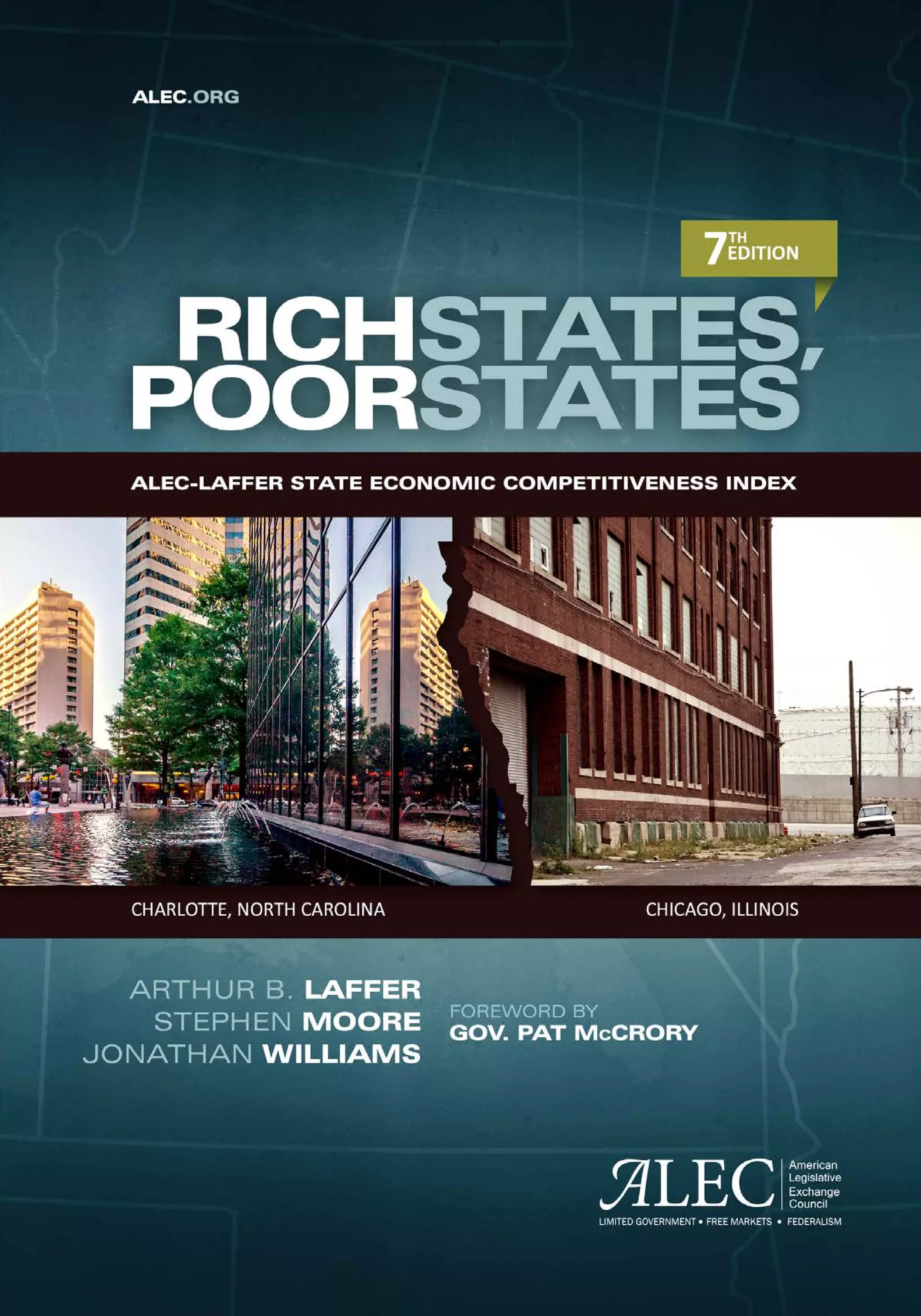




Rich States, Poor States 
ALEC-Laffer State Economic Competitiveness Index 
Arthur B. Laffer 
Stephen Moore 
Jonathan Williams
Rich States, Poor States 
ALEC-Laffer State Economic Competitiveness Index 
© 2014 American Legislative Exchange Council 
All rights reserved. Except as permitted under the United States Copyright Act of 1976, no part of this 
publication may be reproduced or distributed in any form or by any means, or stored in a database or 
retrieval system without the prior permission of the publisher. 
Published by 
American Legislative Exchange Council 
2900 Crystal Drive, Suite 600 
Arlington, VA 22202 
www.alec.org 
Dr. Arthur B. Laffer, Stephen Moore, 
and Jonathan Williams, Authors 
Designed by Joel Sorrell | www.Sorrelldp.com 
ISBN: 978-0-9853779-4-6 
Rich States, Poor States: ALEC-Laffer State Economic Competitiveness Index has been published by the 
American Legislative Exchange Council, America’s largest nonpartisan, voluntary membership organiza-tion 
of state legislators. Made up of nearly one-third of America’s state elected officials, the Council 
provides a unique opportunity for state lawmakers, business leaders and citizen organizations from 
around the country to share experiences and develop state-based, pro-growth models based on aca-demic 
research, existing state policy and proven business practices. 
The American Legislative Exchange Council is classified by the Internal Revenue Service as a 501(c)(3) 
nonprofit and public policy and educational organization. Individuals, philanthropic foundations, corpora-tions, 
companies, or associations are eligible to support the Council’s work through tax-deductible gifts. 
ii Rich States, Poor States
About the Authors 
Acknowledgements 
Foreword 
Executive Summary 
Preface: 10 Golden Rules of Effective Taxation 
CHAPTER 1. State of the States 
The Good, the Bad, and the Ugly: Notable Recent Tax Changes 
Traditionally Liberal Leaning States Adopt Sound Economic Reforms 
The States’ Continuing Pension Crises 
Other Fiscal Issues in the States 
Predictions for 2015 Tax Changes 
Conclusion 
CHAPTER 2. America on the Move 
Movin’ On Up 
North to South 
The Results are in: The Northeast’s Failed Tax and Spend Experiment 
Stories from the States: How is that Income Tax Working Out for You? 
The Shift in State Influence 
The Growth Hot Spots 
The Largest States: A Story of Growth and Decline 
Conclusion 
CHAPTER 3. Race to the Top 
The Wealth and Poverty of Nations 
Income Taxes and Right-to-Work Matter Most 
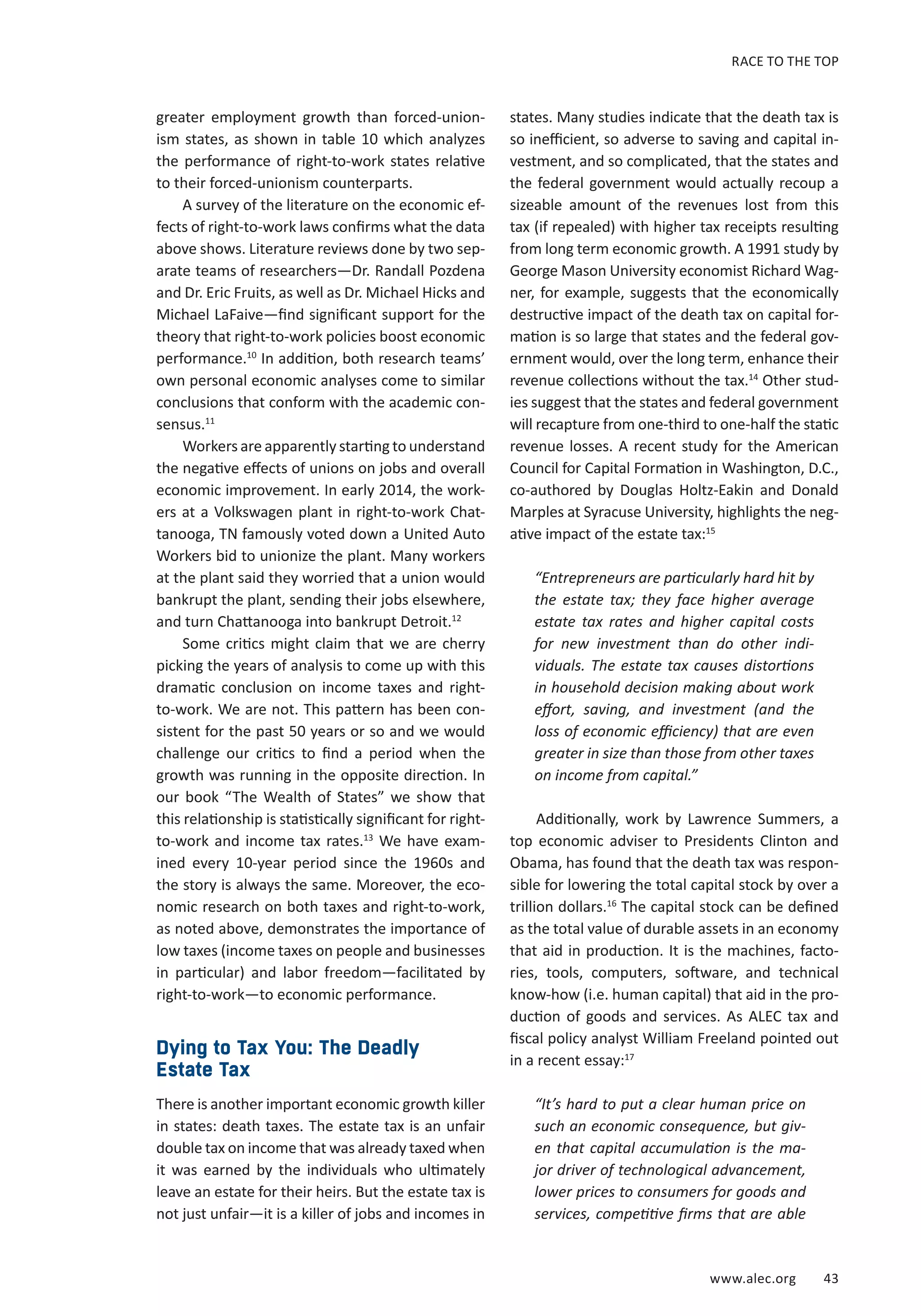
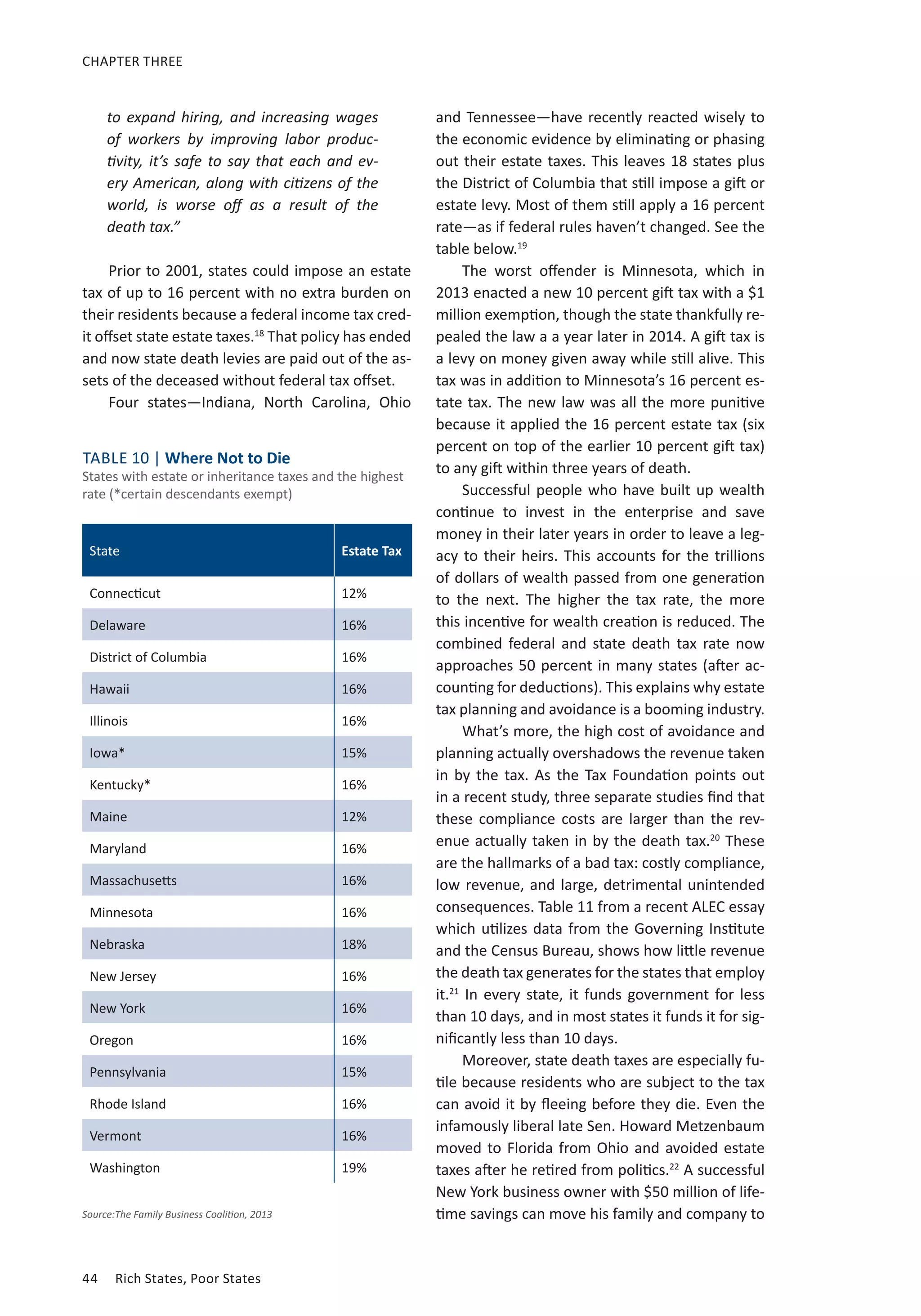
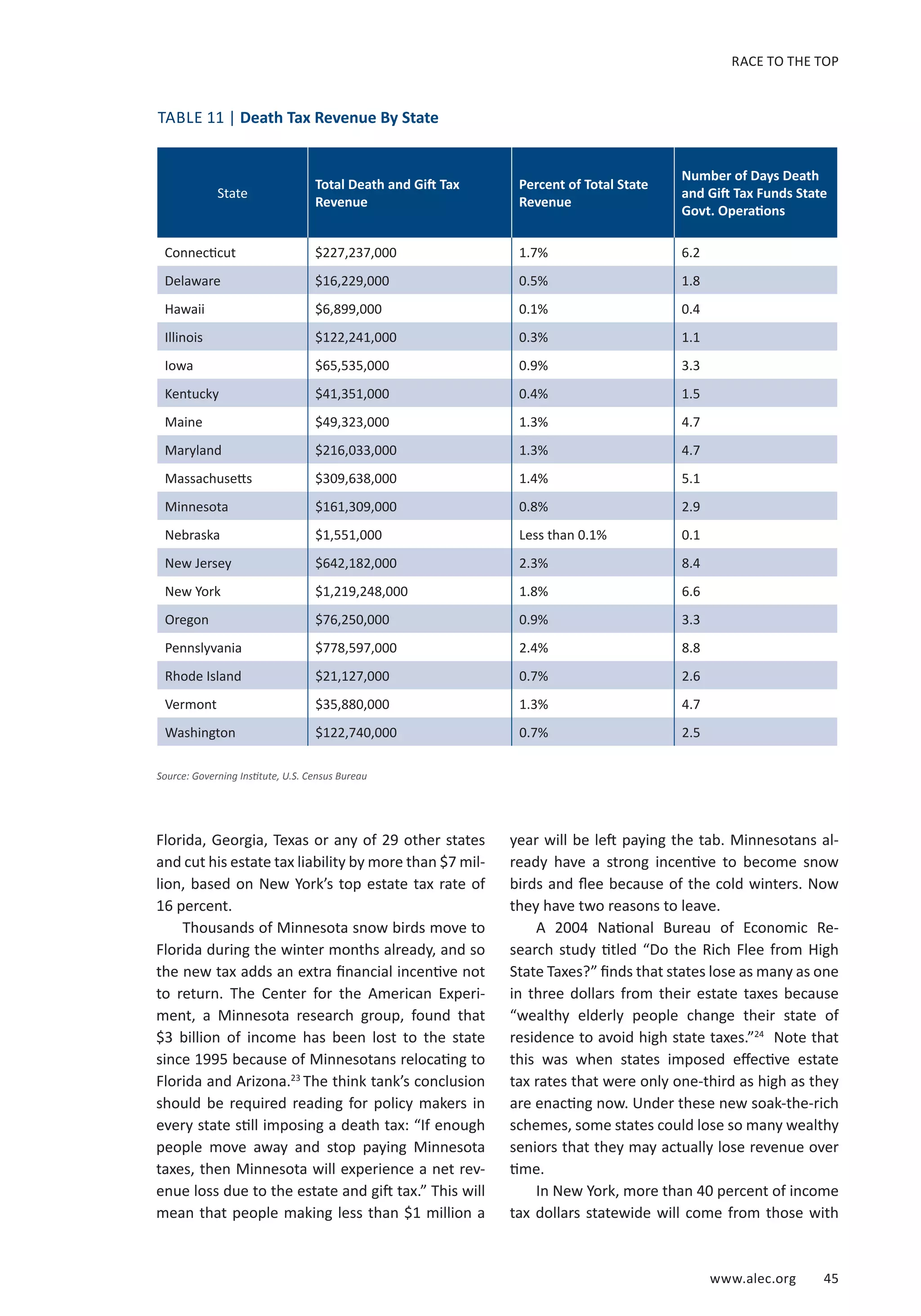
Dying to Tax You: The Deadly Estate Tax 
Beware the Class Warriors 
Minimum Wage Means Maximum Job Loss 
How the States Fare in International Competition 
Tax Cuts and Debt—Does More of One Lead to More of the Other? 
Does State Spending Lead to Better Results? 
What About Schools? 
Rich States, Poor States Matters 
Conclusion 
CHAPTER 4. State Rankings: 2014 ALEC-Laffer State Economic Competitiveness Index 
Appendix. Economic Outlook Methodology 
About the American Legislative Exchange Council 
iv 
v 
vi 
vii 
ix 
1 
2 
7 
9 
13 
16 
17 
21 
22 
24 
25 
27 
29 
30 
31 
32 
35 
37 
39 
43 
46 
51 
53 
57 
58 
60 
61 
62 
67 
120 
122 
Table of Contents 
www.alec.org i ii
About the Authors 
DR. ARTHUR B. LAFFER 
Arthur B. Laffer is the founder and chairman of Laffer Associates, an economic research and consulting 
firm, as well as Laffer Investments, an institutional investment firm. As a result of Laffer’s economic 
insight and influence in starting a worldwide tax-cutting movement during the 1980s, many publications 
have named him “The Father of Supply-Side Economics.” He is a founding member of the Congressional 
Policy Advisory Board, which assisted in forming legislation for the 105th, 106th, and 107th Congresses. 
Laffer served as a member of President Reagan’s Economic Policy Advisory Board for both terms. In 
March 1999, he was noted by Time Magazine as one of “the Century’s Greatest Minds” for his invention 
of the Laffer Curve, which has been called one of “a few of the advances that powered this extraordinary 
century.” He has received many awards for his economic research, including two Graham and Dodd 
Awards from the Financial Analyst Federation. He graduated from Yale with a Bachelor’s degree in 
economics in 1963 and received both his MBA and Ph.D. in economics from Stanford University. 
STEPHEN MOORE 
Stephen Moore, who formerly wrote on the economy and public policy for The Wall Street Journal, is 
chief economist at The Heritage Foundation. Moore, who also was a member of The Journal’s editorial 
board, returned to Heritage in January 2014—about 25 years after his tenure as the leading conservative 
think tank’s Grover M. Hermann Fellow in Budgetary Affairs from 1984 to 1987. Moore was previously 
the founder and president of the Club for Growth, which raises money for political candidates who 
favor free-market economic policies. Over the years, Moore has served as a senior economist at the 
Congressional Joint Economic Committee, and as a senior economics fellow at the Cato Institute, where 
he published dozens of studies on federal and state fiscal policy. He was also a consultant to the National 
Economic Commission in 1987 and research director for President Reagan’s Commission on Privatization. 
JONATHAN WILLIAMS 
Jonathan Williams is the senior task force director of tax and fiscal policy, as well as director of the 
Center for State Fiscal Reform at the American Legislative Exchange Council (ALEC), where he works with 
state policymakers, congressional leaders, and members of the private sector to develop fiscal policy 
solutions for the states. Prior to joining ALEC, Williams served as staff economist at the nonpartisan Tax 
Foundation, authoring numerous tax policy studies. Williams’s work has appeared in many publications 
including The Wall Street Journal, Forbes, and Investor’s Business Daily. He has been a contributing 
author to the Reason Foundation’s Annual Privatization Report and has written for the Ash Center 
for Democratic Governance and Innovation at Harvard’s Kennedy School of Government. In addition, 
Williams was a contributing author of “In Defense of Capitalism” (Northwood University Press). 
Williams has testified before numerous legislative bodies and spoken to audiences across America. He is 
frequent guest on talk radio shows and has appeared on numerous television outlets, including the PBS 
NewsHour with Jim Lehrer, Fox Business News, and Bloomberg News. Williams was also the recipient of 
the prestigious Ludwig von Mises Award in Economics. 
iv Rich States, Poor States
www.alec.org v 
Acknowledgements 
We wish to thank the following for making this publication possible: 
First, our sincere thanks go to the Searle Freedom Trust for their generous support of this research. 
Next, we thank Michael Bowman, Bill Meierling, Cara Sullivan, William Freeland, Theodore Lafferty, 
Kati Siconolfi, Ben Wilterdink, Jacob Gram, Jacob Kohlhepp, Steven Johnson, Damien Salamacha, Joel 
Griffith, Joel Sorrell, and the professional staff of the American Legislative Exchange Council for pub-lishing 
this in a timely manner. We also appreciate the research assistance of Ford Scudder, Nicholas 
Drinkwater, Ali Ansari, John Burke, and Feiran Hao. We hope these research findings will continue to 
be a good resource for America’s state legislators and members of the public interested in pro-growth 
tax reform.
ABOUT THE AUTHORS 
Foreword 
Dear ALEC Member, 
With Washington, D.C. switching back and forth between utter gridlock and attempting to negotiate fiscal 
crises at the last moment, it has become overwhelmingly clear that states must take the lead in ensuring 
that their economies continue to prosper. States have enormous power to jumpstart their economy or 
endure continual mediocrity. It is up to state leaders to deliver on the promise that hard work means 
more economic opportunities and a better future. North Carolina is a success story of what can happen 
when state leaders take this charge to heart. 
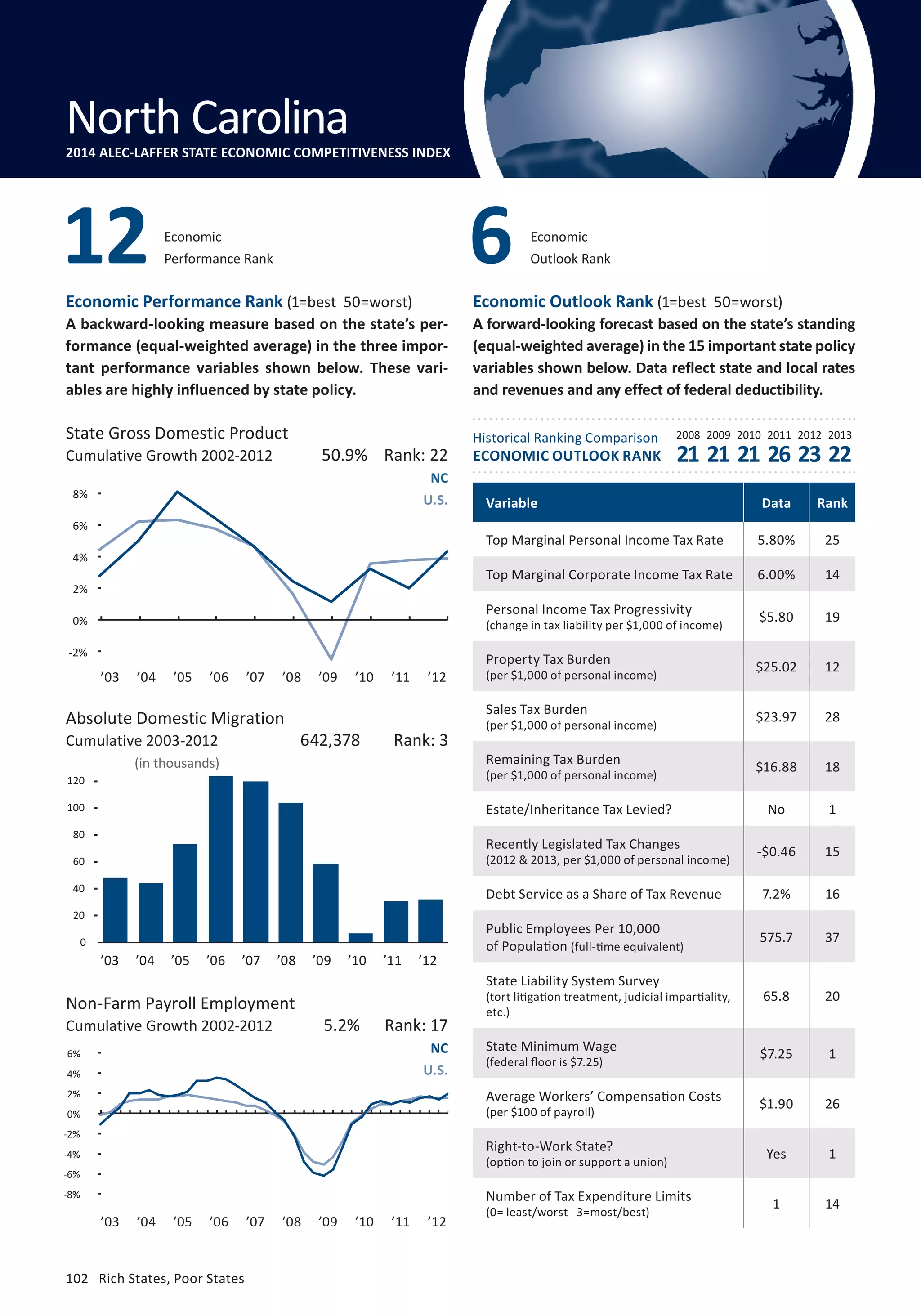
Last year, state lawmakers and I passed the most fundamental tax reform legislation that North 
Carolina has seen in decades. With the helpful lessons from Rich States, Poor States and other publications 
like it, North Carolina adopted tax and fiscal policies that have positioned us to maximize our potential for 
economic growth. The tax code itself was simplified, the playing field was leveled for all business to have 
an opportunity to compete equally, and most importantly, North Carolinians got to keep more of their 
own hard earned income to save and invest. These reforms propelled us from 22nd place in last year’s Rich 
States, Poor States report to 6th place this year. Creating a new and improved business climate will make 
it easier for people to start and grow business in our state and ensure that we are in a position to grow 
our economy to even greater heights. 
From 2002 to 2012, North Carolina has welcomed in a net of nearly 650,000 new citizens from other 
states, ranking third in the nation for net domestic migration over that period. That same time period 
has yielded more than a 50 percent increase in Gross State Product growth. Unemployment is decreasing 
and economic opportunity is on the rise. Financial services firms and other high growth economic sectors 
are flocking to North Carolina and out of states like New York and Illinois. Fostering a pro-growth tax 
and fiscal policy environment depends on principles like those championed by Dr. Art Laffer, Stephen 
Moore, and Jonathan Williams as the authors of Rich States, Poor States. North Carolina’s support of 
these principles made the major tax and fiscal policy reforms possible and continues to be a cornerstone 
of our ever-improving economic outlook. 
States must embrace the responsibility for creating an economic climate in which all citizens and 
businesses have the opportunity to prosper. That economic opportunity is attainable for all state leaders 
who will listen to the evidence and responsibly limit budgets and allow citizens and businesses an 
opportunity to keep their own income and rediscover their place as the drivers of the American economy. 
Residents, taxpayers, and incomes are all mobile between states, but fiscal discipline and common sense 
economic policies that put citizens in control are the key elements for achieving economic prosperity. 
Sincerely, 
Pat McCrory 
Governor of North Carolina 
vi Rich States, Poor States
EXECUTIVE SUMMARY 
www.alec.org v ii 
Executive Summary 
s the federal government continues 
to struggle to adopt policies that are 
conducive to economic growth, the 
states have made their own efforts to maximize 
economic growth and facilitate growing oppor-tunities, 
higher wages, and economic prosperity. 
But in their attempts to boost economic growth, 
states have diverged sharply on the best methods 
for achieving this great goal. Fortunately, deci-phering 
which economic policies help and hinder 
economic growth is no longer relegated to the 
realm of guesswork. Years of economic and statis-tical 
analyses of the different policies states adopt 
(or fail to adopt) provide clear insight into what 
works and what doesn’t. 
In this seventh edition of Rich States, Poor 
States, Arthur B. Laffer, Stephen Moore, and 
Jonathan Williams highlight specific policy choices 
throughout the 50 states that have led some states 
to economic prosperity and others to lackluster 
growth. The authors provide the 2014 ALEC-Laffer 
State Economic Competitiveness Index, based on 
the economic policies of the states. Through the 
empirical evidence and analysis contained in this 
edition of Rich States, Poor States, the policies for 
economic growth are clear. 
In chapter one, the authors provide updates 
on important policy developments that occurred 
throughout 2013 and the first half of 2014 in 
an in-depth, state-of-the-states analysis. Laffer, 
Moore, and Williams outline the highlights and 
lowlights in the states from major advances in 
pension reform, the best and worst changes in 
state tax policy, and new developments in labor 
policy. Readers should also look out for the hot-test 
prospects for future tax reform in Nebraska, 
Georgia, and Rhode Island in the potential pro-growth 
changes section. 
Chapter two chronicles the movement of 
both people and income throughout the states. 
The data on how many people and how much 
income has moved from one state to another is 
readily available, and the authors examine these 
trends and offer compelling explanations for why 
this is the case. Why are so many people leaving 
the Northeast? Of the largest states in the nation, 
which ones are flourishing and which ones are 
floundering? Armed with statistical trends and a 
wealth of economic evidence, the case studies 
examined in this chapter offer compelling insight 
on what kinds of policies successful states imple-ment 
and which ones they avoid. 
In chapter three, the authors provide a de-tailed 
explanation of not just which policies are 
conducive to economic growth and which ones 
are not, but also why this is the case. This chapter 
gives readers an economic primer on why poli-cies 
have the effects that they do, for better or 
for worse. The chapter includes a discussion of 
current academic literature and data to support 
the robust analysis offered. Economic theory and 
quantitative data meet to provide a fuller picture 
of state economic policy. The real world effects of 
minimum wage laws, death taxes, and higher tax 
burdens, are among the questions examined and 
answered in this chapter. 
Finally, chapter four is this year’s compre-hensive 
ALEC-Laffer State Economic Competi-tiveness 
Index. The index is comprised of two 
separate economic rankings. The first ranking is 
a measure of economic performance based on 
the three most effective metrics. Growth in gross 
state product (GSP), absolute domestic migration, 
and growth in non-farm payroll employment are 
calculated for each state over the past ten years 
with the most recent data available. Each of these 
metrics provides an economic insight into the ef-fects 
of a state’s tax and fiscal policy choices by 
A
EXECUTIVE SUMMARY 
showing what their effects have been over a ten 
year time period. 
The second ranking is of a state’s economic 
outlook moving forward. This forecast is based on 
a state’s current standing in 15 equally weighted 
policy areas that are influenced directly by state 
lawmakers. The 15 policy areas have proven over 
time to be among the most influential factors 
(that state lawmakers can control) in determining 
a state’s potential for economic growth. Gener-ally, 
states that spend less, especially on transfer 
payments, and states that tax less, particularly on 
productive activities such as work or investment, 
tend to experience higher rates of economic 
growth than states that tax and spend more. 
The following 15 policy variables are mea-sured 
in the 2014 ALEC-Laffer State Economic 
Competitiveness Index: 
• Highest Marginal Personal Income Tax Rate 
• Highest Marginal Corporate Income Tax Rate 
• Personal Income Tax Progressivity 
viii Rich States, Poor States 
• Property Tax Burden 
• Sales Tax Burden 
• Tax Burden from All Remaining Taxes 
• Estate/Inheritance Tax (Yes or No) 
• Recently Legislated Tax Policy Changes (Over 
past two years) 
• Debt Service as a Share of Tax Revenue 
• Public Employees per 1,000 Residents 
• Quality of State Legal System 
• Worker’s Compensation Costs 
• State Minimum Wage 
• Right-to-Work State (Yes or No) 
• Tax or Expenditure Limits 
This seventh edition of Rich States, Poor 
States contains invaluable insight into each of the 
50 “laboratories of democracy.” With solid empir-ical 
research and the latest data on state econo-mies, 
the evidence is clear on which state tax and 
fiscal policies directly lead to more opportunities, 
more jobs, and more prosperity for all.
10 Golden Rules of Effective Taxation 
www.alec.org i x 
When you tax something more you get 
less of it, and when you tax something 
less you get more of it. 
Tax policy is all about reward and punishment. 
Most politicians know instinctively that taxes 
reduce the activity being taxed—even if they do 
not care to admit it. Congress and state lawmak-ers 
routinely tax things that they consider “bad” 
to discourage the activity. We reduce, or in some 
cases entirely eliminate, taxes on behavior that 
we want to encourage, such as home buying, go-ing 
to college, giving money to charity, and so on. 
By lowering the tax rate in some cases to zero, we 
lower the after tax cost, in the hopes that this will 
lead more people to engage in a desirable activ-ity. 
It is wise to keep taxes on work, savings, and 
investment as low as possible in order not to de-ter 
people from participating in these activities. 
Individuals work and produce goods and 
services to earn money for present or fu-ture 
consumption. 
Workers save, but they do so for the purpose of 
conserving resources so they or their children can 
consume in the future. A corollary to this is that 
people do not work to pay taxes—although some 
politicians seem to think they do. 
Taxes create a wedge between the 
cost of working and the rewards from 
working. 
To state this in economic terms, the difference 
between the price paid by people who demand 
goods and services for consumption and the price 
received by people who provide these goods and 
4 
1 
2 
3 
services—the suppliers—is called the wedge. 
Income and other payroll taxes, as well as reg-ulations, 
restrictions, and government require-ments, 
separate the wages employers pay from 
the wages employees receive. If a worker pays 15 
percent of his income in payroll taxes, 25 percent 
in federal income taxes, and 5 percent in state 
income taxes, his $50,000 wage is reduced to 
roughly $27,500 after taxes. The lost $22,500 of 
income is the tax wedge, or approximately 45 per-cent. 
As large as the wedge seems in this exam-ple, 
it is just part of the total wedge. The wedge 
also includes excise, sales, and property taxes, 
plus an assortment of costs, such as the market 
value of the accountants and lawyers hired to 
maintain compliance with government regula-tions. 
As the wedge grows, the total cost to a firm 
of employing a person goes up, but the net pay-ment 
received by the person goes down. Thus, 
both the quantity of labor demanded and quan-tity 
supplied fall to a new, lower equilibrium level, 
and a lower level of economic activity ensues. This 
is why all taxes ultimately affect people’s incen-tive 
to work and invest, though some taxes clearly 
have a more detrimental effect than others. 
An increase in tax rates will not lead to 
a dollar-for-dollar increase in tax rev-enues, 
and a reduction in tax rates that 
encourages production will lead to less than a 
dollar-for-dollar reduction in tax revenues. 
Lower marginal tax rates reduce the tax wedge 
and lead to an expansion in the production base 
and improved resource allocation. Thus, while 
less tax revenue may be collected per unit of tax 
base, the tax base itself increases. This expansion 
of the tax base will, therefore, offset some (and in
some cases, all) of the loss in revenues because of 
the now lower rates. 
Tax rate changes also affect the amount of tax 
avoidance. It is important to note that legal tax 
avoidance is differentiated throughout this report 
from illegal tax evasion. The higher the marginal 
tax rate, the greater the incentive to reduce tax-able 
income. Tax avoidance takes many forms, 
from workers electing to take an improvement in 
nontaxable fringe benefits in lieu of higher gross 
wages to investment in tax shelter programs. 
Business decisions, too, are increasingly based on 
tax considerations as opposed to market efficien-cy. 
For example, the incentive to avoid a 40 per-cent 
tax, which takes $40 of every $100 earned, 
is twice as high as the incentive to avoid a 20 per-cent 
tax, for which a worker forfeits $20 of every 
$100 earned. 
An obvious way to avoid paying a tax is to 
eliminate market transactions upon which the 
tax is applied. This can be accomplished through 
vertical integration: Manufacturers can establish 
wholesale outlets; retailers can purchase goods 
directly from manufacturers; companies can ac-quire 
suppliers or distributors. The number of 
steps remains the same, but fewer and fewer 
steps involve market transactions and thereby 
avoid the tax. If states refrain from applying their 
sales taxes on business-to-business transactions, 
they will avoid the numerous economic distor-tions 
caused by tax cascading. Michigan, for ex-ample, 
should not tax the sale of rubber to a tire 
company, then tax the tire when it is sold to the 
auto company, then tax the sale of the car from 
the auto company to the dealer, then tax the 
dealer’s sale of the car to the final purchaser of 
the car, or the rubber and wheels are taxed multi-ple 
times. Additionally, the tax cost becomes em-bedded 
in the price of the product and remains 
hidden from the consumer. 
If tax rates become too high, they may 
lead to a reduction in tax receipts. The 
relationship between tax rates and tax 
5 
receipts has been described by the Laffer Curve. 
The Laffer Curve (illustrated on this page) summa-rizes 
this phenomenon. We start this curve with 
the undeniable fact that there are two tax rates 
that generate zero tax revenues: a zero tax rate 
and a 100 percent tax rate. (Remember Golden 
x Rich States, Poor States 
The Laffer Curve 
Source: Laffer Associates 
Tax Revenue 
PREFACE 
Rule #2: People don’t work for the privilege of 
paying taxes, so if all their earnings are taken in 
taxes, they do not work, or at least they do not 
earn income the government knows about. And, 
thus, the government receives no revenues.) 
Now, within what is referred to as the “nor-mal 
range,” an increase in tax rates will lead to 
an increase in tax revenues. At some point, how-ever, 
higher tax rates become counterproductive. 
Above this point, called the “prohibitive range,” an 
increase in tax rates leads to a reduction in tax rev-enues 
and vice versa. Over the entire range, with a 
tax rate reduction, the revenues collected per dol-lar 
of tax base falls. This is the arithmetic effect. 
But the number of units in the tax base expands. 
Lower tax rates lead to higher levels of personal 
income, employment, retail sales, investment, and 
general economic activity. This is the economic, or 
incentive, effect. Tax avoidance also declines. In 
the normal range, the arithmetic effect of a tax 
rate reduction dominates. In the prohibitive range, 
the economic effect is dominant. 
Of course, where a state’s tax rate lies along 
the Laffer Curve depends on many factors, includ-ing 
tax rates in neighboring jurisdictions. If a state 
with a high employment or payroll tax borders a 
state with large population centers along that bor-der, 
businesses will have an incentive to shift their 
operations from inside the jurisdiction of the high 
tax state to the jurisdiction of the low tax state. 
Economists have observed a clear Laffer Curve 
effect with respect to cigarette taxes. States with 
high tobacco taxes that are located next to states
www.alec.org x i 
with low tobacco taxes have very low retail sales 
of cigarettes relative to the low tax states. Illinois 
smokers buy many cartons of cigarettes when in 
Indiana, and the retail sales of cigarettes in the 
two states show this. 
6 The more mobile the factors being taxed, 
the larger the response to a change in 
tax rates. The less mobile the factor, the 
smaller the change in the tax base for a given 
7 
change in tax rates. 
Taxes on capital are almost impossible to enforce 
in the 21st century because capital is instantly 
transportable. For example, imagine the behavior 
of an entrepreneur or corporation that builds a 
factory at a time when profit taxes are low. Once 
the factory is built, the low rate is raised substan-tially 
without warning. The owners of the factory 
may feel cheated by the tax bait and switch, but 
they probably do not shut the factory down be-cause 
it still earns a positive after tax profit. The 
factory will remain in operation for a time even 
though the rate of return, after taxes, has fallen 
sharply. If the factory were to be shut down, the 
after tax return would be zero. After some time 
has passed, when equipment needs servicing, the 
lower rate of return will discourage further invest-ment, 
and the plant will eventually move where 
tax rates are lower. 
A study by the American Enterprise Institute 
has found that high corporate income taxes at the 
national level are associated with lower growth in 
wages. Again, it appears a chain reaction occurs 
when corporate taxes get too high. Capital moves 
out of the high tax area, but wages are a function 
of the ratio of capital to labor, so the reduction in 
capital decreases the wage rate. 
The distinction between initial impact and 
burden was perhaps best explained by one of our 
favorite 20th century economists, Nobel winner 
Friedrich A. Hayek, who makes the point as fol-lows 
in his classic, The Constitution of Liberty: 
The illusion that by some means of pro-gressive 
taxation the burden can be shift-ed 
substantially onto the shoulders of the 
wealthy has been the chief reason why 
taxation has increased as fast as it has 
done and that, under the influence of this 
illusion, the masses have come to accept a 
much heavier load than they would have 
done otherwise. The only major result of 
the policy has been the severe limitation 
of the incomes that could be earned by the 
most successful and thereby gratification 
of the envy of the less well off. 
Raising tax rates on one source of rev-enue 
may reduce the tax revenue from 
other sources, while reducing the tax 
rate on one activity may raise the taxes raised 
from other activities. 
For example, an increase in the tax rate on cor-porate 
profits would be expected to lead to a 
diminution in the amount of corporate activi-ty, 
and hence profits, within the taxing district. 
That alone implies less than a proportionate in-crease 
in corporate tax revenues. Such a reduc-tion 
in corporate activity also implies a reduction 
in employment and personal income. As a result, 
personal income tax revenues would fall. This de-cline, 
too, could offset the increase in corporate 
tax revenues. Conversely, a reduction in corpo-rate 
tax rates may lead to a less than expected 
loss in revenues and an increase in tax receipts 
from other sources. 
An economically efficient tax system has 
a sensible, broad tax base and a low tax 
rate. 
8 
Ideally, the tax system of a state, city, or country 
will distort economic activity only minimally. High 
tax rates alter economic behavior. President Ron-ald 
Reagan used to tell the story that he would 
stop making movies during his acting career once 
he was in the 90 percent tax bracket because the 
income he received was so low after taxes were 
taken away. If the tax base is broad, tax rates can 
be kept as low and non-confiscatory as possible. 
This is one reason we favor a flat tax with mini-mal 
deductions and loopholes. It is also why more 
than 25 nations have now adopted a flat tax. 
Income transfer (welfare) payments 
also create a de facto tax on work and, 
thus, have a high impact on the vitality 
of a state’s economy. 
PREFACE 
9
PREFACE 
Unemployment benefits, welfare payments, and 
subsidies all represent a redistribution of income. 
For every transfer recipient, there is an equivalent 
tax payment or future tax liability. Thus, income 
effects cancel. In many instances, these payments 
are given to people only in the absence of work 
or output. Examples include food stamps (income 
tests), Social Security benefits (retirement test), 
agricultural subsidies, and, of course, unem-ployment 
compensation itself. Thus, the wedge 
on work effort is growing at the same time that 
subsidies for not working are increasing. Transfer 
payments represent a tax on production and a 
subsidy to leisure. Their automatic increase in the 
event of a fall in market income leads to an even 
sharper drop in output. 
In some high benefit states, such as Hawaii, 
Massachusetts, and New York, the entire package 
of welfare payments can pay people the equiva-lent 
10 
of a $10 per hour job (and let us not forget: 
welfare benefits are not taxed, but wages and xii Rich States, Poor States 
salaries are). Because these benefits shrink as in-come 
levels from work climb, welfare can impose 
very high marginal tax rates (60 percent or more) 
on low-income Americans. And those disincen-tives 
to work have a deleterious effect. We found 
a high, statistically significant, negative relation-ship 
between the level of benefits in a state and 
the percentage reduction in caseloads. 
In sum, high welfare benefits magnify the tax 
wedge between effort and reward. As such, out-put 
is expected to fall as a consequence of making 
benefits from not working more generous. Thus, 
an increase in unemployment benefits is expect-ed 
to lead to a rise in unemployment. 
Finally, and most important of all for state leg-islators 
to remember: 
If A and B are two locations, and if 
taxes are raised in B and lowered 
in A, producers and manufacturers 
will have a greater incentive to move from B to A.
Raleigh, North Carolina CCHH1AAPPTTEERR 
State of the States
CHAPTER ONE 
State of the States 
S tates do not enact (or fail to enact) pol-icies 
in a vacuum. This has been one of 
the most important themes throughout 
the history of this publication. In today’s dynamic 
world of increasingly mobile capital, businesses, 
and people, states are in competition with one 
another to provide the best economic climate 
possible to foster economic growth. 
Although there are many factors contributing 
to a state’s economy which cannot be managed, 
tax and fiscal policy factors are solidly in the con-trol 
of the state’s policymakers. A state cannot 
vote for warmer weather, more oil reserves, or 
a nice coastline, but policymakers can make sure 
that there is more capital in the hands of busi-nesses 
and citizens, and can make it easier for 
them to save, earn, and invest. 
While some states have chosen to embrace 
these free market, pro-growth tax and fiscal pol-icies— 
and have realized the benefits—others 
have chosen to disregard the economic data and 
have continued down the path of increasing gov-ernment 
power and ever higher taxes. 
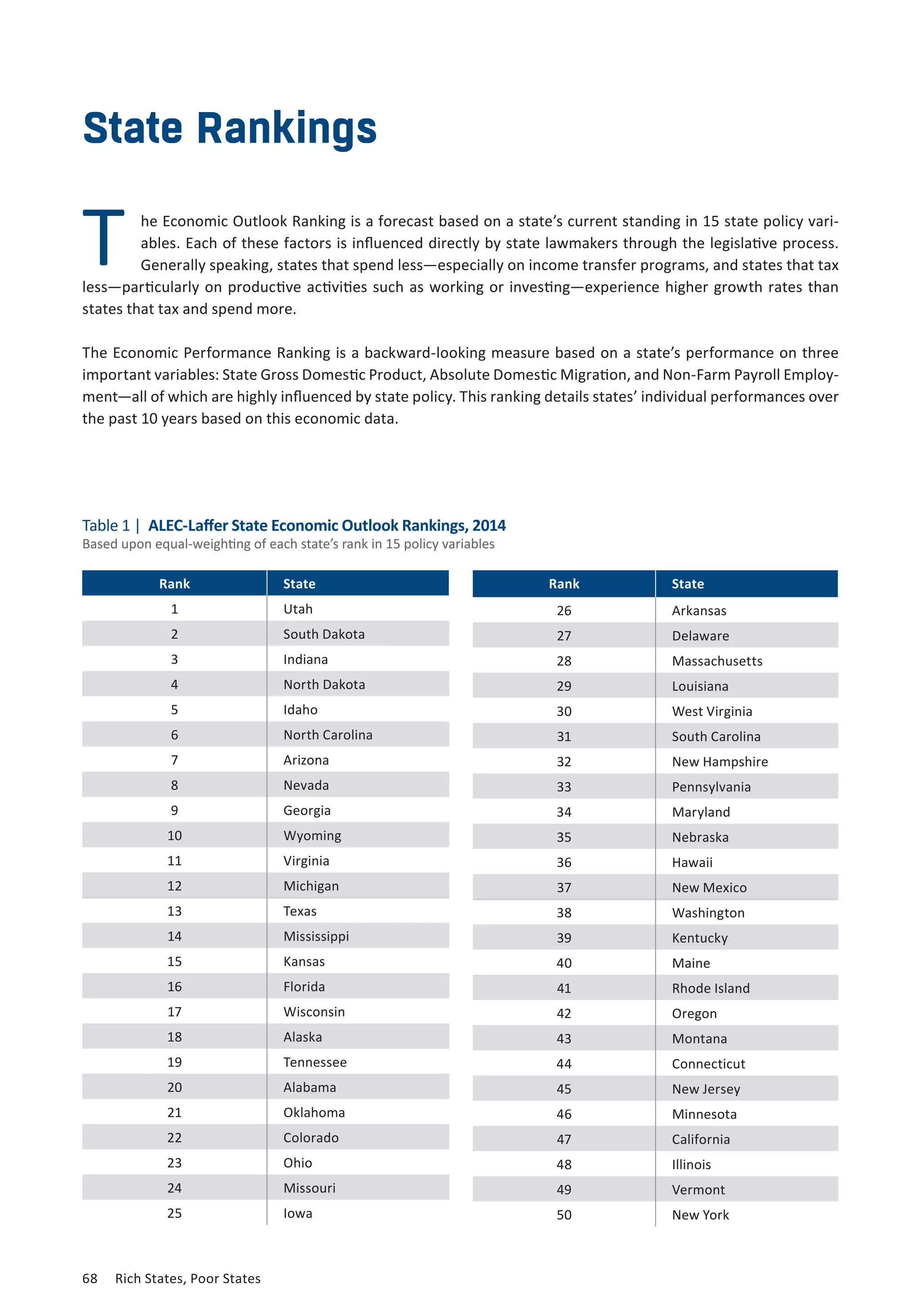
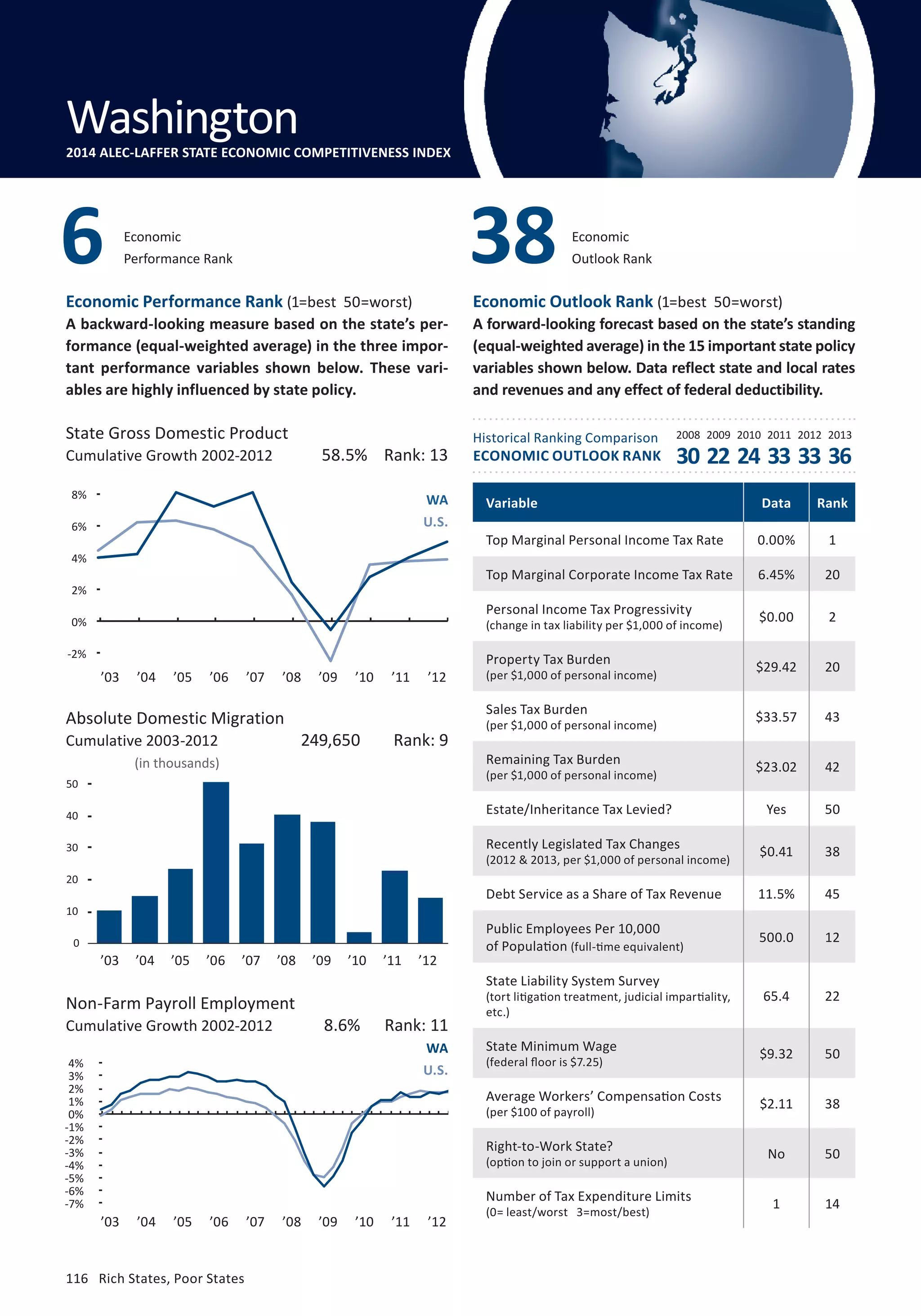
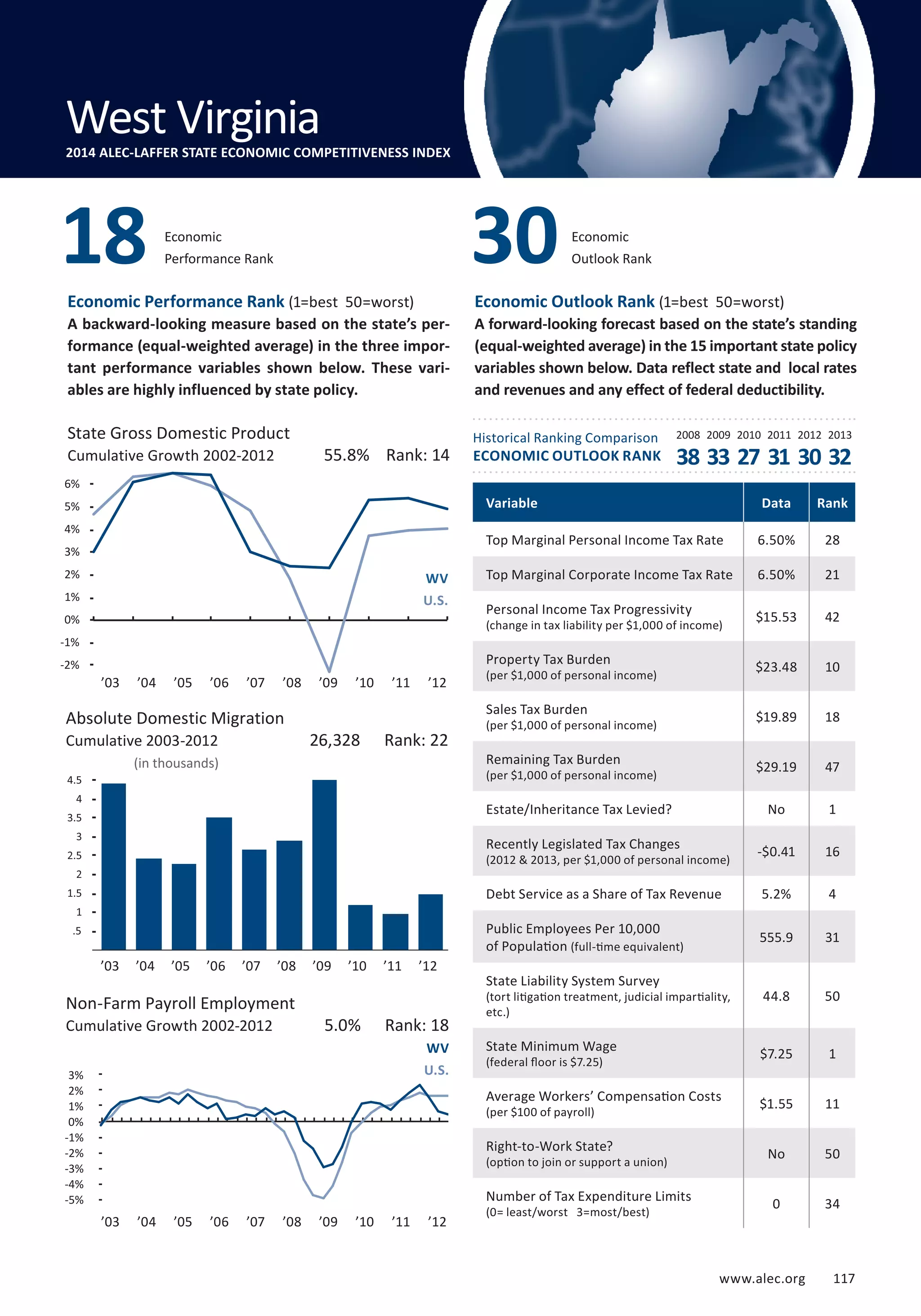
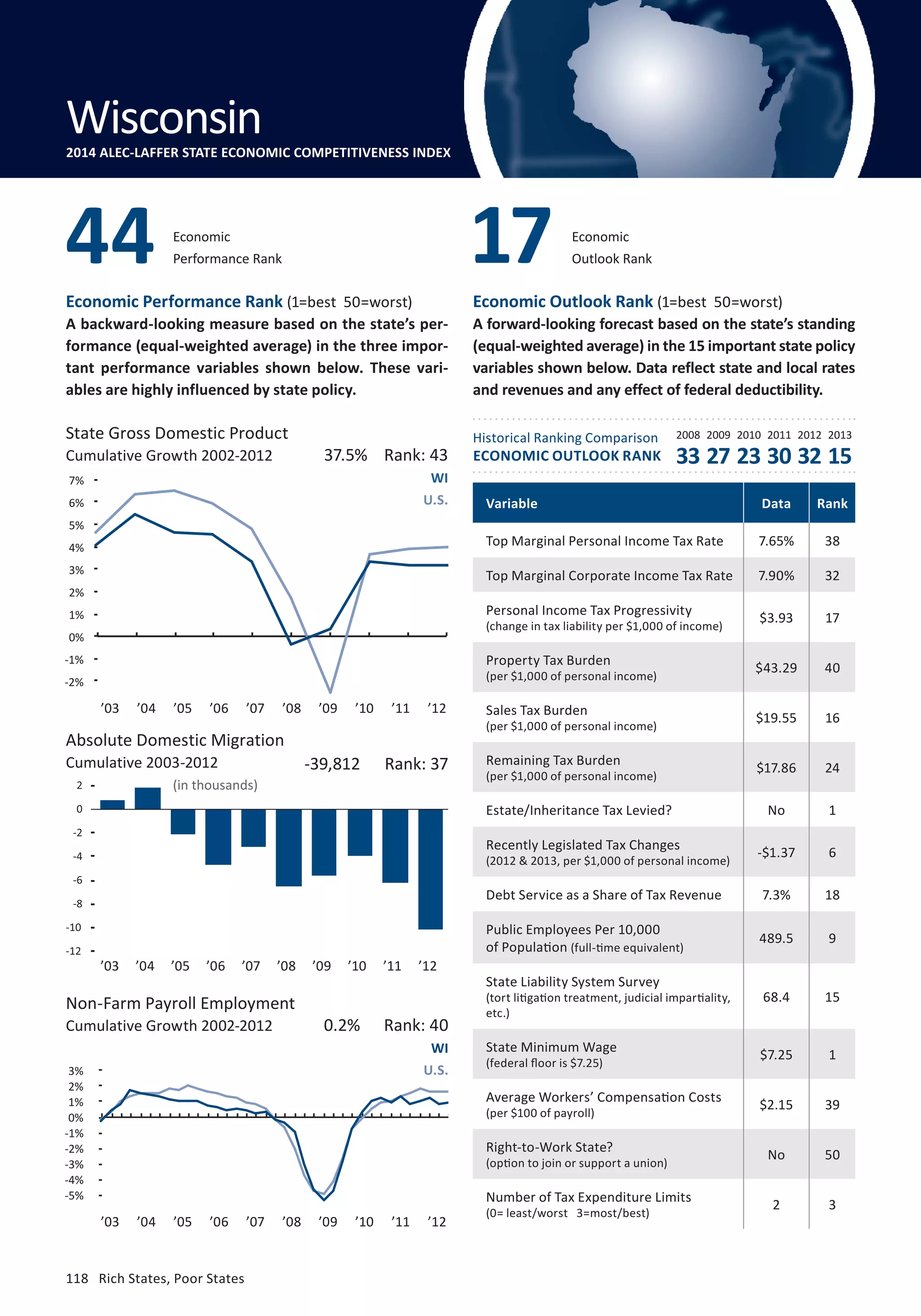
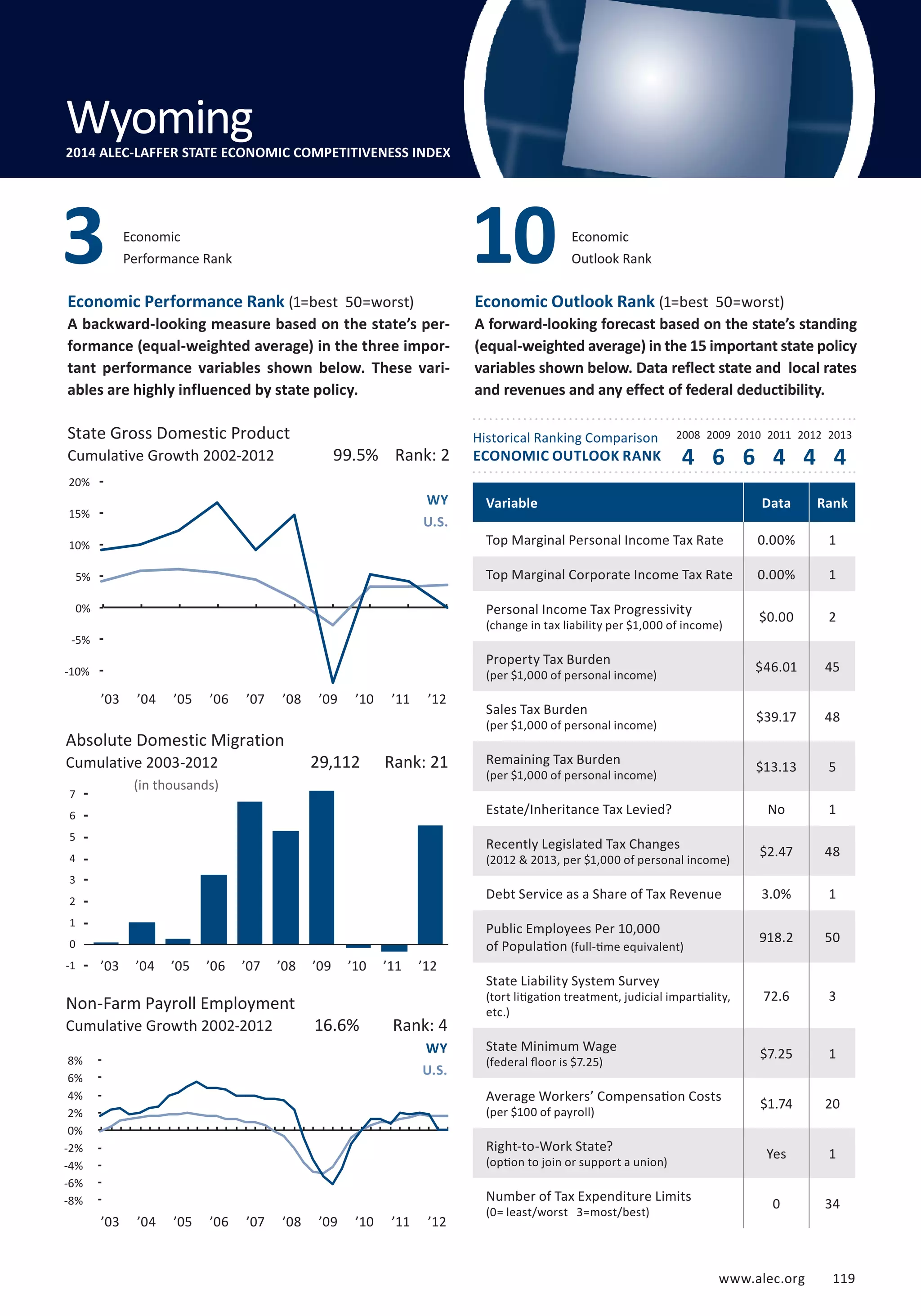
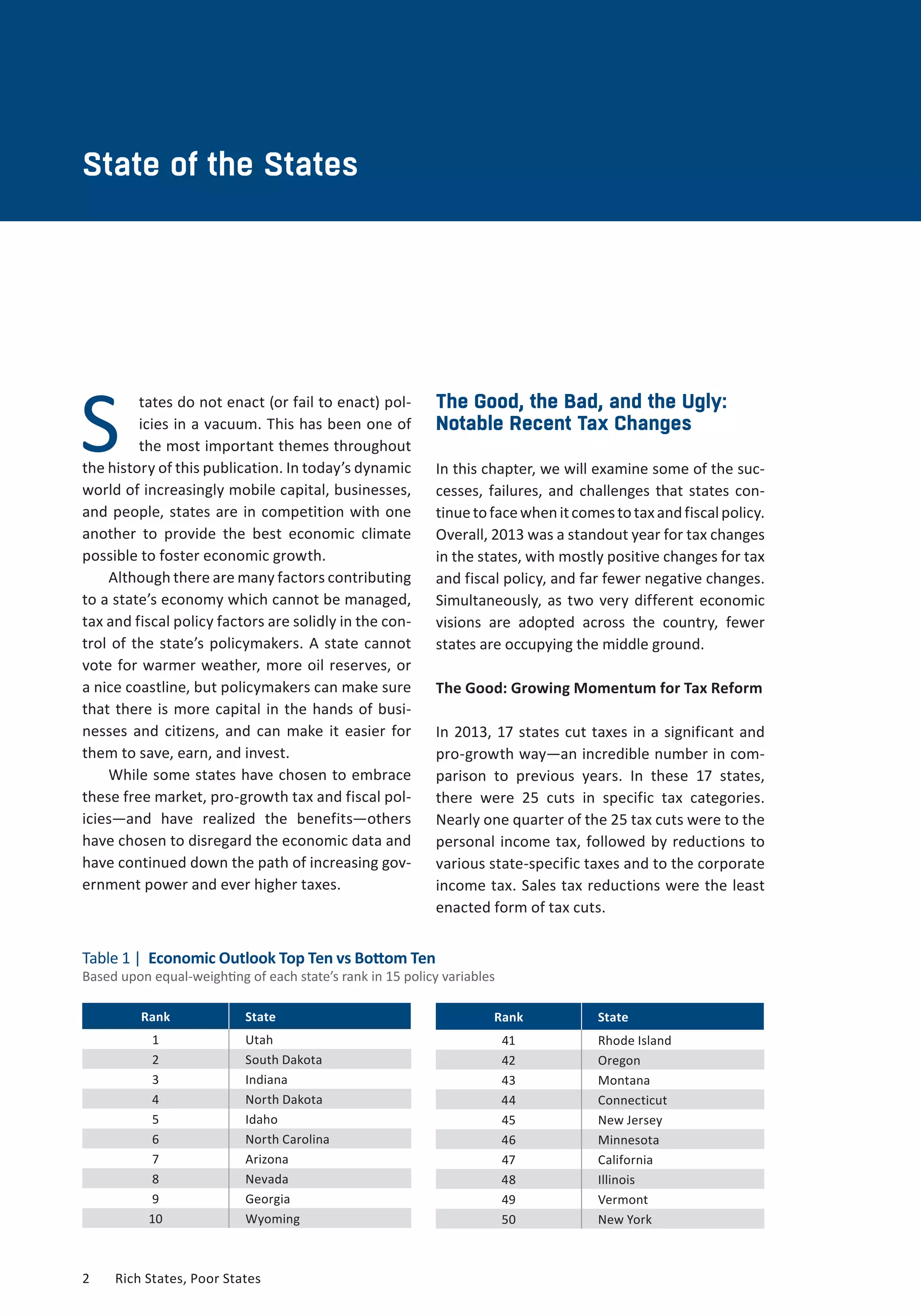
Table 1 | Economic Outlook Top Ten vs Bottom Ten 
Based upon equal-weighting of each state’s rank in 15 policy variables 
2 Rich States, Poor States 
The Good, the Bad, and the Ugly: 
Notable Recent Tax Changes 
In this chapter, we will examine some of the suc-cesses, 
failures, and challenges that states con-tinue 
to face when it comes to tax and fiscal policy. 
Overall, 2013 was a standout year for tax changes 
in the states, with mostly positive changes for tax 
and fiscal policy, and far fewer negative changes. 
Simultaneously, as two very different economic 
visions are adopted across the country, fewer 
states are occupying the middle ground. 
The Good: Growing Momentum for Tax Reform 
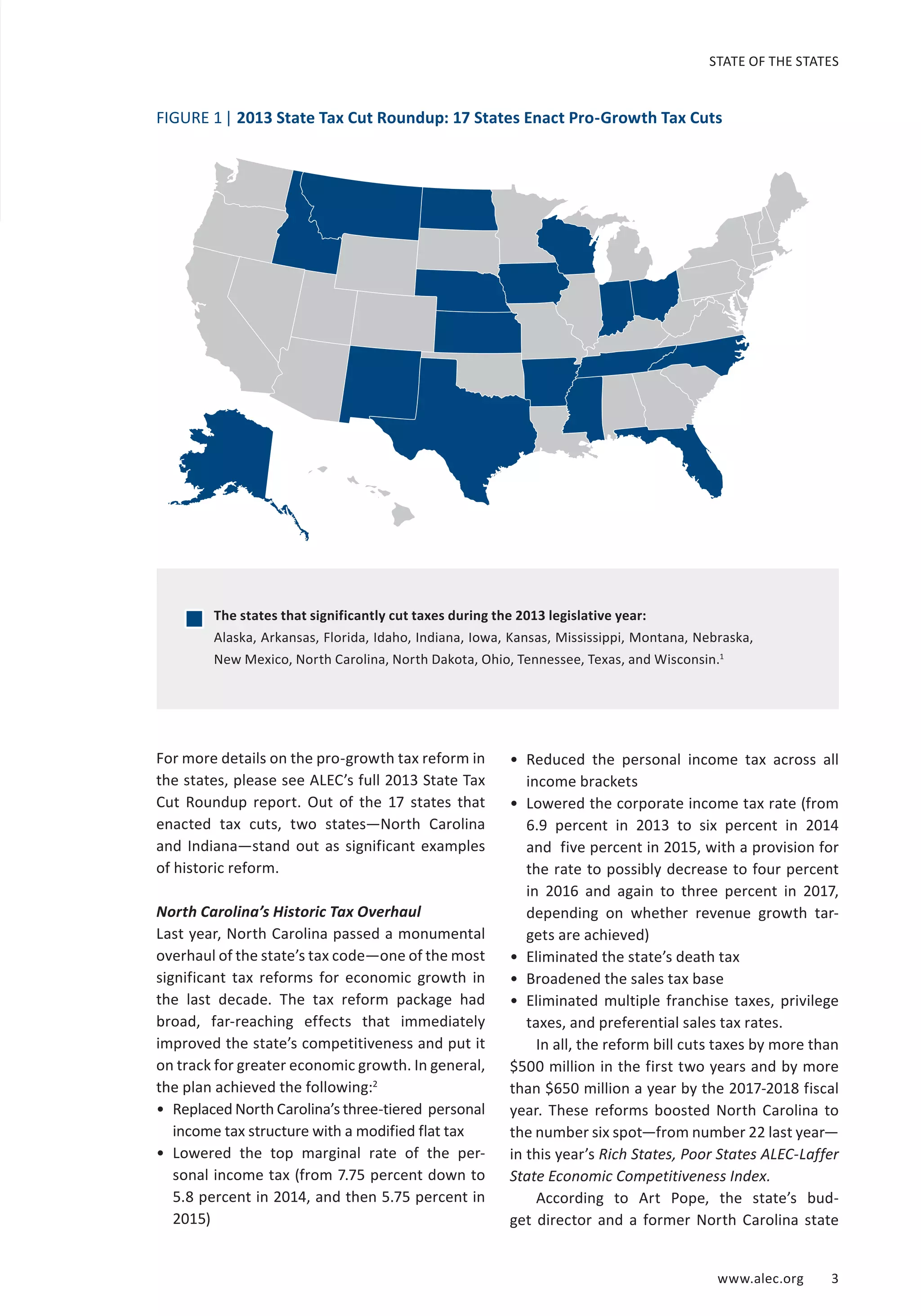
In 2013, 17 states cut taxes in a significant and 
pro-growth way—an incredible number in com-parison 
to previous years. In these 17 states, 
there were 25 cuts in specific tax categories. 
Nearly one quarter of the 25 tax cuts were to the 
personal income tax, followed by reductions to 
various state-specific taxes and to the corporate 
income tax. Sales tax reductions were the least 
enacted form of tax cuts. 
Rank State 
1 Utah 
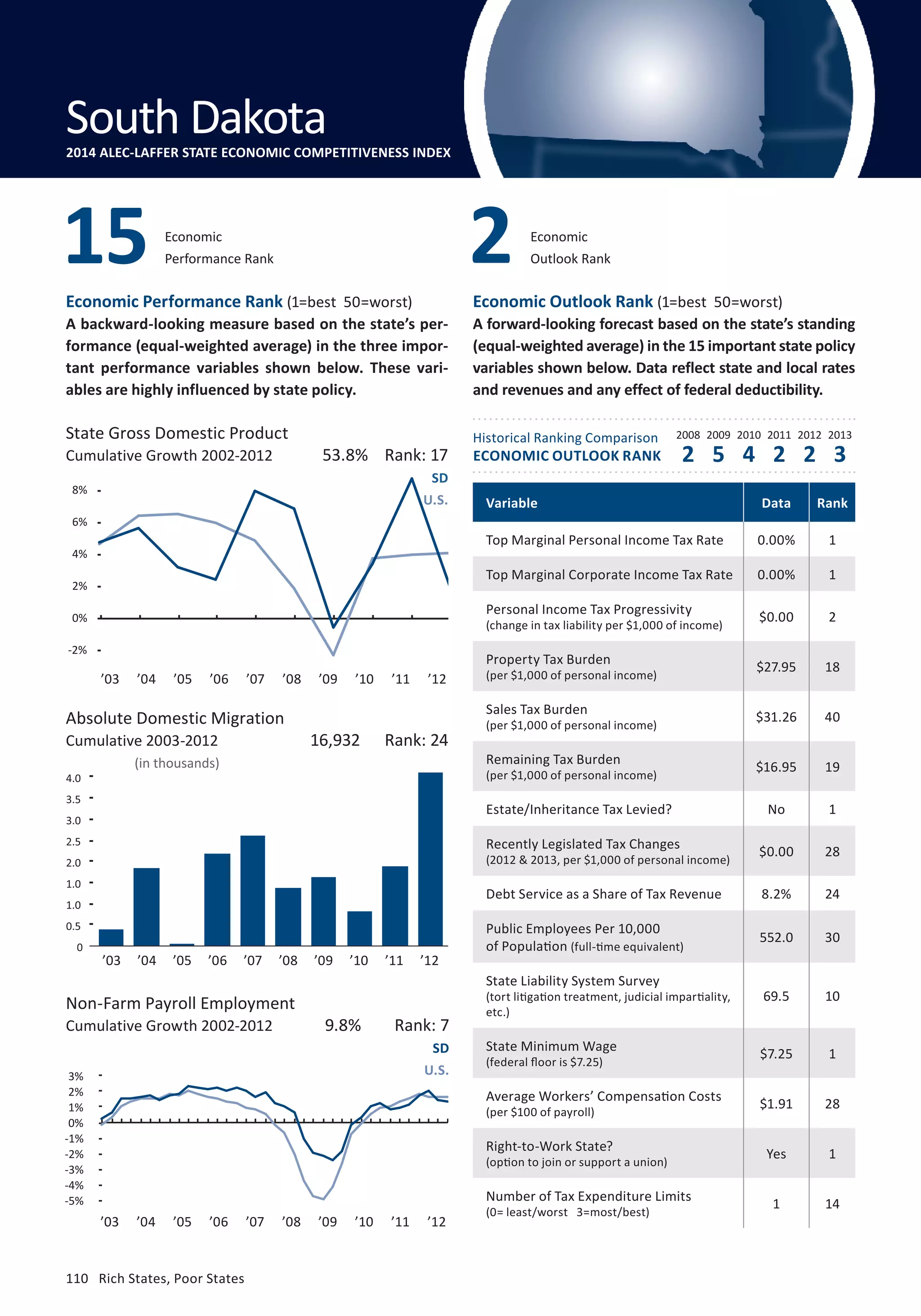
2 South Dakota 
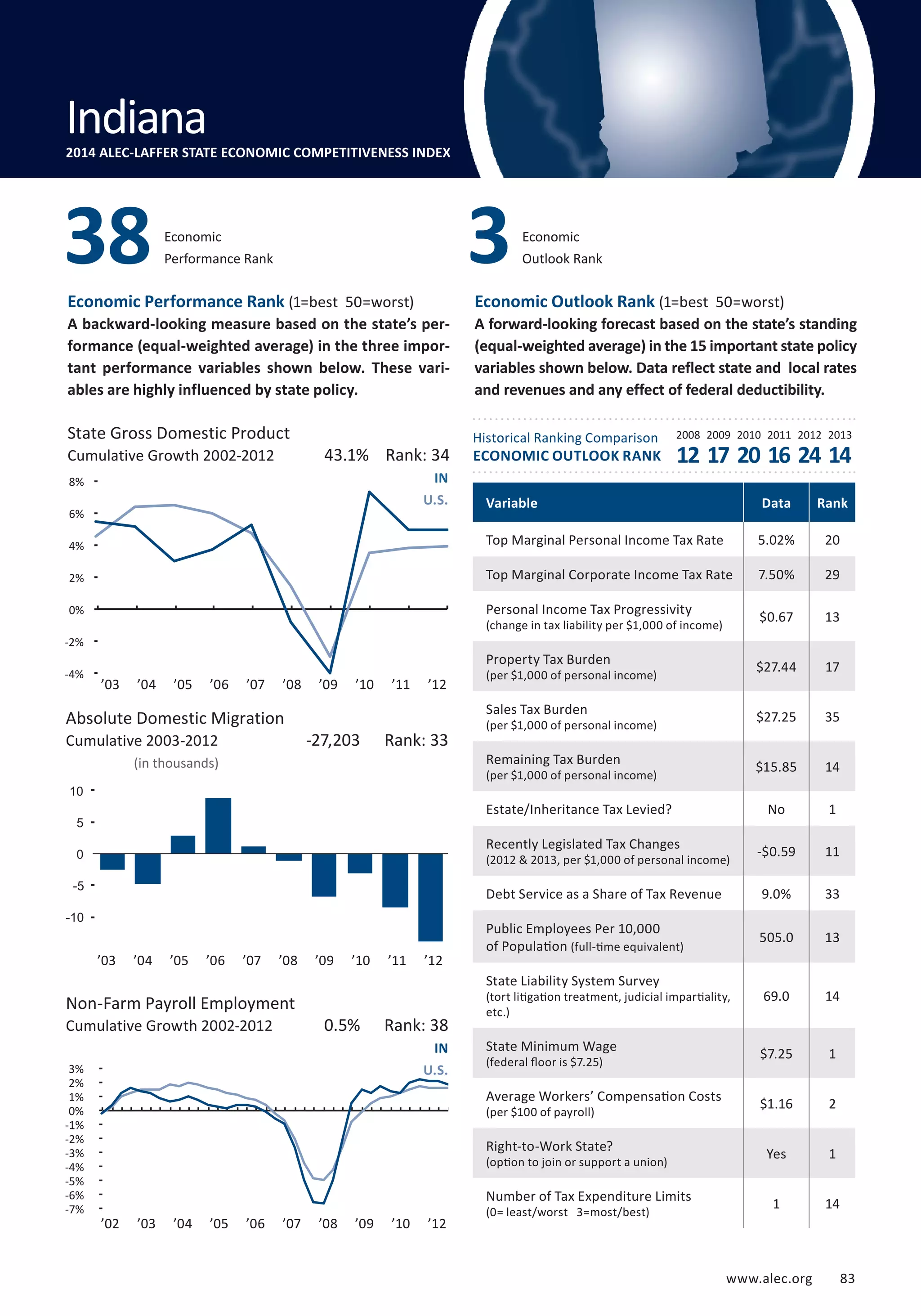
3 Indiana 
4 North Dakota 
5 Idaho 
6 North Carolina 
7 Arizona 
8 Nevada 
9 Georgia 
10 Wyoming 
Rank State 
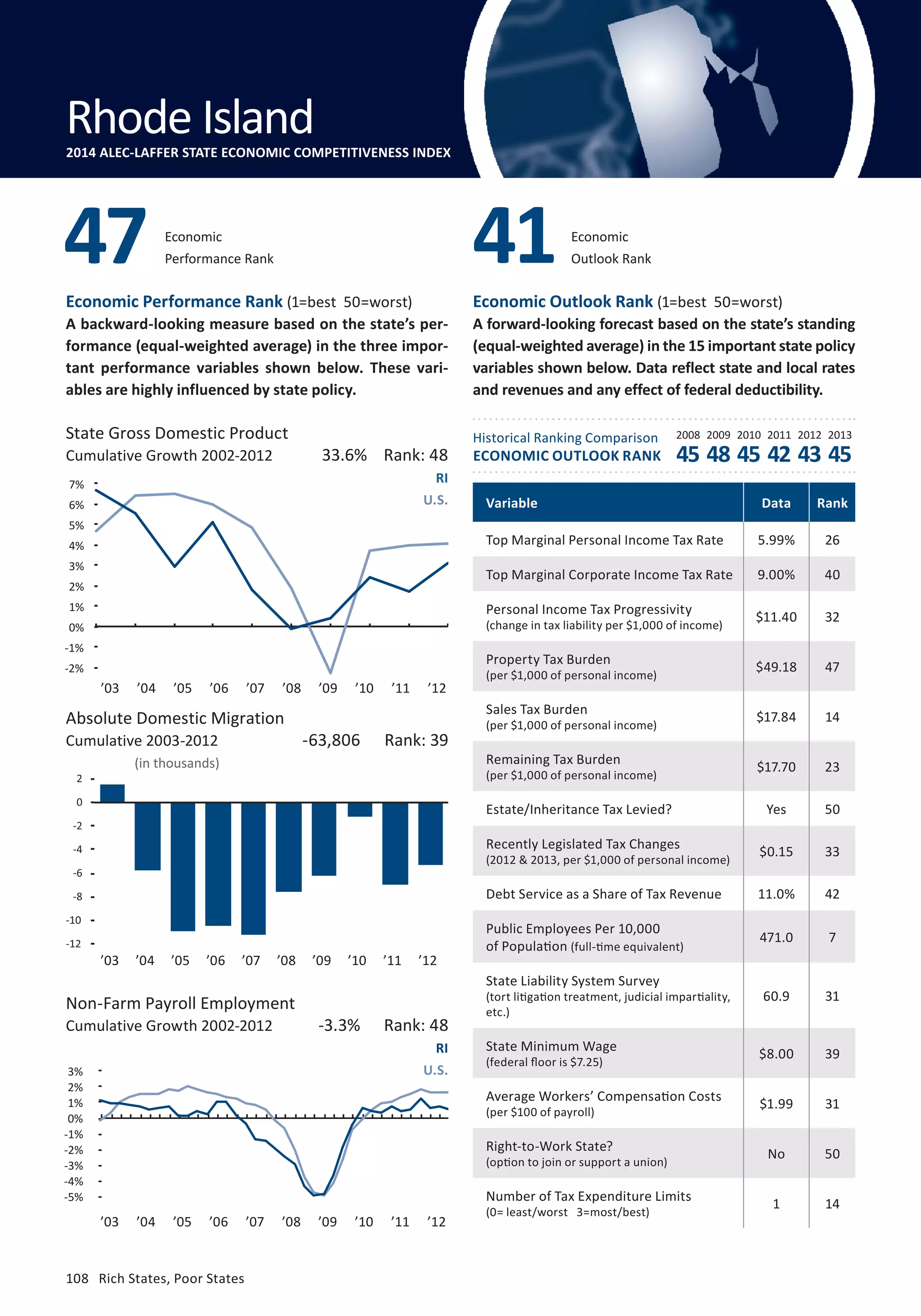
41 Rhode Island 
42 Oregon 
43 Montana 
44 Connecticut 
45 New Jersey 
46 Minnesota 
47 California 
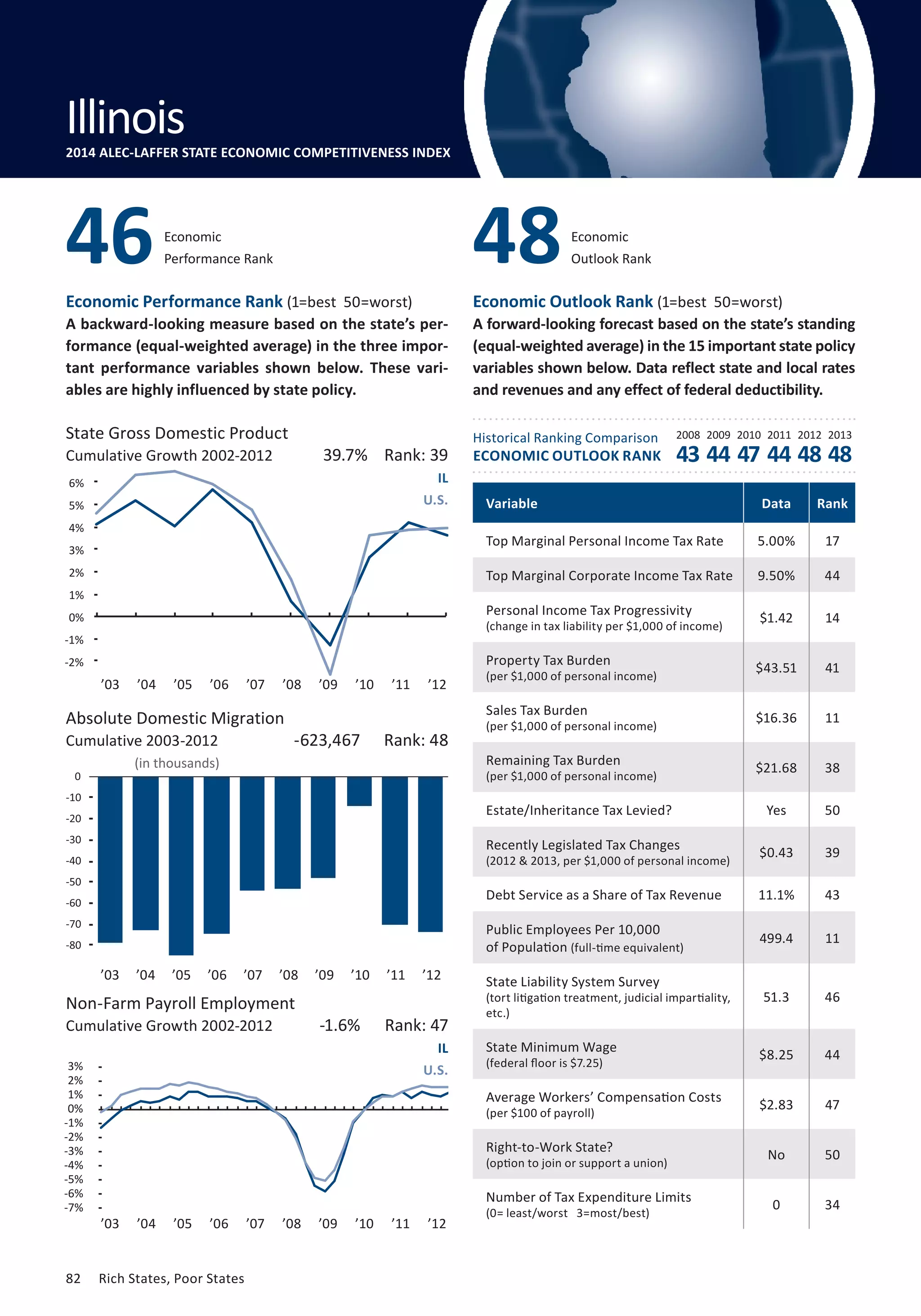
48 Illinois 
49 Vermont 
50 New York
STATE OF THE STATES 
FIGURE 1 | 2013 State Tax Cut Roundup: 17 States Enact Pro-Growth Tax Cuts 
The states that significantly cut taxes during the 2013 legislative year: 
Alaska, Arkansas, Florida, Idaho, Indiana, Iowa, Kansas, Mississippi, Montana, Nebraska, 
New Mexico, North Carolina, North Dakota, Ohio, Tennessee, Texas, and Wisconsin.1 
www.alec.org 3 
For more details on the pro-growth tax reform in 
the states, please see ALEC’s full 2013 State Tax 
Cut Roundup report. Out of the 17 states that 
enacted tax cuts, two states—North Carolina 
and Indiana—stand out as significant examples 
of historic reform. 
North Carolina’s Historic Tax Overhaul 
Last year, North Carolina passed a monumental 
overhaul of the state’s tax code—one of the most 
significant tax reforms for economic growth in 
the last decade. The tax reform package had 
broad, far-reaching effects that immediately 
improved the state’s competitiveness and put it 
on track for greater economic growth. In general, 
the plan achieved the following:2 
• Replaced North Carolina’s three-tiered personal 
income tax structure with a modified flat tax 
• Lowered the top marginal rate of the per-sonal 
income tax (from 7.75 percent down to 
5.8 percent in 2014, and then 5.75 percent in 
2015) 
• Reduced the personal income tax across all 
income brackets 
• Lowered the corporate income tax rate (from 
6.9 percent in 2013 to six percent in 2014 
and five percent in 2015, with a provision for 
the rate to possibly decrease to four percent 
in 2016 and again to three percent in 2017, 
depending on whether revenue growth tar-gets 
are achieved) 
• Eliminated the state’s death tax 
• Broadened the sales tax base 
• Eliminated multiple franchise taxes, privilege 
taxes, and preferential sales tax rates. 
In all, the reform bill cuts taxes by more than 
$500 million in the first two years and by more 
than $650 million a year by the 2017-2018 fiscal 
year. These reforms boosted North Carolina to 
the number six spot—from number 22 last year— 
in this year’s Rich States, Poor States ALEC-Laffer 
State Economic Competitiveness Index. 
According to Art Pope, the state’s bud-get 
director and a former North Carolina state
CHAPTER ONE 
representative, North Carolina’s tax code “is now 
simpler, more uniform, and fairer for everyone.” 
He notes that “nearly every North Carolinian is 
keeping more of the money earned, which is fun-damental 
to building a stronger economy.”3 
Certainly, as the reforms have time to mature 
and other pieces of this comprehensive overhaul 
are phased in, North Carolina is positioned to be 
among the nation’s top economic performers. 
Indiana is Open for Business 
Another success story in the area of pro-growth 
tax reform comes from the Hoosier State. Indi-ana 
has taken significant steps to build a more 
pro-growth economic climate in the past few 
years, and 2013 was no exception. Lawmakers in 
Indiana came together to pass a significant tax 
cut package that will spur more business invest-ment 
and help grow their economy. The plan 
includes a reduction of the state income tax to be 
phased in over four years, ultimately reducing it 
to 3.23 percent from its current 3.4 percent. The 
plan also continues phasing in corporate income 
tax cuts passed in the previous legislative ses-sion 
and fully eliminates the state’s economically 
damaging death tax. With the resulting competi-tive 
tax code and the right-to-work law, the mes-sage 
is clear: Indiana is open for business.4 
Missouri enacts broad based tax cuts for the 
first time in nearly 100 years 
Missouri’s pro-growth reform efforts deserve an 
honorable mention. Although a tax cut package 
was passed by the legislature in the 2013 legisla-tive 
session, Gov. Jay Nixon vetoed the bill, which 
the legislature was unable to overcome, and 
instead called a special session to pass a tax cut 
package for one specific company, Boeing, in an 
effort to entice them to move into the state. That 
special tax package passed, but it failed to lure 
Boeing into the non-right-to-work state.5 
However, legislators in Missouri didn’t give 
up on broad based tax reform. Earlier this year, 
a similar tax cut package was again passed by 
the Missouri legislature, and this time the gov-ernor’s 
veto was overridden. The new Missouri 
tax cuts are the state’s first broad based tax cuts 
to be enacted in almost 100 years. The package 
includes cutting the personal income tax rate 
from its current 6 percent down to 5.5 percent 
gradually over several years, and phasing in a 25 
4 Rich States, Poor States 
percent deduction for business income that is 
taxed through the personal income tax code. The 
total value of the tax cuts is estimated to be $620 
million dollars—an amount that will now remain 
in the pockets of Missouri citizens and businesses. 
Although this is great news for citizens and 
businesses in Missouri, and is certainly a signif-icant 
step in the right direction for tax policy, 
the tax cut package comes with some impor-tant 
caveats. First, the tax cuts do not begin until 
2017 and will not be fully phased in until 2022 
(if revenue estimates are met). Second, the state 
must collect $150 million of revenue above the 
highest level in the preceding three years for the 
next year’s scheduled incremental tax cut to take 
effect. 
Even with these restraints, the Missouri tax 
cuts represent an acknowledgment that the 
status quo is unacceptable when it comes to 
the state’s tax code. Missouri lawmakers have 
taken the first step in helping the state realize its 
potential for economic growth.6 
In addition, there is the prospect for more 
pro-growth policies with a renewed effort to 
pass right-to-work legislation. Despite the gover-nor’s 
stern objections, there seems to be grow-ing 
interest in giving Missouri employees the 
right to choose whether or not they would like to 
belong to a union. The effort is gaining momen-tum 
in Missouri and passing the legislation would 
not only make Missouri a viable location for com-panies 
to relocate, but it would improve eco-nomic 
and competitive conditions for existing 
companies.7 
Ohio Cuts Taxes in New Budget 
In mid-June of 2014, Ohio passed pro-growth tax 
reform as part of a mid-biennium budget update. 
The bill accelerated scheduled income tax cuts to 
10 percent (previously they were scheduled for 
a 9 percent reduction), increased the personal 
deduction for lower and middle income Ohioans, 
and increased the small business tax credit to 75 
percent.8 
The small business tax cut moves Ohio closer 
to the reforms of Kansas, which allows for the 
deduction of all non-wage small business income 
filed by so-called “pass-through entities” in the 
personal income tax code. Businesses can deduct 
75 percent of their first $250,000 of business 
income, up from a previous figure of 50 percent.
STATE OF THE STATES 
www.alec.org 5 
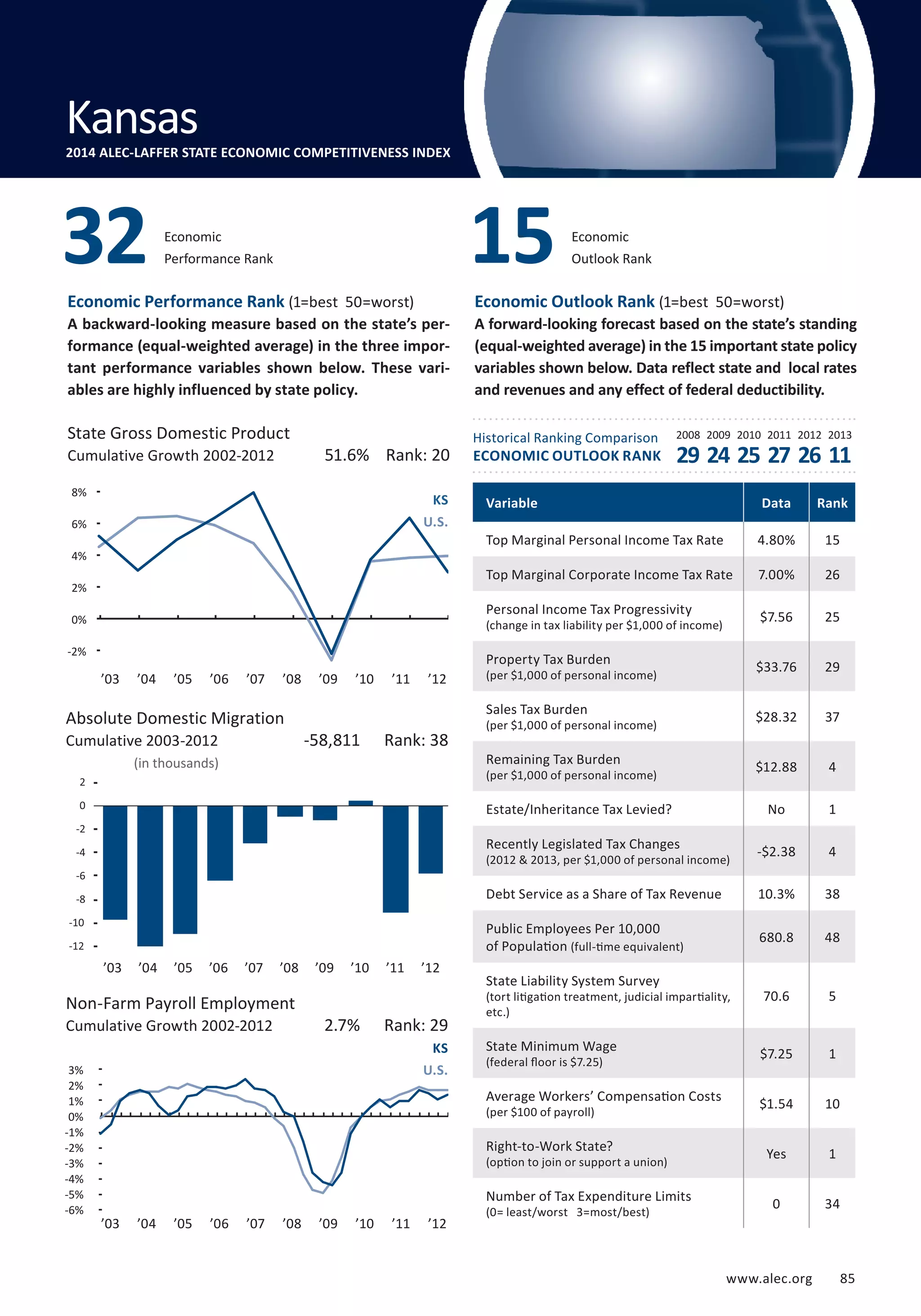
Kansas’ Tax Cutting Streak Continues 
Not to be outdone by neighboring Missouri, Kan-sas 
passed another tax cut package this past ses-sion. 
While the tax cut wasn’t a high profile rate 
reduction, the legislature did vote to phase out 
a little known mortgage registration fee—the 
result of which is expected to save home buy-ers 
in Kansas millions of dollars. By reducing and 
eliminating this fee, it will be easier for Kansas 
residents to purchase homes and allow them to 
keep more of their own money.9 
Commenting on the hidden nature of the 
mortgage registration fee, Sen. Jeff Melcher 
said, “It’s just an unfair tax and it’s a hidden tax. 
Nobody realizes that they’re paying it, it’s just 
another hidden way for them to get into taxpay-ers’ 
pockets without them even knowing it.” He 
went on to note that if counties believe that this 
revenue is necessary and important to main-tain, 
then they should raise taxes that voters are 
aware of, such as property taxes, so that they can 
be held properly accountable.10 
Colorado Voters Reject Tax Hikes, Choose Growth 
Taxpayers in Colorado chose jobs, economic 
opportunity, and growth in 2013 by saying 
“thanks, but no thanks” to Amendment 66. A bal-lot 
measure, Amendment 66, would have elimi-nated 
Colorado’s flat rate income tax of 4.63 per-cent 
in favor of a new tiered income tax system 
that would tax income below $75,000 at 5 per-cent 
and income above that amount at 5.9 per-cent. 
The result would have been nearly $1 billion 
in new taxes on all Coloradans—both high and 
low income earners. 
Despite an influx of out of state money to 
support the initiative, it was eventually defeated 
by Colorado voters by a 30 point margin.11 
Illinois Narrowly Avoids the Economically 
Devastating Graduated Income Tax 
A flat rate income tax is guaranteed by the state 
constitution in Illinois. This year, Illinois Sen. Don 
Harmon almost won an effort to put a constitu-tional 
amendment on the ballot that would ask 
voters to amend the constitution so that the Illi-nois 
legislature could implement a graduated 
income tax in lieu of the flat tax rate. The pro-posal 
came at a time when the state’s temporary 
income tax hike (three percent to five percent) 
was set to partially expire, meaning the rate 
would fall to 3.75 percent if nothing changed. 
Sen. Harmon’s effort was stalled in the Illi-nois 
House when the proposal could not muster 
the votes to pass. Summarizing the voice of the 
opposition, Democrat Rep. Jack Franks, said, “I 
just don’t think it’s very fair, what’s fair is allowing 
the temporary tax increase to expire...as we were 
promised. It’s not a fair tax. It’s a tax increase.”12 
Although proponents of the measure claim 
that this is only a temporary setback, any plans 
to implement a graduated income tax in Illinois 
will have to be delayed until at least 2015. 
The Bad: Failed Tax Reform Measures 
Oklahoma’s Tax Reform Setback 
It is worth noting that Oklahoma lawmakers also 
passed a tax cut package. It was, however, even-tually 
struck down by Oklahoma’s State Supreme 
Court because it contained a provision that 
authorized spending to renovate the state Cap-itol 
building. Oklahoma, like many other states, 
has a single subject rule, which means that bills 
can only deal with one subject at a time. Unfortu-nately, 
the tax cut package violated this rule and 
will not be enacted.13 
Despite the setback, Oklahoma lawmakers 
are currently debating a few different tax cut 
proposals, and Gov. Mary Fallin has indicated 
that she is open to considering pro-growth tax 
reforms in the future. 
Nebraska’s Small Reforms 
Nebraska is another state that seemed poised 
to significantly reform its tax code. While the 
effort did not yield the results that many experts 
and lawmakers expected, the state did form a 
commission to study tax reform options. 
The state also passed a series of small but 
important tax cuts this legislative session. 
Nebraska eliminated the Alternative Minimum 
Tax (AMT), allowed business losses to be carried 
over 20 years rather than five, allowed contribu-tions 
to a college savings plan to be tax deduct-ible, 
and expanded a capital gains tax exclu-sion 
for companies that establish a program for 
employee stock options. These small reforms, 
coupled with the tax reform commission, posi-tions 
Nebraska as a state to watch in the coming 
years, as it could enact some major pro-growth 
tax changes.14
CHAPTER ONE 
Michigan’s “Temporary” Income Tax Hike 
Despite recent gains in the state of Michigan 
including repealing the Michigan Business Tax—a 
tax partially based upon business gross receipts 
widely opposed by economists—and phasing out 
the business personal property tax on business 
capital, tax reformers were ultimately defeated 
in the most recent legislative session as they 
strived to lower the state’s income tax rate. The 
rate was temporarily increased in October 2007 
from 3.9 percent to 4.35 percent. That rate was 
scheduled to gradually sunset back down to 3.9 
percent at a rate of 0.1 percentage point a year 
beginning in 2009, but the rate reduction was 
suspended. Tax reformers attempted to use the 
state’s budget surplus to bring rates back down 
to 3.9 percent but were unsuccessful. 
Tennessee Unable to Repeal Hall Investment Tax 
Tennessee is generally hailed as a state with a pro-growth 
tax policy, notably in its restraint from 
taxing the wage income of its citizens. Despite 
this, the state does have one major shortcoming: 
the Hall Tax on investment income. The tax is lev-ied 
on “unearned” investment income. Despite 
the deceptive title of “unearned,” it indeed does 
take risk and sound stewardship of capital dollars 
in order to “earn” an investment return. More-over, 
capital investment is crucial to innovation, 
business expansion, wage growth, and secure 
retirement for seniors. The tax is an impediment 
to each of these desired outcomes. 
While the Hall Tax brings in very little reve-nue, 
15 hopeful reformers were ultimately unable 
to get all Republicans to sign on to the proposal 
to eliminate it—due to concerns over budget 
shortfalls—and it subsequently died during the 
legislative session. 
The Ugly: State Setbacks for Economic Growth 
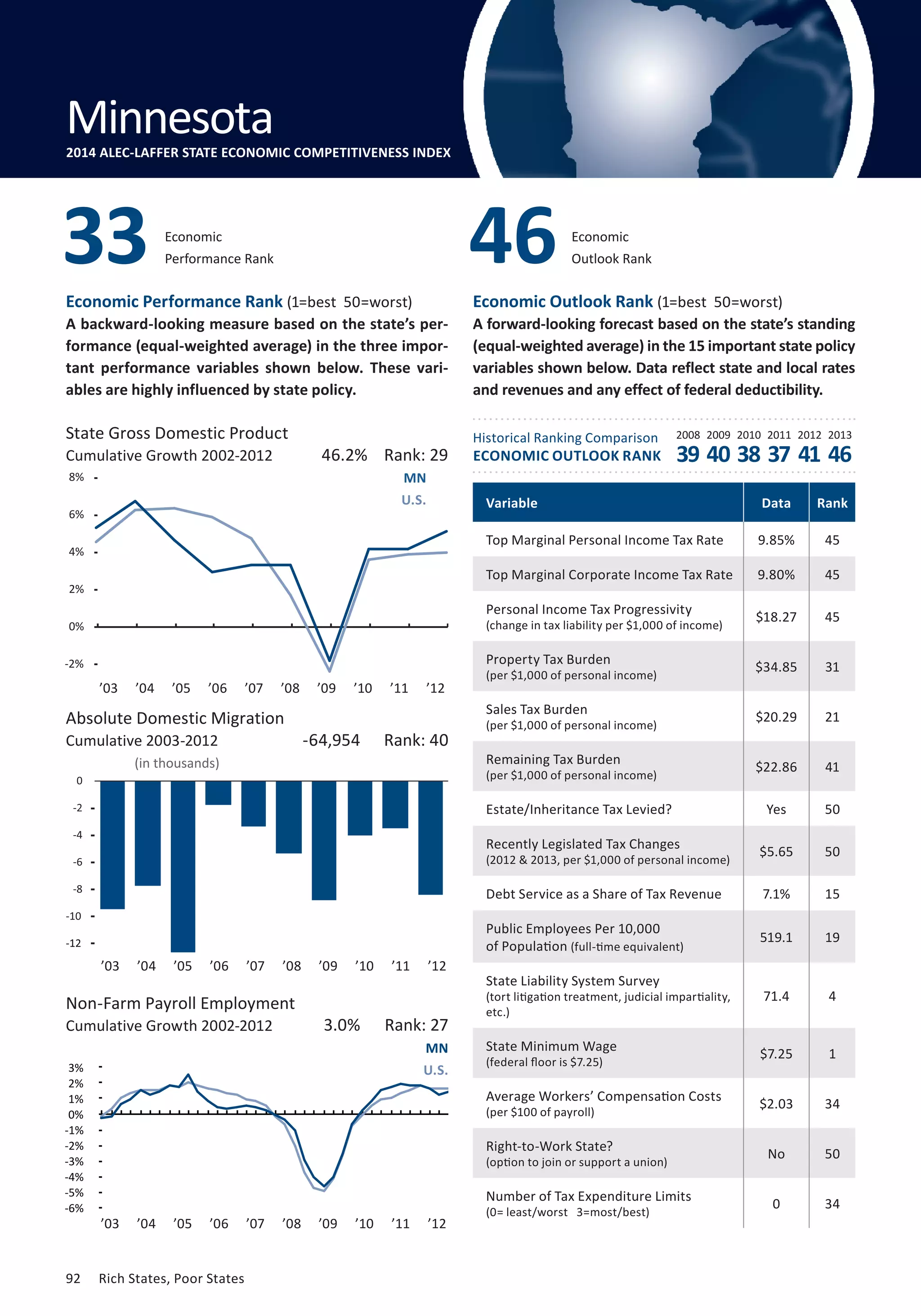
Minnesota’s $2 Billion Tax Hike 
Over the last two years, Minnesota has sent con-flicting 
signals on pro-growth policies. By rais-ing 
taxes on cigarettes and also increasing the 
state’s income tax rate to 9.85 percent on earn-ers 
who make over $150,000 ($250,000 for mar-ried 
couples), lawmakers effectively passed a $2 
billion tax hike during the 2013 legislative ses-sion. 
T he i ncome t ax h ike e quates t o a 2 p er-centage 
point increase over previous rates, and 
6 Rich States, Poor States 
now makes Minnesota the state with the fourth 
highest income taxes in the country.16 Additional 
tax increases as part of the $2 billion included 
instituting a gift tax and taxing various business 
inputs, such as storage and telecommunications 
equipment. 
Despite the major tax increases of 2013, pol-icymakers 
changed course during the 2014 legis-lative 
session and included a bill that is projected 
to reduce taxes in Minnesota by an estimated 
$443 million. This includes a sales tax exemption 
for business to business transactions, a repeal of 
the 2013 gift tax, and an increased exemption 
for the state’s estate tax (the exemption will be 
phased in to $2 million from $1 million over the 
next five years). The tax cut bill also included sev-eral 
other smaller provisions that will decrease 
what Minnesotans have to pay.17 
While the result of the two sessions is a net 
tax hike, the key takeaway is that many taxes that 
were created or increased in 2013 were immedi-ately 
repealed in 2014. 
Virginia’s Controversial Transportation Funding 
Package 
Virginia made national headlines last year when 
it enacted a controversial transportation fund-ing 
package. The tax increase came in the form 
of a revenue positive tax swap for transportation 
funding. The gas tax of 17.5 cents per gallon was 
eliminated and there was a new tax added to the 
wholesale purchase of fuel (3.5 percent on gaso-line 
and 6 percent on diesel). In addition to this 
swap, sales taxes were increased to fund more 
transportation spending. This includes a state-wide 
sales tax increase and region-specific tax 
increases.18 
Specifically, the statewide Virginia sales tax 
was increased from 5 percent to 5.3 percent. As 
part of the region-specific taxes, taxpayers in 
Northern Virginia and Hampton Roads will see 
an increase in sales tax from 5 percent to 6 per-cent. 
Unfortunately, the increased sales tax will 
be paid by drivers and non-drivers alike, which 
shifts costs away from those who “consume” 
the bulk of transportation spending and onto 
those who do not use the roads as much. Addi-tionally, 
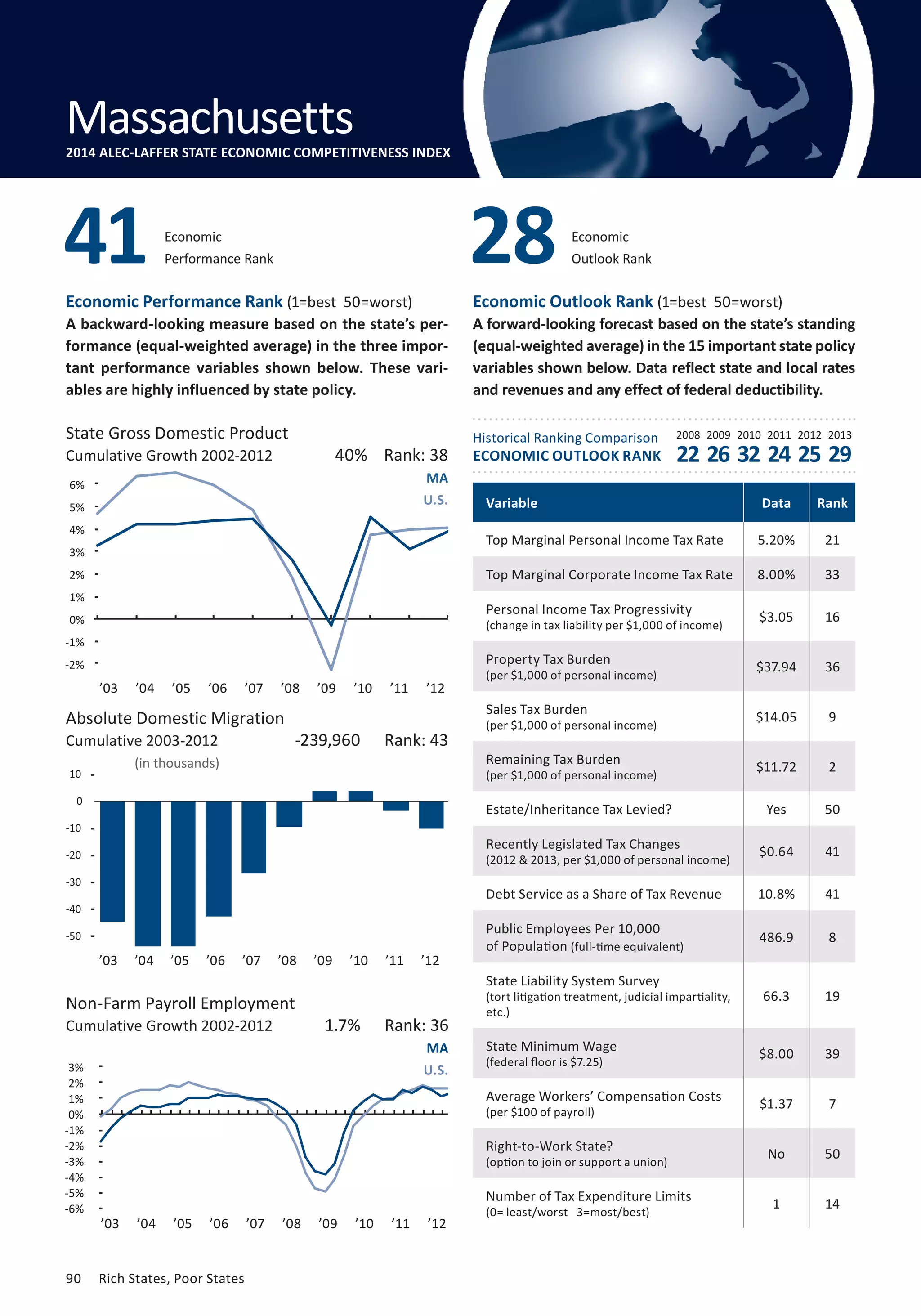
some of the increased revenue will go 
to fund the silver line Metro Rail extension to 
Dulles Airport, increasing costs for those who 
may or may not use the new silver line. Overall,
STATE OF THE STATES 
www.alec.org 7 
the estimated tax hike on Virginians amounts to 
about $5.9 billion.19 
Traditionally Liberal Leaning States 
Adopt Sound Economic Reforms 
In spite of the economic evidence that shows 
lower taxes and a more free economy is far more 
conducive to economic growth, there are still 
some stubborn states that seemingly refuse to 
acknowledge the facts. As Herb Stein famously 
said, if something can’t go on forever, it won’t. 
During the last legislative session, we witnessed 
a growing number of states shift on tax policy. 
This reflects the understanding that catching 
up with their fast-growing free market and pro-growth 
counterparts is a necessity. 
Purple States Move to the Right on Taxes 
Wisconsin Modernizes the Tax Code 
The 2013-2015 biennial budget passed last year 
in Wisconsin contained a cut to tax rates for 
every income bracket. Wisconsin’s complex sys-tem 
of five personal income tax brackets was 
reduced to four, with the lowest income earners 
receiving a 4 percent tax cut, and couples making 
more than $315,000 also sending less to Madi-son 
with a new top personal income tax rate of 
7.65 percent. Middle-income families will pay 
4 to 7 percent less in the newly merged brack-ets. 
The enacted budget also eliminates 17 tax 
deductions and brings depreciation and capi-tal 
loss standards to federal standards. The total 
income tax cut amounts to a taxpayer savings of 
$650 million over two years.20 
In the 2014 legislative session, Wisconsin 
moved to decrease taxes even further with the 
governor signing a tax cut bill that will allow tax-payers 
to save about $541 million. The tax cut 
package reduces property taxes and income 
taxes, decreases the amount withheld from tax-payers 
from each paycheck, and cuts taxes for 
manufacturers. With projected budget surpluses 
and multiple tax cuts, Wisconsin has proved that 
it is committed to a pro-growth economy.21 
New Mexico Cuts its Corporate Income Tax 
Gov. Susana Martinez and the state legisla-ture 
came together in 2013 to pass a significant 
corporate income tax reduction. The rate will 
decrease from 7.6 percent to 5.9 percent and will 
make it easier for New Mexico to remain com-petitive 
with states in the region. 
Although the package was a compromise and 
included specific deductions and targeted tax 
incentives that are generally not ideal for sound 
tax policy, a bipartisan reduction of the top mar-ginal 
corporate income tax rate is a step in the 
right direction to realize economic growth.22 
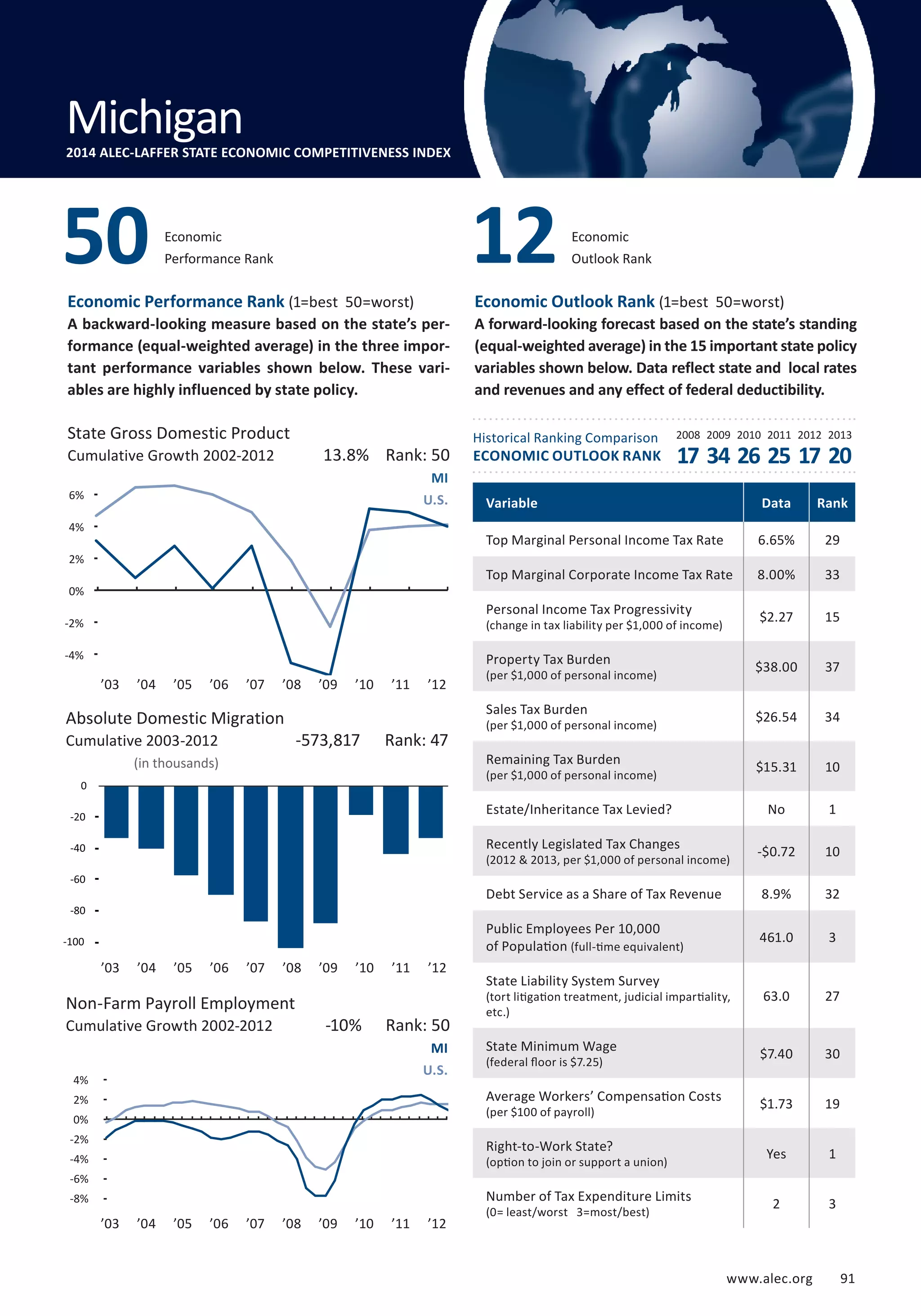
The Michigan Comeback 
Just a few years ago in 2009, Michigan ranked as 
poorly as 34th in the country in this publication. 
Thankfully, recent public policy changes should 
give Michigan citizens reason for optimism for a 
brighter and more prosperous future. This edi-tion 
of Rich States, Poor States shows Michigan 
jumping from the 20th most competitive state 
in 2013, to the 12th most competitive state in 
2014.23 
By the end of 2013, Michigan—the long-standing 
bastion of organized labor—could no 
longer deny economic realities, and became 
the nation’s 24th state to adopt a right-to-work 
law that gives workers the freedom to choose 
whether or not they would like to join a union. 
Advocates of worker freedom hail this as a major 
victory for both the state’s workers and for Mich-igan’s 
economic future.24 
Now that workers have a choice, the SEIU 
healthcare affiliate has seen an 80 percent 
decrease in membership in Michigan. Combined 
with increasingly competitive tax policies, the 
right-to-work legislation will serve to energize 
the state and make Michigan once again a viable 
place to start, move, or grow a business.25 
Michigan policymakers have undertaken 
a number of bold reforms in recent years to 
make the state more hospitable to large and 
small businesses alike. The Michigan business 
tax repeal, the phase-out of the personal prop-erty 
tax, the taxpayer audit guidance, regulatory 
reform, and adoption of a right-to-work policy 
ensure that Michigan is on the right track to a 
true and lasting economic recovery. By simpli-fying 
the bureaucracy, making it easier to start 
and grow businesses, and giving people the 
choice of whether or not they would prefer to 
join a union, Michigan is once again positioned 
for economic growth.
CHAPTER ONE 
Deep Blue States Show a Pulse on Economics 
New Jersey Considers Death Tax Reform 
While New Jersey is facing a revenue shortfall 
and some of the ideas that have been suggested 
to bridge that gap would harm economic growth, 
there is still some serious discussion in the 
legislature on ways that New Jersey can stop 
losing wealthy residents who leave the state 
because of high taxes. 
Specifically, New Jersey is considering serious 
reform to its estate (death tax) and inheritance 
taxes. New Jersey—whose legislature tradition-ally 
leans to the left—is one of only 19 states that 
still levies an estate and/or inheritance tax and 
one of only two states the levies both (Maryland 
is the other).26 
Moreover, these taxes in New Jersey are par-ticularly 
punitive. The rate is as high as 16 percent 
for both the estate and inheritance taxes and 
the exemption is only $675,000. By contrast, the 
federal exemption to the estate tax is $5.25 mil-lion 
and is indexed to rise with inflation. The high 
rates, double taxation, and low exemption make 
New Jersey a highly undesirable place to have an 
estate and makes it harder on small businesses 
who want to keep them in the family.27 
Although there is currently no single plan that 
lawmakers are supporting, several options are 
being formulated. At a minimum, lawmakers are 
showing awareness to the problem and an under-standing 
that they must change policies that ulti-mately 
force wealthy taxpayers out of the state. 
Maryland Reforms the Estate Tax 
Maryland is one of only two states that still main-tains 
both an estate tax, also known as the death 
tax, and an inheritance tax (New Jersey is the only 
other state that still has both taxes). But Mary-land 
lawmakers this session have made their 
estate tax less punitive and have given wealthy 
residents less of a reason to flee the state. 
The legislature passed a bill to raise the estate 
tax exemption from $1 million this year to $1.5 
million in 2015, $2 million in 2016, $3 million in 
2017, and $4 million in 2018 before matching 
the federal exemption (projected to be $5.9 mil-lion) 
on January 1, 2019. From then on, the Mary-land 
estate tax would be coupled with the federal 
exemption and would be indexed for inflation.28 
Maryland’s pro-growth reform comes as 
8 Rich States, Poor States 
many states look at reforming their estate taxes. 
Of the 19 states and the District of Columbia 
that still levy a state level estate tax, Minnesota, 
Maine, New York, New Jersey, and the District of 
Columbia either have reformed their estate tax or 
are likely to in the near future. Additionally, death 
taxes have been repealed in the last four years by 
Indiana, Kansas, North Carolina, Ohio, and Okla-homa. 
Tennessee’s estate tax is set to be com-pletely 
phased out by January 2016.29 
Rhode Island Looks to Gain an Edge in the 
Northeast 
Rhode Island, a state that is not known for its 
conservative tax policy, recently adopted a bud-get 
that would help the state gain an economi-cally 
competitive edge over some of its neigh-bors. 
The newly elected House Speaker, Nicholas 
Mattiello—a Democrat—has made it clear that 
reducing the tax burden of estate and corporate 
taxes is a priority.30 
Those priorities were clear in the state’s bud-get 
that passed through the Rhode Island House 
at the time of publication. The highlight of the 
budget includes a corporate income tax cut from 
9 percent down to 7 percent for tax year 2015. 
The budget also raises the exemption for the 
state’s estate tax from the current $910,725 to 
$1.5 million.31 
The budget included various other provisions, 
but the focus of the budget remains on the mea-sures 
for reducing taxes. If the budget is signed 
into law, Rhode Island would join many other tra-ditionally 
blue states in reforming the estate tax 
and other similar states that are starting to realize 
that they are in competition for people, income, 
and businesses and that they need to make sure 
their tax codes are as competitive as possible. 
Illinois’ Token Pension Reforms 
The chronic underfunding of state and local pub-lic 
pensions has turned the issue of underfunded 
pension systems from an overlooked issue into 
a major concern. Illinois, and especially Chicago, 
has become a poster child for dysfunctional and 
underfunded pension systems. Last year, Illinois 
became the second state in history to be indicted 
by the Securities and Exchange Commission for 
accounting fraud due to how the state handled 
and projected its pension obligations. This indict-ment 
put pressure on Illinois lawmakers to take
STATE OF THE STATES 
www.alec.org 9 
a hard look at public pensions and make a strong 
effort to reform them.32 
Not surprisingly, Illinois lawmakers did not 
pass the major pension reforms that were needed 
to secure the pension system for employees mov-ing 
forward. However, it was not a complete 
loss for reformers, as some good reforms were 
passed, even if they are not as significant as would 
be needed to really fix Illinois’ pension crisis.33 
The plan includes curtailing cost of living 
adjustments for most workers, capping salary 
amounts that can be used to calculate an employ-ee’s 
pension, and raising the retirement age for 
many employees. In exchange, the employee con-tributions 
to their pensions will drop by 1 percent 
and the legislature agreed to more fully fund the 
pension system in its payments each year.34 
While these changes are helpful, the core of 
the plan was an optional 401(k) style defined-contribution 
plan that is optional for new work-ers. 
Moving all new employees into the defined-contribution 
pension plan in the future is the 
best way to make sure that the pension system 
remains stable and reliable for years to come. 
Considering that these reforms took place in 
the left-leaning state of Illinois, there is reason 
reformers should consider this a victory, even if 
it is a small and symbolic one. 
New York’s Small Steps Toward Pro-Growth 
Reform 
New York is no stranger to being in last place in 
the Rich States, Poor States: ALEC-Laffer State 
Economic Competitiveness Index. However, even 
a state like New York cannot deny economic real-ities 
forever. The phenomenon of losing peo-ple, 
businesses, and income year after year has 
led Gov. Andrew Cuomo to address the state’s 
uncompetitive economic climate and adopt a 
few pro-growth reforms, even if they are limited 
in scope. 
Gov. Cuomo signed the FY2014-2015 budget 
into law and in doing so pushed New York in the 
direction of a more competitive economic cli-mate. 
Though there are some targeted tax incen-tives 
that are a negative for economic growth, 
the overall budget contains some extremely 
positive reforms. The core positives of the plan 
include the following: 35 
• A corporate income tax rate reduction to 6.5 
percent from 7.1 percent 
• Coupling the state’s estate tax exemption to 
the federal estate tax exemption (over time) 
• Repealing the individual add-on minimum tax 
While these reforms may seem small when 
compared with North Carolina or Indiana, the 
significance of pro-growth reforms in New 
York after years of ever rising taxes cannot be 
overstated. 
The States’ Continuing Pension Crises 
Unfunded pension liabilities are one of the most 
important issues facing states today. The total 
combined unfunded pension liabilities from 
across the states stands at a staggering $3.9 
trillion.36 
ALEC’s recent report, Keeping the Prom-ise: 
State Solutions for Government Pension 
Reform,37 discusses how the current defined-benefit 
plan structure for government pensions 
are unsustainable and provides solutions for 
reforms that benefit workers, retirees, and tax-payers. 
The defined-benefit pension plan style is 
used in the overwhelming majority of state and 
local pension plans. 
Simply put, defined-benefit pension systems 
guarantee an employee a specific set amount of 
money periodically throughout retirement with 
no limit on the total cost. This arrangement is 
not altered due to market fluctuations or pen-sion 
underfunding, and any gap between what is 
owed to the retiree and what the pension fund 
can pay must be supported entirely by the tax-payers— 
meaning that 100 percent of the risk is 
borne by taxpayers. 
Defined-contribution plans by contrast split 
the risk between employees and taxpayers by 
establishing a dedicated amount of money that 
is invested on the employee’s behalf throughout 
their working career. This can be supplemented 
by the employee and, since it is individualized, it 
is portable and employees can make sure that the 
state (their employer) is not underfunding their 
retirement accounts. At retirement, the money 
belongs to the employee to invest or turn into an 
annuity. Overall, the defined-contribution plan is 
a sustainable solution to public employee retire-ment 
problems and is structurally very similar to 
the 401(k) style plans that most private sector 
employees have. 
While some states and municipalities choose
CHAPTER ONE 
to downplay the severity of unfunded pension 
liabilities resulting from defined-benefit plans, 
others are beginning to recognize these liabil-ities 
for the budget catastrophes that they are. 
They are taking steps to reform them before they 
become a crisis. 
Keeping the Promise: Positive Pension Reforms 
Oklahoma Passes a True Pension Overhaul 
In the most significant pension reform of the 
decade, Oklahoma became the third state in the 
country to transition new hires into a 401(k) style 
defined-contribution pension plan. Oklahoma 
joins Michigan and Alaska in making the switch. 
The pension overhaul exempts teachers and pub-lic 
safety employees from the defined-benefit 
to defined-contribution transition, but all other 
new state employees, beginning in November of 
2015, will be enrolled in the state’s defined-con-tribution 
plan. 
The pension reform will not impact current 
retirees or current employees, the changes will 
only concern new workers. This ambitious reform 
will be an essential part of Oklahoma’s fiscal 
health for years to come. Although the state still 
faces significant unfunded liabilities from its cur-rent 
defined-benefit pension system, it is one of 
only three states that will no longer be accruing 
these massive liabilities every year. Oklahoma can 
now work over time to pay off unfunded liabilities, 
keep its promises to current workers and retirees, 
and also make sure that future employees will 
have a stable and sustainable retirement plan.38 
Oklahoma is the most recent state to recog-nize 
that the traditional defined-benefit plans 
no longer serve a 21st century workforce, hope-fully 
this major fiscal win will not go unnoticed 
in other states that are looking for ways to make 
sure their public servants are well taken care of 
in retirement. 
Boeing Employees Choose a Defined-Contribution 
Pension Plan 
Boeing is the latest example of a Fortune 100 
company to offer defined-contribution plans 
for employees.39 Recently, Boeing and the Inter-national 
Association of Machinists District 751 
negotiated a contract that would allow Boeing 
to build the new 777X jet in Everett, WA Under 
the new contract, all workers will transition from 
10 Rich States, Poor States 
a traditional defined-benefit plan into a mod-ern 
defined-contribution plan.40 The contract 
will freeze all benefits earned from the defined-benefit 
plan in 2016, and transition them into a 
defined-contribution plan. Of union members, 
51 percent voted in favor of the contract, choos-ing 
a defined-contribution plan that promotes 
economic security and mobility.41 
While nearly 85 percent of private sector 
employees across the country are enrolled in 
defined-contribution plans, the public sector 
continues to offer unsustainable defined-benefit 
plans.42 And when the public sector makes pen-sion 
promises they cannot afford, retirees, work-ers, 
and taxpayers suffer.43 
This should serve as a wakeup call for pen-sion 
crisis deniers. Defined-benefit plans are 
simply unsustainable in the long term. If states 
want to protect employees’ pensions and also 
limit risks to the state budget and to taxpayers, 
lawmakers should follow the example of Boeing 
and move all new employees into a defined-con-tribution 
401(k) style system. 
Pension Reform Setbacks in States 
and Municipalities Across the Country 
San Jose Fights an Uphill Battle 
Since major pension reforms were first passed 
through ballot measures in San Jose in 2010, 
known as Measure B, San Jose Mayor Chuck 
Reed has emerged as one of the key leaders in 
the municipal pension reform effort. Unfortu-nately, 
Mayor Reed suffered a double setback in 
May of 2014 to his pension reform efforts. 
A Santa Clara County Superior Court judge 
ruled in May of 2014 that increased employee 
contributions to pensions cannot go into effect 
before July 1, 2015. Employee pay also cannot be 
cut before that date. Increased employee contri-butions 
into the pension system was a key provi-sion 
of Measure B, a voter approved ballot mea-sure 
that was meant to get the city’s pension 
costs under control.44 
It is unclear if the union leaders, who have 
been vocally opposed to pension reform efforts 
such as Measure B, and city officials will reach 
any kind of agreement on employee pension 
contributions before July 1, 2015. Either way, this 
is a major setback in the city’s efforts to reform 
pension costs.
STATE OF THE STATES 
www.alec.org 11 
In light of the lawsuits and other difficulties 
that San Jose has faced in the wake of Measure 
B and the pension funding battle, Mayor Reed 
is now attempting to put a statewide measure 
on the ballot that, if approved, would allow cit-ies 
and localities to alter pension benefits and 
employee pension contributions for future work 
done. Meaning that pension benefits that pub-lic 
employees have already earned cannot be 
altered, but any pension benefits that they have 
yet to earn could potentially be changed. 
This effort, however, was also dealt a setback 
when California Attorney General Kamala Harris 
issued ballot language for the initiative that Reed 
and other supporters said was unrepresentative 
of the issue at hand. Mayor Reed sued to get the 
language changed, but the judge decided in favor 
of Harris’ language. If the ruling stands after all 
appeals are exhausted, Reed and other support-ers 
of the initiative will then decide whether 
they still want to attempt to get the measure on 
November’s ballot or if they will wait until 2016.45 
Rhode Island’s Pension Reforms Take a Major 
Step Backwards 
Rhode Island State Treasurer Gina Raimondo 
became a sensation as a level-headed blue 
state official who seemed to understand the 
importance of enacting major pension reform. 
Her leadership was instrumental in passing the 
2011 pension reform in Rhode Island that, while 
not the ideal, was a significant step in the right 
direction. 
Unfortunately, since this success, she has 
decided to run for governor of Rhode Island and 
in the process has distanced herself from her sig-nature 
pension reforms. Treasurer Raimondo 
came under fire from the president of the Amer-ican 
Federation of Teachers, Randi Weingar-ten, 
because she chose to invest a portion of 
Rhode Island’s pension funds in a hedge fund 
run by Daniel Loeb. Loeb’s fund, Third Point LLC, 
achieved a return of almost 25 percent per year 
(outperforming most hedge funds) while Rhode 
Island’s entire pension fund averaged about 14 
percent.46 
But Loeb is personally a large proponent 
of charter schools and is seen as public enemy 
number one by Weingarten. To stave off fur-ther 
opposition from Weingarten and other 
union special interests in her bid for Democratic 
nominee for Rhode Island governor, it appears 
that Raimondo caved to the pressure and with-drew 
state investments from Mr. Loeb’s fund.47 
As Sen. Dan Liljenquist has said in Keeping the 
Promise: State Solutions for Government Pension 
Reform, pension reform is not a partisan issue, 
but a math issue. When politics are dragged into 
the pension debate, workers, retirees, and tax-payers 
suffer. 
Pennsylvania Pension Reform Efforts Fizzle 
Pennsylvania was on the short list of states that 
were expected to enact fundamental public pen-sion 
reform in 2013. Unfortunately, the legisla-ture 
simply could not reach an agreement on the 
best way to fix the state’s pension problems, and 
consequently no plan was passed. Now in 2014, 
it looks like history could repeat itself. 
There are a few different plans to address 
Pennsylvania’s pensions, ranging from ramping 
up borrowing to putting new hires into a hybrid 
system. The apparent favorite plan right now 
would cap employee benefits that are tradition-ally 
uncapped in the defined-benefit system and 
would have employees receive anything above 
the cap in a 401(k) style defined-contribution 
plan. The opposing idea is to simply borrow more 
money to cover the pension shortfall in the form 
of $9 billion worth of pension obligation bonds.48 
Although the hybrid option seems to be 
more popular—and the pension obligation bond 
idea doesn’t have much support—there has been 
a noticeable lack of movement on the issue. It is 
unclear if 2014 will end up being another year in 
which Pennsylvania gets close to fundamental 
pension reform but can’t quite push it over the 
finish line. 
Pension Reform Stalls in Florida 
Florida Speaker of the House Will Weather-ford 
made pension reform a top priority in the 
2013 legislative session, but reform efforts ulti-mately 
died on the Senate floor. The proposal 
was soundly structured and focused on getting 
employees out of defined-benefit plans and into 
defined-contribution plans. 
These reform efforts respected the currently 
promised defined-benefit plans to state employ-ees, 
but pushed to move new hires into defined-contribution 
plans. Though Florida is not among 
the worst funded public pension systems, it’s not
CHAPTER ONE 
on sound footing and provides both risk and bad 
incentives that harm taxpayers. Despite the bill 
passing in the House, the bill was killed in the 
Senate. According to the Miami Herald, last year 
the “plan was defeated in a 22-18 vote by Dem-ocrats 
and Republicans backed by unions. Taking 
up the issue again in 2014, pension reform was 
defeated even quicker. This year, the measure 
didn’t even get that far.”49 
Reformers are likely to take up the measure 
for a third straight legislative session in 2015. 
Detroit’s Bankruptcy: Here We Go Again 
Detroit’s bankruptcy proceedings have been a 
warning sign to cities, municipalities, and states 
that are still ignoring the high cost of not enact-ing 
pension reform. In the pension proceedings 
that have specifically addressed how the bank-ruptcy 
will affect retired public employees, there 
has been an interesting development. 
Originally the city estimated a shortfall of 
pension payments of about $3.5 billion. This was 
expected to result in a cut of around 14 percent 
to retired police and fire employees and about 34 
percent for all other employees. These deep cuts 
are the inevitable result of neglecting the pen-sion 
problem and refusing to fix it before it’s too 
late. But despite these dire predictions, the city 
has proposed a plan that keeps the pensions of 
current retirees at 73 percent to 100 percent of 
their current base pension plans under the city’s 
current bankruptcy proposal—much smaller cuts 
than originally predicted. This leads to the natu-ral 
question, where did the city find the money 
to do this? 
The answer lies in a gimmick that the city 
used to avoid making difficult choices. The city 
has two funds for pensions; one fund is predicted 
to achieve a 6.25 percent rate of return each year 
and the other is expected to achieve a 6.5 rate of 
return each year. Both are probably higher esti-mates 
than are warranted (Moody’s suggests 
5.5 p ercent), b ut s till f ar l ower t han t he a ver-age 
pension fund in the country, which predicts 
about a 7 to 8 percent rate of return every year. 
So, the city simply changed the expected rate of 
return to 6.75 percent for both funds, and voila! 
No pension shortfall.50 
Baselessly increasing the assumed rate of 
return for pension funds helped to land Detroit 
in bankruptcy in the first place and now the city 
12 Rich States, Poor States 
has returned to old habits to avoid making actual 
difficult cuts. Here we go again. 
Moreover, the Michigan state government 
has stepped in with $195 million in funds for the 
city; in a move many have called a partial bailout 
of the city. Additionally, private foundations have 
pledged funds to the city in order to soften the 
blow on current retirees’ pension cuts. Though 
the funds help Detroit in the short-run, they do 
little to address its fundamental mismanage-ment 
and need for deep restructuring.51 
Future Difficulties in Municipal Funding 
Out of control pension costs are already squeez-ing 
municipal budgets and it will only get worse 
if pension systems are not fundamentally 
reformed. However, in addition to the inherent 
budget problems associated with defined-bene-fit 
pensions, there are a few other developments 
that will likely squeeze municipal budgets even 
more. 
The bankruptcies in Detroit and Stockton, CA 
demonstrate an interesting fact and have created 
a troublesome precedent if left unchallenged. 
Municipal bondholders have essentially been 
given the cold shoulder in both cases. In Detroit, 
bankruptcy judges are considering proposals that 
would give bondholders only about 20 cents on 
the dollar that they are owed. In Stockton, some 
bondholders will not only see a cut in the interest 
they are owed but are likely to see a reduction in 
the principal that they are owed.52 
While these situations are far from resolved 
and will likely face a long series of appeals, one 
thing is clear: Bondholders beware! The more 
likely cities are to file for bankruptcy, mostly 
due to unfunded pension liabilities, the more 
likely it is that bondholders will take the brunt of 
any cuts. If this trend continues and the risk for 
municipal bondholders increases, those bonds 
are going to be far more expensive in the future 
than they traditionally have been. 
Another factor that could affect municipal 
funding and bonds is national tax reform. Con-gressman 
Dave Camp (R-MI) laid out his plan for 
tax reform and even though it will not likely be 
passed anytime soon, the comprehensive pack-age 
is now the de facto starting point for tax 
reform in the future. One component of Rep. 
Camp’s plan would require top earners to pay 
a surtax on previously untaxed municipal (muni)
STATE OF THE STATES 
www.alec.org 13 
bond interest. Currently, state and local govern-ments 
use tax-exempt muni bonds to fund capital 
projects such as bridges and new school buildings. 
The proposed surtax might negatively affect top 
bracket taxpayers’ willingness to invest in muni 
bonds.53 
Overall, eliminating this tax preference might 
be good tax policy. But in the near-term, the sur-tax 
will squeeze already tight municipal budgets. 
Adding a surtax to muni-bond interest—which 
effectively increases the cost of issuing muni 
bonds—could force state and local governments 
to choose whether to fund pensions or capi-tal 
projects. Governments should act quickly to 
reform the greatest existing threat to their bud-gets: 
unfunded pension liabilities. 
Congressman Camp’s tax reform plan also 
contains a provision that would end the federal 
deductibility of state and local taxes, even prop-erty 
taxes. Since $470 billion was deducted by 
taxpayers who itemized in 2011, this would be a 
large tax increase for them, and would put enor-mous 
pressure on state and local governments 
to cut tax rates since those taxes would no lon-ger 
be deductible.54 
While these reform ideas are still in the 
formulation process and by no means set in 
stone, states and localities might not have to 
worry about tightening budgets in the imme-diate 
future. But the fact that these proposals 
are on the table and are a part of the baseline 
tax reform plan is significant. States and locali-ties 
have a window of opportunity to address 
unfunded pension liabilities and they would be 
wise to take action now, before it becomes much 
more difficult. 
Other Fiscal Issues in the States 
Although taxes are extremely important to state 
policy and potential for economic growth, there 
are other policy factors that affect the growth 
potential of the state as well. From labor policy 
to financial risk, states continue to change these 
policies for better or for worse. 
States Hike Their Minimum Wages to New 
Heights 
Minimum wage increases are well-intentioned 
policies that have the unfortunate effect of reg-ularly 
hurting those that they try to help.55 By 
creating a price floor on labor that businesses 
must “purchase,” these policies ensure that any-one 
who provides a return to the employer that 
is less than the artificially set wage floor will not 
be profitable for businesses anymore and will 
likely become unemployed. 
The workers who lose jobs because of 
increases in the minimum wage are by definition 
the most vulnerable, since the product of their 
work is worth less than the new minimum that 
employers must pay. Fewer jobs and less oppor-tunity 
is not an effective way to lift people out of 
poverty. Economic growth and a vibrant job mar-ket 
are far better at increasing the value of indi-viduals’ 
labor and increasing their earning power, 
thereby reducing poverty. 
Ever since President Obama’s call for a 
national increase of the minimum wage to $10.10 
per hour, there has been renewed momentum in 
the states to take up the issue. To date, at least 
six states have raised their minimum wage or are 
seriously considering proposals to raise it. 
Naturally, California leapt at any excuse to 
raise the minimum wage, and a plan to increase 
it successfully passed last year. The state passed 
a proposal to raise the minimum wage to $9 per 
hour as of July, 2014 and then to $10 per hour 
as of January, 2016. Before the increase, Califor-nia 
already had a state mandated minimum wage 
of $8 per hour, $0.75 above the current federal 
floor of $7.25 per hour.56 
Earlier this year, Maryland voted to raise 
its minimum wage. The fully phased in Mary-land 
plan will hike the minimum wage to Presi-dent 
Obama’s recommended $10.10 per hour by 
2018. The $10.10 rate will be phased in however, 
with the first increase set for $8 per hour on Jan-uary 
1, 2015, then $8.25 per hour by July 2015, 
$8.75 per hour by July 2016, and $9.25 per hour 
by July 2017. The proposal has passed in both 
houses and Gov. Martin O’Malley is expected to 
sign the proposal into law.57 
At $9.19, Washington state already has a high 
mandated minimum wage when compared to 
other states. Recently, individual cities within the 
state are attempting to push that even higher. 
Washington’s SeaTac area has already approved 
a minimum wage of $15 per hour for hospitality 
and transportation workers near Seattle-Tacoma 
International Airport.58 
Seattle followed suit and its city council
CHAPTER ONE 
voted to raise the city’s minimum wage to $15 
an hour over the next seven years. Franchisees 
however will have to accommodate the newly 
minted highest minimum wage in the nation in 
only 3 years, a move that has sparked a lawsuit 
because of the disparate treatment; since non-franchise 
competitors will have more than dou-ble 
the amount of time to adapt to the new min-imum 
wage.59 
New Jersey is another state that recently 
raised its minimum wage. Voters in November 
2013 approved a ballot initiative that raised the 
state minimum wage from the federal floor of 
$7.25 per hour to $8.25 per hour. The New Jer-sey 
initiative was also unique in that it included 
a provision for an annual cost of living increase 
on the minimum wage. The $8.25 per hour mini-mum 
wage took effect January 1, 2014.60 
Alaska will put a minimum wage issue on their 
August 2014 ballot. The initiative will ask vot-ers 
to increase the minimum wage from its cur-rent 
$7.75 to $8.75 in January 2015 and then to 
$9.75 in January 2016. It would also be inflation 
adjusted after that and set to always be at least 
$1 above the federally mandated minimum.61 
In addition to the states mentioned above, 
there are several states that are considering pro-posals 
to raise their state level minimum wages 
to $10.10 per hour. Pennsylvania is one state 
that is considering raising its minimum wage to 
$10.10 per hour, and there are even a few law-makers 
in the legislature who are trying to push 
it as high as $12 per hour.62 Connecticut has 
already passed legislation to increase its mini-mum 
wage to $10.10 per hour by 2017.63 
In 2013, Maine passed legislation increas-ing 
its minimum wage to $9 per hour by 2016.64 
Massachusetts will have a ballot question in 
2014 where voters will decide whether to raise 
their minimum wage to $10.50 per hour over 
two years and tie future increases to inflation.65 
Rhode Island is also considering a proposal to 
raise the state’s minimum wage to $10 per hour 
by 2016 and tie it to inflation by 2017.66 Hawaii 
passed legislation to increase its minimum wage 
to $10.10 per hour by 2018.67 
Despite already having one of the highest 
minimum wages in the country, Vermont law-makers 
voted to hike the minimum wage from 
$8.73 to $10.50 per hour by January 2018.68 
Under the new law, the minimum wage will 
14 Rich States, Poor States 
increase to: $9.15 in January 2015, $9.60 in Janu-ary 
2016, $10.00 in January 2017, and $10.50 by 
2018.69 
Michigan Republican legislators passed an 
increase to the minimum wage in late May of 
2014 in an effort to preempt an even worse mini-mum 
wage hike that was set to appear on the bal-lot 
in the state’s 2014 election. The bill raises the 
minimum wage to $9.25 at a gradual pace over 
the next four years from its current rate of $7.40. 
The bill also indexes the minimum wage thresh-old 
to inflation, capped at 3.5 percent annually. 
The ballot proposal that was set to raise the state 
minimum wage if passed would have raised the 
minimum wage to $10.10 over three years, index 
the minimum wage to inflation, and increase the 
minimum wage for tip workers by $0.85 a year 
until it reached $10.10.70 
Another state to take up the issue of increas-ing 
the minimum wage this year was New Hamp-shire. 
A bill to raise the minimum wage from 
$7.25 to $8.25 on January 1, 2015 and then to 
$9 per hour on January 1, 2016 passed the New 
Hampshire House of Representatives. The bill 
also tied the state’s minimum wage to increase 
with the overall rate of inflation after the orig-inal 
increases fully phase in. However, the Sen-ate 
rejected the minimum wage increase. As Sen-ate 
Majority Leader Jeb Bradley explained, “We 
know this is a job killer. Let’s kill this bill and pre-serve 
jobs in New Hampshire.”71 
States Become Financially Ready 
States are beginning to realize that they are far 
more reliant on federal funds for state programs 
than they had once thought. A report from the 
nonpartisan government watchdog, State Bud-get 
Solutions, used Census data to reveal that on 
the whole, states received 31.6 percent of their 
total revenue from the federal government in 
2012.72 Additionally, the report points out that 
“Only 11 states depended on the federal govern-ment 
for more than one-third of their total rev-enues 
in 2001. By 2012, 24 states found them-selves 
in this situation.” 
Despite states receiving an unsustainable 
amount of funds from Washington, state reli-ance 
on federal funds actually fell from 2011 to 
2012.73 The percentage of federal funds in state 
budgets had been on the increase, largely due 
to the American Recovery and Reinvestment
STATE OF THE STATES 
www.alec.org 15 
Act (ARRA, or the “stimulus” bill). A report by 
the U.S. Census Bureau shows that in 2007, 
states received more than $407 billion in federal 
grants. By 2011, that number had risen to over 
$575 billion. But with the stimulus funds begin-ning 
to dry up, federal funding of states dropped 
to $514.2 billion in 2012. This drop represents 
the first year-to-year decrease in federal grants 
to states since 1992.74 
As the temporary funding from ARRA con-tinues 
to dissipate, states will have to change 
the way they spend. Unfortunately, the costly 
strings attached to the federal funds, such as the 
burdensome “maintenance of effort” require-ments, 
will last far longer than the federal sup-port. 
As policymakers in Washington, D.C. face 
increasing pressure to reduce spending in order 
to keep public debt from skyrocketing, federal 
cutbacks seem inevitable.75 Despite this reality, 
very few states have taken significant action to 
prepare for the fiscal shortfalls ahead. 
To make matters worse, these federal funds 
never come without strings attached. Federal 
money promotes federal interests over state 
interests and it can be a dangerous temptation 
for lawmakers to become overly dependent on 
these funds. A historical example of this is the 
55 mph speed limit imposed between 1974 and 
1995. States were denied transportation fund-ing 
unless they complied with this one-size-fits-all 
policy. 
Amid concerns about a potential decline 
in federal funds, a growing national debt, and 
an increasing awareness of federal “strings” 
attached to the dollars, states are taking pro-active 
steps to reduce their dependence on fed-eral 
funds. After all, the federal government is 
more than $17.5 trillion in debt, which is about 
105 percent of GDP. This figure is projected to 
increase to 112 percent of GDP by 2018 accord-ing 
to the Congressional Budget Office.76 
Utah is one state that recognizes these poten-tial 
problems and is leading the effort to prepare. 
In 2011, the Utah legislature passed H.B. 138, The 
Federal Receipts Reporting Requirements Act.77 
This bill required all state agencies to disclose 
total federal receipts, including federal funding’s 
percentage of their respective budgets, and also 
to disclose what their specific contingency plan 
is if federal receipts are diminished. By devel-oping 
a plan to operate state agencies in case 
federal funds dwindle, Utah has a stable eco-nomic 
outlook. The state’s strong fiscal manage-ment 
record has earned Utah strong AAA ratings 
from Moody’s,78 Standard and Poor’s,79 and Fitch. 
Utah has other plans on ways they can bet-ter 
be prepared. Financial Ready Utah is an ini-tiative 
that brings together the state’s leader-ship 
to make sure that Utah is equipped to face 
the fiscal challenges ahead. Last year, the state 
auditor, state treasurer, Senate president, House 
speaker and a team of legislators came together 
to pass a package of bills as part of the initia-tive 
that, among other things, creates a federal 
funds review commission to identify risks and to 
implement a comprehensive planning measure to 
address challenges of an uncertain fiscal future.80 
Sen. Deidre Henderson, one of the lawmak-ers 
leading the initiative, says that “States are 
far too dependent on federal dollars. It would 
be financial malpractice for states not to create 
fiscal emergency plans to prepare for the inevi-table 
time when those federal funds dwindle or 
disappear.”81 
Like Utah, Idaho is another state that has 
implemented measures to prepare for an increas-ingly 
uncertain financial future. Gov. C.L. “Butch” 
Otter established Idaho’s new fiscal preparedness 
initiative through an executive order. The exec-utive 
order requires state agencies to submit a 
yearly report to the Division of Financial Manage-ment. 
Among agency requirements in the yearly 
report are the following: A detailed amount of 
federal funds received for the preceding fiscal 
year; the federal funds to be utilized for the cur-rent 
and upcoming fiscal year; and an identifica-tion 
of any agency obligations, agreements, and 
joint exercise of powers agreements that may be 
impacted by federal or state decisions regarding 
federal receipts. The executive order also requires 
calculations on the amount of federal funds to the 
total appropriation of an agency, along with docu-mentation 
from the Division of Financial Manage-ment 
that describes the agency’s plan for operat-ing 
if there is a reduction of 10 percent or more in 
federal funds that the state receives.82 
Idaho’s economic future will benefit from 
fiscal preparedness. According to a study by 
the Idaho Freedom Foundation and the Suther-land 
Institute’s Center for Self-Government 
in the West, Idaho’s reliance on federal funds 
has grown by more than 80 percent in the past
CHAPTER ONE 
decade.83 At t he v ery l east, t he i nformation w ill 
now be available to assess federal funding and 
make more informed decisions regarding many of 
the federal grants, which often come with strings 
attached.84 By developing a contingency plan to 
operate agencies in the event federal funds are 
decreased, Idaho can have a better fiscal outlook. 
Hopefully, the success stories of Utah and 
Idaho will continue to inspire other states across 
the country to examine their own budgets and 
financially prepare for whatever might come 
their way. 
Predictions for 2015 Tax Changes 
As the benefits enjoyed by more economically 
free and lower tax states become increasingly 
hard to ignore, there are a number of states that 
are reasonably expected to take action to reform 
their tax codes for economic growth. While we 
don’t have a crystal ball, we suggest you keep 
your eyes on the states below as they consider 
fundamental reforms next year. 
Further Reform for Economic Growth 
Nebraska is one state that should be watched 
closely in 2015. The state has gone through a 
series of small but important tax reforms that 
have positioned it well for a broader tax over-haul. 
Those smaller reforms and the tax study 
commission have set the stage for real positive 
reform. It is unclear what exactly will be done 
in the near future, but given the economic cli-mate, 
it is likely the state will look at possibly 
reforming and/or cutting the state’s income 
tax. 
While Oklahoma’s reform efforts were 
halted in 2013, there is cause for hope. Because 
the income tax cuts that passed in 2013 were 
struck down by the State Supreme Court—as 
opposed to not making it out of the legislature— 
and because several different tax cut proposals 
have resurfaced this year, there are some good 
reasons to expect that the state will likely enact 
pro-growth tax reforms soon. 
As was mentioned earlier in this chapter, 
Missouri has reignited the debate over right-to- 
work. While this major reform would have 
significant economic benefits for Missouri, it is 
generally considered to be an insurmountable 
challenge for those pursuing worker freedoms 
16 Rich States, Poor States 
because of the polarizing nature of the topic in 
Missouri politics. However, with potential votes 
and/or ballot measures being considered, Mis-souri 
may just surprise everyone. 
Arizona is in the middle of an economic 
upswing resulting from having a competitive 
economic climate, having their housing sector 
finally start to recover, and from being a neigh-bor 
of economically dysfunctional California. 
These advantages led to the introduction of sev-eral 
pro-growth proposals in 2013 and 2014. It is 
likely that the trend of pro-growth proposals will 
continue into 2015. 
Tennessee reformers will look once again to 
repealing the Hall Tax on “unearned” investment 
income, coming off a defeat of repeal efforts in 
the 2014 session. Though Tennessee does not 
have an income tax on wages, it does levy a dam-aging 
tax on investment income. Investment 
income is a primary ingredient for economic 
growth so a repeal of the tax would serve as a 
major boon to the economy, as well as citizens 
reaching retirement. 
Fresh off a defeat in their efforts to lower 
Michigan’s income tax rate before a “temporary” 
tax hike takes effect, reformers will return to the 
battlefield again in the coming legislative session. 
Michigan has had much success with tax reform 
in recent years with the repeal of the Michigan 
Business Tax and the phase-out of the personal 
property tax on small businesses. Reformers will 
look to build on those successes and continue to 
improve the state’s competitiveness. 
Georgia may also look to lower income and 
corporate income tax rates in the coming legis-lative 
session. The state has hosted a number 
of hearings on the virtues of reform proposals 
and a caucus of reformers is eager to take major 
strides toward improving the state’s competi-tiveness 
in the coming legislative session.85 
These efforts have largely been led by Geor-gia 
Sen. Judson Hill, the chairman of the Senate 
Finance Committee. The income tax cut hearings 
have focused on discussing the recent reforms 
in North Carolina and what that means for eco-nomic 
competition with Georgia. In fact, the 
hearings have not only discussed how best to 
match North Carolina’s reforms but how Geor-gia 
might even become more economically com-petitive 
than North Carolina.86
STATE OF THE STATES 
www.alec.org 17 
Potential Tax Hikes in the States 
Despite some good prospects for pro-growth 
reform in the states, there are also some poten-tially 
negative proposals that are lingering across 
the country. 
Nevada voters will consider a question on 
the November 2014 ballot on whether or not 
the state should adopt an economically damag-ing 
margins tax. The margins tax initiative that 
is being considered is modeled after the mod-ified 
gross receipts tax in Texas that charges 
one percent tax of gross revenue (not profit) on 
businesses, with a few options on what can be 
deducted from the businesses’ “total revenue.” 
The Nevada plan differs in one very significant 
way however; if accepted, the tax rate will be 2 
percent instead—double the Texas rate. 
Maryland will most likely also see some eco-nomically 
damaging proposals re-emerge next 
session. Despite the positive step of expanding 
the exemption for the state’s estate tax, Mary-land 
seems committed to permanently being 
economically second best to Virginia in the 
region. Because the state has increased taxes or 
fees over 32 times from 2007 to 2012, it seems 
unlikely that this trend will end any time soon. 
Illinois is another state that will most likely 
try to raise taxes next year. The state passed 
a budget that creates a significant deficit and 
some lawmakers might try to use this as an 
excuse to bring back the discussion of a gradu-ated 
income tax that was narrowly defeated in 
2014. 
Illinois may not be the only state that attempts 
to use budget shortfalls as an excuse to raise 
taxes next year. At the national level, the fiscal 
cliff at the end of 2012 prompted a sell-off of cap-ital 
gains by those that wisely wanted to avoid the 
potential for a higher tax rate. This then caused a 
one-time surge in capital gains revenues, which 
many states count as ordinary income. This 
income tax spike then was factored into budget-ing 
baselines for states and when this revenue 
surge was not repeated, states were left with sig-nificant 
deficits.87 
Unfortunately, while this should be a les-son 
on why states should not rely on the volatile 
revenue source of personal income taxes, many 
states may use this as a convenient excuse to call 
for tax increases. 
Surprisingly, one state governor who has 
taken this lesson to heart is California’s Jerry 
Brown. While he is not planning to cut or elim-inate 
California’s income tax anytime soon, he 
has consistently called for spending restraint in 
light of rosier budget outlooks. This more tem-pered 
take on how California should plan to 
spend money has caused some friction with lib-eral 
legislators who want to embrace the opti-mistic 
revenue forecasts and spend that reve-nue 
on new projects.88 But Gov. Brown is holding 
firm on his calls to be more realistic about what 
kind of revenue growth (or decline) the state can 
reasonably expect. 
Conclusion 
As the competition between the 50 “laborato-ries 
of democracy” continues to heat up, the 
economic effects of pro-growth tax and fis-cal 
policies will become increasingly clear. The 
past 50 years of data point to a clear connection 
between pro-growth policies of lower taxes, less 
regulations, and competitive labor policies with 
the creation of healthier state economies. 
As we’ll discuss in further chapters of this 
book, numbers don’t lie. Big government advo-cates 
can try to rationalize numbers in various 
ways, but in the end, the results are clear. The 
states that embrace free markets and limited 
government fare much better than their high-tax, 
big government counterparts.
CHAPTER ONE 
(ENDNOTES) 
1 Williams, Jonathan and Wilterdink, Ben. “State Tax Cut Roundup: 2013 Legislative Session.” American Legislative Exchange 
Council. November 2013. 
2 Ibid. 
3 Pope, Art. “Art Pope: NC Tax Reform Working for Working Families.” News and Observer. April 15, 2014. 
4 Williams, Jonathan and Wilterdink, Ben. “State Tax Cut Roundup: 2013 Legislative Session.” American Legislative Exchange 
Council. November 2013. 
5 Freeland, William and Wilterdink, Ben. ”Missouri Tax Hypocrisy.” American Legislator. January 16, 2014. 
6 Wilterdink, Ben. “Missouri Lawmakers Override Governor’s Veto, Choose Economic Growth.” American Legislator. May 7, 
2014. 
7 Wilson, Reid. “Missouri Becomes Latest Right to Work Battleground.” The Washington Post. April 11, 2014. 
8 Koklanaris, Maria. “Ohio Governor Signs Budget Update with Larger Deduction for Small Businesses.” Tax Analysts. June 18, 
2014. 
9 Lowry, Bryan. “Brownback Signs Bill Phasing Out Mortgage Registration Fees.” The Wichita Eagle. May 16, 2014. 
10 Lowry, Bryan. “Kansas Senate Approves Bill Phasing Out Mortgage Registration Fees.” The Wichita Eagle. March 19. 2014. 
11 Wilterdink, Ben. “Colorado Taxpayers Reject Tax Increases, Choose Growth.” American Legislator. November 7, 2013. 
12 Zurick, Maura and Long, Ray. “Illinois Graduated Income Tax Push Stalls Out.” Chicago Tribune. April 29, 2014. 
13 Williams, Jonathan and Wilterdink, Ben. “State Tax Cut Roundup: 2013 Legislative Session.” American Legislative Exchange 
Council. November 2013. 
14 Ibid. 
15 Freeland, William. “Tennessee Considers Eliminating Hall Tax.” American Legislator. March 7, 2014. 
16 Hammersley, Philip. “Minnesota: Higher Income and Cigarette Tax Making it the Land of 10,000 Taxes?” Tax Foundation. July 
3, 2013. 
17 Malm, Liz. “Minnesota Enacts $443 Million Tax Reduction Package.” Tax Foundation. April 25, 2014. 
18 Upton, Will. “Virginia Governor Bob McDonnell’s Transportation Tax Hike Takes Effect Today.” Americans for Tax Reform. July 
1, 2013. 
19 Di Caro, Martin. “Compromise Would Lower Virginia Gas Tax, Raises Sales Tax.” American University Radio. February 20, 
2013. 
20 Ibid. 
21 Marley, Patrick and Stein, Jason. “Scott Walker Signs $541 Million Tax Cut Legislation.” Journal Sentinel. March 24, 2014. 
22 Williams, Jonathan and Wilterdink, Ben. “State Tax Cut Roundup: 2013 Legislative Session.” American Legislative Exchange 
Council. November 2013. 
23 Williams, Jonathan and Freeland, William. “Michigan Rejoins U.S. Economy.” The Detroit News. May 15, 2014. 
24 Bennett, William J. “A Victory for Right to Work Laws.” CNN. December 13, 2012. 
25 “Michigan Union Collapse.” The Wall Street Journal. May 14, 2014. 
26 Ebeling, Ashlea. “Maryland to Cut Estate Tax as Blue States Fall in Line.” Forbes. March 20, 2014. 
27 Ibid. 
28 Schmidt, Johannes and Drenkard, Scott. “Maryland to Cut Estate Tax.” Tax Foundation. March 26, 2014. 
29 Ebeling, Ashlea. “Maryland to Cut Estate Tax as Blue States Fall in Line.” Forbes. March 20, 2014. 
30 Grimaldi, Paul. “Rhode Island House Speaker to Push for Cuts to Estate and Corporate Taxes.” Tax Analysts. May 30, 2014. 
31 DePaul, Jennifer. “Rhode Island House Oks Budget With Corporate Rate Cuts, Combined Reporting.” Tax Analysts. June 16, 
2014. 
32 Bender, Andrew. “SEC: Illinois’ Underfunded Pension are Fraud.” American Legislator. March 18, 2013. 
33 McGuinn, Patrick. “Pension Politics: Public Employee Retirement System Reform in Four States.” Brown Center on Education 
at Brookings. February, 2014. 
34 Ibid. 
35 Henchman, Joseph. “New York Corporate Tax Overhaul Broadens Bases, Lowers Rates, and Reduces Complexity.” Tax Foun-dation. 
April 14, 2014. 
36 Wilterdink, Ben. “The $5.1 Trillion Elephant in the Room.” American Legislator. January 22, 2014. 
37 Liljenquist, Dan. “Keeping the Promise: State Solutions for Government Pension Reform.” American Legislative Exchange 
Council. 2013. 
38 Dabrowski, Ted. “Oklahoma Pension Reform: 401(k)-Style Plans for New Workers.” Illinois Policy Institute. May 31, 2014. 
39 “Seven in Ten Large U.S. Companies Now Offer Only 401(k) Retirement Plans to New Salaried Employees, Towers Watson 
Analysis Finds.” Towers Watson. October 17, 2012. 
18 Rich States, Poor States
STATE OF THE STATES 
40 “Boeing Union Workers Trade DB Pension for Employment Promise.” Pensions and Investments. January 6, 2014. 
41 Kim, Hana. “Machinists Vote to Accept Contract Offer; Boeing Says it will Build 777X in Washington.” Tribune Broadcasting 
www.alec.org 19 
Company. January 3, 2014. 
42 Dabrowski, Ted. “Boeing Latest Fortune 100 Company to Offer 401(k) Retirement Plans.” Illinois Policy Institute. November 
14, 2013. 
43 Bomey, Nathan. “Judge: Detroit Can Cut Employee Pensions.” Detroit Free Press. December 3, 2013. 
44 Rosenberg, Mike. “Pension Reform: Slowed by Judge’s Ruling, San Jose Delays Key Part of Measure B.” San Jose Mercury 
News. May 1, 2014. 
45 Rosenberg, Mike. “San Jose Mayor Chuck Reed Loses Statewide Pension Reform Ballot Challenge.” San Jose Mercury News. 
March 14, 2014. 
46 “The Education of Gina Raimondo.” The Wall Street Journal. February 4, 2014. 
47 Ibid. 
48 Frantz, Jeff. “Is Pension Reform for PA Stalled or Percolating? Depends on Who You Ask.” The Patriot-News. May 12, 2014. 
49 Van Sickler, Michael. “Pension Reform Bill Dies in Senate.” Miami Herald. April 30, 2014. 
50 Kadlec, Dan. “This is How Detroit Found itself a Mysterious Pot of Gold.” Time. April 18, 2014. 
51 Mchugh, Jack. “Detroit Bailout Package.” Michigan Capitol Confidential. May 12, 2014. 
52 “Cram Down.” The Economist. March 1, 2014. 
53 Gleckman, Howard. “Dave Camp’s Tax Plan: A Brave Start but Lots of Gimmicks.” Forbes. February 26, 2014. 
54 Francis, Norton. “Camp Tax Reform Would Create New Challenges for States.” TaxVox. March 3, 2014. 
55 “Raising the Minimum Wage: The Effects on Employment, Businesses, and Consumers.” State Factor. American Legislative 
Exchange Council. March 2014. 
56 Bernstein, Sharon. “California to Raise Minimum Wage to $10 per Hour by 2016.” Reuters. September 25, 2013. 
57 Johnson, Jenna. “Maryland Set to Increase its Minimum Wage to $10.10 by 2018.” The Washington Post. April 7, 2014. 
58 Fox, Emily Jane. “Washington City Votes to Raise Minimum Wage to $15.” CNN Money. November 7, 2013. 
59 Thompson, Lynn and Martinez, Amy. “Seattle City Council Approves Historic $15 Minimum Wage.” The Seattle Times. June 2, 
2014. 
60 Livio, Susan K. “N.J. Voters Approve Constitutional Amendment Raising the Minimum Wage.” The Star-Ledger. November 5, 
2013. 
61 “Minimum Wage Initiative Makes August Ballot.” Anchorage Daily News. February 18, 2014. 
62 Frantz, Jeff. “Senate Democrats Propose Raising PA. Minimum Wage to $12 an Hour.” The Patriot-News. April 1, 2014. 
63 The Associated Press. “Connecticut is Increasing Minimum Wage to $10.10 an Hour.” The New York Times. March 26, 2014. 
64 Long, Robert. “Maine Senate Passes Bill That Would Raise Minimum Wage to $9 per Hour by 2016.” Bangor Daily News. April 
2, 2013. 
65 Ring, Dan. “Massachusetts Advocates Have Enough Signatures for Ballot Questions to Repeal Annual Gas Tax Hike, Expand 
Bottle Bill, and More.” The Republican. November 18, 2013. 
66 Marcelo, Philip. “At House Hearing, Arguments for and Against Raising Rhode Island’s Minimum Wage.” Providence Journal. 
February 5, 2014. 
67 “Hawaii Minimum Wage will Increase to $10.10 by 2018.” Wolters Kluwer. June 3, 2014. 
68 Lobosco, Katie. “Vermont Hikes Minimum Wage to $10.50.” CNN Money. May 12, 2014. 
69 “Gov. Shumlin signs law raising minimum wage to $10.50 per hour by 2018.” Governor Shumlin’s Newsroom. June 9, 2014. 
70 Fidel, Emma. “Michigan’s Snyder Signs Bill Raising the Minimum Wage.” Associated Press. May 28, 2014. 
71 Ireland, Doug. “N.H. Senate Rejects Minimum Wage Hike.“ Eagle Tribune. May 9, 2014. 
72 Freddoso, David. “State Government Dependence on Federal Funds Growing at an Alarming Rate.” The Washington Exam-iner. 
April 15, 2014. 
73 Freeland, William and Siconolfi, Kati. “New Report Reveals Level of Federal Aid to States and Importance of Fiscal Federal-ism.” 
American Legislator. February 28, 2014. 
74 Lee, Cheryl H., Willhide, Robert Jesse, and Pome, Edwin. “State Government Finances Summary Report: 2012.” U.S. Census 
Bureau. January 23, 2014. 
75 De Rugy, Veronique. “America’s Crushing Fiscal Gap.” The Mercatus Center. January 24, 2014. 
76 Congressional Budget Office and United States Treasury Department via U.S. National Debt Clock. 
77 Williams, Bob and Siconolfi, Kati. “Preparing for an Uncertain Fiscal Future: What Other States Can Learn From Utah.” Amer-ican 
Legislator. February 12, 2013. 
78 “Moody’s Assigns Aaa Rating to $40.4 Million of State of Utah GO Bonds.” Moody’s Investors Service. September 5, 2012. 
79 “Infographic: S&P State Credit Ratings, 2001-2012.” Stateline. July 13, 2012.
CHAPTER ONE 
80 Niederhauser, Wayne, Lockhart, Rebecca, Ellis, Richard, and Dougall, John. “A Plea for Fiscal Preparedness.” Inside ALEC. 
March/April 2013. 
81 Williams, Jonathan. “States Need to Prepare for Likely Cuts in Federal Funding.” Heartlander. February 26, 2014. 
82 Salamacha, Damien. “Financial Ready Idaho.” American Legislator. April 4, 2014. 
83 “Unprepared Idaho, Why DC’s Next Budget Crisis is Our Problem.” Idaho Freedom Foundation and The Center for Self Gov-ernment 
in the West. February 2014. 
84 Freeland, William and Siconolfi, Kati. “New Report Reveals Level of Federal Aid to States and Importance of Fiscal Federal-ism.” 
American Legislator. February 28, 2014. 
85 Williams, Dave. “Georgia Lawmakers Eyeing Income Tax Cuts.” Atlanta Business Chronicle. July 26, 2013. 
86 Williams, Jonathan and Wilterdink, Ben. “State Tax Cuts: The Year that Was, The Year that is to Come.” Public Sector Inc. 
December 20, 2013. 
87 Freeland, William. ”Revenue Shortfalls and Debt Downgrades in Kansas.” American Legislator. May 9, 2014. 
88 Willon, Phil and Megerian, Chris. “Legislative Analyst’s Budget Outlook Brighter than Brown’s Projections.” Los Angeles 
Times. May 16, 2014. 
20 Rich States, Poor States
www.alec.org 21 
America on the Move 
2 CHAPTER
CHAPTER TWO 
America on the Move 
his is our seventh edition of Rich States, 
Poor States. The purpose of this study is 
to present state lawmakers with a road 
map to jobs, growth, and prosperity. It is always 
gratifying when some governors and legislators 
take our advice and equally demoralizing when 
states run in the opposite direction of sound 
policy. 
Often times the policymakers who ignore our 
formula for success parrot a line that many pro-gressives 
spout: These policy changes on taxes, 
regulations, spending, debt, and labor don’t make 
much difference in terms of future growth. Our 
reading of the evidence comes to the opposite 
conclusion: Calibrating the basic fiscal and eco-nomic 
policy incentives in the right way matters 
significantly in terms of what states get richer over 
time and which fall behind.1 
Getting the policy matrix right can make a 
big difference in the outcomes that taxpayers 
care most about: The growth of family incomes, 
the number of high-paying jobs, the rate of new 
business creation, and the value of real estate in 
one state or city versus another. Taxes matter. 
Spending and indebtedness matter. Regulations 
and the ease of starting a business matter. The 
right to work and to not be forced to join a union 
matters. 
In this chapter, we’ll discuss two distinctively 
different approaches to public policy: the pro-growth 
approach and the tax and spend approach. 
States following the pro-growth approach have 
policies that promote freedom for workers, spend 
at responsible levels, and keep tax rates competi-tive. 
We like to say that the pro-growth approach 
helps to limit the size and power of government, 
while increasing the overall size of the economy. 
On the other hand, states that follow the tax and 
22 Rich States, Poor States 
spend approach implement policies that increase 
spending, taxes, and regulatory burdens. 
Which approach leads to state economic pros-perity? 
To answer that question, we’ve taken a 
look at the states that Americans are moving to— 
and the states Americans are leaving in droves. 
While multiple factors impact individuals’ moving 
decisions, we find that the pro-growth approach 
creates an environment of economic opportuni-ties. 
As Milton Friedman famously remarked, “the 
clearest demonstration of how much people value 
freedom is the way they vote with their feet when 
they have no other way to vote.”2 
Movin’ On Up 
To demonstrate the power of this point, we exam-ine 
population movements across state borders. 
In this section, we will explore a wide variety of 
measures, including adjusted gross income (AGI), 
net domestic migration, and moving van data. 
First, we’ll take a look at adjusted gross income. 
Travis Brown, author of How Money Walks, finds 
that $2.2 trillion dollars in AGI has migrated from 
one state to another from 1992 to 2011.3 Keep in 
mind that AGI only measures tax filers, meaning 
that the $2.2 trillion figure does not include groups 
of Americans that do not file tax returns. 
Second, we’ll take a look at net domestic mi-gration. 
During that same time period, roughly 
62 million taxpayers moved from one state to 
another.4 Net domestic migration measures the 
amount of people that file taxes in one state one 
year and file taxes in a different state the next 
year; the data is collected and published by the 
Internal Revenue Service. This is different than 
general population growth because absolute do-mestic 
migration does not include birth rates, or 
T
AMERICA ON THE MOVE 
www.alec.org 23 
immigrants from outside the United States.5 Net 
domestic migration is important because it mea-sures 
the choices that Americans make to move 
from one state to another. 
This migration is a big deal for the economy. 
Think, for example, what it means for real estate 
values and home prices. They rise in places that 
people want to relocate to, ignoring the unfortu-nate 
price increases associated with restrictive 
zoning codes. They fall in the places where people 
are fleeing. Want to buy a house in Detroit? In 
2012 you could buy homes for less than $1,000 in 
some burned out and abandoned areas of the Mo-tor 
City.6 Some of these places are being steam-rollered 
and left as empty places that once were 
bustling areas of activity. 
Here is another way to think about it. Econo-mist 
Dr. Richard Vedder found that from 1990 to 
1999, about one thousand persons moved every 
day for nine years to the states with no income 
taxes. As he explains, “more persons fled to the 
no income tax havens than moved from East to 
West Germany during the Cold War…one of the 
greatest migrations in human history occurred— 
and most Americans do not even know about it!”7 
An exploration of moving van records sheds 
additional light on the economic implications 
of Americans on the move. The U-Haul Moving 
Company Web site (www.uhaul.com) allows you 
to type in a pair of U.S. cities to learn how much it 
costs to move from point A to B. Figure 1 demon-strates 
that if you want to move, say, from Austin, 
TX to Los Angeles, CA, the moving van will cost 
you $689 to rent. But if you want to move out of 
Los Angeles, CA to Austin, TX the same van costs 
$1,548. A move from Dallas, TX to Philadelphia, PA 
costs $738, versus $1,467 to swap homes in the 
other direction. The biggest discrepancy we could 
find was nearly a three-fold difference between 
Chicago, IL and Houston, TX. The cost is $348 from 
Houston, TX to Chicago, IL; but the same rental is 
$1,137 from Chicago, IL to Houston, TX. 
The reason for these price differentials is that 
if the price were the same all the vans would end 
up in Dallas, TX, Fort Lauderdale, FL and Char-lotte, 
NC, and there would be no vans to be had 
in Hartford, CT, Los Angeles, CA, or Pittsburgh, 
PA. The van companies have to pay individuals 
to drive the vans back from the highly desirable 
locations. Progressives contend that Americans 
are willing to pay more taxes to get better govern-ment 
services, but their migration patterns reveal 
the opposite. The pro-growth approach to tax and 
fiscal policy creates an environment of economic 
opportunity—and taxpayers will move to pursue 
better opportunities. 
Table 2 | U-Haul Truck Rental Prices, June 2014 
Departing City Arrival City Cost Departing City Arrival City Cost Ratio 
Buffalo, NY Charleston, SC $1,268 Charleston, SC Buffalo, NY $583 2.17 
New York City, NY Atlanta, GA $1,231 Atlanta, GA New York City, NY $477 2.58 
Youngstown, OH Beaufort, SC $820 Beaufort, SC Youngstown, OH $455 1.80 
Providence, RI Orlando, FL $1,369 Orlando, FL Providence, RI $668 2.05 
Los Angeles, CA Austin, TX $1,548 Austin, TX Los Angeles, CA $689 2.25 
Newark, NJ Ft. Worth, TX $2,140 Ft. Worth, TX Newark, NJ $775 2.76 
Philadelphia, PA Dallas, TX $1,467 Dallas, TX Philadelphia, PA $738 1.99 
Chicago, IL Phoenix, AZ $1,533 Phoenix, AZ Chicago, IL $859 1.78 
New York City, NY Charlotte, NC $1,240 Charlotte, NC New York City, NY $407 3.05 
Chicago, IL Houston, TX $1,137 Houston, TX Chicago, IL $348 3.27 
Source: U-Haul
CHAPTER TWO 
North to South 
Based on an overview of the data, the most im-portant 
demographic trend in America is the geo-graphic 
shift in the balance of economic power 
from the Northeast to the South. The biggest 
winners in this interstate competition for jobs and 
growth have generally been states such as the Car-olinas, 
Florida, Texas, and Tennessee. Further to 
the west and in the mountain regions of the coun-try, 
states are flying high too. This list includes 
Arizona, Idaho, the Dakotas, Utah, and Wyoming. 
The states facing economic decline continue 
to be in the traditional rust belt regions of the 
Northeast and Midwest. The demoralizing symp-toms 
of economic despair in the declining states 
typically include lost population, falling housing 
values, a shrinking tax base, business out-migra-linois, 
Table 3 | State Migration Winners and Losers 
24 Rich States, Poor States 
Massachusetts, New York, Pennsylvania, 
Michigan, Vermont, and West Virginia. And Michi-gan 
actually lost population over the ten years! 9 
Another way to analyze this demographic 
trend is through net domestic migration, a key 
metric of our national economic performance 
ranking. For example, Table 3 compares the 10 
states with the greatest net in-migration with 
the ten states with the greatest net out-migra-tion 
from 2003 to 2012. During this time period, 
1,527,359 New Yorkers left the Empire State. De-spite 
all of the natural geographical advantages 
that California has—its gorgeous weather, idyllic 
beaches and iconic cultural standing—1,429,475 
Californians escaped from the state. In the Land 
of Lincoln, 623,467 taxpayers fled Illinois in search 
of better economic opportunities. Meanwhile, 
states that have adopted pro-growth policies 
tion, capital flight, high unemployment rates, and 
less money for schools, roads, and aging infra-structure. 
The Census Bureau reports that 54 per-cent 
of U.S. population growth from 2000-2010 
occurred in the following six states: Texas, Florida, 
Georgia, North Carolina, Tennessee, and Arizona.8 
In addition, five other states enjoyed large popu-lation 
growth of more than 15 percent through-out 
the decade: Nevada, Utah, Colorado, Idaho, 
and South Carolina. Contrast this with the ten 
states which saw less than four percent growth 
the decade: Rhode Island, Louisiana, Ohio, Il-continue 
to grow. During the same time period, 
1,041,977 people moved to the Lone Star State. 
Florida, North Carolina, Arizona, and Georgia 
were also popular destinations. 
The key question is: Why are people leaving 
places like California for Texas? Weather matters 
for sure. Natural resources are a big plus. Those 
are mostly factors that states have no control 
over. Nevada isn’t going to become a beachfront 
area, North Dakota is always going to be cold, 
Texas is going to have lots of oil for decades to 
come, and Seattle will always be rainy and Arizona 
The Ten States with the Greatest Net In-Migration 
Net Domestic Migration (Cumulative 2003-2012) 
The Ten States with the Greatest Net Out-Migration 
Net Domestic Migration (Cumulative 2003-2012) 
State Net Domestic Migration Rank State Net Domestic Migration Rank 
Texas 1,041,977 1 Connecticut -117,924 41 
Florida 1,027,561 2 Maryland -123,674 42 
North Carolina 642,378 3 Massachusetts -239,960 43 
Arizona 618,037 4 Louisiana -253,511 44 
Georgia 485,993 5 Ohio -365,002 45 
South Carolina 318,593 6 New Jersey -491,479 46 
Tennessee 282,763 7 Michigan -573,817 47 
Nevada 273,594 8 Illinois -623,467 48 
Washington 249,650 9 California -1,429,475 49 
Colorado 206,484 10 New York -1,527,359 50 
Source: U.S. Census Bureau
AMERICA ON THE MOVE 
www.alec.org 25 
sunny. So yes, California will always have a natural 
advantage over Minnesota, and Texas will have an 
advantage over Rhode Island. But it’s what states 
do with their resources and how they overcome 
some of their geographical limitations through 
pro-growth policies that can change the pace of 
growth—and help make an undesirable location 
a desirable one. 
The Results are in: The Northeast’s 
Failed Tax and Spend Experiment 
Our overview of demographic trends demon-strates 
that most Americans choose to call the 
Great Plains, Midwest, or the South their new 
home. Let’s take a look at the region where peo-ple 
are fleeing—the Northeast, America’s New 
Rust Belt. The Northeast provides an excellent 
case study on the unintended consequences of 
the tax and spend approach to fiscal policy. 
Northeast state officials have insisted that 
high taxes are costs that families will accept. 
However, there is no Berlin Wall around the 
Northeast. Employers, taxpayers, and workers 
have the freedom to move elsewhere. Ameri-cans 
have been voting with their feet against the 
Northeast’s tax and spend policies—creating a 
massive brain drain from the region. 
In the mid-1990s it appeared that the North-east 
might have finally awakened to the error 
of its ways. In New Jersey, Gov. Christine Todd 
Whitman cut income tax rates. Gov. George Pat-aki 
and Mayor Rudy Giuliani took many bold steps 
to stop the economic decline in New York. Penn-sylvania 
Gov. Tom Ridge pushed for pro-growth 
reforms in the Keystone State. However, today’s 
politicians like Gov. Dan Malloy of Connecticut 
and Gov. Deval Patrick of Massachusetts are urg-ing 
income redistribution, higher tax rates, and 
another round of big government spending. As 
Table 4 demonstrates, all of the Northeast states 
have a corporate tax rate well above the national 
average, and most of the states have a personal 
income tax rate above the norm. 
However, there are a few bright spots in the 
economically troubled Northeast. As we men-tioned 
earlier in this publication, some states in 
the Northeast are considering estate and corpo-rate 
tax reform. We also must give special recog-nition 
to New Hampshire. People often refer to 
the Live Free or Die State’s zero personal income 
tax, zero sales tax, and low excise tax rates as the 
“New Hampshire Advantage.” While most of the 
Northeast states in recent years have raised their 
tax rates, the New Hampshire Advantage has al-lowed 
the Granite State to compete for jobs and 
investments. We can only hope that other states 
in the Northeast region will one day follow suit. 
Save Taxes by Moving…out of the Northeast 
A key indicator of the Northeast’s economic de-cline 
is how much money one can save by leav-ing 
America’s New Rust Belt. Tax migration cal-culators, 
such as the Laffer Center’s Save Taxes 
By Moving, quantifies the savings that a family 
can save in state income taxes just by escaping 
the Northeast. For example Figure 2 shows that, 
a family of four with an income of $150,000 in 
New York, NY can save $12,103 per year in state 
income taxes by moving to Miami, FL. If the fam-ily 
breadwinner invested that $12,103 per year at 
a six percent interest rate, by the time that indi-vidual 
retires at age 67, he or she would have an 
additional $1,540,371 net worth for their family.10 
If our family moves from Newark, NJ to Nashville, 
TN they can save $6,681 per year in state income 
taxes. By the time the family breadwinner retires, 
he or she would have an additional $850,278 net 
worth for their family.11 Finally, if the same family 
moves from Portland, ME to Houston, TX, they can 
Table 4 | Highest Marginal Income Tax Rates 
in the Northeast 
State Personal 
Income Tax 
Corporate 
Income Tax 
Connecticut 6.70% 9.00% 
Maine 7.95% 8.93% 
Massachusetts 5.20% 8.00% 
Rhode Island 5.99% 9.00% 
Vermont 8.95% 8.50% 
Delaware 7.85% 10.41% 
Maryland 8.95% 8.25% 
New Jersey 9.97% 9.00% 
New York 12.70% 17.16% 
Pennsylvania 7.00% 17.07% 
New Hampshire 0.00% 8.50% 
United States Median 6.00% 7.40% 
Source: Laffer Associates
CHAPTER TWO 
Figure 2 | Savings by Moving Out of the Northeast 
save $7,833 per year in state income taxes, with 
an additional $996,837 net worth by retirement.12 
With the savings in state income taxes alone, this 
family now has greater economic opportunities: 
To start a new business, obtain higher paying jobs, 
and achieve a better standard of living. 
The Northeast Brain Drain 
The Northeast was home to a smaller share of the 
U.S. population due to the more than 2.4 million 
person net exodus over the past decade. Accord-ing 
to data from the Bureau of Economic Analysis, 
the Northeast has a smaller industrial base today 
than in the past 50 years, relative to the nation as 
a whole.13 For the rest of the United States—which 
has impressively restructured its economy to meet 
the challenges of the productivity-driven informa-tion 
age—the Northeast is increasingly culturally 
alluring but lacks the economic opportunities nec-essary 
to draw citizens. 
Moving from net domestic migration figures 
to total population growth, (which accounts for 
birth rates and foreign immigration gains) Census 
data demonstrates that the Northeast’s popula-tion 
growth record is still extremely poor. For ex-ample, 
New York and Pennsylvania’s populations 
have barely grown over the past three decades (at 
7.9 percent and 11.1 percent respectively).14 The 
11 Atlantic states (Vermont, Pennsylvania, Maine, 
New Hampshire, Massachusetts, Rhode Island, 
Connecticut, New York, New Jersey, Delaware, 
and Maryland) plus Washington, D.C. experienced 
26 Rich States, Poor States 
a disappointing population gain of less than 8.5 
million, or just 15.2 percent from 1983 to 2013. 
The rest of the nation grew 41.4 percent, nearly 
three times faster. 15 The ten largest cities of the 
Northeast, once the centers of America’s indus-trial 
muscle, gained just over a million people by 
population, a dismal nine percent from 1983 to 
2013.16 Without New York City in the midst, which 
enjoyed a financial resurgence through this pe-riod, 
more than 290,000 in population were lost.17 
The Northeast: Closed for Business? 
Not only are taxpayers seeking much needed tax 
relief, but the Northeast’s forced unionism makes 
it difficult for employers to grow, expand, and 
hire. Of the 24 right-to-work states, zero are in 
the Northeast—though New Hampshire did try to 
end forced unionism in 2012. This may be one of 
the greatest factors limiting this region’s ability to 
compete for jobs and investments. For example, a 
Cato Journal study by economist Dr. Richard Ved-der 
found that from 2000-2008, 4.8 million Ameri-cans 
moved from the forced union states to the 
right-to-work states. That’s one person each min-ute 
of every day.18 Additionally, a Journal of Labor 
study found that after adjusting for economic 
variables, wages increase faster in states that give 
employees the freedom to decide whether or not 
to join a union.19 Without right-to-work legisla-tion, 
employers and employees in the Northeast 
face challenging economic hurdles. 
Another hurdle is lack of economic oppor- 
$1,540,371 
$12,103 per year invested at 6 
percent interest over 37 years $850,278 
$6,681 per year invested at 6 
percent interest over 37 years 
$996,837 
$7,833 per year invested at 6 
percent interest over 37 years 
A family of four with an income 
of $150,000 in New York, NY 
can save $12,103 per year in 
state income taxes by moving 
to Miami, FL. 
A family of four with an income 
of $150,000 in Newark, NJ can 
save $6,681 per year in state 
income taxes by moving to 
Nashville, TN. 
A family of four with an income 
of $150,000 in Portland, ME 
can save $7,833 per year in 
state income taxes by moving 
to Houston, TX. 
Source: SaveTaxesByMoving.com
AMERICA ON THE MOVE 
www.alec.org 27 
tunities in the Northeast. Public assistance poli-cies 
in the Northeast often discourage individual 
empowerment to learn, grow, and move up the 
income ladder. Welfare benefits in many North-east 
states pay the equivalent of a $32,000 a year 
salaried job.20 Former Pennsylvania Secretary of 
Public Welfare Gary Alexander found that a single 
mother of two in the Keystone State is better off 
working a job that pays $29,000, than a job that 
pays $69,000. When you add the government 
benefits ($28,327) that come with the $29,000 
job, the result is $57,327 in net income. If the 
same mother worked a job that pays $69,000, 
after taxes she would only take home $57,045, 
which would disqualify her from receiving gov-ernment 
assistance.21 
Strikingly, Pennsylvania is not even among the 
most generous states in the Northeast in terms 
of providing public assistance. Workers in the 
Northeast frequently have a disincentive to take 
a higher paying job due to the “welfare cliff” as 
described above. Instead of creating a prosperous 
economic environment that provides everyone 
with an opportunity to grow, the Northeast pur-sues 
polices that make it difficult for low income 
earners to get ahead. 
As a result of these hurdles for employers and 
employees, the Northeast has a poor economic 
growth record. For example, Figure 3 compares the 
Northeast and Southeast’s migration trends and 
job creation. All of the data points to one conclu-sion: 
The Northeast is a declining region. These 
states are suffering from a slow-motion version of 
the economic sclerosis now paralyzing much of Eu-rope, 
where overbearing labor policies, high taxes, 
and massive government spending impede growth. 
Stories from the States: How is that 
Income Tax Working Out for You? 
The income tax is a policy favored by many of 
the Northeastern states, so we have to ask—how 
does the income tax impact economic growth? 
The experiences of Connecticut, Ohio, and New 
Jersey serve as great case studies about how the 
income tax influences state economies. 
For example, for each of the 50 states plus 
D.C. and for each year of available IRS migration 
data, Figure 4 displays the number of net in-mi-grant 
tax returns in a given state as a share of the 
gross number of migrant tax returns for that same 
state. We have ranked each column by highest to 
lowest net in-migrant returns as a share of gross 
migrant returns, thus showing the magnitude and 
direction of how tax returns have migrated into or 
out of a state over time. We have then highlighted 
Connecticut, Ohio and New Jersey for each year 
to demonstrate how many tax returns these 
states have lost each year due to citizens voting 
with their feet. 
Ohio 
One of the authors of this book, Dr. Laffer, is a 
Buckeye through and through, tracing most of 
his family to their Northeastern Ohio roots in the 
early 1800s. On one of his recent family visits to 
Figure 3 | Northeast Migration and Jobs 
Average Net Domestic Migration 
Cumulative, 2003-2012 (in thousands) 
Non-Farm Payroll Employment Cumulative 
Growth 2002-2012 
Northeast Southeast 
Northeast 
Southeast 
400,000 
200,000 
0 
-200,000 
-400,000 
3% 
2% 
1% 
0 
Source: Laffer Associates, Bureau of Labor Statistics and U.S Census Bureau
CHAPTER TWO 
Figure 4 | Net New Taxpayers as a Percentage of Total Taxpayers by State 
(Returns in + returns out, ranked highest to lowest) 
92/93 93/94 94/95 95/96 96/97 97/98 98/99 99/00 00/01 01/02 02/03 03/04 04/05 05/06 06/07 07/08 08/09 09/10 
ID NV NV NV NV NV NV NV NV FL NV NV AZ AZ SC SC TX TX 
NV AZ AZ AZ AZ AZ AZ AZ FL NV FL FL FL NV NC NC SC DC 
CO ID NC NC NC NC CO GA AZ AZ AZ AZ NV TX NV TX NC CO 
OR GA GA GA FL FL GA FL CO OR ME DE ID NC AZ CO CO OK 
AZ NC OR OR GA GA NC CO GA ME DE NC NC GA GA OR WY LA 
MT CO TN TN CO CO SC NC NC DE SC ID SC SC TN AZ WA SC 
WA TN ID FL OR SC FL DE NH NC ID SC TN ID TX WA DC ND 
GA FL CO CO SC OR DE NH OR GA OR GA DE OR ID GA OK NC 
UT OR FL ID WA TX NH SC DE SC VA TN OR TN OR UT OR AK 
NC UT MT AR TN TN TN VA WA NH GA MT GA FL UT TN LA WV 
TN MT AR WA ID DE ID ME ME MD TN VA AR AL WY NV TN NM 
FL NM WA SC DE WA OR TN TX TX NC ME WA WA CO ID WV VA 
AR AR UT UT UT ID TX ID SC CO MT AR MT AR WA WY AL SD 
NM WA NM DE TX NH VA MN VA VA NH NM AL DE MT MT AR FL 
AL TX DE NH NH KY WA TX ID TN NM WA TX CO DE DE AZ KY 
DE DE MO TX AL AL MN AR MD ID KY HI NM UT LA AL GA TN 
TX MS SC MO MO VA KY OR TN RI AR AL KY MT AL LA DE AZ 
MN KY NH MT KY AR ME VT RI WA HI KY VA NM KY AR UT DE 
KY AL TX NM AR MS MO RI CA NM WV TX CO WY AR KY NM AR 
WV MO MS KY VA OK AR WA MN WY TX MS HI OK OK SD ND OR 
MO SC KY MN MS MO MS KY VT KY RI SD MO KY NM WV KY AL 
SC SD AL MS OK KS MD MD MO AK MD NH ME MO FL OK SD WA 
MS NH VA OK MN UT VT MO KY VT MO MO UT HI WV DC VA GA 
VA VA MN AL KS CA MA WI AR WV WA WY NH WV SD MS MT MT 
WI MN IN VT IN MN MT MT DC HI AL OR WV VA MO NM AK UT 
SD WY SD VA NM MD CA CA HI MO VT WV MS DC MS VA ID MD 
IN OK VT IN ME MA RI MS WI AR AK AK OK SD DC IA MO NE 
WY IN WI WI VT VT AL IN AK OK MS CO SD NH VA MO MA HI 
OK WI NE NE MA ME WI AL MA MT OK MD WY AK ME HI NV MO 
AK AK OK ME MT IN DC SD MT WI PA VT DC IN MN FL IA IA 
NH VT WY WV MD AK OK MA UT AL WY DC MD ME NH ND KS ID 
VT WV MD WY AK NM KS UT AL MN WI WI IN MN IN KS NE KS 
KS MD WV MD WI MT IN WY OK CT CO OK VT PA PA IN MS MS 
HI KS KS SD NE WY UT DC SD MS SD PA AK VT AK ME PA VT 
MD NE LA MA CA WI AK NM WY PA IN LA PA MD KS NH MD PA 
NE HI ME MI WY WV SD KS IN UT CT ND WI IA IA AK FL MA 
ND LA ND AK WV RI WV OK MS DC MN UT MN WI ND PA IN NV 
IA ND MI ND LA LA WY CT NM KS LA IN IA KS HI MN HI WY 
PA ME IA KS MI DC NM MI CT SD NE MN LA NE WI NE CA CA 
ME PA OH OH OH NE NE AK NJ IN DC IA NE MS VT MA VT IN 
OH IA MA IA RI IA CT WV KS CA CA NE KS ND MD WI NH NH 
LA MA AK LA SD NJ NJ NJ WV NJ KS RI ND IL IL MD MN CT 
IL OH HI PA IA SD MI PA PA LA ND KS CT CT NE IL WI WI 
NJ NJ PA IL ND OH IA HI MI NE UT CA IL MA MA CA IL ME 
DC IL NJ HI NJ CT OH NE NE MA NJ CT NJ OH CT VT ME RI 
RI MI IL NJ HI PA LA OH OH OH IA OH OH NJ CA CT CT MN 
MA DC CT RI DC MI PA IA IL IA OH NJ RI CA OH NY NY NJ 
MI RI RI CT IL HI IL IL IA MI MI IL CA RI RI NJ NJ NY 
CT CT DC DC CT IL HI LA LA ND MA MI MA NY NJ RI OH IL 
NY NY CA CA PA ND ND ND NY IL IL MA MI MI NY OH RI OH 
CA CA NY NY NY NY NY NY ND NY NY NY NY LA MI MI MI MI 
Cleveland’s Lakeview Cemetery, he surveyed the 
Cleveland where he had been raised. Today, the 
city is a hollowed-out, crushed shadow of its for-mer 
self. 
In Youngstown, where he was born, a city or-dinance 
requiring abandoned houses to be torn 
down and grass planted where they once stood 
has transformed Youngstown from a thriving steel 
town into what looks like an abandoned farm. 
Legend has it that in years past, the then-mayor 
of Youngstown blurted out that “The Mahoning 
River [the river that runs through Youngstown] 
is for jobs not for fishes.” Today, both jobs and 
“fishes” are gone. 
28 Rich States, Poor States 
To examine Ohio’s poor performance over the 
past 20 years, we have listed and plotted in Figure 
4 above, the number of federal tax returns mov-ing 
into Ohio less the number of federal tax returns 
leaving Ohio as a share of the sum of both. Buck-eyes 
have left in search of better opportunities, 
bringing their talents and businesses with them. In 
fact, during 2009-2010, Ohio lost more taxpayers 
then almost any other state (expect for Michigan). 
Furthermore, from 2003 to 2012, over 365,000 tax-payers 
left Ohio in search of better opportunities. 
Buckeyes are packing up and moving into low 
tax states, and taking their incomes with them. 
From 1992-2011, Ohio has lost $19.5 billion in an- 
Connecticut New Jersey Ohio 
Source: Laffer Associates, Internal Revenue Service 
1 
51
AMERICA ON THE MOVE 
www.alec.org 29 
nual AGI: $6.80 billion to Florida, $1.61 billion to 
North Carolina, $1.26 billion to Texas, $1.24 billion 
to South Carolina, and $1.15 billion to Arizona, all 
states with more competitive tax policy.22 Is the 
price of an income tax worth it for the Buckeye 
State? 
New Jersey 
In 1965, New Jersey had neither an income tax 
nor a sales tax. It was one of the fastest growing 
states in the nation, and people from all over the 
nation were moving into the Garden State.23 To 
top it off, the state was on sound budgetary foot-ing. 
24 Then, in 1966, New Jersey adopted the sales 
tax and in 1976, the income tax. 
Fast forward to 2009. Jon Corzine was New 
Jersey’s governor and the state had been through 
years of tax increases, welfare expansion, and 
regulatory overreach. New Jersey had the highest 
property taxes in the nation, the third highest per-sonal 
income tax rates, one of the highest corpo-rate 
tax rates, as well as one of the most progres-sive 
tax structures.25 The Garden State became 
one of the slowest growing states in the nation. 
People were leaving the state in droves, and the 
budget was deeply in the red.26 
As we did for Ohio in Figure 4 on page 28, 
we calculated the net federal income tax returns 
moving into New Jersey. The Garden State is no 
longer a thriving state with a strong economy. For 
almost every year from 1992 to 2010, New Jersey 
landed in the bottom ten for out-migration na-tionally. 
In fact, from 2006 to 2010, New Jersey 
consistently ranked in the national bottom five, 
joined by New York, Illinois, Ohio, Rhode Island, 
and Michigan. The Garden State is hemorrhaging 
population: From 2002 to 2013, 491,479 taxpay-ers 
fled the Garden State. 
Even though New Jersey adopted an income 
tax in a misguided attempt to generate more rev-enue, 
the Garden State continues to lose wealth. 
From 1992 to 2011, New Jersey has lost approxi-mately 
$22.3 billion in annual AGI to other states.27 
The Garden State lost $3.12 billion AGI to Pennsyl-vania, 
$2.74 billion to North Carolina, $2.03 billion 
to California, and $1.86 billion to Virginia. What 
we find interesting is that Florida, which does not 
levy an income tax, received $12.06 billion in an-nual 
AGI from former New Jersey taxpayers during 
that same time period—a great deal more than 
the AGI that Pennsylvania, North Carolina, Cali-fornia, 
and Virginia received from former Garden 
State taxpayers.28 
Connecticut 
In 1991, under Gov. Lowell P. Weicker, Jr., Con-necticut 
adopted an income tax with the highest 
tax rate set at 1.5 percent; it now stands at 6.7 
percent.29 As we described earlier for Ohio and 
New Jersey and as is shown in Figure 4 on page 
28, we have calculated the net inflow of tax re-turns 
into Connecticut as a share of both inflows 
and outflows of federal tax returns. In the years 
immediately after the introduction of an income 
tax, Connecticut had a huge out-migration of tax 
returns. Connecticut never ranked better than 31st 
in terms of out-migration, usually ranking in the 
bottom ten. 
Connecticut’s high taxes have driven people 
away. From 2002 to 2013, 117,924 citizens left 
the state. These out-migrants have left Connecti-cut 
for the promise for better economic oppor-tunities 
in other states. If “revealed preferences” 
mean anything, these former Connecticut resi-dents 
prefer their new domiciles’ taxes and provi-sion 
of public services. 
Additionally, when Connecticut’s share of the 
total U.S. population falls, other states’ shares of 
U.S. population have to increase. Where those 
former Connecticut residents ultimately settle 
down is also the place where they take their in-comes 
and skills. These former Connecticut tax-payers 
will have a corresponding impact on their 
destination states just as their departure had on 
Connecticut. For example, from 1992 to 2011 
(since the implementation of the income tax), 
Connecticut has lost $7.4 billion in annual AGI to 
other states.30 The Constitution State lost $5.05 
billion in annual AGI to Florida, $1.16 billion to 
North Carolina, $1.07 billion to Massachusetts, 
and $782.67 million to Virginia.31 Again, no in-come 
tax Florida benefits economically from an-other 
state’s folly. 
The game is on in the interstate competition. 
However, as long as people are free to choose, this 
competition will result in the betterment of all. 
The Shift in State Influence 
Tax and spend policies come at a very high cost— 
the cost of state influence. The very demographic 
trends that are draining the region of economic
CHAPTER TWO 
energy are working against the Yankee states in 
terms of their political clout as well. In the 1950s 
the Northeastern states had 141 House seats. By 
1970, they were down to 111. In 2000, this dipped 
to just 90 and to just 85 in 2010.32 
The 2010 Census results reveal this new shift 
in state influence. What we find interesting is that 
states that embrace pro-growth policies tend to 
gain Congressional seats, and states that embrace 
the tax and spend approach tend to either not 
gain Congressional seats or lose seats. As Figure 
5 shows, states in the Southern and Western 
regions such as Texas, Tennessee, Florida, and 
Georgia gained the most Congressional represen-tation. 
States in the Northeast and the Midwest 
such as Ohio, New York, Pennsylvania, Illinois and 
Michigan lost Congressional seats. Furthermore, 
for the first time since becoming a state in 1850 
California did not gain a Congressional seat.33 
Over the years, Americans have voted with their 
feet, moving to the states that embrace economic 
freedom and opportunity. 
Still, there is hope. As we discussed earlier 
in this publication, states like Maryland, New 
York, and New Jersey are considering pro-growth 
reforms. The Northeast now confronts a clear 
choice: Change or fall behind. At the time of this 
writing, it is not clear this region will choose the 
30 Rich States, Poor States 
RI 
2 
FIGURE 5 | Apportionment of the U.S. House of Representatives Based on the 2010 Census 
GAINED LOST NO CHANGE 
TX 
36 
WA 
10 
OR 
5 
CA 
53 
HI 
2 
VT 
1 
NH 
2 
NJ 
12 
MD 
8 
MA 
9 
CT 
5 
DE 
1 
AK 
1 
NV 
4 UT 
4 
WY 
1 
CO 
7 
AZ 
9 NM 
3 
ID 
2 
MT 
1 
ND 
1 MN 
8 
IA 
4 
MO 
WI 
8 MI 
8 
AR 
4 
LA 
6 
MS 
4 
AL 
7 
WV 
3 VA 
GA 
14 
SC 
7 
11 
FL 
27 
IL 
18 
14 
IN 
9 
OH 
16 
PA 
18 
NY 
27 
ME 
2 
NC 
KY 
6 
TN 13 
9 
SD 
1 
NE 
3 
KS 
4 
OK 
5 
Source: U.S. Census Bureau, 2010 
right course. We hope for the good of the citizens 
there and the rest of the country that the North-east 
starts to get it right. 
The Growth Hot Spots 
Above we chronicled the problems of the North-east 
and we will now briefly highlight economi-cally 
strong regions as well: The South, the Great 
Plains, the Midwest, and the Southwest. Florida, 
Texas, Alabama, North Dakota, and the Caroli-nas— 
states following the pro-growth approach 
to tax and fiscal policy—had some of the fastest 
growing metro areas in 2013.34 On the flip side, 
metro areas in New York, Michigan, Rhode Island, 
and Ohio lost the most population.35 
These trends demonstrate that taxpayers, 
entrepreneurs, and employers move to the ar-eas 
with the best opportunities for growth. The 
South, the Great Plains, and the Southwest are 
following the pro-growth approach to tax and 
fiscal policy by keeping tax rates, spending, and 
regulatory burdens low. These regions realize 
that policies that advance freedom and choice 
for workers create economic prosperity. However, 
California, Illinois, and Northeastern states con-tinue 
to try to tax and spend their way to a better 
economic future, with lackluster results. 
Biggest Winners: TX (+4), FL (+2) 
Biggest Losers: OH (-2), NY (-2)
AMERICA ON THE MOVE 
Figure 6 | Growth in Real Personal Income 
(1990-2014) 
125% 
79% 
65% 
62% 
41% 
TX FL USA CA NY 
www.alec.org 31 
The data demonstrates that high tax burdens 
result in a weaker tax base, low economic activ-ity, 
and higher levels of outmigration.36 However, 
states that follow the tax and spend approach be-lieve 
that redistributing income from high income 
earners and giving to low income earners is a key 
function of government. This is regardless of the 
fact that redistribution policies may make every-one, 
especially low income earners, worse off. An 
opportunity to earn an honest living is the most 
successful anti-poverty program. Redistribution 
policies take away economic opportunities from 
those that need them the most.37 
Illinois, California, and the Northeastern states 
continue to pursue tax and fiscal policies that hin-der 
economic growth. These states follow a labor 
policy of forced unionism, by denying workers the 
freedom to decide on whether or not to join a 
union. Workers have no choice, even if they feel 
that a union does not represent their interests. 
Furthermore, these states continue to increase 
their minimum wages, despite the fact that high 
minimum wages price low-income workers out of 
a job.38 
Meanwhile, in the South, we predict that the 
region from Florida to Texas to Louisiana could 
become a vast income-tax free zone within a de-cade. 
Already, Florida, Texas and Tennessee im-pose 
the most competitive individual income tax 
rate of zero. Last year, Tennessee Gov. Bill Haslam 
signed into law legislation repealing the state gift 
tax and phasing out the state estate tax.39 This 
session, Tennessee lawmakers discussed repeal-ing 
the state’s dreaded Hall Tax, a tax on unearned 
income.40 North Carolina has already made histor-ic 
changes to its tax code, and Georgia and Ten-nessee 
may reform their tax codes in the future.41 
There are signs of hope as the pro-growth 
movement spreads throughout the country. The 
Hoosier State has passed right-to-work, repealed 
the inheritance tax, and reformed the personal 
property tax.42 Lawmakers in Michigan repealed 
the economically destructive Michigan Business 
Tax, passed right-to-work and phased out the per-sonal 
property tax.43 In Kansas, Gov. Sam Brown-back 
slashed the state’s highest personal income 
tax rate from 6.45 percent to 4.9 percent, and he 
has his sights set on eliminating the income tax.44 
Gov. Scott Walker continues to advance positive 
labor and tax reforms in Wisconsin.45 
While the pro-growth states in the South, 
Great Plains, Midwest, and Southwest move for-ward 
with positive reforms, most of the North-east 
continues to try to tax and spend their way 
to prosperity. States following a pro-growth ap-proach 
to tax and fiscal policy will continue to 
lead, and we hope that other states will follow in 
their direction. 
The Largest States: A Story of Growth 
and Decline 
Another way to look at how the pro-growth ap-proach 
benefits state economic growth is by com-paring 
the four largest states, since California, 
Florida, New York, and Texas account for about 
one third of the U.S. population. It’s worth com-paring 
their performance against each other and 
the nation as a whole. 
Texas and Florida have implemented relative-ly 
pro-growth fiscal and tax policies. Neither Texas 
nor Florida has an income tax and they are both 
right-to-work states. Both have also been growing 
much faster than the country as a whole—not-withstanding 
the big hit Florida took during the 
recession from 2008-2009. 
By contrast, California and New York have im-plemented 
counterproductive fiscal policies that 
have eroded each state’s relative economic com-petitiveness. 
Both states have among the highest 
taxes in the nation and both are not right-to-work. 
140% 
120% 
100% 
80% 
60% 
40% 
20% 
0% 
Source: Federal Reserve Bank of St. Louis, Federal Reserve 
Economic Data (FRED), and Bureau of Economic Analysis
CHAPTER TWO 
Table 5 | Growth in Number of Jobs 
(1990-2013) Total non-farm employees in thousands— 
seasonally adjusted 
Furthermore, these states have also been grow-ing 
more slowly than the country as a whole. 
The divergent experiences of these four states il-lustrate 
that when it comes to growth, it is the 
quality of the economic policies that matters, not 
necessarily the weather. California and New York 
share little in common other than that they have 
been following the tax and spend approach to tax 
and fiscal policy. However, as Figure 6 and Table 5 
demonstrate, California and New York performed 
poorly in job and income growth, below the na-tional 
average. Conversely, Texas and Florida per-formed 
better than the national average in both 
job and income growth, while California and New 
York stand out as economic growth cautionary 
tales. 
32 Rich States, Poor States 
Conclusion 
Rich Karlgaard, publisher of Forbes, wisely re-marked 
that, “the most valuable natural resource 
in the 21st century is brains. Smart people tend to 
be mobile. Watch where they go. Because where 
they go, robust economic activity will follow.”46 
We have spent many years watching where 
people are going within the boundaries of the 
United States. What we find consistently over the 
years and decades is that brains, talent and ambi-tious 
Americans are moving to places with eco-nomic 
opportunity and sound public policies that 
encourage, rather than discourage, growth. 
Which policies create economic growth? We’ve 
seen states that follow the pro-growth approach 
by keeping taxes, regulations, and spending low. In 
turn, this creates an environment where entrepre-neurs, 
employers, and taxpayers can flourish. On 
the other hand, states that try to tax and spend 
their way to prosperity only create incentives for 
citizens to leave in search of better economic op-portunities 
elsewhere. 
This result is one of the most dramatic demo-graphic 
shifts in American history. This migration 
is shifting the power center of America right be-fore 
our very eyes. The movement isn’t random 
or even about weather or resources. Economic 
freedom is the magnet and states ignore this 
force at their own peril. 
State 1990 2013 Percentage 
Change 
California 12,494 14,234 13.9% 
Florida 5,346 7,622 42.6% 
New York 8,265 8,939 8.2% 
Texas 6,995 11,259 61.0% 
U.S. total 109,183 136,800 25.3% 
Source: Bureau of Labor Statistics
AMERICA ON THE MOVE 
(ENDNOTES) 
1 Fruits, Eric and Pozdena, Randall. Tax Myths Debunked. American Legislative Exchange Council. 2013. 
2 Friedman, Milton. “The Power of the Market.” The Listener. February 21, 1980. pp. 229-231. 
3 Brown, Travis. How Money Walks. Pelopidas, LLC. 2013. 
4 Ibid. 
5 Ibid. 
6 Based on authors’ search on eBay.com, July 2014. 
7 Vedder, Richard. “Taxes and Economic Growth.” Ohio University. September 2001. 
8 U.S. Census Bureau, Population Distribution and Change: 2000 to 2010. 
9 Ibid. 
10 Save Taxes By Moving. The Laffer Center. Accessed June 2014. 
11 Ibid. 
12 Ibid. 
13 Authors’ calculations based on data from the U.S. Census Bureau and Bureau of Economic Analysis. 
14 Authors’ calculations based on 1983 and 2013 U.S. Census Bureau data. 
15 U.S. Census Bureau, Populations Estimate Program, Population Division. 
16 Ibid. 
17 Authors’ calculations based on U.S. Census Bureau data. 
18 Vedder, Richard. “Right-to-Work Laws: Liberty, Prosperity, and Quality of Life.” The Cato Journal. Vol 30, No 1. (Winter 2010). 
19 Reed, Robert W. “How right-to-work laws affect wages.” Journal of Labor Research. Vol. 24. Issue 4. pp.713-730. Fall 2003. 
20 Tanner, Michael, and Hughes, Charles. “The Work Versus Welfare Trade-Off: 2013.” The Cato Institute. August 19, 2013. 
21 Alexander, Gary. “Welfare’s Failure and the Solution.” Presentation to the American Enterprise Institute. July 2012. 
22 “Ohio Wealth Migration.” How Money Walks. Accessed May 12, 2014. 
23 Laffer, Arthur, Small, Jonathan, and Winegarden, Wayne. “Economics 101.” Oklahoma Council of Public Affairs. February 2012. 
24 Ibid. 
25 Barro, Josh. State Business Climate Tax Index. Tax Foundation. 2009. 
26 Laffer, Arthur, Small Jonathan, and Winegarden, Wayne. “Economics 101.” Oklahoma Council of Public Affairs. February 2012. 
27 “New Jersey Wealth Migration.” How Money Walks. Accessed May 12, 2014. 
28 Ibid. 
29 Connecticut’s income tax took effect on August 22, 1991, but applied to tax years beginning or after January 1, 1991. The rate 
was 1.5 percent for 1991, and then increased to 4.5 percent for following tax years. For more information, please see: Pinho, 
Rute. “Retroactive Income Tax Increases.” Connecticut Office of Legislative Research. January 24, 2012. 
30 “Connecticut Wealth Migration.” How Money Walks. Accessed May 12, 2014. 
31 Ibid. 
32 U.S Census Bureau, 2010. 
33 Rove, Karl. “The GOP Targets State Legislatures.” The Wall Street Journal. March 4, 2010. 
34 “Energy Boom Fuels Rapid Population Growth in Parts of Great Plains; Gulf Coast Also Has High Growth Areas, Says Census 
www.alec.org 33 
Bureau.” U.S. Census Bureau. March 27, 2014. 
35 Ibid. 
36 Laffer, Arthur, Moore, Stephen, and Williams, Jonathan. Rich States, Poor States, 5th ed. American Legislative Exchange Council. 
April 2012. 
37 McBride, William. “What Is the Evidence on Taxes and Growth?” Tax Foundation. December 2012. 
38 Freeland, William. “Minimum Wages: Few Benefits, Many Consequences.” American Legislator. February 10, 2014. Also see: 
Williams, Jonathan and Wilterdink, Ben. “State tax cuts: the year that was, the year that is to come.” Public Sector Inc. December 
20, 2013. 
39 Sarji, Hani. “Tennessee Woos Wealthy Retirees by Repealing Inheritance and Gift Taxes.” Forbes. June 30, 2012.
CHAPTER TWO 
40 Drenkard, Scott. “Hall Tax Repeal Would Improve Tennessee’s Business Tax Climate.” Tax Foundation. February 10, 2014. 
41 Freeland, William. “Pro-Growth Tax Reform Crosses the Finish Line in North Carolina.” American Legislator. July 23, 2013. Also 
see: Williams, Jonathan and Wilterdink, Ben. “State tax cuts: the year that was, the year that is to come.” Public Sector Inc. De-cember 
20, 2013. 
42 Buck, Jim. “Changes pave way to a brighter future.” Kokomo Tribune. April 24, 2014. 
43 Freeland, William. “Right-to-Work Would Have Put Michigan in Top 10 in Rich States, Poor States.” American Legislator. June 25, 
2013. 
44 “Three Years of Pro-Growth Tax Reform: A Shot of Adrenaline into the Kansas Economy.” Kansas Department of Revenue. 2012. 
45 Schneider, Christian. “It’s Working in Walker’s Wisconsin.” City Journal. Winter 2012. Also see: Henchman, Joseph. “Wisconsin 
Approves Income Tax Reduction, Business Tax Reforms.” Tax Foundation. March 25, 2014. 
46 Karlgaard, Forbes. “Where to Get Rich.” Forbes. October 16, 2003. 
34 Rich States, Poor States
Indianapolis, Indiana CHAPTER 
www.alec.org 35 
Policies for Growth 
2 
Race to the Top 
3 CHAPTER
Race to the Top 
O 
ne of the ingenious features of our fed-eralist 
system in America is that it pro-motes 
competition between the states. 
As Justice Louis Brandeis put it, “states are labora-tories 
of democracy.” By this he meant that good 
ideas, over time, will crowd out bad ideas. States 
will learn from each other, and this is the surest 
way to find efficient and pro-growth solutions to 
the crises in education, pensions, litigation, tax 
policy, transportation, corrections, and so on. This 
process of policy innovation and competition be-tween 
states is what we call the “race to the top.” 
Welfare was reformed first in states like Wis-consin 
and Michigan, then other states, and then 
finally their very successful work-based fixes trick-led 
up to the federal government. We are seeing 
this now with criminal sentencing standards. 
Texas and several other states began a new initia-tive 
called “right on crime,” that is deemphasiz-ing 
overly harsh prison sentences for drug users 
and other non-violent criminals as a way to turn 
around the lives of those who are convicted and 
to reduce prison costs for states. It seems to be 
working and other states are starting to adopt this 
approach. 
Yet, when it comes to economic development 
and growth policies, when we try to teach states 
what works—and provide research which shows 
that our model works—we are often accused of 
favoring a “race to the bottom.” By this, our in-tellectual 
adversaries argue that the low tax, less 
regulation, more worker freedom (less union 
power) policies that we espouse are dangerous 
because they will lead all states down a destruc-tive 
path of mindlessly cutting taxes, regulations, 
and services. When the states reach the trough of 
this policy pit, we are told, they will be left with a 
shrunken tax base, lousy schools and public ser-vices, 
36 Rich States, Poor States 
roads splattered with pot holes, stagnant 
wages, a tattered safety net for the poor, and 
big tax cuts for the rich and powerful. It sounds 
pretty grim, but of course that is hardly the policy 
endgame we espouse. In reality, our prescriptions 
would in most cases help alleviate each of these 
problems. 
Let us address the critics head-on. First, no-tice 
the shift in argument by those who disagree 
with our policy solutions. The same people who 
have for years argued that high tax and heavy 
regulation states are economically superior to 
those adopting the low tax and regulation policies 
we support, now argue that states that don’t cut 
taxes and regulations will be left behind if they 
don’t follow suit because they will become less 
competitive over time. This will then force states 
with high taxes, overly generous welfare benefits, 
and stifling regulations to join the race to cut them 
in order to remain competitive. Actually, yes, this 
is what we hope will happen under our system of 
competitive federalism. But then these advocates 
of more activist government say this race will lead 
every state to materially disadvantage many of 
their citizens by eviscerating their government 
services and tax base in order to attract more jobs. 
But how can these policies trigger a race to 
the bottom if the policies don’t matter in terms of 
where people want to live and invest, or in terms 
of producing more jobs and higher incomes? If 
the Left were correct in their critique of our policy 
ideas, then there is no race here to be lost. 
If the failure of limited government, free mar-ket 
policies is so clear and the public so strongly 
desires big government, what state electorate 
would tolerate this race to the bottom? Even if we 
had some mystical power over legislatures, surely 
some states like California would retain their pro-
RACE TO THE TOP 
www.alec.org 37 
gressive policies. In that case, if the “progressives” 
were right that their policy proposals are better 
for a state economy than ours, then these progres-sive 
states would start stealing jobs, businesses, 
and income from the states that follow our advice. 
People would then start moving to these places 
and more states would turn toward progressive 
policies and away from our free market policies. 
There would be no “race to the bottom” at all. This 
is the miracle of competitive federalism: Citizens 
can choose a policy environment that best servic-es 
their varied interests. 
The race to the bottom argument is an implicit 
concession that employers and workers really are 
attracted to areas with pro-growth policies and 
that we have been right all along. Now let us say 
that states across the country follow our advice on 
how to become “rich states.” How is this a race to 
the bottom? If all states adopt the growth strate-gies 
we espouse, this hardly means that states will 
end up in a Darwinian dog eat dog world where 
the strong survive and the rest of the population is 
steadily devoured by the rich and powerful. 
Growth is not a zero sum game—it’s a positive 
sum game with the favorable outcome of more 
jobs, higher incomes, and more opportunity ben-efiting 
all, or at least nearly all. More investment, 
entrepreneurship, invention, and hard work are 
positive forces for progress. Let us say that states 
began, for instance, to look at the combined ben-efit 
structure of their welfare packages—which 
in some states can exceed $30,000 a year—and 
decided to trim back these benefits to encourage 
more work and output.1 This strategy would mean 
more employment in every state that followed this 
course, and the effect would be a better economy 
in each of these states. If all states cut income tax 
rates, this would lead to more overall investment 
in every state, which would mean more prosperity 
everywhere. If every state adopts pro-growth en-ergy 
policies to maximize their energy resources, 
this is a positive outcome for every state. 
So growth and competition create a win-win 
for all states. The real zero sum game is the income 
redistribution strategy, because these policies are 
based mostly on robbing Peter to pay Paul. Fur-thermore, 
since Peter is a producer and Paul is a 
non-producer, these policies may even be negative 
sum games, leaving the whole economy worse off. 
We are confident that if every state were to 
adopt the pro-growth policies we recommend in 
these pages of Rich States, Poor States, then each 
state and the nation as a whole would be better 
off. Imagine, for example, that every state began 
to drill, safely and economically, for our energy 
resources. Every state would get richer, though 
Texas and North Dakota might not have the sizable 
advantage they have now. Similarly, if every state 
enacted right-to-work policies, the overall effi-ciency 
of the U.S. economy would improve. When 
companies have to compete for business, such as 
with FedEx and UPS, the competition makes both 
entities more efficient and means lower costs and 
better service for customers. The same is true with 
state and local governments. When states have to 
compete for taxpayers, they are forced to provide 
better public services at lower costs for their cus-tomers, 
the citizens. 
The Wealth and Poverty of Nations 
Economic freedom has a tremendous impact on 
the wealth, health, quality of life, and decision of 
where to live for individuals. This point has largely 
been ignored by many leading demographers, 
economists, and especially politicians. To illus-trate 
the power of policies and free markets, let’s 
take a look at some similarly situated countries 
with very different economic systems. As we will 
see, the lesson of the last century was that social-ism 
fails and freedom succeeds. 
Consider the classic natural experiment after 
the Second World War, when geo-political events 
split several nations into two. One half of these 
nations adopted a socialist economy while the 
other half adopted more free market economic 
systems. Back in 1989, one of us (Moore)—with 
the late economist Julian Simon—examined what 
happened in some of those divided countries di-vided 
due to post war politics. Two of these sets 
of countries were South Korea and North Korea 
and China and Taiwan.2 What makes this experi-ment 
near-perfect is that every other factor— 
natural resources, education, culture, climate, 
genes, and so on—was virtually the same in these 
pairs of countries, except for the fact that China 
had many more natural resources than the tiny 
and crowded island of Taiwan. Also, both pairs of 
countries started out at roughly the same stan-dard 
of living prior to the separation. 
During the next four decades—a very short 
time span in the course of human history—the
CHAPTER THREE 
nations recorded very different rates of progress. 
An important measure of national economic well-being 
is per capita income, which is the amount 
of gross national product (GNP) per person. This 
puts the capitalist countries at a disadvantage be-cause 
they generally had higher rates of popula-tion 
growth and birthrates, as well as much more 
in-migration. However, in each case, the socialist 
country had a much lower per-capita income than 
its free counterpart. Taiwan’s per capita income 
by 2004 was three to four times as high as that of 
mainland China’s, due to differences in economic 
growth.3 In 2012, the ratio for per capita gross do-mestic 
product (GDP) exceeded four.4 South Ko-rea’s 
per capita GNP was nearly twice that of North 
Korea’s—with a present GDP ratio of more than 16. 
These official government figures do not re-flect 
the fact that leaders in the command econo-mies 
often underpriced basic goods and services, 
thus causing severe shortages and queues. When 
products—bread, chocolate, radios, cars—were 
purchased on the black markets in these coun-tries, 
their prices were much higher than officially 
reported. In addition, we now know that the com-munist 
nations were very adept at lying about their 
standard of living and exaggerating their progress, 
so the differences in income were probably much 
greater than even these numbers suggest. Finally, 
the superior product quality of goods made in the 
West understates the real difference in living stan-dards 
between socialist and free market nations. 
When Moore and Simon went on to examine 
a broader range of socio-economic statistics, the 
findings were the same. The capitalist countries 
were richer, had more access to basic consumer 
items like cars and TVs; were healthier, had lon-ger 
life expectancies, lower infant mortality rates; 
and had high education levels. Even on measures 
of equality the socialist nations fared no better; 
while most people were equally poor in these 
countries, there was also fantastic wealth hoarded 
by the political class. 
Along these same lines, international research 
on the relationship between economic freedom 
and prosperity, as well as quality of life, shows that 
getting policy right pays dividends to political juris-dictions. 
The Cato Institute and the Frasier Insti-tute, 
as well as The Heritage Foundation with The 
Wall Street Journal, publish annual economic free-dom 
indices measuring economic freedom around 
the world. When those rankings are compared to 
38 Rich States, Poor States 
various metrics of economic well-being and qual-ity 
of life, it becomes clear that policy does deeply 
matter to social outcomes and the results are not 
subtle.5 
One last point that is pertinent to the focus 
of this book on the economic performance of the 
states: In the 1950s, ‘60s, ‘70s, and ’80s the citi-zens 
of these socialist countries voted with their 
feet—to the extent they were allowed. The migra-tions 
from socialist systems to capitalist systems 
were such a stampede that the socialist nations 
had to prevent people from leaving—e.g., by 
building the Berlin Wall. The lure of political and 
economic freedom was so great that tens of thou-sands 
risked being shot in the back or having their 
families imprisoned by fleeing the tyranny of col-lectivism. 
The point of this example is not to suggest 
that the more liberal states in America are so-cialist. 
They are largely not—though they are 
more socialistic in their governing philosophies 
and with respect to certain policies. The point is 
to highlight a dramatic case study proving that 
economic policies do make a major difference 
in living standards. If natural resources were the 
key to prosperity, then China would have grown 
very rich after World War II and Taiwan and Hong 
Kong very poor. Socialists retort that Hong Kong 
and Taiwan were rich because of huge inflows of 
foreign investment. That is certainly true, but this 
begs the question of why people chose to invest in 
Hong Kong and not China. The answer is that the 
economic and political systems were much more 
conducive to investment. 
So if national policies make a difference in liv-ing 
standards, why wouldn’t state and local poli-cies 
impact the rate of growth in one state versus 
another? Indeed, given how clear international re-sults 
are on those points, we remain perplexed at 
our critics’ unwillingness to admit that free market 
policy and competitiveness do matter. Perhaps, 
given that the 50 states have much more similar 
policy regimes than do North and South Korea, 
we should expect state differences in policy to 
have less pronounced differences on economic 
and quality of life outcomes. However, if indeed 
these factors do matter on the international lev-el— 
and they clearly do—why would they become 
irrelevant in outcome differences between the 50 
states? We continue to await a satisfactory expla-nation 
from our critics.
RACE TO THE TOP 
TABLE 6 | The Nine States with the Lowest and Highest Marginal Personal Income Tax (PIT) Rates 
10-Year Economic Performance 
www.alec.org 39 
Income Taxes and Right-to-Work 
Matter Most 
We have argued in previous editions of this report 
that the two policy decisions that have the biggest 
impact on growth among the states are 1) the 
highest income tax rate faced by business and in-dividuals, 
and 2) whether a state has forced-union 
policies or right-to-work statutes allowing work-ers 
to opt out of unions. If states are right-to-work 
and keep their corporate and personal income 
taxes low, and all other factors are held constant, 
this should go a long way to making those states a 
place where jobs, people, and capital move. Sure 
enough, our latest analysis covering 2002-2012 
confirms this conclusion once again. 
We compared the economic results in the 
nine states with the highest income tax rates with 
the nine states without an income tax (including 
New Hampshire and Tennessee). In Table 6, we 
compare their ten year economic performance. 
It’s no contest. States without an income tax sub- 
State 
2014 2003-2013 2001-2011 
Top Marginal 
PIT Rate** Population Net Domestic 
Migration† 
Non-Farm 
Payroll 
Employment 
Personal 
Income 
Gross 
State 
Product 
State & 
Local Tax 
Revenue‡ 
Alaska 0.00% 13.4% -2.1% 12.9% 62.6% 84.7% 232.8% 
Florida 0.00% 15.0% 5.1% 4.8% 50.1% 37.0% 50.3% 
Nevada 0.00% 24.1% 9.1% 8.0% 44.9% 46.2% 66.7% 
South Dakota 0.00% 10.6% 2.6% 10.2% 62.3% 63.0% 50.9% 
Texas 0.00% 20.1% 4.5% 19.5% 74.1% 81.7% 63.3% 
Washington 0.00% 14.2% 3.8% 10.6% 55.2% 57.3% 48.6% 
Wyoming 0.00% 15.7% 5.6% 16.2% 76.8% 113.5% 121.1% 
Tennessee^ 0.00% 11.1% 4.4% 3.3% 48.0% 39.2% 50.2% 
New Hampshire^ 0.00% 3.4% 0.2% 3.7% 43.6% 35.0% 54.5% 
Avg. of 9 No 
Income Tax States* 0.00% 14.2% 3.7% 9.9% 57.5% 61.9% 82.0% 
50-State Avg.* 5.66% 9.1% 0.8% 5.9% 51.3% 51.0% 56.5% 
Avg. of 9 Highest 
Income Tax States* 10.39% 6.8% -2.0% 4.3% 47.8% 47.0% 54.3% 
Kentucky 8.20% 6.8% 1.4% 3.0% 44.7% 42.4% 38.9% 
Maryland 8.95% 7.9% -2.4% 4.4% 48.9% 48.9% 52.2% 
Vermont 8.95% 1.4% -1.1% 2.3% 45.7% 38.8% 63.5% 
Minnesota 9.85% 7.3% -1.1% 4.5% 45.7% 42.8% 46.5% 
New Jersey 9.97% 3.5% -5.6% -1.0% 40.5% 34.6% 57.6% 
Oregon 10.62% 10.8% 4.3% 6.4% 47.9% 71.4% 53.3% 
Hawaii 11.00% 12.2% -2.4% 8.8% 61.0% 54.9% 57.6% 
New York 12.70% 2.5% -7.5% 6.1% 49.8% 45.2% 64.7% 
California 13.30% 8.7% -3.7% 4.1% 46.0% 43.5% 54.0% 
*Equal-weighted averages 
**Top marginal PIT rate is the top marginal tax rate on personal earned income imposed as of 1/1/2014 using the tax rate of each state's largest city as a 
proxy for the local tax. The deductibility of federal taxes from state tax liability is included where applicable. 
†Net domestic migration is calculated as the ten-year (2004-2013) sum of net domestic in-migrants divided by the mid-year (2009) population. 
‡2001-2011 due to Census Bureau data release lag. 
^Tennessee and New Hampshire tax interest and dividend income but not ordinary wage income. 
Source: Laffer Associates, U.S. Census Bureau, Bureau of Labor Statistics, Bureau of Economic Analysis
CHAPTER THREE 
TABLE 7 | The Eight States with the Lowest and the Highest Marginal Corporate Income Tax 
(CIT) Rates 
10-Year Economic Performance 
State 
2014 2003-2013 2001-2011 
Top Marginal 
CIT Rate** Population Net Domestic 
Migration† 
40 Rich States, Poor States 
Non-Farm 
Payroll 
Employment 
Personal 
Income 
Gross 
State 
Product 
State & 
Local Tax 
Revenue‡ 
Nevada 0.00% 24.1% 9.1% 8.0% 44.9% 46.2% 66.7% 
South Dakota 0.00% 10.6% 2.6% 10.2% 62.3% 63.0% 50.9% 
Wyoming 0.00% 15.7% 5.6% 16.2% 76.8% 113.5% 121.1% 
Texas 2.65% 20.1% 4.5% 19.5% 74.1% 81.7% 63.3% 
Ohio 3.62% 1.2% -3.1% -2.7% 35.0% 32.6% 28.2% 
Alabama 4.23% 7.3% 2.1% 1.5% 44.5% 42.4% 45.1% 
North Dakota 4.53% 13.2% 4.3% 33.5% 118.6% 149.4% 169.3% 
Colorado 4.63% 16.3% 5.0% 10.6% 54.1% 51.3% 60.7% 
Avg. of 8 Lowest 
Corporate Income 
2.46% 13.6% 3.8% 12.1% 63.8% 72.5% 75.7% 
Tax Rate States* 
50-State Avg.* 7.08% 9.1% 0.8% 5.9% 51.3% 51.0% 56.5% 
Avg. of 8 Highest 
Corporate Income 
Tax Rate States* 
11.81% 7.2% -0.9% 5.1% 48.8% 51.6% 75.1% 
Alaska 9.40% 13.4% -2.1% 12.9% 62.6% 84.7% 232.8% 
Illinois 9.50% 2.6% -4.8% -0.2% 38.2% 35.6% 45.4% 
Minnesota 9.80% 7.3% -1.1% 4.5% 45.7% 42.8% 46.5% 
Iowa 9.90% 5.0% -0.6% 6.2% 58.9% 54.8% 54.1% 
Delaware 10.41% 13.2% 4.7% 2.9% 43.7% 38.1% 53.5% 
Oregon 11.25% 10.8% 4.3% 6.4% 47.9% 71.4% 53.3% 
Pennsylvania 17.05% 3.2% -0.5% 2.3% 43.3% 40.3% 50.3% 
New York 17.16% 2.5% -7.5% 6.1% 49.8% 45.2% 64.7% 
*Equal-weighted averages 
**Top marginal CIT rate is the top marginal rate on corporate income imposed as of 1/1/14 using the tax rate of each state’s largest city as a proxy for 
local taxes. In the case of gross receipts, margins, or business franchise taxes, a comparable tax rate is derived. See the appendix for details. The deduct-ibility 
of federal taxes from state tax liability is included where applicable. 
†Net domestic migration is calculated as the ten-year (2004-2013) sum of net domestic in-migrants divided by the mid-year (2009) population. 
‡2001-2011 due to Census Bureau data release lag. 
Source: Laffer Associates, U.S. Census Bureau, Bureau of Labor Statistics, Bureau of Economic Analysis 
stantially outperform their high-tax competitors. 
Looking at the same data for the eight states 
with the highest top corporate income tax rates 
versus the eight states with the lowest top cor-porate 
income tax rates (including Nevada, South 
Dakota, and Wyoming, which have no corporate 
income tax or business gross receipts tax) shows 
similar results: states with low or no corporate in-come 
taxes are outperforming their high-tax coun-terparts. 
A survey of the economic literature on the 
relationship between taxes and economic per-formance 
confirms the results of the two com-parisons 
above. Dr. William McBride of the Tax 
Foundation analyzed the results from credible ac-ademic 
studies inquiring into the connection be-tween 
taxes and growth, first in an initial paper, 
and then in a follow-up response after his review 
was attacked by the left-wing Center for Budget 
and Policy Priorities.6 He concluded that the vast
RACE TO THE TOP 
VA 9.2% 
#30 
www.alec.org 41 
NE 
9.4% 
#25 
majority of research on the topic—roughly 90 
percent of the studies published—shows that 
there is a significant negative relationship be-tween 
taxes and economic growth. That is, when 
taxes go up, economic performance goes down. 
McBride finds that all taxes harm economic 
growth, but taxes on income—personal, busi-ness, 
and investment—harm economic growth 
the most. Thus, it’s important to point out here 
that sound tax policy is a two faceted challenge: 
Get the form right and keep the burden low. The 
form of taxation matters because taxes on wag-es, 
investment income, and business profits—all 
the product of productive behavior—reduce the 
incentive to engage in this productive behavior. 
When you tax something—say tobacco or alco-hol 
consumption—you get less of it. That’s one 
argument for so-called “sin taxes”—to reduce the 
MI 
9.6% 
#21 
IN 
9.5% 
#22 
State and Local Tax Burden 
as a Percentage of State Income 
consumption of these products. Similarly, taxes 
on productive behaviors reduce the reward for 
productive behaviors, therefore making leisure 
and consumption more desirable. 
Separately, the overall burden of taxation, 
regardless of form, hurts economic growth due 
to the extraction of private resources into less 
efficient public coffers, and the increasing mag-nitude 
of bad incentives as the level of taxation 
increases. Figure 7 from the Tax Foundation ranks 
the overall burden of state and local taxation 
among the states.7 
Updating some research from our colleague 
Richard Vedder, an economist at Ohio University, 
we found that over the past decade, more than 
3,000 people on net every day of the year, includ-ing 
Sundays and holidays, packed up their bags, 
loaded up those moving vans, and moved to tax- 
WY 
6.9% 
#50 
AK 
7% 
#49 
SD 
7.1% 
#48 
TX 
7.5% 
#47 
LA 
7.6% 
#46 
TN 7.6% 
#45 
NV 
8.1% 
#43 
SC 8.3% 
#42 
AL 
8.3% 
#41 
MS 
8.4% 
#40 
OK 
8.5% 
#39 
MT 
8.6% 
#38 
NM 
8.6% 
#37 
ND 
8.8% 
#36 
GA 
8.8% 
#35 
AZ 
8.9% 
#34 
MO 
9% 
#33 
CO 
9% 
#32 
FL 
9.2% 
#31 
IA 
9.3% 
#29 
UT 
9.4% 
#28 
WA 
9.4% 
#27 
KS 
9.4% 
#26 
ID 
9.5% 
#24 
KY 
9.5% #23 
HI 
9.6% 
#20 
WV 
9.7% 
#19 
OH 
9.7% 
#18 
NC 9.8% 
#17 
OR 
10.1% 
#16 
ME 
10.2% 
#14 
IL 
10.2% 
#13 
AR 
10.3% 
#12 
PA 10.3% 
#10 
MN 
10.7% 
#6 WI 
11% 
#5 
CA 
11.4% 
#4 
NY 
12.6% #1 
| | | | | | | | 
Lesser Burden Greater Burden 
MA 
10.3% #11 
RI 
10.5% #8 
CT 
11.9% #3 
NJ 
12.3% #2 
DE 
10.1% #15 
MD 
10.6% #7 
DC 
9.7% (#20) 
VT 
10.5% #9 
NH 
8% #44 
FIGURE 7 | State-Local Tax Burden by Rank Fiscal Year 2011 
U.S. Average 9.8% 
Notes: As a unique state-local entity, Washington, DC is not included in rankings, but the figure in parentheses shows where it would rank. 
Source: Tax Foundation calculations using data from Census Bureau, Rockefeller Institute of Economic Analysis, Council on State Taxation, and Travel 
Industry Association. 
See www.taxfoundation.org/burdens
CHAPTER THREE 
TABLE 8 | Right-To-Work States Benefit from Faster Growth 
Focusing in on the natural experiment of the Midwest while looking at a broader array of 
data encompassing deferences in employer provided health care coverage and the extent 
of innovation as measured by patents granted, the 12 Midwestern states see similar re-sults. 
Since Indiana and Michigan did not enact right-to-work legislation until 2012, those 
states are classified as “forced-unionism” states for purposes of data analysis. 
TABLE 9 | Midwestern Right-To-Work States Benefit from Faster Growth 
haven states like Florida, Texas, Nevada, and New 
Hampshire.8 
What about right-to-work? The Department 
of Labor reported at the end of 2013 that union 
membership in America keeps shrinking. Unions 
lost 400,000 members in 2013 and the percent-age 
of working Americans who belong to a union 
dipped to 11.3 percent way down from the all-time 
high of 34 percent in the 1950s.9 Today, only 
one in 13 private sector workers is a member of a 
labor union—the smallest percentage in at least 
60 years. 
42 Rich States, Poor States 
2003-2013 
State Net Domestic 
Migration† 
Non-Farm Payroll 
Employment 
Personal 
Income 
Gross State 
Product 
Avg. of 23 Right-to-Work States* 3.0% 8.6% 57.9% 58.8% 
50-State Avg.* 0.8% 5.9% 51.3% 51.0% 
Avg. of 27 Forced-Union States* -1.1% 3.7% 45.8% 44.3% 
*Equal-weighted averages 
**Right-to-work status is as of 1/1/2013. For this reason, Michigan has been counted as a forced-union state (RTW did not go into effect in Michigan until 
March 2013). 
†Net domestic migration is calculated as the ten-year (2004-2013) sum of net domestic in-migrants divided by the mid-year (2009) population. 
Source: National Right to Work Legal Defense Foundation, Laffer Associates, U.S. Census Bureau, Bureau of Labor Statistics, Bureau of Economic Analysis 
State 
Measure of Economic Health 
Percentage 
Growth in 
Number of 
Private Sector 
Jobs 2002-2012 
Poverty 
Rate 2012 
Percentage 
Growth in 
Patents Annu-ally 
Granted 
2002-2012 
Percentage 
Growth in 
Real Personal 
Income 
2002-2012 
Percentage Growth 
in Number of 
People Covered by 
Employment-Based 
Private Health Insur-ance 
2002-2012 
Right-to-Work States* 11.9% 12.9% 49.0% 32.9% -2.6% 
Forced-Union States* -2.3% 15.0% 19.6% 11.5% -11.9% 
*Midwestern states include Illinois, Indiana, Michigan, Ohio, North Dakota, South Dakota, Wisconsin, Minnesota, Iowa, Nebraska, Kansas, and Missouri. For 
this table, Indiana and Michigan are considered forced-union states since they did not enact right-to-work legislation until 2012. 
Source: U.S. Census Bureau, Bureau of Economic Analysis, Bureau of Labor Statistics, U.S. Patent and Trademark Office 
In right-to-work states, workers have the right 
to not join the union and not pay dues. In forced-unionism 
states, workers must join the union and 
pay dues if they work in a unionized establish-ment. 
In right-to-work states, union activities are 
in no way inhibited. Individual workers are simply 
empowered to leave the union without quitting 
their current job if they do not feel that union 
membership aligns with their values or provides 
them sufficient benefits. Unionism is no longer a 
condition of employment. We found overwhelm-ing 
evidence that right-to-work states have much
RACE TO THE TOP 
states. Many studies indicate that the death tax is 
so inefficient, so adverse to saving and capital in-vestment, 
and so complicated, that the states and 
the federal government would actually recoup a 
sizeable amount of the revenues lost from this 
tax (if repealed) with higher tax receipts resulting 
from long term economic growth. A 1991 study by 
George Mason University economist Richard Wag-ner, 
for example, suggests that the economically 
destructive impact of the death tax on capital for-mation 
is so large that states and the federal gov-ernment 
would, over the long term, enhance their 
revenue collections without the tax.14 Other stud-ies 
suggest that the states and federal government 
will recapture from one-third to one-half the static 
revenue losses. A recent study for the American 
Council for Capital Formation in Washington, D.C., 
co-authored by Douglas Holtz-Eakin and Donald 
Marples at Syracuse University, highlights the neg-ative 
impact of the estate tax:15 
“Entrepreneurs are particularly hard hit by 
the estate tax; they face higher average 
estate tax rates and higher capital costs 
for new investment than do other indi-viduals. 
The estate tax causes distortions 
in household decision making about work 
effort, saving, and investment (and the 
loss of economic efficiency) that are even 
greater in size than those from other taxes 
on income from capital.” 
Additionally, work by Lawrence Summers, a 
top economic adviser to Presidents Clinton and 
Obama, has found that the death tax was respon-sible 
for lowering the total capital stock by over a 
trillion dollars.16 The capital stock can be defined 
as the total value of durable assets in an economy 
that aid in production. It is the machines, facto-ries, 
tools, computers, software, and technical 
know-how (i.e. human capital) that aid in the pro-duction 
of goods and services. As ALEC tax and 
fiscal policy analyst William Freeland pointed out 
in a recent essay:17 
“It’s hard to put a clear human price on 
such an economic consequence, but giv-en 
that capital accumulation is the ma-jor 
driver of technological advancement, 
lower prices to consumers for goods and 
services, competitive firms that are able 
www.alec.org 43 
greater employment growth than forced-union-ism 
states, as shown in table 10 which analyzes 
the performance of right-to-work states relative 
to their forced-unionism counterparts. 
A survey of the literature on the economic ef-fects 
of right-to-work laws confirms what the data 
above shows. Literature reviews done by two sep-arate 
teams of researchers—Dr. Randall Pozdena 
and Dr. Eric Fruits, as well as Dr. Michael Hicks and 
Michael LaFaive—find significant support for the 
theory that right-to-work policies boost economic 
performance.10 In addition, both research teams’ 
own personal economic analyses come to similar 
conclusions that conform with the academic con-sensus. 
11 
Workers are apparently starting to understand 
the negative effects of unions on jobs and overall 
economic improvement. In early 2014, the work-ers 
at a Volkswagen plant in right-to-work Chat-tanooga, 
TN famously voted down a United Auto 
Workers bid to unionize the plant. Many workers 
at the plant said they worried that a union would 
bankrupt the plant, sending their jobs elsewhere, 
and turn Chattanooga into bankrupt Detroit.12 
Some critics might claim that we are cherry 
picking the years of analysis to come up with this 
dramatic conclusion on income taxes and right-to- 
work. We are not. This pattern has been con-sistent 
for the past 50 years or so and we would 
challenge our critics to find a period when the 
growth was running in the opposite direction. In 
our book “The Wealth of States” we show that 
this relationship is statistically significant for right-to- 
work and income tax rates.13 We have exam-ined 
every 10-year period since the 1960s and 
the story is always the same. Moreover, the eco-nomic 
research on both taxes and right-to-work, 
as noted above, demonstrates the importance of 
low taxes (income taxes on people and businesses 
in particular) and labor freedom—facilitated by 
right-to-work—to economic performance. 
Dying to Tax You: The Deadly 
Estate Tax 
There is another important economic growth killer 
in states: death taxes. The estate tax is an unfair 
double tax on income that was already taxed when 
it was earned by the individuals who ultimately 
leave an estate for their heirs. But the estate tax is 
not just unfair—it is a killer of jobs and incomes in
CHAPTER THREE 
to expand hiring, and increasing wages 
of workers by improving labor produc-tivity, 
it’s safe to say that each and ev-ery 
American, along with citizens of the 
world, is worse off as a result of the 
death tax.” 
Prior to 2001, states could impose an estate 
tax of up to 16 percent with no extra burden on 
their residents because a federal income tax cred-it 
offset state estate taxes.18 That policy has ended 
and now state death levies are paid out of the as-sets 
of the deceased without federal tax offset. 
Four states—Indiana, North Carolina, Ohio 
TABLE 10 | Where Not to Die 
States with estate or inheritance taxes and the highest 
rate (*certain descendants exempt) 
State Estate Tax 
Connecticut 12% 
Delaware 16% 
District of Columbia 16% 
Hawaii 16% 
Illinois 16% 
Iowa* 15% 
Kentucky* 16% 
Maine 12% 
Maryland 16% 
Massachusetts 16% 
Minnesota 16% 
Nebraska 18% 
New Jersey 16% 
New York 16% 
Oregon 16% 
Pennsylvania 15% 
Rhode Island 16% 
Vermont 16% 
Washington 19% 
44 Rich States, Poor States 
and Tennessee—have recently reacted wisely to 
the economic evidence by eliminating or phasing 
out their estate taxes. This leaves 18 states plus 
the District of Columbia that still impose a gift or 
estate levy. Most of them still apply a 16 percent 
rate—as if federal rules haven’t changed. See the 
table below.19 
The worst offender is Minnesota, which in 
2013 enacted a new 10 percent gift tax with a $1 
million exemption, though the state thankfully re-pealed 
the law a a year later in 2014. A gift tax is 
a levy on money given away while still alive. This 
tax was in addition to Minnesota’s 16 percent es-tate 
tax. The new law was all the more punitive 
because it applied the 16 percent estate tax (six 
percent on top of the earlier 10 percent gift tax) 
to any gift within three years of death. 
Successful people who have built up wealth 
continue to invest in the enterprise and save 
money in their later years in order to leave a leg-acy 
to their heirs. This accounts for the trillions 
of dollars of wealth passed from one generation 
to the next. The higher the tax rate, the more 
this incentive for wealth creation is reduced. The 
combined federal and state death tax rate now 
approaches 50 percent in many states (after ac-counting 
for deductions). This explains why estate 
tax planning and avoidance is a booming industry. 
What’s more, the high cost of avoidance and 
planning actually overshadows the revenue taken 
in by the tax. As the Tax Foundation points out 
in a recent study, three separate studies find that 
these compliance costs are larger than the rev-enue 
actually taken in by the death tax.20 These 
are the hallmarks of a bad tax: costly compliance, 
low revenue, and large, detrimental unintended 
consequences. Table 11 from a recent ALEC essay 
which utilizes data from the Governing Institute 
and the Census Bureau, shows how little revenue 
the death tax generates for the states that employ 
it.21 In every state, it funds government for less 
than 10 days, and in most states it funds it for sig-nificantly 
less than 10 days. 
Moreover, state death taxes are especially fu-tile 
because residents who are subject to the tax 
can avoid it by fleeing before they die. Even the 
infamously liberal late Sen. Howard Metzenbaum 
moved to Florida from Ohio and avoided estate 
taxes after he retired from politics.22 A successful 
New York business owner with $50 million of life-time 
Source:The Family Business Coalition, 2013 savings can move his family and company to
RACE TO THE TOP 
www.alec.org 45 
TABLE 11 | Death Tax Revenue By State 
State Total Death and Gift Tax 
Revenue 
Percent of Total State 
Revenue 
Number of Days Death 
and Gift Tax Funds State 
Govt. Operations 
Connecticut $227,237,000 1.7% 6.2 
Delaware $16,229,000 0.5% 1.8 
Hawaii $6,899,000 0.1% 0.4 
Illinois $122,241,000 0.3% 1.1 
Iowa $65,535,000 0.9% 3.3 
Kentucky $41,351,000 0.4% 1.5 
Maine $49,323,000 1.3% 4.7 
Maryland $216,033,000 1.3% 4.7 
Massachusetts $309,638,000 1.4% 5.1 
Minnesota $161,309,000 0.8% 2.9 
Nebraska $1,551,000 Less than 0.1% 0.1 
New Jersey $642,182,000 2.3% 8.4 
New York $1,219,248,000 1.8% 6.6 
Oregon $76,250,000 0.9% 3.3 
Pennslyvania $778,597,000 2.4% 8.8 
Rhode Island $21,127,000 0.7% 2.6 
Vermont $35,880,000 1.3% 4.7 
Washington $122,740,000 0.7% 2.5 
Source: Governing Institute, U.S. Census Bureau 
Florida, Georgia, Texas or any of 29 other states 
and cut his estate tax liability by more than $7 mil-lion, 
based on New York’s top estate tax rate of 
16 percent. 
Thousands of Minnesota snow birds move to 
Florida during the winter months already, and so 
the new tax adds an extra financial incentive not 
to return. The Center for the American Experi-ment, 
a Minnesota research group, found that 
$3 billion of income has been lost to the state 
since 1995 because of Minnesotans relocating to 
Florida and Arizona.23 The think tank’s conclusion 
should be required reading for policy makers in 
every state still imposing a death tax: “If enough 
people move away and stop paying Minnesota 
taxes, then Minnesota will experience a net rev-enue 
loss due to the estate and gift tax.” This will 
mean that people making less than $1 million a 
year will be left paying the tab. Minnesotans al-ready 
have a strong incentive to become snow 
birds and flee because of the cold winters. Now 
they have two reasons to leave. 
A 2004 National Bureau of Economic Re-search 
study titled “Do the Rich Flee from High 
State Taxes?” finds that states lose as many as one 
in three dollars from their estate taxes because 
“wealthy elderly people change their state of 
residence to avoid high state taxes.”24 Note that 
this was when states imposed effective estate 
tax rates that were only one-third as high as they 
are enacting now. Under these new soak-the-rich 
schemes, some states could lose so many wealthy 
seniors that they may actually lose revenue over 
time. 
In New York, more than 40 percent of income 
tax dollars statewide will come from those with
CHAPTER THREE 
earnings of $1 million or more in 2014.25 However, 
a recent report by the New York Sun found that “it 
has been typical for New York to lose wealthy resi-dents 
to so-called “retirement states” with warm-er 
climes and more hospitable tax systems.”26 Es-tate 
tax lawyers told the Sun that “the costs of the 
state estate tax outweigh the benefits…because 
of loss of income and sales tax receipts as well 
as the economic loss engendered by the wealthy 
fleeing the state.” A rational policy out of Albany 
would be to lay down a red carpet to encourage 
more rich people to move in, or at least to stay 
there. Instead, with its 16 percent estate tax, Al-bany 
politicians have effectively declared: “Invest 
anywhere but in New York.” 
Beware the Class Warriors 
Income inequality is the number one issue in 
Washington, D.C. these days, and it has now hit 
the state capitals as well. No doubt, citizens want 
a system of governance and a tax system that they 
regard as “fair.” Are people gaming the system or 
paying lobbyists and lawyers to buy them exemp-tions 
from taxes or laws? If so, that is unfair and 
inequitable. As our own Golden Rules of Taxation 
and ALEC’s Principles of Taxation point out, taxes 
should be broad, neutral, and not play favorites.27 
Moreover, they should consider that one way 
for states to get more money from the rich is to 
attract more rich people. Sometimes liberals for-get 
this when they argue for soaking the rich. A 
13 percent tax on someone who moves out of the 
state yields zero revenues for the state coffers. 
Blue states have tried various strategies to 
level out incomes and wealth. First, they have 
raised income tax rates on middle to high income 
earners. Second, they have raised minimum 
wages to lift incomes of the poor. They have also 
attempted to increase the generosity of welfare 
payments and assistance to the poor and middle 
class. We find these policies usually make states 
poorer and less equal. They are all counterpro-ductive 
policies in the quest to equalize incomes. 
The desire to equalize income instead of 
opportunity is a major blind spot of our redis-tributionist 
critics. For one, there are major is-sues 
in many of the commonly cited measures 
of inequality and median wage stagnation that 
attempt to argue that the gap between the rich 
and the rest of America is growing. There are is-sues 
46 Rich States, Poor States 
related to the technical definition of the 
unit of analysis (“household” vs. “tax file”), how 
income is defined (particularly whether govern-ment 
transfer payments and the income effects 
of the tax code are considered), changes in the 
cost of living over time that must be taken into 
account.28 Adjustments to income data that take 
into account these issues see inequality growth 
essentially disappear. Similarly, median wages 
can be seen to grow steadily once appropriately 
adjusted. 
Moreover, the focus on income or wealth in-equality 
ignores the more important measure— 
income mobility. Income mobility measures how 
likely an individual born in one income group is 
to move into another income group. Measures of 
income mobility show that there essentially has 
been no change in income mobility for 50 years.29 
This isn’t to say that mobility is high enough, but 
nostalgia for some golden age of American equal-ity 
is misplaced. Moreover, the key to improving 
income mobility is to provide greater opportunity 
to individuals. That means employment, growing 
wages, and the possibility of becoming an entre-preneur. 
Which is to say, the problems of income 
inequality and mobility are fundamentally no dif-ferent 
than the traditional core concerns of public 
finance: How do we maximize the growth of the 
economy by providing core public services, while 
minimizing interference with workers, entrepre-neurs, 
firms, and investors? 
In the years since 2008, many states have 
raised income tax rates on the “rich,” reports the 
Tax Foundation, stating: “We have rarely seen so 
many states raise tax rates on the highest income 
group.” The raises in the highest tax brackets were 
all enacted in states with liberal-controlled legis-latures, 
reports Stateline. In each case, Stateline 
reports, “Liberals muscled through the tax rate 
increases, arguing that wealthier residents can 
afford a higher share of the tax burden—particu-larly 
in a recession.” 
We doubt the tax hikes aimed at the wealthi-est 
residents are done. With the class envy argu-ment 
louder than ever today, we expect big push-es 
for tax increases in Illinois, New York, and other 
blue states to continue. In the 1970s, before the 
tax revolt of 1978 started in California with Propo-sition 
13, some states like Delaware had tax rates 
as high as 19.8 percent.30 It’s a good bet that lib-eral 
legislatures will continue to try to raise rates
RACE TO THE TOP 
www.alec.org 47 
on businesses and high income residents. 
These personal income tax rates are paid fre-quently 
by small business owners and operators, 
so this could be a business killer. Many small busi-nesses 
file under the personal income tax code, 
instead of the corporate income tax code, as so-called 
“pass-through” entities. Half of the income 
that would be taxed at progressive rates comes 
from business earnings.31 This means fewer jobs 
and less business investment as businesses see 
the profits they may have reinvested head into 
the state treasury instead. 
TABLE 12 | The Terrible Trio 
Share of Taxes Paid By Rich 
We hate to keep picking on California, New 
Jersey, and New York, but they continue to be 
models of how not to govern a state—though 
Gov. Christie is heroically trying to turn things 
around in New Jersey. These three states each im-pose 
tax rates at or near the highest in the nation. 
They are about twice the national average. Our 
examination of the data from the state revenue 
offices discovered that in 2008 these jurisdictions 
collected between 40 and 50 percent of their in-come 
tax revenues from the wealthiest 1 percent 
of tax filers (see table). 
Former New York City Mayor Michael Bloom-berg 
once called Manhattan a “luxury product,” 
meaning that people are willing to pay a premium 
to live there.32 The polls in Sacramento say much 
the same thing about living in the Golden State. 
But what these jurisdictions are discovering is 
that there are limits. The rich will pay more to 
live in Santa Barbara or Manhattan penthouses 
for sure, but not hundreds of thousands or even 
millions of dollars more—compared to the tax 
savings of living and running a business in Austin, 
Palm Beach, Nashville, Seattle, or countless other 
cities in states where there is no income tax at all. 
Furthermore, when the rich escape, they often 
take more than their own direct tax payments. 
They also take their businesses and jobs with 
them. That’s the collateral damage high tax rates 
have on the middle class and the poor. 
The result of these high tax rates has not been 
to balance state budgets or improve the financing 
of vital state services. Far from it. In 2009, 2010, 
and 2011 these states had to sharply cut state ser-vices. 
You can’t balance the budget on the backs 
of the 1 percent of the most productive citizens of 
a state. They will leave, and they are leaving. The 
goal should be to bring them back, not to drive 
them away. 
Liberals in Illinois understood this during the 
most recent legislative session. The state has a 
constitutionally protected flat income tax—one 
of the few bright spots in Illinois’ otherwise dis-mal 
income tax code. Given large Democratic su-permajorities 
in both houses of the legislature, 
the House Speaker and Democratic Party Chair-man, 
Michael Madigan, only needs to keep his 
caucus together in order to pass the superma-jority 
requirement in both houses necessary to 
bring a constitutional amendment to the voters 
of the state. But alas, two Democratic legislators 
defected, citing the adverse economic effects of a 
progressive income tax. Given Speaker Madigan’s 
inability to find any Republicans willing to vote for 
the proposal, it died in the legislature. 
Maryland tried to raise tax rates on the 
wealthy in 2007 when the politicians in Annapolis 
created a millionaire tax bracket, raising the top 
marginal income-tax rate to 6.25 percent. Since 
Prince George’s and Montgomery counties also 
impose income taxes, the state-local tax rate can 
go as high as 9.45 percent. Gov. Martin O’Malley, 
a dedicated class warrior, declared that these 
richest 0.3 percent of filers were “willing and able 
to pay their fair share.” 
The next year the state auditors discovered 
that one-third of the millionaires disappeared 
from Maryland tax rolls.33 In 2008, roughly 3,000 
million-dollar income tax returns were filed by the 
end of April. The following year there were 2,000 
returns, which the state comptroller’s office con-cedes 
is a “substantial decline.” On those missing 
returns, the government collects 6.25 percent of 
nothing. Instead of the state coffers gaining the 
State Tax Share Paid 
by Top 1%* Top Tax Rate 
California 48% 13.30% 
New Jersey 46% 9.97% 
New York 41% 12.70% 
*This is percent paid of those making more than $500,000 a year or the rich-est 
1.3% of tax filers. Tax rates include the local tax of the states largest city. 
Sources: State and city revenue offices; Manhattan Institute; California Tax 
Commission; and Tax Foundation
CHAPTER THREE 
extra $106 million the politicians predicted, mil-lionaires 
paid $100 million less in taxes than they 
did last year—even at higher rates. 
Of course, the majority of that loss in million-aire 
filings is a result of the recession. This only re-inforces 
our argument that depending on the rich 
to finance government is ill-advised: Progressive 
tax rates create mountains of cash during good 
times that vanish during recessions. For evidence, 
consult California, New York, and New Jersey. 
No one disputes that some rich Maryland-ers 
moved out of the state when the tax rates 
rose. It’s easier than the redistributionists think. 
Christopher Summers, president of the Maryland 
Public Policy Institute, notes: “Marylanders with 
high incomes typically own second homes in tax 
friendlier states like Florida, Delaware, South Car-olina, 
and Virginia. So it’s easy for them to change 
their residency.”34 
All of this means that the burden of paying 
for bloated government in Annapolis will fall on 
the middle class. Thanks to the futility of soaking 
the rich, these working families will now pay Mr. 
O’Malley’s “fair share.” Soak the rich, foiled again. 
Pro-tax income-redistributionists argue that 
high tax rates on the rich are necessary to help 
the poor and to promote a just and equitable 
sharing of the tax burden based on ability to pay. 
In fact, one liberal think tank, the Institute on 
Taxation and Economic Policy (ITEP), publishes an 
annual report which analyzes the regressivity of 
each state’s tax system.35 This analysis is conduct-ed 
Percentage Change 
48 Rich States, Poor States 
by detailing “the precise distribution of state 
income taxes, sales and excise taxes, and property 
taxes paid by each income group.” 
An analysis by Liz Malm of the Tax Founda-tion 
shows some of the folly of ITEP’s analysis.36 
Summarizing from her white paper, there is the 
explicit preference for growth harming income 
taxes over their preferable counterpart, sales and 
use taxes or property taxes in order to facilitate 
progressivity. This is to say, ITEP is prepared to 
sacrifice economic growth for increased progres-sivity. 
Not only this, but they insist on relying on 
the most volatile revenue source, thus ensuring 
that economic cycles and economic shocks have 
massive and devastating effects on tax revenues. 
Figure 8 demonstrates the volatility of state tax 
revenue.37 But on a deeper level, ITEP ignores the 
status quo of progressivity in America. They focus 
on state progressivity, but once federal progres-sivity 
is also considered, an unfortunate truth 
emerges. The OECD has measured the United 
States’ combined state and federal tax system 
as the most progressive in the entire world.38 Let 
that sink in for a moment. Later in this chapter, 
Tables 13 and 14 from the aforementioned Tax 
Foundation report will show the status quo of 
American tax progressivity.39 
Taking the analysis a step further, ITEP also 
ignores the so-called “benefit principle.” The 
benefit principle suggests that taxes should be 
matched to the benefits individuals receive. Thus, 
people should pay for government services in 
FIGURE 8 | State Tax and Revenue Volatility 
Personal Income Tax (PIT) Corporate Income Tax (CIT) General Sales Tax 
300% 
350% 
200% 
150% 
100% 
50% 
0% 
-50% 
-100% 
2004 2005 2006 2007 2008 2009 2010 2011 2012 2013 
15% 
10% 
5% 
0% 
-5% 
-10% 
-15% 
-20% 
’04 ’05 ’06 ’07 ’08 ’09 ’10 ’11 ’12 ’13 
A closer look at PIT Percentage Change 
Source: U.S. Census Bureau and General Sales Tax Percentage Change
RACE TO THE TOP 
www.alec.org 49 
FIGURE 9 | Effective Tax Rates by Quintile 
Combined Effective Rate (state and local combined) 
Bottom 
40.0% 
35.0% 
30.0% 
25.0% 
20.0% 
15.0% 
10.0% 
5.0% 
Source: Original data from ITEP, graph created by Tax Foundation. 
FIGURE 10 | Effective Tax Rates by Quintile 
Federal vs. State & Local 
Bottom 
30.0 
25.0 
20.0 
15.0 
10.0 
5.0 
0.0 
Second Middle Fourth Top 
Quintile 
Percentage 
proportion to the government services that they 
use. Figure 11 from the Tax Foundation, though 
outdated, is important in that it matches the ben-efits 
of government spending on both the federal 
and the state and local level with its comparable 
taxation, all for each income group.40 It shows 
that it is not the case that the wealthy are pay-ing 
high progressive taxes because they benefit 
highly from government spending. 
Thus, while ITEP quibbles over state pro-gressivity, 
they ignore that the United States 
40.0 
35.0 
30.0 
25.0 
20.0 
15.0 
10.0 
5.0 
0.0 
Second Middle Fourth Top 
Quintile 
Percentage 
0.0% 
Boom Second Fourth Quinle 
ITEP computed the effective rate averages by aggregating the averages for each individual category of taxes as percentages of income. 
Source: Original source is a report by ITEP. The graph was produced first by ITEP, then the Tax Foundation, then here. 
State  Local 
Federal 
as a country is already the most progressive tax 
regime in the entire world. Thus, far from draco-nian, 
our tax system is approaching their ideal and 
states attempting to rebalance their tax system to 
formats more in line with international standards 
and pro-growth guidelines are right to ignore 
ITEP’s recommendations. 
Most Americans do not agree with the prin-ciples 
of ITEP and Citizens for Tax Justice, at least 
when voting with their feet for a state in which 
to live. We divided the total taxes as a percent-
CHAPTER THREE 
FIGURE 11 | Ratio of Total Spending Received for Every $1 of Taxes Paid in 2012 
Bottom 20% 
$0 
$9.00 
$8.00 
$7.00 
$6.00 
$5.00 
$4.00 
$3.00 
$2.00 
$1.00 
$0.00 
Second 20% 
$17,104 
Source: Graph was constructed by Tax Foundation using IRS, Census, BEA data 
and the Center for Budget and Policy Priorities to 
be desirable. We found that states with the least 
regressivity underperformed the national popula-tion 
the national population growth rate by 5.6 per-cent. 
vote with their feet against the Left’s definition of 
TABLE 13 | States with the Most Regressive Taxes 
50 Rich States, Poor States 
Middle 20% 
$37,065 
Fourth 20% 
$67,456 
Top 20% 
$119,695 
Top 5% 
$235,047 
Top 1% 
$564,511 
Top 10% 
$165,328 
Total 
Federal 
State  Local 
age of income paid by the poorest 20 percent of 
the population by the total taxes as a percentage 
of income paid by the top 1 percent of the popu-lation 
to assign each statea ratio. Of course, the 
lower the ratio is, the less regressivity inherent 
in the tax policy. Less regressivity and more pro-gressivity 
is considered by liberal groups such as 
ITEP, Citizens for Tax Justice (a subsidiary of ITEP), 
States Taxes as a % of 
Income, Poorest 20% 
growth between 2000 and 2013 by 1.2 per-cent 
while states with high regressivity exceeded 
41 This suggests that millions of Americans 
Taxes as a % of 
Income, Top 1% Ratio Growth in Population Relative to 
National Average 2000-2013 
Washington 16.9% 2.8% 604% 5.9% 
Florida 13.2% 2.3% 574% 10.0% 
South Dakota 11.6% 2.1% 552% -0.4% 
Wyoming 8.2% 1.6% 513% 5.7% 
Tennessee 11.2% 2.8% 400% 1.8% 
Texas 12.6% 3.2% 394% 14.5% 
Nevada 9.0% 2.4% 375% 27.3% 
New Hampshire 8.6% 2.4% 358% -5.2% 
Alaska 7.0% 2.4% 292% 4.9% 
Illinois 13.8% 4.9% 282% -8.6% 
Average Ten Most 
Regressive States 11.2% 2.7% 434% 5.6% 
Source: Bureau of Economic Analysis, U.S. Census Bureau
RACE TO THE TOP 
www.alec.org 51 
TABLE 14 |States with the Least Regressive Taxes 
“tax fairness.” People don’t move to places with 
high tax rates, probably because jobs are created 
at a much faster pace in low tax rate and no in-come 
tax states. 
Minimum Wage Means Maximum 
Job Loss 
Next, is the issue of whether raising the minimum 
wage makes sense as a way to equalize incomes. 
President Obama says yes and many liberals in 
state houses agree, but they are sadly mistaken. 
Objections to increasing the minimum wage 
focus on three main groups of people: Low-skilled 
employees, employers, and consumers. While 
an increase in the minimum wage will certainly 
help a small group of people who are currently 
being paid the minimum wage but whose return 
to employers is worth at least as much as the new 
minimum wage, the vast majority of people in all 
three of these groups will be negatively impacted 
by a minimum wage increase. 
Conceptually, the objection to the minimum 
wage should make sense to clear thinkers. If 
a person’s labor provides a certain return, the 
employer will pay that amount for their labor in 
hopes of getting a return that is more than what 
that employer paid for the labor. By forbidding 
employers from paying less than a certain amount 
in wages, it ensures that people whose labor is 
worth less than that, in terms of potential returns 
for the employer, will never be hired. The people 
whose labor is worth less than this amount are 
the ones who have few skills. Since working is the 
best way to increase skills and therefore increase 
the amount employers are willing to pay for one’s 
labor, locking people with low skills out of em-ployment 
makes it increasingly difficult for them 
to increase their value to potential employers. 
This conceptual argument is confirmed by a 
wide body of economic literature. Studies show 
that states with minimum wage or living wage 
requirements have fewer employment oppor-tunities 
for those at the lower rungs of the eco-nomic 
ladder. Dr. David Neumark and Dr. William 
Wascher find in their seminal treatise, “Minimum 
Wages,” that a majority of research suggests high-er 
minimum wages are correlated with lower em-ployment. 
42 Dr. Bryan Caplan adds to this research 
consensus by pointing out that a wide variety of 
labor research further makes the case that mini-mum 
wages kill jobs.43 The Congressional Budget 
Office recently reported that raising the federal 
minimum wage from $7.50 to $10.10 an hour 
would destroy about 500,000 jobs by pricing low 
skilled workers out of the labor market.44 These 
States Taxes as a % of 
Income, Poorest 20% 
Taxes as a % of 
Income, Top 1% Ratio Growth in Population Relative to 
National Average 2000-2013 
Vermont 8.7% 8.0% 109% -9.4% 
Oregon 8.3% 7.0% 119% 2.5% 
California 10.6% 8.8% 120% 0.8% 
Idaho 8.2% 6.4% 128% 12.3% 
Delaware 5.7% 4.2% 136% 5.8% 
Montana 6.4% 4.7% 136% 0.2% 
West Virginia 8.7% 6.3% 138% -9.8% 
Maine 9.6% 6.9% 139% -8.1% 
Wisconsin 9.6% 6.9% 139% -5.3% 
Minnesota 9.0% 6.0% 142% -2.2% 
Average Ten Least 
Regressive States 8.4% 6.6% 129% -1.2% 
Source: Bureau of Economic Analysis, U.S. Census Bureau
CHAPTER THREE 
500,000 jobs that would be destroyed belong to 
the people who most desperately need the in-come 
and work experience. 
Service jobs often flow to areas with the least 
onerous wage requirements. States with high 
minimum wages also have more unemployment 
and longer spells of unemployment. The Employ-ment 
Policies Institute has found that between 
1996 and 2005, Washington, D.C. and 15 states 
that have raised the minimum wage have seen 
their employment growth lag national employ-ment 
growth by 0.8 percent.45 The minimum 
wage-raising states had 1.8 percent job growth 
versus 2.6 percent for the nation. 
A rule of thumb by economist David Neumark 
of Cornell University, an expert on the employ-ment 
effects of the minimum wage, is that every 
10 percent increase in minimum wages causes 
about a one to three percent decline in low wage 
jobs.46 This is no way to help the poor. 
In addition to the immediate effect of low-skilled 
workers losing their jobs due to minimum 
wage increases, economists are increasingly ex-amining 
52 Rich States, Poor States 
the cost of minimum wage increases on 
entry level jobs that would have been created, but 
weren’t because of an increased minimum wage. 
Jonathan Meer and Jeremy West, researchers at 
Texas AM University, found that as the minimum 
wage increased, businesses had an increased 
incentive to invest in labor-saving automation 
wherever possible.47 The study also calls attention 
to the decline in entry level positions that corre-spond 
to minimum wage increases as measured 
against pre-minimum wage increase expectations. 
But it isn’t just workers who are negatively 
impacted by increases in the minimum wage. 
Many businesses also are hurt by the policy. Most 
small businesses’ primary expense is labor, and 
increasing the minimum wage means increas-ing 
their labor costs. This means that some busi-nesses 
that are on the edge of profitability and 
cannot absorb these costs will end up going out 
of business.48 This is especially true in lower in-come 
areas where businesses cannot pass on the 
higher cost of labor by raising the price of goods 
because their customers have less room in their
RACE TO THE TOP 
www.alec.org 53 
budgets to adjust for higher prices. Since the 
prices of their goods are relatively fixed, they are 
forced to make cutbacks in other areas, such as 
employee hours. This means that the worst ef-fects 
of increases in the minimum wage are con-centrated 
in already impoverished areas, which 
disproportionately hurts low-income workers 
and consumers.49 
Businesses that are able to absorb the extra 
cost and stay in business still face other chal-lenges. 
Attracting investors can be the defining 
opportunity of growing a regional or local busi-ness 
into a national brand. Investment capital can 
mean the difference between good and great for 
many small to medium sized businesses and mini-mum 
wage increases jeopardize the willingness 
of investors to support a business that is overly 
burdened with high labor costs. Minimum wage 
increases mean that otherwise profitable busi-nesses 
will have a harder time getting access to 
investment capital and being able to grow.50 
Businesses and low skilled workers might get 
hit with most of the negative consequences of 
the minimum wage, but consumers are also af-fected. 
Increased labor costs might be offset by 
increased prices. Economist Daniel Aaronson calls 
this a “price pass-through” when discussing the 
findings of a paper examining the topic. Mr. Aar-onson 
and his co-authors found that while wages 
increased for some, businesses reacted by raising 
prices to levels higher than they otherwise would 
have been. This is especially true for food items 
and restaurants, where almost 100 percent of the 
increased labor cost was passed onto consumers 
through higher prices.51 Many of these consum-ers 
will face increasing prices and no offsetting 
increased wages, especially since the same study 
found that over time GDP growth was expected to 
remain constant. 
The minimum wage initiatives are well inten-tioned, 
but make poor public policy. While it re-mains 
true that there would be a certain segment 
of the population that would see an increase in 
wages, the cost of that increase is fewer jobs for 
the most vulnerable, increased costs for busi-nesses, 
and higher prices for all consumers. While 
there are many public policies that would help the 
low wage working population, such as eliminating 
frivolous occupational licensing rules, increasing 
the minimum wage only ends up hurting those it 
was intended to help. 
How the States Fare in International 
Competition 
All of this is especially true when we consider that 
states and cities aren’t just competing against 
each other, but against London, Paris, Berlin, 
Beijing, Jakarta, Mexico City, and any other place 
that would love to steal away businesses and jobs 
from America. Of course national economic poli-cies 
have the biggest impact on whether Michi-gan 
can compete with Dublin, Tel Aviv, or Rio, 
but state policies also make a difference when 
a global company wants to build a new plant or 
research facility and is choosing between Indiana 
and India. “We are competing against everyone 
in the world here in Texas,” says Gov. Rick Perry. 
“That is why we have to get the policies right at 
the state level.” 
We know on a national level that business tax 
rates make a difference in terms of the competi-tiveness 
of nations. The U.S. handicaps growth 
and gives a head start to other countries by im-posing 
the highest statutory corporate income tax 
rate in the industrialized world. When adding in 
tax rates of the states to the charge, it turns out 
that several states levy corporate tax bills within 
one percent of the highest overall rate, includ-ing 
Illinois, California, Rhode Island, and New 
Jersey. So the state corporate rates compound 
the negative impact of the high U.S. federal rate. 
Lowering the federal tax rate through tax reform 
would help every state, and lowering the highest 
tax rates in states would help those states even 
more. 
Exorbitant capital gains tax rates are also im-peding 
growth. The United States federal capital 
gains tax rate already exceeds the OECD average 
by more than 10 percent. However, the negative 
impact on attracting capital is compounded when 
the state capital gains tax rates are considered. 
The effective marginal rate in California of 33 
percent exceeds every OECD country except Den-mark 
and France. New York and New Jersey are 
not far behind California, each with an effective 
marginal rate exceeding 30 percent—far from the 
OECD average of 18.2 percent. These high capital 
gains tax rates act as a disincentive to investment 
relative to other locales as the taxes directly lower 
the expected rate of return on any given invest-ment.
CHAPTER THREE 
The charts below from our friends at the Tax Foundation show where states rank internation-ally 
in terms of the combined federal-state capital gains tax rates and corporate income tax 
rates. It isn’t a pretty picture. 
TABLE 15 | COMPARING U.S. STATE CORPORATE TAXES TO THE OECD (2011) 
OECD 
Overall 
Rank 
Country/State Federal Rate 
54 Rich States, Poor States 
2010 
Top State/Provincial 
Corporate Tax Rate 
Combined Federal and State Rate 
(Adjusted) 
Iowa 35.00% 12.00% 41.60% 
Pennsylvania 35.00% 9.99% 41.50% 
Minnesota 35.00% 9.80% 41.40% 
Illinois 35.00% 9.50% 41.20% 
Alaska 35.00% 9.40% 41.10% 
New Jersey 35.00% 9.36% 41.10% 
Rhode Island 35.00% 9.00% 40.90% 
Maine 35.00% 8.93% 40.80% 
California 35.00% 8.84% 40.70% 
Delaware 35.00% 8.70% 40.70% 
West Virginia 35.00% 8.70% 40.70% 
Indiana 35.00% 8.50% 40.50% 
New Hampshire 35.00% 8.50% 40.50% 
Vermont 35.00% 8.50% 40.50% 
Massachusetts 35.00% 8.25% 40.40% 
Maryland 35.00% 8.25% 40.40% 
Oregon 35.00% 7.90% 40.10% 
Wisconsin 35.00% 7.90% 40.10% 
Nebraska 35.00% 7.81% 40.10% 
Idaho 35.00% 7.60% 39.90% 
New Mexico 35.00% 7.60% 39.90% 
Connecticut 35.00% 7.50% 39.90% 
New York 35.00% 7.10% 39.60% 
Kansas 35.00% 7.00% 39.60% 
Arizona 35.00% 6.97% 39.50% 
North Carolina 35.00% 6.90% 39.50% 
Montana 35.00% 6.75% 39.40% 
1 United States 35.00% 6.56% 39.30% 
Alabama 35.00% 6.50% 39.20% 
Arkansas 35.00% 6.50% 39.20% 
Tennessee 35.00% 6.50% 39.20% 
Hawaii 35.00% 6.40% 39.20% 
North Dakota 35.00% 6.40% 39.20% 
Missouri 35.00% 6.25% 39.10% 
Georgia 35.00% 6.00% 38.90% 
Kentucky 35.00% 6.00% 38.90% 
Oklahoma 35.00% 6.00% 38.90% 
Virginia 35.00% 6.00% 38.90% 
Florida 35.00% 5.50% 38.60% 
Louisiana 35.00% 8.00% 38.50% 
Mississippi 35.00% 5.00% 38.30% 
South Carolina 35.00% 5.00% 38.30%
RACE TO THE TOP 
www.alec.org 55 
OECD 
Overall 
Rank 
Country/State Federal Rate 
2010 
Top State/Provincial 
Corporate Tax Rate 
Combined Federal and State Rate 
(Adjusted) 
Utah 35.00% 5.00% 38.30% 
*Michigan 35.00% 4.95% 38.20% 
Colorado 35.00% 4.63% 38.00% 
*Texas 35.00% 0.00% 35.00% 
*Washington 35.00% 0.00% 35.00% 
*Ohio 35.00% 0.00% 35.00% 
Nevada 35.00% 0.00% 35.00% 
South Dakota 35.00% 0.00% 35.00% 
Wyoming 35.00% 0.00% 35.00% 
2 Japan (2011 Rates) 30.00% 11.51% 34.54% 
3 France 34.43% 0.00% 34.40% 
4 Belgium 33.99% 0.00% 33.99% 
5 Germany 15.83% 14.40% 30.18% 
6 New Zealand 30.00% 0.00% 30.00% 
7 Spain 30.00% 0.00% 30.00% 
8 Australia 30.00% 0.00% 30.00% 
9 Mexico 30.00% 0.00% 30.00% 
10 Luxembourg 21.84% 6.75% 28.59% 
11 Canada 16.50% 11.5% 28.00% 
12 United Kingdom 28.00% 0.00% 28.00% 
13 Norway 28.00% 0.00% 28.00% 
14 Italy 27.50% 0.00% 27.50% 
15 Portugal 25.00% 1.50% 26.50% 
16 Sweden 26.30% 0.00% 26.30% 
17 Finland 26.00% 0.00% 26.00% 
18 Netherlands 25.50% 0.00% 25.50% 
19 Austria 25.00% 0.00% 25.00% 
20 Denmark 25.00% 0.00% 25.00% 
21 Korea 22.00% 2.20% 24.20% 
22 Greece 24.00% 0.00% 24.00% 
23 Switzerland 8.50% 14.47% 21.17% 
24 Turkey 20.00% 0.00% 20.00% 
25 Czech Republic 19.00% 0.00% 19.00% 
26 Hungary 19.00% 0.00% 19.00% 
27 Poland 19.00% 0.00% 19.00% 
28 Slovak Republic 19.00% 0.00% 19.00% 
29 Chile 17.00% 0.00% 17.00% 
30 Iceland 15.00% 0.00% 15.00% 
31 Ireland 12.50% 0.00% 12.50% 
*These states do not have a corporate income tax. 
*Ohio, Texas, and Washington state have gross receipts-style business taxes, not traditional corporate income taxes. Michigan’s gross receipts tax is not 
included. Combined rate adjusted for federal deduction of state tax. Iowa and Louisiana are also adjusted for federal deductibility. 
Source: Ernst and Young, Deloitte, Tax Foundation, and author’s calculations. Data is from 2011 which is the most recent version available.
CHAPTER THREE 
TABLE 16 | Top Marginal Tax Rate on Capital Gains, by OECD Nation and U.S. State, 2014 
Rank State/Country Rate 
1 Denmark 42.0% 
2 France 38.0% 
3 California 33.0% 
3 Ireland 33.0% 
5 Finland 32.0% 
6 New York 31.5% 
7 Oregon 31.0% 
8 Minnesota 30.9% 
9 New Jersey 30.4% 
9 Vermont 30.4% 
9 D.C. 30.4% 
12 Maryland 30.3% 
13 Sweden 30.0% 
14 Maine 29.8% 
15 Iowa 29.6% 
16 Idaho 29.4% 
16 Hawaii 29.4% 
18 Nebraska 29.1% 
19 Connecticut 29.0% 
19 Delaware 29.0% 
21 West Virginia 28.9% 
22 United States 28.7% 
23 Georgia 28.6% 
23 Kentucky 28.6% 
23 Missouri 28.6% 
23 Rhode Island 28.6% 
27 North Carolina 28.5% 
27 Virginia 28.5% 
29 Ohio 28.3% 
30 Wisconsin 28.2% 
30 Oklahoma 28.2% 
32 Massachusetts 28.1% 
33 Portugal 28.0% 
33 United Kingdom 28.0% 
33 Illinois 28.0% 
33 Mississippi 28.0% 
33 Utah 28.0% 
38 Arkansas 27.9% 
38 Montana 27.9% 
38 Louisiana 27.9% 
38 Kansas 27.9% 
42 Indiana 27.8% 
42 Michigan 27.8% 
42 Colorado 27.8% 
56 Rich States, Poor States 
Rank State/Country Rate 
45 Arizona 27.7% 
46 Alabama 27.4% 
47 South Carolina 27.3% 
48 Norway 27.0% 
48 Spain 27.0% 
50 Pennsylvania 26.8% 
51 New Mexico 26.5% 
52 North Dakota 26.3% 
53 Tennessee 25.0% 
53 New Hampshire 25.0% 
53 Austria 25.0% 
53 Germany 25.0% 
53 Israel 25.0% 
53 Slovak Republic 25.0% 
53 Alaska 25.0% 
53 Florida 25.0% 
53 Nevada 25.0% 
53 South Dakota 25.0% 
53 Texas 25.0% 
53 Washington 25.0% 
53 Wyoming 25.0% 
66 Australia 22.5% 
66 Canada 22.5% 
68 Estonia 21.0% 
69 Chile 20.0% 
69 Iceland 20.0% 
69 Italy 20.0% 
69 Japan 20.0% 
73 Poland 19.0% 
74 Hungary 16.0% 
75 Greece 15.0% 
76 Mexico 10.0% 
77 Belgium 0.0% 
77 Czech Republic 0.0% 
77 Korea 0.0% 
77 Luxembourg 0.0% 
77 Netherlands 0.0% 
77 New Zealand 0.0% 
77 Slovenia 0.0% 
77 Switzerland 0.0% 
77 Turkey 0.0% 
OECD Simple Average 18.2% 
Source: Ernst and Young, Deloitte, Tax Foundation, and author’s calculations
RACE TO THE TOP 
www.alec.org 57 
Tax Cuts and Debt—Does More of 
One Lead to More of the Other? 
The next issue in this “race to the bottom” de-bate 
is whether tax reductions lead to a subse-quent 
deterioration in a state’s fiscal condition. 
The evidence from the 1990s and 2000s indicates 
precisely the opposite. If tax cuts contribute to 
fiscal deterioration, then the bond ratings of 
states that cut taxes should be worse than those 
of states that raise them. A Cato Institute com-parison 
of tax raising and tax cutting states in the 
early 1990s found that in the tax cutting states, 
the average Moody’s bond rating in 1995 was 
between AAA and AA. In the tax raising states, 
the average Moody’s bond rating was between 
AA and A1. Moreover, the tax cutting states had 
much larger budget reserves (7.1 percent of state 
expenditures) than the tax increasing states (1.7 
percent).52 
The best modern example of tax hikes not 
helping state bond ratings is the sad plight of 
Illinois. In January 2011 Illinois Gov. Pat Quinn 
bullied through the legislature a 67 percent 
personal income tax hike, the biggest in state 
history.53 The income tax rose to five percent from 
three percent. The corporate tax rate soared to 
9.5 percent, giving the state the fourth highest 
corporate tax rate in the industrialized world. This 
provoked Indiana Gov. Mitch Daniels to remark 
that being a neighboring state to Illinois was like 
living down the street from the Simpsons.54 
Two and a half years later, Springfield was still 
swimming in red ink. According to a 2013 report 
by the state comptroller, Illinois finished the 2011 
fiscal year $6.1 billion in the red with the amount 
of unpaid bills expected to grow to about $9 bil-lion 
by December.55 
Most astounding is what has happened to Il-linois’ 
bond ratings. A 2013 analysis from the Il-linois 
Policy Institute reports that the Land of Lin-coln 
“has suffered 13 downgrades from the three 
major rating agencies since Gov. Pat Quinn took 
office in 2009.”56 In the summer of 2013, Fitch 
Ratings and Moody’s Investors Service downgrad-ed 
Illinois to A- and A3 respectively.57 Then Fitch 
further chopped Chicago’s credit rating by an un-usually 
large three notches to AA- on $8 billion 
of debt. 
We’re no fans of exclusively using bond rat-ings 
to measure state health. However it’s in-structive 
that even the rating agencies have been 
forced to concede that giant tax hikes haven’t 
solved the structural imbalance, which is driven 
by runaway pension costs. Moody’s explained its 
downgrade by noting “severe pension liabilities 
[are] the state’s greatest credit challenge.”58 Stan-dard 
and Poor’s has even gone so far as to call 
low reliance on income taxes a strong boon to 
a high credit rating due to the incredible volatil-ity 
of income tax relative to consumption taxes or 
property taxes.59 
As for Illinois, the “optimistic” estimate is 
that taxpayers are facing a $97 billion unfunded 
public employee pension deficit. Using a more re-alisitic 
estimate on the rate of return on pension 
reserves, however, widens that gap to closer to 
$200 billion.60 
Minor pension reform band aids signed by 
Mr. Quinn haven’t stopped the fiscal bleeding, 
while tax increases have arguably made the pen-sion 
crisis worse by delaying action. In the Windy 
City, Mayor Rahm Emanuel’s solution is to try to 
plug a multi-billion funding gap by taxing smokers 
another 75 cents a pack. 
Meanwhile, Indiana and Iowa, neighbors of 
Illinois, have cut taxes, not raised them. Despite 
this, both states have balanced budgets and AAA 
bond ratings.62 
However, that is not the end of the story of 
how high tax states like Illinois waste money and 
leave their states awash in red ink. An analysis 
by the Illinois Policy Institute finds that “eighty 
cents of every tax hike dollar went to government 
worker pensions,” not to schools, roads, police, 
or balancing the budget.63 So Illinois progressives 
are hatching their latest tax scheme to scrap the 
constitutionally-mandated flat rate income tax, 
and replace it with a “progressive” tax that in-cludes 
a top rate of 11 percent. That’s more than 
double the current rate of five percent and more 
than triple the three percent when Gov. Quinn 
entered office. 
Illinois is one of seven states that constitu-tionally 
require that the income tax be applied at 
a “non-graduated rate,” i.e., a flat tax (the other 
six are Colorado, Indiana, Massachusetts, Michi-gan, 
Pennsylvania, and Utah).64 These flat tax 
requirements were wisely put into state constitu-tions 
on equal protection grounds—that the laws 
should apply equally to all citizens. Liberals hate 
that because if they want to soak the rich, they
CHAPTER THREE 
have to raise taxes on everyone. Property taxes 
are notoriously high, and the sales tax rate in Chi-cago 
is 9.5 percent.65 The joke going around the 
state these days is “bring back Blagojevich,” the 
disgraced prior governor who is now in prison. 
The unions promise voters that the new money 
will be used for investments like schools and roads, 
but no one who understands the state’s finances 
believes that for a second. This is about another 
bailout for an overly generous pension system that 
pays out too much compared to what private work-ers 
receive. 
The progressive tax is being sold as a tax cut 
for the middle class, but that’s myopic and disin-genuous. 
According to Tax Foundation data, 31 
of the 34 states with progressive rates assess a 
higher marginal rate on income of $50,000 than 
Illinois does now.66 It’s easier to sell a seven per-cent 
rate on $75,000 if you can claim that’s better 
than “the rich” who pay 11 percent. “The rich” 
are a quantitatively smaller group than the re-mainder 
of the tax base, and therefore struggle 
to assemble a coalition of voters to oppose high 
tax-and-spend policies because an unfortunate 
few bear a disproportionate large share of the 
burden and net benefit. A steeply progressive tax 
code also creates a cycle of revenue booms and 
busts, given the high volatility of tax receipts on 
personal and corporate income taxes. Legislators 
spend like lottery winners in the good times, only 
to raise taxes again as revenues decline sharply in 
economic downturns. 
Illinois shows again that for states dominated 
by public unions, the appetite for ever-more tax 
revenue is voracious. It is also disconnected from 
any conception of what the private economy can 
afford. Illinois, in short, is a case study in how 
higher taxes don’t lead to less debt. The so-called 
tradeoff is in fact a false choice. 
Illinois is just one example. California has 
among the highest taxes in the nation and it 
has one of the worst credit ratings. Many of its 
cities have declared bankruptcy or are near to 
bankruptcy. Another sad case study is Detroit. 
This has long been one of America’s most heavily 
taxed cities, providing a plethora of municipal ser-vices. 
67 Yet its outcomes were catastrophic for all 
involved, especially those at the bottom of the in-come 
ladder who saw their jobs eliminated, their 
property values in the inner city fall by more than 
half, and their taxes rise year after year. If high tax-es 
58 Rich States, Poor States 
and spending were the antidote to poverty and 
urban decay, Detroit would be a glittering city on 
a hill. Instead, they are in bankruptcy. While this 
may provide them a second chance, they must 
avoid the high taxes and out of control spending 
that led them to unsustainable debt in the first 
place, or risk further economic decline. 
Does State Spending Lead to Better 
Results? 
It is often argued that proponents of low taxes and 
limited governments favor the end of taxation, 
regulation, safety nets and government services. 
Of course, that is not true. Roads, schools, police, 
and basic services can be critical to the economic 
vitality of a state. What we are saying is that how 
they are financed and how good these services 
are makes a big difference. Spending more money 
on schools in ways that don’t help raise achieve-ment 
levels doesn’t make a place more attractive. 
Penalizing the wealth producers and employers 
in a state isn’t a smart way to raise revenues to 
pay for vital services. One point we have made in 
these pages is that states with smart tax policies 
often bring in more revenues than states with de-structive 
tax policies. Growth is a very good way 
to raise revenues. 
Now let us examine whether states that spend 
more on roads, prisons, and other basic munici-pal 
services actually get better results. The answer 
here is often no. High spending states do not have 
better public services than low spending states in 
general. They simply spend more for the same or 
often worse outcomes. 
California spends nearly 200 percent more 
per mile of highway built than most states.68 In 
contrast, high efficiency allows Texas to employ 
30 percent more highway employees per 10,000 
of population than California. Road conditions in 
Texas are ranked 23rd in the nation, while Califor-nia 
ranks dead last despite spending so much. 
The public education system in Texas is in far 
better shape compared to California despite much 
lower per pupil spending. Due to high efficiency, 
Texas does more with less funding. Texas employs 
345 educators for every 10,000 of population, 
while California employs only 231 educators per 
10,000 of population.69 Due to strong arming by 
the teachers union, California pays its educators 
40 percent more per full-time employee than
RACE TO THE TOP 
www.alec.org 59 
does Texas.70 These markedly higher costs do not 
translate into better results. As measured by the 
U.S. Department of Education, California student 
test scores are the fourth worst in the nation, 
while Texas students’ scores are 29th out of 50.71 
In crime control, the same scenario unfolds. 
California pays its law enforcement employees 70 
percent more and pays its corrections employees 
93 percent more compared to Texas.72 Texas uti-lizes 
these personnel cost savings to provide more 
services relative to California at a lower per capita 
cost. Texas has more law enforcement employees 
per 10,000 of population than does California 
(28.9 versus 26.4, respectively) and has far more 
prisoners (923 prisoners per 100,000 population) 
than does California (621 prisoners per 100,000 
population).73 Their efficiency is especially evi-denced 
by the fact that the annual cost of a 
prisoner held in Texas is just half that of Califor-nia—$ 
58.60 a day compared to $129.00 per day 
in California.74 
FIGURE 12 | Welfare Spending Per Capita 
Texas California 
Texas applies the same efficiency in fire pro-tection 
to achieve greater results with lower per 
capita costs. Texas employs 9.2 individuals per 
10,000 of population as fire fighters versus Cali-fornia 
at 7.7 individuals per 10,000.75 Even so, 
Texas actually spends less per capita for greater 
fire protection capabilities in large part because 
California pays fire protection personnel 86 per-cent 
more than does Texas.76 
As a result of public sector unions bullying 
California legislators into providing these sky-high 
salaries, states such as California and Illinois have 
much higher pension obligations, meaning more 
of the tax dollars in these states go to paying 
for public employee retirement benefits. These 
benefits do not provide taxpayers with improved 
quality of services; but they do provide politicians 
with a solid base of support. California’s teach-ers 
union has been the single largest contributor 
to political campaigns in California over the past 
decade ($212 million), double that of the next 
largest contributor, also a state government em-ployees 
union.77 
Then there is the issue of helping the poor. 
Does more spending help the poor at the state 
level and help avert poverty? In many cases, the 
answer is clearly no. Here again, California and 
Texas are instructive. California has much higher 
welfare benefits, spending nearly 50 percent 
more per capita compared to Texas ($1,795 vs. 
$1,201) in the “public welfare” category accord-ing 
to the latest year available from the Census 
Bureau.78 It has far more social programs. The 
chart below shows the per capita spending com-parisons. 
California has one of the most generous 
safety nets in the nation. Texas is considered one 
of the least generous states. Adjusted for the cost 
of living, Texas has significantly less poverty as a 
share of its population (16.5 percent) than does 
California (23.5 percent). 79 Even using the num-bers 
from the United States Census Bureau, Cali-fornia 
has a poverty rate nearly identical to Texas 
(17 percent vs. 17.9 percent respectively).80 This 
is despite the massive difference in spending on 
anti-poverty programs. Using the Supplemental 
Poverty Measure provided by the Census Bureau, 
which adjusts for state-to-state cost of living dif-ferences, 
Texas, three year poverty rate is 16.9 
percent compared to California’s 23.8 percent.81 
Many liberals confuse government spending 
efforts (dollars spent) with government spending 
outcomes. This entirely ignores that businesses 
measure efficiency by lowering costs for compa-rable 
outlays, not adding to them. For example, 
many states and localities have moved toward 
privatization of traditional municipal services. 
This means instead of paying for security, garbage 
collection, snow plowing, and other such activi-ties 
with their tax dollars, they pay private firms 
on a fee for service basis. Taxes and spending are 
generally lower in these areas, as the residents 
pay directly for the services from private vendors. 
$2,000 
$1,600 
$1,200 
$800 
$400 
$0 
Source: US Census Bureau, 2012 American Community Survey
CHAPTER THREE 
60 Rich States, Poor States 
If simply more money were the answer to 
improving education, then the highest-spending 
states would have the finest education systems 
in the land and the lowest-spending states would 
be performing poorly. However, state officials who 
believe that increased education funding is the 
solution to better school performance may be 
interested to learn that in 2011 (the latest year 
available from the Census Bureau), the ten high-est- 
spending states spent nearly twice as much 
as the ten lowest-spending states, excluding D.C. 
($15,419 vs. $7,869). At the same time, average 
SAT scores in the more frugal states last year were 
three percent higher than in the big-spending 
states.85 
Many inner city private schools spend about 
half what the public schools spend, but have high-er 
student achievement records.86 Charter schools 
typically spend less than the traditional public 
schools but have higher test scores and gradua-tion 
rates. 
There is no debate that America’s schools 
need to do a better job of educating our children 
if the nation is to remain internationally competi- 
FIGURE 13 | Per Pupil Spending vs. Mean 
SAT Scores 
1200 1400 1600 1800 2000 
$25,000 
$20,000 
$15,000 
$10,000 
$5,000 
$0 
Per Pupil Spending 
Mean SAT Scores 
Source: US Census Bureau, 2011 Public Education Finances Report 
Source: College Board 
In other areas, communities rely on citizens to 
provide services. Many localities have volunteer 
fire and ambulance services and this shaves costs 
and tax bills too. There is no evidence that these 
volunteer or private providers offer lower quality 
services than the public sector and there is much 
evidence that nongovernmental services are of 
higher quality. 
What About Schools? 
Polls consistently find that Americans care deeply 
about having good public schools—especially in 
their own communities. Voters put such a high 
premium on good schools that they often approve 
tax increases if the money is dedicated to educa-tion. 
Hence, liberals have equated tax cuts with 
bad schools, underfunded schools, or other invest-ment 
needs. Politicians are understandably sensi-tive 
to this argument. However, there are many fal-lacies 
to this argument, which dates back to Propo-sition 
13 in California nearly four decades ago. 
First, school funding already has been rising 
dramatically for a very long time. In 1970, spend-ing 
in the public schools was roughly $3,400 per 
pupil (in today’s dollars).82 By 2000, per pupil U.S. 
education expenditures had doubled to $7,000, 
even after adjusting for inflation. According to 
the figures from the most recent Public Education 
Finances Report available from the United States 
Census Bureau, per student spending is $10,560 
nationwide. Smaller class sizes are an important 
metric for many when considering effective pub-lic 
education, yet class sizes have already been 
steadily declining for the past quarter century. 
Since 1970, the number of pupils per teacher has 
declined by 23 percent, from 22.6 to 17.3.83 
There is no evidence that this higher funding 
has led to better schools. First, look at the scatter-plot 
of school spending and test scores. Above a 
necessary minimum funding level, additional dol-lars 
spent are not correlated with better student 
performance. In fact, a simple regression analysis 
shows a light negative correlation between much 
higher than average school funding and test 
scores. Could it be that the duplicative layers of 
school bureaucracy evidenced in high spending 
school systems impede academic success? Recent 
state-by-state research by the Cato Institute con-curs: 
Funding does not appear to be connected to 
educational outcomes.84
RACE TO THE TOP 
TABLE 17 | Current Rich States, Poor States Economic Outlook Rankings Compared to Current Performance 
(2000-2010) 
Top 10 States Bottom 10 States 
www.alec.org 61 
tive in the next century. Spending more money on 
public schools, however, has been tried in earnest 
for decades, and it has yielded mixed results at 
best. As education analysts John Chubb and Terry 
Moe of the Brookings Institution have noted, “As 
for money, the relationship between it and effec-tive 
schools has been studied to death. The unani-mous 
conclusion is that there is no connection be-tween 
school funding and school performance.”87 
New solutions, including choice in education, 
charter schools, teacher pay for performance, and 
ending tenure to get rid of bad teachers, would 
seem to be much more promising ways to improve 
the schools than simply writing larger checks to an 
ailing public school system. 
Finally, pro-growth tax cuts often lead to high-er 
property values and thus more property tax rev-enues 
for cities and school districts. Prosperity is 
the best way to fund public schools. 
Rich States, Poor States Matters 
You don’t need to simply take our word that these 
rankings matter. The data clearly shows the impact 
of embracing a free market public policy climate. 
Not only do the peer-reviewed studies and the 
data provided in previous sections of this edition 
of Rich States, Poor States establish this, but inde-pendent 
analysis of the Rich States, Poor States 
economic outlook index itself also confirms it. 
Many critics of Rich States, Poor States insist 
on comparing our economic outlook rankings 
(forward looking) from a given year against our 
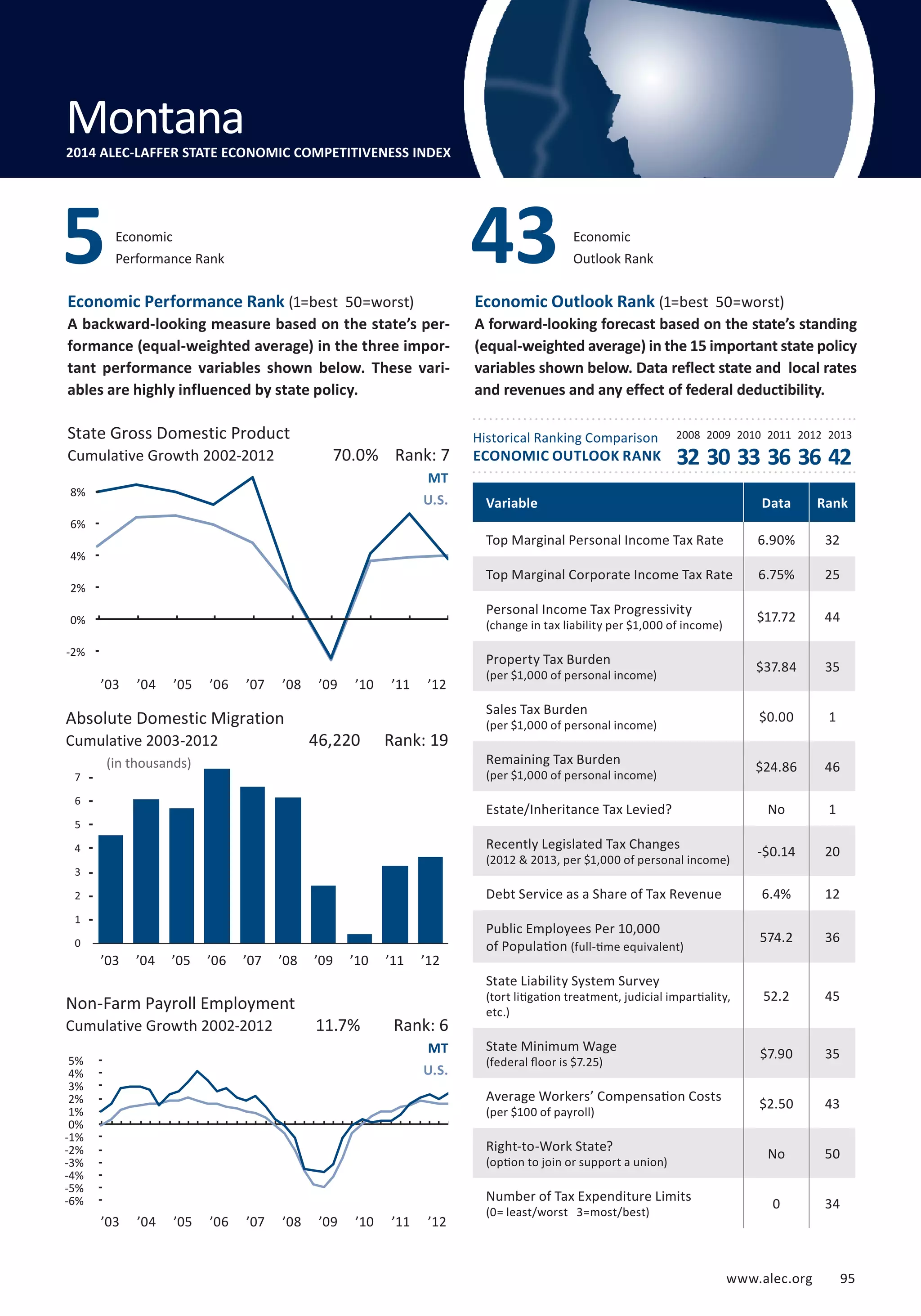
economic performance rankings from that same 
year (backwards looking at the last ten years of 
data). This despite the fact that states like North 
Carolina, Michigan, Kansas, and Wisconsin have 
only recently made big improvements to their 
public policy environments and those changes 
have largely not had an opportunity to improve 
economic performance in those states given that 
policy changes sometimes take time to realize 
their full effect. This is further exacerbated by the 
fact that these rankings look back at a whole de-cade 
of data on economic performance. Even still, 
we see the top ten states in our economic outlook 
index outperforming the bottom ten states on the 
three criteria of the economic performance rank-ings: 
State gross domestic product growth, non-farm 
payroll job growth, and net migration. Table 
17 displays the results. 
To more properly consider this analysis, it 
makes sense to look at past economic outlook 
rankings and compare them to recent economic 
performance rankings. In table 18, we took the 
top and bottom ten economic performance rank- 
State GSP 
Growth Migration Job 
Growth 
Utah 74.9 63,532 17.7 
South Dakota 53.8 16,932 9.8 
Indiana 43.1 -27,203 0.5 
North Dakota 125.1 10,441 32.2 
Idaho 54.5 94,969 9.7 
North Carolina 50.9 642,378 5.2 
Arizona 50.7 618,037 9.0 
Nevada 61.4 273,594 8.3 
Georgia 38.1 485,993 2.2 
Wyoming 99.5 29,112 16.6 
Average Top 10 65.2 220,770 11.1 
State GSP 
Growth Migration Job 
Growth 
Rhode Island 33.6 -63,806 -3.3 
Oregon 66.2 166,474 3.7 
Montana 70.0 46,200 11.7 
Connecticut 35.8 -117,924 -0.9 
New Jersey 34.8 -491,479 -1.4 
Minnesota 46.2 -64,954 3.0 
California 44.4 -1,429,475 0.4 
Illinois 39.7 -623,467 -1.6 
Vermont 39.4 -5,973 2.4 
New York 46.6 -1,527,359 4.4 
Average Bottom 10 45.7 -411,176 1.8 
Source: Bureau of Economic Analysis, U.S. Census Bureau, Bureau of Labor Statistics
CHAPTER THREE 
TABLE 18 | Past Rich States, Poor States Economic Outlook Rankings Compared to Current Performance 
Top 10 States Bottom 10 States 
State GSP 
Growth Migration Job 
Growth 
Utah 74.9 63,532 17.7 
South Dakota 53.8 16,932 9.8 
Arizona 50.7 618,037 9.0 
Colorado 46.9 206,484 7.1 
Wyoming 99.5 29,112 16.6 
Virginia 53.3 139,202 7.1 
Tennessee 43.5 282,763 2.3 
Georgia 38.1 485,993 2.2 
Nevada 61.4 273,594 8.3 
Idaho 54.5 94,969 9.7 
Average Top 10 57.7 221,062 9.0 
Source: Bureau of Economic Analysis, U.S. Census Bureau, Bureau of Labor Statistics 
62 Rich States, Poor States 
State GSP 
Growth Migration Job 
Growth 
Hawaii 61.8 -26,409 8.7 
Pennsylvania 41.7 -26,848 1.9 
California 44.4 -1,429,475 0.4 
Illinois 39.7 -623,467 -1.6 
Ohio 28.0 -365,002 -4.7 
Maine 34.2 12,953 -1.6 
Rhode Island 33.6 -63,806 -3.3 
New Jersey 34.8 -491,479 -1.4 
Vermont 39.4 -5,973 2.4 
New York 46.6 -1,527,359 4.4 
Average Bottom 10 40.4 -454,687 0.5 
ing states from an average of the first three years 
for the index: 2008-2010. We then compared 
those states that most constantly performed near 
the top or bottom from 2008-2010 and looked at 
their economic outlook rankings from the most 
recent version of Rich States, Poor States. As in 
the chart before, the results are clear: States that 
embrace a low tax, low regulation, and limited 
government public policy agenda have outper-formed 
their competitors over the last decade. 
Moving beyond a simple review of the data 
to a more high powered statistical analysis, the 
facts still favor the importance of Rich States, 
Poor States. Two empirical research economists, 
Dr. Randall Pozdena and Dr. Eric Fruits, analyzed 
the Rich States, Poor States economic outlook 
rankings in a recent publication titled “Tax Myths 
Debunked.”88 They compared the economic out-look 
rankings to the Philadelphia Federal Reserve 
Bank’s index of state economic health using vari-ous 
time parameters. They found that depending 
on timing, Rich States, Poor States explains be-tween 
25 percent and 40 percent of the variation 
in state economic health. Given the incredible 
number of determinants of state economic per-formance, 
this is a sizable statistical result. 
The totality of these results should be of no 
surprise to any student of economics, particularly 
those familiar with the international connection 
between economic freedom and economic per-formance. 
Data and theory suggest that states 
that embrace low taxes, moderate regulations, 
and limited government outcompete their big 
government counterparts. It should be of no sur-prise: 
When government puts more money in 
the pockets of employees and citizens and cuts 
the red tape that encroaches on seemingly every 
action, firms can grow, hire, offer pay raises, and 
generate wealth to be shared. 
Conclusion 
Everyone’s familiar with the popular TV ad that 
reminds us, “When insurance companies com-pete, 
you win.” The same is true of states, cities, 
and countries. 
But progressives—they used to be called 
“liberals”—don’t like competition very much. 
Perhaps that is because their ideas don’t work 
when they are put to the test. Progressives obvi-ously 
don’t want to have to compete in races they 
can’t win. It must be infuriating for our progres-sive 
friends in states like Connecticut, Massachu-setts, 
New Jersey, and New York to learn that their 
states are attracting fewer new people than states 
that they have long ridiculed as backwaters or
RACE TO THE TOP 
FIGURE 14 | Higher ALEC-Laffer Ranks Are Associated with Higher State Performance Ranks 
2008 Fed Rank 
2009 Fed Rank 
2010 Fed Rank 
2011 Fed Rank 
2012 Fed Rank 
2012 Regression 
2012 Correlation 
www.alec.org 63 
50 40 30 20 10 0 
fly over country, such as Alabama and Arkansas. 
Massachusetts, New York, and Rhode Island had 
less population growth than the nation’s poor-est 
state, Mississippi. It’s a slow bleed, so in short 
time spans it is sometimes not immediately no-ticeable. 
However, over a decade or two, or three, 
the compounding effect of differential growth 
rates makes a big difference in living standards 
and economic vitality. 
The term progressive is rooted in the word 
“progress.” Yet what is happening in “progressive 
states” is anything but progress when it comes to 
competing for jobs, talent, and businesses. The pro-gressive 
states are falling behind. 
What we have prescribed in this book is not 
0 
10 
20 
30 
40 
50 
a race to the bottom, but a race to the top. We 
believe America is the best hope for the world, a 
beacon of freedom for others to be guided by. Our 
nation and the 50 states should be global lead-ers 
in the race toward prosperity and eliminating 
poverty and deprivation. As we have said in these 
pages and in many previous editions of this book, 
the dream is to make poor people richer, not rich 
people poorer, and to make Detroit and Newark 
look more like Austin or Orlando, not vice versa. 
Our hope is that we have provided governors, 
legislators, mayors, and all public officials with a 
GPS guide to drive us all to a more prosperous 
future—and to stay there. 
Philadelphia Fed State Performance Rank, 2008-2012 
Source: Tax Myths Debunked, American Legislative Exchange Council
CHAPTER THREE 
(ENDNOTES) 
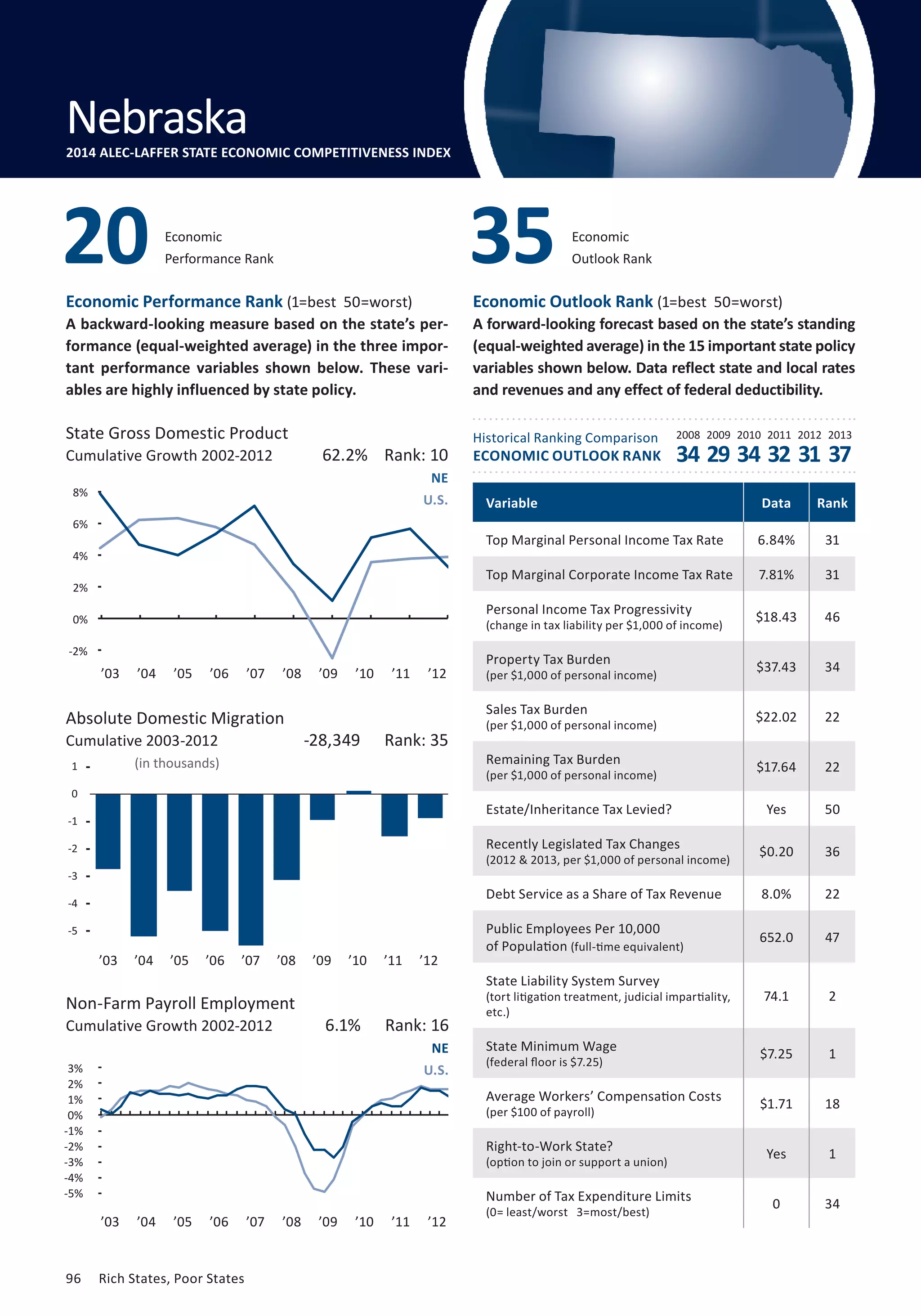
1 Tanner, Michael, and Hughes, Charles. “The Work Versus Welfare Trade-Off: 2013.” The Cato Institute. August 19, 2013. 
2 Moore, Stephen, and Simon, Julian. ”Communism, Capitalism, and Economic Development: Implications for U.S. Economic As-sistance.” 
The Backgrounder, No. 741. December 8, 1989. 
3 International Monetary Fund. “World Economic Outlook Database.” April 2014. 
4 Ibid. 
5 Kim, Anthony. “Advancing Freedom: The Path to Greater Development and Progress.” Heritage Foundation. November 2014. 
Also see: Lawson, Robert. “Economic Freedom.” The Concise Encyclopedia of Economics. December 2007. Also see: Hanke, 
Steve, and Walters, Stephen. “Economic Freedom, Prosperity, and Equality: A Survey.” Cato Journal. Fall 1997. Also see: Gwart-ney, 
James, Lawson, Robert, and Hall, Joshua. “The Relationship between Economic Freedom and Economic Well-Being.” Fall 
2013. 
6 McBride, William. “What Is the Evidence on Taxes and Growth?” Tax Foundation. December 18, 2012. Also see: McBride, Wil-liam. 
“Empirical Evidence on Taxes and Growth: A Response to CBPP” Tax Foundation. February 21, 2014. 
7 Malm, Liz, and Prante, Gerald. “Annual State-Local Tax Burden Ranking FY 2011.” Tax Foundation. April 2, 2014. 
8 Vedder, Richard. “Taxation and Migration.” The Taxpayers Network. March 2003. 
9 Gaiser, T. Elliot. “Chart of the Week: Union Membership Continues to Decline.” The Daily Signal. January 27, 2013. 
10 Hicks, Michael, and LaFaive, Michael. “Research on the Economic Effects of Right-to-Work.” Mackinac Center for Public Policy. 
August 27, 2013. Also see: Fruits, Eric, and Pozdena, Randall. “Right to Work is Right for Oregon: A Comprehensive Analysis of 
the Economic Benefits from Enacting a Right-to-Work Law.” Cascade Policy Institute. February 2012. 
11 Hicks, Michael, and LaFaive, Michael. “Economic Growth and Right-to-Work Laws.” Mackinac Center for Public Policy. August 28, 
2013. Also see: Fruits, Eric, and Pozdena, Randall. “Right to Work is Right for Oregon: A Comprehensive Analysis of the Economic 
Benefits from Enacting a Right-to-Work Law.” Cascade Policy Institute. February 2012. 
12 Schelzig, Erik, and Krisher, Tom. “United Auto Workers Union Rejected by Volkswagen Workers at Tennessee Plant.” Associated 
Press.” February 14, 2014. 
13 Laffer, Arthur B., Moore, Stephen, Sinquefield, Rex A.,  Brown, Travis H. “An Inquiry into the Nature and Causes of the Wealth 
of States.” Wiley. 2014. 
14 Wagner, Richard. “Federal Transfer Taxation: A Study in Social Cost.” Institute for Research on Economic Taxation.1993. 
15 Holtz-Eakin, Douglas, and Marples, Donald. “Estate Taxes, Labor Supply, and Economic Efficiency.” American Council for Capital 
Formation. January 1, 2001. 
16 Summers, Lawrence, and Kotlikoff, Lawrence. “The Contribution of Intergenerational Transfers to Total Wealth: A Reply.” Na-tional 
Bureau of Economic Research. February 1986. 
17 Freeland, William, and Portu, Matt. “The Death Tax—Taxes on Death.” American Legislator. September 12, 2013. 
18 Francis, Norton. “Back From the Dead: State Estate Taxes After the Fiscal Cliff.” Tax Policy Center. November 14, 2012. 
19 Wall Street Journal Editorial Board. “The Die Harder States.” Wall Street Journal. August 20, 2013. 
20 Block, David, and Drenkard, Scott. “The Estate Tax: Even Worse Than Republicans Say.” Tax Foundation. August 29, 2012. 
21 Freeland, William, and Portu, Matt. “The Death Tax—Taxes on Death.” American Legislator. September 12, 2013. Author’s calcu-lations 
based on data from the Census Bureau and Governing Institute. 
22 Wall Street Journal Editorial Board. “Senator Snowbird, RIP.” Wall Street Journal. May 3, 2008. 
23 Banaian, King, Nelson, Peter, and Testa, Patrick. “Changes to Minnesota Gift and Estate Taxes: What Uncle Sam Gives, Minnesota 
Takes Away.” Center of the American Experiment. August 12, 2013. 
24 Bakija, Jon, and Slemrod, Joel. “Do the Rich Flee from High State Taxes? Evidence from Federal Estate Tax Returns.” National 
Bureau of Economic Research. July 2004. 
25 Spector, Joseph. “Million Dollar Incomes Rise in N.Y.” Democrat  Chronicle. January 26, 2014. 
26 Sager, R.h. “Rich New Yorkers May Flee Following Changes in Taxes on Estates of the Wealthy.” New York Sun. May 31, 2002. 
27 American Legislative Exchange Council Model Policy. “ALEC Principles of Taxation.” American Legislative Exchange Council Tax 
and Fiscal Task Force. June 3, 2010. 
28 Freeland, William. “How We Should Think About Income Inequality.” American Legislator. January 28, 2014. Also see: Winship, 
Scott. “Inequality Testimony before the Joint Economic Committee.” E21 at the Manhattan Institute. January 15, 2014. See also: 
Burkhauser, Richard, Armour, Philip, and Larrimore, Jeff. “Levels and Trends in United States Income and Its Distribution A Cross-walk 
from Market Income Towards a Comprehensive Haig-Simons Income Approach.” National Bureau of Economic Research. 
June 2013. See also: Fruits, Eric, and Pozdena, Randall. “Tax Myths Debunked.” American Legislative Exchange Council. February 
2013. 
29 Chetty, Raj, Hendren, Nathaniel, and Kline, Patrick, et al. “Is the United States Still a Land of Opportunity? Recent Trends in 
Intergenerational Mobility.” National Bureau of Economic Research. January 2014. 
30 National Bureau for Economic Research. “Maximum State Income Tax Rates 1977-2011.” 
31 Knittel, Matthew, Nelson, Susan, and DeBacker, Jason, et al. “Methodologies to Identify Small Businesses and Their Owners.” 
Office of Tax Analysis of the Department of Treasury. August 2011. 
64 Rich States, Poor States
RACE TO THE TOP 
32 Cardwell, Diane. “Mayor Says New York is Worth the Cost.” The New York Times, January 3, 2003. 
33 Smitherman, Laura. “Md. Lost nearly 30% of millionaires last year.” The Baltimore Sun. November 24, 2009. 
34 Wall Street Journal Editorial Board. “Millionaires Go Missing: Maryland’s fleeced taxpayers fight back.” The Wall Street Journal. 
www.alec.org 65 
May 27, 2009. 
35 Davis, Carl, Davis, Kelly, and Gardner, Matthew, et al. “Who Pays? A Distributional Analysis of the Tax Systems in All 50 States.” 
Institute for Taxation and Economic Policy. January 2013. 
36 Malm, Liz. “Comments on Who Pays? A Distributional Analysis of the Tax Systems in All 50 States.” Tax Foundation. February 20, 
2013. 
37 U.S. Census Bureau, 2012 Annual Survey of State Government Finances, 
38 Organization for Economic Co-Operation and Development. “Growing Unequal? Income Distribution and Poverty in OECD Coun-tries.” 
Organization for Economic Co-Operation and Development. October 2008. 
39 Malm, Liz. “Comments on Who Pays? A Distributional Analysis of the Tax Systems in All 50 States.” Tax Foundation. February 20, 
2013. 
40 Prante, Gerald, and Hodge, Scott. “The Distribution of Tax and Spending Policies in the United States.” Tax Foundation. Novem-ber 
8, 2013. 
41 Institute on Taxation and Economic Policy and U.S. Census Bureau. 
42 Neumark, David, and Wascher, William. “Minimum Wages.” MIT Press. August 14, 2010. 
43 Caplan, Brian. “’Wages Must Fall!’: What All Good Keynesians Should Say.” Econlog. December 15, 2011. 
44 Congressional Budget Office. “The Effect of a Minimum-Wage Increase on Employment and Family Income.” February 18, 2014. 
45 Troy, Leo. “Freedom of Choice, Business Climates, and Right to Work Laws.” National Institute for Labor Relations Research. 2006. 
46 Neumark, David, and Wascher, William. “Employment Effects of Minimum and Subminimum Wages: panel Data on State Mini-mum 
Wage Laws.” Industrial and Labor Relations Review. October 1992. 
47 Meer, Jonathan and West, Jeremy. “Effects of the Minimum Wage on Employment Dynamics.” Texas AM University. December 
2013. 
48 Wilterdink, Ben. “California Raising the Minimum Wage and the Economic Consequences.” American Legislator. October 28, 
2013. 
49 Wilson, Mark. “The Negative Effects of Minimum Wage Laws.” The Cato Institute. June 21, 2012. 
50 Freeland, William. “Minimum Wages: Few Benefits, Many Consequences.” American Legislator. February 10, 2014. 
51 Aaronson, Daniel, Eric French and James MacDonald. “The Minimum Wage, Restaurant Prices, and Labor Market Structure.” 
Federal Reserve Bank of Chicago. August 2007. 
52 .Stephen Moore and Dean Stansel, “Tax Cuts and Balanced Budgets: Lessons from the States.” Cato Institute, September 17, 
1996. 
53 Jones, Tim. “Illinois Lawmakers Pass 67% Income Tax Increase.” Bloomberg. January 12, 2011. 
54 “Neighboring States Gleeful Over Illinois Tax Increase.” Associated Press. January 12, 2011. 
55 Baar Topinka, Judy. “Bill Backlog Drops…For Now.” The Illinois State Comptroller’s Quarterly. July 2013. 
56 Dabrowski, Ted. “llinois has Lowest Credit Rating of all 50 States.” Illinois Policy Institute. November 19, 2013. 
57 Ibid. 
58 “Moody’s downgrades State of Illinois’ $27 billion of General Obligation Bonds to A3 from A2.” Moody’s Investor Service. June 6, 
2013. 
59 Petek, Gabriel, and Hitchcock, David. “Global Credit Portal. Ratings Direct. Washington; Appropriations, General Obligations.” 
Standard  Poor’s. January 27, 2012. 
60 Reuters. “Illinois’ unfunded pension liability rose in FY 2013-report.” Reuters. December 4, 2013. Also see: Dabrowski, Ted. 
“Moody’s: Illinois FY 2012 pension shortfall jumps to $187 billion.” Illinois Policy Institute. February 28, 2014. 
61 Wilterdink, Ben, and Williams, Jonathan. “State Tax Cut Roundup: 2013 Legislative Session.” American Legislative Exchange 
Council. November 2013. 
62 Malm, Liz, and Borean, Liz. “Monday Map: State Credit Ratings.” Tax Foundation. November 11, 2013. 
63 VanMetre, Ben. “Two-year Anniversary of 2011 Tax Hike Nothing to Celebrate.” Illinois Policy Institute. December 31, 2012. 
64 “Income Taxation in Indiana: Concepts and Issues.” Indiana Fiscal Policy Institute. 
65 “The 2012-2014 Illinois State Sales Tax.” Tax-Rates.org. 
66 “State Individual Income Tax Rates, 2000-2014.” Tax Foundation. April 1, 2013. 
67 Skorup, Jarrett. “Detroit: The Triumph of Progressive Public Policy.” Michigan Capitol Confidential. February 14, 2012. 
68 Hartgen, David, Karanam, Ravi, and Fields, Gregory, et al. “19th Annual Report on the Performance of State Highway Systems 
(1984-2008).” Reason Foundation. September 2010. 
69 Laffer, Arthur B., Moore, Stephen, Sinquefield, Rex A.,  Brown, Travis H. “An Inquiry into the Nature and Causes of the Wealth 
of States.” Wiley, page 232. 2014.
CHAPTER THREE 
70 Ibid. 
71 U.S. Department of Education, National Assessment of Educational Progress (NAEP) test score 
72 Laffer, Arthur B., Moore, Stephen, Sinquefield, Rex A.,  Brown, Travis H. “An Inquiry into the Nature and Causes of the Wealth 
of States.” Wiley, page 232. 2014. 
73 Ibid. 
74 Henrichson, Christina, and, Delany, Ruth. “The Price of Prisons: What Incarceration Costs Taxpayers.” Vera Institute of Justice. 
February 29, 2012. 
75 Laffer, Arthur B., Moore, Stephen, Sinquefield, Rex A.,  Brown, Travis H. “An Inquiry into the Nature and Causes of the Wealth 
of States.” Wiley, page 232. 2014. 
76 Ibid. 
77 California Fair Political Practices Commission. “Big Money Talks.” California Fair Political Practices Commission. March 2010. 
78 U.S. Census Bureau. 2011 Annual Surveys of State and Local Government Finances. Also see: U.S. Census Bureau population 
estimates for 2011. 
79 Short, Kathleen. “Current Population Report: The Research Supplemental Poverty Measure.” U.S. Census Bureau. November 
2013. 
80 Bishaw, Alemayehu. “Poverty: 2000 to 2012. American Community Survey Briefs.” U.S. Census Bureau. September 2013. 
81 Short, Kathleen. “Current Population Report: The Research Supplemental Poverty Measure.” U.S. Census Bureau. November 
2013. 
82 “Digest of Education Statistics.” U.S. Department of Education, National Center for Education Statistics, page 172. 1997. 
83 “Fast Facts.” U.S. Department of Education, National Center for Education Statistics. 
84 Coulson, Andrew. “State Education Trends: Academic Performance and Spending over the Past 40 Years.” Cato Institute. March 
18, 2014. 
85 U.S. Census Bureau. 2011 Public Education Finances Report. Also see: The College Board. 
86 Zinsmeister, Karl. “The Charter School Performance Breakout.” The Wall Street Journal. March 28, 2014. 
87 .John Chubb and Terry Moe. “Letting Schools Work.” NY: The City Journal, Autumn 1990. 
88 Fruits, Eric, and Pozdena, Randall. “Tax Myths Debunked.” American Legislative Exchange Council. February 2013. 
66 Rich States, Poor States
www.alec.org 67 
Salt Lake City, Utah 
State Rankings 
4 CHAPTER
State Rankings 
he Economic Outlook Ranking is a forecast based on a state’s current standing in 15 state policy vari-ables. 
Each of these factors is influenced directly by state lawmakers through the legislative process. 
Generally speaking, states that spend less—especially on income transfer programs, and states that tax 
T 
less—particularly on productive activities such as working or investing—experience higher growth rates than 
states that tax and spend more. 
The Economic Performance Ranking is a backward-looking measure based on a state’s performance on three 
important variables: State Gross Domestic Product, Absolute Domestic Migration, and Non-Farm Payroll Employ-ment— 
all of which are highly influenced by state policy. This ranking details states’ individual performances over 
Table 1 | ALEC-Laffer State Economic Outlook Rankings, 2014 
Based upon equal-weighting of each state’s rank in 15 policy variables 
Rank State 
1 Utah 
2 South Dakota 
3 Indiana 
4 North Dakota 
5 Idaho 
6 North Carolina 
7 Arizona 
8 Nevada 
9 Georgia 
10 Wyoming 
11 Virginia 
12 Michigan 
13 Texas 
14 Mississippi 
15 Kansas 
16 Florida 
17 Wisconsin 
18 Alaska 
19 Tennessee 
20 Alabama 
21 Oklahoma 
22 Colorado 
23 Ohio 
24 Missouri 
25 Iowa 
68 Rich States, Poor States 
Rank State 
26 Arkansas 
27 Delaware 
28 Massachusetts 
29 Louisiana 
30 West Virginia 
31 South Carolina 
32 New Hampshire 
33 Pennsylvania 
34 Maryland 
35 Nebraska 
36 Hawaii 
37 New Mexico 
38 Washington 
39 Kentucky 
40 Maine 
41 Rhode Island 
42 Oregon 
43 Montana 
44 Connecticut 
45 New Jersey 
46 Minnesota 
47 California 
48 Illinois 
49 Vermont 
50 New York 
the past 10 years based on this economic data.
2014 ALEC-LAFFER STATE ECONOMIC COMPETITIVENESS INDEX 
Rank State State Gross Domestic Product Absolute Domestic Migration Non-Farm Payroll 
1 Texas 4 1 3 
2 Utah 5 18 2 
3 Wyoming 2 21 4 
4 North Dakota 1 26 1 
5 Montana 7 19 6 
6 Washington 13 9 11 
7 Nevada 12 8 13 
8 Arizona 23 4 9 
9 Oklahoma 9 17 12 
10 Idaho 16 14 8 
11 Alaska 3 30 5 
12 North Carolina 22 3 17 
13 Oregon 8 11 23 
14 Virginia 19 12 15 
15 South Dakota 17 24 7 
16 Colorado 26 10 14 
17 Hawaii 11 31 10 
18 West Virginia 14 22 18 
19 Florida 31 2 25 
20 Nebraska 10 35 16 
21 Arkansas 25 15 26 
22 South Carolina 37 6 24 
23 New Mexico 24 23 20 
24 Iowa 15 34 19 
25 Tennessee 33 7 33 
26 Delaware 21 20 37 
27 Georgia 42 5 34 
28 Kentucky 35 16 30 
29 Louisiana 6 44 31 
30 Alabama 27 13 41 
31 Maryland 18 42 22 
32 Kansas 20 38 29 
33 Minnesota 29 40 27 
34 New Hampshire 41 27 28 
35 New York 28 50 21 
36 Vermont 40 29 32 
37 Pennsylvania 36 32 35 
38 Indiana 34 33 38 
39 Mississippi 30 36 44 
40 Missouri 46 28 42 
41 Massachusetts 38 43 36 
42 Maine 47 25 46 
43 California 32 49 39 
44 Wisconsin 43 37 40 
45 Connecticut 44 41 43 
46 Illinois 39 48 47 
47 Rhode Island 48 39 48 
48 New Jersey 45 46 45 
49 Ohio 49 45 49 
50 Michigan 50 47 50 
www.alec.org 69 
Table 2 | ALEC-Laffer State Economic Performance Rankings, 2002-2012
Alabama 
2014 ALEC-LAFFER STATE ECONOMIC COMPETITIVENESS INDEX 
Connecticut 
30 20 Outlook Rank Economic 
Economic Performance Rank (1=best 50=worst) 
A backward-looking measure based on the state’s per-formance 
10% 
8% 
6% 
4% 
2% 
0% 
-2% 
-4% 
(equal-weighted average) in the three impor-tant 
performance variables shown below. These vari-ables 
are highly influenced by state policy. 
Absolute Domestic Migration 
Cumulative 2003-2012 
40 
35 
30 
25 
20 
15 
10 
5 
0 
-5 
-10 
-15 
AL 
U.S. 
’03 ’04 ’05 ’06 ’07 ’08 ’09 ’10 ’11 ’12 
Non-Farm Payroll Employment 
Cumulative Growth 2002-2012 
3% 
2% 
1% 
0% 
-1% 
-2% 
-3% 
-4% 
-5% 
-6% 
70 Rich States, Poor States 
Economic 
Performance Rank 
’03 ’04 ’05 ’06 ’07 ’08 ’09 ’10 ’11 ’12 
’03 ’04 ’05 ’06 ’07 ’08 ’09 ’10 ’11 ’12 
Variable Data Rank 
Top Marginal Personal Income Tax Rate 4.02% 12 
Top Marginal Corporate Income Tax Rate 4.23% 6 
Personal Income Tax Progressivity 
-$1.76 1 
(change in tax liability per $1,000 of income) Property Tax Burden 
$15.65 1 
(per $1,000 of personal income) Sales Tax Burden 
$24.02 29 
(per $1,000 of personal income) Remaining Tax Burden 
$24.13 43 
(per $1,000 of personal income) Estate/Inheritance Tax Levied? No 1 
Recently Legislated Tax Changes 
-$0.30 19 
(2012  2013, per $1,000 of personal income) Debt Service as a Share of Tax Revenue 8.1% 23 
Public Employees Per 10,000 
of Population 592.5 40 
(full-time equivalent) 
State Liability System Survey 
(tort litigation treatment, judicial impartiality, 
etc.) 
52.8 43 
State Minimum Wage 
(federal floor is $7.25) $7.25 1 
Average Workers’ Compensation Costs 
(per $100 of payroll) $1.97 30 
Right-to-Work State? 
(option to join or support a union) Yes 1 
Number of Tax Expenditure Limits 
(0= least/worst 3=most/best) 0 34 
State Gross Domestic Product 
Cumulative Growth 2002-2012 46.6% Rank: 27 
Economic Outlook Rank (1=best 50=worst) 
A forward-looking forecast based on the state’s standing 
(equal-weighted average) in the 15 important state policy 
variables shown below. Data reflect state and local rates 
and revenues and any effect of federal deductibility. 
Historical Ranking Comparison 
ECONOMIC OUTLOOK RANK 
104,239 Rank: 13 
0.1% Rank: 41 
AL 
U.S. 
2008 2009 2010 2011 2012 2013 
15 16 17 20 21 17 
(in thousands) 
-7%
www.alec.org 71 
Alaska 
2014 ALEC-LAFFER STATE ECONOMIC COMPETITIVENESS INDEX 
Delaware 
11Economic 
Performance Rank 
15% 
10% 
5% 
0% 
-5% 
-10% 
-15% 
’03 ’04 ’05 ’06 ’07 ’08 ’09 ’10 ’11 ’12 
Absolute Domestic Migration 
Cumulative 2003-2012 
30 
20 
10 
0 
-10 
-20 
-30 
-40 
’03 ’04 ’05 ’06 ’07 ’08 ’09 ’10 ’11 ’12 
Non-Farm Payroll Employment 
Cumulative Growth 2002-2012 
18 
Variable Data Rank 
Top Marginal Personal Income Tax Rate 0.00% 1 
Top Marginal Corporate Income Tax Rate 9.40% 43 
Personal Income Tax Progressivity 
$0.00 2 
(change in tax liability per $1,000 of income) Property Tax Burden 
$44.29 42 
(per $1,000 of personal income) Sales Tax Burden 
$9.92 5 
(per $1,000 of personal income) Remaining Tax Burden 
$14.96 8 
(per $1,000 of personal income) Estate/Inheritance Tax Levied? No 1 
Recently Legislated Tax Changes 
-$20.67 1 
(2012  2013, per $1,000 of personal income) Debt Service as a Share of Tax Revenue 5.9% 8 
Public Employees Per 10,000 
of Population 753.2 49 
(full-time equivalent) 
State Liability System Survey 
(tort litigation treatment, judicial impartiality, 
etc.) 
69.1 13 
State Minimum Wage 
(federal floor is $7.25) $7.75 34 
Average Workers’ Compensation Costs 
(per $100 of payroll) $3.01 50 
Right-to-Work State? 
(option to join or support a union) No 50 
Number of Tax Expenditure Limits 
(0= least/worst 3=most/best) 1 14 
State Gross Domestic Product 
Cumulative Growth 2002-2012 
Economic 
Outlook Rank 
Economic Performance Rank (1=best 50=worst) 
A backward-looking measure based on the state’s per-formance 
(equal-weighted average) in the three impor-tant 
performance variables shown below. These vari-ables 
are highly influenced by state policy. 
Economic Outlook Rank (1=best 50=worst) 
A forward-looking forecast based on the state’s standing 
(equal-weighted average) in the 15 important state policy 
variables shown below. Data reflect state and local rates 
and revenues and any effect of federal deductibility. 
AK 
U.S. 
AK 
U.S. 
Historical Ranking Comparison 
ECONOMIC OUTLOOK RANK 
2008 2009 2010 2011 2012 2013 
37 38 22 29 29 21 
(in thousands) 
-50 
4% 
3% 
2% 
1% 
0% 
-1% 
-2% 
-3% 
-4% 
-5% 
-6% 
79.5% Rank: 3 
-7,930 Rank: 30 
12.8% Rank: 5 
’03 ’04 ’05 ’06 ’07 ’08 ’09 ’10 ’11 ’12
Arizona 
2014 ALEC-LAFFER STATE ECONOMIC COMPETITIVENESS INDEX 
Connecticut 
8Economic 
Performance Rank 
AZ 
U.S. 
’03 ’04 ’05 ’06 ’07 ’08 ’09 ’10 ’11 ’12 
’03 ’04 ’05 ’06 ’07 ’08 ’09 ’10 ’11 ’12 
12% 
10% 
8% 
6% 
4% 
2% 
0% 
-2% 
-4% 
-6% 
-8% 
160 
140 
120 
100 
80 
60 
40 
20 
Non-Farm Payroll Employment 
Cumulative Growth 2002-2012 
’03 ’04 ’05 ’06 ’07 ’08 ’09 ’10 ’11 ’12 
8% 
6% 
4% 
2% 
0% 
-2% 
-4% 
-6% 
-8% 
72 Rich States, Poor States 
7 
Variable Data Rank 
Top Marginal Personal Income Tax Rate 4.54% 13 
Top Marginal Corporate Income Tax Rate 6.50% 21 
Personal Income Tax Progressivity 
$10.60 31 
(change in tax liability per $1,000 of income) Property Tax Burden 
$31.72 27 
(per $1,000 of personal income) Sales Tax Burden 
$36.69 45 
(per $1,000 of personal income) Remaining Tax Burden 
$12.80 3 
(per $1,000 of personal income) Estate/Inheritance Tax Levied? No 1 
Recently Legislated Tax Changes 
-$0.55 12 
(2012  2013, per $1,000 of personal income) Debt Service as a Share of Tax Revenue 11.6% 46 
Public Employees Per 10,000 
of Population 431.8 2 
(full-time equivalent) 
State Liability System Survey 
(tort litigation treatment, judicial impartiality, 
etc.) 
66.8 17 
State Minimum Wage 
(federal floor is $7.25) $7.90 35 
Average Workers’ Compensation Costs 
(per $100 of payroll) $1.61 14 
Right-to-Work State? 
(option to join or support a union) Yes 1 
Number of Tax Expenditure Limits 
(0= least/worst 3=most/best) 2 3 
State Gross Domestic Product 
Cumulative Growth 2002-2012 50.7% Rank: 23 
Absolute Domestic Migration 
Cumulative 2003-2012 
Economic 
Outlook Rank 
Economic Performance Rank (1=best 50=worst) 
A backward-looking measure based on the state’s per-formance 
(equal-weighted average) in the three impor-tant 
performance variables shown below. These vari-ables 
are highly influenced by state policy. 
Economic Outlook Rank (1=best 50=worst) 
A forward-looking forecast based on the state’s standing 
(equal-weighted average) in the 15 important state policy 
variables shown below. Data reflect state and local rates 
and revenues and any effect of federal deductibility. 
Historical Ranking Comparison 
ECONOMIC OUTLOOK RANK 
618,037 Rank: 4 
9.0% Rank: 9 
AZ 
U.S. 
2008 2009 2010 2011 2012 2013 
6 3 3 12 9 6 
(in thousands) 
0 
-10%
www.alec.org 73 
Arkansas 
2014 ALEC-LAFFER STATE ECONOMIC COMPETITIVENESS INDEX 
Delaware 
21 Economic 
8% 
6% 
4% 
2% 
0% 
-2% 
-4% 
Performance Rank 
’03 ’04 ’05 ’06 ’07 ’08 ’09 ’10 ’11 ’12 
Absolute Domestic Migration 
Cumulative 2003-2012 
25 
20 
15 
10 
5 
0 
’03 ’04 ’05 ’06 ’07 ’08 ’09 ’10 ’11 ’12 
Non-Farm Payroll Employment 
Cumulative Growth 2002-2012 
26 
Variable Data Rank 
Top Marginal Personal Income Tax Rate 7.00% 35 
Top Marginal Corporate Income Tax Rate 6.50% 21 
Personal Income Tax Progressivity 
$14.42 40 
(change in tax liability per $1,000 of income) Property Tax Burden 
$18.72 4 
(per $1,000 of personal income) Sales Tax Burden 
$37.70 46 
(per $1,000 of personal income) Remaining Tax Burden 
$18.17 26 
(per $1,000 of personal income) Estate/Inheritance Tax Levied? No 1 
Recently Legislated Tax Changes 
$0.92 43 
(2012  2013, per $1,000 of personal income) Debt Service as a Share of Tax Revenue 5.3% 5 
Public Employees Per 10,000 
of Population 598.1 41 
(full-time equivalent) 
State Liability System Survey 
(tort litigation treatment, judicial impartiality, 
etc.) 
57.2 35 
State Minimum Wage 
(federal floor is $7.25) $7.25 1 
Average Workers’ Compensation Costs 
(per $100 of payroll) $1.19 3 
Right-to-Work State? 
(option to join or support a union) Yes 1 
Number of Tax Expenditure Limits 
(0= least/worst 3=most/best) 1 14 
State Gross Domestic Product 
Cumulative Growth 2002-2012 
Economic 
Outlook Rank 
Economic Performance Rank (1=best 50=worst) 
A backward-looking measure based on the state’s per-formance 
(equal-weighted average) in the three impor-tant 
performance variables shown below. These vari-ables 
are highly influenced by state policy. 
Economic Outlook Rank (1=best 50=worst) 
A forward-looking forecast based on the state’s standing 
(equal-weighted average) in the 15 important state policy 
variables shown below. Data reflect state and local rates 
and revenues and any effect of federal deductibility. 
AR 
U.S. 
AR 
U.S. 
Historical Ranking Comparison 
ECONOMIC OUTLOOK RANK 
2008 2009 2010 2011 2012 2013 
11 12 13 13 11 24 
(in thousands) 
’03 ’04 ’05 ’06 ’07 ’08 ’09 ’10 ’11 ’12 
3% 
2% 
1% 
0% 
-1% 
-2% 
-3% 
-4% 
-5% 
-6% 
47.7% Rank: 25 
80,218 Rank: 15 
3.1% Rank: 26
California 
2014 ALEC-LAFFER STATE ECONOMIC COMPETITIVENESS INDEX 
Connecticut 
43Economic 47 
State Gross Domestic Product 
Cumulative Growth 2002-2012 
10% 
8% 
6% 
4% 
2% 
0% 
-2% 
-4% 
-6% 
’03 ’04 ’05 ’06 ’07 ’08 ’09 ’10 ’11 ’12 
’03 ’04 ’05 ’06 ’07 ’08 ’09 ’10 ’11 ’12 
0 
-50 
-100 
-150 
-200 
-250 
-300 
Non-Farm Payroll Employment 
Cumulative Growth 2002-2012 
4% 
2% 
0% 
-2% 
-4% 
-6% 
74 Rich States, Poor States 
Historical Ranking Comparison 
ECONOMIC OUTLOOK RANK 
(in thousands) 
2008 2009 2010 2011 2012 2013 
Absolute Domestic Migration 
Cumulative 2003-2012 
44.4% Rank: 32 
CA 
U.S. Variable Data Rank 
Top Marginal Personal Income Tax Rate 13.30% 50 
Top Marginal Corporate Income Tax Rate 8.84% 38 
Personal Income Tax Progressivity 
$37.80 50 
(change in tax liability per $1,000 of income) Property Tax Burden 
$32.65 28 
(per $1,000 of personal income) Sales Tax Burden 
$24.47 31 
(per $1,000 of personal income) Remaining Tax Burden 
$19.20 28 
(per $1,000 of personal income) Estate/Inheritance Tax Levied? No 1 
Recently Legislated Tax Changes 
$4.03 49 
(2012  2013, per $1,000 of personal income) Debt Service as a Share of Tax Revenue 10.4% 39 
Public Employees Per 10,000 
of Population 466.1 4 
(full-time equivalent) 
State Liability System Survey 
(tort litigation treatment, judicial impartiality, 
etc.) 
50.6 47 
State Minimum Wage 
(federal floor is $7.25) $8.00 39 
Average Workers’ Compensation Costs 
(per $100 of payroll) $2.92 48 
Right-to-Work State? 
(option to join or support a union) No 50 
Number of Tax Expenditure Limits 
(0= least/worst 3=most/best) 2 3 
-1,429,475 Rank: 49 
0.4% Rank: 39 
CA 
U.S. 
’03 ’04 ’05 ’06 ’07 ’08 ’09 ’10 ’11 ’12 
42 43 46 47 38 47 
Economic 
Outlook Rank 
Economic Performance Rank (1=best 50=worst) 
A backward-looking measure based on the state’s per-formance 
(equal-weighted average) in the three impor-tant 
performance variables shown below. These vari-ables 
are highly influenced by state policy. 
Economic Outlook Rank (1=best 50=worst) 
A forward-looking forecast based on the state’s standing 
(equal-weighted average) in the 15 important state policy 
variables shown below. Data reflect state and local rates 
and revenues and any effect of federal deductibility. 
Performance Rank 
-350 
-8%
Colorado 
2014 ALEC-LAFFER STATE ECONOMIC COMPETITIVENESS INDEX 
Delaware 
Economic 
Outlook Rank 16 Economic 22 
State Gross Domestic Product 2008 2009 2010 2011 2012 2013 
Cumulative Growth 2002-2012 
9 2 2 6 8 16 
www.alec.org 75 
Economic Performance Rank (1=best 50=worst) 
A backward-looking measure based on the state’s per-formance 
(equal-weighted average) in the three impor-tant 
performance variables shown below. These vari-ables 
are highly influenced by state policy. 
Economic Outlook Rank (1=best 50=worst) 
A forward-looking forecast based on the state’s standing 
(equal-weighted average) in the 15 important state policy 
variables shown below. Data reflect state and local rates 
and revenues and any effect of federal deductibility. 
Historical Ranking Comparison 
ECONOMIC OUTLOOK RANK 
10% 
8% 
6% 
4% 
2% 
0% 
-2% 
’03 ’04 ’05 ’06 ’07 ’08 ’09 ’10 ’11 ’12 
Absolute Domestic Migration 
Cumulative 2003-2012 
(in thousands) 
-4% 
46.9% Rank: 26 
CO 
U.S. 
Variable Data Rank 
Top Marginal Personal Income Tax Rate 4.63% 14 
Top Marginal Corporate Income Tax Rate 4.63% 8 
Personal Income Tax Progressivity 
$6.27 20 
(change in tax liability per $1,000 of income) Property Tax Burden 
$38.08 38 
(per $1,000 of personal income) Sales Tax Burden 
$23.91 27 
(per $1,000 of personal income) Remaining Tax Burden 
$14.52 7 
(per $1,000 of personal income) Estate/Inheritance Tax Levied? No 1 
Recently Legislated Tax Changes 
$0.48 40 
(2012  2013, per $1,000 of personal income) Debt Service as a Share of Tax Revenue 11.8% 47 
Public Employees Per 10,000 
of Population 527.0 21 
(full-time equivalent) 
State Liability System Survey 
(tort litigation treatment, judicial impartiality, 
etc.) 
64.2 23 
State Minimum Wage 
(federal floor is $7.25) $8.00 39 
Average Workers’ Compensation Costs 
(per $100 of payroll) $1.42 8 
Right-to-Work State? 
(option to join or support a union) No 50 
Number of Tax Expenditure Limits 
(0= least/worst 3=most/best) 3 1 
Performance Rank 
206,484 Rank: 10 
’03 ’04 ’05 ’06 ’07 ’08 ’09 ’10 ’11 ’12 
CO 
U.S. 
50 
40 
30 
20 
10 
0 
Non-Farm Payroll Employment 
Cumulative Growth 2002-2012 
7.1% Rank: 14 
’03 ’04 ’05 ’06 ’07 ’08 ’09 ’10 ’11 ’12 
-10 
4% 
3% 
2% 
1% 
0% 
-1% 
-2% 
-3% 
-4% 
-5% 
-6%
Outlook Rank 44 
Connecticut 
2014 ALEC-LAFFER STATE ECONOMIC COMPETITIVENESS INDEX 
Economic 
Performance Rank 45 Economic 
Economic Performance Rank (1=best 50=worst) 
A backward-looking measure based on the state’s per-formance 
(equal-weighted average) in the three impor-tant 
performance variables shown below. These vari-ables 
are highly influenced by state policy. 
State Gross Domestic Product 2008 2009 2010 2011 2012 2013 
Cumulative Growth 2002-2012 
10% 40 32 36 35 44 43 
8% 
6% 
4% 
2% 
0% 
-2% 
-4% 
Absolute Domestic Migration 
Cumulative 2003-2012 
0 
-5 
-10 
-15 
-20 
3% 
2% 
1% 
0% 
-1% 
-2% 
-3% 
-4% 
-5% 
76 Rich States, Poor States 
Economic Outlook Rank (1=best 50=worst) 
A forward-looking forecast based on the state’s standing 
(equal-weighted average) in the 15 important state policy 
variables shown below. Data reflect state and local rates 
and revenues and any effect of federal deductibility. 
Historical Ranking Comparison 
ECONOMIC OUTLOOK RANK 
(in thousands) 
-25 
Non-Farm Payroll Employment 
Cumulative Growth 2002-2012 
35.8% Rank: 44 
CT 
U.S. 
-117,924 Rank: 41 
-0.9% Rank: 43 
CT 
U.S. 
Variable Data Rank 
Top Marginal Personal Income Tax Rate 6.70% 30 
Top Marginal Corporate Income Tax Rate 9.00% 40 
Personal Income Tax Progressivity 
$7.67 26 
(change in tax liability per $1,000 of income) Property Tax Burden 
$45.36 43 
(per $1,000 of personal income) Sales Tax Burden 
$15.98 10 
(per $1,000 of personal income) Remaining Tax Burden 
$15.43 11 
(per $1,000 of personal income) Estate/Inheritance Tax Levied? Yes 50 
Recently Legislated Tax Changes 
$1.90 47 
(2012  2013, per $1,000 of personal income) Debt Service as a Share of Tax Revenue 8.3% 26 
Public Employees Per 10,000 
of Population 513.0 16 
(full-time equivalent) 
State Liability System Survey 
(tort litigation treatment, judicial impartiality, 
etc.) 
63.8 25 
State Minimum Wage 
(federal floor is $7.25) $8.70 47 
Average Workers’ Compensation Costs 
(per $100 of payroll) $2.99 49 
Right-to-Work State? 
(option to join or support a union) No 50 
Number of Tax Expenditure Limits 
(0= least/worst 3=most/best) 1 14 
Connecticut 
-6% 
’03 ’04 ’05 ’06 ’07 ’08 ’09 ’10 ’11 ’12 
’03 ’04 ’05 ’06 ’07 ’08 ’09 ’10 ’11 ’12 
’03 ’04 ’05 ’06 ’07 ’08 ’09 ’10 ’11 ’12
Outlook Rank 27 
Delaware 
2014 ALEC-LAFFER STATE ECONOMIC COMPETITIVENESS INDEX 
Economic 
Performance Rank 26 Economic 
State Gross Domestic Product 
Cumulative Growth 2002-2012 31 31 37 34 34 30 
10% 
8% 
6% 
4% 
2% 
0% 
-2% 
-4% 
Absolute Domestic Migration 
Cumulative 2003-2012 
www.alec.org 7 7 
Economic Performance Rank (1=best 50=worst) 
A backward-looking measure based on the state’s per-formance 
(equal-weighted average) in the three impor-tant 
performance variables shown below. These vari-ables 
are highly influenced by state policy. 
Economic Outlook Rank (1=best 50=worst) 
A forward-looking forecast based on the state’s standing 
(equal-weighted average) in the 15 important state policy 
variables shown below. Data reflect state and local rates 
and revenues and any effect of federal deductibility. 
Historical Ranking Comparison 
ECONOMIC OUTLOOK RANK 
2008 2009 2010 2011 2012 2013 
(in thousands) 
9 
8 
7 
6 
5 
4 
3 
2 
1 
0 
Non-Farm Payroll Employment 
Cumulative Growth 2002-2012 
51.1% Rank: 21 
DE 
U.S. 
44,580 Rank: 20 
1.2% Rank: 37 
DE 
U.S. 
Variable Data Rank 
Top Marginal Personal Income Tax Rate 7.85% 39 
Top Marginal Corporate Income Tax Rate 10.41% 47 
Personal Income Tax Progressivity 
$13.70 38 
(change in tax liability per $1,000 of income) Property Tax Burden 
$17.50 3 
(per $1,000 of personal income) Sales Tax Burden 
$0.00 1 
(per $1,000 of personal income) Remaining Tax Burden 
$48.06 50 
(per $1,000 of personal income) Estate/Inheritance Tax Levied? Yes 50 
Recently Legislated Tax Changes 
-$0.55 13 
(2012  2013, per $1,000 of personal income) Debt Service as a Share of Tax Revenue 8.6% 29 
Public Employees Per 10,000 
of Population 544.1 27 
(full-time equivalent) 
State Liability System Survey 
(tort litigation treatment, judicial impartiality, 
etc.) 
75.8 1 
State Minimum Wage 
(federal floor is $7.25) $7.25 1 
Average Workers’ Compensation Costs 
(per $100 of payroll) $1.77 21 
Right-to-Work State? 
(option to join or support a union) No 50 
Number of Tax Expenditure Limits 
(0= least/worst 3=most/best) 2 3 
Delaware 
4% 
3% 
2% 
1% 
0% 
-1% 
-2% 
-3% 
-4% 
-5% 
-6% 
’03 ’04 ’05 ’06 ’07 ’08 ’09 ’10 ’11 ’12 
’03 ’04 ’05 ’06 ’07 ’08 ’09 ’10 ’11 ’12 
’03 ’04 ’05 ’06 ’07 ’08 ’09 ’10 ’11 ’12
Outlook Rank 16 
19 Economic 
Economic 
Performance Rank 
Economic Performance Rank (1=best 50=worst) 
A backward-looking measure based on the state’s per-formance 
(equal-weighted average) in the three impor-tant 
performance variables shown below. These vari-ables 
are highly influenced by state policy. 
State Gross Domestic Product 
Cumulative Growth 2002-2012 
12% 
10% 
8% 
6% 
4% 
2% 
0% 
-2% 
-4% 
Absolute Domestic Migration 
Cumulative 2003-2012 
300 
250 
200 
150 
100 
50 
0 
-50 
6% 
4% 
2% 
0% 
-2% 
-4% 
-6% 
78 Rich States, Poor States 
Economic Outlook Rank (1=best 50=worst) 
A forward-looking forecast based on the state’s standing 
(equal-weighted average) in the 15 important state policy 
variables shown below. Data reflect state and local rates 
and revenues and any effect of federal deductibility. 
Historical Ranking Comparison 
ECONOMIC OUTLOOK RANK 
2008 2009 2010 2011 2012 2013 
(in thousands) 
45.0% Rank: 31 
FL 
U.S. 
1,027,561 Rank: 2 
’03 ’04 ’05 ’06 ’07 ’08 ’09 ’10 ’11 ’12 
16 11 5 10 13 9 
Non-Farm Payroll Employment 
Cumulative Growth 2002-2012 
3.4% Rank: 25 
FL 
U.S. 
Variable Data Rank 
Top Marginal Personal Income Tax Rate 0.00% 1 
Top Marginal Corporate Income Tax Rate 5.50% 13 
Personal Income Tax Progressivity 
$0.00 2 
(change in tax liability per $1,000 of income) Property Tax Burden 
$34.80 30 
(per $1,000 of personal income) Sales Tax Burden 
$28.34 38 
(per $1,000 of personal income) Remaining Tax Burden 
$21.83 40 
(per $1,000 of personal income) Estate/Inheritance Tax Levied? No 1 
Recently Legislated Tax Changes 
$0.03 31 
(2012  2013, per $1,000 of personal income) Debt Service as a Share of Tax Revenue 9.1% 34 
Public Employees Per 10,000 
of Population 466.7 5 
(full-time equivalent) 
State Liability System Survey 
(tort litigation treatment, judicial impartiality, 
etc.) 
55.3 41 
State Minimum Wage 
(federal floor is $7.25) $7.93 37 
Average Workers’ Compensation Costs 
(per $100 of payroll) $1.82 22 
Right-to-Work State? 
(option to join or support a union) Yes 1 
Number of Tax Expenditure Limits 
(0= least/worst 3=most/best) 2 3 
Florida 
2014 ALEC-LAFFER STATE ECONOMIC COMPETITIVENESS INDEX 
-8% 
’03 ’04 ’05 ’06 ’07 ’08 ’09 ’10 ’11 ’12 
’03 ’04 ’05 ’06 ’07 ’08 ’09 ’10 ’11 ’12
Outlook Rank 9 
Economic 
Performance Rank 27 Economic 
State Gross Domestic Product 
Cumulative 8% 
Growth 2002-2012 8 8 9 11 10 8 
6% 
4% 
2% 
0% 
-2% 
-4% 
Absolute Domestic Migration 
Cumulative 2003-2012 
www.alec.org 79 
Economic Performance Rank (1=best 50=worst) 
A backward-looking measure based on the state’s per-formance 
(equal-weighted average) in the three impor-tant 
performance variables shown below. These vari-ables 
are highly influenced by state policy. 
Economic Outlook Rank (1=best 50=worst) 
A forward-looking forecast based on the state’s standing 
(equal-weighted average) in the 15 important state policy 
variables shown below. Data reflect state and local rates 
and revenues and any effect of federal deductibility. 
Historical Ranking Comparison 
ECONOMIC OUTLOOK RANK 
2008 2009 2010 2011 2012 2013 
(in thousands) 
140 
120 
100 
80 
60 
40 
20 
0 
Non-Farm Payroll Employment 
Cumulative Growth 2002-2012 
38.1% Rank: 42 
GA 
U.S. 
485,993 Rank: 5 
2.2% Rank: 34 
GA 
U.S. 
Variable Data Rank 
Top Marginal Personal Income Tax Rate 6.00% 27 
Top Marginal Corporate Income Tax Rate 6.00% 14 
Personal Income Tax Progressivity 
$6.53 22 
(change in tax liability per $1,000 of income) Property Tax Burden 
$29.95 23 
(per $1,000 of personal income) Sales Tax Burden 
$24.72 32 
(per $1,000 of personal income) Remaining Tax Burden 
$11.32 1 
(per $1,000 of personal income) Estate/Inheritance Tax Levied? No 1 
Recently Legislated Tax Changes 
-$0.37 18 
(2012  2013, per $1,000 of personal income) Debt Service as a Share of Tax Revenue 7.5% 19 
Public Employees Per 10,000 
of Population 518.5 18 
(full-time equivalent) 
State Liability System Survey 
(tort litigation treatment, judicial impartiality, 
etc.) 
64.0 24 
State Minimum Wage 
(federal floor is $7.25) $7.25 1 
Average Workers’ Compensation Costs 
(per $100 of payroll) $1.88 24 
Right-to-Work State? 
(option to join or support a union) Yes 1 
Number of Tax Expenditure Limits 
(0= least/worst 3=most/best) 0 34 
Georgia 
2014 ALEC-LAFFER STATE ECONOMIC COMPETITIVENESS INDEX 
4% 
3% 
2% 
1% 
0% 
-1% 
-2% 
-3% 
-4% 
-5% 
-6% 
-7% 
’03 ’04 ’05 ’06 ’07 ’08 ’09 ’10 ’11 ’12 
’03 ’04 ’05 ’06 ’07 ’08 ’09 ’10 ’11 ’12 
’03 ’04 ’05 ’06 ’07 ’08 ’09 ’10 ’11 ’12
Outlook Rank 36 
Economic 
Performance Rank 17 Economic 
Economic Performance Rank (1=best 50=worst) 
A backward-looking measure based on the state’s per-formance 
(equal-weighted average) in the three impor-tant 
performance variables shown below. These vari-ables 
are highly influenced by state policy. 
State Gross Domestic Product 2008 2009 2010 2011 2012 2013 
Cumulative Growth 2002-2012 
10% 
8% 
6% 
4% 
2% 
0% 
-2% 
-4% 
Absolute Domestic Migration 
Cumulative 2003-2012 
6 
4 
2 
0 
-2 
-4 
-6 
-8 
-10 
-12 
-14 
5% 
4% 
3% 
2% 
1% 
0% 
-1% 
-2% 
-3% 
-4% 
-5% 
80 Rich States, Poor States 
Economic Outlook Rank (1=best 50=worst) 
A forward-looking forecast based on the state’s standing 
(equal-weighted average) in the 15 important state policy 
variables shown below. Data reflect state and local rates 
and revenues and any effect of federal deductibility. 
Historical Ranking Comparison 
ECONOMIC OUTLOOK RANK 
(in thousands) 
61.8% Rank: 11 
HI 
U.S. 
-26,409 Rank: 31 
’03 ’04 ’05 ’06 ’07 ’08 ’09 ’10 ’11 ’12 
41 41 39 46 46 40 
Non-Farm Payroll Employment 
Cumulative Growth 2002-2012 
8.7% Rank: 10 
HI 
U.S. 
Variable Data Rank 
Top Marginal Personal Income Tax Rate 11.00% 48 
Top Marginal Corporate Income Tax Rate 6.40% 19 
Personal Income Tax Progressivity 
$13.54 37 
(change in tax liability per $1,000 of income) Property Tax Burden 
$22.62 9 
(per $1,000 of personal income) Sales Tax Burden 
$42.62 50 
(per $1,000 of personal income) Remaining Tax Burden 
$24.54 45 
(per $1,000 of personal income) Estate/Inheritance Tax Levied? Yes 50 
Recently Legislated Tax Changes 
-$0.74 9 
(2012  2013, per $1,000 of personal income) Debt Service as a Share of Tax Revenue 8.5% 27 
Public Employees Per 10,000 
of Population 535.1 24 
(full-time equivalent) 
State Liability System Survey 
(tort litigation treatment, judicial impartiality, 
etc.) 
62.5 29 
State Minimum Wage 
(federal floor is $7.25) $7.25 1 
Average Workers’ Compensation Costs 
(per $100 of payroll) $1.66 16 
Right-to-Work State? 
(option to join or support a union) No 50 
Number of Tax Expenditure Limits 
(0= least/worst 3=most/best) 1 14 
Hawaii 
2014 ALEC-LAFFER STATE ECONOMIC COMPETITIVENESS INDEX 
-6% 
’03 ’04 ’05 ’06 ’07 ’08 ’09 ’10 ’11 ’12 
’03 ’04 ’05 ’06 ’07 ’08 ’09 ’10 ’11 ’12
Idaho 
2014 ALEC-LAFFER STATE ECONOMIC COMPETITIVENESS INDEX 
State Gross Domestic Product 2008 2009 2010 2011 2012 2013 
Cumulative Growth 2002-2012 
www.alec.org 81 
Economic Performance Rank (1=best 50=worst) 
A backward-looking measure based on the state’s per-formance 
(equal-weighted average) in the three impor-tant 
performance variables shown below. These vari-ables 
are highly influenced by state policy. 
Economic Outlook Rank (1=best 50=worst) 
A forward-looking forecast based on the state’s standing 
(equal-weighted average) in the 15 important state policy 
variables shown below. Data reflect state and local rates 
and revenues and any effect of federal deductibility. 
Historical Ranking Comparison 
ECONOMIC OUTLOOK RANK 
(in thousands) 
Economic 
Outlook Rank 
14% 
12% 
10% 
8% 
6% 
4% 
2% 
0% 
-2% 
-4% 
Absolute Domestic Migration 
Cumulative 2003-2012 
10 14 7 5 6 7 
25 
20 
15 
10 
5 
0 
-5 
Non-Farm Payroll Employment 
Cumulative Growth 2002-2012 
54.4% Rank: 16 
ID 
U.S. 
94,969 Rank: 14 
ID 
U.S. 
Variable Data Rank 
Top Marginal Personal Income Tax Rate 7.40% 37 
Top Marginal Corporate Income Tax Rate 7.40% 28 
Personal Income Tax Progressivity 
$13.26 36 
(change in tax liability per $1,000 of income) Property Tax Burden 
$26.41 14 
(per $1,000 of personal income) Sales Tax Burden 
$22.92 24 
(per $1,000 of personal income) Remaining Tax Burden 
$15.62 13 
(per $1,000 of personal income) Estate/Inheritance Tax Levied? No 1 
Recently Legislated Tax Changes 
-$0.47 14 
(2012  2013, per $1,000 of personal income) Debt Service as a Share of Tax Revenue 5.8% 7 
Public Employees Per 10,000 
of Population 491.2 10 
(full-time equivalent) 
State Liability System Survey 
(tort litigation treatment, judicial impartiality, 
etc.) 
70.5 6 
State Minimum Wage 
(federal floor is $7.25) $7.25 1 
Average Workers’ Compensation Costs 
(per $100 of payroll) $2.02 32 
Right-to-Work State? 
(option to join or support a union) Yes 1 
Number of Tax Expenditure Limits 
(0= least/worst 3=most/best) 1 14 
Economic 
Performance Rank 10 
6% 
4% 
2% 
0% 
-2% 
-4% 
-6% 
-8% 
’03 ’04 ’05 ’06 ’07 ’08 ’09 ’10 ’11 ’12 
’03 ’04 ’05 ’06 ’07 ’08 ’09 ’10 ’11 ’12 
’03 ’04 ’05 ’06 ’07 ’08 ’09 ’10 ’11 ’12 
5 
9.7% Rank: 8
Outlook Rank 48 
Economic 
Performance Rank 46 Economic 
Economic Performance Rank (1=best 50=worst) 
A backward-looking measure based on the state’s per-formance 
(equal-weighted average) in the three impor-tant 
performance variables shown below. These vari-ables 
are highly influenced by state policy. 
State Gross Domestic Product 
Cumulative 7% 
Growth 2002-2012 43 44 47 44 48 48 
6% 
5% 
4% 
3% 
2% 
1% 
0% 
-1% 
-2% 
-3% 
Absolute Domestic Migration 
Cumulative 2003-2012 
0 
-10 
-20 
-30 
-40 
-50 
-60 
-70 
-80 
-90 
3% 
2% 
1% 
0% 
-1% 
-2% 
-3% 
-4% 
-5% 
-6% 
82 Rich States, Poor States 
Economic Outlook Rank (1=best 50=worst) 
A forward-looking forecast based on the state’s standing 
(equal-weighted average) in the 15 important state policy 
variables shown below. Data reflect state and local rates 
and revenues and any effect of federal deductibility. 
Historical Ranking Comparison 
ECONOMIC OUTLOOK RANK 
2008 2009 2010 2011 2012 2013 
(in thousands) 
39.7% Rank: 39 
-623,467 Rank: 48 
Non-Farm Payroll Employment 
Cumulative Growth 2002-2012 
IL 
U.S. 
-1.6% Rank: 47 
IL 
U.S. 
Variable Data Rank 
Top Marginal Personal Income Tax Rate 5.00% 17 
Top Marginal Corporate Income Tax Rate 9.50% 44 
Personal Income Tax Progressivity 
$1.42 14 
(change in tax liability per $1,000 of income) Property Tax Burden 
$43.51 41 
(per $1,000 of personal income) Sales Tax Burden 
$16.36 11 
(per $1,000 of personal income) Remaining Tax Burden 
$21.68 38 
(per $1,000 of personal income) Estate/Inheritance Tax Levied? Yes 50 
Recently Legislated Tax Changes 
$0.43 39 
(2012  2013, per $1,000 of personal income) Debt Service as a Share of Tax Revenue 11.1% 43 
Public Employees Per 10,000 
of Population 499.4 11 
(full-time equivalent) 
State Liability System Survey 
(tort litigation treatment, judicial impartiality, 
etc.) 
51.3 46 
State Minimum Wage 
(federal floor is $7.25) $8.25 44 
Average Workers’ Compensation Costs 
(per $100 of payroll) $2.83 47 
Right-to-Work State? 
(option to join or support a union) No 50 
Number of Tax Expenditure Limits 
(0= least/worst 3=most/best) 0 34 
Illinois 
2014 ALEC-LAFFER STATE ECONOMIC COMPETITIVENESS INDEX 
-7% 
’03 ’04 ’05 ’06 ’07 ’08 ’09 ’10 ’11 ’12 
’03 ’04 ’05 ’06 ’07 ’08 ’09 ’10 ’11 ’12 
’03 ’04 ’05 ’06 ’07 ’08 ’09 ’10 ’11 ’12
Outlook Rank 3 
Economic 
Performance Rank 38 Economic 
State Gross Domestic Product 
Cumulative Growth 2002-2012 12 17 20 16 24 14 
8% 
6% 
4% 
2% 
0% 
-2% 
-4% 
Absolute Domestic Migration 
Cumulative 2003-2012 
www.alec.org 8 3 
Economic Performance Rank (1=best 50=worst) 
A backward-looking measure based on the state’s per-formance 
(equal-weighted average) in the three impor-tant 
performance variables shown below. These vari-ables 
are highly influenced by state policy. 
Economic Outlook Rank (1=best 50=worst) 
A forward-looking forecast based on the state’s standing 
(equal-weighted average) in the 15 important state policy 
variables shown below. Data reflect state and local rates 
and revenues and any effect of federal deductibility. 
Historical Ranking Comparison 
ECONOMIC OUTLOOK RANK 
2008 2009 2010 2011 2012 2013 
(in thousands) 
15 
10 
5 
0 
-5 
-10 
-15 
Non-Farm Payroll Employment 
Cumulative Growth 2002-2012 
43.1% Rank: 34 
IN 
U.S. 
-27,203 Rank: 33 
0.5% Rank: 38 
IN 
U.S. 
Variable Data Rank 
Top Marginal Personal Income Tax Rate 5.02% 20 
Top Marginal Corporate Income Tax Rate 7.50% 29 
Personal Income Tax Progressivity 
$0.67 13 
(change in tax liability per $1,000 of income) Property Tax Burden 
$27.44 17 
(per $1,000 of personal income) Sales Tax Burden 
$27.25 35 
(per $1,000 of personal income) Remaining Tax Burden 
$15.85 14 
(per $1,000 of personal income) Estate/Inheritance Tax Levied? No 1 
Recently Legislated Tax Changes 
-$0.59 11 
(2012  2013, per $1,000 of personal income) Debt Service as a Share of Tax Revenue 9.0% 33 
Public Employees Per 10,000 
of Population 505.0 13 
(full-time equivalent) 
State Liability System Survey 
(tort litigation treatment, judicial impartiality, 
etc.) 
69.0 14 
State Minimum Wage 
(federal floor is $7.25) $7.25 1 
Average Workers’ Compensation Costs 
(per $100 of payroll) $1.16 2 
Right-to-Work State? 
(option to join or support a union) Yes 1 
Number of Tax Expenditure Limits 
(0= least/worst 3=most/best) 1 14 
Indiana 
2014 ALEC-LAFFER STATE ECONOMIC COMPETITIVENESS INDEX 
3% 
2% 
1% 
0% 
-1% 
-2% 
-3% 
-4% 
-5% 
-6% 
-7% 
-8% 
’03 ’04 ’05 ’06 ’07 ’08 ’09 ’10 ’11 ’12 
’03 ’04 ’05 ’06 ’07 ’08 ’09 ’10 ’11 ’12 
’02 ’03 ’04 ’05 ’06 ’07 ’08 ’09 ’10 ’12
Outlook Rank 25 
Economic 
Performance Rank 24 Economic 
Economic Performance Rank (1=best 50=worst) 
A backward-looking measure based on the state’s per-formance 
(equal-weighted average) in the three impor-tant 
performance variables shown below. These vari-ables 
are highly influenced by state policy. 
State Gross Domestic Product 
Cumulative Growth 2002-2012 
12% 
10% 
8% 
6% 
4% 
2% 
0% 
-2% 
-4% 
Absolute Domestic Migration 
Cumulative 2003-2012 
1 
0 
-1 
-2 
-3 
-4 
-5 
-6 
-7 
-8 
-9 
3% 
2% 
1% 
0% 
-1% 
-2% 
-3% 
-4% 
-5% 
84 Rich States, Poor States 
Economic Outlook Rank (1=best 50=worst) 
A forward-looking forecast based on the state’s standing 
(equal-weighted average) in the 15 important state policy 
variables shown below. Data reflect state and local rates 
and revenues and any effect of federal deductibility. 
Historical Ranking Comparison 
ECONOMIC OUTLOOK RANK 
2008 2009 2010 2011 2012 2013 
(in thousands) 
54.6% Rank: 15 
IA 
U.S. 
-27,470 Rank: 34 
’03 ’04 ’05 ’06 ’07 ’08 ’09 ’10 ’11 ’12 
25 35 28 23 22 25 
Non-Farm Payroll Employment 
Cumulative Growth 2002-2012 
4.9% Rank: 19 
IA 
U.S. 
Variable Data Rank 
Top Marginal Personal Income Tax Rate 5.42% 23 
Top Marginal Corporate Income Tax Rate 9.90% 46 
Personal Income Tax Progressivity 
$11.89 33 
(change in tax liability per $1,000 of income) Property Tax Burden 
$35.15 32 
(per $1,000 of personal income) Sales Tax Burden 
$23.34 26 
(per $1,000 of personal income) Remaining Tax Burden 
$17.57 21 
(per $1,000 of personal income) Estate/Inheritance Tax Levied? Yes 50 
Recently Legislated Tax Changes 
-$0.12 21 
(2012  2013, per $1,000 of personal income) Debt Service as a Share of Tax Revenue 5.0% 3 
Public Employees Per 10,000 
of Population 564.8 33 
(full-time equivalent) 
State Liability System Survey 
(tort litigation treatment, judicial impartiality, 
etc.) 
69.5 10 
State Minimum Wage 
(federal floor is $7.25) $7.25 1 
Average Workers’ Compensation Costs 
(per $100 of payroll) $1.90 26 
Right-to-Work State? 
(option to join or support a union) Yes 1 
Number of Tax Expenditure Limits 
(0= least/worst 3=most/best) 1 14 
Iowa 
2014 ALEC-LAFFER STATE ECONOMIC COMPETITIVENESS INDEX 
-6% 
’03 ’04 ’05 ’06 ’07 ’08 ’09 ’10 ’11 ’12 
’03 ’04 ’05 ’06 ’07 ’08 ’09 ’10 ’11 ’12
Outlook Rank 15 
Economic 
Performance Rank 32 Economic 
State Gross Domestic Product 
Cumulative Growth 2002-2012 
10% 29 24 25 27 26 11 
8% 
6% 
4% 
2% 
0% 
-2% 
Absolute Domestic Migration 
Cumulative 2003-2012 
www.alec.org 85 
Economic Performance Rank (1=best 50=worst) 
A backward-looking measure based on the state’s per-formance 
(equal-weighted average) in the three impor-tant 
performance variables shown below. These vari-ables 
are highly influenced by state policy. 
Economic Outlook Rank (1=best 50=worst) 
A forward-looking forecast based on the state’s standing 
(equal-weighted average) in the 15 important state policy 
variables shown below. Data reflect state and local rates 
and revenues and any effect of federal deductibility. 
Historical Ranking Comparison 
ECONOMIC OUTLOOK RANK 
2008 2009 2010 2011 2012 2013 
(in thousands) 
-4% 
2 
0 
-2 
-4 
-6 
-8 
-10 
-12 
-14 
Non-Farm Payroll Employment 
Cumulative Growth 2002-2012 
51.6% Rank: 20 
KS 
U.S. 
-58,811 Rank: 38 
2.7% Rank: 29 
KS 
U.S. 
Variable Data Rank 
Top Marginal Personal Income Tax Rate 4.80% 15 
Top Marginal Corporate Income Tax Rate 7.00% 26 
Personal Income Tax Progressivity 
$7.56 25 
(change in tax liability per $1,000 of income) Property Tax Burden 
$33.76 29 
(per $1,000 of personal income) Sales Tax Burden 
$28.32 37 
(per $1,000 of personal income) Remaining Tax Burden 
$12.88 4 
(per $1,000 of personal income) Estate/Inheritance Tax Levied? No 1 
Recently Legislated Tax Changes 
-$2.38 4 
(2012  2013, per $1,000 of personal income) Debt Service as a Share of Tax Revenue 10.3% 38 
Public Employees Per 10,000 
of Population 680.8 48 
(full-time equivalent) 
State Liability System Survey 
(tort litigation treatment, judicial impartiality, 
etc.) 
70.6 5 
State Minimum Wage 
(federal floor is $7.25) $7.25 1 
Average Workers’ Compensation Costs 
(per $100 of payroll) $1.54 10 
Right-to-Work State? 
(option to join or support a union) Yes 1 
Number of Tax Expenditure Limits 
(0= least/worst 3=most/best) 0 34 
Kansas 
2014 ALEC-LAFFER STATE ECONOMIC COMPETITIVENESS INDEX 
3% 
2% 
1% 
0% 
-1% 
-2% 
-3% 
-4% 
-5% 
-6% 
’03 ’04 ’05 ’06 ’07 ’08 ’09 ’10 ’11 ’12 
’03 ’04 ’05 ’06 ’07 ’08 ’09 ’10 ’11 ’12 
’03 ’04 ’05 ’06 ’07 ’08 ’09 ’10 ’11 ’12
Outlook Rank 39 
Economic 
Performance Rank 28 Economic 
Economic Performance Rank (1=best 50=worst) 
A backward-looking measure based on the state’s per-formance 
(equal-weighted average) in the three impor-tant 
performance variables shown below. These vari-ables 
are highly influenced by state policy. 
State Gross Domestic Product 
Cumulative Growth 2002-2012 44 36 40 40 39 38 
7% 
6% 
5% 
4% 
3% 
2% 
1% 
0% 
-1% 
-2% 
-3% 
Absolute Domestic Migration 
Cumulative 2003-2012 
20 
15 
10 
5 
0 
-5 
-10 
3% 
2% 
1% 
0% 
-1% 
-2% 
-3% 
-4% 
-5% 
86 Rich States, Poor States 
Economic Outlook Rank (1=best 50=worst) 
A forward-looking forecast based on the state’s standing 
(equal-weighted average) in the 15 important state policy 
variables shown below. Data reflect state and local rates 
and revenues and any effect of federal deductibility. 
Historical Ranking Comparison 
ECONOMIC OUTLOOK RANK 
2008 2009 2010 2011 2012 2013 
(in thousands) 
Non-Farm Payroll Employment 
Cumulative Growth 2002-2012 
42.8% Rank: 35 
KY 
U.S. 
75,684 Rank: 16 
2.5% Rank: 30 
KY 
U.S. 
Variable Data Rank 
Top Marginal Personal Income Tax Rate 8.20% 42 
Top Marginal Corporate Income Tax Rate 6.00% 14 
Personal Income Tax Progressivity 
$5.51 18 
(change in tax liability per $1,000 of income) Property Tax Burden 
$20.42 7 
(per $1,000 of personal income) Sales Tax Burden 
$19.69 17 
(per $1,000 of personal income) Remaining Tax Burden 
$21.67 37 
(per $1,000 of personal income) Estate/Inheritance Tax Levied? Yes 50 
Recently Legislated Tax Changes 
$0.36 37 
(2012  2013, per $1,000 of personal income) Debt Service as a Share of Tax Revenue 13.5% 50 
Public Employees Per 10,000 
of Population 564.4 32 
(full-time equivalent) 
State Liability System Survey 
(tort litigation treatment, judicial impartiality, 
etc.) 
56.8 38 
State Minimum Wage 
(federal floor is $7.25) $7.25 1 
Average Workers’ Compensation Costs 
(per $100 of payroll) $1.96 29 
Right-to-Work State? 
(option to join or support a union) No 50 
Number of Tax Expenditure Limits 
(0= least/worst 3=most/best) 1 14 
Kentucky 
2014 ALEC-LAFFER STATE ECONOMIC COMPETITIVENESS INDEX 
-6% 
’03 ’04 ’05 ’06 ’07 ’08 ’09 ’10 ’11 ’12 
’03 ’04 ’05 ’06 ’07 ’08 ’09 ’10 ’11 ’12 
’02 ’03 ’04 ’05 ’06 ’07 ’08 ’09 ’10 ’12
Outlook Rank 29 
Economic 
Performance Rank 29 Economic 
State Gross Domestic Product 
Cumulative Growth 2002-2012 24 18 16 15 19 28 
20% 
15% 
10% 
5% 
0% 
-5% 
-10% 
’03 ’04 ’05 ’06 ’07 ’08 ’09 ’10 ’11 ’12 
Absolute Domestic Migration 
Cumulative 2003-2012 
www.alec.org 87 
Economic Performance Rank (1=best 50=worst) 
A backward-looking measure based on the state’s per-formance 
(equal-weighted average) in the three impor-tant 
performance variables shown below. These vari-ables 
are highly influenced by state policy. 
Economic Outlook Rank (1=best 50=worst) 
A forward-looking forecast based on the state’s standing 
(equal-weighted average) in the 15 important state policy 
variables shown below. Data reflect state and local rates 
and revenues and any effect of federal deductibility. 
Historical Ranking Comparison 
ECONOMIC OUTLOOK RANK 
2008 2009 2010 2011 2012 2013 
(in thousands) 
50 
-50 
-100 
-150 
-200 
-250 
-300 
Non-Farm Payroll Employment 
Cumulative Growth 2002-2012 
74.8% Rank: 6 
LA 
U.S. 
-253,511 Rank: 44 
2.4% Rank: 31 
LA 
U.S. 
Variable Data Rank 
Top Marginal Personal Income Tax Rate 3.62% 11 
Top Marginal Corporate Income Tax Rate 5.20% 12 
Personal Income Tax Progressivity 
$10.19 29 
(change in tax liability per $1,000 of income) Property Tax Burden 
$20.42 6 
(per $1,000 of personal income) Sales Tax Burden 
$37.84 47 
(per $1,000 of personal income) Remaining Tax Burden 
$18.42 27 
(per $1,000 of personal income) Estate/Inheritance Tax Levied? No 1 
Recently Legislated Tax Changes 
-$0.02 24 
(2012  2013, per $1,000 of personal income) Debt Service as a Share of Tax Revenue 11.4% 44 
Public Employees Per 10,000 
of Population 589.8 39 
(full-time equivalent) 
State Liability System Survey 
(tort litigation treatment, judicial impartiality, 
etc.) 
46.5 49 
State Minimum Wage 
(federal floor is $7.25) $7.25 1 
Average Workers’ Compensation Costs 
(per $100 of payroll) $2.06 36 
Right-to-Work State? 
(option to join or support a union) Yes 1 
Number of Tax Expenditure Limits 
(0= least/worst 3=most/best) 2 3 
Louisiana 
2014 ALEC-LAFFER STATE ECONOMIC COMPETITIVENESS INDEX 
6% 
4% 
2% 
0% 
-2% 
-4% 
-6% 
-8% 
0 
’03 ’04 ’05 ’06 ’07 ’08 ’09 ’10 ’11 ’12 
’03 ’04 ’05 ’06 ’07 ’08 ’09 ’10 ’11 ’12
Outlook Rank 40 
Maine 
2014 ALEC-LAFFER STATE ECONOMIC COMPETITIVENESS INDEX 
Economic 
Performance Rank 42 Economic 
Economic Performance Rank (1=best 50=worst) 
A backward-looking measure based on the state’s per-formance 
(equal-weighted average) in the three impor-tant 
performance variables shown below. These vari-ables 
are highly influenced by state policy. 
State Gross Domestic Product 
Cumulative Growth 2002-2012 46 47 44 48 47 41 
8% 
6% 
4% 
2% 
0% 
-2% 
-4% 
Absolute Domestic Migration 
Cumulative 2003-2012 
10 
8 
6 
4 
2 
0 
-2 
-4 
3% 
2% 
1% 
0% 
-1% 
-2% 
-3% 
-4% 
-5% 
88 Rich States, Poor States 
Economic Outlook Rank (1=best 50=worst) 
A forward-looking forecast based on the state’s standing 
(equal-weighted average) in the 15 important state policy 
variables shown below. Data reflect state and local rates 
and revenues and any effect of federal deductibility. 
Historical Ranking Comparison 
ECONOMIC OUTLOOK RANK 
2008 2009 2010 2011 2012 2013 
(in thousands) 
Non-Farm Payroll Employment 
Cumulative Growth 2002-2012 
34.2% Rank: 47 
ME 
U.S. 
12,953 Rank: 25 
-1.6% Rank: 46 
ME 
U.S. 
Variable Data Rank 
Top Marginal Personal Income Tax Rate 7.95% 41 
Top Marginal Corporate Income Tax Rate 8.93% 39 
Personal Income Tax Progressivity 
$19.31 47 
(change in tax liability per $1,000 of income) Property Tax Burden 
$47.52 46 
(per $1,000 of personal income) Sales Tax Burden 
$19.99 19 
(per $1,000 of personal income) Remaining Tax Burden 
$20.05 31 
(per $1,000 of personal income) Estate/Inheritance Tax Levied? Yes 50 
Recently Legislated Tax Changes 
-$0.75 8 
(2012  2013, per $1,000 of personal income) Debt Service as a Share of Tax Revenue 6.2% 9 
Public Employees Per 10,000 
of Population 583.2 38 
(full-time equivalent) 
State Liability System Survey 
(tort litigation treatment, judicial impartiality, 
etc.) 
69.2 12 
State Minimum Wage 
(federal floor is $7.25) $7.50 31 
Average Workers’ Compensation Costs 
(per $100 of payroll) $2.24 41 
Right-to-Work State? 
(option to join or support a union) No 50 
Number of Tax Expenditure Limits 
(0= least/worst 3=most/best) 1 14 
Maine 
-6% 
’03 ’04 ’05 ’06 ’07 ’08 ’09 ’10 ’11 ’12 
’03 ’04 ’05 ’06 ’07 ’08 ’09 ’10 ’11 ’12 
’03 ’04 ’05 ’06 ’07 ’08 ’09 ’10 ’11 ’12
Outlook Rank 34 
Maryland 
2014 ALEC-LAFFER STATE ECONOMIC COMPETITIVENESS INDEX 
Economic 
Performance Rank 31 Economic 
State Gross Domestic Product 
Cumulative Growth 2002-2012 28 28 29 21 20 35 
8% 
6% 
4% 
2% 
0% 
-2% 
-4% 
Absolute Domestic Migration 
Cumulative 2003-2012 
www.alec.org 89 
Economic Performance Rank (1=best 50=worst) 
A backward-looking measure based on the state’s per-formance 
(equal-weighted average) in the three impor-tant 
performance variables shown below. These vari-ables 
are highly influenced by state policy. 
Economic Outlook Rank (1=best 50=worst) 
A forward-looking forecast based on the state’s standing 
(equal-weighted average) in the 15 important state policy 
variables shown below. Data reflect state and local rates 
and revenues and any effect of federal deductibility. 
Historical Ranking Comparison 
ECONOMIC OUTLOOK RANK 
2008 2009 2010 2011 2012 2013 
(in thousands) 
10 
5 
0 
-5 
-10 
-15 
-20 
-25 
-30 
-35 
-40 
Non-Farm Payroll Employment 
Cumulative Growth 2002-2012 
53.7% Rank: 18 
MD 
U.S. 
-123,674 Rank: 42 
4.4% Rank: 22 
MD 
U.S. 
Variable Data Rank 
Top Marginal Personal Income Tax Rate 8.95% 43 
Top Marginal Corporate Income Tax Rate 8.25% 35 
Personal Income Tax Progressivity 
$6.95 23 
(change in tax liability per $1,000 of income) Property Tax Burden 
$28.27 19 
(per $1,000 of personal income) Sales Tax Burden 
$13.08 8 
(per $1,000 of personal income) Remaining Tax Burden 
$17.91 25 
(per $1,000 of personal income) Estate/Inheritance Tax Levied? Yes 50 
Recently Legislated Tax Changes 
$1.15 46 
(2012  2013, per $1,000 of personal income) Debt Service as a Share of Tax Revenue 6.4% 11 
Public Employees Per 10,000 
of Population 528.2 23 
(full-time equivalent) 
State Liability System Survey 
(tort litigation treatment, judicial impartiality, 
etc.) 
58.3 33 
State Minimum Wage 
(federal floor is $7.25) $7.25 1 
Average Workers’ Compensation Costs 
(per $100 of payroll) $1.68 17 
Right-to-Work State? 
(option to join or support a union) No 50 
Number of Tax Expenditure Limits 
(0= least/worst 3=most/best) 0 34 
Maryland 
3% 
2% 
1% 
0% 
-1% 
-2% 
-3% 
-4% 
-5% 
-6% 
’03 ’04 ’05 ’06 ’07 ’08 ’09 ’10 ’11 ’12 
’03 ’04 ’05 ’06 ’07 ’08 ’09 ’10 ’11 ’12 
’03 ’04 ’05 ’06 ’07 ’08 ’09 ’10 ’11 ’12
Outlook Rank 28 
Economic 
Performance Rank 41 Economic 
Economic Performance Rank (1=best 50=worst) 
A backward-looking measure based on the state’s per-formance 
(equal-weighted average) in the three impor-tant 
performance variables shown below. These vari-ables 
are highly influenced by state policy. 
State Gross Domestic Product 
Cumulative Growth 2002-2012 
7% 
6% 
5% 
4% 
3% 
2% 
1% 
0% 
-1% 
-2% 
-3% 
Absolute Domestic Migration 
Cumulative 2003-2012 
10 
0 
-10 
-20 
-30 
-40 
-50 
-60 
3% 
2% 
1% 
0% 
-1% 
-2% 
-3% 
-4% 
-5% 
90 Rich States, Poor States 
Economic Outlook Rank (1=best 50=worst) 
A forward-looking forecast based on the state’s standing 
(equal-weighted average) in the 15 important state policy 
variables shown below. Data reflect state and local rates 
and revenues and any effect of federal deductibility. 
Historical Ranking Comparison 
ECONOMIC OUTLOOK RANK 
2008 2009 2010 2011 2012 2013 
(in thousands) 
40% Rank: 38 
MA 
U.S. 
-239,960 Rank: 43 
’03 ’04 ’05 ’06 ’07 ’08 ’09 ’10 ’11 ’12 
22 26 32 24 25 29 
Non-Farm Payroll Employment 
Cumulative Growth 2002-2012 
1.7% Rank: 36 
MA 
U.S. 
Variable Data Rank 
Top Marginal Personal Income Tax Rate 5.20% 21 
Top Marginal Corporate Income Tax Rate 8.00% 33 
Personal Income Tax Progressivity 
$3.05 16 
(change in tax liability per $1,000 of income) Property Tax Burden 
$37.94 36 
(per $1,000 of personal income) Sales Tax Burden 
$14.05 9 
(per $1,000 of personal income) Remaining Tax Burden 
$11.72 2 
(per $1,000 of personal income) Estate/Inheritance Tax Levied? Yes 50 
Recently Legislated Tax Changes 
$0.64 41 
(2012  2013, per $1,000 of personal income) Debt Service as a Share of Tax Revenue 10.8% 41 
Public Employees Per 10,000 
of Population 486.9 8 
(full-time equivalent) 
State Liability System Survey 
(tort litigation treatment, judicial impartiality, 
etc.) 
66.3 19 
State Minimum Wage 
(federal floor is $7.25) $8.00 39 
Average Workers’ Compensation Costs 
(per $100 of payroll) $1.37 7 
Right-to-Work State? 
(option to join or support a union) No 50 
Number of Tax Expenditure Limits 
(0= least/worst 3=most/best) 1 14 
Massachusetts 
2014 ALEC-LAFFER STATE ECONOMIC COMPETITIVENESS INDEX 
-6% 
’03 ’04 ’05 ’06 ’07 ’08 ’09 ’10 ’11 ’12 
’03 ’04 ’05 ’06 ’07 ’08 ’09 ’10 ’11 ’12
Outlook Rank 12 
Economic 
Performance Rank 50 Economic 
State Gross Domestic Product 
Cumulative Growth 2002-2012 
8% 
6% 
4% 
2% 
0% 
-2% 
-4% 
-6% 
Absolute Domestic Migration 
Cumulative 2003-2012 
www.alec.org 91 
Economic Performance Rank (1=best 50=worst) 
A backward-looking measure based on the state’s per-formance 
(equal-weighted average) in the three impor-tant 
performance variables shown below. These vari-ables 
are highly influenced by state policy. 
Economic Outlook Rank (1=best 50=worst) 
A forward-looking forecast based on the state’s standing 
(equal-weighted average) in the 15 important state policy 
variables shown below. Data reflect state and local rates 
and revenues and any effect of federal deductibility. 
Historical Ranking Comparison 
ECONOMIC OUTLOOK RANK 
2008 2009 2010 2011 2012 2013 
(in thousands) 
0 
-20 
-40 
-60 
-80 
-100 
-120 
Non-Farm Payroll Employment 
Cumulative Growth 2002-2012 
13.8% Rank: 50 
MI 
U.S. 
-573,817 Rank: 47 
-10% Rank: 50 
MI 
U.S. 
Variable Data Rank 
Top Marginal Personal Income Tax Rate 6.65% 29 
Top Marginal Corporate Income Tax Rate 8.00% 33 
Personal Income Tax Progressivity 
$2.27 15 
(change in tax liability per $1,000 of income) Property Tax Burden 
$38.00 37 
(per $1,000 of personal income) Sales Tax Burden 
$26.54 34 
(per $1,000 of personal income) Remaining Tax Burden 
$15.31 10 
(per $1,000 of personal income) Estate/Inheritance Tax Levied? No 1 
Recently Legislated Tax Changes 
-$0.72 10 
(2012  2013, per $1,000 of personal income) Debt Service as a Share of Tax Revenue 8.9% 32 
Public Employees Per 10,000 
of Population 461.0 3 
(full-time equivalent) 
State Liability System Survey 
(tort litigation treatment, judicial impartiality, 
etc.) 
63.0 27 
State Minimum Wage 
(federal floor is $7.25) $7.40 30 
Average Workers’ Compensation Costs 
(per $100 of payroll) $1.73 19 
Right-to-Work State? 
(option to join or support a union) Yes 1 
Number of Tax Expenditure Limits 
(0= least/worst 3=most/best) 2 3 
Michigan 
2014 ALEC-LAFFER STATE ECONOMIC COMPETITIVENESS INDEX 
4% 
2% 
0% 
-2% 
-4% 
-6% 
-8% 
-10% 
’03 ’04 ’05 ’06 ’07 ’08 ’09 ’10 ’11 ’12 
’03 ’04 ’05 ’06 ’07 ’08 ’09 ’10 ’11 ’12 
’03 ’04 ’05 ’06 ’07 ’08 ’09 ’10 ’11 ’12 
17 34 26 25 17 20
Outlook Rank 46 
Economic 
Performance Rank 33 Economic 
Economic Performance Rank (1=best 50=worst) 
A backward-looking measure based on the state’s per-formance 
(equal-weighted average) in the three impor-tant 
performance variables shown below. These vari-ables 
are highly influenced by state policy. 
State Gross Domestic Product 
Cumulative Growth 2002-2012 
8% 
6% 
4% 
2% 
0% 
-2% 
-4% 
Absolute Domestic Migration 
Cumulative 2003-2012 
0 
-2 
-4 
-6 
-8 
-10 
-12 
-14 
3% 
2% 
1% 
0% 
-1% 
-2% 
-3% 
-4% 
-5% 
92 Rich States, Poor States 
Economic Outlook Rank (1=best 50=worst) 
A forward-looking forecast based on the state’s standing 
(equal-weighted average) in the 15 important state policy 
variables shown below. Data reflect state and local rates 
and revenues and any effect of federal deductibility. 
Historical Ranking Comparison 
ECONOMIC OUTLOOK RANK 
2008 2009 2010 2011 2012 2013 
(in thousands) 
46.2% Rank: 29 
MN 
U.S. 
-64,954 Rank: 40 
’03 ’04 ’05 ’06 ’07 ’08 ’09 ’10 ’11 ’12 
39 40 38 37 41 46 
Non-Farm Payroll Employment 
Cumulative Growth 2002-2012 
3.0% Rank: 27 
MN 
U.S. 
Variable Data Rank 
Top Marginal Personal Income Tax Rate 9.85% 45 
Top Marginal Corporate Income Tax Rate 9.80% 45 
Personal Income Tax Progressivity 
$18.27 45 
(change in tax liability per $1,000 of income) Property Tax Burden 
$34.85 31 
(per $1,000 of personal income) Sales Tax Burden 
$20.29 21 
(per $1,000 of personal income) Remaining Tax Burden 
$22.86 41 
(per $1,000 of personal income) Estate/Inheritance Tax Levied? Yes 50 
Recently Legislated Tax Changes 
$5.65 50 
(2012  2013, per $1,000 of personal income) Debt Service as a Share of Tax Revenue 7.1% 15 
Public Employees Per 10,000 
of Population 519.1 19 
(full-time equivalent) 
State Liability System Survey 
(tort litigation treatment, judicial impartiality, 
etc.) 
71.4 4 
State Minimum Wage 
(federal floor is $7.25) $7.25 1 
Average Workers’ Compensation Costs 
(per $100 of payroll) $2.03 34 
Right-to-Work State? 
(option to join or support a union) No 50 
Number of Tax Expenditure Limits 
(0= least/worst 3=most/best) 0 34 
Minnesota 
2014 ALEC-LAFFER STATE ECONOMIC COMPETITIVENESS INDEX 
-6% 
’03 ’04 ’05 ’06 ’07 ’08 ’09 ’10 ’11 ’12 
’03 ’04 ’05 ’06 ’07 ’08 ’09 ’10 ’11 ’12
Outlook Rank 14 
Economic 
Performance Rank 39 Economic 
State Gross Domestic Product 
Cumulative 8% 
Growth 2002-2012 19 19 18 19 15 10 
6% 
4% 
2% 
0% 
-2% 
-4% 
Absolute Domestic Migration 
Cumulative 2003-2012 
www.alec.org 93 
Economic Performance Rank (1=best 50=worst) 
A backward-looking measure based on the state’s per-formance 
(equal-weighted average) in the three impor-tant 
performance variables shown below. These vari-ables 
are highly influenced by state policy. 
Economic Outlook Rank (1=best 50=worst) 
A forward-looking forecast based on the state’s standing 
(equal-weighted average) in the 15 important state policy 
variables shown below. Data reflect state and local rates 
and revenues and any effect of federal deductibility. 
Historical Ranking Comparison 
ECONOMIC OUTLOOK RANK 
2008 2009 2010 2011 2012 2013 
(in thousands) 
10 
5 
0 
-5 
-10 
-15 
-20 
-25 
Non-Farm Payroll Employment 
Cumulative Growth 2002-2012 
46.0% Rank: 30 
MS 
U.S. 
-32,013 Rank: 36 
-1.1% Rank: 44 
MS 
U.S. 
Variable Data Rank 
Top Marginal Personal Income Tax Rate 5.00% 17 
Top Marginal Corporate Income Tax Rate 5.00% 9 
Personal Income Tax Progressivity 
$7.53 24 
(change in tax liability per $1,000 of income) Property Tax Burden 
$27.25 15 
(per $1,000 of personal income) Sales Tax Burden 
$31.78 41 
(per $1,000 of personal income) Remaining Tax Burden 
$20.37 32 
(per $1,000 of personal income) Estate/Inheritance Tax Levied? No 1 
Recently Legislated Tax Changes 
-$0.05 22 
(2012  2013, per $1,000 of personal income) Debt Service as a Share of Tax Revenue 6.2% 10 
Public Employees Per 10,000 
of Population 640.9 45 
(full-time equivalent) 
State Liability System Survey 
(tort litigation treatment, judicial impartiality, 
etc.) 
46.6 48 
State Minimum Wage 
(federal floor is $7.25) $7.25 1 
Average Workers’ Compensation Costs 
(per $100 of payroll) $1.49 9 
Right-to-Work State? 
(option to join or support a union) Yes 1 
Number of Tax Expenditure Limits 
(0= least/worst 3=most/best) 2 3 
Mississippi 
2014 ALEC-LAFFER STATE ECONOMIC COMPETITIVENESS INDEX 
3% 
2% 
1% 
0% 
-1% 
-2% 
-3% 
-4% 
-5% 
-6% 
03 ’04 ’05 ’06 ’07 ’08 ’09 ’10 ’11 ’12 
’03 ’04 ’05 ’06 ’07 ’08 ’09 ’10 ’11 ’12 
’03 ’04 ’05 ’06 ’07 ’08 ’09 ’10 ’11 ’12
Missouri 
2014 ALEC-LAFFER STATE ECONOMIC COMPETITIVENESS INDEX 
Economic Performance Rank (1=best 50=worst) 
A backward-looking measure based on the state’s per-formance 
(equal-weighted average) in the three impor-tant 
performance variables shown below. These vari-ables 
are highly influenced by state policy. 
State Gross Domestic Product 2008 2009 2010 2011 2012 2013 
Cumulative Growth 2002-2012 
7% 
6% 
5% 
4% 
3% 
2% 
1% 
0% 
-1% 
-2% 
-3% 
20 
15 
10 
5 
0 
-5 
-10 
-15 
-20 
3% 
2% 
1% 
0% 
-1% 
-2% 
-3% 
-4% 
-5% 
’03 ’04 ’05 ’06 ’07 ’08 ’09 ’10 ’11 ’12 
94 Rich States, Poor States 
Economic Outlook Rank (1=best 50=worst) 
A forward-looking forecast based on the state’s standing 
(equal-weighted average) in the 15 important state policy 
variables shown below. Data reflect state and local rates 
and revenues and any effect of federal deductibility. 
Historical Ranking Comparison 
ECONOMIC OUTLOOK RANK 
Absolute Domestic Migration 
Cumulative 2003-2012 
(in thousands) 
25 23 15 9 7 23 
Non-Farm Payroll Employment 
Cumulative Growth 2002-2012 
34.7% Rank: 46 
MO 
U.S. 
7,025 Rank: 28 
-0.6% Rank: 42 
MO 
U.S. 
Variable Data Rank 
Top Marginal Personal Income Tax Rate 7.00% 34 
Top Marginal Corporate Income Tax Rate 6.16% 18 
Personal Income Tax Progressivity 
$13.92 39 
(change in tax liability per $1,000 of income) Property Tax Burden 
$26.31 13 
(per $1,000 of personal income) Sales Tax Burden 
$22.17 23 
(per $1,000 of personal income) Remaining Tax Burden 
$16.05 15 
(per $1,000 of personal income) Estate/Inheritance Tax Levied? No 1 
Recently Legislated Tax Changes 
$0.00 26 
(2012  2013, per $1,000 of personal income) Debt Service as a Share of Tax Revenue 9.2% 35 
Public Employees Per 10,000 
of Population 527.5 22 
(full-time equivalent) 
State Liability System Survey 
(tort litigation treatment, judicial impartiality, 
etc.) 
57.8 34 
State Minimum Wage 
(federal floor is $7.25) $7.50 31 
Average Workers’ Compensation Costs 
(per $100 of payroll) $1.62 15 
Right-to-Work State? 
(option to join or support a union) No 50 
Number of Tax Expenditure Limits 
(0= least/worst 3=most/best) 3 1 
40 Economic 
Performance Rank 
Economic 
Outlook Rank 24 
Missouri 
-6% 
’03 ’04 ’05 ’06 ’07 ’08 ’09 ’10 ’11 ’12 
’03 ’04 ’05 ’06 ’07 ’08 ’09 ’10 ’11 ’12
Outlook Rank 43 
Montana 
2014 ALEC-LAFFER STATE ECONOMIC COMPETITIVENESS INDEX 
5 Economic 
State Gross Domestic Product 
Cumulative Growth 2002-2012 
10% 
8% 
6% 
4% 
2% 
0% 
-2% 
-4% 
Absolute Domestic Migration 
Cumulative 2003-2012 
www.alec.org 95 
Economic Performance Rank (1=best 50=worst) 
A backward-looking measure based on the state’s per-formance 
(equal-weighted average) in the three impor-tant 
performance variables shown below. These vari-ables 
are highly influenced by state policy. 
Economic Outlook Rank (1=best 50=worst) 
A forward-looking forecast based on the state’s standing 
(equal-weighted average) in the 15 important state policy 
variables shown below. Data reflect state and local rates 
and revenues and any effect of federal deductibility. 
Historical Ranking Comparison 
ECONOMIC OUTLOOK RANK 
2008 2009 2010 2011 2012 2013 
(in thousands) 
8 
7 
6 
5 
4 
3 
2 
1 
0 
Non-Farm Payroll Employment 
Cumulative Growth 2002-2012 
32 30 33 36 36 42 
Economic 
Performance Rank 
70.0% Rank: 7 
MT 
U.S. 
46,220 Rank: 19 
11.7% Rank: 6 
MT 
U.S. 
Variable Data Rank 
Top Marginal Personal Income Tax Rate 6.90% 32 
Top Marginal Corporate Income Tax Rate 6.75% 25 
Personal Income Tax Progressivity 
$17.72 44 
(change in tax liability per $1,000 of income) Property Tax Burden 
$37.84 35 
(per $1,000 of personal income) Sales Tax Burden 
$0.00 1 
(per $1,000 of personal income) Remaining Tax Burden 
$24.86 46 
(per $1,000 of personal income) Estate/Inheritance Tax Levied? No 1 
Recently Legislated Tax Changes 
-$0.14 20 
(2012  2013, per $1,000 of personal income) Debt Service as a Share of Tax Revenue 6.4% 12 
Public Employees Per 10,000 
of Population 574.2 36 
(full-time equivalent) 
State Liability System Survey 
(tort litigation treatment, judicial impartiality, 
etc.) 
52.2 45 
State Minimum Wage 
(federal floor is $7.25) $7.90 35 
Average Workers’ Compensation Costs 
(per $100 of payroll) $2.50 43 
Right-to-Work State? 
(option to join or support a union) No 50 
Number of Tax Expenditure Limits 
(0= least/worst 3=most/best) 0 34 
Montana 
5% 
4% 
3% 
2% 
1% 
0% 
-1% 
-2% 
-3% 
-4% 
-5% 
-6% 
’03 ’04 ’05 ’06 ’07 ’08 ’09 ’10 ’11 ’12 
’03 ’04 ’05 ’06 ’07 ’08 ’09 ’10 ’11 ’12 
’03 ’04 ’05 ’06 ’07 ’08 ’09 ’10 ’11 ’12
Outlook Rank 35 
Economic 
Performance Rank 20 Economic 
Economic Performance Rank (1=best 50=worst) 
A backward-looking measure based on the state’s per-formance 
(equal-weighted average) in the three impor-tant 
performance variables shown below. These vari-ables 
are highly influenced by state policy. 
State Gross Domestic Product 
Cumulative Growth 2002-2012 
10% 
8% 
6% 
4% 
2% 
0% 
-2% 
-4% 
Absolute Domestic Migration 
Cumulative 2003-2012 
1 
0 
-1 
-2 
-3 
-4 
-5 
-6 
3% 
2% 
1% 
0% 
-1% 
-2% 
-3% 
-4% 
-5% 
96 Rich States, Poor States 
Economic Outlook Rank (1=best 50=worst) 
A forward-looking forecast based on the state’s standing 
(equal-weighted average) in the 15 important state policy 
variables shown below. Data reflect state and local rates 
and revenues and any effect of federal deductibility. 
Historical Ranking Comparison 
ECONOMIC OUTLOOK RANK 
2008 2009 2010 2011 2012 2013 
(in thousands) 
62.2% Rank: 10 
NE 
U.S. 
-28,349 Rank: 35 
’03 ’04 ’05 ’06 ’07 ’08 ’09 ’10 ’11 ’12 
34 29 34 32 31 37 
Non-Farm Payroll Employment 
Cumulative Growth 2002-2012 
6.1% Rank: 16 
NE 
U.S. 
Variable Data Rank 
Top Marginal Personal Income Tax Rate 6.84% 31 
Top Marginal Corporate Income Tax Rate 7.81% 31 
Personal Income Tax Progressivity 
$18.43 46 
(change in tax liability per $1,000 of income) Property Tax Burden 
$37.43 34 
(per $1,000 of personal income) Sales Tax Burden 
$22.02 22 
(per $1,000 of personal income) Remaining Tax Burden 
$17.64 22 
(per $1,000 of personal income) Estate/Inheritance Tax Levied? Yes 50 
Recently Legislated Tax Changes 
$0.20 36 
(2012  2013, per $1,000 of personal income) Debt Service as a Share of Tax Revenue 8.0% 22 
Public Employees Per 10,000 
of Population 652.0 47 
(full-time equivalent) 
State Liability System Survey 
(tort litigation treatment, judicial impartiality, 
etc.) 
74.1 2 
State Minimum Wage 
(federal floor is $7.25) $7.25 1 
Average Workers’ Compensation Costs 
(per $100 of payroll) $1.71 18 
Right-to-Work State? 
(option to join or support a union) Yes 1 
Number of Tax Expenditure Limits 
(0= least/worst 3=most/best) 0 34 
Nebraska 
2014 ALEC-LAFFER STATE ECONOMIC COMPETITIVENESS INDEX 
-6% 
’03 ’04 ’05 ’06 ’07 ’08 ’09 ’10 ’11 ’12 
’03 ’04 ’05 ’06 ’07 ’08 ’09 ’10 ’11 ’12
Outlook Rank 8 
Economic 
Performance Rank 7 Economic 
State Gross Domestic Product 
Cumulative Growth 2002-2012 7 7 11 17 18 13 
15% 
10% 
5% 
0% 
-5% 
-10% 
Absolute Domestic Migration 
Cumulative 2003-2012 
www.alec.org 97 
Economic Performance Rank (1=best 50=worst) 
A backward-looking measure based on the state’s per-formance 
(equal-weighted average) in the three impor-tant 
performance variables shown below. These vari-ables 
are highly influenced by state policy. 
Economic Outlook Rank (1=best 50=worst) 
A forward-looking forecast based on the state’s standing 
(equal-weighted average) in the 15 important state policy 
variables shown below. Data reflect state and local rates 
and revenues and any effect of federal deductibility. 
Historical Ranking Comparison 
ECONOMIC OUTLOOK RANK 
2008 2009 2010 2011 2012 2013 
(in thousands) 
80 
70 
60 
50 
40 
30 
20 
10 
0 
-10 
-20 
Non-Farm Payroll Employment 
Cumulative Growth 2002-2012 
61.4% Rank: 12 
NV 
U.S. 
273,594 Rank: 8 
8.3% Rank: 13 
NV 
U.S. 
Variable Data Rank 
Top Marginal Personal Income Tax Rate 0.00% 1 
Top Marginal Corporate Income Tax Rate 0.00% 1 
Personal Income Tax Progressivity 
$0.00 2 
(change in tax liability per $1,000 of income) Property Tax Burden 
$29.91 21 
(per $1,000 of personal income) Sales Tax Burden 
$32.17 42 
(per $1,000 of personal income) Remaining Tax Burden 
$36.70 49 
(per $1,000 of personal income) Estate/Inheritance Tax Levied? No 1 
Recently Legislated Tax Changes 
$0.00 27 
(2012  2013, per $1,000 of personal income) Debt Service as a Share of Tax Revenue 10.6% 40 
Public Employees Per 10,000 
of Population 418.8 1 
(full-time equivalent) 
State Liability System Survey 
(tort litigation treatment, judicial impartiality, 
etc.) 
57.0 37 
State Minimum Wage 
(federal floor is $7.25) $8.25 44 
Average Workers’ Compensation Costs 
(per $100 of payroll) $1.33 5 
Right-to-Work State? 
(option to join or support a union) Yes 1 
Number of Tax Expenditure Limits 
(0= least/worst 3=most/best) 2 3 
Nevada 
2014 ALEC-LAFFER STATE ECONOMIC COMPETITIVENESS INDEX 
8% 
6% 
4% 
2% 
0% 
-2% 
-4% 
-6% 
-8% 
-10% 
-12% 
’03 ’04 ’05 ’06 ’07 ’08 ’09 ’10 ’11 ’12 
’03 ’04 ’05 ’06 ’07 ’08 ’09 ’10 ’11 ’12 
’03 ’04 ’05 ’06 ’07 ’08 ’09 ’10 ’11 ’12
Outlook Rank 32 
Economic 
Performance Rank 34 Economic 
Economic Performance Rank (1=best 50=worst) 
A backward-looking measure based on the state’s per-formance 
(equal-weighted average) in the three impor-tant 
performance variables shown below. These vari-ables 
are highly influenced by state policy. 
State Gross Domestic Product 2008 2009 2010 2011 2012 2013 
Cumulative Growth 2002-2012 
7% 
6% 
5% 
4% 
3% 
2% 
1% 
0% 
-1% 
-2% 
-3% 
6 
5 
4 
3 
2 
1 
0 
-1 
-2 
-3 
-4 
3% 
2% 
1% 
0% 
-1% 
-2% 
-3% 
-4% 
-5% 
’03 ’04 ’05 ’06 ’07 ’08 ’09 ’10 ’11 ’12 
98 Rich States, Poor States 
Economic Outlook Rank (1=best 50=worst) 
A forward-looking forecast based on the state’s standing 
(equal-weighted average) in the 15 important state policy 
variables shown below. Data reflect state and local rates 
and revenues and any effect of federal deductibility. 
Historical Ranking Comparison 
ECONOMIC OUTLOOK RANK 
Absolute Domestic Migration 
Cumulative 2003-2012 
(in thousands) 
26 37 30 28 28 27 
Non-Farm Payroll Employment 
Cumulative Growth 2002-2012 
38.4% Rank: 41 
NH 
U.S. 
10,282 Rank: 27 
3.0% Rank: 28 
NH 
U.S. 
Variable Data Rank 
Top Marginal Personal Income Tax Rate 0.00% 1 
Top Marginal Corporate Income Tax Rate 8.50% 36 
Personal Income Tax Progressivity 
$0.00 2 
(change in tax liability per $1,000 of income) Property Tax Burden 
$54.32 49 
(per $1,000 of personal income) Sales Tax Burden 
$0.00 1 
(per $1,000 of personal income) Remaining Tax Burden 
$21.74 39 
(per $1,000 of personal income) Estate/Inheritance Tax Levied? No 1 
Recently Legislated Tax Changes 
-$0.02 25 
(2012  2013, per $1,000 of personal income) Debt Service as a Share of Tax Revenue 9.5% 37 
Public Employees Per 10,000 
of Population 547.4 28 
(full-time equivalent) 
State Liability System Survey 
(tort litigation treatment, judicial impartiality, 
etc.) 
65.7 21 
State Minimum Wage 
(federal floor is $7.25) $7.25 1 
Average Workers’ Compensation Costs 
(per $100 of payroll) $2.40 42 
Right-to-Work State? 
(option to join or support a union) No 50 
Number of Tax Expenditure Limits 
(0= least/worst 3=most/best) 0 34 
New Hampshire 
2014 ALEC-LAFFER STATE ECONOMIC COMPETITIVENESS INDEX 
-6% 
’03 ’04 ’05 ’06 ’07 ’08 ’09 ’10 ’11 ’12 
’03 ’04 ’05 ’06 ’07 ’08 ’09 ’10 ’11 ’12
Outlook Rank 45 
Economic 
Performance Rank 48 Economic 
State Gross Domestic Product 2008 2009 2010 2011 2012 2013 
Cumulative Growth 2002-2012 
www.alec.org 9 9 
Economic Performance Rank (1=best 50=worst) 
A backward-looking measure based on the state’s per-formance 
(equal-weighted average) in the three impor-tant 
performance variables shown below. These vari-ables 
are highly influenced by state policy. 
Economic Outlook Rank (1=best 50=worst) 
A forward-looking forecast based on the state’s standing 
(equal-weighted average) in the 15 important state policy 
variables shown below. Data reflect state and local rates 
and revenues and any effect of federal deductibility. 
Historical Ranking Comparison 
ECONOMIC OUTLOOK RANK 
7% 
6% 
5% 
4% 
3% 
2% 
1% 
0% 
-1% 
-2% 
-3% 
’03 ’04 ’05 ’06 ’07 ’08 ’09 ’10 ’11 ’12 
Absolute Domestic Migration 
Cumulative 2003-2012 
(in thousands) 
48 46 48 45 42 39 
34.8% Rank: 45 
-491,479 Rank: 46 
0 
-10 
-20 
-30 
-40 
-50 
-60 
-70 
-80 
-90 
Non-Farm Payroll Employment 
Cumulative Growth 2002-2012 
NJ 
U.S. 
-1.4% Rank: 45 
NJ 
U.S. 
Variable Data Rank 
Top Marginal Personal Income Tax Rate 9.97% 46 
Top Marginal Corporate Income Tax Rate 9.00% 40 
Personal Income Tax Progressivity 
$24.81 48 
(change in tax liability per $1,000 of income) Property Tax Burden 
$55.54 50 
(per $1,000 of personal income) Sales Tax Burden 
$17.73 13 
(per $1,000 of personal income) Remaining Tax Burden 
$14.49 6 
(per $1,000 of personal income) Estate/Inheritance Tax Levied? Yes 50 
Recently Legislated Tax Changes 
-$1.05 7 
(2012  2013, per $1,000 of personal income) Debt Service as a Share of Tax Revenue 6.6% 13 
Public Employees Per 10,000 
of Population 551.6 29 
(full-time equivalent) 
State Liability System Survey 
(tort litigation treatment, judicial impartiality, 
etc.) 
60.1 32 
State Minimum Wage 
(federal floor is $7.25) $8.25 44 
Average Workers’ Compensation Costs 
(per $100 of payroll) $2.74 44 
Right-to-Work State? 
(option to join or support a union) No 50 
Number of Tax Expenditure Limits 
(0= least/worst 3=most/best) 1 14 
New Jersey 
2014 ALEC-LAFFER STATE ECONOMIC COMPETITIVENESS INDEX 
3% 
2% 
1% 
0% 
-1% 
-2% 
-3% 
-4% 
-5% 
-6% 
’03 ’04 ’05 ’06 ’07 ’08 ’09 ’10 ’11 ’12 
’03 ’04 ’05 ’06 ’07 ’08 ’09 ’10 ’11 ’12
Outlook Rank 37 
Economic 
Performance Rank 23 Economic 
Economic Performance Rank (1=best 50=worst) 
A backward-looking measure based on the state’s per-formance 
(equal-weighted average) in the three impor-tant 
performance variables shown below. These vari-ables 
are highly influenced by state policy. 
State Gross Domestic Product 2008 2009 2010 2011 2012 2013 
Cumulative Growth 2002-2012 
12% 
10% 
8% 
6% 
4% 
2% 
0% 
-2% 
-4% 
Absolute Domestic Migration 
Cumulative 2003-2012 
10 
8 
6 
4 
2 
0 
-2 
-4 
-6 
-8 
4% 
3% 
2% 
1% 
0% 
-1% 
-2% 
-3% 
-4% 
-5% 
100 Rich States, Poor States 
Economic Outlook Rank (1=best 50=worst) 
A forward-looking forecast based on the state’s standing 
(equal-weighted average) in the 15 important state policy 
variables shown below. Data reflect state and local rates 
and revenues and any effect of federal deductibility. 
Historical Ranking Comparison 
ECONOMIC OUTLOOK RANK 
(in thousands) 
50.2% Rank: 24 
NM 
U.S. 
26,159 Rank: 23 
’03 ’04 ’05 ’06 ’07 ’08 ’09 ’10 ’11 ’12 
Non-Farm Payroll Employment 
Cumulative Growth 2002-2012 
27 25 35 39 35 33 
4.9% Rank: 20 
NM 
U.S. 
Variable Data Rank 
Top Marginal Personal Income Tax Rate 4.90% 16 
Top Marginal Corporate Income Tax Rate 7.30% 27 
Personal Income Tax Progressivity 
$10.36 30 
(change in tax liability per $1,000 of income) Property Tax Burden 
$19.38 5 
(per $1,000 of personal income) Sales Tax Burden 
$39.70 49 
(per $1,000 of personal income) Remaining Tax Burden 
$15.51 12 
(per $1,000 of personal income) Estate/Inheritance Tax Levied? No 1 
Recently Legislated Tax Changes 
$0.18 34 
(2012  2013, per $1,000 of personal income) Debt Service as a Share of Tax Revenue 8.0% 21 
Public Employees Per 10,000 
of Population 604.4 43 
(full-time equivalent) 
State Liability System Survey 
(tort litigation treatment, judicial impartiality, 
etc.) 
52.7 44 
State Minimum Wage 
(federal floor is $7.25) $7.50 31 
Average Workers’ Compensation Costs 
(per $100 of payroll) $1.88 24 
Right-to-Work State? 
(option to join or support a union) No 50 
Number of Tax Expenditure Limits 
(0= least/worst 3=most/best) 0 34 
New Mexico 
2014 ALEC-LAFFER STATE ECONOMIC COMPETITIVENESS INDEX 
-6% 
’03 ’04 ’05 ’06 ’07 ’08 ’09 ’10 ’11 ’12 
’03 ’04 ’05 ’06 ’07 ’08 ’09 ’10 ’11 ’12
Outlook Rank 50 
Economic 
Performance Rank 35 Economic 
State Gross Domestic Product 
Cumulative Growth 2002-2012 
10% 49 50 50 50 50 49 
8% 
6% 
4% 
2% 
0% 
-2% 
Absolute Domestic Migration 
Cumulative 2003-2012 
www.alec.org 101 
Economic Performance Rank (1=best 50=worst) 
A backward-looking measure based on the state’s per-formance 
(equal-weighted average) in the three impor-tant 
performance variables shown below. These vari-ables 
are highly influenced by state policy. 
Economic Outlook Rank (1=best 50=worst) 
A forward-looking forecast based on the state’s standing 
(equal-weighted average) in the 15 important state policy 
variables shown below. Data reflect state and local rates 
and revenues and any effect of federal deductibility. 
Historical Ranking Comparison 
ECONOMIC OUTLOOK RANK 
2008 2009 2010 2011 2012 2013 
(in thousands) 
-4% 
46.6% Rank: 28 
-1,527,359 Rank: 50 
0 
-50 
-100 
-150 
-200 
-250 
-300 
Non-Farm Payroll Employment 
Cumulative Growth 2002-2012 
NY 
U.S. 
4.4% Rank: 21 
NY 
U.S. 
Variable Data Rank 
Top Marginal Personal Income Tax Rate 12.70% 49 
Top Marginal Corporate Income Tax Rate 17.16% 50 
Personal Income Tax Progressivity 
$12.53 34 
(change in tax liability per $1,000 of income) Property Tax Burden 
$45.92 44 
(per $1,000 of personal income) Sales Tax Burden 
$24.27 30 
(per $1,000 of personal income) Remaining Tax Burden 
$20.84 34 
(per $1,000 of personal income) Estate/Inheritance Tax Levied? Yes 50 
Recently Legislated Tax Changes 
$0.01 30 
(2012  2013, per $1,000 of personal income) Debt Service as a Share of Tax Revenue 9.4% 36 
Public Employees Per 10,000 
of Population 603.8 42 
(full-time equivalent) 
State Liability System Survey 
(tort litigation treatment, judicial impartiality, 
etc.) 
66.4 18 
State Minimum Wage 
(federal floor is $7.25) $8.00 39 
Average Workers’ Compensation Costs 
(per $100 of payroll) $2.82 46 
Right-to-Work State? 
(option to join or support a union) No 50 
Number of Tax Expenditure Limits 
(0= least/worst 3=most/best) 0 34 
New York 
2014 ALEC-LAFFER STATE ECONOMIC COMPETITIVENESS INDEX 
3% 
2% 
1% 
0% 
-1% 
-2% 
-3% 
-4% 
-5% 
-6% 
’03 ’04 ’05 ’06 ’07 ’08 ’09 ’10 ’11 ’12 
’03 ’04 ’05 ’06 ’07 ’08 ’09 ’10 ’11 ’12 
’03 ’04 ’05 ’06 ’07 ’08 ’09 ’10 ’11 ’12
Outlook Rank 6 
Economic 
Performance Rank 12 Economic 
Economic Performance Rank (1=best 50=worst) 
A backward-looking measure based on the state’s per-formance 
(equal-weighted average) in the three impor-tant 
performance variables shown below. These vari-ables 
are highly influenced by state policy. 
State Gross Domestic Product 
Cumulative Growth 2002-2012 
10% 
8% 
6% 
4% 
2% 
0% 
-2% 
-4% 
Absolute Domestic Migration 
Cumulative 2003-2012 
140 
120 
100 
80 
60 
40 
20 
0 
6% 
4% 
2% 
0% 
-2% 
-4% 
-6% 
102 Rich States, Poor States 
Economic Outlook Rank (1=best 50=worst) 
A forward-looking forecast based on the state’s standing 
(equal-weighted average) in the 15 important state policy 
variables shown below. Data reflect state and local rates 
and revenues and any effect of federal deductibility. 
Historical Ranking Comparison 
ECONOMIC OUTLOOK RANK 
2008 2009 2010 2011 2012 2013 
(in thousands) 
50.9% Rank: 22 
NC 
U.S. 
642,378 Rank: 3 
’03 ’04 ’05 ’06 ’07 ’08 ’09 ’10 ’11 ’12 
21 21 21 26 23 22 
Non-Farm Payroll Employment 
Cumulative Growth 2002-2012 
5.2% Rank: 17 
NC 
U.S. 
Variable Data Rank 
Top Marginal Personal Income Tax Rate 5.80% 25 
Top Marginal Corporate Income Tax Rate 6.00% 14 
Personal Income Tax Progressivity 
$5.80 19 
(change in tax liability per $1,000 of income) Property Tax Burden 
$25.02 12 
(per $1,000 of personal income) Sales Tax Burden 
$23.97 28 
(per $1,000 of personal income) Remaining Tax Burden 
$16.88 18 
(per $1,000 of personal income) Estate/Inheritance Tax Levied? No 1 
Recently Legislated Tax Changes 
-$0.46 15 
(2012  2013, per $1,000 of personal income) Debt Service as a Share of Tax Revenue 7.2% 16 
Public Employees Per 10,000 
of Population 575.7 37 
(full-time equivalent) 
State Liability System Survey 
(tort litigation treatment, judicial impartiality, 
etc.) 
65.8 20 
State Minimum Wage 
(federal floor is $7.25) $7.25 1 
Average Workers’ Compensation Costs 
(per $100 of payroll) $1.90 26 
Right-to-Work State? 
(option to join or support a union) Yes 1 
Number of Tax Expenditure Limits 
(0= least/worst 3=most/best) 1 14 
North Carolina 
2014 ALEC-LAFFER STATE ECONOMIC COMPETITIVENESS INDEX 
-8% 
’03 ’04 ’05 ’06 ’07 ’08 ’09 ’10 ’11 ’12 
’03 ’04 ’05 ’06 ’07 ’08 ’09 ’10 ’11 ’12
North Dakota 
2014 ALEC-LAFFER STATE ECONOMIC COMPETITIVENESS INDEX 
4 Economic 
4 
Performance Rank 
State Gross Domestic Product 2008 2009 2010 2011 2012 2013 
Cumulative Growth 2002-2012 
www.alec.org 103 
Economic Performance Rank (1=best 50=worst) 
A backward-looking measure based on the state’s per-formance 
(equal-weighted average) in the three impor-tant 
performance variables shown below. These vari-ables 
are highly influenced by state policy. 
Economic Outlook Rank (1=best 50=worst) 
A forward-looking forecast based on the state’s standing 
(equal-weighted average) in the 15 important state policy 
variables shown below. Data reflect state and local rates 
and revenues and any effect of federal deductibility. 
Historical Ranking Comparison 
ECONOMIC OUTLOOK RANK 
16% 
14% 
12% 
10% 
8% 
6% 
4% 
2% 
0% 
-2% 
Absolute Domestic Migration 
Cumulative 2003-2012 
(in thousands) 
12 
10 
8 
6 
4 
2 
0 
-2 
-4 
12% 
10% 
8% 
6% 
4% 
2% 
0% 
-2% 
-4% 
-6% 
18 13 12 7 5 2 
Non-Farm Payroll Employment 
Cumulative Growth 2002-2012 
Economic 
Outlook Rank 
125.1% Rank: 1 
ND 
U.S. 
10,441 Rank: 26 
32.2% Rank: 1 
ND 
U.S. 
Variable Data Rank 
Top Marginal Personal Income Tax Rate 3.22% 10 
Top Marginal Corporate Income Tax Rate 4.53% 7 
Personal Income Tax Progressivity 
$9.01 28 
(change in tax liability per $1,000 of income) Property Tax Burden 
$23.83 11 
(per $1,000 of personal income) Sales Tax Burden 
$29.47 39 
(per $1,000 of personal income) Remaining Tax Burden 
$19.53 29 
(per $1,000 of personal income) Estate/Inheritance Tax Levied? No 1 
Recently Legislated Tax Changes 
-$3.78 2 
(2012  2013, per $1,000 of personal income) Debt Service as a Share of Tax Revenue 3.9% 2 
Public Employees Per 10,000 
of Population 650.7 46 
(full-time equivalent) 
State Liability System Survey 
(tort litigation treatment, judicial impartiality, 
etc.) 
69.8 8 
State Minimum Wage 
(federal floor is $7.25) $7.25 1 
Average Workers’ Compensation Costs 
(per $100 of payroll) $1.01 1 
Right-to-Work State? 
(option to join or support a union) Yes 1 
Number of Tax Expenditure Limits 
(0= least/worst 3=most/best) 0 34 
North Dakota 
-4% 
-6 
’03 ’04 ’05 ’06 ’07 ’08 ’09 ’10 ’11 ’12 
’03 ’04 ’05 ’06 ’07 ’08 ’09 ’10 ’11 ’12 
’03 ’04 ’05 ’06 ’07 ’08 ’09 ’10 ’11 ’12
Outlook Rank 23 
Economic 
Performance Rank 49 Economic 
Economic Performance Rank (1=best 50=worst) 
A backward-looking measure based on the state’s per-formance 
(equal-weighted average) in the three impor-tant 
performance variables shown below. These vari-ables 
are highly influenced by state policy. 
State Gross Domestic Product 
Cumulative 8% 
Growth 2002-2012 47 45 42 38 37 26 
6% 
4% 
2% 
0% 
-2% 
-4% 
Absolute Domestic Migration 
Cumulative 2003-2012 
0 
-5 
-10 
-15 
-20 
-25 
-30 
-35 
-40 
-45 
-50 
3% 
2% 
1% 
0% 
-1% 
-2% 
-3% 
-4% 
-5% 
-6% 
104 Rich States, Poor States 
Economic Outlook Rank (1=best 50=worst) 
A forward-looking forecast based on the state’s standing 
(equal-weighted average) in the 15 important state policy 
variables shown below. Data reflect state and local rates 
and revenues and any effect of federal deductibility. 
Historical Ranking Comparison 
ECONOMIC OUTLOOK RANK 
2008 2009 2010 2011 2012 2013 
(in thousands) 
28% Rank: 49 
-365,002 Rank: 45 
Non-Farm Payroll Employment 
Cumulative Growth 2002-2012 
OH 
U.S. 
-4.7% Rank: 49 
OH 
U.S. 
Variable Data Rank 
Top Marginal Personal Income Tax Rate 7.89% 40 
Top Marginal Corporate Income Tax Rate 3.62% 5 
Personal Income Tax Progressivity 
$12.88 35 
(change in tax liability per $1,000 of income) Property Tax Burden 
$30.40 24 
(per $1,000 of personal income) Sales Tax Burden 
$18.66 15 
(per $1,000 of personal income) Remaining Tax Burden 
$20.83 33 
(per $1,000 of personal income) Estate/Inheritance Tax Levied? No 1 
Recently Legislated Tax Changes 
-$1.97 5 
(2012  2013, per $1,000 of personal income) Debt Service as a Share of Tax Revenue 7.2% 17 
Public Employees Per 10,000 
of Population 514.3 17 
(full-time equivalent) 
State Liability System Survey 
(tort litigation treatment, judicial impartiality, 
etc.) 
62.1 30 
State Minimum Wage 
(federal floor is $7.25) $7.95 38 
Average Workers’ Compensation Costs 
(per $100 of payroll) $1.84 23 
Right-to-Work State? 
(option to join or support a union) No 50 
Number of Tax Expenditure Limits 
(0= least/worst 3=most/best) 1 14 
Ohio 
2014 ALEC-LAFFER STATE ECONOMIC COMPETITIVENESS INDEX 
-7% 
’03 ’04 ’05 ’06 ’07 ’08 ’09 ’10 ’11 ’12 
’03 ’04 ’05 ’06 ’07 ’08 ’09 ’10 ’11 ’12 
’03 ’04 ’05 ’06 ’07 ’08 ’09 ’10 ’11 ’12
Outlook Rank 21 
Economic 
Performance Rank 9 Economic 
State Gross Domestic Product 2008 2009 2010 2011 2012 2013 
Cumulative Growth 2002-2012 
www.alec.org 105 
Economic Performance Rank (1=best 50=worst) 
A backward-looking measure based on the state’s per-formance 
(equal-weighted average) in the three impor-tant 
performance variables shown below. These vari-ables 
are highly influenced by state policy. 
Economic Outlook Rank (1=best 50=worst) 
A forward-looking forecast based on the state’s standing 
(equal-weighted average) in the 15 important state policy 
variables shown below. Data reflect state and local rates 
and revenues and any effect of federal deductibility. 
Historical Ranking Comparison 
ECONOMIC OUTLOOK RANK 
12% 
10% 
8% 
6% 
4% 
2% 
0% 
-2% 
-4% 
-6% 
-8% 
-10% 
Absolute Domestic Migration 
Cumulative 2003-2012 
(in thousands) 
25 
20 
15 
10 
5 
0 
-5 
-10 
Non-Farm Payroll Employment 
Cumulative Growth 2002-2012 
14 15 14 14 14 19 
62.9% Rank: 9 
OK 
U.S. 
67,198 Rank: 17 
8.5% Rank: 12 
OK 
U.S. 
Variable Data Rank 
Top Marginal Personal Income Tax Rate 5.25% 22 
Top Marginal Corporate Income Tax Rate 6.00% 14 
Personal Income Tax Progressivity 
$7.84 27 
(change in tax liability per $1,000 of income) Property Tax Burden 
$15.74 2 
(per $1,000 of personal income) Sales Tax Burden 
$27.74 36 
(per $1,000 of personal income) Remaining Tax Burden 
$16.26 16 
(per $1,000 of personal income) Estate/Inheritance Tax Levied? No 1 
Recently Legislated Tax Changes 
$0.00 29 
(2012  2013, per $1,000 of personal income) Debt Service as a Share of Tax Revenue 6.9% 14 
Public Employees Per 10,000 
of Population 566.3 35 
(full-time equivalent) 
State Liability System Survey 
(tort litigation treatment, judicial impartiality, 
etc.) 
55.0 42 
State Minimum Wage 
(federal floor is $7.25) $7.25 1 
Average Workers’ Compensation Costs 
(per $100 of payroll) $2.77 45 
Right-to-Work State? 
(option to join or support a union) Yes 1 
Number of Tax Expenditure Limits 
(0= least/worst 3=most/best) 2 3 
Oklahoma 
2014 ALEC-LAFFER STATE ECONOMIC COMPETITIVENESS INDEX 
4% 
3% 
2% 
1% 
0% 
-1% 
-2% 
-3% 
-4% 
-5% 
-6% 
’03 ’04 ’05 ’06 ’07 ’08 ’09 ’10 ’11 ’12 
’03 ’04 ’05 ’06 ’07 ’08 ’09 ’10 ’11 ’12 
’03 ’04 ’05 ’06 ’07 ’08 ’09 ’10 ’11 ’12
Outlook Rank 42 
Economic 
Performance Rank 13 Economic 
Economic Performance Rank (1=best 50=worst) 
A backward-looking measure based on the state’s per-formance 
(equal-weighted average) in the three impor-tant 
performance variables shown below. These vari-ables 
are highly influenced by state policy. 
State Gross Domestic Product 
Cumulative Growth 2002-2012 35 39 41 43 45 44 
14% 
12% 
10% 
8% 
6% 
4% 
2% 
0% 
-2% 
-4% 
Absolute Domestic Migration 
Cumulative 2003-2012 
40 
35 
30 
25 
20 
15 
10 
5 
6% 
4% 
2% 
0% 
-2% 
-4% 
-6% 
106 Rich States, Poor States 
Economic Outlook Rank (1=best 50=worst) 
A forward-looking forecast based on the state’s standing 
(equal-weighted average) in the 15 important state policy 
variables shown below. Data reflect state and local rates 
and revenues and any effect of federal deductibility. 
Historical Ranking Comparison 
ECONOMIC OUTLOOK RANK 
2008 2009 2010 2011 2012 2013 
0 
(in thousands) 
Non-Farm Payroll Employment 
Cumulative Growth 2002-2012 
66.2% Rank: 8 
OR 
U.S. 
166,474 Rank: 11 
3.7% Rank: 23 
OR 
U.S. 
Variable Data Rank 
Top Marginal Personal Income Tax Rate 10.62% 47 
Top Marginal Corporate Income Tax Rate 11.25% 48 
Personal Income Tax Progressivity 
$15.41 41 
(change in tax liability per $1,000 of income) Property Tax Burden 
$35.64 33 
(per $1,000 of personal income) Sales Tax Burden 
$0.00 1 
(per $1,000 of personal income) Remaining Tax Burden 
$21.38 36 
(per $1,000 of personal income) Estate/Inheritance Tax Levied? Yes 50 
Recently Legislated Tax Changes 
$0.88 42 
(2012  2013, per $1,000 of personal income) Debt Service as a Share of Tax Revenue 8.9% 31 
Public Employees Per 10,000 
of Population 509.6 14 
(full-time equivalent) 
State Liability System Survey 
(tort litigation treatment, judicial impartiality, 
etc.) 
62.6 28 
State Minimum Wage 
(federal floor is $7.25) $9.10 49 
Average Workers’ Compensation Costs 
(per $100 of payroll) $1.58 12 
Right-to-Work State? 
(option to join or support a union) No 50 
Number of Tax Expenditure Limits 
(0= least/worst 3=most/best) 2 3 
Oregon 
2014 ALEC-LAFFER STATE ECONOMIC COMPETITIVENESS INDEX 
-8% 
’03 ’04 ’05 ’06 ’07 ’08 ’09 ’10 ’11 ’12 
’03 ’04 ’05 ’06 ’07 ’08 ’09 ’10 ’11 ’12 
’03 ’04 ’05 ’06 ’07 ’08 ’09 ’10 ’11 ’12
www.alec.org 107 
Outlook Rank 33 
Economic 
Performance Rank 37 Economic 
Economic Performance Rank (1=best 50=worst) 
A backward-looking measure based on the state’s per-formance 
(equal-weighted average) in the three impor-tant 
performance variables shown below. These vari-ables 
are highly influenced by state policy. 
Economic Outlook Rank (1=best 50=worst) 
A forward-looking forecast based on the state’s standing 
(equal-weighted average) in the 15 important state policy 
variables shown below. Data reflect state and local rates 
and revenues and any effect of federal deductibility. 
Historical Ranking Comparison 
ECONOMIC OUTLOOK RANK 
2008 2009 2010 2011 2012 2013 
State Gross Domestic Product 
Cumulative Growth 2002-2012 
7% 
6% 
5% 
4% 
3% 
2% 
1% 
0% 
-1% 
-2% 
-3% 
Absolute Domestic Migration 
Cumulative 2003-2012 
(in thousands) 
36 42 43 41 40 34 
10 
5 
0 
-5 
-10 
-15 
-20 
Non-Farm Payroll Employment 
Cumulative Growth 2002-2012 
41.7% Rank: 36 
PA 
U.S. 
-26,848 Rank: 32 
1.9% Rank: 35 
PA 
U.S. 
Variable Data Rank 
Top Marginal Personal Income Tax Rate 7.00% 33 
Top Marginal Corporate Income Tax Rate 17.05% 49 
Personal Income Tax Progressivity 
$0.00 2 
(change in tax liability per $1,000 of income) Property Tax Burden 
$30.40 25 
(per $1,000 of personal income) Sales Tax Burden 
$17.55 12 
(per $1,000 of personal income) Remaining Tax Burden 
$24.46 44 
(per $1,000 of personal income) Estate/Inheritance Tax Levied? Yes 50 
Recently Legislated Tax Changes 
-$2.66 3 
(2012  2013, per $1,000 of personal income) Debt Service as a Share of Tax Revenue 8.6% 28 
Public Employees Per 10,000 
of Population 467.7 6 
(full-time equivalent) 
State Liability System Survey 
(tort litigation treatment, judicial impartiality, 
etc.) 
56.3 39 
State Minimum Wage 
(federal floor is $7.25) $7.25 1 
Average Workers’ Compensation Costs 
(per $100 of payroll) $2.15 39 
Right-to-Work State? 
(option to join or support a union) No 50 
Number of Tax Expenditure Limits 
(0= least/worst 3=most/best) 0 34 
Pennsylvania 
2014 ALEC-LAFFER STATE ECONOMIC COMPETITIVENESS INDEX 
3% 
2% 
1% 
0% 
-1% 
-2% 
-3% 
-4% 
-5% 
-6% 
’03 ’04 ’05 ’06 ’07 ’08 ’09 ’10 ’11 ’12 
’03 ’04 ’05 ’06 ’07 ’08 ’09 ’10 ’11 ’12 
’03 ’04 ’05 ’06 ’07 ’08 ’09 ’10 ’11 ’12
Outlook Rank 41 
Economic 
Performance Rank 47 Economic 
Economic Performance Rank (1=best 50=worst) 
A backward-looking measure based on the state’s per-formance 
(equal-weighted average) in the three impor-tant 
performance variables shown below. These vari-ables 
are highly influenced by state policy. 
State Gross Domestic Product 
Cumulative Growth 2002-2012 
8% 
7% 
6% 
5% 
4% 
3% 
2% 
1% 
0% 
-1% 
-2% 
-3% 
Absolute Domestic Migration 
Cumulative 2003-2012 
4 
2 
0 
-2 
-4 
-6 
-8 
-10 
-12 
3% 
2% 
1% 
0% 
-1% 
-2% 
-3% 
-4% 
-5% 
’03 ’04 ’05 ’06 ’07 ’08 ’09 ’10 ’11 ’12 
108 Rich States, Poor States 
Economic Outlook Rank (1=best 50=worst) 
A forward-looking forecast based on the state’s standing 
(equal-weighted average) in the 15 important state policy 
variables shown below. Data reflect state and local rates 
and revenues and any effect of federal deductibility. 
Historical Ranking Comparison 
ECONOMIC OUTLOOK RANK 
2008 2009 2010 2011 2012 2013 
(in thousands) 
Non-Farm Payroll Employment 
Cumulative Growth 2002-2012 
45 48 45 42 43 45 
33.6% Rank: 48 
RI 
U.S. 
-63,806 Rank: 39 
-3.3% Rank: 48 
RI 
U.S. 
Variable Data Rank 
Top Marginal Personal Income Tax Rate 5.99% 26 
Top Marginal Corporate Income Tax Rate 9.00% 40 
Personal Income Tax Progressivity 
$11.40 32 
(change in tax liability per $1,000 of income) Property Tax Burden 
$49.18 47 
(per $1,000 of personal income) Sales Tax Burden 
$17.84 14 
(per $1,000 of personal income) Remaining Tax Burden 
$17.70 23 
(per $1,000 of personal income) Estate/Inheritance Tax Levied? Yes 50 
Recently Legislated Tax Changes 
$0.15 33 
(2012  2013, per $1,000 of personal income) Debt Service as a Share of Tax Revenue 11.0% 42 
Public Employees Per 10,000 
of Population 471.0 7 
(full-time equivalent) 
State Liability System Survey 
(tort litigation treatment, judicial impartiality, 
etc.) 
60.9 31 
State Minimum Wage 
(federal floor is $7.25) $8.00 39 
Average Workers’ Compensation Costs 
(per $100 of payroll) $1.99 31 
Right-to-Work State? 
(option to join or support a union) No 50 
Number of Tax Expenditure Limits 
(0= least/worst 3=most/best) 1 14 
Rhode Island 
2014 ALEC-LAFFER STATE ECONOMIC COMPETITIVENESS INDEX 
-6% 
’03 ’04 ’05 ’06 ’07 ’08 ’09 ’10 ’11 ’12 
’03 ’04 ’05 ’06 ’07 ’08 ’09 ’10 ’11 ’12
www.alec.org 109 
Outlook Rank 31 
Economic 
Performance Rank 22 Economic 
Economic Performance Rank (1=best 50=worst) 
A backward-looking measure based on the state’s per-formance 
(equal-weighted average) in the three impor-tant 
performance variables shown below. These vari-ables 
are highly influenced by state policy. 
Economic Outlook Rank (1=best 50=worst) 
A forward-looking forecast based on the state’s standing 
(equal-weighted average) in the 15 important state policy 
variables shown below. Data reflect state and local rates 
and revenues and any effect of federal deductibility. 
Historical Ranking Comparison 
ECONOMIC OUTLOOK RANK 
2008 2009 2010 2011 2012 2013 
State Gross Domestic Product 
Cumulative Growth 2002-2012 
7% 
6% 
5% 
4% 
3% 
2% 
1% 
0% 
-1% 
-2% 
-3% 
’03 ’04 ’05 ’06 ’07 ’08 ’09 ’10 ’11 ’12 
Absolute Domestic Migration 
60 
Cumulative 2003-2012 
50 
40 
30 
20 
10 
0 
(in thousands) 
20 20 31 22 27 31 
Non-Farm Payroll Employment 
Cumulative Growth 2002-2012 
41.7% Rank: 37 
SC 
U.S. 
318,593 Rank: 6 
3.5% Rank: 24 
SC 
U.S. 
Variable Data Rank 
Top Marginal Personal Income Tax Rate 7.00% 35 
Top Marginal Corporate Income Tax Rate 5.00% 9 
Personal Income Tax Progressivity 
$16.00 43 
(change in tax liability per $1,000 of income) Property Tax Burden 
$30.82 26 
(per $1,000 of personal income) Sales Tax Burden 
$20.21 20 
(per $1,000 of personal income) Remaining Tax Burden 
$17.10 20 
(per $1,000 of personal income) Estate/Inheritance Tax Levied? No 1 
Recently Legislated Tax Changes 
-$0.04 23 
(2012  2013, per $1,000 of personal income) Debt Service as a Share of Tax Revenue 13.3% 49 
Public Employees Per 10,000 
of Population 540.8 25 
(full-time equivalent) 
State Liability System Survey 
(tort litigation treatment, judicial impartiality, 
etc.) 
56.3 39 
State Minimum Wage 
(federal floor is $7.25) $7.25 1 
Average Workers’ Compensation Costs 
(per $100 of payroll) $2.04 35 
Right-to-Work State? 
(option to join or support a union) Yes 1 
Number of Tax Expenditure Limits 
(0= least/worst 3=most/best) 1 14 
South Carolina 
2014 ALEC-LAFFER STATE ECONOMIC COMPETITIVENESS INDEX 
3% 
2% 
1% 
0% 
-1% 
-2% 
-3% 
-4% 
-5% 
-6% 
-7% 
’03 ’04 ’05 ’06 ’07 ’08 ’09 ’10 ’11 ’12 
’03 ’04 ’05 ’06 ’07 ’08 ’09 ’10 ’11 ’12
Economic 
Performance Rank 15 2 
Economic Performance Rank (1=best 50=worst) 
A backward-looking measure based on the state’s per-formance 
(equal-weighted average) in the three impor-tant 
performance variables shown below. These vari-ables 
are highly influenced by state policy. 
State Gross Domestic Product 
Cumulative Growth 2002-2012 2 5 4 2 2 3 
10% 
8% 
6% 
4% 
2% 
0% 
-2% 
-4% 
’03 ’04 ’05 ’06 ’07 ’08 ’09 ’10 ’11 ’12 
Absolute Domestic Migration 
Cumulative 2003-2012 
4.5 
4.0 
3.5 
3.0 
2.5 
2.0 
1.0 
1.0 
0.5 
0 
3% 
2% 
1% 
0% 
-1% 
-2% 
-3% 
-4% 
-5% 
110 Rich States, Poor States 
Economic Outlook Rank (1=best 50=worst) 
A forward-looking forecast based on the state’s standing 
(equal-weighted average) in the 15 important state policy 
variables shown below. Data reflect state and local rates 
and revenues and any effect of federal deductibility. 
Historical Ranking Comparison 
ECONOMIC OUTLOOK RANK 
2008 2009 2010 2011 2012 2013 
(in thousands) 
Non-Farm Payroll Employment 
Cumulative Growth 2002-2012 
Economic 
Outlook Rank 
53.8% Rank: 17 
SD 
U.S. 
16,932 Rank: 24 
9.8% Rank: 7 
SD 
U.S. 
Variable Data Rank 
Top Marginal Personal Income Tax Rate 0.00% 1 
Top Marginal Corporate Income Tax Rate 0.00% 1 
Personal Income Tax Progressivity 
$0.00 2 
(change in tax liability per $1,000 of income) Property Tax Burden 
$27.95 18 
(per $1,000 of personal income) Sales Tax Burden 
$31.26 40 
(per $1,000 of personal income) Remaining Tax Burden 
$16.95 19 
(per $1,000 of personal income) Estate/Inheritance Tax Levied? No 1 
Recently Legislated Tax Changes 
$0.00 28 
(2012  2013, per $1,000 of personal income) Debt Service as a Share of Tax Revenue 8.2% 24 
Public Employees Per 10,000 
of Population 552.0 30 
(full-time equivalent) 
State Liability System Survey 
(tort litigation treatment, judicial impartiality, 
etc.) 
69.5 10 
State Minimum Wage 
(federal floor is $7.25) $7.25 1 
Average Workers’ Compensation Costs 
(per $100 of payroll) $1.91 28 
Right-to-Work State? 
(option to join or support a union) Yes 1 
Number of Tax Expenditure Limits 
(0= least/worst 3=most/best) 1 14 
South Dakota 
2014 ALEC-LAFFER STATE ECONOMIC COMPETITIVENESS INDEX 
-6% 
’03 ’04 ’05 ’06 ’07 ’08 ’09 ’10 ’11 ’12 
’03 ’04 ’05 ’06 ’07 ’08 ’09 ’10 ’11 ’12
www.alec.org 111 
Economic 
Performance Rank 25 19 
Economic Performance Rank (1=best 50=worst) 
A backward-looking measure based on the state’s per-formance 
(equal-weighted average) in the three impor-tant 
performance variables shown below. These vari-ables 
are highly influenced by state policy. 
Economic Outlook Rank (1=best 50=worst) 
A forward-looking forecast based on the state’s standing 
(equal-weighted average) in the 15 important state policy 
variables shown below. Data reflect state and local rates 
and revenues and any effect of federal deductibility. 
Historical Ranking Comparison 
ECONOMIC OUTLOOK RANK 
2008 2009 2010 2011 2012 2013 
State Gross Domestic Product 
Cumulative Growth 2002-2012 
7% 
6% 
5% 
4% 
3% 
2% 
1% 
0% 
-1% 
-2% 
-3% 
’03 ’04 ’05 ’06 ’07 ’08 ’09 ’10 ’11 ’12 
Absolute Domestic Migration 
Cumulative 2003-2012 
60 
50 
40 
30 
20 
10 
0 
(in thousands) 
3 9 10 8 12 18 
Non-Farm Payroll Employment 
Cumulative Growth 2002-2012 
Economic 
Outlook Rank 
43.5% Rank: 33 
TN 
U.S. 
282,763 Rank: 7 
2.3% Rank: 33 
TN 
U.S. 
Variable Data Rank 
Top Marginal Personal Income Tax Rate 0.00% 1 
Top Marginal Corporate Income Tax Rate 6.50% 21 
Personal Income Tax Progressivity 
$0.00 2 
(change in tax liability per $1,000 of income) Property Tax Burden 
$22.06 8 
(per $1,000 of personal income) Sales Tax Burden 
$35.21 44 
(per $1,000 of personal income) Remaining Tax Burden 
$19.75 30 
(per $1,000 of personal income) Estate/Inheritance Tax Levied? Yes 50 
Recently Legislated Tax Changes 
$0.09 32 
(2012  2013, per $1,000 of personal income) Debt Service as a Share of Tax Revenue 8.7% 30 
Public Employees Per 10,000 
of Population 512.0 15 
(full-time equivalent) 
State Liability System Survey 
(tort litigation treatment, judicial impartiality, 
etc.) 
63.7 26 
State Minimum Wage 
(federal floor is $7.25) $7.25 1 
Average Workers’ Compensation Costs 
(per $100 of payroll) $2.02 32 
Right-to-Work State? 
(option to join or support a union) Yes 1 
Number of Tax Expenditure Limits 
(0= least/worst 3=most/best) 1 14 
Tennessee 
2014 ALEC-LAFFER STATE ECONOMIC COMPETITIVENESS INDEX 
3% 
2% 
1% 
0% 
-1% 
-2% 
-3% 
-4% 
-5% 
-6% 
-7% 
’03 ’04 ’05 ’06 ’07 ’08 ’09 ’10 ’11 ’12 
’03 ’04 ’05 ’06 ’07 ’08 ’09 ’10 ’11 ’12
Texas 
2014 ALEC-LAFFER STATE ECONOMIC COMPETITIVENESS INDEX 
Economic 
Outlook Rank Economic 13 
Economic Performance Rank (1=best 50=worst) 
A backward-looking measure based on the state’s per-formance 
(equal-weighted average) in the three impor-tant 
performance variables shown below. These vari-ables 
are highly influenced by state policy. 
State Gross Domestic Product 
Cumulative Growth 2002-2012 
12% 
10% 
8% 
6% 
4% 
2% 
0% 
-2% 
-4% 
-6% 
-8% 
Absolute Domestic Migration 
Cumulative 2003-2012 
250 
200 
150 
100 
50 
0 
4% 
3% 
2% 
1% 
0% 
-1% 
-2% 
-3% 
-4% 
-5% 
112 Rich States, Poor States 
Economic Outlook Rank (1=best 50=worst) 
A forward-looking forecast based on the state’s standing 
(equal-weighted average) in the 15 important state policy 
variables shown below. Data reflect state and local rates 
and revenues and any effect of federal deductibility. 
Historical Ranking Comparison 
ECONOMIC OUTLOOK RANK 
2008 2009 2010 2011 2012 2013 
(in thousands) 
78.5% Rank: 4 
TX 
U.S. 
1,041,977 Rank: 1 
’03 ’04 ’05 ’06 ’07 ’08 ’09 ’10 ’11 ’12 
13 10 19 18 16 12 
Non-Farm Payroll Employment 
Cumulative Growth 2002-2012 
16.9% Rank: 3 
TX 
U.S. 
Variable Data Rank 
Top Marginal Personal Income Tax Rate 0.00% 1 
Top Marginal Corporate Income Tax Rate 2.65% 4 
Personal Income Tax Progressivity 
$0.00 2 
(change in tax liability per $1,000 of income) Property Tax Burden 
$39.22 39 
(per $1,000 of personal income) Sales Tax Burden 
$23.10 25 
(per $1,000 of personal income) Remaining Tax Burden 
$21.05 35 
(per $1,000 of personal income) Estate/Inheritance Tax Levied? No 1 
Recently Legislated Tax Changes 
-$0.39 17 
(2012  2013, per $1,000 of personal income) Debt Service as a Share of Tax Revenue 12.1% 48 
Public Employees Per 10,000 
of Population 565.2 34 
(full-time equivalent) 
State Liability System Survey 
(tort litigation treatment, judicial impartiality, 
etc.) 
57.2 35 
State Minimum Wage 
(federal floor is $7.25) $7.25 1 
Average Workers’ Compensation Costs 
(per $100 of payroll) $1.60 13 
Right-to-Work State? 
(option to join or support a union) Yes 1 
Number of Tax Expenditure Limits 
(0= least/worst 3=most/best) 1 14 
Performance Rank 1 
-6.0% 
’03 ’04 ’05 ’06 ’07 ’08 ’09 ’10 ’11 ’12 
’03 ’04 ’05 ’06 ’07 ’08 ’09 ’10 ’11 ’12
Economic 
Performance Rank 2 1 
State Gross Domestic Product 
Cumulative Growth 2002-2012 
12% 
10% 
8% 
6% 
4% 
2% 
0% 
-2% 
-4% 
’03 ’04 ’05 ’06 ’07 ’08 ’09 ’10 ’11 ’12 
Absolute Domestic Migration 
Cumulative 2003-2012 
www.alec.org 113 
Economic Performance Rank (1=best 50=worst) 
A backward-looking measure based on the state’s per-formance 
(equal-weighted average) in the three impor-tant 
performance variables shown below. These vari-ables 
are highly influenced by state policy. 
Economic Outlook Rank (1=best 50=worst) 
A forward-looking forecast based on the state’s standing 
(equal-weighted average) in the 15 important state policy 
variables shown below. Data reflect state and local rates 
and revenues and any effect of federal deductibility. 
Historical Ranking Comparison 
ECONOMIC OUTLOOK RANK 
2008 2009 2010 2011 2012 2013 
(in thousands) 
Economic 
Outlook Rank 
1 1 1 1 1 1 
25 
20 
15 
10 
5 
0 
-5 
-10 
Non-Farm Payroll Employment 
Cumulative Growth 2002-2012 
74.9% Rank: 5 
UT 
U.S. 
63,532 Rank: 18 
17.7% Rank: 2 
UT 
U.S. 
Variable Data Rank 
Top Marginal Personal Income Tax Rate 5.00% 17 
Top Marginal Corporate Income Tax Rate 5.00% 9 
Personal Income Tax Progressivity 
$0.00 2 
(change in tax liability per $1,000 of income) Property Tax Burden 
$27.37 16 
(per $1,000 of personal income) Sales Tax Burden 
$26.19 33 
(per $1,000 of personal income) Remaining Tax Burden 
$15.20 9 
(per $1,000 of personal income) Estate/Inheritance Tax Levied? No 1 
Recently Legislated Tax Changes 
$0.19 35 
(2012  2013, per $1,000 of personal income) Debt Service as a Share of Tax Revenue 7.7% 20 
Public Employees Per 10,000 
of Population 523.1 20 
(full-time equivalent) 
State Liability System Survey 
(tort litigation treatment, judicial impartiality, 
etc.) 
69.7 9 
State Minimum Wage 
(federal floor is $7.25) $7.25 1 
Average Workers’ Compensation Costs 
(per $100 of payroll) $1.35 6 
Right-to-Work State? 
(option to join or support a union) Yes 1 
Number of Tax Expenditure Limits 
(0= least/worst 3=most/best) 1 14 
Utah 
2014 ALEC-LAFFER STATE ECONOMIC COMPETITIVENESS INDEX 
6% 
4% 
2% 
0% 
-2% 
-4% 
-6% 
-8% 
’03 ’04 ’05 ’06 ’07 ’08 ’09 ’10 ’11 ’12 
’03 ’04 ’05 ’06 ’07 ’08 ’09 ’10 ’11 ’12
Outlook Rank 49 
Economic 
Performance Rank 36 Economic 
Economic Performance Rank (1=best 50=worst) 
A backward-looking measure based on the state’s per-formance 
(equal-weighted average) in the three impor-tant 
performance variables shown below. These vari-ables 
are highly influenced by state policy. 
State Gross Domestic Product 2008 2009 2010 2011 2012 2013 
Cumulative Growth 2002-2012 
7% 
6% 
5% 
4% 
3% 
2% 
1% 
0% 
-1% 
-2% 
-3% 
1 
5 
0 
-5 
-1 
-1 
-2 
3% 
2% 
1% 
0% 
-1% 
-2% 
-3% 
-4% 
-5% 
114 Rich States, Poor States 
Economic Outlook Rank (1=best 50=worst) 
A forward-looking forecast based on the state’s standing 
(equal-weighted average) in the 15 important state policy 
variables shown below. Data reflect state and local rates 
and revenues and any effect of federal deductibility. 
Historical Ranking Comparison 
ECONOMIC OUTLOOK RANK 
Absolute Domestic Migration 
Cumulative 2003-2012 
(in thousands) 
39.3% Rank: 40 
VT 
U.S. 
-5,973 Rank: 29 
’03 ’04 ’05 ’06 ’07 ’08 ’09 ’10 ’11 ’12 
50 49 49 49 49 50 
Non-Farm Payroll Employment 
Cumulative Growth 2002-2012 
2.4% Rank: 32 
VT 
U.S. 
Variable Data Rank 
Top Marginal Personal Income Tax Rate 8.95% 43 
Top Marginal Corporate Income Tax Rate 8.50% 36 
Personal Income Tax Progressivity 
$28.56 49 
(change in tax liability per $1,000 of income) Property Tax Burden 
$52.97 48 
(per $1,000 of personal income) Sales Tax Burden 
$12.90 7 
(per $1,000 of personal income) Remaining Tax Burden 
$29.57 48 
(per $1,000 of personal income) Estate/Inheritance Tax Levied? Yes 50 
Recently Legislated Tax Changes 
$1.12 45 
(2012  2013, per $1,000 of personal income) Debt Service as a Share of Tax Revenue 5.5% 6 
Public Employees Per 10,000 
of Population 632.6 44 
(full-time equivalent) 
State Liability System Survey 
(tort litigation treatment, judicial impartiality, 
etc.) 
67.1 16 
State Minimum Wage 
(federal floor is $7.25) $8.73 48 
Average Workers’ Compensation Costs 
(per $100 of payroll) $2.07 37 
Right-to-Work State? 
(option to join or support a union) No 50 
Number of Tax Expenditure Limits 
(0= least/worst 3=most/best) 0 34 
Vermont 
2014 ALEC-LAFFER STATE ECONOMIC COMPETITIVENESS INDEX 
-6% 
’03 ’04 ’05 ’06 ’07 ’08 ’09 ’10 ’11 ’12 
’03 ’04 ’05 ’06 ’07 ’08 ’09 ’10 ’11 ’12
14 Economic 
11 
Performance Rank 
State Gross Domestic Product 
Cumulative Growth 2002-2012 5 4 8 3 3 5 
10% 
8% 
6% 
4% 
2% 
0% 
-2% 
-4% 
’03 ’04 ’05 ’06 ’07 ’08 ’09 ’10 ’11 ’12 
Absolute Domestic Migration 
Cumulative 2003-2012 
www.alec.org 115 
Economic Performance Rank (1=best 50=worst) 
A backward-looking measure based on the state’s per-formance 
(equal-weighted average) in the three impor-tant 
performance variables shown below. These vari-ables 
are highly influenced by state policy. 
Economic Outlook Rank (1=best 50=worst) 
A forward-looking forecast based on the state’s standing 
(equal-weighted average) in the 15 important state policy 
variables shown below. Data reflect state and local rates 
and revenues and any effect of federal deductibility. 
Historical Ranking Comparison 
ECONOMIC OUTLOOK RANK 
2008 2009 2010 2011 2012 2013 
(in thousands) 
45 
40 
35 
30 
25 
20 
15 
10 
5 
0 
-5 
Non-Farm Payroll Employment 
Cumulative Growth 2002-2012 
Economic 
Outlook Rank 
53.3% Rank: 19 
VA 
U.S. 
139,202 Rank: 12 
7.1% Rank: 15 
VA 
U.S. 
Variable Data Rank 
Top Marginal Personal Income Tax Rate 5.75% 24 
Top Marginal Corporate Income Tax Rate 7.55% 30 
Personal Income Tax Progressivity 
$6.45 21 
(change in tax liability per $1,000 of income) Property Tax Burden 
$29.92 22 
(per $1,000 of personal income) Sales Tax Burden 
$12.06 6 
(per $1,000 of personal income) Remaining Tax Burden 
$16.51 17 
(per $1,000 of personal income) Estate/Inheritance Tax Levied? No 1 
Recently Legislated Tax Changes 
$1.01 44 
(2012  2013, per $1,000 of personal income) Debt Service as a Share of Tax Revenue 8.3% 25 
Public Employees Per 10,000 
of Population 542.7 26 
(full-time equivalent) 
State Liability System Survey 
(tort litigation treatment, judicial impartiality, 
etc.) 
70.2 7 
State Minimum Wage 
(federal floor is $7.25) $7.25 1 
Average Workers’ Compensation Costs 
(per $100 of payroll) $1.20 4 
Right-to-Work State? 
(option to join or support a union) Yes 1 
Number of Tax Expenditure Limits 
(0= least/worst 3=most/best) 0 34 
Virginia 
2014 ALEC-LAFFER STATE ECONOMIC COMPETITIVENESS INDEX 
4% 
3% 
2% 
1% 
0% 
-1% 
-2% 
-3% 
-4% 
-5% 
-6% 
’03 ’04 ’05 ’06 ’07 ’08 ’09 ’10 ’11 ’12 
’03 ’04 ’05 ’06 ’07 ’08 ’09 ’10 ’11 ’12
Outlook Rank 38 
Economic 
Performance Rank 6 Economic 
Economic Performance Rank (1=best 50=worst) 
A backward-looking measure based on the state’s per-formance 
(equal-weighted average) in the three impor-tant 
performance variables shown below. These vari-ables 
are highly influenced by state policy. 
State Gross Domestic Product 
Cumulative Growth 2002-2012 
10% 
8% 
6% 
4% 
2% 
0% 
-2% 
-4% 
Absolute Domestic Migration 
Cumulative 2003-2012 
60 
50 
40 
30 
20 
10 
0 
4% 
3% 
2% 
1% 
0% 
-1% 
-2% 
-3% 
-4% 
-5% 
-6% 
116 Rich States, Poor States 
Economic Outlook Rank (1=best 50=worst) 
A forward-looking forecast based on the state’s standing 
(equal-weighted average) in the 15 important state policy 
variables shown below. Data reflect state and local rates 
and revenues and any effect of federal deductibility. 
Historical Ranking Comparison 
ECONOMIC OUTLOOK RANK 
2008 2009 2010 2011 2012 2013 
(in thousands) 
58.5% Rank: 13 
WA 
U.S. 
249,650 Rank: 9 
’03 ’04 ’05 ’06 ’07 ’08 ’09 ’10 ’11 ’12 
30 22 24 33 33 36 
Non-Farm Payroll Employment 
Cumulative Growth 2002-2012 
8.6% Rank: 11 
WA 
U.S. 
Variable Data Rank 
Top Marginal Personal Income Tax Rate 0.00% 1 
Top Marginal Corporate Income Tax Rate 6.45% 20 
Personal Income Tax Progressivity 
$0.00 2 
(change in tax liability per $1,000 of income) Property Tax Burden 
$29.42 20 
(per $1,000 of personal income) Sales Tax Burden 
$33.57 43 
(per $1,000 of personal income) Remaining Tax Burden 
$23.02 42 
(per $1,000 of personal income) Estate/Inheritance Tax Levied? Yes 50 
Recently Legislated Tax Changes 
$0.41 38 
(2012  2013, per $1,000 of personal income) Debt Service as a Share of Tax Revenue 11.5% 45 
Public Employees Per 10,000 
of Population 500.0 12 
(full-time equivalent) 
State Liability System Survey 
(tort litigation treatment, judicial impartiality, 
etc.) 
65.4 22 
State Minimum Wage 
(federal floor is $7.25) $9.32 50 
Average Workers’ Compensation Costs 
(per $100 of payroll) $2.11 38 
Right-to-Work State? 
(option to join or support a union) No 50 
Number of Tax Expenditure Limits 
(0= least/worst 3=most/best) 1 14 
Washington 
2014 ALEC-LAFFER STATE ECONOMIC COMPETITIVENESS INDEX 
-7% 
’03 ’04 ’05 ’06 ’07 ’08 ’09 ’10 ’11 ’12 
’03 ’04 ’05 ’06 ’07 ’08 ’09 ’10 ’11 ’12
Outlook Rank 30 
Economic 
Performance Rank 18 Economic 
State Gross Domestic Product 
Cumulative Growth 2002-2012 38 33 27 31 30 32 
7% 
6% 
5% 
4% 
3% 
2% 
1% 
0% 
-1% 
-2% 
-3% 
’03 ’04 ’05 ’06 ’07 ’08 ’09 ’10 ’11 ’12 
Absolute Domestic Migration 
Cumulative 2003-2012 
www.alec.org 117 
Economic Performance Rank (1=best 50=worst) 
A backward-looking measure based on the state’s per-formance 
(equal-weighted average) in the three impor-tant 
performance variables shown below. These vari-ables 
are highly influenced by state policy. 
Economic Outlook Rank (1=best 50=worst) 
A forward-looking forecast based on the state’s standing 
(equal-weighted average) in the 15 important state policy 
variables shown below. Data reflect state and local rates 
and revenues and any effect of federal deductibility. 
Historical Ranking Comparison 
ECONOMIC OUTLOOK RANK 
2008 2009 2010 2011 2012 2013 
(in thousands) 
5 
4.5 
4 
3.5 
3 
2.5 
2 
1.5 
1 
.5 
Non-Farm Payroll Employment 
Cumulative Growth 2002-2012 
55.8% Rank: 14 
WV 
U.S. 
26,328 Rank: 22 
5.0% Rank: 18 
WV 
U.S. 
Variable Data Rank 
Top Marginal Personal Income Tax Rate 6.50% 28 
Top Marginal Corporate Income Tax Rate 6.50% 21 
Personal Income Tax Progressivity 
$15.53 42 
(change in tax liability per $1,000 of income) Property Tax Burden 
$23.48 10 
(per $1,000 of personal income) Sales Tax Burden 
$19.89 18 
(per $1,000 of personal income) Remaining Tax Burden 
$29.19 47 
(per $1,000 of personal income) Estate/Inheritance Tax Levied? No 1 
Recently Legislated Tax Changes 
-$0.41 16 
(2012  2013, per $1,000 of personal income) Debt Service as a Share of Tax Revenue 5.2% 4 
Public Employees Per 10,000 
of Population 555.9 31 
(full-time equivalent) 
State Liability System Survey 
(tort litigation treatment, judicial impartiality, 
etc.) 
44.8 50 
State Minimum Wage 
(federal floor is $7.25) $7.25 1 
Average Workers’ Compensation Costs 
(per $100 of payroll) $1.55 11 
Right-to-Work State? 
(option to join or support a union) No 50 
Number of Tax Expenditure Limits 
(0= least/worst 3=most/best) 0 34 
West Virginia 
2014 ALEC-LAFFER STATE ECONOMIC COMPETITIVENESS INDEX 
3% 
2% 
1% 
0% 
-1% 
-2% 
-3% 
-4% 
-5% 
-6% 
’03 ’04 ’05 ’06 ’07 ’08 ’09 ’10 ’11 ’12 
’03 ’04 ’05 ’06 ’07 ’08 ’09 ’10 ’11 ’12
Outlook Rank 17 
Wisconsin 
2014 ALEC-LAFFER STATE ECONOMIC COMPETITIVENESS INDEX 
Economic 
Performance Rank 44 Economic 
Economic Performance Rank (1=best 50=worst) 
A backward-looking measure based on the state’s per-formance 
(equal-weighted average) in the three impor-tant 
performance variables shown below. These vari-ables 
are highly influenced by state policy. 
State Gross Domestic Product 2008 2009 2010 2011 2012 2013 
Cumulative Growth 2002-2012 
7% 
6% 
5% 
4% 
3% 
2% 
1% 
0% 
-1% 
-2% 
-3% 
4 
2 
0 
-2 
-4 
-6 
-8 
-10 
-12 
3% 
2% 
1% 
0% 
-1% 
-2% 
-3% 
-4% 
-5% 
118 Rich States, Poor States 
Economic Outlook Rank (1=best 50=worst) 
A forward-looking forecast based on the state’s standing 
(equal-weighted average) in the 15 important state policy 
variables shown below. Data reflect state and local rates 
and revenues and any effect of federal deductibility. 
Historical Ranking Comparison 
ECONOMIC OUTLOOK RANK 
Absolute Domestic Migration 
Cumulative 2003-2012 
(in thousands) 
37.5% Rank: 43 
’03 ’04 ’05 ’06 ’07 ’08 ’09 ’10 ’11 ’12 
Non-Farm Payroll Employment 
Cumulative Growth 2002-2012 
33 27 23 30 32 15 
WI 
U.S. 
-39,812 Rank: 37 
Variable Data Rank 
Top Marginal Personal Income Tax Rate 7.65% 38 
Top Marginal Corporate Income Tax Rate 7.90% 32 
Personal Income Tax Progressivity 
$3.93 17 
(change in tax liability per $1,000 of income) Property Tax Burden 
$43.29 40 
(per $1,000 of personal income) Sales Tax Burden 
$19.55 16 
(per $1,000 of personal income) Remaining Tax Burden 
$17.86 24 
(per $1,000 of personal income) Estate/Inheritance Tax Levied? No 1 
Recently Legislated Tax Changes 
-$1.37 6 
(2012  2013, per $1,000 of personal income) Debt Service as a Share of Tax Revenue 7.3% 18 
Public Employees Per 10,000 
of Population 489.5 9 
(full-time equivalent) 
State Liability System Survey 
(tort litigation treatment, judicial impartiality, 
etc.) 
68.4 15 
State Minimum Wage 
(federal floor is $7.25) $7.25 1 
Average Workers’ Compensation Costs 
(per $100 of payroll) $2.15 39 
Right-to-Work State? 
(option to join or support a union) No 50 
Number of Tax Expenditure Limits 
(0= least/worst 3=most/best) 2 3 
0.2% Rank: 40 
WI 
U.S. 
-6% 
’03 ’04 ’05 ’06 ’07 ’08 ’09 ’10 ’11 ’12 
’03 ’04 ’05 ’06 ’07 ’08 ’09 ’10 ’11 ’12
10 
State Gross Domestic Product 2008 2009 2010 2011 2012 2013 
Cumulative Growth 2002-2012 
www.alec.org 119 
Economic Performance Rank (1=best 50=worst) 
A backward-looking measure based on the state’s per-formance 
(equal-weighted average) in the three impor-tant 
performance variables shown below. These vari-ables 
are highly influenced by state policy. 
Economic Outlook Rank (1=best 50=worst) 
A forward-looking forecast based on the state’s standing 
(equal-weighted average) in the 15 important state policy 
variables shown below. Data reflect state and local rates 
and revenues and any effect of federal deductibility. 
Historical Ranking Comparison 
ECONOMIC OUTLOOK RANK 
20% 
15% 
10% 
5% 
0% 
-5% 
-10% 
-15% 
’03 ’04 ’05 ’06 ’07 ’08 ’09 ’10 ’11 ’12 
Absolute Domestic Migration 
Cumulative 2003-2012 
(in thousands) 
3 
4 6 6 4 4 4 
8 
7 
6 
5 
4 
3 
2 
1 
0 
-1 
Non-Farm Payroll Employment 
Cumulative Growth 2002-2012 
99.5% Rank: 2 
16.6% Rank: 4 
WY 
U.S. 
Economic 
Performance Rank 
Economic 
Outlook Rank 
WY 
U.S. 
29,112 Rank: 21 
Variable Data Rank 
Top Marginal Personal Income Tax Rate 0.00% 1 
Top Marginal Corporate Income Tax Rate 0.00% 1 
Personal Income Tax Progressivity 
$0.00 2 
(change in tax liability per $1,000 of income) Property Tax Burden 
$46.01 45 
(per $1,000 of personal income) Sales Tax Burden 
$39.17 48 
(per $1,000 of personal income) Remaining Tax Burden 
$13.13 5 
(per $1,000 of personal income) Estate/Inheritance Tax Levied? No 1 
Recently Legislated Tax Changes 
$2.47 48 
(2012  2013, per $1,000 of personal income) Debt Service as a Share of Tax Revenue 3.0% 1 
Public Employees Per 10,000 
of Population 918.2 50 
(full-time equivalent) 
State Liability System Survey 
(tort litigation treatment, judicial impartiality, 
etc.) 
72.6 3 
State Minimum Wage 
(federal floor is $7.25) $7.25 1 
Average Workers’ Compensation Costs 
(per $100 of payroll) $1.74 20 
Right-to-Work State? 
(option to join or support a union) Yes 1 
Number of Tax Expenditure Limits 
(0= least/worst 3=most/best) 0 34 
Wyoming 
2014 ALEC-LAFFER STATE ECONOMIC COMPETITIVENESS INDEX 
8% 
6% 
4% 
2% 
0% 
-2% 
-4% 
-6% 
-8% 
’03 ’04 ’05 ’06 ’07 ’08 ’09 ’10 ’11 ’12 
’03 ’04 ’05 ’06 ’07 ’08 ’09 ’10 ’11 ’12
APPENDIX 
Appendix 
2014 ALEC-Laffer State Economic Competitiveness 
Index: Economic Outlook Methodology 
I 
n previous editions of this report we introduced 15 policy variables that have a proven impact on 
the migration of capital—both investment and human—into and out of states. The end result of 
an equal-weighted combination of these variables is the 2014 ALEC-Laffer Economic Outlook rank-ings 
of the states. Each of these factors is influenced directly by state lawmakers through the legislative 
process. The 15 factors and a basic description of their purposes, sourcing, and subsequent calculation 
methodologies are as follows: 
HIGHEST MARGINAL PERSONAL INCOME 
TAX RATE 
This ranking includes local taxes, if any, and any 
impact of federal deductibility, if allowed. A 
state’s largest city was used as a proxy for local 
tax rates. Data were drawn from: Tax Analysts, 
Federation of Tax Administrators, and individual 
state tax return forms. Tax rates are as of January 
1, 2014. 
HIGHEST MARGINAL CORPORATE INCOME 
TAX RATE 
This variable includes local taxes, if any, and in-cludes 
the effect of federal deductibility, if al-lowed. 
A state’s largest city was used as a proxy 
for local tax rates. In the case of gross receipts 
or business franchise taxes, an effective tax rate 
was approximated using NIPA profits, rental and 
proprietor’s income, and gross domestic product 
data. The Texas franchise tax is not a traditional 
gross receipts tax, but is instead a “margin” tax 
with more than one rate. A margin tax creates 
less distortion than does a gross receipts tax. 
Therefore, what we believe is the best measure-ment 
for an effective corporate tax rate for Texas 
is to average the 4.3 percent measure we would 
use if the tax was a gross receipts tax and the 1 
percent highest rate on its margin tax, leading to 
our measure of 2.65 percent. Data were drawn 
from: Tax Analysts, Federation of Tax Administra-tors, 
individual state tax return forms, and the 
Bureau of Economic Analysis. Tax rates are as of 
January 1, 2014. 
PERSONAL INCOME TAX PROGRESSIVITY 
This variable was measured as the difference be-tween 
the average tax liability per $1,000 at in-comes 
120 Rich States, Poor States 
of $50,000 and $150,000. The tax liabilities 
were measured using a combination of effective 
tax rates, exemptions, and deductions at both 
state and federal levels, which are calculations 
from Laffer Associates. 
PROPERTY TAX BURDEN 
This variable was calculated by taking tax rev-enues 
from property taxes per $1,000 of personal 
income. We have used U.S. Census Bureau data, 
for which the most recent year available is 2011. 
These data were released in July 2013. 
SALES TAX BURDEN 
This variable was calculated by taking tax rev-enues 
from sales taxes per $1,000 of personal in-come. 
Sales taxes taken into consideration include 
the general sales tax and specific sales taxes. We 
have used U.S. Census Bureau Data, for which the 
most recent year available is 2011. Where appro-priate, 
gross receipts or business franchise taxes, 
counted as sales taxes in the Census data, were 
subtracted from a state’s total sales taxes in order 
to avoid double-counting tax burden in a state. 
These data were released in July 2013. 
REMAINING TAX BURDEN 
This variable was calculated by taking tax rev-enues 
from all taxes—excluding personal income, 
corporate income (including corporate license), 
property, sales, and severance per $1,000 of per-sonal 
income. We used U.S. Census Bureau Data, 
for which the most recent year available is 2011. 
These data were released in July 2013. 
ESTATE OR INHERITANCE TAX (YES OR NO) 
This variable assesses if a state levies an estate or
www.alec.org 121 
inheritance tax. We chose to score states based 
on either a “yes” for the presence of a state-level 
estate or inheritance tax, or a “no” for the lack 
thereof. Data were drawn from: McGuire Woods 
LLP, “State Death Tax Chart: Revised January 1, 
2014,” and indicate the presence of an estate or 
inheritance tax as of January 1, 2014. 
RECENTLY LEGISLATED TAX CHANGES 
This variable calculates each state’s relative 
change in tax burden over a two-year period (in 
this case, the 2012 and 2013 legislative session) 
for the immediate next fiscal year, using revenue 
estimates of legislated tax changes per $1,000 of 
personal income. This timeframe ensures that tax 
changes will impact a state’s ranking immediately 
enough to overcome any lags in the tax revenue 
data. Laffer Associates calculations used raw data 
from Tax Analysts, state legislative fiscal notes, 
state budget offices, state revenue offices, and 
other sources. 
DEBT SERVICE AS A SHARE OF TAX REVENUE 
Interest paid on debt as a percentage of total tax 
revenue. This information comes from 2011 U.S. 
Census Bureau data. These data were released in 
July 2013. 
PUBLIC EMPLOYEES PER 10,000 RESIDENTS 
This variable shows the full-time equivalent pub-lic 
employees per 10,000 of population. This in-formation 
comes from 2012 U.S. Census Bureau 
data. 
QUALITY OF STATE LEGAL SYSTEM 
This variable ranks tort systems by state. Informa-tion 
comes from the 2012 U.S. Chamber of Com-merce 
State Liability Systems Ranking. 
STATE MINIMUM WAGE 
Minimum wage enforced on a state-by-state ba-sis. 
If a state does not have a minimum wage, we 
use the federal minimum wage floor. This infor-mation 
comes from the U.S. Department of Labor, 
as of January 1, 2014. 
WORKERS’ COMPENSATION COSTS 
This variable highlights the 2012 Workers’ Com-pensation 
Index Rate (cost per $100 of payroll). 
This survey is conducted biennially by the Oregon 
Department of Consumer  Business Services, In-formation 
Management Division. 
RIGHT-TO-WORK STATE (YES OR NO) 
This variable assesses whether or not a state re-quires 
union membership for its employees. We 
have chosen to score states based on either a 
“yes” for the presence of a right-to-work law or a 
“no” for the lack thereof. This information comes 
from the National Right to Work Legal Defense 
and Education Foundation, Inc. Right-to-work sta-tus 
is as of January 1, 2014. 
TAX OR EXPENDITURE LIMIT 
States were ranked only by the number of state 
tax or expenditure limits in place. We measure 
this by i) a state expenditure limit, ii) mandato-ry 
voter approval of tax increases, and iii) a su-permajority 
requirement for tax increases. One 
point is awarded for each type of tax or expendi-ture 
limitation a state has. All tax or expenditure 
limitations measured apply directly to state gov-ernment. 
This information comes from the Cato 
Institute and other sources.
About the American Legislative Exchange Council 
T 
122 Rich States, Poor States 
TASK FORCE ON COMMERCE, 
INSURANCE AND ECONOMIC 
DEVELOPMENT 
• Limiting Government Mandates on Business 
• Transportation and Infrastructure 
• Employee Rights and Freedoms 
TASK FORCE ON ENERGY, 
ENVIRONMENT AND AGRICULTURE 
• Energy Affordability and Reliability 
• Regulatory Reform 
• Agriculture and Land Use 
TASK FORCE ON EDUCATION 
• Education Reform 
• Parental Choice 
• Efficiency, Accountability and Transparency 
TASK FORCE ON HEALTH AND HUMAN 
SERVICES 
• Pro-Patient, Free Market Health Policy 
• Private and Public Health Insurance 
• Federal Health Reform 
TASK FORCE ON INTERNATIONAL 
RELATIONS 
• International Trade 
• Intellectual Property Rights Protection 
• Federalism 
TASK FORCE ON TAX AND FISCAL POLICY 
• Pro-Growth Tax Reform 
• Priority-Based Budgeting 
• Pension Reform 
TASK FORCE ON COMMUNICATIONS 
AND TECHNOLOGY 
• Broadband Deployment 
• Consumer Privacy 
• E-Commerce 
JUSTICE PERFORMANCE PROJECT 
• Recidivism Reduction 
• Overcriminalization 
• Data-Driven Criminal Justice Reform 
he American Legislative Exchange Coun-cil 
is America’s largest nonpartisan, vol-untary 
membership organization of state 
legislators. Made up of nearly one-third of Amer-ica’s 
state elected officials, the Council provides a 
unique opportunity for state lawmakers, business 
leaders and citizen organizations from around the 
country to share experiences and develop state-based, 
pro-growth models based on academic 
research, existing state policy and proven busi-ness 
practices. The ultimate goal of the Exchange 
Council is to help state lawmakers make govern-ment 
work more efficiently and move government 
closer to the communities they serve, thereby cre-ating 
opportunity for all Americans. 
In state legislatures around the country, citizen 
groups foster ideas, participate in discussions and 
provide their points of view to lawmakers. This pro-cess 
is an important part of American Democracy. 
The Exchange Council and its nine task forces 
closely imitate the state legislative process: resolu-tions 
are introduced and assigned to an appropri-ate 
task force based on subject and scope; meet-ings 
are conducted where experts present facts 
and opinion for discussion, just as they would in 
committee hearings; these discussions are fol-lowed 
by a vote. 
Council task forces serve as testing grounds to 
judge whether resolutions can achieve consen-sus 
and enough support to survive the legislative 
process in a state capitol. All adopted model poli-cies 
are published at www.alec.org to promote in-creased 
education and the open exchange of ideas 
across America. 
The Exchange Council’s Nine Task Forces and 
Issue Areas Include: 
TASK FORCE ON CIVIL JUSTICE 
• Civil Liability Predictability 
• Fairness in Damages 
• Discouraging Lawsuit Abuse
“ For years now, policymakers across our nation have looked to Rich States, Poor States as 
an essential guide to evaluate how their state ranks in economic competitiveness and job 
creation. We have taken this message to heart by significantly reducing taxes and working 
to ensure that hard working Iowans keep more of what they earn. This publication is a 
fantastic resource for state policymakers interested in creating more economic opportunity 
and enhancing the level of well-being for the citizens of their state.” 
Majority Leader Linda Upmeyer, Iowa; ALEC 2014 National Chair 
“ A society based on true fairness is one that creates opportunity for everyone. Rich States, 
Poor States highlights the states whose public policies best empower citizens to earn their 
own success.” 
Arthur C. Brooks, President, American Enterprise Institute 
“ Pro-growth tax and fiscal policies outlined in Rich States, Poor States help to foster an 
environment full of opportunities for taxpayers across our nation. In my home state of 
Washington, we do not tax individual income, which enables greater opportunities for 
entrepreneurs to start their own businesses, and gives taxpayers greater opportunity to 
provide for their own families. Anyone interested in bringing economic success to their 
own state will benefit from this publication.” 
Congresswoman Cathy McMorris Rodgers, Washington 
“ Over the past few years, Kansas has taken up the task of fundamentally improving our tax 
code. As reflected in the most recent edition of Rich States, Poor States, the ALEC-Laffer 
State Economic Competitiveness Index, the results of this overhaul have been excellent, 
with record new business startups and falling unemployment, Kansas is more economically 
competitive than ever. In my view, the high-quality research undertaken throughout the 
seven editions of Rich States, Poor States has done more to promote state economic 
growth and competitiveness than any other publication of its kind.” 
Speaker Ray Merrick, Kansas 
American Legislative Exchange Council 
2900 Crystal Drive, Suite 600 
Arlington, VA 22202 
www.alec.org

Rich States, Poor States 2014 Edition

  • 3.
    Rich States, PoorStates ALEC-Laffer State Economic Competitiveness Index Arthur B. Laffer Stephen Moore Jonathan Williams
  • 4.
    Rich States, PoorStates ALEC-Laffer State Economic Competitiveness Index © 2014 American Legislative Exchange Council All rights reserved. Except as permitted under the United States Copyright Act of 1976, no part of this publication may be reproduced or distributed in any form or by any means, or stored in a database or retrieval system without the prior permission of the publisher. Published by American Legislative Exchange Council 2900 Crystal Drive, Suite 600 Arlington, VA 22202 www.alec.org Dr. Arthur B. Laffer, Stephen Moore, and Jonathan Williams, Authors Designed by Joel Sorrell | www.Sorrelldp.com ISBN: 978-0-9853779-4-6 Rich States, Poor States: ALEC-Laffer State Economic Competitiveness Index has been published by the American Legislative Exchange Council, America’s largest nonpartisan, voluntary membership organiza-tion of state legislators. Made up of nearly one-third of America’s state elected officials, the Council provides a unique opportunity for state lawmakers, business leaders and citizen organizations from around the country to share experiences and develop state-based, pro-growth models based on aca-demic research, existing state policy and proven business practices. The American Legislative Exchange Council is classified by the Internal Revenue Service as a 501(c)(3) nonprofit and public policy and educational organization. Individuals, philanthropic foundations, corpora-tions, companies, or associations are eligible to support the Council’s work through tax-deductible gifts. ii Rich States, Poor States
  • 5.
    About the Authors Acknowledgements Foreword Executive Summary Preface: 10 Golden Rules of Effective Taxation CHAPTER 1. State of the States The Good, the Bad, and the Ugly: Notable Recent Tax Changes Traditionally Liberal Leaning States Adopt Sound Economic Reforms The States’ Continuing Pension Crises Other Fiscal Issues in the States Predictions for 2015 Tax Changes Conclusion CHAPTER 2. America on the Move Movin’ On Up North to South The Results are in: The Northeast’s Failed Tax and Spend Experiment Stories from the States: How is that Income Tax Working Out for You? The Shift in State Influence The Growth Hot Spots The Largest States: A Story of Growth and Decline Conclusion CHAPTER 3. Race to the Top The Wealth and Poverty of Nations Income Taxes and Right-to-Work Matter Most Dying to Tax You: The Deadly Estate Tax Beware the Class Warriors Minimum Wage Means Maximum Job Loss How the States Fare in International Competition Tax Cuts and Debt—Does More of One Lead to More of the Other? Does State Spending Lead to Better Results? What About Schools? Rich States, Poor States Matters Conclusion CHAPTER 4. State Rankings: 2014 ALEC-Laffer State Economic Competitiveness Index Appendix. Economic Outlook Methodology About the American Legislative Exchange Council iv v vi vii ix 1 2 7 9 13 16 17 21 22 24 25 27 29 30 31 32 35 37 39 43 46 51 53 57 58 60 61 62 67 120 122 Table of Contents www.alec.org i ii
  • 6.
    About the Authors DR. ARTHUR B. LAFFER Arthur B. Laffer is the founder and chairman of Laffer Associates, an economic research and consulting firm, as well as Laffer Investments, an institutional investment firm. As a result of Laffer’s economic insight and influence in starting a worldwide tax-cutting movement during the 1980s, many publications have named him “The Father of Supply-Side Economics.” He is a founding member of the Congressional Policy Advisory Board, which assisted in forming legislation for the 105th, 106th, and 107th Congresses. Laffer served as a member of President Reagan’s Economic Policy Advisory Board for both terms. In March 1999, he was noted by Time Magazine as one of “the Century’s Greatest Minds” for his invention of the Laffer Curve, which has been called one of “a few of the advances that powered this extraordinary century.” He has received many awards for his economic research, including two Graham and Dodd Awards from the Financial Analyst Federation. He graduated from Yale with a Bachelor’s degree in economics in 1963 and received both his MBA and Ph.D. in economics from Stanford University. STEPHEN MOORE Stephen Moore, who formerly wrote on the economy and public policy for The Wall Street Journal, is chief economist at The Heritage Foundation. Moore, who also was a member of The Journal’s editorial board, returned to Heritage in January 2014—about 25 years after his tenure as the leading conservative think tank’s Grover M. Hermann Fellow in Budgetary Affairs from 1984 to 1987. Moore was previously the founder and president of the Club for Growth, which raises money for political candidates who favor free-market economic policies. Over the years, Moore has served as a senior economist at the Congressional Joint Economic Committee, and as a senior economics fellow at the Cato Institute, where he published dozens of studies on federal and state fiscal policy. He was also a consultant to the National Economic Commission in 1987 and research director for President Reagan’s Commission on Privatization. JONATHAN WILLIAMS Jonathan Williams is the senior task force director of tax and fiscal policy, as well as director of the Center for State Fiscal Reform at the American Legislative Exchange Council (ALEC), where he works with state policymakers, congressional leaders, and members of the private sector to develop fiscal policy solutions for the states. Prior to joining ALEC, Williams served as staff economist at the nonpartisan Tax Foundation, authoring numerous tax policy studies. Williams’s work has appeared in many publications including The Wall Street Journal, Forbes, and Investor’s Business Daily. He has been a contributing author to the Reason Foundation’s Annual Privatization Report and has written for the Ash Center for Democratic Governance and Innovation at Harvard’s Kennedy School of Government. In addition, Williams was a contributing author of “In Defense of Capitalism” (Northwood University Press). Williams has testified before numerous legislative bodies and spoken to audiences across America. He is frequent guest on talk radio shows and has appeared on numerous television outlets, including the PBS NewsHour with Jim Lehrer, Fox Business News, and Bloomberg News. Williams was also the recipient of the prestigious Ludwig von Mises Award in Economics. iv Rich States, Poor States
  • 7.
    www.alec.org v Acknowledgements We wish to thank the following for making this publication possible: First, our sincere thanks go to the Searle Freedom Trust for their generous support of this research. Next, we thank Michael Bowman, Bill Meierling, Cara Sullivan, William Freeland, Theodore Lafferty, Kati Siconolfi, Ben Wilterdink, Jacob Gram, Jacob Kohlhepp, Steven Johnson, Damien Salamacha, Joel Griffith, Joel Sorrell, and the professional staff of the American Legislative Exchange Council for pub-lishing this in a timely manner. We also appreciate the research assistance of Ford Scudder, Nicholas Drinkwater, Ali Ansari, John Burke, and Feiran Hao. We hope these research findings will continue to be a good resource for America’s state legislators and members of the public interested in pro-growth tax reform.
  • 8.
    ABOUT THE AUTHORS Foreword Dear ALEC Member, With Washington, D.C. switching back and forth between utter gridlock and attempting to negotiate fiscal crises at the last moment, it has become overwhelmingly clear that states must take the lead in ensuring that their economies continue to prosper. States have enormous power to jumpstart their economy or endure continual mediocrity. It is up to state leaders to deliver on the promise that hard work means more economic opportunities and a better future. North Carolina is a success story of what can happen when state leaders take this charge to heart. Last year, state lawmakers and I passed the most fundamental tax reform legislation that North Carolina has seen in decades. With the helpful lessons from Rich States, Poor States and other publications like it, North Carolina adopted tax and fiscal policies that have positioned us to maximize our potential for economic growth. The tax code itself was simplified, the playing field was leveled for all business to have an opportunity to compete equally, and most importantly, North Carolinians got to keep more of their own hard earned income to save and invest. These reforms propelled us from 22nd place in last year’s Rich States, Poor States report to 6th place this year. Creating a new and improved business climate will make it easier for people to start and grow business in our state and ensure that we are in a position to grow our economy to even greater heights. From 2002 to 2012, North Carolina has welcomed in a net of nearly 650,000 new citizens from other states, ranking third in the nation for net domestic migration over that period. That same time period has yielded more than a 50 percent increase in Gross State Product growth. Unemployment is decreasing and economic opportunity is on the rise. Financial services firms and other high growth economic sectors are flocking to North Carolina and out of states like New York and Illinois. Fostering a pro-growth tax and fiscal policy environment depends on principles like those championed by Dr. Art Laffer, Stephen Moore, and Jonathan Williams as the authors of Rich States, Poor States. North Carolina’s support of these principles made the major tax and fiscal policy reforms possible and continues to be a cornerstone of our ever-improving economic outlook. States must embrace the responsibility for creating an economic climate in which all citizens and businesses have the opportunity to prosper. That economic opportunity is attainable for all state leaders who will listen to the evidence and responsibly limit budgets and allow citizens and businesses an opportunity to keep their own income and rediscover their place as the drivers of the American economy. Residents, taxpayers, and incomes are all mobile between states, but fiscal discipline and common sense economic policies that put citizens in control are the key elements for achieving economic prosperity. Sincerely, Pat McCrory Governor of North Carolina vi Rich States, Poor States
  • 9.
    EXECUTIVE SUMMARY www.alec.orgv ii Executive Summary s the federal government continues to struggle to adopt policies that are conducive to economic growth, the states have made their own efforts to maximize economic growth and facilitate growing oppor-tunities, higher wages, and economic prosperity. But in their attempts to boost economic growth, states have diverged sharply on the best methods for achieving this great goal. Fortunately, deci-phering which economic policies help and hinder economic growth is no longer relegated to the realm of guesswork. Years of economic and statis-tical analyses of the different policies states adopt (or fail to adopt) provide clear insight into what works and what doesn’t. In this seventh edition of Rich States, Poor States, Arthur B. Laffer, Stephen Moore, and Jonathan Williams highlight specific policy choices throughout the 50 states that have led some states to economic prosperity and others to lackluster growth. The authors provide the 2014 ALEC-Laffer State Economic Competitiveness Index, based on the economic policies of the states. Through the empirical evidence and analysis contained in this edition of Rich States, Poor States, the policies for economic growth are clear. In chapter one, the authors provide updates on important policy developments that occurred throughout 2013 and the first half of 2014 in an in-depth, state-of-the-states analysis. Laffer, Moore, and Williams outline the highlights and lowlights in the states from major advances in pension reform, the best and worst changes in state tax policy, and new developments in labor policy. Readers should also look out for the hot-test prospects for future tax reform in Nebraska, Georgia, and Rhode Island in the potential pro-growth changes section. Chapter two chronicles the movement of both people and income throughout the states. The data on how many people and how much income has moved from one state to another is readily available, and the authors examine these trends and offer compelling explanations for why this is the case. Why are so many people leaving the Northeast? Of the largest states in the nation, which ones are flourishing and which ones are floundering? Armed with statistical trends and a wealth of economic evidence, the case studies examined in this chapter offer compelling insight on what kinds of policies successful states imple-ment and which ones they avoid. In chapter three, the authors provide a de-tailed explanation of not just which policies are conducive to economic growth and which ones are not, but also why this is the case. This chapter gives readers an economic primer on why poli-cies have the effects that they do, for better or for worse. The chapter includes a discussion of current academic literature and data to support the robust analysis offered. Economic theory and quantitative data meet to provide a fuller picture of state economic policy. The real world effects of minimum wage laws, death taxes, and higher tax burdens, are among the questions examined and answered in this chapter. Finally, chapter four is this year’s compre-hensive ALEC-Laffer State Economic Competi-tiveness Index. The index is comprised of two separate economic rankings. The first ranking is a measure of economic performance based on the three most effective metrics. Growth in gross state product (GSP), absolute domestic migration, and growth in non-farm payroll employment are calculated for each state over the past ten years with the most recent data available. Each of these metrics provides an economic insight into the ef-fects of a state’s tax and fiscal policy choices by A
  • 10.
    EXECUTIVE SUMMARY showingwhat their effects have been over a ten year time period. The second ranking is of a state’s economic outlook moving forward. This forecast is based on a state’s current standing in 15 equally weighted policy areas that are influenced directly by state lawmakers. The 15 policy areas have proven over time to be among the most influential factors (that state lawmakers can control) in determining a state’s potential for economic growth. Gener-ally, states that spend less, especially on transfer payments, and states that tax less, particularly on productive activities such as work or investment, tend to experience higher rates of economic growth than states that tax and spend more. The following 15 policy variables are mea-sured in the 2014 ALEC-Laffer State Economic Competitiveness Index: • Highest Marginal Personal Income Tax Rate • Highest Marginal Corporate Income Tax Rate • Personal Income Tax Progressivity viii Rich States, Poor States • Property Tax Burden • Sales Tax Burden • Tax Burden from All Remaining Taxes • Estate/Inheritance Tax (Yes or No) • Recently Legislated Tax Policy Changes (Over past two years) • Debt Service as a Share of Tax Revenue • Public Employees per 1,000 Residents • Quality of State Legal System • Worker’s Compensation Costs • State Minimum Wage • Right-to-Work State (Yes or No) • Tax or Expenditure Limits This seventh edition of Rich States, Poor States contains invaluable insight into each of the 50 “laboratories of democracy.” With solid empir-ical research and the latest data on state econo-mies, the evidence is clear on which state tax and fiscal policies directly lead to more opportunities, more jobs, and more prosperity for all.
  • 11.
    10 Golden Rulesof Effective Taxation www.alec.org i x When you tax something more you get less of it, and when you tax something less you get more of it. Tax policy is all about reward and punishment. Most politicians know instinctively that taxes reduce the activity being taxed—even if they do not care to admit it. Congress and state lawmak-ers routinely tax things that they consider “bad” to discourage the activity. We reduce, or in some cases entirely eliminate, taxes on behavior that we want to encourage, such as home buying, go-ing to college, giving money to charity, and so on. By lowering the tax rate in some cases to zero, we lower the after tax cost, in the hopes that this will lead more people to engage in a desirable activ-ity. It is wise to keep taxes on work, savings, and investment as low as possible in order not to de-ter people from participating in these activities. Individuals work and produce goods and services to earn money for present or fu-ture consumption. Workers save, but they do so for the purpose of conserving resources so they or their children can consume in the future. A corollary to this is that people do not work to pay taxes—although some politicians seem to think they do. Taxes create a wedge between the cost of working and the rewards from working. To state this in economic terms, the difference between the price paid by people who demand goods and services for consumption and the price received by people who provide these goods and 4 1 2 3 services—the suppliers—is called the wedge. Income and other payroll taxes, as well as reg-ulations, restrictions, and government require-ments, separate the wages employers pay from the wages employees receive. If a worker pays 15 percent of his income in payroll taxes, 25 percent in federal income taxes, and 5 percent in state income taxes, his $50,000 wage is reduced to roughly $27,500 after taxes. The lost $22,500 of income is the tax wedge, or approximately 45 per-cent. As large as the wedge seems in this exam-ple, it is just part of the total wedge. The wedge also includes excise, sales, and property taxes, plus an assortment of costs, such as the market value of the accountants and lawyers hired to maintain compliance with government regula-tions. As the wedge grows, the total cost to a firm of employing a person goes up, but the net pay-ment received by the person goes down. Thus, both the quantity of labor demanded and quan-tity supplied fall to a new, lower equilibrium level, and a lower level of economic activity ensues. This is why all taxes ultimately affect people’s incen-tive to work and invest, though some taxes clearly have a more detrimental effect than others. An increase in tax rates will not lead to a dollar-for-dollar increase in tax rev-enues, and a reduction in tax rates that encourages production will lead to less than a dollar-for-dollar reduction in tax revenues. Lower marginal tax rates reduce the tax wedge and lead to an expansion in the production base and improved resource allocation. Thus, while less tax revenue may be collected per unit of tax base, the tax base itself increases. This expansion of the tax base will, therefore, offset some (and in
  • 12.
    some cases, all)of the loss in revenues because of the now lower rates. Tax rate changes also affect the amount of tax avoidance. It is important to note that legal tax avoidance is differentiated throughout this report from illegal tax evasion. The higher the marginal tax rate, the greater the incentive to reduce tax-able income. Tax avoidance takes many forms, from workers electing to take an improvement in nontaxable fringe benefits in lieu of higher gross wages to investment in tax shelter programs. Business decisions, too, are increasingly based on tax considerations as opposed to market efficien-cy. For example, the incentive to avoid a 40 per-cent tax, which takes $40 of every $100 earned, is twice as high as the incentive to avoid a 20 per-cent tax, for which a worker forfeits $20 of every $100 earned. An obvious way to avoid paying a tax is to eliminate market transactions upon which the tax is applied. This can be accomplished through vertical integration: Manufacturers can establish wholesale outlets; retailers can purchase goods directly from manufacturers; companies can ac-quire suppliers or distributors. The number of steps remains the same, but fewer and fewer steps involve market transactions and thereby avoid the tax. If states refrain from applying their sales taxes on business-to-business transactions, they will avoid the numerous economic distor-tions caused by tax cascading. Michigan, for ex-ample, should not tax the sale of rubber to a tire company, then tax the tire when it is sold to the auto company, then tax the sale of the car from the auto company to the dealer, then tax the dealer’s sale of the car to the final purchaser of the car, or the rubber and wheels are taxed multi-ple times. Additionally, the tax cost becomes em-bedded in the price of the product and remains hidden from the consumer. If tax rates become too high, they may lead to a reduction in tax receipts. The relationship between tax rates and tax 5 receipts has been described by the Laffer Curve. The Laffer Curve (illustrated on this page) summa-rizes this phenomenon. We start this curve with the undeniable fact that there are two tax rates that generate zero tax revenues: a zero tax rate and a 100 percent tax rate. (Remember Golden x Rich States, Poor States The Laffer Curve Source: Laffer Associates Tax Revenue PREFACE Rule #2: People don’t work for the privilege of paying taxes, so if all their earnings are taken in taxes, they do not work, or at least they do not earn income the government knows about. And, thus, the government receives no revenues.) Now, within what is referred to as the “nor-mal range,” an increase in tax rates will lead to an increase in tax revenues. At some point, how-ever, higher tax rates become counterproductive. Above this point, called the “prohibitive range,” an increase in tax rates leads to a reduction in tax rev-enues and vice versa. Over the entire range, with a tax rate reduction, the revenues collected per dol-lar of tax base falls. This is the arithmetic effect. But the number of units in the tax base expands. Lower tax rates lead to higher levels of personal income, employment, retail sales, investment, and general economic activity. This is the economic, or incentive, effect. Tax avoidance also declines. In the normal range, the arithmetic effect of a tax rate reduction dominates. In the prohibitive range, the economic effect is dominant. Of course, where a state’s tax rate lies along the Laffer Curve depends on many factors, includ-ing tax rates in neighboring jurisdictions. If a state with a high employment or payroll tax borders a state with large population centers along that bor-der, businesses will have an incentive to shift their operations from inside the jurisdiction of the high tax state to the jurisdiction of the low tax state. Economists have observed a clear Laffer Curve effect with respect to cigarette taxes. States with high tobacco taxes that are located next to states
  • 13.
    www.alec.org x i with low tobacco taxes have very low retail sales of cigarettes relative to the low tax states. Illinois smokers buy many cartons of cigarettes when in Indiana, and the retail sales of cigarettes in the two states show this. 6 The more mobile the factors being taxed, the larger the response to a change in tax rates. The less mobile the factor, the smaller the change in the tax base for a given 7 change in tax rates. Taxes on capital are almost impossible to enforce in the 21st century because capital is instantly transportable. For example, imagine the behavior of an entrepreneur or corporation that builds a factory at a time when profit taxes are low. Once the factory is built, the low rate is raised substan-tially without warning. The owners of the factory may feel cheated by the tax bait and switch, but they probably do not shut the factory down be-cause it still earns a positive after tax profit. The factory will remain in operation for a time even though the rate of return, after taxes, has fallen sharply. If the factory were to be shut down, the after tax return would be zero. After some time has passed, when equipment needs servicing, the lower rate of return will discourage further invest-ment, and the plant will eventually move where tax rates are lower. A study by the American Enterprise Institute has found that high corporate income taxes at the national level are associated with lower growth in wages. Again, it appears a chain reaction occurs when corporate taxes get too high. Capital moves out of the high tax area, but wages are a function of the ratio of capital to labor, so the reduction in capital decreases the wage rate. The distinction between initial impact and burden was perhaps best explained by one of our favorite 20th century economists, Nobel winner Friedrich A. Hayek, who makes the point as fol-lows in his classic, The Constitution of Liberty: The illusion that by some means of pro-gressive taxation the burden can be shift-ed substantially onto the shoulders of the wealthy has been the chief reason why taxation has increased as fast as it has done and that, under the influence of this illusion, the masses have come to accept a much heavier load than they would have done otherwise. The only major result of the policy has been the severe limitation of the incomes that could be earned by the most successful and thereby gratification of the envy of the less well off. Raising tax rates on one source of rev-enue may reduce the tax revenue from other sources, while reducing the tax rate on one activity may raise the taxes raised from other activities. For example, an increase in the tax rate on cor-porate profits would be expected to lead to a diminution in the amount of corporate activi-ty, and hence profits, within the taxing district. That alone implies less than a proportionate in-crease in corporate tax revenues. Such a reduc-tion in corporate activity also implies a reduction in employment and personal income. As a result, personal income tax revenues would fall. This de-cline, too, could offset the increase in corporate tax revenues. Conversely, a reduction in corpo-rate tax rates may lead to a less than expected loss in revenues and an increase in tax receipts from other sources. An economically efficient tax system has a sensible, broad tax base and a low tax rate. 8 Ideally, the tax system of a state, city, or country will distort economic activity only minimally. High tax rates alter economic behavior. President Ron-ald Reagan used to tell the story that he would stop making movies during his acting career once he was in the 90 percent tax bracket because the income he received was so low after taxes were taken away. If the tax base is broad, tax rates can be kept as low and non-confiscatory as possible. This is one reason we favor a flat tax with mini-mal deductions and loopholes. It is also why more than 25 nations have now adopted a flat tax. Income transfer (welfare) payments also create a de facto tax on work and, thus, have a high impact on the vitality of a state’s economy. PREFACE 9
  • 14.
    PREFACE Unemployment benefits,welfare payments, and subsidies all represent a redistribution of income. For every transfer recipient, there is an equivalent tax payment or future tax liability. Thus, income effects cancel. In many instances, these payments are given to people only in the absence of work or output. Examples include food stamps (income tests), Social Security benefits (retirement test), agricultural subsidies, and, of course, unem-ployment compensation itself. Thus, the wedge on work effort is growing at the same time that subsidies for not working are increasing. Transfer payments represent a tax on production and a subsidy to leisure. Their automatic increase in the event of a fall in market income leads to an even sharper drop in output. In some high benefit states, such as Hawaii, Massachusetts, and New York, the entire package of welfare payments can pay people the equiva-lent 10 of a $10 per hour job (and let us not forget: welfare benefits are not taxed, but wages and xii Rich States, Poor States salaries are). Because these benefits shrink as in-come levels from work climb, welfare can impose very high marginal tax rates (60 percent or more) on low-income Americans. And those disincen-tives to work have a deleterious effect. We found a high, statistically significant, negative relation-ship between the level of benefits in a state and the percentage reduction in caseloads. In sum, high welfare benefits magnify the tax wedge between effort and reward. As such, out-put is expected to fall as a consequence of making benefits from not working more generous. Thus, an increase in unemployment benefits is expect-ed to lead to a rise in unemployment. Finally, and most important of all for state leg-islators to remember: If A and B are two locations, and if taxes are raised in B and lowered in A, producers and manufacturers will have a greater incentive to move from B to A.
  • 15.
    Raleigh, North CarolinaCCHH1AAPPTTEERR State of the States
  • 16.
    CHAPTER ONE Stateof the States S tates do not enact (or fail to enact) pol-icies in a vacuum. This has been one of the most important themes throughout the history of this publication. In today’s dynamic world of increasingly mobile capital, businesses, and people, states are in competition with one another to provide the best economic climate possible to foster economic growth. Although there are many factors contributing to a state’s economy which cannot be managed, tax and fiscal policy factors are solidly in the con-trol of the state’s policymakers. A state cannot vote for warmer weather, more oil reserves, or a nice coastline, but policymakers can make sure that there is more capital in the hands of busi-nesses and citizens, and can make it easier for them to save, earn, and invest. While some states have chosen to embrace these free market, pro-growth tax and fiscal pol-icies— and have realized the benefits—others have chosen to disregard the economic data and have continued down the path of increasing gov-ernment power and ever higher taxes. Table 1 | Economic Outlook Top Ten vs Bottom Ten Based upon equal-weighting of each state’s rank in 15 policy variables 2 Rich States, Poor States The Good, the Bad, and the Ugly: Notable Recent Tax Changes In this chapter, we will examine some of the suc-cesses, failures, and challenges that states con-tinue to face when it comes to tax and fiscal policy. Overall, 2013 was a standout year for tax changes in the states, with mostly positive changes for tax and fiscal policy, and far fewer negative changes. Simultaneously, as two very different economic visions are adopted across the country, fewer states are occupying the middle ground. The Good: Growing Momentum for Tax Reform In 2013, 17 states cut taxes in a significant and pro-growth way—an incredible number in com-parison to previous years. In these 17 states, there were 25 cuts in specific tax categories. Nearly one quarter of the 25 tax cuts were to the personal income tax, followed by reductions to various state-specific taxes and to the corporate income tax. Sales tax reductions were the least enacted form of tax cuts. Rank State 1 Utah 2 South Dakota 3 Indiana 4 North Dakota 5 Idaho 6 North Carolina 7 Arizona 8 Nevada 9 Georgia 10 Wyoming Rank State 41 Rhode Island 42 Oregon 43 Montana 44 Connecticut 45 New Jersey 46 Minnesota 47 California 48 Illinois 49 Vermont 50 New York
  • 17.
    STATE OF THESTATES FIGURE 1 | 2013 State Tax Cut Roundup: 17 States Enact Pro-Growth Tax Cuts The states that significantly cut taxes during the 2013 legislative year: Alaska, Arkansas, Florida, Idaho, Indiana, Iowa, Kansas, Mississippi, Montana, Nebraska, New Mexico, North Carolina, North Dakota, Ohio, Tennessee, Texas, and Wisconsin.1 www.alec.org 3 For more details on the pro-growth tax reform in the states, please see ALEC’s full 2013 State Tax Cut Roundup report. Out of the 17 states that enacted tax cuts, two states—North Carolina and Indiana—stand out as significant examples of historic reform. North Carolina’s Historic Tax Overhaul Last year, North Carolina passed a monumental overhaul of the state’s tax code—one of the most significant tax reforms for economic growth in the last decade. The tax reform package had broad, far-reaching effects that immediately improved the state’s competitiveness and put it on track for greater economic growth. In general, the plan achieved the following:2 • Replaced North Carolina’s three-tiered personal income tax structure with a modified flat tax • Lowered the top marginal rate of the per-sonal income tax (from 7.75 percent down to 5.8 percent in 2014, and then 5.75 percent in 2015) • Reduced the personal income tax across all income brackets • Lowered the corporate income tax rate (from 6.9 percent in 2013 to six percent in 2014 and five percent in 2015, with a provision for the rate to possibly decrease to four percent in 2016 and again to three percent in 2017, depending on whether revenue growth tar-gets are achieved) • Eliminated the state’s death tax • Broadened the sales tax base • Eliminated multiple franchise taxes, privilege taxes, and preferential sales tax rates. In all, the reform bill cuts taxes by more than $500 million in the first two years and by more than $650 million a year by the 2017-2018 fiscal year. These reforms boosted North Carolina to the number six spot—from number 22 last year— in this year’s Rich States, Poor States ALEC-Laffer State Economic Competitiveness Index. According to Art Pope, the state’s bud-get director and a former North Carolina state
  • 18.
    CHAPTER ONE representative,North Carolina’s tax code “is now simpler, more uniform, and fairer for everyone.” He notes that “nearly every North Carolinian is keeping more of the money earned, which is fun-damental to building a stronger economy.”3 Certainly, as the reforms have time to mature and other pieces of this comprehensive overhaul are phased in, North Carolina is positioned to be among the nation’s top economic performers. Indiana is Open for Business Another success story in the area of pro-growth tax reform comes from the Hoosier State. Indi-ana has taken significant steps to build a more pro-growth economic climate in the past few years, and 2013 was no exception. Lawmakers in Indiana came together to pass a significant tax cut package that will spur more business invest-ment and help grow their economy. The plan includes a reduction of the state income tax to be phased in over four years, ultimately reducing it to 3.23 percent from its current 3.4 percent. The plan also continues phasing in corporate income tax cuts passed in the previous legislative ses-sion and fully eliminates the state’s economically damaging death tax. With the resulting competi-tive tax code and the right-to-work law, the mes-sage is clear: Indiana is open for business.4 Missouri enacts broad based tax cuts for the first time in nearly 100 years Missouri’s pro-growth reform efforts deserve an honorable mention. Although a tax cut package was passed by the legislature in the 2013 legisla-tive session, Gov. Jay Nixon vetoed the bill, which the legislature was unable to overcome, and instead called a special session to pass a tax cut package for one specific company, Boeing, in an effort to entice them to move into the state. That special tax package passed, but it failed to lure Boeing into the non-right-to-work state.5 However, legislators in Missouri didn’t give up on broad based tax reform. Earlier this year, a similar tax cut package was again passed by the Missouri legislature, and this time the gov-ernor’s veto was overridden. The new Missouri tax cuts are the state’s first broad based tax cuts to be enacted in almost 100 years. The package includes cutting the personal income tax rate from its current 6 percent down to 5.5 percent gradually over several years, and phasing in a 25 4 Rich States, Poor States percent deduction for business income that is taxed through the personal income tax code. The total value of the tax cuts is estimated to be $620 million dollars—an amount that will now remain in the pockets of Missouri citizens and businesses. Although this is great news for citizens and businesses in Missouri, and is certainly a signif-icant step in the right direction for tax policy, the tax cut package comes with some impor-tant caveats. First, the tax cuts do not begin until 2017 and will not be fully phased in until 2022 (if revenue estimates are met). Second, the state must collect $150 million of revenue above the highest level in the preceding three years for the next year’s scheduled incremental tax cut to take effect. Even with these restraints, the Missouri tax cuts represent an acknowledgment that the status quo is unacceptable when it comes to the state’s tax code. Missouri lawmakers have taken the first step in helping the state realize its potential for economic growth.6 In addition, there is the prospect for more pro-growth policies with a renewed effort to pass right-to-work legislation. Despite the gover-nor’s stern objections, there seems to be grow-ing interest in giving Missouri employees the right to choose whether or not they would like to belong to a union. The effort is gaining momen-tum in Missouri and passing the legislation would not only make Missouri a viable location for com-panies to relocate, but it would improve eco-nomic and competitive conditions for existing companies.7 Ohio Cuts Taxes in New Budget In mid-June of 2014, Ohio passed pro-growth tax reform as part of a mid-biennium budget update. The bill accelerated scheduled income tax cuts to 10 percent (previously they were scheduled for a 9 percent reduction), increased the personal deduction for lower and middle income Ohioans, and increased the small business tax credit to 75 percent.8 The small business tax cut moves Ohio closer to the reforms of Kansas, which allows for the deduction of all non-wage small business income filed by so-called “pass-through entities” in the personal income tax code. Businesses can deduct 75 percent of their first $250,000 of business income, up from a previous figure of 50 percent.
  • 19.
    STATE OF THESTATES www.alec.org 5 Kansas’ Tax Cutting Streak Continues Not to be outdone by neighboring Missouri, Kan-sas passed another tax cut package this past ses-sion. While the tax cut wasn’t a high profile rate reduction, the legislature did vote to phase out a little known mortgage registration fee—the result of which is expected to save home buy-ers in Kansas millions of dollars. By reducing and eliminating this fee, it will be easier for Kansas residents to purchase homes and allow them to keep more of their own money.9 Commenting on the hidden nature of the mortgage registration fee, Sen. Jeff Melcher said, “It’s just an unfair tax and it’s a hidden tax. Nobody realizes that they’re paying it, it’s just another hidden way for them to get into taxpay-ers’ pockets without them even knowing it.” He went on to note that if counties believe that this revenue is necessary and important to main-tain, then they should raise taxes that voters are aware of, such as property taxes, so that they can be held properly accountable.10 Colorado Voters Reject Tax Hikes, Choose Growth Taxpayers in Colorado chose jobs, economic opportunity, and growth in 2013 by saying “thanks, but no thanks” to Amendment 66. A bal-lot measure, Amendment 66, would have elimi-nated Colorado’s flat rate income tax of 4.63 per-cent in favor of a new tiered income tax system that would tax income below $75,000 at 5 per-cent and income above that amount at 5.9 per-cent. The result would have been nearly $1 billion in new taxes on all Coloradans—both high and low income earners. Despite an influx of out of state money to support the initiative, it was eventually defeated by Colorado voters by a 30 point margin.11 Illinois Narrowly Avoids the Economically Devastating Graduated Income Tax A flat rate income tax is guaranteed by the state constitution in Illinois. This year, Illinois Sen. Don Harmon almost won an effort to put a constitu-tional amendment on the ballot that would ask voters to amend the constitution so that the Illi-nois legislature could implement a graduated income tax in lieu of the flat tax rate. The pro-posal came at a time when the state’s temporary income tax hike (three percent to five percent) was set to partially expire, meaning the rate would fall to 3.75 percent if nothing changed. Sen. Harmon’s effort was stalled in the Illi-nois House when the proposal could not muster the votes to pass. Summarizing the voice of the opposition, Democrat Rep. Jack Franks, said, “I just don’t think it’s very fair, what’s fair is allowing the temporary tax increase to expire...as we were promised. It’s not a fair tax. It’s a tax increase.”12 Although proponents of the measure claim that this is only a temporary setback, any plans to implement a graduated income tax in Illinois will have to be delayed until at least 2015. The Bad: Failed Tax Reform Measures Oklahoma’s Tax Reform Setback It is worth noting that Oklahoma lawmakers also passed a tax cut package. It was, however, even-tually struck down by Oklahoma’s State Supreme Court because it contained a provision that authorized spending to renovate the state Cap-itol building. Oklahoma, like many other states, has a single subject rule, which means that bills can only deal with one subject at a time. Unfortu-nately, the tax cut package violated this rule and will not be enacted.13 Despite the setback, Oklahoma lawmakers are currently debating a few different tax cut proposals, and Gov. Mary Fallin has indicated that she is open to considering pro-growth tax reforms in the future. Nebraska’s Small Reforms Nebraska is another state that seemed poised to significantly reform its tax code. While the effort did not yield the results that many experts and lawmakers expected, the state did form a commission to study tax reform options. The state also passed a series of small but important tax cuts this legislative session. Nebraska eliminated the Alternative Minimum Tax (AMT), allowed business losses to be carried over 20 years rather than five, allowed contribu-tions to a college savings plan to be tax deduct-ible, and expanded a capital gains tax exclu-sion for companies that establish a program for employee stock options. These small reforms, coupled with the tax reform commission, posi-tions Nebraska as a state to watch in the coming years, as it could enact some major pro-growth tax changes.14
  • 20.
    CHAPTER ONE Michigan’s“Temporary” Income Tax Hike Despite recent gains in the state of Michigan including repealing the Michigan Business Tax—a tax partially based upon business gross receipts widely opposed by economists—and phasing out the business personal property tax on business capital, tax reformers were ultimately defeated in the most recent legislative session as they strived to lower the state’s income tax rate. The rate was temporarily increased in October 2007 from 3.9 percent to 4.35 percent. That rate was scheduled to gradually sunset back down to 3.9 percent at a rate of 0.1 percentage point a year beginning in 2009, but the rate reduction was suspended. Tax reformers attempted to use the state’s budget surplus to bring rates back down to 3.9 percent but were unsuccessful. Tennessee Unable to Repeal Hall Investment Tax Tennessee is generally hailed as a state with a pro-growth tax policy, notably in its restraint from taxing the wage income of its citizens. Despite this, the state does have one major shortcoming: the Hall Tax on investment income. The tax is lev-ied on “unearned” investment income. Despite the deceptive title of “unearned,” it indeed does take risk and sound stewardship of capital dollars in order to “earn” an investment return. More-over, capital investment is crucial to innovation, business expansion, wage growth, and secure retirement for seniors. The tax is an impediment to each of these desired outcomes. While the Hall Tax brings in very little reve-nue, 15 hopeful reformers were ultimately unable to get all Republicans to sign on to the proposal to eliminate it—due to concerns over budget shortfalls—and it subsequently died during the legislative session. The Ugly: State Setbacks for Economic Growth Minnesota’s $2 Billion Tax Hike Over the last two years, Minnesota has sent con-flicting signals on pro-growth policies. By rais-ing taxes on cigarettes and also increasing the state’s income tax rate to 9.85 percent on earn-ers who make over $150,000 ($250,000 for mar-ried couples), lawmakers effectively passed a $2 billion tax hike during the 2013 legislative ses-sion. T he i ncome t ax h ike e quates t o a 2 p er-centage point increase over previous rates, and 6 Rich States, Poor States now makes Minnesota the state with the fourth highest income taxes in the country.16 Additional tax increases as part of the $2 billion included instituting a gift tax and taxing various business inputs, such as storage and telecommunications equipment. Despite the major tax increases of 2013, pol-icymakers changed course during the 2014 legis-lative session and included a bill that is projected to reduce taxes in Minnesota by an estimated $443 million. This includes a sales tax exemption for business to business transactions, a repeal of the 2013 gift tax, and an increased exemption for the state’s estate tax (the exemption will be phased in to $2 million from $1 million over the next five years). The tax cut bill also included sev-eral other smaller provisions that will decrease what Minnesotans have to pay.17 While the result of the two sessions is a net tax hike, the key takeaway is that many taxes that were created or increased in 2013 were immedi-ately repealed in 2014. Virginia’s Controversial Transportation Funding Package Virginia made national headlines last year when it enacted a controversial transportation fund-ing package. The tax increase came in the form of a revenue positive tax swap for transportation funding. The gas tax of 17.5 cents per gallon was eliminated and there was a new tax added to the wholesale purchase of fuel (3.5 percent on gaso-line and 6 percent on diesel). In addition to this swap, sales taxes were increased to fund more transportation spending. This includes a state-wide sales tax increase and region-specific tax increases.18 Specifically, the statewide Virginia sales tax was increased from 5 percent to 5.3 percent. As part of the region-specific taxes, taxpayers in Northern Virginia and Hampton Roads will see an increase in sales tax from 5 percent to 6 per-cent. Unfortunately, the increased sales tax will be paid by drivers and non-drivers alike, which shifts costs away from those who “consume” the bulk of transportation spending and onto those who do not use the roads as much. Addi-tionally, some of the increased revenue will go to fund the silver line Metro Rail extension to Dulles Airport, increasing costs for those who may or may not use the new silver line. Overall,
  • 21.
    STATE OF THESTATES www.alec.org 7 the estimated tax hike on Virginians amounts to about $5.9 billion.19 Traditionally Liberal Leaning States Adopt Sound Economic Reforms In spite of the economic evidence that shows lower taxes and a more free economy is far more conducive to economic growth, there are still some stubborn states that seemingly refuse to acknowledge the facts. As Herb Stein famously said, if something can’t go on forever, it won’t. During the last legislative session, we witnessed a growing number of states shift on tax policy. This reflects the understanding that catching up with their fast-growing free market and pro-growth counterparts is a necessity. Purple States Move to the Right on Taxes Wisconsin Modernizes the Tax Code The 2013-2015 biennial budget passed last year in Wisconsin contained a cut to tax rates for every income bracket. Wisconsin’s complex sys-tem of five personal income tax brackets was reduced to four, with the lowest income earners receiving a 4 percent tax cut, and couples making more than $315,000 also sending less to Madi-son with a new top personal income tax rate of 7.65 percent. Middle-income families will pay 4 to 7 percent less in the newly merged brack-ets. The enacted budget also eliminates 17 tax deductions and brings depreciation and capi-tal loss standards to federal standards. The total income tax cut amounts to a taxpayer savings of $650 million over two years.20 In the 2014 legislative session, Wisconsin moved to decrease taxes even further with the governor signing a tax cut bill that will allow tax-payers to save about $541 million. The tax cut package reduces property taxes and income taxes, decreases the amount withheld from tax-payers from each paycheck, and cuts taxes for manufacturers. With projected budget surpluses and multiple tax cuts, Wisconsin has proved that it is committed to a pro-growth economy.21 New Mexico Cuts its Corporate Income Tax Gov. Susana Martinez and the state legisla-ture came together in 2013 to pass a significant corporate income tax reduction. The rate will decrease from 7.6 percent to 5.9 percent and will make it easier for New Mexico to remain com-petitive with states in the region. Although the package was a compromise and included specific deductions and targeted tax incentives that are generally not ideal for sound tax policy, a bipartisan reduction of the top mar-ginal corporate income tax rate is a step in the right direction to realize economic growth.22 The Michigan Comeback Just a few years ago in 2009, Michigan ranked as poorly as 34th in the country in this publication. Thankfully, recent public policy changes should give Michigan citizens reason for optimism for a brighter and more prosperous future. This edi-tion of Rich States, Poor States shows Michigan jumping from the 20th most competitive state in 2013, to the 12th most competitive state in 2014.23 By the end of 2013, Michigan—the long-standing bastion of organized labor—could no longer deny economic realities, and became the nation’s 24th state to adopt a right-to-work law that gives workers the freedom to choose whether or not they would like to join a union. Advocates of worker freedom hail this as a major victory for both the state’s workers and for Mich-igan’s economic future.24 Now that workers have a choice, the SEIU healthcare affiliate has seen an 80 percent decrease in membership in Michigan. Combined with increasingly competitive tax policies, the right-to-work legislation will serve to energize the state and make Michigan once again a viable place to start, move, or grow a business.25 Michigan policymakers have undertaken a number of bold reforms in recent years to make the state more hospitable to large and small businesses alike. The Michigan business tax repeal, the phase-out of the personal prop-erty tax, the taxpayer audit guidance, regulatory reform, and adoption of a right-to-work policy ensure that Michigan is on the right track to a true and lasting economic recovery. By simpli-fying the bureaucracy, making it easier to start and grow businesses, and giving people the choice of whether or not they would prefer to join a union, Michigan is once again positioned for economic growth.
  • 22.
    CHAPTER ONE DeepBlue States Show a Pulse on Economics New Jersey Considers Death Tax Reform While New Jersey is facing a revenue shortfall and some of the ideas that have been suggested to bridge that gap would harm economic growth, there is still some serious discussion in the legislature on ways that New Jersey can stop losing wealthy residents who leave the state because of high taxes. Specifically, New Jersey is considering serious reform to its estate (death tax) and inheritance taxes. New Jersey—whose legislature tradition-ally leans to the left—is one of only 19 states that still levies an estate and/or inheritance tax and one of only two states the levies both (Maryland is the other).26 Moreover, these taxes in New Jersey are par-ticularly punitive. The rate is as high as 16 percent for both the estate and inheritance taxes and the exemption is only $675,000. By contrast, the federal exemption to the estate tax is $5.25 mil-lion and is indexed to rise with inflation. The high rates, double taxation, and low exemption make New Jersey a highly undesirable place to have an estate and makes it harder on small businesses who want to keep them in the family.27 Although there is currently no single plan that lawmakers are supporting, several options are being formulated. At a minimum, lawmakers are showing awareness to the problem and an under-standing that they must change policies that ulti-mately force wealthy taxpayers out of the state. Maryland Reforms the Estate Tax Maryland is one of only two states that still main-tains both an estate tax, also known as the death tax, and an inheritance tax (New Jersey is the only other state that still has both taxes). But Mary-land lawmakers this session have made their estate tax less punitive and have given wealthy residents less of a reason to flee the state. The legislature passed a bill to raise the estate tax exemption from $1 million this year to $1.5 million in 2015, $2 million in 2016, $3 million in 2017, and $4 million in 2018 before matching the federal exemption (projected to be $5.9 mil-lion) on January 1, 2019. From then on, the Mary-land estate tax would be coupled with the federal exemption and would be indexed for inflation.28 Maryland’s pro-growth reform comes as 8 Rich States, Poor States many states look at reforming their estate taxes. Of the 19 states and the District of Columbia that still levy a state level estate tax, Minnesota, Maine, New York, New Jersey, and the District of Columbia either have reformed their estate tax or are likely to in the near future. Additionally, death taxes have been repealed in the last four years by Indiana, Kansas, North Carolina, Ohio, and Okla-homa. Tennessee’s estate tax is set to be com-pletely phased out by January 2016.29 Rhode Island Looks to Gain an Edge in the Northeast Rhode Island, a state that is not known for its conservative tax policy, recently adopted a bud-get that would help the state gain an economi-cally competitive edge over some of its neigh-bors. The newly elected House Speaker, Nicholas Mattiello—a Democrat—has made it clear that reducing the tax burden of estate and corporate taxes is a priority.30 Those priorities were clear in the state’s bud-get that passed through the Rhode Island House at the time of publication. The highlight of the budget includes a corporate income tax cut from 9 percent down to 7 percent for tax year 2015. The budget also raises the exemption for the state’s estate tax from the current $910,725 to $1.5 million.31 The budget included various other provisions, but the focus of the budget remains on the mea-sures for reducing taxes. If the budget is signed into law, Rhode Island would join many other tra-ditionally blue states in reforming the estate tax and other similar states that are starting to realize that they are in competition for people, income, and businesses and that they need to make sure their tax codes are as competitive as possible. Illinois’ Token Pension Reforms The chronic underfunding of state and local pub-lic pensions has turned the issue of underfunded pension systems from an overlooked issue into a major concern. Illinois, and especially Chicago, has become a poster child for dysfunctional and underfunded pension systems. Last year, Illinois became the second state in history to be indicted by the Securities and Exchange Commission for accounting fraud due to how the state handled and projected its pension obligations. This indict-ment put pressure on Illinois lawmakers to take
  • 23.
    STATE OF THESTATES www.alec.org 9 a hard look at public pensions and make a strong effort to reform them.32 Not surprisingly, Illinois lawmakers did not pass the major pension reforms that were needed to secure the pension system for employees mov-ing forward. However, it was not a complete loss for reformers, as some good reforms were passed, even if they are not as significant as would be needed to really fix Illinois’ pension crisis.33 The plan includes curtailing cost of living adjustments for most workers, capping salary amounts that can be used to calculate an employ-ee’s pension, and raising the retirement age for many employees. In exchange, the employee con-tributions to their pensions will drop by 1 percent and the legislature agreed to more fully fund the pension system in its payments each year.34 While these changes are helpful, the core of the plan was an optional 401(k) style defined-contribution plan that is optional for new work-ers. Moving all new employees into the defined-contribution pension plan in the future is the best way to make sure that the pension system remains stable and reliable for years to come. Considering that these reforms took place in the left-leaning state of Illinois, there is reason reformers should consider this a victory, even if it is a small and symbolic one. New York’s Small Steps Toward Pro-Growth Reform New York is no stranger to being in last place in the Rich States, Poor States: ALEC-Laffer State Economic Competitiveness Index. However, even a state like New York cannot deny economic real-ities forever. The phenomenon of losing peo-ple, businesses, and income year after year has led Gov. Andrew Cuomo to address the state’s uncompetitive economic climate and adopt a few pro-growth reforms, even if they are limited in scope. Gov. Cuomo signed the FY2014-2015 budget into law and in doing so pushed New York in the direction of a more competitive economic cli-mate. Though there are some targeted tax incen-tives that are a negative for economic growth, the overall budget contains some extremely positive reforms. The core positives of the plan include the following: 35 • A corporate income tax rate reduction to 6.5 percent from 7.1 percent • Coupling the state’s estate tax exemption to the federal estate tax exemption (over time) • Repealing the individual add-on minimum tax While these reforms may seem small when compared with North Carolina or Indiana, the significance of pro-growth reforms in New York after years of ever rising taxes cannot be overstated. The States’ Continuing Pension Crises Unfunded pension liabilities are one of the most important issues facing states today. The total combined unfunded pension liabilities from across the states stands at a staggering $3.9 trillion.36 ALEC’s recent report, Keeping the Prom-ise: State Solutions for Government Pension Reform,37 discusses how the current defined-benefit plan structure for government pensions are unsustainable and provides solutions for reforms that benefit workers, retirees, and tax-payers. The defined-benefit pension plan style is used in the overwhelming majority of state and local pension plans. Simply put, defined-benefit pension systems guarantee an employee a specific set amount of money periodically throughout retirement with no limit on the total cost. This arrangement is not altered due to market fluctuations or pen-sion underfunding, and any gap between what is owed to the retiree and what the pension fund can pay must be supported entirely by the tax-payers— meaning that 100 percent of the risk is borne by taxpayers. Defined-contribution plans by contrast split the risk between employees and taxpayers by establishing a dedicated amount of money that is invested on the employee’s behalf throughout their working career. This can be supplemented by the employee and, since it is individualized, it is portable and employees can make sure that the state (their employer) is not underfunding their retirement accounts. At retirement, the money belongs to the employee to invest or turn into an annuity. Overall, the defined-contribution plan is a sustainable solution to public employee retire-ment problems and is structurally very similar to the 401(k) style plans that most private sector employees have. While some states and municipalities choose
  • 24.
    CHAPTER ONE todownplay the severity of unfunded pension liabilities resulting from defined-benefit plans, others are beginning to recognize these liabil-ities for the budget catastrophes that they are. They are taking steps to reform them before they become a crisis. Keeping the Promise: Positive Pension Reforms Oklahoma Passes a True Pension Overhaul In the most significant pension reform of the decade, Oklahoma became the third state in the country to transition new hires into a 401(k) style defined-contribution pension plan. Oklahoma joins Michigan and Alaska in making the switch. The pension overhaul exempts teachers and pub-lic safety employees from the defined-benefit to defined-contribution transition, but all other new state employees, beginning in November of 2015, will be enrolled in the state’s defined-con-tribution plan. The pension reform will not impact current retirees or current employees, the changes will only concern new workers. This ambitious reform will be an essential part of Oklahoma’s fiscal health for years to come. Although the state still faces significant unfunded liabilities from its cur-rent defined-benefit pension system, it is one of only three states that will no longer be accruing these massive liabilities every year. Oklahoma can now work over time to pay off unfunded liabilities, keep its promises to current workers and retirees, and also make sure that future employees will have a stable and sustainable retirement plan.38 Oklahoma is the most recent state to recog-nize that the traditional defined-benefit plans no longer serve a 21st century workforce, hope-fully this major fiscal win will not go unnoticed in other states that are looking for ways to make sure their public servants are well taken care of in retirement. Boeing Employees Choose a Defined-Contribution Pension Plan Boeing is the latest example of a Fortune 100 company to offer defined-contribution plans for employees.39 Recently, Boeing and the Inter-national Association of Machinists District 751 negotiated a contract that would allow Boeing to build the new 777X jet in Everett, WA Under the new contract, all workers will transition from 10 Rich States, Poor States a traditional defined-benefit plan into a mod-ern defined-contribution plan.40 The contract will freeze all benefits earned from the defined-benefit plan in 2016, and transition them into a defined-contribution plan. Of union members, 51 percent voted in favor of the contract, choos-ing a defined-contribution plan that promotes economic security and mobility.41 While nearly 85 percent of private sector employees across the country are enrolled in defined-contribution plans, the public sector continues to offer unsustainable defined-benefit plans.42 And when the public sector makes pen-sion promises they cannot afford, retirees, work-ers, and taxpayers suffer.43 This should serve as a wakeup call for pen-sion crisis deniers. Defined-benefit plans are simply unsustainable in the long term. If states want to protect employees’ pensions and also limit risks to the state budget and to taxpayers, lawmakers should follow the example of Boeing and move all new employees into a defined-con-tribution 401(k) style system. Pension Reform Setbacks in States and Municipalities Across the Country San Jose Fights an Uphill Battle Since major pension reforms were first passed through ballot measures in San Jose in 2010, known as Measure B, San Jose Mayor Chuck Reed has emerged as one of the key leaders in the municipal pension reform effort. Unfortu-nately, Mayor Reed suffered a double setback in May of 2014 to his pension reform efforts. A Santa Clara County Superior Court judge ruled in May of 2014 that increased employee contributions to pensions cannot go into effect before July 1, 2015. Employee pay also cannot be cut before that date. Increased employee contri-butions into the pension system was a key provi-sion of Measure B, a voter approved ballot mea-sure that was meant to get the city’s pension costs under control.44 It is unclear if the union leaders, who have been vocally opposed to pension reform efforts such as Measure B, and city officials will reach any kind of agreement on employee pension contributions before July 1, 2015. Either way, this is a major setback in the city’s efforts to reform pension costs.
  • 25.
    STATE OF THESTATES www.alec.org 11 In light of the lawsuits and other difficulties that San Jose has faced in the wake of Measure B and the pension funding battle, Mayor Reed is now attempting to put a statewide measure on the ballot that, if approved, would allow cit-ies and localities to alter pension benefits and employee pension contributions for future work done. Meaning that pension benefits that pub-lic employees have already earned cannot be altered, but any pension benefits that they have yet to earn could potentially be changed. This effort, however, was also dealt a setback when California Attorney General Kamala Harris issued ballot language for the initiative that Reed and other supporters said was unrepresentative of the issue at hand. Mayor Reed sued to get the language changed, but the judge decided in favor of Harris’ language. If the ruling stands after all appeals are exhausted, Reed and other support-ers of the initiative will then decide whether they still want to attempt to get the measure on November’s ballot or if they will wait until 2016.45 Rhode Island’s Pension Reforms Take a Major Step Backwards Rhode Island State Treasurer Gina Raimondo became a sensation as a level-headed blue state official who seemed to understand the importance of enacting major pension reform. Her leadership was instrumental in passing the 2011 pension reform in Rhode Island that, while not the ideal, was a significant step in the right direction. Unfortunately, since this success, she has decided to run for governor of Rhode Island and in the process has distanced herself from her sig-nature pension reforms. Treasurer Raimondo came under fire from the president of the Amer-ican Federation of Teachers, Randi Weingar-ten, because she chose to invest a portion of Rhode Island’s pension funds in a hedge fund run by Daniel Loeb. Loeb’s fund, Third Point LLC, achieved a return of almost 25 percent per year (outperforming most hedge funds) while Rhode Island’s entire pension fund averaged about 14 percent.46 But Loeb is personally a large proponent of charter schools and is seen as public enemy number one by Weingarten. To stave off fur-ther opposition from Weingarten and other union special interests in her bid for Democratic nominee for Rhode Island governor, it appears that Raimondo caved to the pressure and with-drew state investments from Mr. Loeb’s fund.47 As Sen. Dan Liljenquist has said in Keeping the Promise: State Solutions for Government Pension Reform, pension reform is not a partisan issue, but a math issue. When politics are dragged into the pension debate, workers, retirees, and tax-payers suffer. Pennsylvania Pension Reform Efforts Fizzle Pennsylvania was on the short list of states that were expected to enact fundamental public pen-sion reform in 2013. Unfortunately, the legisla-ture simply could not reach an agreement on the best way to fix the state’s pension problems, and consequently no plan was passed. Now in 2014, it looks like history could repeat itself. There are a few different plans to address Pennsylvania’s pensions, ranging from ramping up borrowing to putting new hires into a hybrid system. The apparent favorite plan right now would cap employee benefits that are tradition-ally uncapped in the defined-benefit system and would have employees receive anything above the cap in a 401(k) style defined-contribution plan. The opposing idea is to simply borrow more money to cover the pension shortfall in the form of $9 billion worth of pension obligation bonds.48 Although the hybrid option seems to be more popular—and the pension obligation bond idea doesn’t have much support—there has been a noticeable lack of movement on the issue. It is unclear if 2014 will end up being another year in which Pennsylvania gets close to fundamental pension reform but can’t quite push it over the finish line. Pension Reform Stalls in Florida Florida Speaker of the House Will Weather-ford made pension reform a top priority in the 2013 legislative session, but reform efforts ulti-mately died on the Senate floor. The proposal was soundly structured and focused on getting employees out of defined-benefit plans and into defined-contribution plans. These reform efforts respected the currently promised defined-benefit plans to state employ-ees, but pushed to move new hires into defined-contribution plans. Though Florida is not among the worst funded public pension systems, it’s not
  • 26.
    CHAPTER ONE onsound footing and provides both risk and bad incentives that harm taxpayers. Despite the bill passing in the House, the bill was killed in the Senate. According to the Miami Herald, last year the “plan was defeated in a 22-18 vote by Dem-ocrats and Republicans backed by unions. Taking up the issue again in 2014, pension reform was defeated even quicker. This year, the measure didn’t even get that far.”49 Reformers are likely to take up the measure for a third straight legislative session in 2015. Detroit’s Bankruptcy: Here We Go Again Detroit’s bankruptcy proceedings have been a warning sign to cities, municipalities, and states that are still ignoring the high cost of not enact-ing pension reform. In the pension proceedings that have specifically addressed how the bank-ruptcy will affect retired public employees, there has been an interesting development. Originally the city estimated a shortfall of pension payments of about $3.5 billion. This was expected to result in a cut of around 14 percent to retired police and fire employees and about 34 percent for all other employees. These deep cuts are the inevitable result of neglecting the pen-sion problem and refusing to fix it before it’s too late. But despite these dire predictions, the city has proposed a plan that keeps the pensions of current retirees at 73 percent to 100 percent of their current base pension plans under the city’s current bankruptcy proposal—much smaller cuts than originally predicted. This leads to the natu-ral question, where did the city find the money to do this? The answer lies in a gimmick that the city used to avoid making difficult choices. The city has two funds for pensions; one fund is predicted to achieve a 6.25 percent rate of return each year and the other is expected to achieve a 6.5 rate of return each year. Both are probably higher esti-mates than are warranted (Moody’s suggests 5.5 p ercent), b ut s till f ar l ower t han t he a ver-age pension fund in the country, which predicts about a 7 to 8 percent rate of return every year. So, the city simply changed the expected rate of return to 6.75 percent for both funds, and voila! No pension shortfall.50 Baselessly increasing the assumed rate of return for pension funds helped to land Detroit in bankruptcy in the first place and now the city 12 Rich States, Poor States has returned to old habits to avoid making actual difficult cuts. Here we go again. Moreover, the Michigan state government has stepped in with $195 million in funds for the city; in a move many have called a partial bailout of the city. Additionally, private foundations have pledged funds to the city in order to soften the blow on current retirees’ pension cuts. Though the funds help Detroit in the short-run, they do little to address its fundamental mismanage-ment and need for deep restructuring.51 Future Difficulties in Municipal Funding Out of control pension costs are already squeez-ing municipal budgets and it will only get worse if pension systems are not fundamentally reformed. However, in addition to the inherent budget problems associated with defined-bene-fit pensions, there are a few other developments that will likely squeeze municipal budgets even more. The bankruptcies in Detroit and Stockton, CA demonstrate an interesting fact and have created a troublesome precedent if left unchallenged. Municipal bondholders have essentially been given the cold shoulder in both cases. In Detroit, bankruptcy judges are considering proposals that would give bondholders only about 20 cents on the dollar that they are owed. In Stockton, some bondholders will not only see a cut in the interest they are owed but are likely to see a reduction in the principal that they are owed.52 While these situations are far from resolved and will likely face a long series of appeals, one thing is clear: Bondholders beware! The more likely cities are to file for bankruptcy, mostly due to unfunded pension liabilities, the more likely it is that bondholders will take the brunt of any cuts. If this trend continues and the risk for municipal bondholders increases, those bonds are going to be far more expensive in the future than they traditionally have been. Another factor that could affect municipal funding and bonds is national tax reform. Con-gressman Dave Camp (R-MI) laid out his plan for tax reform and even though it will not likely be passed anytime soon, the comprehensive pack-age is now the de facto starting point for tax reform in the future. One component of Rep. Camp’s plan would require top earners to pay a surtax on previously untaxed municipal (muni)
  • 27.
    STATE OF THESTATES www.alec.org 13 bond interest. Currently, state and local govern-ments use tax-exempt muni bonds to fund capital projects such as bridges and new school buildings. The proposed surtax might negatively affect top bracket taxpayers’ willingness to invest in muni bonds.53 Overall, eliminating this tax preference might be good tax policy. But in the near-term, the sur-tax will squeeze already tight municipal budgets. Adding a surtax to muni-bond interest—which effectively increases the cost of issuing muni bonds—could force state and local governments to choose whether to fund pensions or capi-tal projects. Governments should act quickly to reform the greatest existing threat to their bud-gets: unfunded pension liabilities. Congressman Camp’s tax reform plan also contains a provision that would end the federal deductibility of state and local taxes, even prop-erty taxes. Since $470 billion was deducted by taxpayers who itemized in 2011, this would be a large tax increase for them, and would put enor-mous pressure on state and local governments to cut tax rates since those taxes would no lon-ger be deductible.54 While these reform ideas are still in the formulation process and by no means set in stone, states and localities might not have to worry about tightening budgets in the imme-diate future. But the fact that these proposals are on the table and are a part of the baseline tax reform plan is significant. States and locali-ties have a window of opportunity to address unfunded pension liabilities and they would be wise to take action now, before it becomes much more difficult. Other Fiscal Issues in the States Although taxes are extremely important to state policy and potential for economic growth, there are other policy factors that affect the growth potential of the state as well. From labor policy to financial risk, states continue to change these policies for better or for worse. States Hike Their Minimum Wages to New Heights Minimum wage increases are well-intentioned policies that have the unfortunate effect of reg-ularly hurting those that they try to help.55 By creating a price floor on labor that businesses must “purchase,” these policies ensure that any-one who provides a return to the employer that is less than the artificially set wage floor will not be profitable for businesses anymore and will likely become unemployed. The workers who lose jobs because of increases in the minimum wage are by definition the most vulnerable, since the product of their work is worth less than the new minimum that employers must pay. Fewer jobs and less oppor-tunity is not an effective way to lift people out of poverty. Economic growth and a vibrant job mar-ket are far better at increasing the value of indi-viduals’ labor and increasing their earning power, thereby reducing poverty. Ever since President Obama’s call for a national increase of the minimum wage to $10.10 per hour, there has been renewed momentum in the states to take up the issue. To date, at least six states have raised their minimum wage or are seriously considering proposals to raise it. Naturally, California leapt at any excuse to raise the minimum wage, and a plan to increase it successfully passed last year. The state passed a proposal to raise the minimum wage to $9 per hour as of July, 2014 and then to $10 per hour as of January, 2016. Before the increase, Califor-nia already had a state mandated minimum wage of $8 per hour, $0.75 above the current federal floor of $7.25 per hour.56 Earlier this year, Maryland voted to raise its minimum wage. The fully phased in Mary-land plan will hike the minimum wage to Presi-dent Obama’s recommended $10.10 per hour by 2018. The $10.10 rate will be phased in however, with the first increase set for $8 per hour on Jan-uary 1, 2015, then $8.25 per hour by July 2015, $8.75 per hour by July 2016, and $9.25 per hour by July 2017. The proposal has passed in both houses and Gov. Martin O’Malley is expected to sign the proposal into law.57 At $9.19, Washington state already has a high mandated minimum wage when compared to other states. Recently, individual cities within the state are attempting to push that even higher. Washington’s SeaTac area has already approved a minimum wage of $15 per hour for hospitality and transportation workers near Seattle-Tacoma International Airport.58 Seattle followed suit and its city council
  • 28.
    CHAPTER ONE votedto raise the city’s minimum wage to $15 an hour over the next seven years. Franchisees however will have to accommodate the newly minted highest minimum wage in the nation in only 3 years, a move that has sparked a lawsuit because of the disparate treatment; since non-franchise competitors will have more than dou-ble the amount of time to adapt to the new min-imum wage.59 New Jersey is another state that recently raised its minimum wage. Voters in November 2013 approved a ballot initiative that raised the state minimum wage from the federal floor of $7.25 per hour to $8.25 per hour. The New Jer-sey initiative was also unique in that it included a provision for an annual cost of living increase on the minimum wage. The $8.25 per hour mini-mum wage took effect January 1, 2014.60 Alaska will put a minimum wage issue on their August 2014 ballot. The initiative will ask vot-ers to increase the minimum wage from its cur-rent $7.75 to $8.75 in January 2015 and then to $9.75 in January 2016. It would also be inflation adjusted after that and set to always be at least $1 above the federally mandated minimum.61 In addition to the states mentioned above, there are several states that are considering pro-posals to raise their state level minimum wages to $10.10 per hour. Pennsylvania is one state that is considering raising its minimum wage to $10.10 per hour, and there are even a few law-makers in the legislature who are trying to push it as high as $12 per hour.62 Connecticut has already passed legislation to increase its mini-mum wage to $10.10 per hour by 2017.63 In 2013, Maine passed legislation increas-ing its minimum wage to $9 per hour by 2016.64 Massachusetts will have a ballot question in 2014 where voters will decide whether to raise their minimum wage to $10.50 per hour over two years and tie future increases to inflation.65 Rhode Island is also considering a proposal to raise the state’s minimum wage to $10 per hour by 2016 and tie it to inflation by 2017.66 Hawaii passed legislation to increase its minimum wage to $10.10 per hour by 2018.67 Despite already having one of the highest minimum wages in the country, Vermont law-makers voted to hike the minimum wage from $8.73 to $10.50 per hour by January 2018.68 Under the new law, the minimum wage will 14 Rich States, Poor States increase to: $9.15 in January 2015, $9.60 in Janu-ary 2016, $10.00 in January 2017, and $10.50 by 2018.69 Michigan Republican legislators passed an increase to the minimum wage in late May of 2014 in an effort to preempt an even worse mini-mum wage hike that was set to appear on the bal-lot in the state’s 2014 election. The bill raises the minimum wage to $9.25 at a gradual pace over the next four years from its current rate of $7.40. The bill also indexes the minimum wage thresh-old to inflation, capped at 3.5 percent annually. The ballot proposal that was set to raise the state minimum wage if passed would have raised the minimum wage to $10.10 over three years, index the minimum wage to inflation, and increase the minimum wage for tip workers by $0.85 a year until it reached $10.10.70 Another state to take up the issue of increas-ing the minimum wage this year was New Hamp-shire. A bill to raise the minimum wage from $7.25 to $8.25 on January 1, 2015 and then to $9 per hour on January 1, 2016 passed the New Hampshire House of Representatives. The bill also tied the state’s minimum wage to increase with the overall rate of inflation after the orig-inal increases fully phase in. However, the Sen-ate rejected the minimum wage increase. As Sen-ate Majority Leader Jeb Bradley explained, “We know this is a job killer. Let’s kill this bill and pre-serve jobs in New Hampshire.”71 States Become Financially Ready States are beginning to realize that they are far more reliant on federal funds for state programs than they had once thought. A report from the nonpartisan government watchdog, State Bud-get Solutions, used Census data to reveal that on the whole, states received 31.6 percent of their total revenue from the federal government in 2012.72 Additionally, the report points out that “Only 11 states depended on the federal govern-ment for more than one-third of their total rev-enues in 2001. By 2012, 24 states found them-selves in this situation.” Despite states receiving an unsustainable amount of funds from Washington, state reli-ance on federal funds actually fell from 2011 to 2012.73 The percentage of federal funds in state budgets had been on the increase, largely due to the American Recovery and Reinvestment
  • 29.
    STATE OF THESTATES www.alec.org 15 Act (ARRA, or the “stimulus” bill). A report by the U.S. Census Bureau shows that in 2007, states received more than $407 billion in federal grants. By 2011, that number had risen to over $575 billion. But with the stimulus funds begin-ning to dry up, federal funding of states dropped to $514.2 billion in 2012. This drop represents the first year-to-year decrease in federal grants to states since 1992.74 As the temporary funding from ARRA con-tinues to dissipate, states will have to change the way they spend. Unfortunately, the costly strings attached to the federal funds, such as the burdensome “maintenance of effort” require-ments, will last far longer than the federal sup-port. As policymakers in Washington, D.C. face increasing pressure to reduce spending in order to keep public debt from skyrocketing, federal cutbacks seem inevitable.75 Despite this reality, very few states have taken significant action to prepare for the fiscal shortfalls ahead. To make matters worse, these federal funds never come without strings attached. Federal money promotes federal interests over state interests and it can be a dangerous temptation for lawmakers to become overly dependent on these funds. A historical example of this is the 55 mph speed limit imposed between 1974 and 1995. States were denied transportation fund-ing unless they complied with this one-size-fits-all policy. Amid concerns about a potential decline in federal funds, a growing national debt, and an increasing awareness of federal “strings” attached to the dollars, states are taking pro-active steps to reduce their dependence on fed-eral funds. After all, the federal government is more than $17.5 trillion in debt, which is about 105 percent of GDP. This figure is projected to increase to 112 percent of GDP by 2018 accord-ing to the Congressional Budget Office.76 Utah is one state that recognizes these poten-tial problems and is leading the effort to prepare. In 2011, the Utah legislature passed H.B. 138, The Federal Receipts Reporting Requirements Act.77 This bill required all state agencies to disclose total federal receipts, including federal funding’s percentage of their respective budgets, and also to disclose what their specific contingency plan is if federal receipts are diminished. By devel-oping a plan to operate state agencies in case federal funds dwindle, Utah has a stable eco-nomic outlook. The state’s strong fiscal manage-ment record has earned Utah strong AAA ratings from Moody’s,78 Standard and Poor’s,79 and Fitch. Utah has other plans on ways they can bet-ter be prepared. Financial Ready Utah is an ini-tiative that brings together the state’s leader-ship to make sure that Utah is equipped to face the fiscal challenges ahead. Last year, the state auditor, state treasurer, Senate president, House speaker and a team of legislators came together to pass a package of bills as part of the initia-tive that, among other things, creates a federal funds review commission to identify risks and to implement a comprehensive planning measure to address challenges of an uncertain fiscal future.80 Sen. Deidre Henderson, one of the lawmak-ers leading the initiative, says that “States are far too dependent on federal dollars. It would be financial malpractice for states not to create fiscal emergency plans to prepare for the inevi-table time when those federal funds dwindle or disappear.”81 Like Utah, Idaho is another state that has implemented measures to prepare for an increas-ingly uncertain financial future. Gov. C.L. “Butch” Otter established Idaho’s new fiscal preparedness initiative through an executive order. The exec-utive order requires state agencies to submit a yearly report to the Division of Financial Manage-ment. Among agency requirements in the yearly report are the following: A detailed amount of federal funds received for the preceding fiscal year; the federal funds to be utilized for the cur-rent and upcoming fiscal year; and an identifica-tion of any agency obligations, agreements, and joint exercise of powers agreements that may be impacted by federal or state decisions regarding federal receipts. The executive order also requires calculations on the amount of federal funds to the total appropriation of an agency, along with docu-mentation from the Division of Financial Manage-ment that describes the agency’s plan for operat-ing if there is a reduction of 10 percent or more in federal funds that the state receives.82 Idaho’s economic future will benefit from fiscal preparedness. According to a study by the Idaho Freedom Foundation and the Suther-land Institute’s Center for Self-Government in the West, Idaho’s reliance on federal funds has grown by more than 80 percent in the past
  • 30.
    CHAPTER ONE decade.83At t he v ery l east, t he i nformation w ill now be available to assess federal funding and make more informed decisions regarding many of the federal grants, which often come with strings attached.84 By developing a contingency plan to operate agencies in the event federal funds are decreased, Idaho can have a better fiscal outlook. Hopefully, the success stories of Utah and Idaho will continue to inspire other states across the country to examine their own budgets and financially prepare for whatever might come their way. Predictions for 2015 Tax Changes As the benefits enjoyed by more economically free and lower tax states become increasingly hard to ignore, there are a number of states that are reasonably expected to take action to reform their tax codes for economic growth. While we don’t have a crystal ball, we suggest you keep your eyes on the states below as they consider fundamental reforms next year. Further Reform for Economic Growth Nebraska is one state that should be watched closely in 2015. The state has gone through a series of small but important tax reforms that have positioned it well for a broader tax over-haul. Those smaller reforms and the tax study commission have set the stage for real positive reform. It is unclear what exactly will be done in the near future, but given the economic cli-mate, it is likely the state will look at possibly reforming and/or cutting the state’s income tax. While Oklahoma’s reform efforts were halted in 2013, there is cause for hope. Because the income tax cuts that passed in 2013 were struck down by the State Supreme Court—as opposed to not making it out of the legislature— and because several different tax cut proposals have resurfaced this year, there are some good reasons to expect that the state will likely enact pro-growth tax reforms soon. As was mentioned earlier in this chapter, Missouri has reignited the debate over right-to- work. While this major reform would have significant economic benefits for Missouri, it is generally considered to be an insurmountable challenge for those pursuing worker freedoms 16 Rich States, Poor States because of the polarizing nature of the topic in Missouri politics. However, with potential votes and/or ballot measures being considered, Mis-souri may just surprise everyone. Arizona is in the middle of an economic upswing resulting from having a competitive economic climate, having their housing sector finally start to recover, and from being a neigh-bor of economically dysfunctional California. These advantages led to the introduction of sev-eral pro-growth proposals in 2013 and 2014. It is likely that the trend of pro-growth proposals will continue into 2015. Tennessee reformers will look once again to repealing the Hall Tax on “unearned” investment income, coming off a defeat of repeal efforts in the 2014 session. Though Tennessee does not have an income tax on wages, it does levy a dam-aging tax on investment income. Investment income is a primary ingredient for economic growth so a repeal of the tax would serve as a major boon to the economy, as well as citizens reaching retirement. Fresh off a defeat in their efforts to lower Michigan’s income tax rate before a “temporary” tax hike takes effect, reformers will return to the battlefield again in the coming legislative session. Michigan has had much success with tax reform in recent years with the repeal of the Michigan Business Tax and the phase-out of the personal property tax on small businesses. Reformers will look to build on those successes and continue to improve the state’s competitiveness. Georgia may also look to lower income and corporate income tax rates in the coming legis-lative session. The state has hosted a number of hearings on the virtues of reform proposals and a caucus of reformers is eager to take major strides toward improving the state’s competi-tiveness in the coming legislative session.85 These efforts have largely been led by Geor-gia Sen. Judson Hill, the chairman of the Senate Finance Committee. The income tax cut hearings have focused on discussing the recent reforms in North Carolina and what that means for eco-nomic competition with Georgia. In fact, the hearings have not only discussed how best to match North Carolina’s reforms but how Geor-gia might even become more economically com-petitive than North Carolina.86
  • 31.
    STATE OF THESTATES www.alec.org 17 Potential Tax Hikes in the States Despite some good prospects for pro-growth reform in the states, there are also some poten-tially negative proposals that are lingering across the country. Nevada voters will consider a question on the November 2014 ballot on whether or not the state should adopt an economically damag-ing margins tax. The margins tax initiative that is being considered is modeled after the mod-ified gross receipts tax in Texas that charges one percent tax of gross revenue (not profit) on businesses, with a few options on what can be deducted from the businesses’ “total revenue.” The Nevada plan differs in one very significant way however; if accepted, the tax rate will be 2 percent instead—double the Texas rate. Maryland will most likely also see some eco-nomically damaging proposals re-emerge next session. Despite the positive step of expanding the exemption for the state’s estate tax, Mary-land seems committed to permanently being economically second best to Virginia in the region. Because the state has increased taxes or fees over 32 times from 2007 to 2012, it seems unlikely that this trend will end any time soon. Illinois is another state that will most likely try to raise taxes next year. The state passed a budget that creates a significant deficit and some lawmakers might try to use this as an excuse to bring back the discussion of a gradu-ated income tax that was narrowly defeated in 2014. Illinois may not be the only state that attempts to use budget shortfalls as an excuse to raise taxes next year. At the national level, the fiscal cliff at the end of 2012 prompted a sell-off of cap-ital gains by those that wisely wanted to avoid the potential for a higher tax rate. This then caused a one-time surge in capital gains revenues, which many states count as ordinary income. This income tax spike then was factored into budget-ing baselines for states and when this revenue surge was not repeated, states were left with sig-nificant deficits.87 Unfortunately, while this should be a les-son on why states should not rely on the volatile revenue source of personal income taxes, many states may use this as a convenient excuse to call for tax increases. Surprisingly, one state governor who has taken this lesson to heart is California’s Jerry Brown. While he is not planning to cut or elim-inate California’s income tax anytime soon, he has consistently called for spending restraint in light of rosier budget outlooks. This more tem-pered take on how California should plan to spend money has caused some friction with lib-eral legislators who want to embrace the opti-mistic revenue forecasts and spend that reve-nue on new projects.88 But Gov. Brown is holding firm on his calls to be more realistic about what kind of revenue growth (or decline) the state can reasonably expect. Conclusion As the competition between the 50 “laborato-ries of democracy” continues to heat up, the economic effects of pro-growth tax and fis-cal policies will become increasingly clear. The past 50 years of data point to a clear connection between pro-growth policies of lower taxes, less regulations, and competitive labor policies with the creation of healthier state economies. As we’ll discuss in further chapters of this book, numbers don’t lie. Big government advo-cates can try to rationalize numbers in various ways, but in the end, the results are clear. The states that embrace free markets and limited government fare much better than their high-tax, big government counterparts.
  • 32.
    CHAPTER ONE (ENDNOTES) 1 Williams, Jonathan and Wilterdink, Ben. “State Tax Cut Roundup: 2013 Legislative Session.” American Legislative Exchange Council. November 2013. 2 Ibid. 3 Pope, Art. “Art Pope: NC Tax Reform Working for Working Families.” News and Observer. April 15, 2014. 4 Williams, Jonathan and Wilterdink, Ben. “State Tax Cut Roundup: 2013 Legislative Session.” American Legislative Exchange Council. November 2013. 5 Freeland, William and Wilterdink, Ben. ”Missouri Tax Hypocrisy.” American Legislator. January 16, 2014. 6 Wilterdink, Ben. “Missouri Lawmakers Override Governor’s Veto, Choose Economic Growth.” American Legislator. May 7, 2014. 7 Wilson, Reid. “Missouri Becomes Latest Right to Work Battleground.” The Washington Post. April 11, 2014. 8 Koklanaris, Maria. “Ohio Governor Signs Budget Update with Larger Deduction for Small Businesses.” Tax Analysts. June 18, 2014. 9 Lowry, Bryan. “Brownback Signs Bill Phasing Out Mortgage Registration Fees.” The Wichita Eagle. May 16, 2014. 10 Lowry, Bryan. “Kansas Senate Approves Bill Phasing Out Mortgage Registration Fees.” The Wichita Eagle. March 19. 2014. 11 Wilterdink, Ben. “Colorado Taxpayers Reject Tax Increases, Choose Growth.” American Legislator. November 7, 2013. 12 Zurick, Maura and Long, Ray. “Illinois Graduated Income Tax Push Stalls Out.” Chicago Tribune. April 29, 2014. 13 Williams, Jonathan and Wilterdink, Ben. “State Tax Cut Roundup: 2013 Legislative Session.” American Legislative Exchange Council. November 2013. 14 Ibid. 15 Freeland, William. “Tennessee Considers Eliminating Hall Tax.” American Legislator. March 7, 2014. 16 Hammersley, Philip. “Minnesota: Higher Income and Cigarette Tax Making it the Land of 10,000 Taxes?” Tax Foundation. July 3, 2013. 17 Malm, Liz. “Minnesota Enacts $443 Million Tax Reduction Package.” Tax Foundation. April 25, 2014. 18 Upton, Will. “Virginia Governor Bob McDonnell’s Transportation Tax Hike Takes Effect Today.” Americans for Tax Reform. July 1, 2013. 19 Di Caro, Martin. “Compromise Would Lower Virginia Gas Tax, Raises Sales Tax.” American University Radio. February 20, 2013. 20 Ibid. 21 Marley, Patrick and Stein, Jason. “Scott Walker Signs $541 Million Tax Cut Legislation.” Journal Sentinel. March 24, 2014. 22 Williams, Jonathan and Wilterdink, Ben. “State Tax Cut Roundup: 2013 Legislative Session.” American Legislative Exchange Council. November 2013. 23 Williams, Jonathan and Freeland, William. “Michigan Rejoins U.S. Economy.” The Detroit News. May 15, 2014. 24 Bennett, William J. “A Victory for Right to Work Laws.” CNN. December 13, 2012. 25 “Michigan Union Collapse.” The Wall Street Journal. May 14, 2014. 26 Ebeling, Ashlea. “Maryland to Cut Estate Tax as Blue States Fall in Line.” Forbes. March 20, 2014. 27 Ibid. 28 Schmidt, Johannes and Drenkard, Scott. “Maryland to Cut Estate Tax.” Tax Foundation. March 26, 2014. 29 Ebeling, Ashlea. “Maryland to Cut Estate Tax as Blue States Fall in Line.” Forbes. March 20, 2014. 30 Grimaldi, Paul. “Rhode Island House Speaker to Push for Cuts to Estate and Corporate Taxes.” Tax Analysts. May 30, 2014. 31 DePaul, Jennifer. “Rhode Island House Oks Budget With Corporate Rate Cuts, Combined Reporting.” Tax Analysts. June 16, 2014. 32 Bender, Andrew. “SEC: Illinois’ Underfunded Pension are Fraud.” American Legislator. March 18, 2013. 33 McGuinn, Patrick. “Pension Politics: Public Employee Retirement System Reform in Four States.” Brown Center on Education at Brookings. February, 2014. 34 Ibid. 35 Henchman, Joseph. “New York Corporate Tax Overhaul Broadens Bases, Lowers Rates, and Reduces Complexity.” Tax Foun-dation. April 14, 2014. 36 Wilterdink, Ben. “The $5.1 Trillion Elephant in the Room.” American Legislator. January 22, 2014. 37 Liljenquist, Dan. “Keeping the Promise: State Solutions for Government Pension Reform.” American Legislative Exchange Council. 2013. 38 Dabrowski, Ted. “Oklahoma Pension Reform: 401(k)-Style Plans for New Workers.” Illinois Policy Institute. May 31, 2014. 39 “Seven in Ten Large U.S. Companies Now Offer Only 401(k) Retirement Plans to New Salaried Employees, Towers Watson Analysis Finds.” Towers Watson. October 17, 2012. 18 Rich States, Poor States
  • 33.
    STATE OF THESTATES 40 “Boeing Union Workers Trade DB Pension for Employment Promise.” Pensions and Investments. January 6, 2014. 41 Kim, Hana. “Machinists Vote to Accept Contract Offer; Boeing Says it will Build 777X in Washington.” Tribune Broadcasting www.alec.org 19 Company. January 3, 2014. 42 Dabrowski, Ted. “Boeing Latest Fortune 100 Company to Offer 401(k) Retirement Plans.” Illinois Policy Institute. November 14, 2013. 43 Bomey, Nathan. “Judge: Detroit Can Cut Employee Pensions.” Detroit Free Press. December 3, 2013. 44 Rosenberg, Mike. “Pension Reform: Slowed by Judge’s Ruling, San Jose Delays Key Part of Measure B.” San Jose Mercury News. May 1, 2014. 45 Rosenberg, Mike. “San Jose Mayor Chuck Reed Loses Statewide Pension Reform Ballot Challenge.” San Jose Mercury News. March 14, 2014. 46 “The Education of Gina Raimondo.” The Wall Street Journal. February 4, 2014. 47 Ibid. 48 Frantz, Jeff. “Is Pension Reform for PA Stalled or Percolating? Depends on Who You Ask.” The Patriot-News. May 12, 2014. 49 Van Sickler, Michael. “Pension Reform Bill Dies in Senate.” Miami Herald. April 30, 2014. 50 Kadlec, Dan. “This is How Detroit Found itself a Mysterious Pot of Gold.” Time. April 18, 2014. 51 Mchugh, Jack. “Detroit Bailout Package.” Michigan Capitol Confidential. May 12, 2014. 52 “Cram Down.” The Economist. March 1, 2014. 53 Gleckman, Howard. “Dave Camp’s Tax Plan: A Brave Start but Lots of Gimmicks.” Forbes. February 26, 2014. 54 Francis, Norton. “Camp Tax Reform Would Create New Challenges for States.” TaxVox. March 3, 2014. 55 “Raising the Minimum Wage: The Effects on Employment, Businesses, and Consumers.” State Factor. American Legislative Exchange Council. March 2014. 56 Bernstein, Sharon. “California to Raise Minimum Wage to $10 per Hour by 2016.” Reuters. September 25, 2013. 57 Johnson, Jenna. “Maryland Set to Increase its Minimum Wage to $10.10 by 2018.” The Washington Post. April 7, 2014. 58 Fox, Emily Jane. “Washington City Votes to Raise Minimum Wage to $15.” CNN Money. November 7, 2013. 59 Thompson, Lynn and Martinez, Amy. “Seattle City Council Approves Historic $15 Minimum Wage.” The Seattle Times. June 2, 2014. 60 Livio, Susan K. “N.J. Voters Approve Constitutional Amendment Raising the Minimum Wage.” The Star-Ledger. November 5, 2013. 61 “Minimum Wage Initiative Makes August Ballot.” Anchorage Daily News. February 18, 2014. 62 Frantz, Jeff. “Senate Democrats Propose Raising PA. Minimum Wage to $12 an Hour.” The Patriot-News. April 1, 2014. 63 The Associated Press. “Connecticut is Increasing Minimum Wage to $10.10 an Hour.” The New York Times. March 26, 2014. 64 Long, Robert. “Maine Senate Passes Bill That Would Raise Minimum Wage to $9 per Hour by 2016.” Bangor Daily News. April 2, 2013. 65 Ring, Dan. “Massachusetts Advocates Have Enough Signatures for Ballot Questions to Repeal Annual Gas Tax Hike, Expand Bottle Bill, and More.” The Republican. November 18, 2013. 66 Marcelo, Philip. “At House Hearing, Arguments for and Against Raising Rhode Island’s Minimum Wage.” Providence Journal. February 5, 2014. 67 “Hawaii Minimum Wage will Increase to $10.10 by 2018.” Wolters Kluwer. June 3, 2014. 68 Lobosco, Katie. “Vermont Hikes Minimum Wage to $10.50.” CNN Money. May 12, 2014. 69 “Gov. Shumlin signs law raising minimum wage to $10.50 per hour by 2018.” Governor Shumlin’s Newsroom. June 9, 2014. 70 Fidel, Emma. “Michigan’s Snyder Signs Bill Raising the Minimum Wage.” Associated Press. May 28, 2014. 71 Ireland, Doug. “N.H. Senate Rejects Minimum Wage Hike.“ Eagle Tribune. May 9, 2014. 72 Freddoso, David. “State Government Dependence on Federal Funds Growing at an Alarming Rate.” The Washington Exam-iner. April 15, 2014. 73 Freeland, William and Siconolfi, Kati. “New Report Reveals Level of Federal Aid to States and Importance of Fiscal Federal-ism.” American Legislator. February 28, 2014. 74 Lee, Cheryl H., Willhide, Robert Jesse, and Pome, Edwin. “State Government Finances Summary Report: 2012.” U.S. Census Bureau. January 23, 2014. 75 De Rugy, Veronique. “America’s Crushing Fiscal Gap.” The Mercatus Center. January 24, 2014. 76 Congressional Budget Office and United States Treasury Department via U.S. National Debt Clock. 77 Williams, Bob and Siconolfi, Kati. “Preparing for an Uncertain Fiscal Future: What Other States Can Learn From Utah.” Amer-ican Legislator. February 12, 2013. 78 “Moody’s Assigns Aaa Rating to $40.4 Million of State of Utah GO Bonds.” Moody’s Investors Service. September 5, 2012. 79 “Infographic: S&P State Credit Ratings, 2001-2012.” Stateline. July 13, 2012.
  • 34.
    CHAPTER ONE 80Niederhauser, Wayne, Lockhart, Rebecca, Ellis, Richard, and Dougall, John. “A Plea for Fiscal Preparedness.” Inside ALEC. March/April 2013. 81 Williams, Jonathan. “States Need to Prepare for Likely Cuts in Federal Funding.” Heartlander. February 26, 2014. 82 Salamacha, Damien. “Financial Ready Idaho.” American Legislator. April 4, 2014. 83 “Unprepared Idaho, Why DC’s Next Budget Crisis is Our Problem.” Idaho Freedom Foundation and The Center for Self Gov-ernment in the West. February 2014. 84 Freeland, William and Siconolfi, Kati. “New Report Reveals Level of Federal Aid to States and Importance of Fiscal Federal-ism.” American Legislator. February 28, 2014. 85 Williams, Dave. “Georgia Lawmakers Eyeing Income Tax Cuts.” Atlanta Business Chronicle. July 26, 2013. 86 Williams, Jonathan and Wilterdink, Ben. “State Tax Cuts: The Year that Was, The Year that is to Come.” Public Sector Inc. December 20, 2013. 87 Freeland, William. ”Revenue Shortfalls and Debt Downgrades in Kansas.” American Legislator. May 9, 2014. 88 Willon, Phil and Megerian, Chris. “Legislative Analyst’s Budget Outlook Brighter than Brown’s Projections.” Los Angeles Times. May 16, 2014. 20 Rich States, Poor States
  • 35.
    www.alec.org 21 Americaon the Move 2 CHAPTER
  • 36.
    CHAPTER TWO Americaon the Move his is our seventh edition of Rich States, Poor States. The purpose of this study is to present state lawmakers with a road map to jobs, growth, and prosperity. It is always gratifying when some governors and legislators take our advice and equally demoralizing when states run in the opposite direction of sound policy. Often times the policymakers who ignore our formula for success parrot a line that many pro-gressives spout: These policy changes on taxes, regulations, spending, debt, and labor don’t make much difference in terms of future growth. Our reading of the evidence comes to the opposite conclusion: Calibrating the basic fiscal and eco-nomic policy incentives in the right way matters significantly in terms of what states get richer over time and which fall behind.1 Getting the policy matrix right can make a big difference in the outcomes that taxpayers care most about: The growth of family incomes, the number of high-paying jobs, the rate of new business creation, and the value of real estate in one state or city versus another. Taxes matter. Spending and indebtedness matter. Regulations and the ease of starting a business matter. The right to work and to not be forced to join a union matters. In this chapter, we’ll discuss two distinctively different approaches to public policy: the pro-growth approach and the tax and spend approach. States following the pro-growth approach have policies that promote freedom for workers, spend at responsible levels, and keep tax rates competi-tive. We like to say that the pro-growth approach helps to limit the size and power of government, while increasing the overall size of the economy. On the other hand, states that follow the tax and 22 Rich States, Poor States spend approach implement policies that increase spending, taxes, and regulatory burdens. Which approach leads to state economic pros-perity? To answer that question, we’ve taken a look at the states that Americans are moving to— and the states Americans are leaving in droves. While multiple factors impact individuals’ moving decisions, we find that the pro-growth approach creates an environment of economic opportuni-ties. As Milton Friedman famously remarked, “the clearest demonstration of how much people value freedom is the way they vote with their feet when they have no other way to vote.”2 Movin’ On Up To demonstrate the power of this point, we exam-ine population movements across state borders. In this section, we will explore a wide variety of measures, including adjusted gross income (AGI), net domestic migration, and moving van data. First, we’ll take a look at adjusted gross income. Travis Brown, author of How Money Walks, finds that $2.2 trillion dollars in AGI has migrated from one state to another from 1992 to 2011.3 Keep in mind that AGI only measures tax filers, meaning that the $2.2 trillion figure does not include groups of Americans that do not file tax returns. Second, we’ll take a look at net domestic mi-gration. During that same time period, roughly 62 million taxpayers moved from one state to another.4 Net domestic migration measures the amount of people that file taxes in one state one year and file taxes in a different state the next year; the data is collected and published by the Internal Revenue Service. This is different than general population growth because absolute do-mestic migration does not include birth rates, or T
  • 37.
    AMERICA ON THEMOVE www.alec.org 23 immigrants from outside the United States.5 Net domestic migration is important because it mea-sures the choices that Americans make to move from one state to another. This migration is a big deal for the economy. Think, for example, what it means for real estate values and home prices. They rise in places that people want to relocate to, ignoring the unfortu-nate price increases associated with restrictive zoning codes. They fall in the places where people are fleeing. Want to buy a house in Detroit? In 2012 you could buy homes for less than $1,000 in some burned out and abandoned areas of the Mo-tor City.6 Some of these places are being steam-rollered and left as empty places that once were bustling areas of activity. Here is another way to think about it. Econo-mist Dr. Richard Vedder found that from 1990 to 1999, about one thousand persons moved every day for nine years to the states with no income taxes. As he explains, “more persons fled to the no income tax havens than moved from East to West Germany during the Cold War…one of the greatest migrations in human history occurred— and most Americans do not even know about it!”7 An exploration of moving van records sheds additional light on the economic implications of Americans on the move. The U-Haul Moving Company Web site (www.uhaul.com) allows you to type in a pair of U.S. cities to learn how much it costs to move from point A to B. Figure 1 demon-strates that if you want to move, say, from Austin, TX to Los Angeles, CA, the moving van will cost you $689 to rent. But if you want to move out of Los Angeles, CA to Austin, TX the same van costs $1,548. A move from Dallas, TX to Philadelphia, PA costs $738, versus $1,467 to swap homes in the other direction. The biggest discrepancy we could find was nearly a three-fold difference between Chicago, IL and Houston, TX. The cost is $348 from Houston, TX to Chicago, IL; but the same rental is $1,137 from Chicago, IL to Houston, TX. The reason for these price differentials is that if the price were the same all the vans would end up in Dallas, TX, Fort Lauderdale, FL and Char-lotte, NC, and there would be no vans to be had in Hartford, CT, Los Angeles, CA, or Pittsburgh, PA. The van companies have to pay individuals to drive the vans back from the highly desirable locations. Progressives contend that Americans are willing to pay more taxes to get better govern-ment services, but their migration patterns reveal the opposite. The pro-growth approach to tax and fiscal policy creates an environment of economic opportunity—and taxpayers will move to pursue better opportunities. Table 2 | U-Haul Truck Rental Prices, June 2014 Departing City Arrival City Cost Departing City Arrival City Cost Ratio Buffalo, NY Charleston, SC $1,268 Charleston, SC Buffalo, NY $583 2.17 New York City, NY Atlanta, GA $1,231 Atlanta, GA New York City, NY $477 2.58 Youngstown, OH Beaufort, SC $820 Beaufort, SC Youngstown, OH $455 1.80 Providence, RI Orlando, FL $1,369 Orlando, FL Providence, RI $668 2.05 Los Angeles, CA Austin, TX $1,548 Austin, TX Los Angeles, CA $689 2.25 Newark, NJ Ft. Worth, TX $2,140 Ft. Worth, TX Newark, NJ $775 2.76 Philadelphia, PA Dallas, TX $1,467 Dallas, TX Philadelphia, PA $738 1.99 Chicago, IL Phoenix, AZ $1,533 Phoenix, AZ Chicago, IL $859 1.78 New York City, NY Charlotte, NC $1,240 Charlotte, NC New York City, NY $407 3.05 Chicago, IL Houston, TX $1,137 Houston, TX Chicago, IL $348 3.27 Source: U-Haul
  • 38.
    CHAPTER TWO Northto South Based on an overview of the data, the most im-portant demographic trend in America is the geo-graphic shift in the balance of economic power from the Northeast to the South. The biggest winners in this interstate competition for jobs and growth have generally been states such as the Car-olinas, Florida, Texas, and Tennessee. Further to the west and in the mountain regions of the coun-try, states are flying high too. This list includes Arizona, Idaho, the Dakotas, Utah, and Wyoming. The states facing economic decline continue to be in the traditional rust belt regions of the Northeast and Midwest. The demoralizing symp-toms of economic despair in the declining states typically include lost population, falling housing values, a shrinking tax base, business out-migra-linois, Table 3 | State Migration Winners and Losers 24 Rich States, Poor States Massachusetts, New York, Pennsylvania, Michigan, Vermont, and West Virginia. And Michi-gan actually lost population over the ten years! 9 Another way to analyze this demographic trend is through net domestic migration, a key metric of our national economic performance ranking. For example, Table 3 compares the 10 states with the greatest net in-migration with the ten states with the greatest net out-migra-tion from 2003 to 2012. During this time period, 1,527,359 New Yorkers left the Empire State. De-spite all of the natural geographical advantages that California has—its gorgeous weather, idyllic beaches and iconic cultural standing—1,429,475 Californians escaped from the state. In the Land of Lincoln, 623,467 taxpayers fled Illinois in search of better economic opportunities. Meanwhile, states that have adopted pro-growth policies tion, capital flight, high unemployment rates, and less money for schools, roads, and aging infra-structure. The Census Bureau reports that 54 per-cent of U.S. population growth from 2000-2010 occurred in the following six states: Texas, Florida, Georgia, North Carolina, Tennessee, and Arizona.8 In addition, five other states enjoyed large popu-lation growth of more than 15 percent through-out the decade: Nevada, Utah, Colorado, Idaho, and South Carolina. Contrast this with the ten states which saw less than four percent growth the decade: Rhode Island, Louisiana, Ohio, Il-continue to grow. During the same time period, 1,041,977 people moved to the Lone Star State. Florida, North Carolina, Arizona, and Georgia were also popular destinations. The key question is: Why are people leaving places like California for Texas? Weather matters for sure. Natural resources are a big plus. Those are mostly factors that states have no control over. Nevada isn’t going to become a beachfront area, North Dakota is always going to be cold, Texas is going to have lots of oil for decades to come, and Seattle will always be rainy and Arizona The Ten States with the Greatest Net In-Migration Net Domestic Migration (Cumulative 2003-2012) The Ten States with the Greatest Net Out-Migration Net Domestic Migration (Cumulative 2003-2012) State Net Domestic Migration Rank State Net Domestic Migration Rank Texas 1,041,977 1 Connecticut -117,924 41 Florida 1,027,561 2 Maryland -123,674 42 North Carolina 642,378 3 Massachusetts -239,960 43 Arizona 618,037 4 Louisiana -253,511 44 Georgia 485,993 5 Ohio -365,002 45 South Carolina 318,593 6 New Jersey -491,479 46 Tennessee 282,763 7 Michigan -573,817 47 Nevada 273,594 8 Illinois -623,467 48 Washington 249,650 9 California -1,429,475 49 Colorado 206,484 10 New York -1,527,359 50 Source: U.S. Census Bureau
  • 39.
    AMERICA ON THEMOVE www.alec.org 25 sunny. So yes, California will always have a natural advantage over Minnesota, and Texas will have an advantage over Rhode Island. But it’s what states do with their resources and how they overcome some of their geographical limitations through pro-growth policies that can change the pace of growth—and help make an undesirable location a desirable one. The Results are in: The Northeast’s Failed Tax and Spend Experiment Our overview of demographic trends demon-strates that most Americans choose to call the Great Plains, Midwest, or the South their new home. Let’s take a look at the region where peo-ple are fleeing—the Northeast, America’s New Rust Belt. The Northeast provides an excellent case study on the unintended consequences of the tax and spend approach to fiscal policy. Northeast state officials have insisted that high taxes are costs that families will accept. However, there is no Berlin Wall around the Northeast. Employers, taxpayers, and workers have the freedom to move elsewhere. Ameri-cans have been voting with their feet against the Northeast’s tax and spend policies—creating a massive brain drain from the region. In the mid-1990s it appeared that the North-east might have finally awakened to the error of its ways. In New Jersey, Gov. Christine Todd Whitman cut income tax rates. Gov. George Pat-aki and Mayor Rudy Giuliani took many bold steps to stop the economic decline in New York. Penn-sylvania Gov. Tom Ridge pushed for pro-growth reforms in the Keystone State. However, today’s politicians like Gov. Dan Malloy of Connecticut and Gov. Deval Patrick of Massachusetts are urg-ing income redistribution, higher tax rates, and another round of big government spending. As Table 4 demonstrates, all of the Northeast states have a corporate tax rate well above the national average, and most of the states have a personal income tax rate above the norm. However, there are a few bright spots in the economically troubled Northeast. As we men-tioned earlier in this publication, some states in the Northeast are considering estate and corpo-rate tax reform. We also must give special recog-nition to New Hampshire. People often refer to the Live Free or Die State’s zero personal income tax, zero sales tax, and low excise tax rates as the “New Hampshire Advantage.” While most of the Northeast states in recent years have raised their tax rates, the New Hampshire Advantage has al-lowed the Granite State to compete for jobs and investments. We can only hope that other states in the Northeast region will one day follow suit. Save Taxes by Moving…out of the Northeast A key indicator of the Northeast’s economic de-cline is how much money one can save by leav-ing America’s New Rust Belt. Tax migration cal-culators, such as the Laffer Center’s Save Taxes By Moving, quantifies the savings that a family can save in state income taxes just by escaping the Northeast. For example Figure 2 shows that, a family of four with an income of $150,000 in New York, NY can save $12,103 per year in state income taxes by moving to Miami, FL. If the fam-ily breadwinner invested that $12,103 per year at a six percent interest rate, by the time that indi-vidual retires at age 67, he or she would have an additional $1,540,371 net worth for their family.10 If our family moves from Newark, NJ to Nashville, TN they can save $6,681 per year in state income taxes. By the time the family breadwinner retires, he or she would have an additional $850,278 net worth for their family.11 Finally, if the same family moves from Portland, ME to Houston, TX, they can Table 4 | Highest Marginal Income Tax Rates in the Northeast State Personal Income Tax Corporate Income Tax Connecticut 6.70% 9.00% Maine 7.95% 8.93% Massachusetts 5.20% 8.00% Rhode Island 5.99% 9.00% Vermont 8.95% 8.50% Delaware 7.85% 10.41% Maryland 8.95% 8.25% New Jersey 9.97% 9.00% New York 12.70% 17.16% Pennsylvania 7.00% 17.07% New Hampshire 0.00% 8.50% United States Median 6.00% 7.40% Source: Laffer Associates
  • 40.
    CHAPTER TWO Figure2 | Savings by Moving Out of the Northeast save $7,833 per year in state income taxes, with an additional $996,837 net worth by retirement.12 With the savings in state income taxes alone, this family now has greater economic opportunities: To start a new business, obtain higher paying jobs, and achieve a better standard of living. The Northeast Brain Drain The Northeast was home to a smaller share of the U.S. population due to the more than 2.4 million person net exodus over the past decade. Accord-ing to data from the Bureau of Economic Analysis, the Northeast has a smaller industrial base today than in the past 50 years, relative to the nation as a whole.13 For the rest of the United States—which has impressively restructured its economy to meet the challenges of the productivity-driven informa-tion age—the Northeast is increasingly culturally alluring but lacks the economic opportunities nec-essary to draw citizens. Moving from net domestic migration figures to total population growth, (which accounts for birth rates and foreign immigration gains) Census data demonstrates that the Northeast’s popula-tion growth record is still extremely poor. For ex-ample, New York and Pennsylvania’s populations have barely grown over the past three decades (at 7.9 percent and 11.1 percent respectively).14 The 11 Atlantic states (Vermont, Pennsylvania, Maine, New Hampshire, Massachusetts, Rhode Island, Connecticut, New York, New Jersey, Delaware, and Maryland) plus Washington, D.C. experienced 26 Rich States, Poor States a disappointing population gain of less than 8.5 million, or just 15.2 percent from 1983 to 2013. The rest of the nation grew 41.4 percent, nearly three times faster. 15 The ten largest cities of the Northeast, once the centers of America’s indus-trial muscle, gained just over a million people by population, a dismal nine percent from 1983 to 2013.16 Without New York City in the midst, which enjoyed a financial resurgence through this pe-riod, more than 290,000 in population were lost.17 The Northeast: Closed for Business? Not only are taxpayers seeking much needed tax relief, but the Northeast’s forced unionism makes it difficult for employers to grow, expand, and hire. Of the 24 right-to-work states, zero are in the Northeast—though New Hampshire did try to end forced unionism in 2012. This may be one of the greatest factors limiting this region’s ability to compete for jobs and investments. For example, a Cato Journal study by economist Dr. Richard Ved-der found that from 2000-2008, 4.8 million Ameri-cans moved from the forced union states to the right-to-work states. That’s one person each min-ute of every day.18 Additionally, a Journal of Labor study found that after adjusting for economic variables, wages increase faster in states that give employees the freedom to decide whether or not to join a union.19 Without right-to-work legisla-tion, employers and employees in the Northeast face challenging economic hurdles. Another hurdle is lack of economic oppor- $1,540,371 $12,103 per year invested at 6 percent interest over 37 years $850,278 $6,681 per year invested at 6 percent interest over 37 years $996,837 $7,833 per year invested at 6 percent interest over 37 years A family of four with an income of $150,000 in New York, NY can save $12,103 per year in state income taxes by moving to Miami, FL. A family of four with an income of $150,000 in Newark, NJ can save $6,681 per year in state income taxes by moving to Nashville, TN. A family of four with an income of $150,000 in Portland, ME can save $7,833 per year in state income taxes by moving to Houston, TX. Source: SaveTaxesByMoving.com
  • 41.
    AMERICA ON THEMOVE www.alec.org 27 tunities in the Northeast. Public assistance poli-cies in the Northeast often discourage individual empowerment to learn, grow, and move up the income ladder. Welfare benefits in many North-east states pay the equivalent of a $32,000 a year salaried job.20 Former Pennsylvania Secretary of Public Welfare Gary Alexander found that a single mother of two in the Keystone State is better off working a job that pays $29,000, than a job that pays $69,000. When you add the government benefits ($28,327) that come with the $29,000 job, the result is $57,327 in net income. If the same mother worked a job that pays $69,000, after taxes she would only take home $57,045, which would disqualify her from receiving gov-ernment assistance.21 Strikingly, Pennsylvania is not even among the most generous states in the Northeast in terms of providing public assistance. Workers in the Northeast frequently have a disincentive to take a higher paying job due to the “welfare cliff” as described above. Instead of creating a prosperous economic environment that provides everyone with an opportunity to grow, the Northeast pur-sues polices that make it difficult for low income earners to get ahead. As a result of these hurdles for employers and employees, the Northeast has a poor economic growth record. For example, Figure 3 compares the Northeast and Southeast’s migration trends and job creation. All of the data points to one conclu-sion: The Northeast is a declining region. These states are suffering from a slow-motion version of the economic sclerosis now paralyzing much of Eu-rope, where overbearing labor policies, high taxes, and massive government spending impede growth. Stories from the States: How is that Income Tax Working Out for You? The income tax is a policy favored by many of the Northeastern states, so we have to ask—how does the income tax impact economic growth? The experiences of Connecticut, Ohio, and New Jersey serve as great case studies about how the income tax influences state economies. For example, for each of the 50 states plus D.C. and for each year of available IRS migration data, Figure 4 displays the number of net in-mi-grant tax returns in a given state as a share of the gross number of migrant tax returns for that same state. We have ranked each column by highest to lowest net in-migrant returns as a share of gross migrant returns, thus showing the magnitude and direction of how tax returns have migrated into or out of a state over time. We have then highlighted Connecticut, Ohio and New Jersey for each year to demonstrate how many tax returns these states have lost each year due to citizens voting with their feet. Ohio One of the authors of this book, Dr. Laffer, is a Buckeye through and through, tracing most of his family to their Northeastern Ohio roots in the early 1800s. On one of his recent family visits to Figure 3 | Northeast Migration and Jobs Average Net Domestic Migration Cumulative, 2003-2012 (in thousands) Non-Farm Payroll Employment Cumulative Growth 2002-2012 Northeast Southeast Northeast Southeast 400,000 200,000 0 -200,000 -400,000 3% 2% 1% 0 Source: Laffer Associates, Bureau of Labor Statistics and U.S Census Bureau
  • 42.
    CHAPTER TWO Figure4 | Net New Taxpayers as a Percentage of Total Taxpayers by State (Returns in + returns out, ranked highest to lowest) 92/93 93/94 94/95 95/96 96/97 97/98 98/99 99/00 00/01 01/02 02/03 03/04 04/05 05/06 06/07 07/08 08/09 09/10 ID NV NV NV NV NV NV NV NV FL NV NV AZ AZ SC SC TX TX NV AZ AZ AZ AZ AZ AZ AZ FL NV FL FL FL NV NC NC SC DC CO ID NC NC NC NC CO GA AZ AZ AZ AZ NV TX NV TX NC CO OR GA GA GA FL FL GA FL CO OR ME DE ID NC AZ CO CO OK AZ NC OR OR GA GA NC CO GA ME DE NC NC GA GA OR WY LA MT CO TN TN CO CO SC NC NC DE SC ID SC SC TN AZ WA SC WA TN ID FL OR SC FL DE NH NC ID SC TN ID TX WA DC ND GA FL CO CO SC OR DE NH OR GA OR GA DE OR ID GA OK NC UT OR FL ID WA TX NH SC DE SC VA TN OR TN OR UT OR AK NC UT MT AR TN TN TN VA WA NH GA MT GA FL UT TN LA WV TN MT AR WA ID DE ID ME ME MD TN VA AR AL WY NV TN NM FL NM WA SC DE WA OR TN TX TX NC ME WA WA CO ID WV VA AR AR UT UT UT ID TX ID SC CO MT AR MT AR WA WY AL SD NM WA NM DE TX NH VA MN VA VA NH NM AL DE MT MT AR FL AL TX DE NH NH KY WA TX ID TN NM WA TX CO DE DE AZ KY DE DE MO TX AL AL MN AR MD ID KY HI NM UT LA AL GA TN TX MS SC MO MO VA KY OR TN RI AR AL KY MT AL LA DE AZ MN KY NH MT KY AR ME VT RI WA HI KY VA NM KY AR UT DE KY AL TX NM AR MS MO RI CA NM WV TX CO WY AR KY NM AR WV MO MS KY VA OK AR WA MN WY TX MS HI OK OK SD ND OR MO SC KY MN MS MO MS KY VT KY RI SD MO KY NM WV KY AL SC SD AL MS OK KS MD MD MO AK MD NH ME MO FL OK SD WA MS NH VA OK MN UT VT MO KY VT MO MO UT HI WV DC VA GA VA VA MN AL KS CA MA WI AR WV WA WY NH WV SD MS MT MT WI MN IN VT IN MN MT MT DC HI AL OR WV VA MO NM AK UT SD WY SD VA NM MD CA CA HI MO VT WV MS DC MS VA ID MD IN OK VT IN ME MA RI MS WI AR AK AK OK SD DC IA MO NE WY IN WI WI VT VT AL IN AK OK MS CO SD NH VA MO MA HI OK WI NE NE MA ME WI AL MA MT OK MD WY AK ME HI NV MO AK AK OK ME MT IN DC SD MT WI PA VT DC IN MN FL IA IA NH VT WY WV MD AK OK MA UT AL WY DC MD ME NH ND KS ID VT WV MD WY AK NM KS UT AL MN WI WI IN MN IN KS NE KS KS MD WV MD WI MT IN WY OK CT CO OK VT PA PA IN MS MS HI KS KS SD NE WY UT DC SD MS SD PA AK VT AK ME PA VT MD NE LA MA CA WI AK NM WY PA IN LA PA MD KS NH MD PA NE HI ME MI WY WV SD KS IN UT CT ND WI IA IA AK FL MA ND LA ND AK WV RI WV OK MS DC MN UT MN WI ND PA IN NV IA ND MI ND LA LA WY CT NM KS LA IN IA KS HI MN HI WY PA ME IA KS MI DC NM MI CT SD NE MN LA NE WI NE CA CA ME PA OH OH OH NE NE AK NJ IN DC IA NE MS VT MA VT IN OH IA MA IA RI IA CT WV KS CA CA NE KS ND MD WI NH NH LA MA AK LA SD NJ NJ NJ WV NJ KS RI ND IL IL MD MN CT IL OH HI PA IA SD MI PA PA LA ND KS CT CT NE IL WI WI NJ NJ PA IL ND OH IA HI MI NE UT CA IL MA MA CA IL ME DC IL NJ HI NJ CT OH NE NE MA NJ CT NJ OH CT VT ME RI RI MI IL NJ HI PA LA OH OH OH IA OH OH NJ CA CT CT MN MA DC CT RI DC MI PA IA IL IA OH NJ RI CA OH NY NY NJ MI RI RI CT IL HI IL IL IA MI MI IL CA RI RI NJ NJ NY CT CT DC DC CT IL HI LA LA ND MA MI MA NY NJ RI OH IL NY NY CA CA PA ND ND ND NY IL IL MA MI MI NY OH RI OH CA CA NY NY NY NY NY NY ND NY NY NY NY LA MI MI MI MI Cleveland’s Lakeview Cemetery, he surveyed the Cleveland where he had been raised. Today, the city is a hollowed-out, crushed shadow of its for-mer self. In Youngstown, where he was born, a city or-dinance requiring abandoned houses to be torn down and grass planted where they once stood has transformed Youngstown from a thriving steel town into what looks like an abandoned farm. Legend has it that in years past, the then-mayor of Youngstown blurted out that “The Mahoning River [the river that runs through Youngstown] is for jobs not for fishes.” Today, both jobs and “fishes” are gone. 28 Rich States, Poor States To examine Ohio’s poor performance over the past 20 years, we have listed and plotted in Figure 4 above, the number of federal tax returns mov-ing into Ohio less the number of federal tax returns leaving Ohio as a share of the sum of both. Buck-eyes have left in search of better opportunities, bringing their talents and businesses with them. In fact, during 2009-2010, Ohio lost more taxpayers then almost any other state (expect for Michigan). Furthermore, from 2003 to 2012, over 365,000 tax-payers left Ohio in search of better opportunities. Buckeyes are packing up and moving into low tax states, and taking their incomes with them. From 1992-2011, Ohio has lost $19.5 billion in an- Connecticut New Jersey Ohio Source: Laffer Associates, Internal Revenue Service 1 51
  • 43.
    AMERICA ON THEMOVE www.alec.org 29 nual AGI: $6.80 billion to Florida, $1.61 billion to North Carolina, $1.26 billion to Texas, $1.24 billion to South Carolina, and $1.15 billion to Arizona, all states with more competitive tax policy.22 Is the price of an income tax worth it for the Buckeye State? New Jersey In 1965, New Jersey had neither an income tax nor a sales tax. It was one of the fastest growing states in the nation, and people from all over the nation were moving into the Garden State.23 To top it off, the state was on sound budgetary foot-ing. 24 Then, in 1966, New Jersey adopted the sales tax and in 1976, the income tax. Fast forward to 2009. Jon Corzine was New Jersey’s governor and the state had been through years of tax increases, welfare expansion, and regulatory overreach. New Jersey had the highest property taxes in the nation, the third highest per-sonal income tax rates, one of the highest corpo-rate tax rates, as well as one of the most progres-sive tax structures.25 The Garden State became one of the slowest growing states in the nation. People were leaving the state in droves, and the budget was deeply in the red.26 As we did for Ohio in Figure 4 on page 28, we calculated the net federal income tax returns moving into New Jersey. The Garden State is no longer a thriving state with a strong economy. For almost every year from 1992 to 2010, New Jersey landed in the bottom ten for out-migration na-tionally. In fact, from 2006 to 2010, New Jersey consistently ranked in the national bottom five, joined by New York, Illinois, Ohio, Rhode Island, and Michigan. The Garden State is hemorrhaging population: From 2002 to 2013, 491,479 taxpay-ers fled the Garden State. Even though New Jersey adopted an income tax in a misguided attempt to generate more rev-enue, the Garden State continues to lose wealth. From 1992 to 2011, New Jersey has lost approxi-mately $22.3 billion in annual AGI to other states.27 The Garden State lost $3.12 billion AGI to Pennsyl-vania, $2.74 billion to North Carolina, $2.03 billion to California, and $1.86 billion to Virginia. What we find interesting is that Florida, which does not levy an income tax, received $12.06 billion in an-nual AGI from former New Jersey taxpayers during that same time period—a great deal more than the AGI that Pennsylvania, North Carolina, Cali-fornia, and Virginia received from former Garden State taxpayers.28 Connecticut In 1991, under Gov. Lowell P. Weicker, Jr., Con-necticut adopted an income tax with the highest tax rate set at 1.5 percent; it now stands at 6.7 percent.29 As we described earlier for Ohio and New Jersey and as is shown in Figure 4 on page 28, we have calculated the net inflow of tax re-turns into Connecticut as a share of both inflows and outflows of federal tax returns. In the years immediately after the introduction of an income tax, Connecticut had a huge out-migration of tax returns. Connecticut never ranked better than 31st in terms of out-migration, usually ranking in the bottom ten. Connecticut’s high taxes have driven people away. From 2002 to 2013, 117,924 citizens left the state. These out-migrants have left Connecti-cut for the promise for better economic oppor-tunities in other states. If “revealed preferences” mean anything, these former Connecticut resi-dents prefer their new domiciles’ taxes and provi-sion of public services. Additionally, when Connecticut’s share of the total U.S. population falls, other states’ shares of U.S. population have to increase. Where those former Connecticut residents ultimately settle down is also the place where they take their in-comes and skills. These former Connecticut tax-payers will have a corresponding impact on their destination states just as their departure had on Connecticut. For example, from 1992 to 2011 (since the implementation of the income tax), Connecticut has lost $7.4 billion in annual AGI to other states.30 The Constitution State lost $5.05 billion in annual AGI to Florida, $1.16 billion to North Carolina, $1.07 billion to Massachusetts, and $782.67 million to Virginia.31 Again, no in-come tax Florida benefits economically from an-other state’s folly. The game is on in the interstate competition. However, as long as people are free to choose, this competition will result in the betterment of all. The Shift in State Influence Tax and spend policies come at a very high cost— the cost of state influence. The very demographic trends that are draining the region of economic
  • 44.
    CHAPTER TWO energyare working against the Yankee states in terms of their political clout as well. In the 1950s the Northeastern states had 141 House seats. By 1970, they were down to 111. In 2000, this dipped to just 90 and to just 85 in 2010.32 The 2010 Census results reveal this new shift in state influence. What we find interesting is that states that embrace pro-growth policies tend to gain Congressional seats, and states that embrace the tax and spend approach tend to either not gain Congressional seats or lose seats. As Figure 5 shows, states in the Southern and Western regions such as Texas, Tennessee, Florida, and Georgia gained the most Congressional represen-tation. States in the Northeast and the Midwest such as Ohio, New York, Pennsylvania, Illinois and Michigan lost Congressional seats. Furthermore, for the first time since becoming a state in 1850 California did not gain a Congressional seat.33 Over the years, Americans have voted with their feet, moving to the states that embrace economic freedom and opportunity. Still, there is hope. As we discussed earlier in this publication, states like Maryland, New York, and New Jersey are considering pro-growth reforms. The Northeast now confronts a clear choice: Change or fall behind. At the time of this writing, it is not clear this region will choose the 30 Rich States, Poor States RI 2 FIGURE 5 | Apportionment of the U.S. House of Representatives Based on the 2010 Census GAINED LOST NO CHANGE TX 36 WA 10 OR 5 CA 53 HI 2 VT 1 NH 2 NJ 12 MD 8 MA 9 CT 5 DE 1 AK 1 NV 4 UT 4 WY 1 CO 7 AZ 9 NM 3 ID 2 MT 1 ND 1 MN 8 IA 4 MO WI 8 MI 8 AR 4 LA 6 MS 4 AL 7 WV 3 VA GA 14 SC 7 11 FL 27 IL 18 14 IN 9 OH 16 PA 18 NY 27 ME 2 NC KY 6 TN 13 9 SD 1 NE 3 KS 4 OK 5 Source: U.S. Census Bureau, 2010 right course. We hope for the good of the citizens there and the rest of the country that the North-east starts to get it right. The Growth Hot Spots Above we chronicled the problems of the North-east and we will now briefly highlight economi-cally strong regions as well: The South, the Great Plains, the Midwest, and the Southwest. Florida, Texas, Alabama, North Dakota, and the Caroli-nas— states following the pro-growth approach to tax and fiscal policy—had some of the fastest growing metro areas in 2013.34 On the flip side, metro areas in New York, Michigan, Rhode Island, and Ohio lost the most population.35 These trends demonstrate that taxpayers, entrepreneurs, and employers move to the ar-eas with the best opportunities for growth. The South, the Great Plains, and the Southwest are following the pro-growth approach to tax and fiscal policy by keeping tax rates, spending, and regulatory burdens low. These regions realize that policies that advance freedom and choice for workers create economic prosperity. However, California, Illinois, and Northeastern states con-tinue to try to tax and spend their way to a better economic future, with lackluster results. Biggest Winners: TX (+4), FL (+2) Biggest Losers: OH (-2), NY (-2)
  • 45.
    AMERICA ON THEMOVE Figure 6 | Growth in Real Personal Income (1990-2014) 125% 79% 65% 62% 41% TX FL USA CA NY www.alec.org 31 The data demonstrates that high tax burdens result in a weaker tax base, low economic activ-ity, and higher levels of outmigration.36 However, states that follow the tax and spend approach be-lieve that redistributing income from high income earners and giving to low income earners is a key function of government. This is regardless of the fact that redistribution policies may make every-one, especially low income earners, worse off. An opportunity to earn an honest living is the most successful anti-poverty program. Redistribution policies take away economic opportunities from those that need them the most.37 Illinois, California, and the Northeastern states continue to pursue tax and fiscal policies that hin-der economic growth. These states follow a labor policy of forced unionism, by denying workers the freedom to decide on whether or not to join a union. Workers have no choice, even if they feel that a union does not represent their interests. Furthermore, these states continue to increase their minimum wages, despite the fact that high minimum wages price low-income workers out of a job.38 Meanwhile, in the South, we predict that the region from Florida to Texas to Louisiana could become a vast income-tax free zone within a de-cade. Already, Florida, Texas and Tennessee im-pose the most competitive individual income tax rate of zero. Last year, Tennessee Gov. Bill Haslam signed into law legislation repealing the state gift tax and phasing out the state estate tax.39 This session, Tennessee lawmakers discussed repeal-ing the state’s dreaded Hall Tax, a tax on unearned income.40 North Carolina has already made histor-ic changes to its tax code, and Georgia and Ten-nessee may reform their tax codes in the future.41 There are signs of hope as the pro-growth movement spreads throughout the country. The Hoosier State has passed right-to-work, repealed the inheritance tax, and reformed the personal property tax.42 Lawmakers in Michigan repealed the economically destructive Michigan Business Tax, passed right-to-work and phased out the per-sonal property tax.43 In Kansas, Gov. Sam Brown-back slashed the state’s highest personal income tax rate from 6.45 percent to 4.9 percent, and he has his sights set on eliminating the income tax.44 Gov. Scott Walker continues to advance positive labor and tax reforms in Wisconsin.45 While the pro-growth states in the South, Great Plains, Midwest, and Southwest move for-ward with positive reforms, most of the North-east continues to try to tax and spend their way to prosperity. States following a pro-growth ap-proach to tax and fiscal policy will continue to lead, and we hope that other states will follow in their direction. The Largest States: A Story of Growth and Decline Another way to look at how the pro-growth ap-proach benefits state economic growth is by com-paring the four largest states, since California, Florida, New York, and Texas account for about one third of the U.S. population. It’s worth com-paring their performance against each other and the nation as a whole. Texas and Florida have implemented relative-ly pro-growth fiscal and tax policies. Neither Texas nor Florida has an income tax and they are both right-to-work states. Both have also been growing much faster than the country as a whole—not-withstanding the big hit Florida took during the recession from 2008-2009. By contrast, California and New York have im-plemented counterproductive fiscal policies that have eroded each state’s relative economic com-petitiveness. Both states have among the highest taxes in the nation and both are not right-to-work. 140% 120% 100% 80% 60% 40% 20% 0% Source: Federal Reserve Bank of St. Louis, Federal Reserve Economic Data (FRED), and Bureau of Economic Analysis
  • 46.
    CHAPTER TWO Table5 | Growth in Number of Jobs (1990-2013) Total non-farm employees in thousands— seasonally adjusted Furthermore, these states have also been grow-ing more slowly than the country as a whole. The divergent experiences of these four states il-lustrate that when it comes to growth, it is the quality of the economic policies that matters, not necessarily the weather. California and New York share little in common other than that they have been following the tax and spend approach to tax and fiscal policy. However, as Figure 6 and Table 5 demonstrate, California and New York performed poorly in job and income growth, below the na-tional average. Conversely, Texas and Florida per-formed better than the national average in both job and income growth, while California and New York stand out as economic growth cautionary tales. 32 Rich States, Poor States Conclusion Rich Karlgaard, publisher of Forbes, wisely re-marked that, “the most valuable natural resource in the 21st century is brains. Smart people tend to be mobile. Watch where they go. Because where they go, robust economic activity will follow.”46 We have spent many years watching where people are going within the boundaries of the United States. What we find consistently over the years and decades is that brains, talent and ambi-tious Americans are moving to places with eco-nomic opportunity and sound public policies that encourage, rather than discourage, growth. Which policies create economic growth? We’ve seen states that follow the pro-growth approach by keeping taxes, regulations, and spending low. In turn, this creates an environment where entrepre-neurs, employers, and taxpayers can flourish. On the other hand, states that try to tax and spend their way to prosperity only create incentives for citizens to leave in search of better economic op-portunities elsewhere. This result is one of the most dramatic demo-graphic shifts in American history. This migration is shifting the power center of America right be-fore our very eyes. The movement isn’t random or even about weather or resources. Economic freedom is the magnet and states ignore this force at their own peril. State 1990 2013 Percentage Change California 12,494 14,234 13.9% Florida 5,346 7,622 42.6% New York 8,265 8,939 8.2% Texas 6,995 11,259 61.0% U.S. total 109,183 136,800 25.3% Source: Bureau of Labor Statistics
  • 47.
    AMERICA ON THEMOVE (ENDNOTES) 1 Fruits, Eric and Pozdena, Randall. Tax Myths Debunked. American Legislative Exchange Council. 2013. 2 Friedman, Milton. “The Power of the Market.” The Listener. February 21, 1980. pp. 229-231. 3 Brown, Travis. How Money Walks. Pelopidas, LLC. 2013. 4 Ibid. 5 Ibid. 6 Based on authors’ search on eBay.com, July 2014. 7 Vedder, Richard. “Taxes and Economic Growth.” Ohio University. September 2001. 8 U.S. Census Bureau, Population Distribution and Change: 2000 to 2010. 9 Ibid. 10 Save Taxes By Moving. The Laffer Center. Accessed June 2014. 11 Ibid. 12 Ibid. 13 Authors’ calculations based on data from the U.S. Census Bureau and Bureau of Economic Analysis. 14 Authors’ calculations based on 1983 and 2013 U.S. Census Bureau data. 15 U.S. Census Bureau, Populations Estimate Program, Population Division. 16 Ibid. 17 Authors’ calculations based on U.S. Census Bureau data. 18 Vedder, Richard. “Right-to-Work Laws: Liberty, Prosperity, and Quality of Life.” The Cato Journal. Vol 30, No 1. (Winter 2010). 19 Reed, Robert W. “How right-to-work laws affect wages.” Journal of Labor Research. Vol. 24. Issue 4. pp.713-730. Fall 2003. 20 Tanner, Michael, and Hughes, Charles. “The Work Versus Welfare Trade-Off: 2013.” The Cato Institute. August 19, 2013. 21 Alexander, Gary. “Welfare’s Failure and the Solution.” Presentation to the American Enterprise Institute. July 2012. 22 “Ohio Wealth Migration.” How Money Walks. Accessed May 12, 2014. 23 Laffer, Arthur, Small, Jonathan, and Winegarden, Wayne. “Economics 101.” Oklahoma Council of Public Affairs. February 2012. 24 Ibid. 25 Barro, Josh. State Business Climate Tax Index. Tax Foundation. 2009. 26 Laffer, Arthur, Small Jonathan, and Winegarden, Wayne. “Economics 101.” Oklahoma Council of Public Affairs. February 2012. 27 “New Jersey Wealth Migration.” How Money Walks. Accessed May 12, 2014. 28 Ibid. 29 Connecticut’s income tax took effect on August 22, 1991, but applied to tax years beginning or after January 1, 1991. The rate was 1.5 percent for 1991, and then increased to 4.5 percent for following tax years. For more information, please see: Pinho, Rute. “Retroactive Income Tax Increases.” Connecticut Office of Legislative Research. January 24, 2012. 30 “Connecticut Wealth Migration.” How Money Walks. Accessed May 12, 2014. 31 Ibid. 32 U.S Census Bureau, 2010. 33 Rove, Karl. “The GOP Targets State Legislatures.” The Wall Street Journal. March 4, 2010. 34 “Energy Boom Fuels Rapid Population Growth in Parts of Great Plains; Gulf Coast Also Has High Growth Areas, Says Census www.alec.org 33 Bureau.” U.S. Census Bureau. March 27, 2014. 35 Ibid. 36 Laffer, Arthur, Moore, Stephen, and Williams, Jonathan. Rich States, Poor States, 5th ed. American Legislative Exchange Council. April 2012. 37 McBride, William. “What Is the Evidence on Taxes and Growth?” Tax Foundation. December 2012. 38 Freeland, William. “Minimum Wages: Few Benefits, Many Consequences.” American Legislator. February 10, 2014. Also see: Williams, Jonathan and Wilterdink, Ben. “State tax cuts: the year that was, the year that is to come.” Public Sector Inc. December 20, 2013. 39 Sarji, Hani. “Tennessee Woos Wealthy Retirees by Repealing Inheritance and Gift Taxes.” Forbes. June 30, 2012.
  • 48.
    CHAPTER TWO 40Drenkard, Scott. “Hall Tax Repeal Would Improve Tennessee’s Business Tax Climate.” Tax Foundation. February 10, 2014. 41 Freeland, William. “Pro-Growth Tax Reform Crosses the Finish Line in North Carolina.” American Legislator. July 23, 2013. Also see: Williams, Jonathan and Wilterdink, Ben. “State tax cuts: the year that was, the year that is to come.” Public Sector Inc. De-cember 20, 2013. 42 Buck, Jim. “Changes pave way to a brighter future.” Kokomo Tribune. April 24, 2014. 43 Freeland, William. “Right-to-Work Would Have Put Michigan in Top 10 in Rich States, Poor States.” American Legislator. June 25, 2013. 44 “Three Years of Pro-Growth Tax Reform: A Shot of Adrenaline into the Kansas Economy.” Kansas Department of Revenue. 2012. 45 Schneider, Christian. “It’s Working in Walker’s Wisconsin.” City Journal. Winter 2012. Also see: Henchman, Joseph. “Wisconsin Approves Income Tax Reduction, Business Tax Reforms.” Tax Foundation. March 25, 2014. 46 Karlgaard, Forbes. “Where to Get Rich.” Forbes. October 16, 2003. 34 Rich States, Poor States
  • 49.
    Indianapolis, Indiana CHAPTER www.alec.org 35 Policies for Growth 2 Race to the Top 3 CHAPTER
  • 50.
    Race to theTop O ne of the ingenious features of our fed-eralist system in America is that it pro-motes competition between the states. As Justice Louis Brandeis put it, “states are labora-tories of democracy.” By this he meant that good ideas, over time, will crowd out bad ideas. States will learn from each other, and this is the surest way to find efficient and pro-growth solutions to the crises in education, pensions, litigation, tax policy, transportation, corrections, and so on. This process of policy innovation and competition be-tween states is what we call the “race to the top.” Welfare was reformed first in states like Wis-consin and Michigan, then other states, and then finally their very successful work-based fixes trick-led up to the federal government. We are seeing this now with criminal sentencing standards. Texas and several other states began a new initia-tive called “right on crime,” that is deemphasiz-ing overly harsh prison sentences for drug users and other non-violent criminals as a way to turn around the lives of those who are convicted and to reduce prison costs for states. It seems to be working and other states are starting to adopt this approach. Yet, when it comes to economic development and growth policies, when we try to teach states what works—and provide research which shows that our model works—we are often accused of favoring a “race to the bottom.” By this, our in-tellectual adversaries argue that the low tax, less regulation, more worker freedom (less union power) policies that we espouse are dangerous because they will lead all states down a destruc-tive path of mindlessly cutting taxes, regulations, and services. When the states reach the trough of this policy pit, we are told, they will be left with a shrunken tax base, lousy schools and public ser-vices, 36 Rich States, Poor States roads splattered with pot holes, stagnant wages, a tattered safety net for the poor, and big tax cuts for the rich and powerful. It sounds pretty grim, but of course that is hardly the policy endgame we espouse. In reality, our prescriptions would in most cases help alleviate each of these problems. Let us address the critics head-on. First, no-tice the shift in argument by those who disagree with our policy solutions. The same people who have for years argued that high tax and heavy regulation states are economically superior to those adopting the low tax and regulation policies we support, now argue that states that don’t cut taxes and regulations will be left behind if they don’t follow suit because they will become less competitive over time. This will then force states with high taxes, overly generous welfare benefits, and stifling regulations to join the race to cut them in order to remain competitive. Actually, yes, this is what we hope will happen under our system of competitive federalism. But then these advocates of more activist government say this race will lead every state to materially disadvantage many of their citizens by eviscerating their government services and tax base in order to attract more jobs. But how can these policies trigger a race to the bottom if the policies don’t matter in terms of where people want to live and invest, or in terms of producing more jobs and higher incomes? If the Left were correct in their critique of our policy ideas, then there is no race here to be lost. If the failure of limited government, free mar-ket policies is so clear and the public so strongly desires big government, what state electorate would tolerate this race to the bottom? Even if we had some mystical power over legislatures, surely some states like California would retain their pro-
  • 51.
    RACE TO THETOP www.alec.org 37 gressive policies. In that case, if the “progressives” were right that their policy proposals are better for a state economy than ours, then these progres-sive states would start stealing jobs, businesses, and income from the states that follow our advice. People would then start moving to these places and more states would turn toward progressive policies and away from our free market policies. There would be no “race to the bottom” at all. This is the miracle of competitive federalism: Citizens can choose a policy environment that best servic-es their varied interests. The race to the bottom argument is an implicit concession that employers and workers really are attracted to areas with pro-growth policies and that we have been right all along. Now let us say that states across the country follow our advice on how to become “rich states.” How is this a race to the bottom? If all states adopt the growth strate-gies we espouse, this hardly means that states will end up in a Darwinian dog eat dog world where the strong survive and the rest of the population is steadily devoured by the rich and powerful. Growth is not a zero sum game—it’s a positive sum game with the favorable outcome of more jobs, higher incomes, and more opportunity ben-efiting all, or at least nearly all. More investment, entrepreneurship, invention, and hard work are positive forces for progress. Let us say that states began, for instance, to look at the combined ben-efit structure of their welfare packages—which in some states can exceed $30,000 a year—and decided to trim back these benefits to encourage more work and output.1 This strategy would mean more employment in every state that followed this course, and the effect would be a better economy in each of these states. If all states cut income tax rates, this would lead to more overall investment in every state, which would mean more prosperity everywhere. If every state adopts pro-growth en-ergy policies to maximize their energy resources, this is a positive outcome for every state. So growth and competition create a win-win for all states. The real zero sum game is the income redistribution strategy, because these policies are based mostly on robbing Peter to pay Paul. Fur-thermore, since Peter is a producer and Paul is a non-producer, these policies may even be negative sum games, leaving the whole economy worse off. We are confident that if every state were to adopt the pro-growth policies we recommend in these pages of Rich States, Poor States, then each state and the nation as a whole would be better off. Imagine, for example, that every state began to drill, safely and economically, for our energy resources. Every state would get richer, though Texas and North Dakota might not have the sizable advantage they have now. Similarly, if every state enacted right-to-work policies, the overall effi-ciency of the U.S. economy would improve. When companies have to compete for business, such as with FedEx and UPS, the competition makes both entities more efficient and means lower costs and better service for customers. The same is true with state and local governments. When states have to compete for taxpayers, they are forced to provide better public services at lower costs for their cus-tomers, the citizens. The Wealth and Poverty of Nations Economic freedom has a tremendous impact on the wealth, health, quality of life, and decision of where to live for individuals. This point has largely been ignored by many leading demographers, economists, and especially politicians. To illus-trate the power of policies and free markets, let’s take a look at some similarly situated countries with very different economic systems. As we will see, the lesson of the last century was that social-ism fails and freedom succeeds. Consider the classic natural experiment after the Second World War, when geo-political events split several nations into two. One half of these nations adopted a socialist economy while the other half adopted more free market economic systems. Back in 1989, one of us (Moore)—with the late economist Julian Simon—examined what happened in some of those divided countries di-vided due to post war politics. Two of these sets of countries were South Korea and North Korea and China and Taiwan.2 What makes this experi-ment near-perfect is that every other factor— natural resources, education, culture, climate, genes, and so on—was virtually the same in these pairs of countries, except for the fact that China had many more natural resources than the tiny and crowded island of Taiwan. Also, both pairs of countries started out at roughly the same stan-dard of living prior to the separation. During the next four decades—a very short time span in the course of human history—the
  • 52.
    CHAPTER THREE nationsrecorded very different rates of progress. An important measure of national economic well-being is per capita income, which is the amount of gross national product (GNP) per person. This puts the capitalist countries at a disadvantage be-cause they generally had higher rates of popula-tion growth and birthrates, as well as much more in-migration. However, in each case, the socialist country had a much lower per-capita income than its free counterpart. Taiwan’s per capita income by 2004 was three to four times as high as that of mainland China’s, due to differences in economic growth.3 In 2012, the ratio for per capita gross do-mestic product (GDP) exceeded four.4 South Ko-rea’s per capita GNP was nearly twice that of North Korea’s—with a present GDP ratio of more than 16. These official government figures do not re-flect the fact that leaders in the command econo-mies often underpriced basic goods and services, thus causing severe shortages and queues. When products—bread, chocolate, radios, cars—were purchased on the black markets in these coun-tries, their prices were much higher than officially reported. In addition, we now know that the com-munist nations were very adept at lying about their standard of living and exaggerating their progress, so the differences in income were probably much greater than even these numbers suggest. Finally, the superior product quality of goods made in the West understates the real difference in living stan-dards between socialist and free market nations. When Moore and Simon went on to examine a broader range of socio-economic statistics, the findings were the same. The capitalist countries were richer, had more access to basic consumer items like cars and TVs; were healthier, had lon-ger life expectancies, lower infant mortality rates; and had high education levels. Even on measures of equality the socialist nations fared no better; while most people were equally poor in these countries, there was also fantastic wealth hoarded by the political class. Along these same lines, international research on the relationship between economic freedom and prosperity, as well as quality of life, shows that getting policy right pays dividends to political juris-dictions. The Cato Institute and the Frasier Insti-tute, as well as The Heritage Foundation with The Wall Street Journal, publish annual economic free-dom indices measuring economic freedom around the world. When those rankings are compared to 38 Rich States, Poor States various metrics of economic well-being and qual-ity of life, it becomes clear that policy does deeply matter to social outcomes and the results are not subtle.5 One last point that is pertinent to the focus of this book on the economic performance of the states: In the 1950s, ‘60s, ‘70s, and ’80s the citi-zens of these socialist countries voted with their feet—to the extent they were allowed. The migra-tions from socialist systems to capitalist systems were such a stampede that the socialist nations had to prevent people from leaving—e.g., by building the Berlin Wall. The lure of political and economic freedom was so great that tens of thou-sands risked being shot in the back or having their families imprisoned by fleeing the tyranny of col-lectivism. The point of this example is not to suggest that the more liberal states in America are so-cialist. They are largely not—though they are more socialistic in their governing philosophies and with respect to certain policies. The point is to highlight a dramatic case study proving that economic policies do make a major difference in living standards. If natural resources were the key to prosperity, then China would have grown very rich after World War II and Taiwan and Hong Kong very poor. Socialists retort that Hong Kong and Taiwan were rich because of huge inflows of foreign investment. That is certainly true, but this begs the question of why people chose to invest in Hong Kong and not China. The answer is that the economic and political systems were much more conducive to investment. So if national policies make a difference in liv-ing standards, why wouldn’t state and local poli-cies impact the rate of growth in one state versus another? Indeed, given how clear international re-sults are on those points, we remain perplexed at our critics’ unwillingness to admit that free market policy and competitiveness do matter. Perhaps, given that the 50 states have much more similar policy regimes than do North and South Korea, we should expect state differences in policy to have less pronounced differences on economic and quality of life outcomes. However, if indeed these factors do matter on the international lev-el— and they clearly do—why would they become irrelevant in outcome differences between the 50 states? We continue to await a satisfactory expla-nation from our critics.
  • 53.
    RACE TO THETOP TABLE 6 | The Nine States with the Lowest and Highest Marginal Personal Income Tax (PIT) Rates 10-Year Economic Performance www.alec.org 39 Income Taxes and Right-to-Work Matter Most We have argued in previous editions of this report that the two policy decisions that have the biggest impact on growth among the states are 1) the highest income tax rate faced by business and in-dividuals, and 2) whether a state has forced-union policies or right-to-work statutes allowing work-ers to opt out of unions. If states are right-to-work and keep their corporate and personal income taxes low, and all other factors are held constant, this should go a long way to making those states a place where jobs, people, and capital move. Sure enough, our latest analysis covering 2002-2012 confirms this conclusion once again. We compared the economic results in the nine states with the highest income tax rates with the nine states without an income tax (including New Hampshire and Tennessee). In Table 6, we compare their ten year economic performance. It’s no contest. States without an income tax sub- State 2014 2003-2013 2001-2011 Top Marginal PIT Rate** Population Net Domestic Migration† Non-Farm Payroll Employment Personal Income Gross State Product State & Local Tax Revenue‡ Alaska 0.00% 13.4% -2.1% 12.9% 62.6% 84.7% 232.8% Florida 0.00% 15.0% 5.1% 4.8% 50.1% 37.0% 50.3% Nevada 0.00% 24.1% 9.1% 8.0% 44.9% 46.2% 66.7% South Dakota 0.00% 10.6% 2.6% 10.2% 62.3% 63.0% 50.9% Texas 0.00% 20.1% 4.5% 19.5% 74.1% 81.7% 63.3% Washington 0.00% 14.2% 3.8% 10.6% 55.2% 57.3% 48.6% Wyoming 0.00% 15.7% 5.6% 16.2% 76.8% 113.5% 121.1% Tennessee^ 0.00% 11.1% 4.4% 3.3% 48.0% 39.2% 50.2% New Hampshire^ 0.00% 3.4% 0.2% 3.7% 43.6% 35.0% 54.5% Avg. of 9 No Income Tax States* 0.00% 14.2% 3.7% 9.9% 57.5% 61.9% 82.0% 50-State Avg.* 5.66% 9.1% 0.8% 5.9% 51.3% 51.0% 56.5% Avg. of 9 Highest Income Tax States* 10.39% 6.8% -2.0% 4.3% 47.8% 47.0% 54.3% Kentucky 8.20% 6.8% 1.4% 3.0% 44.7% 42.4% 38.9% Maryland 8.95% 7.9% -2.4% 4.4% 48.9% 48.9% 52.2% Vermont 8.95% 1.4% -1.1% 2.3% 45.7% 38.8% 63.5% Minnesota 9.85% 7.3% -1.1% 4.5% 45.7% 42.8% 46.5% New Jersey 9.97% 3.5% -5.6% -1.0% 40.5% 34.6% 57.6% Oregon 10.62% 10.8% 4.3% 6.4% 47.9% 71.4% 53.3% Hawaii 11.00% 12.2% -2.4% 8.8% 61.0% 54.9% 57.6% New York 12.70% 2.5% -7.5% 6.1% 49.8% 45.2% 64.7% California 13.30% 8.7% -3.7% 4.1% 46.0% 43.5% 54.0% *Equal-weighted averages **Top marginal PIT rate is the top marginal tax rate on personal earned income imposed as of 1/1/2014 using the tax rate of each state's largest city as a proxy for the local tax. The deductibility of federal taxes from state tax liability is included where applicable. †Net domestic migration is calculated as the ten-year (2004-2013) sum of net domestic in-migrants divided by the mid-year (2009) population. ‡2001-2011 due to Census Bureau data release lag. ^Tennessee and New Hampshire tax interest and dividend income but not ordinary wage income. Source: Laffer Associates, U.S. Census Bureau, Bureau of Labor Statistics, Bureau of Economic Analysis
  • 54.
    CHAPTER THREE TABLE7 | The Eight States with the Lowest and the Highest Marginal Corporate Income Tax (CIT) Rates 10-Year Economic Performance State 2014 2003-2013 2001-2011 Top Marginal CIT Rate** Population Net Domestic Migration† 40 Rich States, Poor States Non-Farm Payroll Employment Personal Income Gross State Product State & Local Tax Revenue‡ Nevada 0.00% 24.1% 9.1% 8.0% 44.9% 46.2% 66.7% South Dakota 0.00% 10.6% 2.6% 10.2% 62.3% 63.0% 50.9% Wyoming 0.00% 15.7% 5.6% 16.2% 76.8% 113.5% 121.1% Texas 2.65% 20.1% 4.5% 19.5% 74.1% 81.7% 63.3% Ohio 3.62% 1.2% -3.1% -2.7% 35.0% 32.6% 28.2% Alabama 4.23% 7.3% 2.1% 1.5% 44.5% 42.4% 45.1% North Dakota 4.53% 13.2% 4.3% 33.5% 118.6% 149.4% 169.3% Colorado 4.63% 16.3% 5.0% 10.6% 54.1% 51.3% 60.7% Avg. of 8 Lowest Corporate Income 2.46% 13.6% 3.8% 12.1% 63.8% 72.5% 75.7% Tax Rate States* 50-State Avg.* 7.08% 9.1% 0.8% 5.9% 51.3% 51.0% 56.5% Avg. of 8 Highest Corporate Income Tax Rate States* 11.81% 7.2% -0.9% 5.1% 48.8% 51.6% 75.1% Alaska 9.40% 13.4% -2.1% 12.9% 62.6% 84.7% 232.8% Illinois 9.50% 2.6% -4.8% -0.2% 38.2% 35.6% 45.4% Minnesota 9.80% 7.3% -1.1% 4.5% 45.7% 42.8% 46.5% Iowa 9.90% 5.0% -0.6% 6.2% 58.9% 54.8% 54.1% Delaware 10.41% 13.2% 4.7% 2.9% 43.7% 38.1% 53.5% Oregon 11.25% 10.8% 4.3% 6.4% 47.9% 71.4% 53.3% Pennsylvania 17.05% 3.2% -0.5% 2.3% 43.3% 40.3% 50.3% New York 17.16% 2.5% -7.5% 6.1% 49.8% 45.2% 64.7% *Equal-weighted averages **Top marginal CIT rate is the top marginal rate on corporate income imposed as of 1/1/14 using the tax rate of each state’s largest city as a proxy for local taxes. In the case of gross receipts, margins, or business franchise taxes, a comparable tax rate is derived. See the appendix for details. The deduct-ibility of federal taxes from state tax liability is included where applicable. †Net domestic migration is calculated as the ten-year (2004-2013) sum of net domestic in-migrants divided by the mid-year (2009) population. ‡2001-2011 due to Census Bureau data release lag. Source: Laffer Associates, U.S. Census Bureau, Bureau of Labor Statistics, Bureau of Economic Analysis stantially outperform their high-tax competitors. Looking at the same data for the eight states with the highest top corporate income tax rates versus the eight states with the lowest top cor-porate income tax rates (including Nevada, South Dakota, and Wyoming, which have no corporate income tax or business gross receipts tax) shows similar results: states with low or no corporate in-come taxes are outperforming their high-tax coun-terparts. A survey of the economic literature on the relationship between taxes and economic per-formance confirms the results of the two com-parisons above. Dr. William McBride of the Tax Foundation analyzed the results from credible ac-ademic studies inquiring into the connection be-tween taxes and growth, first in an initial paper, and then in a follow-up response after his review was attacked by the left-wing Center for Budget and Policy Priorities.6 He concluded that the vast
  • 55.
    RACE TO THETOP VA 9.2% #30 www.alec.org 41 NE 9.4% #25 majority of research on the topic—roughly 90 percent of the studies published—shows that there is a significant negative relationship be-tween taxes and economic growth. That is, when taxes go up, economic performance goes down. McBride finds that all taxes harm economic growth, but taxes on income—personal, busi-ness, and investment—harm economic growth the most. Thus, it’s important to point out here that sound tax policy is a two faceted challenge: Get the form right and keep the burden low. The form of taxation matters because taxes on wag-es, investment income, and business profits—all the product of productive behavior—reduce the incentive to engage in this productive behavior. When you tax something—say tobacco or alco-hol consumption—you get less of it. That’s one argument for so-called “sin taxes”—to reduce the MI 9.6% #21 IN 9.5% #22 State and Local Tax Burden as a Percentage of State Income consumption of these products. Similarly, taxes on productive behaviors reduce the reward for productive behaviors, therefore making leisure and consumption more desirable. Separately, the overall burden of taxation, regardless of form, hurts economic growth due to the extraction of private resources into less efficient public coffers, and the increasing mag-nitude of bad incentives as the level of taxation increases. Figure 7 from the Tax Foundation ranks the overall burden of state and local taxation among the states.7 Updating some research from our colleague Richard Vedder, an economist at Ohio University, we found that over the past decade, more than 3,000 people on net every day of the year, includ-ing Sundays and holidays, packed up their bags, loaded up those moving vans, and moved to tax- WY 6.9% #50 AK 7% #49 SD 7.1% #48 TX 7.5% #47 LA 7.6% #46 TN 7.6% #45 NV 8.1% #43 SC 8.3% #42 AL 8.3% #41 MS 8.4% #40 OK 8.5% #39 MT 8.6% #38 NM 8.6% #37 ND 8.8% #36 GA 8.8% #35 AZ 8.9% #34 MO 9% #33 CO 9% #32 FL 9.2% #31 IA 9.3% #29 UT 9.4% #28 WA 9.4% #27 KS 9.4% #26 ID 9.5% #24 KY 9.5% #23 HI 9.6% #20 WV 9.7% #19 OH 9.7% #18 NC 9.8% #17 OR 10.1% #16 ME 10.2% #14 IL 10.2% #13 AR 10.3% #12 PA 10.3% #10 MN 10.7% #6 WI 11% #5 CA 11.4% #4 NY 12.6% #1 | | | | | | | | Lesser Burden Greater Burden MA 10.3% #11 RI 10.5% #8 CT 11.9% #3 NJ 12.3% #2 DE 10.1% #15 MD 10.6% #7 DC 9.7% (#20) VT 10.5% #9 NH 8% #44 FIGURE 7 | State-Local Tax Burden by Rank Fiscal Year 2011 U.S. Average 9.8% Notes: As a unique state-local entity, Washington, DC is not included in rankings, but the figure in parentheses shows where it would rank. Source: Tax Foundation calculations using data from Census Bureau, Rockefeller Institute of Economic Analysis, Council on State Taxation, and Travel Industry Association. See www.taxfoundation.org/burdens
  • 56.
    CHAPTER THREE TABLE8 | Right-To-Work States Benefit from Faster Growth Focusing in on the natural experiment of the Midwest while looking at a broader array of data encompassing deferences in employer provided health care coverage and the extent of innovation as measured by patents granted, the 12 Midwestern states see similar re-sults. Since Indiana and Michigan did not enact right-to-work legislation until 2012, those states are classified as “forced-unionism” states for purposes of data analysis. TABLE 9 | Midwestern Right-To-Work States Benefit from Faster Growth haven states like Florida, Texas, Nevada, and New Hampshire.8 What about right-to-work? The Department of Labor reported at the end of 2013 that union membership in America keeps shrinking. Unions lost 400,000 members in 2013 and the percent-age of working Americans who belong to a union dipped to 11.3 percent way down from the all-time high of 34 percent in the 1950s.9 Today, only one in 13 private sector workers is a member of a labor union—the smallest percentage in at least 60 years. 42 Rich States, Poor States 2003-2013 State Net Domestic Migration† Non-Farm Payroll Employment Personal Income Gross State Product Avg. of 23 Right-to-Work States* 3.0% 8.6% 57.9% 58.8% 50-State Avg.* 0.8% 5.9% 51.3% 51.0% Avg. of 27 Forced-Union States* -1.1% 3.7% 45.8% 44.3% *Equal-weighted averages **Right-to-work status is as of 1/1/2013. For this reason, Michigan has been counted as a forced-union state (RTW did not go into effect in Michigan until March 2013). †Net domestic migration is calculated as the ten-year (2004-2013) sum of net domestic in-migrants divided by the mid-year (2009) population. Source: National Right to Work Legal Defense Foundation, Laffer Associates, U.S. Census Bureau, Bureau of Labor Statistics, Bureau of Economic Analysis State Measure of Economic Health Percentage Growth in Number of Private Sector Jobs 2002-2012 Poverty Rate 2012 Percentage Growth in Patents Annu-ally Granted 2002-2012 Percentage Growth in Real Personal Income 2002-2012 Percentage Growth in Number of People Covered by Employment-Based Private Health Insur-ance 2002-2012 Right-to-Work States* 11.9% 12.9% 49.0% 32.9% -2.6% Forced-Union States* -2.3% 15.0% 19.6% 11.5% -11.9% *Midwestern states include Illinois, Indiana, Michigan, Ohio, North Dakota, South Dakota, Wisconsin, Minnesota, Iowa, Nebraska, Kansas, and Missouri. For this table, Indiana and Michigan are considered forced-union states since they did not enact right-to-work legislation until 2012. Source: U.S. Census Bureau, Bureau of Economic Analysis, Bureau of Labor Statistics, U.S. Patent and Trademark Office In right-to-work states, workers have the right to not join the union and not pay dues. In forced-unionism states, workers must join the union and pay dues if they work in a unionized establish-ment. In right-to-work states, union activities are in no way inhibited. Individual workers are simply empowered to leave the union without quitting their current job if they do not feel that union membership aligns with their values or provides them sufficient benefits. Unionism is no longer a condition of employment. We found overwhelm-ing evidence that right-to-work states have much
  • 57.
    RACE TO THETOP states. Many studies indicate that the death tax is so inefficient, so adverse to saving and capital in-vestment, and so complicated, that the states and the federal government would actually recoup a sizeable amount of the revenues lost from this tax (if repealed) with higher tax receipts resulting from long term economic growth. A 1991 study by George Mason University economist Richard Wag-ner, for example, suggests that the economically destructive impact of the death tax on capital for-mation is so large that states and the federal gov-ernment would, over the long term, enhance their revenue collections without the tax.14 Other stud-ies suggest that the states and federal government will recapture from one-third to one-half the static revenue losses. A recent study for the American Council for Capital Formation in Washington, D.C., co-authored by Douglas Holtz-Eakin and Donald Marples at Syracuse University, highlights the neg-ative impact of the estate tax:15 “Entrepreneurs are particularly hard hit by the estate tax; they face higher average estate tax rates and higher capital costs for new investment than do other indi-viduals. The estate tax causes distortions in household decision making about work effort, saving, and investment (and the loss of economic efficiency) that are even greater in size than those from other taxes on income from capital.” Additionally, work by Lawrence Summers, a top economic adviser to Presidents Clinton and Obama, has found that the death tax was respon-sible for lowering the total capital stock by over a trillion dollars.16 The capital stock can be defined as the total value of durable assets in an economy that aid in production. It is the machines, facto-ries, tools, computers, software, and technical know-how (i.e. human capital) that aid in the pro-duction of goods and services. As ALEC tax and fiscal policy analyst William Freeland pointed out in a recent essay:17 “It’s hard to put a clear human price on such an economic consequence, but giv-en that capital accumulation is the ma-jor driver of technological advancement, lower prices to consumers for goods and services, competitive firms that are able www.alec.org 43 greater employment growth than forced-union-ism states, as shown in table 10 which analyzes the performance of right-to-work states relative to their forced-unionism counterparts. A survey of the literature on the economic ef-fects of right-to-work laws confirms what the data above shows. Literature reviews done by two sep-arate teams of researchers—Dr. Randall Pozdena and Dr. Eric Fruits, as well as Dr. Michael Hicks and Michael LaFaive—find significant support for the theory that right-to-work policies boost economic performance.10 In addition, both research teams’ own personal economic analyses come to similar conclusions that conform with the academic con-sensus. 11 Workers are apparently starting to understand the negative effects of unions on jobs and overall economic improvement. In early 2014, the work-ers at a Volkswagen plant in right-to-work Chat-tanooga, TN famously voted down a United Auto Workers bid to unionize the plant. Many workers at the plant said they worried that a union would bankrupt the plant, sending their jobs elsewhere, and turn Chattanooga into bankrupt Detroit.12 Some critics might claim that we are cherry picking the years of analysis to come up with this dramatic conclusion on income taxes and right-to- work. We are not. This pattern has been con-sistent for the past 50 years or so and we would challenge our critics to find a period when the growth was running in the opposite direction. In our book “The Wealth of States” we show that this relationship is statistically significant for right-to- work and income tax rates.13 We have exam-ined every 10-year period since the 1960s and the story is always the same. Moreover, the eco-nomic research on both taxes and right-to-work, as noted above, demonstrates the importance of low taxes (income taxes on people and businesses in particular) and labor freedom—facilitated by right-to-work—to economic performance. Dying to Tax You: The Deadly Estate Tax There is another important economic growth killer in states: death taxes. The estate tax is an unfair double tax on income that was already taxed when it was earned by the individuals who ultimately leave an estate for their heirs. But the estate tax is not just unfair—it is a killer of jobs and incomes in
  • 58.
    CHAPTER THREE toexpand hiring, and increasing wages of workers by improving labor produc-tivity, it’s safe to say that each and ev-ery American, along with citizens of the world, is worse off as a result of the death tax.” Prior to 2001, states could impose an estate tax of up to 16 percent with no extra burden on their residents because a federal income tax cred-it offset state estate taxes.18 That policy has ended and now state death levies are paid out of the as-sets of the deceased without federal tax offset. Four states—Indiana, North Carolina, Ohio TABLE 10 | Where Not to Die States with estate or inheritance taxes and the highest rate (*certain descendants exempt) State Estate Tax Connecticut 12% Delaware 16% District of Columbia 16% Hawaii 16% Illinois 16% Iowa* 15% Kentucky* 16% Maine 12% Maryland 16% Massachusetts 16% Minnesota 16% Nebraska 18% New Jersey 16% New York 16% Oregon 16% Pennsylvania 15% Rhode Island 16% Vermont 16% Washington 19% 44 Rich States, Poor States and Tennessee—have recently reacted wisely to the economic evidence by eliminating or phasing out their estate taxes. This leaves 18 states plus the District of Columbia that still impose a gift or estate levy. Most of them still apply a 16 percent rate—as if federal rules haven’t changed. See the table below.19 The worst offender is Minnesota, which in 2013 enacted a new 10 percent gift tax with a $1 million exemption, though the state thankfully re-pealed the law a a year later in 2014. A gift tax is a levy on money given away while still alive. This tax was in addition to Minnesota’s 16 percent es-tate tax. The new law was all the more punitive because it applied the 16 percent estate tax (six percent on top of the earlier 10 percent gift tax) to any gift within three years of death. Successful people who have built up wealth continue to invest in the enterprise and save money in their later years in order to leave a leg-acy to their heirs. This accounts for the trillions of dollars of wealth passed from one generation to the next. The higher the tax rate, the more this incentive for wealth creation is reduced. The combined federal and state death tax rate now approaches 50 percent in many states (after ac-counting for deductions). This explains why estate tax planning and avoidance is a booming industry. What’s more, the high cost of avoidance and planning actually overshadows the revenue taken in by the tax. As the Tax Foundation points out in a recent study, three separate studies find that these compliance costs are larger than the rev-enue actually taken in by the death tax.20 These are the hallmarks of a bad tax: costly compliance, low revenue, and large, detrimental unintended consequences. Table 11 from a recent ALEC essay which utilizes data from the Governing Institute and the Census Bureau, shows how little revenue the death tax generates for the states that employ it.21 In every state, it funds government for less than 10 days, and in most states it funds it for sig-nificantly less than 10 days. Moreover, state death taxes are especially fu-tile because residents who are subject to the tax can avoid it by fleeing before they die. Even the infamously liberal late Sen. Howard Metzenbaum moved to Florida from Ohio and avoided estate taxes after he retired from politics.22 A successful New York business owner with $50 million of life-time Source:The Family Business Coalition, 2013 savings can move his family and company to
  • 59.
    RACE TO THETOP www.alec.org 45 TABLE 11 | Death Tax Revenue By State State Total Death and Gift Tax Revenue Percent of Total State Revenue Number of Days Death and Gift Tax Funds State Govt. Operations Connecticut $227,237,000 1.7% 6.2 Delaware $16,229,000 0.5% 1.8 Hawaii $6,899,000 0.1% 0.4 Illinois $122,241,000 0.3% 1.1 Iowa $65,535,000 0.9% 3.3 Kentucky $41,351,000 0.4% 1.5 Maine $49,323,000 1.3% 4.7 Maryland $216,033,000 1.3% 4.7 Massachusetts $309,638,000 1.4% 5.1 Minnesota $161,309,000 0.8% 2.9 Nebraska $1,551,000 Less than 0.1% 0.1 New Jersey $642,182,000 2.3% 8.4 New York $1,219,248,000 1.8% 6.6 Oregon $76,250,000 0.9% 3.3 Pennslyvania $778,597,000 2.4% 8.8 Rhode Island $21,127,000 0.7% 2.6 Vermont $35,880,000 1.3% 4.7 Washington $122,740,000 0.7% 2.5 Source: Governing Institute, U.S. Census Bureau Florida, Georgia, Texas or any of 29 other states and cut his estate tax liability by more than $7 mil-lion, based on New York’s top estate tax rate of 16 percent. Thousands of Minnesota snow birds move to Florida during the winter months already, and so the new tax adds an extra financial incentive not to return. The Center for the American Experi-ment, a Minnesota research group, found that $3 billion of income has been lost to the state since 1995 because of Minnesotans relocating to Florida and Arizona.23 The think tank’s conclusion should be required reading for policy makers in every state still imposing a death tax: “If enough people move away and stop paying Minnesota taxes, then Minnesota will experience a net rev-enue loss due to the estate and gift tax.” This will mean that people making less than $1 million a year will be left paying the tab. Minnesotans al-ready have a strong incentive to become snow birds and flee because of the cold winters. Now they have two reasons to leave. A 2004 National Bureau of Economic Re-search study titled “Do the Rich Flee from High State Taxes?” finds that states lose as many as one in three dollars from their estate taxes because “wealthy elderly people change their state of residence to avoid high state taxes.”24 Note that this was when states imposed effective estate tax rates that were only one-third as high as they are enacting now. Under these new soak-the-rich schemes, some states could lose so many wealthy seniors that they may actually lose revenue over time. In New York, more than 40 percent of income tax dollars statewide will come from those with
  • 60.
    CHAPTER THREE earningsof $1 million or more in 2014.25 However, a recent report by the New York Sun found that “it has been typical for New York to lose wealthy resi-dents to so-called “retirement states” with warm-er climes and more hospitable tax systems.”26 Es-tate tax lawyers told the Sun that “the costs of the state estate tax outweigh the benefits…because of loss of income and sales tax receipts as well as the economic loss engendered by the wealthy fleeing the state.” A rational policy out of Albany would be to lay down a red carpet to encourage more rich people to move in, or at least to stay there. Instead, with its 16 percent estate tax, Al-bany politicians have effectively declared: “Invest anywhere but in New York.” Beware the Class Warriors Income inequality is the number one issue in Washington, D.C. these days, and it has now hit the state capitals as well. No doubt, citizens want a system of governance and a tax system that they regard as “fair.” Are people gaming the system or paying lobbyists and lawyers to buy them exemp-tions from taxes or laws? If so, that is unfair and inequitable. As our own Golden Rules of Taxation and ALEC’s Principles of Taxation point out, taxes should be broad, neutral, and not play favorites.27 Moreover, they should consider that one way for states to get more money from the rich is to attract more rich people. Sometimes liberals for-get this when they argue for soaking the rich. A 13 percent tax on someone who moves out of the state yields zero revenues for the state coffers. Blue states have tried various strategies to level out incomes and wealth. First, they have raised income tax rates on middle to high income earners. Second, they have raised minimum wages to lift incomes of the poor. They have also attempted to increase the generosity of welfare payments and assistance to the poor and middle class. We find these policies usually make states poorer and less equal. They are all counterpro-ductive policies in the quest to equalize incomes. The desire to equalize income instead of opportunity is a major blind spot of our redis-tributionist critics. For one, there are major is-sues in many of the commonly cited measures of inequality and median wage stagnation that attempt to argue that the gap between the rich and the rest of America is growing. There are is-sues 46 Rich States, Poor States related to the technical definition of the unit of analysis (“household” vs. “tax file”), how income is defined (particularly whether govern-ment transfer payments and the income effects of the tax code are considered), changes in the cost of living over time that must be taken into account.28 Adjustments to income data that take into account these issues see inequality growth essentially disappear. Similarly, median wages can be seen to grow steadily once appropriately adjusted. Moreover, the focus on income or wealth in-equality ignores the more important measure— income mobility. Income mobility measures how likely an individual born in one income group is to move into another income group. Measures of income mobility show that there essentially has been no change in income mobility for 50 years.29 This isn’t to say that mobility is high enough, but nostalgia for some golden age of American equal-ity is misplaced. Moreover, the key to improving income mobility is to provide greater opportunity to individuals. That means employment, growing wages, and the possibility of becoming an entre-preneur. Which is to say, the problems of income inequality and mobility are fundamentally no dif-ferent than the traditional core concerns of public finance: How do we maximize the growth of the economy by providing core public services, while minimizing interference with workers, entrepre-neurs, firms, and investors? In the years since 2008, many states have raised income tax rates on the “rich,” reports the Tax Foundation, stating: “We have rarely seen so many states raise tax rates on the highest income group.” The raises in the highest tax brackets were all enacted in states with liberal-controlled legis-latures, reports Stateline. In each case, Stateline reports, “Liberals muscled through the tax rate increases, arguing that wealthier residents can afford a higher share of the tax burden—particu-larly in a recession.” We doubt the tax hikes aimed at the wealthi-est residents are done. With the class envy argu-ment louder than ever today, we expect big push-es for tax increases in Illinois, New York, and other blue states to continue. In the 1970s, before the tax revolt of 1978 started in California with Propo-sition 13, some states like Delaware had tax rates as high as 19.8 percent.30 It’s a good bet that lib-eral legislatures will continue to try to raise rates
  • 61.
    RACE TO THETOP www.alec.org 47 on businesses and high income residents. These personal income tax rates are paid fre-quently by small business owners and operators, so this could be a business killer. Many small busi-nesses file under the personal income tax code, instead of the corporate income tax code, as so-called “pass-through” entities. Half of the income that would be taxed at progressive rates comes from business earnings.31 This means fewer jobs and less business investment as businesses see the profits they may have reinvested head into the state treasury instead. TABLE 12 | The Terrible Trio Share of Taxes Paid By Rich We hate to keep picking on California, New Jersey, and New York, but they continue to be models of how not to govern a state—though Gov. Christie is heroically trying to turn things around in New Jersey. These three states each im-pose tax rates at or near the highest in the nation. They are about twice the national average. Our examination of the data from the state revenue offices discovered that in 2008 these jurisdictions collected between 40 and 50 percent of their in-come tax revenues from the wealthiest 1 percent of tax filers (see table). Former New York City Mayor Michael Bloom-berg once called Manhattan a “luxury product,” meaning that people are willing to pay a premium to live there.32 The polls in Sacramento say much the same thing about living in the Golden State. But what these jurisdictions are discovering is that there are limits. The rich will pay more to live in Santa Barbara or Manhattan penthouses for sure, but not hundreds of thousands or even millions of dollars more—compared to the tax savings of living and running a business in Austin, Palm Beach, Nashville, Seattle, or countless other cities in states where there is no income tax at all. Furthermore, when the rich escape, they often take more than their own direct tax payments. They also take their businesses and jobs with them. That’s the collateral damage high tax rates have on the middle class and the poor. The result of these high tax rates has not been to balance state budgets or improve the financing of vital state services. Far from it. In 2009, 2010, and 2011 these states had to sharply cut state ser-vices. You can’t balance the budget on the backs of the 1 percent of the most productive citizens of a state. They will leave, and they are leaving. The goal should be to bring them back, not to drive them away. Liberals in Illinois understood this during the most recent legislative session. The state has a constitutionally protected flat income tax—one of the few bright spots in Illinois’ otherwise dis-mal income tax code. Given large Democratic su-permajorities in both houses of the legislature, the House Speaker and Democratic Party Chair-man, Michael Madigan, only needs to keep his caucus together in order to pass the superma-jority requirement in both houses necessary to bring a constitutional amendment to the voters of the state. But alas, two Democratic legislators defected, citing the adverse economic effects of a progressive income tax. Given Speaker Madigan’s inability to find any Republicans willing to vote for the proposal, it died in the legislature. Maryland tried to raise tax rates on the wealthy in 2007 when the politicians in Annapolis created a millionaire tax bracket, raising the top marginal income-tax rate to 6.25 percent. Since Prince George’s and Montgomery counties also impose income taxes, the state-local tax rate can go as high as 9.45 percent. Gov. Martin O’Malley, a dedicated class warrior, declared that these richest 0.3 percent of filers were “willing and able to pay their fair share.” The next year the state auditors discovered that one-third of the millionaires disappeared from Maryland tax rolls.33 In 2008, roughly 3,000 million-dollar income tax returns were filed by the end of April. The following year there were 2,000 returns, which the state comptroller’s office con-cedes is a “substantial decline.” On those missing returns, the government collects 6.25 percent of nothing. Instead of the state coffers gaining the State Tax Share Paid by Top 1%* Top Tax Rate California 48% 13.30% New Jersey 46% 9.97% New York 41% 12.70% *This is percent paid of those making more than $500,000 a year or the rich-est 1.3% of tax filers. Tax rates include the local tax of the states largest city. Sources: State and city revenue offices; Manhattan Institute; California Tax Commission; and Tax Foundation
  • 62.
    CHAPTER THREE extra$106 million the politicians predicted, mil-lionaires paid $100 million less in taxes than they did last year—even at higher rates. Of course, the majority of that loss in million-aire filings is a result of the recession. This only re-inforces our argument that depending on the rich to finance government is ill-advised: Progressive tax rates create mountains of cash during good times that vanish during recessions. For evidence, consult California, New York, and New Jersey. No one disputes that some rich Maryland-ers moved out of the state when the tax rates rose. It’s easier than the redistributionists think. Christopher Summers, president of the Maryland Public Policy Institute, notes: “Marylanders with high incomes typically own second homes in tax friendlier states like Florida, Delaware, South Car-olina, and Virginia. So it’s easy for them to change their residency.”34 All of this means that the burden of paying for bloated government in Annapolis will fall on the middle class. Thanks to the futility of soaking the rich, these working families will now pay Mr. O’Malley’s “fair share.” Soak the rich, foiled again. Pro-tax income-redistributionists argue that high tax rates on the rich are necessary to help the poor and to promote a just and equitable sharing of the tax burden based on ability to pay. In fact, one liberal think tank, the Institute on Taxation and Economic Policy (ITEP), publishes an annual report which analyzes the regressivity of each state’s tax system.35 This analysis is conduct-ed Percentage Change 48 Rich States, Poor States by detailing “the precise distribution of state income taxes, sales and excise taxes, and property taxes paid by each income group.” An analysis by Liz Malm of the Tax Founda-tion shows some of the folly of ITEP’s analysis.36 Summarizing from her white paper, there is the explicit preference for growth harming income taxes over their preferable counterpart, sales and use taxes or property taxes in order to facilitate progressivity. This is to say, ITEP is prepared to sacrifice economic growth for increased progres-sivity. Not only this, but they insist on relying on the most volatile revenue source, thus ensuring that economic cycles and economic shocks have massive and devastating effects on tax revenues. Figure 8 demonstrates the volatility of state tax revenue.37 But on a deeper level, ITEP ignores the status quo of progressivity in America. They focus on state progressivity, but once federal progres-sivity is also considered, an unfortunate truth emerges. The OECD has measured the United States’ combined state and federal tax system as the most progressive in the entire world.38 Let that sink in for a moment. Later in this chapter, Tables 13 and 14 from the aforementioned Tax Foundation report will show the status quo of American tax progressivity.39 Taking the analysis a step further, ITEP also ignores the so-called “benefit principle.” The benefit principle suggests that taxes should be matched to the benefits individuals receive. Thus, people should pay for government services in FIGURE 8 | State Tax and Revenue Volatility Personal Income Tax (PIT) Corporate Income Tax (CIT) General Sales Tax 300% 350% 200% 150% 100% 50% 0% -50% -100% 2004 2005 2006 2007 2008 2009 2010 2011 2012 2013 15% 10% 5% 0% -5% -10% -15% -20% ’04 ’05 ’06 ’07 ’08 ’09 ’10 ’11 ’12 ’13 A closer look at PIT Percentage Change Source: U.S. Census Bureau and General Sales Tax Percentage Change
  • 63.
    RACE TO THETOP www.alec.org 49 FIGURE 9 | Effective Tax Rates by Quintile Combined Effective Rate (state and local combined) Bottom 40.0% 35.0% 30.0% 25.0% 20.0% 15.0% 10.0% 5.0% Source: Original data from ITEP, graph created by Tax Foundation. FIGURE 10 | Effective Tax Rates by Quintile Federal vs. State & Local Bottom 30.0 25.0 20.0 15.0 10.0 5.0 0.0 Second Middle Fourth Top Quintile Percentage proportion to the government services that they use. Figure 11 from the Tax Foundation, though outdated, is important in that it matches the ben-efits of government spending on both the federal and the state and local level with its comparable taxation, all for each income group.40 It shows that it is not the case that the wealthy are pay-ing high progressive taxes because they benefit highly from government spending. Thus, while ITEP quibbles over state pro-gressivity, they ignore that the United States 40.0 35.0 30.0 25.0 20.0 15.0 10.0 5.0 0.0 Second Middle Fourth Top Quintile Percentage 0.0% Boom Second Fourth Quinle ITEP computed the effective rate averages by aggregating the averages for each individual category of taxes as percentages of income. Source: Original source is a report by ITEP. The graph was produced first by ITEP, then the Tax Foundation, then here. State Local Federal as a country is already the most progressive tax regime in the entire world. Thus, far from draco-nian, our tax system is approaching their ideal and states attempting to rebalance their tax system to formats more in line with international standards and pro-growth guidelines are right to ignore ITEP’s recommendations. Most Americans do not agree with the prin-ciples of ITEP and Citizens for Tax Justice, at least when voting with their feet for a state in which to live. We divided the total taxes as a percent-
  • 64.
    CHAPTER THREE FIGURE11 | Ratio of Total Spending Received for Every $1 of Taxes Paid in 2012 Bottom 20% $0 $9.00 $8.00 $7.00 $6.00 $5.00 $4.00 $3.00 $2.00 $1.00 $0.00 Second 20% $17,104 Source: Graph was constructed by Tax Foundation using IRS, Census, BEA data and the Center for Budget and Policy Priorities to be desirable. We found that states with the least regressivity underperformed the national popula-tion the national population growth rate by 5.6 per-cent. vote with their feet against the Left’s definition of TABLE 13 | States with the Most Regressive Taxes 50 Rich States, Poor States Middle 20% $37,065 Fourth 20% $67,456 Top 20% $119,695 Top 5% $235,047 Top 1% $564,511 Top 10% $165,328 Total Federal State Local age of income paid by the poorest 20 percent of the population by the total taxes as a percentage of income paid by the top 1 percent of the popu-lation to assign each statea ratio. Of course, the lower the ratio is, the less regressivity inherent in the tax policy. Less regressivity and more pro-gressivity is considered by liberal groups such as ITEP, Citizens for Tax Justice (a subsidiary of ITEP), States Taxes as a % of Income, Poorest 20% growth between 2000 and 2013 by 1.2 per-cent while states with high regressivity exceeded 41 This suggests that millions of Americans Taxes as a % of Income, Top 1% Ratio Growth in Population Relative to National Average 2000-2013 Washington 16.9% 2.8% 604% 5.9% Florida 13.2% 2.3% 574% 10.0% South Dakota 11.6% 2.1% 552% -0.4% Wyoming 8.2% 1.6% 513% 5.7% Tennessee 11.2% 2.8% 400% 1.8% Texas 12.6% 3.2% 394% 14.5% Nevada 9.0% 2.4% 375% 27.3% New Hampshire 8.6% 2.4% 358% -5.2% Alaska 7.0% 2.4% 292% 4.9% Illinois 13.8% 4.9% 282% -8.6% Average Ten Most Regressive States 11.2% 2.7% 434% 5.6% Source: Bureau of Economic Analysis, U.S. Census Bureau
  • 65.
    RACE TO THETOP www.alec.org 51 TABLE 14 |States with the Least Regressive Taxes “tax fairness.” People don’t move to places with high tax rates, probably because jobs are created at a much faster pace in low tax rate and no in-come tax states. Minimum Wage Means Maximum Job Loss Next, is the issue of whether raising the minimum wage makes sense as a way to equalize incomes. President Obama says yes and many liberals in state houses agree, but they are sadly mistaken. Objections to increasing the minimum wage focus on three main groups of people: Low-skilled employees, employers, and consumers. While an increase in the minimum wage will certainly help a small group of people who are currently being paid the minimum wage but whose return to employers is worth at least as much as the new minimum wage, the vast majority of people in all three of these groups will be negatively impacted by a minimum wage increase. Conceptually, the objection to the minimum wage should make sense to clear thinkers. If a person’s labor provides a certain return, the employer will pay that amount for their labor in hopes of getting a return that is more than what that employer paid for the labor. By forbidding employers from paying less than a certain amount in wages, it ensures that people whose labor is worth less than that, in terms of potential returns for the employer, will never be hired. The people whose labor is worth less than this amount are the ones who have few skills. Since working is the best way to increase skills and therefore increase the amount employers are willing to pay for one’s labor, locking people with low skills out of em-ployment makes it increasingly difficult for them to increase their value to potential employers. This conceptual argument is confirmed by a wide body of economic literature. Studies show that states with minimum wage or living wage requirements have fewer employment oppor-tunities for those at the lower rungs of the eco-nomic ladder. Dr. David Neumark and Dr. William Wascher find in their seminal treatise, “Minimum Wages,” that a majority of research suggests high-er minimum wages are correlated with lower em-ployment. 42 Dr. Bryan Caplan adds to this research consensus by pointing out that a wide variety of labor research further makes the case that mini-mum wages kill jobs.43 The Congressional Budget Office recently reported that raising the federal minimum wage from $7.50 to $10.10 an hour would destroy about 500,000 jobs by pricing low skilled workers out of the labor market.44 These States Taxes as a % of Income, Poorest 20% Taxes as a % of Income, Top 1% Ratio Growth in Population Relative to National Average 2000-2013 Vermont 8.7% 8.0% 109% -9.4% Oregon 8.3% 7.0% 119% 2.5% California 10.6% 8.8% 120% 0.8% Idaho 8.2% 6.4% 128% 12.3% Delaware 5.7% 4.2% 136% 5.8% Montana 6.4% 4.7% 136% 0.2% West Virginia 8.7% 6.3% 138% -9.8% Maine 9.6% 6.9% 139% -8.1% Wisconsin 9.6% 6.9% 139% -5.3% Minnesota 9.0% 6.0% 142% -2.2% Average Ten Least Regressive States 8.4% 6.6% 129% -1.2% Source: Bureau of Economic Analysis, U.S. Census Bureau
  • 66.
    CHAPTER THREE 500,000jobs that would be destroyed belong to the people who most desperately need the in-come and work experience. Service jobs often flow to areas with the least onerous wage requirements. States with high minimum wages also have more unemployment and longer spells of unemployment. The Employ-ment Policies Institute has found that between 1996 and 2005, Washington, D.C. and 15 states that have raised the minimum wage have seen their employment growth lag national employ-ment growth by 0.8 percent.45 The minimum wage-raising states had 1.8 percent job growth versus 2.6 percent for the nation. A rule of thumb by economist David Neumark of Cornell University, an expert on the employ-ment effects of the minimum wage, is that every 10 percent increase in minimum wages causes about a one to three percent decline in low wage jobs.46 This is no way to help the poor. In addition to the immediate effect of low-skilled workers losing their jobs due to minimum wage increases, economists are increasingly ex-amining 52 Rich States, Poor States the cost of minimum wage increases on entry level jobs that would have been created, but weren’t because of an increased minimum wage. Jonathan Meer and Jeremy West, researchers at Texas AM University, found that as the minimum wage increased, businesses had an increased incentive to invest in labor-saving automation wherever possible.47 The study also calls attention to the decline in entry level positions that corre-spond to minimum wage increases as measured against pre-minimum wage increase expectations. But it isn’t just workers who are negatively impacted by increases in the minimum wage. Many businesses also are hurt by the policy. Most small businesses’ primary expense is labor, and increasing the minimum wage means increas-ing their labor costs. This means that some busi-nesses that are on the edge of profitability and cannot absorb these costs will end up going out of business.48 This is especially true in lower in-come areas where businesses cannot pass on the higher cost of labor by raising the price of goods because their customers have less room in their
  • 67.
    RACE TO THETOP www.alec.org 53 budgets to adjust for higher prices. Since the prices of their goods are relatively fixed, they are forced to make cutbacks in other areas, such as employee hours. This means that the worst ef-fects of increases in the minimum wage are con-centrated in already impoverished areas, which disproportionately hurts low-income workers and consumers.49 Businesses that are able to absorb the extra cost and stay in business still face other chal-lenges. Attracting investors can be the defining opportunity of growing a regional or local busi-ness into a national brand. Investment capital can mean the difference between good and great for many small to medium sized businesses and mini-mum wage increases jeopardize the willingness of investors to support a business that is overly burdened with high labor costs. Minimum wage increases mean that otherwise profitable busi-nesses will have a harder time getting access to investment capital and being able to grow.50 Businesses and low skilled workers might get hit with most of the negative consequences of the minimum wage, but consumers are also af-fected. Increased labor costs might be offset by increased prices. Economist Daniel Aaronson calls this a “price pass-through” when discussing the findings of a paper examining the topic. Mr. Aar-onson and his co-authors found that while wages increased for some, businesses reacted by raising prices to levels higher than they otherwise would have been. This is especially true for food items and restaurants, where almost 100 percent of the increased labor cost was passed onto consumers through higher prices.51 Many of these consum-ers will face increasing prices and no offsetting increased wages, especially since the same study found that over time GDP growth was expected to remain constant. The minimum wage initiatives are well inten-tioned, but make poor public policy. While it re-mains true that there would be a certain segment of the population that would see an increase in wages, the cost of that increase is fewer jobs for the most vulnerable, increased costs for busi-nesses, and higher prices for all consumers. While there are many public policies that would help the low wage working population, such as eliminating frivolous occupational licensing rules, increasing the minimum wage only ends up hurting those it was intended to help. How the States Fare in International Competition All of this is especially true when we consider that states and cities aren’t just competing against each other, but against London, Paris, Berlin, Beijing, Jakarta, Mexico City, and any other place that would love to steal away businesses and jobs from America. Of course national economic poli-cies have the biggest impact on whether Michi-gan can compete with Dublin, Tel Aviv, or Rio, but state policies also make a difference when a global company wants to build a new plant or research facility and is choosing between Indiana and India. “We are competing against everyone in the world here in Texas,” says Gov. Rick Perry. “That is why we have to get the policies right at the state level.” We know on a national level that business tax rates make a difference in terms of the competi-tiveness of nations. The U.S. handicaps growth and gives a head start to other countries by im-posing the highest statutory corporate income tax rate in the industrialized world. When adding in tax rates of the states to the charge, it turns out that several states levy corporate tax bills within one percent of the highest overall rate, includ-ing Illinois, California, Rhode Island, and New Jersey. So the state corporate rates compound the negative impact of the high U.S. federal rate. Lowering the federal tax rate through tax reform would help every state, and lowering the highest tax rates in states would help those states even more. Exorbitant capital gains tax rates are also im-peding growth. The United States federal capital gains tax rate already exceeds the OECD average by more than 10 percent. However, the negative impact on attracting capital is compounded when the state capital gains tax rates are considered. The effective marginal rate in California of 33 percent exceeds every OECD country except Den-mark and France. New York and New Jersey are not far behind California, each with an effective marginal rate exceeding 30 percent—far from the OECD average of 18.2 percent. These high capital gains tax rates act as a disincentive to investment relative to other locales as the taxes directly lower the expected rate of return on any given invest-ment.
  • 68.
    CHAPTER THREE Thecharts below from our friends at the Tax Foundation show where states rank internation-ally in terms of the combined federal-state capital gains tax rates and corporate income tax rates. It isn’t a pretty picture. TABLE 15 | COMPARING U.S. STATE CORPORATE TAXES TO THE OECD (2011) OECD Overall Rank Country/State Federal Rate 54 Rich States, Poor States 2010 Top State/Provincial Corporate Tax Rate Combined Federal and State Rate (Adjusted) Iowa 35.00% 12.00% 41.60% Pennsylvania 35.00% 9.99% 41.50% Minnesota 35.00% 9.80% 41.40% Illinois 35.00% 9.50% 41.20% Alaska 35.00% 9.40% 41.10% New Jersey 35.00% 9.36% 41.10% Rhode Island 35.00% 9.00% 40.90% Maine 35.00% 8.93% 40.80% California 35.00% 8.84% 40.70% Delaware 35.00% 8.70% 40.70% West Virginia 35.00% 8.70% 40.70% Indiana 35.00% 8.50% 40.50% New Hampshire 35.00% 8.50% 40.50% Vermont 35.00% 8.50% 40.50% Massachusetts 35.00% 8.25% 40.40% Maryland 35.00% 8.25% 40.40% Oregon 35.00% 7.90% 40.10% Wisconsin 35.00% 7.90% 40.10% Nebraska 35.00% 7.81% 40.10% Idaho 35.00% 7.60% 39.90% New Mexico 35.00% 7.60% 39.90% Connecticut 35.00% 7.50% 39.90% New York 35.00% 7.10% 39.60% Kansas 35.00% 7.00% 39.60% Arizona 35.00% 6.97% 39.50% North Carolina 35.00% 6.90% 39.50% Montana 35.00% 6.75% 39.40% 1 United States 35.00% 6.56% 39.30% Alabama 35.00% 6.50% 39.20% Arkansas 35.00% 6.50% 39.20% Tennessee 35.00% 6.50% 39.20% Hawaii 35.00% 6.40% 39.20% North Dakota 35.00% 6.40% 39.20% Missouri 35.00% 6.25% 39.10% Georgia 35.00% 6.00% 38.90% Kentucky 35.00% 6.00% 38.90% Oklahoma 35.00% 6.00% 38.90% Virginia 35.00% 6.00% 38.90% Florida 35.00% 5.50% 38.60% Louisiana 35.00% 8.00% 38.50% Mississippi 35.00% 5.00% 38.30% South Carolina 35.00% 5.00% 38.30%
  • 69.
    RACE TO THETOP www.alec.org 55 OECD Overall Rank Country/State Federal Rate 2010 Top State/Provincial Corporate Tax Rate Combined Federal and State Rate (Adjusted) Utah 35.00% 5.00% 38.30% *Michigan 35.00% 4.95% 38.20% Colorado 35.00% 4.63% 38.00% *Texas 35.00% 0.00% 35.00% *Washington 35.00% 0.00% 35.00% *Ohio 35.00% 0.00% 35.00% Nevada 35.00% 0.00% 35.00% South Dakota 35.00% 0.00% 35.00% Wyoming 35.00% 0.00% 35.00% 2 Japan (2011 Rates) 30.00% 11.51% 34.54% 3 France 34.43% 0.00% 34.40% 4 Belgium 33.99% 0.00% 33.99% 5 Germany 15.83% 14.40% 30.18% 6 New Zealand 30.00% 0.00% 30.00% 7 Spain 30.00% 0.00% 30.00% 8 Australia 30.00% 0.00% 30.00% 9 Mexico 30.00% 0.00% 30.00% 10 Luxembourg 21.84% 6.75% 28.59% 11 Canada 16.50% 11.5% 28.00% 12 United Kingdom 28.00% 0.00% 28.00% 13 Norway 28.00% 0.00% 28.00% 14 Italy 27.50% 0.00% 27.50% 15 Portugal 25.00% 1.50% 26.50% 16 Sweden 26.30% 0.00% 26.30% 17 Finland 26.00% 0.00% 26.00% 18 Netherlands 25.50% 0.00% 25.50% 19 Austria 25.00% 0.00% 25.00% 20 Denmark 25.00% 0.00% 25.00% 21 Korea 22.00% 2.20% 24.20% 22 Greece 24.00% 0.00% 24.00% 23 Switzerland 8.50% 14.47% 21.17% 24 Turkey 20.00% 0.00% 20.00% 25 Czech Republic 19.00% 0.00% 19.00% 26 Hungary 19.00% 0.00% 19.00% 27 Poland 19.00% 0.00% 19.00% 28 Slovak Republic 19.00% 0.00% 19.00% 29 Chile 17.00% 0.00% 17.00% 30 Iceland 15.00% 0.00% 15.00% 31 Ireland 12.50% 0.00% 12.50% *These states do not have a corporate income tax. *Ohio, Texas, and Washington state have gross receipts-style business taxes, not traditional corporate income taxes. Michigan’s gross receipts tax is not included. Combined rate adjusted for federal deduction of state tax. Iowa and Louisiana are also adjusted for federal deductibility. Source: Ernst and Young, Deloitte, Tax Foundation, and author’s calculations. Data is from 2011 which is the most recent version available.
  • 70.
    CHAPTER THREE TABLE16 | Top Marginal Tax Rate on Capital Gains, by OECD Nation and U.S. State, 2014 Rank State/Country Rate 1 Denmark 42.0% 2 France 38.0% 3 California 33.0% 3 Ireland 33.0% 5 Finland 32.0% 6 New York 31.5% 7 Oregon 31.0% 8 Minnesota 30.9% 9 New Jersey 30.4% 9 Vermont 30.4% 9 D.C. 30.4% 12 Maryland 30.3% 13 Sweden 30.0% 14 Maine 29.8% 15 Iowa 29.6% 16 Idaho 29.4% 16 Hawaii 29.4% 18 Nebraska 29.1% 19 Connecticut 29.0% 19 Delaware 29.0% 21 West Virginia 28.9% 22 United States 28.7% 23 Georgia 28.6% 23 Kentucky 28.6% 23 Missouri 28.6% 23 Rhode Island 28.6% 27 North Carolina 28.5% 27 Virginia 28.5% 29 Ohio 28.3% 30 Wisconsin 28.2% 30 Oklahoma 28.2% 32 Massachusetts 28.1% 33 Portugal 28.0% 33 United Kingdom 28.0% 33 Illinois 28.0% 33 Mississippi 28.0% 33 Utah 28.0% 38 Arkansas 27.9% 38 Montana 27.9% 38 Louisiana 27.9% 38 Kansas 27.9% 42 Indiana 27.8% 42 Michigan 27.8% 42 Colorado 27.8% 56 Rich States, Poor States Rank State/Country Rate 45 Arizona 27.7% 46 Alabama 27.4% 47 South Carolina 27.3% 48 Norway 27.0% 48 Spain 27.0% 50 Pennsylvania 26.8% 51 New Mexico 26.5% 52 North Dakota 26.3% 53 Tennessee 25.0% 53 New Hampshire 25.0% 53 Austria 25.0% 53 Germany 25.0% 53 Israel 25.0% 53 Slovak Republic 25.0% 53 Alaska 25.0% 53 Florida 25.0% 53 Nevada 25.0% 53 South Dakota 25.0% 53 Texas 25.0% 53 Washington 25.0% 53 Wyoming 25.0% 66 Australia 22.5% 66 Canada 22.5% 68 Estonia 21.0% 69 Chile 20.0% 69 Iceland 20.0% 69 Italy 20.0% 69 Japan 20.0% 73 Poland 19.0% 74 Hungary 16.0% 75 Greece 15.0% 76 Mexico 10.0% 77 Belgium 0.0% 77 Czech Republic 0.0% 77 Korea 0.0% 77 Luxembourg 0.0% 77 Netherlands 0.0% 77 New Zealand 0.0% 77 Slovenia 0.0% 77 Switzerland 0.0% 77 Turkey 0.0% OECD Simple Average 18.2% Source: Ernst and Young, Deloitte, Tax Foundation, and author’s calculations
  • 71.
    RACE TO THETOP www.alec.org 57 Tax Cuts and Debt—Does More of One Lead to More of the Other? The next issue in this “race to the bottom” de-bate is whether tax reductions lead to a subse-quent deterioration in a state’s fiscal condition. The evidence from the 1990s and 2000s indicates precisely the opposite. If tax cuts contribute to fiscal deterioration, then the bond ratings of states that cut taxes should be worse than those of states that raise them. A Cato Institute com-parison of tax raising and tax cutting states in the early 1990s found that in the tax cutting states, the average Moody’s bond rating in 1995 was between AAA and AA. In the tax raising states, the average Moody’s bond rating was between AA and A1. Moreover, the tax cutting states had much larger budget reserves (7.1 percent of state expenditures) than the tax increasing states (1.7 percent).52 The best modern example of tax hikes not helping state bond ratings is the sad plight of Illinois. In January 2011 Illinois Gov. Pat Quinn bullied through the legislature a 67 percent personal income tax hike, the biggest in state history.53 The income tax rose to five percent from three percent. The corporate tax rate soared to 9.5 percent, giving the state the fourth highest corporate tax rate in the industrialized world. This provoked Indiana Gov. Mitch Daniels to remark that being a neighboring state to Illinois was like living down the street from the Simpsons.54 Two and a half years later, Springfield was still swimming in red ink. According to a 2013 report by the state comptroller, Illinois finished the 2011 fiscal year $6.1 billion in the red with the amount of unpaid bills expected to grow to about $9 bil-lion by December.55 Most astounding is what has happened to Il-linois’ bond ratings. A 2013 analysis from the Il-linois Policy Institute reports that the Land of Lin-coln “has suffered 13 downgrades from the three major rating agencies since Gov. Pat Quinn took office in 2009.”56 In the summer of 2013, Fitch Ratings and Moody’s Investors Service downgrad-ed Illinois to A- and A3 respectively.57 Then Fitch further chopped Chicago’s credit rating by an un-usually large three notches to AA- on $8 billion of debt. We’re no fans of exclusively using bond rat-ings to measure state health. However it’s in-structive that even the rating agencies have been forced to concede that giant tax hikes haven’t solved the structural imbalance, which is driven by runaway pension costs. Moody’s explained its downgrade by noting “severe pension liabilities [are] the state’s greatest credit challenge.”58 Stan-dard and Poor’s has even gone so far as to call low reliance on income taxes a strong boon to a high credit rating due to the incredible volatil-ity of income tax relative to consumption taxes or property taxes.59 As for Illinois, the “optimistic” estimate is that taxpayers are facing a $97 billion unfunded public employee pension deficit. Using a more re-alisitic estimate on the rate of return on pension reserves, however, widens that gap to closer to $200 billion.60 Minor pension reform band aids signed by Mr. Quinn haven’t stopped the fiscal bleeding, while tax increases have arguably made the pen-sion crisis worse by delaying action. In the Windy City, Mayor Rahm Emanuel’s solution is to try to plug a multi-billion funding gap by taxing smokers another 75 cents a pack. Meanwhile, Indiana and Iowa, neighbors of Illinois, have cut taxes, not raised them. Despite this, both states have balanced budgets and AAA bond ratings.62 However, that is not the end of the story of how high tax states like Illinois waste money and leave their states awash in red ink. An analysis by the Illinois Policy Institute finds that “eighty cents of every tax hike dollar went to government worker pensions,” not to schools, roads, police, or balancing the budget.63 So Illinois progressives are hatching their latest tax scheme to scrap the constitutionally-mandated flat rate income tax, and replace it with a “progressive” tax that in-cludes a top rate of 11 percent. That’s more than double the current rate of five percent and more than triple the three percent when Gov. Quinn entered office. Illinois is one of seven states that constitu-tionally require that the income tax be applied at a “non-graduated rate,” i.e., a flat tax (the other six are Colorado, Indiana, Massachusetts, Michi-gan, Pennsylvania, and Utah).64 These flat tax requirements were wisely put into state constitu-tions on equal protection grounds—that the laws should apply equally to all citizens. Liberals hate that because if they want to soak the rich, they
  • 72.
    CHAPTER THREE haveto raise taxes on everyone. Property taxes are notoriously high, and the sales tax rate in Chi-cago is 9.5 percent.65 The joke going around the state these days is “bring back Blagojevich,” the disgraced prior governor who is now in prison. The unions promise voters that the new money will be used for investments like schools and roads, but no one who understands the state’s finances believes that for a second. This is about another bailout for an overly generous pension system that pays out too much compared to what private work-ers receive. The progressive tax is being sold as a tax cut for the middle class, but that’s myopic and disin-genuous. According to Tax Foundation data, 31 of the 34 states with progressive rates assess a higher marginal rate on income of $50,000 than Illinois does now.66 It’s easier to sell a seven per-cent rate on $75,000 if you can claim that’s better than “the rich” who pay 11 percent. “The rich” are a quantitatively smaller group than the re-mainder of the tax base, and therefore struggle to assemble a coalition of voters to oppose high tax-and-spend policies because an unfortunate few bear a disproportionate large share of the burden and net benefit. A steeply progressive tax code also creates a cycle of revenue booms and busts, given the high volatility of tax receipts on personal and corporate income taxes. Legislators spend like lottery winners in the good times, only to raise taxes again as revenues decline sharply in economic downturns. Illinois shows again that for states dominated by public unions, the appetite for ever-more tax revenue is voracious. It is also disconnected from any conception of what the private economy can afford. Illinois, in short, is a case study in how higher taxes don’t lead to less debt. The so-called tradeoff is in fact a false choice. Illinois is just one example. California has among the highest taxes in the nation and it has one of the worst credit ratings. Many of its cities have declared bankruptcy or are near to bankruptcy. Another sad case study is Detroit. This has long been one of America’s most heavily taxed cities, providing a plethora of municipal ser-vices. 67 Yet its outcomes were catastrophic for all involved, especially those at the bottom of the in-come ladder who saw their jobs eliminated, their property values in the inner city fall by more than half, and their taxes rise year after year. If high tax-es 58 Rich States, Poor States and spending were the antidote to poverty and urban decay, Detroit would be a glittering city on a hill. Instead, they are in bankruptcy. While this may provide them a second chance, they must avoid the high taxes and out of control spending that led them to unsustainable debt in the first place, or risk further economic decline. Does State Spending Lead to Better Results? It is often argued that proponents of low taxes and limited governments favor the end of taxation, regulation, safety nets and government services. Of course, that is not true. Roads, schools, police, and basic services can be critical to the economic vitality of a state. What we are saying is that how they are financed and how good these services are makes a big difference. Spending more money on schools in ways that don’t help raise achieve-ment levels doesn’t make a place more attractive. Penalizing the wealth producers and employers in a state isn’t a smart way to raise revenues to pay for vital services. One point we have made in these pages is that states with smart tax policies often bring in more revenues than states with de-structive tax policies. Growth is a very good way to raise revenues. Now let us examine whether states that spend more on roads, prisons, and other basic munici-pal services actually get better results. The answer here is often no. High spending states do not have better public services than low spending states in general. They simply spend more for the same or often worse outcomes. California spends nearly 200 percent more per mile of highway built than most states.68 In contrast, high efficiency allows Texas to employ 30 percent more highway employees per 10,000 of population than California. Road conditions in Texas are ranked 23rd in the nation, while Califor-nia ranks dead last despite spending so much. The public education system in Texas is in far better shape compared to California despite much lower per pupil spending. Due to high efficiency, Texas does more with less funding. Texas employs 345 educators for every 10,000 of population, while California employs only 231 educators per 10,000 of population.69 Due to strong arming by the teachers union, California pays its educators 40 percent more per full-time employee than
  • 73.
    RACE TO THETOP www.alec.org 59 does Texas.70 These markedly higher costs do not translate into better results. As measured by the U.S. Department of Education, California student test scores are the fourth worst in the nation, while Texas students’ scores are 29th out of 50.71 In crime control, the same scenario unfolds. California pays its law enforcement employees 70 percent more and pays its corrections employees 93 percent more compared to Texas.72 Texas uti-lizes these personnel cost savings to provide more services relative to California at a lower per capita cost. Texas has more law enforcement employees per 10,000 of population than does California (28.9 versus 26.4, respectively) and has far more prisoners (923 prisoners per 100,000 population) than does California (621 prisoners per 100,000 population).73 Their efficiency is especially evi-denced by the fact that the annual cost of a prisoner held in Texas is just half that of Califor-nia—$ 58.60 a day compared to $129.00 per day in California.74 FIGURE 12 | Welfare Spending Per Capita Texas California Texas applies the same efficiency in fire pro-tection to achieve greater results with lower per capita costs. Texas employs 9.2 individuals per 10,000 of population as fire fighters versus Cali-fornia at 7.7 individuals per 10,000.75 Even so, Texas actually spends less per capita for greater fire protection capabilities in large part because California pays fire protection personnel 86 per-cent more than does Texas.76 As a result of public sector unions bullying California legislators into providing these sky-high salaries, states such as California and Illinois have much higher pension obligations, meaning more of the tax dollars in these states go to paying for public employee retirement benefits. These benefits do not provide taxpayers with improved quality of services; but they do provide politicians with a solid base of support. California’s teach-ers union has been the single largest contributor to political campaigns in California over the past decade ($212 million), double that of the next largest contributor, also a state government em-ployees union.77 Then there is the issue of helping the poor. Does more spending help the poor at the state level and help avert poverty? In many cases, the answer is clearly no. Here again, California and Texas are instructive. California has much higher welfare benefits, spending nearly 50 percent more per capita compared to Texas ($1,795 vs. $1,201) in the “public welfare” category accord-ing to the latest year available from the Census Bureau.78 It has far more social programs. The chart below shows the per capita spending com-parisons. California has one of the most generous safety nets in the nation. Texas is considered one of the least generous states. Adjusted for the cost of living, Texas has significantly less poverty as a share of its population (16.5 percent) than does California (23.5 percent). 79 Even using the num-bers from the United States Census Bureau, Cali-fornia has a poverty rate nearly identical to Texas (17 percent vs. 17.9 percent respectively).80 This is despite the massive difference in spending on anti-poverty programs. Using the Supplemental Poverty Measure provided by the Census Bureau, which adjusts for state-to-state cost of living dif-ferences, Texas, three year poverty rate is 16.9 percent compared to California’s 23.8 percent.81 Many liberals confuse government spending efforts (dollars spent) with government spending outcomes. This entirely ignores that businesses measure efficiency by lowering costs for compa-rable outlays, not adding to them. For example, many states and localities have moved toward privatization of traditional municipal services. This means instead of paying for security, garbage collection, snow plowing, and other such activi-ties with their tax dollars, they pay private firms on a fee for service basis. Taxes and spending are generally lower in these areas, as the residents pay directly for the services from private vendors. $2,000 $1,600 $1,200 $800 $400 $0 Source: US Census Bureau, 2012 American Community Survey
  • 74.
    CHAPTER THREE 60Rich States, Poor States If simply more money were the answer to improving education, then the highest-spending states would have the finest education systems in the land and the lowest-spending states would be performing poorly. However, state officials who believe that increased education funding is the solution to better school performance may be interested to learn that in 2011 (the latest year available from the Census Bureau), the ten high-est- spending states spent nearly twice as much as the ten lowest-spending states, excluding D.C. ($15,419 vs. $7,869). At the same time, average SAT scores in the more frugal states last year were three percent higher than in the big-spending states.85 Many inner city private schools spend about half what the public schools spend, but have high-er student achievement records.86 Charter schools typically spend less than the traditional public schools but have higher test scores and gradua-tion rates. There is no debate that America’s schools need to do a better job of educating our children if the nation is to remain internationally competi- FIGURE 13 | Per Pupil Spending vs. Mean SAT Scores 1200 1400 1600 1800 2000 $25,000 $20,000 $15,000 $10,000 $5,000 $0 Per Pupil Spending Mean SAT Scores Source: US Census Bureau, 2011 Public Education Finances Report Source: College Board In other areas, communities rely on citizens to provide services. Many localities have volunteer fire and ambulance services and this shaves costs and tax bills too. There is no evidence that these volunteer or private providers offer lower quality services than the public sector and there is much evidence that nongovernmental services are of higher quality. What About Schools? Polls consistently find that Americans care deeply about having good public schools—especially in their own communities. Voters put such a high premium on good schools that they often approve tax increases if the money is dedicated to educa-tion. Hence, liberals have equated tax cuts with bad schools, underfunded schools, or other invest-ment needs. Politicians are understandably sensi-tive to this argument. However, there are many fal-lacies to this argument, which dates back to Propo-sition 13 in California nearly four decades ago. First, school funding already has been rising dramatically for a very long time. In 1970, spend-ing in the public schools was roughly $3,400 per pupil (in today’s dollars).82 By 2000, per pupil U.S. education expenditures had doubled to $7,000, even after adjusting for inflation. According to the figures from the most recent Public Education Finances Report available from the United States Census Bureau, per student spending is $10,560 nationwide. Smaller class sizes are an important metric for many when considering effective pub-lic education, yet class sizes have already been steadily declining for the past quarter century. Since 1970, the number of pupils per teacher has declined by 23 percent, from 22.6 to 17.3.83 There is no evidence that this higher funding has led to better schools. First, look at the scatter-plot of school spending and test scores. Above a necessary minimum funding level, additional dol-lars spent are not correlated with better student performance. In fact, a simple regression analysis shows a light negative correlation between much higher than average school funding and test scores. Could it be that the duplicative layers of school bureaucracy evidenced in high spending school systems impede academic success? Recent state-by-state research by the Cato Institute con-curs: Funding does not appear to be connected to educational outcomes.84
  • 75.
    RACE TO THETOP TABLE 17 | Current Rich States, Poor States Economic Outlook Rankings Compared to Current Performance (2000-2010) Top 10 States Bottom 10 States www.alec.org 61 tive in the next century. Spending more money on public schools, however, has been tried in earnest for decades, and it has yielded mixed results at best. As education analysts John Chubb and Terry Moe of the Brookings Institution have noted, “As for money, the relationship between it and effec-tive schools has been studied to death. The unani-mous conclusion is that there is no connection be-tween school funding and school performance.”87 New solutions, including choice in education, charter schools, teacher pay for performance, and ending tenure to get rid of bad teachers, would seem to be much more promising ways to improve the schools than simply writing larger checks to an ailing public school system. Finally, pro-growth tax cuts often lead to high-er property values and thus more property tax rev-enues for cities and school districts. Prosperity is the best way to fund public schools. Rich States, Poor States Matters You don’t need to simply take our word that these rankings matter. The data clearly shows the impact of embracing a free market public policy climate. Not only do the peer-reviewed studies and the data provided in previous sections of this edition of Rich States, Poor States establish this, but inde-pendent analysis of the Rich States, Poor States economic outlook index itself also confirms it. Many critics of Rich States, Poor States insist on comparing our economic outlook rankings (forward looking) from a given year against our economic performance rankings from that same year (backwards looking at the last ten years of data). This despite the fact that states like North Carolina, Michigan, Kansas, and Wisconsin have only recently made big improvements to their public policy environments and those changes have largely not had an opportunity to improve economic performance in those states given that policy changes sometimes take time to realize their full effect. This is further exacerbated by the fact that these rankings look back at a whole de-cade of data on economic performance. Even still, we see the top ten states in our economic outlook index outperforming the bottom ten states on the three criteria of the economic performance rank-ings: State gross domestic product growth, non-farm payroll job growth, and net migration. Table 17 displays the results. To more properly consider this analysis, it makes sense to look at past economic outlook rankings and compare them to recent economic performance rankings. In table 18, we took the top and bottom ten economic performance rank- State GSP Growth Migration Job Growth Utah 74.9 63,532 17.7 South Dakota 53.8 16,932 9.8 Indiana 43.1 -27,203 0.5 North Dakota 125.1 10,441 32.2 Idaho 54.5 94,969 9.7 North Carolina 50.9 642,378 5.2 Arizona 50.7 618,037 9.0 Nevada 61.4 273,594 8.3 Georgia 38.1 485,993 2.2 Wyoming 99.5 29,112 16.6 Average Top 10 65.2 220,770 11.1 State GSP Growth Migration Job Growth Rhode Island 33.6 -63,806 -3.3 Oregon 66.2 166,474 3.7 Montana 70.0 46,200 11.7 Connecticut 35.8 -117,924 -0.9 New Jersey 34.8 -491,479 -1.4 Minnesota 46.2 -64,954 3.0 California 44.4 -1,429,475 0.4 Illinois 39.7 -623,467 -1.6 Vermont 39.4 -5,973 2.4 New York 46.6 -1,527,359 4.4 Average Bottom 10 45.7 -411,176 1.8 Source: Bureau of Economic Analysis, U.S. Census Bureau, Bureau of Labor Statistics
  • 76.
    CHAPTER THREE TABLE18 | Past Rich States, Poor States Economic Outlook Rankings Compared to Current Performance Top 10 States Bottom 10 States State GSP Growth Migration Job Growth Utah 74.9 63,532 17.7 South Dakota 53.8 16,932 9.8 Arizona 50.7 618,037 9.0 Colorado 46.9 206,484 7.1 Wyoming 99.5 29,112 16.6 Virginia 53.3 139,202 7.1 Tennessee 43.5 282,763 2.3 Georgia 38.1 485,993 2.2 Nevada 61.4 273,594 8.3 Idaho 54.5 94,969 9.7 Average Top 10 57.7 221,062 9.0 Source: Bureau of Economic Analysis, U.S. Census Bureau, Bureau of Labor Statistics 62 Rich States, Poor States State GSP Growth Migration Job Growth Hawaii 61.8 -26,409 8.7 Pennsylvania 41.7 -26,848 1.9 California 44.4 -1,429,475 0.4 Illinois 39.7 -623,467 -1.6 Ohio 28.0 -365,002 -4.7 Maine 34.2 12,953 -1.6 Rhode Island 33.6 -63,806 -3.3 New Jersey 34.8 -491,479 -1.4 Vermont 39.4 -5,973 2.4 New York 46.6 -1,527,359 4.4 Average Bottom 10 40.4 -454,687 0.5 ing states from an average of the first three years for the index: 2008-2010. We then compared those states that most constantly performed near the top or bottom from 2008-2010 and looked at their economic outlook rankings from the most recent version of Rich States, Poor States. As in the chart before, the results are clear: States that embrace a low tax, low regulation, and limited government public policy agenda have outper-formed their competitors over the last decade. Moving beyond a simple review of the data to a more high powered statistical analysis, the facts still favor the importance of Rich States, Poor States. Two empirical research economists, Dr. Randall Pozdena and Dr. Eric Fruits, analyzed the Rich States, Poor States economic outlook rankings in a recent publication titled “Tax Myths Debunked.”88 They compared the economic out-look rankings to the Philadelphia Federal Reserve Bank’s index of state economic health using vari-ous time parameters. They found that depending on timing, Rich States, Poor States explains be-tween 25 percent and 40 percent of the variation in state economic health. Given the incredible number of determinants of state economic per-formance, this is a sizable statistical result. The totality of these results should be of no surprise to any student of economics, particularly those familiar with the international connection between economic freedom and economic per-formance. Data and theory suggest that states that embrace low taxes, moderate regulations, and limited government outcompete their big government counterparts. It should be of no sur-prise: When government puts more money in the pockets of employees and citizens and cuts the red tape that encroaches on seemingly every action, firms can grow, hire, offer pay raises, and generate wealth to be shared. Conclusion Everyone’s familiar with the popular TV ad that reminds us, “When insurance companies com-pete, you win.” The same is true of states, cities, and countries. But progressives—they used to be called “liberals”—don’t like competition very much. Perhaps that is because their ideas don’t work when they are put to the test. Progressives obvi-ously don’t want to have to compete in races they can’t win. It must be infuriating for our progres-sive friends in states like Connecticut, Massachu-setts, New Jersey, and New York to learn that their states are attracting fewer new people than states that they have long ridiculed as backwaters or
  • 77.
    RACE TO THETOP FIGURE 14 | Higher ALEC-Laffer Ranks Are Associated with Higher State Performance Ranks 2008 Fed Rank 2009 Fed Rank 2010 Fed Rank 2011 Fed Rank 2012 Fed Rank 2012 Regression 2012 Correlation www.alec.org 63 50 40 30 20 10 0 fly over country, such as Alabama and Arkansas. Massachusetts, New York, and Rhode Island had less population growth than the nation’s poor-est state, Mississippi. It’s a slow bleed, so in short time spans it is sometimes not immediately no-ticeable. However, over a decade or two, or three, the compounding effect of differential growth rates makes a big difference in living standards and economic vitality. The term progressive is rooted in the word “progress.” Yet what is happening in “progressive states” is anything but progress when it comes to competing for jobs, talent, and businesses. The pro-gressive states are falling behind. What we have prescribed in this book is not 0 10 20 30 40 50 a race to the bottom, but a race to the top. We believe America is the best hope for the world, a beacon of freedom for others to be guided by. Our nation and the 50 states should be global lead-ers in the race toward prosperity and eliminating poverty and deprivation. As we have said in these pages and in many previous editions of this book, the dream is to make poor people richer, not rich people poorer, and to make Detroit and Newark look more like Austin or Orlando, not vice versa. Our hope is that we have provided governors, legislators, mayors, and all public officials with a GPS guide to drive us all to a more prosperous future—and to stay there. Philadelphia Fed State Performance Rank, 2008-2012 Source: Tax Myths Debunked, American Legislative Exchange Council
  • 78.
    CHAPTER THREE (ENDNOTES) 1 Tanner, Michael, and Hughes, Charles. “The Work Versus Welfare Trade-Off: 2013.” The Cato Institute. August 19, 2013. 2 Moore, Stephen, and Simon, Julian. ”Communism, Capitalism, and Economic Development: Implications for U.S. Economic As-sistance.” The Backgrounder, No. 741. December 8, 1989. 3 International Monetary Fund. “World Economic Outlook Database.” April 2014. 4 Ibid. 5 Kim, Anthony. “Advancing Freedom: The Path to Greater Development and Progress.” Heritage Foundation. November 2014. Also see: Lawson, Robert. “Economic Freedom.” The Concise Encyclopedia of Economics. December 2007. Also see: Hanke, Steve, and Walters, Stephen. “Economic Freedom, Prosperity, and Equality: A Survey.” Cato Journal. Fall 1997. Also see: Gwart-ney, James, Lawson, Robert, and Hall, Joshua. “The Relationship between Economic Freedom and Economic Well-Being.” Fall 2013. 6 McBride, William. “What Is the Evidence on Taxes and Growth?” Tax Foundation. December 18, 2012. Also see: McBride, Wil-liam. “Empirical Evidence on Taxes and Growth: A Response to CBPP” Tax Foundation. February 21, 2014. 7 Malm, Liz, and Prante, Gerald. “Annual State-Local Tax Burden Ranking FY 2011.” Tax Foundation. April 2, 2014. 8 Vedder, Richard. “Taxation and Migration.” The Taxpayers Network. March 2003. 9 Gaiser, T. Elliot. “Chart of the Week: Union Membership Continues to Decline.” The Daily Signal. January 27, 2013. 10 Hicks, Michael, and LaFaive, Michael. “Research on the Economic Effects of Right-to-Work.” Mackinac Center for Public Policy. August 27, 2013. Also see: Fruits, Eric, and Pozdena, Randall. “Right to Work is Right for Oregon: A Comprehensive Analysis of the Economic Benefits from Enacting a Right-to-Work Law.” Cascade Policy Institute. February 2012. 11 Hicks, Michael, and LaFaive, Michael. “Economic Growth and Right-to-Work Laws.” Mackinac Center for Public Policy. August 28, 2013. Also see: Fruits, Eric, and Pozdena, Randall. “Right to Work is Right for Oregon: A Comprehensive Analysis of the Economic Benefits from Enacting a Right-to-Work Law.” Cascade Policy Institute. February 2012. 12 Schelzig, Erik, and Krisher, Tom. “United Auto Workers Union Rejected by Volkswagen Workers at Tennessee Plant.” Associated Press.” February 14, 2014. 13 Laffer, Arthur B., Moore, Stephen, Sinquefield, Rex A., Brown, Travis H. “An Inquiry into the Nature and Causes of the Wealth of States.” Wiley. 2014. 14 Wagner, Richard. “Federal Transfer Taxation: A Study in Social Cost.” Institute for Research on Economic Taxation.1993. 15 Holtz-Eakin, Douglas, and Marples, Donald. “Estate Taxes, Labor Supply, and Economic Efficiency.” American Council for Capital Formation. January 1, 2001. 16 Summers, Lawrence, and Kotlikoff, Lawrence. “The Contribution of Intergenerational Transfers to Total Wealth: A Reply.” Na-tional Bureau of Economic Research. February 1986. 17 Freeland, William, and Portu, Matt. “The Death Tax—Taxes on Death.” American Legislator. September 12, 2013. 18 Francis, Norton. “Back From the Dead: State Estate Taxes After the Fiscal Cliff.” Tax Policy Center. November 14, 2012. 19 Wall Street Journal Editorial Board. “The Die Harder States.” Wall Street Journal. August 20, 2013. 20 Block, David, and Drenkard, Scott. “The Estate Tax: Even Worse Than Republicans Say.” Tax Foundation. August 29, 2012. 21 Freeland, William, and Portu, Matt. “The Death Tax—Taxes on Death.” American Legislator. September 12, 2013. Author’s calcu-lations based on data from the Census Bureau and Governing Institute. 22 Wall Street Journal Editorial Board. “Senator Snowbird, RIP.” Wall Street Journal. May 3, 2008. 23 Banaian, King, Nelson, Peter, and Testa, Patrick. “Changes to Minnesota Gift and Estate Taxes: What Uncle Sam Gives, Minnesota Takes Away.” Center of the American Experiment. August 12, 2013. 24 Bakija, Jon, and Slemrod, Joel. “Do the Rich Flee from High State Taxes? Evidence from Federal Estate Tax Returns.” National Bureau of Economic Research. July 2004. 25 Spector, Joseph. “Million Dollar Incomes Rise in N.Y.” Democrat Chronicle. January 26, 2014. 26 Sager, R.h. “Rich New Yorkers May Flee Following Changes in Taxes on Estates of the Wealthy.” New York Sun. May 31, 2002. 27 American Legislative Exchange Council Model Policy. “ALEC Principles of Taxation.” American Legislative Exchange Council Tax and Fiscal Task Force. June 3, 2010. 28 Freeland, William. “How We Should Think About Income Inequality.” American Legislator. January 28, 2014. Also see: Winship, Scott. “Inequality Testimony before the Joint Economic Committee.” E21 at the Manhattan Institute. January 15, 2014. See also: Burkhauser, Richard, Armour, Philip, and Larrimore, Jeff. “Levels and Trends in United States Income and Its Distribution A Cross-walk from Market Income Towards a Comprehensive Haig-Simons Income Approach.” National Bureau of Economic Research. June 2013. See also: Fruits, Eric, and Pozdena, Randall. “Tax Myths Debunked.” American Legislative Exchange Council. February 2013. 29 Chetty, Raj, Hendren, Nathaniel, and Kline, Patrick, et al. “Is the United States Still a Land of Opportunity? Recent Trends in Intergenerational Mobility.” National Bureau of Economic Research. January 2014. 30 National Bureau for Economic Research. “Maximum State Income Tax Rates 1977-2011.” 31 Knittel, Matthew, Nelson, Susan, and DeBacker, Jason, et al. “Methodologies to Identify Small Businesses and Their Owners.” Office of Tax Analysis of the Department of Treasury. August 2011. 64 Rich States, Poor States
  • 79.
    RACE TO THETOP 32 Cardwell, Diane. “Mayor Says New York is Worth the Cost.” The New York Times, January 3, 2003. 33 Smitherman, Laura. “Md. Lost nearly 30% of millionaires last year.” The Baltimore Sun. November 24, 2009. 34 Wall Street Journal Editorial Board. “Millionaires Go Missing: Maryland’s fleeced taxpayers fight back.” The Wall Street Journal. www.alec.org 65 May 27, 2009. 35 Davis, Carl, Davis, Kelly, and Gardner, Matthew, et al. “Who Pays? A Distributional Analysis of the Tax Systems in All 50 States.” Institute for Taxation and Economic Policy. January 2013. 36 Malm, Liz. “Comments on Who Pays? A Distributional Analysis of the Tax Systems in All 50 States.” Tax Foundation. February 20, 2013. 37 U.S. Census Bureau, 2012 Annual Survey of State Government Finances, 38 Organization for Economic Co-Operation and Development. “Growing Unequal? Income Distribution and Poverty in OECD Coun-tries.” Organization for Economic Co-Operation and Development. October 2008. 39 Malm, Liz. “Comments on Who Pays? A Distributional Analysis of the Tax Systems in All 50 States.” Tax Foundation. February 20, 2013. 40 Prante, Gerald, and Hodge, Scott. “The Distribution of Tax and Spending Policies in the United States.” Tax Foundation. Novem-ber 8, 2013. 41 Institute on Taxation and Economic Policy and U.S. Census Bureau. 42 Neumark, David, and Wascher, William. “Minimum Wages.” MIT Press. August 14, 2010. 43 Caplan, Brian. “’Wages Must Fall!’: What All Good Keynesians Should Say.” Econlog. December 15, 2011. 44 Congressional Budget Office. “The Effect of a Minimum-Wage Increase on Employment and Family Income.” February 18, 2014. 45 Troy, Leo. “Freedom of Choice, Business Climates, and Right to Work Laws.” National Institute for Labor Relations Research. 2006. 46 Neumark, David, and Wascher, William. “Employment Effects of Minimum and Subminimum Wages: panel Data on State Mini-mum Wage Laws.” Industrial and Labor Relations Review. October 1992. 47 Meer, Jonathan and West, Jeremy. “Effects of the Minimum Wage on Employment Dynamics.” Texas AM University. December 2013. 48 Wilterdink, Ben. “California Raising the Minimum Wage and the Economic Consequences.” American Legislator. October 28, 2013. 49 Wilson, Mark. “The Negative Effects of Minimum Wage Laws.” The Cato Institute. June 21, 2012. 50 Freeland, William. “Minimum Wages: Few Benefits, Many Consequences.” American Legislator. February 10, 2014. 51 Aaronson, Daniel, Eric French and James MacDonald. “The Minimum Wage, Restaurant Prices, and Labor Market Structure.” Federal Reserve Bank of Chicago. August 2007. 52 .Stephen Moore and Dean Stansel, “Tax Cuts and Balanced Budgets: Lessons from the States.” Cato Institute, September 17, 1996. 53 Jones, Tim. “Illinois Lawmakers Pass 67% Income Tax Increase.” Bloomberg. January 12, 2011. 54 “Neighboring States Gleeful Over Illinois Tax Increase.” Associated Press. January 12, 2011. 55 Baar Topinka, Judy. “Bill Backlog Drops…For Now.” The Illinois State Comptroller’s Quarterly. July 2013. 56 Dabrowski, Ted. “llinois has Lowest Credit Rating of all 50 States.” Illinois Policy Institute. November 19, 2013. 57 Ibid. 58 “Moody’s downgrades State of Illinois’ $27 billion of General Obligation Bonds to A3 from A2.” Moody’s Investor Service. June 6, 2013. 59 Petek, Gabriel, and Hitchcock, David. “Global Credit Portal. Ratings Direct. Washington; Appropriations, General Obligations.” Standard Poor’s. January 27, 2012. 60 Reuters. “Illinois’ unfunded pension liability rose in FY 2013-report.” Reuters. December 4, 2013. Also see: Dabrowski, Ted. “Moody’s: Illinois FY 2012 pension shortfall jumps to $187 billion.” Illinois Policy Institute. February 28, 2014. 61 Wilterdink, Ben, and Williams, Jonathan. “State Tax Cut Roundup: 2013 Legislative Session.” American Legislative Exchange Council. November 2013. 62 Malm, Liz, and Borean, Liz. “Monday Map: State Credit Ratings.” Tax Foundation. November 11, 2013. 63 VanMetre, Ben. “Two-year Anniversary of 2011 Tax Hike Nothing to Celebrate.” Illinois Policy Institute. December 31, 2012. 64 “Income Taxation in Indiana: Concepts and Issues.” Indiana Fiscal Policy Institute. 65 “The 2012-2014 Illinois State Sales Tax.” Tax-Rates.org. 66 “State Individual Income Tax Rates, 2000-2014.” Tax Foundation. April 1, 2013. 67 Skorup, Jarrett. “Detroit: The Triumph of Progressive Public Policy.” Michigan Capitol Confidential. February 14, 2012. 68 Hartgen, David, Karanam, Ravi, and Fields, Gregory, et al. “19th Annual Report on the Performance of State Highway Systems (1984-2008).” Reason Foundation. September 2010. 69 Laffer, Arthur B., Moore, Stephen, Sinquefield, Rex A., Brown, Travis H. “An Inquiry into the Nature and Causes of the Wealth of States.” Wiley, page 232. 2014.
  • 80.
    CHAPTER THREE 70Ibid. 71 U.S. Department of Education, National Assessment of Educational Progress (NAEP) test score 72 Laffer, Arthur B., Moore, Stephen, Sinquefield, Rex A., Brown, Travis H. “An Inquiry into the Nature and Causes of the Wealth of States.” Wiley, page 232. 2014. 73 Ibid. 74 Henrichson, Christina, and, Delany, Ruth. “The Price of Prisons: What Incarceration Costs Taxpayers.” Vera Institute of Justice. February 29, 2012. 75 Laffer, Arthur B., Moore, Stephen, Sinquefield, Rex A., Brown, Travis H. “An Inquiry into the Nature and Causes of the Wealth of States.” Wiley, page 232. 2014. 76 Ibid. 77 California Fair Political Practices Commission. “Big Money Talks.” California Fair Political Practices Commission. March 2010. 78 U.S. Census Bureau. 2011 Annual Surveys of State and Local Government Finances. Also see: U.S. Census Bureau population estimates for 2011. 79 Short, Kathleen. “Current Population Report: The Research Supplemental Poverty Measure.” U.S. Census Bureau. November 2013. 80 Bishaw, Alemayehu. “Poverty: 2000 to 2012. American Community Survey Briefs.” U.S. Census Bureau. September 2013. 81 Short, Kathleen. “Current Population Report: The Research Supplemental Poverty Measure.” U.S. Census Bureau. November 2013. 82 “Digest of Education Statistics.” U.S. Department of Education, National Center for Education Statistics, page 172. 1997. 83 “Fast Facts.” U.S. Department of Education, National Center for Education Statistics. 84 Coulson, Andrew. “State Education Trends: Academic Performance and Spending over the Past 40 Years.” Cato Institute. March 18, 2014. 85 U.S. Census Bureau. 2011 Public Education Finances Report. Also see: The College Board. 86 Zinsmeister, Karl. “The Charter School Performance Breakout.” The Wall Street Journal. March 28, 2014. 87 .John Chubb and Terry Moe. “Letting Schools Work.” NY: The City Journal, Autumn 1990. 88 Fruits, Eric, and Pozdena, Randall. “Tax Myths Debunked.” American Legislative Exchange Council. February 2013. 66 Rich States, Poor States
  • 81.
    www.alec.org 67 SaltLake City, Utah State Rankings 4 CHAPTER
  • 82.
    State Rankings heEconomic Outlook Ranking is a forecast based on a state’s current standing in 15 state policy vari-ables. Each of these factors is influenced directly by state lawmakers through the legislative process. Generally speaking, states that spend less—especially on income transfer programs, and states that tax T less—particularly on productive activities such as working or investing—experience higher growth rates than states that tax and spend more. The Economic Performance Ranking is a backward-looking measure based on a state’s performance on three important variables: State Gross Domestic Product, Absolute Domestic Migration, and Non-Farm Payroll Employ-ment— all of which are highly influenced by state policy. This ranking details states’ individual performances over Table 1 | ALEC-Laffer State Economic Outlook Rankings, 2014 Based upon equal-weighting of each state’s rank in 15 policy variables Rank State 1 Utah 2 South Dakota 3 Indiana 4 North Dakota 5 Idaho 6 North Carolina 7 Arizona 8 Nevada 9 Georgia 10 Wyoming 11 Virginia 12 Michigan 13 Texas 14 Mississippi 15 Kansas 16 Florida 17 Wisconsin 18 Alaska 19 Tennessee 20 Alabama 21 Oklahoma 22 Colorado 23 Ohio 24 Missouri 25 Iowa 68 Rich States, Poor States Rank State 26 Arkansas 27 Delaware 28 Massachusetts 29 Louisiana 30 West Virginia 31 South Carolina 32 New Hampshire 33 Pennsylvania 34 Maryland 35 Nebraska 36 Hawaii 37 New Mexico 38 Washington 39 Kentucky 40 Maine 41 Rhode Island 42 Oregon 43 Montana 44 Connecticut 45 New Jersey 46 Minnesota 47 California 48 Illinois 49 Vermont 50 New York the past 10 years based on this economic data.
  • 83.
    2014 ALEC-LAFFER STATEECONOMIC COMPETITIVENESS INDEX Rank State State Gross Domestic Product Absolute Domestic Migration Non-Farm Payroll 1 Texas 4 1 3 2 Utah 5 18 2 3 Wyoming 2 21 4 4 North Dakota 1 26 1 5 Montana 7 19 6 6 Washington 13 9 11 7 Nevada 12 8 13 8 Arizona 23 4 9 9 Oklahoma 9 17 12 10 Idaho 16 14 8 11 Alaska 3 30 5 12 North Carolina 22 3 17 13 Oregon 8 11 23 14 Virginia 19 12 15 15 South Dakota 17 24 7 16 Colorado 26 10 14 17 Hawaii 11 31 10 18 West Virginia 14 22 18 19 Florida 31 2 25 20 Nebraska 10 35 16 21 Arkansas 25 15 26 22 South Carolina 37 6 24 23 New Mexico 24 23 20 24 Iowa 15 34 19 25 Tennessee 33 7 33 26 Delaware 21 20 37 27 Georgia 42 5 34 28 Kentucky 35 16 30 29 Louisiana 6 44 31 30 Alabama 27 13 41 31 Maryland 18 42 22 32 Kansas 20 38 29 33 Minnesota 29 40 27 34 New Hampshire 41 27 28 35 New York 28 50 21 36 Vermont 40 29 32 37 Pennsylvania 36 32 35 38 Indiana 34 33 38 39 Mississippi 30 36 44 40 Missouri 46 28 42 41 Massachusetts 38 43 36 42 Maine 47 25 46 43 California 32 49 39 44 Wisconsin 43 37 40 45 Connecticut 44 41 43 46 Illinois 39 48 47 47 Rhode Island 48 39 48 48 New Jersey 45 46 45 49 Ohio 49 45 49 50 Michigan 50 47 50 www.alec.org 69 Table 2 | ALEC-Laffer State Economic Performance Rankings, 2002-2012
  • 84.
    Alabama 2014 ALEC-LAFFERSTATE ECONOMIC COMPETITIVENESS INDEX Connecticut 30 20 Outlook Rank Economic Economic Performance Rank (1=best 50=worst) A backward-looking measure based on the state’s per-formance 10% 8% 6% 4% 2% 0% -2% -4% (equal-weighted average) in the three impor-tant performance variables shown below. These vari-ables are highly influenced by state policy. Absolute Domestic Migration Cumulative 2003-2012 40 35 30 25 20 15 10 5 0 -5 -10 -15 AL U.S. ’03 ’04 ’05 ’06 ’07 ’08 ’09 ’10 ’11 ’12 Non-Farm Payroll Employment Cumulative Growth 2002-2012 3% 2% 1% 0% -1% -2% -3% -4% -5% -6% 70 Rich States, Poor States Economic Performance Rank ’03 ’04 ’05 ’06 ’07 ’08 ’09 ’10 ’11 ’12 ’03 ’04 ’05 ’06 ’07 ’08 ’09 ’10 ’11 ’12 Variable Data Rank Top Marginal Personal Income Tax Rate 4.02% 12 Top Marginal Corporate Income Tax Rate 4.23% 6 Personal Income Tax Progressivity -$1.76 1 (change in tax liability per $1,000 of income) Property Tax Burden $15.65 1 (per $1,000 of personal income) Sales Tax Burden $24.02 29 (per $1,000 of personal income) Remaining Tax Burden $24.13 43 (per $1,000 of personal income) Estate/Inheritance Tax Levied? No 1 Recently Legislated Tax Changes -$0.30 19 (2012 2013, per $1,000 of personal income) Debt Service as a Share of Tax Revenue 8.1% 23 Public Employees Per 10,000 of Population 592.5 40 (full-time equivalent) State Liability System Survey (tort litigation treatment, judicial impartiality, etc.) 52.8 43 State Minimum Wage (federal floor is $7.25) $7.25 1 Average Workers’ Compensation Costs (per $100 of payroll) $1.97 30 Right-to-Work State? (option to join or support a union) Yes 1 Number of Tax Expenditure Limits (0= least/worst 3=most/best) 0 34 State Gross Domestic Product Cumulative Growth 2002-2012 46.6% Rank: 27 Economic Outlook Rank (1=best 50=worst) A forward-looking forecast based on the state’s standing (equal-weighted average) in the 15 important state policy variables shown below. Data reflect state and local rates and revenues and any effect of federal deductibility. Historical Ranking Comparison ECONOMIC OUTLOOK RANK 104,239 Rank: 13 0.1% Rank: 41 AL U.S. 2008 2009 2010 2011 2012 2013 15 16 17 20 21 17 (in thousands) -7%
  • 85.
    www.alec.org 71 Alaska 2014 ALEC-LAFFER STATE ECONOMIC COMPETITIVENESS INDEX Delaware 11Economic Performance Rank 15% 10% 5% 0% -5% -10% -15% ’03 ’04 ’05 ’06 ’07 ’08 ’09 ’10 ’11 ’12 Absolute Domestic Migration Cumulative 2003-2012 30 20 10 0 -10 -20 -30 -40 ’03 ’04 ’05 ’06 ’07 ’08 ’09 ’10 ’11 ’12 Non-Farm Payroll Employment Cumulative Growth 2002-2012 18 Variable Data Rank Top Marginal Personal Income Tax Rate 0.00% 1 Top Marginal Corporate Income Tax Rate 9.40% 43 Personal Income Tax Progressivity $0.00 2 (change in tax liability per $1,000 of income) Property Tax Burden $44.29 42 (per $1,000 of personal income) Sales Tax Burden $9.92 5 (per $1,000 of personal income) Remaining Tax Burden $14.96 8 (per $1,000 of personal income) Estate/Inheritance Tax Levied? No 1 Recently Legislated Tax Changes -$20.67 1 (2012 2013, per $1,000 of personal income) Debt Service as a Share of Tax Revenue 5.9% 8 Public Employees Per 10,000 of Population 753.2 49 (full-time equivalent) State Liability System Survey (tort litigation treatment, judicial impartiality, etc.) 69.1 13 State Minimum Wage (federal floor is $7.25) $7.75 34 Average Workers’ Compensation Costs (per $100 of payroll) $3.01 50 Right-to-Work State? (option to join or support a union) No 50 Number of Tax Expenditure Limits (0= least/worst 3=most/best) 1 14 State Gross Domestic Product Cumulative Growth 2002-2012 Economic Outlook Rank Economic Performance Rank (1=best 50=worst) A backward-looking measure based on the state’s per-formance (equal-weighted average) in the three impor-tant performance variables shown below. These vari-ables are highly influenced by state policy. Economic Outlook Rank (1=best 50=worst) A forward-looking forecast based on the state’s standing (equal-weighted average) in the 15 important state policy variables shown below. Data reflect state and local rates and revenues and any effect of federal deductibility. AK U.S. AK U.S. Historical Ranking Comparison ECONOMIC OUTLOOK RANK 2008 2009 2010 2011 2012 2013 37 38 22 29 29 21 (in thousands) -50 4% 3% 2% 1% 0% -1% -2% -3% -4% -5% -6% 79.5% Rank: 3 -7,930 Rank: 30 12.8% Rank: 5 ’03 ’04 ’05 ’06 ’07 ’08 ’09 ’10 ’11 ’12
  • 86.
    Arizona 2014 ALEC-LAFFERSTATE ECONOMIC COMPETITIVENESS INDEX Connecticut 8Economic Performance Rank AZ U.S. ’03 ’04 ’05 ’06 ’07 ’08 ’09 ’10 ’11 ’12 ’03 ’04 ’05 ’06 ’07 ’08 ’09 ’10 ’11 ’12 12% 10% 8% 6% 4% 2% 0% -2% -4% -6% -8% 160 140 120 100 80 60 40 20 Non-Farm Payroll Employment Cumulative Growth 2002-2012 ’03 ’04 ’05 ’06 ’07 ’08 ’09 ’10 ’11 ’12 8% 6% 4% 2% 0% -2% -4% -6% -8% 72 Rich States, Poor States 7 Variable Data Rank Top Marginal Personal Income Tax Rate 4.54% 13 Top Marginal Corporate Income Tax Rate 6.50% 21 Personal Income Tax Progressivity $10.60 31 (change in tax liability per $1,000 of income) Property Tax Burden $31.72 27 (per $1,000 of personal income) Sales Tax Burden $36.69 45 (per $1,000 of personal income) Remaining Tax Burden $12.80 3 (per $1,000 of personal income) Estate/Inheritance Tax Levied? No 1 Recently Legislated Tax Changes -$0.55 12 (2012 2013, per $1,000 of personal income) Debt Service as a Share of Tax Revenue 11.6% 46 Public Employees Per 10,000 of Population 431.8 2 (full-time equivalent) State Liability System Survey (tort litigation treatment, judicial impartiality, etc.) 66.8 17 State Minimum Wage (federal floor is $7.25) $7.90 35 Average Workers’ Compensation Costs (per $100 of payroll) $1.61 14 Right-to-Work State? (option to join or support a union) Yes 1 Number of Tax Expenditure Limits (0= least/worst 3=most/best) 2 3 State Gross Domestic Product Cumulative Growth 2002-2012 50.7% Rank: 23 Absolute Domestic Migration Cumulative 2003-2012 Economic Outlook Rank Economic Performance Rank (1=best 50=worst) A backward-looking measure based on the state’s per-formance (equal-weighted average) in the three impor-tant performance variables shown below. These vari-ables are highly influenced by state policy. Economic Outlook Rank (1=best 50=worst) A forward-looking forecast based on the state’s standing (equal-weighted average) in the 15 important state policy variables shown below. Data reflect state and local rates and revenues and any effect of federal deductibility. Historical Ranking Comparison ECONOMIC OUTLOOK RANK 618,037 Rank: 4 9.0% Rank: 9 AZ U.S. 2008 2009 2010 2011 2012 2013 6 3 3 12 9 6 (in thousands) 0 -10%
  • 87.
    www.alec.org 73 Arkansas 2014 ALEC-LAFFER STATE ECONOMIC COMPETITIVENESS INDEX Delaware 21 Economic 8% 6% 4% 2% 0% -2% -4% Performance Rank ’03 ’04 ’05 ’06 ’07 ’08 ’09 ’10 ’11 ’12 Absolute Domestic Migration Cumulative 2003-2012 25 20 15 10 5 0 ’03 ’04 ’05 ’06 ’07 ’08 ’09 ’10 ’11 ’12 Non-Farm Payroll Employment Cumulative Growth 2002-2012 26 Variable Data Rank Top Marginal Personal Income Tax Rate 7.00% 35 Top Marginal Corporate Income Tax Rate 6.50% 21 Personal Income Tax Progressivity $14.42 40 (change in tax liability per $1,000 of income) Property Tax Burden $18.72 4 (per $1,000 of personal income) Sales Tax Burden $37.70 46 (per $1,000 of personal income) Remaining Tax Burden $18.17 26 (per $1,000 of personal income) Estate/Inheritance Tax Levied? No 1 Recently Legislated Tax Changes $0.92 43 (2012 2013, per $1,000 of personal income) Debt Service as a Share of Tax Revenue 5.3% 5 Public Employees Per 10,000 of Population 598.1 41 (full-time equivalent) State Liability System Survey (tort litigation treatment, judicial impartiality, etc.) 57.2 35 State Minimum Wage (federal floor is $7.25) $7.25 1 Average Workers’ Compensation Costs (per $100 of payroll) $1.19 3 Right-to-Work State? (option to join or support a union) Yes 1 Number of Tax Expenditure Limits (0= least/worst 3=most/best) 1 14 State Gross Domestic Product Cumulative Growth 2002-2012 Economic Outlook Rank Economic Performance Rank (1=best 50=worst) A backward-looking measure based on the state’s per-formance (equal-weighted average) in the three impor-tant performance variables shown below. These vari-ables are highly influenced by state policy. Economic Outlook Rank (1=best 50=worst) A forward-looking forecast based on the state’s standing (equal-weighted average) in the 15 important state policy variables shown below. Data reflect state and local rates and revenues and any effect of federal deductibility. AR U.S. AR U.S. Historical Ranking Comparison ECONOMIC OUTLOOK RANK 2008 2009 2010 2011 2012 2013 11 12 13 13 11 24 (in thousands) ’03 ’04 ’05 ’06 ’07 ’08 ’09 ’10 ’11 ’12 3% 2% 1% 0% -1% -2% -3% -4% -5% -6% 47.7% Rank: 25 80,218 Rank: 15 3.1% Rank: 26
  • 88.
    California 2014 ALEC-LAFFERSTATE ECONOMIC COMPETITIVENESS INDEX Connecticut 43Economic 47 State Gross Domestic Product Cumulative Growth 2002-2012 10% 8% 6% 4% 2% 0% -2% -4% -6% ’03 ’04 ’05 ’06 ’07 ’08 ’09 ’10 ’11 ’12 ’03 ’04 ’05 ’06 ’07 ’08 ’09 ’10 ’11 ’12 0 -50 -100 -150 -200 -250 -300 Non-Farm Payroll Employment Cumulative Growth 2002-2012 4% 2% 0% -2% -4% -6% 74 Rich States, Poor States Historical Ranking Comparison ECONOMIC OUTLOOK RANK (in thousands) 2008 2009 2010 2011 2012 2013 Absolute Domestic Migration Cumulative 2003-2012 44.4% Rank: 32 CA U.S. Variable Data Rank Top Marginal Personal Income Tax Rate 13.30% 50 Top Marginal Corporate Income Tax Rate 8.84% 38 Personal Income Tax Progressivity $37.80 50 (change in tax liability per $1,000 of income) Property Tax Burden $32.65 28 (per $1,000 of personal income) Sales Tax Burden $24.47 31 (per $1,000 of personal income) Remaining Tax Burden $19.20 28 (per $1,000 of personal income) Estate/Inheritance Tax Levied? No 1 Recently Legislated Tax Changes $4.03 49 (2012 2013, per $1,000 of personal income) Debt Service as a Share of Tax Revenue 10.4% 39 Public Employees Per 10,000 of Population 466.1 4 (full-time equivalent) State Liability System Survey (tort litigation treatment, judicial impartiality, etc.) 50.6 47 State Minimum Wage (federal floor is $7.25) $8.00 39 Average Workers’ Compensation Costs (per $100 of payroll) $2.92 48 Right-to-Work State? (option to join or support a union) No 50 Number of Tax Expenditure Limits (0= least/worst 3=most/best) 2 3 -1,429,475 Rank: 49 0.4% Rank: 39 CA U.S. ’03 ’04 ’05 ’06 ’07 ’08 ’09 ’10 ’11 ’12 42 43 46 47 38 47 Economic Outlook Rank Economic Performance Rank (1=best 50=worst) A backward-looking measure based on the state’s per-formance (equal-weighted average) in the three impor-tant performance variables shown below. These vari-ables are highly influenced by state policy. Economic Outlook Rank (1=best 50=worst) A forward-looking forecast based on the state’s standing (equal-weighted average) in the 15 important state policy variables shown below. Data reflect state and local rates and revenues and any effect of federal deductibility. Performance Rank -350 -8%
  • 89.
    Colorado 2014 ALEC-LAFFERSTATE ECONOMIC COMPETITIVENESS INDEX Delaware Economic Outlook Rank 16 Economic 22 State Gross Domestic Product 2008 2009 2010 2011 2012 2013 Cumulative Growth 2002-2012 9 2 2 6 8 16 www.alec.org 75 Economic Performance Rank (1=best 50=worst) A backward-looking measure based on the state’s per-formance (equal-weighted average) in the three impor-tant performance variables shown below. These vari-ables are highly influenced by state policy. Economic Outlook Rank (1=best 50=worst) A forward-looking forecast based on the state’s standing (equal-weighted average) in the 15 important state policy variables shown below. Data reflect state and local rates and revenues and any effect of federal deductibility. Historical Ranking Comparison ECONOMIC OUTLOOK RANK 10% 8% 6% 4% 2% 0% -2% ’03 ’04 ’05 ’06 ’07 ’08 ’09 ’10 ’11 ’12 Absolute Domestic Migration Cumulative 2003-2012 (in thousands) -4% 46.9% Rank: 26 CO U.S. Variable Data Rank Top Marginal Personal Income Tax Rate 4.63% 14 Top Marginal Corporate Income Tax Rate 4.63% 8 Personal Income Tax Progressivity $6.27 20 (change in tax liability per $1,000 of income) Property Tax Burden $38.08 38 (per $1,000 of personal income) Sales Tax Burden $23.91 27 (per $1,000 of personal income) Remaining Tax Burden $14.52 7 (per $1,000 of personal income) Estate/Inheritance Tax Levied? No 1 Recently Legislated Tax Changes $0.48 40 (2012 2013, per $1,000 of personal income) Debt Service as a Share of Tax Revenue 11.8% 47 Public Employees Per 10,000 of Population 527.0 21 (full-time equivalent) State Liability System Survey (tort litigation treatment, judicial impartiality, etc.) 64.2 23 State Minimum Wage (federal floor is $7.25) $8.00 39 Average Workers’ Compensation Costs (per $100 of payroll) $1.42 8 Right-to-Work State? (option to join or support a union) No 50 Number of Tax Expenditure Limits (0= least/worst 3=most/best) 3 1 Performance Rank 206,484 Rank: 10 ’03 ’04 ’05 ’06 ’07 ’08 ’09 ’10 ’11 ’12 CO U.S. 50 40 30 20 10 0 Non-Farm Payroll Employment Cumulative Growth 2002-2012 7.1% Rank: 14 ’03 ’04 ’05 ’06 ’07 ’08 ’09 ’10 ’11 ’12 -10 4% 3% 2% 1% 0% -1% -2% -3% -4% -5% -6%
  • 90.
    Outlook Rank 44 Connecticut 2014 ALEC-LAFFER STATE ECONOMIC COMPETITIVENESS INDEX Economic Performance Rank 45 Economic Economic Performance Rank (1=best 50=worst) A backward-looking measure based on the state’s per-formance (equal-weighted average) in the three impor-tant performance variables shown below. These vari-ables are highly influenced by state policy. State Gross Domestic Product 2008 2009 2010 2011 2012 2013 Cumulative Growth 2002-2012 10% 40 32 36 35 44 43 8% 6% 4% 2% 0% -2% -4% Absolute Domestic Migration Cumulative 2003-2012 0 -5 -10 -15 -20 3% 2% 1% 0% -1% -2% -3% -4% -5% 76 Rich States, Poor States Economic Outlook Rank (1=best 50=worst) A forward-looking forecast based on the state’s standing (equal-weighted average) in the 15 important state policy variables shown below. Data reflect state and local rates and revenues and any effect of federal deductibility. Historical Ranking Comparison ECONOMIC OUTLOOK RANK (in thousands) -25 Non-Farm Payroll Employment Cumulative Growth 2002-2012 35.8% Rank: 44 CT U.S. -117,924 Rank: 41 -0.9% Rank: 43 CT U.S. Variable Data Rank Top Marginal Personal Income Tax Rate 6.70% 30 Top Marginal Corporate Income Tax Rate 9.00% 40 Personal Income Tax Progressivity $7.67 26 (change in tax liability per $1,000 of income) Property Tax Burden $45.36 43 (per $1,000 of personal income) Sales Tax Burden $15.98 10 (per $1,000 of personal income) Remaining Tax Burden $15.43 11 (per $1,000 of personal income) Estate/Inheritance Tax Levied? Yes 50 Recently Legislated Tax Changes $1.90 47 (2012 2013, per $1,000 of personal income) Debt Service as a Share of Tax Revenue 8.3% 26 Public Employees Per 10,000 of Population 513.0 16 (full-time equivalent) State Liability System Survey (tort litigation treatment, judicial impartiality, etc.) 63.8 25 State Minimum Wage (federal floor is $7.25) $8.70 47 Average Workers’ Compensation Costs (per $100 of payroll) $2.99 49 Right-to-Work State? (option to join or support a union) No 50 Number of Tax Expenditure Limits (0= least/worst 3=most/best) 1 14 Connecticut -6% ’03 ’04 ’05 ’06 ’07 ’08 ’09 ’10 ’11 ’12 ’03 ’04 ’05 ’06 ’07 ’08 ’09 ’10 ’11 ’12 ’03 ’04 ’05 ’06 ’07 ’08 ’09 ’10 ’11 ’12
  • 91.
    Outlook Rank 27 Delaware 2014 ALEC-LAFFER STATE ECONOMIC COMPETITIVENESS INDEX Economic Performance Rank 26 Economic State Gross Domestic Product Cumulative Growth 2002-2012 31 31 37 34 34 30 10% 8% 6% 4% 2% 0% -2% -4% Absolute Domestic Migration Cumulative 2003-2012 www.alec.org 7 7 Economic Performance Rank (1=best 50=worst) A backward-looking measure based on the state’s per-formance (equal-weighted average) in the three impor-tant performance variables shown below. These vari-ables are highly influenced by state policy. Economic Outlook Rank (1=best 50=worst) A forward-looking forecast based on the state’s standing (equal-weighted average) in the 15 important state policy variables shown below. Data reflect state and local rates and revenues and any effect of federal deductibility. Historical Ranking Comparison ECONOMIC OUTLOOK RANK 2008 2009 2010 2011 2012 2013 (in thousands) 9 8 7 6 5 4 3 2 1 0 Non-Farm Payroll Employment Cumulative Growth 2002-2012 51.1% Rank: 21 DE U.S. 44,580 Rank: 20 1.2% Rank: 37 DE U.S. Variable Data Rank Top Marginal Personal Income Tax Rate 7.85% 39 Top Marginal Corporate Income Tax Rate 10.41% 47 Personal Income Tax Progressivity $13.70 38 (change in tax liability per $1,000 of income) Property Tax Burden $17.50 3 (per $1,000 of personal income) Sales Tax Burden $0.00 1 (per $1,000 of personal income) Remaining Tax Burden $48.06 50 (per $1,000 of personal income) Estate/Inheritance Tax Levied? Yes 50 Recently Legislated Tax Changes -$0.55 13 (2012 2013, per $1,000 of personal income) Debt Service as a Share of Tax Revenue 8.6% 29 Public Employees Per 10,000 of Population 544.1 27 (full-time equivalent) State Liability System Survey (tort litigation treatment, judicial impartiality, etc.) 75.8 1 State Minimum Wage (federal floor is $7.25) $7.25 1 Average Workers’ Compensation Costs (per $100 of payroll) $1.77 21 Right-to-Work State? (option to join or support a union) No 50 Number of Tax Expenditure Limits (0= least/worst 3=most/best) 2 3 Delaware 4% 3% 2% 1% 0% -1% -2% -3% -4% -5% -6% ’03 ’04 ’05 ’06 ’07 ’08 ’09 ’10 ’11 ’12 ’03 ’04 ’05 ’06 ’07 ’08 ’09 ’10 ’11 ’12 ’03 ’04 ’05 ’06 ’07 ’08 ’09 ’10 ’11 ’12
  • 92.
    Outlook Rank 16 19 Economic Economic Performance Rank Economic Performance Rank (1=best 50=worst) A backward-looking measure based on the state’s per-formance (equal-weighted average) in the three impor-tant performance variables shown below. These vari-ables are highly influenced by state policy. State Gross Domestic Product Cumulative Growth 2002-2012 12% 10% 8% 6% 4% 2% 0% -2% -4% Absolute Domestic Migration Cumulative 2003-2012 300 250 200 150 100 50 0 -50 6% 4% 2% 0% -2% -4% -6% 78 Rich States, Poor States Economic Outlook Rank (1=best 50=worst) A forward-looking forecast based on the state’s standing (equal-weighted average) in the 15 important state policy variables shown below. Data reflect state and local rates and revenues and any effect of federal deductibility. Historical Ranking Comparison ECONOMIC OUTLOOK RANK 2008 2009 2010 2011 2012 2013 (in thousands) 45.0% Rank: 31 FL U.S. 1,027,561 Rank: 2 ’03 ’04 ’05 ’06 ’07 ’08 ’09 ’10 ’11 ’12 16 11 5 10 13 9 Non-Farm Payroll Employment Cumulative Growth 2002-2012 3.4% Rank: 25 FL U.S. Variable Data Rank Top Marginal Personal Income Tax Rate 0.00% 1 Top Marginal Corporate Income Tax Rate 5.50% 13 Personal Income Tax Progressivity $0.00 2 (change in tax liability per $1,000 of income) Property Tax Burden $34.80 30 (per $1,000 of personal income) Sales Tax Burden $28.34 38 (per $1,000 of personal income) Remaining Tax Burden $21.83 40 (per $1,000 of personal income) Estate/Inheritance Tax Levied? No 1 Recently Legislated Tax Changes $0.03 31 (2012 2013, per $1,000 of personal income) Debt Service as a Share of Tax Revenue 9.1% 34 Public Employees Per 10,000 of Population 466.7 5 (full-time equivalent) State Liability System Survey (tort litigation treatment, judicial impartiality, etc.) 55.3 41 State Minimum Wage (federal floor is $7.25) $7.93 37 Average Workers’ Compensation Costs (per $100 of payroll) $1.82 22 Right-to-Work State? (option to join or support a union) Yes 1 Number of Tax Expenditure Limits (0= least/worst 3=most/best) 2 3 Florida 2014 ALEC-LAFFER STATE ECONOMIC COMPETITIVENESS INDEX -8% ’03 ’04 ’05 ’06 ’07 ’08 ’09 ’10 ’11 ’12 ’03 ’04 ’05 ’06 ’07 ’08 ’09 ’10 ’11 ’12
  • 93.
    Outlook Rank 9 Economic Performance Rank 27 Economic State Gross Domestic Product Cumulative 8% Growth 2002-2012 8 8 9 11 10 8 6% 4% 2% 0% -2% -4% Absolute Domestic Migration Cumulative 2003-2012 www.alec.org 79 Economic Performance Rank (1=best 50=worst) A backward-looking measure based on the state’s per-formance (equal-weighted average) in the three impor-tant performance variables shown below. These vari-ables are highly influenced by state policy. Economic Outlook Rank (1=best 50=worst) A forward-looking forecast based on the state’s standing (equal-weighted average) in the 15 important state policy variables shown below. Data reflect state and local rates and revenues and any effect of federal deductibility. Historical Ranking Comparison ECONOMIC OUTLOOK RANK 2008 2009 2010 2011 2012 2013 (in thousands) 140 120 100 80 60 40 20 0 Non-Farm Payroll Employment Cumulative Growth 2002-2012 38.1% Rank: 42 GA U.S. 485,993 Rank: 5 2.2% Rank: 34 GA U.S. Variable Data Rank Top Marginal Personal Income Tax Rate 6.00% 27 Top Marginal Corporate Income Tax Rate 6.00% 14 Personal Income Tax Progressivity $6.53 22 (change in tax liability per $1,000 of income) Property Tax Burden $29.95 23 (per $1,000 of personal income) Sales Tax Burden $24.72 32 (per $1,000 of personal income) Remaining Tax Burden $11.32 1 (per $1,000 of personal income) Estate/Inheritance Tax Levied? No 1 Recently Legislated Tax Changes -$0.37 18 (2012 2013, per $1,000 of personal income) Debt Service as a Share of Tax Revenue 7.5% 19 Public Employees Per 10,000 of Population 518.5 18 (full-time equivalent) State Liability System Survey (tort litigation treatment, judicial impartiality, etc.) 64.0 24 State Minimum Wage (federal floor is $7.25) $7.25 1 Average Workers’ Compensation Costs (per $100 of payroll) $1.88 24 Right-to-Work State? (option to join or support a union) Yes 1 Number of Tax Expenditure Limits (0= least/worst 3=most/best) 0 34 Georgia 2014 ALEC-LAFFER STATE ECONOMIC COMPETITIVENESS INDEX 4% 3% 2% 1% 0% -1% -2% -3% -4% -5% -6% -7% ’03 ’04 ’05 ’06 ’07 ’08 ’09 ’10 ’11 ’12 ’03 ’04 ’05 ’06 ’07 ’08 ’09 ’10 ’11 ’12 ’03 ’04 ’05 ’06 ’07 ’08 ’09 ’10 ’11 ’12
  • 94.
    Outlook Rank 36 Economic Performance Rank 17 Economic Economic Performance Rank (1=best 50=worst) A backward-looking measure based on the state’s per-formance (equal-weighted average) in the three impor-tant performance variables shown below. These vari-ables are highly influenced by state policy. State Gross Domestic Product 2008 2009 2010 2011 2012 2013 Cumulative Growth 2002-2012 10% 8% 6% 4% 2% 0% -2% -4% Absolute Domestic Migration Cumulative 2003-2012 6 4 2 0 -2 -4 -6 -8 -10 -12 -14 5% 4% 3% 2% 1% 0% -1% -2% -3% -4% -5% 80 Rich States, Poor States Economic Outlook Rank (1=best 50=worst) A forward-looking forecast based on the state’s standing (equal-weighted average) in the 15 important state policy variables shown below. Data reflect state and local rates and revenues and any effect of federal deductibility. Historical Ranking Comparison ECONOMIC OUTLOOK RANK (in thousands) 61.8% Rank: 11 HI U.S. -26,409 Rank: 31 ’03 ’04 ’05 ’06 ’07 ’08 ’09 ’10 ’11 ’12 41 41 39 46 46 40 Non-Farm Payroll Employment Cumulative Growth 2002-2012 8.7% Rank: 10 HI U.S. Variable Data Rank Top Marginal Personal Income Tax Rate 11.00% 48 Top Marginal Corporate Income Tax Rate 6.40% 19 Personal Income Tax Progressivity $13.54 37 (change in tax liability per $1,000 of income) Property Tax Burden $22.62 9 (per $1,000 of personal income) Sales Tax Burden $42.62 50 (per $1,000 of personal income) Remaining Tax Burden $24.54 45 (per $1,000 of personal income) Estate/Inheritance Tax Levied? Yes 50 Recently Legislated Tax Changes -$0.74 9 (2012 2013, per $1,000 of personal income) Debt Service as a Share of Tax Revenue 8.5% 27 Public Employees Per 10,000 of Population 535.1 24 (full-time equivalent) State Liability System Survey (tort litigation treatment, judicial impartiality, etc.) 62.5 29 State Minimum Wage (federal floor is $7.25) $7.25 1 Average Workers’ Compensation Costs (per $100 of payroll) $1.66 16 Right-to-Work State? (option to join or support a union) No 50 Number of Tax Expenditure Limits (0= least/worst 3=most/best) 1 14 Hawaii 2014 ALEC-LAFFER STATE ECONOMIC COMPETITIVENESS INDEX -6% ’03 ’04 ’05 ’06 ’07 ’08 ’09 ’10 ’11 ’12 ’03 ’04 ’05 ’06 ’07 ’08 ’09 ’10 ’11 ’12
  • 95.
    Idaho 2014 ALEC-LAFFERSTATE ECONOMIC COMPETITIVENESS INDEX State Gross Domestic Product 2008 2009 2010 2011 2012 2013 Cumulative Growth 2002-2012 www.alec.org 81 Economic Performance Rank (1=best 50=worst) A backward-looking measure based on the state’s per-formance (equal-weighted average) in the three impor-tant performance variables shown below. These vari-ables are highly influenced by state policy. Economic Outlook Rank (1=best 50=worst) A forward-looking forecast based on the state’s standing (equal-weighted average) in the 15 important state policy variables shown below. Data reflect state and local rates and revenues and any effect of federal deductibility. Historical Ranking Comparison ECONOMIC OUTLOOK RANK (in thousands) Economic Outlook Rank 14% 12% 10% 8% 6% 4% 2% 0% -2% -4% Absolute Domestic Migration Cumulative 2003-2012 10 14 7 5 6 7 25 20 15 10 5 0 -5 Non-Farm Payroll Employment Cumulative Growth 2002-2012 54.4% Rank: 16 ID U.S. 94,969 Rank: 14 ID U.S. Variable Data Rank Top Marginal Personal Income Tax Rate 7.40% 37 Top Marginal Corporate Income Tax Rate 7.40% 28 Personal Income Tax Progressivity $13.26 36 (change in tax liability per $1,000 of income) Property Tax Burden $26.41 14 (per $1,000 of personal income) Sales Tax Burden $22.92 24 (per $1,000 of personal income) Remaining Tax Burden $15.62 13 (per $1,000 of personal income) Estate/Inheritance Tax Levied? No 1 Recently Legislated Tax Changes -$0.47 14 (2012 2013, per $1,000 of personal income) Debt Service as a Share of Tax Revenue 5.8% 7 Public Employees Per 10,000 of Population 491.2 10 (full-time equivalent) State Liability System Survey (tort litigation treatment, judicial impartiality, etc.) 70.5 6 State Minimum Wage (federal floor is $7.25) $7.25 1 Average Workers’ Compensation Costs (per $100 of payroll) $2.02 32 Right-to-Work State? (option to join or support a union) Yes 1 Number of Tax Expenditure Limits (0= least/worst 3=most/best) 1 14 Economic Performance Rank 10 6% 4% 2% 0% -2% -4% -6% -8% ’03 ’04 ’05 ’06 ’07 ’08 ’09 ’10 ’11 ’12 ’03 ’04 ’05 ’06 ’07 ’08 ’09 ’10 ’11 ’12 ’03 ’04 ’05 ’06 ’07 ’08 ’09 ’10 ’11 ’12 5 9.7% Rank: 8
  • 96.
    Outlook Rank 48 Economic Performance Rank 46 Economic Economic Performance Rank (1=best 50=worst) A backward-looking measure based on the state’s per-formance (equal-weighted average) in the three impor-tant performance variables shown below. These vari-ables are highly influenced by state policy. State Gross Domestic Product Cumulative 7% Growth 2002-2012 43 44 47 44 48 48 6% 5% 4% 3% 2% 1% 0% -1% -2% -3% Absolute Domestic Migration Cumulative 2003-2012 0 -10 -20 -30 -40 -50 -60 -70 -80 -90 3% 2% 1% 0% -1% -2% -3% -4% -5% -6% 82 Rich States, Poor States Economic Outlook Rank (1=best 50=worst) A forward-looking forecast based on the state’s standing (equal-weighted average) in the 15 important state policy variables shown below. Data reflect state and local rates and revenues and any effect of federal deductibility. Historical Ranking Comparison ECONOMIC OUTLOOK RANK 2008 2009 2010 2011 2012 2013 (in thousands) 39.7% Rank: 39 -623,467 Rank: 48 Non-Farm Payroll Employment Cumulative Growth 2002-2012 IL U.S. -1.6% Rank: 47 IL U.S. Variable Data Rank Top Marginal Personal Income Tax Rate 5.00% 17 Top Marginal Corporate Income Tax Rate 9.50% 44 Personal Income Tax Progressivity $1.42 14 (change in tax liability per $1,000 of income) Property Tax Burden $43.51 41 (per $1,000 of personal income) Sales Tax Burden $16.36 11 (per $1,000 of personal income) Remaining Tax Burden $21.68 38 (per $1,000 of personal income) Estate/Inheritance Tax Levied? Yes 50 Recently Legislated Tax Changes $0.43 39 (2012 2013, per $1,000 of personal income) Debt Service as a Share of Tax Revenue 11.1% 43 Public Employees Per 10,000 of Population 499.4 11 (full-time equivalent) State Liability System Survey (tort litigation treatment, judicial impartiality, etc.) 51.3 46 State Minimum Wage (federal floor is $7.25) $8.25 44 Average Workers’ Compensation Costs (per $100 of payroll) $2.83 47 Right-to-Work State? (option to join or support a union) No 50 Number of Tax Expenditure Limits (0= least/worst 3=most/best) 0 34 Illinois 2014 ALEC-LAFFER STATE ECONOMIC COMPETITIVENESS INDEX -7% ’03 ’04 ’05 ’06 ’07 ’08 ’09 ’10 ’11 ’12 ’03 ’04 ’05 ’06 ’07 ’08 ’09 ’10 ’11 ’12 ’03 ’04 ’05 ’06 ’07 ’08 ’09 ’10 ’11 ’12
  • 97.
    Outlook Rank 3 Economic Performance Rank 38 Economic State Gross Domestic Product Cumulative Growth 2002-2012 12 17 20 16 24 14 8% 6% 4% 2% 0% -2% -4% Absolute Domestic Migration Cumulative 2003-2012 www.alec.org 8 3 Economic Performance Rank (1=best 50=worst) A backward-looking measure based on the state’s per-formance (equal-weighted average) in the three impor-tant performance variables shown below. These vari-ables are highly influenced by state policy. Economic Outlook Rank (1=best 50=worst) A forward-looking forecast based on the state’s standing (equal-weighted average) in the 15 important state policy variables shown below. Data reflect state and local rates and revenues and any effect of federal deductibility. Historical Ranking Comparison ECONOMIC OUTLOOK RANK 2008 2009 2010 2011 2012 2013 (in thousands) 15 10 5 0 -5 -10 -15 Non-Farm Payroll Employment Cumulative Growth 2002-2012 43.1% Rank: 34 IN U.S. -27,203 Rank: 33 0.5% Rank: 38 IN U.S. Variable Data Rank Top Marginal Personal Income Tax Rate 5.02% 20 Top Marginal Corporate Income Tax Rate 7.50% 29 Personal Income Tax Progressivity $0.67 13 (change in tax liability per $1,000 of income) Property Tax Burden $27.44 17 (per $1,000 of personal income) Sales Tax Burden $27.25 35 (per $1,000 of personal income) Remaining Tax Burden $15.85 14 (per $1,000 of personal income) Estate/Inheritance Tax Levied? No 1 Recently Legislated Tax Changes -$0.59 11 (2012 2013, per $1,000 of personal income) Debt Service as a Share of Tax Revenue 9.0% 33 Public Employees Per 10,000 of Population 505.0 13 (full-time equivalent) State Liability System Survey (tort litigation treatment, judicial impartiality, etc.) 69.0 14 State Minimum Wage (federal floor is $7.25) $7.25 1 Average Workers’ Compensation Costs (per $100 of payroll) $1.16 2 Right-to-Work State? (option to join or support a union) Yes 1 Number of Tax Expenditure Limits (0= least/worst 3=most/best) 1 14 Indiana 2014 ALEC-LAFFER STATE ECONOMIC COMPETITIVENESS INDEX 3% 2% 1% 0% -1% -2% -3% -4% -5% -6% -7% -8% ’03 ’04 ’05 ’06 ’07 ’08 ’09 ’10 ’11 ’12 ’03 ’04 ’05 ’06 ’07 ’08 ’09 ’10 ’11 ’12 ’02 ’03 ’04 ’05 ’06 ’07 ’08 ’09 ’10 ’12
  • 98.
    Outlook Rank 25 Economic Performance Rank 24 Economic Economic Performance Rank (1=best 50=worst) A backward-looking measure based on the state’s per-formance (equal-weighted average) in the three impor-tant performance variables shown below. These vari-ables are highly influenced by state policy. State Gross Domestic Product Cumulative Growth 2002-2012 12% 10% 8% 6% 4% 2% 0% -2% -4% Absolute Domestic Migration Cumulative 2003-2012 1 0 -1 -2 -3 -4 -5 -6 -7 -8 -9 3% 2% 1% 0% -1% -2% -3% -4% -5% 84 Rich States, Poor States Economic Outlook Rank (1=best 50=worst) A forward-looking forecast based on the state’s standing (equal-weighted average) in the 15 important state policy variables shown below. Data reflect state and local rates and revenues and any effect of federal deductibility. Historical Ranking Comparison ECONOMIC OUTLOOK RANK 2008 2009 2010 2011 2012 2013 (in thousands) 54.6% Rank: 15 IA U.S. -27,470 Rank: 34 ’03 ’04 ’05 ’06 ’07 ’08 ’09 ’10 ’11 ’12 25 35 28 23 22 25 Non-Farm Payroll Employment Cumulative Growth 2002-2012 4.9% Rank: 19 IA U.S. Variable Data Rank Top Marginal Personal Income Tax Rate 5.42% 23 Top Marginal Corporate Income Tax Rate 9.90% 46 Personal Income Tax Progressivity $11.89 33 (change in tax liability per $1,000 of income) Property Tax Burden $35.15 32 (per $1,000 of personal income) Sales Tax Burden $23.34 26 (per $1,000 of personal income) Remaining Tax Burden $17.57 21 (per $1,000 of personal income) Estate/Inheritance Tax Levied? Yes 50 Recently Legislated Tax Changes -$0.12 21 (2012 2013, per $1,000 of personal income) Debt Service as a Share of Tax Revenue 5.0% 3 Public Employees Per 10,000 of Population 564.8 33 (full-time equivalent) State Liability System Survey (tort litigation treatment, judicial impartiality, etc.) 69.5 10 State Minimum Wage (federal floor is $7.25) $7.25 1 Average Workers’ Compensation Costs (per $100 of payroll) $1.90 26 Right-to-Work State? (option to join or support a union) Yes 1 Number of Tax Expenditure Limits (0= least/worst 3=most/best) 1 14 Iowa 2014 ALEC-LAFFER STATE ECONOMIC COMPETITIVENESS INDEX -6% ’03 ’04 ’05 ’06 ’07 ’08 ’09 ’10 ’11 ’12 ’03 ’04 ’05 ’06 ’07 ’08 ’09 ’10 ’11 ’12
  • 99.
    Outlook Rank 15 Economic Performance Rank 32 Economic State Gross Domestic Product Cumulative Growth 2002-2012 10% 29 24 25 27 26 11 8% 6% 4% 2% 0% -2% Absolute Domestic Migration Cumulative 2003-2012 www.alec.org 85 Economic Performance Rank (1=best 50=worst) A backward-looking measure based on the state’s per-formance (equal-weighted average) in the three impor-tant performance variables shown below. These vari-ables are highly influenced by state policy. Economic Outlook Rank (1=best 50=worst) A forward-looking forecast based on the state’s standing (equal-weighted average) in the 15 important state policy variables shown below. Data reflect state and local rates and revenues and any effect of federal deductibility. Historical Ranking Comparison ECONOMIC OUTLOOK RANK 2008 2009 2010 2011 2012 2013 (in thousands) -4% 2 0 -2 -4 -6 -8 -10 -12 -14 Non-Farm Payroll Employment Cumulative Growth 2002-2012 51.6% Rank: 20 KS U.S. -58,811 Rank: 38 2.7% Rank: 29 KS U.S. Variable Data Rank Top Marginal Personal Income Tax Rate 4.80% 15 Top Marginal Corporate Income Tax Rate 7.00% 26 Personal Income Tax Progressivity $7.56 25 (change in tax liability per $1,000 of income) Property Tax Burden $33.76 29 (per $1,000 of personal income) Sales Tax Burden $28.32 37 (per $1,000 of personal income) Remaining Tax Burden $12.88 4 (per $1,000 of personal income) Estate/Inheritance Tax Levied? No 1 Recently Legislated Tax Changes -$2.38 4 (2012 2013, per $1,000 of personal income) Debt Service as a Share of Tax Revenue 10.3% 38 Public Employees Per 10,000 of Population 680.8 48 (full-time equivalent) State Liability System Survey (tort litigation treatment, judicial impartiality, etc.) 70.6 5 State Minimum Wage (federal floor is $7.25) $7.25 1 Average Workers’ Compensation Costs (per $100 of payroll) $1.54 10 Right-to-Work State? (option to join or support a union) Yes 1 Number of Tax Expenditure Limits (0= least/worst 3=most/best) 0 34 Kansas 2014 ALEC-LAFFER STATE ECONOMIC COMPETITIVENESS INDEX 3% 2% 1% 0% -1% -2% -3% -4% -5% -6% ’03 ’04 ’05 ’06 ’07 ’08 ’09 ’10 ’11 ’12 ’03 ’04 ’05 ’06 ’07 ’08 ’09 ’10 ’11 ’12 ’03 ’04 ’05 ’06 ’07 ’08 ’09 ’10 ’11 ’12
  • 100.
    Outlook Rank 39 Economic Performance Rank 28 Economic Economic Performance Rank (1=best 50=worst) A backward-looking measure based on the state’s per-formance (equal-weighted average) in the three impor-tant performance variables shown below. These vari-ables are highly influenced by state policy. State Gross Domestic Product Cumulative Growth 2002-2012 44 36 40 40 39 38 7% 6% 5% 4% 3% 2% 1% 0% -1% -2% -3% Absolute Domestic Migration Cumulative 2003-2012 20 15 10 5 0 -5 -10 3% 2% 1% 0% -1% -2% -3% -4% -5% 86 Rich States, Poor States Economic Outlook Rank (1=best 50=worst) A forward-looking forecast based on the state’s standing (equal-weighted average) in the 15 important state policy variables shown below. Data reflect state and local rates and revenues and any effect of federal deductibility. Historical Ranking Comparison ECONOMIC OUTLOOK RANK 2008 2009 2010 2011 2012 2013 (in thousands) Non-Farm Payroll Employment Cumulative Growth 2002-2012 42.8% Rank: 35 KY U.S. 75,684 Rank: 16 2.5% Rank: 30 KY U.S. Variable Data Rank Top Marginal Personal Income Tax Rate 8.20% 42 Top Marginal Corporate Income Tax Rate 6.00% 14 Personal Income Tax Progressivity $5.51 18 (change in tax liability per $1,000 of income) Property Tax Burden $20.42 7 (per $1,000 of personal income) Sales Tax Burden $19.69 17 (per $1,000 of personal income) Remaining Tax Burden $21.67 37 (per $1,000 of personal income) Estate/Inheritance Tax Levied? Yes 50 Recently Legislated Tax Changes $0.36 37 (2012 2013, per $1,000 of personal income) Debt Service as a Share of Tax Revenue 13.5% 50 Public Employees Per 10,000 of Population 564.4 32 (full-time equivalent) State Liability System Survey (tort litigation treatment, judicial impartiality, etc.) 56.8 38 State Minimum Wage (federal floor is $7.25) $7.25 1 Average Workers’ Compensation Costs (per $100 of payroll) $1.96 29 Right-to-Work State? (option to join or support a union) No 50 Number of Tax Expenditure Limits (0= least/worst 3=most/best) 1 14 Kentucky 2014 ALEC-LAFFER STATE ECONOMIC COMPETITIVENESS INDEX -6% ’03 ’04 ’05 ’06 ’07 ’08 ’09 ’10 ’11 ’12 ’03 ’04 ’05 ’06 ’07 ’08 ’09 ’10 ’11 ’12 ’02 ’03 ’04 ’05 ’06 ’07 ’08 ’09 ’10 ’12
  • 101.
    Outlook Rank 29 Economic Performance Rank 29 Economic State Gross Domestic Product Cumulative Growth 2002-2012 24 18 16 15 19 28 20% 15% 10% 5% 0% -5% -10% ’03 ’04 ’05 ’06 ’07 ’08 ’09 ’10 ’11 ’12 Absolute Domestic Migration Cumulative 2003-2012 www.alec.org 87 Economic Performance Rank (1=best 50=worst) A backward-looking measure based on the state’s per-formance (equal-weighted average) in the three impor-tant performance variables shown below. These vari-ables are highly influenced by state policy. Economic Outlook Rank (1=best 50=worst) A forward-looking forecast based on the state’s standing (equal-weighted average) in the 15 important state policy variables shown below. Data reflect state and local rates and revenues and any effect of federal deductibility. Historical Ranking Comparison ECONOMIC OUTLOOK RANK 2008 2009 2010 2011 2012 2013 (in thousands) 50 -50 -100 -150 -200 -250 -300 Non-Farm Payroll Employment Cumulative Growth 2002-2012 74.8% Rank: 6 LA U.S. -253,511 Rank: 44 2.4% Rank: 31 LA U.S. Variable Data Rank Top Marginal Personal Income Tax Rate 3.62% 11 Top Marginal Corporate Income Tax Rate 5.20% 12 Personal Income Tax Progressivity $10.19 29 (change in tax liability per $1,000 of income) Property Tax Burden $20.42 6 (per $1,000 of personal income) Sales Tax Burden $37.84 47 (per $1,000 of personal income) Remaining Tax Burden $18.42 27 (per $1,000 of personal income) Estate/Inheritance Tax Levied? No 1 Recently Legislated Tax Changes -$0.02 24 (2012 2013, per $1,000 of personal income) Debt Service as a Share of Tax Revenue 11.4% 44 Public Employees Per 10,000 of Population 589.8 39 (full-time equivalent) State Liability System Survey (tort litigation treatment, judicial impartiality, etc.) 46.5 49 State Minimum Wage (federal floor is $7.25) $7.25 1 Average Workers’ Compensation Costs (per $100 of payroll) $2.06 36 Right-to-Work State? (option to join or support a union) Yes 1 Number of Tax Expenditure Limits (0= least/worst 3=most/best) 2 3 Louisiana 2014 ALEC-LAFFER STATE ECONOMIC COMPETITIVENESS INDEX 6% 4% 2% 0% -2% -4% -6% -8% 0 ’03 ’04 ’05 ’06 ’07 ’08 ’09 ’10 ’11 ’12 ’03 ’04 ’05 ’06 ’07 ’08 ’09 ’10 ’11 ’12
  • 102.
    Outlook Rank 40 Maine 2014 ALEC-LAFFER STATE ECONOMIC COMPETITIVENESS INDEX Economic Performance Rank 42 Economic Economic Performance Rank (1=best 50=worst) A backward-looking measure based on the state’s per-formance (equal-weighted average) in the three impor-tant performance variables shown below. These vari-ables are highly influenced by state policy. State Gross Domestic Product Cumulative Growth 2002-2012 46 47 44 48 47 41 8% 6% 4% 2% 0% -2% -4% Absolute Domestic Migration Cumulative 2003-2012 10 8 6 4 2 0 -2 -4 3% 2% 1% 0% -1% -2% -3% -4% -5% 88 Rich States, Poor States Economic Outlook Rank (1=best 50=worst) A forward-looking forecast based on the state’s standing (equal-weighted average) in the 15 important state policy variables shown below. Data reflect state and local rates and revenues and any effect of federal deductibility. Historical Ranking Comparison ECONOMIC OUTLOOK RANK 2008 2009 2010 2011 2012 2013 (in thousands) Non-Farm Payroll Employment Cumulative Growth 2002-2012 34.2% Rank: 47 ME U.S. 12,953 Rank: 25 -1.6% Rank: 46 ME U.S. Variable Data Rank Top Marginal Personal Income Tax Rate 7.95% 41 Top Marginal Corporate Income Tax Rate 8.93% 39 Personal Income Tax Progressivity $19.31 47 (change in tax liability per $1,000 of income) Property Tax Burden $47.52 46 (per $1,000 of personal income) Sales Tax Burden $19.99 19 (per $1,000 of personal income) Remaining Tax Burden $20.05 31 (per $1,000 of personal income) Estate/Inheritance Tax Levied? Yes 50 Recently Legislated Tax Changes -$0.75 8 (2012 2013, per $1,000 of personal income) Debt Service as a Share of Tax Revenue 6.2% 9 Public Employees Per 10,000 of Population 583.2 38 (full-time equivalent) State Liability System Survey (tort litigation treatment, judicial impartiality, etc.) 69.2 12 State Minimum Wage (federal floor is $7.25) $7.50 31 Average Workers’ Compensation Costs (per $100 of payroll) $2.24 41 Right-to-Work State? (option to join or support a union) No 50 Number of Tax Expenditure Limits (0= least/worst 3=most/best) 1 14 Maine -6% ’03 ’04 ’05 ’06 ’07 ’08 ’09 ’10 ’11 ’12 ’03 ’04 ’05 ’06 ’07 ’08 ’09 ’10 ’11 ’12 ’03 ’04 ’05 ’06 ’07 ’08 ’09 ’10 ’11 ’12
  • 103.
    Outlook Rank 34 Maryland 2014 ALEC-LAFFER STATE ECONOMIC COMPETITIVENESS INDEX Economic Performance Rank 31 Economic State Gross Domestic Product Cumulative Growth 2002-2012 28 28 29 21 20 35 8% 6% 4% 2% 0% -2% -4% Absolute Domestic Migration Cumulative 2003-2012 www.alec.org 89 Economic Performance Rank (1=best 50=worst) A backward-looking measure based on the state’s per-formance (equal-weighted average) in the three impor-tant performance variables shown below. These vari-ables are highly influenced by state policy. Economic Outlook Rank (1=best 50=worst) A forward-looking forecast based on the state’s standing (equal-weighted average) in the 15 important state policy variables shown below. Data reflect state and local rates and revenues and any effect of federal deductibility. Historical Ranking Comparison ECONOMIC OUTLOOK RANK 2008 2009 2010 2011 2012 2013 (in thousands) 10 5 0 -5 -10 -15 -20 -25 -30 -35 -40 Non-Farm Payroll Employment Cumulative Growth 2002-2012 53.7% Rank: 18 MD U.S. -123,674 Rank: 42 4.4% Rank: 22 MD U.S. Variable Data Rank Top Marginal Personal Income Tax Rate 8.95% 43 Top Marginal Corporate Income Tax Rate 8.25% 35 Personal Income Tax Progressivity $6.95 23 (change in tax liability per $1,000 of income) Property Tax Burden $28.27 19 (per $1,000 of personal income) Sales Tax Burden $13.08 8 (per $1,000 of personal income) Remaining Tax Burden $17.91 25 (per $1,000 of personal income) Estate/Inheritance Tax Levied? Yes 50 Recently Legislated Tax Changes $1.15 46 (2012 2013, per $1,000 of personal income) Debt Service as a Share of Tax Revenue 6.4% 11 Public Employees Per 10,000 of Population 528.2 23 (full-time equivalent) State Liability System Survey (tort litigation treatment, judicial impartiality, etc.) 58.3 33 State Minimum Wage (federal floor is $7.25) $7.25 1 Average Workers’ Compensation Costs (per $100 of payroll) $1.68 17 Right-to-Work State? (option to join or support a union) No 50 Number of Tax Expenditure Limits (0= least/worst 3=most/best) 0 34 Maryland 3% 2% 1% 0% -1% -2% -3% -4% -5% -6% ’03 ’04 ’05 ’06 ’07 ’08 ’09 ’10 ’11 ’12 ’03 ’04 ’05 ’06 ’07 ’08 ’09 ’10 ’11 ’12 ’03 ’04 ’05 ’06 ’07 ’08 ’09 ’10 ’11 ’12
  • 104.
    Outlook Rank 28 Economic Performance Rank 41 Economic Economic Performance Rank (1=best 50=worst) A backward-looking measure based on the state’s per-formance (equal-weighted average) in the three impor-tant performance variables shown below. These vari-ables are highly influenced by state policy. State Gross Domestic Product Cumulative Growth 2002-2012 7% 6% 5% 4% 3% 2% 1% 0% -1% -2% -3% Absolute Domestic Migration Cumulative 2003-2012 10 0 -10 -20 -30 -40 -50 -60 3% 2% 1% 0% -1% -2% -3% -4% -5% 90 Rich States, Poor States Economic Outlook Rank (1=best 50=worst) A forward-looking forecast based on the state’s standing (equal-weighted average) in the 15 important state policy variables shown below. Data reflect state and local rates and revenues and any effect of federal deductibility. Historical Ranking Comparison ECONOMIC OUTLOOK RANK 2008 2009 2010 2011 2012 2013 (in thousands) 40% Rank: 38 MA U.S. -239,960 Rank: 43 ’03 ’04 ’05 ’06 ’07 ’08 ’09 ’10 ’11 ’12 22 26 32 24 25 29 Non-Farm Payroll Employment Cumulative Growth 2002-2012 1.7% Rank: 36 MA U.S. Variable Data Rank Top Marginal Personal Income Tax Rate 5.20% 21 Top Marginal Corporate Income Tax Rate 8.00% 33 Personal Income Tax Progressivity $3.05 16 (change in tax liability per $1,000 of income) Property Tax Burden $37.94 36 (per $1,000 of personal income) Sales Tax Burden $14.05 9 (per $1,000 of personal income) Remaining Tax Burden $11.72 2 (per $1,000 of personal income) Estate/Inheritance Tax Levied? Yes 50 Recently Legislated Tax Changes $0.64 41 (2012 2013, per $1,000 of personal income) Debt Service as a Share of Tax Revenue 10.8% 41 Public Employees Per 10,000 of Population 486.9 8 (full-time equivalent) State Liability System Survey (tort litigation treatment, judicial impartiality, etc.) 66.3 19 State Minimum Wage (federal floor is $7.25) $8.00 39 Average Workers’ Compensation Costs (per $100 of payroll) $1.37 7 Right-to-Work State? (option to join or support a union) No 50 Number of Tax Expenditure Limits (0= least/worst 3=most/best) 1 14 Massachusetts 2014 ALEC-LAFFER STATE ECONOMIC COMPETITIVENESS INDEX -6% ’03 ’04 ’05 ’06 ’07 ’08 ’09 ’10 ’11 ’12 ’03 ’04 ’05 ’06 ’07 ’08 ’09 ’10 ’11 ’12
  • 105.
    Outlook Rank 12 Economic Performance Rank 50 Economic State Gross Domestic Product Cumulative Growth 2002-2012 8% 6% 4% 2% 0% -2% -4% -6% Absolute Domestic Migration Cumulative 2003-2012 www.alec.org 91 Economic Performance Rank (1=best 50=worst) A backward-looking measure based on the state’s per-formance (equal-weighted average) in the three impor-tant performance variables shown below. These vari-ables are highly influenced by state policy. Economic Outlook Rank (1=best 50=worst) A forward-looking forecast based on the state’s standing (equal-weighted average) in the 15 important state policy variables shown below. Data reflect state and local rates and revenues and any effect of federal deductibility. Historical Ranking Comparison ECONOMIC OUTLOOK RANK 2008 2009 2010 2011 2012 2013 (in thousands) 0 -20 -40 -60 -80 -100 -120 Non-Farm Payroll Employment Cumulative Growth 2002-2012 13.8% Rank: 50 MI U.S. -573,817 Rank: 47 -10% Rank: 50 MI U.S. Variable Data Rank Top Marginal Personal Income Tax Rate 6.65% 29 Top Marginal Corporate Income Tax Rate 8.00% 33 Personal Income Tax Progressivity $2.27 15 (change in tax liability per $1,000 of income) Property Tax Burden $38.00 37 (per $1,000 of personal income) Sales Tax Burden $26.54 34 (per $1,000 of personal income) Remaining Tax Burden $15.31 10 (per $1,000 of personal income) Estate/Inheritance Tax Levied? No 1 Recently Legislated Tax Changes -$0.72 10 (2012 2013, per $1,000 of personal income) Debt Service as a Share of Tax Revenue 8.9% 32 Public Employees Per 10,000 of Population 461.0 3 (full-time equivalent) State Liability System Survey (tort litigation treatment, judicial impartiality, etc.) 63.0 27 State Minimum Wage (federal floor is $7.25) $7.40 30 Average Workers’ Compensation Costs (per $100 of payroll) $1.73 19 Right-to-Work State? (option to join or support a union) Yes 1 Number of Tax Expenditure Limits (0= least/worst 3=most/best) 2 3 Michigan 2014 ALEC-LAFFER STATE ECONOMIC COMPETITIVENESS INDEX 4% 2% 0% -2% -4% -6% -8% -10% ’03 ’04 ’05 ’06 ’07 ’08 ’09 ’10 ’11 ’12 ’03 ’04 ’05 ’06 ’07 ’08 ’09 ’10 ’11 ’12 ’03 ’04 ’05 ’06 ’07 ’08 ’09 ’10 ’11 ’12 17 34 26 25 17 20
  • 106.
    Outlook Rank 46 Economic Performance Rank 33 Economic Economic Performance Rank (1=best 50=worst) A backward-looking measure based on the state’s per-formance (equal-weighted average) in the three impor-tant performance variables shown below. These vari-ables are highly influenced by state policy. State Gross Domestic Product Cumulative Growth 2002-2012 8% 6% 4% 2% 0% -2% -4% Absolute Domestic Migration Cumulative 2003-2012 0 -2 -4 -6 -8 -10 -12 -14 3% 2% 1% 0% -1% -2% -3% -4% -5% 92 Rich States, Poor States Economic Outlook Rank (1=best 50=worst) A forward-looking forecast based on the state’s standing (equal-weighted average) in the 15 important state policy variables shown below. Data reflect state and local rates and revenues and any effect of federal deductibility. Historical Ranking Comparison ECONOMIC OUTLOOK RANK 2008 2009 2010 2011 2012 2013 (in thousands) 46.2% Rank: 29 MN U.S. -64,954 Rank: 40 ’03 ’04 ’05 ’06 ’07 ’08 ’09 ’10 ’11 ’12 39 40 38 37 41 46 Non-Farm Payroll Employment Cumulative Growth 2002-2012 3.0% Rank: 27 MN U.S. Variable Data Rank Top Marginal Personal Income Tax Rate 9.85% 45 Top Marginal Corporate Income Tax Rate 9.80% 45 Personal Income Tax Progressivity $18.27 45 (change in tax liability per $1,000 of income) Property Tax Burden $34.85 31 (per $1,000 of personal income) Sales Tax Burden $20.29 21 (per $1,000 of personal income) Remaining Tax Burden $22.86 41 (per $1,000 of personal income) Estate/Inheritance Tax Levied? Yes 50 Recently Legislated Tax Changes $5.65 50 (2012 2013, per $1,000 of personal income) Debt Service as a Share of Tax Revenue 7.1% 15 Public Employees Per 10,000 of Population 519.1 19 (full-time equivalent) State Liability System Survey (tort litigation treatment, judicial impartiality, etc.) 71.4 4 State Minimum Wage (federal floor is $7.25) $7.25 1 Average Workers’ Compensation Costs (per $100 of payroll) $2.03 34 Right-to-Work State? (option to join or support a union) No 50 Number of Tax Expenditure Limits (0= least/worst 3=most/best) 0 34 Minnesota 2014 ALEC-LAFFER STATE ECONOMIC COMPETITIVENESS INDEX -6% ’03 ’04 ’05 ’06 ’07 ’08 ’09 ’10 ’11 ’12 ’03 ’04 ’05 ’06 ’07 ’08 ’09 ’10 ’11 ’12
  • 107.
    Outlook Rank 14 Economic Performance Rank 39 Economic State Gross Domestic Product Cumulative 8% Growth 2002-2012 19 19 18 19 15 10 6% 4% 2% 0% -2% -4% Absolute Domestic Migration Cumulative 2003-2012 www.alec.org 93 Economic Performance Rank (1=best 50=worst) A backward-looking measure based on the state’s per-formance (equal-weighted average) in the three impor-tant performance variables shown below. These vari-ables are highly influenced by state policy. Economic Outlook Rank (1=best 50=worst) A forward-looking forecast based on the state’s standing (equal-weighted average) in the 15 important state policy variables shown below. Data reflect state and local rates and revenues and any effect of federal deductibility. Historical Ranking Comparison ECONOMIC OUTLOOK RANK 2008 2009 2010 2011 2012 2013 (in thousands) 10 5 0 -5 -10 -15 -20 -25 Non-Farm Payroll Employment Cumulative Growth 2002-2012 46.0% Rank: 30 MS U.S. -32,013 Rank: 36 -1.1% Rank: 44 MS U.S. Variable Data Rank Top Marginal Personal Income Tax Rate 5.00% 17 Top Marginal Corporate Income Tax Rate 5.00% 9 Personal Income Tax Progressivity $7.53 24 (change in tax liability per $1,000 of income) Property Tax Burden $27.25 15 (per $1,000 of personal income) Sales Tax Burden $31.78 41 (per $1,000 of personal income) Remaining Tax Burden $20.37 32 (per $1,000 of personal income) Estate/Inheritance Tax Levied? No 1 Recently Legislated Tax Changes -$0.05 22 (2012 2013, per $1,000 of personal income) Debt Service as a Share of Tax Revenue 6.2% 10 Public Employees Per 10,000 of Population 640.9 45 (full-time equivalent) State Liability System Survey (tort litigation treatment, judicial impartiality, etc.) 46.6 48 State Minimum Wage (federal floor is $7.25) $7.25 1 Average Workers’ Compensation Costs (per $100 of payroll) $1.49 9 Right-to-Work State? (option to join or support a union) Yes 1 Number of Tax Expenditure Limits (0= least/worst 3=most/best) 2 3 Mississippi 2014 ALEC-LAFFER STATE ECONOMIC COMPETITIVENESS INDEX 3% 2% 1% 0% -1% -2% -3% -4% -5% -6% 03 ’04 ’05 ’06 ’07 ’08 ’09 ’10 ’11 ’12 ’03 ’04 ’05 ’06 ’07 ’08 ’09 ’10 ’11 ’12 ’03 ’04 ’05 ’06 ’07 ’08 ’09 ’10 ’11 ’12
  • 108.
    Missouri 2014 ALEC-LAFFERSTATE ECONOMIC COMPETITIVENESS INDEX Economic Performance Rank (1=best 50=worst) A backward-looking measure based on the state’s per-formance (equal-weighted average) in the three impor-tant performance variables shown below. These vari-ables are highly influenced by state policy. State Gross Domestic Product 2008 2009 2010 2011 2012 2013 Cumulative Growth 2002-2012 7% 6% 5% 4% 3% 2% 1% 0% -1% -2% -3% 20 15 10 5 0 -5 -10 -15 -20 3% 2% 1% 0% -1% -2% -3% -4% -5% ’03 ’04 ’05 ’06 ’07 ’08 ’09 ’10 ’11 ’12 94 Rich States, Poor States Economic Outlook Rank (1=best 50=worst) A forward-looking forecast based on the state’s standing (equal-weighted average) in the 15 important state policy variables shown below. Data reflect state and local rates and revenues and any effect of federal deductibility. Historical Ranking Comparison ECONOMIC OUTLOOK RANK Absolute Domestic Migration Cumulative 2003-2012 (in thousands) 25 23 15 9 7 23 Non-Farm Payroll Employment Cumulative Growth 2002-2012 34.7% Rank: 46 MO U.S. 7,025 Rank: 28 -0.6% Rank: 42 MO U.S. Variable Data Rank Top Marginal Personal Income Tax Rate 7.00% 34 Top Marginal Corporate Income Tax Rate 6.16% 18 Personal Income Tax Progressivity $13.92 39 (change in tax liability per $1,000 of income) Property Tax Burden $26.31 13 (per $1,000 of personal income) Sales Tax Burden $22.17 23 (per $1,000 of personal income) Remaining Tax Burden $16.05 15 (per $1,000 of personal income) Estate/Inheritance Tax Levied? No 1 Recently Legislated Tax Changes $0.00 26 (2012 2013, per $1,000 of personal income) Debt Service as a Share of Tax Revenue 9.2% 35 Public Employees Per 10,000 of Population 527.5 22 (full-time equivalent) State Liability System Survey (tort litigation treatment, judicial impartiality, etc.) 57.8 34 State Minimum Wage (federal floor is $7.25) $7.50 31 Average Workers’ Compensation Costs (per $100 of payroll) $1.62 15 Right-to-Work State? (option to join or support a union) No 50 Number of Tax Expenditure Limits (0= least/worst 3=most/best) 3 1 40 Economic Performance Rank Economic Outlook Rank 24 Missouri -6% ’03 ’04 ’05 ’06 ’07 ’08 ’09 ’10 ’11 ’12 ’03 ’04 ’05 ’06 ’07 ’08 ’09 ’10 ’11 ’12
  • 109.
    Outlook Rank 43 Montana 2014 ALEC-LAFFER STATE ECONOMIC COMPETITIVENESS INDEX 5 Economic State Gross Domestic Product Cumulative Growth 2002-2012 10% 8% 6% 4% 2% 0% -2% -4% Absolute Domestic Migration Cumulative 2003-2012 www.alec.org 95 Economic Performance Rank (1=best 50=worst) A backward-looking measure based on the state’s per-formance (equal-weighted average) in the three impor-tant performance variables shown below. These vari-ables are highly influenced by state policy. Economic Outlook Rank (1=best 50=worst) A forward-looking forecast based on the state’s standing (equal-weighted average) in the 15 important state policy variables shown below. Data reflect state and local rates and revenues and any effect of federal deductibility. Historical Ranking Comparison ECONOMIC OUTLOOK RANK 2008 2009 2010 2011 2012 2013 (in thousands) 8 7 6 5 4 3 2 1 0 Non-Farm Payroll Employment Cumulative Growth 2002-2012 32 30 33 36 36 42 Economic Performance Rank 70.0% Rank: 7 MT U.S. 46,220 Rank: 19 11.7% Rank: 6 MT U.S. Variable Data Rank Top Marginal Personal Income Tax Rate 6.90% 32 Top Marginal Corporate Income Tax Rate 6.75% 25 Personal Income Tax Progressivity $17.72 44 (change in tax liability per $1,000 of income) Property Tax Burden $37.84 35 (per $1,000 of personal income) Sales Tax Burden $0.00 1 (per $1,000 of personal income) Remaining Tax Burden $24.86 46 (per $1,000 of personal income) Estate/Inheritance Tax Levied? No 1 Recently Legislated Tax Changes -$0.14 20 (2012 2013, per $1,000 of personal income) Debt Service as a Share of Tax Revenue 6.4% 12 Public Employees Per 10,000 of Population 574.2 36 (full-time equivalent) State Liability System Survey (tort litigation treatment, judicial impartiality, etc.) 52.2 45 State Minimum Wage (federal floor is $7.25) $7.90 35 Average Workers’ Compensation Costs (per $100 of payroll) $2.50 43 Right-to-Work State? (option to join or support a union) No 50 Number of Tax Expenditure Limits (0= least/worst 3=most/best) 0 34 Montana 5% 4% 3% 2% 1% 0% -1% -2% -3% -4% -5% -6% ’03 ’04 ’05 ’06 ’07 ’08 ’09 ’10 ’11 ’12 ’03 ’04 ’05 ’06 ’07 ’08 ’09 ’10 ’11 ’12 ’03 ’04 ’05 ’06 ’07 ’08 ’09 ’10 ’11 ’12
  • 110.
    Outlook Rank 35 Economic Performance Rank 20 Economic Economic Performance Rank (1=best 50=worst) A backward-looking measure based on the state’s per-formance (equal-weighted average) in the three impor-tant performance variables shown below. These vari-ables are highly influenced by state policy. State Gross Domestic Product Cumulative Growth 2002-2012 10% 8% 6% 4% 2% 0% -2% -4% Absolute Domestic Migration Cumulative 2003-2012 1 0 -1 -2 -3 -4 -5 -6 3% 2% 1% 0% -1% -2% -3% -4% -5% 96 Rich States, Poor States Economic Outlook Rank (1=best 50=worst) A forward-looking forecast based on the state’s standing (equal-weighted average) in the 15 important state policy variables shown below. Data reflect state and local rates and revenues and any effect of federal deductibility. Historical Ranking Comparison ECONOMIC OUTLOOK RANK 2008 2009 2010 2011 2012 2013 (in thousands) 62.2% Rank: 10 NE U.S. -28,349 Rank: 35 ’03 ’04 ’05 ’06 ’07 ’08 ’09 ’10 ’11 ’12 34 29 34 32 31 37 Non-Farm Payroll Employment Cumulative Growth 2002-2012 6.1% Rank: 16 NE U.S. Variable Data Rank Top Marginal Personal Income Tax Rate 6.84% 31 Top Marginal Corporate Income Tax Rate 7.81% 31 Personal Income Tax Progressivity $18.43 46 (change in tax liability per $1,000 of income) Property Tax Burden $37.43 34 (per $1,000 of personal income) Sales Tax Burden $22.02 22 (per $1,000 of personal income) Remaining Tax Burden $17.64 22 (per $1,000 of personal income) Estate/Inheritance Tax Levied? Yes 50 Recently Legislated Tax Changes $0.20 36 (2012 2013, per $1,000 of personal income) Debt Service as a Share of Tax Revenue 8.0% 22 Public Employees Per 10,000 of Population 652.0 47 (full-time equivalent) State Liability System Survey (tort litigation treatment, judicial impartiality, etc.) 74.1 2 State Minimum Wage (federal floor is $7.25) $7.25 1 Average Workers’ Compensation Costs (per $100 of payroll) $1.71 18 Right-to-Work State? (option to join or support a union) Yes 1 Number of Tax Expenditure Limits (0= least/worst 3=most/best) 0 34 Nebraska 2014 ALEC-LAFFER STATE ECONOMIC COMPETITIVENESS INDEX -6% ’03 ’04 ’05 ’06 ’07 ’08 ’09 ’10 ’11 ’12 ’03 ’04 ’05 ’06 ’07 ’08 ’09 ’10 ’11 ’12
  • 111.
    Outlook Rank 8 Economic Performance Rank 7 Economic State Gross Domestic Product Cumulative Growth 2002-2012 7 7 11 17 18 13 15% 10% 5% 0% -5% -10% Absolute Domestic Migration Cumulative 2003-2012 www.alec.org 97 Economic Performance Rank (1=best 50=worst) A backward-looking measure based on the state’s per-formance (equal-weighted average) in the three impor-tant performance variables shown below. These vari-ables are highly influenced by state policy. Economic Outlook Rank (1=best 50=worst) A forward-looking forecast based on the state’s standing (equal-weighted average) in the 15 important state policy variables shown below. Data reflect state and local rates and revenues and any effect of federal deductibility. Historical Ranking Comparison ECONOMIC OUTLOOK RANK 2008 2009 2010 2011 2012 2013 (in thousands) 80 70 60 50 40 30 20 10 0 -10 -20 Non-Farm Payroll Employment Cumulative Growth 2002-2012 61.4% Rank: 12 NV U.S. 273,594 Rank: 8 8.3% Rank: 13 NV U.S. Variable Data Rank Top Marginal Personal Income Tax Rate 0.00% 1 Top Marginal Corporate Income Tax Rate 0.00% 1 Personal Income Tax Progressivity $0.00 2 (change in tax liability per $1,000 of income) Property Tax Burden $29.91 21 (per $1,000 of personal income) Sales Tax Burden $32.17 42 (per $1,000 of personal income) Remaining Tax Burden $36.70 49 (per $1,000 of personal income) Estate/Inheritance Tax Levied? No 1 Recently Legislated Tax Changes $0.00 27 (2012 2013, per $1,000 of personal income) Debt Service as a Share of Tax Revenue 10.6% 40 Public Employees Per 10,000 of Population 418.8 1 (full-time equivalent) State Liability System Survey (tort litigation treatment, judicial impartiality, etc.) 57.0 37 State Minimum Wage (federal floor is $7.25) $8.25 44 Average Workers’ Compensation Costs (per $100 of payroll) $1.33 5 Right-to-Work State? (option to join or support a union) Yes 1 Number of Tax Expenditure Limits (0= least/worst 3=most/best) 2 3 Nevada 2014 ALEC-LAFFER STATE ECONOMIC COMPETITIVENESS INDEX 8% 6% 4% 2% 0% -2% -4% -6% -8% -10% -12% ’03 ’04 ’05 ’06 ’07 ’08 ’09 ’10 ’11 ’12 ’03 ’04 ’05 ’06 ’07 ’08 ’09 ’10 ’11 ’12 ’03 ’04 ’05 ’06 ’07 ’08 ’09 ’10 ’11 ’12
  • 112.
    Outlook Rank 32 Economic Performance Rank 34 Economic Economic Performance Rank (1=best 50=worst) A backward-looking measure based on the state’s per-formance (equal-weighted average) in the three impor-tant performance variables shown below. These vari-ables are highly influenced by state policy. State Gross Domestic Product 2008 2009 2010 2011 2012 2013 Cumulative Growth 2002-2012 7% 6% 5% 4% 3% 2% 1% 0% -1% -2% -3% 6 5 4 3 2 1 0 -1 -2 -3 -4 3% 2% 1% 0% -1% -2% -3% -4% -5% ’03 ’04 ’05 ’06 ’07 ’08 ’09 ’10 ’11 ’12 98 Rich States, Poor States Economic Outlook Rank (1=best 50=worst) A forward-looking forecast based on the state’s standing (equal-weighted average) in the 15 important state policy variables shown below. Data reflect state and local rates and revenues and any effect of federal deductibility. Historical Ranking Comparison ECONOMIC OUTLOOK RANK Absolute Domestic Migration Cumulative 2003-2012 (in thousands) 26 37 30 28 28 27 Non-Farm Payroll Employment Cumulative Growth 2002-2012 38.4% Rank: 41 NH U.S. 10,282 Rank: 27 3.0% Rank: 28 NH U.S. Variable Data Rank Top Marginal Personal Income Tax Rate 0.00% 1 Top Marginal Corporate Income Tax Rate 8.50% 36 Personal Income Tax Progressivity $0.00 2 (change in tax liability per $1,000 of income) Property Tax Burden $54.32 49 (per $1,000 of personal income) Sales Tax Burden $0.00 1 (per $1,000 of personal income) Remaining Tax Burden $21.74 39 (per $1,000 of personal income) Estate/Inheritance Tax Levied? No 1 Recently Legislated Tax Changes -$0.02 25 (2012 2013, per $1,000 of personal income) Debt Service as a Share of Tax Revenue 9.5% 37 Public Employees Per 10,000 of Population 547.4 28 (full-time equivalent) State Liability System Survey (tort litigation treatment, judicial impartiality, etc.) 65.7 21 State Minimum Wage (federal floor is $7.25) $7.25 1 Average Workers’ Compensation Costs (per $100 of payroll) $2.40 42 Right-to-Work State? (option to join or support a union) No 50 Number of Tax Expenditure Limits (0= least/worst 3=most/best) 0 34 New Hampshire 2014 ALEC-LAFFER STATE ECONOMIC COMPETITIVENESS INDEX -6% ’03 ’04 ’05 ’06 ’07 ’08 ’09 ’10 ’11 ’12 ’03 ’04 ’05 ’06 ’07 ’08 ’09 ’10 ’11 ’12
  • 113.
    Outlook Rank 45 Economic Performance Rank 48 Economic State Gross Domestic Product 2008 2009 2010 2011 2012 2013 Cumulative Growth 2002-2012 www.alec.org 9 9 Economic Performance Rank (1=best 50=worst) A backward-looking measure based on the state’s per-formance (equal-weighted average) in the three impor-tant performance variables shown below. These vari-ables are highly influenced by state policy. Economic Outlook Rank (1=best 50=worst) A forward-looking forecast based on the state’s standing (equal-weighted average) in the 15 important state policy variables shown below. Data reflect state and local rates and revenues and any effect of federal deductibility. Historical Ranking Comparison ECONOMIC OUTLOOK RANK 7% 6% 5% 4% 3% 2% 1% 0% -1% -2% -3% ’03 ’04 ’05 ’06 ’07 ’08 ’09 ’10 ’11 ’12 Absolute Domestic Migration Cumulative 2003-2012 (in thousands) 48 46 48 45 42 39 34.8% Rank: 45 -491,479 Rank: 46 0 -10 -20 -30 -40 -50 -60 -70 -80 -90 Non-Farm Payroll Employment Cumulative Growth 2002-2012 NJ U.S. -1.4% Rank: 45 NJ U.S. Variable Data Rank Top Marginal Personal Income Tax Rate 9.97% 46 Top Marginal Corporate Income Tax Rate 9.00% 40 Personal Income Tax Progressivity $24.81 48 (change in tax liability per $1,000 of income) Property Tax Burden $55.54 50 (per $1,000 of personal income) Sales Tax Burden $17.73 13 (per $1,000 of personal income) Remaining Tax Burden $14.49 6 (per $1,000 of personal income) Estate/Inheritance Tax Levied? Yes 50 Recently Legislated Tax Changes -$1.05 7 (2012 2013, per $1,000 of personal income) Debt Service as a Share of Tax Revenue 6.6% 13 Public Employees Per 10,000 of Population 551.6 29 (full-time equivalent) State Liability System Survey (tort litigation treatment, judicial impartiality, etc.) 60.1 32 State Minimum Wage (federal floor is $7.25) $8.25 44 Average Workers’ Compensation Costs (per $100 of payroll) $2.74 44 Right-to-Work State? (option to join or support a union) No 50 Number of Tax Expenditure Limits (0= least/worst 3=most/best) 1 14 New Jersey 2014 ALEC-LAFFER STATE ECONOMIC COMPETITIVENESS INDEX 3% 2% 1% 0% -1% -2% -3% -4% -5% -6% ’03 ’04 ’05 ’06 ’07 ’08 ’09 ’10 ’11 ’12 ’03 ’04 ’05 ’06 ’07 ’08 ’09 ’10 ’11 ’12
  • 114.
    Outlook Rank 37 Economic Performance Rank 23 Economic Economic Performance Rank (1=best 50=worst) A backward-looking measure based on the state’s per-formance (equal-weighted average) in the three impor-tant performance variables shown below. These vari-ables are highly influenced by state policy. State Gross Domestic Product 2008 2009 2010 2011 2012 2013 Cumulative Growth 2002-2012 12% 10% 8% 6% 4% 2% 0% -2% -4% Absolute Domestic Migration Cumulative 2003-2012 10 8 6 4 2 0 -2 -4 -6 -8 4% 3% 2% 1% 0% -1% -2% -3% -4% -5% 100 Rich States, Poor States Economic Outlook Rank (1=best 50=worst) A forward-looking forecast based on the state’s standing (equal-weighted average) in the 15 important state policy variables shown below. Data reflect state and local rates and revenues and any effect of federal deductibility. Historical Ranking Comparison ECONOMIC OUTLOOK RANK (in thousands) 50.2% Rank: 24 NM U.S. 26,159 Rank: 23 ’03 ’04 ’05 ’06 ’07 ’08 ’09 ’10 ’11 ’12 Non-Farm Payroll Employment Cumulative Growth 2002-2012 27 25 35 39 35 33 4.9% Rank: 20 NM U.S. Variable Data Rank Top Marginal Personal Income Tax Rate 4.90% 16 Top Marginal Corporate Income Tax Rate 7.30% 27 Personal Income Tax Progressivity $10.36 30 (change in tax liability per $1,000 of income) Property Tax Burden $19.38 5 (per $1,000 of personal income) Sales Tax Burden $39.70 49 (per $1,000 of personal income) Remaining Tax Burden $15.51 12 (per $1,000 of personal income) Estate/Inheritance Tax Levied? No 1 Recently Legislated Tax Changes $0.18 34 (2012 2013, per $1,000 of personal income) Debt Service as a Share of Tax Revenue 8.0% 21 Public Employees Per 10,000 of Population 604.4 43 (full-time equivalent) State Liability System Survey (tort litigation treatment, judicial impartiality, etc.) 52.7 44 State Minimum Wage (federal floor is $7.25) $7.50 31 Average Workers’ Compensation Costs (per $100 of payroll) $1.88 24 Right-to-Work State? (option to join or support a union) No 50 Number of Tax Expenditure Limits (0= least/worst 3=most/best) 0 34 New Mexico 2014 ALEC-LAFFER STATE ECONOMIC COMPETITIVENESS INDEX -6% ’03 ’04 ’05 ’06 ’07 ’08 ’09 ’10 ’11 ’12 ’03 ’04 ’05 ’06 ’07 ’08 ’09 ’10 ’11 ’12
  • 115.
    Outlook Rank 50 Economic Performance Rank 35 Economic State Gross Domestic Product Cumulative Growth 2002-2012 10% 49 50 50 50 50 49 8% 6% 4% 2% 0% -2% Absolute Domestic Migration Cumulative 2003-2012 www.alec.org 101 Economic Performance Rank (1=best 50=worst) A backward-looking measure based on the state’s per-formance (equal-weighted average) in the three impor-tant performance variables shown below. These vari-ables are highly influenced by state policy. Economic Outlook Rank (1=best 50=worst) A forward-looking forecast based on the state’s standing (equal-weighted average) in the 15 important state policy variables shown below. Data reflect state and local rates and revenues and any effect of federal deductibility. Historical Ranking Comparison ECONOMIC OUTLOOK RANK 2008 2009 2010 2011 2012 2013 (in thousands) -4% 46.6% Rank: 28 -1,527,359 Rank: 50 0 -50 -100 -150 -200 -250 -300 Non-Farm Payroll Employment Cumulative Growth 2002-2012 NY U.S. 4.4% Rank: 21 NY U.S. Variable Data Rank Top Marginal Personal Income Tax Rate 12.70% 49 Top Marginal Corporate Income Tax Rate 17.16% 50 Personal Income Tax Progressivity $12.53 34 (change in tax liability per $1,000 of income) Property Tax Burden $45.92 44 (per $1,000 of personal income) Sales Tax Burden $24.27 30 (per $1,000 of personal income) Remaining Tax Burden $20.84 34 (per $1,000 of personal income) Estate/Inheritance Tax Levied? Yes 50 Recently Legislated Tax Changes $0.01 30 (2012 2013, per $1,000 of personal income) Debt Service as a Share of Tax Revenue 9.4% 36 Public Employees Per 10,000 of Population 603.8 42 (full-time equivalent) State Liability System Survey (tort litigation treatment, judicial impartiality, etc.) 66.4 18 State Minimum Wage (federal floor is $7.25) $8.00 39 Average Workers’ Compensation Costs (per $100 of payroll) $2.82 46 Right-to-Work State? (option to join or support a union) No 50 Number of Tax Expenditure Limits (0= least/worst 3=most/best) 0 34 New York 2014 ALEC-LAFFER STATE ECONOMIC COMPETITIVENESS INDEX 3% 2% 1% 0% -1% -2% -3% -4% -5% -6% ’03 ’04 ’05 ’06 ’07 ’08 ’09 ’10 ’11 ’12 ’03 ’04 ’05 ’06 ’07 ’08 ’09 ’10 ’11 ’12 ’03 ’04 ’05 ’06 ’07 ’08 ’09 ’10 ’11 ’12
  • 116.
    Outlook Rank 6 Economic Performance Rank 12 Economic Economic Performance Rank (1=best 50=worst) A backward-looking measure based on the state’s per-formance (equal-weighted average) in the three impor-tant performance variables shown below. These vari-ables are highly influenced by state policy. State Gross Domestic Product Cumulative Growth 2002-2012 10% 8% 6% 4% 2% 0% -2% -4% Absolute Domestic Migration Cumulative 2003-2012 140 120 100 80 60 40 20 0 6% 4% 2% 0% -2% -4% -6% 102 Rich States, Poor States Economic Outlook Rank (1=best 50=worst) A forward-looking forecast based on the state’s standing (equal-weighted average) in the 15 important state policy variables shown below. Data reflect state and local rates and revenues and any effect of federal deductibility. Historical Ranking Comparison ECONOMIC OUTLOOK RANK 2008 2009 2010 2011 2012 2013 (in thousands) 50.9% Rank: 22 NC U.S. 642,378 Rank: 3 ’03 ’04 ’05 ’06 ’07 ’08 ’09 ’10 ’11 ’12 21 21 21 26 23 22 Non-Farm Payroll Employment Cumulative Growth 2002-2012 5.2% Rank: 17 NC U.S. Variable Data Rank Top Marginal Personal Income Tax Rate 5.80% 25 Top Marginal Corporate Income Tax Rate 6.00% 14 Personal Income Tax Progressivity $5.80 19 (change in tax liability per $1,000 of income) Property Tax Burden $25.02 12 (per $1,000 of personal income) Sales Tax Burden $23.97 28 (per $1,000 of personal income) Remaining Tax Burden $16.88 18 (per $1,000 of personal income) Estate/Inheritance Tax Levied? No 1 Recently Legislated Tax Changes -$0.46 15 (2012 2013, per $1,000 of personal income) Debt Service as a Share of Tax Revenue 7.2% 16 Public Employees Per 10,000 of Population 575.7 37 (full-time equivalent) State Liability System Survey (tort litigation treatment, judicial impartiality, etc.) 65.8 20 State Minimum Wage (federal floor is $7.25) $7.25 1 Average Workers’ Compensation Costs (per $100 of payroll) $1.90 26 Right-to-Work State? (option to join or support a union) Yes 1 Number of Tax Expenditure Limits (0= least/worst 3=most/best) 1 14 North Carolina 2014 ALEC-LAFFER STATE ECONOMIC COMPETITIVENESS INDEX -8% ’03 ’04 ’05 ’06 ’07 ’08 ’09 ’10 ’11 ’12 ’03 ’04 ’05 ’06 ’07 ’08 ’09 ’10 ’11 ’12
  • 117.
    North Dakota 2014ALEC-LAFFER STATE ECONOMIC COMPETITIVENESS INDEX 4 Economic 4 Performance Rank State Gross Domestic Product 2008 2009 2010 2011 2012 2013 Cumulative Growth 2002-2012 www.alec.org 103 Economic Performance Rank (1=best 50=worst) A backward-looking measure based on the state’s per-formance (equal-weighted average) in the three impor-tant performance variables shown below. These vari-ables are highly influenced by state policy. Economic Outlook Rank (1=best 50=worst) A forward-looking forecast based on the state’s standing (equal-weighted average) in the 15 important state policy variables shown below. Data reflect state and local rates and revenues and any effect of federal deductibility. Historical Ranking Comparison ECONOMIC OUTLOOK RANK 16% 14% 12% 10% 8% 6% 4% 2% 0% -2% Absolute Domestic Migration Cumulative 2003-2012 (in thousands) 12 10 8 6 4 2 0 -2 -4 12% 10% 8% 6% 4% 2% 0% -2% -4% -6% 18 13 12 7 5 2 Non-Farm Payroll Employment Cumulative Growth 2002-2012 Economic Outlook Rank 125.1% Rank: 1 ND U.S. 10,441 Rank: 26 32.2% Rank: 1 ND U.S. Variable Data Rank Top Marginal Personal Income Tax Rate 3.22% 10 Top Marginal Corporate Income Tax Rate 4.53% 7 Personal Income Tax Progressivity $9.01 28 (change in tax liability per $1,000 of income) Property Tax Burden $23.83 11 (per $1,000 of personal income) Sales Tax Burden $29.47 39 (per $1,000 of personal income) Remaining Tax Burden $19.53 29 (per $1,000 of personal income) Estate/Inheritance Tax Levied? No 1 Recently Legislated Tax Changes -$3.78 2 (2012 2013, per $1,000 of personal income) Debt Service as a Share of Tax Revenue 3.9% 2 Public Employees Per 10,000 of Population 650.7 46 (full-time equivalent) State Liability System Survey (tort litigation treatment, judicial impartiality, etc.) 69.8 8 State Minimum Wage (federal floor is $7.25) $7.25 1 Average Workers’ Compensation Costs (per $100 of payroll) $1.01 1 Right-to-Work State? (option to join or support a union) Yes 1 Number of Tax Expenditure Limits (0= least/worst 3=most/best) 0 34 North Dakota -4% -6 ’03 ’04 ’05 ’06 ’07 ’08 ’09 ’10 ’11 ’12 ’03 ’04 ’05 ’06 ’07 ’08 ’09 ’10 ’11 ’12 ’03 ’04 ’05 ’06 ’07 ’08 ’09 ’10 ’11 ’12
  • 118.
    Outlook Rank 23 Economic Performance Rank 49 Economic Economic Performance Rank (1=best 50=worst) A backward-looking measure based on the state’s per-formance (equal-weighted average) in the three impor-tant performance variables shown below. These vari-ables are highly influenced by state policy. State Gross Domestic Product Cumulative 8% Growth 2002-2012 47 45 42 38 37 26 6% 4% 2% 0% -2% -4% Absolute Domestic Migration Cumulative 2003-2012 0 -5 -10 -15 -20 -25 -30 -35 -40 -45 -50 3% 2% 1% 0% -1% -2% -3% -4% -5% -6% 104 Rich States, Poor States Economic Outlook Rank (1=best 50=worst) A forward-looking forecast based on the state’s standing (equal-weighted average) in the 15 important state policy variables shown below. Data reflect state and local rates and revenues and any effect of federal deductibility. Historical Ranking Comparison ECONOMIC OUTLOOK RANK 2008 2009 2010 2011 2012 2013 (in thousands) 28% Rank: 49 -365,002 Rank: 45 Non-Farm Payroll Employment Cumulative Growth 2002-2012 OH U.S. -4.7% Rank: 49 OH U.S. Variable Data Rank Top Marginal Personal Income Tax Rate 7.89% 40 Top Marginal Corporate Income Tax Rate 3.62% 5 Personal Income Tax Progressivity $12.88 35 (change in tax liability per $1,000 of income) Property Tax Burden $30.40 24 (per $1,000 of personal income) Sales Tax Burden $18.66 15 (per $1,000 of personal income) Remaining Tax Burden $20.83 33 (per $1,000 of personal income) Estate/Inheritance Tax Levied? No 1 Recently Legislated Tax Changes -$1.97 5 (2012 2013, per $1,000 of personal income) Debt Service as a Share of Tax Revenue 7.2% 17 Public Employees Per 10,000 of Population 514.3 17 (full-time equivalent) State Liability System Survey (tort litigation treatment, judicial impartiality, etc.) 62.1 30 State Minimum Wage (federal floor is $7.25) $7.95 38 Average Workers’ Compensation Costs (per $100 of payroll) $1.84 23 Right-to-Work State? (option to join or support a union) No 50 Number of Tax Expenditure Limits (0= least/worst 3=most/best) 1 14 Ohio 2014 ALEC-LAFFER STATE ECONOMIC COMPETITIVENESS INDEX -7% ’03 ’04 ’05 ’06 ’07 ’08 ’09 ’10 ’11 ’12 ’03 ’04 ’05 ’06 ’07 ’08 ’09 ’10 ’11 ’12 ’03 ’04 ’05 ’06 ’07 ’08 ’09 ’10 ’11 ’12
  • 119.
    Outlook Rank 21 Economic Performance Rank 9 Economic State Gross Domestic Product 2008 2009 2010 2011 2012 2013 Cumulative Growth 2002-2012 www.alec.org 105 Economic Performance Rank (1=best 50=worst) A backward-looking measure based on the state’s per-formance (equal-weighted average) in the three impor-tant performance variables shown below. These vari-ables are highly influenced by state policy. Economic Outlook Rank (1=best 50=worst) A forward-looking forecast based on the state’s standing (equal-weighted average) in the 15 important state policy variables shown below. Data reflect state and local rates and revenues and any effect of federal deductibility. Historical Ranking Comparison ECONOMIC OUTLOOK RANK 12% 10% 8% 6% 4% 2% 0% -2% -4% -6% -8% -10% Absolute Domestic Migration Cumulative 2003-2012 (in thousands) 25 20 15 10 5 0 -5 -10 Non-Farm Payroll Employment Cumulative Growth 2002-2012 14 15 14 14 14 19 62.9% Rank: 9 OK U.S. 67,198 Rank: 17 8.5% Rank: 12 OK U.S. Variable Data Rank Top Marginal Personal Income Tax Rate 5.25% 22 Top Marginal Corporate Income Tax Rate 6.00% 14 Personal Income Tax Progressivity $7.84 27 (change in tax liability per $1,000 of income) Property Tax Burden $15.74 2 (per $1,000 of personal income) Sales Tax Burden $27.74 36 (per $1,000 of personal income) Remaining Tax Burden $16.26 16 (per $1,000 of personal income) Estate/Inheritance Tax Levied? No 1 Recently Legislated Tax Changes $0.00 29 (2012 2013, per $1,000 of personal income) Debt Service as a Share of Tax Revenue 6.9% 14 Public Employees Per 10,000 of Population 566.3 35 (full-time equivalent) State Liability System Survey (tort litigation treatment, judicial impartiality, etc.) 55.0 42 State Minimum Wage (federal floor is $7.25) $7.25 1 Average Workers’ Compensation Costs (per $100 of payroll) $2.77 45 Right-to-Work State? (option to join or support a union) Yes 1 Number of Tax Expenditure Limits (0= least/worst 3=most/best) 2 3 Oklahoma 2014 ALEC-LAFFER STATE ECONOMIC COMPETITIVENESS INDEX 4% 3% 2% 1% 0% -1% -2% -3% -4% -5% -6% ’03 ’04 ’05 ’06 ’07 ’08 ’09 ’10 ’11 ’12 ’03 ’04 ’05 ’06 ’07 ’08 ’09 ’10 ’11 ’12 ’03 ’04 ’05 ’06 ’07 ’08 ’09 ’10 ’11 ’12
  • 120.
    Outlook Rank 42 Economic Performance Rank 13 Economic Economic Performance Rank (1=best 50=worst) A backward-looking measure based on the state’s per-formance (equal-weighted average) in the three impor-tant performance variables shown below. These vari-ables are highly influenced by state policy. State Gross Domestic Product Cumulative Growth 2002-2012 35 39 41 43 45 44 14% 12% 10% 8% 6% 4% 2% 0% -2% -4% Absolute Domestic Migration Cumulative 2003-2012 40 35 30 25 20 15 10 5 6% 4% 2% 0% -2% -4% -6% 106 Rich States, Poor States Economic Outlook Rank (1=best 50=worst) A forward-looking forecast based on the state’s standing (equal-weighted average) in the 15 important state policy variables shown below. Data reflect state and local rates and revenues and any effect of federal deductibility. Historical Ranking Comparison ECONOMIC OUTLOOK RANK 2008 2009 2010 2011 2012 2013 0 (in thousands) Non-Farm Payroll Employment Cumulative Growth 2002-2012 66.2% Rank: 8 OR U.S. 166,474 Rank: 11 3.7% Rank: 23 OR U.S. Variable Data Rank Top Marginal Personal Income Tax Rate 10.62% 47 Top Marginal Corporate Income Tax Rate 11.25% 48 Personal Income Tax Progressivity $15.41 41 (change in tax liability per $1,000 of income) Property Tax Burden $35.64 33 (per $1,000 of personal income) Sales Tax Burden $0.00 1 (per $1,000 of personal income) Remaining Tax Burden $21.38 36 (per $1,000 of personal income) Estate/Inheritance Tax Levied? Yes 50 Recently Legislated Tax Changes $0.88 42 (2012 2013, per $1,000 of personal income) Debt Service as a Share of Tax Revenue 8.9% 31 Public Employees Per 10,000 of Population 509.6 14 (full-time equivalent) State Liability System Survey (tort litigation treatment, judicial impartiality, etc.) 62.6 28 State Minimum Wage (federal floor is $7.25) $9.10 49 Average Workers’ Compensation Costs (per $100 of payroll) $1.58 12 Right-to-Work State? (option to join or support a union) No 50 Number of Tax Expenditure Limits (0= least/worst 3=most/best) 2 3 Oregon 2014 ALEC-LAFFER STATE ECONOMIC COMPETITIVENESS INDEX -8% ’03 ’04 ’05 ’06 ’07 ’08 ’09 ’10 ’11 ’12 ’03 ’04 ’05 ’06 ’07 ’08 ’09 ’10 ’11 ’12 ’03 ’04 ’05 ’06 ’07 ’08 ’09 ’10 ’11 ’12
  • 121.
    www.alec.org 107 OutlookRank 33 Economic Performance Rank 37 Economic Economic Performance Rank (1=best 50=worst) A backward-looking measure based on the state’s per-formance (equal-weighted average) in the three impor-tant performance variables shown below. These vari-ables are highly influenced by state policy. Economic Outlook Rank (1=best 50=worst) A forward-looking forecast based on the state’s standing (equal-weighted average) in the 15 important state policy variables shown below. Data reflect state and local rates and revenues and any effect of federal deductibility. Historical Ranking Comparison ECONOMIC OUTLOOK RANK 2008 2009 2010 2011 2012 2013 State Gross Domestic Product Cumulative Growth 2002-2012 7% 6% 5% 4% 3% 2% 1% 0% -1% -2% -3% Absolute Domestic Migration Cumulative 2003-2012 (in thousands) 36 42 43 41 40 34 10 5 0 -5 -10 -15 -20 Non-Farm Payroll Employment Cumulative Growth 2002-2012 41.7% Rank: 36 PA U.S. -26,848 Rank: 32 1.9% Rank: 35 PA U.S. Variable Data Rank Top Marginal Personal Income Tax Rate 7.00% 33 Top Marginal Corporate Income Tax Rate 17.05% 49 Personal Income Tax Progressivity $0.00 2 (change in tax liability per $1,000 of income) Property Tax Burden $30.40 25 (per $1,000 of personal income) Sales Tax Burden $17.55 12 (per $1,000 of personal income) Remaining Tax Burden $24.46 44 (per $1,000 of personal income) Estate/Inheritance Tax Levied? Yes 50 Recently Legislated Tax Changes -$2.66 3 (2012 2013, per $1,000 of personal income) Debt Service as a Share of Tax Revenue 8.6% 28 Public Employees Per 10,000 of Population 467.7 6 (full-time equivalent) State Liability System Survey (tort litigation treatment, judicial impartiality, etc.) 56.3 39 State Minimum Wage (federal floor is $7.25) $7.25 1 Average Workers’ Compensation Costs (per $100 of payroll) $2.15 39 Right-to-Work State? (option to join or support a union) No 50 Number of Tax Expenditure Limits (0= least/worst 3=most/best) 0 34 Pennsylvania 2014 ALEC-LAFFER STATE ECONOMIC COMPETITIVENESS INDEX 3% 2% 1% 0% -1% -2% -3% -4% -5% -6% ’03 ’04 ’05 ’06 ’07 ’08 ’09 ’10 ’11 ’12 ’03 ’04 ’05 ’06 ’07 ’08 ’09 ’10 ’11 ’12 ’03 ’04 ’05 ’06 ’07 ’08 ’09 ’10 ’11 ’12
  • 122.
    Outlook Rank 41 Economic Performance Rank 47 Economic Economic Performance Rank (1=best 50=worst) A backward-looking measure based on the state’s per-formance (equal-weighted average) in the three impor-tant performance variables shown below. These vari-ables are highly influenced by state policy. State Gross Domestic Product Cumulative Growth 2002-2012 8% 7% 6% 5% 4% 3% 2% 1% 0% -1% -2% -3% Absolute Domestic Migration Cumulative 2003-2012 4 2 0 -2 -4 -6 -8 -10 -12 3% 2% 1% 0% -1% -2% -3% -4% -5% ’03 ’04 ’05 ’06 ’07 ’08 ’09 ’10 ’11 ’12 108 Rich States, Poor States Economic Outlook Rank (1=best 50=worst) A forward-looking forecast based on the state’s standing (equal-weighted average) in the 15 important state policy variables shown below. Data reflect state and local rates and revenues and any effect of federal deductibility. Historical Ranking Comparison ECONOMIC OUTLOOK RANK 2008 2009 2010 2011 2012 2013 (in thousands) Non-Farm Payroll Employment Cumulative Growth 2002-2012 45 48 45 42 43 45 33.6% Rank: 48 RI U.S. -63,806 Rank: 39 -3.3% Rank: 48 RI U.S. Variable Data Rank Top Marginal Personal Income Tax Rate 5.99% 26 Top Marginal Corporate Income Tax Rate 9.00% 40 Personal Income Tax Progressivity $11.40 32 (change in tax liability per $1,000 of income) Property Tax Burden $49.18 47 (per $1,000 of personal income) Sales Tax Burden $17.84 14 (per $1,000 of personal income) Remaining Tax Burden $17.70 23 (per $1,000 of personal income) Estate/Inheritance Tax Levied? Yes 50 Recently Legislated Tax Changes $0.15 33 (2012 2013, per $1,000 of personal income) Debt Service as a Share of Tax Revenue 11.0% 42 Public Employees Per 10,000 of Population 471.0 7 (full-time equivalent) State Liability System Survey (tort litigation treatment, judicial impartiality, etc.) 60.9 31 State Minimum Wage (federal floor is $7.25) $8.00 39 Average Workers’ Compensation Costs (per $100 of payroll) $1.99 31 Right-to-Work State? (option to join or support a union) No 50 Number of Tax Expenditure Limits (0= least/worst 3=most/best) 1 14 Rhode Island 2014 ALEC-LAFFER STATE ECONOMIC COMPETITIVENESS INDEX -6% ’03 ’04 ’05 ’06 ’07 ’08 ’09 ’10 ’11 ’12 ’03 ’04 ’05 ’06 ’07 ’08 ’09 ’10 ’11 ’12
  • 123.
    www.alec.org 109 OutlookRank 31 Economic Performance Rank 22 Economic Economic Performance Rank (1=best 50=worst) A backward-looking measure based on the state’s per-formance (equal-weighted average) in the three impor-tant performance variables shown below. These vari-ables are highly influenced by state policy. Economic Outlook Rank (1=best 50=worst) A forward-looking forecast based on the state’s standing (equal-weighted average) in the 15 important state policy variables shown below. Data reflect state and local rates and revenues and any effect of federal deductibility. Historical Ranking Comparison ECONOMIC OUTLOOK RANK 2008 2009 2010 2011 2012 2013 State Gross Domestic Product Cumulative Growth 2002-2012 7% 6% 5% 4% 3% 2% 1% 0% -1% -2% -3% ’03 ’04 ’05 ’06 ’07 ’08 ’09 ’10 ’11 ’12 Absolute Domestic Migration 60 Cumulative 2003-2012 50 40 30 20 10 0 (in thousands) 20 20 31 22 27 31 Non-Farm Payroll Employment Cumulative Growth 2002-2012 41.7% Rank: 37 SC U.S. 318,593 Rank: 6 3.5% Rank: 24 SC U.S. Variable Data Rank Top Marginal Personal Income Tax Rate 7.00% 35 Top Marginal Corporate Income Tax Rate 5.00% 9 Personal Income Tax Progressivity $16.00 43 (change in tax liability per $1,000 of income) Property Tax Burden $30.82 26 (per $1,000 of personal income) Sales Tax Burden $20.21 20 (per $1,000 of personal income) Remaining Tax Burden $17.10 20 (per $1,000 of personal income) Estate/Inheritance Tax Levied? No 1 Recently Legislated Tax Changes -$0.04 23 (2012 2013, per $1,000 of personal income) Debt Service as a Share of Tax Revenue 13.3% 49 Public Employees Per 10,000 of Population 540.8 25 (full-time equivalent) State Liability System Survey (tort litigation treatment, judicial impartiality, etc.) 56.3 39 State Minimum Wage (federal floor is $7.25) $7.25 1 Average Workers’ Compensation Costs (per $100 of payroll) $2.04 35 Right-to-Work State? (option to join or support a union) Yes 1 Number of Tax Expenditure Limits (0= least/worst 3=most/best) 1 14 South Carolina 2014 ALEC-LAFFER STATE ECONOMIC COMPETITIVENESS INDEX 3% 2% 1% 0% -1% -2% -3% -4% -5% -6% -7% ’03 ’04 ’05 ’06 ’07 ’08 ’09 ’10 ’11 ’12 ’03 ’04 ’05 ’06 ’07 ’08 ’09 ’10 ’11 ’12
  • 124.
    Economic Performance Rank15 2 Economic Performance Rank (1=best 50=worst) A backward-looking measure based on the state’s per-formance (equal-weighted average) in the three impor-tant performance variables shown below. These vari-ables are highly influenced by state policy. State Gross Domestic Product Cumulative Growth 2002-2012 2 5 4 2 2 3 10% 8% 6% 4% 2% 0% -2% -4% ’03 ’04 ’05 ’06 ’07 ’08 ’09 ’10 ’11 ’12 Absolute Domestic Migration Cumulative 2003-2012 4.5 4.0 3.5 3.0 2.5 2.0 1.0 1.0 0.5 0 3% 2% 1% 0% -1% -2% -3% -4% -5% 110 Rich States, Poor States Economic Outlook Rank (1=best 50=worst) A forward-looking forecast based on the state’s standing (equal-weighted average) in the 15 important state policy variables shown below. Data reflect state and local rates and revenues and any effect of federal deductibility. Historical Ranking Comparison ECONOMIC OUTLOOK RANK 2008 2009 2010 2011 2012 2013 (in thousands) Non-Farm Payroll Employment Cumulative Growth 2002-2012 Economic Outlook Rank 53.8% Rank: 17 SD U.S. 16,932 Rank: 24 9.8% Rank: 7 SD U.S. Variable Data Rank Top Marginal Personal Income Tax Rate 0.00% 1 Top Marginal Corporate Income Tax Rate 0.00% 1 Personal Income Tax Progressivity $0.00 2 (change in tax liability per $1,000 of income) Property Tax Burden $27.95 18 (per $1,000 of personal income) Sales Tax Burden $31.26 40 (per $1,000 of personal income) Remaining Tax Burden $16.95 19 (per $1,000 of personal income) Estate/Inheritance Tax Levied? No 1 Recently Legislated Tax Changes $0.00 28 (2012 2013, per $1,000 of personal income) Debt Service as a Share of Tax Revenue 8.2% 24 Public Employees Per 10,000 of Population 552.0 30 (full-time equivalent) State Liability System Survey (tort litigation treatment, judicial impartiality, etc.) 69.5 10 State Minimum Wage (federal floor is $7.25) $7.25 1 Average Workers’ Compensation Costs (per $100 of payroll) $1.91 28 Right-to-Work State? (option to join or support a union) Yes 1 Number of Tax Expenditure Limits (0= least/worst 3=most/best) 1 14 South Dakota 2014 ALEC-LAFFER STATE ECONOMIC COMPETITIVENESS INDEX -6% ’03 ’04 ’05 ’06 ’07 ’08 ’09 ’10 ’11 ’12 ’03 ’04 ’05 ’06 ’07 ’08 ’09 ’10 ’11 ’12
  • 125.
    www.alec.org 111 Economic Performance Rank 25 19 Economic Performance Rank (1=best 50=worst) A backward-looking measure based on the state’s per-formance (equal-weighted average) in the three impor-tant performance variables shown below. These vari-ables are highly influenced by state policy. Economic Outlook Rank (1=best 50=worst) A forward-looking forecast based on the state’s standing (equal-weighted average) in the 15 important state policy variables shown below. Data reflect state and local rates and revenues and any effect of federal deductibility. Historical Ranking Comparison ECONOMIC OUTLOOK RANK 2008 2009 2010 2011 2012 2013 State Gross Domestic Product Cumulative Growth 2002-2012 7% 6% 5% 4% 3% 2% 1% 0% -1% -2% -3% ’03 ’04 ’05 ’06 ’07 ’08 ’09 ’10 ’11 ’12 Absolute Domestic Migration Cumulative 2003-2012 60 50 40 30 20 10 0 (in thousands) 3 9 10 8 12 18 Non-Farm Payroll Employment Cumulative Growth 2002-2012 Economic Outlook Rank 43.5% Rank: 33 TN U.S. 282,763 Rank: 7 2.3% Rank: 33 TN U.S. Variable Data Rank Top Marginal Personal Income Tax Rate 0.00% 1 Top Marginal Corporate Income Tax Rate 6.50% 21 Personal Income Tax Progressivity $0.00 2 (change in tax liability per $1,000 of income) Property Tax Burden $22.06 8 (per $1,000 of personal income) Sales Tax Burden $35.21 44 (per $1,000 of personal income) Remaining Tax Burden $19.75 30 (per $1,000 of personal income) Estate/Inheritance Tax Levied? Yes 50 Recently Legislated Tax Changes $0.09 32 (2012 2013, per $1,000 of personal income) Debt Service as a Share of Tax Revenue 8.7% 30 Public Employees Per 10,000 of Population 512.0 15 (full-time equivalent) State Liability System Survey (tort litigation treatment, judicial impartiality, etc.) 63.7 26 State Minimum Wage (federal floor is $7.25) $7.25 1 Average Workers’ Compensation Costs (per $100 of payroll) $2.02 32 Right-to-Work State? (option to join or support a union) Yes 1 Number of Tax Expenditure Limits (0= least/worst 3=most/best) 1 14 Tennessee 2014 ALEC-LAFFER STATE ECONOMIC COMPETITIVENESS INDEX 3% 2% 1% 0% -1% -2% -3% -4% -5% -6% -7% ’03 ’04 ’05 ’06 ’07 ’08 ’09 ’10 ’11 ’12 ’03 ’04 ’05 ’06 ’07 ’08 ’09 ’10 ’11 ’12
  • 126.
    Texas 2014 ALEC-LAFFERSTATE ECONOMIC COMPETITIVENESS INDEX Economic Outlook Rank Economic 13 Economic Performance Rank (1=best 50=worst) A backward-looking measure based on the state’s per-formance (equal-weighted average) in the three impor-tant performance variables shown below. These vari-ables are highly influenced by state policy. State Gross Domestic Product Cumulative Growth 2002-2012 12% 10% 8% 6% 4% 2% 0% -2% -4% -6% -8% Absolute Domestic Migration Cumulative 2003-2012 250 200 150 100 50 0 4% 3% 2% 1% 0% -1% -2% -3% -4% -5% 112 Rich States, Poor States Economic Outlook Rank (1=best 50=worst) A forward-looking forecast based on the state’s standing (equal-weighted average) in the 15 important state policy variables shown below. Data reflect state and local rates and revenues and any effect of federal deductibility. Historical Ranking Comparison ECONOMIC OUTLOOK RANK 2008 2009 2010 2011 2012 2013 (in thousands) 78.5% Rank: 4 TX U.S. 1,041,977 Rank: 1 ’03 ’04 ’05 ’06 ’07 ’08 ’09 ’10 ’11 ’12 13 10 19 18 16 12 Non-Farm Payroll Employment Cumulative Growth 2002-2012 16.9% Rank: 3 TX U.S. Variable Data Rank Top Marginal Personal Income Tax Rate 0.00% 1 Top Marginal Corporate Income Tax Rate 2.65% 4 Personal Income Tax Progressivity $0.00 2 (change in tax liability per $1,000 of income) Property Tax Burden $39.22 39 (per $1,000 of personal income) Sales Tax Burden $23.10 25 (per $1,000 of personal income) Remaining Tax Burden $21.05 35 (per $1,000 of personal income) Estate/Inheritance Tax Levied? No 1 Recently Legislated Tax Changes -$0.39 17 (2012 2013, per $1,000 of personal income) Debt Service as a Share of Tax Revenue 12.1% 48 Public Employees Per 10,000 of Population 565.2 34 (full-time equivalent) State Liability System Survey (tort litigation treatment, judicial impartiality, etc.) 57.2 35 State Minimum Wage (federal floor is $7.25) $7.25 1 Average Workers’ Compensation Costs (per $100 of payroll) $1.60 13 Right-to-Work State? (option to join or support a union) Yes 1 Number of Tax Expenditure Limits (0= least/worst 3=most/best) 1 14 Performance Rank 1 -6.0% ’03 ’04 ’05 ’06 ’07 ’08 ’09 ’10 ’11 ’12 ’03 ’04 ’05 ’06 ’07 ’08 ’09 ’10 ’11 ’12
  • 127.
    Economic Performance Rank2 1 State Gross Domestic Product Cumulative Growth 2002-2012 12% 10% 8% 6% 4% 2% 0% -2% -4% ’03 ’04 ’05 ’06 ’07 ’08 ’09 ’10 ’11 ’12 Absolute Domestic Migration Cumulative 2003-2012 www.alec.org 113 Economic Performance Rank (1=best 50=worst) A backward-looking measure based on the state’s per-formance (equal-weighted average) in the three impor-tant performance variables shown below. These vari-ables are highly influenced by state policy. Economic Outlook Rank (1=best 50=worst) A forward-looking forecast based on the state’s standing (equal-weighted average) in the 15 important state policy variables shown below. Data reflect state and local rates and revenues and any effect of federal deductibility. Historical Ranking Comparison ECONOMIC OUTLOOK RANK 2008 2009 2010 2011 2012 2013 (in thousands) Economic Outlook Rank 1 1 1 1 1 1 25 20 15 10 5 0 -5 -10 Non-Farm Payroll Employment Cumulative Growth 2002-2012 74.9% Rank: 5 UT U.S. 63,532 Rank: 18 17.7% Rank: 2 UT U.S. Variable Data Rank Top Marginal Personal Income Tax Rate 5.00% 17 Top Marginal Corporate Income Tax Rate 5.00% 9 Personal Income Tax Progressivity $0.00 2 (change in tax liability per $1,000 of income) Property Tax Burden $27.37 16 (per $1,000 of personal income) Sales Tax Burden $26.19 33 (per $1,000 of personal income) Remaining Tax Burden $15.20 9 (per $1,000 of personal income) Estate/Inheritance Tax Levied? No 1 Recently Legislated Tax Changes $0.19 35 (2012 2013, per $1,000 of personal income) Debt Service as a Share of Tax Revenue 7.7% 20 Public Employees Per 10,000 of Population 523.1 20 (full-time equivalent) State Liability System Survey (tort litigation treatment, judicial impartiality, etc.) 69.7 9 State Minimum Wage (federal floor is $7.25) $7.25 1 Average Workers’ Compensation Costs (per $100 of payroll) $1.35 6 Right-to-Work State? (option to join or support a union) Yes 1 Number of Tax Expenditure Limits (0= least/worst 3=most/best) 1 14 Utah 2014 ALEC-LAFFER STATE ECONOMIC COMPETITIVENESS INDEX 6% 4% 2% 0% -2% -4% -6% -8% ’03 ’04 ’05 ’06 ’07 ’08 ’09 ’10 ’11 ’12 ’03 ’04 ’05 ’06 ’07 ’08 ’09 ’10 ’11 ’12
  • 128.
    Outlook Rank 49 Economic Performance Rank 36 Economic Economic Performance Rank (1=best 50=worst) A backward-looking measure based on the state’s per-formance (equal-weighted average) in the three impor-tant performance variables shown below. These vari-ables are highly influenced by state policy. State Gross Domestic Product 2008 2009 2010 2011 2012 2013 Cumulative Growth 2002-2012 7% 6% 5% 4% 3% 2% 1% 0% -1% -2% -3% 1 5 0 -5 -1 -1 -2 3% 2% 1% 0% -1% -2% -3% -4% -5% 114 Rich States, Poor States Economic Outlook Rank (1=best 50=worst) A forward-looking forecast based on the state’s standing (equal-weighted average) in the 15 important state policy variables shown below. Data reflect state and local rates and revenues and any effect of federal deductibility. Historical Ranking Comparison ECONOMIC OUTLOOK RANK Absolute Domestic Migration Cumulative 2003-2012 (in thousands) 39.3% Rank: 40 VT U.S. -5,973 Rank: 29 ’03 ’04 ’05 ’06 ’07 ’08 ’09 ’10 ’11 ’12 50 49 49 49 49 50 Non-Farm Payroll Employment Cumulative Growth 2002-2012 2.4% Rank: 32 VT U.S. Variable Data Rank Top Marginal Personal Income Tax Rate 8.95% 43 Top Marginal Corporate Income Tax Rate 8.50% 36 Personal Income Tax Progressivity $28.56 49 (change in tax liability per $1,000 of income) Property Tax Burden $52.97 48 (per $1,000 of personal income) Sales Tax Burden $12.90 7 (per $1,000 of personal income) Remaining Tax Burden $29.57 48 (per $1,000 of personal income) Estate/Inheritance Tax Levied? Yes 50 Recently Legislated Tax Changes $1.12 45 (2012 2013, per $1,000 of personal income) Debt Service as a Share of Tax Revenue 5.5% 6 Public Employees Per 10,000 of Population 632.6 44 (full-time equivalent) State Liability System Survey (tort litigation treatment, judicial impartiality, etc.) 67.1 16 State Minimum Wage (federal floor is $7.25) $8.73 48 Average Workers’ Compensation Costs (per $100 of payroll) $2.07 37 Right-to-Work State? (option to join or support a union) No 50 Number of Tax Expenditure Limits (0= least/worst 3=most/best) 0 34 Vermont 2014 ALEC-LAFFER STATE ECONOMIC COMPETITIVENESS INDEX -6% ’03 ’04 ’05 ’06 ’07 ’08 ’09 ’10 ’11 ’12 ’03 ’04 ’05 ’06 ’07 ’08 ’09 ’10 ’11 ’12
  • 129.
    14 Economic 11 Performance Rank State Gross Domestic Product Cumulative Growth 2002-2012 5 4 8 3 3 5 10% 8% 6% 4% 2% 0% -2% -4% ’03 ’04 ’05 ’06 ’07 ’08 ’09 ’10 ’11 ’12 Absolute Domestic Migration Cumulative 2003-2012 www.alec.org 115 Economic Performance Rank (1=best 50=worst) A backward-looking measure based on the state’s per-formance (equal-weighted average) in the three impor-tant performance variables shown below. These vari-ables are highly influenced by state policy. Economic Outlook Rank (1=best 50=worst) A forward-looking forecast based on the state’s standing (equal-weighted average) in the 15 important state policy variables shown below. Data reflect state and local rates and revenues and any effect of federal deductibility. Historical Ranking Comparison ECONOMIC OUTLOOK RANK 2008 2009 2010 2011 2012 2013 (in thousands) 45 40 35 30 25 20 15 10 5 0 -5 Non-Farm Payroll Employment Cumulative Growth 2002-2012 Economic Outlook Rank 53.3% Rank: 19 VA U.S. 139,202 Rank: 12 7.1% Rank: 15 VA U.S. Variable Data Rank Top Marginal Personal Income Tax Rate 5.75% 24 Top Marginal Corporate Income Tax Rate 7.55% 30 Personal Income Tax Progressivity $6.45 21 (change in tax liability per $1,000 of income) Property Tax Burden $29.92 22 (per $1,000 of personal income) Sales Tax Burden $12.06 6 (per $1,000 of personal income) Remaining Tax Burden $16.51 17 (per $1,000 of personal income) Estate/Inheritance Tax Levied? No 1 Recently Legislated Tax Changes $1.01 44 (2012 2013, per $1,000 of personal income) Debt Service as a Share of Tax Revenue 8.3% 25 Public Employees Per 10,000 of Population 542.7 26 (full-time equivalent) State Liability System Survey (tort litigation treatment, judicial impartiality, etc.) 70.2 7 State Minimum Wage (federal floor is $7.25) $7.25 1 Average Workers’ Compensation Costs (per $100 of payroll) $1.20 4 Right-to-Work State? (option to join or support a union) Yes 1 Number of Tax Expenditure Limits (0= least/worst 3=most/best) 0 34 Virginia 2014 ALEC-LAFFER STATE ECONOMIC COMPETITIVENESS INDEX 4% 3% 2% 1% 0% -1% -2% -3% -4% -5% -6% ’03 ’04 ’05 ’06 ’07 ’08 ’09 ’10 ’11 ’12 ’03 ’04 ’05 ’06 ’07 ’08 ’09 ’10 ’11 ’12
  • 130.
    Outlook Rank 38 Economic Performance Rank 6 Economic Economic Performance Rank (1=best 50=worst) A backward-looking measure based on the state’s per-formance (equal-weighted average) in the three impor-tant performance variables shown below. These vari-ables are highly influenced by state policy. State Gross Domestic Product Cumulative Growth 2002-2012 10% 8% 6% 4% 2% 0% -2% -4% Absolute Domestic Migration Cumulative 2003-2012 60 50 40 30 20 10 0 4% 3% 2% 1% 0% -1% -2% -3% -4% -5% -6% 116 Rich States, Poor States Economic Outlook Rank (1=best 50=worst) A forward-looking forecast based on the state’s standing (equal-weighted average) in the 15 important state policy variables shown below. Data reflect state and local rates and revenues and any effect of federal deductibility. Historical Ranking Comparison ECONOMIC OUTLOOK RANK 2008 2009 2010 2011 2012 2013 (in thousands) 58.5% Rank: 13 WA U.S. 249,650 Rank: 9 ’03 ’04 ’05 ’06 ’07 ’08 ’09 ’10 ’11 ’12 30 22 24 33 33 36 Non-Farm Payroll Employment Cumulative Growth 2002-2012 8.6% Rank: 11 WA U.S. Variable Data Rank Top Marginal Personal Income Tax Rate 0.00% 1 Top Marginal Corporate Income Tax Rate 6.45% 20 Personal Income Tax Progressivity $0.00 2 (change in tax liability per $1,000 of income) Property Tax Burden $29.42 20 (per $1,000 of personal income) Sales Tax Burden $33.57 43 (per $1,000 of personal income) Remaining Tax Burden $23.02 42 (per $1,000 of personal income) Estate/Inheritance Tax Levied? Yes 50 Recently Legislated Tax Changes $0.41 38 (2012 2013, per $1,000 of personal income) Debt Service as a Share of Tax Revenue 11.5% 45 Public Employees Per 10,000 of Population 500.0 12 (full-time equivalent) State Liability System Survey (tort litigation treatment, judicial impartiality, etc.) 65.4 22 State Minimum Wage (federal floor is $7.25) $9.32 50 Average Workers’ Compensation Costs (per $100 of payroll) $2.11 38 Right-to-Work State? (option to join or support a union) No 50 Number of Tax Expenditure Limits (0= least/worst 3=most/best) 1 14 Washington 2014 ALEC-LAFFER STATE ECONOMIC COMPETITIVENESS INDEX -7% ’03 ’04 ’05 ’06 ’07 ’08 ’09 ’10 ’11 ’12 ’03 ’04 ’05 ’06 ’07 ’08 ’09 ’10 ’11 ’12
  • 131.
    Outlook Rank 30 Economic Performance Rank 18 Economic State Gross Domestic Product Cumulative Growth 2002-2012 38 33 27 31 30 32 7% 6% 5% 4% 3% 2% 1% 0% -1% -2% -3% ’03 ’04 ’05 ’06 ’07 ’08 ’09 ’10 ’11 ’12 Absolute Domestic Migration Cumulative 2003-2012 www.alec.org 117 Economic Performance Rank (1=best 50=worst) A backward-looking measure based on the state’s per-formance (equal-weighted average) in the three impor-tant performance variables shown below. These vari-ables are highly influenced by state policy. Economic Outlook Rank (1=best 50=worst) A forward-looking forecast based on the state’s standing (equal-weighted average) in the 15 important state policy variables shown below. Data reflect state and local rates and revenues and any effect of federal deductibility. Historical Ranking Comparison ECONOMIC OUTLOOK RANK 2008 2009 2010 2011 2012 2013 (in thousands) 5 4.5 4 3.5 3 2.5 2 1.5 1 .5 Non-Farm Payroll Employment Cumulative Growth 2002-2012 55.8% Rank: 14 WV U.S. 26,328 Rank: 22 5.0% Rank: 18 WV U.S. Variable Data Rank Top Marginal Personal Income Tax Rate 6.50% 28 Top Marginal Corporate Income Tax Rate 6.50% 21 Personal Income Tax Progressivity $15.53 42 (change in tax liability per $1,000 of income) Property Tax Burden $23.48 10 (per $1,000 of personal income) Sales Tax Burden $19.89 18 (per $1,000 of personal income) Remaining Tax Burden $29.19 47 (per $1,000 of personal income) Estate/Inheritance Tax Levied? No 1 Recently Legislated Tax Changes -$0.41 16 (2012 2013, per $1,000 of personal income) Debt Service as a Share of Tax Revenue 5.2% 4 Public Employees Per 10,000 of Population 555.9 31 (full-time equivalent) State Liability System Survey (tort litigation treatment, judicial impartiality, etc.) 44.8 50 State Minimum Wage (federal floor is $7.25) $7.25 1 Average Workers’ Compensation Costs (per $100 of payroll) $1.55 11 Right-to-Work State? (option to join or support a union) No 50 Number of Tax Expenditure Limits (0= least/worst 3=most/best) 0 34 West Virginia 2014 ALEC-LAFFER STATE ECONOMIC COMPETITIVENESS INDEX 3% 2% 1% 0% -1% -2% -3% -4% -5% -6% ’03 ’04 ’05 ’06 ’07 ’08 ’09 ’10 ’11 ’12 ’03 ’04 ’05 ’06 ’07 ’08 ’09 ’10 ’11 ’12
  • 132.
    Outlook Rank 17 Wisconsin 2014 ALEC-LAFFER STATE ECONOMIC COMPETITIVENESS INDEX Economic Performance Rank 44 Economic Economic Performance Rank (1=best 50=worst) A backward-looking measure based on the state’s per-formance (equal-weighted average) in the three impor-tant performance variables shown below. These vari-ables are highly influenced by state policy. State Gross Domestic Product 2008 2009 2010 2011 2012 2013 Cumulative Growth 2002-2012 7% 6% 5% 4% 3% 2% 1% 0% -1% -2% -3% 4 2 0 -2 -4 -6 -8 -10 -12 3% 2% 1% 0% -1% -2% -3% -4% -5% 118 Rich States, Poor States Economic Outlook Rank (1=best 50=worst) A forward-looking forecast based on the state’s standing (equal-weighted average) in the 15 important state policy variables shown below. Data reflect state and local rates and revenues and any effect of federal deductibility. Historical Ranking Comparison ECONOMIC OUTLOOK RANK Absolute Domestic Migration Cumulative 2003-2012 (in thousands) 37.5% Rank: 43 ’03 ’04 ’05 ’06 ’07 ’08 ’09 ’10 ’11 ’12 Non-Farm Payroll Employment Cumulative Growth 2002-2012 33 27 23 30 32 15 WI U.S. -39,812 Rank: 37 Variable Data Rank Top Marginal Personal Income Tax Rate 7.65% 38 Top Marginal Corporate Income Tax Rate 7.90% 32 Personal Income Tax Progressivity $3.93 17 (change in tax liability per $1,000 of income) Property Tax Burden $43.29 40 (per $1,000 of personal income) Sales Tax Burden $19.55 16 (per $1,000 of personal income) Remaining Tax Burden $17.86 24 (per $1,000 of personal income) Estate/Inheritance Tax Levied? No 1 Recently Legislated Tax Changes -$1.37 6 (2012 2013, per $1,000 of personal income) Debt Service as a Share of Tax Revenue 7.3% 18 Public Employees Per 10,000 of Population 489.5 9 (full-time equivalent) State Liability System Survey (tort litigation treatment, judicial impartiality, etc.) 68.4 15 State Minimum Wage (federal floor is $7.25) $7.25 1 Average Workers’ Compensation Costs (per $100 of payroll) $2.15 39 Right-to-Work State? (option to join or support a union) No 50 Number of Tax Expenditure Limits (0= least/worst 3=most/best) 2 3 0.2% Rank: 40 WI U.S. -6% ’03 ’04 ’05 ’06 ’07 ’08 ’09 ’10 ’11 ’12 ’03 ’04 ’05 ’06 ’07 ’08 ’09 ’10 ’11 ’12
  • 133.
    10 State GrossDomestic Product 2008 2009 2010 2011 2012 2013 Cumulative Growth 2002-2012 www.alec.org 119 Economic Performance Rank (1=best 50=worst) A backward-looking measure based on the state’s per-formance (equal-weighted average) in the three impor-tant performance variables shown below. These vari-ables are highly influenced by state policy. Economic Outlook Rank (1=best 50=worst) A forward-looking forecast based on the state’s standing (equal-weighted average) in the 15 important state policy variables shown below. Data reflect state and local rates and revenues and any effect of federal deductibility. Historical Ranking Comparison ECONOMIC OUTLOOK RANK 20% 15% 10% 5% 0% -5% -10% -15% ’03 ’04 ’05 ’06 ’07 ’08 ’09 ’10 ’11 ’12 Absolute Domestic Migration Cumulative 2003-2012 (in thousands) 3 4 6 6 4 4 4 8 7 6 5 4 3 2 1 0 -1 Non-Farm Payroll Employment Cumulative Growth 2002-2012 99.5% Rank: 2 16.6% Rank: 4 WY U.S. Economic Performance Rank Economic Outlook Rank WY U.S. 29,112 Rank: 21 Variable Data Rank Top Marginal Personal Income Tax Rate 0.00% 1 Top Marginal Corporate Income Tax Rate 0.00% 1 Personal Income Tax Progressivity $0.00 2 (change in tax liability per $1,000 of income) Property Tax Burden $46.01 45 (per $1,000 of personal income) Sales Tax Burden $39.17 48 (per $1,000 of personal income) Remaining Tax Burden $13.13 5 (per $1,000 of personal income) Estate/Inheritance Tax Levied? No 1 Recently Legislated Tax Changes $2.47 48 (2012 2013, per $1,000 of personal income) Debt Service as a Share of Tax Revenue 3.0% 1 Public Employees Per 10,000 of Population 918.2 50 (full-time equivalent) State Liability System Survey (tort litigation treatment, judicial impartiality, etc.) 72.6 3 State Minimum Wage (federal floor is $7.25) $7.25 1 Average Workers’ Compensation Costs (per $100 of payroll) $1.74 20 Right-to-Work State? (option to join or support a union) Yes 1 Number of Tax Expenditure Limits (0= least/worst 3=most/best) 0 34 Wyoming 2014 ALEC-LAFFER STATE ECONOMIC COMPETITIVENESS INDEX 8% 6% 4% 2% 0% -2% -4% -6% -8% ’03 ’04 ’05 ’06 ’07 ’08 ’09 ’10 ’11 ’12 ’03 ’04 ’05 ’06 ’07 ’08 ’09 ’10 ’11 ’12
  • 134.
    APPENDIX Appendix 2014ALEC-Laffer State Economic Competitiveness Index: Economic Outlook Methodology I n previous editions of this report we introduced 15 policy variables that have a proven impact on the migration of capital—both investment and human—into and out of states. The end result of an equal-weighted combination of these variables is the 2014 ALEC-Laffer Economic Outlook rank-ings of the states. Each of these factors is influenced directly by state lawmakers through the legislative process. The 15 factors and a basic description of their purposes, sourcing, and subsequent calculation methodologies are as follows: HIGHEST MARGINAL PERSONAL INCOME TAX RATE This ranking includes local taxes, if any, and any impact of federal deductibility, if allowed. A state’s largest city was used as a proxy for local tax rates. Data were drawn from: Tax Analysts, Federation of Tax Administrators, and individual state tax return forms. Tax rates are as of January 1, 2014. HIGHEST MARGINAL CORPORATE INCOME TAX RATE This variable includes local taxes, if any, and in-cludes the effect of federal deductibility, if al-lowed. A state’s largest city was used as a proxy for local tax rates. In the case of gross receipts or business franchise taxes, an effective tax rate was approximated using NIPA profits, rental and proprietor’s income, and gross domestic product data. The Texas franchise tax is not a traditional gross receipts tax, but is instead a “margin” tax with more than one rate. A margin tax creates less distortion than does a gross receipts tax. Therefore, what we believe is the best measure-ment for an effective corporate tax rate for Texas is to average the 4.3 percent measure we would use if the tax was a gross receipts tax and the 1 percent highest rate on its margin tax, leading to our measure of 2.65 percent. Data were drawn from: Tax Analysts, Federation of Tax Administra-tors, individual state tax return forms, and the Bureau of Economic Analysis. Tax rates are as of January 1, 2014. PERSONAL INCOME TAX PROGRESSIVITY This variable was measured as the difference be-tween the average tax liability per $1,000 at in-comes 120 Rich States, Poor States of $50,000 and $150,000. The tax liabilities were measured using a combination of effective tax rates, exemptions, and deductions at both state and federal levels, which are calculations from Laffer Associates. PROPERTY TAX BURDEN This variable was calculated by taking tax rev-enues from property taxes per $1,000 of personal income. We have used U.S. Census Bureau data, for which the most recent year available is 2011. These data were released in July 2013. SALES TAX BURDEN This variable was calculated by taking tax rev-enues from sales taxes per $1,000 of personal in-come. Sales taxes taken into consideration include the general sales tax and specific sales taxes. We have used U.S. Census Bureau Data, for which the most recent year available is 2011. Where appro-priate, gross receipts or business franchise taxes, counted as sales taxes in the Census data, were subtracted from a state’s total sales taxes in order to avoid double-counting tax burden in a state. These data were released in July 2013. REMAINING TAX BURDEN This variable was calculated by taking tax rev-enues from all taxes—excluding personal income, corporate income (including corporate license), property, sales, and severance per $1,000 of per-sonal income. We used U.S. Census Bureau Data, for which the most recent year available is 2011. These data were released in July 2013. ESTATE OR INHERITANCE TAX (YES OR NO) This variable assesses if a state levies an estate or
  • 135.
    www.alec.org 121 inheritancetax. We chose to score states based on either a “yes” for the presence of a state-level estate or inheritance tax, or a “no” for the lack thereof. Data were drawn from: McGuire Woods LLP, “State Death Tax Chart: Revised January 1, 2014,” and indicate the presence of an estate or inheritance tax as of January 1, 2014. RECENTLY LEGISLATED TAX CHANGES This variable calculates each state’s relative change in tax burden over a two-year period (in this case, the 2012 and 2013 legislative session) for the immediate next fiscal year, using revenue estimates of legislated tax changes per $1,000 of personal income. This timeframe ensures that tax changes will impact a state’s ranking immediately enough to overcome any lags in the tax revenue data. Laffer Associates calculations used raw data from Tax Analysts, state legislative fiscal notes, state budget offices, state revenue offices, and other sources. DEBT SERVICE AS A SHARE OF TAX REVENUE Interest paid on debt as a percentage of total tax revenue. This information comes from 2011 U.S. Census Bureau data. These data were released in July 2013. PUBLIC EMPLOYEES PER 10,000 RESIDENTS This variable shows the full-time equivalent pub-lic employees per 10,000 of population. This in-formation comes from 2012 U.S. Census Bureau data. QUALITY OF STATE LEGAL SYSTEM This variable ranks tort systems by state. Informa-tion comes from the 2012 U.S. Chamber of Com-merce State Liability Systems Ranking. STATE MINIMUM WAGE Minimum wage enforced on a state-by-state ba-sis. If a state does not have a minimum wage, we use the federal minimum wage floor. This infor-mation comes from the U.S. Department of Labor, as of January 1, 2014. WORKERS’ COMPENSATION COSTS This variable highlights the 2012 Workers’ Com-pensation Index Rate (cost per $100 of payroll). This survey is conducted biennially by the Oregon Department of Consumer Business Services, In-formation Management Division. RIGHT-TO-WORK STATE (YES OR NO) This variable assesses whether or not a state re-quires union membership for its employees. We have chosen to score states based on either a “yes” for the presence of a right-to-work law or a “no” for the lack thereof. This information comes from the National Right to Work Legal Defense and Education Foundation, Inc. Right-to-work sta-tus is as of January 1, 2014. TAX OR EXPENDITURE LIMIT States were ranked only by the number of state tax or expenditure limits in place. We measure this by i) a state expenditure limit, ii) mandato-ry voter approval of tax increases, and iii) a su-permajority requirement for tax increases. One point is awarded for each type of tax or expendi-ture limitation a state has. All tax or expenditure limitations measured apply directly to state gov-ernment. This information comes from the Cato Institute and other sources.
  • 136.
    About the AmericanLegislative Exchange Council T 122 Rich States, Poor States TASK FORCE ON COMMERCE, INSURANCE AND ECONOMIC DEVELOPMENT • Limiting Government Mandates on Business • Transportation and Infrastructure • Employee Rights and Freedoms TASK FORCE ON ENERGY, ENVIRONMENT AND AGRICULTURE • Energy Affordability and Reliability • Regulatory Reform • Agriculture and Land Use TASK FORCE ON EDUCATION • Education Reform • Parental Choice • Efficiency, Accountability and Transparency TASK FORCE ON HEALTH AND HUMAN SERVICES • Pro-Patient, Free Market Health Policy • Private and Public Health Insurance • Federal Health Reform TASK FORCE ON INTERNATIONAL RELATIONS • International Trade • Intellectual Property Rights Protection • Federalism TASK FORCE ON TAX AND FISCAL POLICY • Pro-Growth Tax Reform • Priority-Based Budgeting • Pension Reform TASK FORCE ON COMMUNICATIONS AND TECHNOLOGY • Broadband Deployment • Consumer Privacy • E-Commerce JUSTICE PERFORMANCE PROJECT • Recidivism Reduction • Overcriminalization • Data-Driven Criminal Justice Reform he American Legislative Exchange Coun-cil is America’s largest nonpartisan, vol-untary membership organization of state legislators. Made up of nearly one-third of Amer-ica’s state elected officials, the Council provides a unique opportunity for state lawmakers, business leaders and citizen organizations from around the country to share experiences and develop state-based, pro-growth models based on academic research, existing state policy and proven busi-ness practices. The ultimate goal of the Exchange Council is to help state lawmakers make govern-ment work more efficiently and move government closer to the communities they serve, thereby cre-ating opportunity for all Americans. In state legislatures around the country, citizen groups foster ideas, participate in discussions and provide their points of view to lawmakers. This pro-cess is an important part of American Democracy. The Exchange Council and its nine task forces closely imitate the state legislative process: resolu-tions are introduced and assigned to an appropri-ate task force based on subject and scope; meet-ings are conducted where experts present facts and opinion for discussion, just as they would in committee hearings; these discussions are fol-lowed by a vote. Council task forces serve as testing grounds to judge whether resolutions can achieve consen-sus and enough support to survive the legislative process in a state capitol. All adopted model poli-cies are published at www.alec.org to promote in-creased education and the open exchange of ideas across America. The Exchange Council’s Nine Task Forces and Issue Areas Include: TASK FORCE ON CIVIL JUSTICE • Civil Liability Predictability • Fairness in Damages • Discouraging Lawsuit Abuse
  • 137.
    “ For yearsnow, policymakers across our nation have looked to Rich States, Poor States as an essential guide to evaluate how their state ranks in economic competitiveness and job creation. We have taken this message to heart by significantly reducing taxes and working to ensure that hard working Iowans keep more of what they earn. This publication is a fantastic resource for state policymakers interested in creating more economic opportunity and enhancing the level of well-being for the citizens of their state.” Majority Leader Linda Upmeyer, Iowa; ALEC 2014 National Chair “ A society based on true fairness is one that creates opportunity for everyone. Rich States, Poor States highlights the states whose public policies best empower citizens to earn their own success.” Arthur C. Brooks, President, American Enterprise Institute “ Pro-growth tax and fiscal policies outlined in Rich States, Poor States help to foster an environment full of opportunities for taxpayers across our nation. In my home state of Washington, we do not tax individual income, which enables greater opportunities for entrepreneurs to start their own businesses, and gives taxpayers greater opportunity to provide for their own families. Anyone interested in bringing economic success to their own state will benefit from this publication.” Congresswoman Cathy McMorris Rodgers, Washington “ Over the past few years, Kansas has taken up the task of fundamentally improving our tax code. As reflected in the most recent edition of Rich States, Poor States, the ALEC-Laffer State Economic Competitiveness Index, the results of this overhaul have been excellent, with record new business startups and falling unemployment, Kansas is more economically competitive than ever. In my view, the high-quality research undertaken throughout the seven editions of Rich States, Poor States has done more to promote state economic growth and competitiveness than any other publication of its kind.” Speaker Ray Merrick, Kansas American Legislative Exchange Council 2900 Crystal Drive, Suite 600 Arlington, VA 22202 www.alec.org